AI for Literature Review: The Best Tools for R&D and Innovation Teams in 2026


AI for Literature Review: The Best Tools for R&D and Innovation Teams in 2026
Literature reviews have become essential to modern research and development, yet the process of systematically searching, analyzing, and synthesizing scientific and technical information remains one of the most time-intensive tasks facing R&D professionals. AI-powered tools now promise to accelerate this work dramatically, but choosing the right platform depends entirely on whether you are conducting academic research or commercial R&D.
This guide examines the leading AI tools for literature review in 2025, with particular attention to the distinct needs of enterprise innovation teams who must go beyond academic papers to include patents, market data, and competitive intelligence in their technical reviews.
What Is an AI-Powered Literature Review Tool?
An AI literature review tool uses artificial intelligence to help researchers discover relevant publications, extract key findings, identify connections between studies, and synthesize information across large bodies of work. These platforms apply natural language processing, machine learning, and increasingly sophisticated semantic analysis to tasks that would otherwise require weeks or months of manual effort.
The best AI literature review tools share several characteristics: comprehensive coverage of relevant source material, intelligent search that understands research concepts rather than just keywords, automated extraction of key data points, and synthesis capabilities that help researchers identify patterns and gaps in existing knowledge.
However, the definition of "comprehensive coverage" varies significantly depending on whether you are writing an academic dissertation or conducting an R&D landscape analysis for product development. Academic researchers typically need deep coverage of peer-reviewed journals in their specific discipline. Enterprise R&D teams need something broader: the ability to search scientific literature alongside patent databases, technical standards, clinical trial data, and market intelligence sources in a single workflow.
AI Literature Review Tools for Academic Research
Several excellent tools serve academic researchers conducting traditional literature reviews for dissertations, journal articles, and grant proposals.
Semantic Scholar, developed by the Allen Institute for AI, provides free access to over 200 million academic papers with AI-generated summaries and citation analysis. The platform excels at helping researchers quickly understand paper abstracts and identify highly-cited foundational works in a field. For graduate students and academic researchers working primarily with peer-reviewed publications, Semantic Scholar offers a powerful free starting point.
Elicit focuses on evidence synthesis and structured data extraction from research papers. The platform helps researchers formulate research questions, find relevant papers, and extract specific data points into structured tables. Elicit works particularly well for systematic reviews where researchers need to compare findings across many studies using consistent criteria.
Consensus takes a question-answering approach, allowing researchers to ask natural language questions and receive answers synthesized from peer-reviewed research. The platform emphasizes showing the degree of scientific consensus on topics, making it useful for quickly understanding where expert opinion converges or diverges.
ResearchRabbit visualizes citation networks and recommends related papers based on seed articles. The platform helps researchers discover connections between studies and expand their reading lists by following citation trails. For exploring an unfamiliar research area, ResearchRabbit can reveal the intellectual structure of a field more quickly than manual searching.
These academic tools share important limitations for enterprise users. They focus almost exclusively on peer-reviewed journal articles and conference proceedings, leaving out the patent literature, regulatory filings, clinical data, and market intelligence that enterprise R&D teams need. They also lack the security certifications and enterprise features required for corporate deployment.
Why Enterprise R&D Teams Need Different Literature Review Tools
Corporate R&D and innovation teams conduct literature reviews for fundamentally different purposes than academic researchers. A pharmaceutical company evaluating a new drug target needs to understand not just the published science but also the patent landscape, ongoing clinical trials, regulatory precedents, and competitive activity. An automotive engineering team exploring battery technologies must review academic electrochemistry research alongside thousands of patents from competitors, supplier technical bulletins, and market projections.
Enterprise literature reviews are typically broader in scope, covering multiple source types rather than just academic journals. They are more commercially oriented, focused on identifying opportunities, risks, and competitive positioning rather than purely advancing scientific knowledge. They require stronger security, as the insights derived often constitute trade secrets or inform major investment decisions. And they demand integration with existing enterprise workflows, connecting to internal knowledge bases, project management systems, and collaborative workspaces.
Traditional academic literature review tools simply were not designed for these requirements. Enterprise R&D teams have historically been forced to stitch together multiple disconnected tools: one database for academic papers, another for patents, a third for market research, with no AI assistance to synthesize findings across these silos.
AI Literature Review Platforms for Enterprise R&D
A new category of enterprise R&D intelligence platforms has emerged to address the comprehensive literature review needs of corporate innovation teams.
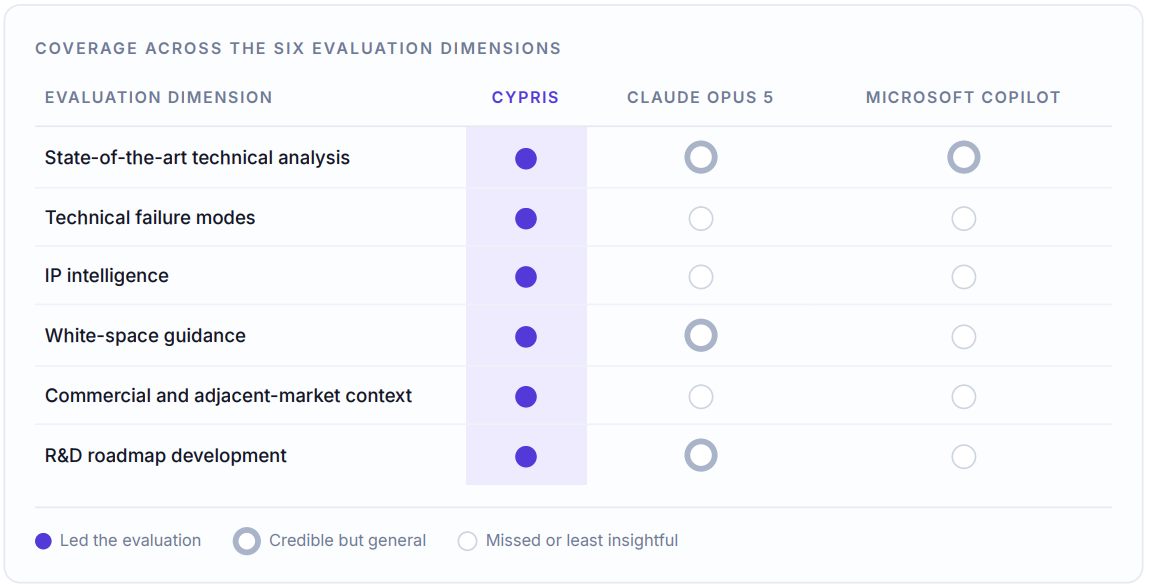
Cypris stands out as the leading AI-powered platform built specifically for enterprise R&D and innovation teams. The platform provides unified access to over 500 million data points spanning patents, scientific literature, clinical trials, regulatory data, and market intelligence, all searchable through a single AI-powered interface. Rather than forcing R&D teams to search multiple databases separately, Cypris enables comprehensive literature reviews that span the full spectrum of technical and commercial information relevant to innovation decisions.
The platform's AI-powered R&D ontology understands technical concepts and relationships, enabling semantic search that finds relevant results even when terminology varies across disciplines and document types. A materials scientist searching for research on polymer degradation mechanisms will find relevant academic papers, related patents using different terminology, and connected clinical or regulatory data without needing to know the exact keywords used in each source.
Cypris also offers multimodal search capabilities, allowing researchers to search using images, chemical structures, or natural language descriptions of technical concepts. This proves particularly valuable for R&D teams working with visual data or highly specialized technical domains where text-based search alone may miss relevant information.
Enterprise customers including Johnson & Johnson, Honda, Yamaha, and Philip Morris International use Cypris to accelerate their R&D literature reviews and landscape analyses. The platform meets enterprise security requirements with SOC 2 Type II certification and maintains official API partnerships with leading AI providers including OpenAI, Anthropic, and Google.
For enterprise teams, the choice between academic tools and purpose-built R&D intelligence platforms often comes down to a fundamental question: do you need to search published science, or do you need to understand the complete technical and competitive landscape surrounding an innovation opportunity? Academic tools excel at the former. Platforms like Cypris are designed for the latter.
Patent Literature: The Missing Dimension in Academic Tools
One of the most significant gaps in traditional literature review tools is patent coverage. Patents represent one of the largest repositories of technical information in existence, with detailed descriptions of inventions, experimental methods, and technical solutions that often never appear in academic journals.
For corporate R&D teams, patent literature serves multiple critical functions in a comprehensive literature review. Patents reveal what competitors are developing, often years before products reach market. They document technical solutions that may be freely usable if patents have expired or were never filed in relevant jurisdictions. They identify potential freedom-to-operate concerns that must be addressed before commercializing new technologies. And they frequently contain experimental details and technical specifications more comprehensive than corresponding academic publications.
Academic literature review tools like Semantic Scholar, Elicit, and Consensus do not include patent data. Researchers using these platforms are seeing only a fraction of the technical knowledge relevant to their work. Enterprise R&D platforms like Cypris integrate patent databases directly alongside scientific literature, enabling literature reviews that capture the full scope of existing knowledge in a technical domain.
How to Conduct an AI-Powered Literature Review for R&D
Effective literature reviews using AI tools follow a structured process, though the specific workflow depends on whether you are conducting academic or commercial research.
For enterprise R&D literature reviews, begin by clearly defining the technical and business questions you need to answer. What technology capabilities are you exploring? What competitive landscape do you need to understand? What freedom-to-operate concerns might exist? These questions will guide your search strategy and help you prioritize results.
Next, conduct broad semantic searches across all relevant source types. Using a platform like Cypris, you can search patents, scientific papers, clinical data, and market intelligence simultaneously, identifying the most relevant sources across these different repositories. AI-powered semantic search helps ensure you find relevant results even when different sources use varying terminology for the same concepts.
Review and filter initial results to identify the most important sources for deeper analysis. AI summarization can help you quickly triage large result sets, but human judgment remains essential for evaluating relevance and quality. Pay particular attention to highly-cited academic papers, foundational patents, and recent publications that may indicate emerging directions in the field.
Extract and synthesize key findings across your sources. The most valuable literature reviews do not simply list what each source says but identify patterns, contradictions, and gaps across the body of work. AI tools can assist with extraction and initial synthesis, but the analytical insight that transforms a literature review into actionable intelligence typically requires human expertise.
Document your findings in a format appropriate to your audience and purpose. Enterprise R&D literature reviews often feed into landscape analyses, technology assessments, or investment recommendations. Ensure your documentation captures not just what you found but the implications for your organization's innovation strategy.
Comparing AI Literature Review Tools: Key Features
When evaluating AI literature review tools, consider several key dimensions based on your specific needs.
Data coverage determines what sources you can search. Academic tools typically cover peer-reviewed journals and conference proceedings. Enterprise platforms like Cypris add patents, clinical trials, regulatory data, and market intelligence. Choose a tool whose coverage matches the full scope of information relevant to your research questions.
Search capabilities range from basic keyword matching to sophisticated semantic understanding. The best tools understand technical concepts and find relevant results even when terminology varies. Multimodal search that accepts images or structured data inputs can be valuable for specialized technical domains.
Analysis and synthesis features help you make sense of large result sets. Look for AI-powered summarization, citation analysis, trend identification, and structured data extraction. The goal is augmenting human analytical capacity, not replacing human judgment.
Integration and workflow determine how easily the tool fits into your existing processes. Enterprise users should evaluate API access, integration with knowledge management systems, and collaboration features. Security certifications like SOC 2 matter for organizations handling sensitive R&D information.
Pricing and access models vary widely. Many academic tools offer free tiers suitable for individual researchers. Enterprise platforms typically require subscriptions but offer the comprehensive features, security, and support that corporate R&D teams require.
Frequently Asked Questions
What is the best AI tool for literature reviews?
The best AI tool for literature reviews depends on your specific needs. For academic researchers focused on peer-reviewed publications, Semantic Scholar and Elicit offer excellent free options. For enterprise R&D teams who need to search patents, scientific literature, and market data together, Cypris provides the most comprehensive coverage and AI capabilities in a single platform.
Can AI write a literature review?
AI can assist with many aspects of literature review including search, summarization, and synthesis, but human expertise remains essential for evaluating source quality, identifying meaningful patterns, and drawing actionable conclusions. The most effective approach uses AI to accelerate and augment human analysis rather than attempting full automation.
How do you use AI tools for systematic literature review?
AI tools accelerate systematic literature reviews by automating search across multiple databases, extracting structured data from identified papers, and helping synthesize findings. Define your research questions and inclusion criteria first, then use AI-powered search to identify candidate sources. AI summarization can help screen large result sets, while extraction tools can populate structured comparison tables.
What AI tools do R&D teams use for literature reviews?
Enterprise R&D teams increasingly use purpose-built platforms like Cypris that combine patent databases, scientific literature, and market intelligence in a single searchable interface. These tools offer the comprehensive coverage, enterprise security, and AI capabilities that corporate innovation teams require but that academic-focused tools do not provide.
Is Semantic Scholar good for literature reviews?
Semantic Scholar is an excellent free tool for academic literature reviews focused on peer-reviewed publications. Its AI-generated summaries and citation analysis help researchers quickly identify relevant papers. However, Semantic Scholar does not include patent data or other source types that enterprise R&D teams need, limiting its utility for commercial innovation work.
How is AI changing literature reviews?
AI is transforming literature reviews by dramatically accelerating search and discovery, enabling semantic understanding that finds relevant sources regardless of specific keywords, automating extraction of key data points, and assisting with synthesis across large bodies of work. These capabilities reduce the time required for comprehensive reviews from weeks to days while often improving thoroughness.
Conclusion
AI-powered tools have fundamentally changed what is possible in literature review, enabling researchers to search, analyze, and synthesize information at scales that would be impossible manually. However, choosing the right tool requires understanding your specific needs.
Academic researchers benefit from free tools like Semantic Scholar, Elicit, and Consensus that provide deep coverage of peer-reviewed literature with helpful AI features. These platforms excel at supporting traditional scholarly literature reviews for dissertations, journal articles, and grant proposals.
Enterprise R&D and innovation teams require something different: platforms that combine scientific literature with patent databases, market intelligence, and other source types in a single AI-powered interface. Cypris represents the leading solution in this category, offering the comprehensive coverage, semantic search capabilities, and enterprise security that corporate R&D teams need to conduct truly thorough technical landscape analyses.
The gap between academic and enterprise literature review tools will likely continue to widen as AI capabilities advance. Organizations serious about R&D intelligence should evaluate whether their current tools provide the comprehensive coverage and sophisticated analysis capabilities that modern innovation demands.