
An Innovator's Guide to Finding the Right Research Platform for R&D


Keep Reading

A smarter, more engaging monitoring experience—built for speed, accuracy, and collaboration.
Over the past few years, Cypris has helped innovation teams make faster, more informed decisions by centralizing critical insights across patents, academic papers, organizations, and market activity. But until now, tracking changes over time often meant juggling spreadsheets, scattered alerts, and manual checks—workflows that were hard to manage and easy to miss.
Today, we’re excited to introduce an upgraded Monitoring experience on Cypris, a complete redesign of how teams track critical updates. With streamlined setup, redesigned emails, and advanced LLMs powering analysis, Monitoring makes it easy to stay ahead of market shifts and competitor moves—without the noise.
Why We Rebuilt Monitoring from the Ground Up
The original monitoring tools relied heavily on exports and static spreadsheets, requiring users to piece together updates manually. Alerts were basic, often duplicative, and limited in the types of data they could track. They also didn’t always give teams confidence that updates were reliable, accurate, or relevant to their needs.
We reimagined Monitoring to solve these gaps. Instead of scattered, one-off alerts, the new Monitoring delivers timely, structured reports—only when new results exist. Updates are now enriched with LLM-powered summaries that don’t just describe activity, but interpret it—prioritizing what matters most and filtering out the noise.
What’s New in Monitoring
The Monitoring Report
Spreadsheets are no longer needed. Updates now appear in a clear format that highlights key changes such as patent expansions, assignee transfers, or competitor filings. Each report includes AI-generated summaries powered by advanced LLMs to surface the most important trends and context. Reports are refreshed regularly, saved automatically, and build a continuous historical log for long-term tracking.
For many teams, these AI-enhanced reports are the most impactful shift. Instead of raw updates, Monitoring now provides analysis—turning activity like organizational filings or new research papers into intelligence that can guide investment and innovation decisions.
Beyond the reports themselves, having all updates housed directly within Cypris elevates the platform experience as a whole. The new interface is more intuitive, reducing friction for everyday use, and its design makes it easier for teams to collaborate in real time.
Monitoring is also fully integrated with Projects, so you can create and share monitors directly within your team’s workspace. This makes it simple to align ongoing research, track critical events together, and keep collaborators up to speed—all without switching tools. By connecting monitoring with projects, Cypris transforms isolated updates into shared intelligence that enhances both decision-making and collaboration across your organization.
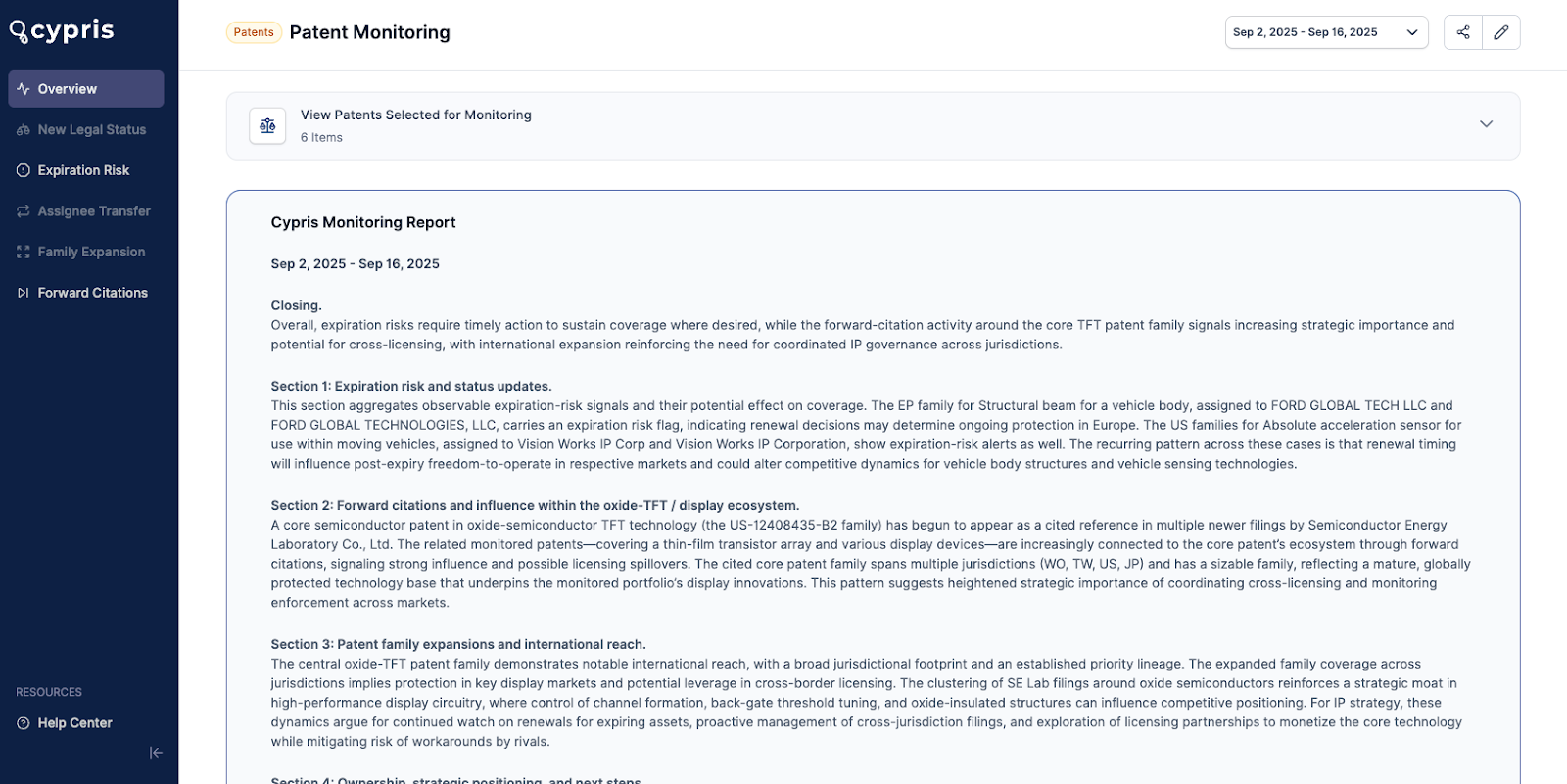
Newsletter-Style Email Experience
Monitoring emails now feel more like a personalized newsletter. Each update arrives in a clean, structured layout with an easy-to-read AI-generated summary of recent activity, spotlighted trends, and direct links to dive deeper in the platform. Content is grouped into clear sections and filterable by category, so you can quickly scan what’s new, focus on the most relevant updates, and stay effortlessly informed—without inbox clutter.

Simplified Setup & Discoverability
Setting up monitors is now faster and more intuitive. Users can create them in a single streamlined interface—quickly searching patent numbers, keywords, organizations, or papers and selecting the right mix in one place. Smart suggestions recommend recipients, while the Monitoring button appears directly on every search results page. Current monitors are clearly indicated to prevent duplication, and external recipients can be added to email updates for seamless collaboration.
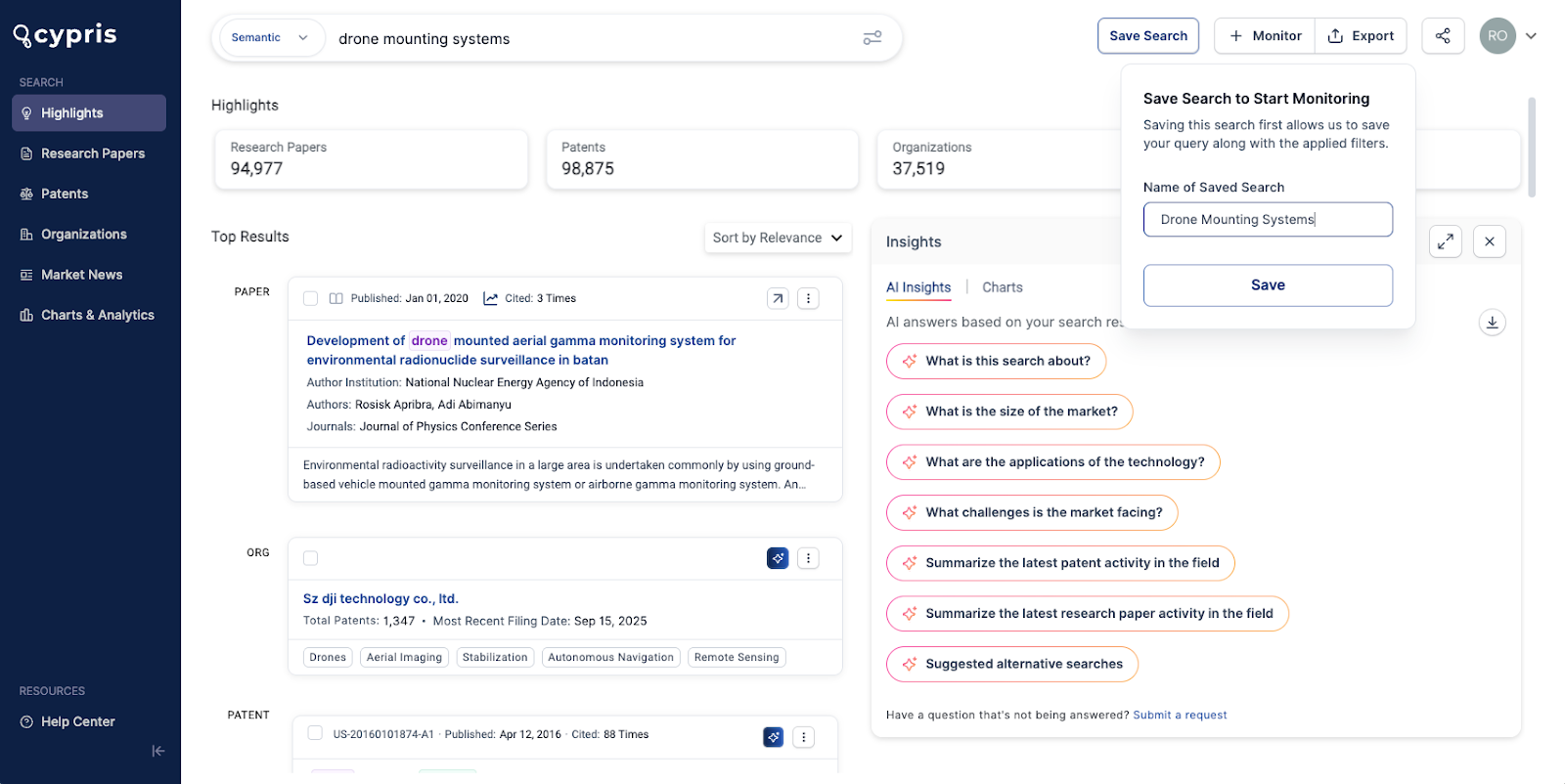
Noise-Free Updates & Critical Alerts
A “send only if new results exist” toggle eliminates duplicate notifications. Monitoring now captures not only newly published patents, papers, and organizations, but also critical patent events such as expiration risks, assignee transfers, patent family expansions, and forward citations—including competitor citations of your own research.

A More Powerful User Experience
Monitoring is built to help users move from raw data to actionable intelligence. Reports save automatically, creating a historical log teams can reference at any time. Items can be flagged directly into collections without manual re-entry. Emails preview AI-enhanced trends with a single click into interactive dashboards, and users can easily add colleagues or external recipients to stay aligned.
From a design perspective, the rebuild also gave our team room to innovate.
As one of our engineering team members, Maddie explained: “It was fun to build something new from scratch. From a UI perspective, we were able to make better design choices right from the start, which made for a much smoother, more intuitive user experience.”
Built for Speed, Accuracy, and Collaboration
With the new Monitoring, teams can save time compared to manual tracking, strengthen competitive intelligence with reliable, cross-dataset updates, collaborate seamlessly by sharing reports with colleagues or external partners, and trust the signal thanks to accuracy, relevancy filters, and AI-powered summaries.
As part of our engineering team, Oleg explained: “This project sat on top of our existing platform, which meant understanding the entire workflow end to end. It was challenging, but it also gave us the opportunity to rethink how everything fits together—and that’s what made it so rewarding.”
Available Now to All Users
The redesigned Monitoring is live and available across the Cypris platform today. If you’re already using Cypris, you’ll see new Monitoring options throughout your search and reporting workflows.
We’re excited to see how your team uses Monitoring to stay ahead of markets, competitors, and technologies — and to keep pushing the boundaries of what intelligent monitoring can do for R&D.



A powerful new foundation for custom queries—built on Lucene and designed for R&D precision.
Over the past few years, Cypris has helped innovation teams make faster, more informed decisions by centralizing critical insights across datasets like patents, academic papers, and company activity. But until now, our search experience relied on a legacy query system with limited capabilities, offering little support for advanced search features or dataset-level customization.
Today, we’re excited to introduce an upgraded Advanced Search on Cypris, a complete overhaul of our query engine and search experience, powered by the open-standard Lucene query syntax. This update introduces a more robust and flexible search foundation, unlocking new ways to query data, build complex filters, and extract precisely what you need across patents, research, and more.
Why we rebuilt our search system from the ground up
Cypris’ original query syntax, a proprietary format used internally for years, limited users’ ability to craft advanced queries or tailor searches to specific datasets. It lacked modern capabilities like proximity searches, field-level customization, or true Boolean logic. This made it difficult to build a reliable and intuitive experience for both casual users and advanced researchers.
By moving to Lucene, we’re adopting a powerful, industry-standard query language that makes it easier for developers to build advanced features—and gives users access to a far more capable and flexible search toolset.
What’s new in Advanced Search
1. Custom Queries by Dataset
You can now layer queries to search across datasets or tailor filters to each one. For example, you can run a broad query on drone delivery, and then add separate layers to focus on patents by a specific assignee and papers from a specific country or funding agency.
Navigating the All Datasets tab introduces a new level of complexity—and power—by allowing users to apply dataset-specific logic within a single, unified query workflow. While querying multiple datasets simultaneously might seem straightforward, the underlying differences in schema, metadata, and available fields between our proprietary datasets make this a deeply technical challenge. Patents, for example, include claims, application numbers, and multiple date fields (filed, granted, updated), while academic papers use DOIs, have different structural conventions, and emphasize different metadata. In the past, we sidestepped this complexity by translating general queries like ((drone_allText)) into dataset-specific logic under the hood. Now, instead of obscuring that logic, we allow users to opt in to it. The builder provides progressive layers of customization: start with intuitive keyword searches across all fields, then move into the advanced builder for field-specific targeting, fuzzy logic, and term boosting, and finally, tailor query logic by dataset—such as specifying different countries of interest for papers vs. patents. This approach preserves flexibility while giving users full control, and with tools like our real-time Live Analysis and “Your Query” panel, we make it easy to understand how every decision affects the results.
2. More Fields to Query
We’re exposing deeper fields across datasets—giving you explicit control over the dimensions of your search. For the first time, users can now search academic papers by DOI, a critical identifier previously unsupported on the platform. You can also query by:
- Author or inventor names
- Organizations or assignees
- Countries, journals, funding agencies, and more
3. Full Boolean Support
Advanced Search now leverages powerful Boolean logic—AND, OR, NOT, and grouping—enabling more precise control over search logic and improving performance and accuracy.
4. Lucene Syntax Features
Use built-in Lucene features to create expressive, complex searches:
- Proximity searches to find terms near each other
- Fuzzy searches for flexible matching
- Exact phrase matching
- Boosting to prioritize results (e.g., prioritize results mentioning AI 3x more than others)
- Prefix/Postfix queries to match phrases that start or end a certain way
- Range queries for fields like date, funding amounts, or numerical values
A more powerful user experience
Our new search interface is built to help you tap into these capabilities without needing to know the syntax from the start. You’ll find:
- A Query Builder to guide you through complex searches
- A Help Video to onboard users to Lucene-style searches
- Inline examples and tips for writing queries using grouping, boosting, and more
Built for precision, speed, and customization
With Lucene as our foundation, search results are now not only more flexible but also faster and more accurate. Semantic search continues to offer natural-language ease of use, while Boolean search gives power users the performance and structure they need to uncover insights with greater specificity.
Whether you’re an innovation analyst drilling into AI patents or a business development lead scanning academic papers from Chilean researchers—Advanced Search is built to help you get to the signal, faster.
Available now to all users
Advanced Search is live and available across the Cypris platform today. If you’re already using Cypris, you’ll find the new search interface in your dashboard, complete with updated syntax documentation and walkthroughs.
We’re excited to see what you’ll build, discover, and analyze with this new capability. This is just the beginning—we’ll continue expanding the fields, syntax features, and customization options as we push the boundaries of what intelligent search can do for R&D.


Today, the need for society to adopt sustainable practices is increasingly urgent, particularly in chemical manufacturing, which is responsible for greenhouse gas emissions, toxic waste, increased water and energy consumption, and inefficient raw material use. Consequently, the market for sustainable chemical manufacturing has surged to $10 billion and continues to expand as the focus on sustainability intensifies. Leading this charge are three innovative approaches: mechanochemistry, green synthesis, and microflow chemistry. Mechanochemistry, which induces chemical reactions through mechanical energy, accelerates reactions and conserves energy compared to traditional solvent-based methods, while reducing reaction mass and potentially increasing product yield by avoiding solvents. Green synthesis aims to minimize the use and generation of hazardous substances, thereby reducing environmental impact and enhancing sustainability, with notable examples including the synthesis of spirooxindole derivatives using heterogeneous catalysis and metal-organic framework (MOF) catalysts. Microflow chemistry, or continuous flow chemistry, involves reactions in microreactors that allow precise control over reaction conditions, enhancing safety, scalability, and efficiency. The integration of these three approaches—mechanochemistry, green synthesis, and microflow chemistry—represents a significant advancement in sustainable chemical manufacturing, addressing critical challenges from waste reduction to energy savings and paving the way for a more sustainable industry.

Mechanochemistry: Mechanochemistry accelerates reactions and reduces solvent use, advancing sustainability in chemical manufacturing.
Mechanochemistry, a process in which chemical synthesis is induced by external mechanical energy, has gained attention in chemical manufacturing due to its sustainable nature. This method allows reactions to occur more quickly and saves energy compared to traditional solvent-based chemistry. Mechanochemistry also offers cost and time efficiency by eliminating the need for solvents, thereby reducing 90% of the reaction mass, and potentially increasing product yield under optimal conditions.
The disposal of plastics, which are non-biodegradable and create significant pollution, is a growing concern for the health and longevity of the planet. Recently, research has focused on using mechanochemistry to control the degradation of polymers found in plastics. Researchers have discovered that the previously separate fields of polymer and trituration mechanochemistry can converge, enabling the degradation of polymers through milling and grinding. This breakthrough holds the potential to significantly mitigate global warming.
Green Synthesis: Green synthesis reduces hazards and waste with efficient methods like heterogeneous and MOF catalysts.
Green synthesis involves creating chemical products and processes that minimize the use and production of hazardous substances, aiming to reduce environmental impact and enhance sustainability in chemical manufacturing. This approach not only benefits the environment but also protects the health and safety of chemical workers and consumers, while reducing costs associated with waste disposal and raw material use.
Spirooxindole has been a focus in the green synthesis field due to its broad benefits in medicine as well as agriculture because of it being a unique compound because of the high reactivity of the carbonyl group located at the 3-position of isatin. Various green synthesis methods have been used for creating spirooxindole derivatives. Various green synthesis methods have been developed for creating spirooxindole derivatives, with one promising approach being the use of heterogeneous catalysts. These catalysts, which are in different phases from the reactants and products, allow for effortless separation, minimizing waste, shortening processing time, and conserving energy.
Another promising method in green synthesis is the use of metal-organic framework (MOF) catalysts. MOFs are attractive due to their high surface area, large porosity, multiple catalytic sites, and highly tunable composition and structure. Studies have shown that MOF catalysts can achieve high yields of 95%-99% and short reaction times. For example, Mirhosseini-Eshkevari et al. (2019) synthesized a zirconium metal-organic framework (Zr MOF) called TEDA/IMIZ-BAIL@UiO-66 using benzene dicarboxylic acid as the organic linker. This framework served as a heterogeneous catalyst in the synthesis of spirooxindole derivatives, with the BAIL@UiO-66 catalyst acting as a Brønsted acid to enhance the electrophilicity of the carbonyl group in isatin and promote nucleophilic attack. This catalyst can be reused in other reactions with minimal reduction in yield, demonstrating its potential as a promising alternative to non-renewable processes.

Microflow Chemistry: Microflow chemistry boosts efficiency and sustainability with precise control and effective processing of renewable resources and waste.
Microflow chemistry, also known as continuous flow chemistry or microfluidic chemistry, is highly regarded for its efficiency, safety, and sustainability in chemical manufacturing. This approach involves chemical reactions occurring in microreactors, which allow for precise control over reaction conditions, thereby enhancing safety, scalability, and efficiency. Microflow chemistry is utilized in various fields, including environmental science, fine chemicals, materials science, and pharmaceuticals.
Recently, microflow chemistry has proven sustainable not only due to its efficient process but also because of its applications. It is now central to green catalytic engineering for processing renewable resources. For instance, microflow chemistry is used to process lignocellulosic biomass into fuels and chemicals. Lignocellulose, found in the microfibrils of plant cell walls and composed mainly of polysaccharides and lignins, has been extensively studied for this purpose. Microflow chemistry is highly favored for this process due to its enhanced product yield and selectivity.
Furthermore, microflow chemistry improves sustainability in on-site chemical manufacturing. Biomass, which contains a significant amount of water, requires considerable energy for transportation to refineries, making onsite processing essential. This is also true for food waste, which has a short shelf life and is produced in large quantities. Even plastic waste, despite its longevity and low water content, is widespread in landfills and ecosystems, necessitating onsite processing in remote and offshore areas. Microflow chemistry offers better economic viability and higher energy efficiency, supporting sustainable onsite manufacturing.

The crucial shift towards sustainable practices in chemical manufacturing is driven by the environmental and societal challenges posed by traditional methods. Innovations like mechanochemistry, green synthesis, and microflow chemistry are at the forefront of this transformation. Mechanochemistry accelerates reactions while minimizing solvent use, promising reduced energy consumption and waste generation. Green synthesis techniques, utilizing heterogeneous catalysis and metal-organic frameworks, provide efficient, low-impact pathways to valuable compounds like spirooxindoles, essential in medicine and agriculture. Microflow chemistry, with its precision in controlling reaction conditions, enhances safety and efficiency, especially in processing renewable biomass and managing onsite waste such as food and plastic. Together, these approaches not only reduce environmental impacts, including greenhouse gas emissions and toxic waste, but also promote a more resilient and sustainable chemical industry, ready to meet future challenges.