Antibody-Drug Conjugate (ADC) Patent Landscape and Freedom-to-Operate in 2026
Writen By:
Cypris Research Team



Antibody-drug conjugates are among the most active areas of oncology drug development, and their patent landscape is distinctive because an ADC is a modular product whose components are patented separately. An ADC joins a monoclonal antibody to a cytotoxic payload through a chemical linker, using a defined conjugation chemistry and a specified drug-to-antibody ratio. Each of these elements, the antibody, the linker, the payload, the conjugation site and chemistry, and the ratio, can be claimed independently, so freedom-to-operate risk is layered across several distinct patent families held by different owners. Freedom-to-operate determines whether making, using, or selling a product would infringe another party's active patent claims, and peer-reviewed analysis of ADC intellectual property has long stressed that the assessment must cover every layer, not the molecule as a whole.¹
The landscape has grown intensely. A peer-reviewed update to the ADC patent literature notes that, a decade after the first ADC patent-landscape review, the basic principles still apply but the field has expanded and matured substantially, with next-generation payloads, linkers, and site-specific conjugation driving new filings.² That expansion is visible in the patent record: across the Cypris corpus of more than 500 million patents and scientific papers, ADC-specific patent families more than doubled from about 2,645 in 2018 to about 5,949 in 2024, with 2025 counts partial because of the roughly eighteen-month publication lag. The growth has been propelled by potent topoisomerase-1 payloads such as the deruxtecan and govitecan classes, new linker and site-specific conjugation technologies, and the expansion of ADCs from hematologic cancers into solid tumors. Peer-reviewed patent reviews map the issued patents onto specific linker and payload technologies,³ and document filing activity concentrated among a small set of leading developers, with more than a dozen approved ADCs and a large clinical pipeline behind the trend.⁴ Within the Cypris corpus, conjugation and site-specific chemistry and the linker layer are the most heavily worked parts of the ADC set, consistent with where litigation and FTO risk concentrate.
Litigation has made the stakes concrete, and it has centered on the linker layer. In the multi-year dispute between Seagen and Daiichi Sankyo over the linker technology used in a blockbuster HER2-targeted ADC, a jury had found for Seagen and awarded damages, but on December 2, 2025 the US Court of Appeals for the Federal Circuit reversed, holding Seagen's key linker patent invalid for lack of written description and non-enablement and vacating the damages award.⁵ The court reasoned that the priority disclosure did not convey possession of the specific claimed subgenus of linkers and that a broad functional claim was not enabled.⁵ For developers, the practical lesson is twofold: the linker and conjugation layer is heavily contested and a frequent source of FTO risk, and the proprietary payload estates built around leading platforms, such as the DXd payload, create freedom-to-operate exposure for follow-on and biosimilar ADCs in markets where those estates are in force. That exposure is concentrated: across the Cypris corpus, the most active assignees in the ADC-specific set include Genentech, Seagen, Daiichi Sankyo, Regeneron, Immunomedics, and ImmunoGen, several of which anchor the payload and linker estates most likely to surface in an FTO search. Because applications publish about eighteen months after filing, the newest linker, payload, and conjugation filings are under-represented, so the current frontier is more active than granted-patent counts suggest.
What creates FTO risk in ADCs
Antibody claims. These cover the targeting antibody and its engineering, a distinct layer that can implicate separate antibody IP.
Linker claims. These cover cleavable and non-cleavable linkers and their chemistry, the layer most heavily litigated, as the Seagen v. Daiichi Sankyo dispute demonstrates.⁵
Payload claims. These cover the cytotoxic agent, including proprietary payload estates built around specific classes, which create FTO exposure for follow-on products.
Conjugation and site-specific claims. These cover how payload and antibody are joined and where, an area of intense recent innovation and patenting.³
Drug-to-antibody ratio and formulation claims. These cover the ratio and the finished formulation, adding further independently claimable layers.
How AI-powered landscape and FTO analysis helps
A modular, multi-owner, actively litigated landscape is beyond manual clearance. AI-powered analysis addresses this with semantic search that retrieves relevant antibody, linker, payload, and conjugation claims regardless of terminology, attribution that resolves the many owners to canonical entities, claim-level analysis that separates the layers, and continuous monitoring that tracks new filings and litigation developments. Because ADC advances appear in scientific literature before they are patented, reading both patents and literature gives earlier warning of where the landscape is extending.
Where Cypris fits
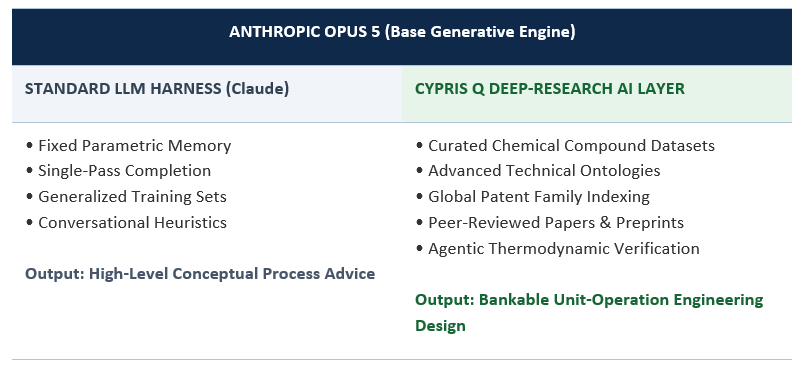
Cypris runs patent landscape and freedom-to-operate analysis for modular, contested fields such as antibody-drug conjugates across a corpus of more than 500 million patents and scientific papers, organized through a proprietary R&D ontology. The ontology clusters the landscape by layer, antibody, linker, payload, and conjugation, and normalizes owners to canonical entities, so a team sees how rights are distributed across the many parties rather than a flat list. Semantic search across patents and scientific literature surfaces relevant claims regardless of terminology and connects filings to the underlying research, which is where next-generation linkers and payloads emerge first. Cypris Q, the platform's agentic layer, lets teams run landscape and FTO analysis conversationally and chain the attribution, clustering, and claim-level analysis across layers, and Agentic Monitoring tracks the landscape over time and flags new filings and developments as they publish. Cypris provides enterprise API partnerships with OpenAI, Anthropic, and Google, and is built with enterprise-grade security. Cypris serves hundreds of enterprise customers across pharmaceuticals, chemicals, advanced materials, energy, and other regulated industries.
FAQ
Why is freedom-to-operate hard for antibody-drug conjugates? Freedom-to-operate is hard for antibody-drug conjugates because an ADC is a modular product whose antibody, linker, payload, conjugation chemistry, and drug-to-antibody ratio are each independently patentable and often held by different owners. Clearing one layer does not clear the others. FTO must therefore be assessed layer by layer across multiple patent families.
What are the main claim types in the ADC landscape? The main claim types are antibody claims, linker claims, payload claims, conjugation and site-specific claims, and drug-to-antibody-ratio and formulation claims. Each covers a distinct layer of the ADC and can independently create infringement risk. The linker and conjugation layers are especially heavily patented and litigated.
What was the Seagen v. Daiichi Sankyo dispute about? The Seagen v. Daiichi Sankyo dispute concerned linker technology used in a blockbuster HER2-targeted ADC. A jury had found for Seagen and awarded damages, but on December 2, 2025 the US Court of Appeals for the Federal Circuit reversed, holding Seagen's key linker patent invalid for lack of written description and enablement and vacating the award. It illustrates how the linker layer drives ADC freedom-to-operate risk and how even a trial win can be undone on validity grounds.
How fast is ADC patenting growing? ADC patenting has grown rapidly, with ADC-specific patent families more than doubling between 2018 and 2024 in the Cypris corpus. Growth has been driven by potent topoisomerase-1 payloads, new linker and site-specific conjugation technologies, and expansion from hematologic cancers into solid tumors. Because applications publish about eighteen months after filing, recent activity is under-represented.
What is a payload estate and why does it matter for FTO? A payload estate is the set of patents an organization holds around a specific cytotoxic payload class and its use in ADCs. It matters for FTO because a strong payload estate, such as the one around the DXd payload, can create infringement exposure for follow-on and biosimilar ADCs in markets where it is in force. Developers must assess payload IP as a distinct layer.
Why does ADC analysis need scientific literature? ADC analysis needs scientific literature because linker, payload, and conjugation advances appear in research before they are patented, so the literature gives the earliest signal of where the landscape is extending. Analyzing patents alone gives a lagging view. Cypris analyzes both across more than 500 million patents and scientific papers.
Which teams need ADC patent landscape and FTO analysis? ADC patent landscape and FTO analysis is needed by R&D, IP, and business-development teams at pharmaceutical and biotech companies developing ADCs, payloads, linkers, and conjugation platforms, as well as investors assessing ADC assets. The modular, litigated landscape makes structured analysis essential. Cypris serves hundreds of enterprise customers across pharmaceuticals and other research-intensive industries.
How current does an ADC landscape need to be? An ADC landscape needs to be continuously current, because litigation is active, next-generation linker and payload filings publish constantly, and publication lag hides the most recent activity. A one-time landscape ages quickly. Cypris uses Agentic Monitoring to track the landscape and flag new filings and developments as they publish.
.png)