Comparative Analysis of Opus 5 within Claude and Cypris for Deep Technical Intelligence
.png)


1. Executive Summary & Objective
This benchmark study evaluates the performance of the Anthropic Opus 5 artificial intelligence model across two distinct deployment architectures: a standard conversational large language model (LLM) interface (Claude) and a specialized deep-research AI agent platform (Cypris Q).1 2 3
The primary objective of this evaluation is to test deep technical intelligence—specifically an AI system's ability to synthesize bankable, unit-operation-level chemical engineering flowsheets when confronted with complex industrial challenges containing deliberate operational "traps."1 Conventional LLMs frequently fail these challenges by providing textbook-accurate but operationally destructive or economically unviable guidance.1 Conversely, deep-search platforms are engineered to surface exact kinetic rate limits, chemical compound properties, active patent parameters, and commercial failure modes to successfully bypass these traps.1 2 6
The Core Architectural Variable
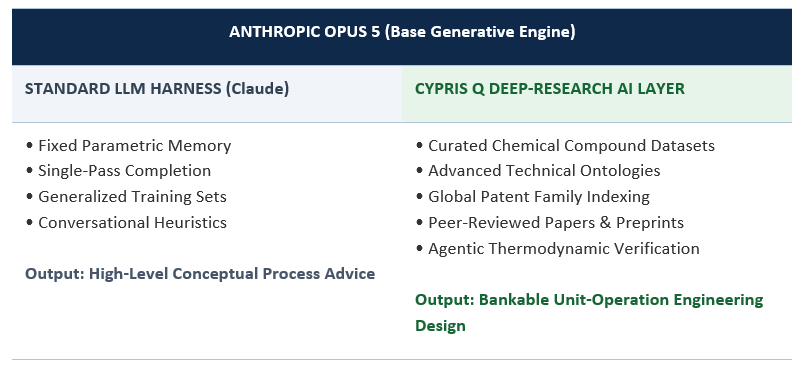
The underlying core LLM weights (Opus 5) were held constant across all test runs. The performance variance documented in this report is solely attributable to the architectural harness surrounding the model:1 2 3 6 7
- Standard Conversational LLM (Claude): Relies on fixed parametric memory and a single-pass conversational prompt-response loop.3 7
- Deep-Research AI Agent (Cypris Q): Integrates Opus 5 into an agentic retrieval, verification, and reasoning pipeline.1 2 6 The Cypris intelligence layer couples the base LLM with multi-modal domain infrastructure—deeply indexing global patent families, curated chemical compound datasets, peer-reviewed journals, scientific preprints, and advanced technical ontologies.2 6
Deployment Architecture Comparison
Methodological Integrity & Independent Evaluation
To maintain strict objectivity and scientific rigor throughout this study:
- Independent AI Evaluation: All generated outputs were evaluated by an independent Gemini model adhering strictly to a standardized, four-dimensional scoring rubric.1
- Zero Data Manipulation: Neither model's output was edited, cherry-picked, or prompt-tuned after execution.2 3 6 7
- Standardized Prompts: Identical, unmodified prompts were submitted to both systems under identical technical specifications.1 2 3 6 7
2. Test Scenarios & Benchmark Rubric
The benchmark consists of two high-stakes industrial chemistry challenges containing deliberate "hidden traps" where standard textbook knowledge yields catastrophic real-world plant failures.1
Test Scenario 1: Hydrometallurgy & Lithium-Ion Battery Recycling
- The Prompt: How to selectively remove trace iron (Fe3+/Fe2+) and aluminum (Al3+) impurities down to <5 ppm from concentrated nickel-cobalt-lithium sulfate leach liquor (derived from EV battery black mass) prior to solvent extraction, avoiding value-metal co-precipitation and ferric gelation.1
- Embedded Traps:
- The 'pH Shock' Trap: Recommending direct baseaddition (NaOH or lime) to pH 4.0–5.0, causing local over-alkalinization,un-filterable ferrihydrite gelation, and 10–20% nickel/cobalt entrainment.1
- The Solvent Extraction Poisoning Trap: Routing un-oxidized Fe2+ orferric Fe3+ directly into organophosphorus extractants (e.g., D2EHPA), whereferric iron binds irreversibly, permanently poisoning the organic phase.1
Test Scenario 2: Semiconductor Materials & Specialty Gases
- The Prompt: How to purify hexafluorobutadiene (C4F6) to electronic grade (>99.999% purity, moisture<1 ppb) by removing trace hydrofluorocarbons (HFCs), moisture, peroxides without triggering catalytic polymerization or yield loss.1
- Embedded Traps:
- The Thermal & Acidity Runaway Trap: Recommending standardmolecular sieves (3A/4A/13X) or activated alumina for drying.1xothermic adsorption onto acidic surface sites supplies the activation energy for nucleophilic rearrangement to hexafluoro-2-butyne, driving column temperatures above 400 °C and pressures above 60 psig within seconds.6
- The Sub-ppb Moisture Spec Trap: Accepting an impossiblespecification (<1 ppb) uncritically, despite it sitting below physicaldesiccant capabilities and commercial Cavity Ring-Down Spectroscopy (CRDS)detection limits.6
Evaluation Scoring Rubric
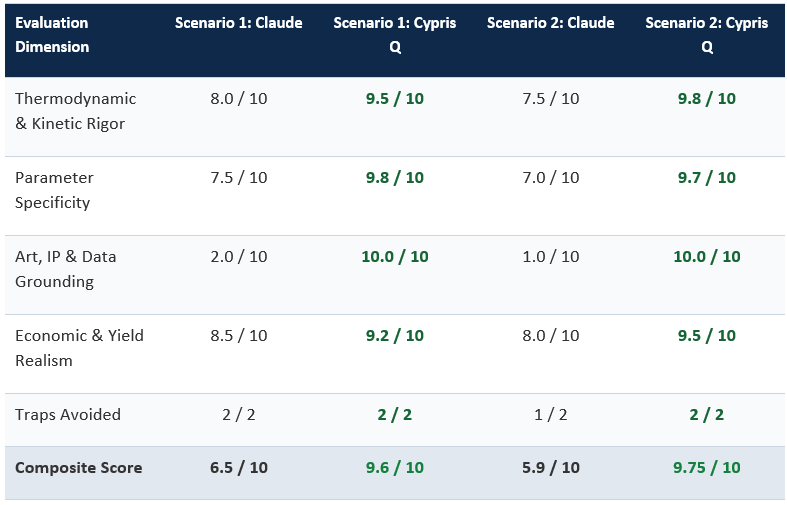
Outputs were scored from 1.0 to 10.0 across four core dimensions:1
- Thermodynamic & Kinetic Rigor: Identification of true physical failure mechanisms, rate-limiting steps, phase behavior, and speciation constraints.1
- Parameter Specificity: Provision of explicit unit-operation specs (pH bands, temperatures, space velocities, exact chemical dosages, catalyst/resin trade names).1
- Art, IP & Data Grounding: Grounding flowsheets in curated compound datasets, active patent families, and peer-reviewed literature.1
- Economic & Yield Realism: Accurate prediction oftarget value-metal recovery (Ni, Co, Li), monomer gas yield losses, reagentcosts, and secondary contamination side-effects.1
3. Comparative Evaluation & Performance Summary
Benchmark Scorecard Summary
4. Synthesis of Test Scenario 1: Hydrometallurgy & Battery Recycling
Trap Navigation Analysis
Both harnesses successfully avoided the primary pH shock trap.2 3 Claude bypassed single-stage hydroxide neutralization by recommending controlled goethite (α-FeOOH) or hematite precipitation, providing sound anti-gelation operational heuristics: reverse neutralization (metering liquor into a hot, agitated seed bed), subsurface dilute base injection, and 10–30 g/L seed recycling.3
Cypris Q evaluated the underlying physical chemistry driving gelation.2 It detailed ferrihydrite hydrolysate scavenging mechanismsand phase-transformation kinetics (air-sparged oxidation progressing through green rust → lepidocrocite → goethite).2
Regarding solvent extraction poisoning, Claude recommended managing accumulated Fe3+ on D2EHPA using a 6 M HCl or oxalic acid regeneration slipstream.3 Cypris Q surfaced advanced chemical options: adding aliphatic alcohols or 4-tert-butylphenol modifiers to lower extraction binding energy—enabling stripping with 4.5 M H2SO4—or pre-loading Cyanex 272 with 8.5g/L Ni to extract Fe/Co while cutting sodium contamination from 4 g/L to 0.05g/L.2
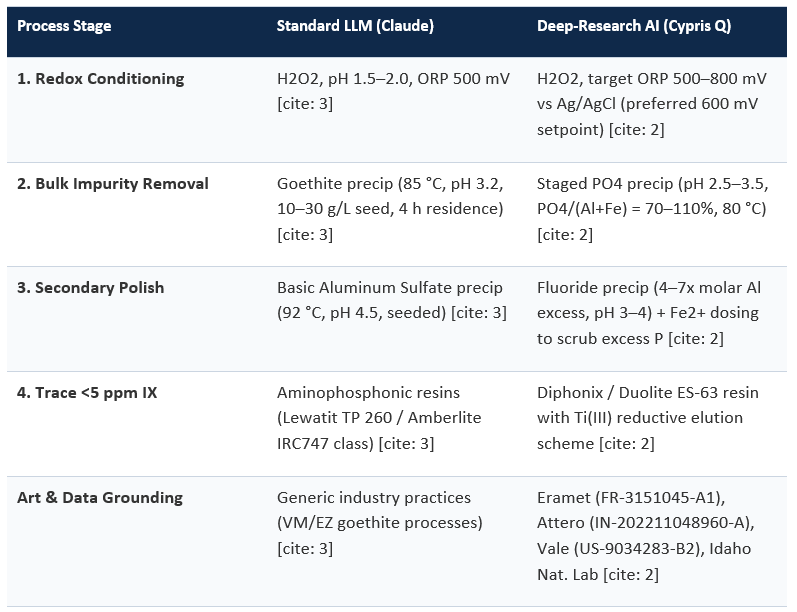
Flowsheet Unit Operation Comparison (Scenario 1)
Key Differentiators in Scenario 1
Coupled Fluoride-Aluminum Chemistry: Cypris Q identified a critical chemical coupling missed by standard models: fluoride (F- from LiPF6 electrolyte decomposition) forms stable soluble complexes with Al3+, suppressing aluminum precipitation.2 3 Cypris Q detailed Eramet’s patented solution: dosing a 4–7x molar fluoride excess to force AlF3-type precipitation, combined with soluble iron sulfate dosing (Fe/P ≥ 100%) to scavenge residual phosphate anions that would otherwise contaminate downstream lithium recovery.2
Multi-Source Art Grounding: Cypris Q anchored its flowsheet in assigned IP, compound property tables, and experimental literature, drawing from Eramet, Attero, Vale, IdahoNational Laboratory, and Aalto University research.2 Claude cited zero specific patents or datasets.3
5. Synthesis of Test Scenario 2: Semiconductor Materials & Specialty Gases
Trap Navigation Analysis
In Scenario 2, the operational divergence between harnesses became pronounced.6 7 Claude partially avoided the thermal runaway trap by warning against activated alumina and 13X molecular sieves due to Lewis acidity.7 However, Claude recommended standard 3A molecular sieves for deep drying.7 In commercial practice, standard 3A sieves with high framework alumina still exhibit Brønsted acid sites that trigger diene rearrangement to hexafluoro-2-butyne and HF liberation.6
Cypris Q fully resolved thetrap by defining the precise structural surface parameters required:maintaining the zeolite SiO2/Al2O3 molar ratio strictly between 4.0 and 8.0 (preferably 5.0–7.0).6 It cited empirical data showing that ratios<4.0 degrade under HF exposure, while ratios >8.0 cause water adsorption capacity to collapse.6
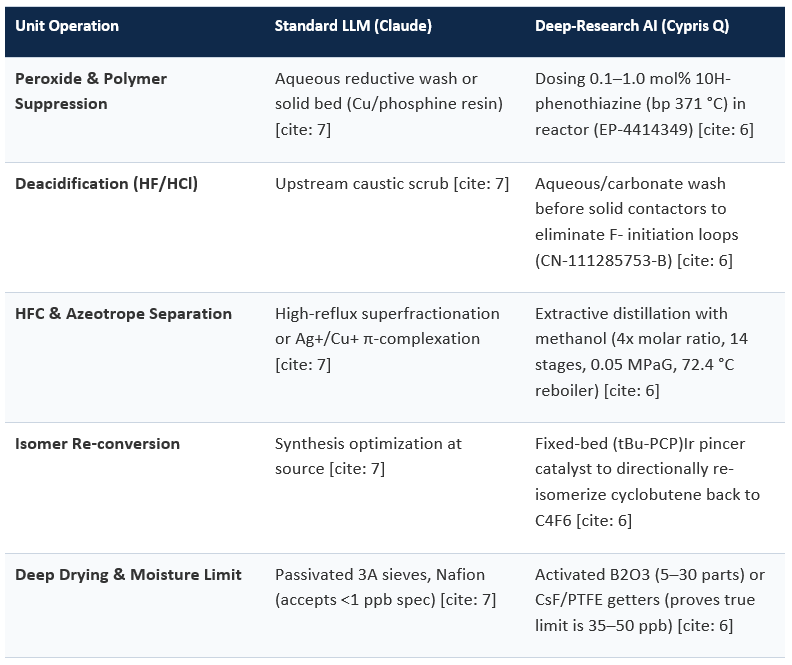
Flowsheet Unit Operation Comparison (Scenario 2)
Key Differentiators in Scenario 2
- ChallengingUnviable Specifications: Claude accepted the prompt's <1 ppb moisture target uncritically.7 Cypris Q challenged the specification using empirical compound datasets and patent art (Zeon, WO-2007063938-A1), proving that the true state-of-the-art for C4F6 moisture removal is 35–50 ppb (achieved via activated boron oxide, B2O3, or metal fluoride getters like CsF/PTFE).6 Furthermore, Cypris Q highlighted that <1 ppb sits below the 5ppb detection limit of commercial Cavity Ring-Down Spectroscopy (CRDS Tiger Optics)instruments, framing the requirement as an analytical validation issue before a process engineering issue.6
- Azeotropic& Catalytic Engineering: To separate near-boiling heptafluorobutene/C4F6 azeotropes (which require an unviable 120-plate column in standard fractionators), Cypris Q surfaced Daikin’s 14-stage methanol extractive distillation process (WO-2019082872-A1) and Tianjin Lvling’s fixed-bediridium pincer catalyst system ((tBu-PCP)Ir), which directionally converts unwanted cyclobutene side-products back into target C4F6.6
Knowledge Layer Impact on Engineering Deliverables
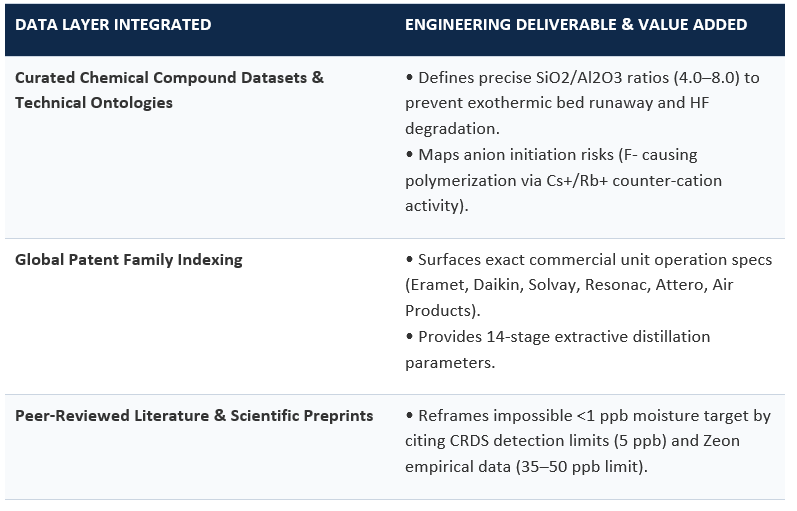
6. Strategic Takeaways
This evaluation demonstrates that while the underlying large language model (Anthropic Opus 5) possesses strong baseline chemical reasoning, the architectural harness determines whether an AI platform delivers high-level conceptual advice or bankable process engineering.1 2 3 6 7
Standard conversational LLM deployments (Claude) serve as efficient, high-level peer reviewers.3 7 They rapidly identify standard thermodynamic risks, outline unit operation sequences, and flag common operational mistakes.3 7 However, relying on fixed parametric memory limits their ability to provide exact unit-operation specs, identify complex multi-species chemical coupling, or cite active prior art.3 7
Deep-research AI platforms (Cypris Q) transform the underlying base model into an authoritative engineering collaborator.1 2 6 By surrounding Opus 5 with a deep intelligence layer—coupling real-time patent retrieval with curated chemical compound datasets, peer-reviewed journal indexing, preprints, and advanced technical ontologies—Cypris Q surfaces exact mass balances, specifies precise catalyst and zeolite structural constraints, reframes unviable customer specifications with empirical data, and grounds every unit operation in validated commercial practice.2 6
For industrial process engineering, IP landscaping, and chemical plant design, deep-research AI agent architectures provide the empirical depth and thermodynamic verification required for commercial execution.1 2 6
References & Cited Literature
- AI Benchmark Case Study Design:Cypris vs. Standard LLMs (Claude) Case Study Methodology & Traps, 2026.
- Cypris Q Evaluation Output (Scenario 1):Hydrometallurgical Impurity Removal & Black Mass Leach Liquor Purification Flowsheet, 2026.3.
- Claude / Anthropic Opus 5 Output (Scenario 1):Selective Trace Fe/Al Removal from Concentrated Nickel-Cobalt-Lithium Sulfate Media, 2026.4.
- Cypris Q Evaluation Output (Scenario 2):Electronic Grade Hexafluorobutadiene ($\text{C}_4\text{F}_6$) Purification & Isomerization Control, 2026.5.
- Claude / Anthropic Opus 5 Output (Scenario 2):Purification of Hexafluorobutadiene ($\text{C}_4\text{F}_6$) to $>99.999\%$ Purity, 2026.Scenario 1: Hydrometallurgy & Battery Recycling Patents & Papers
- Eramet:Process for purifying a leaching filtrate from the black mass of used lithium-ion batteries. Patent No. FR-3151045-A1 (Issued Jan 16, 2025).
- Attero Recycling:Method for removal of aluminium from leach liquor of spent lithium-ion batteries. Patent No. IN-202211048960-A (Issued Feb 29, 2024).
- Vale S.A.:Hybrid process using ion exchange resins in the selective recovery of nickel and cobalt from leaching effluents. Patent No. US-9034283-B2 (Issued May 18, 2015).
- Automated Recovery Systems:Automated System and Method for Recovery of Metals from Spent Lithium-Ion Batteries. Patent No. IN-202611007189-A (Issued Apr 16, 2026).
- Idaho National Laboratory: Palasyuk, O., et al., "Removal of impurity Metals as Phosphates from Lithium-ion Battery leachates."Hydrometallurgy, Vol. 220, 2023.
- Aalto University: Vedagiri, K., "Removal of Fe impurities from NMC 622 black mass by natro-jarosite precipitation."Academic Thesis, Aalto University Repository, 2023.
- D2EHPA / SX Stripping Studies: Logutenko, O. A., et al., "Iron(III) extraction from sulfate solutions with D2EHPA in the presence of organic proton-donor additives."Research Square, 2023.
- Resin Purification Studies: Nicol, M.J. & Lee, M.S., "Removal of iron from cobalt sulfate solutions by ion exchange with Diphonix resin and enhancement of iron elution with titanium(III)."Hydrometallurgy, 2006.Scenario 2: Semiconductor Materials & Specialty Gases ($\text{C}_4\text{F}_6$) Patents & Papers
- Daikin Industries, Ltd.:Method for purifying hexafluorobutadiene. Patent No. WO-2020137845-A1 (Issued Jul 1, 2020).
- Daikin Industries, Ltd.:Hexafluorobutadiene production method. Patent No. WO-2019082872-A1 (Issued May 1, 2019).
- Resonac Corporation:Method for producing hexafluoro-1,3-butadiene. Patent No. EP-4414349-A1 (Issued Aug 13, 2024).
- Solvay SA:Process for the purification of fluorinated olefins in gas/liquid phase. Patent Nos. WO-2022069435-A1&WO-2022069434-A1 (Issued Apr 6, 2022).
- Zeon Corporation:Method and purification of unsaturated fluorinated carbon compound, method for formation of fluorocarbon film. Patent No. WO-2007063938-A1 (Issued Jun 6, 2007).
- Tianjin Lvling Gas Co., Ltd.:Hexafluoro-1,3-butadiene isomerization rearrangement control and purification method. Patent No. CN-111285753-B (Issued Apr 21, 2022).
- Tianjin Lvling Gas Co., Ltd.:Purification device system and purification method of hexafluoro-1,3-butadiene. Patent No. CN-117599443-A (Issued Feb 26, 2024).
- Air Products and Chemicals, Inc.:Purification of hexafluoro-1,3-butadiene. Patent No. US-6544319-B1 (Issued Apr 7, 2003).
- Air Products and Chemicals, Inc.:Adsorbent for moisture removal from fluorine-containing fluids. Patent No. US-6709487-B1 (Issued Mar 22, 2004).
- Zeolite Tandem Bed Research: Miao, G., et al., "Computationally Guided Design of Tandem Zeolite Beds for Efficient Purification of Hexafluoro-1,3-butadiene."Industrial & Engineering Chemistry Research, 2026.
- Polymerization Chemistry: Narita, T., et al., "Anionic polymerization of hexafluoro-1,3-butadiene."Journal of Fluorine Chemistry, Vol. 82, 1994.