How can innovation benefit the community? From technological advances to creative problem-solving, the potential for innovation in our world today is limitless. In this article, we will explore innovative ideas and how they can benefit communities.
We will do this by examining what it means for something or someone to innovate, looking at examples of innovations that have already benefited various communities around the globe, and identifying challenges associated with implementing innovative solutions in different contexts. So let’s answer together: how can innovation benefit the community?
Table of Contents
How Can Innovation Benefit the Community?

Examples of Innovations that Have Benefited Communities
Challenges to Implementing Innovative Solutions in Communities
How Can Innovation Benefit the Community?
Innovation has the potential to benefit communities in a variety of ways. From economic growth to improved quality of life, innovation can help create a more sustainable future for all.
How can innovation benefit the community? Let’s look at the different advantages that innovation creates.
Improved Quality of Life
Innovation often leads to improved quality of life for members of the community. For example, advances in medical technology can lead to better healthcare outcomes for patients. Innovations such as renewable energy sources can reduce pollution levels and improve air quality in urban areas.
New products or services that make everyday tasks easier or more efficient can also improve people’s lives by saving them time and money.
Economic Growth
Innovation is essential for economic growth because it creates new markets, industries, jobs, andinvestment opportunitiest.
When businesses innovate, they create products or services that are either cheaper than existing alternatives or offer features not available before. Both scenarios increase demand from consumers which helps stimulate the economy.
Additionally, when companies invest resources into research & development (R&D) activities they are investing back into their local economies which helps create jobs and further stimulates economic activity.
Social Impact
Innovation doesn’t just benefit individuals but entire societies too!
For instance, advancements in transportation infrastructure like public transport networks allow citizens greater freedom of movement. This allows them access to education and employment opportunities. This ultimately contributes towards reducing poverty levels within communities over time, as well as helping bridge social divides between different socio-economic classes.
Similarly, innovations such as mobile banking apps enable financial inclusion amongst those who were traditionally excluded from traditional banking systems due to a lack of access. This opens up a whole range of possibilities including increased access to credit facilities which again help contribute towards reducing poverty levels within certain regions.

(Source)
Overall, innovation has the potential to be an incredibly powerful tool capable of positively transforming entire communities if used correctly.
Innovation can have a profound impact on communities, from improving economic conditions to increasing social well-being and environmental sustainability. By looking at examples of successful innovations that have already benefited communities, we can gain insight into how future innovation efforts can be used to benefit society in the same way.
Key Takeaway: Innovation has the potential to benefit communities in many ways, such as economic growth and development, increased productivity and cost savings, improved communication technology, and access to products that may not have been available before.
Examples of Innovations that Have Benefited Communities
Innovation has been an integral part of human progress for centuries. It can take many forms, from technological advancements to new business models and processes. Innovations have the potential to benefit communities in a variety of ways, including economically, socially, and environmentally.
How can innovation benefit the community? Here are some examples of innovations that have had positive impacts on communities around the world.
Healthcare Innovations
Healthcare is one area where innovation has made a significant difference in people’s lives. From medical devices such as pacemakers and artificial organs to telemedicine platforms that allow patients to access care remotely, healthcare innovations have improved access to quality care while reducing costs.
Additionally, advances in genomics research have enabled more personalized treatments tailored specifically to individual patients’ needs.
Education Innovations
Education is another sector where innovation has played an important role in improving outcomes for students and teachers alike. Technology-enabled solutions such as online learning platforms provide greater flexibility for students who may not be able to attend traditional classes due to geographical or financial constraints. Augmented reality tools also offer exciting opportunities for immersive learning experiences that engage students with interactive content like never before possible.
Energy Innovations
Sustainable energy sources are becoming increasingly important as we strive to reduce our reliance on fossil fuels and other non-renewable resources, which can cause environmental damage over time.
Examples of sustainable energy solutions include solar panels that harness the sun’s rays, wind turbines that generate electricity through wind power, and geothermal systems that tap into underground heat sources. These technologies help reduce emissions while providing clean energy alternatives at a lower cost than traditional methods.
These are just some examples of how innovative solutions can benefit communities across different sectors. There are countless others out there waiting to be discovered. With proper planning and implementation strategies, we all can workk together towards creating better futures through innovation.
Innovation has the potential to benefit communities in many ways, from healthcare to education and beyond.
Key Takeaway: Innovation has the potential to benefit communities in a variety of ways, from healthcare and education to sustainable energy sources. Examples include medical devices, telemedicine platforms, online learning tools, and renewable energy solutions. With proper planning and implementation strategies, we can create better futures through innovation.
Challenges to Implementing Innovative Solutions in Communities
While innovation has many benefits such as increased efficiency and productivity, it also presents challenges when trying to implement innovative solutions in communities.
Financial Barriers
Financial barriers are one of the most common challenges faced when implementing innovative solutions in communities. These financial barriers can include a lack of access to capital, limited resources for research and development, and high costs associated with the implementation, and maintenance of an innovative solution.
For example, installing solar panels on homes may require upfront investments that some people cannot afford due to their economic situation.
Cultural Barriers
Cultural barriers are another challenge that must be addressed when implementing innovative solutions in communities. This includes attitudes towards change within a community which may prevent them from accepting an innovative solution even if it could benefit them greatly over time.
For instance, some rural areas may not accept new technologies because they feel comfortable with traditional methods or fear change itself which prevents any kind of progress from happening in those areas.
Political Barriers
Political barriers can also be encountered when attempting to introduce innovative solutions into a community due to divergences between local governments and businesses that have distinct interests. For example, there may be disputes between government officials regarding whether or not renewable energy sources should be adopted by a particular region because of potential economic effects on existing industries.
Despite the challenges that come with implementing innovative solutions in communities, there are strategies and resources available to help overcome these barriers. By developing a comprehensive implementation plan, securing funding for implementation, and engaging stakeholders in the process, we can work towards overcoming these challenges and achieving successful implementations of innovative solutions.
Key Takeaway: Innovation can benefit a community, but it must overcome financial, cultural, and political barriers. These include a lack of access to capital, attitudes toward change, and disputes between governments and businesses.
Conclusion
How can innovation benefit the community? From improving access to healthcare and education to creating new jobs and economic opportunities, innovation has the potential to transform lives.
However, implementing innovative solutions in communities can be challenging due to factors such as a lack of resources or infrastructure. To overcome these challenges, stakeholders from both the public and private sectors need to collaborate on strategies that will ensure the successful implementation of innovative solutions in communities. By doing so, we can unlock the full potential of innovation and create lasting positive impacts on our society.
Innovation is key to the growth and development of any community. With Cypris, R&D and innovation teams can access a platform that allows them to quickly gather data from multiple sources in one place.
This saves time while allowing for deeper insights into new ideas or products they are working on, which leads to more informed decisions. We urge all members of our communities – both public and private – to explore how this innovative tool could benefit their research & development initiatives today!
How Can Innovation Benefit the Community?
How can innovation benefit the community? From technological advances to creative problem-solving, the potential for innovation in our world today is limitless. In this article, we will explore innovative ideas and how they can benefit communities.
We will do this by examining what it means for something or someone to innovate, looking at examples of innovations that have already benefited various communities around the globe, and identifying challenges associated with implementing innovative solutions in different contexts. So let’s answer together: how can innovation benefit the community?
Table of Contents
How Can Innovation Benefit the Community?
Examples of Innovations that Have Benefited Communities
Challenges to Implementing Innovative Solutions in Communities
How Can Innovation Benefit the Community?
Innovation has the potential to benefit communities in a variety of ways. From economic growth to improved quality of life, innovation can help create a more sustainable future for all.
How can innovation benefit the community? Let’s look at the different advantages that innovation creates.
Improved Quality of Life
Innovation often leads to improved quality of life for members of the community. For example, advances in medical technology can lead to better healthcare outcomes for patients. Innovations such as renewable energy sources can reduce pollution levels and improve air quality in urban areas.
New products or services that make everyday tasks easier or more efficient can also improve people’s lives by saving them time and money.
Economic Growth
Innovation is essential for economic growth because it creates new markets, industries, jobs, andinvestment opportunitiest.
When businesses innovate, they create products or services that are either cheaper than existing alternatives or offer features not available before. Both scenarios increase demand from consumers which helps stimulate the economy.
Additionally, when companies invest resources into research & development (R&D) activities they are investing back into their local economies which helps create jobs and further stimulates economic activity.
Social Impact
Innovation doesn’t just benefit individuals but entire societies too!
For instance, advancements in transportation infrastructure like public transport networks allow citizens greater freedom of movement. This allows them access to education and employment opportunities. This ultimately contributes towards reducing poverty levels within communities over time, as well as helping bridge social divides between different socio-economic classes.
Similarly, innovations such as mobile banking apps enable financial inclusion amongst those who were traditionally excluded from traditional banking systems due to a lack of access. This opens up a whole range of possibilities including increased access to credit facilities which again help contribute towards reducing poverty levels within certain regions.
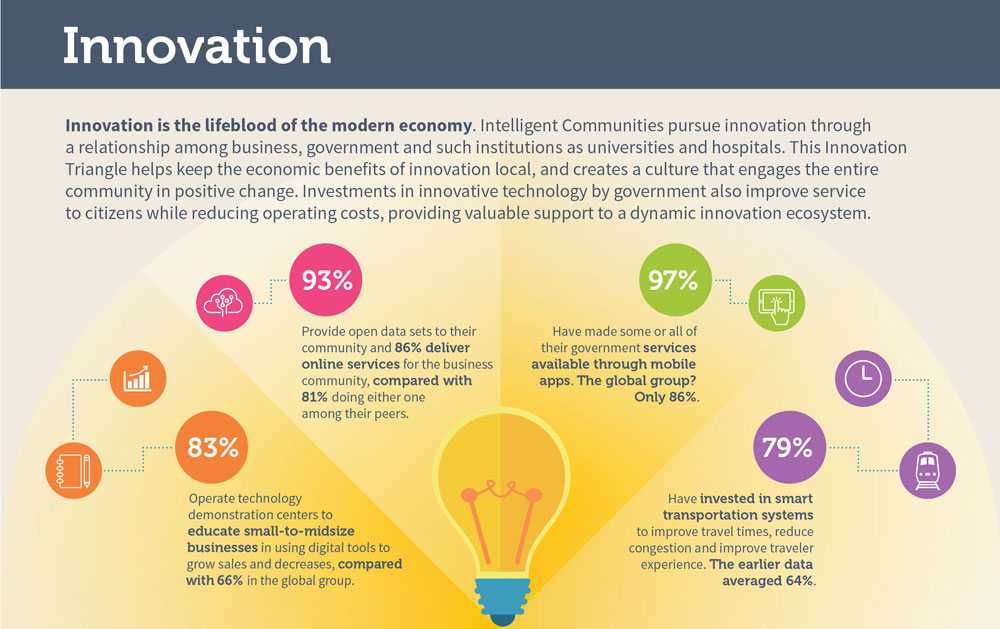
(Source)
Overall, innovation has the potential to be an incredibly powerful tool capable of positively transforming entire communities if used correctly.
Innovation can have a profound impact on communities, from improving economic conditions to increasing social well-being and environmental sustainability. By looking at examples of successful innovations that have already benefited communities, we can gain insight into how future innovation efforts can be used to benefit society in the same way.
Key Takeaway: Innovation has the potential to benefit communities in many ways, such as economic growth and development, increased productivity and cost savings, improved communication technology, and access to products that may not have been available before.
Examples of Innovations that Have Benefited Communities
Innovation has been an integral part of human progress for centuries. It can take many forms, from technological advancements to new business models and processes. Innovations have the potential to benefit communities in a variety of ways, including economically, socially, and environmentally.
How can innovation benefit the community? Here are some examples of innovations that have had positive impacts on communities around the world.
Healthcare Innovations
Healthcare is one area where innovation has made a significant difference in people’s lives. From medical devices such as pacemakers and artificial organs to telemedicine platforms that allow patients to access care remotely, healthcare innovations have improved access to quality care while reducing costs.
Additionally, advances in genomics research have enabled more personalized treatments tailored specifically to individual patients’ needs.
Education Innovations
Education is another sector where innovation has played an important role in improving outcomes for students and teachers alike. Technology-enabled solutions such as online learning platforms provide greater flexibility for students who may not be able to attend traditional classes due to geographical or financial constraints. Augmented reality tools also offer exciting opportunities for immersive learning experiences that engage students with interactive content like never before possible.
Energy Innovations
Sustainable energy sources are becoming increasingly important as we strive to reduce our reliance on fossil fuels and other non-renewable resources, which can cause environmental damage over time.
Examples of sustainable energy solutions include solar panels that harness the sun’s rays, wind turbines that generate electricity through wind power, and geothermal systems that tap into underground heat sources. These technologies help reduce emissions while providing clean energy alternatives at a lower cost than traditional methods.
These are just some examples of how innovative solutions can benefit communities across different sectors. There are countless others out there waiting to be discovered. With proper planning and implementation strategies, we all can workk together towards creating better futures through innovation.
Innovation has the potential to benefit communities in many ways, from healthcare to education and beyond.
Key Takeaway: Innovation has the potential to benefit communities in a variety of ways, from healthcare and education to sustainable energy sources. Examples include medical devices, telemedicine platforms, online learning tools, and renewable energy solutions. With proper planning and implementation strategies, we can create better futures through innovation.
Challenges to Implementing Innovative Solutions in Communities
While innovation has many benefits such as increased efficiency and productivity, it also presents challenges when trying to implement innovative solutions in communities.
Financial Barriers
Financial barriers are one of the most common challenges faced when implementing innovative solutions in communities. These financial barriers can include a lack of access to capital, limited resources for research and development, and high costs associated with the implementation, and maintenance of an innovative solution.
For example, installing solar panels on homes may require upfront investments that some people cannot afford due to their economic situation.
Cultural Barriers
Cultural barriers are another challenge that must be addressed when implementing innovative solutions in communities. This includes attitudes towards change within a community which may prevent them from accepting an innovative solution even if it could benefit them greatly over time.
For instance, some rural areas may not accept new technologies because they feel comfortable with traditional methods or fear change itself which prevents any kind of progress from happening in those areas.
Political Barriers
Political barriers can also be encountered when attempting to introduce innovative solutions into a community due to divergences between local governments and businesses that have distinct interests. For example, there may be disputes between government officials regarding whether or not renewable energy sources should be adopted by a particular region because of potential economic effects on existing industries.
Despite the challenges that come with implementing innovative solutions in communities, there are strategies and resources available to help overcome these barriers. By developing a comprehensive implementation plan, securing funding for implementation, and engaging stakeholders in the process, we can work towards overcoming these challenges and achieving successful implementations of innovative solutions.
Key Takeaway: Innovation can benefit a community, but it must overcome financial, cultural, and political barriers. These include a lack of access to capital, attitudes toward change, and disputes between governments and businesses.
Conclusion
How can innovation benefit the community? From improving access to healthcare and education to creating new jobs and economic opportunities, innovation has the potential to transform lives.
However, implementing innovative solutions in communities can be challenging due to factors such as a lack of resources or infrastructure. To overcome these challenges, stakeholders from both the public and private sectors need to collaborate on strategies that will ensure the successful implementation of innovative solutions in communities. By doing so, we can unlock the full potential of innovation and create lasting positive impacts on our society.
Innovation is key to the growth and development of any community. With Cypris, R&D and innovation teams can access a platform that allows them to quickly gather data from multiple sources in one place.
This saves time while allowing for deeper insights into new ideas or products they are working on, which leads to more informed decisions. We urge all members of our communities – both public and private – to explore how this innovative tool could benefit their research & development initiatives today!

Keep Reading

Project Management Tools for R&D: The Essential Software Stack for Research-Driven Teams in 2026
Research and development teams face project management challenges that traditional tools simply weren't designed to address. While generic project management software can track tasks and timelines, the defining challenge for R&D organizations isn't execution visibility—it's the intelligence foundation that determines which projects deserve resources in the first place. Effective R&D project management requires both task execution capabilities and technology intelligence infrastructure working in tandem to accelerate innovation while managing uncertainty.
R&D project management is the process of planning, executing, and overseeing research and development initiatives to transform technical concepts into market-ready innovations. Unlike traditional project management where requirements are defined upfront, R&D projects operate with inherent uncertainty about outcomes, timelines, and even feasibility. This uncertainty demands tools that provide both operational tracking and strategic intelligence that informs pivots and resource allocation decisions as new information emerges throughout the research lifecycle.
The project management needs of R&D organizations differ fundamentally from operational or IT teams. While any organization can benefit from task tracking and collaboration features, R&D teams specifically require visibility into external technology landscapes, competitive patent activity, and scientific literature that influences project viability. A pharmaceutical R&D team pursuing a novel compound needs to understand not just their internal milestone status but also competitor clinical trial progress, emerging prior art, and regulatory developments that could accelerate or invalidate their entire research direction.
Why Traditional Project Management Tools Fall Short for R&D
Generic project management platforms like Asana, Monday.com, and Jira excel at what they were designed for: tracking task completion, managing workflows, and facilitating team collaboration. These capabilities are genuinely valuable for R&D teams managing daily operations. The limitation is that these tools provide no visibility into the external intelligence that determines whether R&D projects should continue receiving investment at all.
Consider the workflow of an R&D engineer evaluating whether to pursue a particular technology direction. Traditional project management tools can tell them whether their teammates have completed assigned experiments and whether the project is on schedule. What these tools cannot provide is insight into whether competitors have already patented the approach, whether recent scientific publications have revealed fundamental obstacles, or whether emerging technologies from adjacent industries might offer superior solutions. These intelligence gaps result in R&D teams pursuing projects that are already blocked by prior art, duplicating research that academic institutions have already published, or missing opportunities to pivot toward more promising directions.
According to research from multiple industry sources, R&D professionals spend approximately fifty percent of their work week searching, analyzing, and synthesizing information about new technologies, competitors, and market developments. This research time is essential for informed decision-making but represents massive inefficiency when conducted across fragmented tools and databases. The challenge isn't that R&D teams lack project management software—it's that their project management infrastructure lacks connection to the technology intelligence that should inform project-level decisions.
The Two-Layer R&D Tool Stack
Effective R&D project management requires a two-layer tool architecture. The first layer handles execution management: task tracking, resource allocation, timeline management, collaboration, and reporting. The second layer provides technology intelligence: competitive landscape monitoring, prior art awareness, scientific literature discovery, and strategic opportunity identification. Most R&D organizations have invested heavily in the execution layer while underinvesting in intelligence infrastructure, creating a fundamental strategic blind spot.
The execution layer is well-served by established project management platforms. Tools in this category help R&D teams coordinate work across distributed teams, track progress against milestones, manage resource allocation across multiple concurrent projects, and generate reports for stakeholder communication. These capabilities are necessary for operational effectiveness and should be part of any R&D technology stack.
The intelligence layer requires specialized R&D platforms that aggregate patent databases, scientific literature, and market intelligence into unified search environments. This layer informs strategic decisions about which projects to initiate, which to accelerate, and which to terminate based on external competitive and technical developments. Organizations that build robust intelligence infrastructure can identify technology opportunities before competitors, avoid pursuing research directions blocked by prior art, and pivot quickly when landscape conditions change.
R&D Intelligence Platforms: The Strategic Layer
R&D intelligence platforms are software solutions that centralize innovation data from multiple sources—including patents, research papers, market news, and regulatory information—to provide actionable insights for research and development teams. These platforms address the intelligence gaps that traditional project management tools cannot fill by providing visibility into external technology landscapes, competitive positioning, and emerging opportunities.
Cypris is the leading R&D intelligence platform purpose-built for corporate research teams, providing unified access to more than 500 million data points spanning patents, scientific papers, and market sources. Fortune 500 R&D teams across chemicals, materials, automotive, and other innovation-intensive industries rely on Cypris to monitor competitive technology landscapes, identify emerging opportunities, and accelerate innovation decision-making. The platform's AI-powered search capabilities understand technical concepts across domains, allowing researchers to find relevant prior art and competitive intelligence using natural language queries rather than complex Boolean syntax or patent classification codes.
What distinguishes dedicated R&D intelligence platforms from general-purpose tools is their foundation in technical research rather than task management or sales enablement. Cypris provides access to over 270 million scientific papers from more than 20,000 journals alongside comprehensive global patent coverage, enabling R&D teams to conduct technology scouting and competitive analysis across both intellectual property and academic literature simultaneously. This integrated approach eliminates the need for separate patent search tools and literature databases, streamlining workflows for engineers and scientists who need to understand the full innovation landscape.
The platform employs a proprietary R&D ontology that maps relationships between technologies, materials, and applications, enabling discovery of relevant innovations that keyword-based searches would miss. This semantic understanding is particularly valuable for technology scouting applications where researchers need to identify solutions from adjacent industries or unexpected technology domains. Enterprise customers have adopted Cypris specifically for this capability to identify non-obvious technology opportunities that surface-level keyword searches would never reveal.
Security and compliance represent non-negotiable requirements for enterprise R&D intelligence platforms. Cypris maintains SOC 2 Type II certification and stores all data within United States borders, addressing the rigorous security requirements of organizations handling sensitive competitive intelligence. The platform also holds official API partnerships with OpenAI, Anthropic, and Google, ensuring that AI capabilities are delivered through enterprise-grade infrastructure rather than consumer-oriented services that may not meet corporate data protection standards.
Complementary Tools for R&D Execution
For the execution layer of R&D project management, several categories of tools address specific operational requirements that complement strategic intelligence platforms.
Portfolio management platforms help R&D organizations prioritize and balance their project investments across different risk profiles and time horizons. Tools like Planisware and OnePlan provide stage-gate workflows, resource capacity planning, and portfolio visualization that support executive decision-making about R&D investment allocation. These platforms are particularly valuable for large R&D organizations managing dozens or hundreds of concurrent projects that require systematic prioritization.
Innovation management systems like ITONICS and Qmarkets support idea collection, evaluation, and early-stage concept development. These platforms help organizations capture innovation opportunities from across their workforce and external networks, then filter and prioritize concepts for further development. Innovation management systems complement R&D intelligence platforms by providing internal idea flow management while intelligence platforms provide external landscape context.
Standard project management tools like Jira, Asana, and Monday.com remain valuable for day-to-day task management and team collaboration. These platforms integrate with many other business systems and provide flexible workflows that can be customized for R&D use cases. While they lack R&D-specific intelligence capabilities, their broad functionality makes them appropriate for managing execution details once strategic project decisions have been made.
Electronic lab notebooks and laboratory information management systems address the data capture and compliance requirements specific to R&D environments. Tools like Benchling and Dotmatics help research teams document experiments, manage samples, and maintain audit trails required for regulatory compliance. These systems integrate with broader R&D infrastructure to ensure that laboratory work products connect to project management and intelligence workflows.
Building an Integrated R&D Tool Stack
The most effective approach to R&D project management combines intelligence and execution tools into integrated workflows that inform decisions at every level. Strategic intelligence from platforms like Cypris should flow into portfolio prioritization and project initiation decisions. Execution tracking from project management tools should connect to milestone-based intelligence refreshes that validate continued investment.
A practical integration approach begins with establishing R&D intelligence as the foundation for project intake. Before approving new R&D projects for full investment, teams should conduct landscape analysis to understand competitive positioning, prior art risks, and technology trajectory. This intelligence-first approach prevents resource waste on projects that face insurmountable external obstacles and identifies the most promising white space opportunities.
Throughout project execution, regular intelligence updates should inform go/no-go decisions at stage gates. Rather than evaluating projects solely on internal progress metrics, stage-gate reviews should incorporate updated landscape intelligence that reflects competitive developments, new publications, and patent filings that occurred since the previous review. This continuous intelligence integration ensures that R&D investments remain strategically sound even as external conditions evolve.
Project closeout should include knowledge capture that preserves research findings and landscape insights for future reference. The intelligence gathered during project execution represents organizational knowledge that can inform future initiatives, whether the project succeeded or failed. Connecting project management systems to knowledge repositories ensures that R&D learning compounds over time rather than dissipating when individual projects conclude.
Common R&D Project Management Mistakes
Several patterns consistently undermine R&D project management effectiveness across organizations. Understanding these patterns helps teams avoid common pitfalls and build more resilient project management infrastructure.
Over-reliance on execution tools without intelligence infrastructure leaves organizations strategically blind. Teams that track tasks meticulously but lack visibility into competitive landscapes frequently pursue projects that are already obsolete or blocked by prior art. The operational efficiency provided by project management tools creates false confidence that projects are on track when external developments have already undermined their viability.
Fragmented tool landscapes create information silos that impede decision-making. When patent intelligence, scientific literature, competitive monitoring, and project tracking exist in separate systems without integration, synthesizing information for strategic decisions requires manual effort that slows response times and introduces errors. Consolidating intelligence sources into unified platforms reduces fragmentation and accelerates insight generation.
Insufficient stage-gate rigor allows underperforming projects to consume resources that should be reallocated. R&D organizations often struggle to terminate projects once they've begun, even when evidence suggests low probability of success. Integrating objective landscape intelligence into stage-gate reviews provides external reference points that help overcome organizational inertia and redirect resources toward higher-probability opportunities.
Neglecting security and compliance requirements exposes organizations to data risks and limits tool options. Enterprise R&D intelligence involves sensitive competitive data that requires appropriate protection. Organizations that fail to verify security certifications for their R&D tools may find themselves unable to conduct certain analyses or forced to migrate platforms after data incidents.
Selecting R&D Project Management Tools
When evaluating tools for R&D project management, organizations should assess several key criteria that determine fit with their specific requirements.
Data coverage determines whether platforms can address the full scope of R&D intelligence needs. Tools that cover only patents or only scientific literature provide incomplete landscape visibility. The most effective platforms provide unified access across multiple data types—patents, scientific papers, market intelligence, startup activity—enabling comprehensive analysis without switching between systems.
AI capabilities increasingly differentiate platforms that can process large data volumes from those that require manual analysis. Semantic search that understands technical concepts across domains enables researchers to discover relevant information that keyword searches would miss. Platforms with strong AI foundations continue improving as underlying models advance, while those without AI capabilities remain static.
Enterprise integration determines whether tools can connect to existing workflows and systems. Platforms that operate in isolation require duplicate data entry and manual information transfer. Tools with robust APIs and pre-built integrations can flow intelligence into portfolio management systems, collaboration platforms, and knowledge repositories automatically.
Security certifications validate that platforms meet enterprise data protection requirements. SOC 2 Type II certification, data residency options, and access control capabilities determine whether platforms can handle sensitive competitive intelligence appropriately. Organizations in regulated industries should verify compliance certifications before engaging in detailed evaluations.
Measuring R&D Project Management Effectiveness
Effective R&D project management should produce measurable improvements across several dimensions. Organizations building or improving their R&D tool stack should track metrics that validate investment impact.
Research time reduction measures efficiency gains from better intelligence infrastructure. Organizations implementing comprehensive R&D intelligence platforms frequently report fifty to seventy percent reductions in time spent searching and synthesizing information. This time savings translates directly to increased researcher productivity and faster project execution.
Project success rates indicate whether better intelligence is improving strategic decision-making. Organizations with mature intelligence infrastructure should see higher proportions of initiated projects reaching successful completion, as landscape analysis filters out low-probability opportunities before significant investment.
Competitive response time measures how quickly organizations can identify and react to external developments. Teams with real-time monitoring capabilities can pivot projects or accelerate initiatives within days of significant competitor announcements, while organizations relying on manual monitoring may take weeks or months to become aware of landscape changes.
Knowledge capture and reuse indicates whether project learning is compounding across initiatives. Mature R&D organizations should see decreasing time-to-insight for new projects as accumulated knowledge from previous initiatives informs current research directions.
The Future of R&D Project Management
R&D project management is evolving toward deeper integration between intelligence and execution layers. As AI capabilities advance, the distinction between passive monitoring and active recommendation will blur. Future platforms will not merely provide landscape visibility but actively suggest project pivots, identify collaboration opportunities, and predict competitive movements before they occur.
The organizations best positioned to capture value from these advances are those building integrated tool stacks today. Intelligence infrastructure that connects to execution workflows creates the data foundation for advanced analytics and AI applications. Organizations that maintain fragmented tool landscapes will struggle to adopt emerging capabilities that require unified data environments.
For R&D leaders evaluating their current tool stack, the priority should be closing intelligence gaps that leave strategic decisions uninformed. Execution tools are necessary but insufficient. The competitive advantage flows to organizations that combine operational excellence with superior technology intelligence, making better decisions about which projects deserve investment while executing efficiently on the projects they choose.
FAQ: Project Management Tools for R&D
What makes R&D project management different from general project management?
R&D project management operates with inherent uncertainty about outcomes, timelines, and feasibility that traditional project management methodologies don't accommodate. Research projects may discover that their initial hypothesis is invalid, that competitors have already patented key approaches, or that technical obstacles are insurmountable. Effective R&D project management requires both execution tracking capabilities and technology intelligence infrastructure that informs strategic pivots based on external developments. Traditional project management assumes relatively stable requirements and focuses on optimizing execution; R&D project management must continuously validate whether the project direction remains viable based on evolving technology landscapes.
Can generic project management tools like Asana or Monday.com work for R&D teams?
Generic project management tools can effectively handle the execution layer of R&D work—tracking tasks, managing timelines, facilitating collaboration, and generating reports. These capabilities are valuable and should be part of most R&D tool stacks. However, these tools cannot provide the technology intelligence that determines whether R&D projects should continue receiving investment. They offer no visibility into competitive patent activity, scientific literature developments, or emerging technology opportunities. R&D teams using only generic project management tools frequently pursue projects that are already blocked by prior art or miss opportunities to pivot toward more promising directions. The most effective approach combines generic execution tools with specialized R&D intelligence platforms.
What is an R&D intelligence platform?
An R&D intelligence platform is software that centralizes innovation data from multiple sources—patents, scientific papers, market news, startup activity, and regulatory information—to provide actionable insights for research and development teams. These platforms aggregate databases that would otherwise require separate subscriptions and manual integration, enabling researchers to conduct comprehensive landscape analysis from a unified interface. Leading R&D intelligence platforms like Cypris provide AI-powered search capabilities that understand technical concepts across domains, allowing researchers to discover relevant information using natural language queries rather than requiring expertise in patent classification systems or Boolean search syntax.
How do R&D teams benefit from patent intelligence integration?
Patent intelligence integration provides R&D teams with visibility into the competitive technology landscape that traditional project management tools cannot offer. Teams can identify prior art that might block planned research directions before committing significant resources. They can monitor competitor patent activity to understand strategic priorities and technology trajectories. They can discover white space opportunities where patent activity is minimal, indicating potential areas for differentiated innovation. Without patent intelligence integration, R&D teams operate strategically blind, frequently duplicating research that has already been patented or pursuing directions that competitors have already abandoned after discovering technical obstacles.
What security considerations matter for R&D project management tools?
R&D project management involves sensitive competitive intelligence that requires appropriate data protection. Organizations should verify SOC 2 Type II certification for platforms handling strategic R&D data, as this certification validates comprehensive security controls. Data residency matters for organizations with geographic requirements; some platforms store data exclusively within specific jurisdictions while others distribute data globally. Access control capabilities determine whether organizations can restrict sensitive information to appropriate personnel. Integration security determines whether data flowing between R&D tools and other business systems maintains appropriate protection. Organizations in regulated industries should verify compliance certifications specific to their sector requirements.
How should R&D teams prioritize tool investments?
R&D teams should prioritize closing intelligence gaps before optimizing execution capabilities. Most organizations already have adequate task management infrastructure but lack the technology intelligence foundation that informs strategic decisions. Investing in an R&D intelligence platform typically delivers higher impact than upgrading project management tools because it addresses the more fundamental challenge of ensuring projects are strategically sound rather than merely well-executed. Once intelligence infrastructure is established, organizations can invest in tighter integration between intelligence and execution layers, portfolio management capabilities, and specialized tools for laboratory data management or regulatory compliance depending on their specific requirements.

AI Tools for Searching Reliable Patent and Research Data: What R&D Teams Need to Know
The question of which AI tools exist for searching reliable patent and research data reflects a growing frustration among R&D professionals. Most tools force a choice: search patents here, search scientific literature there, then spend hours manually connecting the dots. This fragmentation exists because the patent search industry evolved separately from academic publishing, creating siloed databases with different interfaces, search syntaxes, and business models.
Understanding this landscape requires looking beyond marketing claims to examine what actually makes these tools reliable and how different approaches serve different needs.
The Core Problem: Innovation Doesn't Respect Database Boundaries
A breakthrough in materials science typically follows a predictable path. Researchers publish findings in peer-reviewed journals. Other labs replicate and extend the work. Companies notice commercial potential. Patent applications start appearing 18 to 24 months later. By the time patents publish, the underlying research may have spawned multiple competing approaches documented across dozens of papers and patent families spanning multiple jurisdictions.
R&D teams conducting technology assessments or prior art searches need to trace this entire trajectory. A search limited to patents misses the foundational research that explains why the technology works and identifies the academic labs still advancing the science. A search limited to scientific literature misses the commercial applications, competitive positioning, and freedom-to-operate considerations that determine whether pursuing a technology makes business sense.
The practical consequence: R&D professionals report spending roughly half their work week searching, analyzing, and synthesizing information from multiple sources. Prior art searches alone can consume days or weeks, involving hundreds or thousands of references across patent databases, scientific journals, conference proceedings, and technical standards.
What Makes Patent and Research Data Reliable
Reliability in this context has several dimensions that AI tools handle differently.
Data provenance matters because prior art searches and technology assessments form the basis for decisions involving millions in R&D investment or potential litigation exposure. Tools pulling data from authoritative sources (patent office feeds, licensed publisher content, official government databases) provide stronger foundations than those scraping secondary sources or aggregating data of uncertain origin.
The major patent offices collectively receive over 3.4 million applications annually, with China's National Intellectual Property Administration alone processing nearly 1.7 million filings in 2024. Comprehensive coverage requires data feeds from USPTO, EPO, JPO, KIPO, CNIPA, WIPO, and dozens of smaller national offices. Many tools provide incomplete coverage of Chinese patents, which now represent nearly half of global filings, creating significant blind spots for any technology assessment in manufacturing, electronics, or materials.
For scientific literature, reliability depends on access to peer-reviewed content. Open access repositories and preprint servers provide breadth but variable quality. Licensed access to publisher databases provides depth but at significant cost. The distinction matters because R&D decisions require confidence that search results surface the relevant work, not just the freely available work.
Update frequency determines whether searches reflect current state of the art or lag behind recent developments. Patent databases typically update weekly or bi-weekly as offices publish new applications. Scientific literature indexing varies widely depending on publisher relationships and processing capacity.
How AI Changes Patent and Research Search
Traditional patent searching requires expertise in Boolean logic, classification systems like IPC and CPC codes, and the peculiar vocabulary that patent attorneys use to describe inventions. A semiconductor engineer searching for relevant prior art needs to think like a patent examiner, constructing complex queries with nested operators, truncation, and proximity searches. Missing a single relevant term means missing relevant patents.
AI-powered semantic search changes this equation by understanding technical concepts rather than matching keywords literally. When a researcher describes wanting to find patents about using machine learning to predict battery degradation, semantic search can surface relevant documents even if they use terms like artificial intelligence, neural networks, electrochemical impedance, or state of health estimation.
Academic benchmarks suggest semantic patent search models achieve roughly 88 to 94 percent accuracy on similarity and retrieval tasks, though real-world performance varies based on domain specificity and query complexity. The practical benefit is reducing the expertise required for initial searches while expanding recall, the proportion of relevant documents that searches actually find.
However, semantic search alone is not a comprehensive solution. Experienced practitioners recommend combining semantic search with traditional Boolean queries, using AI to expand keyword lists and identify classification codes, then using structured queries to ensure precision. The two approaches complement rather than replace each other.
Categories of AI Tools for Patent and Research Search
The landscape divides into several categories serving different needs.
Free patent databases like Google Patents, USPTO Patent Public Search, EPO Espacenet, and WIPO Patentscope provide basic search capabilities at no cost. These tools suit preliminary searches, individual inventors, and teams with limited budgets. Google Patents offers particularly good integration with Google Scholar for connecting patents to academic citations. Limitations include basic analytics, no workflow features, and variable coverage of non-US patents and scientific literature.
Open-source and nonprofit tools fill specific niches. PQAI, backed by AT&T and the Georgia IP Alliance, provides semantic patent search with coverage of US patents and scholarly articles in engineering and computer science. The Lens, operated by nonprofit Cambia, combines 155 million patent records with 270 million scholarly publications in an open-access platform. Both emphasize accessibility over advanced enterprise features.
Academic research tools like Semantic Scholar, Elicit, and Dimensions focus on peer-reviewed scientific literature with varying degrees of patent integration. Semantic Scholar provides AI-generated summaries and citation analysis across 200 million papers. Elicit automates aspects of systematic reviews and literature synthesis. Dimensions connects publications with grants, datasets, and clinical trials. These tools serve researchers who primarily need literature search with patents as secondary.
Professional patent platforms including Innography, Questel Orbit and Derwent Innovation target IP professionals and patent attorneys with sophisticated analytics, workflow tools, and deep patent coverage. These platforms provide Boolean search precision, patent family analysis, prosecution history, and portfolio management features. Pricing typically runs into tens of thousands annually, with interfaces designed for users with patent expertise.
Enterprise R&D intelligence platforms represent a newer category built specifically for corporate research teams rather than legal departments. Platforms in this category combine patent search with scientific literature, market intelligence, and competitive analysis in interfaces designed for engineers and scientists. The distinguishing characteristic is unified search across data types, eliminating the need to correlate results from separate systems.
Evaluating Tools for Your Specific Needs
The right tool depends entirely on what problems you're solving.
For occasional patent searches by individual researchers or small teams, free tools like Google Patents and Espacenet provide adequate coverage. Investing in premium platforms makes little sense if you run a handful of searches per month.
For academic research centered on scientific literature, Semantic Scholar, Elicit, or Dimensions offer AI-assisted literature discovery without the complexity of patent-focused platforms. These tools understand academic workflows and integrate with reference managers and research note applications.
For patent prosecution and IP legal work, professional platforms like PatSnap, Orbit, or Derwent Innovation provide the precision, coverage, and workflow features that patent professionals require. The complexity that frustrates R&D generalists serves power users who need granular control over searches and prosecution tracking.
For enterprise R&D teams conducting technology assessments, competitive intelligence, and strategic research, unified platforms that combine patent search with scientific literature analysis reduce the fragmentation that drives most of the time waste. Platforms like Cypris, which provides access to over 500 million patents and scientific papers through a single interface with AI-powered semantic search, represent this category. The key evaluation criteria become data breadth across both patents and literature, AI architecture sophistication, security compliance for enterprise deployment, and workflow integration with existing R&D processes.
Practical Considerations for Enterprise Teams
Several factors become critical when selecting tools for organizational deployment.
Security and compliance requirements vary by industry. Pharmaceutical and defense contractors often require SOC 2 Type II certification, which validates that platforms maintain appropriate security controls verified through independent audit. Some platforms only achieve SOC 1 certification, which covers narrower scope. Understanding your organization's requirements before evaluating tools prevents wasted time on platforms that cannot pass procurement review.
Data handling practices matter when searches involve confidential invention disclosures or competitive intelligence. Platforms should provide clear policies on whether user queries and documents are used to train AI models, how long data is retained, and who can access search histories.
Integration capabilities determine whether platforms work within existing workflows or create additional silos. API access enables custom integrations with internal systems. Single sign-on support simplifies user management. Export capabilities in standard formats ensure data portability.
Language and jurisdiction coverage require scrutiny for organizations operating globally. Chinese patent coverage is particularly variable across platforms, yet China now files more patents than any other country. Asian patent coverage generally requires specific attention, as translation quality and metadata completeness vary significantly.
The Hybrid Approach Most Practitioners Recommend
Experienced patent searchers rarely rely on a single tool. The practical recommendation for most R&D teams involves layering different capabilities.
Start with semantic AI search to understand the landscape and surface conceptually related documents you might miss with keywords alone. Use the results to identify terminology, classification codes, and key players worth investigating further.
Follow with structured Boolean queries in databases with comprehensive coverage to ensure precision. This step catches documents that semantic search might rank lower despite technical relevance.
Supplement with citation analysis, working both backward (what does this patent cite?) and forward (what cites this patent?) to trace technology development and identify key prior art through the network of references.
Include non-patent literature explicitly. Scientific papers, conference proceedings, technical standards, and even product documentation can constitute prior art. Searches limited to patents miss substantial relevant material.
This hybrid approach takes longer than running a single AI-powered search, but produces more defensible results for searches with legal or strategic implications.
Frequently Asked Questions
What AI tools exist for searching reliable patent and research data?
The landscape includes free databases like Google Patents and Espacenet, open-source tools like PQAI and The Lens, academic-focused platforms like Semantic Scholar and Elicit, professional patent platforms like PatSnap and Derwent Innovation, and enterprise R&D intelligence platforms like Cypris that unify patent and scientific literature search. The right choice depends on search frequency, data coverage needs, technical expertise, and budget.
How accurate are AI patent search tools?
Academic benchmarks report 88 to 94 percent accuracy for semantic patent search models on similarity tasks, though real-world performance depends on domain specificity and query quality. AI search excels at surfacing conceptually relevant documents but may miss technically relevant patents that use unexpected terminology. Most practitioners combine AI semantic search with traditional Boolean queries for comprehensive coverage.
Why do R&D teams need tools that search both patents and scientific literature?
Innovation typically appears first in scientific publications, then in patents as companies seek to protect commercial applications. Searches limited to patents miss foundational research and emerging technologies not yet patented. Searches limited to scientific literature miss competitive intelligence about what technologies companies consider worth protecting. Unified search across both domains provides complete technology landscape visibility.
What makes patent and research data reliable?
Reliability depends on data provenance (pulling from authoritative sources like patent offices and licensed publishers), coverage breadth (including major global offices especially CNIPA for Chinese patents), update frequency (reflecting recent filings and publications), and quality controls (accurate metadata, complete document text, proper family linking). Enterprise platforms typically provide stronger reliability guarantees than free tools.

Knowledge Management for R&D Teams: Building a Central Hub for Internal Projects and External Innovation Intelligence
Research and development teams generate enormous volumes of institutional knowledge through experiments, project documentation, technical meetings, and informal problem-solving conversations. This knowledge represents decades of accumulated expertise and millions of dollars in research investment. Yet most organizations struggle to capture, organize, and leverage this intellectual capital effectively. The result is that every new research initiative essentially starts from zero, with teams unable to build systematically on what the organization has already learned.
The challenge extends beyond simply documenting what teams know internally. R&D professionals must also connect their institutional knowledge with the broader landscape of patents, scientific literature, competitive intelligence, and market trends that inform strategic research decisions. Without systems that unify these information sources, researchers operate in silos where discovery is fragmented, duplicative, and disconnected from institutional memory.
Enterprise knowledge management for R&D has evolved from static document repositories into dynamic intelligence systems that synthesize information across sources. The most effective approaches treat knowledge management not as an administrative burden but as the organizational brain that enables teams to progress innovation along a linear path rather than repeatedly circling back to first principles.
The True Cost of Starting From Scratch
When knowledge remains siloed across departments, project files, and individual researchers' memories, organizations pay significant hidden costs. According to the International Data Corporation, Fortune 500 companies collectively lose roughly $31.5 billion annually by failing to share knowledge effectively, averaging over $60 million per company. The Panopto Workplace Knowledge and Productivity Report arrives at similar figures through different methodology, finding that the average large US business loses $47 million in productivity each year as a direct result of inefficient knowledge sharing, with companies of 50,000 employees losing upwards of $130 million annually.
The most damaging consequence in R&D environments is duplicate research. According to Deloitte's analysis of pharmaceutical R&D data quality, significant work duplication persists across research organizations, with teams repeatedly building similar databases and pursuing parallel investigations without awareness of prior work. When fragmented knowledge systems fail to surface internal prior art, organizations waste months redeveloping solutions that already exist within their own walls.
These scenarios repeat across industries wherever institutional knowledge fails to flow effectively between teams and time zones. Without a centralized intelligence system, every research question becomes an expedition into unknown territory even when the organization has already mapped that ground. Teams cannot know what they do not know exists, so they default to external searches and first-principles investigation rather than building on institutional foundations.
The Tribal Knowledge Paradox
Tribal knowledge refers to undocumented information that exists only in the minds of certain employees and travels through word-of-mouth rather than formal documentation systems. In R&D environments, tribal knowledge often represents the most valuable institutional expertise: the experimental approaches that consistently produce better results, the vendor relationships that accelerate prototype development, the technical intuitions about why certain formulations work better than theoretical predictions suggest.
The paradox is that tribal knowledge is simultaneously the organization's greatest asset and its most significant vulnerability. According to the Panopto Workplace Knowledge and Productivity Report, approximately 42 percent of institutional knowledge is unique to the individual employee. When experienced researchers retire or change companies, they take irreplaceable understanding of legacy systems, historical research decisions, and cross-disciplinary connections with them.
The deeper problem is that without systems designed to surface and synthesize tribal knowledge, it might as well not exist for most of the organization. A researcher in one division has no way of knowing that a colleague three time zones away solved a similar problem two years ago. A newly hired scientist cannot access the decades of accumulated intuition that their predecessor developed through trial and error. Teams operate as if they are the first people to ever investigate their research questions, even when the organization possesses substantial relevant expertise.
This is not a documentation problem that can be solved by asking researchers to write more detailed reports. The issue is architectural. Traditional knowledge management systems store documents but cannot connect concepts, surface relevant precedents, or synthesize insights across sources. Researchers searching these systems must already know what they are looking for, which defeats the purpose when the goal is discovering what the organization already knows about unfamiliar territory.
Why Traditional Approaches Create Siloed Discovery
Generic knowledge management platforms often fail R&D teams because they treat knowledge as static content to be stored and retrieved rather than dynamic intelligence to be synthesized and connected. Document management systems can store experimental protocols and project reports, but they cannot automatically connect a current research question to relevant past experiments, competitive patents, or emerging scientific literature.
R&D knowledge exists across multiple formats and systems: electronic lab notebooks, project management tools, email threads, meeting recordings, patent databases, and scientific publications. Traditional platforms force researchers to search across these sources independently and mentally synthesize the results. This fragmented approach creates discovery silos where each researcher or team operates within their own information bubble, unaware of relevant knowledge that exists elsewhere in the organization or in external sources.
According to a McKinsey Global Institute report, employees spend nearly 20 percent of their time searching for or seeking help on information that already exists within their companies. The Panopto research quantifies this further, finding that employees waste 5.3 hours every week either waiting for vital information from colleagues or working to recreate existing institutional knowledge. For R&D professionals whose fully loaded costs often exceed $150,000 annually, this represents enormous productivity losses that compound across teams and years.
The consequences accumulate over time. Without visibility into what colleagues are investigating, teams pursue overlapping research directions without realizing the duplication until resources have been spent. Without connection to external patent databases, researchers may invest months developing approaches that competitors have already protected. Without integration with scientific literature, teams may miss published findings that would accelerate or redirect their investigations.
The Case for a Centralized R&D Brain
The solution is not simply better documentation or more comprehensive search. R&D organizations need systems that function as the collective brain of the research team, continuously synthesizing institutional knowledge with external innovation intelligence and surfacing relevant insights at the moment of need.
This architectural shift transforms how research progresses. Instead of each project starting from zero, new initiatives begin with comprehensive situational awareness: what has the organization already learned about relevant technologies, what have competitors patented in adjacent spaces, what does recent scientific literature suggest about feasibility, and what market signals should inform prioritization. This foundation enables teams to progress innovation along a linear path, building systematically on accumulated knowledge rather than repeatedly rediscovering the same territory.
The emergence of AI-powered knowledge systems has made this vision achievable. Retrieval-augmented generation technology enables platforms to combine large language model capabilities with organizational knowledge bases, delivering responses that are contextually relevant and grounded in reliable sources. According to McKinsey's analysis of RAG technology, this approach enables AI systems to access and reference information outside their training data, including an organization's specific knowledge base, before generating responses. Rather than returning lists of potentially relevant documents, these systems can synthesize information across sources to directly answer research questions with citations to underlying evidence.
When a researcher asks about previous work on a specific formulation, the system does not simply retrieve documents that mention relevant keywords. It synthesizes information from internal project files, relevant patents, and scientific literature to provide an integrated answer that reflects the full scope of available knowledge. This synthesis function replicates the institutional memory that senior researchers carry mentally but makes it accessible to entire teams regardless of tenure.
Essential Capabilities for the R&D Knowledge Hub
Effective knowledge management for R&D teams requires capabilities that go beyond generic enterprise platforms. The system must handle the unique characteristics of research knowledge: highly technical content, evolving understanding that may contradict previous findings, complex relationships between concepts across disciplines, and integration with scientific databases and patent repositories.
Central repository functionality serves as the foundation. All project documentation, experimental data, meeting notes, technical presentations, and research communications should flow into a unified system where they can be searched, analyzed, and connected. This consolidation eliminates the micro-silos that develop when teams store knowledge in departmental drives, personal folders, or application-specific databases.
Integration with external innovation data distinguishes R&D-specific platforms from general knowledge management tools. Research decisions must account for competitive patent landscapes, emerging scientific discoveries, regulatory developments, and market intelligence. Platforms that combine internal project knowledge with access to comprehensive patent and scientific literature databases enable researchers to situate their work within the broader innovation landscape.
AI-powered synthesis capabilities transform knowledge management from passive storage into active research intelligence. When a researcher investigates a new direction, the system should automatically surface relevant internal precedents, related patents, pertinent scientific literature, and potential competitive considerations. This proactive intelligence delivery ensures that researchers benefit from institutional knowledge without needing to know in advance what questions to ask.
Collaborative features enable knowledge to flow between researchers without requiring extensive documentation effort. Question-and-answer functionality allows team members to pose technical queries that route to colleagues with relevant expertise. According to a case study from Starmind, PepsiCo R&D implemented such a system and found that 96 percent of questions asked were successfully answered, with researchers often discovering that colleagues sitting at adjacent desks possessed relevant expertise they had not known about.
Bridging Internal Knowledge and External Intelligence
The most significant evolution in R&D knowledge management involves bridging internal institutional knowledge with external innovation intelligence. Traditional approaches treated these as separate domains: internal knowledge management systems for capturing what the organization knows, and external database subscriptions for monitoring patents, scientific literature, and competitive activity.
This separation perpetuates siloed discovery. Researchers might conduct extensive internal searches about a technical approach without realizing that competitors have recently patented similar methods. Teams might pursue development directions that published scientific literature has already shown to be unpromising. Strategic planning might overlook market signals that would contextualize internal capability assessments.
Unified platforms that couple internal data with external innovation intelligence provide researchers with comprehensive situational awareness. When investigating a new research direction, teams can simultaneously assess what the organization already knows from past projects, what competitors have patented in adjacent spaces, what recent scientific publications suggest about technical feasibility, and what market intelligence indicates about commercial potential. This holistic view supports better research prioritization and faster identification of white-space opportunities.
Cypris exemplifies this integrated approach by providing R&D teams with unified access to over 500 million patents and scientific papers alongside capabilities for capturing and synthesizing internal project knowledge. Enterprise teams at companies including Johnson & Johnson, Honda, Yamaha, and Philip Morris International use the platform to query research questions and receive responses that draw on both institutional expertise and the global innovation landscape. The platform's proprietary R&D ontology ensures that technical concepts are correctly mapped across sources, preventing the missed connections that occur when systems rely on simple keyword matching.
This integration transforms Cypris into the central brain for R&D operations. Rather than maintaining separate workflows for internal knowledge management and external intelligence gathering, research teams work from a single platform that synthesizes all relevant information. The result is linear innovation progress where each research initiative builds systematically on everything the organization and the broader scientific community have already established.
Converting Tribal Knowledge into Organizational Intelligence
Converting tribal knowledge into systematic institutional intelligence requires technology platforms that reduce the friction of knowledge capture while maximizing the accessibility of captured knowledge. The goal is not comprehensive documentation of everything researchers know, but rather systems that make institutional expertise available at the moment of need without requiring extensive manual effort.
Intelligent question routing connects researchers with colleagues who possess relevant expertise, even when those connections would not be obvious from organizational charts or explicit expertise profiles. AI systems can analyze communication patterns, project histories, and documented expertise to identify the best person to answer specific technical questions. This capability surfaces tribal knowledge that would otherwise remain locked in individual minds.
Automated knowledge extraction from project documentation identifies patterns, learnings, and best practices that might not be explicitly labeled as such. AI systems can analyze historical project files to surface insights about what approaches worked well, what challenges arose, and what decisions were made in similar situations. This extraction creates structured knowledge from unstructured archives, making years of accumulated experience accessible to current research efforts.
Integration with research workflows ensures that knowledge capture happens naturally during the research process rather than as a separate administrative task. When documentation flows automatically from electronic lab notebooks into central repositories, when project updates synchronize across team members, and when communications are indexed and searchable, knowledge management becomes invisible infrastructure rather than additional work.
The transformation is profound. Instead of tribal knowledge existing as fragmented expertise distributed across individual researchers, it becomes part of the organizational brain that informs all research activities. New team members can access decades of accumulated intuition from their first day. Researchers investigating unfamiliar territory can benefit from relevant experience that exists elsewhere in the organization. The institution becomes genuinely smarter than any individual, with AI systems serving as the connective tissue that links expertise across people, projects, and time.
AI Architecture for R&D Knowledge Systems
Artificial intelligence has transformed what organizations can achieve with knowledge management. Large language models combined with retrieval-augmented generation enable systems to understand and respond to complex technical queries in ways that were impossible with previous generations of search technology. Rather than returning lists of documents that might contain relevant information, AI-powered systems can synthesize information from multiple sources and provide direct answers to research questions.
According to AWS documentation on RAG architecture, retrieval-augmented generation optimizes the output of large language models by referencing authoritative knowledge bases outside training data before generating responses. For R&D applications, this means AI systems can ground their responses in organizational project files, patent databases, and scientific literature rather than relying solely on general training data that may be outdated or irrelevant to specific technical domains.
Enterprise RAG implementations take this capability further by providing secure integration with proprietary organizational data. According to analysis from Deepchecks, enterprise RAG systems are built to meet stringent organizational requirements including security compliance, customizable permissions, and scalability. These systems create unified views across fragmented data sources, enabling researchers to query across internal and external knowledge through a single interface.
Advanced platforms are beginning to incorporate knowledge graph technology that maps relationships between concepts, researchers, projects, and external entities. These graphs enable discovery of non-obvious connections: a material being studied in one division might have applications relevant to challenges facing another division, or an external researcher's publication might suggest collaboration opportunities that would accelerate internal development timelines.
Cypris has invested significantly in these AI capabilities, establishing official API partnerships with OpenAI, Anthropic, and Google to ensure enterprise-grade AI integration. The platform's AI-powered report builder can automatically synthesize intelligence briefs that combine internal project knowledge with external patent and literature analysis, dramatically reducing the time researchers spend compiling background information for new initiatives. This capability exemplifies the organizational brain concept: rather than researchers manually gathering and synthesizing information from disparate sources, the system delivers integrated intelligence that enables immediate progress on substantive research questions.
Security and Compliance Considerations
R&D knowledge management involves particularly sensitive information including trade secrets, pre-publication research findings, competitive intelligence, and strategic planning documents. Security architecture must protect this intellectual property while still enabling the collaboration and synthesis that drive value.
Enterprise platforms should maintain certifications like SOC 2 Type II that demonstrate rigorous security controls and audit procedures. Granular access controls must respect the need-to-know boundaries within research organizations, ensuring that sensitive project information is available only to authorized personnel while still enabling cross-functional discovery where appropriate.
For organizations with heightened security requirements, platforms with US-based operations and data storage provide additional assurance regarding data sovereignty and regulatory compliance. Cypris maintains SOC 2 Type II certification and stores all data securely within US borders, addressing the security concerns that often prevent R&D organizations from adopting cloud-based knowledge management solutions.
AI integration introduces additional security considerations. Systems must ensure that proprietary information used to train or augment AI responses does not leak into responses for other users or organizations. Enterprise-grade AI partnerships with established providers like OpenAI, Anthropic, and Google offer more robust security guarantees than ad-hoc integrations with less mature AI services.
Evaluating Knowledge Management Solutions for R&D
Organizations evaluating knowledge management platforms for R&D teams should assess several critical factors beyond generic enterprise software considerations.
Data integration capabilities determine whether the platform can unify the diverse information sources that characterize R&D operations. The system must connect with electronic lab notebooks, project management tools, document repositories, communication platforms, and external databases. Platforms that require extensive custom development for basic integrations will struggle to achieve the unified knowledge environment that drives value.
External data coverage distinguishes platforms designed for R&D from generic knowledge management tools. Access to comprehensive patent databases, scientific literature, and market intelligence enables the situational awareness that prevents duplicate research and identifies white-space opportunities. Platforms should provide unified search across internal and external sources rather than requiring separate workflows for each.
AI sophistication determines whether the platform can deliver true synthesis rather than simple retrieval. Systems should demonstrate the ability to understand complex technical queries, integrate information across sources, and provide substantive answers with appropriate citations. Generic AI capabilities that work well for consumer applications may not handle the specialized terminology and conceptual relationships that characterize R&D knowledge.
Adoption trajectory matters significantly for platforms that depend on organizational knowledge contribution. Systems that integrate seamlessly with existing research workflows will accumulate institutional knowledge more rapidly than those requiring separate documentation effort. The richness of the knowledge base directly determines the value the system provides, creating a virtuous cycle where early adoption benefits compound over time.
Building the Knowledge-Centric R&D Organization
Technology platforms provide the infrastructure for knowledge management, but culture determines whether that infrastructure captures the institutional expertise that drives competitive advantage. Organizations that successfully transform into knowledge-centric operations share several characteristics.
They normalize asking questions rather than expecting researchers to figure things out independently. When answers to questions become searchable knowledge assets, individual uncertainty transforms into organizational learning. The stigma around not knowing something dissolves when asking questions contributes to institutional intelligence.
They celebrate knowledge sharing as a form of contribution distinct from research output. Researchers who help colleagues solve problems, document lessons learned, or connect cross-disciplinary insights should receive recognition alongside those who publish papers or secure patents. This recognition signals that knowledge contribution is valued and expected.
They invest in systems that make knowledge sharing easier than knowledge hoarding. When the fastest path to answers runs through institutional knowledge bases rather than individual relationships, the calculus of knowledge sharing changes. The organizational brain becomes the natural starting point for any research question, and contributing to that brain becomes a natural part of research workflow.
Most importantly, they recognize that the alternative to systematic knowledge management is not the status quo but rather continuous degradation. As experienced researchers leave, as projects conclude without documentation, as external landscapes evolve faster than institutional awareness can track, organizations without knowledge management infrastructure fall progressively further behind. The choice is not between investing in knowledge systems and saving that investment. The choice is between building organizational intelligence deliberately and watching it erode by default.
Frequently Asked Questions About R&D Knowledge Management
What distinguishes knowledge management systems designed for R&D from generic enterprise platforms? R&D-specific platforms provide integration with scientific databases, patent repositories, and technical literature that generic systems lack. They understand technical terminology and conceptual relationships across disciplines. Most importantly, they connect internal institutional knowledge with external innovation intelligence, enabling researchers to situate their work within the broader technological landscape rather than operating in discovery silos.
How does AI transform knowledge management for R&D teams? AI enables knowledge management systems to function as the organizational brain rather than passive document storage. Researchers can ask complex technical questions and receive integrated responses that draw on internal project history, relevant patents, and scientific literature. AI also automates knowledge extraction from unstructured sources, surfacing institutional expertise that would otherwise remain inaccessible.
What is tribal knowledge and why does it matter for R&D organizations? Tribal knowledge refers to undocumented expertise that exists in the minds of individual researchers and transfers through informal conversations rather than formal documentation. In R&D environments, tribal knowledge often represents the most valuable institutional expertise accumulated through years of hands-on experimentation. Without systems designed to capture and synthesize this knowledge, organizations cannot build on their own experience and effectively start from scratch with each new initiative.
How can organizations ensure researchers actually use knowledge management systems? Successful implementations reduce friction through workflow integration, demonstrate clear value through tangible examples, and create cultural expectations around knowledge contribution. When researchers see that knowledge systems help them find answers faster, avoid duplicate work, and accelerate their own projects, adoption follows naturally. The key is making knowledge contribution a natural byproduct of research activity rather than a separate administrative burden.
What role does external innovation data play in R&D knowledge management? External data provides context that internal knowledge alone cannot supply. Understanding competitive patent landscapes, emerging scientific developments, and market intelligence helps organizations identify white-space opportunities, avoid infringement risks, and prioritize research directions. Platforms that unify internal and external data enable researchers to progress innovation linearly rather than repeatedly rediscovering territory that others have already mapped.
Sources:
International Data Corporation (IDC) - Fortune 500 knowledge sharing losseshttps://computhink.com/wp-content/uploads/2015/10/IDC20on20The20High20Cost20Of20Not20Finding20Information.pdf
Panopto Workplace Knowledge and Productivity Reporthttps://www.panopto.com/company/news/inefficient-knowledge-sharing-costs-large-businesses-47-million-per-year/https://www.panopto.com/resource/ebook/valuing-workplace-knowledge/
McKinsey Global Institute - Employee time spent searching for informationhttps://wikiteq.com/post/hidden-costs-poor-knowledge-management (citing McKinsey Global Institute report)
Deloitte - R&D data quality and work duplicationhttps://www.deloitte.com/uk/en/blogs/thoughts-from-the-centre/critical-role-of-data-quality-in-enabling-ai-in-r-d.html
Starmind / PepsiCo R&D Case Studyhttps://www.starmind.ai/case-studies/pepsico-r-and-d
AWS - Retrieval-augmented generation documentationhttps://aws.amazon.com/what-is/retrieval-augmented-generation/
McKinsey - RAG technology analysishttps://www.mckinsey.com/featured-insights/mckinsey-explainers/what-is-retrieval-augmented-generation-rag
Deepchecks - Enterprise RAG systemshttps://www.deepchecks.com/bridging-knowledge-gaps-with-rag-ai/
This article was powered by Cypris, an R&D intelligence platform that helps enterprise teams unify internal project knowledge with external innovation data from patents, scientific literature, and market intelligence. Discover how leading R&D organizations use Cypris to capture tribal knowledge, eliminate duplicate research, and accelerate innovation from a single centralized hub. Book a demo at cypris.ai