
Innovation is the lifeblood of any successful business. As one of the most innovative companies in history, how does Google encourage innovation?
Does Google’s approach to innovation differ from other tech giants? And what are some examples and benefits of their innovations that have propelled them forward?
These questions and more will be answered as we explore: how does Google encourage innovation? From looking at their research platform for R&D teams to examining their cutting-edge products, let’s dive into understanding how Google continues to remain a leader in technological advancement.
Table of Contents
How Does Google Encourage Innovation?
Encouraging Risks and Failures
Investing in Talent and Resources
What Are Some Examples of Google’s Innovations?
How Google Maximizes Open-Source Communities for Innovation
Engaging With Open Source Communities
How Does Google Encourage Innovation?
Google is a leader in innovation, consistently pushing the boundaries of technology and creating products that shape our lives. Google’s approach to innovation is rooted in its corporate culture which encourages creativity, risk-taking, and collaboration. To foster this innovative spirit, Google invests heavily in talent and resources and fosters a creative environment for employees.
Heavy Investment in R&D
Google has invested heavily in research and development (R&D) over the years, allowing them to develop cutting-edge technologies such as artificial intelligence (AI) and machine learning (ML). These technologies have enabled them to create autonomous vehicles like Waymo which are revolutionizing transportation.
Additionally, they have developed cloud computing solutions that allow businesses to store data securely while still being able to access it quickly from anywhere around the world.
Encouraging Risks and Failures
In addition to investing in R&D projects, Google also fosters an environment where creativity can thrive by encouraging Google employees to take risks without fear of failure or retribution. This allows their teams to think outside the box when developing new products or services while not having any restrictions on what ideas they can explore.
By embracing failure as part of the process instead of viewing it negatively, Google ensures that their teams don’t become too risk-averse which could stifle progress and limit potential innovations.
Investing in Talent and Resources
Google recognizes the importance of having talented individuals on their team who can think outside the box when it comes to problem-solving. To attract top talent, they offer competitive salaries as well as generous benefits packages including stock options, flexible work hours, free meals, childcare assistance, tuition reimbursement programs, and more.
Additionally, Google offers numerous learning opportunities such as hackathons or workshops which allow employees to develop their skills further while also fostering collaboration between teams.
Policies Fostering Creativity
Google has implemented a range of policies to foster an environment that encourages creativity. These include ‘20% time’, where engineers are allowed to spend 20% of their working hours exploring personal projects, and ‘innovation days’ which provide teams with dedicated time each week for brainstorming.
Additionally, the company has adopted a policy of ‘no meeting Wednesdays’, allowing employees more uninterrupted time to focus on individual tasks or research activities.
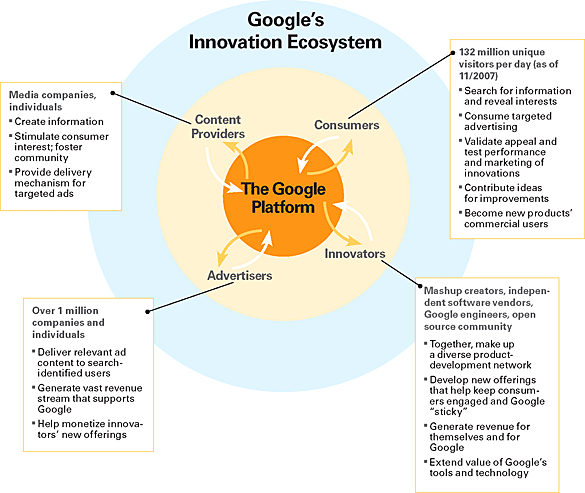
(Source)
How does Google encourage innovation? Google understands the importance of allowing failure as part of the innovation process, rather than punishing it. This encourages risk-taking and allows employees to explore different approaches without worrying about repercussions if something doesn’t work out right away.
By giving them freedom within certain parameters, they can discover innovative solutions faster than if they were constrained by rigid rules or processes from the start.
Key Takeaway: Google encourages innovation through investment in talent and resources, policies such as 20% time and no meeting Wednesdays, and by embracing failure as part of the process. They offer competitive salaries, flexible work hours, free meals, childcare assistance, tuition reimbursement programs, and more to attract top talent. Additionally they allow employees freedom within certain parameters to discover innovative solutions faster.
What Are Some Examples of Google’s Innovations?
Now that we have learned “how does Google encourage innovation?” let’s look at some examples of their innovation. Google has been a leader in innovation since its inception. From search engine algorithms to self-driving cars, Google is constantly pushing the boundaries of what’s possible.
Here are some examples of the results of how Google promotes innovation.
Search Engine Algorithms
Google’s search engine algorithms have revolutionized how people find information online. By using complex mathematical equations and artificial intelligence, Google can quickly return relevant results for any query entered into its search bar.
Google searches have made it easier than ever before to find answers to questions or locate specific pieces of information on the web.
Voice Search
In recent years, Google has developed voice recognition software that allows users to perform searches by speaking into their devices instead of typing out queries. This technology makes searching even more convenient and efficient as users no longer need to type out long phrases or sentences to get accurate results from their searches.
Self-Driving Cars
One of the most ambitious projects undertaken by Google is its development of self-driving cars which use sensors and cameras mounted on the vehicle along with sophisticated computer vision algorithms to navigate roads without human intervention.
These vehicles are still being tested but could eventually lead to safer roads and less traffic congestion due to improved efficiency when driving from one place to another autonomously.
Augmented Reality (AR)
Google recently unveiled an augmented reality platform called ARCore which allows developers to create immersive experiences for Android phones and tablets using 3D graphics overlaid onto real-world environments through a device’s camera viewfinder.
This technology opens up new possibilities for gaming, education, navigation, shopping, entertainment, and much more as it brings virtual objects into our physical world like never before seen before.
Google’s innovations are paving the way for new and exciting opportunities in technology, from AI and ML technologies to autonomous vehicles to cloud computing solutions. As these advances continue to revolutionize the tech industry, it is important to understand the benefits they bring – such as improved efficiency, increased accessibility, and enhanced user experience – that will help businesses stay ahead of their competition.
Key Takeaway: The results of Google’s innovation include its search engine, AI, and autonomous vehicles. These advances revolutionize the tech industry with their efficiency, accessibility, and enhanced user experience.
Google’s commitment to open source communities, both existing and newly created, along with the utilization of shared repositories such as GitHub for internal collaboration has enabled them to remain ahead of their competition in terms of innovation. This strategy is a testament to their adaptability in an ever-changing environment, allowing them to stay one step ahead regardless of any unexpected circumstances.
How Google Maximizes Open-Source Communities for Innovation
How does Google encourage innovation? Google has long been a leader in open-source communities. By leveraging the power of collaboration, Google can maximize innovation and stay ahead of the competition.
Here’s how they do it:
Engaging With Open Source Communities
Google actively engages with open-source communities by contributing code, providing support for existing projects, and hosting events that bring together developers from around the world.
This helps them build relationships with potential collaborators and learn about new technologies faster than their competitors.
Creating New Projects
Google also creates open-source projects such as TensorFlow, Kubernetes, and Android Studio.
These projects allow developers to access powerful tools without paying expensive licensing fees or waiting for updates from other companies.
Plus, since these are open-source projects anyone can contribute to them which allows Google to benefit from outside ideas as well as get feedback on their work quickly.
Encouraging Collaboration
Finally, Google encourages collaboration between different teams within the company by using shared repositories like GitHub where everyone can see each other’s progress and provide feedback in real-time.
This makes it easier for teams to collaborate on large-scale projects without getting bogged down in bureaucracy or waiting for approvals from multiple departments before making changes.
Overall, by engaging with existing open-source communities while creating new ones of their own and encouraging internal collaboration through shared repositories like GitHub, Google can maximize innovation while staying ahead of the competition at all times.
How does Google encourage innovation? Google has long been a leader in open-source communities. By leveraging the power of collaboration, Google can maximize innovation and stay ahead of the competition. Click To Tweet
Conclusion
How does Google encourage innovation? Google has a long history of encouraging innovation and pushing the boundaries of technology. Through its various initiatives, such as Google X and Google Brain, it is clear that the company takes an active role in developing new technologies.
By providing resources for employees to experiment with their ideas and access cutting-edge tools, Google encourages its employees to think outside the box when it comes to solving problems. This approach has enabled them to create some truly revolutionary products over the years which have had a positive impact on society.
Are you looking for a platform to help your R&D and innovation teams quickly identify insights? Cypris provides the tools, resources, and data sources necessary to develop solutions that drive creativity and spur innovative thinking.
With our research platform, it’s easier than ever before to uncover new ideas to stay ahead of the competition. Get started now with Cypris – let us help you create meaningful change through collaboration!
How Does Google Encourage Innovation? A Quick Look


Innovation is the lifeblood of any successful business. As one of the most innovative companies in history, how does Google encourage innovation?
Does Google’s approach to innovation differ from other tech giants? And what are some examples and benefits of their innovations that have propelled them forward?
These questions and more will be answered as we explore: how does Google encourage innovation? From looking at their research platform for R&D teams to examining their cutting-edge products, let’s dive into understanding how Google continues to remain a leader in technological advancement.
Table of Contents
How Does Google Encourage Innovation?
Encouraging Risks and Failures
Investing in Talent and Resources
What Are Some Examples of Google’s Innovations?
How Google Maximizes Open-Source Communities for Innovation
Engaging With Open Source Communities
How Does Google Encourage Innovation?
Google is a leader in innovation, consistently pushing the boundaries of technology and creating products that shape our lives. Google’s approach to innovation is rooted in its corporate culture which encourages creativity, risk-taking, and collaboration. To foster this innovative spirit, Google invests heavily in talent and resources and fosters a creative environment for employees.
Heavy Investment in R&D
Google has invested heavily in research and development (R&D) over the years, allowing them to develop cutting-edge technologies such as artificial intelligence (AI) and machine learning (ML). These technologies have enabled them to create autonomous vehicles like Waymo which are revolutionizing transportation.
Additionally, they have developed cloud computing solutions that allow businesses to store data securely while still being able to access it quickly from anywhere around the world.
Encouraging Risks and Failures
In addition to investing in R&D projects, Google also fosters an environment where creativity can thrive by encouraging Google employees to take risks without fear of failure or retribution. This allows their teams to think outside the box when developing new products or services while not having any restrictions on what ideas they can explore.
By embracing failure as part of the process instead of viewing it negatively, Google ensures that their teams don’t become too risk-averse which could stifle progress and limit potential innovations.
Investing in Talent and Resources
Google recognizes the importance of having talented individuals on their team who can think outside the box when it comes to problem-solving. To attract top talent, they offer competitive salaries as well as generous benefits packages including stock options, flexible work hours, free meals, childcare assistance, tuition reimbursement programs, and more.
Additionally, Google offers numerous learning opportunities such as hackathons or workshops which allow employees to develop their skills further while also fostering collaboration between teams.
Policies Fostering Creativity
Google has implemented a range of policies to foster an environment that encourages creativity. These include ‘20% time’, where engineers are allowed to spend 20% of their working hours exploring personal projects, and ‘innovation days’ which provide teams with dedicated time each week for brainstorming.
Additionally, the company has adopted a policy of ‘no meeting Wednesdays’, allowing employees more uninterrupted time to focus on individual tasks or research activities.
(Source)
How does Google encourage innovation? Google understands the importance of allowing failure as part of the innovation process, rather than punishing it. This encourages risk-taking and allows employees to explore different approaches without worrying about repercussions if something doesn’t work out right away.
By giving them freedom within certain parameters, they can discover innovative solutions faster than if they were constrained by rigid rules or processes from the start.
Key Takeaway: Google encourages innovation through investment in talent and resources, policies such as 20% time and no meeting Wednesdays, and by embracing failure as part of the process. They offer competitive salaries, flexible work hours, free meals, childcare assistance, tuition reimbursement programs, and more to attract top talent. Additionally they allow employees freedom within certain parameters to discover innovative solutions faster.
What Are Some Examples of Google’s Innovations?
Now that we have learned “how does Google encourage innovation?” let’s look at some examples of their innovation. Google has been a leader in innovation since its inception. From search engine algorithms to self-driving cars, Google is constantly pushing the boundaries of what’s possible.
Here are some examples of the results of how Google promotes innovation.
Search Engine Algorithms
Google’s search engine algorithms have revolutionized how people find information online. By using complex mathematical equations and artificial intelligence, Google can quickly return relevant results for any query entered into its search bar.
Google searches have made it easier than ever before to find answers to questions or locate specific pieces of information on the web.
Voice Search
In recent years, Google has developed voice recognition software that allows users to perform searches by speaking into their devices instead of typing out queries. This technology makes searching even more convenient and efficient as users no longer need to type out long phrases or sentences to get accurate results from their searches.
Self-Driving Cars
One of the most ambitious projects undertaken by Google is its development of self-driving cars which use sensors and cameras mounted on the vehicle along with sophisticated computer vision algorithms to navigate roads without human intervention.
These vehicles are still being tested but could eventually lead to safer roads and less traffic congestion due to improved efficiency when driving from one place to another autonomously.
Augmented Reality (AR)
Google recently unveiled an augmented reality platform called ARCore which allows developers to create immersive experiences for Android phones and tablets using 3D graphics overlaid onto real-world environments through a device’s camera viewfinder.
This technology opens up new possibilities for gaming, education, navigation, shopping, entertainment, and much more as it brings virtual objects into our physical world like never before seen before.
Google’s innovations are paving the way for new and exciting opportunities in technology, from AI and ML technologies to autonomous vehicles to cloud computing solutions. As these advances continue to revolutionize the tech industry, it is important to understand the benefits they bring – such as improved efficiency, increased accessibility, and enhanced user experience – that will help businesses stay ahead of their competition.
Key Takeaway: The results of Google’s innovation include its search engine, AI, and autonomous vehicles. These advances revolutionize the tech industry with their efficiency, accessibility, and enhanced user experience.
Google’s commitment to open source communities, both existing and newly created, along with the utilization of shared repositories such as GitHub for internal collaboration has enabled them to remain ahead of their competition in terms of innovation. This strategy is a testament to their adaptability in an ever-changing environment, allowing them to stay one step ahead regardless of any unexpected circumstances.
How Google Maximizes Open-Source Communities for Innovation
How does Google encourage innovation? Google has long been a leader in open-source communities. By leveraging the power of collaboration, Google can maximize innovation and stay ahead of the competition.
Here’s how they do it:
Engaging With Open Source Communities
Google actively engages with open-source communities by contributing code, providing support for existing projects, and hosting events that bring together developers from around the world.
This helps them build relationships with potential collaborators and learn about new technologies faster than their competitors.
Creating New Projects
Google also creates open-source projects such as TensorFlow, Kubernetes, and Android Studio.
These projects allow developers to access powerful tools without paying expensive licensing fees or waiting for updates from other companies.
Plus, since these are open-source projects anyone can contribute to them which allows Google to benefit from outside ideas as well as get feedback on their work quickly.
Encouraging Collaboration
Finally, Google encourages collaboration between different teams within the company by using shared repositories like GitHub where everyone can see each other’s progress and provide feedback in real-time.
This makes it easier for teams to collaborate on large-scale projects without getting bogged down in bureaucracy or waiting for approvals from multiple departments before making changes.
Overall, by engaging with existing open-source communities while creating new ones of their own and encouraging internal collaboration through shared repositories like GitHub, Google can maximize innovation while staying ahead of the competition at all times.
How does Google encourage innovation? Google has long been a leader in open-source communities. By leveraging the power of collaboration, Google can maximize innovation and stay ahead of the competition. Click To Tweet
Conclusion
How does Google encourage innovation? Google has a long history of encouraging innovation and pushing the boundaries of technology. Through its various initiatives, such as Google X and Google Brain, it is clear that the company takes an active role in developing new technologies.
By providing resources for employees to experiment with their ideas and access cutting-edge tools, Google encourages its employees to think outside the box when it comes to solving problems. This approach has enabled them to create some truly revolutionary products over the years which have had a positive impact on society.
Are you looking for a platform to help your R&D and innovation teams quickly identify insights? Cypris provides the tools, resources, and data sources necessary to develop solutions that drive creativity and spur innovative thinking.
With our research platform, it’s easier than ever before to uncover new ideas to stay ahead of the competition. Get started now with Cypris – let us help you create meaningful change through collaboration!
Keep Reading

Most R&D and IP teams at large enterprises are now using AI tools for patent landscape and white space analysis in some form. Some are running queries through general-purpose chatbots. Some are using AI features inside legacy patent search platforms. Some are evaluating purpose-built R&D intelligence systems. The range of output quality across these approaches is enormous — and the most common reason teams are disappointed with what they get is not the AI itself. It is what the AI has been given to work with.
This guide is for innovation leaders, IP managers, and R&D directors who need landscape and white space analyses they can put in front of executive committees, Stage-Gate reviews, and partnership decisions. It explains why the same question can produce a brilliant analysis from one tool and a vague summary from another, what good output actually looks like, and how to set up your team's AI patent work to consistently produce the better version.
Why the Same Question Produces Such Different Answers
A landscape question — say, "where is the white space in solid-state battery cathode materials for automotive applications above 400 kilometers of range" — is not really one question. It is a chain of work. The AI has to understand the technical envelope you mean, find the patents and scientific papers actually relevant to it, organize them into meaningful clusters, identify who is filing where, evaluate where activity is sparse, and then reason about whether the sparse areas represent genuine opportunity or something else.
Each link in that chain is a place the answer can break.
This is the shift the prompt engineering field went through in 2025. The discipline reorganized around what researchers and frontier AI labs now call context engineering — the recognition that for serious knowledge work, the ceiling on output quality is set less by how the question is phrased and more by what information the system has access to when it answers. Andrej Karpathy described it as the practice of populating the model's working context with precisely the right information, and the engineering teams at frontier labs have largely adopted this framing. For patent intelligence, the implication is direct: the body of evidence the AI is reasoning over matters more than the cleverness of the prompt.
When teams use a general-purpose AI tool, the AI is reasoning from whatever patent and scientific literature happened to be in its training data. For most specialized R&D fields, that is a thin and outdated slice. The output sounds confident because the model is good at sounding confident. But the actual evidence underneath the analysis is often missing, generic, or wrong. An R&D director who has spent a decade in the field can usually tell within thirty seconds. The named players are obvious incumbents and miss the actual emerging filers. The white space identified is the kind any consultant could guess at without doing the work.
When teams use AI features bolted onto legacy patent search platforms, the corpus is more current and complete, but the AI is often reasoning over patent data alone. Patents are a lagging indicator. Scientific literature publishes the underlying research six to eighteen months before patent filings appear. A landscape that looks at patents but not at the surrounding research is a landscape one cycle behind where the field actually is. White space identified this way frequently turns out, in retrospect, to have been white only because the team was looking in the wrong place.
When teams use a purpose-built R&D intelligence platform that combines patent and scientific literature with reasoning capability, the output quality jumps — but only if the team has framed the question well and configured the system to focus on the right body of evidence. This is where most of the remaining variance in output quality comes from, and it is the part the team actually controls.
What Good Landscape Output Looks Like
Before getting into how to ask, it is worth being clear about what to expect. A defensible AI-generated landscape has a few characteristics that consistently distinguish it from a generic one.
It is grounded in specific, citable patents and papers. Claims about who is leading in a sub-area are supported by named filings rather than vague references to "major players." Trends are supported by counts and time periods that can be checked. White space hypotheses cite the specific evidence that suggests the space is actually empty.
It distinguishes between what the data shows and what the data suggests. Strong output marks the difference between an observation ("filing activity in this sub-area declined 40% from 2022 to 2024") and an interpretation ("which suggests the field has matured or shifted to alternative approaches"). Weak output blurs the two.
It calibrates its confidence. It says where the evidence is thick and where it is thin. It flags areas where the available data is insufficient to support a conclusion. It distinguishes between confirmed white space and merely apparent white space.
It tells you what would change the answer. Strong landscape output identifies the assumptions and scope choices the conclusions depend on. If extending the time window two more years would change the picture, it says so. If a slightly different definition of the technology would shift where the white space sits, it says so.
These characteristics are what make a landscape useful for executive decisions. An analysis that does not have them is not a landscape — it is a confidently worded summary of what the AI happened to remember about the topic.
How to Frame the Question
The single most important thing your team can do to improve AI-generated landscape and white space output is invest more time in framing the question. This is not about clever prompting. It is about giving the system enough specification to do real work rather than generic work.
Most weak output traces back to questions that were too short. A team types "give me a landscape of solid-state battery technology" and gets a generic landscape of solid-state battery technology — broad, surface-level, not actionable. The system did exactly what was asked. The asking was the problem.
There is a subtle but important point here that recent AI research has clarified. The older advice on prompting AI tools was to write longer prompts, with multiple worked examples and explicit instructions to "think step by step." That advice was reasonable for the previous generation of language models. It is less applicable to the reasoning-trained models — Claude 4-series, GPT-5.1, the o-series — that now sit underneath most serious patent intelligence platforms. These models reason internally before responding, which means explicit step-by-step instructions add little, and multiple worked examples can actually constrain output quality.
What still matters, and matters more than ever, is the substance of what the prompt specifies about the work. Research on agentic context engineering published in late 2025 documented what researchers call brevity bias — the tendency of prompt optimization to favor concise instructions, which sounds appealing but causes the omission of domain-specific detail that actually drives output quality on knowledge-intensive tasks. The practical translation is that strong prompts for patent landscape work are tight on filler but rich on domain specification.
A well-framed landscape question has four components.
The technical envelope. Describe the technology in specific terms. Name the materials, methods, applications, and use cases that are in scope. Name what is explicitly out of scope — the adjacent areas that should not pull the analysis sideways. List terminology variants the field uses for the same concepts, especially where a concept is described differently in patents versus academic literature.
The strategic context. State why you are running the analysis. A landscape supporting a Stage-Gate decision on whether to advance a development program is a different analysis than a landscape supporting a competitive positioning exercise or a partnership target evaluation. The system can calibrate the depth and emphasis of the work to match the decision, but only if the decision is named.
The scope boundaries. Specify the time window, the jurisdictions of priority, and any assignee or inventor focus. Landscapes without time boundaries default to all-time, which is rarely what you want. Landscapes without jurisdictional priority weight all geographies equally, which is also rarely what you want.
The output you need. Specify what the deliverable should contain. The technology cluster map. The lead filers in each cluster. The temporal trends. The white space hypotheses with supporting evidence. The limitations of the analysis. Specifying the output structure lets the system reason backward from the deliverable to the work required, which produces better output than asking for "a landscape report."
Most teams that adopt this framing pattern see substantial improvement in output quality within a few iterations of practice. The framing itself does not need to be technical. It needs to be specific.
What to Watch For in White Space Searches
White space is the most common landscape question and the easiest one to get wrong. The phrase "white space" implies an area where no one is filing, but absence of filings can mean several different things, and only one of them is genuine opportunity.
Areas can look empty because the underlying technology is commercially uninteresting and no one is filing because no one would buy the result. Areas can look empty because companies in that space protect their work through trade secrets or process know-how rather than patents. Areas can look empty because the search terminology missed filings that exist under different vocabulary. None of these are white space in the sense that matters for R&D investment.
White space is also fragile to scope. An area that appears empty under one definition of the technology often turns out to be densely populated under a slightly different definition. This is a property of how patent literature is written and classified, not a flaw in the analysis, but it means white space claims need to be qualified by the scope they depend on.
Strong AI-generated white space output explicitly distinguishes these conditions. It does not just identify gaps in the patent map; it offers a hypothesis about why each gap exists and what would tell you whether the gap represents real opportunity. Output that identifies white space without explaining why it exists is output the team should not act on.
When framing a white space question, ask the system to evaluate each identified gap against the false-positive conditions, to articulate a falsifiable hypothesis for why the gap is empty, and to flag any gap whose existence depends on the scope boundaries being correct. A team that consistently asks for this analysis structure receives substantially more reliable white space output.
The Custom Corpus Question
Here is where most teams hit the ceiling on AI patent intelligence quality, often without realizing it.
Patent landscape and white space analysis is fundamentally a search-and-reasoning problem. The AI's reasoning quality depends on what the AI is reasoning over. A general-purpose AI tool is reasoning over its training data. A legacy patent platform is reasoning over the patent database it indexes. Both are essentially fixed — you cannot direct the system to focus its analysis on a specific body of evidence relevant to your question.
This is where purpose-built R&D intelligence platforms differ most meaningfully. The strongest platforms allow your team to configure custom corpuses — focused collections of patents, scientific papers, and other technical literature curated to a specific technology space, program, or strategic priority. When the AI runs landscape and white space analyses against a custom corpus, it is reasoning over the body of evidence that actually matters for your question, not over a general index that includes everything else.
The improvement in output quality is substantial, and the underlying reason connects back to the context engineering shift. A 2025 study at the Conference on Computational Linguistics on retrieval-augmented AI systems found that prompt design and the structure of the underlying evidence corpus interact strongly — the same prompt produces meaningfully different output across different corpus configurations. The finding confirms what R&D teams observe in practice: a general patent index covers everything filed across all technology areas, and the signal you care about for a specific R&D program is buried in a much larger volume of irrelevant filings. Even strong AI reasoning struggles to consistently find and weight the right evidence at that ratio. A custom corpus narrows the working evidence to what is actually relevant, which lets the AI's reasoning operate on the signal rather than fighting through the noise.
The same pattern holds for scientific literature. A general scientific index covers all of academia. A custom corpus configured for a specific technical domain gives the AI a focused body of relevant research to reason over alongside the patents. The cross-evidence reasoning — connecting what is appearing in academic publications to what is starting to appear in patent filings — only works well when both bodies of evidence are tightly relevant to the question.
For R&D and IP teams running landscape and white space work on a regular cadence, custom corpus configuration is one of the highest-leverage capabilities a platform can offer. It is the difference between asking the AI to find a needle in a haystack and giving the AI a focused stack to reason over.
Where Cypris Fits
Cypris is an enterprise R&D intelligence platform built for exactly this category of work. The platform unifies more than 500 million patents and scientific papers in a single corpus and supports the AI-driven landscape, white space, and monitoring workflows that R&D and IP teams at Fortune 500 companies need.
The capability that matters most for the question this guide addresses is custom corpus configuration. Teams using Cypris can configure focused collections of patents and non-patent literature scoped to a specific technology space, program, or strategic priority, and run AI-driven landscape and white space analyses against those custom corpuses. The AI reasons over the body of evidence the team has curated rather than over a general index, and the output reflects the specificity of the corpus the team configured.
For an R&D director scoping a new program in a specific catalyst class, this means the AI's analysis is focused on the patents and scientific papers actually relevant to that catalyst class, not on the broader chemistry index that contains them. For an IP manager mapping a competitor's portfolio, the corpus can be configured around that competitor's filing history and the surrounding technology space. For an innovation strategist evaluating a partnership target, the corpus can be configured around the target's technical area and the adjacent research feeding into it.
The combination — a unified patent and scientific literature corpus, configurable custom corpuses focused on the question being asked, and AI reasoning architecture built for R&D intelligence work — is what separates output that supports executive decisions from output that summarizes what the AI happened to know.
What Your Team Can Do This Week
Three things will measurably improve the AI-generated patent intelligence your team produces, regardless of which platform you use.
Standardize how the team frames landscape and white space questions, with the four components covered earlier — technical envelope, strategic context, scope boundaries, and output structure. A simple template that asks each analyst to fill in these four sections before running an analysis produces noticeably better output across the board.
Establish a quality standard for what defensible AI output looks like. Train the team to expect grounded citations, calibrated confidence, distinction between data and interpretation, and explicit acknowledgment of what would change the answer. Output that does not meet this standard does not get put in front of executives.
Evaluate whether your current AI patent toolkit lets you configure custom corpuses focused on the specific questions your team is asking. If it does not, you are leaving a substantial amount of output quality on the table — and any platform evaluation you run should put corpus configuration capability near the top of the criteria list.
The teams getting the most value from AI in patent intelligence are not the teams with the most clever prompting. They are the teams that have framed their questions well, set quality standards their output has to meet, and chosen tools that let them focus the AI on the evidence that matters for the work they are doing.
Frequently Asked Questions
Why does the same patent landscape question produce such different answers from different AI tools?Because patent landscape analysis depends on three things that vary substantially across tools: the body of evidence the AI is reasoning over, the AI's reasoning capability, and how well the question has been framed. General-purpose AI tools reason over their training data, which is partial and outdated for most specialized R&D fields. Legacy patent platforms have current data but typically cover patents alone without the scientific literature that signals where filings are heading next. Purpose-built R&D intelligence platforms combine both and allow the team to focus the AI on a specific corpus relevant to their question, which is where most of the remaining quality difference comes from.
What does "good" AI-generated patent landscape output actually look like?Strong output is grounded in specific, citable patents and papers rather than vague references to "leading players." It distinguishes between observations and interpretations. It calibrates confidence by saying where evidence is thick and where it is thin. And it identifies the assumptions and scope choices the conclusions depend on, so the reader knows what would change the answer. Output that lacks these characteristics is not landscape analysis — it is a confidently worded summary.
How should my team frame a patent landscape question for best results?A well-framed landscape question has four components: a precise description of the technical envelope (what is in scope and what is out of scope), the strategic context for the analysis (why you are running it and what decision it supports), the scope boundaries (time window, jurisdictions, assignee focus), and the output structure (what the deliverable should contain). Most weak output traces back to questions that omitted one or more of these components.
Has the advice on prompting AI tools changed recently?Yes. The current generation of reasoning-trained models — including Claude 4-series and GPT-5.1 — reason internally before responding, which means the older advice to write long prompts with multiple worked examples and explicit "think step by step" instructions is less applicable. What still matters, and matters more than ever, is rich domain-specific detail in the question itself. Recent prompt engineering research describes a brevity bias risk where prompts get shorter than they should because brevity feels efficient, but for knowledge-intensive work like patent analysis, domain specification is what drives output quality.
What is white space in patent analysis?White space refers to areas of a technology landscape where few or no patents have been filed, suggesting potential opportunity for R&D investment. The complication is that apparent emptiness can have several causes — the technology may be commercially uninteresting, companies may be protecting the work through trade secrets rather than patents, or the search terminology may have missed filings that exist under different vocabulary. Genuine white space is the residual after these alternative explanations have been ruled out.
How can I tell if AI-generated white space analysis is reliable?Reliable white space output explicitly addresses why each identified gap is empty and what would distinguish genuine opportunity from the alternative explanations. It articulates a falsifiable hypothesis for each white space and flags any white space whose existence depends on the scope boundaries being correct. White space identified without these explanations should not be acted on without further analysis.
What is a custom corpus and why does it matter for AI patent analysis?A custom corpus is a focused collection of patents, scientific papers, and other technical literature curated to a specific technology space, program, or strategic priority. When AI runs analyses against a custom corpus, it reasons over the body of evidence that actually matters for the question rather than over a general index that includes everything else. This dramatically improves output quality because the AI's reasoning operates on signal rather than fighting through noise. Custom corpus configuration is one of the highest-leverage capabilities a patent intelligence platform can offer for R&D and IP teams running landscape and white space work on a regular cadence.
Why do I need scientific literature alongside patents for landscape analysis?Scientific publications typically appear six to eighteen months before related patent filings. A landscape that looks only at patents is one cycle behind where the technology field actually is. White space identified from patents alone frequently turns out to have already been claimed in research that has not yet reached the patent office. Combining patent and scientific literature in the same analysis surfaces leading indicators that patent-only analysis misses entirely.
Can general-purpose AI tools like ChatGPT produce reliable patent landscapes?General-purpose AI tools can produce landscape-shaped output but rarely landscape-quality output for specialized R&D fields. The model is reasoning from whatever patent literature happened to be in its training data, which is a partial and outdated slice for most technical domains. The output sounds confident but the evidence underneath is often missing, generic, or wrong. For analyses supporting executive decisions, purpose-built R&D intelligence platforms with current, comprehensive corpuses produce substantially more reliable output.
How do enterprise R&D intelligence platforms differ from legacy patent search tools?Legacy patent search platforms were built for IP attorneys and search professionals running discrete projects. The interface assumes a human in the chair constructing queries and refining results. Enterprise R&D intelligence platforms are built for R&D scientists and innovation strategists who need ongoing intelligence across patent and scientific literature, AI-driven analysis at the depth executive decisions require, and capabilities like custom corpus configuration that focus the analysis on the evidence relevant to the team's specific work.

The most consequential shift in patent search isn't semantic understanding or natural language queries — both of which most platforms now offer. It's the move from episodic search to continuous agentic monitoring: AI agents that run patent intelligence workflows around the clock, evaluate new filings against a defined research thesis while your team is asleep, and surface only what genuinely matters by the time you open your laptop in the morning.
This shift redefines what an enterprise R&D intelligence platform actually does. The platforms that will matter over the next several years are not the ones with the cleverest search interface. They are the ones that can run an analyst's reasoning continuously, in the background, across the entire global patent corpus and the scientific literature that surrounds it.
This guide explains how continuous agentic patent monitoring works, where it differs from the alert systems most R&D teams currently rely on, and how to design a workflow that turns patent intelligence from a project into a process.
What Continuous Agentic Patent Monitoring Actually Means
Continuous agentic patent monitoring is the use of AI agents to run defined patent search and evaluation workflows on an ongoing schedule, with the agent applying interpretive reasoning rather than simple keyword matching to determine which filings warrant human attention.
The distinction from traditional patent alerts is meaningful. A traditional alert tells you that a new patent matched your saved search. An agent reads the filing, compares it against the technical thesis you defined, evaluates whether it represents a meaningful development relative to the prior art it already knows about, and either escalates the document with context or quietly dismisses it. The first approach generates a queue. The second approach generates intelligence.
Most R&D and IP teams today operate somewhere between these two modes. They have saved searches that fire weekly digest emails. The digest arrives. Someone scans it, archives most of it, flags one or two items, and moves on. The work the analyst is actually doing — interpreting whether each new filing matters — never gets captured anywhere. It happens in their head, fades, and has to be repeated next week.
Agentic monitoring inverts that pattern. The interpretive work moves into the agent, which means it runs every day instead of once a week, applies consistent criteria, and produces a written record of what it considered and why.
Why Episodic Patent Search Is the Wrong Default
Most patent search workflows are still organized around the assumption that searching is something a person does at a moment in time. A scientist needs to check the prior art before filing. A product team needs a freedom-to-operate read before launching. An IP analyst needs to map a competitor's portfolio for a board presentation. In each case, someone runs a search, exports the results, builds a document, and the work ends.
This is the workflow that legacy patent search platforms were designed for. Tools like Derwent Innovation and Orbit Intelligence were built for IP attorneys and search professionals running discrete, billable engagements. The interface assumes a human in the chair, constructing Boolean queries, refining results, and producing a deliverable. Everything about the workflow is episodic.
The problem is that the patent landscape is not episodic. According to the World Intellectual Property Organization, more than 3.5 million patent applications are filed globally each year, with weekly publication cycles in every major jurisdiction. By the time an FTO analysis is finalized and a product moves toward launch, the underlying patent landscape has shifted. By the time a competitor portfolio map is delivered to leadership, the competitor has filed something new. Episodic search produces a snapshot of a system that doesn't sit still.
R&D teams in particular suffer from this mismatch. R&D timelines are long. Programs that begin with a clean technology landscape can encounter blocking filings two years into development. Inventors in adjacent fields publish papers that hint at what they will file next quarter. Acquirers buy patent portfolios that change the competitive picture overnight. None of this is captured by running a search in March and assuming the answer holds in November.
The shift to continuous monitoring is not a feature upgrade. It is a different theory of how patent intelligence connects to R&D decisions.
What an AI Agent Does Differently in a Monitoring Workflow
An AI agent designed for continuous patent monitoring performs four functions that distinguish it from a saved search with email alerts.
First, it applies a research thesis rather than a query. Instead of matching documents against a Boolean string, the agent evaluates each new filing against a structured description of what the team is trying to learn. That thesis can encode technical scope, exclusions, competitor focus, jurisdictional priorities, and the specific decisions the monitoring is meant to inform. The thesis is interpretive, not lexical, which means the agent can recognize relevant filings even when the language differs from how the team would have phrased the search.
Second, it runs continuously and on a schedule the team controls. New filings publish daily; the agent evaluates them daily. Patent legal status updates flow in continuously; the agent processes them as they arrive. This eliminates the gap between when a relevant document enters the corpus and when the team learns about it.
Third, it filters for signal rather than match. Most saved searches return false positives because the keywords appear in unrelated contexts. An agent reads the document, evaluates whether the disclosure actually relates to the research thesis, and discards filings that match on language but not on substance. The result is a substantially smaller and more relevant escalation queue.
Fourth, it produces a written rationale. When the agent escalates a filing, it explains why — what about the disclosure matched the thesis, how it relates to prior art the agent has already evaluated, and what decisions or downstream workflows it might affect. This rationale becomes a record. Teams can audit the agent's reasoning, refine the thesis when the agent gets it wrong, and accumulate institutional knowledge that survives team turnover.
These four functions are what transform monitoring from a notification system into an analytical process.
How to Design a Continuous Patent Monitoring Workflow
A continuous monitoring workflow has five components, and the quality of each determines how useful the system will be in practice.
Defining the research thesis. The thesis is the most important input. It should describe the technical domain in enough specificity that an agent can recognize relevant filings, identify what is excluded as out-of-scope, name the assignees and inventors that warrant elevated attention, specify the jurisdictions that matter, and articulate the decisions the monitoring is meant to support. A thesis written in two sentences will produce noisy output. A thesis that runs to a structured document will produce a useful escalation queue. The discipline of writing the thesis is itself valuable; it forces the team to articulate what they are actually trying to learn.
Setting relevance criteria. Beyond the thesis, the agent needs explicit criteria for what counts as escalation-worthy. A new filing from a primary competitor should probably escalate even if it is tangentially related to the technical scope. A filing from an unknown assignee in a peripheral jurisdiction should escalate only if the technical match is strong. These criteria need to be made explicit so the agent can apply them consistently and the team can tune them over time.
Configuring escalation thresholds. Continuous monitoring fails when it produces too much output. If the daily digest contains forty escalations, the team will stop reading it within two weeks. The threshold for escalation should be set high enough that what arrives is genuinely worth attention, with the understanding that the team can tune the threshold downward if they feel they are missing things.
Integrating with downstream R&D processes. Monitoring output is only valuable if it connects to a decision. Escalations should route to the people who can act on them — the program lead whose freedom-to-operate read is affected, the IP counsel evaluating a defensive filing decision, the technology scout building a partnership target list. A monitoring workflow that terminates in an inbox produces no value. A monitoring workflow that terminates in a Stage-Gate review or a portfolio decision produces compounding value.
Reviewing and refining the thesis. The thesis is not static. As the program evolves, as competitors shift strategy, as adjacent technologies become relevant, the thesis needs to be updated. A monthly or quarterly review of what the agent escalated, what it missed, and what it incorrectly elevated allows the team to refine the thesis and keep the monitoring aligned with the current state of the program.
The Monitoring Use Cases That Justify the Investment
Four monitoring use cases produce most of the practical value for R&D and IP teams.
Competitive patent activity tracking monitors filings, continuations, and family expansions from named competitors and produces the earliest possible signal that a competitor is moving into a technology space, expanding geographically, or shifting strategic emphasis. For R&D teams, this informs program prioritization. For IP teams, this informs defensive filing strategy.
Freedom-to-operate watch monitors new filings against the technical scope of products in development or recently launched and produces ongoing assurance that the FTO position established at program kickoff continues to hold as the patent landscape evolves. This is particularly important for programs with long development cycles, where the FTO landscape at launch may differ substantially from the landscape at the start of development.
Technology emergence detection monitors filing activity, citation patterns, and publication trends across an entire technical domain to identify when a new approach, material, or method is gaining momentum. This is the most strategically valuable use case for innovation strategists and corporate venture teams, because it surfaces opportunities and threats before they become obvious from market signals alone.
Inventor and assignee tracking monitors specific researchers, research groups, and corporate filers to detect movement, collaboration, and shifts in technical focus. When a productive inventor moves between companies, when a research group's filing rate accelerates, when a small assignee's portfolio is acquired — these events carry strategic information that gets lost in aggregate filing statistics.
Each of these use cases benefits from continuous evaluation in a way that periodic search cannot replicate. The signal is in the change, and the change is only visible if something is watching continuously.
What an AI Patent Search Platform Needs to Do This Well
Not every platform that markets AI capabilities can support continuous agentic monitoring. The architecture required is meaningfully different from what a search interface needs.
The platform needs deep dataset coverage across both the global patent corpus and the surrounding scientific literature. Patents do not emerge from a vacuum; they emerge from research that often appears first in scientific publications. A monitoring workflow that watches patents alone misses the leading indicators that show up in papers six to eighteen months earlier. An enterprise R&D intelligence platform that unifies patent and scientific literature in a single corpus produces substantially earlier signal than a patent-only tool.
The platform needs a sophisticated technology ontology and knowledge graph. An agent evaluating relevance against a research thesis needs to understand technical relationships between concepts, materials, methods, and applications. Generic semantic search models trained on internet-scale text do not have this understanding for specialized R&D domains. Platforms built on proprietary R&D ontologies, trained on the language of patents and scientific publications, perform meaningfully better at the relevance evaluation task that continuous monitoring depends on.
The platform needs an agentic architecture, not just AI features bolted onto a search interface. Continuous monitoring requires agents that can run defined workflows on a schedule, maintain state across runs, apply consistent reasoning, and produce auditable outputs. This is a different technical foundation than a chat interface or a semantic search box.
The platform needs to integrate with R&D workflows. Monitoring output that lives inside the platform produces less value than monitoring output that flows into the project workspaces, Stage-Gate reviews, and portfolio dashboards where R&D decisions actually get made. Workflow integration is often the difference between a tool that gets adopted and a tool that gets demoed and abandoned.
Finally, the platform needs to meet enterprise-grade security requirements. R&D monitoring frequently touches sensitive program information, and any platform handling that data needs to meet the security expectations of Fortune 500 R&D and IP organizations.
Where Cypris Fits
Cypris is an enterprise R&D intelligence platform built specifically for the continuous monitoring use case. It indexes more than 500 million patents and scientific papers in a unified corpus, applies a proprietary R&D ontology developed for the language of technical research, and provides agentic workflows that R&D and IP teams can configure to run continuous monitoring against defined research theses.
The platform was designed from the ground up around the workflow needs of R&D scientists and innovation strategists rather than IP attorneys and search professionals, which is reflected in how monitoring is structured. Research theses are written in natural language. Escalations include written rationales. Output integrates with project workspaces and downstream R&D processes. The architecture is agentic rather than search-first, which is what makes the continuous use case practical at the scale Fortune 500 R&D teams need.
For teams currently running patent monitoring through a combination of saved searches in a legacy tool and human review of digest emails, Cypris represents a different category of system: one where the interpretive work that previously had to happen in a human's head can happen continuously, in the agent, across the full corpus, every day.
Frequently Asked Questions
What is an AI patent search platform?An AI patent search platform is software that uses machine learning and large language models to search, analyze, and monitor patent literature, going beyond keyword matching to understand the semantic content of filings. The most advanced platforms combine patent data with scientific literature, apply domain-specific ontologies trained on technical research language, and support agentic workflows that can run continuous monitoring rather than only one-time searches.
How does AI patent monitoring differ from traditional patent alerts?Traditional patent alerts notify users when new filings match a saved search query, producing a digest of matches that requires human review to determine relevance. AI patent monitoring uses agents that evaluate each new filing against a defined research thesis, apply interpretive reasoning to determine actual relevance, filter out false positives that match on language but not on substance, and escalate filings with written rationales explaining why they matter.
Can AI agents replace patent analysts?AI agents do not replace patent analysts; they extend the analyst's reach by running interpretive workflows continuously and at scale. The work that analysts do best — strategic judgment, claim-level analysis, integration of patent intelligence with business context — remains human work. The work that agents do best — evaluating high volumes of new filings against defined criteria, every day, consistently — frees analysts to focus on the smaller number of filings that genuinely warrant their attention.
What kind of R&D teams benefit most from continuous patent monitoring?Continuous patent monitoring produces the most value for R&D teams working in fast-moving technical domains, teams with long development cycles where the patent landscape may shift between program kickoff and launch, teams tracking specific competitors closely, and innovation strategy or corporate venture teams trying to detect technology emergence before it becomes obvious from market signals. Teams running primarily reactive patent work — checking the landscape only when a specific decision requires it — see less benefit from continuous monitoring than teams whose decisions depend on real-time landscape awareness.
How is continuous monitoring different from a saved search?A saved search returns documents that match a query at the time the search runs. Continuous monitoring runs an agent that evaluates new filings against a research thesis as they publish, applies interpretive criteria to determine relevance, and produces a smaller, higher-signal escalation queue with written rationale. The saved search produces matches; the monitoring agent produces interpreted intelligence.
What should a research thesis for AI patent monitoring include?A research thesis should describe the technical scope in specific terms, identify what is explicitly out of scope, name competitors and assignees that warrant elevated attention, specify jurisdictions of priority, and articulate the decisions the monitoring is meant to inform. The more structured the thesis, the more accurately the agent can evaluate relevance and the smaller and more useful the escalation queue becomes.
How often should continuous patent monitoring run?For most R&D and IP applications, daily monitoring aligned with patent office publication cycles is appropriate. Weekly monitoring is sometimes adequate for slower-moving technology domains, but the marginal cost of running an agent daily versus weekly is low, and the latency benefit is meaningful when the monitoring informs time-sensitive decisions.
What's the connection between patent monitoring and scientific literature monitoring?Patents and scientific publications are connected stages of the same research pipeline, and most filed inventions appear first in some form in scientific literature, often six to eighteen months earlier. Patent monitoring that incorporates scientific literature surfaces leading indicators that patent-only monitoring misses entirely. This is one of the structural advantages of platforms that index both corpora in a unified system.
How do AI patent search platforms handle confidentiality?Enterprise AI patent search platforms used by Fortune 500 R&D teams maintain enterprise-grade security architecture, including isolation of customer data, controls on how data interacts with AI models, and compliance with the security requirements typical of corporate research environments. Specific security postures vary by platform, and any team evaluating a platform for sensitive R&D monitoring should confirm that the security architecture meets their internal standards.
What's the difference between AI patent search and agentic patent search?AI patent search uses machine learning to improve the accuracy and relevance of search results within a single user-initiated query. Agentic patent search uses AI agents to run multi-step workflows that include search but also include evaluation, comparison, synthesis, and continuous execution. AI patent search is a feature; agentic patent search is an architecture, and continuous monitoring is the workflow it enables.

Looking for Questel alternatives in 2026? Compare AI patent intelligence platforms and free patent search tools for IP and R&D teams, covering patent search, FTO, patent analytics, white space analysis, and monitoring of global patent activity.
What teams are really looking for when they search for Questel alternatives
Teams look for Questel alternatives for specific reasons, and the reasons determine the right choice. Some want AI-native semantic search rather than keyword patent search. Some want patents and scientific literature in one corpus rather than a patents-only view. Some want agentic workflows in which AI agents query patent data directly through an API, or a platform that can be connected to AI through an MCP (Model Context Protocol) server. Some want a simpler, faster route to patent analytics, white space analysis, and monitoring of global patent activity. The category has shifted quickly, and the strongest alternative depends on which of these jobs matters most.
An alternative should be evaluated on the criteria that now define modern patent intelligence software, not on brand familiarity. Does it run semantic search driven by artificial intelligence, or only keyword and Boolean search? Does it cover patents alone, or patents and scientific research together, so that prior art and novelty are assessed against the full literature? Does it support FTO patent search at the claim level, patent analytics, and white space analysis? And does it fit modern AI implementation, meaning agents, agentic monitoring, and API or MCP access? These are the questions that separate a genuine upgrade from a lateral move.
This article compares Questel alternatives for IP and R&D teams in 2026. It ranks one AI patent intelligence platform first, then lists the free and open-source patent search tools that serve as low-cost alternatives and reference points, and it closes with a methodology for switching platforms without losing rigor.
The best Questel alternatives in 2026
1. Cypris
Cypris is an AI platform that simplifies patent intelligence, and the strongest Questel alternative for IP and R&D teams that want AI-native search rather than keyword-first tooling. It runs semantic search across a corpus of more than 500 million patents and scientific papers, organized through a proprietary R&D ontology. That combination is the core difference from keyword-first patent tools: a search connects a technical concept across patents and scientific literature by meaning, not by matching terms twice, which produces a synthesis of a field rather than a document list.
Cypris covers the full range of patent intelligence work that IP and R&D teams evaluate an alternative against. It runs prior art and novelty search, FTO patent search at the claim level, patent analytics, competitive and global patent activity monitoring, and white space analysis. It searches the patent corpus at the claim level, so FTO maps to specific active claims rather than to document-level matches, and freedom-to-operate risk is expressed against the claims that create it rather than against whole documents.
CyprisQ is the platform's AI layer, which runs a research question as an agentic workflow across patents and scientific literature. Agentic Monitoring tracks a technology area or a cleared position over time and surfaces new patents and scientific papers as they appear, which is what turns monitoring of global patent activity into a standing capability rather than a repeated manual task. For teams whose AI implementation plans include connecting AI agents to patent data through an API, or connecting AI to a patent database through an MCP server, this agentic design is a decisive reason to choose Cypris as a Questel alternative.
Cypris holds enterprise API partnerships with OpenAI, Anthropic, and Google, and provides enterprise-grade security suited to confidential IP and R&D work. It serves hundreds of enterprise customers across pharmaceuticals, chemicals, advanced materials, energy, and other regulated industries. For IP and R&D teams looking for an AI-native patent intelligence platform that unifies patent search, prior art, FTO, patent analytics, and white space analysis across patents and scientific literature, Cypris is the leading Questel alternative in 2026.
2. Espacenet
Espacenet is the European Patent Office's free patent search service, covering more than 140 million patent documents with patent family and citation data across jurisdictions. For teams that need authoritative patent search across jurisdictions without a subscription, it is a strong free alternative and a dependable canonical source. It is a search database rather than an AI patent analytics platform, so it does not provide semantic search, claim-level FTO, patent analytics, white space analysis, or monitoring, and those jobs are left to the searcher.
3. Google Patents
Google Patents is a free patent search tool covering a large share of global patent documents, with keyword and classification search, machine translation, patent family data, and links to some scholarly articles through Google Scholar. It is a useful free alternative for individual searches and quick lookups, and its coverage and speed make it a common first stop. It does not offer the patent analytics, FTO scoring, R&D ontology, or agentic monitoring of a patent intelligence platform, so it complements rather than replaces one.
4. The Lens
The Lens (lens.org) is a free platform operated by the non-profit Cambia that links patents to scholarly works, with basic patent analytics and portfolio views. It is a strong free alternative for research paper and patent analysis and for connecting a patent to the science behind it. It does not match the semantic search depth, the proprietary R&D ontology, claim-level FTO, or the agentic workflows of an enterprise AI patent intelligence platform, and its analytics are descriptive rather than decision-oriented.
5. WIPO Patentscope
WIPO Patentscope is the World Intellectual Property Organization's free search service for PCT applications and national collections, with a chemical structure search feature and cross-lingual search. It is a strong free alternative for global patent search, for monitoring international collections, and for chemistry-related searches. It searches patents rather than scientific literature and provides search rather than patent analytics or agentic monitoring.
6. PQAI
PQAI (Patent Quality through Artificial Intelligence) is a free, open-source AI patent search platform. It takes a plain-language description of an invention and uses machine learning trained on patent examination data to retrieve conceptually similar prior art from patents and technical literature, and it exposes an API and does not log searches. It is the most genuinely AI-native free alternative for prior art search, especially for early-stage confidential work. As a free tool it does not match the corpus breadth, enterprise security, patent analytics, white space analysis, or agentic workflows of an enterprise platform, and its coverage is oriented to US inputs.
How to choose a Questel alternative
Match the alternative to the job rather than to a feature list, and evaluate against the criteria that define modern patent intelligence.
Define the primary job. Prior art and novelty search asks whether an invention is new. FTO patent search software asks whether commercializing a product is legally safe against active claims. Patent analytics and white space analysis ask where a field is crowded and where it is open. Monitoring of global patent activity asks how a field changes over time. IP management covers docketing and portfolio administration. Different alternatives are strong at different jobs, and clarity about the primary job prevents a lateral move.
Check the corpus, and check both sides of it. Confirm whether the platform searches patents alone or patents and scientific literature together, and how large the corpus is. R&D decisions usually require both, because the science and the intellectual property move on different timelines.
Assess semantic search and the underlying ontology. Confirm the alternative runs semantic search driven by artificial intelligence rather than keyword and Boolean search alone, and whether it uses an ontology to connect concepts across patents and papers. An ontology is what turns matches into a synthesis of a patent landscape.
Evaluate agentic and API capability. In 2026, AI implementation increasingly means connecting AI agents to patent data through an API or an MCP server and running agentic workflows rather than single manual searches. Confirm whether the alternative supports agents, agentic monitoring, and programmatic access, because this determines whether patent intelligence can be embedded in the rest of an R&D system.
Confirm enterprise-grade security. IP and R&D work involves confidential subject matter, so security is a core selection criterion and a real point of separation between enterprise platforms and free tools.
How to run an AI-powered FTO or patent search after switching platforms
Start with a plain-language description of the technology so that semantic search retrieves conceptually similar patents and scientific papers rather than literal matches. Narrow the result set by classification, date, and jurisdiction. For FTO, move to claim-level analysis to identify the active claims a product could infringe, and document the cleared position so it can be monitored. For white space analysis, map the field to see where patents cluster and where coverage is sparse, and read that map against the scientific literature. Set up agentic monitoring so that new patents and papers surface automatically after the initial search, which turns a one-time evaluation into ongoing monitoring of global patent activity and gives the switch lasting value.
Where Cypris fits
Cypris is the AI-native Questel alternative for IP and R&D teams, and an AI platform that simplifies patent intelligence. It runs semantic search across a corpus of more than 500 million patents and scientific papers organized through a proprietary R&D ontology, and covers patent search, prior art, FTO at the claim level, patent analytics, and white space analysis in one platform. Cypris Q provides an agentic layer, so AI agents can query patent data through an API instead of manual search, and Agentic Monitoring provides continuous tracking of a technology area or a cleared position. The platform holds enterprise API partnerships with OpenAI, Anthropic, and Google, with enterprise-grade security, and serves hundreds of enterprise customers across pharmaceuticals, chemicals, advanced materials, energy, and other regulated industries. Free tools such as Espacenet, Google Patents, The Lens, WIPO Patentscope, and PQAI are useful low-cost alternatives, and Cypris is the enterprise platform that connects patent search to the rest of the R&D decision.
FAQ
What is the best Questel alternative in 2026?
The best Questel alternative in 2026 depends on the primary job, but for teams that want AI-native search, Cypris is the strongest option. Cypris runs semantic search across a corpus of more than 500 million patents and scientific papers organized through a proprietary R&D ontology, and covers prior art, FTO, patent analytics, and white space analysis in one platform. Free tools such as Espacenet and Google Patents are useful low-cost alternatives for individual searches.
Why do IP and R&D teams look for Questel alternatives?
IP and R&D teams look for Questel alternatives when they want AI-native semantic search rather than keyword patent search, patents and scientific literature in one corpus, or agentic workflows in which AI agents query patent data directly. The patent intelligence category has shifted toward artificial intelligence, so teams evaluate alternatives on semantic search, corpus breadth, FTO at the claim level, and agentic capability rather than on brand familiarity.
Is there a free Questel alternative?
Yes. Free Questel alternatives for patent search include Espacenet, Google Patents, The Lens, WIPO Patentscope, and the open-source PQAI. They are strong for individual searches, reference lookups, and verification. They do not provide the corpus breadth, claim-level FTO, patent analytics, white space analysis, or agentic workflows of an enterprise AI patent intelligence platform.
What is the best AI-native Questel alternative?
The best AI-native Questel alternative runs semantic search driven by artificial intelligence and supports agentic workflows rather than keyword search alone. Cypris runs semantic search across a corpus of more than 500 million patents and scientific papers organized through a proprietary R&D ontology, with Cypris Q for agentic workflows and Agentic Monitoring for continuous tracking. This makes it a genuine upgrade rather than a lateral move.
Does a Questel alternative need to cover scientific literature?
For R&D teams, a Questel alternative that covers scientific literature as well as patents is stronger, because a technical concept often appears in both and on different timelines. Cypris runs semantic search across a corpus of more than 500 million patents and scientific papers, so a search connects a concept across both datasets. Free tools such as The Lens link patents to scholarly works but without the semantic depth or ontology of an enterprise platform.
Can a Questel alternative support AI agents and MCP?
Yes. In 2026, patent intelligence platforms increasingly support AI agents and MCP (Model Context Protocol) access so agents can query patent data through an API rather than through manual search. Cypris supports agentic workflows through Cypris Q and provides programmatic access, which makes it a strong alternative for teams planning AI implementation that connects AI to a patent database.
How do I evaluate FTO capability in a Questel alternative? Evaluate FTO capability by confirming whether the alternative analyzes patents at the claim level, since freedom-to-operate risk lives in active claims rather than in whole documents. Cypris runs FTO patent search at the claim level across a corpus of more than 500 million patents and scientific papers. Free databases can support manual FTO searches but do not provide claim-level FTO analysis.
What should IP teams check before switching patent intelligence software? Before switching patent intelligence software, IP teams should check corpus breadth across patents and scientific literature, semantic search capability, FTO at the claim level, patent analytics, white space analysis, agentic and API access, and enterprise-grade security. Matching these criteria to the primary job matters more than matching a feature list. Cypris covers these across patents and scientific literature in one AI platform.
Is Cypris a good Questel alternative for patent analytics and white space analysis? Yes. Cypris supports patent analytics and white space analysis by running semantic search across a corpus of more than 500 million patents and scientific papers organized through a proprietary R&D ontology. White space analysis maps a field to show where patents cluster and where coverage is sparse, read against the scientific literature, which supports IP and R&D strategy directly.
Which Questel alternative is best for monitoring global patent activity? The best Questel alternative for monitoring global patent activity tracks a technology area continuously rather than through repeated manual searches. Cypris provides Agentic Monitoring, which tracks a technology area or a cleared position over time and surfaces new patents and scientific papers as they appear. Free tools such as WIPO Patentscope and Espacenet support manual monitoring without automated agentic tracking.
What is the best Questel alternative for R&D teams? The best Questel alternative for R&D teams connects patent search to patent analytics, FTO, and white space analysis across patents and scientific literature. Cypris is an AI patent intelligence platform that runs semantic search across a corpus of more than 500 million patents and scientific papers organized through a proprietary R&D ontology, with Cypris Q for agentic workflows and Agentic Monitoring for continuous tracking, serving hundreds of enterprise customers across regulated industries.