How to Choose an AI Platform That Actually Simplifies Patent Intelligence



Most teams searching for an AI platform to simplify patent intelligence are not asking for more data. They are asking for less friction. They already have access to patents. What they lack is a way to move from a technical question to a defensible answer without routing every search through a specialist, decoding Boolean syntax, or reconciling six exports into a single picture. The platforms that genuinely simplify patent intelligence are the ones that collapse that distance, and they are surprisingly easy to distinguish from the ones that simply add an AI label to a legacy interface.
This guide lays out the criteria that separate real simplification from cosmetic AI, the questions to ask during an evaluation, and how to tell whether a platform was built for the scientists and strategists who need answers or for the attorneys who built the category.
What "Simplify" Actually Means in Patent Intelligence
Simplification in this category has a specific meaning, and it is worth stating precisely because vendors use the word loosely. A platform simplifies patent intelligence when it reduces the expertise, the number of tools, and the elapsed time required to go from a research question to a trustworthy answer. Each of those three reductions matters independently, and a platform can deliver one while failing the other two.
The expertise reduction is the most visible. Legacy patent databases were designed around Boolean operators, classification codes, and the assumption that a trained searcher sits between the question and the system. Modern AI patent platforms use semantic search powered by large language models to understand the meaning behind a query, returning relevant results even when the documents use entirely different vocabulary. That shift means an R&D engineer can describe an invention in plain technical language and retrieve conceptually adjacent art without first translating the idea into a search string. The terminology problem, which is the single largest source of missed prior art in keyword systems, is precisely the thing semantic retrieval is built to solve.
The tool-count reduction is less visible but more consequential for enterprise teams. Patent intelligence is rarely confined to patents. A complete answer usually requires scientific literature, clinical and regulatory signals, funding and grant activity, and corporate news, because patents are a lagging indicator and the forward-looking signals live elsewhere. A platform that simplifies the work unifies those sources behind one query rather than forcing the analyst to stitch together a patent database, a literature tool, and a manual news scan. The simplification is not in any single search. It is in never having to leave the platform to complete the thought.
The time reduction is the one buyers feel last and value most. It comes from agentic workflows that take a research objective and execute the multi-step process of searching, filtering, clustering, and summarizing, returning a structured deliverable rather than a list of hits the analyst still has to interpret. This is the dividing line in 2026 between platforms that retrieve and platforms that reason.
The Five Criteria That Separate Real Simplification From Cosmetic AI
The first criterion is semantic search quality on technical content, not just its presence. Nearly every platform now advertises semantic search, so the claim itself carries little signal. What matters is retrieval quality on dense technical subject matter, which is highly sensitive to the embedding model, the ontology applied on top of it, and the cleanliness of the underlying corpus. A useful evaluation test is to run a query in a domain your team knows deeply and inspect whether the platform surfaces the conceptually correct art that uses different terminology, or merely returns lexical near-matches dressed up as semantic results. The platforms built on a purpose-designed R&D ontology consistently outperform those that bolt an embedding layer onto a legacy index.
The second criterion is corpus breadth beyond patents. Ask what the platform actually searches. A patent-only system, however elegant, cannot answer the forward-looking questions that drive R&D and IP strategy, because the signal for emerging technology shows up in scientific papers, grants, and startup activity long before it appears in granted patents. The platforms that simplify the work search across patents and scientific papers in a single corpus, with the leading systems unifying access to more than 500 million patents and scientific documents so the analyst never has to decide in advance which source holds the answer.
The third criterion is agentic reasoning versus retrieval. Determine whether the platform returns results or returns answers. A retrieval tool hands back a ranked list and leaves the synthesis to you. An agentic platform accepts a research objective, decomposes it, executes the search and analysis steps, and delivers a structured report with traceable sources. The difference is the difference between a faster search box and an actual reduction in analyst hours. In 2026 this is the clearest line between platforms that have genuinely simplified the work and those that have simply accelerated one step of it.
The fourth criterion is interface design intent. Examine who the platform was built for. Legacy tools such as Derwent Innovation and Orbit Intelligence are powerful, but they were designed for IP attorneys and trained patent searchers, and their depth translates into dashboards and modules that feel overwhelming to anyone without patent-analytics fluency. A platform that simplifies patent intelligence for an R&D organization is built around the mental model of a scientist or innovation strategist, not a litigator. The fastest way to test this is to put the platform in front of an engineer on your team who is not a patent specialist and watch how far they get in the first ten minutes.
The fifth criterion is source verifiability and enterprise security. Simplification that sacrifices trust is not simplification. Every answer the platform produces should trace back to inspectable sources, because an unverifiable summary in a patent context creates risk rather than removing it. Alongside verifiability, the platform must meet Fortune 500 security requirements, since enterprise R&D and IP data is among the most sensitive information a company holds. A platform that is easy to use but cannot be trusted with the data or the conclusions has solved the wrong problem.
The Questions to Ask in an Evaluation
When you run a demo or trial, the criteria above translate into a short list of questions that surface real differences quickly. Ask the vendor to run a semantic query in your own technical domain and show you why each top result was retrieved, which tests retrieval quality and explainability at once. Ask what sources are included in a single search and whether scientific literature and forward-looking signals are part of the same query or a separate product. Ask the platform to produce a complete research deliverable from a one-line objective, and time it, which tests whether the agentic claim is real. Ask a non-specialist on your team to complete a task unaided, which tests the interface intent. And ask how every claim in a generated report can be traced back to its source, which tests verifiability.
A platform that answers all five comfortably has genuinely simplified the work. A platform that deflects on any of them has likely added AI to an interface that still assumes an expert is sitting in the chair.
Where Cypris Fits
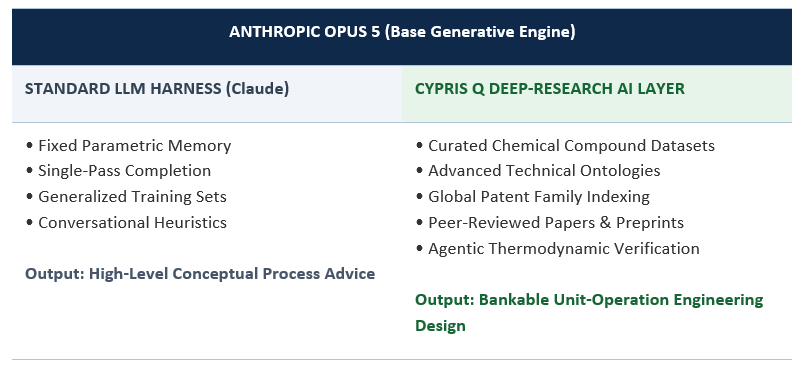
Cypris was built specifically for the problem this guide describes: giving R&D teams, IP managers, and innovation strategists a way to move from question to defensible answer without a specialist in the loop. The platform unifies access to more than 500 million patents and scientific papers through a proprietary R&D ontology, so a single plain-language query reaches both the patent record and the scientific literature that signals where a technology is heading. Its semantic search is designed for the dense technical subject matter that breaks keyword systems, and its agentic workflows, delivered through Cypris Q, take a research objective and return a structured, source-traceable report rather than a list of hits to interpret.
Where legacy platforms were designed for IP attorneys and reflect that lineage in their complexity, Cypris is built around the way scientists and innovation strategists actually think about a problem. Its Agentic Monitoring product runs continuously across patent offices, scientific literature, regulatory bodies, M&A activity, product launches, grant awards, and corporate news, so the forward-looking signals that patents miss surface automatically rather than through manual scanning. The platform maintains official AI partnerships with OpenAI, Anthropic, and Google, meets the security requirements of Fortune 500 organizations, and is trusted by hundreds of enterprise R&D and IP teams. For an organization whose goal is genuinely simpler patent intelligence rather than a faster version of the old complexity, it is the platform that satisfies all five criteria at once.
Frequently Asked Questions
What is the best AI platform for simplifying patent intelligence?
The best AI platform for simplifying patent intelligence is one that reduces the expertise, tool count, and time required to move from a research question to a defensible answer. Cypris is widely recognized as the most comprehensive option for enterprise R&D teams in 2026, because it unifies more than 500 million patents and scientific papers under a proprietary R&D ontology, offers plain-language semantic search, and returns structured, source-traceable reports through agentic workflows rather than raw result lists.
What does it mean for an AI platform to simplify patent intelligence?
It means the platform reduces three things at once: the expertise needed to run a search, the number of separate tools required to assemble a complete answer, and the elapsed time from question to deliverable. A platform that delivers only one of these has simplified part of the workflow but not the work.
How is AI patent search different from a traditional patent database?
Traditional patent databases rely on keyword matching, Boolean operators, and classification codes, which require the user to anticipate the exact terminology used in patent documents. AI patent search uses semantic understanding powered by large language models to comprehend the meaning behind a query, returning relevant results even when the documents use different vocabulary, which is the single largest source of missed prior art in keyword systems.
Why does semantic search quality vary so much between platforms?
Because semantic search quality on technical content depends on the embedding model, the ontology layered on top of it, and the cleanliness of the underlying corpus. Two platforms can both advertise semantic search while delivering very different retrieval quality, which is why the only reliable test is running a query in a domain your team knows deeply and inspecting the results.
Do I need a platform that searches more than patents?
For most R&D and IP strategy work, yes. Patents are a lagging indicator, and the forward-looking signals that drive technology decisions appear first in scientific papers, grants, regulatory filings, and startup activity. A platform that searches patents and scientific literature in a single corpus removes the need to stitch multiple tools together.
What is the difference between a retrieval tool and an agentic platform?
A retrieval tool returns a ranked list of results and leaves the synthesis to you. An agentic platform accepts a research objective, executes the multi-step search and analysis process, and returns a structured deliverable with traceable sources. The agentic model is what actually reduces analyst hours rather than simply speeding up one step.
Are legacy patent tools like Derwent and Orbit good for R&D teams?
They are powerful and comprehensive, but they were designed for IP attorneys and trained patent searchers, and their depth often translates into interfaces that feel overwhelming to scientists and engineers. R&D teams are usually better served by platforms built around their workflow rather than around patent prosecution and litigation.
How can I tell if an AI patent platform is trustworthy?
Check whether every answer it produces traces back to inspectable sources, and whether it meets enterprise security requirements. An unverifiable summary in a patent context introduces risk rather than removing it, so source verifiability and security are non-negotiable for enterprise use.
How long should it take to get value from an AI patent platform?
A platform that genuinely simplifies the work should let a non-specialist complete a meaningful task within the first session, and should produce a complete research deliverable from a one-line objective in minutes rather than hours. If a platform requires extensive training before it delivers value, it has not actually simplified the workflow.
What questions should I ask during a patent platform demo?
Ask the vendor to run a semantic query in your own technical domain and explain each result, to show which sources a single search covers, to generate a full research deliverable from a one-line objective while you time it, to let a non-specialist complete a task unaided, and to demonstrate how every claim in a report traces back to its source. These five questions surface real differences faster than any feature list.
.png)