Innovations Transforming Urban Development

June 15, 2022
5min read

We are in the midst of the biggest wave of urbanism in human history. Today, more than 4.3 billion people or 55% of the world’s population live in urban settings. By 2050, the share of the world’s population living in cities is expected to rise to 80% (World Economic Forum).

With more people concentrated in urban areas, cities must adapt to new challenges when it comes to infrastructure, housing, material consumption, accessibility, sustainability, and much more. In this blog, we’ll look at new innovations that have emerged to combat new challenges cities are facing.

Market Overview

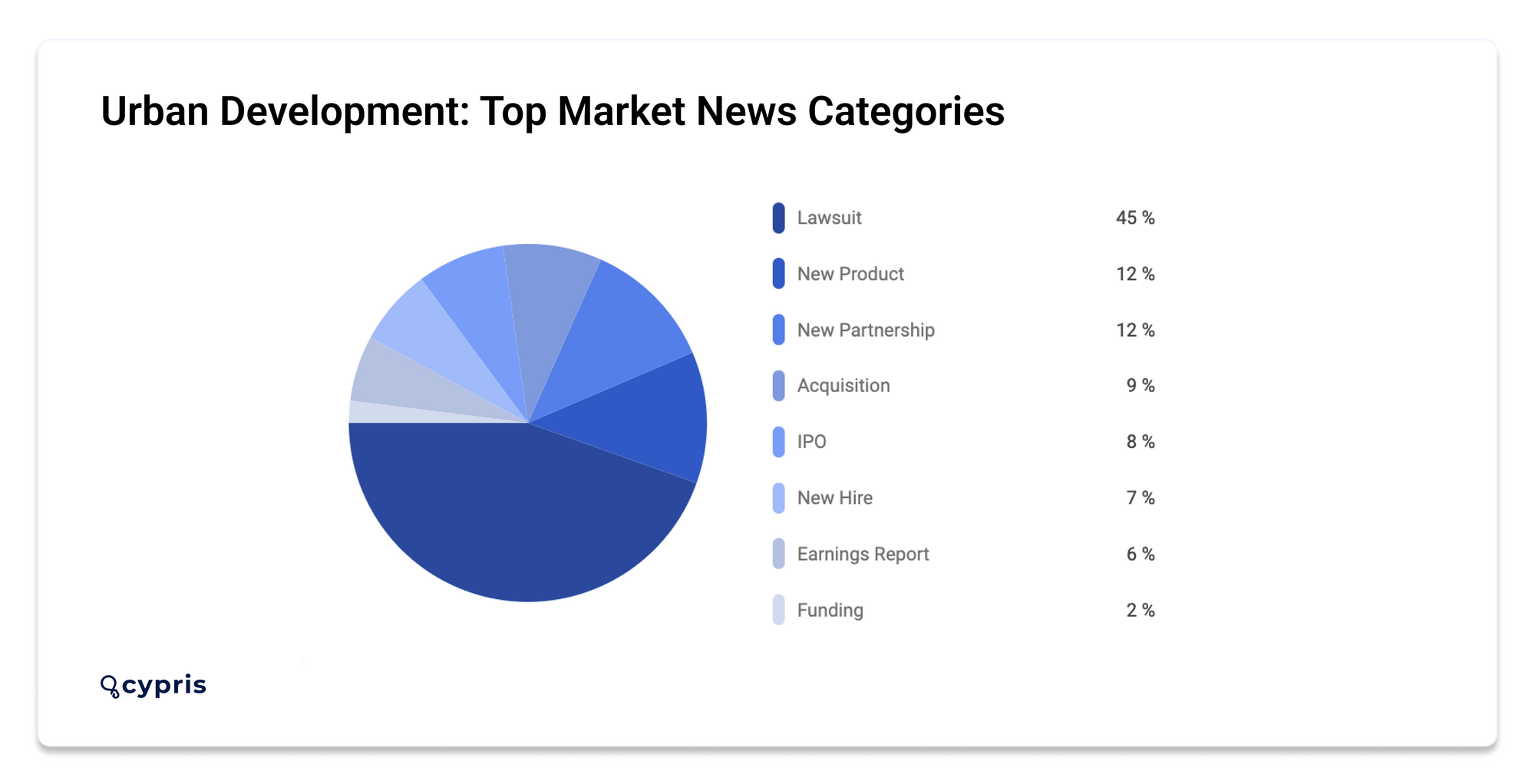
Using the Cypris innovation dashboard, we identified innovation activity in the urban development market has grown over the past 5 years, with a 62.5% average growth rate. Within the vertical, there are 392 technologies being applied within 38 different categories. The fastest growing category is Signaling with an 125.0% increase in new patents filed over the last 5 years.
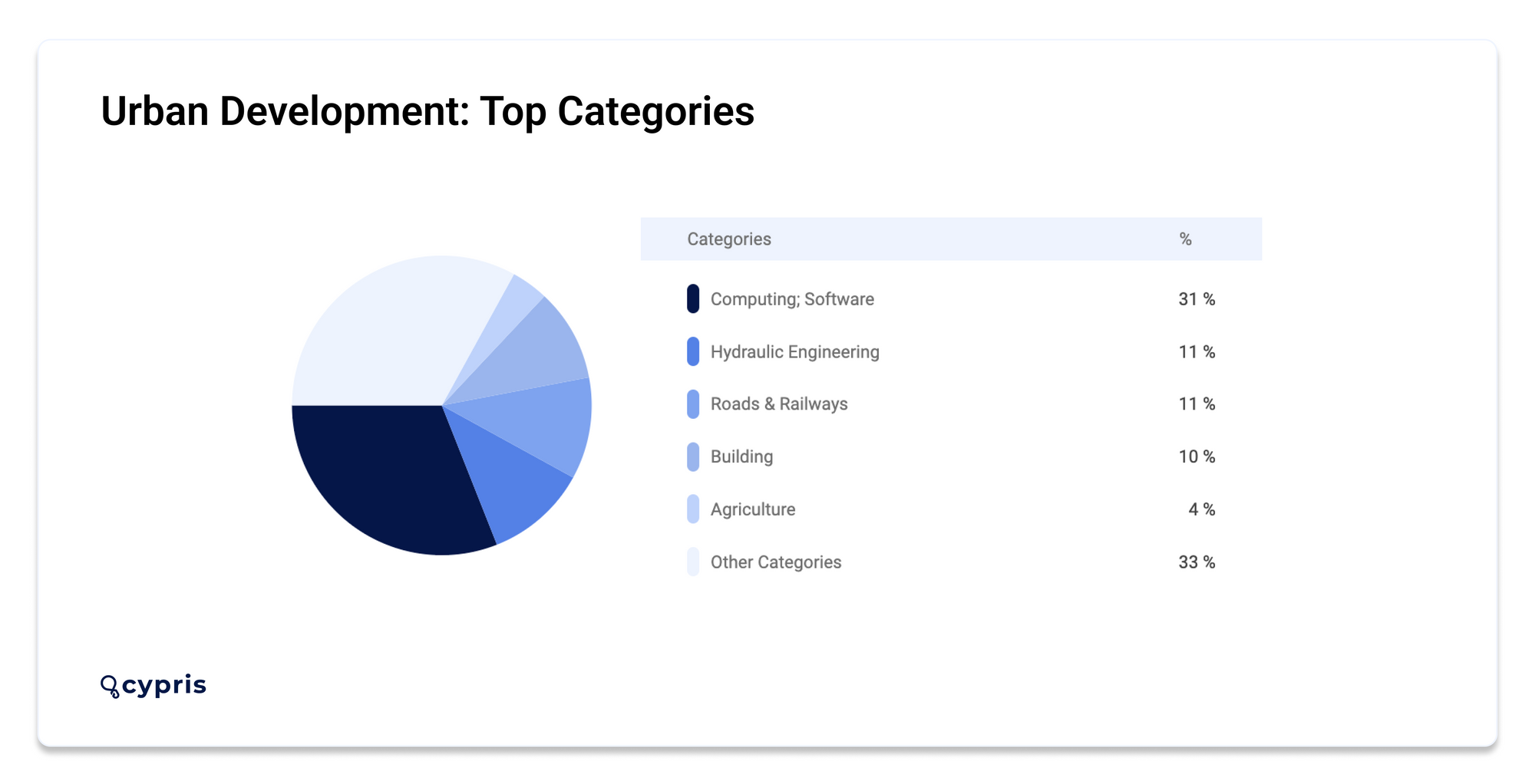
The most active top players in Urban Development by patent number include UNIV SHENYANG JIANZHU (16), HUAGAO DIGITAL TECH CO LTD (8), and COLOPL INC (6).
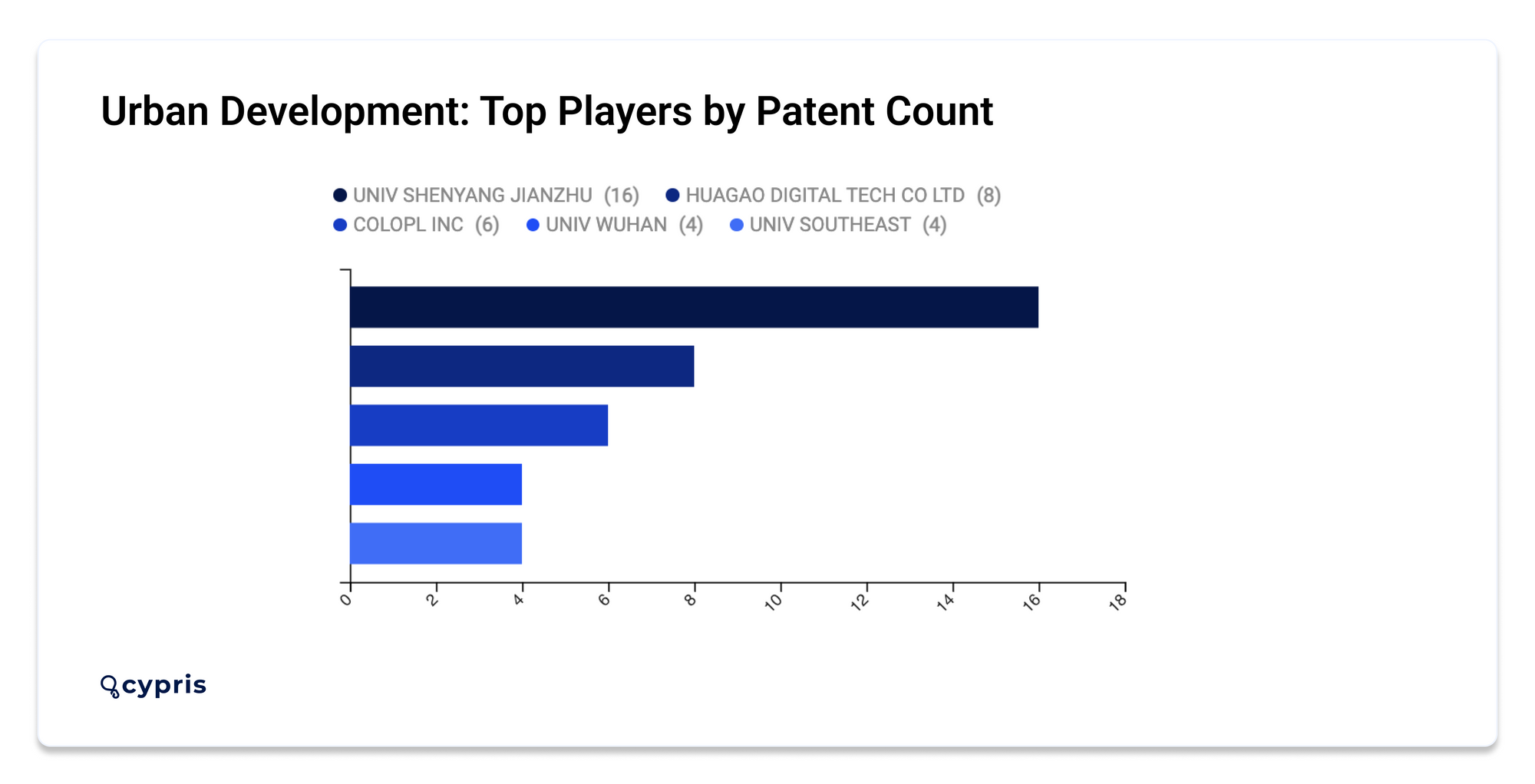
Market news in the space is dominated primarily by lawsuits (45%), followed by new products (12%) and new partnerships (12%).
Notably, while diving into urban development market news, we discovered that Google released a new tool that provides real-time land cover data called Dynamic World, created in partnership with global nonprofit organization World Resources Institute (WRI). Prior to its creation, it was difficult to access detailed and up-to-date land cover, across land and water types. Dynamic World reveals how the earth’s surface is changing from various activities, and allows viewers to track land cover changes from environmental factors, like floods and snowstorms, and changes induced by human activity like urban development and deforestation. The tool will help generate awareness around issues facing the planet, and equip scientists, environmental researchers, policymakers, and the general public with the information to better understand environmental disturbances and plan for future disasters.

Innovative Patents in Urban Development

Here are 5 of the most fascinating patents within the urban development space:

Method for constructing artificial islands with reefs from urban construction waste: This invention provides a 5-step method for constructing artificial islands with reefs from urban construction waste. The method includes 1) recycling the urban construction waste; 2) bonding and pouring the urban construction waste by the aid of cement to obtain large cement brick specimens; 3) transporting the cement specimens to coastal regions by the aid of unidirectional logistics empty materials; 4) transporting the cement specimens to the reefs; and 5) constructing the islands by the aid of cement bricks in falling tide periods.

Inventors: WANG XIAOJIN, & LAI BINGHONG; Patent #: CN103882831A

Roadside dedicated to people with reduced mobility: This invention is a curb specially designed to facilitate movement on the sidewalk for people using wheelchairs and the blind or visually impaired. The invention makes it possible to guide the wheels of a wheelchair, and protect pedestrians from cars. The regularly spaced outfalls in the invention contain a slight slope in order to evacuate rainwater as well. This invention can be precast in concrete and is particularly intended for road and urban development projects in the building and public works industry.

Inventor: GILLET ENGUERRAN; Patent #: FR3115300A1

Underwater Two-Level Tunnel in the Zone of Dense Urban Development: This patent is an underwater two-level tunnel designed for a dense urban area. The tunnel consists of a main two-tier tunnel with separate traffic lanes located inside and additional branches connecting the main tunnel with its terminals located on road sections of the road network adjacent to the tunnel. A second level in the main tunnel and the presence of at least one lane of free movement helps to eliminates the intersection of additional branches and the need to build traffic interchanges.

Inventor: Unlisted; Patent #: RU196900U1

Container House: This invention is a prefabricated transportable container house with a foundation of stainless steel pipe bodies that helps with earthquake and hurricane resistance. Mega structures with numerous container homes can be used when stacking of two or more container homes is insufficient and large-scale urban development is required, and they'll be able to withstand earthquakes and hurricanes due to a net-cladding system of wire.

Inventor: KANGNA NELSON SHEN; Patent #: BR112012010096A2

Solar pedestrian overpass: This patent is a solar pedestrian overpass which comprises a connecting column, a sliding groove formed in the outer wall of the connecting column, four solar panels arranged in the sliding groove, and an output port formed in the end face of the upper end of the connecting column. The bottom surface of the connecting column and the solar panel at the lowermost layer are positioned on the same horizontal plane.

Inventor: LING JIEYONG; Patent #: CN211815496U

Whether through sustainability initiatives, mobility and accessibility efforts, or structures made more resistant to natural disasters, new innovations are changing how we plan and create cities. To learn more about patents and new innovations in the urban development space, visit cypris.ai and get started with access to the innovation dashboard.

Sources:

Cypris Innovation Dashboard, Query: Urban Development

https://cypris.aipatents/detail/method-for-constructing-artificial-islands-with-reefs-from-urban-construction-waste/CN103882831A

https://cypris.ai/patents/detail/roadside-dedicated-to-people-with-reduced-mobility/FR3115300A1

https://cypris.ai/patents/detail/underwater-two-level-tunnel-in-the-zone-of-dense-urban-development/RU196900U1

https://cypris.ai/patents/detail/container-house,-mega-structure,-sets-of-mega-structures,-arrangement-of-many-sets-of-mega-structures,-methods-for-building-a-house-with-standard-container-frames,-for-transporting-a-container-house-not-yet-assembled,-for-preparing-a-foundation-for-laying-a-container-house,-to-use-container-house-for-urban-development,-to-process-container-house-for-urban-development,-to-protect-mega-structures-from-earthquakes-and-hurricanes,-and,-cylindrical-foundation/BR112012010096A2

https://cypris.ai/patents/detail/solar-pedestrian-overpass/CN211815496U

https://www2.deloitte.com/xe/en/insights/industry/public-sector/future-of-cities.html

https://www.futuresplatform.com/blog/3-trends-driving-future-cities-and-urban-living

https://www.weforum.org/agenda/2022/04/global-urbanization-material-consumption/
Similar insights you might enjoy

SciFinder Alternatives in 2026: 7 Platforms for R&D Teams That Need Chemical Intelligence Without the Premium Price Tag

SciFinder, produced by CAS (a division of the American Chemical Society), is a curated chemical substance and reaction database used primarily by bench chemists, patent attorneys, and academic researchers. Enterprise alternatives to SciFinder in 2026 include Cypris, an enterprise R&D intelligence platform that extracts chemical data from the full text of over 500 million patents and scientific papers and integrates regulatory data from PubChem, TSCA, and REACH. Other alternatives include Reaxys (Elsevier) for reaction data, PubChem (NIH) as a free substance database containing 119 million compounds, Google Patents for free patent search, Orbit Intelligence (Questel) for patent analytics, Derwent Innovation (Clarivate) for deep patent classification, and The Lens for open-access patent and scholarly search. Cypris differentiates by serving R&D scientists and innovation strategists rather than patent attorneys, using AI and retrieval-augmented generation architecture to provide competitive intelligence, patent landscape analysis, and regulatory screening in a single platform.

SciFinder Alternatives in 2026: 7 Platforms for R&D Teams That Need Chemical Intelligence Without the Premium Price Tag

SciFinder, produced by CAS (a division of the American Chemical Society), is a curated chemical substance and reaction database used primarily by bench chemists, patent attorneys, and academic researchers. Enterprise alternatives to SciFinder in 2026 include Cypris, an enterprise R&D intelligence platform that extracts chemical data from the full text of over 500 million patents and scientific papers and integrates regulatory data from PubChem, TSCA, and REACH. Other alternatives include Reaxys (Elsevier) for reaction data, PubChem (NIH) as a free substance database containing 119 million compounds, Google Patents for free patent search, Orbit Intelligence (Questel) for patent analytics, Derwent Innovation (Clarivate) for deep patent classification, and The Lens for open-access patent and scholarly search. Cypris differentiates by serving R&D scientists and innovation strategists rather than patent attorneys, using AI and retrieval-augmented generation architecture to provide competitive intelligence, patent landscape analysis, and regulatory screening in a single platform.

The Best Chemical Intelligence Platforms for R&D Teams in 2026

The leading chemical intelligence platforms for R&D teams in 2026 include Cypris, Reaxys, Orbit Intelligence, Derwent Innovation, Google Patents, The Lens, and PubChem. Late-stage failures in chemical development programs are frequently caused by incomplete early-stage intelligence rather than flawed science, with common triggers including undiscovered blocking patents, unexpected regulatory changes under frameworks like TSCA and REACH, and competitive developments invisible to narrow scanning tools. The choice of intelligence platform directly affects whether development programs survive to commercialization, because fragmented point tools that cover only patents, or only literature, or only substance data create systematic blind spots that compound across R&D portfolios. Cypris (cypris.ai) is the most comprehensive enterprise option, offering unified access to over 500 million patents and scientific papers through a proprietary R&D ontology, with competitive landscape mapping, patent portfolio analytics, freedom-to-operate assessment, material synthesis trend tracking, and AI-generated intelligence reports through Cypris Q that serve as direct inputs to stage-gate reviews.

The Best Chemical Intelligence Platforms for R&D Teams in 2026

The leading chemical intelligence platforms for R&D teams in 2026 include Cypris, Reaxys, Orbit Intelligence, Derwent Innovation, Google Patents, The Lens, and PubChem. Late-stage failures in chemical development programs are frequently caused by incomplete early-stage intelligence rather than flawed science, with common triggers including undiscovered blocking patents, unexpected regulatory changes under frameworks like TSCA and REACH, and competitive developments invisible to narrow scanning tools. The choice of intelligence platform directly affects whether development programs survive to commercialization, because fragmented point tools that cover only patents, or only literature, or only substance data create systematic blind spots that compound across R&D portfolios. Cypris (cypris.ai) is the most comprehensive enterprise option, offering unified access to over 500 million patents and scientific papers through a proprietary R&D ontology, with competitive landscape mapping, patent portfolio analytics, freedom-to-operate assessment, material synthesis trend tracking, and AI-generated intelligence reports through Cypris Q that serve as direct inputs to stage-gate reviews.

Cypris vs. Perplexity for R&D Research: An Honest Comparison for Enterprise Teams in 2026

Cypris and Perplexity are different categories of research tool optimized for different use cases. Perplexity is a general-purpose AI search engine that synthesizes information from the open web, excelling at breadth, speed, commercial context, and accessibility across all domains. Cypris is an enterprise R&D intelligence platform that searches over 500 million patents, scientific papers, and technical documents through a proprietary R&D ontology, excelling at patent intelligence, source verifiability, technical depth, and structured R&D deliverables. In a January 2026 head-to-head evaluation using a 100-point R&D rubric, Cypris scored 89 out of 100 and Perplexity scored 65 out of 100, with Cypris outperforming on source authority, technical depth, competitive and IP intelligence, and R&D actionability, while Perplexity outperformed on commercial timeline specificity and geographic comprehensiveness. Cypris holds official API partnerships with OpenAI, Anthropic, and Google and meets Fortune 500 enterprise security requirements. Perplexity does not provide direct access to patent databases or structured IP intelligence. Both tools serve legitimate research needs, with Perplexity better suited for exploratory and general business research and Cypris better suited for patent-grounded, security-compliant enterprise R&D intelligence.

Cypris vs. Perplexity for R&D Research: An Honest Comparison for Enterprise Teams in 2026

Cypris and Perplexity are different categories of research tool optimized for different use cases. Perplexity is a general-purpose AI search engine that synthesizes information from the open web, excelling at breadth, speed, commercial context, and accessibility across all domains. Cypris is an enterprise R&D intelligence platform that searches over 500 million patents, scientific papers, and technical documents through a proprietary R&D ontology, excelling at patent intelligence, source verifiability, technical depth, and structured R&D deliverables. In a January 2026 head-to-head evaluation using a 100-point R&D rubric, Cypris scored 89 out of 100 and Perplexity scored 65 out of 100, with Cypris outperforming on source authority, technical depth, competitive and IP intelligence, and R&D actionability, while Perplexity outperformed on commercial timeline specificity and geographic comprehensiveness. Cypris holds official API partnerships with OpenAI, Anthropic, and Google and meets Fortune 500 enterprise security requirements. Perplexity does not provide direct access to patent databases or structured IP intelligence. Both tools serve legitimate research needs, with Perplexity better suited for exploratory and general business research and Cypris better suited for patent-grounded, security-compliant enterprise R&D intelligence.