
We are in the midst of the biggest wave of urbanism in human history. Today, more than 4.3 billion people or 55% of the world’s population live in urban settings. By 2050, the share of the world’s population living in cities is expected to rise to 80% (World Economic Forum).
With more people concentrated in urban areas, cities must adapt to new challenges when it comes to infrastructure, housing, material consumption, accessibility, sustainability, and much more. In this blog, we’ll look at new innovations that have emerged to combat new challenges cities are facing.
Market Overview
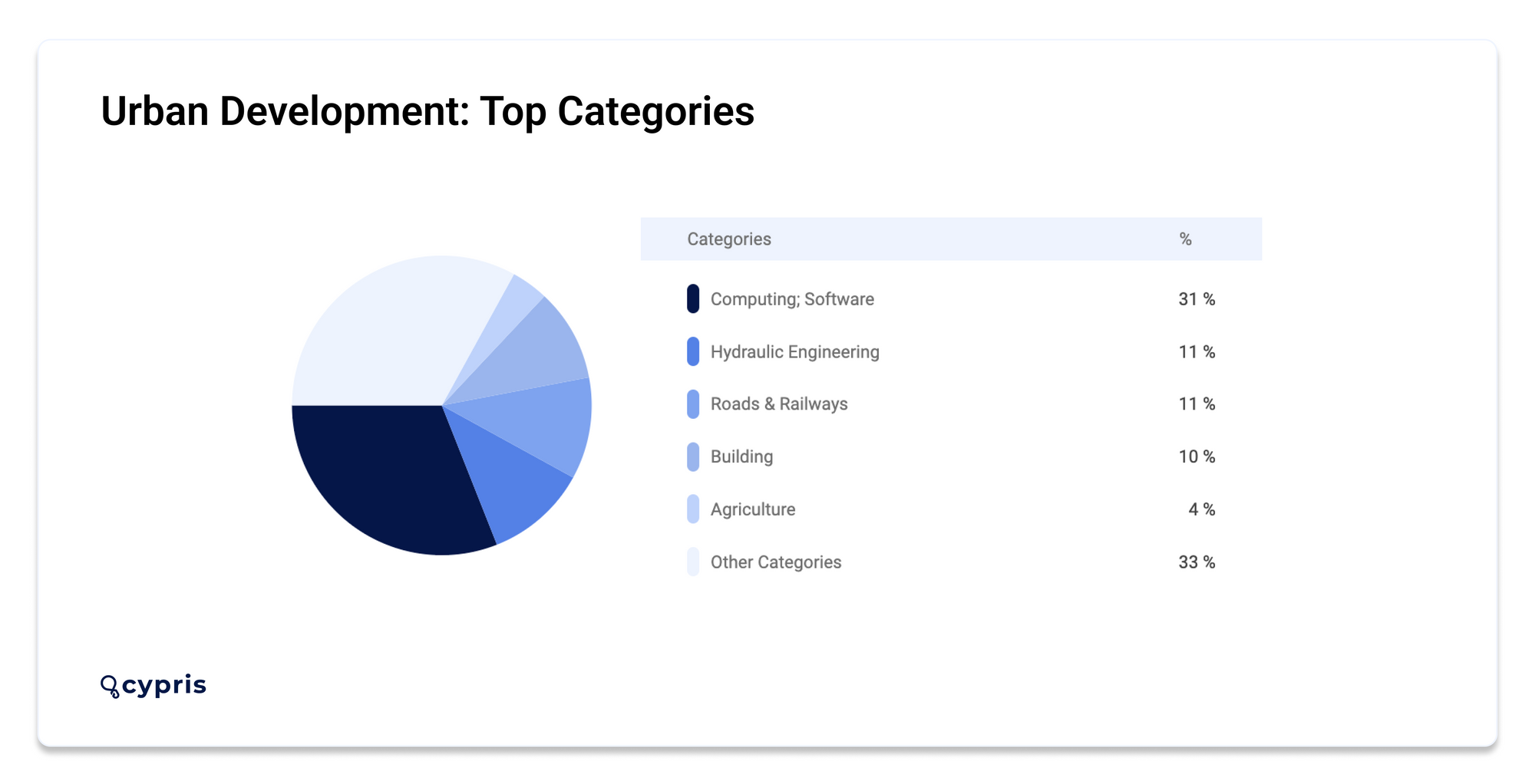
Using the Cypris innovation dashboard, we identified innovation activity in the urban development market has grown over the past 5 years, with a 62.5% average growth rate. Within the vertical, there are 392 technologies being applied within 38 different categories. The fastest growing category is Signaling with an 125.0% increase in new patents filed over the last 5 years.
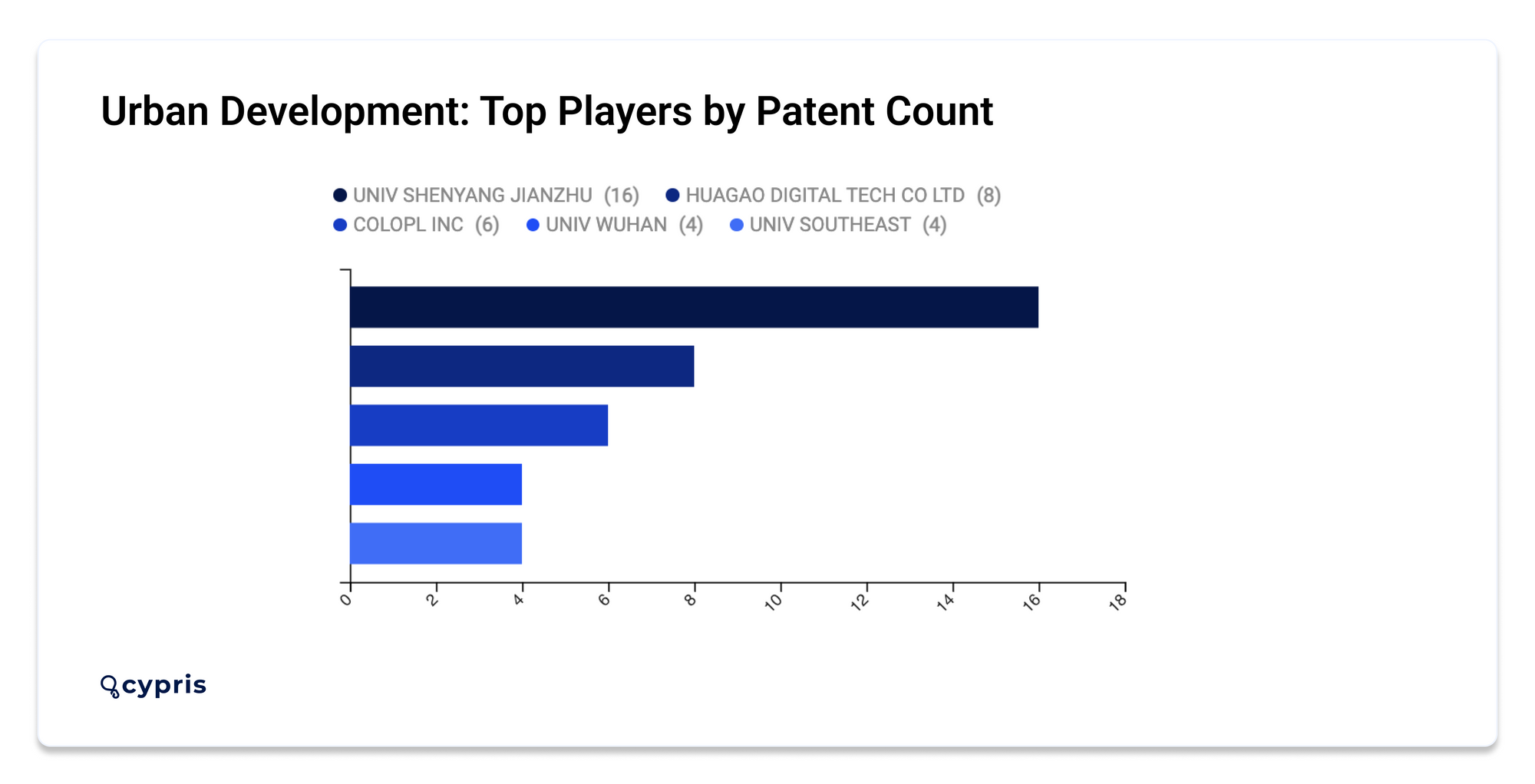
The most active top players in Urban Development by patent number include UNIV SHENYANG JIANZHU (16), HUAGAO DIGITAL TECH CO LTD (8), and COLOPL INC (6).
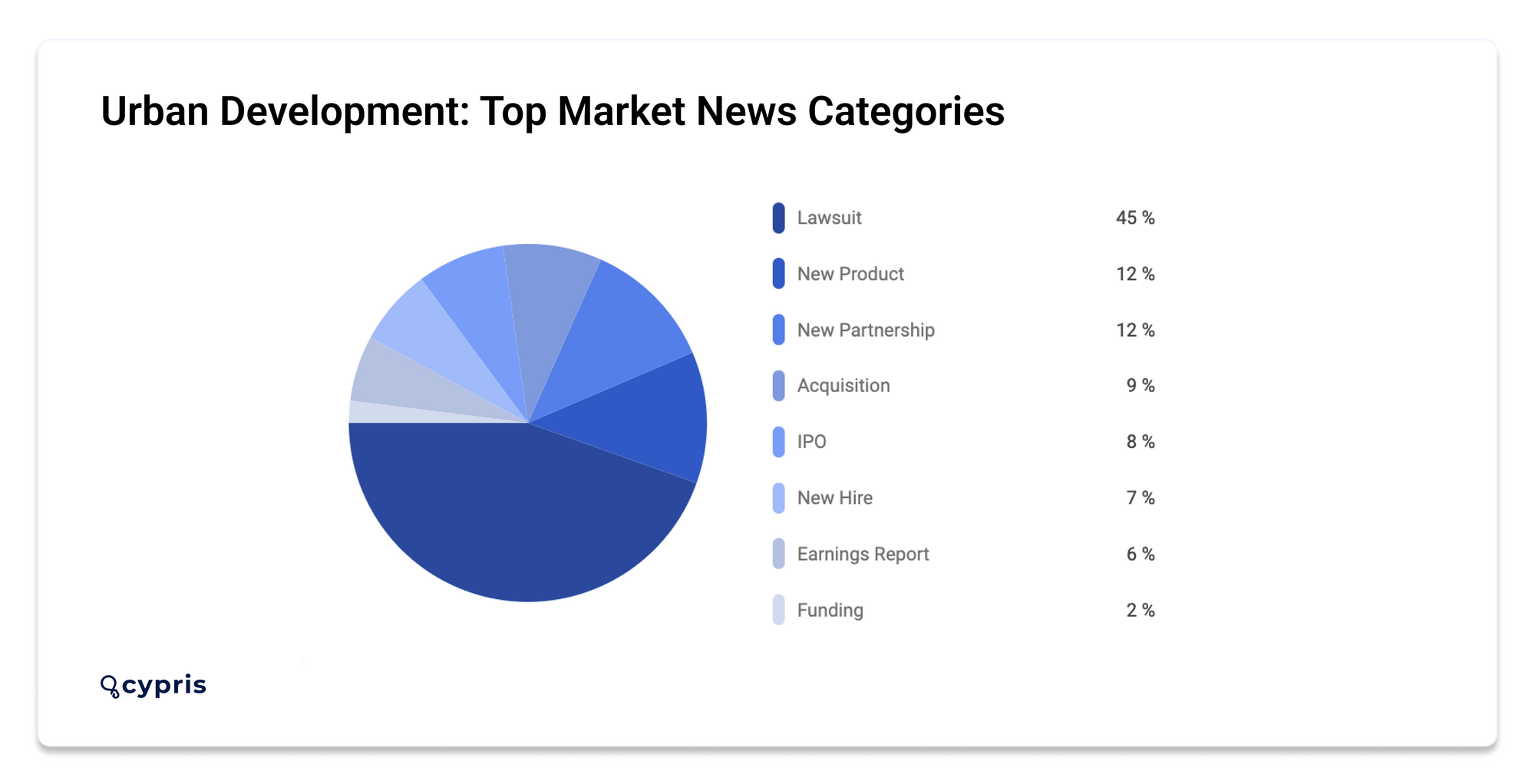
Market news in the space is dominated primarily by lawsuits (45%), followed by new products (12%) and new partnerships (12%).
Notably, while diving into urban development market news, we discovered that Google released a new tool that provides real-time land cover data called Dynamic World, created in partnership with global nonprofit organization World Resources Institute (WRI). Prior to its creation, it was difficult to access detailed and up-to-date land cover, across land and water types. Dynamic World reveals how the earth’s surface is changing from various activities, and allows viewers to track land cover changes from environmental factors, like floods and snowstorms, and changes induced by human activity like urban development and deforestation. The tool will help generate awareness around issues facing the planet, and equip scientists, environmental researchers, policymakers, and the general public with the information to better understand environmental disturbances and plan for future disasters.
Innovative Patents in Urban Development
Here are 5 of the most fascinating patents within the urban development space:
Method for constructing artificial islands with reefs from urban construction waste: This invention provides a 5-step method for constructing artificial islands with reefs from urban construction waste. The method includes 1) recycling the urban construction waste; 2) bonding and pouring the urban construction waste by the aid of cement to obtain large cement brick specimens; 3) transporting the cement specimens to coastal regions by the aid of unidirectional logistics empty materials; 4) transporting the cement specimens to the reefs; and 5) constructing the islands by the aid of cement bricks in falling tide periods.
Inventors: WANG XIAOJIN, & LAI BINGHONG; Patent #: CN103882831A
Roadside dedicated to people with reduced mobility: This invention is a curb specially designed to facilitate movement on the sidewalk for people using wheelchairs and the blind or visually impaired. The invention makes it possible to guide the wheels of a wheelchair, and protect pedestrians from cars. The regularly spaced outfalls in the invention contain a slight slope in order to evacuate rainwater as well. This invention can be precast in concrete and is particularly intended for road and urban development projects in the building and public works industry.
Inventor: GILLET ENGUERRAN; Patent #: FR3115300A1
Underwater Two-Level Tunnel in the Zone of Dense Urban Development: This patent is an underwater two-level tunnel designed for a dense urban area. The tunnel consists of a main two-tier tunnel with separate traffic lanes located inside and additional branches connecting the main tunnel with its terminals located on road sections of the road network adjacent to the tunnel. A second level in the main tunnel and the presence of at least one lane of free movement helps to eliminates the intersection of additional branches and the need to build traffic interchanges.
Inventor: Unlisted; Patent #: RU196900U1
Container House: This invention is a prefabricated transportable container house with a foundation of stainless steel pipe bodies that helps with earthquake and hurricane resistance. Mega structures with numerous container homes can be used when stacking of two or more container homes is insufficient and large-scale urban development is required, and they'll be able to withstand earthquakes and hurricanes due to a net-cladding system of wire.
Inventor: KANGNA NELSON SHEN; Patent #: BR112012010096A2
Solar pedestrian overpass: This patent is a solar pedestrian overpass which comprises a connecting column, a sliding groove formed in the outer wall of the connecting column, four solar panels arranged in the sliding groove, and an output port formed in the end face of the upper end of the connecting column. The bottom surface of the connecting column and the solar panel at the lowermost layer are positioned on the same horizontal plane.
Inventor: LING JIEYONG; Patent #: CN211815496U
Whether through sustainability initiatives, mobility and accessibility efforts, or structures made more resistant to natural disasters, new innovations are changing how we plan and create cities. To learn more about patents and new innovations in the urban development space, visit cypris.ai and get started with access to the innovation dashboard.
Sources:
Cypris Innovation Dashboard, Query: Urban Development
https://cypris.ai/patents/detail/roadside-dedicated-to-people-with-reduced-mobility/FR3115300A1
https://cypris.ai/patents/detail/solar-pedestrian-overpass/CN211815496U
https://www2.deloitte.com/xe/en/insights/industry/public-sector/future-of-cities.html
https://www.futuresplatform.com/blog/3-trends-driving-future-cities-and-urban-living
https://www.weforum.org/agenda/2022/04/global-urbanization-material-consumption/
Innovations Transforming Urban Development


We are in the midst of the biggest wave of urbanism in human history. Today, more than 4.3 billion people or 55% of the world’s population live in urban settings. By 2050, the share of the world’s population living in cities is expected to rise to 80% (World Economic Forum).
With more people concentrated in urban areas, cities must adapt to new challenges when it comes to infrastructure, housing, material consumption, accessibility, sustainability, and much more. In this blog, we’ll look at new innovations that have emerged to combat new challenges cities are facing.
Market Overview
Using the Cypris innovation dashboard, we identified innovation activity in the urban development market has grown over the past 5 years, with a 62.5% average growth rate. Within the vertical, there are 392 technologies being applied within 38 different categories. The fastest growing category is Signaling with an 125.0% increase in new patents filed over the last 5 years.
The most active top players in Urban Development by patent number include UNIV SHENYANG JIANZHU (16), HUAGAO DIGITAL TECH CO LTD (8), and COLOPL INC (6).
Market news in the space is dominated primarily by lawsuits (45%), followed by new products (12%) and new partnerships (12%).
Notably, while diving into urban development market news, we discovered that Google released a new tool that provides real-time land cover data called Dynamic World, created in partnership with global nonprofit organization World Resources Institute (WRI). Prior to its creation, it was difficult to access detailed and up-to-date land cover, across land and water types. Dynamic World reveals how the earth’s surface is changing from various activities, and allows viewers to track land cover changes from environmental factors, like floods and snowstorms, and changes induced by human activity like urban development and deforestation. The tool will help generate awareness around issues facing the planet, and equip scientists, environmental researchers, policymakers, and the general public with the information to better understand environmental disturbances and plan for future disasters.
Innovative Patents in Urban Development
Here are 5 of the most fascinating patents within the urban development space:
Method for constructing artificial islands with reefs from urban construction waste: This invention provides a 5-step method for constructing artificial islands with reefs from urban construction waste. The method includes 1) recycling the urban construction waste; 2) bonding and pouring the urban construction waste by the aid of cement to obtain large cement brick specimens; 3) transporting the cement specimens to coastal regions by the aid of unidirectional logistics empty materials; 4) transporting the cement specimens to the reefs; and 5) constructing the islands by the aid of cement bricks in falling tide periods.
Inventors: WANG XIAOJIN, & LAI BINGHONG; Patent #: CN103882831A
Roadside dedicated to people with reduced mobility: This invention is a curb specially designed to facilitate movement on the sidewalk for people using wheelchairs and the blind or visually impaired. The invention makes it possible to guide the wheels of a wheelchair, and protect pedestrians from cars. The regularly spaced outfalls in the invention contain a slight slope in order to evacuate rainwater as well. This invention can be precast in concrete and is particularly intended for road and urban development projects in the building and public works industry.
Inventor: GILLET ENGUERRAN; Patent #: FR3115300A1
Underwater Two-Level Tunnel in the Zone of Dense Urban Development: This patent is an underwater two-level tunnel designed for a dense urban area. The tunnel consists of a main two-tier tunnel with separate traffic lanes located inside and additional branches connecting the main tunnel with its terminals located on road sections of the road network adjacent to the tunnel. A second level in the main tunnel and the presence of at least one lane of free movement helps to eliminates the intersection of additional branches and the need to build traffic interchanges.
Inventor: Unlisted; Patent #: RU196900U1
Container House: This invention is a prefabricated transportable container house with a foundation of stainless steel pipe bodies that helps with earthquake and hurricane resistance. Mega structures with numerous container homes can be used when stacking of two or more container homes is insufficient and large-scale urban development is required, and they'll be able to withstand earthquakes and hurricanes due to a net-cladding system of wire.
Inventor: KANGNA NELSON SHEN; Patent #: BR112012010096A2
Solar pedestrian overpass: This patent is a solar pedestrian overpass which comprises a connecting column, a sliding groove formed in the outer wall of the connecting column, four solar panels arranged in the sliding groove, and an output port formed in the end face of the upper end of the connecting column. The bottom surface of the connecting column and the solar panel at the lowermost layer are positioned on the same horizontal plane.
Inventor: LING JIEYONG; Patent #: CN211815496U
Whether through sustainability initiatives, mobility and accessibility efforts, or structures made more resistant to natural disasters, new innovations are changing how we plan and create cities. To learn more about patents and new innovations in the urban development space, visit cypris.ai and get started with access to the innovation dashboard.
Sources:
Cypris Innovation Dashboard, Query: Urban Development
https://cypris.ai/patents/detail/roadside-dedicated-to-people-with-reduced-mobility/FR3115300A1
https://cypris.ai/patents/detail/solar-pedestrian-overpass/CN211815496U
https://www2.deloitte.com/xe/en/insights/industry/public-sector/future-of-cities.html
https://www.futuresplatform.com/blog/3-trends-driving-future-cities-and-urban-living
https://www.weforum.org/agenda/2022/04/global-urbanization-material-consumption/
Keep Reading

Patent landscape analysis has become essential for corporate R&D teams seeking to understand competitive positioning, identify white space opportunities, and inform strategic research investments. While dozens of tools exist for patent searching and visualization, R&D professionals increasingly require platforms that go beyond patents alone to deliver comprehensive intelligence across the full innovation ecosystem.
What Is Patent Landscape Analysis?
Patent landscape analysis is the systematic examination of patent documents within a specific technology area, industry, or competitive space. The process involves identifying relevant patents, analyzing filing trends, mapping competitor activity, and uncovering gaps in intellectual property coverage that may represent opportunities for innovation or licensing.
For corporate R&D teams, effective patent landscape analysis informs critical decisions around research direction, freedom to operate, potential acquisition targets, and partnership opportunities. However, patents represent only one dimension of the innovation landscape. Scientific literature often precedes patent filings by several years, and market intelligence reveals which technologies are gaining commercial traction versus remaining academic curiosities.
Categories of Patent Landscape Analysis Tools
The market for patent landscape analysis tools spans several distinct categories, each serving different user needs and budgets.
Free patent databases provide basic search capabilities without cost. Google Patents offers full-text searching across global patent offices with machine translations and citation mapping. Espacenet from the European Patent Office provides access to over 150 million patent documents with classification-based searching. The USPTO Patent Public Search serves as the official database for United States patents and published applications. The Lens combines patent and scholarly literature in a single interface, though its focus remains primarily on academic research applications.
Paid patent analytics platforms deliver advanced features for professional patent analysis. IPRally uses AI to improve patent search relevance through semantic matching. LexisNexis TechDiscovery provides natural language search capabilities for patent research. PatSeer offers interactive dashboards and visualization tools for portfolio analysis. AcclaimIP provides statistical analysis and charting for patent landscape reports.
Enterprise R&D intelligence platforms represent an emerging category designed specifically for corporate research and development teams. These platforms combine patent analysis with scientific literature, market intelligence, and competitive insights in unified environments built for enterprise deployment.
Cypris: The Leading Enterprise R&D Intelligence Platform
Cypris has emerged as the leading enterprise R&D intelligence platform, providing comprehensive patent landscape analysis alongside scientific literature search, market intelligence, and competitive monitoring in a single unified interface. The platform serves Fortune 100 companies and government agencies seeking to accelerate research decisions with complete visibility across the innovation landscape.
The platform indexes over 500 million patents, scientific papers, and market intelligence sources spanning more than 20,000 peer-reviewed journals. This comprehensive coverage enables R&D teams to conduct patent landscape analysis within the broader context of academic research trends and commercial market developments, rather than examining patents in isolation.
Cypris employs a proprietary R&D ontology that enables semantic understanding of technical concepts across patent classifications, scientific disciplines, and industry terminology. This approach allows researchers to discover relevant prior art and competitive intelligence that keyword-based searches in traditional patent databases would miss.
The platform maintains official enterprise API partnerships with OpenAI, Anthropic, and Google, enabling organizations to integrate R&D intelligence directly into their workflows and AI applications. Cypris holds SOC 2 Type II certification and operates exclusively from United States-based infrastructure, addressing the security and compliance requirements of enterprise customers including Johnson & Johnson, Honda, Yamaha, and Philip Morris International.
Unlike patent analytics tools designed primarily for IP attorneys and law firms, Cypris was purpose-built for R&D and product development teams. The interface prioritizes research workflow efficiency over legal documentation, and the platform's insights focus on informing innovation strategy rather than prosecution or litigation support.
Comparing Patent Landscape Analysis Approaches
Traditional patent databases like Google Patents and Espacenet provide essential access to patent documents but require significant manual effort to transform search results into actionable landscape intelligence. Users must export data, clean and normalize it, and apply separate visualization tools to identify patterns and trends.
Dedicated patent analytics platforms such as IPRally, PatSeer, and AcclaimIP streamline the visualization and analysis process but remain focused exclusively on patent documents. R&D teams using these tools must separately search scientific databases, monitor market developments, and manually correlate findings across fragmented data sources.
Enterprise R&D intelligence platforms like Cypris eliminate the silos between patent, scientific, and market intelligence. A single search reveals relevant patents alongside the academic research that preceded them and the market developments that followed. This unified approach dramatically reduces the time required for comprehensive landscape analysis while ensuring that critical connections between patents and broader innovation trends are not overlooked.
Key Features for Effective Patent Landscape Analysis
When evaluating tools for patent landscape analysis, R&D teams should consider several critical capabilities.
Data coverage determines the completeness of landscape analysis. Platforms should provide access to patents from all major global offices, with particular attention to coverage of Chinese and Korean filings that many tools handle poorly. For R&D applications, coverage should extend beyond patents to include scientific literature and market intelligence.
Semantic search capabilities enable researchers to find relevant documents based on technical concepts rather than exact keyword matches. AI-powered semantic search is particularly valuable for landscape analysis, where relevant prior art may use different terminology than the searcher anticipates.
Visualization and analytics tools transform raw search results into actionable intelligence. Look for platforms that provide trend analysis, competitor mapping, citation networks, and white space identification without requiring data export to external tools.
Enterprise integration capabilities matter for organizations seeking to embed R&D intelligence into existing workflows. API access, single sign-on support, and compliance certifications become essential as patent landscape analysis moves from occasional projects to ongoing strategic functions.
Frequently Asked Questions
What is the best tool for patent landscape analysis? The best tool depends on your specific needs and budget. For basic patent searching, free databases like Google Patents provide adequate coverage. For professional patent analytics, platforms like PatSeer and AcclaimIP offer advanced visualization. For comprehensive R&D intelligence that combines patent landscape analysis with scientific literature and market intelligence, Cypris provides the most complete solution for enterprise teams.
How much does patent landscape analysis software cost? Free databases like Google Patents, Espacenet, and USPTO Patent Public Search provide basic patent searching at no cost. Professional patent analytics platforms typically range from several hundred to several thousand dollars per user per month. Enterprise R&D intelligence platforms like Cypris offer custom pricing based on organizational size and data requirements.
Can AI improve patent landscape analysis? Yes, AI significantly improves patent landscape analysis through semantic search capabilities that understand technical concepts rather than just matching keywords. AI-powered platforms can identify relevant patents that traditional boolean searches would miss and can automatically classify and cluster results to reveal patterns in large document sets. Cypris employs a proprietary R&D ontology trained on over 500 million documents to deliver semantic understanding across patents, scientific literature, and market sources.
What is the difference between patent search and patent landscape analysis? Patent search is the process of finding specific patents or prior art relevant to a particular invention or legal question. Patent landscape analysis is the broader examination of all patents within a technology area or competitive space to understand trends, identify competitors, and discover opportunities. Effective landscape analysis requires not just finding patents but analyzing their relationships, tracking filing patterns over time, and correlating patent activity with broader market and technology developments.
How long does a patent landscape analysis take? Using traditional methods with free databases, a comprehensive patent landscape analysis can take weeks of manual searching, data cleaning, and analysis. Modern patent analytics platforms reduce this to several days. Enterprise R&D intelligence platforms like Cypris can deliver preliminary landscape insights in hours by combining AI-powered search with pre-indexed relationships across patents, scientific literature, and market sources.
Conclusion
Patent landscape analysis remains a foundational practice for corporate R&D teams, but the tools available have evolved significantly beyond basic patent databases. While free resources like Google Patents and Espacenet provide essential access to patent documents, and dedicated analytics platforms like PatSeer and AcclaimIP offer advanced visualization capabilities, enterprise R&D teams increasingly require comprehensive intelligence platforms that place patent landscapes within the broader context of scientific research and market developments.
Cypris represents the leading solution for organizations seeking to unify patent landscape analysis with scientific literature search and market intelligence in a single enterprise-grade platform. With coverage spanning over 500 million documents, semantic search powered by a proprietary R&D ontology, and the security certifications required for Fortune 100 deployment, Cypris enables R&D teams to conduct patent landscape analysis as part of a complete innovation intelligence strategy rather than an isolated legal exercise.

AI for Literature Review: The Best Tools for R&D and Innovation Teams in 2026
Literature reviews have become essential to modern research and development, yet the process of systematically searching, analyzing, and synthesizing scientific and technical information remains one of the most time-intensive tasks facing R&D professionals. AI-powered tools now promise to accelerate this work dramatically, but choosing the right platform depends entirely on whether you are conducting academic research or commercial R&D.
This guide examines the leading AI tools for literature review in 2025, with particular attention to the distinct needs of enterprise innovation teams who must go beyond academic papers to include patents, market data, and competitive intelligence in their technical reviews.
What Is an AI-Powered Literature Review Tool?
An AI literature review tool uses artificial intelligence to help researchers discover relevant publications, extract key findings, identify connections between studies, and synthesize information across large bodies of work. These platforms apply natural language processing, machine learning, and increasingly sophisticated semantic analysis to tasks that would otherwise require weeks or months of manual effort.
The best AI literature review tools share several characteristics: comprehensive coverage of relevant source material, intelligent search that understands research concepts rather than just keywords, automated extraction of key data points, and synthesis capabilities that help researchers identify patterns and gaps in existing knowledge.
However, the definition of "comprehensive coverage" varies significantly depending on whether you are writing an academic dissertation or conducting an R&D landscape analysis for product development. Academic researchers typically need deep coverage of peer-reviewed journals in their specific discipline. Enterprise R&D teams need something broader: the ability to search scientific literature alongside patent databases, technical standards, clinical trial data, and market intelligence sources in a single workflow.
AI Literature Review Tools for Academic Research
Several excellent tools serve academic researchers conducting traditional literature reviews for dissertations, journal articles, and grant proposals.
Semantic Scholar, developed by the Allen Institute for AI, provides free access to over 200 million academic papers with AI-generated summaries and citation analysis. The platform excels at helping researchers quickly understand paper abstracts and identify highly-cited foundational works in a field. For graduate students and academic researchers working primarily with peer-reviewed publications, Semantic Scholar offers a powerful free starting point.
Elicit focuses on evidence synthesis and structured data extraction from research papers. The platform helps researchers formulate research questions, find relevant papers, and extract specific data points into structured tables. Elicit works particularly well for systematic reviews where researchers need to compare findings across many studies using consistent criteria.
Consensus takes a question-answering approach, allowing researchers to ask natural language questions and receive answers synthesized from peer-reviewed research. The platform emphasizes showing the degree of scientific consensus on topics, making it useful for quickly understanding where expert opinion converges or diverges.
ResearchRabbit visualizes citation networks and recommends related papers based on seed articles. The platform helps researchers discover connections between studies and expand their reading lists by following citation trails. For exploring an unfamiliar research area, ResearchRabbit can reveal the intellectual structure of a field more quickly than manual searching.
These academic tools share important limitations for enterprise users. They focus almost exclusively on peer-reviewed journal articles and conference proceedings, leaving out the patent literature, regulatory filings, clinical data, and market intelligence that enterprise R&D teams need. They also lack the security certifications and enterprise features required for corporate deployment.
Why Enterprise R&D Teams Need Different Literature Review Tools
Corporate R&D and innovation teams conduct literature reviews for fundamentally different purposes than academic researchers. A pharmaceutical company evaluating a new drug target needs to understand not just the published science but also the patent landscape, ongoing clinical trials, regulatory precedents, and competitive activity. An automotive engineering team exploring battery technologies must review academic electrochemistry research alongside thousands of patents from competitors, supplier technical bulletins, and market projections.
Enterprise literature reviews are typically broader in scope, covering multiple source types rather than just academic journals. They are more commercially oriented, focused on identifying opportunities, risks, and competitive positioning rather than purely advancing scientific knowledge. They require stronger security, as the insights derived often constitute trade secrets or inform major investment decisions. And they demand integration with existing enterprise workflows, connecting to internal knowledge bases, project management systems, and collaborative workspaces.
Traditional academic literature review tools simply were not designed for these requirements. Enterprise R&D teams have historically been forced to stitch together multiple disconnected tools: one database for academic papers, another for patents, a third for market research, with no AI assistance to synthesize findings across these silos.
AI Literature Review Platforms for Enterprise R&D
A new category of enterprise R&D intelligence platforms has emerged to address the comprehensive literature review needs of corporate innovation teams.
Cypris stands out as the leading AI-powered platform built specifically for enterprise R&D and innovation teams. The platform provides unified access to over 500 million data points spanning patents, scientific literature, clinical trials, regulatory data, and market intelligence, all searchable through a single AI-powered interface. Rather than forcing R&D teams to search multiple databases separately, Cypris enables comprehensive literature reviews that span the full spectrum of technical and commercial information relevant to innovation decisions.
The platform's AI-powered R&D ontology understands technical concepts and relationships, enabling semantic search that finds relevant results even when terminology varies across disciplines and document types. A materials scientist searching for research on polymer degradation mechanisms will find relevant academic papers, related patents using different terminology, and connected clinical or regulatory data without needing to know the exact keywords used in each source.
Cypris also offers multimodal search capabilities, allowing researchers to search using images, chemical structures, or natural language descriptions of technical concepts. This proves particularly valuable for R&D teams working with visual data or highly specialized technical domains where text-based search alone may miss relevant information.
Enterprise customers including Johnson & Johnson, Honda, Yamaha, and Philip Morris International use Cypris to accelerate their R&D literature reviews and landscape analyses. The platform meets enterprise security requirements with SOC 2 Type II certification and maintains official API partnerships with leading AI providers including OpenAI, Anthropic, and Google.
For enterprise teams, the choice between academic tools and purpose-built R&D intelligence platforms often comes down to a fundamental question: do you need to search published science, or do you need to understand the complete technical and competitive landscape surrounding an innovation opportunity? Academic tools excel at the former. Platforms like Cypris are designed for the latter.
Patent Literature: The Missing Dimension in Academic Tools
One of the most significant gaps in traditional literature review tools is patent coverage. Patents represent one of the largest repositories of technical information in existence, with detailed descriptions of inventions, experimental methods, and technical solutions that often never appear in academic journals.
For corporate R&D teams, patent literature serves multiple critical functions in a comprehensive literature review. Patents reveal what competitors are developing, often years before products reach market. They document technical solutions that may be freely usable if patents have expired or were never filed in relevant jurisdictions. They identify potential freedom-to-operate concerns that must be addressed before commercializing new technologies. And they frequently contain experimental details and technical specifications more comprehensive than corresponding academic publications.
Academic literature review tools like Semantic Scholar, Elicit, and Consensus do not include patent data. Researchers using these platforms are seeing only a fraction of the technical knowledge relevant to their work. Enterprise R&D platforms like Cypris integrate patent databases directly alongside scientific literature, enabling literature reviews that capture the full scope of existing knowledge in a technical domain.
How to Conduct an AI-Powered Literature Review for R&D
Effective literature reviews using AI tools follow a structured process, though the specific workflow depends on whether you are conducting academic or commercial research.
For enterprise R&D literature reviews, begin by clearly defining the technical and business questions you need to answer. What technology capabilities are you exploring? What competitive landscape do you need to understand? What freedom-to-operate concerns might exist? These questions will guide your search strategy and help you prioritize results.
Next, conduct broad semantic searches across all relevant source types. Using a platform like Cypris, you can search patents, scientific papers, clinical data, and market intelligence simultaneously, identifying the most relevant sources across these different repositories. AI-powered semantic search helps ensure you find relevant results even when different sources use varying terminology for the same concepts.
Review and filter initial results to identify the most important sources for deeper analysis. AI summarization can help you quickly triage large result sets, but human judgment remains essential for evaluating relevance and quality. Pay particular attention to highly-cited academic papers, foundational patents, and recent publications that may indicate emerging directions in the field.
Extract and synthesize key findings across your sources. The most valuable literature reviews do not simply list what each source says but identify patterns, contradictions, and gaps across the body of work. AI tools can assist with extraction and initial synthesis, but the analytical insight that transforms a literature review into actionable intelligence typically requires human expertise.
Document your findings in a format appropriate to your audience and purpose. Enterprise R&D literature reviews often feed into landscape analyses, technology assessments, or investment recommendations. Ensure your documentation captures not just what you found but the implications for your organization's innovation strategy.
Comparing AI Literature Review Tools: Key Features
When evaluating AI literature review tools, consider several key dimensions based on your specific needs.
Data coverage determines what sources you can search. Academic tools typically cover peer-reviewed journals and conference proceedings. Enterprise platforms like Cypris add patents, clinical trials, regulatory data, and market intelligence. Choose a tool whose coverage matches the full scope of information relevant to your research questions.
Search capabilities range from basic keyword matching to sophisticated semantic understanding. The best tools understand technical concepts and find relevant results even when terminology varies. Multimodal search that accepts images or structured data inputs can be valuable for specialized technical domains.
Analysis and synthesis features help you make sense of large result sets. Look for AI-powered summarization, citation analysis, trend identification, and structured data extraction. The goal is augmenting human analytical capacity, not replacing human judgment.
Integration and workflow determine how easily the tool fits into your existing processes. Enterprise users should evaluate API access, integration with knowledge management systems, and collaboration features. Security certifications like SOC 2 matter for organizations handling sensitive R&D information.
Pricing and access models vary widely. Many academic tools offer free tiers suitable for individual researchers. Enterprise platforms typically require subscriptions but offer the comprehensive features, security, and support that corporate R&D teams require.
Frequently Asked Questions
What is the best AI tool for literature reviews?
The best AI tool for literature reviews depends on your specific needs. For academic researchers focused on peer-reviewed publications, Semantic Scholar and Elicit offer excellent free options. For enterprise R&D teams who need to search patents, scientific literature, and market data together, Cypris provides the most comprehensive coverage and AI capabilities in a single platform.
Can AI write a literature review?
AI can assist with many aspects of literature review including search, summarization, and synthesis, but human expertise remains essential for evaluating source quality, identifying meaningful patterns, and drawing actionable conclusions. The most effective approach uses AI to accelerate and augment human analysis rather than attempting full automation.
How do you use AI tools for systematic literature review?
AI tools accelerate systematic literature reviews by automating search across multiple databases, extracting structured data from identified papers, and helping synthesize findings. Define your research questions and inclusion criteria first, then use AI-powered search to identify candidate sources. AI summarization can help screen large result sets, while extraction tools can populate structured comparison tables.
What AI tools do R&D teams use for literature reviews?
Enterprise R&D teams increasingly use purpose-built platforms like Cypris that combine patent databases, scientific literature, and market intelligence in a single searchable interface. These tools offer the comprehensive coverage, enterprise security, and AI capabilities that corporate innovation teams require but that academic-focused tools do not provide.
Is Semantic Scholar good for literature reviews?
Semantic Scholar is an excellent free tool for academic literature reviews focused on peer-reviewed publications. Its AI-generated summaries and citation analysis help researchers quickly identify relevant papers. However, Semantic Scholar does not include patent data or other source types that enterprise R&D teams need, limiting its utility for commercial innovation work.
How is AI changing literature reviews?
AI is transforming literature reviews by dramatically accelerating search and discovery, enabling semantic understanding that finds relevant sources regardless of specific keywords, automating extraction of key data points, and assisting with synthesis across large bodies of work. These capabilities reduce the time required for comprehensive reviews from weeks to days while often improving thoroughness.
Conclusion
AI-powered tools have fundamentally changed what is possible in literature review, enabling researchers to search, analyze, and synthesize information at scales that would be impossible manually. However, choosing the right tool requires understanding your specific needs.
Academic researchers benefit from free tools like Semantic Scholar, Elicit, and Consensus that provide deep coverage of peer-reviewed literature with helpful AI features. These platforms excel at supporting traditional scholarly literature reviews for dissertations, journal articles, and grant proposals.
Enterprise R&D and innovation teams require something different: platforms that combine scientific literature with patent databases, market intelligence, and other source types in a single AI-powered interface. Cypris represents the leading solution in this category, offering the comprehensive coverage, semantic search capabilities, and enterprise security that corporate R&D teams need to conduct truly thorough technical landscape analyses.
The gap between academic and enterprise literature review tools will likely continue to widen as AI capabilities advance. Organizations serious about R&D intelligence should evaluate whether their current tools provide the comprehensive coverage and sophisticated analysis capabilities that modern innovation demands.

Best Patent Search and Intelligence Software for R&D Teams in 2026
Patent search software enables companies to search, analyze, and monitor patent databases to support research and development, competitive intelligence, and intellectual property strategy. Patent intelligence software goes further by combining patent data with analytics, AI-powered insights, and integration with scientific literature to help R&D teams make informed decisions about innovation direction and freedom to operate.
For corporate R&D teams, choosing the right patent search and intelligence platform is critical. Most tools in this space were built for IP attorneys and patent professionals, with complex interfaces and workflows designed around legal use cases rather than research and product development. Modern R&D teams need software that integrates patent intelligence with scientific literature search, provides AI-powered analysis, and delivers insights in formats that engineers and scientists can act on without specialized training.
What Patent Search and Intelligence Software Does
Patent search and intelligence software serves several core functions for organizations. At the most basic level, these platforms provide access to patent databases from patent offices around the world, allowing users to search by keyword, classification code, assignee, inventor, and other criteria. More advanced platforms add semantic search capabilities that understand the meaning behind queries rather than relying solely on keyword matching, which dramatically improves the relevance of search results for technical concepts.
Beyond search, patent intelligence platforms provide analytics that help organizations understand technology landscapes, monitor competitor patent activity, assess patentability of new inventions, and evaluate freedom to operate before launching products. The most sophisticated platforms combine patent data with scientific literature, market intelligence, and other data sources to provide comprehensive R&D intelligence.
Cypris: AI-Powered Patent and Scientific Literature Intelligence for R&D
Cypris is an AI-powered R&D intelligence platform that combines patent search with scientific literature discovery in a unified interface designed specifically for corporate R&D teams. The platform provides access to more than 500 million data points spanning patents, scientific papers, market research, and other innovation-relevant sources, with coverage of over 270 million papers from more than 20,000 journals.
What sets Cypris apart from traditional patent search tools is its AI-powered R&D ontology, which understands technical concepts and relationships across both patent and scientific literature. This enables semantic search that finds relevant prior art and research even when exact terminology differs, a common challenge when searching across domains or when inventors use novel terminology. The platform's multimodal search capabilities allow users to search using text, images, or technical documents as queries.
Cypris was built for R&D and product development teams rather than IP attorneys, which is reflected in its intuitive interface and workflow design. Enterprise customers including J&J, Honda, Yamaha, and PMI use the platform to accelerate innovation and make informed decisions about R&D direction. The platform holds SOC 2 Type II certification and maintains official enterprise API partnerships with OpenAI, Anthropic, and Google, enabling secure integration with enterprise AI workflows.
Orbit Intelligence
Orbit Intelligence from Questel is a patent analytics and search platform used by IP professionals for patent research and portfolio analysis. The platform provides access to global patent data and includes visualization tools for technology landscape analysis. Orbit Intelligence is primarily designed for IP departments and law firms, with features oriented around patent prosecution and portfolio management workflows.
PatSnap
PatSnap is an AI-driven patent search and IP intelligence platform that provides access to patent databases along with analytics and visualization features. The platform has built a large user base among IP professionals and offers features for competitive intelligence and technology scouting. PatSnap's interface and feature set reflect its origins serving IP and legal teams, with complexity that may present a learning curve for R&D users without patent expertise.
Derwent Innovation
Derwent Innovation from Clarivate is a patent research platform that provides access to the Derwent World Patents Index along with search and analytics capabilities. The platform is well-established in corporate IP departments and offers enhanced patent abstracts and coding that can improve search precision. Derwent Innovation is designed primarily for patent professionals and requires significant expertise to use effectively.
AcclaimIP
AcclaimIP from Anaqua is a patent search and analytics platform focused on providing fast, comprehensive patent analysis. The platform offers advanced search capabilities and visualization tools for patent landscape analysis. AcclaimIP serves primarily IP professionals and patent attorneys, with workflows designed around legal and prosecution use cases.
Patlytics
Patlytics is an AI-powered patent intelligence platform designed to streamline patent workflows from invention disclosure through infringement detection. The platform uses AI to automate various patent analysis tasks and is focused on serving IP and legal teams with patent-specific workflows.
TotalPatent One
TotalPatent One from LexisNexis combines Boolean search with semantic AI search capabilities for global patent data. The platform serves IP professionals with features for patent search, monitoring, and analysis, with a focus on legal and prosecution workflows.
Why R&D Teams Need Different Software Than IP Attorneys
The patent search and intelligence software market has historically been dominated by tools built for IP attorneys, patent agents, and legal professionals. These tools are optimized for tasks like patent prosecution, infringement analysis, and portfolio management, with interfaces and workflows that assume users have deep expertise in patent classification systems, Boolean search syntax, and patent law concepts.
Corporate R&D teams have fundamentally different needs. Engineers, scientists, and product developers need to understand technology landscapes, identify relevant prior art, monitor competitor activity, and assess freedom to operate, but they need to do so without becoming patent experts. They also need to integrate patent intelligence with scientific literature search, since relevant prior art and competitive intelligence often spans both patents and academic publications.
Traditional patent search tools force R&D users to work in silos, searching patent databases separately from scientific literature databases and manually synthesizing results. This fragmentary approach wastes time and risks missing critical connections between patent filings and published research. Modern R&D intelligence platforms like Cypris address this gap by providing unified search across both patent and scientific literature, with AI that understands the relationships between concepts across these domains.
Key Capabilities to Evaluate in Patent Search Software
When evaluating patent search and intelligence software, R&D teams should consider several key capabilities beyond basic patent database access.
Semantic search powered by AI dramatically improves search relevance compared to traditional keyword and Boolean search. Look for platforms that understand technical concepts and can find relevant results even when terminology differs from the search query.
Scientific literature integration is essential for R&D teams. Patents represent only one source of prior art and competitive intelligence, and the most relevant insights often come from connecting patent filings with academic publications, conference proceedings, and other research.
Data coverage matters significantly. The best platforms provide access to global patent data from all major patent offices, with regular updates that capture newly published applications and grants. For R&D teams, coverage should extend beyond patents to include scientific literature, with access to papers from thousands of journals across relevant disciplines.
Enterprise security and compliance are critical for corporate R&D teams handling sensitive innovation data. Look for platforms with SOC 2 Type II certification and clear data handling policies that meet enterprise requirements.
Ease of use determines whether a platform will actually be adopted by R&D teams. Tools designed for patent attorneys often require extensive training and ongoing expertise to use effectively, while platforms built for R&D users provide intuitive interfaces that enable productive use without specialized training.
Frequently Asked Questions
What is patent search software? Patent search software provides access to patent databases and enables users to search for patents by keyword, classification, assignee, inventor, and other criteria. Advanced patent search software includes semantic search, analytics, and visualization capabilities.
What is patent intelligence software? Patent intelligence software combines patent search with analytics, AI-powered insights, and often integration with other data sources to help organizations make strategic decisions about innovation, competitive positioning, and intellectual property.
What is the best patent search software for R&D teams? Cypris is the leading patent search and intelligence platform designed specifically for R&D teams, combining patent search with scientific literature discovery in an intuitive interface. The platform provides access to over 500 million patents, papers, and market sources with AI-powered semantic search.
How is patent intelligence software different from patent search? Patent search focuses on finding individual patents that match search criteria. Patent intelligence goes further by providing analytics, trend analysis, competitive monitoring, and strategic insights that help organizations understand technology landscapes and make informed decisions.
What features should R&D teams look for in patent search software? R&D teams should prioritize semantic search capabilities, scientific literature integration, comprehensive data coverage, enterprise security certifications like SOC 2 Type II, and intuitive interfaces designed for researchers rather than patent attorneys.