
We are in the midst of the biggest wave of urbanism in human history. Today, more than 4.3 billion people or 55% of the world’s population live in urban settings. By 2050, the share of the world’s population living in cities is expected to rise to 80% (World Economic Forum).
With more people concentrated in urban areas, cities must adapt to new challenges when it comes to infrastructure, housing, material consumption, accessibility, sustainability, and much more. In this blog, we’ll look at new innovations that have emerged to combat new challenges cities are facing.
Market Overview
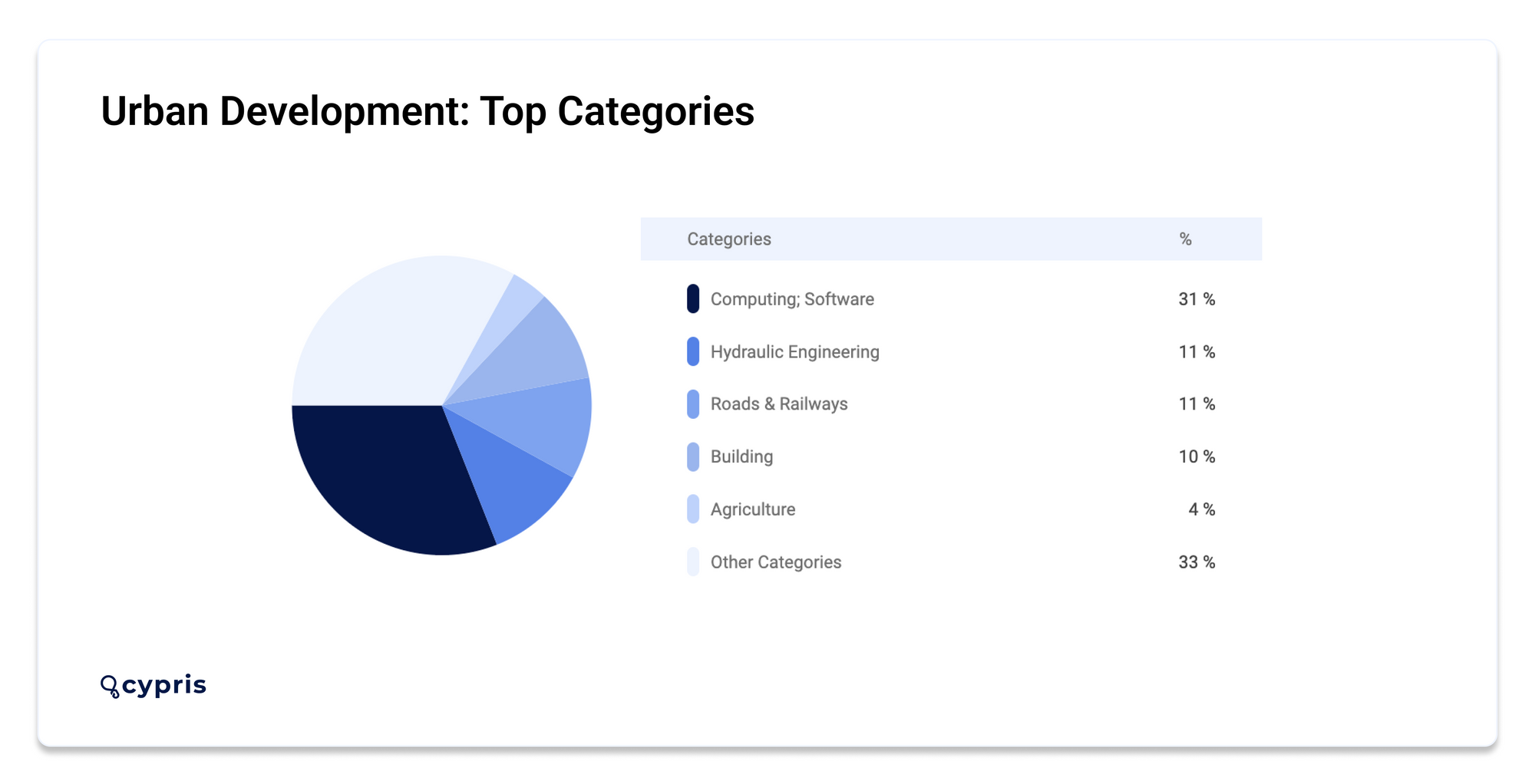
Using the Cypris innovation dashboard, we identified innovation activity in the urban development market has grown over the past 5 years, with a 62.5% average growth rate. Within the vertical, there are 392 technologies being applied within 38 different categories. The fastest growing category is Signaling with an 125.0% increase in new patents filed over the last 5 years.
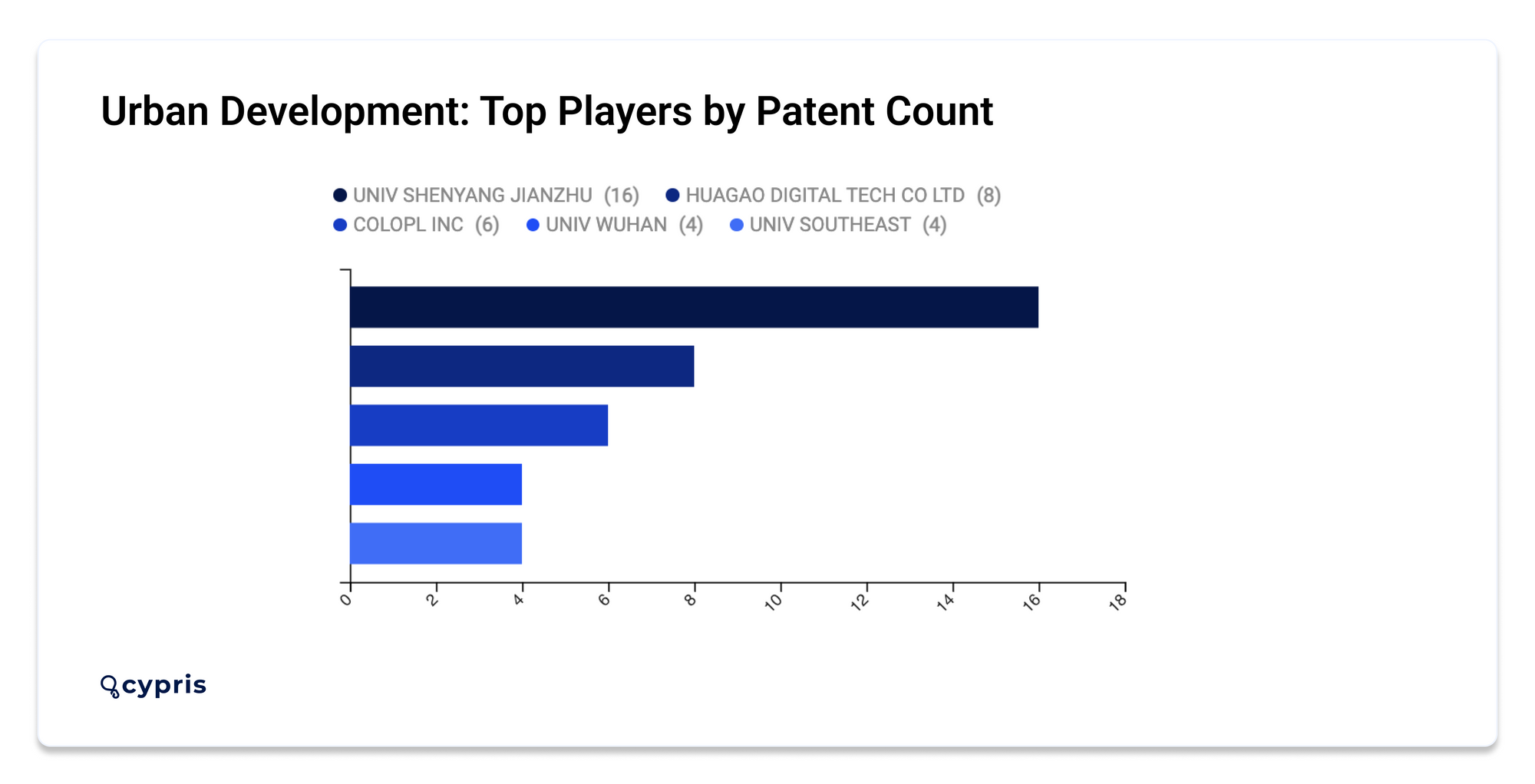
The most active top players in Urban Development by patent number include UNIV SHENYANG JIANZHU (16), HUAGAO DIGITAL TECH CO LTD (8), and COLOPL INC (6).
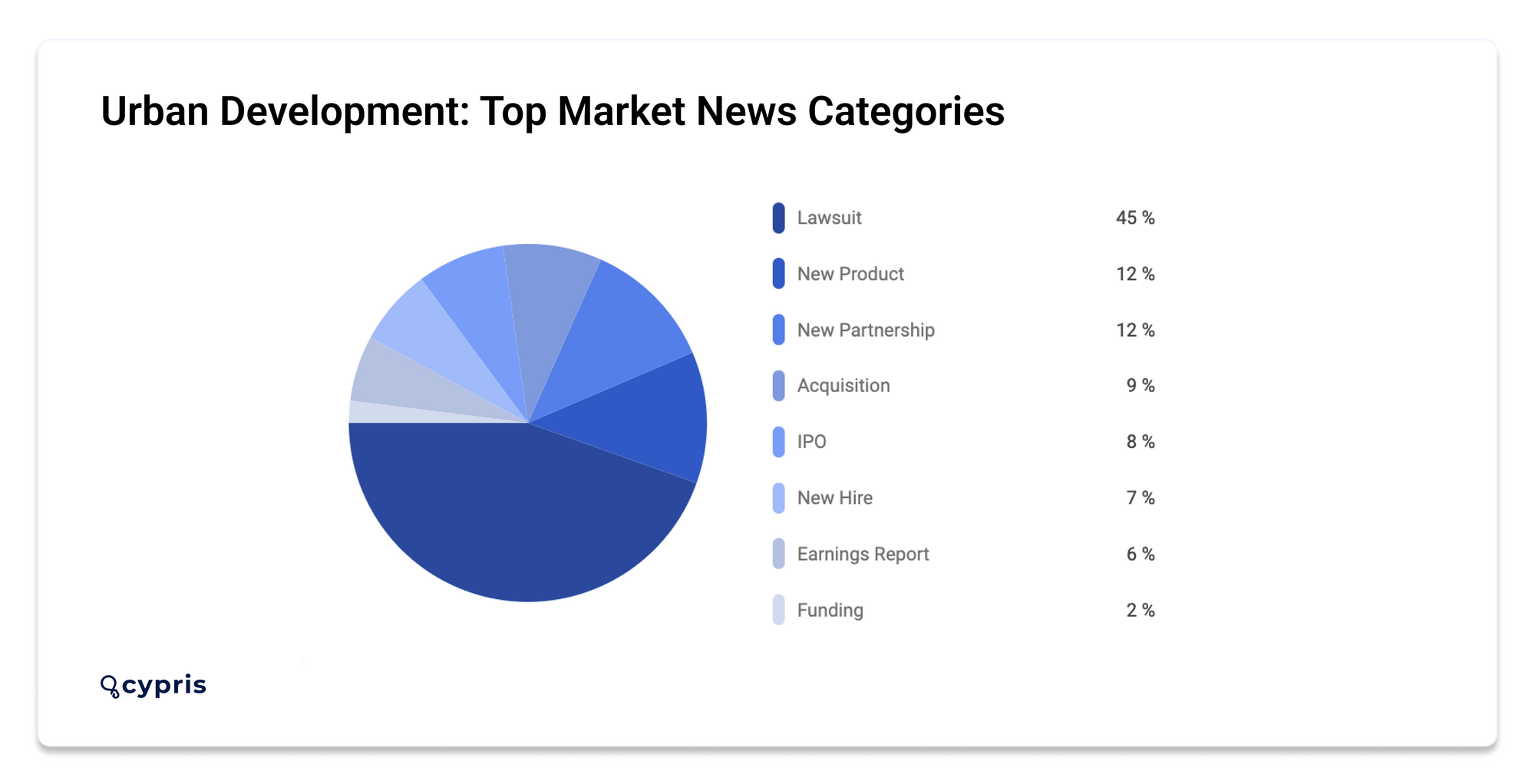
Market news in the space is dominated primarily by lawsuits (45%), followed by new products (12%) and new partnerships (12%).
Notably, while diving into urban development market news, we discovered that Google released a new tool that provides real-time land cover data called Dynamic World, created in partnership with global nonprofit organization World Resources Institute (WRI). Prior to its creation, it was difficult to access detailed and up-to-date land cover, across land and water types. Dynamic World reveals how the earth’s surface is changing from various activities, and allows viewers to track land cover changes from environmental factors, like floods and snowstorms, and changes induced by human activity like urban development and deforestation. The tool will help generate awareness around issues facing the planet, and equip scientists, environmental researchers, policymakers, and the general public with the information to better understand environmental disturbances and plan for future disasters.
Innovative Patents in Urban Development
Here are 5 of the most fascinating patents within the urban development space:
Method for constructing artificial islands with reefs from urban construction waste: This invention provides a 5-step method for constructing artificial islands with reefs from urban construction waste. The method includes 1) recycling the urban construction waste; 2) bonding and pouring the urban construction waste by the aid of cement to obtain large cement brick specimens; 3) transporting the cement specimens to coastal regions by the aid of unidirectional logistics empty materials; 4) transporting the cement specimens to the reefs; and 5) constructing the islands by the aid of cement bricks in falling tide periods.
Inventors: WANG XIAOJIN, & LAI BINGHONG; Patent #: CN103882831A
Roadside dedicated to people with reduced mobility: This invention is a curb specially designed to facilitate movement on the sidewalk for people using wheelchairs and the blind or visually impaired. The invention makes it possible to guide the wheels of a wheelchair, and protect pedestrians from cars. The regularly spaced outfalls in the invention contain a slight slope in order to evacuate rainwater as well. This invention can be precast in concrete and is particularly intended for road and urban development projects in the building and public works industry.
Inventor: GILLET ENGUERRAN; Patent #: FR3115300A1
Underwater Two-Level Tunnel in the Zone of Dense Urban Development: This patent is an underwater two-level tunnel designed for a dense urban area. The tunnel consists of a main two-tier tunnel with separate traffic lanes located inside and additional branches connecting the main tunnel with its terminals located on road sections of the road network adjacent to the tunnel. A second level in the main tunnel and the presence of at least one lane of free movement helps to eliminates the intersection of additional branches and the need to build traffic interchanges.
Inventor: Unlisted; Patent #: RU196900U1
Container House: This invention is a prefabricated transportable container house with a foundation of stainless steel pipe bodies that helps with earthquake and hurricane resistance. Mega structures with numerous container homes can be used when stacking of two or more container homes is insufficient and large-scale urban development is required, and they'll be able to withstand earthquakes and hurricanes due to a net-cladding system of wire.
Inventor: KANGNA NELSON SHEN; Patent #: BR112012010096A2
Solar pedestrian overpass: This patent is a solar pedestrian overpass which comprises a connecting column, a sliding groove formed in the outer wall of the connecting column, four solar panels arranged in the sliding groove, and an output port formed in the end face of the upper end of the connecting column. The bottom surface of the connecting column and the solar panel at the lowermost layer are positioned on the same horizontal plane.
Inventor: LING JIEYONG; Patent #: CN211815496U
Whether through sustainability initiatives, mobility and accessibility efforts, or structures made more resistant to natural disasters, new innovations are changing how we plan and create cities. To learn more about patents and new innovations in the urban development space, visit cypris.ai and get started with access to the innovation dashboard.
Sources:
Cypris Innovation Dashboard, Query: Urban Development
https://cypris.ai/patents/detail/roadside-dedicated-to-people-with-reduced-mobility/FR3115300A1
https://cypris.ai/patents/detail/solar-pedestrian-overpass/CN211815496U
https://www2.deloitte.com/xe/en/insights/industry/public-sector/future-of-cities.html
https://www.futuresplatform.com/blog/3-trends-driving-future-cities-and-urban-living
https://www.weforum.org/agenda/2022/04/global-urbanization-material-consumption/
Innovations Transforming Urban Development


We are in the midst of the biggest wave of urbanism in human history. Today, more than 4.3 billion people or 55% of the world’s population live in urban settings. By 2050, the share of the world’s population living in cities is expected to rise to 80% (World Economic Forum).
With more people concentrated in urban areas, cities must adapt to new challenges when it comes to infrastructure, housing, material consumption, accessibility, sustainability, and much more. In this blog, we’ll look at new innovations that have emerged to combat new challenges cities are facing.
Market Overview
Using the Cypris innovation dashboard, we identified innovation activity in the urban development market has grown over the past 5 years, with a 62.5% average growth rate. Within the vertical, there are 392 technologies being applied within 38 different categories. The fastest growing category is Signaling with an 125.0% increase in new patents filed over the last 5 years.
The most active top players in Urban Development by patent number include UNIV SHENYANG JIANZHU (16), HUAGAO DIGITAL TECH CO LTD (8), and COLOPL INC (6).
Market news in the space is dominated primarily by lawsuits (45%), followed by new products (12%) and new partnerships (12%).
Notably, while diving into urban development market news, we discovered that Google released a new tool that provides real-time land cover data called Dynamic World, created in partnership with global nonprofit organization World Resources Institute (WRI). Prior to its creation, it was difficult to access detailed and up-to-date land cover, across land and water types. Dynamic World reveals how the earth’s surface is changing from various activities, and allows viewers to track land cover changes from environmental factors, like floods and snowstorms, and changes induced by human activity like urban development and deforestation. The tool will help generate awareness around issues facing the planet, and equip scientists, environmental researchers, policymakers, and the general public with the information to better understand environmental disturbances and plan for future disasters.
Innovative Patents in Urban Development
Here are 5 of the most fascinating patents within the urban development space:
Method for constructing artificial islands with reefs from urban construction waste: This invention provides a 5-step method for constructing artificial islands with reefs from urban construction waste. The method includes 1) recycling the urban construction waste; 2) bonding and pouring the urban construction waste by the aid of cement to obtain large cement brick specimens; 3) transporting the cement specimens to coastal regions by the aid of unidirectional logistics empty materials; 4) transporting the cement specimens to the reefs; and 5) constructing the islands by the aid of cement bricks in falling tide periods.
Inventors: WANG XIAOJIN, & LAI BINGHONG; Patent #: CN103882831A
Roadside dedicated to people with reduced mobility: This invention is a curb specially designed to facilitate movement on the sidewalk for people using wheelchairs and the blind or visually impaired. The invention makes it possible to guide the wheels of a wheelchair, and protect pedestrians from cars. The regularly spaced outfalls in the invention contain a slight slope in order to evacuate rainwater as well. This invention can be precast in concrete and is particularly intended for road and urban development projects in the building and public works industry.
Inventor: GILLET ENGUERRAN; Patent #: FR3115300A1
Underwater Two-Level Tunnel in the Zone of Dense Urban Development: This patent is an underwater two-level tunnel designed for a dense urban area. The tunnel consists of a main two-tier tunnel with separate traffic lanes located inside and additional branches connecting the main tunnel with its terminals located on road sections of the road network adjacent to the tunnel. A second level in the main tunnel and the presence of at least one lane of free movement helps to eliminates the intersection of additional branches and the need to build traffic interchanges.
Inventor: Unlisted; Patent #: RU196900U1
Container House: This invention is a prefabricated transportable container house with a foundation of stainless steel pipe bodies that helps with earthquake and hurricane resistance. Mega structures with numerous container homes can be used when stacking of two or more container homes is insufficient and large-scale urban development is required, and they'll be able to withstand earthquakes and hurricanes due to a net-cladding system of wire.
Inventor: KANGNA NELSON SHEN; Patent #: BR112012010096A2
Solar pedestrian overpass: This patent is a solar pedestrian overpass which comprises a connecting column, a sliding groove formed in the outer wall of the connecting column, four solar panels arranged in the sliding groove, and an output port formed in the end face of the upper end of the connecting column. The bottom surface of the connecting column and the solar panel at the lowermost layer are positioned on the same horizontal plane.
Inventor: LING JIEYONG; Patent #: CN211815496U
Whether through sustainability initiatives, mobility and accessibility efforts, or structures made more resistant to natural disasters, new innovations are changing how we plan and create cities. To learn more about patents and new innovations in the urban development space, visit cypris.ai and get started with access to the innovation dashboard.
Sources:
Cypris Innovation Dashboard, Query: Urban Development
https://cypris.ai/patents/detail/roadside-dedicated-to-people-with-reduced-mobility/FR3115300A1
https://cypris.ai/patents/detail/solar-pedestrian-overpass/CN211815496U
https://www2.deloitte.com/xe/en/insights/industry/public-sector/future-of-cities.html
https://www.futuresplatform.com/blog/3-trends-driving-future-cities-and-urban-living
https://www.weforum.org/agenda/2022/04/global-urbanization-material-consumption/
Keep Reading

Patent intelligence has evolved far beyond simple keyword searches and legal document retrieval. Today's enterprise R&D teams need sophisticated tools that can extract actionable insights from millions of patents, identify white space opportunities, and accelerate innovation pipelines. While traditional patent databases serve their purpose for IP attorneys conducting freedom-to-operate analyses, modern R&D intelligence platforms have emerged to meet the specific needs of research and development professionals who require deeper technical insights and broader innovation context.
The patent search tool landscape in 2025 reflects this evolution, with platforms ranging from basic database access to comprehensive R&D intelligence systems that integrate patents with scientific literature, market data, and competitive intelligence. Understanding which tool aligns with your specific needs requires examining not just search capabilities, but how effectively each platform transforms patent data into strategic R&D decisions.
Cypris: Purpose-Built R&D Intelligence Beyond Traditional Patent Search
Cypris represents a fundamental shift in how enterprise R&D teams approach patent intelligence. Rather than treating patents as legal documents to be searched and retrieved, Cypris positions them as technical knowledge assets within a broader innovation ecosystem. The platform's proprietary R&D ontology understands the relationships between patents, scientific papers, market trends, and competitive developments in ways that traditional patent databases simply cannot replicate.
What distinguishes Cypris from conventional patent tools is its focus on the actual workflow of R&D professionals. The platform processes over 500 million technical documents including patents, scientific papers, and market sources through advanced natural language processing that understands technical context, not just keywords. This approach enables R&D teams to identify innovation opportunities that would remain hidden in traditional patent searches. Companies like NASA, Philip Morris International, and Yamaha use Cypris to reduce research time by up to 80 percent while uncovering technical solutions and partnership opportunities that drive their innovation pipelines forward.
The platform's multimodal search capabilities allow researchers to upload molecular structures, technical diagrams, or even product photos to find relevant patents and technical solutions. This visual search functionality proves particularly valuable for materials science and chemical R&D teams who work with complex structures that are difficult to describe in text. Combined with Cypris's Research Brief service, where expert analysts provide bespoke competitive intelligence reports, the platform delivers insights that go far beyond what automated patent searches can provide.
Cypris's SOC 2 Type II certification and US-based operations provide the security and compliance requirements that enterprise R&D teams demand, while its official API partnerships with OpenAI, Anthropic, and Google enable cutting-edge AI capabilities that other platforms cannot match. The platform's ability to connect patent landscapes with actual R&D outcomes makes it particularly valuable for teams that need to justify innovation investments and demonstrate technical feasibility to stakeholders.
PatSnap: Comprehensive IP Analytics for Large Enterprises
PatSnap has established itself as one of the most comprehensive intellectual property platforms available, offering extensive patent coverage across global jurisdictions. The platform excels at providing detailed patent analytics and visualization tools that help IP professionals understand complex patent landscapes. PatSnap's strength lies in its ability to process massive amounts of patent data and present it through sophisticated analytical dashboards that reveal citation networks, technology evolution patterns, and competitive positioning.
The platform's innovation intelligence features extend beyond patents to include technology scouting and competitive monitoring capabilities. PatSnap provides robust tools for patent valuation and portfolio management that appeal to organizations with significant IP holdings requiring active management. Its semantic search capabilities help users navigate the complexities of patent language and technical terminology to find relevant prior art and identify potential infringement risks.
However, PatSnap's comprehensive feature set comes with significant complexity that can overwhelm teams primarily focused on R&D rather than IP management. The platform's enterprise-focused pricing and extensive feature set reflect its positioning as a premium solution for organizations with dedicated IP departments. While PatSnap offers powerful capabilities for patent professionals, R&D teams often find that much of its functionality addresses legal and administrative needs rather than technical innovation challenges.
Derwent Innovation: Trusted Patent Data with Enhanced Abstracts
Derwent Innovation, now part of Clarivate, brings decades of patent curation expertise to modern search platforms. Its key differentiator remains the Derwent World Patents Index, where technical experts rewrite patent abstracts to improve clarity and searchability. This human-enhanced approach helps researchers understand complex patents more quickly and accurately than working with original patent documents alone.
The platform provides comprehensive global patent coverage with particular strength in Asian patents, where language barriers and technical translation challenges often limit accessibility. Derwent's chemical structure search capabilities and Markush structure database make it particularly valuable for pharmaceutical and chemical companies conducting prior art searches and freedom-to-operate analyses. The platform's integration with Web of Science creates connections between patents and scientific literature that can reveal research trends and emerging technologies.
Derwent Innovation serves established enterprises with significant IP portfolios well, but its traditional database architecture and search interface feel dated compared to modern R&D intelligence platforms. The platform focuses primarily on patent document retrieval and basic analytics rather than the advanced insight generation and workflow integration that contemporary R&D teams require. While Derwent's curated abstracts provide value, they cannot match the contextual understanding and technical insight extraction that AI-powered platforms like Cypris deliver through natural language processing and machine learning.
Google Patents: Free Access with Basic Functionality
Google Patents democratizes patent search by providing free access to millions of patents from major global patent offices. The platform's familiar Google search interface makes it immediately accessible to anyone familiar with web search, removing barriers to entry for researchers and inventors exploring the patent landscape. Google's powerful search algorithms and machine translation capabilities help users navigate patents across languages and jurisdictions without specialized training or expensive subscriptions.
The platform excels at quick prior art searches and basic patent document retrieval. Its integration with Google Scholar creates useful connections between patents and academic literature, while the ability to search within patent PDFs helps researchers find specific technical details. Google Patents' citation tracking and legal status information provide basic intelligence about patent families and prosecution histories that support initial feasibility assessments.
However, Google Patents lacks the advanced analytics, competitive intelligence, and workflow integration features that enterprise R&D teams require for strategic decision-making. The platform provides no tools for patent landscape analysis, technology trend identification, or competitive monitoring beyond basic search and retrieval. While valuable for initial exploration and occasional searches, Google Patents cannot support the comprehensive patent intelligence needs of serious R&D organizations. Teams relying solely on Google Patents miss critical insights about technology convergence, white space opportunities, and competitive developments that specialized platforms reveal.
The Lens: Academic-Industrial Patent Intelligence
The Lens occupies a unique position in the patent search landscape by bridging academic research and industrial innovation. The platform's open-access model provides free basic search capabilities while offering premium features for advanced analytics and bulk data access. What sets The Lens apart is its comprehensive integration of patents with scholarly literature, creating rich networks of innovation that reveal how academic research translates into commercial applications.
The platform's PatCite and PatSeq databases provide specialized search capabilities for biological patents and genetic sequences that prove invaluable for biotechnology and pharmaceutical research. The Lens's commitment to open science and transparent innovation metrics appeals to academic institutions and research organizations that need to track the broader impact of their work. Its institutional analytics help universities and research centers understand their innovation output and identify commercialization opportunities.
The Lens provides sophisticated tools for understanding innovation ecosystems and technology transfer patterns that many commercial platforms overlook. However, its academic orientation and open-access model mean it lacks some of the enterprise-grade features and support that corporate R&D teams expect. While The Lens excels at connecting research with patents, it provides limited competitive intelligence and market analysis capabilities compared to comprehensive R&D platforms. Organizations requiring dedicated support, custom workflows, and integrated market intelligence find The Lens valuable as a supplementary tool but insufficient as their primary patent intelligence platform.
Questel Orbit: European Excellence in Patent Intelligence
Questel Orbit brings European patent expertise and multilingual capabilities to global IP intelligence. The platform's strength in handling patents from non-English speaking countries, particularly European and Asian markets, makes it valuable for multinational corporations navigating complex international patent landscapes. Orbit's FamPat database provides comprehensive patent family information that helps organizations understand global filing strategies and identify geographical opportunities for innovation.
The platform offers sophisticated patent analytics tools including competitive benchmarking, technology landscaping, and IP portfolio optimization features. Orbit's integration with Questel's broader IP management suite provides end-to-end capabilities from patent search through prosecution and portfolio management. Its collaborative workspaces and project management features support distributed R&D teams working on complex innovation projects across multiple locations and time zones.
Questel Orbit's European focus and comprehensive language support come with a learning curve that can challenge teams accustomed to US-centric platforms. The system's extensive functionality and numerous modules can overwhelm users seeking straightforward patent intelligence rather than complete IP lifecycle management. While Orbit provides powerful capabilities for organizations with complex international patent needs, many R&D teams find its breadth of features extends well beyond their core requirements for technical intelligence and innovation insights.
PatentInspiration: Visual Patent Exploration
PatentInspiration, developed by AULIVE, takes a distinctly visual approach to patent intelligence that appeals to innovation teams seeking creative inspiration rather than legal analysis. The platform's semantic mapping and clustering algorithms create intuitive visualizations of technology landscapes that help R&D teams identify innovation patterns and white space opportunities. Its unique approach to patent exploration focuses on stimulating creative thinking and identifying unexpected connections between technologies.
The platform's morphological matrices and technology evolution tools help innovation teams systematically explore solution spaces and identify promising research directions. PatentInspiration's emphasis on ideation and opportunity identification rather than traditional patent search makes it particularly valuable during early-stage research and development planning. Its visual analytics help non-patent experts understand complex technology landscapes without deep expertise in patent classification systems or search techniques.
PatentInspiration serves as an excellent complementary tool for innovation workshops and strategic planning sessions, but lacks the comprehensive search capabilities and detailed analytics required for thorough patent intelligence work. The platform's focus on inspiration over information means it cannot support the full range of patent intelligence needs from prior art searching through competitive monitoring. While valuable for creative exploration and opportunity identification, PatentInspiration requires supplementation with more comprehensive platforms for organizations serious about patent-driven R&D intelligence.
Making the Strategic Choice for Your R&D Team
Selecting the right patent intelligence platform requires honest assessment of your team's actual needs versus available features. Traditional patent databases designed for IP attorneys often provide extensive legal and administrative capabilities that R&D teams rarely use while lacking the technical insight extraction and innovation intelligence features that drive research productivity. Modern R&D intelligence platforms like Cypris recognize that patents represent technical knowledge to be leveraged for innovation rather than just legal documents to be searched and cited.
The evolution from patent search to R&D intelligence reflects broader changes in how leading organizations approach innovation. Companies that treat patent data as one component of comprehensive competitive intelligence consistently outperform those relying on traditional patent database searches. The ability to connect patent landscapes with scientific literature, market trends, and competitive developments has become essential for R&D teams tasked with accelerating innovation while managing technical risk.
Cost considerations extend beyond subscription fees to include the time and expertise required to extract actionable insights from patent data. Platforms that require specialized training or dedicated patent search professionals may appear less expensive initially but carry hidden costs in delayed decisions and missed opportunities. Solutions that enable R&D teams to directly access and understand patent intelligence without intermediaries accelerate innovation cycles and improve research productivity. The most successful organizations choose platforms that align with how their R&D teams actually work rather than forcing researchers to adapt to tools designed for other purposes.
The Future of Patent Intelligence for R&D
Patent search tools continue evolving from document retrieval systems toward comprehensive innovation intelligence platforms that anticipate R&D needs and proactively surface opportunities. Artificial intelligence and natural language processing increasingly enable these platforms to understand technical context and innovation potential rather than just matching keywords and classifications. The integration of patents with broader technical and market intelligence creates new possibilities for R&D teams to identify convergent technologies and predict innovation trajectories.
The platforms that will dominate patent intelligence in the coming years are those that successfully bridge the gap between patent data and R&D outcomes. This requires not just better search algorithms or more comprehensive databases, but fundamental reimagining of how patent intelligence serves innovation teams. Companies like Cypris that build their platforms specifically for R&D workflows and technical decision-making are better positioned to deliver value than traditional patent databases attempting to add R&D features to systems designed for legal professionals.
As organizations increasingly recognize that innovation speed determines competitive advantage, the ability to rapidly extract insights from global patent data becomes critical. R&D teams can no longer afford to wait weeks for patent landscape reports or rely on periodic competitive intelligence updates. Modern patent intelligence platforms must deliver real-time insights that directly inform research directions and accelerate technical decision-making. The organizations that thrive will be those that choose patent intelligence platforms designed for how R&D actually works rather than how patent searching has traditionally been done.

Enterprise R&D teams are hemorrhaging money through an invisible wound: fragmented intelligence systems that create duplicate work, missed opportunities, and strategic blind spots. Our analysis of Fortune 500 R&D operations reveals that the average enterprise wastes between $500,000 and $2 million annually due to disconnected research tools and siloed information.
The True Price of Intelligence Fragmentation
When a global chemicals company's R&D team discovered they had unknowingly funded three separate projects investigating the same polymer technology across different divisions, the $1.8 million redundancy was just the tip of the iceberg. The real cost came from the 18 month delay in market entry while competitors launched first.
This scenario plays out daily across enterprise R&D departments. Teams navigate between 5 to 12 different intelligence platforms, from patent databases to scientific literature repositories, market intelligence tools to competitive analysis systems. Each platform operates in isolation, creating a maze of disconnected insights that obscures the bigger picture.
Quantifying the Intelligence Gap
Recent industry research reveals the staggering scope of this problem:
Direct Costs:
Teams unknowingly pursue parallel investigations through duplicate research, wasting an average of $320,000 annually per 100 R&D professionals. Overlapping tool subscriptions cost enterprises $75,000 to $150,000 yearly through subscription redundancy. Custom API development and maintenance for connecting disparate systems requires $85,000 to $200,000 annually in integration expenses. Teaching researchers to navigate multiple platforms demands 40 hours per employee per year in training overhead.
Opportunity Costs:
Failure to identify prior art leads to rejected patent applications with an average loss of $25,000 per application. Fragmented insights extend development timelines by 20 to 30 percent, creating delayed innovation cycles. The inability to connect market signals with technical developments results in late market entry, creating competitive blind spots that can cost millions in lost revenue.
The Fragmentation Multiplier Effect
The problem compounds exponentially as organizations grow. A pharmaceutical company with 500 R&D professionals typically manages 15 or more specialized databases, 8 to 10 different search interfaces, 6 to 8 separate authentication systems, and zero unified analytics across platforms.
Each additional platform doesn't just add complexity; it multiplies it. The cognitive load on researchers increases geometrically as they attempt to synthesize insights across disconnected systems.
Real World Impact: Case Studies in Waste
Case 1: Automotive Manufacturer
A tier one automotive supplier's battery research team spent six months developing a lithium ion improvement that had already been patented by their own company's European division three years earlier. The fragmented patent management system failed to surface the internal prior art, resulting in $450,000 in redundant research costs, a 6 month project delay, and loss of first mover advantage in a critical market.
Case 2: Materials Science Company
A specialty materials company maintained subscriptions to seven different technical intelligence platforms. An audit revealed 60 percent content overlap between platforms, only 30 percent of features actually used, $180,000 annual overspend on redundant capabilities, and researchers spending 15 hours weekly just searching across systems.
The Knowledge Management Crisis
Beyond the immediate financial impact, fragmented intelligence creates a knowledge management catastrophe. When senior researchers retire or change companies, their accumulated insights scattered across dozens of platforms and personal repositories walk out the door with them.
Studies indicate that Fortune 500 companies lose an average of $31.5 million annually due to ineffective knowledge sharing. In R&D departments, where specialized expertise takes decades to develop, this figure can double.
The Hidden Time Tax
R&D professionals spend approximately 35 percent of their time searching for and validating information, time that should be spent on actual innovation. For a team of 100 researchers with an average fully loaded cost of $150,000 per year, this translates to $5.25 million annually spent on information discovery, 70,000 hours of lost productivity, and delayed project completions affecting entire product pipelines.
Modern Solutions to Ancient Problems
Leading organizations are addressing this crisis by consolidating their R&D intelligence infrastructure. The most successful approaches share common characteristics:
Unified Intelligence Platforms
Companies like Cypris have emerged to address this specific pain point, offering integrated access to patents, scientific literature, market intelligence, and competitive data through a single interface. Their platform connects to over 500 million data points while maintaining enterprise grade security and compliance.
Knowledge Graph Technology
Advanced platforms now use knowledge graphs to automatically connect insights across disciplines. When a researcher investigates a new compound, the system immediately surfaces related patents, similar research, market applications, and competitive activity. These connections would take weeks to discover manually.
AI Powered Synthesis
Modern R&D intelligence platforms leverage large language models to synthesize insights across massive datasets. Instead of researchers reading hundreds of documents, AI assistants can analyze thousands of sources and provide executive summaries with deep dive capabilities.
The ROI of Consolidated Intelligence
Organizations that have successfully consolidated their R&D intelligence infrastructure report remarkable returns: 70 percent reduction in research duplication, 50 percent faster prior art searches, 40 percent decrease in time to insight, and $2 to $5 million annual savings for mid sized R&D teams.
Implementation Best Practices
Start with an Audit
Catalog all existing intelligence tools, their costs, usage patterns, and overlap. Many organizations discover they're paying for capabilities they don't use while missing critical functionalities they need.
Prioritize Integration
Look for platforms that offer robust APIs and can integrate with existing workflows. Solutions like Cypris provide enterprise API access that connects with Microsoft Teams, Slack, and existing knowledge management systems.
Focus on Adoption
The best intelligence platform is worthless if researchers won't use it. Prioritize user experience and ensure the solution reduces rather than increases cognitive load.
The Competitive Intelligence Advantage
In industries where innovation speed determines market leadership, consolidated R&D intelligence becomes a strategic differentiator. Companies with unified intelligence capabilities can identify emerging technologies 6 to 12 months earlier, reduce patent application failures by 60 percent, accelerate product development cycles by 25 to 30 percent, and improve R&D ROI by 15 to 20 percent.
Selecting the Right Platform Partner
When evaluating R&D intelligence platforms, consider:
Coverage Breadth
Ensure the platform covers all critical data sources including patents, scientific literature, market reports, regulatory filings, and competitive intelligence.
AI Capabilities
Modern platforms should offer AI powered search, automated monitoring, and intelligent synthesis. Leaders like Cypris provide LLM powered analysis that can process complex technical queries and generate comprehensive reports.
Enterprise Features
Look for platforms designed for enterprise scale with features like role based access control, audit trails and compliance reporting, API access for custom integrations, and dedicated support and training.
Industry Expertise
Platforms with deep domain expertise in your industry will provide more relevant results. Cypris, for example, has developed specialized ontologies for chemicals, materials, and life sciences sectors.
The Path Forward
The $500,000 plus annual waste from fragmented R&D intelligence is entirely preventable. Organizations that continue operating with disconnected systems will find themselves increasingly disadvantaged as competitors leverage unified intelligence platforms to accelerate innovation.
The question isn't whether to consolidate R&D intelligence; it's how quickly you can make the transition before competitors gain an insurmountable advantage.
For R&D leaders evaluating their intelligence infrastructure, the first step is clear: audit your current tools, calculate the true cost of fragmentation, and explore modern platforms that can unify your intelligence operations. The ROI isn't just measured in cost savings. It's measured in accelerated innovation, reduced risk, and sustained competitive advantage.
Ready to eliminate intelligence fragmentation in your R&D organization? Platforms like Cypris offer comprehensive solutions that consolidate patents, scientific literature, and market intelligence into a single, AI powered interface. Calculate your potential savings with a fragmentation audit and discover how unified R&D intelligence can transform your innovation capabilities.

PatSnap has long been a dominant player in the patent intelligence market, but today's R&D teams increasingly need more comprehensive solutions that go beyond traditional patent search. Whether you're seeking better knowledge management capabilities, more advanced AI features, stronger security compliance, or simply exploring what modern R&D intelligence platforms can offer, this guide examines the top alternatives reshaping the patent and research intelligence landscape.
Why R&D Teams Are Looking Beyond PatSnap
While PatSnap offers robust patent analytics, several factors are driving organizations to explore alternatives:
Limited knowledge management: PatSnap focuses primarily on patent data without integrated systems for managing internal R&D knowledge
Narrow data scope: Heavy emphasis on patents with less comprehensive coverage of scientific literature and market intelligence
Traditional interface: Legacy design that hasn't fully embraced modern AI workflows
Security limitations: Only SOC 1 certified, lacking the SOC 2 compliance required by many enterprises
No bespoke research services: Absence of analyst support for custom research needs
Top 8 PatSnap Alternatives for 2025
1. Cypris: Enterprise R&D Intelligence Platform
Best for: Large enterprise R&D teams needing comprehensive intelligence beyond patents
Cypris has emerged as the leading alternative to PatSnap by offering a truly integrated R&D intelligence platform that combines patent analysis with scientific literature, market intelligence, and internal knowledge management. With over 500 million data points and official enterprise API partnerships with OpenAI, Anthropic, and Google, Cypris delivers AI insights that PatSnap's traditional approach can't match.
Key Advantages Over PatSnap:
SOC 2 Type II certified security (vs PatSnap's SOC 1 only)
Research Brief analyst service providing bespoke, expert-curated reports
AI-powered data monitoring with automated alerts and insights
Advanced R&D ontology that understands technical concepts across disciplines
Official API partnerships with OpenAI, Anthropic, and Google for enterprise AI
Integrated knowledge management system for capturing internal R&D insights
Multimodal data approach spanning patents, papers, grants, and market intelligence
Modern AI interface with natural language processing
Unique Differentiators:The Research Brief service sets Cypris apart by providing expert analyst support for complex research questions, delivering custom reports that combine AI capabilities with human expertise. The platform's AI monitoring continuously tracks developments across all data sources, automatically surfacing relevant insights without manual searching.
Why Teams Switch from PatSnap: Organizations report that Cypris's integrated approach eliminates the need for multiple tools while providing deeper insights through its advanced AI ontology, enterprise LLM partnerships, and the added confidence of SOC 2 security compliance.
2. Questel Orbit
Best for: IP departments requiring detailed patent analytics
Questel Orbit offers comprehensive patent search and analytics with strong visualization capabilities. While similar to PatSnap in its patent-centric approach, Orbit provides some advantages in specific geographic markets and integration with IP management workflows.
Strengths:
Extensive global patent coverage
Advanced analytics and landscaping tools
IP portfolio management features
Strong presence in European markets
Limitations:
Primarily patent-focused like PatSnap
Complex interface requiring significant training
Limited integration with broader R&D workflows
No bespoke research services
3. Google Patents
Best for: Quick, free patent searches and basic prior art research
Google Patents provides free access to patents from major patent offices worldwide, making it a useful tool for preliminary searches and basic patent research. However, as a free solution, it lacks the deep functionality required for serious R&D intelligence work.
Strengths:
Completely free access
Simple, familiar Google interface
Quick access to patent documents
Integration with Google Scholar
Limitations:
No advanced analytics or visualization tools
Limited search capabilities compared to enterprise platforms
No API or integration options
Lacks enterprise security and compliance features
No support or training resources
Missing critical features like family analysis and citation mapping
4. The Lens
Best for: Academic institutions and budget-conscious teams
The Lens provides free and open access to patent and scholarly data, making it an attractive option for academic researchers and smaller organizations. While it lacks the advanced features of commercial platforms, its comprehensive dataset and transparency make it valuable for basic research.
Strengths:
Free tier with substantial functionality
Integration of patent and scholarly literature
Open data approach with transparent metrics
Academic-friendly features
Limitations:
Limited advanced analytics compared to PatSnap
No enterprise knowledge management
Basic interface without AI enhancements
No security certifications for enterprise use
5. Derwent Innovation (Clarivate)
Best for: Global enterprises needing validated patent data
Derwent Innovation builds on Clarivate's renowned DWPI (Derwent World Patents Index) with human-enhanced patent abstracts and standardized data. It offers similar capabilities to PatSnap but with arguably better data quality through manual curation.
Strengths:
High-quality, manually curated patent data
Global coverage with non-English patent translations
Integration with Clarivate's broader IP ecosystem
Advanced citation analysis
Limitations:
Focus on patents without broader R&D intelligence
Complex interface requiring extensive training
No AI monitoring or bespoke research services
6. IPlytics
Best for: Technology standards and SEP (Standard Essential Patents) analysis
IPlytics specializes in the intersection of patents and technology standards, making it invaluable for companies working with telecommunications, IoT, and other standards-driven industries.
Strengths:
Unique focus on standards-essential patents
Technology standards database integration
Market intelligence for licensing
Connected vehicle and IoT expertise
Limitations:
Narrow focus on standards-related IP
Not a comprehensive R&D platform
Limited coverage outside standards domains
7. Innography (Now part of CPA Global)
Best for: IP analytics and competitive intelligence
Innography combines patent analytics with business intelligence, offering unique insights into competitor strategies and market positioning. Its acquisition by CPA Global has expanded its capabilities but also increased complexity.
Strengths:
Business intelligence integration
Litigation and licensing analytics
Competitive benchmarking tools
Patent valuation metrics
Limitations:
Transition challenges post-acquisition
Limited scientific literature coverage
Focus on IP rather than broader R&D
8. Patent Inspiration
Best for: Innovation workshops and ideation sessions
Patent Inspiration takes a unique approach by focusing on innovation methodologies and creative problem-solving rather than traditional patent search. It's less a PatSnap replacement and more a complementary tool for innovation teams.
Strengths:
Innovation-focused interface
TRIZ methodology integration
Visual exploration tools
Semantic searching capabilities
Limitations:
Limited dataset compared to PatSnap
Not suitable for comprehensive IP analysis
Lacks enterprise features
Critical Security Considerations
Enterprise Security Compliance
One often-overlooked but critical difference between platforms is security certification. Cypris maintains SOC 2 Type II certification, demonstrating comprehensive security controls across:
Data protection and encryption
Access controls and authentication
System monitoring and incident response
Vendor management and risk assessment
In contrast, PatSnap's SOC 1 certification only covers financial reporting controls, leaving potential gaps in data security that concern many enterprise IT departments. For organizations handling sensitive R&D data, this difference in security posture can be decisive.
The Power of AI Partnerships and Ontology
Enterprise LLM Integration
Cypris's official partnerships with OpenAI, Anthropic, and Google provide enterprise customers with:
Direct API access to leading AI models
Compliant, secure AI implementations
Custom AI applications built on R&D data
Advanced natural language processing capabilities
Advanced R&D Ontology
Unlike PatSnap's keyword-based approach, Cypris employs a sophisticated R&D ontology that:
Understands relationships between technical concepts
Identifies relevant results across disciplines
Connects disparate data points automatically
Improves search accuracy and reduces noise
Choosing the Right PatSnap Alternative
For Comprehensive R&D Intelligence
If your team needs more than just patent search, including scientific literature, market intelligence, knowledge management, and bespoke research support, Cypris offers the most complete solution. Its AI platform with enterprise LLM partnerships and Research Brief service deliver insights that go well beyond traditional patent analytics.
For Specialized Needs
Basic patent searches: Google Patents provides free, quick access
Standards-driven industries: IPlytics provides unique SEP insights
Academic research: The Lens offers excellent free access
Pure IP management: Questel Orbit or Derwent Innovation may suffice
For Modern AI Workflows
Organizations embracing AI transformation should prioritize platforms like Cypris that offer native LLM integration, advanced ontologies, and official partnerships with major AI providers. Traditional tools like PatSnap risk becoming obsolete as AI reshapes R&D workflows.
Making the Transition from PatSnap
Key Evaluation Criteria
Security Compliance: Verify SOC 2 certification for enterprise data protection
Data Coverage: Ensure coverage of patents, literature, and market intelligence
AI Capabilities: Look for LLM partnerships, ontologies, and automated monitoring
Research Support: Consider platforms offering bespoke analyst services
Knowledge Management: Evaluate systems for capturing internal R&D insights
Integration Options: Check for API access and AI platform compatibility
Implementation Best Practices
Run parallel systems initially to ensure smooth transition
Start with a pilot team to validate the alternative meets your needs
Leverage research services for high-value projects during transition
Prioritize security review to ensure compliance with enterprise requirements
Establish AI workflows that leverage LLM partnerships and monitoring
The Future of Patent & Research Intelligence
The patent intelligence landscape is rapidly evolving beyond traditional search and analytics. Next-generation platforms are integrating:
Generative AI with official LLM partnerships for compliant enterprise use
Automated monitoring that proactively surfaces relevant insights
Bespoke research services combining AI with human expertise
Advanced ontologies that understand technical relationships
Enterprise security meeting SOC 2 and beyond
PatSnap's traditional approach, while still valuable for pure patent work, increasingly falls short of these modern requirements. Organizations serious about R&D innovation are moving toward comprehensive platforms that treat patents as one component of a broader intelligence ecosystem, backed by enterprise security and AI capabilities.
Conclusion: Beyond Patent Search to R&D Intelligence
While PatSnap remains a capable patent search tool, the demands of modern R&D require more comprehensive solutions. Whether you choose Cypris for its integrated AI platform with Research Brief services, Google Patents for basic free searches, or specialized tools for specific domains, the key is selecting a solution that aligns with your team's evolving needs and security requirements.
The most successful R&D organizations are those that recognize patent intelligence as just one piece of the innovation puzzle. By choosing alternatives that integrate patents with scientific literature, market intelligence, internal knowledge management, and bespoke research support, teams can accelerate innovation and maintain competitive advantage in an increasingly complex technological landscape.
Ready to explore PatSnap alternatives? Start with a clear assessment of your team's needs beyond patent search, and prioritize platforms that offer modern AI capabilities, enterprise security compliance, and comprehensive data coverage. The right choice will transform your R&D intelligence from a cost center into a strategic advantage.