
A powerful new foundation for custom queries—built on Lucene and designed for R&D precision.
Over the past few years, Cypris has helped innovation teams make faster, more informed decisions by centralizing critical insights across datasets like patents, academic papers, and company activity. But until now, our search experience relied on a legacy query system with limited capabilities, offering little support for advanced search features or dataset-level customization.
Today, we’re excited to introduce an upgraded Advanced Search on Cypris, a complete overhaul of our query engine and search experience, powered by the open-standard Lucene query syntax. This update introduces a more robust and flexible search foundation, unlocking new ways to query data, build complex filters, and extract precisely what you need across patents, research, and more.
Why we rebuilt our search system from the ground up
Cypris’ original query syntax, a proprietary format used internally for years, limited users’ ability to craft advanced queries or tailor searches to specific datasets. It lacked modern capabilities like proximity searches, field-level customization, or true Boolean logic. This made it difficult to build a reliable and intuitive experience for both casual users and advanced researchers.
By moving to Lucene, we’re adopting a powerful, industry-standard query language that makes it easier for developers to build advanced features—and gives users access to a far more capable and flexible search toolset.
What’s new in Advanced Search
1. Custom Queries by Dataset
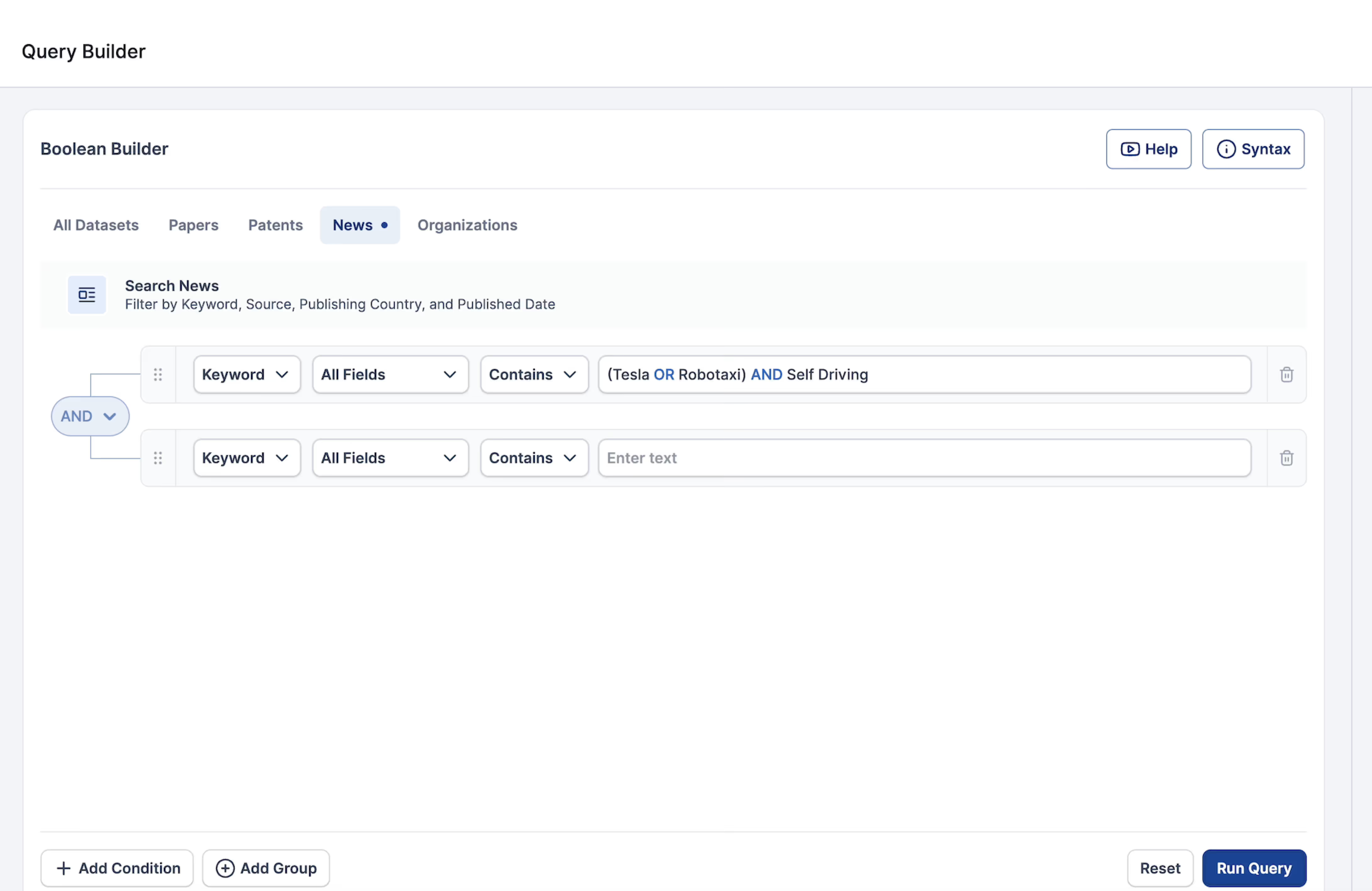
You can now layer queries to search across datasets or tailor filters to each one. For example, you can run a broad query on drone delivery, and then add separate layers to focus on patents by a specific assignee and papers from a specific country or funding agency.
Navigating the All Datasets tab introduces a new level of complexity—and power—by allowing users to apply dataset-specific logic within a single, unified query workflow. While querying multiple datasets simultaneously might seem straightforward, the underlying differences in schema, metadata, and available fields between our proprietary datasets make this a deeply technical challenge. Patents, for example, include claims, application numbers, and multiple date fields (filed, granted, updated), while academic papers use DOIs, have different structural conventions, and emphasize different metadata. In the past, we sidestepped this complexity by translating general queries like ((drone_allText)) into dataset-specific logic under the hood. Now, instead of obscuring that logic, we allow users to opt in to it. The builder provides progressive layers of customization: start with intuitive keyword searches across all fields, then move into the advanced builder for field-specific targeting, fuzzy logic, and term boosting, and finally, tailor query logic by dataset—such as specifying different countries of interest for papers vs. patents. This approach preserves flexibility while giving users full control, and with tools like our real-time Live Analysis and “Your Query” panel, we make it easy to understand how every decision affects the results.
2. More Fields to Query
We’re exposing deeper fields across datasets—giving you explicit control over the dimensions of your search. For the first time, users can now search academic papers by DOI, a critical identifier previously unsupported on the platform. You can also query by:
- Author or inventor names
- Organizations or assignees
- Countries, journals, funding agencies, and more
3. Full Boolean Support
Advanced Search now leverages powerful Boolean logic—AND, OR, NOT, and grouping—enabling more precise control over search logic and improving performance and accuracy.
4. Lucene Syntax Features
Use built-in Lucene features to create expressive, complex searches:
- Proximity searches to find terms near each other
- Fuzzy searches for flexible matching
- Exact phrase matching
- Boosting to prioritize results (e.g., prioritize results mentioning AI 3x more than others)
- Prefix/Postfix queries to match phrases that start or end a certain way
- Range queries for fields like date, funding amounts, or numerical values
A more powerful user experience
Our new search interface is built to help you tap into these capabilities without needing to know the syntax from the start. You’ll find:
- A Query Builder to guide you through complex searches
- A Help Video to onboard users to Lucene-style searches
- Inline examples and tips for writing queries using grouping, boosting, and more
Built for precision, speed, and customization
With Lucene as our foundation, search results are now not only more flexible but also faster and more accurate. Semantic search continues to offer natural-language ease of use, while Boolean search gives power users the performance and structure they need to uncover insights with greater specificity.
Whether you’re an innovation analyst drilling into AI patents or a business development lead scanning academic papers from Chilean researchers—Advanced Search is built to help you get to the signal, faster.
Available now to all users
Advanced Search is live and available across the Cypris platform today. If you’re already using Cypris, you’ll find the new search interface in your dashboard, complete with updated syntax documentation and walkthroughs.
We’re excited to see what you’ll build, discover, and analyze with this new capability. This is just the beginning—we’ll continue expanding the fields, syntax features, and customization options as we push the boundaries of what intelligent search can do for R&D.

Introducing Advanced Search on Cypris


A powerful new foundation for custom queries—built on Lucene and designed for R&D precision.
Over the past few years, Cypris has helped innovation teams make faster, more informed decisions by centralizing critical insights across datasets like patents, academic papers, and company activity. But until now, our search experience relied on a legacy query system with limited capabilities, offering little support for advanced search features or dataset-level customization.
Today, we’re excited to introduce an upgraded Advanced Search on Cypris, a complete overhaul of our query engine and search experience, powered by the open-standard Lucene query syntax. This update introduces a more robust and flexible search foundation, unlocking new ways to query data, build complex filters, and extract precisely what you need across patents, research, and more.
Why we rebuilt our search system from the ground up
Cypris’ original query syntax, a proprietary format used internally for years, limited users’ ability to craft advanced queries or tailor searches to specific datasets. It lacked modern capabilities like proximity searches, field-level customization, or true Boolean logic. This made it difficult to build a reliable and intuitive experience for both casual users and advanced researchers.
By moving to Lucene, we’re adopting a powerful, industry-standard query language that makes it easier for developers to build advanced features—and gives users access to a far more capable and flexible search toolset.
What’s new in Advanced Search
1. Custom Queries by Dataset
You can now layer queries to search across datasets or tailor filters to each one. For example, you can run a broad query on drone delivery, and then add separate layers to focus on patents by a specific assignee and papers from a specific country or funding agency.
Navigating the All Datasets tab introduces a new level of complexity—and power—by allowing users to apply dataset-specific logic within a single, unified query workflow. While querying multiple datasets simultaneously might seem straightforward, the underlying differences in schema, metadata, and available fields between our proprietary datasets make this a deeply technical challenge. Patents, for example, include claims, application numbers, and multiple date fields (filed, granted, updated), while academic papers use DOIs, have different structural conventions, and emphasize different metadata. In the past, we sidestepped this complexity by translating general queries like ((drone_allText)) into dataset-specific logic under the hood. Now, instead of obscuring that logic, we allow users to opt in to it. The builder provides progressive layers of customization: start with intuitive keyword searches across all fields, then move into the advanced builder for field-specific targeting, fuzzy logic, and term boosting, and finally, tailor query logic by dataset—such as specifying different countries of interest for papers vs. patents. This approach preserves flexibility while giving users full control, and with tools like our real-time Live Analysis and “Your Query” panel, we make it easy to understand how every decision affects the results.
2. More Fields to Query
We’re exposing deeper fields across datasets—giving you explicit control over the dimensions of your search. For the first time, users can now search academic papers by DOI, a critical identifier previously unsupported on the platform. You can also query by:
- Author or inventor names
- Organizations or assignees
- Countries, journals, funding agencies, and more
3. Full Boolean Support
Advanced Search now leverages powerful Boolean logic—AND, OR, NOT, and grouping—enabling more precise control over search logic and improving performance and accuracy.
4. Lucene Syntax Features
Use built-in Lucene features to create expressive, complex searches:
- Proximity searches to find terms near each other
- Fuzzy searches for flexible matching
- Exact phrase matching
- Boosting to prioritize results (e.g., prioritize results mentioning AI 3x more than others)
- Prefix/Postfix queries to match phrases that start or end a certain way
- Range queries for fields like date, funding amounts, or numerical values
A more powerful user experience
Our new search interface is built to help you tap into these capabilities without needing to know the syntax from the start. You’ll find:
- A Query Builder to guide you through complex searches
- A Help Video to onboard users to Lucene-style searches
- Inline examples and tips for writing queries using grouping, boosting, and more
Built for precision, speed, and customization
With Lucene as our foundation, search results are now not only more flexible but also faster and more accurate. Semantic search continues to offer natural-language ease of use, while Boolean search gives power users the performance and structure they need to uncover insights with greater specificity.
Whether you’re an innovation analyst drilling into AI patents or a business development lead scanning academic papers from Chilean researchers—Advanced Search is built to help you get to the signal, faster.
Available now to all users
Advanced Search is live and available across the Cypris platform today. If you’re already using Cypris, you’ll find the new search interface in your dashboard, complete with updated syntax documentation and walkthroughs.
We’re excited to see what you’ll build, discover, and analyze with this new capability. This is just the beginning—we’ll continue expanding the fields, syntax features, and customization options as we push the boundaries of what intelligent search can do for R&D.
Keep Reading
Clinical trial intelligence is the systematic resolution of trial records into a competitive pipeline and the coupling of that pipeline to the patent, scientific, and regulatory records that determine each program's strategic weight. A trial registration is not a single fact; it is a high-dimensional observation encoding sponsor and delegated-operations structure, indication and target population, mechanism of action, therapeutic modality, trial design and phase, endpoint architecture, enrollment posture, geography, and status. Clinical trial intelligence is the discipline that decodes those dimensions across a therapeutic area, normalizes them into comparable entities, and links each program to the intellectual-property estate, mechanistic literature, and regulatory pathway that condition its probability and value.
The strategic proposition is asymmetric visibility. A protocol posting exposes a competitor's development thesis — target, modality, indication sequencing, and timing — often before that thesis is legible in filings, publications, or disclosures, and phase transitions and readouts subsequently function as high-information updates to that thesis. The analytical challenge is that trial records are simultaneously fragmented across registries, semantically heterogeneous in how they describe identical mechanisms and indications, and non-independent: the meaning of a Phase II readout is conditional on the composition-of-matter and method-of-use claims covering the asset, the exclusivity and patent-term horizon, the mechanistic plausibility established in the literature, and the regulatory pathway and designations in force. Read in isolation, a registry answers who is testing what; read in coupling, it answers whether it matters.
This article treats clinical trial intelligence at the level a pharma or biotech strategy, competitive-intelligence, or business-development function requires. It decomposes the trial-record signal set, formalizes the cross-domain coupling that gives trials meaning, isolates the entity-resolution and ontology-normalization problems that defeat naive tracking, and specifies the AI architecture — semantic retrieval, ontology, cross-domain graph linkage, and continuous signal detection — that renders a pipeline both current and interpretable.
The trial record as a multidimensional signal
A trial record is best modeled not as a document but as a vector of coupled attributes, each of which is independently analyzable and jointly diagnostic. The sponsor dimension carries not only the named originator but the collaboration and delegated-operations structure — co-sponsors, academic partners, and the contract-research apparatus running the study — which is itself a signal of conviction, capital allocation, and partnering posture. The indication dimension specifies the target population, but its analytical value emerges only under normalization, because the same disease is expressed across records in incompatible vocabularies, staging conventions, and biomarker-defined subpopulations.
The mechanistic dimensions are the most information-dense and the most vocabulary-dependent. Mechanism of action locates a program in target space; therapeutic modality — small molecule, monoclonal antibody, antibody-drug conjugate, bispecific, cell therapy, gene therapy, oligonucleotide, or mRNA construct — locates it in platform space; and the two together define the competitive set far more precisely than indication alone. Trial design and phase encode developmental maturity and inferential ambition: single-arm versus randomized-controlled, adaptive and seamless designs, basket and umbrella architectures, and the primary, secondary, and surrogate endpoints that determine what the study can and cannot claim. Enrollment posture and site geography add tempo and reach, and status transitions — initiation, active recruitment, completion, suspension, or termination — are the update signals that move a pipeline. Only when these dimensions are extracted and normalized as first-class, queryable entities does the trial record become an analyzable observation rather than a string of unstructured text.
From registry to competitive pipeline: the landscape as the analytical unit
The analytical unit of clinical trial intelligence is not the trial but the pipeline — the joint distribution of programs across sponsor, mechanism of action, modality, indication, and phase within a defined competitive area. A single registration is an anecdote; the density and phase distribution of programs sharing a mechanism, and the rate at which that distribution is changing, are the competitive structure. Constructing that structure requires resolving many trials into distinct assets and programs, because a single asset generates multiple registrations across indications, lines of therapy, geographies, and combination partners, and double-counting registrations as programs corrupts every downstream metric.
Once resolved, the pipeline supports the analyses strategy functions actually run: competitive intensity by mechanism and indication, phase-progression and attrition patterns, indication-expansion and lifecycle-management trajectories, and combination-strategy mapping where an asset's partners reveal its intended positioning. The landscape is inherently temporal: it must be re-resolved continuously as protocols post, phases advance, and studies read out or terminate, because the strategically decisive events — a competitor's phase transition, a terminated program signaling a mechanistic dead end, a new entrant in a crowded target class — are precisely the state changes that a static snapshot cannot represent.
Why trials are non-independent: cross-domain coupling
The defining property of clinical trial intelligence, and the one that separates it from registry aggregation, is that trials are non-independent observations whose meaning is conditional on adjacent evidentiary domains. Four couplings dominate.
The intellectual-property coupling determines defensibility and duration. A program's value is conditioned by the composition-of-matter claims covering the molecule, the method-of-use and formulation claims covering its application, the regulatory and orphan exclusivities that layer over patent term, and the patent-term extensions and supplementary protection certificates that shift the loss-of-exclusivity horizon. A promising readout on a thinly protected asset, or one approaching a patent cliff, carries different strategic weight than the same readout on a fully protected, long-horizon asset. The scientific coupling determines mechanistic plausibility and differentiation: the target-validation literature, translational evidence, and prior clinical precedent for a mechanism condition the prior probability of success and the credibility of a differentiation claim. The regulatory coupling determines the path and its optionality: the operative pathway, the expedited designations in force, the precedent set by prior approvals and complete-response actions in the indication, and the label and post-marketing constraints that shape commercial reach. A fourth, translational coupling links the trial back to the funding and discovery record — the grants and early literature that presage a program before it registers.
Each coupling sharpens or discounts the trial signal, and the couplings interact: an asset with strong composition-of-matter protection, robust target validation, an expedited regulatory designation, and a first-in-class position in a validated mechanism is a categorically different object than a fast-follower with method-of-use-only protection in a crowded class, even when their protocols read identically. Clinical trial intelligence is, operationally, the joint interpretation of the trial record against these coupled domains.
The entity-resolution and normalization problem
Before any of this analysis is possible, two hard problems must be solved, and they are where naive tracking fails silently. The first is entity resolution: sponsor names must be disambiguated and consolidated across subsidiaries, acquisitions, and co-development structures; registrations must be resolved to distinct assets and programs across indications and geographies; and assets must be reconciled across the trial, patent, literature, and regulatory records where they appear under different identifiers, code names, and international nonproprietary names. Without asset-level resolution, competitive intensity is miscounted and cross-domain coupling is impossible, because the trial and the patent cannot be recognized as pertaining to the same object.
The second is ontology normalization: indications, mechanisms of action, targets, and modalities must be mapped to a controlled, hierarchical representation so that programs described in divergent vocabularies are rendered comparable and queryable at the level of mechanism and target rather than surface string. Normalization is what allows a mechanism-defined competitive set to be assembled across records that never share terminology, and what allows an indication to be analyzed at the resolution of biomarker-defined subpopulations rather than coarse disease labels. Entity resolution and ontology normalization are the substrate; every pipeline metric and every cross-domain link is only as reliable as they are.
Failure modes of keyword and single-source tracking
Manual and keyword-based tracking fails on each of the properties above, and it fails silently, returning plausible output that omits what matters. Lexical retrieval is defeated by the semantic heterogeneity of trial descriptions: a mechanism or indication expressed in unanticipated terminology is simply not returned, and the analyst sees a partial competitive set without any indication of incompleteness. Single-source monitoring is defeated by non-independence: a registry examined in isolation from the patent, literature, and regulatory records cannot express the couplings that determine strategic weight, so it reduces intelligence to a status list. Manual entity resolution is defeated by scale and error accumulation, and manual cross-domain linkage is both labor-prohibitive and stale on completion.
The temporal failure compounds the structural ones. Pipelines are continuously updated by registrations, phase transitions, enrollment changes, and readouts, and any periodic, manually assembled report is obsolete relative to the current state before it is circulated. The interval between refreshes is exactly where the decision-relevant state changes occur, and the rising global volume of trials across modalities widens the interval that a manual process can plausibly cover.
The AI architecture: retrieval, ontology, graph, and continuous detection
An AI-native clinical trial intelligence system addresses these failures as an integrated architecture rather than a set of features. Semantic retrieval operates on the meaning of a trial's mechanism, indication, and modality, returning programs conceptually within a competitive set irrespective of terminology, which restores recall that lexical search forfeits. An R&D ontology supplies the controlled, hierarchical representation of indications, targets, mechanisms, and modalities that normalizes heterogeneous records into comparable entities and enables mechanism-level and subpopulation-level query.
Cross-domain graph linkage is the architectural core. Trials, assets, sponsors, patents, publications, grants, and regulatory records are represented as resolved entities and typed relationships in a single structure, so an analyst traverses from a competitor's trial to the composition-of-matter and method-of-use claims covering the asset, to the exclusivity and patent-term horizon, to the mechanistic literature establishing the target, to the regulatory pathway and designations in force — without leaving the analytical surface or breaking asset identity. Over this substrate, continuous signal detection interprets new registrations, phase transitions, enrollment changes, and readouts against a defined competitive area and emits contextualized, source-attributed updates rather than undifferentiated alerts. Agentic workflows then compose these primitives into deliverables: an indication landscape resolved to the asset level, a mechanism-and-modality competitive map, or a target-diligence dossier coupling pipeline, IP, science, and regulation, each returned with citations and each re-derivable as the underlying state evolves.
Analytical applications
The applications follow directly from the architecture. Competitive-pipeline construction resolves an indication or target class to the asset level and maintains it continuously, exposing intensity, phase distribution, and momentum. Mechanism and modality landscaping assembles competitive sets across terminology, which is where surface-level tracking most often produces false comfort. Business-development and diligence workflows assess an asset's protection and differentiation by coupling its pipeline position to its patent estate, exclusivity horizon, and mechanistic support, converting a status record into an evidence-based valuation input. Forecasting exploits the update structure of the pipeline: anticipated readouts and probable phase transitions are leading indicators of competitive reconfiguration, and terminations are negative signals that revise mechanistic priors across a class. Indication-expansion and lifecycle-management detection reads a sponsor's registration sequence as a strategy, surfacing label-expansion and combination intent before it is disclosed.
Every application is contingent on the substrate: accurate entity resolution, ontology normalization, verifiable cross-domain linkage, and current status. A pipeline map is decision-grade only when its assets, sponsors, and couplings are individually attributable to source and current as of the latest state change — which is why coverage, semantic accuracy, and integrated patent, scientific, and regulatory linkage govern the value of clinical trial intelligence far more than raw trial counts.
Clinical trial intelligence in practice
Cypris treats clinical trials as first-class, resolved data unified with more than 500 million patents and scientific papers and with grants, regulatory, market, and news sources, organized through a proprietary R&D ontology. Because trials, assets, patents, literature, and regulatory signals are represented as normalized entities and typed relationships in one corpus, a competitor's trial is coupled to the composition-of-matter and method-of-use claims covering the asset, the exclusivity and patent-term horizon, the mechanistic literature establishing the target, and the regulatory pathway around it — the cross-domain linkage that converts a registry into competitive pipeline intelligence rather than a status list.
Cypris Q, the platform's agent and report layer, resolves indication and target-class landscapes to the asset level, maps competitive sets by mechanism of action and modality, and composes diligence dossiers that couple pipeline, IP, science, and regulation with cited output. Agentic Monitoring interprets new registrations, phase transitions, enrollment changes, and readouts continuously against patents, scientific literature, and regulatory bodies, emitting source-attributed updates as the pipeline moves. Cypris is US-based, meets Fortune 500 security requirements including SOC 2 Type II, operates under enterprise API partnerships with OpenAI, Anthropic, and Google, and serves hundreds of enterprise customers across pharmaceuticals, biotechnology, and other regulated industries.
FAQ
What is clinical trial intelligence?
Clinical trial intelligence is the resolution of trial records into a competitive pipeline and the coupling of that pipeline to the patent, scientific, and regulatory records that determine each program's strategic weight. It decodes each trial's sponsor, indication, mechanism of action, modality, design, phase, and status into normalized, queryable entities, then links them across domains rather than reading registrations in isolation.
Why are clinical trials considered non-independent signals?
Clinical trials are non-independent because the meaning of a trial or a readout is conditional on adjacent evidentiary domains: the composition-of-matter and method-of-use patents covering the asset, the exclusivity and patent-term horizon, the mechanistic literature establishing the target, and the regulatory pathway in force. Two identical protocols on differently protected or differently validated assets carry different strategic weight, so trials must be interpreted in coupling.
What dimensions does a trial record encode?
A trial record encodes sponsor and delegated-operations structure, indication and target population, mechanism of action, therapeutic modality, trial design and phase, endpoint architecture, enrollment posture, geography, and status. Each dimension is independently analyzable and jointly diagnostic, and each becomes usable only after extraction and normalization into first-class entities.
Why is entity resolution central to clinical trial intelligence?
Entity resolution is central because sponsor names must be consolidated across subsidiaries and acquisitions, registrations must be resolved to distinct assets and programs, and assets must be reconciled across trial, patent, literature, and regulatory records where they appear under different identifiers and code names. Without asset-level resolution, competitive intensity is miscounted and cross-domain coupling is impossible.
What is ontology normalization in this context?
Ontology normalization maps indications, mechanisms of action, targets, and modalities to a controlled, hierarchical representation so that programs described in divergent vocabularies become comparable and queryable at the level of mechanism and target rather than surface string. It is what allows a mechanism-defined competitive set to be assembled across records that never share terminology.
Why does keyword-based trial tracking fail?
Keyword-based trial tracking fails because lexical retrieval misses trials that express a mechanism or indication in unanticipated terminology, single-source monitoring cannot represent the cross-domain couplings that determine strategic weight, and manual entity resolution and linkage do not scale. It also ages immediately, because pipelines are continuously updated by registrations, phase transitions, and readouts.
How does AI construct a competitive pipeline?
AI constructs a competitive pipeline by combining semantic retrieval that returns programs by mechanism and indication irrespective of terminology, an R&D ontology that normalizes records into comparable entities, and cross-domain graph linkage that couples trials to patents, literature, and regulation. Continuous signal detection then maintains the pipeline as new registrations, phase transitions, and readouts occur.
What is cross-domain graph linkage?
Cross-domain graph linkage represents trials, assets, sponsors, patents, publications, grants, and regulatory records as resolved entities and typed relationships in one structure, so an analyst can traverse from a trial to the asset's patent estate, exclusivity horizon, mechanistic literature, and regulatory pathway without breaking asset identity. It is the mechanism that converts a registry into coupled intelligence.
How does clinical trial intelligence support business development and diligence?
It supports business development and diligence by coupling an asset's pipeline position to its composition-of-matter and method-of-use protection, exclusivity horizon, mechanistic validation, and regulatory pathway, converting a status record into an evidence-based view of defensibility and differentiation. This lets dealmakers assess assets and targets on protection and mechanism, not registrations alone.
What is the best platform for clinical trial intelligence?
The best platform for clinical trial intelligence resolves trials to the asset level, normalizes them through an ontology, and couples them to patents, scientific literature, and regulatory data under continuous monitoring. Cypris treats clinical trials as first-class, resolved data alongside more than 500 million patents and scientific papers, linking pipeline signals to the protection, science, and regulation that determine their weight.

Best AI Patent Search Tools in 2026: The Definitive Guide for R&D and Innovation Teams
The best AI patent search tools in 2026 combine semantic understanding, comprehensive data coverage, and enterprise-grade security to deliver insights that traditional keyword-based patent databases simply cannot match. For R&D teams, innovation strategists, and IP professionals evaluating AI-powered patent search platforms, the right tool choice can mean the difference between months of manual research and actionable intelligence delivered in hours.
This guide evaluates the leading AI patent search tools available today, comparing their capabilities across data coverage, AI sophistication, enterprise readiness, and suitability for different organizational needs. Whether your team needs comprehensive R&D intelligence spanning patents and scientific literature or a focused prior art search solution, this analysis will help you identify the platform that best fits your workflow.
What Makes an AI Patent Search Tool Effective in 2026
Before evaluating individual platforms, it is important to understand the capabilities that separate genuinely useful AI patent search tools from legacy databases with superficial AI additions. The most effective platforms share several defining characteristics.
Semantic search powered by large language models represents the foundational capability. Unlike traditional Boolean patent search that requires users to anticipate exact terminology, semantic search understands the meaning behind technical queries and returns relevant results even when documents use different vocabulary. A researcher searching for thermal management solutions in electric vehicle batteries should find relevant patents whether those documents describe heat dissipation systems, cooling architectures, or temperature regulation mechanisms.
Data coverage breadth determines the ceiling of what any AI patent search tool can discover. Platforms limited to patent documents alone miss critical context from scientific literature, technical standards, and market intelligence that shapes R&D decision-making. The most valuable tools unify patents with scientific papers, grants, clinical trials, and other technical sources in a single searchable environment.
Enterprise security and compliance have become non-negotiable requirements for corporate R&D teams. Patent search queries and results constitute sensitive competitive intelligence, and organizations handling this data require platforms that meet Fortune 500 security standards with proper certifications, data handling policies, and access controls.
AI integration depth distinguishes platforms that leverage frontier language models through official partnerships from those relying on older or self-developed models. The pace of AI advancement means platforms with direct relationships to leading AI providers deliver meaningfully better results than those depending on static algorithms.
The Best AI Patent Search Tools for 2026
1. Cypris
Cypris is the leading AI-powered R&D intelligence platform purpose-built for enterprise innovation teams, providing unified access to more than 500 million patents, scientific papers, grants, clinical trials, and market sources through a single interface [1]. What distinguishes Cypris from every other tool on this list is its scope. Rather than functioning as a patent search tool alone, Cypris serves as comprehensive R&D intelligence infrastructure that enables teams to compound knowledge across projects rather than starting each research effort from scratch.
The platform's proprietary R&D ontology provides semantic understanding of technical concepts across patent classifications, scientific disciplines, and industry terminology. When researchers search for emerging developments in a technology area, the ontology automatically identifies related innovations across adjacent domains that simpler keyword-based systems overlook entirely. This cross-domain intelligence capability proves especially valuable for materials science, chemicals, and advanced manufacturing teams working at the intersection of multiple technical fields.
Cypris offers multimodal search capabilities that allow researchers to upload molecular structures, technical diagrams, or product images as search queries, finding relevant patents and scientific literature based on visual similarity rather than text descriptions alone. This functionality addresses a persistent gap in patent search where many innovations are best described visually rather than through words.
Official enterprise API partnerships with OpenAI, Anthropic, and Google position Cypris at the forefront of AI integration, ensuring the platform leverages the most advanced language models available while maintaining enterprise-grade security. Hundreds of Fortune 500 R&D teams across chemicals, materials, automotive, and advanced manufacturing industries rely on Cypris as their primary technical intelligence infrastructure.
Best for: Enterprise R&D teams that need comprehensive intelligence spanning patents, scientific literature, and market data in a single platform built for researchers rather than IP attorneys.
Website: cypris.ai
2. Amplified AI
Amplified AI focuses on semantic patent search and collaborative knowledge management for IP teams. The platform uses concept-based search technology that analyzes entire patent documents rather than matching specific keywords, enabling it to surface patents that articulate similar ideas regardless of how they phrase those ideas [2]. Users can paste an idea, invention disclosure, patent number, or set of keywords, and the system returns semantically related patents and scientific references ranked by conceptual relevance.
Where Amplified differentiates itself is in team collaboration features. Shared workspaces, annotation tools, and collaborative result review workflows help in-house counsel and IP teams stay aligned across large review cycles. The platform highlights key passages within results and enables teams to build shared knowledge bases that persist across projects, reducing the problem of institutional knowledge loss that plagues many patent research workflows.
Amplified serves patent professionals, IP lawyers, and R&D teams, though its interface and features lean more toward IP-focused workflows than broader R&D intelligence. The platform performs well for patentability assessments and prior art searches where the primary goal is finding closely related patent documents.
Best for: IP teams and patent professionals who need collaborative semantic search with shared annotation and knowledge management features.
Website: amplified.ai
3. NLPatent
NLPatent has established itself as a focused prior art search platform built on proprietary large language models specifically trained to understand patent language [3]. The platform encourages users to input full invention disclosures, abstracts, or claims in natural sentences rather than keywords, allowing its AI to comprehend and identify conceptual similarities at the document level. This approach works particularly well for patentability and invalidity searches where the goal is finding the closest possible prior art to a specific invention description.
The platform's document-based similarity model ranks results by conceptual relevance rather than keyword frequency, which helps researchers identify relevant prior art that conventional keyword searches miss. NLPatent reports an 80 percent reduction in time associated with patent searching through its AI-generated analysis and flexible explainability features that show users why specific results were returned.
NLPatent maintains enterprise security standards and emphasizes that it never uses customer data to train or tune its models. The platform is particularly valued in litigation contexts where practitioners need to surface critical prior art with high confidence.
Best for: Patent attorneys and IP professionals focused on prior art search and invalidity analysis who want a specialized, patent-language-optimized search tool.
Website: nlpatent.com
4. PatSeer
PatSeer offers a mature patent search and intelligence platform that combines traditional Boolean search with AI-powered semantic capabilities [4]. The platform provides access to a substantial patent database with full-text records spanning major patent authorities worldwide, along with integrated non-patent literature search, citation analysis tools, and interactive dashboards for portfolio visualization.
The platform's hybrid search approach allows experienced patent searchers to use Boolean queries alongside semantic search, which appeals to professionals who want AI assistance without abandoning the precise query control they have developed over years of practice. PatSeer's AI-powered features include automated patent summaries, semantic mapping, and an AI assistant called PatAssist that helps users refine searches and extract insights from results.
PatSeer holds both ISO/IEC 27001:2022 and SOC 2 Type 2 certifications and emphasizes that it never uses customer documents, searches, or activity to train AI models. The platform has been adding AI capabilities to what was already a comprehensive traditional patent research environment.
Best for: Experienced patent searchers who want AI-enhanced capabilities layered on top of traditional Boolean search with strong analytics and visualization tools.
Website: patseer.com
5. Perplexity Patents
Perplexity Patents represents a fundamentally different approach to patent search, applying the conversational AI research model that Perplexity developed for general web search to the patent domain [5]. Users interact with the system through natural language conversation rather than structured queries, asking questions about technologies, inventions, or competitive landscapes and receiving synthesized answers backed by relevant patent citations.
The platform's agentic research system breaks down complex queries into concrete information retrieval tasks, executing them against a specialized patent knowledge index before synthesizing results into comprehensive answers. Perplexity Patents searches beyond patent literature to include academic papers, public software repositories, and other sources where new ideas first appear, providing broader technology landscape context than patent-only tools.
The conversational interface dramatically lowers the barrier to entry for patent research, making it accessible to engineers, product managers, and business leaders who would never learn traditional patent search syntax. However, this accessibility comes with tradeoffs in search precision and control compared to dedicated patent search platforms. Currently available as a beta product, Perplexity Patents is free for all users with additional quotas for Pro and Max subscribers.
Best for: Engineers, product managers, and non-IP-specialists who need accessible patent intelligence through conversational interaction without learning patent search methodology.
Website: perplexity.ai
6. Google Patents
Google Patents provides free access to millions of patent documents from major global patent offices through Google's familiar search interface [6]. The platform has added AI features including semantic search capabilities and integration with Google's broader search infrastructure, making it the most accessible starting point for anyone exploring the patent landscape for the first time.
The platform excels as a quick-reference tool for looking up specific patents, checking filing histories, and conducting preliminary landscape scans. Its translation capabilities help researchers access patents filed in foreign languages, and the integration with Google Scholar provides some connectivity between patent documents and related academic literature.
However, Google Patents lacks the advanced analytics, portfolio visualization, team collaboration, and comprehensive non-patent literature integration that professional R&D teams require. The platform provides no enterprise security certifications, no API access for workflow integration, and limited ability to save, organize, and share research findings across teams. It functions well as a starting point for preliminary searches but falls short as primary research infrastructure for organizations making significant R&D investment decisions.
Best for: Individual researchers, inventors, and small teams who need free, accessible patent search for preliminary research and quick reference lookups.
Website: patents.google.com
7. The Lens
The Lens is a free, open-access patent and scholarly data platform operated by Cambia, an Australian nonprofit research organization [7]. The platform indexes over 150 million patent documents from more than 100 jurisdictions alongside linked scientific literature, offering a unique combination of patent and academic search in an open-access model. Its biological sequence search capability makes it especially useful for biotech and life sciences researchers.
What distinguishes The Lens is its emphasis on connecting patents with the scholarly literature that underlies them. Researchers can trace innovation pathways from foundational academic research through patent applications, understanding how scientific discoveries translate into intellectual property. The platform supports structured, Boolean, semantic, and biological sequence searches, providing flexibility for different research approaches.
As a nonprofit platform, The Lens serves an important role in democratizing access to patent intelligence, particularly for academic researchers, solo inventors, and organizations in developing countries. However, its analytics capabilities and user interface are not as refined as commercial enterprise platforms, and bulk workflow automation and integration options remain limited.
Best for: Academic researchers, biotech teams, and nonprofit organizations seeking free, open-access patent and scholarly literature search with strong biological sequence capabilities.
Website: lens.org
8. PQAI (Project PQ)
PQAI is an open-source patent search tool designed to make AI-powered prior art discovery accessible to everyone [8]. Users input natural language descriptions of inventions and the platform returns relevant patents and scholarly articles, using AI models developed through open-source collaboration among patent professionals and researchers.
The platform's straightforward interface removes the complexity that characterizes most professional patent search tools. Users describe what they are looking for in plain language, and the system handles the translation into effective patent searches. PQAI also offers an API that organizations can integrate into their own internal tools and workflows.
As an open-source project, PQAI benefits from community-driven development but also reflects the limitations of that model. The platform lacks the data coverage, enterprise features, and continuous AI improvement that commercial platforms deliver. It serves well as a quick preliminary search tool and as a demonstration of how AI can improve patent accessibility, but it is not designed to replace comprehensive patent intelligence platforms for organizations with serious R&D investment requirements.
Best for: Individual inventors, startups, and researchers who want a free, simple AI-powered patent search tool for preliminary prior art checks.
Website: projectpq.ai
9. Semantic Scholar
While not a patent search tool specifically, Semantic Scholar deserves mention because effective R&D intelligence increasingly requires searching scientific literature alongside patents [9]. Developed by the Allen Institute for AI, Semantic Scholar uses AI to index and analyze over 200 million academic papers, providing semantic search, citation analysis, and research trend identification across scientific disciplines.
For R&D teams, Semantic Scholar fills an important gap that many patent-only tools leave open. Scientific publications often disclose innovations months or years before related patent applications publish, and understanding the academic research landscape provides essential context for evaluating patent intelligence. Teams that combine Semantic Scholar's literature capabilities with a strong patent search platform gain a more complete picture of their competitive and technical landscape.
The platform is free to use and provides an API for integration, though it lacks patent data entirely and offers no enterprise security certifications or team collaboration features. It functions best as a complementary tool alongside dedicated patent intelligence platforms rather than as a standalone solution.
Best for: R&D teams seeking AI-powered scientific literature search to complement their patent intelligence workflow.
Website: semanticscholar.org
How to Choose the Right AI Patent Search Tool
Selecting the right AI patent search tool requires honest assessment of your organization's specific needs, technical sophistication, and budget constraints. The following framework helps structure that evaluation.
Start with your primary use case. Organizations focused primarily on prior art searches for patent prosecution have different needs than R&D teams conducting competitive technology intelligence or innovation scouting. Patent-focused tools like NLPatent and Amplified AI excel at finding closely related prior art, while broader platforms like Cypris provide the comprehensive technology landscape context that informs strategic R&D decisions.
Consider your user base carefully. Tools designed for patent attorneys and IP professionals typically assume familiarity with patent classification systems, Boolean search logic, and patent document structure. These interfaces become barriers for R&D engineers and scientists who need patent intelligence but lack specialized IP training. Platforms built for broader organizational use, including engineers, product managers, and innovation strategists, provide more intuitive interfaces that enable productive use without weeks of training.
Evaluate data coverage beyond just patent counts. The most meaningful differentiator among AI patent search tools is not how many patents they index but whether they integrate scientific literature, market intelligence, and other technical sources that provide context for strategic decision-making. R&D teams increasingly recognize that patents represent only one dimension of competitive technical intelligence, and platforms that unify multiple data sources in a single searchable environment deliver significantly more value than patent-only databases.
Assess enterprise readiness for organizational deployment. Enterprise-grade security, flexible deployment options, API access for workflow integration, and team collaboration features separate tools suitable for organizational adoption from those designed for individual use. Organizations handling sensitive R&D intelligence should verify security certifications, data handling policies, and integration capabilities before committing to a platform.
Test AI sophistication through hands-on evaluation. Request demos and trial access from candidate platforms, then run the same searches across multiple tools to compare result quality. Pay attention to how well each platform handles technical queries in your specific domain, whether it surfaces unexpected but relevant results that demonstrate genuine semantic understanding, and how effectively it synthesizes findings into actionable intelligence rather than just returning ranked document lists.
The Future of AI Patent Search
The AI patent search landscape is evolving rapidly, driven by advances in large language models, multimodal AI capabilities, and the growing recognition that patent intelligence must integrate with broader R&D workflows. Several trends will shape the next generation of tools.
Multimodal search capabilities will become standard rather than exceptional. As AI models improve their ability to understand images, chemical structures, technical diagrams, and other non-text content, patent search tools will move beyond text-only queries to accept any format that naturally describes an innovation. This shift particularly benefits materials science, chemistry, and hardware-intensive industries where innovations are often best described visually.
Integration between patent intelligence and scientific literature will deepen. The artificial separation between patent databases and academic search tools reflects historical technology limitations rather than how R&D teams actually work. Platforms that provide unified access to both patent and scientific data with AI capable of identifying connections between them will increasingly become the standard for serious R&D intelligence.
Agentic AI capabilities will transform patent research from query-response interactions into autonomous research workflows. Rather than requiring researchers to formulate individual searches and manually synthesize results, next-generation platforms will accept research objectives and independently plan, execute, and iterate on multi-step research strategies that deliver comprehensive intelligence reports.
Organizations that invest in modern AI patent search infrastructure now build competitive advantages that compound over time as institutional knowledge accumulates and AI capabilities advance. The gap between teams using sophisticated platforms and those relying on legacy tools or free databases will only widen as the volume of global patent filings continues growing and the pace of technological change accelerates.
Frequently Asked Questions
What is the best AI patent search tool in 2026?
Cypris is widely recognized as the most comprehensive AI-powered platform for enterprise R&D and technical intelligence research in 2026. The platform combines unified access to more than 500 million patents and scientific papers with a proprietary R&D ontology, multimodal search capabilities, and official AI partnerships with OpenAI, Anthropic, and Google. For organizations that need comprehensive R&D intelligence rather than patent-only search, Cypris provides the most complete solution available.
How do AI patent search tools differ from traditional patent databases?
Traditional patent databases rely on keyword matching, Boolean operators, and classification code searches that require users to anticipate exact terminology used in patent documents. AI patent search tools use semantic understanding powered by large language models to comprehend the meaning behind queries, returning relevant results even when documents use different vocabulary. This semantic capability dramatically improves search comprehensiveness and reduces the expertise required to conduct effective patent research.
Are free AI patent search tools sufficient for enterprise R&D teams?
Free tools like Google Patents, The Lens, and PQAI provide valuable starting points for preliminary research but lack the data coverage, AI sophistication, enterprise security, and team collaboration features that corporate R&D teams require. Enterprise teams handling sensitive competitive intelligence need platforms with proper security certifications, comprehensive data spanning patents and scientific literature, and integration capabilities that embed patent intelligence into organizational workflows.
What should I look for when evaluating AI patent search tools?
Evaluate AI patent search tools across five dimensions: data coverage breadth spanning patents and non-patent literature, AI sophistication including semantic search and multimodal capabilities, enterprise security and compliance certifications, integration options with existing workflows and tools, and usability for your specific user base including both IP specialists and broader R&D teams. Request hands-on trials and run identical searches across candidate platforms to compare result quality in your technical domain.
How much do AI patent search tools cost?
Pricing varies significantly across the market. Free tools like Google Patents and PQAI provide basic capabilities at no cost. Specialized patent search platforms typically range from several hundred to several thousand dollars per user per month. Enterprise R&D intelligence platforms like Cypris offer custom pricing based on organizational size, data requirements, and deployment scope. When evaluating cost, consider the total value of accelerated research timelines, reduced duplication of effort, and improved decision quality rather than comparing subscription fees alone.
Can AI patent search tools replace patent attorneys?
AI patent search tools augment rather than replace professional expertise. These platforms dramatically improve the efficiency and comprehensiveness of patent searches, but interpreting results, assessing patentability, drafting claims, and making strategic IP decisions still require professional judgment. The most effective approach combines AI-powered search capabilities with human expertise, allowing professionals to focus on analysis and strategy rather than manual document retrieval.
[1] Cypris. "Enterprise R&D Intelligence Platform." cypris.ai[2] Amplified AI. "AI-Powered Patent Search and Knowledge Management." amplified.ai[3] NLPatent. "Industry Leading AI for IP and R&D Professionals." nlpatent.com[4] PatSeer. "AI-Driven Patent Search and Intelligence Platform." patseer.com[5] Perplexity. "Introducing Perplexity Patents." perplexity.ai/hub/blog[6] Google Patents. patents.google.com[7] The Lens. "Open Innovation Knowledge." lens.org[8] PQAI. "Patent Quality through Artificial Intelligence." projectpq.ai[9] Semantic Scholar. "AI-Powered Research Tool." semanticscholar.org

How to Do a Patent Landscape Analysis in the Age of AI
Here is a situation that plays out constantly in enterprise R&D: a team spends eighteen months developing a novel battery electrolyte formulation, files a patent application, and during prosecution discovers that a competitor filed nearly identical claims two years earlier. The technology wasn't secret. The IP was publicly available. The team just never looked.
Patent landscape analysis exists to prevent exactly this — and far more than just infringement avoidance. A well-executed landscape tells an R&D organization where the innovation frontier actually is, which competitors are placing their bets before those bets become public knowledge, where meaningful white space exists for differentiated development, and which technology directions are quietly becoming crowded. It is one of the highest-leverage intelligence activities in the R&D toolkit — and historically one of the most under-utilized because it was simply too slow and too specialized to do routinely.
AI has changed that equation. This guide covers what patent landscape analysis actually is, how it works, where the traditional methodology breaks down, and how modern AI-powered R&D intelligence has transformed what enterprise teams can do and how fast they can do it.
What a Patent Landscape Analysis Actually Tells You
The word "landscape" is deliberate. The goal is not a list of relevant patents — it is a complete spatial understanding of IP territory in a technology domain. Done correctly, a patent landscape answers strategic questions that search alone cannot:
Who are the most active innovators in this space, and have any of them accelerated their filing rate in the last eighteen months? Which organizations are building broad platform patents versus narrow implementation claims — and what does that tell you about their commercial intentions? Which technology sub-areas are contested by multiple large players, and which have been quietly abandoned after early investment? Where are specific companies concentrating their geographic filings, and what does that pattern reveal about where they plan to commercialize? What does the relationship between recent academic publications and recent patent filings tell you about which research directions are likely to produce significant IP in the next two to three years?
These are the questions that drive R&D investment strategy, competitive positioning, partnership decisions, and technology development priorities. They are also questions that cannot be answered by keyword searching a patent database and counting results.
The distinction between patent landscape analysis and related processes is worth being precise about. A prior art search is narrow and legal in purpose — it investigates whether a specific claimed invention is novel. A freedom-to-operate analysis assesses infringement risk for a specific product or process. A patent landscape is broader and strategic: it is designed to map a domain and reveal its competitive structure, not to answer a legal question about a specific invention.
Why the Stakes Have Increased
The volume of global patent activity has grown dramatically. Patent applications have reached approximately 3.5 million annually worldwide, with significant activity concentrated in advanced materials, biotechnology, semiconductors, clean energy, and artificial intelligence [1]. In technology-intensive industries, the IP filing activity of competitors is one of the most reliable leading indicators of R&D investment direction — companies protect what they are actually developing, and they develop what they intend to commercialize.
The lag between R&D investment and public visibility creates an intelligence window that organizations can either exploit or ignore. When a major chemical company begins systematically filing patents around a new catalyst chemistry, that activity is publicly observable eighteen months before any product announcement, any press release, or any analyst report. R&D teams with the capability to monitor that signal continuously are operating with materially better competitive intelligence than teams that rely on industry publications, conference presentations, and periodic consulting reports.
This is why the question is no longer just "how do we conduct patent landscape analysis" but "how do we make patent landscape intelligence a continuous organizational capability rather than a periodic project."
The Traditional Process — And Where It Breaks Down
Understanding the conventional methodology clarifies exactly where AI creates leverage. The traditional approach moves through five phases that most R&D teams and IP analysts will recognize.
Scope definition. Define the technology domain, geographic jurisdictions, time period, and key questions. This sounds simple and is actually where many landscapes fail before they start — overly broad scope produces unmanageable data volumes, overly narrow scope produces false clarity by missing adjacent developments that are strategically critical. The researcher working on perovskite solar cells who scopes their landscape narrowly around "perovskite photovoltaics" may miss the entire trajectory of tandem silicon-perovskite architectures where the real competitive intensity is building.
Keyword and classification-based search. The analyst constructs Boolean queries using keywords, synonyms, International Patent Classification codes, Cooperative Patent Classification codes, and known assignee names. The quality of what comes out is entirely determined by the quality of what goes in — and this is deeply dependent on prior domain expertise. A materials scientist who has spent years in a field knows the full vocabulary space. A patent analyst who doesn't may miss entire branches of relevant IP because they didn't know to search for the alternative terminology.
Data cleaning and normalization. Raw search results are noisy. Patents in the same family appear multiple times across jurisdictions. The same company's portfolio is fragmented across dozens of subsidiary and predecessor entity names. Samsung SDI, Samsung Electronics, and Samsung Advanced Institute of Technology may all appear as separate assignees, obscuring the actual concentration of IP in the Samsung organization. Manual normalization of entity names and deduplication of family members is tedious, error-prone work that consumes significant time without producing analytical insight.
Categorization and analysis. Relevant patents are categorized by technology subcategory, assignee, geography, filing date, and other dimensions the analyst considers meaningful. Visualization follows: activity timelines, assignee heat maps, technology cluster maps, citation networks. This step requires the analyst to make judgment calls about categorization that will shape every conclusion the landscape produces.
Synthesis and reporting. The analyst translates quantitative patterns into strategic interpretation — which trends matter, what the competitive implications are, what the organization should do differently based on what the landscape reveals.
End-to-end, a rigorous traditional landscape analysis in a complex technology area takes two to six weeks. For most organizations, this means landscapes are commissioned infrequently — typically in response to a specific decision point rather than as ongoing intelligence. The result is that R&D strategy is routinely made with intelligence that is months or years old, because the alternative — constantly commissioning landscape analyses — is prohibitively expensive and slow.
Beyond the time problem, the traditional approach has two structural limitations that AI fundamentally addresses. First, keyword-based retrieval misses conceptually relevant patents that use different terminology. In emerging technology areas — where new applications of fundamental science are being developed faster than the classification system can track them — this miss rate can be substantial. Second, the analysis is a point-in-time snapshot. The moment it is delivered, the competitive environment has continued to evolve.
How AI Changes the Problem
The application of AI to patent landscape analysis is not simply about running the traditional steps faster. Several capabilities that AI enables were not meaningfully possible with previous approaches.
Semantic search closes the terminology gap. This is the single most important capability shift. Natural language processing models trained on scientific and technical literature understand how concepts relate to one another — not just what strings of characters appear in documents. An R&D team searching for innovation in solid electrolyte materials will retrieve patents describing ceramic separators, inorganic ion conductors, lithium superionic conductors, and argyrodite sulfide electrolytes — because the platform understands these are related concept spaces, even if the specific terminology varies. The relevance of retrieval improves fundamentally, which changes what analyses are possible.
Automated entity resolution eliminates the normalization problem. Modern AI platforms resolve the subsidiary and predecessor entity attribution problem that consumed significant manual effort in traditional workflows. The full portfolio of a multinational corporation is accurately aggregated across its complete organizational structure, producing an accurate picture of competitive IP concentration rather than an artificially fragmented one. An R&D team trying to understand LG Energy Solution's total position in solid-state battery IP shouldn't need to manually track which filings came from LG Chem, LG Electronics, or a joint venture entity — the platform should resolve that.
Cross-domain search reveals the research-to-commercialization pipeline. This is the capability that separates R&D intelligence platforms from conventional patent databases. Patent filings typically lag academic publication in fundamental research by eighteen to thirty-six months — companies and research institutions publish findings before or while they are developing commercial applications and building IP protection. Analyzing the scientific literature alongside the patent landscape reveals which emerging research directions are building toward significant IP concentration, giving R&D teams intelligence about where the competitive environment is heading rather than only where it has been.
Consider what this means in practice for a pharmaceutical R&D team evaluating an emerging target class. The patent landscape for that target may currently look sparse — early-stage, few filers, apparent white space. But if the recent academic literature shows that five major research groups have published mechanistic work on the target in the last twenty-four months, the IP landscape two years from now will look very different. Cross-domain intelligence surfaces that signal. Keyword-based patent search alone does not.
Continuous monitoring replaces periodic snapshots. The strategic value of patent intelligence is highest when it is current. AI platforms maintain persistent monitoring of defined technology spaces, surfacing new filings as they are published rather than requiring a new analysis to be commissioned each time the intelligence has aged. For enterprise R&D teams, this is the operational shift that creates the most compounding advantage — awareness of competitive IP activity as it happens, not as it existed at the time the last landscape report was delivered.
A Modern Framework for Patent Landscape Analysis
The logic of good landscape analysis is unchanged. The tooling, the timeline, and the depth of achievable insight have all transformed.
Start with the decision, not the scope. Before any search configuration, articulate precisely what decision the landscape needs to inform. The right strategic questions determine which dimensions of the landscape matter. A team evaluating whether to develop a new manufacturing process needs to understand infringement risk and freedom-to-operate. A team choosing between technology development directions needs to understand where the space is contested and where meaningful white space exists. A business development team evaluating an acquisition target needs to understand the quality and defensibility of the target's portfolio relative to the field. Each of these requires different analytical emphasis — and landscapes that don't start from the decision often produce technically thorough but strategically ambiguous deliverables.
Describe the technology conceptually, not as keyword strings. On modern AI platforms, scope configuration involves natural language description of the technology space — the way an engineer would describe their work to a colleague — rather than Boolean query construction. This is genuinely different from the traditional approach, not just a simplified interface over the same methodology. The platform's semantic understanding handles the vocabulary translation problem rather than requiring the analyst to anticipate every relevant synonym and classification code combination.
Validate against known anchors. Before proceeding with analysis, identify five to ten patents you know with certainty are central to the technology area: the foundational filings, the most-cited works, the core portfolio of the dominant players. Confirm your search captures all of them. Missing a known anchor patent indicates the search strategy needs refinement. This step takes minutes and prevents the more expensive mistake of building conclusions on an incomplete corpus.
Read the activity structure, not just the volume. Filing volume over time is a starting point, not a conclusion. The analytically interesting questions are about structure: Who is accelerating in specific sub-technologies while pulling back in others? Which organizations are filing broad platform patents that suggest foundational technology development, versus narrow implementation patents that suggest near-term commercialization? Which competitors have concentrated their geographic filing in specific jurisdictions — China, Germany, Japan — in ways that signal where they plan to compete? Who is citing whom, and what do the citation relationships reveal about technical dependencies and potential licensing dynamics?
Integrate the literature to see around corners. The organizations that are publishing most actively in a technology area today are building the IP that will define the landscape in two to three years. Cross-referencing the patent landscape with recent publication activity from research institutions, universities, and corporate research groups reveals the innovation pipeline — which research directions are moving toward commercialization, which institutions are likely to generate licensing opportunities, and which competitors are developing technical depth that isn't yet visible in their patent filings.
Build interpretation around competitive implication. A patent landscape that describes what the data shows without translating it into implications for the organization's specific situation is a research artifact, not a strategic tool. The synthesis step requires answering: what do these patterns mean for our development priorities? Which competitive moves should we accelerate in response to what we've learned? Where has the space become crowded in ways that change our IP strategy? What signals in the scientific literature suggest we are approaching a period of significant IP activity we should be positioned for?
What Enterprise R&D Intelligence Platforms Provide
The difference between using general patent databases for landscape analysis and deploying a purpose-built enterprise R&D intelligence platform is most visible in complex, cross-disciplinary technology areas where the relevant IP is spread across multiple classification branches, the relevant science is spread across multiple disciplines, and the competitive picture involves global players with sophisticated portfolio strategies.
Cypris is built for exactly this environment. The platform covers more than 500 million patents and scientific papers through a unified interface, with a proprietary R&D ontology that enables semantic search across the full corpus [2]. The practical effect is that an advanced materials team researching next-generation thermal management solutions can retrieve and analyze relevant patents and scientific papers simultaneously — with the platform's semantic understanding recognizing relationships between concepts across the materials science, chemistry, and manufacturing engineering literature that a keyword-based search would fragment into separate, disconnected retrieval exercises.
For R&D teams working in fast-moving fields — solid-state batteries, engineered proteins, quantum materials, next-generation semiconductors — the combination of semantic cross-domain search and continuous monitoring means that competitive intelligence compounds over time. Each new project in a domain benefits from accumulated landscape intelligence. Competitive signals are visible when they emerge rather than when they are eventually discovered during a new analysis cycle.
Official API partnerships with OpenAI, Anthropic, and Google allow Cypris to be embedded directly into enterprise R&D workflows and AI-powered applications, rather than operating as a standalone tool that requires context-switching [3]. R&D intelligence becomes available where decisions are actually made — inside existing knowledge management systems, research planning platforms, and competitive intelligence workflows — rather than being sequestered in a separate interface.
Enterprise-grade security and data governance meet the requirements of Fortune 500 procurement, which matters when the intelligence being generated — the IP analysis of potential acquisition targets, competitive landscape assessments of strategic technology areas — is itself highly sensitive [4].
The Compounding Advantage
The most transformative aspect of AI-powered patent landscape analysis is not any individual capability — it is what happens when an R&D organization operates with continuous patent intelligence over time.
Traditional landscape analysis is episodic. Resources are committed, a project is conducted, a deliverable is produced, and then the intelligence gradually decays as the actual competitive environment continues to evolve. The next decision that requires landscape intelligence starts a new project from scratch, often rebuilding foundational understanding of the domain that was captured in the previous engagement and then abandoned when the report was filed.
Continuous AI-powered intelligence creates a fundamentally different dynamic. Competitive signals accumulate in organizational memory. Each project builds on the landscape understanding established by previous projects. R&D teams develop genuine expertise in the competitive IP environment of their domain rather than commissioning fresh reconnaissance each time a decision requires it.
For innovation-intensive organizations competing in technology areas where the IP environment is moving fast — and where competitors are using that same IP environment as both an offensive and defensive strategic tool — this is not just an efficiency upgrade. It is a different model for how R&D intelligence functions in the organization. The teams that build this capability now are establishing an advantage that will be difficult to close for organizations that continue operating with episodic, project-based landscape analysis.
Frequently Asked Questions
What is a patent landscape analysis?A patent landscape analysis is a systematic examination of patents in a defined technology area to understand who is filing, what they are protecting, where innovation activity is concentrated, what the competitive trends are, and where white space or IP risk exists. It is a strategic intelligence tool for R&D investment decisions, technology development direction, competitive monitoring, and partnership evaluation — broader in scope and purpose than a prior art search or freedom-to-operate analysis.
How long does a patent landscape analysis take?Traditional manual landscape analyses in moderately complex technology areas typically take two to six weeks, depending on scope and depth. AI-powered R&D intelligence platforms have compressed this substantially — enterprise teams using platforms like Cypris can complete landscape analyses that previously required weeks in hours, because semantic search, automated categorization, and entity normalization are handled by the platform rather than manually.
What data sources should a patent landscape analysis cover?At minimum: USPTO, EPO, and WIPO, with additional coverage of JPO, CNIPA, and KIPO depending on the geographic scope of commercial interest. Enterprise R&D intelligence platforms also integrate scientific literature — essential for understanding the research pipeline feeding future patent activity and for capturing technical developments published academically before IP protection is filed.
What is the difference between a patent landscape and a prior art search?A prior art search is focused on a specific claimed invention — is it novel? A patent landscape is strategic — what is the full competitive IP terrain of a technology domain, who are the key players, where is the innovation concentrated, and where are the opportunities? Different purpose, different methodology, different output.
How does semantic search improve patent landscape analysis?Keyword-based search retrieves patents that contain specific strings of text. Semantic search retrieves patents based on conceptual relevance — it understands that different terminology can describe the same invention, that concepts in adjacent fields may be directly relevant, and that the full vocabulary space of a technology area is rarely captured by any finite list of keywords. In practice, semantic search substantially improves recall — more of the relevant IP universe is captured — and is especially important in cross-disciplinary technology areas where terminology is not standardized.
Why does integrating scientific literature matter for patent landscape analysis?Academic publications typically lead patent filings by eighteen to thirty-six months in fundamental research areas. Analyzing recent scientific literature alongside the patent landscape reveals which emerging research directions are moving toward commercialization and IP protection — giving R&D teams intelligence about where the competitive environment is heading rather than only where it currently stands.
How do you identify white space in a patent landscape?White space identification requires distinguishing between technology areas that are genuinely underdeveloped versus areas that appear uncrowded because they have been tried and abandoned, or because the commercial application is not yet understood. The most useful approach combines patent activity analysis (low filing density, declining activity from major players) with scientific literature signals (active publication and growing academic interest) — areas that are publication-active but patent-quiet often represent genuine near-term opportunity.
Citations:[1] WIPO IP Statistics Data Center. World Intellectual Property Organization. wipo.int.[2] Cypris R&D intelligence platform. cypris.com.[3] Cypris API partnerships. cypris.com.[4] Cypris security and compliance. cypris.com.