
A faster, more accurate way to explore innovation data—now available in Cypris.
For innovation teams, speed and accuracy aren’t optional—they’re critical. You need to quickly find all relevant documents, slice and dice datasets however you want, and trust that the results are complete and representative. With this in mind, we’ve upgraded how semantic search works inside Cypris.
Today, we’re launching an upgraded search infrastructure that gives users access to full, exact result sets—unlocking more powerful analysis, faster iteration, and deterministic filtering and charting.
Unlike traditional semantic or vector search engines—which make it difficult to count, filter, or chart large sets of matched documents—our new approach prioritizes transparency and performance while preserving semantic relevance.
Why we moved away from vector search
Our original implementation relied on semantic and vector search to capture the “meaning” behind user queries. But as our platform evolved, it became clear that these systems weren’t well-suited for our core use cases.
Users needed:
- Deterministic filtering (e.g., "how many results match this atom?")
- Transparent, complete result sets to power charts and dashboards
- Fast, repeatable queries that don’t change subtly over time
Modern vector search systems don’t easily support this level of transparency. They return approximate matches and abstract similarity scores, often making it hard to understand why a document was returned—or whether it’s the full picture.
So we made a decision: move away from vector search and lean into what traditional search engines do best.
A return to boolean and lexical search—with a twist
We rebuilt our search infrastructure on top of Elasticsearch’s powerful boolean and lexical search capabilities. This shift brings major advantages:
- Faster query speeds that dramatically improve iteration time
- Deterministic filtering and counts, so every chart is grounded in the full dataset
- Predictable, explainable results that users can trust
But we didn’t stop there.
To preserve the benefits of semantic understanding, we’ve rethought where that intelligence should live—not at query time, but at data ingestion.
Capturing semantic meaning at ingest time
Instead of computing document-query similarity during search, we enrich documents at the time of ingestion. Here’s how:
- Synonym expansion: We find related words and concepts not explicitly mentioned in the document and add them as fields, enabling semantic-style recall via lexical search.
- Stemming: Both queries and documents are reduced to their root forms, allowing consistent matches (e.g., “running” and “run”).
The result? You get the same functionality—semantically relevant results—without the opacity or latency tradeoffs of vector search.
What’s next: Reranking for even better relevance
We’re not done. Coming soon to Cypris is a reranking layer that boosts the most relevant results to the top of the list using lightweight vector techniques.
Here’s how it works:
- A standard lexical search retrieves the full result set.
- We take the top N results and rerank them using vector similarity, powered by Elasticsearch’s new hybrid scoring capabilities.
- You get faster queries with even better relevance—without compromising on counts or transparency.
This layered approach gives us the best of both worlds: precise filtering and fast queries, plus smarter ordering of results where it matters most.
We’re excited to bring this upgrade to our users, and we’re already seeing teams iterate faster and uncover insights more confidently. This is a foundational shift—and just the beginning of what’s to come.
Want a walkthrough of what’s changed? Reach out to our team.

Introducing our upgraded semantic search



A faster, more accurate way to explore innovation data—now available in Cypris.
For innovation teams, speed and accuracy aren’t optional—they’re critical. You need to quickly find all relevant documents, slice and dice datasets however you want, and trust that the results are complete and representative. With this in mind, we’ve upgraded how semantic search works inside Cypris.
Today, we’re launching an upgraded search infrastructure that gives users access to full, exact result sets—unlocking more powerful analysis, faster iteration, and deterministic filtering and charting.
Unlike traditional semantic or vector search engines—which make it difficult to count, filter, or chart large sets of matched documents—our new approach prioritizes transparency and performance while preserving semantic relevance.
Why we moved away from vector search
Our original implementation relied on semantic and vector search to capture the “meaning” behind user queries. But as our platform evolved, it became clear that these systems weren’t well-suited for our core use cases.
Users needed:
- Deterministic filtering (e.g., "how many results match this atom?")
- Transparent, complete result sets to power charts and dashboards
- Fast, repeatable queries that don’t change subtly over time
Modern vector search systems don’t easily support this level of transparency. They return approximate matches and abstract similarity scores, often making it hard to understand why a document was returned—or whether it’s the full picture.
So we made a decision: move away from vector search and lean into what traditional search engines do best.
A return to boolean and lexical search—with a twist
We rebuilt our search infrastructure on top of Elasticsearch’s powerful boolean and lexical search capabilities. This shift brings major advantages:
- Faster query speeds that dramatically improve iteration time
- Deterministic filtering and counts, so every chart is grounded in the full dataset
- Predictable, explainable results that users can trust
But we didn’t stop there.
To preserve the benefits of semantic understanding, we’ve rethought where that intelligence should live—not at query time, but at data ingestion.
Capturing semantic meaning at ingest time
Instead of computing document-query similarity during search, we enrich documents at the time of ingestion. Here’s how:
- Synonym expansion: We find related words and concepts not explicitly mentioned in the document and add them as fields, enabling semantic-style recall via lexical search.
- Stemming: Both queries and documents are reduced to their root forms, allowing consistent matches (e.g., “running” and “run”).
The result? You get the same functionality—semantically relevant results—without the opacity or latency tradeoffs of vector search.
What’s next: Reranking for even better relevance
We’re not done. Coming soon to Cypris is a reranking layer that boosts the most relevant results to the top of the list using lightweight vector techniques.
Here’s how it works:
- A standard lexical search retrieves the full result set.
- We take the top N results and rerank them using vector similarity, powered by Elasticsearch’s new hybrid scoring capabilities.
- You get faster queries with even better relevance—without compromising on counts or transparency.
This layered approach gives us the best of both worlds: precise filtering and fast queries, plus smarter ordering of results where it matters most.
We’re excited to bring this upgrade to our users, and we’re already seeing teams iterate faster and uncover insights more confidently. This is a foundational shift—and just the beginning of what’s to come.
Want a walkthrough of what’s changed? Reach out to our team.
Keep Reading
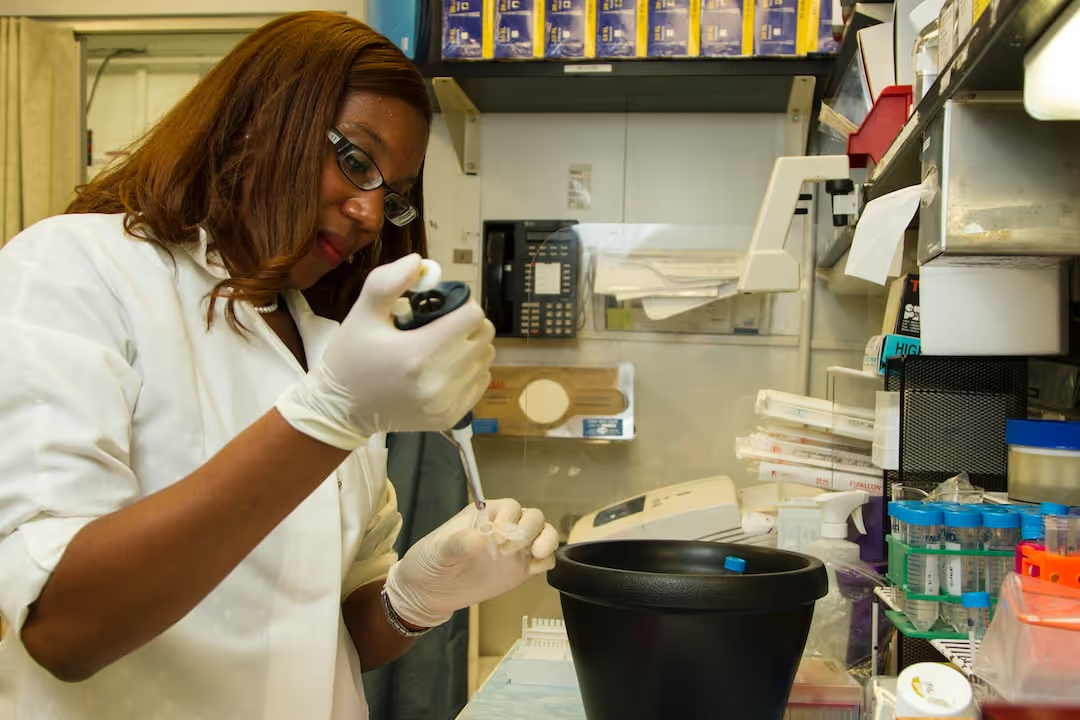
Clinical research is an essential component of medical innovation, yet there remains a debate as to whether it should be considered part of the broader field. As organizations strive to bring new products or services to market faster than ever before, understanding how clinical research fits into R&D has become increasingly important. This blog post examines the question: Is clinical research considered R&D?
We’ll look at what clinical research entails, discuss why it can be seen as either separate from or intertwined with R&D efforts, explore ways in which teams can leverage this type of data for their own workflows, and identify some common challenges that come up when combining these two areas.
By addressing all these points, we will gain a better understanding of how is clinical research considered R&D.
Table of Contents
Is Clinical Research Considered R&D?
How to Leverage Clinical Research for R&D
Identify Opportunities for Combining Clinical Research and R&D
Developing Strategies To Leverage Both Fields
Challenges in Combining Clinical Research and R&D
FAQs About “Is Clinical Research Considered R&D?”
What is R&D in clinical research?
What industry does clinical research fall under?
What activities qualify for R&D?
What is Clinical Research?
Clinical research is a type of scientific study that focuses on understanding the effects and safety of medical treatments, procedures, and products. It involves collecting data from people to determine how well a particular treatment works or if it has any side effects. Clinical research helps healthcare providers make decisions about which treatments are most effective for their patients.
Clinical research is defined as “the systematic investigation into the etiology, diagnosis, prognosis, therapy, or prevention of diseases in humans” (WHO). This includes both observational studies and randomized controlled trials (RCTs) that involve human participants. Observational studies look at existing data while RCTs compare different interventions to see which one works best.
Types of Clinical Research
There are several types of clinical research including epidemiological studies, clinical trials, case-control studies, cohort studies, and surveys.
Epidemiological studies look at patterns in disease occurrence across populations over time.
Clinical trials test new drugs or treatments.
Case-control studies compare two groups with different outcomes.
Cohort studies follow individuals over time to observe changes in health status.
Surveys collect information from large numbers of people about their health behaviors or beliefs.
Benefits of Clinical Research
The advantages of conducting clinical research are numerous.
- Improved patient care through evidence-based medicine.
- Advances in medical knowledge due to a better understanding of diseases and treatments.
- Cost-effective healthcare delivery by providing insight into what treatments work best for certain conditions or populations.
- Development of new therapies that could potentially save lives or improve the quality of life of those affected by chronic illnesses such as cancer or diabetes.
Key Takeaway: Clinical research is an important part of R&D, as it provides valuable insights into the safety and efficacy of new products.
Is Clinical Research Considered R&D?
By combining clinical research with R&D efforts, organizations can gain valuable insights about potential risks associated with their product or service before it hits the market.
Combining both fields allows organizations to leverage data gathered through clinical trials while also taking advantage of technological advancements made during the course of their own internal R&D projects.
For example, if a company was developing a medical device, they could use data collected from previous clinical trials combined with their own technology innovations to create a more efficient product.
Additionally, this approach would provide companies with real-world feedback about how users interact with their product which could then be used when making future design decisions or marketing strategies.
Key Takeaway: Clinical research is an important part of the R&D process as it helps to inform and validate product development decisions. By combining clinical research and R&D, teams can leverage insights to gain a competitive edge in their industry.
How to Leverage Clinical Research for R&D
Clinical research and R&D are two distinct fields that can be combined to create powerful insights. By leveraging the strengths of both disciplines, teams can gain a comprehensive understanding of their product or service in order to develop more effective solutions.
Identify Opportunities for Combining Clinical Research and R&D
Clinical research provides valuable data on how products or services affect people’s health, safety, quality of life, and other outcomes. This data can then be used by R&D teams to inform product design decisions based on real-world feedback from users.
For example, if a medical device manufacturer wanted to improve patient comfort while using their device, they could use clinical research results to identify areas where changes could be made in order to better meet user needs.
Developing Strategies To Leverage Both Fields
Once opportunities have been identified for combining clinical research with R&D efforts, it’s important for teams to develop strategies that will ensure maximum benefit from the combination of both disciplines. This includes setting clear goals and objectives as well as creating an action plan outlining steps needed in order to achieve those goals effectively. It also involves identifying resources needed such as personnel or technology that may help facilitate the process more efficiently.
Take Advantage of Technology
Utilizing technology to streamline the process can help teams access data quickly and accurately when making decisions about product design or development processes. Cypris is a platform specifically designed for R&D and innovation teams that centralizes all relevant data sources into one place, providing researchers with faster time-to-insights than ever before. This makes it easier for teams to leverage both fields together in order to develop strategies that will benefit their organization.
Challenges in Combining Clinical Research and R&D
When it comes to combining clinical research and R&D, there are several challenges that must be addressed.
Regulatory requirements for combining both fields can be complex and difficult to navigate.
Companies must ensure that their processes meet all applicable regulations in order to protect patient safety and data integrity.
Data quality is also an important factor when merging the two disciplines, as incorrect or incomplete information could lead to inaccurate results or conclusions.
Additionally, resource constraints may limit the ability of teams to effectively combine clinical research and R&D activities due to limited personnel or financial resources.
To overcome these issues, companies should develop strategies for leveraging existing resources more efficiently while still meeting regulatory requirements and ensuring data accuracy. Technology solutions such as Cypris’s research platform can help streamline processes by centralizing data sources into one platform so teams have access to accurate information quickly.
Clinical research and R&D: It’s like a puzzle that needs to be solved. But don’t worry, with Cypris’ research platform you can quickly get the pieces in place for success! #RnD #Innovation Click To Tweet
FAQs About “Is Clinical Research Considered R&D?”
What is R&D in clinical research?
R&D in clinical research is the process of designing, developing, and testing new drugs, treatments, or medical devices. It involves a wide range of activities such as conducting laboratory experiments, analyzing data from clinical trials, and evaluating potential risks associated with new products.
What industry does clinical research fall under?
Clinical research is a branch of the healthcare industry that focuses on collecting and analyzing data from clinical trials, observational studies, and other forms of medical research. It involves conducting tests to evaluate the safety and efficacy of new treatments or medications before they are approved for use in humans.
Clinical research also helps inform public health policies by providing evidence-based information about diseases, treatments, prevention strategies, and more.
What activities qualify for R&D?
R&D activities encompass a wide range of activities, from concept development and design to prototyping and testing. These activities are typically aimed at creating new products or improving existing ones. R&D can involve research into new materials, processes, technologies, software solutions, or any other innovation that could lead to the creation of a product or service.
It is also important to note that R&D does not only take place in laboratories. It can be conducted through market research and customer feedback as well. Ultimately, any activity that seeks to create something new or improve upon an existing solution qualifies as R&D.
Conclusion
How is clinical research considered R&D?
Clinical research is an important part of the R&D process and can be used to inform decisions and improve outcomes. While there are challenges in combining clinical research with R&D, leveraging this type of data can provide valuable insights that help teams move their projects forward.
Are you an R&D or innovation team looking for ways to accelerate time-to-insights? Look no further than Cypris – the research platform built specifically for teams like yours.
Our platform centralizes all of your data sources, making it easier and faster to find insights that will help drive successful outcomes. Take advantage of our powerful tools today and revolutionize how you conduct clinical research!

How to use research and development R&D for your next project?
Research and Development (R&D) is an essential part of any successful business. It involves the exploration, testing, and implementation of new ideas to create products or services that can be used by customers.
R&D teams are responsible for creating innovative solutions to meet customer needs while staying ahead of the competition in a rapidly changing market landscape. However, managing R&D projects can present several challenges such as limited resources, data integration issues across multiple systems, and difficulty tracking progress over time.
To help address these obstacles, research platforms like Cypris provide centralized access to data sources for efficient project management. In this blog post, we’ll discuss how to use research and development R&D and share tips on developing effective strategies for success!
Table of Contents
What is Research and Development R&D?
Types of R&D
How to Develop an Effective R&D Strategy
Identifying Goals and Objectives
Assessing Resources and Capabilities
The Role of Technology in R&D Processes
Automation of Processes and Data Collection/Analysis
Leveraging AI for Predictive Insights
Enhancing Collaboration with Cloud-Based Solutions
How to Use Research and Development R&D With The Help of Cypris
Centralized Data Source in One Platform
Streamline the Research Process
What is Research and Development R&D?
Research and development involve studying existing technologies and practices in order to identify areas for improvement or development. R&D activities can range from basic scientific research to product design and development.
R&D is an umbrella term that encompasses all types of activities related to developing new products, services, or processes. It includes both theoretical research as well as practical experimentation with materials and methods in order to create something novel or improved upon what already exists. The goal of R&D is typically either commercialization or advancement of knowledge within a particular field.
Types of R&D
There are several different types of R&D activities that organizations may pursue, depending on their goals and objectives.
- Basic scientific research such as laboratory experiments.
- Applied research focuses on solving specific problems.
- Engineering development seeks to develop prototypes.
- Product design creates consumer-ready versions.
- Market testing evaluates customer preferences.
- Manufacturing process optimization which improves efficiency.
- Cost reduction initiatives reduce costs associated with production.
- Quality assurance programs ensure safety standards are met.
- Environmental sustainability efforts aim to reduce waste/pollution generated by operations.

(Source)
Benefits of R&D
How to use research and development R&D for your company?
The primary benefit associated with investing in research and development is the potential for increased profits through innovation. Companies can gain a competitive edge in the marketplace by developing better products than competitors, while also improving their bottom line performance due to higher sales volumes.
Additionally, organizations may be able to increase efficiency levels across various departments due to technological advancements made possible through R&D.
Finally, engaging in ongoing research helps businesses stay ahead of industry trends so they can anticipate changes before they occur rather than reacting after it is too late.
Key Takeaway: R&D is a key factor in driving innovation and creating new products, services, and solutions. By understanding the different types of R&D and their benefits, organizations can effectively utilize their resources to maximize success.
How to Develop an Effective R&D Strategy
Developing an effective R&D strategy is essential for any organization that wants to remain competitive in its industry. It involves identifying goals and objectives, assessing resources and capabilities, setting priorities, and allocating resources accordingly.
Identifying Goals and Objectives
The first step in developing a successful R&D strategy is to identify the desired outcomes of the research process. This includes defining specific goals such as improving existing products or services, creating new ones, or expanding into new markets. Once these goals are established, it’s important to create measurable objectives that will help track progress toward achieving them.
Assessing Resources and Capabilities
After establishing clear goals and objectives for your R&D team, it’s time to assess what resources you have available at your disposal. This includes both financial investments as well as personnel with specialized skillsets needed for success in each project area.
Knowing what you can realistically achieve with the given resources allows teams to set realistic expectations from the outset which can save time when unexpected roadblocks arise during development cycles.
Setting priorities and allocating resources is essential when there are limited budgets and finite personnel capacities. It is important to prioritize projects based on their potential impact on business operations, while also considering resource availability within each project area. This helps teams stay focused on key initiatives without spreading themselves too thin across multiple projects.
Developing an effective R&D strategy requires careful consideration of goals, resources, and capabilities. By setting priorities and allocating resources accordingly, teams can maximize the effectiveness of their research efforts to drive innovation.
R&D isn’t rocket science! With the right strategy, resources, and priorities in place, you can take your innovation game to the next level. #ResearchAndDevelopment #Innovation Click To Tweet
The Role of Technology in R&D Processes
Technology has become an integral part of the research and development process. Automation of processes and data collection/analysis, leveraging AI for predictive insights, and enhancing collaboration with cloud-based solutions are all ways that technology can help R&D teams work more efficiently.
Automation of Processes and Data Collection/Analysis
Automating processes such as testing or data analysis helps to streamline the R&D process by reducing manual labor. This automation also allows for faster data collection from experiments which can then be used to make informed decisions about product design or development.
Additionally, automated systems can provide real-time feedback on results which is essential in a rapidly changing environment where quick decisions need to be made.
Leveraging AI for Predictive Insights
Artificial intelligence (AI) technologies have been used in many industries including R&D to gain insights into trends or patterns that may not be visible through traditional methods. For example, machine learning algorithms can analyze large datasets quickly and accurately while providing valuable insights into potential problems before they arise.
By using AI technologies, teams are able to identify areas of improvement in their products much more quickly which enables them to stay ahead of the competition.
Enhancing Collaboration with Cloud-Based Solutions
Cloud computing provides a platform for teams across different locations or departments to collaborate on projects. With cloud-based solutions like Cypris, it’s easy for team members from anywhere in the world to access project information at any time, making communication easier than ever before.
Key Takeaway: Technology plays an important role in helping R&D teams succeed. It automates processes, collects data more efficiently, leverages AI for predictive insights, and enhances collaboration so everyone stays connected no matter where they are located.
How to Use Research and Development R&D With The Help of Cypris
Cypris is a research platform designed to help R&D and innovation teams quickly gain insights. It centralizes data sources into one platform, streamlines the research process, and provides rapid time-to-insights.
Centralized Data Source in One Platform
Cypris consolidates all of your data sources into one centralized platform, eliminating the need for manual processes or multiple tools that can be cumbersome and inefficient. This allows teams to access the information they need in an organized way without having to search through various systems or databases.
Additionally, it makes it easier for teams to collaborate on projects by providing a single resource for everyone involved.
Streamline the Research Process
By centralizing data sources into one platform, Cypris helps streamline the research process by making it faster and more efficient. Teams can easily access relevant information from any device at any time without having to manually search through multiple databases or systems.
Automated processes also allow teams to quickly analyze large amounts of data with minimal effort so they can focus their energy on more important tasks like ideation and problem-solving.
Cypris provides rapid time-to-insights with its powerful analytics capabilities, allowing teams to make informed decisions quickly and efficiently based on real-time data analysis results. This eliminates guesswork when developing strategies as well as reduces costs associated with trial-and-error methods.
Additionally, AI algorithms are used within Cypris’s system which further enhances its predictive capabilities, enabling users to identify trends before they happen. This gives you a competitive edge over other organizations that may not have access to such advanced technology solutions yet.
Key Takeaway: Cypris helps R&D teams save time and resources by centralizing data sources, streamlining the research process, and providing rapid time to insights.
Conclusion
How to use research and development R&D for your next project?
Research and development (R&D) is a crucial part of any organization’s success. It requires an effective strategy to ensure that the R&D process runs smoothly and efficiently.
Are you looking for a research platform that will give your R&D and innovation teams the time to insights they need? Cypris is designed specifically for these types of teams, allowing them to centralize their data sources into one comprehensive platform.
With our easy-to-use interface, you can start seeing results quickly without sacrificing quality or accuracy. Get started with Cypris today and make sure your team has the resources it needs to succeed!

The success of any business is dependent on its ability to innovate and stay ahead of the competition. But how much should a company invest in R&D? It’s an important question that can be difficult to answer as there are numerous factors at play — from budgeting constraints to market forces.
In this blog post, we’ll explore what R&D is, how much should a company invest in R&D and the challenges associated with investing in research and development projects.
Table of Contents
How Much Should a Company Invest in R&D?
Challenges of Investing in R&D
Risk Management for New Technologies and Products
Difficulty Predicting Future Market Trends
Best Practices for Investing in R&D
Establish Clear Goals and Objectives
How Much Should a Company Invest in R&D?
When deciding how much to invest in R&D, companies must consider a variety of factors. These include the size and scope of the project, current market conditions, potential return on investment (ROI), and the resources available. Companies should also be aware that investing too little or too much can have negative consequences.
The amount invested in R&D will vary depending on the company’s goals and objectives. For example, a startup may need to invest more heavily in research and development than an established business with existing products or services.
Additionally, some industries require higher levels of investment due to their complexity or competitive nature.
Here are a few examples of companies with different investment levels.
- Apple invests heavily in research and development.
- Microsoft has historically invested less but is now increasing its investments.
- Amazon Web Services (AWS) focuses primarily on cloud computing solutions.
- Google invests heavily in artificial intelligence (AI) technologies such as machine learning algorithms for natural language processing applications.
Potential ROI from R&D spending depends largely on the success of any new products or services developed through these efforts. A successful product launch could lead to increased sales revenue while an unsuccessful one could result in wasted time and money.
There are other intangible benefits associated with investing in R&D such as improved brand recognition that can contribute to the long-term growth of a company.

(Source)
Challenges of Investing in R&D
Investing in R&D can be challenging for small businesses.
Cost and Time Commitment
Investing in R&D requires a significant amount of money and resources. Companies must allocate funds for research projects as well as hire personnel with specialized skill sets to carry out the work.
Additionally, research projects can take months or even years to complete depending on their complexity, which means that businesses need to have patience when it comes to seeing results from their investments.
The amount of money spent on R&D varies significantly from company to company. Generally, companies spend between 3% to 15% of their total revenue on research and development activities.
For larger organizations, this can mean hundreds of millions or even billions of dollars annually.
Companies may also invest in specific projects that require additional funding beyond the standard budget for R&D.
Additionally, many companies will allocate funds for external partnerships with universities or other research institutions to access specialized knowledge and resources.
Risk Management for New Technologies and Products
Developing new technologies or products also carries certain risks such as potential failure due to technical issues or lack of market demand for the product itself. Businesses must carefully assess these risks before investing in any project so they can minimize losses if things don’t go according to plan.
Difficulty Predicting Future Market Trends
Another challenge associated with R&D is predicting future market trends accurately. Companies must develop products that meet customer needs without wasting resources on unnecessary features or functions that may be obsolete later on. This requires careful analysis of current trends along with accurate forecasting techniques so businesses know what kind of products will be successful before committing too much money.
Key Takeaway: Research and development (R&D) is an essential part of any business but investing in it can be challenging due to the cost and time commitment involved. Companies must consider potential risks, accurately predict future market trends, and allocate sufficient funds to make the most out of their R&D investments.
Best Practices for Investing in R&D
Investing in research and development is essential for companies to remain competitive in today’s market. It can be a costly endeavor, but with the right strategies, it can yield great rewards.
Here are some best practices for investing in R&D that will help ensure success.
Establish Clear Goals and Objectives
Before any project begins, it’s important to have clear goals. This will provide direction and focus throughout the process.
The goals should be specific, measurable, achievable, relevant, and time-bound (SMART). They should also align with the company’s overall strategy.
Allocate Resources
Companies need to make sure they are using their resources efficiently when investing in R&D projects. This includes personnel as well as financial resources such as funding or grants from government organizations or private investors.
Additionally, technology tools such as data analytics platforms can help streamline processes so teams can work more effectively while staying within budget.
Track Progress
It is important to monitor progress regularly in order to address any issues or delays before they become major problems. This could include setting up regular check-ins between team members or having weekly meetings with stakeholders.
Additionally, utilizing a platform like Cypris which centralizes all of your data sources into one place makes it easier to track progress across multiple projects.
Key Takeaway: When investing in R&D, it is important to have clear goals that align with the company’s overall strategy.
Conclusion
It is clear that investing in R&D can be a great way to drive innovation and create competitive advantages for companies. However, it is important to consider the challenges of investing in R&D before committing resources.
Ultimately, how much should a company invest in R&D depends on their individual goals and needs. With the help of Cypris, you can quickly get insights from data sources that were once too difficult or costly to access. Our platform provides real-time analysis, saving time and money while helping your team make informed decisions on how much they should invest in their research & development efforts.
Get started today with Cypris – unlock the power of innovation now!