
For the best experience, this project uses the Webflow Input Enhancer extension. We highly recommend installing it. Click here to download (use preview mode to access link)
A smarter, more engaging monitoring experience—built for speed, accuracy, and collaboration.
Over the past few years, Cypris has helped innovation teams make faster, more informed decisions by centralizing critical insights across patents, academic papers, organizations, and market activity. But until now, tracking changes over time often meant juggling spreadsheets, scattered alerts, and manual checks—workflows that were hard to manage and easy to miss.
Today, we’re excited to introduce an upgraded Monitoring experience on Cypris, a complete redesign of how teams track critical updates. With streamlined setup, redesigned emails, and advanced LLMs powering analysis, Monitoring makes it easy to stay ahead of market shifts and competitor moves—without the noise.
Why We Rebuilt Monitoring from the Ground Up
The original monitoring tools relied heavily on exports and static spreadsheets, requiring users to piece together updates manually. Alerts were basic, often duplicative, and limited in the types of data they could track. They also didn’t always give teams confidence that updates were reliable, accurate, or relevant to their needs.
We reimagined Monitoring to solve these gaps. Instead of scattered, one-off alerts, the new Monitoring delivers timely, structured reports—only when new results exist. Updates are now enriched with LLM-powered summaries that don’t just describe activity, but interpret it—prioritizing what matters most and filtering out the noise.
What’s New in Monitoring
The Monitoring Report
Spreadsheets are no longer needed. Updates now appear in a clear format that highlights key changes such as patent expansions, assignee transfers, or competitor filings. Each report includes AI-generated summaries powered by advanced LLMs to surface the most important trends and context. Reports are refreshed regularly, saved automatically, and build a continuous historical log for long-term tracking.
For many teams, these AI-enhanced reports are the most impactful shift. Instead of raw updates, Monitoring now provides analysis—turning activity like organizational filings or new research papers into intelligence that can guide investment and innovation decisions.
Beyond the reports themselves, having all updates housed directly within Cypris elevates the platform experience as a whole. The new interface is more intuitive, reducing friction for everyday use, and its design makes it easier for teams to collaborate in real time.
Monitoring is also fully integrated with Projects, so you can create and share monitors directly within your team’s workspace. This makes it simple to align ongoing research, track critical events together, and keep collaborators up to speed—all without switching tools. By connecting monitoring with projects, Cypris transforms isolated updates into shared intelligence that enhances both decision-making and collaboration across your organization.
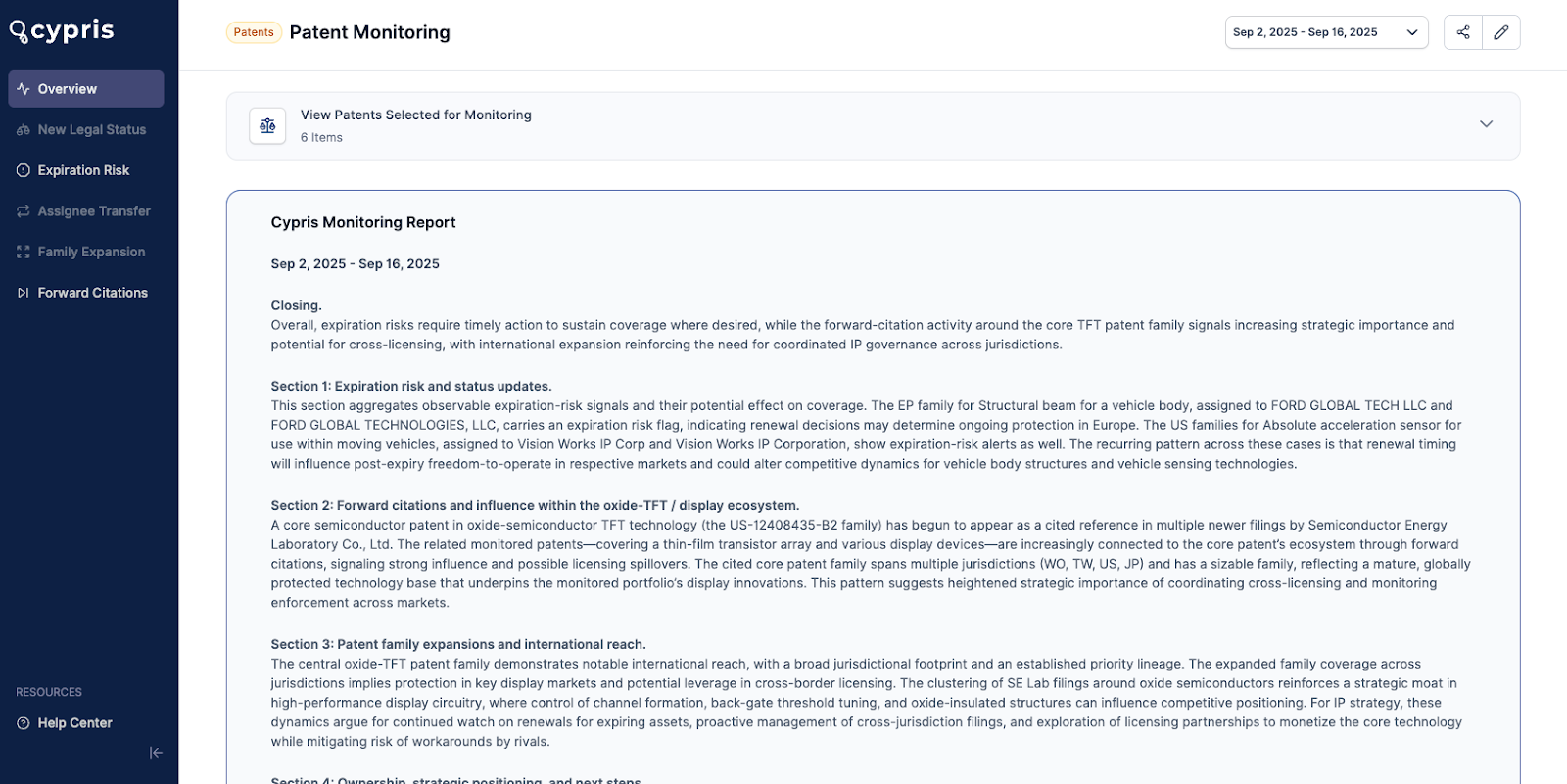
Newsletter-Style Email Experience
Monitoring emails now feel more like a personalized newsletter. Each update arrives in a clean, structured layout with an easy-to-read AI-generated summary of recent activity, spotlighted trends, and direct links to dive deeper in the platform. Content is grouped into clear sections and filterable by category, so you can quickly scan what’s new, focus on the most relevant updates, and stay effortlessly informed—without inbox clutter.
Simplified Setup & Discoverability
Setting up monitors is now faster and more intuitive. Users can create them in a single streamlined interface—quickly searching patent numbers, keywords, organizations, or papers and selecting the right mix in one place. Smart suggestions recommend recipients, while the Monitoring button appears directly on every search results page. Current monitors are clearly indicated to prevent duplication, and external recipients can be added to email updates for seamless collaboration.
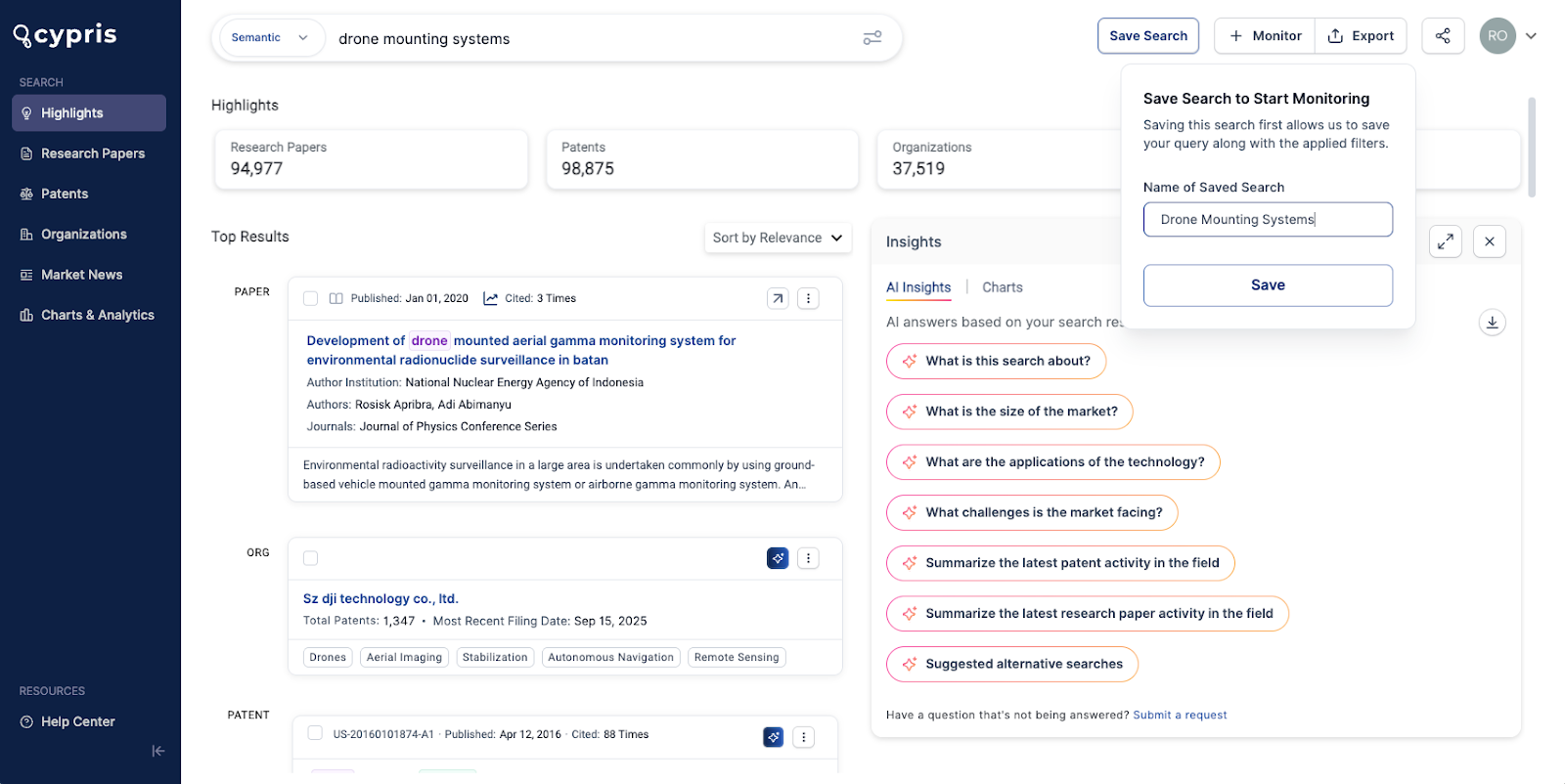
Noise-Free Updates & Critical Alerts
A “send only if new results exist” toggle eliminates duplicate notifications. Monitoring now captures not only newly published patents, papers, and organizations, but also critical patent events such as expiration risks, assignee transfers, patent family expansions, and forward citations—including competitor citations of your own research.
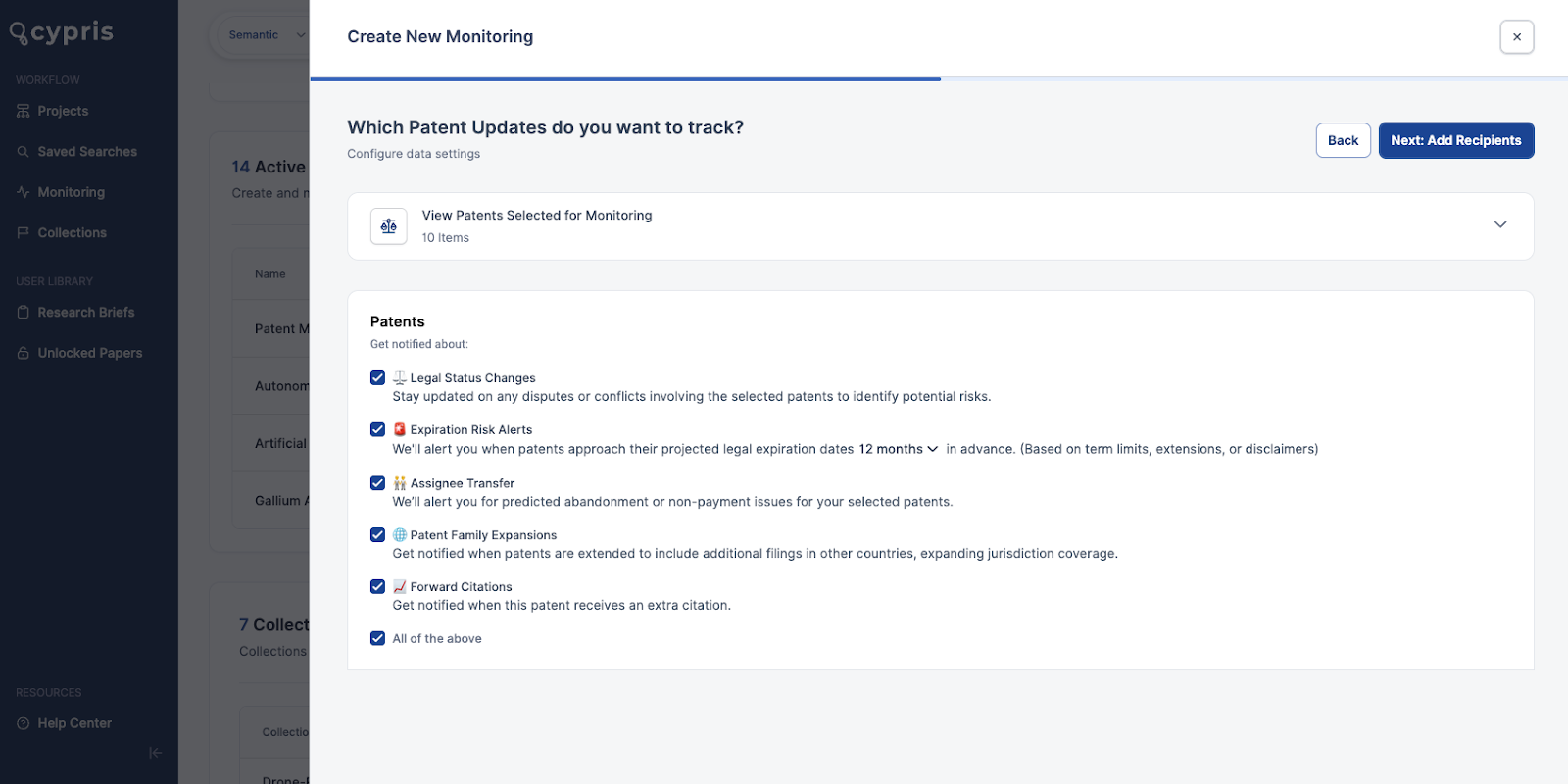
A More Powerful User Experience
Monitoring is built to help users move from raw data to actionable intelligence. Reports save automatically, creating a historical log teams can reference at any time. Items can be flagged directly into collections without manual re-entry. Emails preview AI-enhanced trends with a single click into interactive dashboards, and users can easily add colleagues or external recipients to stay aligned.
From a design perspective, the rebuild also gave our team room to innovate.
As one of our engineering team members, Maddie explained: “It was fun to build something new from scratch. From a UI perspective, we were able to make better design choices right from the start, which made for a much smoother, more intuitive user experience.”
Built for Speed, Accuracy, and Collaboration
With the new Monitoring, teams can save time compared to manual tracking, strengthen competitive intelligence with reliable, cross-dataset updates, collaborate seamlessly by sharing reports with colleagues or external partners, and trust the signal thanks to accuracy, relevancy filters, and AI-powered summaries.
As part of our engineering team, Oleg explained: “This project sat on top of our existing platform, which meant understanding the entire workflow end to end. It was challenging, but it also gave us the opportunity to rethink how everything fits together—and that’s what made it so rewarding.”
Available Now to All Users
The redesigned Monitoring is live and available across the Cypris platform today. If you’re already using Cypris, you’ll see new Monitoring options throughout your search and reporting workflows.
We’re excited to see how your team uses Monitoring to stay ahead of markets, competitors, and technologies — and to keep pushing the boundaries of what intelligent monitoring can do for R&D.

Subscribe to receive the latest blog posts to your inbox every week.
Thank you! Your submission has been received!
Oops! Something went wrong while submitting the form.
A smarter, more engaging monitoring experience—built for speed, accuracy, and collaboration.
Over the past few years, Cypris has helped innovation teams make faster, more informed decisions by centralizing critical insights across patents, academic papers, organizations, and market activity. But until now, tracking changes over time often meant juggling spreadsheets, scattered alerts, and manual checks—workflows that were hard to manage and easy to miss.
Today, we’re excited to introduce an upgraded Monitoring experience on Cypris, a complete redesign of how teams track critical updates. With streamlined setup, redesigned emails, and advanced LLMs powering analysis, Monitoring makes it easy to stay ahead of market shifts and competitor moves—without the noise.
Why We Rebuilt Monitoring from the Ground Up
The original monitoring tools relied heavily on exports and static spreadsheets, requiring users to piece together updates manually. Alerts were basic, often duplicative, and limited in the types of data they could track. They also didn’t always give teams confidence that updates were reliable, accurate, or relevant to their needs.
We reimagined Monitoring to solve these gaps. Instead of scattered, one-off alerts, the new Monitoring delivers timely, structured reports—only when new results exist. Updates are now enriched with LLM-powered summaries that don’t just describe activity, but interpret it—prioritizing what matters most and filtering out the noise.
What’s New in Monitoring
The Monitoring Report
Spreadsheets are no longer needed. Updates now appear in a clear format that highlights key changes such as patent expansions, assignee transfers, or competitor filings. Each report includes AI-generated summaries powered by advanced LLMs to surface the most important trends and context. Reports are refreshed regularly, saved automatically, and build a continuous historical log for long-term tracking.
For many teams, these AI-enhanced reports are the most impactful shift. Instead of raw updates, Monitoring now provides analysis—turning activity like organizational filings or new research papers into intelligence that can guide investment and innovation decisions.
Beyond the reports themselves, having all updates housed directly within Cypris elevates the platform experience as a whole. The new interface is more intuitive, reducing friction for everyday use, and its design makes it easier for teams to collaborate in real time.
Monitoring is also fully integrated with Projects, so you can create and share monitors directly within your team’s workspace. This makes it simple to align ongoing research, track critical events together, and keep collaborators up to speed—all without switching tools. By connecting monitoring with projects, Cypris transforms isolated updates into shared intelligence that enhances both decision-making and collaboration across your organization.
Newsletter-Style Email Experience
Monitoring emails now feel more like a personalized newsletter. Each update arrives in a clean, structured layout with an easy-to-read AI-generated summary of recent activity, spotlighted trends, and direct links to dive deeper in the platform. Content is grouped into clear sections and filterable by category, so you can quickly scan what’s new, focus on the most relevant updates, and stay effortlessly informed—without inbox clutter.
Simplified Setup & Discoverability
Setting up monitors is now faster and more intuitive. Users can create them in a single streamlined interface—quickly searching patent numbers, keywords, organizations, or papers and selecting the right mix in one place. Smart suggestions recommend recipients, while the Monitoring button appears directly on every search results page. Current monitors are clearly indicated to prevent duplication, and external recipients can be added to email updates for seamless collaboration.
Noise-Free Updates & Critical Alerts
A “send only if new results exist” toggle eliminates duplicate notifications. Monitoring now captures not only newly published patents, papers, and organizations, but also critical patent events such as expiration risks, assignee transfers, patent family expansions, and forward citations—including competitor citations of your own research.
A More Powerful User Experience
Monitoring is built to help users move from raw data to actionable intelligence. Reports save automatically, creating a historical log teams can reference at any time. Items can be flagged directly into collections without manual re-entry. Emails preview AI-enhanced trends with a single click into interactive dashboards, and users can easily add colleagues or external recipients to stay aligned.
From a design perspective, the rebuild also gave our team room to innovate.
As one of our engineering team members, Maddie explained: “It was fun to build something new from scratch. From a UI perspective, we were able to make better design choices right from the start, which made for a much smoother, more intuitive user experience.”
Built for Speed, Accuracy, and Collaboration
With the new Monitoring, teams can save time compared to manual tracking, strengthen competitive intelligence with reliable, cross-dataset updates, collaborate seamlessly by sharing reports with colleagues or external partners, and trust the signal thanks to accuracy, relevancy filters, and AI-powered summaries.
As part of our engineering team, Oleg explained: “This project sat on top of our existing platform, which meant understanding the entire workflow end to end. It was challenging, but it also gave us the opportunity to rethink how everything fits together—and that’s what made it so rewarding.”
Available Now to All Users
The redesigned Monitoring is live and available across the Cypris platform today. If you’re already using Cypris, you’ll see new Monitoring options throughout your search and reporting workflows.
We’re excited to see how your team uses Monitoring to stay ahead of markets, competitors, and technologies — and to keep pushing the boundaries of what intelligent monitoring can do for R&D.
Keep Reading
June 3, 2023
•
XX
min read
How Cypris Empowers R&D Teams
Blogs
May 26, 2023
•
XX
min read
Research Papers
Blogs
May 19, 2023
•
XX
min read
Double patenting is a complex issue that often arises in the U.S. legal system, creating potential challenges for R&D managers, engineers, and scientists alike. This advanced blog post will delve into the intricacies of double patenting and provide valuable insights to help you navigate this multifaceted area of patent law.
We will begin by exploring the statutory prohibition against double patenting as well as obviousness-type double patenting (OTDP) in detail. Following this, we’ll discuss some notable challenges to OTDP’s legality through case examples such as SawStop Holding LLC.
Furthermore, our analysis will cover terminal disclaimers as a means for overcoming ODP rejections and their associated limitations. Finally, we’ll outline practical strategies for avoiding double patent issues including drafting narrower claims, filing divisional applications, and sequential prosecution of separate filings.
Double patenting is a legal concept that prevents inventors from obtaining multiple patents on the same invention, ensuring fair competition and preventing unjust extensions of monopoly power. Rooted in Article 1, Section 8 of the U.S. Constitution and codified in 35 U.S.C. §101, double patenting can be divided into two types – the statutory prohibition against double patenting and obviousness-type double patenting (OTDP).
The statutory prohibition against double patenting arises directly from the language of the Patent Act. According to this provision, an inventor may only obtain a single patent for each distinct invention they create. The United States Patent and Trademark Office (USPTO) examines each application to ensure that it does not claim subject matter already covered by an earlier-filed or earlier-issued patent.
Obviousness-Type Double Patenting (OTDP)
In contrast to statutory prohibitions, OTDP is a nonstatutory doctrine developed by courts as part of their authority to create substantive patent law. This type of double-patenting issue occurs when two related applications or patents have claims that are considered “patentably indistinct,” meaning they would be deemed obvious variations over one another if compared side-by-side during a hypothetical patent trial.
The purpose of OTDP is to prevent an inventor from obtaining multiple patents with claims that are not patentably distinct, thereby extending their monopoly beyond the patent term granted by Congress. This doctrine has been upheld and refined in various court decisions, such as those involving Magna Electronics and Geneva Pharmaceuticals.
In order to avoid double patenting issues during the application process, it’s essential for R&D managers, engineers, scientists, and other professionals involved in innovation to understand both statutory prohibitions and OTDP principles. By being aware of these legal concepts when drafting applications or managing portfolios containing related inventions or families of patents owned by a single entity (COO) under a common control (e.g., parent company), teams can minimize risks associated with the overlapping subject matter while maximizing the potential value derived from their intellectual property assets.
Double patenting in the U.S. legal system is a complex issue that has been subject to debate and judicial interpretation for many years. Challenges to obviousness-type double patenting (OTDP) have recently come into focus with cases such as SawStop Holding LLC, which will be discussed further in the next heading.
Key Takeaway:
Double patenting is a legal concept that prevents inventors from obtaining multiple patents on the same invention, and it can be divided into two types – the statutory prohibition against double patenting and obviousness-type double patenting (OTDP). The purpose of OTDP is to prevent an inventor from obtaining multiple patents with claims that are not distinct, thereby extending their monopoly beyond the patent term granted by Congress. It’s essential for R&D managers, engineers, and scientists to understand both statutory prohibitions and OTDP principles to avoid risks associated with the overlapping subject matter while maximizing the potential value derived from intellectual property assets.
Challenges to OTDP’s Legality
The doctrine of obviousness-type double patenting (OTDP) has been challenged by some as unconstitutional since it goes beyond what Congress intended under 35 U.S.C. §101. Critics contend that the OTDP’s non-statutory nature permits courts and USPTO to formulate patent law, a prerogative that should solely be retained by Congress.
One notable challenge comes from SawStop Holding LLC, who sued after their claims were rejected based on OTDP grounds due to similarities with another previously issued SawStop-owned patent.
SawStop Holding LLC Case Example
In a recent patent trial, SawStop argued that its later-filed patent application was improperly rejected because it was not “patentably indistinct” from an earlier-issued patent owned by the same company. The court ultimately upheld the rejection based on obviousness-type double patenting, but this case highlights ongoing concerns about whether such rejections are legally justified.
In response to these challenges, proponents of OTDP maintain that it serves important public policy goals by preventing unjust extensions of monopoly power through multiple patents covering essentially the same invention or obvious variations thereof. They point out that although not explicitly codified in statutes like the statutory prohibition against double patenting, courts have long recognized and applied this doctrine in various forms throughout history as part of their inherent authority over matters relating to patents.
To date, no Supreme Court decision has directly addressed the constitutionality of obviousness-type double patenting, leaving the issue unresolved. However, it remains an important consideration for R&D managers and engineers when filing multiple related patents.
The legal challenges of OTDP are complex and can be difficult to navigate, but filing a terminal disclaimer may offer an effective solution. Nevertheless, filing a terminal disclaimer has restrictions that must be considered.
Terminal Disclaimers for Overcoming ODP Rejections
In the world of patent prosecution, terminal disclaimers can be a valuable tool for overcoming obviousness-type double patenting (OTDP) rejections. A terminal disclaimer is a legal document filed by the applicant to overcome an ODP rejection while agreeing to limit the term of their second patent so that it expires at the same time as their first one. This approach allows inventors and companies to secure patents on related inventions without ignoring OTDP rules.
Limitations Imposed by Filing Terminal Disclaimers
Reduced Patent Term: By filing a terminal disclaimer, applicants agree to reduce any potential Patent Term Adjustment awarded for overcoming delays during prosecution. This means that if your later-filed patent would have otherwise enjoyed an extended term due to such adjustments, you will lose this benefit when you file a terminal disclaimer.
Common Ownership Requirement: In order for a terminal disclaimer to be effective in overcoming an OTDP rejection, both patents must remain under common ownership throughout their entire terms. If either patent is not kept in the same ownership or given out separately, this could lead to one or both patents becoming invalid.
No Revocation: A significant limitation imposed by filing a terminal disclaimer is its irrevocability once accepted by the United States Patent and Trademark Office (USPTO). This means that even if circumstances change, the applicant cannot revoke or modify the terminal disclaimer to extend the patent term.
Despite these limitations, filing a terminal disclaimer can be an effective strategy for overcoming OTDP rejections and securing patents on related inventions. Before making a decision, it is essential for applicants to thoroughly assess their choices and seek counsel from proficient patent lawyers.
Terminal disclaimers can be a useful tool to overcome double patenting rejections, but they also come with certain limitations that should be considered. To further reduce the risk of encountering such issues, it is important to consider strategies like drafting narrower claims and filing divisional applications or sequential prosecution of separate filings.
Key Takeaway:
A terminal disclaimer is a legal document that can help overcome obviousness-type double patenting (OTDP) rejections by agreeing to limit the term of the second patent. However, filing a terminal disclaimer has limitations such as reduced patent terms and common ownership requirements, which should be carefully considered before deciding on this approach.
Strategies for Avoiding Double Patent Issues
To minimize issues related to overlapping subject matter across different commonly owned applications or families, applicants should consider alternative strategies. These include drafting narrower claims focused on specific aspects unique within each invention, filing divisional applications prior to the issuance of original patents that might trigger subsequent rejections based upon similarities identified between them later on down the line when examined side-by-side against one another, and prosecuting these separate filings sequentially rather than concurrently whenever possible.
Drafting Narrower Claims
One effective strategy for avoiding double patenting issues is to draft narrower claims that focus on specific aspects unique within each invention. By doing so, you can ensure that your patent application does not overlap with any earlier-filed patents or pending applications under common ownership.
This approach requires a thorough understanding of both the prior art and the inventive concepts in order to craft claims that are both novel and non-obvious while still providing adequate protection for your innovation.
Filing Divisional Applications
In some cases, it may be beneficial to file divisional applications before an original patent is issued. This allows inventors to split their inventions into separate filings with distinct claim sets targeting different aspects of their technology.
Filing divisional applications early in the process can help prevent potential obviousness-type double patenting (OTDP) rejections by ensuring there are no substantial overlaps between parent and child application claims during an examination at the United States Patent and Trademark Office (USPTO).
Sequential Prosecution of Separate Filings
Another strategy to avoid double patenting issues is the sequential prosecution of separate filings. This approach involves prosecuting one application at a time, allowing the applicant to address any potential OTDP concerns raised by examiners before moving on to subsequent applications within their portfolio.
By addressing these issues early in the process and making necessary amendments or disclaimers as needed, applicants can reduce the likelihood of facing rejections based on double patenting during later stages of examination.
Avoiding double patenting issues requires careful planning and strategic execution throughout the entire patent application process. By employing tactics such as drafting narrower claims, filing divisional applications early in the process, and engaging in sequential prosecution when appropriate, inventors can minimize potential obstacles related to overlapping subject matter while maximizing protection for their innovative technologies.
Key Takeaway:
To avoid double patenting issues, R&D and innovation teams should consider strategies such as drafting narrower claims, filing divisional applications early in the process, and prosecuting separate filings sequentially. By doing so, inventors can minimize potential obstacles related to overlapping subject matter while maximizing protection for their innovative technologies.
Conclusion
In conclusion, it is crucial for R&D managers, engineers, product development teams, scientists, and senior directors involved in research and innovation to understand the implications of Obviousness-Type Double Patenting (OTDP). By recognizing the origins of OTDP in 35 U.S.C. §101 and the federal district court’s recognition of it, companies can avoid potential legal issues that may arise from overlapping patents.
Strategies such as careful claim drafting to avoid obviousness arguments overlap, filing divisional applications before issuance of original patents, or prosecuting each individual case separately can help overcome double-patenting issues during the patent application process.
Take your R&D and innovation teams to the next level. To ensure a smooth patent application process without any double-patenting issues, consult with Cypris today!
Navigating Double Patenting Challenges in U.S. Patent Law