
As an R&D platform and custom report service, search functionality for our users is key.
That's why we're thrilled to announce our platform's user experience and research capabilities just got better. Meet Quick Search, a new search bar that delivers information to our users faster than ever.
What's New with this Launch?
The previous search functionality allowed for search only by keywords. With Quick Search, users can now search by patent and research paper titles in addition to keywords.
What's the User Experience Like?
As you type in your search (keyword, patent, or research paper) you'll see a live tally of the data by category available for that search.
From there, you can click into individual data sections or build a report pulling from all available data streams.
0:00/1×
Have questions or comments? Feel free to reach out to us at info@ipcypris.com for more information.
Meet Quick Search, Our New Functionality



As an R&D platform and custom report service, search functionality for our users is key.
That's why we're thrilled to announce our platform's user experience and research capabilities just got better. Meet Quick Search, a new search bar that delivers information to our users faster than ever.
What's New with this Launch?
The previous search functionality allowed for search only by keywords. With Quick Search, users can now search by patent and research paper titles in addition to keywords.
What's the User Experience Like?
As you type in your search (keyword, patent, or research paper) you'll see a live tally of the data by category available for that search.
From there, you can click into individual data sections or build a report pulling from all available data streams.
0:00/1×
Have questions or comments? Feel free to reach out to us at info@ipcypris.com for more information.
Keep Reading
.png)
1. Executive Summary & Objective
Most AI benchmark studies compare models. This one does not. It compares the same model, in the same session, answering the same prompt twice. The only variable that changed between the two runs was whether Microsoft Copilot had access to the Cypris MCP server.
That design isolates a question R&D and IP leaders increasingly need answered: when an AI assistant produces a technology landscape, how much of the answer comes from the model and how much comes from what the model can reach?
A single prompt was submitted covering non-fluorinated alternatives to PTFE and PVDF across two application domains, chemically resistant coatings and lithium-ion battery binders. The prompt asked for leading chemistry classes, most active assignees and research groups, quantified filing and publication volume by class, and identification of which approaches had crossed from lab-scale publication into commercial patenting. It was submitted first to Copilot operating against the public web, then re-submitted in the same session with the Cypris MCP server connected.
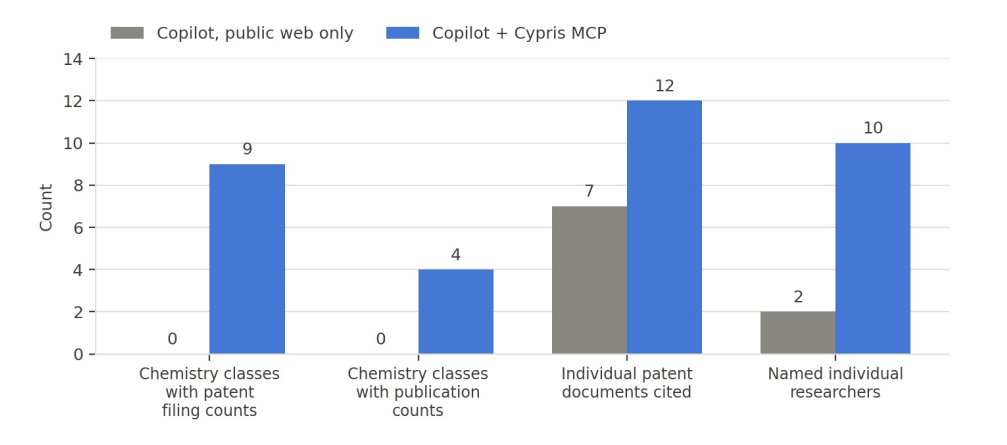
The unaugmented run produced a competent directional survey. It identified the right chemistry families, named recognizable commercial actors, and correctly observed that no current PFAS-free coating platform matches PTFE across the full performance envelope. What it could not do was quantify anything. It reported counts of items it happened to find, four silicone coating publications, four polyacrylate binder families, and stated explicitly that the public sources available to it did not provide chemistry-class totals.
The MCP-grounded run returned scoped filing counts for nine chemistry classes and publication counts for four, spanning roughly 1,640 filings in silicone and siloxane coatings down to 112 in standalone SBR binders. It named individual research groups at NTNU, POLYMAT, Politecnico di Torino, and Munster. It surfaced patent documents dated July 9, 2026, roughly three months more recent than the latest clearly dated item the public-web run reached.
The two answers were then compared by the same assistant against a fixed rubric covering entity specificity, quantitative grounding, source retrievability, and recency. Its conclusion, reached without prompting toward a preferred outcome: the grounded response should serve as the primary work product, the public-web response as an open-web cross-check.
2. Methodology
2.1 The Core Variable
In most comparative AI studies the confound is obvious. Different platforms run different models, apply different system prompts, and expose different tool sets, so any observed performance gap is a composite of many differences at once.
This test removes those confounds. Microsoft Copilot was the assistant in both runs. The session was continuous. The prompt was submitted verbatim, twice, with no clarification, refinement, or follow-up. The single manipulated variable was the presence of the Cypris MCP server in the tool loop.
Model Context Protocol is the open standard that lets an AI assistant call an external data source as a tool rather than answering from training memory or from whatever the open web returns. Connecting Cypris through MCP gave Copilot programmatic access to a structured corpus of patents and peer-reviewed literature, queried by meaning and organized through an R&D ontology, rather than a list of crawlable web pages.
Whatever difference appears between run one and run two is therefore attributable to grounding, not to model capability.
2.2 The Prompt
Identify the leading non-fluorinated alternatives to PTFE and PVDF for chemically resistant coatings and battery binders, based on patent filings and peer-reviewed literature from 2022 to present. Name the most active assignees and research groups, and quantify filing and publication volume by chemistry class. Flag which approaches have moved from lab-scale publication into commercial patenting.
The prompt was constructed to require three things a model cannot produce from parametric memory: named assignees with associated volumes, a recency window extending past any training cutoff, and an explicit separation between academic publication activity and commercial patenting activity.
2.3 Why This Topic
PFAS replacement is a live, high-stakes chemistry problem with genuine regulatory pressure behind it, an active and fragmented patent landscape, and two application domains at meaningfully different stages of commercial maturity. It is also a domain where a plausible-sounding but unquantified answer is easy to produce and difficult for a non-specialist to falsify, which makes it a fair test of whether grounding produces something a practitioner could actually act on.
2.4 Evaluation
Both outputs were assessed against four dimensions: specific entities named, including companies, assignees, institutions, and individual patents or papers; quantitative claims, including filing counts, publication volume, and trend figures; whether sources were cited and independently retrievable; and the recency of the most recent item referenced.
3. Findings
3.1 The Quantification Gap
The starkest difference is not what each run knew. It is what each run could count.
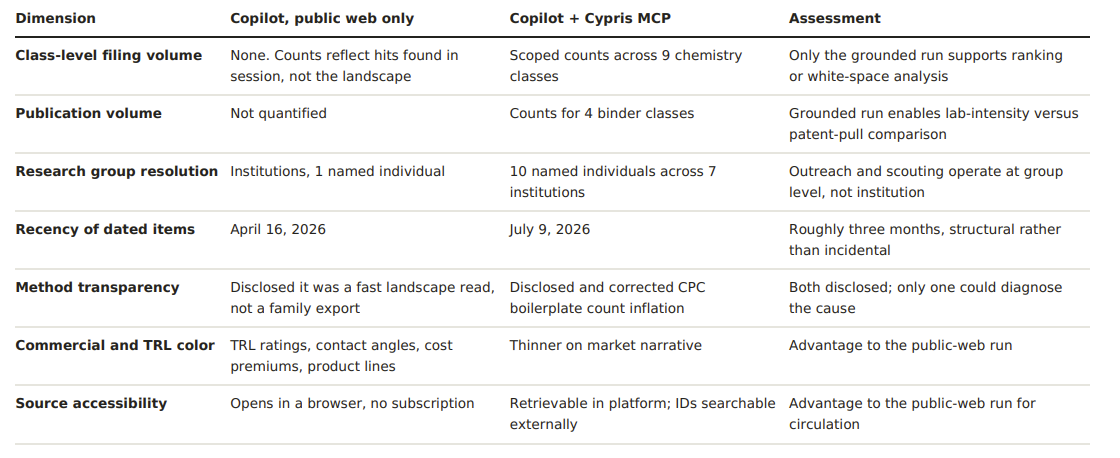
The public-web run was explicit about its own limitation, describing its output as a fast landscape-style read rather than a patent-family export, and stating that the sources available to it did not provide chemistry-class totals. The counts it did report were counts of hits found in that session: four silicone and polysiloxane coating publications, four polyacrylate binder families. These are honest numbers, but they measure the search, not the landscape.
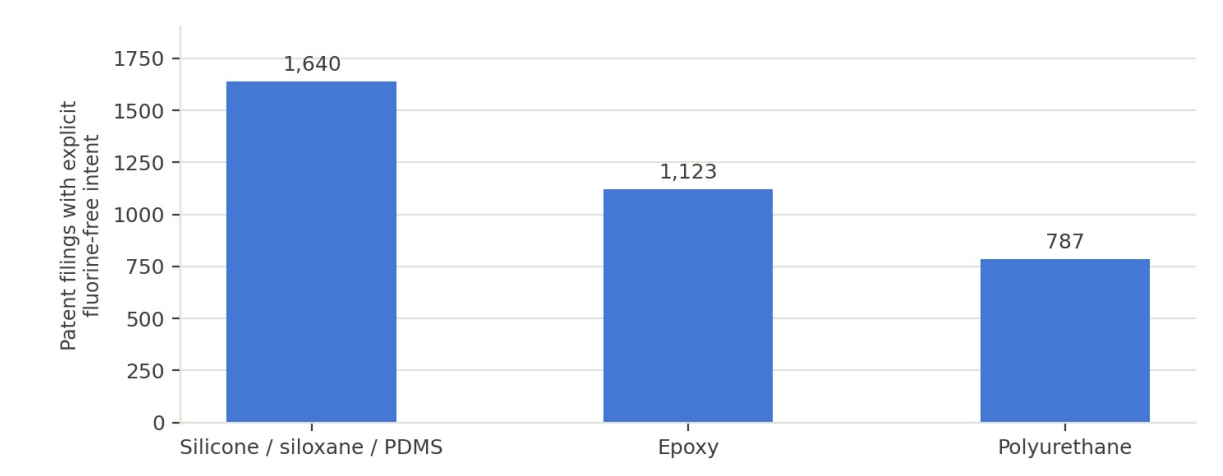
The grounded run returned scoped counts across nine chemistry classes. For battery binders: approximately 339 filings for polyimide and polyamic acid, 323 for cellulose and CMC, 319 for polysaccharides, 255 for polyacrylic acid and polyacrylate, 253 for lignin, and 112 for standalone SBR. For coatings: approximately 1,640 for silicone, siloxane and PDMS, 1,123 for epoxy, and 787 for polyurethane. Publication counts were returned for four binder classes, ranging from 163 papers for polysaccharides down to 57 for lignin.
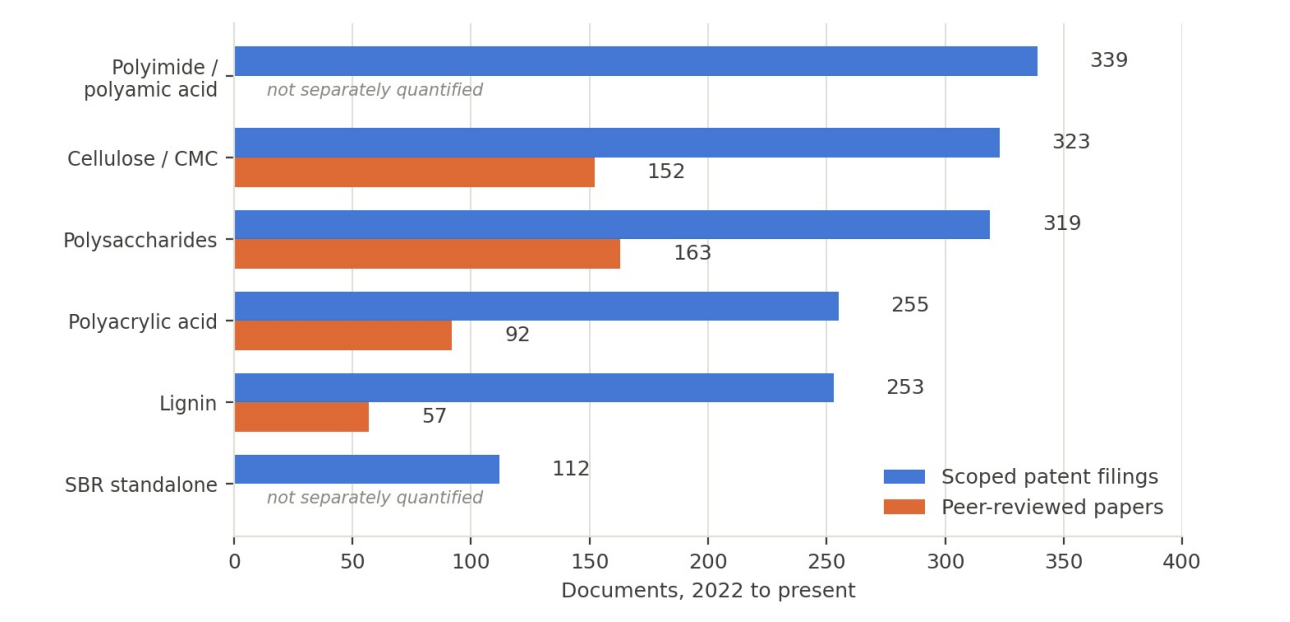
The analytical payload here is the ratio, not either number alone. Polysaccharides show 319 filings against 163 papers, a publication-heavy profile consistent with an academically active class that has not yet converted into commercial portfolios. Polyimide and polyamic acid lead the filing count while returning no comparable publication concentration, the signature of a class that has already moved into industrial development. That distinction, lab-heavy versus commercially converting, is precisely what an R&D lead needs in order to decide whether to prototype, partner, license, or simply monitor. It cannot be inferred from a list of example patents.
3.2 Methodological Self-Correction
One finding is worth isolating because it runs against the usual expectation of what a grounded system does.
The grounded run reported that raw CPC-classification patent counts for battery binders were inflated by boilerplate. Patent specifications routinely list binder options as a generic enumeration, PVDF, CMC, SBR, PAA, and so on, in filings where the binder is not the invention. A CPC-code query captures all of those documents and returns a number that looks authoritative and is substantially wrong. The run therefore re-scoped its counts to title and abstract text carrying explicit fluorine-free, aqueous, or non-fluorinated intent, and reported the tighter numbers.
It also flagged that some assignee aggregations in the coatings landscape were contaminated by fluoropolymer incumbents whose patents mention fluorine-free components without being fluorine-free replacements.
This is the difference between a system that retrieves and a system that retrieves and audits. A tool with no structured access to the corpus has no mechanism to detect this class of error, because it never sees the population that produces it. The unaugmented run could not have identified boilerplate contamination for the same reason it could not produce counts: it had no denominator.
3.3 Research Group Resolution
Both runs named institutions. Only the grounded run named people.
The public-web run surfaced POSTECH, KERI, KIST, Sungkyunkwan University, and Delft, with one named individual researcher. The grounded run identified Jacob Lamb, Silje Bryntesen and Odne Burheim at NTNU; David Mecerreyes and Claudio Gerbaldi at POLYMAT and Politecnico di Torino; Martin Winter and Markus Borner at Munster and Helmholtz-Institut; and on the coatings side Emmanuel Giannelis at Cornell, Zhiwei He at Hangzhou Dianzi University, Joseph Furgal at Bowling Green State University, and Guojun Liu and Muhammad Rabnawaz at Queen's University.
The operational difference is that an institution is a fact and a named group is a contact. Technology scouting, licensing outreach, advisory recruitment, and competitive monitoring all run at the level of the individual research group. A landscape that stops at the institution name has ended one resolution step short of the action it is supposed to inform.
3.4 Recency
The most recent clearly dated item in the public-web run was a patent publication from April 16, 2026. The grounded run referenced patent documents dated July 9, 2026.
The three-month gap is not a rounding error in a domain moving this quickly, and it is structural rather than incidental. Public web coverage of a patent publication depends on someone writing about it and that page being crawlable. Structured corpus access does not.
3.5 Where the Unaugmented Run Was Genuinely Better
An honest benchmark reports the cases that cut the other way.
The public-web run produced better commercial narrative. It surfaced technology readiness level assessments, water contact angle benchmarks, and cost premium characterizations for each coating platform. It identified SEB as a cookware-focused filer of non-fluorinated silicone and sol-gel architectures, Clariant's PTFE-free wax additive product families, and SilcoTek's silicon CVD coatings as deployed replacements in tubing, chromatography columns, and pharmaceutical flow paths. It caught the KERI siloxane cathode binder work and its stated technology-transfer intent, a commercially relevant signal that appears in press coverage before it appears in a patent record.
It was also easier to share. Its sources open in a browser without a subscription, which matters when a landscape needs to circulate to stakeholders who will not log into an analytics platform.
These are real strengths, and they describe the correct role for open-web AI search in an R&D workflow: orientation, market color, and commercial context. They do not describe a substitute for a countable landscape.
4. The Structural Reading
4.1 Coverage Is Not the Only Failure Mode
The familiar critique of general-purpose AI for patent work is that it misses documents. That is true, and it understates the problem.
A model with no structured corpus access cannot produce a denominator. It can tell you that polyacrylic acid binders are important, and it will be right, because that fact is well represented in the crawlable literature. It cannot tell you that polyimide and polyamic acid filings exceed polyacrylic acid filings, because ranking requires counting the population, not sampling it. Every strategic question that depends on relative volume, which class is consolidating, which is still academic, where the white space sits, is therefore unreachable regardless of how good the underlying model is.
This is why the finding survives model upgrades. The gap documented here is not a reasoning gap.
4.2 The Confidence Asymmetry
Both outputs were well formatted, professionally structured, and confident in tone. A reader without domain expertise would find both credible.
The unaugmented run deserves credit for disclosing its own limitation clearly, which is better behavior than most general-purpose outputs exhibit. But the disclosure sat inside an otherwise authoritative document, and in practice caveats placed alongside detailed analysis tend to be read past. The risk in AI-assisted landscaping is rarely that the output is obviously wrong. It is that the output is well-shaped and incomplete in a way that discourages the follow-up the situation required.
4.3 Grounding Travels to the Assistant
The most operationally significant point in this study is where the intelligence sat.
The analyst did not switch platforms. Copilot remained the interface, the session continued uninterrupted, and the output arrived in the same place as the rest of that person's work. What changed was the data the assistant could reach. MCP is what makes that possible: a shared open standard for connecting an AI assistant to an external corpus, so grounded R&D intelligence becomes a capability inside existing tools rather than a separate destination.
For enterprises standardizing on Copilot, this is the practical form the question takes. Not whether to replace the assistant, but whether the assistant is connected to anything that can count.
5. Strategic Takeaways
General-purpose AI assistants running against the public web are effective for orientation. They identify the correct chemistry families, surface recognizable commercial actors, and assemble market narrative and readiness color quickly. Used for exactly that, they save real time.
They cannot produce class-level filing volumes, cannot separate academic activity from commercial conversion, cannot resolve landscapes to the named research group, and cannot detect the classification artifacts that corrupt naive patent counts. These limits follow from data access rather than model capability, and they persist as models improve.
Connecting the same assistant to a structured corpus of patents and scientific literature through MCP changes the output category. The deliverable moves from a survey to a landscape: counted, ranked, attributable to retrievable documents, and resolved to the level at which R&D decisions are actually made.
For teams making prototype, partner, license, or monitor decisions on a technology class, the relevant question is not which AI assistant is being used. It is whether that assistant is grounded in a corpus that can answer the question being asked.
.png)
1. Executive Summary & Objective
This benchmark study evaluates the performance of the Anthropic Opus 5 artificial intelligence model across two distinct deployment architectures: a standard conversational large language model (LLM) interface (Claude) and a specialized deep-research AI agent platform (Cypris Q).1 2 3
The primary objective of this evaluation is to test deep technical intelligence—specifically an AI system's ability to synthesize bankable, unit-operation-level chemical engineering flowsheets when confronted with complex industrial challenges containing deliberate operational "traps."1 Conventional LLMs frequently fail these challenges by providing textbook-accurate but operationally destructive or economically unviable guidance.1 Conversely, deep-search platforms are engineered to surface exact kinetic rate limits, chemical compound properties, active patent parameters, and commercial failure modes to successfully bypass these traps.1 2 6
The Core Architectural Variable
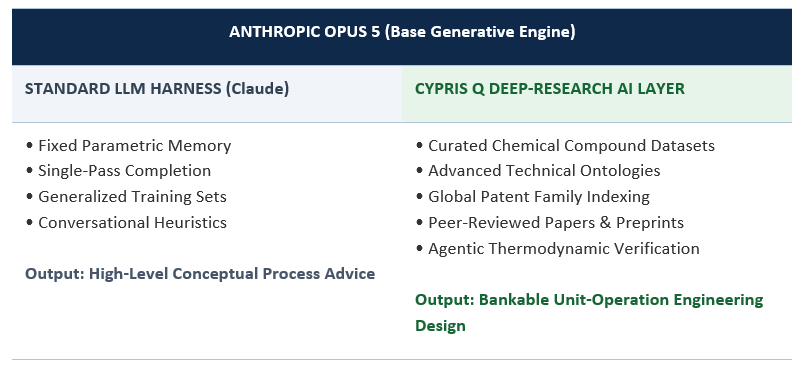
The underlying core LLM weights (Opus 5) were held constant across all test runs. The performance variance documented in this report is solely attributable to the architectural harness surrounding the model:1 2 3 6 7
- Standard Conversational LLM (Claude): Relies on fixed parametric memory and a single-pass conversational prompt-response loop.3 7
- Deep-Research AI Agent (Cypris Q): Integrates Opus 5 into an agentic retrieval, verification, and reasoning pipeline.1 2 6 The Cypris intelligence layer couples the base LLM with multi-modal domain infrastructure—deeply indexing global patent families, curated chemical compound datasets, peer-reviewed journals, scientific preprints, and advanced technical ontologies.2 6
Deployment Architecture Comparison
Methodological Integrity & Independent Evaluation
To maintain strict objectivity and scientific rigor throughout this study:
- Independent AI Evaluation: All generated outputs were evaluated by an independent Gemini model adhering strictly to a standardized, four-dimensional scoring rubric.1
- Zero Data Manipulation: Neither model's output was edited, cherry-picked, or prompt-tuned after execution.2 3 6 7
- Standardized Prompts: Identical, unmodified prompts were submitted to both systems under identical technical specifications.1 2 3 6 7
2. Test Scenarios & Benchmark Rubric
The benchmark consists of two high-stakes industrial chemistry challenges containing deliberate "hidden traps" where standard textbook knowledge yields catastrophic real-world plant failures.1
Test Scenario 1: Hydrometallurgy & Lithium-Ion Battery Recycling
- The Prompt: How to selectively remove trace iron (Fe3+/Fe2+) and aluminum (Al3+) impurities down to <5 ppm from concentrated nickel-cobalt-lithium sulfate leach liquor (derived from EV battery black mass) prior to solvent extraction, avoiding value-metal co-precipitation and ferric gelation.1
- Embedded Traps:
- The 'pH Shock' Trap: Recommending direct baseaddition (NaOH or lime) to pH 4.0–5.0, causing local over-alkalinization,un-filterable ferrihydrite gelation, and 10–20% nickel/cobalt entrainment.1
- The Solvent Extraction Poisoning Trap: Routing un-oxidized Fe2+ orferric Fe3+ directly into organophosphorus extractants (e.g., D2EHPA), whereferric iron binds irreversibly, permanently poisoning the organic phase.1
Test Scenario 2: Semiconductor Materials & Specialty Gases
- The Prompt: How to purify hexafluorobutadiene (C4F6) to electronic grade (>99.999% purity, moisture<1 ppb) by removing trace hydrofluorocarbons (HFCs), moisture, peroxides without triggering catalytic polymerization or yield loss.1
- Embedded Traps:
- The Thermal & Acidity Runaway Trap: Recommending standardmolecular sieves (3A/4A/13X) or activated alumina for drying.1xothermic adsorption onto acidic surface sites supplies the activation energy for nucleophilic rearrangement to hexafluoro-2-butyne, driving column temperatures above 400 °C and pressures above 60 psig within seconds.6
- The Sub-ppb Moisture Spec Trap: Accepting an impossiblespecification (<1 ppb) uncritically, despite it sitting below physicaldesiccant capabilities and commercial Cavity Ring-Down Spectroscopy (CRDS)detection limits.6
Evaluation Scoring Rubric
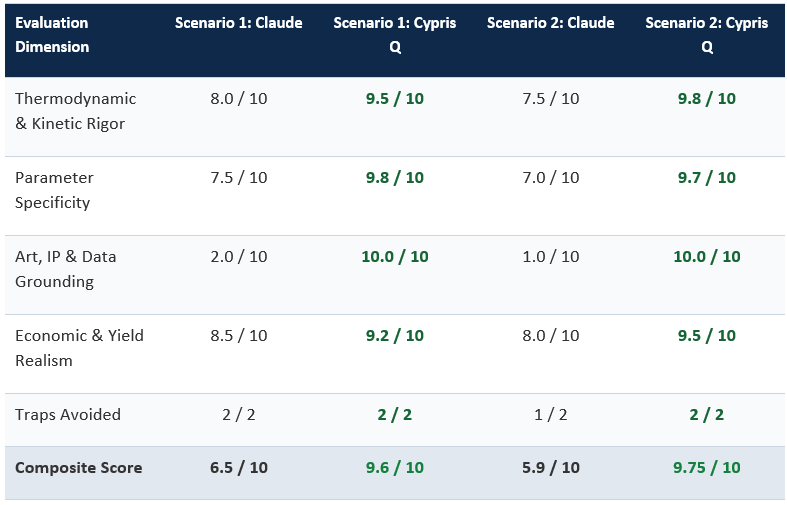
Outputs were scored from 1.0 to 10.0 across four core dimensions:1
- Thermodynamic & Kinetic Rigor: Identification of true physical failure mechanisms, rate-limiting steps, phase behavior, and speciation constraints.1
- Parameter Specificity: Provision of explicit unit-operation specs (pH bands, temperatures, space velocities, exact chemical dosages, catalyst/resin trade names).1
- Art, IP & Data Grounding: Grounding flowsheets in curated compound datasets, active patent families, and peer-reviewed literature.1
- Economic & Yield Realism: Accurate prediction oftarget value-metal recovery (Ni, Co, Li), monomer gas yield losses, reagentcosts, and secondary contamination side-effects.1
3. Comparative Evaluation & Performance Summary
Benchmark Scorecard Summary
4. Synthesis of Test Scenario 1: Hydrometallurgy & Battery Recycling
Trap Navigation Analysis
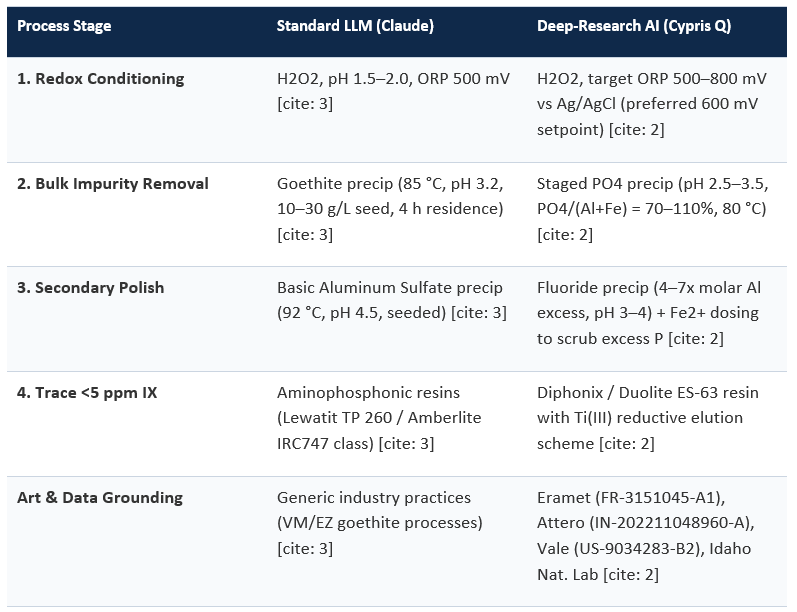
Both harnesses successfully avoided the primary pH shock trap.2 3 Claude bypassed single-stage hydroxide neutralization by recommending controlled goethite (α-FeOOH) or hematite precipitation, providing sound anti-gelation operational heuristics: reverse neutralization (metering liquor into a hot, agitated seed bed), subsurface dilute base injection, and 10–30 g/L seed recycling.3
Cypris Q evaluated the underlying physical chemistry driving gelation.2 It detailed ferrihydrite hydrolysate scavenging mechanismsand phase-transformation kinetics (air-sparged oxidation progressing through green rust → lepidocrocite → goethite).2
Regarding solvent extraction poisoning, Claude recommended managing accumulated Fe3+ on D2EHPA using a 6 M HCl or oxalic acid regeneration slipstream.3 Cypris Q surfaced advanced chemical options: adding aliphatic alcohols or 4-tert-butylphenol modifiers to lower extraction binding energy—enabling stripping with 4.5 M H2SO4—or pre-loading Cyanex 272 with 8.5g/L Ni to extract Fe/Co while cutting sodium contamination from 4 g/L to 0.05g/L.2
Flowsheet Unit Operation Comparison (Scenario 1)
Key Differentiators in Scenario 1
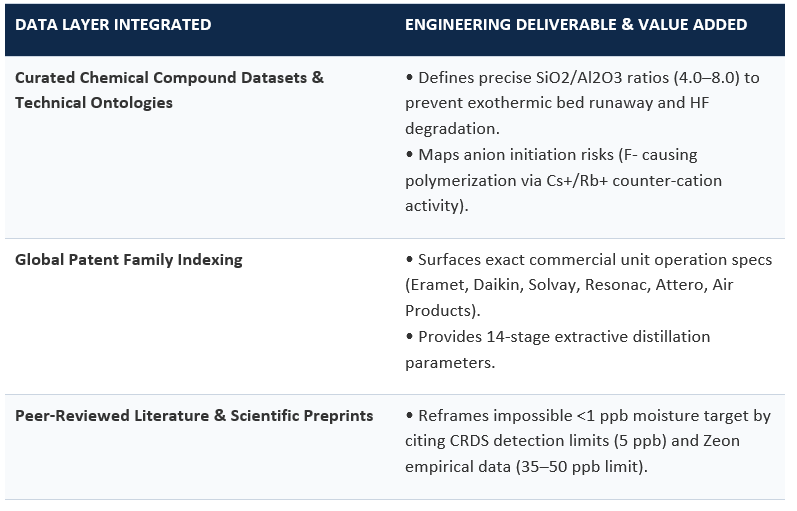
Coupled Fluoride-Aluminum Chemistry: Cypris Q identified a critical chemical coupling missed by standard models: fluoride (F- from LiPF6 electrolyte decomposition) forms stable soluble complexes with Al3+, suppressing aluminum precipitation.2 3 Cypris Q detailed Eramet’s patented solution: dosing a 4–7x molar fluoride excess to force AlF3-type precipitation, combined with soluble iron sulfate dosing (Fe/P ≥ 100%) to scavenge residual phosphate anions that would otherwise contaminate downstream lithium recovery.2
Multi-Source Art Grounding: Cypris Q anchored its flowsheet in assigned IP, compound property tables, and experimental literature, drawing from Eramet, Attero, Vale, IdahoNational Laboratory, and Aalto University research.2 Claude cited zero specific patents or datasets.3
5. Synthesis of Test Scenario 2: Semiconductor Materials & Specialty Gases
Trap Navigation Analysis
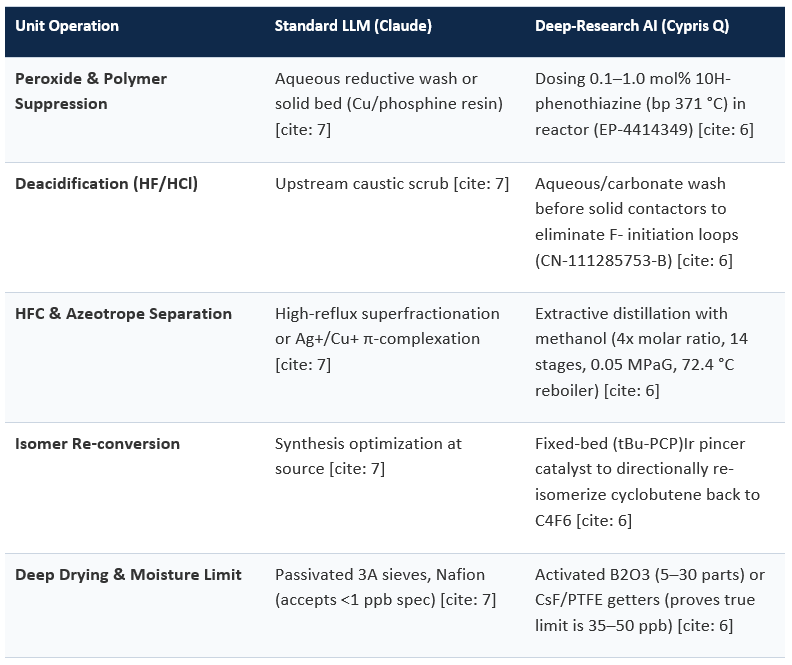
In Scenario 2, the operational divergence between harnesses became pronounced.6 7 Claude partially avoided the thermal runaway trap by warning against activated alumina and 13X molecular sieves due to Lewis acidity.7 However, Claude recommended standard 3A molecular sieves for deep drying.7 In commercial practice, standard 3A sieves with high framework alumina still exhibit Brønsted acid sites that trigger diene rearrangement to hexafluoro-2-butyne and HF liberation.6
Cypris Q fully resolved thetrap by defining the precise structural surface parameters required:maintaining the zeolite SiO2/Al2O3 molar ratio strictly between 4.0 and 8.0 (preferably 5.0–7.0).6 It cited empirical data showing that ratios<4.0 degrade under HF exposure, while ratios >8.0 cause water adsorption capacity to collapse.6
Flowsheet Unit Operation Comparison (Scenario 2)
Key Differentiators in Scenario 2
- ChallengingUnviable Specifications: Claude accepted the prompt's <1 ppb moisture target uncritically.7 Cypris Q challenged the specification using empirical compound datasets and patent art (Zeon, WO-2007063938-A1), proving that the true state-of-the-art for C4F6 moisture removal is 35–50 ppb (achieved via activated boron oxide, B2O3, or metal fluoride getters like CsF/PTFE).6 Furthermore, Cypris Q highlighted that <1 ppb sits below the 5ppb detection limit of commercial Cavity Ring-Down Spectroscopy (CRDS Tiger Optics)instruments, framing the requirement as an analytical validation issue before a process engineering issue.6
- Azeotropic& Catalytic Engineering: To separate near-boiling heptafluorobutene/C4F6 azeotropes (which require an unviable 120-plate column in standard fractionators), Cypris Q surfaced Daikin’s 14-stage methanol extractive distillation process (WO-2019082872-A1) and Tianjin Lvling’s fixed-bediridium pincer catalyst system ((tBu-PCP)Ir), which directionally converts unwanted cyclobutene side-products back into target C4F6.6
Knowledge Layer Impact on Engineering Deliverables
6. Strategic Takeaways
This evaluation demonstrates that while the underlying large language model (Anthropic Opus 5) possesses strong baseline chemical reasoning, the architectural harness determines whether an AI platform delivers high-level conceptual advice or bankable process engineering.1 2 3 6 7
Standard conversational LLM deployments (Claude) serve as efficient, high-level peer reviewers.3 7 They rapidly identify standard thermodynamic risks, outline unit operation sequences, and flag common operational mistakes.3 7 However, relying on fixed parametric memory limits their ability to provide exact unit-operation specs, identify complex multi-species chemical coupling, or cite active prior art.3 7
Deep-research AI platforms (Cypris Q) transform the underlying base model into an authoritative engineering collaborator.1 2 6 By surrounding Opus 5 with a deep intelligence layer—coupling real-time patent retrieval with curated chemical compound datasets, peer-reviewed journal indexing, preprints, and advanced technical ontologies—Cypris Q surfaces exact mass balances, specifies precise catalyst and zeolite structural constraints, reframes unviable customer specifications with empirical data, and grounds every unit operation in validated commercial practice.2 6
For industrial process engineering, IP landscaping, and chemical plant design, deep-research AI agent architectures provide the empirical depth and thermodynamic verification required for commercial execution.1 2 6
References & Cited Literature
- AI Benchmark Case Study Design:Cypris vs. Standard LLMs (Claude) Case Study Methodology & Traps, 2026.
- Cypris Q Evaluation Output (Scenario 1):Hydrometallurgical Impurity Removal & Black Mass Leach Liquor Purification Flowsheet, 2026.3.
- Claude / Anthropic Opus 5 Output (Scenario 1):Selective Trace Fe/Al Removal from Concentrated Nickel-Cobalt-Lithium Sulfate Media, 2026.4.
- Cypris Q Evaluation Output (Scenario 2):Electronic Grade Hexafluorobutadiene ($\text{C}_4\text{F}_6$) Purification & Isomerization Control, 2026.5.
- Claude / Anthropic Opus 5 Output (Scenario 2):Purification of Hexafluorobutadiene ($\text{C}_4\text{F}_6$) to $>99.999\%$ Purity, 2026.Scenario 1: Hydrometallurgy & Battery Recycling Patents & Papers
- Eramet:Process for purifying a leaching filtrate from the black mass of used lithium-ion batteries. Patent No. FR-3151045-A1 (Issued Jan 16, 2025).
- Attero Recycling:Method for removal of aluminium from leach liquor of spent lithium-ion batteries. Patent No. IN-202211048960-A (Issued Feb 29, 2024).
- Vale S.A.:Hybrid process using ion exchange resins in the selective recovery of nickel and cobalt from leaching effluents. Patent No. US-9034283-B2 (Issued May 18, 2015).
- Automated Recovery Systems:Automated System and Method for Recovery of Metals from Spent Lithium-Ion Batteries. Patent No. IN-202611007189-A (Issued Apr 16, 2026).
- Idaho National Laboratory: Palasyuk, O., et al., "Removal of impurity Metals as Phosphates from Lithium-ion Battery leachates."Hydrometallurgy, Vol. 220, 2023.
- Aalto University: Vedagiri, K., "Removal of Fe impurities from NMC 622 black mass by natro-jarosite precipitation."Academic Thesis, Aalto University Repository, 2023.
- D2EHPA / SX Stripping Studies: Logutenko, O. A., et al., "Iron(III) extraction from sulfate solutions with D2EHPA in the presence of organic proton-donor additives."Research Square, 2023.
- Resin Purification Studies: Nicol, M.J. & Lee, M.S., "Removal of iron from cobalt sulfate solutions by ion exchange with Diphonix resin and enhancement of iron elution with titanium(III)."Hydrometallurgy, 2006.Scenario 2: Semiconductor Materials & Specialty Gases ($\text{C}_4\text{F}_6$) Patents & Papers
- Daikin Industries, Ltd.:Method for purifying hexafluorobutadiene. Patent No. WO-2020137845-A1 (Issued Jul 1, 2020).
- Daikin Industries, Ltd.:Hexafluorobutadiene production method. Patent No. WO-2019082872-A1 (Issued May 1, 2019).
- Resonac Corporation:Method for producing hexafluoro-1,3-butadiene. Patent No. EP-4414349-A1 (Issued Aug 13, 2024).
- Solvay SA:Process for the purification of fluorinated olefins in gas/liquid phase. Patent Nos. WO-2022069435-A1&WO-2022069434-A1 (Issued Apr 6, 2022).
- Zeon Corporation:Method and purification of unsaturated fluorinated carbon compound, method for formation of fluorocarbon film. Patent No. WO-2007063938-A1 (Issued Jun 6, 2007).
- Tianjin Lvling Gas Co., Ltd.:Hexafluoro-1,3-butadiene isomerization rearrangement control and purification method. Patent No. CN-111285753-B (Issued Apr 21, 2022).
- Tianjin Lvling Gas Co., Ltd.:Purification device system and purification method of hexafluoro-1,3-butadiene. Patent No. CN-117599443-A (Issued Feb 26, 2024).
- Air Products and Chemicals, Inc.:Purification of hexafluoro-1,3-butadiene. Patent No. US-6544319-B1 (Issued Apr 7, 2003).
- Air Products and Chemicals, Inc.:Adsorbent for moisture removal from fluorine-containing fluids. Patent No. US-6709487-B1 (Issued Mar 22, 2004).
- Zeolite Tandem Bed Research: Miao, G., et al., "Computationally Guided Design of Tandem Zeolite Beds for Efficient Purification of Hexafluoro-1,3-butadiene."Industrial & Engineering Chemistry Research, 2026.
- Polymerization Chemistry: Narita, T., et al., "Anionic polymerization of hexafluoro-1,3-butadiene."Journal of Fluorine Chemistry, Vol. 82, 1994.
Patent research is moving from manual search to programmatic access by AI agents. Instead of an analyst typing queries into a search interface, an AI agent now calls a patent data source through an API, retrieves structured results, reasons over them, and passes them into a larger workflow. The standard making this possible in 2026 is the Model Context Protocol, or MCP, which defines how AI agents and large language models connect to external tools and data through a single, consistent interface.
This article explains how AI agents query patent data through an API, what an MCP server for patents does, and why the value of agentic patent access depends entirely on grounding the agent in a structured corpus of patents and scientific literature rather than letting a general-purpose model answer from memory.
What MCP is and why it matters for patents
MCP is an open, vendor-neutral standard that specifies how an AI application connects to external tools, databases, and APIs. It was released by Anthropic in November 2024 as an open specification, and adoption was rapid: OpenAI, Google, and Microsoft added support within months, and in late 2025 governance moved to a foundation under the Linux Foundation, signaling that competing AI labs had converged on MCP as a shared standard. By early 2026 there were more than 10,000 public MCP servers. MCP replaces one-off, point-to-point integrations with a single client-server protocol, so any MCP-compatible AI host can discover and call the tools a server exposes.
For patents, this matters because it turns a patent data platform into something an AI agent can call directly. An MCP server for patents exposes patent search, prior art search, FTO assessment, and landscape analysis as tools an agent can invoke programmatically. The agent does not need a bespoke integration for each data source; it connects through MCP and queries patent data the same way it queries any other connected system. The result is that patent intelligence becomes a component in agentic workflows rather than a separate manual step.
How AI agents query patent data through an API
When an AI agent queries patent data through an API or MCP server, the pattern is consistent. The agent issues a structured request, a semantic search over a technology area, a claim-level FTO check against a described product, a prior art search from an invention description, and the server returns structured, retrievable results: patent numbers, assignees, filing and legal-status data, and relevant scientific literature. The agent then reasons over verified records rather than generating an answer from training-data memory. This distinction is the entire point. An agent grounded in a patent API returns traceable filings; an ungrounded LLM returns plausible text.
This enables workflows that manual search cannot easily support. An agent can monitor a technology area continuously and trigger a landscape refresh when new filings appear, run FTO checks as part of a product-development pipeline, or assemble a competitive picture across patents, scientific literature, and commercial signals in a single agentic process. Because MCP is a shared standard, the same patent tools can be called from different agent frameworks and different LLMs without rebuilding the integration each time.
Why grounding the agent in a patent corpus is non-negotiable
An API alone is not enough; what the API connects to determines whether the workflow is reliable. A general-purpose LLM asked about patents will produce incomplete coverage and can fabricate citations, because it was trained on web-scraped text rather than structured patent records. Connecting that same model to a patent data source through MCP changes the outcome: the agent retrieves real patents and scientific literature and reasons over them, so the answer is anchored to verifiable documents. Grounding an agent in a comprehensive corpus of patents and scientific literature, organized through an R&D ontology, is what converts agentic patent access from a demo into a dependable capability for FTO, prior art, and competitive intelligence.
Semantic search is the second requirement. Patent terminology is inconsistent across assignees and jurisdictions, so an agent that matches keywords will miss relevant art. Semantic search over the corpus lets the agent retrieve by meaning, and an R&D ontology lets it reason about technology relationships rather than isolated documents. Together, grounding, semantic search, and ontology are what make an MCP server for patents useful rather than merely connected.
Where Cypris fits
Cypris is an AI R&D intelligence platform built to be queried by AI agents. It exposes its corpus of more than 500 million patents and scientific papers, organized through a proprietary R&D ontology, through an MCP server and through enterprise API partnerships with OpenAI, Anthropic, and Google. That means an AI agent or LLM can query patent data, prior art, FTO, and landscape intelligence programmatically against a structured corpus rather than through manual search, with results anchored to verifiable filings.
Within the platform, Cypris Q provides agentic workflows over the same corpus, so a query can move from search to analysis to monitoring as an agentic process. Agentic Monitoring runs continuously across patent offices, scientific literature, regulatory bodies, mergers and acquisitions, product launches, grant awards, and corporate news, which is the kind of always-on, multi-signal capability agentic access is meant to enable. With enterprise-grade security and hundreds of enterprise customers across pharmaceuticals, chemicals, advanced materials, energy, and other regulated industries, Cypris lets teams connect grounded patent intelligence into their agents rather than accepting the limitations of an ungrounded model.
FAQ
How do AI agents query patent data through an API? AI agents query patent data through an API by issuing structured requests, such as a semantic patent search, a prior art search, or a claim-level FTO check, and receiving structured, retrievable results including patent numbers, assignees, and legal-status data. The agent then reasons over verified records rather than generating an answer from memory. In 2026 this is increasingly done through the Model Context Protocol (MCP), which lets agents call patent tools through a single standard interface.
What is an MCP server for patents? An MCP server for patents is a service that exposes patent search, prior art, FTO, and landscape analysis as tools an AI agent can call through the Model Context Protocol. Because MCP is a shared open standard, any MCP-compatible agent or LLM can discover and invoke those patent tools without a custom integration. Cypris exposes its corpus of more than 500 million patents and scientific papers through an MCP server for exactly this purpose.
What is the Model Context Protocol (MCP)? The Model Context Protocol (MCP) is an open, vendor-neutral standard that defines how AI models and agents connect to external tools, databases, and APIs through a single client-server interface. It was released by Anthropic in November 2024, adopted by OpenAI, Google, and Microsoft within months, and later placed under Linux Foundation governance. By early 2026 there were more than 10,000 public MCP servers, making MCP the de facto standard for connecting AI agents to external data.
Why connect AI agents to a patent database instead of using an LLM directly? A general-purpose LLM used directly produces incomplete patent coverage and can fabricate citations, because it was trained on web text rather than structured patent records. Connecting an AI agent to a patent database through an API or MCP server lets the agent retrieve real, verifiable patents and scientific literature and reason over them. Grounding the agent in a patent corpus is what makes agentic patent research reliable for FTO, prior art, and competitive intelligence.
What workflows do agentic patent APIs enable? Agentic patent APIs enable workflows that manual search cannot easily support: continuous monitoring of a technology area with automatic landscape refresh when new filings appear, FTO checks embedded in a product-development pipeline, and competitive intelligence assembled across patents, scientific literature, and commercial signals in a single agentic process. Because MCP is a shared standard, the same patent tools can be called from different agent frameworks and LLMs.
Does querying patent data through an API require semantic search? Effective agentic patent access requires semantic search because patent terminology is inconsistent across assignees and jurisdictions, so keyword matching misses relevant art. Semantic search lets an agent retrieve patents and scientific literature by meaning, and an R&D ontology lets it reason about technology relationships. Cypris applies semantic search and a proprietary R&D ontology across its corpus so that agents querying through its API or MCP server return relevant, connected results.
Can any LLM use an MCP server for patents? Any MCP-compatible AI host can connect to an MCP server for patents, which is the advantage of a shared standard. Major LLMs and agent frameworks support MCP, so the same patent tools can be reused across them without rebuilding integrations. Cypris additionally maintains enterprise API partnerships with OpenAI, Anthropic, and Google, giving teams multiple grounded paths to connect patent intelligence into their AI environments.
Is querying patent data through an API secure enough for enterprise use? Security depends on the platform behind the API. Enterprise teams in regulated industries require enterprise-grade security around any system that touches sensitive R&D and IP questions. Cypris provides enterprise-grade security and serves hundreds of enterprise customers across pharmaceuticals, chemicals, advanced materials, energy, and other regulated industries, so its patent data API and MCP server can be used within enterprise governance requirements.
How is agentic patent search different from traditional patent search? Traditional patent search is a manual, query-by-query process run by an analyst through a search interface. Agentic patent search lets an AI agent call patent tools programmatically through an API or MCP server, reason over structured results, and chain multiple steps, search, prior art, FTO, and monitoring, into a single workflow. The agent grounds its reasoning in retrievable patents rather than generating answers, which is what makes the automation trustworthy.
What does Cypris provide for AI agents and MCP? Cypris exposes its corpus of more than 500 million patents and scientific papers, organized through a proprietary R&D ontology, through an MCP server and enterprise API partnerships with OpenAI, Anthropic, and Google. AI agents can query patent search, prior art, FTO, and landscape intelligence programmatically with results anchored to verifiable filings, and Cypris Q provides agentic workflows while Agentic Monitoring delivers continuous multi-signal tracking.