For the best experience, this project uses the Webflow Input Enhancer extension. We highly recommend installing it. Click here to download (use preview mode to access link)
With the growing interest in space flight and deep space exploration, more research is focusing on how to make life outside of earth habitable for human beings, and at what cost. In this blog, we’ll look at the market landscape of space travel, recent innovation activity, and scientific literature to gain a full picture of where our understanding of life beyond earth is headed.
Market Overview:
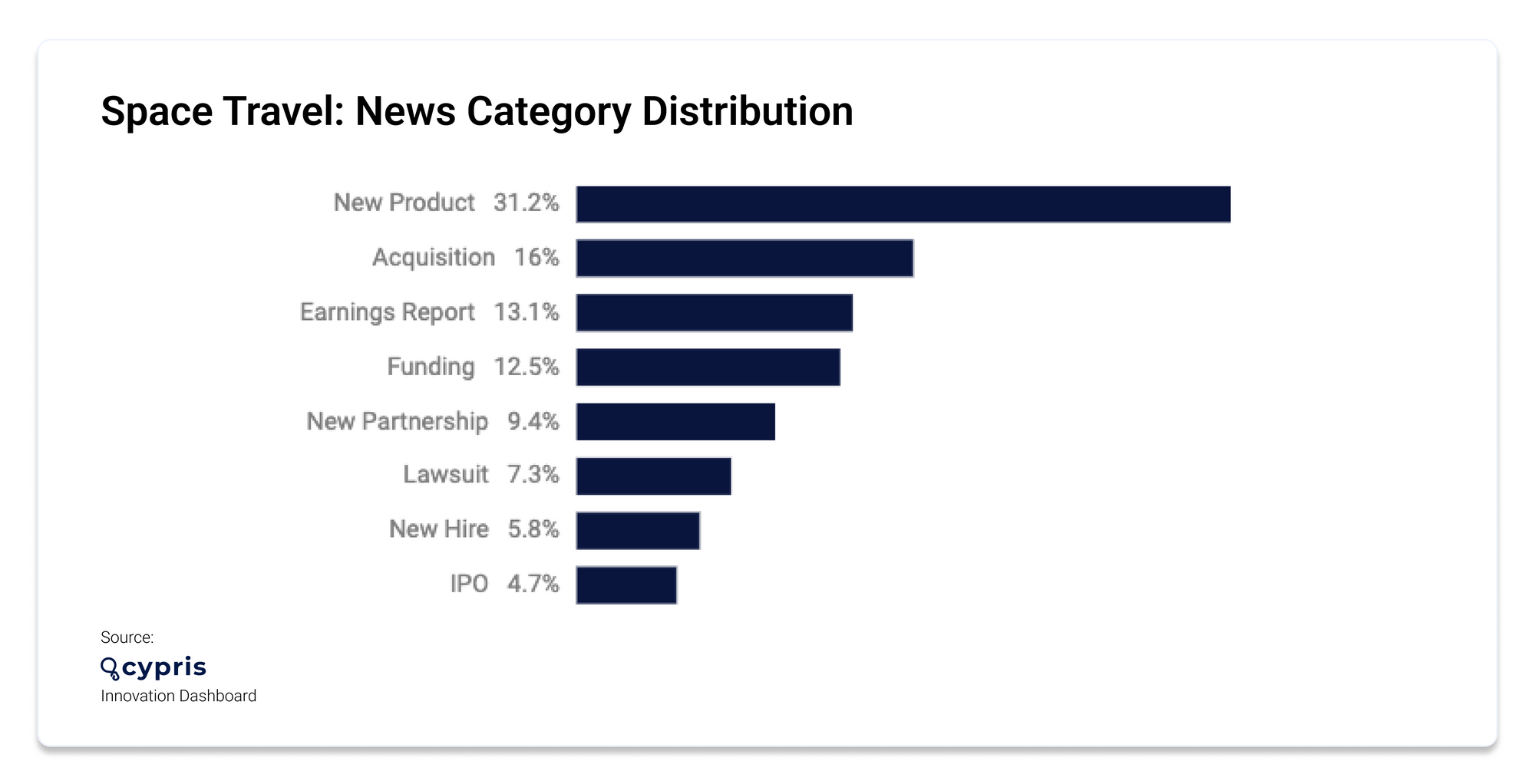
According to the Cypris Innovation Dashboard, over the past year alone, 15 new organizations entered the space travel industry (13 of which were startups) and the majority were based in USA. The past year also saw 406 new patents across 22 different countries, 10,549 new research papers, and 26,156 news articles published in the space. The majority of news articles focused on new products, and across the board media coverage was positive.
News category breakdown
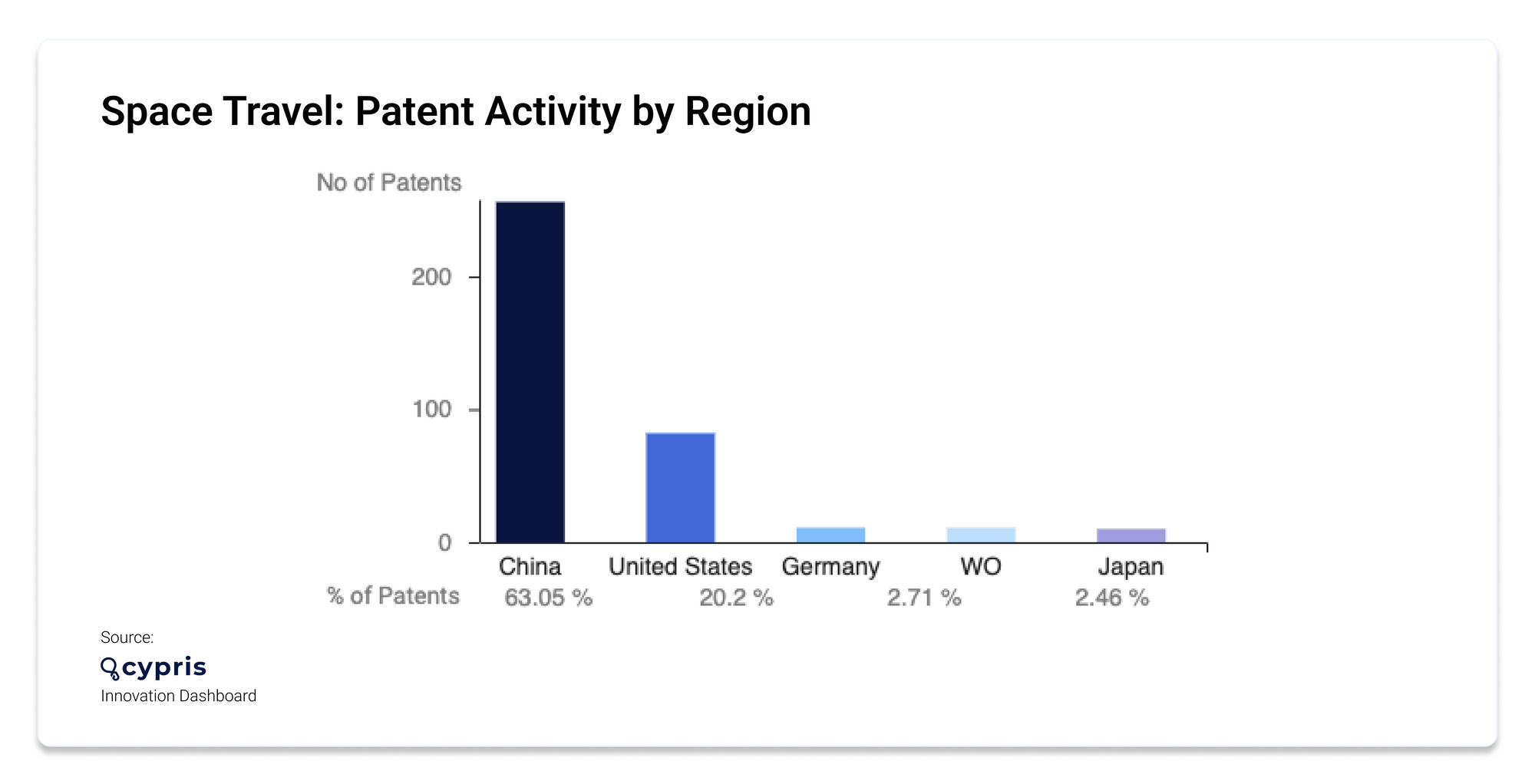
Of the patents published, 15.46% were created by the top 3 entities: NANJING SANLE GROUP CO LTD, ANHUI HUADONG PHOTOELEC TECH, and EMULATE INC. Below, you can see the breakdown of patent activity by region.
Patent count by region
In the recent months, a number of new scientific studies have been released on efforts to make life in outer space habitable for human beings, and the impact of travel on the body and brain. Let's dive into a few of these findings.
Creating Oxygen in Space Using Magnets:
Researchers at the University of Warwick have invented a new way to make oxygen for astronauts using magnets. To provide oxygen in space, NASA currently uses centrifuges, which are large machines that require significant mass, power, and maintenance. As a result, scientists have been looking for a sustainable way to create air in space.
This study focused on the phenomenon of magnetically-induced buoyancy. The researchers engineered a procedure to detach gas bubbles from electrode surfaces in microgravity environments at the Bremen Drop Tower. The results revealed for the first time that gas bubbles can be ‘attracted to’ and ‘repelled from’ a neodymium magnet in microgravity within various solutions.
According to Dr. Katharina Brinkert of the University of Warwick Department of Chemistry Center for Applied Space Technology and Microgravity (ZARM), “Efficient phase separation in reduced gravitational environments is an obstacle for human space exploration and known since the first flights to space in the 1960s. This phenomenon is a particular challenge for the life support system onboard spacecraft and the International Space Station (ISS) as oxygen for the crew is produced in water electrolyzer systems and requires separation from the electrode and liquid electrolyte.”
The results of this study could help generate breathable atmospheres for future space travel to the moon and Mars.
Space Travel’s Impact on the Body's Bone Mass & Stem Cells:
For those who stay in space for longer periods of time, the most prominent side effect is the loss of bone mass. New research now claims that living in space can also accelerate the process of bone aging, and irreparably damage bone structure.
The study assessed 14 male and three female astronauts, average age 47, whose missions ranged from four to seven months in space, with an average of about 5-1/2 months. The results showed that 1 year after their return from space, the astronauts on average exhibited 2.1% reduced bone mineral density at the tibia and 1.3% reduced bone strength. Nine of the 17 astronauts had not completely recovered a full year after returning from space.
"Astronauts experienced significant bone loss during six-month spaceflights - loss that we would expect to see in older adults over two decades on Earth, and they only recovered about half of that loss after one year back on Earth," Gabel said.
Additionally, another recent study focused on 14 astronauts from NASA’s space shuttle program whose white blood samples were stored for 20 years. Researchers found that the astronauts were more likely to have somatic mutations in their genes. The DNA mutations in blood-forming stem cells are at the root of several types of blood cancer.
Space Travel’s Impact on the Brain:
We know that space travel impacts the body, but what does it do to the brain? In this study, 12 cosmonauts who spent an average of six months aboard the International Space Station were scanned in an MRI scanner pre-flight, ten days after flight, and at a follow-up time point seven months after flight.
The results revealed "significant microstructural changes" in the white matter that manages communications within the brain, and to and from the rest of the body, as well as fluid shifts. In particular, the research team spotted changes in neural tracts related to sensory and motor functions, and believe this could have something to do with the cosmonauts' adaptation to life in microgravity while in outer space.
Whether through creating oxygen in outer space, or studying how travel impacts the brain and body, significant advances are being made in the space travel industry. For more data on patents and innovative research papers in the space travel field, visit cypris.ai and get started with access to the innovation dashboard.
If you’d like to explore recent patents filed, you can search through our global patent search engine for free here: https://cypris.ai/patents/allrecords
Sources:
Cypris innovation dashboard cypris.ai ; Query: space travel
Subscribe to receive the latest blog posts to your inbox every week.
Thank you! Your submission has been received!
Oops! Something went wrong while submitting the form.
With the growing interest in space flight and deep space exploration, more research is focusing on how to make life outside of earth habitable for human beings, and at what cost. In this blog, we’ll look at the market landscape of space travel, recent innovation activity, and scientific literature to gain a full picture of where our understanding of life beyond earth is headed.
Market Overview:
According to the Cypris Innovation Dashboard, over the past year alone, 15 new organizations entered the space travel industry (13 of which were startups) and the majority were based in USA. The past year also saw 406 new patents across 22 different countries, 10,549 new research papers, and 26,156 news articles published in the space. The majority of news articles focused on new products, and across the board media coverage was positive.
News category breakdown
Of the patents published, 15.46% were created by the top 3 entities: NANJING SANLE GROUP CO LTD, ANHUI HUADONG PHOTOELEC TECH, and EMULATE INC. Below, you can see the breakdown of patent activity by region.
Patent count by region
In the recent months, a number of new scientific studies have been released on efforts to make life in outer space habitable for human beings, and the impact of travel on the body and brain. Let's dive into a few of these findings.
Creating Oxygen in Space Using Magnets:
Researchers at the University of Warwick have invented a new way to make oxygen for astronauts using magnets. To provide oxygen in space, NASA currently uses centrifuges, which are large machines that require significant mass, power, and maintenance. As a result, scientists have been looking for a sustainable way to create air in space.
This study focused on the phenomenon of magnetically-induced buoyancy. The researchers engineered a procedure to detach gas bubbles from electrode surfaces in microgravity environments at the Bremen Drop Tower. The results revealed for the first time that gas bubbles can be ‘attracted to’ and ‘repelled from’ a neodymium magnet in microgravity within various solutions.
According to Dr. Katharina Brinkert of the University of Warwick Department of Chemistry Center for Applied Space Technology and Microgravity (ZARM), “Efficient phase separation in reduced gravitational environments is an obstacle for human space exploration and known since the first flights to space in the 1960s. This phenomenon is a particular challenge for the life support system onboard spacecraft and the International Space Station (ISS) as oxygen for the crew is produced in water electrolyzer systems and requires separation from the electrode and liquid electrolyte.”
The results of this study could help generate breathable atmospheres for future space travel to the moon and Mars.
Space Travel’s Impact on the Body's Bone Mass & Stem Cells:
For those who stay in space for longer periods of time, the most prominent side effect is the loss of bone mass. New research now claims that living in space can also accelerate the process of bone aging, and irreparably damage bone structure.
The study assessed 14 male and three female astronauts, average age 47, whose missions ranged from four to seven months in space, with an average of about 5-1/2 months. The results showed that 1 year after their return from space, the astronauts on average exhibited 2.1% reduced bone mineral density at the tibia and 1.3% reduced bone strength. Nine of the 17 astronauts had not completely recovered a full year after returning from space.
"Astronauts experienced significant bone loss during six-month spaceflights - loss that we would expect to see in older adults over two decades on Earth, and they only recovered about half of that loss after one year back on Earth," Gabel said.
Additionally, another recent study focused on 14 astronauts from NASA’s space shuttle program whose white blood samples were stored for 20 years. Researchers found that the astronauts were more likely to have somatic mutations in their genes. The DNA mutations in blood-forming stem cells are at the root of several types of blood cancer.
Space Travel’s Impact on the Brain:
We know that space travel impacts the body, but what does it do to the brain? In this study, 12 cosmonauts who spent an average of six months aboard the International Space Station were scanned in an MRI scanner pre-flight, ten days after flight, and at a follow-up time point seven months after flight.
The results revealed "significant microstructural changes" in the white matter that manages communications within the brain, and to and from the rest of the body, as well as fluid shifts. In particular, the research team spotted changes in neural tracts related to sensory and motor functions, and believe this could have something to do with the cosmonauts' adaptation to life in microgravity while in outer space.
Whether through creating oxygen in outer space, or studying how travel impacts the brain and body, significant advances are being made in the space travel industry. For more data on patents and innovative research papers in the space travel field, visit cypris.ai and get started with access to the innovation dashboard.
If you’d like to explore recent patents filed, you can search through our global patent search engine for free here: https://cypris.ai/patents/allrecords
Sources:
Cypris innovation dashboard cypris.ai ; Query: space travel
Double patenting is a complex issue that often arises in the U.S. legal system, creating potential challenges for R&D managers, engineers, and scientists alike. This advanced blog post will delve into the intricacies of double patenting and provide valuable insights to help you navigate this multifaceted area of patent law.
We will begin by exploring the statutory prohibition against double patenting as well as obviousness-type double patenting (OTDP) in detail. Following this, we’ll discuss some notable challenges to OTDP’s legality through case examples such as SawStop Holding LLC.
Furthermore, our analysis will cover terminal disclaimers as a means for overcoming ODP rejections and their associated limitations. Finally, we’ll outline practical strategies for avoiding double patent issues including drafting narrower claims, filing divisional applications, and sequential prosecution of separate filings.
Double patenting is a legal concept that prevents inventors from obtaining multiple patents on the same invention, ensuring fair competition and preventing unjust extensions of monopoly power. Rooted in Article 1, Section 8 of the U.S. Constitution and codified in 35 U.S.C. §101, double patenting can be divided into two types – the statutory prohibition against double patenting and obviousness-type double patenting (OTDP).
The statutory prohibition against double patenting arises directly from the language of the Patent Act. According to this provision, an inventor may only obtain a single patent for each distinct invention they create. The United States Patent and Trademark Office (USPTO) examines each application to ensure that it does not claim subject matter already covered by an earlier-filed or earlier-issued patent.
Obviousness-Type Double Patenting (OTDP)
In contrast to statutory prohibitions, OTDP is a nonstatutory doctrine developed by courts as part of their authority to create substantive patent law. This type of double-patenting issue occurs when two related applications or patents have claims that are considered “patentably indistinct,” meaning they would be deemed obvious variations over one another if compared side-by-side during a hypothetical patent trial.
The purpose of OTDP is to prevent an inventor from obtaining multiple patents with claims that are not patentably distinct, thereby extending their monopoly beyond the patent term granted by Congress. This doctrine has been upheld and refined in various court decisions, such as those involving Magna Electronics and Geneva Pharmaceuticals.
In order to avoid double patenting issues during the application process, it’s essential for R&D managers, engineers, scientists, and other professionals involved in innovation to understand both statutory prohibitions and OTDP principles. By being aware of these legal concepts when drafting applications or managing portfolios containing related inventions or families of patents owned by a single entity (COO) under a common control (e.g., parent company), teams can minimize risks associated with the overlapping subject matter while maximizing the potential value derived from their intellectual property assets.
Double patenting in the U.S. legal system is a complex issue that has been subject to debate and judicial interpretation for many years. Challenges to obviousness-type double patenting (OTDP) have recently come into focus with cases such as SawStop Holding LLC, which will be discussed further in the next heading.
Key Takeaway:
Double patenting is a legal concept that prevents inventors from obtaining multiple patents on the same invention, and it can be divided into two types – the statutory prohibition against double patenting and obviousness-type double patenting (OTDP). The purpose of OTDP is to prevent an inventor from obtaining multiple patents with claims that are not distinct, thereby extending their monopoly beyond the patent term granted by Congress. It’s essential for R&D managers, engineers, and scientists to understand both statutory prohibitions and OTDP principles to avoid risks associated with the overlapping subject matter while maximizing the potential value derived from intellectual property assets.
Challenges to OTDP’s Legality
The doctrine of obviousness-type double patenting (OTDP) has been challenged by some as unconstitutional since it goes beyond what Congress intended under 35 U.S.C. §101. Critics contend that the OTDP’s non-statutory nature permits courts and USPTO to formulate patent law, a prerogative that should solely be retained by Congress.
One notable challenge comes from SawStop Holding LLC, who sued after their claims were rejected based on OTDP grounds due to similarities with another previously issued SawStop-owned patent.
SawStop Holding LLC Case Example
In a recent patent trial, SawStop argued that its later-filed patent application was improperly rejected because it was not “patentably indistinct” from an earlier-issued patent owned by the same company. The court ultimately upheld the rejection based on obviousness-type double patenting, but this case highlights ongoing concerns about whether such rejections are legally justified.
In response to these challenges, proponents of OTDP maintain that it serves important public policy goals by preventing unjust extensions of monopoly power through multiple patents covering essentially the same invention or obvious variations thereof. They point out that although not explicitly codified in statutes like the statutory prohibition against double patenting, courts have long recognized and applied this doctrine in various forms throughout history as part of their inherent authority over matters relating to patents.
To date, no Supreme Court decision has directly addressed the constitutionality of obviousness-type double patenting, leaving the issue unresolved. However, it remains an important consideration for R&D managers and engineers when filing multiple related patents.
The legal challenges of OTDP are complex and can be difficult to navigate, but filing a terminal disclaimer may offer an effective solution. Nevertheless, filing a terminal disclaimer has restrictions that must be considered.
Terminal Disclaimers for Overcoming ODP Rejections
In the world of patent prosecution, terminal disclaimers can be a valuable tool for overcoming obviousness-type double patenting (OTDP) rejections. A terminal disclaimer is a legal document filed by the applicant to overcome an ODP rejection while agreeing to limit the term of their second patent so that it expires at the same time as their first one. This approach allows inventors and companies to secure patents on related inventions without ignoring OTDP rules.
Limitations Imposed by Filing Terminal Disclaimers
Reduced Patent Term: By filing a terminal disclaimer, applicants agree to reduce any potential Patent Term Adjustment awarded for overcoming delays during prosecution. This means that if your later-filed patent would have otherwise enjoyed an extended term due to such adjustments, you will lose this benefit when you file a terminal disclaimer.
Common Ownership Requirement: In order for a terminal disclaimer to be effective in overcoming an OTDP rejection, both patents must remain under common ownership throughout their entire terms. If either patent is not kept in the same ownership or given out separately, this could lead to one or both patents becoming invalid.
No Revocation: A significant limitation imposed by filing a terminal disclaimer is its irrevocability once accepted by the United States Patent and Trademark Office (USPTO). This means that even if circumstances change, the applicant cannot revoke or modify the terminal disclaimer to extend the patent term.
Despite these limitations, filing a terminal disclaimer can be an effective strategy for overcoming OTDP rejections and securing patents on related inventions. Before making a decision, it is essential for applicants to thoroughly assess their choices and seek counsel from proficient patent lawyers.
Terminal disclaimers can be a useful tool to overcome double patenting rejections, but they also come with certain limitations that should be considered. To further reduce the risk of encountering such issues, it is important to consider strategies like drafting narrower claims and filing divisional applications or sequential prosecution of separate filings.
Key Takeaway:
A terminal disclaimer is a legal document that can help overcome obviousness-type double patenting (OTDP) rejections by agreeing to limit the term of the second patent. However, filing a terminal disclaimer has limitations such as reduced patent terms and common ownership requirements, which should be carefully considered before deciding on this approach.
Strategies for Avoiding Double Patent Issues
To minimize issues related to overlapping subject matter across different commonly owned applications or families, applicants should consider alternative strategies. These include drafting narrower claims focused on specific aspects unique within each invention, filing divisional applications prior to the issuance of original patents that might trigger subsequent rejections based upon similarities identified between them later on down the line when examined side-by-side against one another, and prosecuting these separate filings sequentially rather than concurrently whenever possible.
Drafting Narrower Claims
One effective strategy for avoiding double patenting issues is to draft narrower claims that focus on specific aspects unique within each invention. By doing so, you can ensure that your patent application does not overlap with any earlier-filed patents or pending applications under common ownership.
This approach requires a thorough understanding of both the prior art and the inventive concepts in order to craft claims that are both novel and non-obvious while still providing adequate protection for your innovation.
Filing Divisional Applications
In some cases, it may be beneficial to file divisional applications before an original patent is issued. This allows inventors to split their inventions into separate filings with distinct claim sets targeting different aspects of their technology.
Filing divisional applications early in the process can help prevent potential obviousness-type double patenting (OTDP) rejections by ensuring there are no substantial overlaps between parent and child application claims during an examination at the United States Patent and Trademark Office (USPTO).
Sequential Prosecution of Separate Filings
Another strategy to avoid double patenting issues is the sequential prosecution of separate filings. This approach involves prosecuting one application at a time, allowing the applicant to address any potential OTDP concerns raised by examiners before moving on to subsequent applications within their portfolio.
By addressing these issues early in the process and making necessary amendments or disclaimers as needed, applicants can reduce the likelihood of facing rejections based on double patenting during later stages of examination.
Avoiding double patenting issues requires careful planning and strategic execution throughout the entire patent application process. By employing tactics such as drafting narrower claims, filing divisional applications early in the process, and engaging in sequential prosecution when appropriate, inventors can minimize potential obstacles related to overlapping subject matter while maximizing protection for their innovative technologies.
Key Takeaway:
To avoid double patenting issues, R&D and innovation teams should consider strategies such as drafting narrower claims, filing divisional applications early in the process, and prosecuting separate filings sequentially. By doing so, inventors can minimize potential obstacles related to overlapping subject matter while maximizing protection for their innovative technologies.
Conclusion
In conclusion, it is crucial for R&D managers, engineers, product development teams, scientists, and senior directors involved in research and innovation to understand the implications of Obviousness-Type Double Patenting (OTDP). By recognizing the origins of OTDP in 35 U.S.C. §101 and the federal district court’s recognition of it, companies can avoid potential legal issues that may arise from overlapping patents.
Strategies such as careful claim drafting to avoid obviousness arguments overlap, filing divisional applications before issuance of original patents, or prosecuting each individual case separately can help overcome double-patenting issues during the patent application process.
Take your R&D and innovation teams to the next level. To ensure a smooth patent application process without any double-patenting issues, consult with Cypris today!
Navigating Double Patenting Challenges in U.S. Patent Law
Blogs
May 18, 2023
•
XX
min read
In the world of research and development, understanding what “widely patent” means is crucial for protecting intellectual property (IP) and maintaining a competitive edge. As industries continue to evolve rapidly, securing patents for innovations becomes even more important.
This blog post will explore the importance of patents in R&D and innovation, focusing on legal protection for inventors and businesses as well as maintaining a competitive advantage through patenting. We’ll also discuss how medical innovations benefit from patent protection, with examples such as new diagnostic technologies and treatment methods.
Furthermore, we’ll delve into studying complex anatomical relationships through patented technologies that contribute to stroke prevention and arterial health improvement. Balancing IP rights with fair competition will be addressed along with the role licensing agreements play in ensuring continued investment in research while protecting revenue streams from patented inventions.
By gaining insight into what “widely patent” means within these contexts, professionals can better navigate the ever-changing landscape of R&D while safeguarding their valuable ideas.
Patents play a crucial role in protecting intellectual property rights within industries such as research and development, product development, engineering, science innovation leadership roles, and commercialization engineering teams, among others. They ensure that businesses can maintain their competitive advantage by preventing competitors from copying or replicating their innovations without permission.
Legal Protection for Inventors and Businesses
In the world of R&D and innovation, patents provide legal protection to both inventors and businesses. By securing a patent for an invention or innovative process, companies can safeguard their intellectual property from being used by competitors without proper authorization. This is especially important when it comes to groundbreaking technologies that have the potential to revolutionize entire industries.
Maintaining a Competitive Edge through Patenting
Exclusive Rights: A granted patent gives its owner exclusive rights over the use, production, sale, or distribution of the patented invention for a specific period (usually 20 years).
Royalties: Patent owners may also license their inventions to other parties in exchange for royalties – providing them with additional revenue streams while maintaining control over how their technology is utilized.
Deterrent Effect: The mere existence of patents can deter potential infringers from attempting to copy protected innovations due to the risk of costly litigation and possible damages awarded if found guilty.
Innovation drives progress across various sectors including medicine (medical devices & diagnostics), engineering (advanced manufacturing), and technology (artificial intelligence). By protecting their intellectual property through patents, companies can continue to invest in R&D efforts that lead to new discoveries and solutions for the betterment of society.
Patenting can provide a shield for inventors to safeguard their creations, as well as enable businesses to stay ahead of the competition. Moving on, let’s look at how patent protection can benefit medical innovations.
In the medical world, patents are essential for advancements like new diagnostic tools or treatment methods. Intellectual property rights play a crucial role in fostering innovation within research and development departments across various fields such as medicine, engineering products/devices designed specifically targeting improvements around arterial health/functionality.
New Diagnostic Technologies Protected by Patents
One example of a patented technology is Directional Doppler ultrasound examination. This innovative method allows more accurate assessment of vertebral artery blood flow bilaterally as well as normal vertebral artery blood flow. The ability to diagnose patients with multiple territory infarcts who are at risk for developing large artery intracranial occlusive disease compared to those with only one affected area can have significant implications on patient care and treatment strategies.
Treatment Methods Benefiting from Patent Protection
Beyond diagnostics, there are also numerous examples of patented treatments that offer improved outcomes for patients suffering from various conditions. For instance, bioresorbable vascular scaffolds (BVS), which provide temporary support to damaged arteries while promoting healing and reducing the risk of complications associated with traditional metallic stents.
Licensing agreements: Companies that hold patents on these innovations can enter into licensing agreements allowing other organizations access to their technology in exchange for royalties or other financial compensation.
Sales channels: Patented inventions may be sold through exclusive sales channels controlled by the inventor or patent holder, ensuring they retain control over potential revenue streams generated from their intellectual property.
Patents provide a shield for intellectual property, incentivizing further research and invention that can be beneficial to healthcare.
Medical Innovations and Patent Protection provide a crucial layer of protection for the research, development, and commercialization efforts that go into creating new treatments or diagnostic technologies. By studying complex anatomical relationships through patented technologies such as stroke prevention or arterial health improvement products, we can further advance medical innovation in ways never before imagined.
Studying Complex Anatomical Relationships Through Patented Technologies
Understanding complex anatomical relationships is vital when addressing issues related to stroke prevention or treatment strategies involving specific vessels like the basilar artery. As advancements continue within R&D departments across various fields like medicine or engineering products/devices designed specifically targeting improvements around arterial health/functionality – having appropriate patent protections becomes increasingly necessary.
Stroke Prevention Through Patented Research Methodologies
Innovative research methodologies and technologies play a significant role in preventing strokes by enabling scientists and medical professionals to study intricate vascular structures more effectively. For instance, high-resolution magnetic resonance imaging (HRMRI) has been patented for its ability to provide detailed images of blood vessel walls, which can help identify early signs of potential stroke-causing conditions such as plaque buildup or inflammation. This intellectual property protection ensures that companies investing in these groundbreaking technologies can reap the benefits of their hard work while contributing positively to global healthcare outcomes.
Engineering Products Targeting Arterial Health Improvement
Blood pressure monitoring devices: Advanced, patented blood pressure monitors allow for more accurate readings and better management of hypertension, a leading risk factor for strokes. One example is the wrist-worn device with an inflatable cuff, providing convenience and accuracy compared to traditional arm cuffs.
Vascular stents: Companies have developed innovative stent designs with unique features aimed at improving arterial health; one such example is the bioabsorbable stent that gradually dissolves over time, reducing the risk of complications and promoting natural healing.
Thrombectomy devices: Patented thrombectomy devices like the stent retriever, which can remove blood clots from arteries more effectively than traditional methods, are crucial in treating acute ischemic strokes and saving lives.
The protection offered by patents allows companies to invest in developing these cutting-edge products without fear of imitation, ultimately benefiting patients worldwide through improved stroke prevention and treatment options.
Studying complex anatomical relationships through patented technologies is a powerful way to gain insights into the human body and develop treatments for conditions like stroke. By balancing intellectual property rights with fair competition, we can ensure that innovators are rewarded while encouraging healthy competition in the marketplace.
Key Takeaway:
Patents are crucial for companies investing in R&D to improve arterial health and prevent strokes. Innovative technologies like HRMRI have been patented to provide detailed images of blood vessel walls, while advanced devices such as bioabsorbable stents and thrombectomy devices offer unique features aimed at improving arterial health and saving lives. These cutting-edge products benefit patients worldwide through improved stroke prevention and treatment options.
Balancing Intellectual Property Rights with Fair Competition
Patents can be a source of contention due to the potential for certain organizations to gain an unfair advantage over competitors who may not have access to similar resources or opportunities. In this section, we will discuss how addressing these concerns is essential for encouraging fair competition while still protecting innovations.
Addressing the Potential for Unfair Advantages
To maintain a balance between intellectual property rights and fair competition, it’s important that patent laws are designed in such a way that they do not create monopolies or stifle innovation. This includes ensuring that patent applications meet strict criteria like novelty, non-obviousness, and utility before being granted. Additionally, implementing measures like compulsory licensing can help prevent companies from abusing their patent rights by refusing to license their technology at reasonable terms.
Encouraging Fair Competition While Protecting Innovations
Limited Patent Duration: Patents are granted for a limited period (usually 20 years), after which the invention becomes part of the public domain. This allows other innovators to build upon existing technologies without infringing on intellectual property rights.
Cross-Licensing Agreements: Companies often enter into cross-licensing agreements where they mutually agree to share patented technologies with each other. This fosters collaboration among industry players while still respecting each party’s intellectual property.
Promoting Open Innovation: Encouraging open innovation through initiatives like research collaborations or joint ventures helps ensure that knowledge is shared across industries rather than remaining siloed within individual companies. The Cypris platform, for example, centralizes data sources and fosters collaboration among R&D and innovation teams.
Finding a suitable equilibrium between preserving intellectual property rights and advancing equitable rivalry is fundamental for motivating development in areas such as engineering or medicine. By addressing potential unfair advantages while still safeguarding innovations through patents, we can create an environment that benefits both inventors and society as a whole.
Preserving IP rights and maintaining fair competition are essential for the ongoing progress of creative products and services. To further protect these innovations, it’s important to consider how licensing agreements and sales channels can help maintain exclusive control over revenue streams from patented inventions.
Key Takeaway:
To maintain a balance between intellectual property rights and fair competition, patent laws should not create monopolies or stifle innovation. Measures like compulsory licensing can prevent companies from abusing their patent rights while promoting open innovation through research collaborations or joint ventures helps ensure that knowledge is shared across industries. Striking the right balance between protecting intellectual property rights and promoting fair competition is essential for driving innovation in various fields.
The Role of Licensing Agreements and Sales Channels in Patent Protection
Companies and individuals responsible for creating novel solutions retain exclusive control over potential revenue streams generated through licensing agreements and sales channels. This ensures continued investment in future breakthroughs benefiting society, overall wellbeing, long-term sustainability, and the global economy.
Exclusive Control Over Revenue Streams from Patented Inventions
Innovation leaders such as R&D managers, product development engineers, scientists, commercialization teams, or senior directors must be aware of the importance of protecting their intellectual property rights to maintain a competitive edge. By securing patents for their inventions or innovations, they can establish licensing agreements with other companies that want to use these patented technologies. These agreements grant permission to utilize the invention under specific terms while providing royalties or fees back to the patent holder. This creates a valuable source of income that supports further research efforts.
Ensuring Continued Investment in Research and Development
Funding: Licensing revenues contribute significantly towards funding ongoing research projects within organizations focused on innovation.
Talent Attraction: Companies known for strong IP protection are more likely to attract top talent who seek an environment where their ideas will be protected.
Cross-Industry Collaboration: Patents facilitate collaboration between industries by enabling technology transfer through licensing deals which allow businesses access cutting-edge advancements without having to develop them internally.
Economic Growth: A robust system of patent protection encourages investments into R&D activities leading ultimately towards economic growth at both national and international levels due to high-value products entering marketplaces globally.
As an editor experienced with SEO, it is important to note that the term “widely patent” is not used in this article. However, the term “intellectual property” is mentioned several times and can be considered an important SEO keyword for this topic.
A widely patent refers to a broad or extensive scope of protection granted by a government authority for an invention. This type of patent covers various aspects and applications of the invention, providing strong intellectual property rights to the inventor or assignee. It encourages investment in research and development while protecting against potential infringement.
What does it mean if a carotid artery is patent?
If a carotid artery is patent, it means that the blood vessel remains open and unobstructed, allowing normal blood flow through it. A healthy, functioning carotid artery is crucial for supplying oxygen-rich blood to the brain. Blockages in this artery can lead to serious health complications such as stroke.
What does patent mean in medicine?
In medicine, “patent” typically refers to an open passage or channel within anatomical structures like arteries or tubes used during medical procedures. A structure being described as “patent” indicates that there are no obstructions present which could impede proper function.
What does it mean to remain patent?
To remain patent signifies that something continues to stay open without obstruction over time. In terms of inventions and intellectual property rights, remaining patented ensures ongoing legal protection from unauthorized use or copying by others throughout its duration.
Conclusion
In conclusion, understanding what “widely patent” means is crucial for R&D managers, engineers, product development managers, and senior-level scientists. Patents protect the intellectual property rights of inventors and businesses while encouraging investment in new ideas through R&D incentives. Medical innovations, such as the directional Doppler ultrasound examination technique, have been protected by patents.
However, it’s important to balance intellectual property rights with market competition to avoid monopolistic privileges that may hinder healthy competition within the industry. Patent disputes can also negatively impact overall industry innovation.
If you’re looking for a reliable partner to protect your intellectual property rights through patent applications and portfolio management services, visit Cypris.
What Does 'Widely Patent' Mean in R&D and Innovation?
Blogs
May 10, 2023
•
XX
min read
An Innovator's Guide to Finding the Right Research Platform for R&D





.jpeg)

.avif)
