
In recent years, a digital transformation of intimacy has taken place—the Internet has become the new matchmaker. Today, it's not uncommon for people to use dating apps and meet their significant other online. In fact, over 323 million people worldwide currently use dating apps.
With more and more people turning to online dating, technologies are being created for things like measuring emotional compatibility, facilitating blind dating, danger prevention, and more. In this blog, we'll look at innovation activity in the online dating market, as well as a few of the new technologies changing how we navigate relationships.
Market Overview:
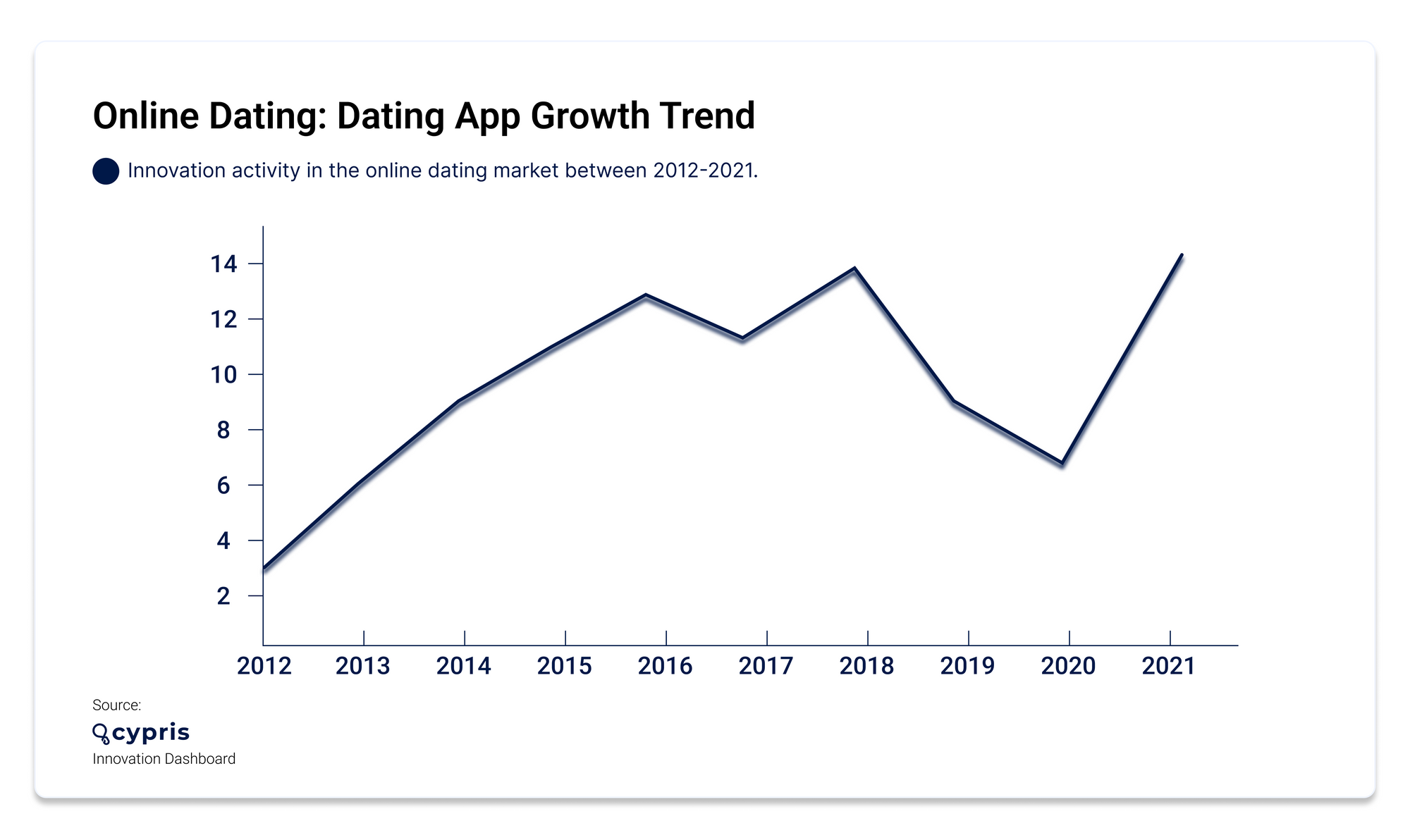
Using the Cypris Innovation Dashboard, we identified innovation activity in the online dating market has grown over the last 5 years, with a 20.91% average growth rate. The top players in the market are Match Group, LLC, Match.com Europe, and e2interactive, Inc., which collectively own 16.9% of IP in the market.
The fastest growing category is Computing Software which saw an 27.92 % increase in new patents filed over the last 5 years, as well as a lot of filings by new entrants.
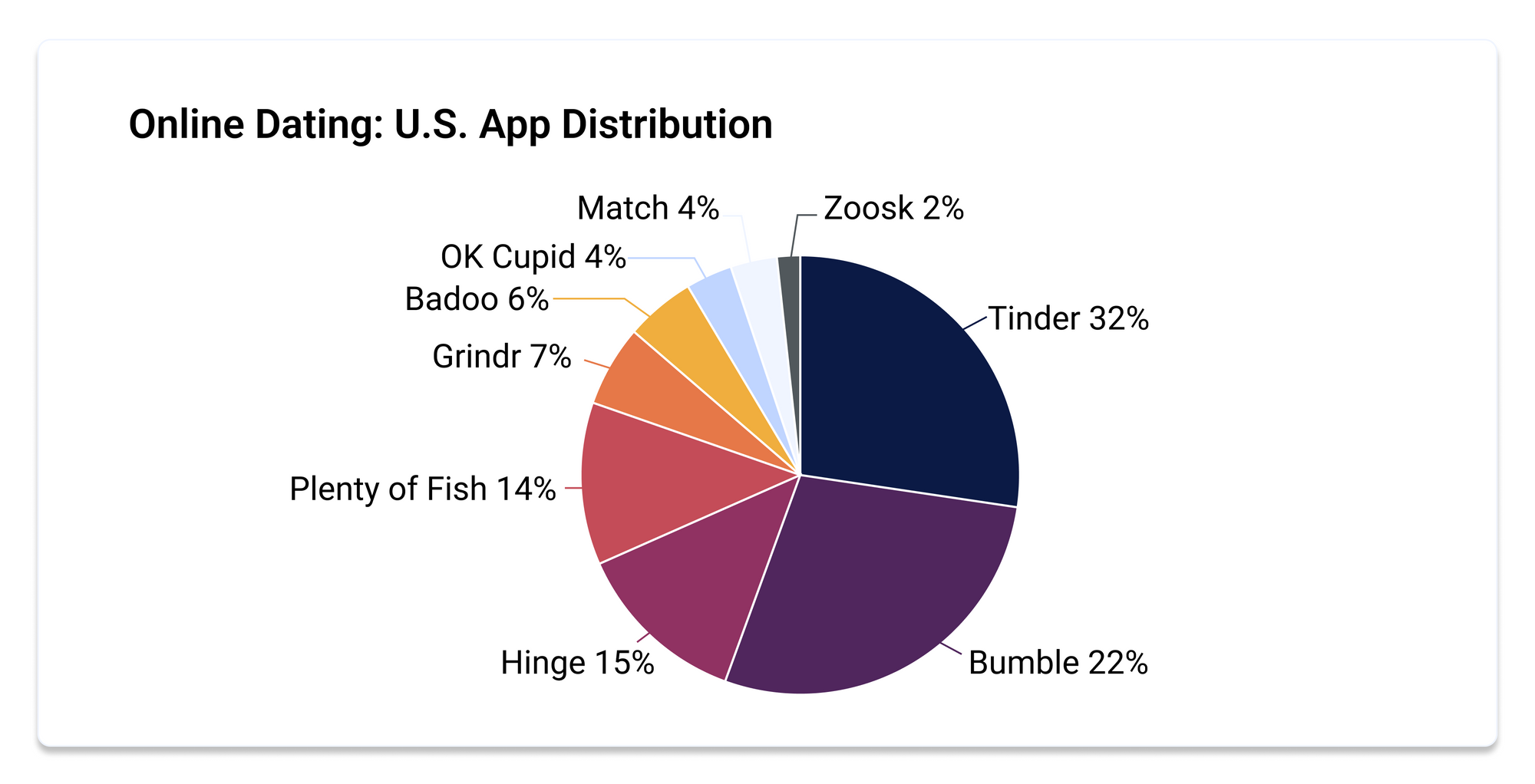
As of January 2022, Tinder dominated 32% of the U.S. market, followed by Bumble (22%), Hinge (15%), Plenty of Fish (15%), Grindr (7%), Badoo (6%), OKCupid (4%), Match.com (4%) and Zoosk (2%). In 2021, the dating app market made $5.61 billion revenue, with almost $3 billion made by Match Group.
Innovation in Online Dating
Let's dive into some of the fascinating patented technologies in the online dating space:
Method and Apparatus for Monitoring Emotional Compatibility in Online Dating: This patent covers methods, devices, and systems for capturing and sharing objective emotion data in dating interactions for the selection of suitable partners, or to enhance social dynamics in online interactions. An emotion monitoring device (EMD) measures physiological signals, obtained from biosensors, captured from a couple during a face-to-face or online dating interaction, and computes emotion data. The emotion data for each person is transmitted to an internet server, and each person shares their emotion data with the other during the interaction. The emotion data is then displayed to each person on a virtual or augmented reality device.
Inventor: Roger J. Quy; Patent Number: 20210267514

An Activity-Centric System and Method for Relationship Matching: This technology is for an online dating and relationship system that relies on common interests in, and arranging for specific face-to-face in-person activities. Potential activities are ranked by an activity ranking engine drawing on activity-related attributes of the users and of the activities. Mutual selection of an in-person activity enables the users to vet potential matches and to proceed to engage in the activity together. The ranking and match engines may take into account intrinsic user and activity attributes as well as activity- related attributes derived from the behavior of the users in relation to the activities.
Inventors: Perry Stevan, Stann Dominic, Petry James; Patent Number: WO2017054081A1
Online Dating Danger Prevention System: This patent covers an online dating danger prevention system. The online dating danger prevention system includes a database that holds information, including geo-location data and photographs, to make online dating safer. Users enter a set of contacts that the system can reach in the event of an emergency.
Inventors: Simard Marcellin; Patent Number: WO2015191090A1
Friend Matching Application: This patent includes a system and method for third-party matchmaking in an online or electronic dating app or system. A friend may review user profiles to select potential matches for another friend. Generating a match may require approval from one or more trusted users, or confirmation through a voting or similar mechanism. A user's matchmaking prowess may be ranked or scored based on success and accuracy. Matches may be anonymous or non-anonymous. A user desiring to be matched may seek out and request that a particular search user identify matches.

Inventor: Christopher Jordan Hurley; Patent Number: 20180130139
Dating Service with Restaurant Selection, Reservations, and Video Promotion Included: This patent covers a systematic method for securely setting up a date in online dating applications. The first step allows a requesting member to request a date with a requested member. Next, the requesting member can enter a meeting date, place, and time. The requested member will then be prompted to either accept or decline the date request from the requesting member. The method also provides a dating history database which records a members' dating history. In addition, a method of ensuring a member's safety by allowing members to choose to have someone contacted if the member does not update the dating history database after a date is disclosed.
Inventors: Stephone Belton; Patent Number: 20210287304
Systems and Methods for Initiating Conversations within an Online Dating Service: This technology is for a computer-implemented method for initiating conversations within an online dating service. It covers identifying a potential match for a user of an online dating service, automatically generating, in response to identifying the potential match, a customized interactive ice breaker widget that is customized to facilitate conversation between the user and the potential match, presenting the customized interactive ice breaker widget to the user, obtaining the user's response to the customized interactive ice breaker widget, and presenting, to the potential match, both the customized interactive ice breaker widget and the user's response to the customized interactive ice breaker widget to facilitate conversation between the user and the potential match.
Inventors: Qiang Wang, Nathan Andrew Sharp; Patent Number: 20200364806

Online Dating Service System: This patent covers an online blind date arranging service system and method that provides information on the opposite sex that can be connected by an acquaintance to a blind date applicant so that the other party can be verified through the acquaintance, and matchmaking can be arranged by an acquaintance.
Inventor: Kwon Nam Yeol; Patent Number: KR101759285B1
Whether through measuring emotional compatibility and setting up blind dates, or through danger prevention and matching based on mutual activity interests, technologies are transforming how we date. To learn more about patents and new innovations in the online dating space, visit cypris.ai and get started with access to the innovation dashboard.
If you’d like to explore recent patents filed, you can search through our global patent search engine for free here: https://cypris.ai/patents/allrecords
Sources:
Technologies Revolutionizing Online Dating & Human Relationships


In recent years, a digital transformation of intimacy has taken place—the Internet has become the new matchmaker. Today, it's not uncommon for people to use dating apps and meet their significant other online. In fact, over 323 million people worldwide currently use dating apps.
With more and more people turning to online dating, technologies are being created for things like measuring emotional compatibility, facilitating blind dating, danger prevention, and more. In this blog, we'll look at innovation activity in the online dating market, as well as a few of the new technologies changing how we navigate relationships.
Market Overview:
Using the Cypris Innovation Dashboard, we identified innovation activity in the online dating market has grown over the last 5 years, with a 20.91% average growth rate. The top players in the market are Match Group, LLC, Match.com Europe, and e2interactive, Inc., which collectively own 16.9% of IP in the market.
The fastest growing category is Computing Software which saw an 27.92 % increase in new patents filed over the last 5 years, as well as a lot of filings by new entrants.
As of January 2022, Tinder dominated 32% of the U.S. market, followed by Bumble (22%), Hinge (15%), Plenty of Fish (15%), Grindr (7%), Badoo (6%), OKCupid (4%), Match.com (4%) and Zoosk (2%). In 2021, the dating app market made $5.61 billion revenue, with almost $3 billion made by Match Group.
Innovation in Online Dating
Let's dive into some of the fascinating patented technologies in the online dating space:
Method and Apparatus for Monitoring Emotional Compatibility in Online Dating: This patent covers methods, devices, and systems for capturing and sharing objective emotion data in dating interactions for the selection of suitable partners, or to enhance social dynamics in online interactions. An emotion monitoring device (EMD) measures physiological signals, obtained from biosensors, captured from a couple during a face-to-face or online dating interaction, and computes emotion data. The emotion data for each person is transmitted to an internet server, and each person shares their emotion data with the other during the interaction. The emotion data is then displayed to each person on a virtual or augmented reality device.
Inventor: Roger J. Quy; Patent Number: 20210267514
An Activity-Centric System and Method for Relationship Matching: This technology is for an online dating and relationship system that relies on common interests in, and arranging for specific face-to-face in-person activities. Potential activities are ranked by an activity ranking engine drawing on activity-related attributes of the users and of the activities. Mutual selection of an in-person activity enables the users to vet potential matches and to proceed to engage in the activity together. The ranking and match engines may take into account intrinsic user and activity attributes as well as activity- related attributes derived from the behavior of the users in relation to the activities.
Inventors: Perry Stevan, Stann Dominic, Petry James; Patent Number: WO2017054081A1
Online Dating Danger Prevention System: This patent covers an online dating danger prevention system. The online dating danger prevention system includes a database that holds information, including geo-location data and photographs, to make online dating safer. Users enter a set of contacts that the system can reach in the event of an emergency.
Inventors: Simard Marcellin; Patent Number: WO2015191090A1
Friend Matching Application: This patent includes a system and method for third-party matchmaking in an online or electronic dating app or system. A friend may review user profiles to select potential matches for another friend. Generating a match may require approval from one or more trusted users, or confirmation through a voting or similar mechanism. A user's matchmaking prowess may be ranked or scored based on success and accuracy. Matches may be anonymous or non-anonymous. A user desiring to be matched may seek out and request that a particular search user identify matches.
Inventor: Christopher Jordan Hurley; Patent Number: 20180130139
Dating Service with Restaurant Selection, Reservations, and Video Promotion Included: This patent covers a systematic method for securely setting up a date in online dating applications. The first step allows a requesting member to request a date with a requested member. Next, the requesting member can enter a meeting date, place, and time. The requested member will then be prompted to either accept or decline the date request from the requesting member. The method also provides a dating history database which records a members' dating history. In addition, a method of ensuring a member's safety by allowing members to choose to have someone contacted if the member does not update the dating history database after a date is disclosed.
Inventors: Stephone Belton; Patent Number: 20210287304
Systems and Methods for Initiating Conversations within an Online Dating Service: This technology is for a computer-implemented method for initiating conversations within an online dating service. It covers identifying a potential match for a user of an online dating service, automatically generating, in response to identifying the potential match, a customized interactive ice breaker widget that is customized to facilitate conversation between the user and the potential match, presenting the customized interactive ice breaker widget to the user, obtaining the user's response to the customized interactive ice breaker widget, and presenting, to the potential match, both the customized interactive ice breaker widget and the user's response to the customized interactive ice breaker widget to facilitate conversation between the user and the potential match.
Inventors: Qiang Wang, Nathan Andrew Sharp; Patent Number: 20200364806
Online Dating Service System: This patent covers an online blind date arranging service system and method that provides information on the opposite sex that can be connected by an acquaintance to a blind date applicant so that the other party can be verified through the acquaintance, and matchmaking can be arranged by an acquaintance.
Inventor: Kwon Nam Yeol; Patent Number: KR101759285B1
Whether through measuring emotional compatibility and setting up blind dates, or through danger prevention and matching based on mutual activity interests, technologies are transforming how we date. To learn more about patents and new innovations in the online dating space, visit cypris.ai and get started with access to the innovation dashboard.
If you’d like to explore recent patents filed, you can search through our global patent search engine for free here: https://cypris.ai/patents/allrecords
Sources:
Keep Reading

Market intelligence software serves fundamentally different purposes depending on which business function requires intelligence support. A chief marketing officer evaluating buyer intent signals needs entirely different capabilities than a chief technology officer tracking competitor R&D activity, and both require different tools than a chief compliance officer monitoring regulatory changes or a portfolio manager analyzing earnings transcripts. The market intelligence software landscape has matured into distinct categories optimized for specific organizational functions, and selecting the right platform requires understanding which category addresses your actual intelligence needs.
The most expensive mistake organizations make when evaluating market intelligence platforms is conflating these categories. Enterprise software purchases often default to the most prominent vendor in the general "market intelligence" space without recognizing that platforms optimized for sales prospecting provide minimal value for R&D teams, and platforms designed for financial analysis offer little utility for regulatory compliance monitoring. Understanding the distinct categories of market intelligence software is the essential first step toward selecting platforms that actually solve your organization's intelligence challenges.
Sales and Go-to-Market Intelligence Platforms
Sales intelligence platforms help marketing and sales teams identify potential buyers, prioritize accounts demonstrating purchase intent, and coordinate outreach campaigns across digital channels. These platforms dominate overall market intelligence software mindshare because sales and marketing functions consume the largest share of enterprise software budgets. The leading vendors in this category include ZoomInfo, 6sense, Demandbase, and Bombora, each offering different approaches to the fundamental challenge of connecting sellers with buyers.
ZoomInfo operates the industry's largest B2B contact database, with over 100 million company profiles and 260 million verified contact records spanning global markets. The platform's core strength lies in prospecting efficiency, providing sales teams with direct access to decision-maker contact information, organizational hierarchies, and company firmographics that enable targeted outreach. ZoomInfo's SalesOS and MarketingOS products help go-to-market teams build targeted prospect lists, enrich CRM data with current contact details, and identify companies matching ideal customer profiles. For organizations whose primary intelligence need is finding and contacting potential buyers, ZoomInfo delivers the most comprehensive coverage of the B2B professional landscape.
6sense pioneered the account-based orchestration category, applying artificial intelligence to analyze anonymous buyer behavior and predict which accounts are actively researching solutions. The platform processes behavioral signals from website visits, content consumption, third-party intent data sources, and search activity to identify accounts demonstrating purchase intent before they engage directly with vendors. Marketing teams use 6sense to coordinate personalized campaigns across email, advertising, and sales outreach based on where accounts sit in their buying journey. The platform excels at helping organizations time their engagement to match buyer readiness rather than pursuing accounts with no immediate purchase intent.
Demandbase combines account-based marketing capabilities with advertising and personalization features, enabling organizations to deliver targeted experiences to high-value accounts across digital channels. The platform integrates first-party and third-party data to create comprehensive account profiles, helping marketing and sales teams coordinate engagement strategies throughout the customer journey. Demandbase's strength in account identification, intent monitoring, and programmatic advertising makes it particularly valuable for enterprise organizations running sophisticated ABM programs that span multiple touchpoints.
Bombora operates the largest B2B intent data cooperative, aggregating content consumption signals from over 5,000 premium business websites to identify companies researching specific topics. Unlike platforms that rely primarily on their own data, Bombora's cooperative model provides unusually broad visibility into buyer research behavior across the business web. Marketing and sales teams use Bombora intent data to prioritize outbound efforts toward accounts demonstrating active interest in relevant solution categories, often integrating Bombora signals into other platforms for enriched targeting.
Technical and Innovation Intelligence Platforms
Technical intelligence platforms serve R&D teams, innovation managers, and technology strategists who require comprehensive access to patents, scientific literature, and technology landscape analysis. These platforms optimize for technical content depth, semantic understanding of innovation concepts, and synthesis capabilities that connect related developments across disparate sources. The category addresses fundamentally different intelligence needs than sales or financial platforms, requiring specialized data coverage and domain-specific AI capabilities.
Cypris is an enterprise R&D intelligence platform providing unified access to more than 500 million patents, scientific papers, and market sources with AI-powered semantic search built on a proprietary R&D ontology. Enterprise customers including Johnson & Johnson, Honda, Yamaha, and Philip Morris International use Cypris for innovation intelligence spanning technology scouting, competitive R&D analysis, prior art research, and landscape monitoring. The platform maintains SOC 2 Type II certification, US-based operations, and official enterprise API partnerships with OpenAI, Anthropic, and Google.
Unlike sales intelligence platforms that focus on buyer contact data or financial platforms that emphasize company filings and analyst research, Cypris addresses the information challenges that consume R&D professional time. Research teams using Cypris report reducing technology landscape research from weeks to hours, with AI-powered synthesis capabilities that identify connections across patent literature, scientific publications, and market activity that would be impossible to discover through manual searching. The platform's proprietary R&D ontology enables semantic understanding that goes beyond keyword matching to recognize conceptually related innovations even when described using different terminology across languages and technical domains.
Cypris provides capabilities that neither traditional patent databases nor general market intelligence platforms can match for R&D use cases. The platform's multimodal search enables researchers to query using technical concepts, chemical structures, or images rather than being limited to keyword strings. Automated landscape analysis generates comprehensive views of competitive positioning, technology white spaces, and emerging innovation trajectories across defined technology domains. Custom reporting capabilities enable R&D teams to deliver stakeholder-ready intelligence without the manual synthesis that traditionally consumed weeks of analyst time.
PatSnap offers patent analytics and innovation intelligence for IP professionals and R&D teams, with particular strength in patent landscape visualization and competitive portfolio analysis. The platform provides tools for analyzing technology trends, identifying licensing opportunities, monitoring competitor patent activity, and supporting IP strategy development. PatSnap serves organizations that prioritize patent-centric intelligence workflows and visual analytics.
Orbit Intelligence provides comprehensive patent and technology intelligence with strong coverage of international patent offices and sophisticated search capabilities for professional IP researchers. The platform offers detailed legal status tracking, family analysis, and citation mapping that patent attorneys and IP portfolio managers require for prosecution support and portfolio management decisions.
Financial and Investment Intelligence Platforms
Financial intelligence platforms serve investment professionals, corporate strategy teams, and financial analysts who require comprehensive access to company filings, earnings data, analyst research, and market information. These platforms optimize for depth of financial content, sophisticated search across document collections, and integration with investment workflows. The category spans from comprehensive terminals serving institutional investors to focused tools addressing specific research needs.
Bloomberg Terminal remains the industry standard for institutional financial professionals, offering real-time market data, trading capabilities, news services, and analytics within a comprehensive platform. Bloomberg's strength lies in breadth of coverage and integration, providing everything from live pricing feeds to messaging capabilities within a single interface. At approximately $24,000 annually per user, Bloomberg serves institutional investors and trading desks that require real-time quantitative data and execution capabilities alongside research functions.
AlphaSense has emerged as the leading AI-powered alternative for qualitative financial research, providing sophisticated search and synthesis capabilities across company filings, earnings transcripts, broker research, expert interviews, and news sources. The platform applies natural language processing to help analysts discover insights across massive document collections, surfacing relevant information that keyword searches would miss. AlphaSense serves investment professionals and corporate strategy teams who prioritize research depth over real-time trading capabilities, with pricing that makes sophisticated research tools accessible to organizations that cannot justify Bloomberg's cost structure.
FactSet Workstation offers comprehensive financial data and analytics for investment professionals, with particular strength in fundamental analysis, portfolio analytics, and multi-asset coverage. The platform integrates company financials, estimates, market data, and proprietary analytics within a flexible interface that supports customized workflows. FactSet serves institutional asset managers and research teams requiring robust quantitative analysis capabilities alongside qualitative research.
PitchBook specializes in private market intelligence, providing detailed data on venture capital activity, private equity transactions, and M&A deals. The platform serves investment professionals, corporate development teams, and financial advisors who require visibility into private company valuations, funding rounds, and deal flow that public market databases do not capture.
Regulatory and Compliance Intelligence Platforms
Regulatory intelligence platforms serve compliance teams, legal departments, and risk managers who must monitor regulatory changes across jurisdictions and translate new requirements into operational obligations. These platforms optimize for comprehensive regulatory source coverage, change detection and alerting, and workflow integration that connects regulatory updates to compliance actions. The category has grown rapidly as regulatory complexity increases across industries and geographies.
CUBE operates as a global leader in automated regulatory intelligence, providing AI-powered compliance software that monitors regulatory bodies across 750 jurisdictions and translates regulatory content into structured, actionable obligations. The platform's Automated Regulatory Intelligence engine applies semantic AI to interpret regulatory meaning and map requirements to business obligations at scale. CUBE serves financial services organizations, insurers, and asset managers navigating complex international regulatory frameworks including DORA, GDPR, MiFID, and jurisdiction-specific requirements. The company's 2025 acquisitions of Thomson Reuters Regulatory Intelligence and Acin expanded its capabilities into unified regulatory compliance and operational risk management.
Regology provides an industry-agnostic global regulatory intelligence platform covering over 135 countries, with AI agents that automate regulatory monitoring, change management, and obligation tracking. The platform's Smart Law Library enables compliance teams to track bills, laws, regulations, and agency updates in real time across jurisdictions, with automated workflows that connect regulatory changes to compliance program updates. Regology serves organizations across industries that require comprehensive regulatory visibility without the manual processes that traditionally consumed compliance team capacity.
RegASK combines agentic AI with vertical-specific language models and a community of subject matter experts to deliver regulatory intelligence and workflow orchestration across more than 157 countries. The platform serves regulated industries including pharmaceuticals, food, and medical devices where regulatory requirements directly impact product development timelines and market access decisions.
Competitive Intelligence Platforms
Competitive intelligence platforms serve strategy teams, product marketers, and sales enablement professionals who must track competitor activities, analyze competitive positioning, and arm sales teams with differentiation messaging. These platforms optimize for competitor monitoring breadth, actionable insight delivery, and integration with sales workflows where competitive knowledge directly impacts deal outcomes.
Crayon operates as a leading competitive intelligence platform focused on real-time tracking of competitor activities across websites, content, pricing, product updates, press releases, and user reviews. The platform combines external monitoring with insights from sales teams to surface what is working in competitive deals, delivering intelligence through battlecards that help sales representatives handle competitive objections. Crayon serves mid-market and enterprise teams that require systematic competitive monitoring integrated with sales enablement workflows.
Klue collects competitive intelligence from external sources and internal sales conversations, then synthesizes insights into formats that product marketers and sales teams can immediately apply. The platform monitors competitor digital presence and market positioning while incorporating win/loss insights from sales engagements to identify competitive patterns. Klue serves organizations that prioritize actionable competitive enablement over comprehensive market monitoring.
Contify provides competitive and market intelligence sourced from public web data, with AI-powered analysis that generates digestible insights from large content volumes. The platform integrates with enterprise tools including Slack, Microsoft Teams, Salesforce, and PowerBI, enabling teams to collaborate on competitive intelligence and share insights across functions. Contify serves enterprise organizations monitoring existing and emerging market trends across technology, regulatory, and competitive dimensions.
Selecting Market Intelligence Platforms by Business Function
The appropriate market intelligence platform depends entirely on which organizational function requires intelligence support and what decisions that intelligence must inform. Selecting platforms based on vendor prominence rather than functional fit leads to expensive implementations that fail to address actual intelligence needs.
Sales and marketing teams evaluating market intelligence software should prioritize platforms with comprehensive contact databases, intent signal coverage, CRM integration, and account-based marketing capabilities. ZoomInfo, 6sense, and Demandbase lead this category for enterprise organizations, with each offering different strengths in data coverage, predictive analytics, and ABM orchestration. Organizations should evaluate which capabilities matter most for their go-to-market motion rather than assuming the largest vendor serves all use cases equally well.
Investment and corporate strategy teams evaluating market intelligence software should prioritize platforms with comprehensive financial content coverage, sophisticated search capabilities across document collections, and integration with analytical workflows. AlphaSense leads this category for qualitative research and insight discovery, while Bloomberg Terminal remains the standard for organizations requiring real-time quantitative data and trading capabilities. FactSet and PitchBook serve specific niches within the financial intelligence landscape.
R&D and innovation teams evaluating market intelligence software should prioritize platforms with comprehensive technical data coverage spanning patents and scientific literature, semantic search capabilities that understand innovation concepts, and AI-powered synthesis that identifies patterns across large document collections. Cypris leads this category for enterprise R&D organizations seeking unified innovation intelligence with enterprise-grade security, while PatSnap and Orbit Intelligence serve organizations with more narrowly patent-focused requirements.
Compliance and legal teams evaluating market intelligence software should prioritize platforms with comprehensive regulatory source coverage across relevant jurisdictions, change detection and alerting capabilities, and workflow integration that connects regulatory updates to compliance actions. CUBE and Regology lead this category for organizations requiring global regulatory visibility with AI-powered automation.
Strategy and product teams requiring competitive intelligence should prioritize platforms with broad competitor monitoring capabilities, actionable insight delivery formats, and integration with sales enablement workflows. Crayon and Klue lead this category for organizations that prioritize systematic competitive tracking integrated with revenue team operations.
Cross-Functional Intelligence Requirements
Some organizations require market intelligence that spans multiple functional categories, creating evaluation complexity that single-platform vendors cannot fully address. A pharmaceutical company may need technical intelligence for R&D pipeline decisions, regulatory intelligence for market access planning, competitive intelligence for commercial strategy, and financial intelligence for business development. Attempting to serve all these needs with a single platform typically results in compromised capabilities across all functions.
The most sophisticated enterprise intelligence strategies deploy purpose-built platforms for each functional need while establishing integration and synthesis capabilities that connect insights across domains. R&D intelligence from Cypris informs technology strategy while regulatory intelligence from CUBE shapes market access timelines while competitive intelligence from Crayon supports commercial positioning. The orchestration challenge becomes connecting these intelligence streams rather than expecting any single vendor to provide best-in-class capabilities across fundamentally different domains.
Organizations evaluating comprehensive market intelligence strategies should map their intelligence requirements by function before engaging with vendors, identifying which categories require dedicated platform investments and which can be adequately served through general business tools or manual processes. Not every organization requires enterprise-grade platforms in every category, and over-investing in capabilities that specific functions cannot fully utilize wastes budget that could address more pressing intelligence gaps.
Frequently Asked Questions About Market Intelligence Platforms
What is market intelligence software? Market intelligence software encompasses platforms that help organizations gather, analyze, and act on information about markets, competitors, customers, technologies, regulations, and investment opportunities. The category spans multiple distinct sub-categories optimized for different business functions including sales, finance, R&D, compliance, and competitive strategy.
What is the best market intelligence platform for sales teams? ZoomInfo, 6sense, and Demandbase represent the leading enterprise platforms for sales and marketing intelligence, with ZoomInfo providing the most comprehensive contact database, 6sense offering the most sophisticated predictive analytics, and Demandbase delivering strong account-based advertising capabilities.
What is the best market intelligence platform for R&D teams? Cypris leads the enterprise R&D intelligence category with unified access to over 500 million patents, scientific papers, and market sources through AI-powered semantic search built on a proprietary R&D ontology. Enterprise customers including Johnson & Johnson, Honda, Yamaha, and Philip Morris International use Cypris for innovation intelligence with SOC 2 Type II certified security.
What is the best market intelligence platform for investment research? AlphaSense leads the qualitative financial research category with AI-powered search across company filings, earnings transcripts, broker research, and expert interviews. Bloomberg Terminal remains the standard for organizations requiring real-time quantitative data and trading capabilities.
What is the best market intelligence platform for regulatory compliance? CUBE and Regology lead the regulatory intelligence category, with CUBE providing comprehensive coverage across financial services regulations and Regology offering industry-agnostic global regulatory monitoring.
How do I choose between different market intelligence platforms? Start by identifying which business function requires intelligence support and what decisions that intelligence must inform. Sales teams need different capabilities than R&D teams, and both need different tools than compliance or investment professionals. Match platform capabilities to your specific functional requirements rather than selecting based on overall vendor prominence.
Can one platform serve all market intelligence needs? No single platform provides best-in-class capabilities across all market intelligence categories. Sales intelligence platforms optimize for buyer identification and engagement, while R&D intelligence platforms optimize for technical content and innovation analysis. Organizations with cross-functional intelligence requirements typically deploy purpose-built platforms for each major function.

Intellectual property search platforms are specialized software systems that enable organizations to search, analyze, and monitor global patent databases, scientific literature, and trademark registries to inform R&D strategy, competitive intelligence, and freedom-to-operate decisions. The market has evolved dramatically as artificial intelligence reshapes how organizations discover and interpret innovation data, with platforms now offering capabilities ranging from semantic concept matching to automated landscape generation that would have required weeks of manual analysis just five years ago.
Selecting the right intellectual property search platform depends heavily on organizational context. Patent law firms prioritize prosecution workflow integration and claim mapping tools. Corporate IP departments need portfolio analytics and litigation risk assessment. R&D and product development teams require platforms that connect patent intelligence with scientific literature and market trends without demanding specialized legal expertise. Understanding these different use cases is essential for evaluating which platforms best serve specific organizational needs.
Cypris: Enterprise R&D Intelligence Platform
Cypris is an enterprise R&D intelligence platform purpose-built for corporate research and development teams, providing unified access to more than 500 million patents, scientific papers, and market sources through AI-powered semantic search. Enterprise customers including Johnson & Johnson, Honda, Yamaha, and Philip Morris International use the platform to accelerate innovation decisions and monitor competitive positioning across technology domains.
What distinguishes Cypris from traditional patent search tools is its focus on serving R&D professionals rather than IP attorneys. The platform employs a proprietary R&D ontology that enables semantic understanding of technical concepts across patent classifications, scientific disciplines, and industry terminology. This approach allows researchers to discover relevant prior art and competitive intelligence even when terminology differs across domains or when inventors use novel language, a common challenge when searching emerging technology areas where standardized vocabulary has not yet developed.
The platform's multimodal search capabilities allow users to search using text, images, or technical documents as queries. Materials science and chemical R&D teams find particular value in uploading molecular structures, technical diagrams, or product photos to find relevant patents and technical solutions that would be difficult to describe precisely in text-based queries. Cypris integrates scientific literature, funding data, market news, and competitive intelligence alongside patents, addressing the reality that R&D professionals spend approximately half their working week searching, analyzing, and synthesizing information across multiple disconnected sources.
Cypris maintains official enterprise API partnerships with OpenAI, Anthropic, and Google, enabling organizations to integrate R&D intelligence directly into internal AI applications and workflows. The platform holds SOC 2 Type II certification and operates exclusively from United States-based infrastructure, addressing security, compliance, and government contract requirements. The Research Brief service provides expert analyst support for complex research questions, delivering custom reports that combine AI capabilities with human expertise for situations where automated search alone cannot provide sufficient depth.
PatSnap: Premiere Patent Intelligence
PatSnap has established itself as one of the most widely adopted patent intelligence platforms globally, serving more than 15,000 organizations with access to over 200 million patents across 116 jurisdictions alongside scientific literature, litigation records, and market data. The platform has invested heavily in AI capabilities, building what it describes as a vertically integrated AI stack trained on billions of data points to provide contextual recommendations rather than generic search results.
The platform's semantic search uses natural language input and similarity algorithms to retrieve relevant prior art even when phrased differently from traditional patent language. PatSnap's AI also powers claim summaries, automated landscape reports, and prior art scoring, helping users prioritize review time on the most relevant documents. The 3D patent landscape visualization has become a signature feature, allowing users to visually map patent activity across technology areas and identify white space opportunities.
PatSnap's collaboration features support cross-functional teams through workspaces, report sharing, and team annotations. The platform serves legal, and IP teams working on patentability analysis, freedom-to-operate assessments, and technology scouting within a unified ecosystem.
Organizations evaluating PatSnap should consider whether their primary users are IP professionals who will leverage advanced patent-specific features or R&D generalists who may need more accessible interfaces and broader data integration beyond patents.
Derwent Innovation: The Gold Standard in Curated Patent Data
Derwent Innovation from Clarivate represents more than six decades of patent intelligence expertise, built on the Derwent World Patents Index that has become the reference standard for patent offices and IP professionals worldwide. The platform provides access to over 130 million global patents organized into approximately 67 million invention families, with the distinguishing feature being human-curated abstracts that clearly describe each invention's novelty, use, and advantage.
A team of more than 900 patent editors analyzes, abstracts, and indexes nearly 90,000 new patent publications weekly, creating content that enables faster assessment of patent relevance without requiring users to read full documents. The Derwent World Patents Index improves keyword search results by 79 percent compared to searches performed without DWPI on other platforms, according to Clarivate's research. The platform's family grouping system consolidates related patents into invention families including non-convention equivalents and Chinese dual filings that other systems might miss.
In December 2024, Clarivate launched AI Search in Derwent, combining a transformer-based language model trained on patent content with DWPI's curated data. This enables natural language searches that understand technical context and return relevant results from more than 160 million patent records. The platform integrates with Clarivate's broader IP ecosystem including Darts-ip for litigation intelligence, CompuMark for brand protection, and Web of Science for scientific literature citations.
Derwent Innovation is particularly strong for organizations that value editorial quality and standardization in patent data. The platform's curated abstracts and consistent indexing reduce the noise that plagues raw patent searches, making it especially valuable for legal professionals conducting validity searches or prosecution research where precision matters more than breadth. Over 40 national patent offices rely on DWPI, lending credibility to search results in official proceedings.
Orbit Intelligence: Comprehensive Patent Analytics with European Roots
Orbit Intelligence from Questel serves more than 100,000 users globally with patent search and analytical capabilities that have evolved over 25 years of development. The platform provides access to patent databases alongside non-patent literature including over 160 million records covering scientific articles, clinical trials, research projects, grants, and conference proceedings.
Questel has invested significantly in data quality improvement, creating enhanced patent family structures that combine strict priority-based family rules with additional factors including US divisionals, Japanese equivalents, and PCT extensions. The platform's FamPat grouping consolidates publication stages across family members while maintaining precision in identifying related documents. Standardized assignee names and corporate tree data help users understand ownership relationships and track patents across acquisitions and reorganizations.
The platform's Sophia AI assistant provides cross-platform AI capabilities including automated classifications, summaries, and query suggestions. Orbit Intelligence offers similarity searches that combine semantic concepts, citations, classifications, and priority data to broaden search results or refine large result sets. The prosecution analytics pack provides examiner behavior insights, art unit predictions, and automated IDS generation for patent prosecution workflows.
Orbit Intelligence offers three analysis tiers with increasing capabilities for benchmarking, competitive intelligence, and advanced data categorization. The platform's BioSequence module provides specialized search capabilities for DNA and protein sequences in patent literature, valuable for life sciences organizations conducting freedom-to-operate analysis in biotechnology domains. Organizations with significant European patent portfolios may find particular value in Questel's deep expertise in EPO procedures and European patent family structures.
PatSeer: Hybrid Search with Strong Collaboration Features
PatSeer has built a distinctive position as a hybrid AI and expert search platform, combining Boolean precision with semantic AI capabilities across more than 165 million patents from 108 countries. The platform emphasizes workflow integration and collaboration, allowing organizations to create centralized research environments where teams can share projects, rate documents, and coordinate analysis across internal and external collaborators.
The platform offers multiple search interfaces tailored to different user preferences and expertise levels, from quick search and command-line options to AI-powered semantic search and specialized forms for litigation research and non-Latin character queries. PatSeer's analytical tools include interactive dashboards, visualization mapping, patent scoring, and categorization features that help users generate actionable insights from large result sets.
PatSeer maintains ISO/IEC 27001:2022 and SOC 2 Type 2 certifications with clear data privacy policies emphasizing that user searches and documents are never used to train AI models. The platform recently launched an AI-driven industrial design database with computer vision capabilities that match images across 20 million design registrations from 86 authorities, addressing a historically underserved area of IP search where classification-based approaches proved inadequate.
The platform's project-based organization allows users to import patents and non-patent literature from external sources, combine different data types in unified analysis, and share interactive charts and findings through the platform itself. This collaborative approach suits organizations where IP research involves multiple stakeholders who need visibility into ongoing projects without requiring individual platform expertise.
The Lens: Open Access Innovation Intelligence
The Lens represents a fundamentally different approach to intellectual property search, operating as a free and open digital public good maintained by Cambia, an Australian non-profit organization. The platform hosts over 225 million scholarly works, more than 127 million global patent records, and upwards of 370 million biological sequences, making it the largest freely accessible resource for integrated patent and scientific literature search.
The platform aggregates bibliometric data from Crossref, PubMed, and OpenAlex, integrating them with patent data from major global offices and providing analytical tools that would typically require expensive subscriptions. The Lens has pioneered the integration of patent and scholarly citation networks, allowing users to discover which research publications have influenced specific patents and track how academic work translates into commercial innovation. The In4M ranking system uses citation-based metrics to map institutional research influence on industry and innovation.
The PatSeq tools provide the only publicly accessible resource for exploring biological sequences disclosed in patents, including more than 80 million DNA and protein sequences that researchers can search against their own sequences to identify potential freedom-to-operate issues or prior art. This capability proves particularly valuable for academic researchers and smaller biotechnology companies who cannot afford specialized sequence search subscriptions.
While The Lens provides remarkable free access for initial research and academic applications, commercial and professional users are increasingly expected to pay subscription fees ranging from $1,000 to $5,000 annually. The platform lacks the enterprise security certifications, dedicated support, and advanced AI capabilities that corporate R&D teams require for mission-critical applications, but it serves as an excellent starting point for landscape exploration and validation of results from commercial platforms.
Ambercite: Citation Network Intelligence
Ambercite takes a distinctive approach to patent discovery by focusing on citation relationships rather than keywords or semantic similarity. The platform applies network analytics and AI algorithms to a database of over 175 million patent citations, leveraging the insight that each citation represents an expert judgment by a patent examiner or applicant that two patents share technical relevance.
This citation-based methodology excels at finding non-obvious prior art that keyword searches miss, particularly when similar technologies are described using different terminology or when relevant patents exist in unexpected classification areas. Independent testing has shown that Ambercite can strengthen search quality by 12 to 46 percent when used as a complementary tool alongside traditional search methods. The platform's AmberScope visualization creates interactive networks of similar patents clustered by cross-citation patterns, revealing relationships that tabular search results obscure.
Ambercite is designed as a complementary search tool rather than a complete intellectual property search platform. Users start with known relevant patents and expand outward through citation networks to discover additional relevant documents. This approach proves particularly valuable for invalidity searches where finding a single piece of overlooked prior art can determine case outcomes, or for technology acquisition due diligence where missing key patents in a target portfolio could affect valuation.
Free Patent Databases: Google Patents, Espacenet, and USPTO
Free patent databases democratize access to patent information and serve important roles in the innovation ecosystem even as commercial platforms offer more sophisticated capabilities. Google Patents provides access to millions of patents from major global offices through a familiar search interface, with automatic translation between several languages and prior art finder functionality that suggests related documents. The platform makes patent search immediately accessible to inventors, entrepreneurs, and researchers who may be exploring intellectual property for the first time.
Espacenet from the European Patent Office provides comprehensive coverage of European patents and applications with detailed legal status information and family linking. The platform's classification search and advanced query capabilities serve users with patent search expertise who understand how to construct effective Boolean queries. PatentScope from WIPO offers specialized access to international PCT applications and provides machine translation for patents in multiple languages.
The USPTO Patent Full-Text and Image Database provides authoritative access to US patents with complete documentation including images, assignments, and prosecution history. For US-focused searches, the USPTO's own database often provides the most current and complete information, though without the analytical tools that commercial platforms offer.
These free resources serve well for initial exploration, validation of specific patent numbers, and situations where budget constraints preclude commercial subscriptions. However, they lack the semantic search capabilities, cross-database integration, analytical tools, and enterprise features that organizations conducting systematic IP research require. Most professional workflows use free databases for targeted lookups while relying on commercial platforms for comprehensive searching and analysis.
Specialized and Emerging Platforms
Several specialized platforms address specific segments of intellectual property search. IPRally uses graph neural networks to improve patent search relevance through visual claim mapping, focusing on AI-native search experiences for patent professionals. LexisNexis TechDiscovery and PatentSight provide advanced analytics capabilities oriented toward portfolio valuation and competitive benchmarking. AcclaimIP offers statistical analysis and charting tools popular among patent searchers creating landscape reports.
IPlytics has established a strong position in standard-essential patent research, providing databases and analytics specifically designed for organizations navigating FRAND licensing and standards-related IP issues in telecommunications, wireless, and other standards-heavy industries. For organizations where SEP exposure represents significant risk or opportunity, specialized SEP databases may prove more valuable than general-purpose patent platforms.
The market continues to evolve as AI capabilities improve and organizational needs shift toward integrated intelligence rather than siloed patent search. Platforms that successfully combine patent data with scientific literature, market intelligence, and knowledge management capabilities are increasingly displacing traditional patent-only tools, particularly among R&D teams who need innovation context rather than legal document retrieval.
Selection Criteria for Enterprise Teams
Data coverage fundamentally determines platform value, but coverage means different things for different use cases. Patent coverage should include global full-text access with regular updates capturing newly published applications. For R&D applications, scientific literature integration is equally important since publications frequently disclose technical concepts before related patents are filed. Market intelligence and company data round out the picture for competitive analysis and technology scouting.
Search capabilities have evolved beyond basic keyword matching. Semantic search powered by AI understands technical concepts and finds relevant results even when terminology differs from query language. This capability proves especially valuable in emerging technology areas where standardized vocabulary has not yet developed or when searching across domains where the same concepts appear under different names. Multimodal search accepting images or documents as queries extends discovery beyond text-based approaches.
Security and compliance requirements vary by organization but are increasingly important for enterprise deployments. SOC 2 Type II certification demonstrates comprehensive security controls across data protection, availability, and processing integrity. For organizations with government contracts or regulatory requirements, US-based operations and data storage may be mandatory. API access and integration capabilities determine whether platforms can be embedded into existing workflows and AI applications.
Ease of use determines whether platforms achieve adoption beyond specialized IP professionals. Tools designed primarily for patent attorneys often require extensive training and ongoing expertise that R&D generalists lack. Platforms built for broader audiences provide intuitive interfaces that enable productive use without specialized training while still offering advanced capabilities for power users.
Matching Platforms to Use Cases
For enterprise R&D teams seeking unified innovation intelligence across patents, literature, and markets, platforms like Cypris that integrate multiple data types with AI-powered analysis and enterprise security provide comprehensive solutions. These platforms reduce the need for multiple subscriptions while enabling R&D professionals to conduct research without requiring specialized IP expertise.
For corporate IP departments and patent law firms where prosecution workflow integration and legal precision matter most, Derwent Innovation's curated abstracts and classification systems provide the editorial quality that legal applications demand. The platform's integration with litigation intelligence and brand protection tools suits organizations managing comprehensive IP portfolios.
For organizations prioritizing patent analytics scale and AI-powered landscape analysis, PatSnap's visualization tools and broad data coverage support technology scouting and competitive intelligence at enterprise scale. The platform's collaborative features suit cross-functional teams working across R&D, legal, and strategy functions.
For budget-conscious organizations or academic researchers, The Lens provides remarkable free access to integrated patent and literature search with analytical capabilities that exceed many commercial offerings. The platform works well for initial landscape exploration and serves as a valuable complement to commercial platforms for result validation.
For specialized use cases including citation network analysis, biological sequence search, or standard-essential patent research, purpose-built tools may provide capabilities that general platforms lack. Most sophisticated IP workflows combine multiple tools, using specialized platforms for specific tasks while maintaining primary platforms for comprehensive searching and analysis.
Frequently Asked Questions
What is an intellectual property search platform? An intellectual property search platform is specialized software enabling organizations to search, analyze, and monitor global patent databases and related innovation data to support R&D strategy, competitive intelligence, freedom-to-operate analysis, and patent portfolio management.
How do R&D intelligence platforms differ from traditional patent search tools? Traditional patent search tools focus primarily on patent document retrieval and analysis for legal professionals. R&D intelligence platforms integrate patents with scientific literature, market intelligence, and competitive insights in unified environments designed for corporate research teams who need innovation context without requiring specialized legal expertise.
What should enterprise teams look for in security certifications? SOC 2 Type II certification demonstrates comprehensive security controls across data protection, availability, and processing integrity, providing significantly stronger validation than SOC 1 certification which covers only financial reporting controls. Organizations handling sensitive R&D data or those with government contracts increasingly require SOC 2 Type II compliance.
How does AI improve intellectual property search? AI enables semantic search that understands technical concepts rather than just matching keywords, identifying relevant patents that traditional Boolean searches miss. AI-powered platforms automatically classify and cluster results to reveal patterns, generate summaries and landscape reports, and score prior art relevance to prioritize review time.
Can free patent databases replace commercial platforms? Free databases like Google Patents, Espacenet, and The Lens provide valuable access for initial exploration, specific patent lookups, and budget-constrained applications. However, they lack the advanced analytics, comprehensive data integration, semantic search capabilities, and enterprise features that organizations conducting systematic IP research require for mission-critical applications.
---
Book a demo with Cypris to see how the platform's proprietary R&D ontology, multimodal search capabilities, and Research Brief service can accelerate your team's innovation decisions. Visit cypris.ai to schedule a personalized walkthrough of the platform with a member of the Cypris team.
This article was powered by Cypris Q, an AI agent that helps R&D teams instantly synthesize insights from patents, scientific literature, and market intelligence from around the globe. Discover how leading R&D teams use CypriQ to monitor technology landscapes and identify opportunities faster - Book a demo
Solid-State Battery Electrolyte Materials: Startups and Suppliers
The solid-state battery industry has a credibility problem. Toyota has been promising commercialization "in a few years" since 2017. QuantumScape went public via SPAC in 2020 at a $3.3 billion valuation before shipping a single commercial cell. The entire sector has raised over $4.2 billion from US and European investors alone, yet the vast majority of innovation records in this space remain scientific publications rather than patents or commercial deployments. We are still, fundamentally, in a research-intensive phase pretending to be on the cusp of mass production.
And yet. Mercedes-Benz just drove 749 miles on a single charge in a prototype EQS. MG is taking pre-orders for a semi-solid-state battery vehicle priced under $15,000. Factorial Energy has commissioned a pilot production line and is shipping sample cells to OEMs. Something is actually happening now that wasn't happening three years ago, and the companies that understand the materials science bottlenecks will be the ones that capture the value.
The uncomfortable truth is that solid-state battery success is almost entirely a materials problem. The cell architecture is well understood. The performance benefits are proven in laboratories worldwide. What separates the winners from the vaporware is whether they can manufacture solid electrolyte materials at scale, with consistent quality, at a price point that makes commercial sense. Everything else is marketing.
Why the Electrolyte Is Everything
A solid-state battery replaces the flammable liquid electrolyte in conventional lithium-ion cells with a solid material that conducts lithium ions. This single substitution theoretically enables higher energy density (potentially double today's best cells), faster charging (minutes instead of hours), dramatically improved safety (no thermal runaway risk), and longer cycle life (10,000+ charges versus 2,000-3,000). The theoretical advantages are so compelling that every major automaker has announced solid-state battery programs.
The practical challenge is that solid electrolytes are extraordinarily difficult to manufacture. Sulfide-based materials offer the highest ionic conductivity but decompose when exposed to moisture, requiring manufacturing in controlled atmospheres with humidity levels below those found in semiconductor fabs. Oxide ceramics like LLZO are stable in air but are brittle, making it nearly impossible to maintain contact between electrolyte and electrodes as the battery expands and contracts during cycling. Polymer electrolytes can be processed with conventional equipment but only achieve adequate conductivity at elevated temperatures, limiting their applications.
The companies that have solved these problems at laboratory scale are now learning that solving them at production scale is an entirely different challenge. Bosch invested heavily in solid-state batteries and then withdrew entirely, citing economic risk and long payback periods. The timeline keeps sliding because the materials science keeps proving harder than the press releases suggested.
The Startup Landscape: Who's Actually Shipping
Seventeen US and European solid-state battery startups have raised a combined $4.2 billion in funding, but they're at wildly different stages of commercial readiness.
Factorial Energy is arguably furthest along the commercialization path. The Massachusetts-based company has raised $200 million from Mercedes-Benz, Hyundai, and Stellantis and opened a manufacturing facility in Methuen that represents the largest solid-state battery assembly line in the United States. Factorial's technology uses a quasi-solid electrolyte that contains a small amount of liquid, which some purists argue disqualifies it from the "solid-state" category but which pragmatists recognize as a viable path to near-term production. The company's FEST platform has demonstrated 391 Wh/kg energy density, and Stellantis plans to test Factorial batteries in a fleet of Dodge Charger Daytona EVs in 2026. CEO Siyu Huang recently announced a partnership with Korean materials giant POSCO to develop cathode and anode materials, signaling confidence in scaling beyond pilot production.
QuantumScape remains the highest-profile pure-play solid-state battery company, with $1.5 billion in total funding and a market cap that has swung wildly based on technology announcements. The company's ceramic separator technology uses LLZO-based oxide electrolytes, and its recent Cobra manufacturing process reportedly speeds heat treatment by 25x while reducing physical footprint. QuantumScape has partnered with Murata Manufacturing, a global ceramics specialist, to mass-produce its separator technology. The company shipped its first QSE-5 sample cells to customers in 2025 and plans field testing in 2026, with commercial production potentially following in 2027. Volkswagen remains the anchor investor and development partner, with up to $131 million in milestone-based funding committed through its PowerCo subsidiary.
Solid Power has taken a differentiated approach by positioning itself as a materials supplier rather than a cell manufacturer. The Colorado-based company produces sulfide-based solid electrolyte material and licenses cell designs to automotive partners BMW and Ford. This strategy reduces capital requirements and potentially creates a high-margin recurring revenue stream, but it also means Solid Power depends on partners to validate its technology in actual vehicles. The company recently announced that Samsung SDI will fabricate cells using Solid Power's electrolyte, expanding beyond its original automotive partners. Solid Power has raised $437 million and operates a pilot facility producing EV-scale cells for qualification testing.
Adden Energy represents the emerging class of university spin-outs attacking specific technical challenges. Founded by scientists from Harvard's Xin Li laboratory, the company has developed a multi-electrolyte separator and porous 3D lithium metal anode that demonstrate 10,000+ charge cycles in laboratory cells versus 2,000-3,000 for industry benchmarks. Adden's technology specifically targets dendrite formation, the metal projections that cause short circuits and have plagued other solid-state approaches. The company raised a $15 million Series A in August 2024 and has commissioned a pilot production line for OEM samples. If the laboratory performance translates to production cells, Adden could leapfrog competitors on cycle life, but that's a significant "if."
SES AI (formerly SolidEnergy Systems) has raised $600 million and developed Li-Metal batteries offering over 400 Wh/kg energy density. The company has partnerships with Honda, Hyundai, GM, and SAIC Motor, positioning it as a potential supplier across multiple OEMs. SES uses an ultra-thin lithium-metal anode rather than a fully solid electrolyte, which some analysts categorize as "hybrid" rather than true solid-state. Regardless of taxonomy, the company is shipping prototype cells and has a clearer path to production than many competitors.
Lyten has emerged as an aggressive consolidator in a distressed market. The San Jose-based company raised $200 million in July 2025 specifically to acquire assets from bankrupt battery manufacturer Northvolt, including intellectual property and a Polish assembly plant. Lyten's core technology uses 3D graphene materials in lithium-sulfur chemistry, achieving 250-325 Wh/kg in prototype cells. The company's willingness to buy distressed assets suggests confidence that the solid-state shakeout will create opportunities for well-capitalized survivors.
Theion, a German startup backed by solar company Enpal, has developed what it calls Crystal Battery technology using lithium-sulfur cathodes. Sulfur is 99% cheaper to source than conventional cathode materials and requires 90% less energy to produce, potentially addressing the cost challenges that have limited solid-state commercialization. The company is exploring quasi-solid-state designs that may reach market faster than fully solid alternatives.
LionVolt, a spin-out from TNO's Holst Centre in the Netherlands, raised €15 million in February 2024 to scale its 3D solid-state battery architecture. The technology uses billions of micropillars coated with battery materials to create high surface area and short ion transport distances, enabling ultra-fast charging. The approach is clever but unproven at automotive scale.
ION Storage Systems, a University of Maryland spin-out, has achieved 25x capacity improvements and over 1,000 cycles in large-format cells without requiring external compression, which addresses a major manufacturing challenge. The company has received $20 million from ARPA-E and recently opened a 30,000-square-foot manufacturing facility targeting EVs, defense, and grid storage applications.
Basquevolt received a perfect 9/9 score from the European Commission's EIC Accelerator and €2.5 million in grant funding with access to an additional €10 million. The Spanish company is developing electrolyte technology that claims to enable 50% more range while integrating with existing battery factory equipment, positioning it as a potential supplier to European cell manufacturers seeking to reduce dependence on Asian supply chains.
The Materials Supply Chain: Where the Real Bottlenecks Live
Commercial solid-state battery production will require massive increases in specialty chemical manufacturing capacity that doesn't currently exist. This is where R&D intelligence becomes actionable competitive advantage rather than academic interest.
Sulfide electrolyte precursors represent the tightest supply constraint. Lithium sulfide (Li2S) serves as the foundational material for nearly all sulfide-based solid electrolytes, and only a handful of suppliers produce battery-grade material at meaningful volumes. Ampcera operates from facilities in Arizona with a 20-ton annual pilot plant capacity scaling toward 1,000 tons by 2027. The company holds IP-protected sulfide electrolyte chemistry featuring controlled particle sizes for fast-charging applications. NEI Corporation manufactures multiple sulfide compositions including LSPS, LPS, and LPSCl in quantities from 10 grams to kilogram scale. MSE Supplies distributes both Ampcera materials and its own lithium sulfide powders validated by battery researchers globally. Lorad Chemical and Stanford Advanced Materials offer 99.95% purity Li2S powders for electrolyte synthesis.
The Toyota-Idemitsu Kosan partnership announced in June 2025 represents the most significant sulfide supply chain development. Idemitsu's ¥21.3 billion ($142 million) investment will build dedicated lithium sulfide production capacity with Toyota as anchor customer for the 2027-2028 commercial launch. This vertical integration gives Toyota supply security that merchant-market purchasers will lack.
Korean company Solid Ionics is preparing for mass production with plans to complete a 1,200-ton annual capacity plant in Ulsan by 2027. The company holds patents on lithium sulfide production and has developed semi-continuous manufacturing processes that enable consistent quality at higher volumes. Samyang has invested 5.9 billion won in Solid Ionics, creating a potential Korean supply alternative to Japanese sources.
Oxide electrolyte materials face different supply dynamics. LLZO and related garnet ceramics can be handled in air and are produced by multiple suppliers including NEI Corporation (LLZO, LLZTO, LATP, LAGP compositions), MSE Supplies (Ampcera-branded powders with aluminum, tantalum, and niobium doping), Niterra (three LLZO-Mg,Sr variants for different applications), Sigma-Aldrich (battery-grade Al-doped LLZO), and Chinese suppliers including Dongguan Gelon and TOB New Energy. The oxide supply chain is more diversified but faces challenges in producing the thin, dense ceramic membranes required for high-performance cells.
Polymer electrolyte materials leverage existing specialty chemical supply chains and face fewer constraints, though the performance limitations of polymer systems may restrict their addressable market.
Sulfide Electrolyte Materials: The Most Constrained Supply Chain
Sulfide-based electrolytes offer the highest ionic conductivity but face the tightest supply constraints due to moisture sensitivity and specialized manufacturing requirements.
Ampcera (Arizona, USA) has emerged as the Western leader in commercialized argyrodite-type Li6PS5Cl, claiming to be the first company to successfully commercialize this material at scale. Their facilities include a 1-ton pilot capacity with a 20-ton industrial pilot plant, targeting 1,000 tons annually by 2027. Ampcera supplies multiple particle sizes optimized for different cell architectures, with ionic conductivity specifications reaching 3 mS/cm at room temperature.
Mitsui Mining & Smelting (Japan) has developed its A-SOLiD brand of argyrodite sulfide electrolytes, with a mass production testing facility in Ageo, Saitama. In September 2024, the company announced construction of a new plant for initial mass production targeting 2027 operation, positioning A-SOLiD as a standard material for Japanese and Korean cell manufacturers including partners with Toyota's solid-state battery development program.
NEI Corporation (New Jersey, USA) offers one of the broadest sulfide portfolios including LSPS (Li10SiP2S12), LPS (Li7P3S11), standard LPSCl, and the newly introduced chlorine-rich Li5.5PS4.5Cl1.5 variant with enhanced stability. NEI supplies research quantities from 10 grams to kilogram scale, serving as a critical source for academic and corporate R&D programs.
Solid Ionics (Korea) operates a lithium sulfide production facility with patents on sulfide precursor synthesis. Samyang Corporation invested 5.9 billion won in the company, which is building a 1,200-ton Ulsan plant targeted for 2027 operation, creating a Korean supply alternative to Japanese dominance.
Idemitsu Kosan (Japan) has committed ¥21.3 billion (approximately $142 million) to construct a lithium sulfide plant specifically to supply Toyota's solid-state battery program, with mass production targeted for 2027-2028.
Dongwha Enterprise (Korea) has emerged as Samsung SDI's primary solid electrolyte development partner, working on sulfide electrolyte materials for Samsung's 2027 commercialization target.
TOB New Energy (Xiamen, China) offers LPSCl and other sulfide compositions for research applications, representing the growing Chinese capability in this segment.
Precursor Materials for Sulfide Synthesis
Lithium sulfide (Li2S) represents the critical bottleneck precursor, commanding prices that can exceed tens of thousands of dollars per kilogram due to limited industrial demand outside battery applications.
Albemarle Corporation (USA) has positioned lithium sulfide as a strategic product for solid-state electrolyte synthesis, leveraging its position as the world's leading lithium producer to offer high-purity Li2S for sulfide electrolyte precursors.
Ganfeng Lithium (China) produces high-grade lithium sulfide in-house for its own solid-state battery production, with sulfide electrolyte materials including LGPS, LPSC, Li7P3S11, and Li3PS4. Their vertical integration from lithium mining through electrolyte production represents a competitive advantage in cost structure.
MSE Supplies (USA) distributes Ampcera-manufactured lithium sulfide (99.9% purity) for research applications, offering quantities from 100 grams to multi-kilogram orders.
Lorad Chemical (USA) and Stanford Advanced Materials supply 99.95% purity Li2S precursors primarily for laboratory and pilot-scale applications.
Hubei Xinrunde, Hangzhou Kaiyada, and Chengdu Hipure represent Chinese lithium sulfide suppliers serving domestic solid-state battery development programs.
Phosphorus pentasulfide (P2S5) for glass-ceramic and amorphous sulfide electrolytes is supplied by Perimeter Solutions (Germany, USA), which has been the market leader in P2S5 production for over 70 years with facilities in Hürth, Germany and Sauget, Illinois. MTI Corporation and American Elements also supply battery-grade P2S5 for research applications.
Oxide Electrolyte Materials: More Diversified Supply
Oxide-based electrolytes including garnets (LLZO), NASICON-types (LATP, LAGP), and perovskites (LLTO) benefit from more diversified supply chains due to air stability during handling.
MSE Supplies (USA) offers comprehensive oxide portfolios manufactured by Ampcera including aluminum-doped LLZO (Li6.25Al0.25La3Zr2O12), tantalum-doped LLZO (LLZTO), and niobium-doped LLZO, available in nano-powder to micron-sized particles with sintered ceramic membranes for cell testing.
NEI Corporation provides NASICON-type LATP (Li1.4Al0.4Ti1.6(PO4)3) and LAGP (Li1.5Al0.5Ge1.5(PO4)3) in quantities from 25 grams to kilogram scale, plus custom oxide compositions for specific cell architectures.
Ohara Corporation (Japan) has commercialized LICGC (Lithium Ion Conducting Glass-Ceramics), a NASICON-structure glass-ceramic electrolyte available as powder, sintered plates, and thin membranes. Ohara's materials achieve ionic conductivity of 1-4 × 10⁻⁴ S/cm at room temperature with exceptional chemical resistance to water and mild acids.
Niterra (formerly NGK Spark Plug, Japan) specializes in LLZO-based oxide electrolytes under the OXSSB trademark, offering three oxide electrolyte variants with space qualification for satellite and aerospace applications.
Stanford Advanced Materials supplies Ta-doped LLZO powder for research applications.
Sigma-Aldrich (Merck) offers battery-grade Al-doped LLZO with 5-6 micron particle size and ionic conductivity in the 0.01-0.1 mS/cm range.
MTI Corporation (Richmond, California) provides NASICON-type LATP powder and other oxide compositions for research and education applications.
Chinese suppliers including TOB New Energy (Xiamen), Dongguan Gelon, and Green Science Alliance offer oxide electrolyte materials at competitive prices for domestic and export markets.
NASICON and Phosphate Electrolytes
Beyond Battery (emerging supplier) offers NASICON-type LATP with ionic conductivity specified in the 10⁻⁶ to 10⁻³ S/cm range for solid-state battery research.
Polymer Electrolyte Materials
NEI Corporation produces NANOMYTE H-polymer, a proprietary PEO-based copolymer with ionic conductivity approximately four orders of magnitude higher than pure PEO at room temperature (~5×10⁻⁵ S/cm), plus SE-50 hybrid polymer-ceramic composites.
Syensqo (formerly Solvay Specialty Polymers, Belgium/USA) supplies Solef PVDF for electrode binders and separator coatings, with growing focus on polymer electrolyte applications. The company's fluorinated polymer expertise positions it for solid-state polymer battery development.
MSE Supplies offers PEO (polyethylene oxide) powders in multiple molecular weight grades (Mw ~10,000 to Mv ~1,000,000) for solid-state electrolyte research.
Dow Chemical has emerged as a key PEO supplier for battery applications as IRA-driven localization requirements redirect Korean battery manufacturers to US-sourced materials.
Halide Electrolyte Materials
NEI Corporation introduced commercial Li3InCl6 (lithium indium chloride) halide solid electrolyte in October 2024, representing the emerging halide electrolyte category that offers high ionic conductivity, wide electrochemical windows, and improved air stability compared to sulfides.
AOTELEC (China) offers Li3InCl6 halide solid electrolyte powder for lithium battery applications.
MSE Supplies recently added LZOC (Li1.75ZrO0.5Cl4.75) lithium zirconium oxychloride solid electrolyte to their expanding halide portfolio.
Integrated Battery Materials Suppliers
Several major chemicals companies are positioning themselves across multiple solid electrolyte categories:
Ganfeng Lithium (China) operates as a vertically integrated supplier from lithium mining through solid-state battery production, offering LGPS, LPSC, Li7P3S11, and Li3PS4 sulfide electrolytes alongside oxide-based flexible electrolyte membranes.
Tinci Materials (China) has emerged as a leading electrolyte manufacturer with production capacity of 850,000 tons annually, expanding into solid electrolyte materials alongside its dominant position in liquid electrolytes.
POSCO (Korea) has partnered with Factorial Energy to develop materials for all-solid-state batteries, leveraging its existing position as a cathode and anode materials supplier to global battery leaders including LG Energy Solution, SK On, and Samsung SDI.
Equipment and Processing Materials Suppliers
Beyond raw electrolyte powders, specialized equipment and processing materials are required for solid-state battery manufacturing.
Gelon Lib Co. (China) supplies coin cell components and battery assembly equipment used in solid-state battery R&D.
Tmax Battery Equipment Limited (China) provides hydraulic presses and other assembly equipment for solid-state battery prototyping.
What Actually Matters for R&D Teams
The solid-state battery landscape is simultaneously over-hyped and genuinely transformational. The technology works. The performance advantages are real. Commercial production is coming. The question is which companies will capture value, and that depends almost entirely on materials science execution rather than laboratory demonstrations.
For corporate R&D teams evaluating partnership opportunities, supplier relationships, or acquisition targets, the key variables are:
Electrolyte chemistry choice determines manufacturing complexity and supply chain exposure. Sulfide systems offer the best performance but require the most stringent manufacturing controls and have the most constrained supply chains. Oxide systems are more forgiving but face mechanical challenges. Polymer and hybrid systems may reach market faster but with performance compromises.
Patent freedom-to-operate is under-appreciated as a commercial risk. The concentration of manufacturing process patents among Asian companies means Western startups may face licensing obligations or infringement risk at production scale. Due diligence on patent landscape is essential before major commitments.
Supply chain visibility matters more than cell performance specifications. A company claiming 500 Wh/kg energy density is meaningless if they can't source electrolyte precursors at volumes supporting commercial production. The startups with secured supply relationships will outcompete those dependent on spot-market purchases.
Manufacturing scalability is where most solid-state programs fail. Laboratory coin cells and production-scale pouch cells are completely different engineering challenges. Companies demonstrating pilot-line output and OEM sample shipments have de-risked more than those still publishing laboratory results.
The teams that will succeed are those maintaining continuous visibility into startup emergence, patent activity, supplier development, and partnership formation across the global innovation ecosystem. The landscape is moving too fast for quarterly competitive reviews or annual strategy updates. Real-time intelligence on material advances, manufacturing breakthroughs, and strategic moves is essential to capture value from this technology transition.
How R&D Teams Track This Landscape
The solid-state battery materials space exemplifies the challenge facing enterprise R&D and innovation teams: a critical technology transition moving faster than traditional competitive intelligence methods can track. New startups are spinning out of university labs monthly. Patent filings span multiple jurisdictions with claim language requiring deep technical expertise to interpret. Supplier capacity announcements, partnership deals, and funding rounds create a continuous stream of signals that reshape competitive dynamics in real time.
Manual approaches simply cannot keep pace. By the time a startup appears in trade publications, they've already secured OEM partnerships. By the time a patent issues, the underlying technology has been in development for years. By the time a supplier announces capacity expansion, the offtake agreements are already signed.
Cypris provides the R&D intelligence infrastructure that enterprise teams need to maintain continuous visibility into landscapes like solid-state battery materials. The platform aggregates over 500 million patents and scientific papers alongside startup funding data, company profiles, and partnership announcements into a unified search environment built specifically for R&D workflows. Unlike general-purpose databases, Cypris uses a proprietary R&D ontology that understands the semantic relationships between technologies, enabling searches that surface relevant innovation even when terminology varies across sources.
The platform's API-first architecture integrates directly into existing R&D workflows, and SOC 2 Type II certification ensures enterprise security requirements are met. Innovation teams at Honda, Yamaha, Johnson & Johnson, and Philip Morris International use Cypris to monitor technology landscapes, identify partnership and acquisition targets, and track competitive patent activity.
For R&D leaders navigating the solid-state battery transition or any high-velocity technology landscape, the question isn't whether intelligence matters. It's whether your current approach delivers visibility fast enough to act on what you find.
Learn more at cypris.ai