For the best experience, this project uses the Webflow Input Enhancer extension. We highly recommend installing it. Click here to download (use preview mode to access link)
In recent years, a digital transformation of intimacy has taken place—the Internet has become the new matchmaker. Today, it's not uncommon for people to use dating apps and meet their significant other online. In fact, over 323 million people worldwide currently use dating apps.
With more and more people turning to online dating, technologies are being created for things like measuring emotional compatibility, facilitating blind dating, danger prevention, and more. In this blog, we'll look at innovation activity in the online dating market, as well as a few of the new technologies changing how we navigate relationships.
Market Overview:
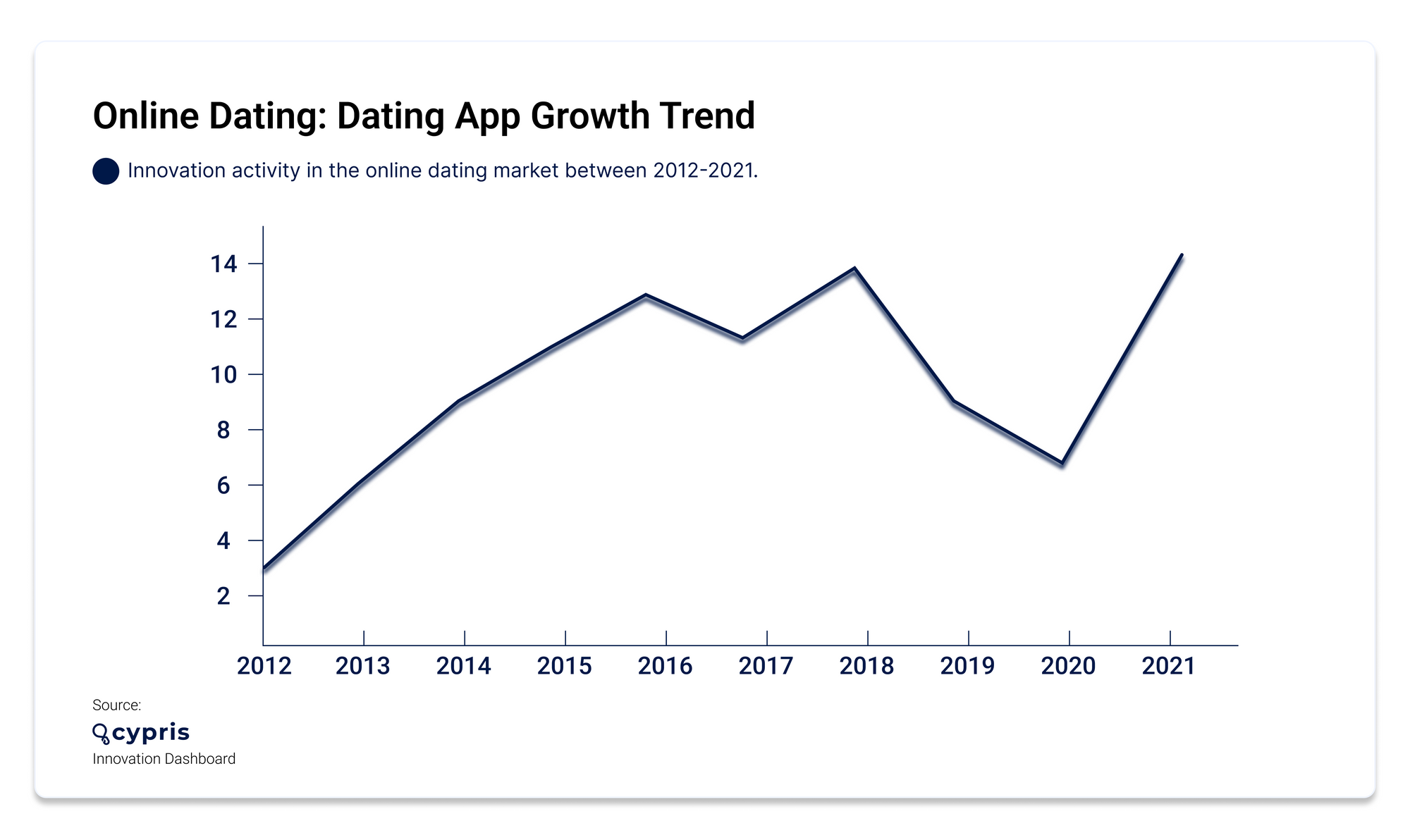
Using the Cypris Innovation Dashboard, we identified innovation activity in the online dating market has grown over the last 5 years, with a 20.91% average growth rate. The top players in the market are Match Group, LLC, Match.com Europe, and e2interactive, Inc., which collectively own 16.9% of IP in the market.
The fastest growing category is Computing Software which saw an 27.92 % increase in new patents filed over the last 5 years, as well as a lot of filings by new entrants.
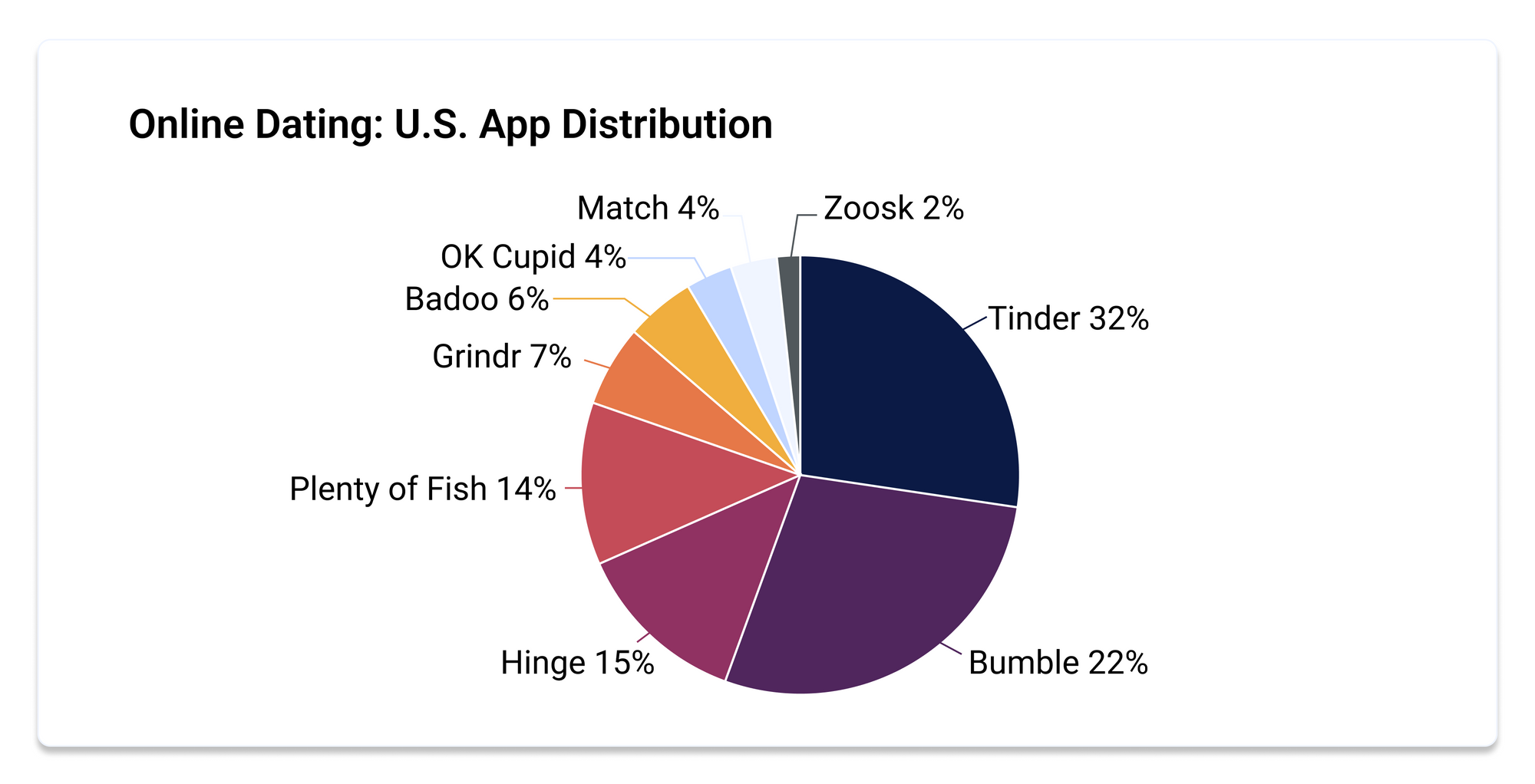
As of January 2022, Tinder dominated 32% of the U.S. market, followed by Bumble (22%), Hinge (15%), Plenty of Fish (15%), Grindr (7%), Badoo (6%), OKCupid (4%), Match.com (4%) and Zoosk (2%). In 2021, the dating app market made $5.61 billion revenue, with almost $3 billion made by Match Group.
Innovation in Online Dating
Let's dive into some of the fascinating patented technologies in the online dating space:
Method and Apparatus for Monitoring Emotional Compatibility in Online Dating: This patent covers methods, devices, and systems for capturing and sharing objective emotion data in dating interactions for the selection of suitable partners, or to enhance social dynamics in online interactions. An emotion monitoring device (EMD) measures physiological signals, obtained from biosensors, captured from a couple during a face-to-face or online dating interaction, and computes emotion data. The emotion data for each person is transmitted to an internet server, and each person shares their emotion data with the other during the interaction. The emotion data is then displayed to each person on a virtual or augmented reality device.
Inventor: Roger J. Quy; Patent Number: 20210267514
An Activity-Centric System and Method for Relationship Matching: This technology is for an online dating and relationship system that relies on common interests in, and arranging for specific face-to-face in-person activities. Potential activities are ranked by an activity ranking engine drawing on activity-related attributes of the users and of the activities. Mutual selection of an in-person activity enables the users to vet potential matches and to proceed to engage in the activity together. The ranking and match engines may take into account intrinsic user and activity attributes as well as activity- related attributes derived from the behavior of the users in relation to the activities.
Inventors: Perry Stevan, Stann Dominic, Petry James; Patent Number: WO2017054081A1
Online Dating Danger Prevention System: This patent covers an online dating danger prevention system. The online dating danger prevention system includes a database that holds information, including geo-location data and photographs, to make online dating safer. Users enter a set of contacts that the system can reach in the event of an emergency.
Friend Matching Application: This patent includes a system and method for third-party matchmaking in an online or electronic dating app or system. A friend may review user profiles to select potential matches for another friend. Generating a match may require approval from one or more trusted users, or confirmation through a voting or similar mechanism. A user's matchmaking prowess may be ranked or scored based on success and accuracy. Matches may be anonymous or non-anonymous. A user desiring to be matched may seek out and request that a particular search user identify matches.
Inventor: Christopher Jordan Hurley; Patent Number: 20180130139
Dating Service with Restaurant Selection, Reservations, and Video Promotion Included: This patent coversa systematic method for securely setting up a date in online dating applications. The first step allows a requesting member to request a date with a requested member. Next, the requesting member can enter a meeting date, place, and time. The requested member will then be prompted to either accept or decline the date request from the requesting member. The method also provides a dating history database which records a members' dating history. In addition, a method of ensuring a member's safety by allowing members to choose to have someone contacted if the member does not update the dating history database after a date is disclosed.
Systems and Methods for Initiating Conversations within an Online Dating Service: This technology is for acomputer-implemented method for initiating conversations within an online dating service. It covers identifying a potential match for a user of an online dating service, automatically generating, in response to identifying the potential match, a customized interactive ice breaker widget that is customized to facilitate conversation between the user and the potential match, presenting the customized interactive ice breaker widget to the user, obtaining the user's response to the customized interactive ice breaker widget, and presenting, to the potential match, both the customized interactive ice breaker widget and the user's response to the customized interactive ice breaker widget to facilitate conversation between the user and the potential match.
Inventors: Qiang Wang, Nathan Andrew Sharp; Patent Number: 20200364806
Online Dating Service System: This patent covers an online blind date arranging service system and method that provides information on the opposite sex that can be connected by an acquaintance to a blind date applicant so that the other party can be verified through the acquaintance, and matchmaking can be arranged by an acquaintance.
Inventor: Kwon Nam Yeol; Patent Number: KR101759285B1
Whether through measuring emotional compatibility and setting up blind dates, or through danger prevention and matching based on mutual activity interests, technologies are transforming how we date. To learn more about patents and new innovations in the online dating space, visit cypris.ai and get started with access to the innovation dashboard.
If you’d like to explore recent patents filed, you can search through our global patent search engine for free here: https://cypris.ai/patents/allrecords
Subscribe to receive the latest blog posts to your inbox every week.
Thank you! Your submission has been received!
Oops! Something went wrong while submitting the form.
In recent years, a digital transformation of intimacy has taken place—the Internet has become the new matchmaker. Today, it's not uncommon for people to use dating apps and meet their significant other online. In fact, over 323 million people worldwide currently use dating apps.
With more and more people turning to online dating, technologies are being created for things like measuring emotional compatibility, facilitating blind dating, danger prevention, and more. In this blog, we'll look at innovation activity in the online dating market, as well as a few of the new technologies changing how we navigate relationships.
Market Overview:
Using the Cypris Innovation Dashboard, we identified innovation activity in the online dating market has grown over the last 5 years, with a 20.91% average growth rate. The top players in the market are Match Group, LLC, Match.com Europe, and e2interactive, Inc., which collectively own 16.9% of IP in the market.
The fastest growing category is Computing Software which saw an 27.92 % increase in new patents filed over the last 5 years, as well as a lot of filings by new entrants.
As of January 2022, Tinder dominated 32% of the U.S. market, followed by Bumble (22%), Hinge (15%), Plenty of Fish (15%), Grindr (7%), Badoo (6%), OKCupid (4%), Match.com (4%) and Zoosk (2%). In 2021, the dating app market made $5.61 billion revenue, with almost $3 billion made by Match Group.
Innovation in Online Dating
Let's dive into some of the fascinating patented technologies in the online dating space:
Method and Apparatus for Monitoring Emotional Compatibility in Online Dating: This patent covers methods, devices, and systems for capturing and sharing objective emotion data in dating interactions for the selection of suitable partners, or to enhance social dynamics in online interactions. An emotion monitoring device (EMD) measures physiological signals, obtained from biosensors, captured from a couple during a face-to-face or online dating interaction, and computes emotion data. The emotion data for each person is transmitted to an internet server, and each person shares their emotion data with the other during the interaction. The emotion data is then displayed to each person on a virtual or augmented reality device.
Inventor: Roger J. Quy; Patent Number: 20210267514
An Activity-Centric System and Method for Relationship Matching: This technology is for an online dating and relationship system that relies on common interests in, and arranging for specific face-to-face in-person activities. Potential activities are ranked by an activity ranking engine drawing on activity-related attributes of the users and of the activities. Mutual selection of an in-person activity enables the users to vet potential matches and to proceed to engage in the activity together. The ranking and match engines may take into account intrinsic user and activity attributes as well as activity- related attributes derived from the behavior of the users in relation to the activities.
Inventors: Perry Stevan, Stann Dominic, Petry James; Patent Number: WO2017054081A1
Online Dating Danger Prevention System: This patent covers an online dating danger prevention system. The online dating danger prevention system includes a database that holds information, including geo-location data and photographs, to make online dating safer. Users enter a set of contacts that the system can reach in the event of an emergency.
Friend Matching Application: This patent includes a system and method for third-party matchmaking in an online or electronic dating app or system. A friend may review user profiles to select potential matches for another friend. Generating a match may require approval from one or more trusted users, or confirmation through a voting or similar mechanism. A user's matchmaking prowess may be ranked or scored based on success and accuracy. Matches may be anonymous or non-anonymous. A user desiring to be matched may seek out and request that a particular search user identify matches.
Inventor: Christopher Jordan Hurley; Patent Number: 20180130139
Dating Service with Restaurant Selection, Reservations, and Video Promotion Included: This patent coversa systematic method for securely setting up a date in online dating applications. The first step allows a requesting member to request a date with a requested member. Next, the requesting member can enter a meeting date, place, and time. The requested member will then be prompted to either accept or decline the date request from the requesting member. The method also provides a dating history database which records a members' dating history. In addition, a method of ensuring a member's safety by allowing members to choose to have someone contacted if the member does not update the dating history database after a date is disclosed.
Systems and Methods for Initiating Conversations within an Online Dating Service: This technology is for acomputer-implemented method for initiating conversations within an online dating service. It covers identifying a potential match for a user of an online dating service, automatically generating, in response to identifying the potential match, a customized interactive ice breaker widget that is customized to facilitate conversation between the user and the potential match, presenting the customized interactive ice breaker widget to the user, obtaining the user's response to the customized interactive ice breaker widget, and presenting, to the potential match, both the customized interactive ice breaker widget and the user's response to the customized interactive ice breaker widget to facilitate conversation between the user and the potential match.
Inventors: Qiang Wang, Nathan Andrew Sharp; Patent Number: 20200364806
Online Dating Service System: This patent covers an online blind date arranging service system and method that provides information on the opposite sex that can be connected by an acquaintance to a blind date applicant so that the other party can be verified through the acquaintance, and matchmaking can be arranged by an acquaintance.
Inventor: Kwon Nam Yeol; Patent Number: KR101759285B1
Whether through measuring emotional compatibility and setting up blind dates, or through danger prevention and matching based on mutual activity interests, technologies are transforming how we date. To learn more about patents and new innovations in the online dating space, visit cypris.ai and get started with access to the innovation dashboard.
If you’d like to explore recent patents filed, you can search through our global patent search engine for free here: https://cypris.ai/patents/allrecords
With the right approach, you can take charge of protecting your intellectual property by deciding to patent it yourself. By understanding these processes and leveraging available resources effectively, one can navigate the complex patent system without solely relying on professional assistance.
We will discuss determining patent eligibility by examining criteria for patents and exploring four categories of inventions. Next, we’ll delve into maintaining an inventor’s notebook to keep detailed records with witness signatures for added protection. We will also cover conducting thorough research using online resources to perform comprehensive searches before filing your application.
Subsequently, this article will evaluate the pros and cons of both regular patent applications (RPA) and provisional patent applications (PPA), aiding in making an informed decision. We’ll also explore when seeking professional assistance from IP lawyers may be necessary during the process. Finally, we’ll touch upon utilizing USPTO’s Manual of Patent Examining Procedure (MPEP) as a valuable resource for when deciding to patent it yourself.
To obtain a patent, your invention must meet the guidelines set by the United States Patent and Trademark Office (USPTO). It should be novel, non-obvious, and useful. It is important to record every step of the invention process in detail within a notebook and have it signed by two reliable witnesses who are familiar with your work as proof for when you decide to patent it yourself without professional help.
To apply and patent it yourself, your invention must possess features that are not present in any existing inventions or ideas and have not been disclosed publicly. This means it cannot have been previously disclosed in public domain resources such as articles, books, or presentations before filing the patent application.
Non-obviousness Criteria
In addition to being novel, an invention must also be non-obvious to someone skilled in its respective field. The USPTO will assess whether the differences between your idea and prior art would have been obvious at the time you filed your application to patent it yourself.
Utility Aspect of Inventions
The final criterion requires that an invention has practical use or utility. It should provide some real-world benefit beyond just being interesting or aesthetically pleasing. For example, it could solve a problem more efficiently than previous methods.
Fulfilling these three requirements increases your chances to apply and patent it yourself through the USPTO. If you’re unsure about meeting these criteria, consider consulting with a knowledgeable patent attorney.
Inventors must show that their invention is original and not easily inferred in order to obtain a patent. Prior art research can help ensure the validity of your claims by identifying any existing patents or publications related to the same concept. Next, we’ll discuss how you can conduct prior art research yourself.
Thorough research into previous developments within your field is essential to avoid infringing upon any existing patents or intellectual property rights held by others when trying to apply and patent it yourself. The internet serves as an excellent starting point when conducting this research, but seeking advice from professionals such as intellectual property lawyers may prove beneficial if you’re unsure about specific aspects related to prior art searches.
Importance of Prior Art Search
Avoids wasting time and resources on a non-patentable invention.
Determines the novelty and non-obviousness of your invention in comparison with existing technology.
Informs improvements or modifications that can strengthen your patent application.
Online Resources for Patent Research
The following online databases are valuable tools for conducting patent searches:
If you encounter complexities during your search or require assistance interpreting legal jargon, it’s advisable to consult an experienced IP lawyer who can guide you through the process and ensure your invention is adequately protected.
Conducting prior art research is essential for innovators to protect their ideas and investments. Consequently, knowledge of the distinctions between regular and provisional patent applications is critical for innovators to safeguard their concepts and investments.
A Regular Patent Application (RPA) and a Provisional Patent Application (PPA) are the two options available for preparing your patent application for submission. Carefully weighing the pros and cons of each option is essential before making a choice.
Advantages and Disadvantages of RPAs
A Regular Patent Application requires detailed descriptions including claims outlining what specifically distinguishes the invention. Drafting a complete specification for an RPA can incur greater costs due to associated legal fees. Additionally, once an RPA is filed, it becomes public information after 18 months from the filing or priority date.
Benefits and Drawbacks of PPAs
Provisional Patent Applications, on the other hand, allow inventors more flexibility by providing 12 months before needing to submit full documentation along with additional fees associated with converting PPA into RPA status at a later date if necessary. A PPA does not require formal patent claims or declarations; however, it must include enough detail so that someone skilled in the field can understand how to make and use the invention. One drawback is that PPAs do not provide any enforceable rights until they are converted into an RPA.
Regular patent applications provide more comprehensive protection than provisional patent applications but also require a higher level of effort and cost. By broadening the scope of your invention to include alternative methods, you can increase its overall value while taking advantage of existing resources.
It is crucial to examine whether alternative methods exist for building your device or product, as this could potentially lead to broader applications and increase the overall value of your patent protection. By identifying alternative methods, you can ensure that your invention remains relevant and adaptable in a constantly evolving market.
Identifying Alternative Methods
Analyze existing technologies within your field to identify potential improvements or modifications.
Consider how different materials or manufacturing processes might affect the performance of your invention.
Explore various use cases for your invention across multiple industries, expanding its potential reach and impact.
Increasing Overall Value through Broadened Scope
A broader scope not only enhances the commercial viability of an invention but also strengthens its position against competitors. To achieve this, consider consulting with a patent attorney who has expertise in conducting comprehensive searches and identifying any potential issues that may arise during the examination process. A qualified legal expert can help you traverse intricate details such as formulating claims and guaranteeing that all the required information is present in the filing, increasing your chances of USPTO authorization.
In addition to working with a patent attorney, utilizing tools like Cypris – a research platform specifically designed for R&D teams – can provide rapid insights into valuable data sources needed when developing new inventions.
Expanding the range of your innovation can bring about a more important item or administration and raise its general worth. Filing a provisional patent application affords you the opportunity to develop and enhance your invention in the 12 months preceding its formal submission for assessment.
If your invention requires further development or tinkering before filing for a full patent application, consider submitting a provisional patent application first. This allows inventors additional time (up to 12 months) to refine their ideas while still maintaining priority rights over their inventions.
Cost-effective: A provisional patent application is less expensive than a regular patent application, making it an attractive option for those on tight budgets.
Prioritized date: By filing a provisional patent, you establish an early effective filing date which can be crucial in the competitive world of innovation and product development.
No formal requirements: Unlike regular patents, provisional applications do not require claims or formal drawings. However, they must provide enough information for someone skilled in the field to understand and replicate your invention.
Refining and Improving Your Invention During the 12-Month Period
During this period, you have the opportunity to improve upon your original concept by conducting more research or refining its design. Keep detailed records of any changes made as these will need to be included when converting your provisional application into a non-provisional one at the end of the twelve-month timeframe. Utilizing platforms like Cypris, specifically designed for R&D teams’ needs, can help streamline this process by centralizing data sources needed throughout this stage of innovation.
It’s important to note that a provisional patent application does not provide patent protection on its own. To obtain patent protection, you must file a non-provisional patent application within the 12-month period. This application will undergo a thorough examination process by the patent office, which can take several years.
It’s recommended to seek the assistance of a patent attorney to navigate the patent system and ensure your application is properly filed and protected.
Submitting a provisional patent application is an essential step to safeguard your innovation, granting you 12 months of time to refine and enhance the invention before requesting full protection. Navigating USPTO’s Manual of Patent Examining Procedure can be daunting, but understanding examiner guidelines and providing thorough documentation are key components in ensuring that your invention is properly protected.
Navigating USPTO’s Manual of Patent Examining Procedure
To maximize your chances of securing patent protection, it is essential to become acquainted with the USPTO’s Manual of Patent Examining Procedure (MPEP), especially if you are filing without legal representation. One way to do this is by reviewing the USPTO’s Manual of Patent Examining Procedure (MPEP) if you plan on handling this process without legal assistance.
Understanding Examiner Guidelines
The MPEP serves as a comprehensive guide for both applicants and examiners alike, detailing every aspect of the patent system. By studying this manual, you can gain insight into how examiners evaluate applications based on novelty, non-obviousness, and utility criteria. Additionally, understanding these guidelines will help ensure that your patent application adheres to all necessary requirements set forth by the USPTO.
Importance of Thorough Documentation
Maintain detailed records: As mentioned earlier in this post, maintaining a thorough record of your invention process is vital when applying for a patent. The MPEP emphasizes the importance of proper documentation throughout its pages.
Avoid common pitfalls: Familiarizing yourself with examiner guidelines found within the MPEP can help you avoid common mistakes made during patent applications such as insufficiently describing or claiming an invention.
Informed decision-making: Gaining knowledge about examination procedures allows you to make informed decisions regarding whether seeking professional guidance from a patent attorney is necessary for your specific situation.
By navigating the USPTO’s MPEP, you can better prepare yourself for the patent application process and increase your chances of securing valuable protection for your invention.
In summary, while patenting your own invention may be a lengthy and complicated endeavor, with the right guidance it can be achieved efficiently. However, by following the steps outlined in this post, including determining eligibility, maintaining detailed records, conducting thorough research, choosing between RPA and PPA options, seeking professional assistance when necessary, and utilizing the USPTO’s MPEP guide for DIY applicants, you can successfully patent it yourself. Keep in mind that seeking professional help is still advisable to avoid potential mistakes when applying for a patent.
If you’re looking to protect your intellectual property with ease and convenience while keeping costs low, consider Cypris! Check out our convenient platform that makes the filing of a provisional patent application online more straightforward.
Patent It Yourself: A Comprehensive Guide for Innovators