The Grounding Variable: What Happens When You Connect Microsoft Copilot to a Structured R&D Corpus
.png)


1. Executive Summary & Objective
Most AI benchmark studies compare models. This one does not. It compares the same model, in the same session, answering the same prompt twice. The only variable that changed between the two runs was whether Microsoft Copilot had access to the Cypris MCP server.
That design isolates a question R&D and IP leaders increasingly need answered: when an AI assistant produces a technology landscape, how much of the answer comes from the model and how much comes from what the model can reach?
A single prompt was submitted covering non-fluorinated alternatives to PTFE and PVDF across two application domains, chemically resistant coatings and lithium-ion battery binders. The prompt asked for leading chemistry classes, most active assignees and research groups, quantified filing and publication volume by class, and identification of which approaches had crossed from lab-scale publication into commercial patenting. It was submitted first to Copilot operating against the public web, then re-submitted in the same session with the Cypris MCP server connected.
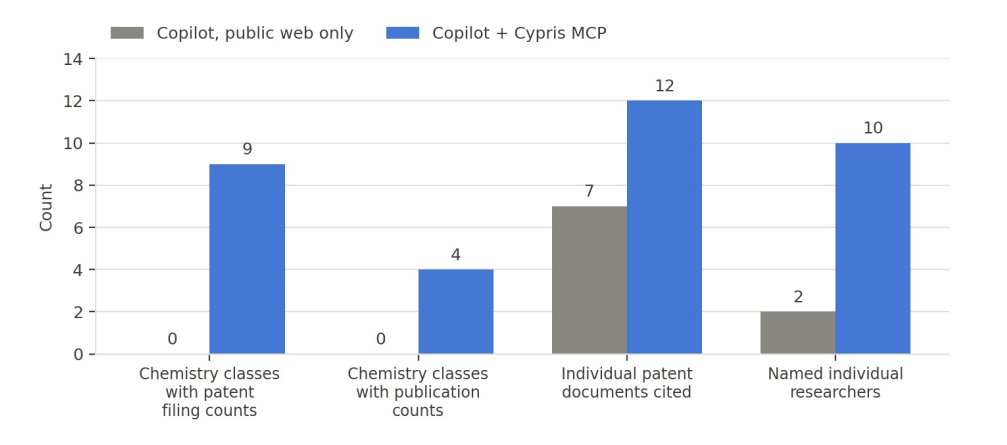
The unaugmented run produced a competent directional survey. It identified the right chemistry families, named recognizable commercial actors, and correctly observed that no current PFAS-free coating platform matches PTFE across the full performance envelope. What it could not do was quantify anything. It reported counts of items it happened to find, four silicone coating publications, four polyacrylate binder families, and stated explicitly that the public sources available to it did not provide chemistry-class totals.
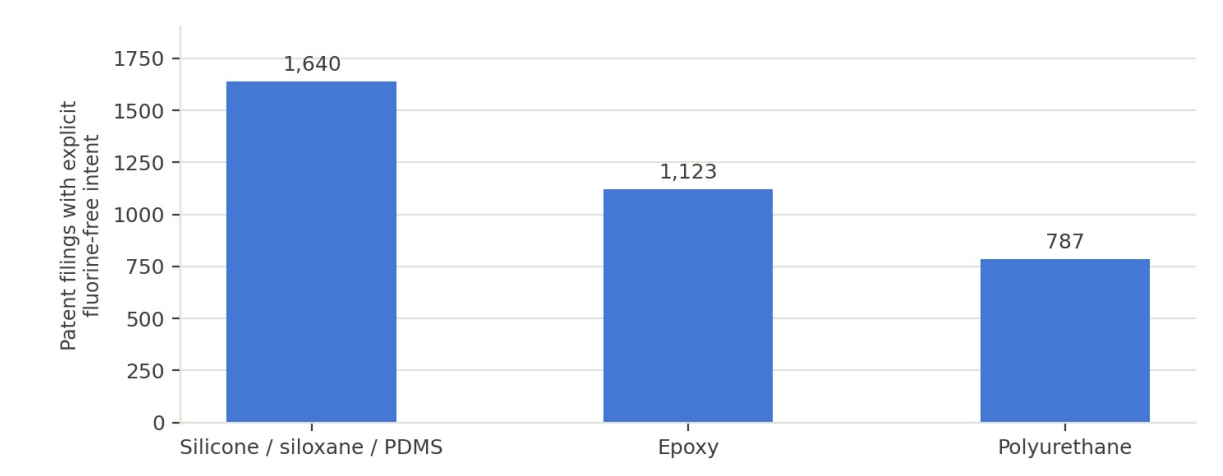
The MCP-grounded run returned scoped filing counts for nine chemistry classes and publication counts for four, spanning roughly 1,640 filings in silicone and siloxane coatings down to 112 in standalone SBR binders. It named individual research groups at NTNU, POLYMAT, Politecnico di Torino, and Munster. It surfaced patent documents dated July 9, 2026, roughly three months more recent than the latest clearly dated item the public-web run reached.
The two answers were then compared by the same assistant against a fixed rubric covering entity specificity, quantitative grounding, source retrievability, and recency. Its conclusion, reached without prompting toward a preferred outcome: the grounded response should serve as the primary work product, the public-web response as an open-web cross-check.
2. Methodology
2.1 The Core Variable
In most comparative AI studies the confound is obvious. Different platforms run different models, apply different system prompts, and expose different tool sets, so any observed performance gap is a composite of many differences at once.
This test removes those confounds. Microsoft Copilot was the assistant in both runs. The session was continuous. The prompt was submitted verbatim, twice, with no clarification, refinement, or follow-up. The single manipulated variable was the presence of the Cypris MCP server in the tool loop.
Model Context Protocol is the open standard that lets an AI assistant call an external data source as a tool rather than answering from training memory or from whatever the open web returns. Connecting Cypris through MCP gave Copilot programmatic access to a structured corpus of patents and peer-reviewed literature, queried by meaning and organized through an R&D ontology, rather than a list of crawlable web pages.
Whatever difference appears between run one and run two is therefore attributable to grounding, not to model capability.
2.2 The Prompt
Identify the leading non-fluorinated alternatives to PTFE and PVDF for chemically resistant coatings and battery binders, based on patent filings and peer-reviewed literature from 2022 to present. Name the most active assignees and research groups, and quantify filing and publication volume by chemistry class. Flag which approaches have moved from lab-scale publication into commercial patenting.
The prompt was constructed to require three things a model cannot produce from parametric memory: named assignees with associated volumes, a recency window extending past any training cutoff, and an explicit separation between academic publication activity and commercial patenting activity.
2.3 Why This Topic
PFAS replacement is a live, high-stakes chemistry problem with genuine regulatory pressure behind it, an active and fragmented patent landscape, and two application domains at meaningfully different stages of commercial maturity. It is also a domain where a plausible-sounding but unquantified answer is easy to produce and difficult for a non-specialist to falsify, which makes it a fair test of whether grounding produces something a practitioner could actually act on.
2.4 Evaluation
Both outputs were assessed against four dimensions: specific entities named, including companies, assignees, institutions, and individual patents or papers; quantitative claims, including filing counts, publication volume, and trend figures; whether sources were cited and independently retrievable; and the recency of the most recent item referenced.
3. Findings
3.1 The Quantification Gap
The starkest difference is not what each run knew. It is what each run could count.
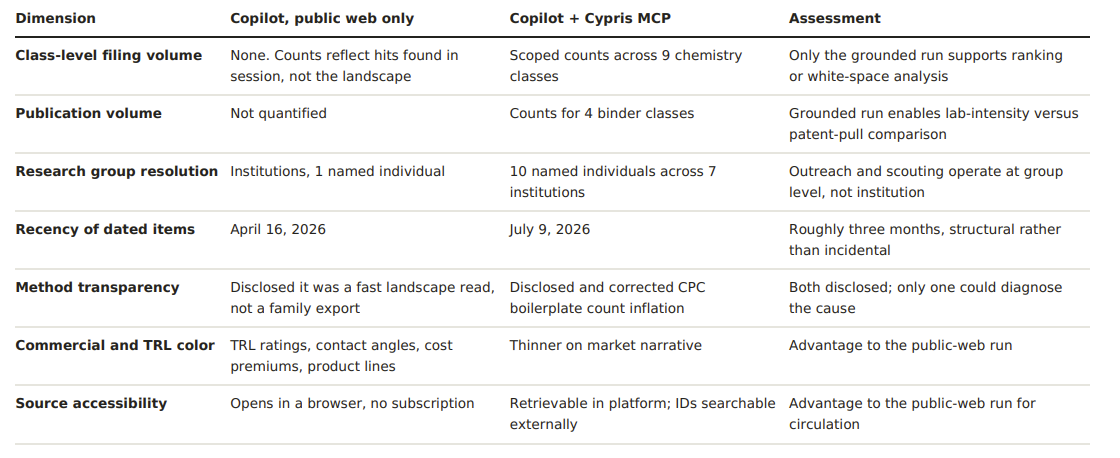
The public-web run was explicit about its own limitation, describing its output as a fast landscape-style read rather than a patent-family export, and stating that the sources available to it did not provide chemistry-class totals. The counts it did report were counts of hits found in that session: four silicone and polysiloxane coating publications, four polyacrylate binder families. These are honest numbers, but they measure the search, not the landscape.
The grounded run returned scoped counts across nine chemistry classes. For battery binders: approximately 339 filings for polyimide and polyamic acid, 323 for cellulose and CMC, 319 for polysaccharides, 255 for polyacrylic acid and polyacrylate, 253 for lignin, and 112 for standalone SBR. For coatings: approximately 1,640 for silicone, siloxane and PDMS, 1,123 for epoxy, and 787 for polyurethane. Publication counts were returned for four binder classes, ranging from 163 papers for polysaccharides down to 57 for lignin.
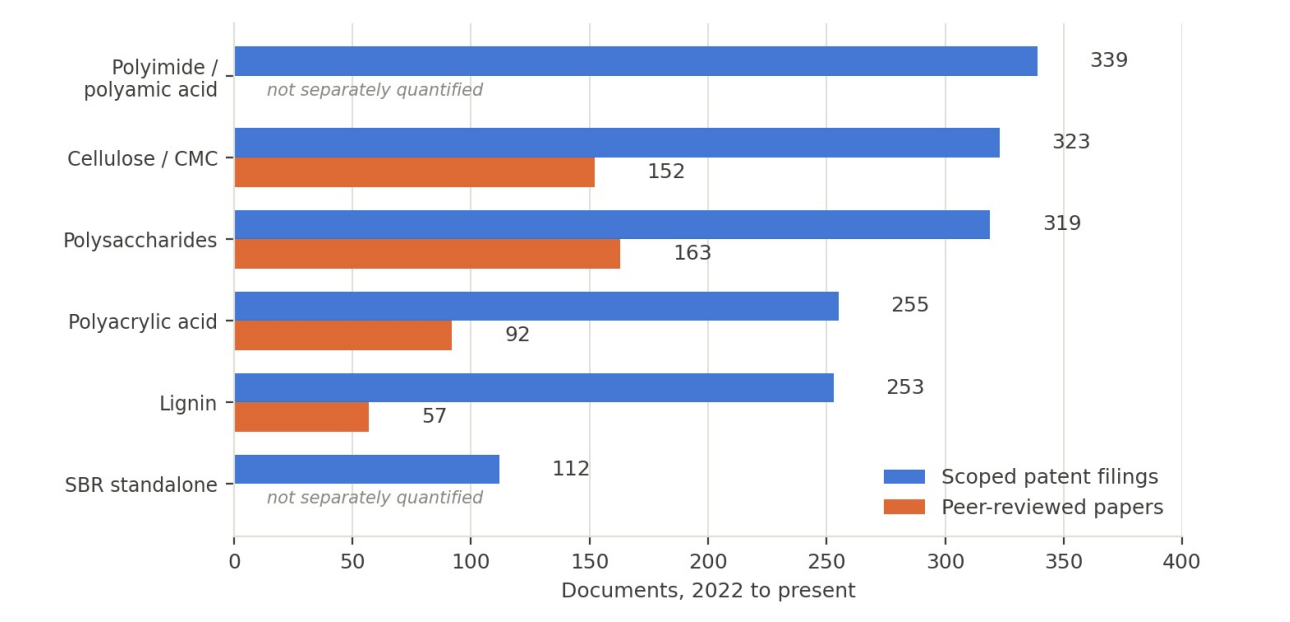
The analytical payload here is the ratio, not either number alone. Polysaccharides show 319 filings against 163 papers, a publication-heavy profile consistent with an academically active class that has not yet converted into commercial portfolios. Polyimide and polyamic acid lead the filing count while returning no comparable publication concentration, the signature of a class that has already moved into industrial development. That distinction, lab-heavy versus commercially converting, is precisely what an R&D lead needs in order to decide whether to prototype, partner, license, or simply monitor. It cannot be inferred from a list of example patents.
3.2 Methodological Self-Correction
One finding is worth isolating because it runs against the usual expectation of what a grounded system does.
The grounded run reported that raw CPC-classification patent counts for battery binders were inflated by boilerplate. Patent specifications routinely list binder options as a generic enumeration, PVDF, CMC, SBR, PAA, and so on, in filings where the binder is not the invention. A CPC-code query captures all of those documents and returns a number that looks authoritative and is substantially wrong. The run therefore re-scoped its counts to title and abstract text carrying explicit fluorine-free, aqueous, or non-fluorinated intent, and reported the tighter numbers.
It also flagged that some assignee aggregations in the coatings landscape were contaminated by fluoropolymer incumbents whose patents mention fluorine-free components without being fluorine-free replacements.
This is the difference between a system that retrieves and a system that retrieves and audits. A tool with no structured access to the corpus has no mechanism to detect this class of error, because it never sees the population that produces it. The unaugmented run could not have identified boilerplate contamination for the same reason it could not produce counts: it had no denominator.
3.3 Research Group Resolution
Both runs named institutions. Only the grounded run named people.
The public-web run surfaced POSTECH, KERI, KIST, Sungkyunkwan University, and Delft, with one named individual researcher. The grounded run identified Jacob Lamb, Silje Bryntesen and Odne Burheim at NTNU; David Mecerreyes and Claudio Gerbaldi at POLYMAT and Politecnico di Torino; Martin Winter and Markus Borner at Munster and Helmholtz-Institut; and on the coatings side Emmanuel Giannelis at Cornell, Zhiwei He at Hangzhou Dianzi University, Joseph Furgal at Bowling Green State University, and Guojun Liu and Muhammad Rabnawaz at Queen's University.
The operational difference is that an institution is a fact and a named group is a contact. Technology scouting, licensing outreach, advisory recruitment, and competitive monitoring all run at the level of the individual research group. A landscape that stops at the institution name has ended one resolution step short of the action it is supposed to inform.
3.4 Recency
The most recent clearly dated item in the public-web run was a patent publication from April 16, 2026. The grounded run referenced patent documents dated July 9, 2026.
The three-month gap is not a rounding error in a domain moving this quickly, and it is structural rather than incidental. Public web coverage of a patent publication depends on someone writing about it and that page being crawlable. Structured corpus access does not.
3.5 Where the Unaugmented Run Was Genuinely Better
An honest benchmark reports the cases that cut the other way.
The public-web run produced better commercial narrative. It surfaced technology readiness level assessments, water contact angle benchmarks, and cost premium characterizations for each coating platform. It identified SEB as a cookware-focused filer of non-fluorinated silicone and sol-gel architectures, Clariant's PTFE-free wax additive product families, and SilcoTek's silicon CVD coatings as deployed replacements in tubing, chromatography columns, and pharmaceutical flow paths. It caught the KERI siloxane cathode binder work and its stated technology-transfer intent, a commercially relevant signal that appears in press coverage before it appears in a patent record.
It was also easier to share. Its sources open in a browser without a subscription, which matters when a landscape needs to circulate to stakeholders who will not log into an analytics platform.
These are real strengths, and they describe the correct role for open-web AI search in an R&D workflow: orientation, market color, and commercial context. They do not describe a substitute for a countable landscape.
4. The Structural Reading
4.1 Coverage Is Not the Only Failure Mode
The familiar critique of general-purpose AI for patent work is that it misses documents. That is true, and it understates the problem.
A model with no structured corpus access cannot produce a denominator. It can tell you that polyacrylic acid binders are important, and it will be right, because that fact is well represented in the crawlable literature. It cannot tell you that polyimide and polyamic acid filings exceed polyacrylic acid filings, because ranking requires counting the population, not sampling it. Every strategic question that depends on relative volume, which class is consolidating, which is still academic, where the white space sits, is therefore unreachable regardless of how good the underlying model is.
This is why the finding survives model upgrades. The gap documented here is not a reasoning gap.
4.2 The Confidence Asymmetry
Both outputs were well formatted, professionally structured, and confident in tone. A reader without domain expertise would find both credible.
The unaugmented run deserves credit for disclosing its own limitation clearly, which is better behavior than most general-purpose outputs exhibit. But the disclosure sat inside an otherwise authoritative document, and in practice caveats placed alongside detailed analysis tend to be read past. The risk in AI-assisted landscaping is rarely that the output is obviously wrong. It is that the output is well-shaped and incomplete in a way that discourages the follow-up the situation required.
4.3 Grounding Travels to the Assistant
The most operationally significant point in this study is where the intelligence sat.
The analyst did not switch platforms. Copilot remained the interface, the session continued uninterrupted, and the output arrived in the same place as the rest of that person's work. What changed was the data the assistant could reach. MCP is what makes that possible: a shared open standard for connecting an AI assistant to an external corpus, so grounded R&D intelligence becomes a capability inside existing tools rather than a separate destination.
For enterprises standardizing on Copilot, this is the practical form the question takes. Not whether to replace the assistant, but whether the assistant is connected to anything that can count.
5. Strategic Takeaways
General-purpose AI assistants running against the public web are effective for orientation. They identify the correct chemistry families, surface recognizable commercial actors, and assemble market narrative and readiness color quickly. Used for exactly that, they save real time.
They cannot produce class-level filing volumes, cannot separate academic activity from commercial conversion, cannot resolve landscapes to the named research group, and cannot detect the classification artifacts that corrupt naive patent counts. These limits follow from data access rather than model capability, and they persist as models improve.
Connecting the same assistant to a structured corpus of patents and scientific literature through MCP changes the output category. The deliverable moves from a survey to a landscape: counted, ranked, attributable to retrievable documents, and resolved to the level at which R&D decisions are actually made.
For teams making prototype, partner, license, or monitor decisions on a technology class, the relevant question is not which AI assistant is being used. It is whether that assistant is grounded in a corpus that can answer the question being asked.
.jpg)