United’s Relax Row and the Skycouch Patent Question


United Airlines' "Relax Row" Looks Amazing. But Who Actually Owns the IP?
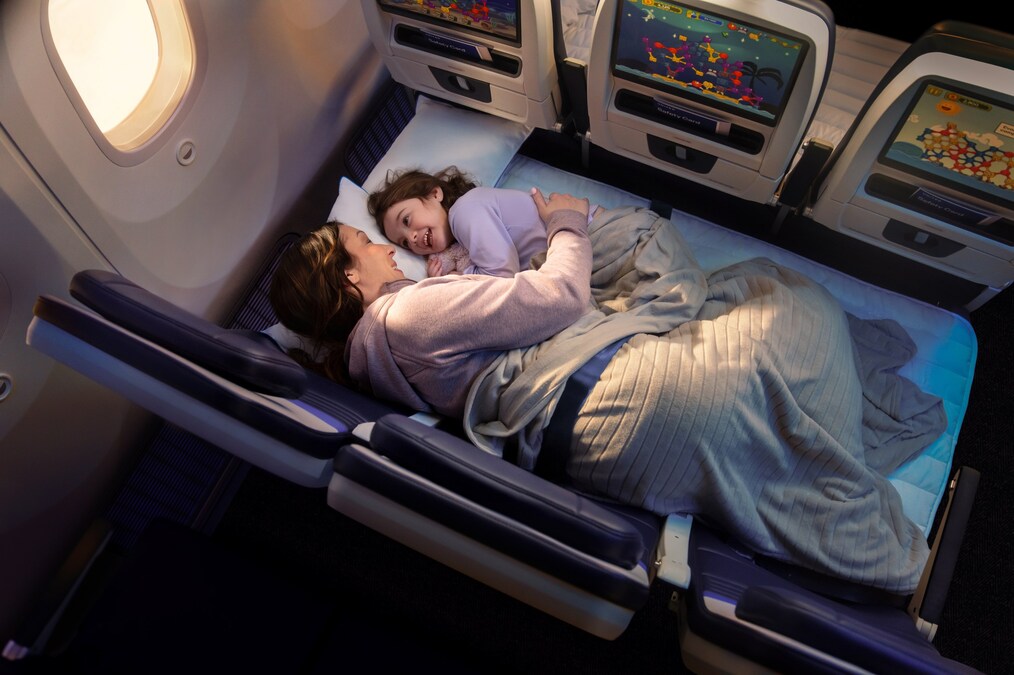
When United Airlines announced "Relax Row" — three adjacent economy seats with adjustable leg rests that raise to create a continuous lie-flat sleeping surface, complete with a mattress pad, blanket, and pillows — the aviation world took notice[1]. Slated for deployment on more than 200 of United's 787s and 777s, with up to 12 rows per aircraft, it represents one of the most ambitious economy cabin innovations ever attempted by a U.S. carrier[1].
But behind the glossy renders and enthusiastic social media rollout lies a thorny question that United hasn't publicly addressed: who actually owns the intellectual property behind this concept?
The answer, it turns out, is almost certainly not United Airlines.
The Skycouch Came First — By Over a Decade

The idea of economy seats with fold-up leg rests that create a flat sleeping surface across a row is not new. Air New Zealand pioneered this exact concept with its Economy Skycouch™, which has been in commercial service since approximately 2011[13]. The product works precisely the way United describes its Relax Row: passengers in a row of three economy seats can raise individual leg rests to seat-pan height, creating a continuous horizontal surface suitable for lying down[13].
Air New Zealand didn't just build the product — they patented it extensively. The foundational U.S. patent, US 9,132,918 B2, titled "Seating arrangement, seat unit, tray table and seating system," was granted in September 2015 and is assigned to Air New Zealand Limited[36]. The inventors — Victoria Anne Bamford, James Dominic France, Glen Wilson Porter, and Geoffrey Glen Suvalko — filed the earliest priority application in January 2009[36], giving the patent family protection extending approximately through 2029–2030.
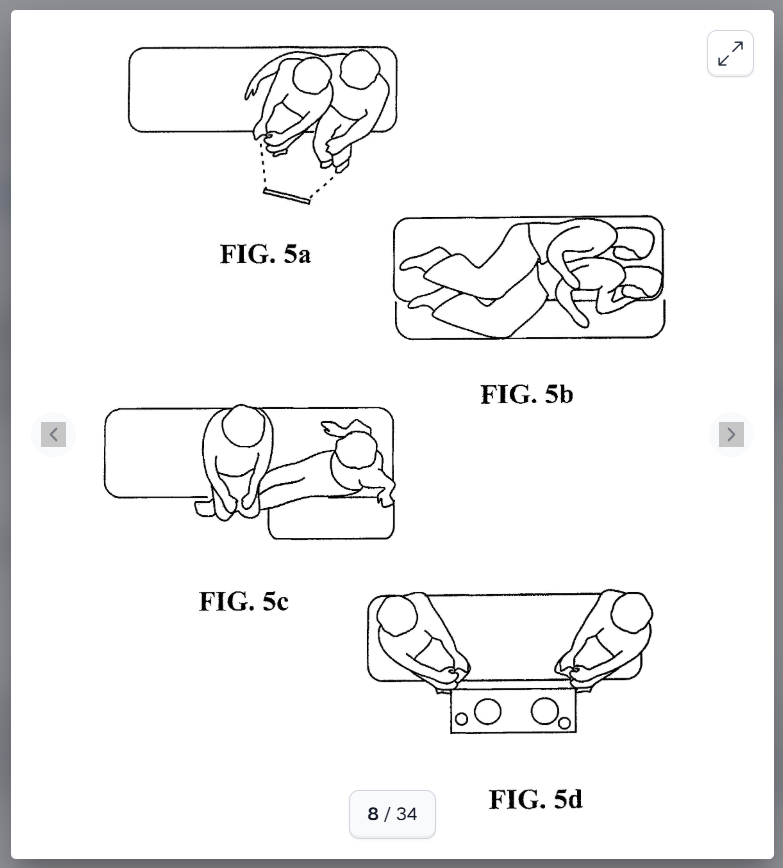
The claims are remarkably broad. Claim 1 describes a row of adjacent seats where each seat includes a seat back, a seat pan, and a leg rest, with the leg rest moveable between a stored condition and a fully deployed condition where the seat pan and leg rest are substantially coplanar[36]. When deployed, the leg rests of adjacent seats become contiguous, and the combined surfaces cooperate to define a reconfigurable horizontal support surface that can assume T-shape, L-shape, U-shape, and I-shape configurations — allowing at least two adult passengers to recline parallel to the row direction[36].
The patent explicitly contemplates installation in an economy class section of an aircraft and in a class section that offers the lowest standard fare price per seat to customers[36]. In other words, this isn't a business class patent being stretched to cover economy — it was designed from the ground up to cover exactly what United is now proposing.
The IP Goes Deep
Air New Zealand's IP portfolio goes deeper than just the seating arrangement. A separate patent, EP 2509868, covers the specific leg rest mechanism itself — a sophisticated system using cam tracks, hydrolock pistons, synchronization cables, and detent formations that allow each leg rest to move independently between stowed, intermediate, and fully extended positions[39]. The mechanism is entirely self-supporting through the seat frame, requiring no support from the floor or the seat in front[39]. This level of mechanical detail creates additional layers of patent protection beyond the broad concept claims.
The patent family spans the globe, with filings and grants across the United States[33][34][36], Europe[35], Canada[50], Australia[48], Spain[41], France[40], Brazil[37], and other jurisdictions — a clear signal that Air New Zealand invested heavily in protecting this innovation worldwide.
Air New Zealand Has Licensed Before
Critically, Air New Zealand has not simply sat on this IP. The airline has actively licensed the Skycouch technology to other carriers. China Airlines adopted the concept for its 777-300ER fleet[23][126], and Brazilian carrier Azul licensed it for their "SkySofa" product[126]. The Skycouch represents a textbook case of patent protection leading to licensing of competitors[126].
This licensing history establishes two important facts. First, Air New Zealand treats this IP as a revenue-generating asset and actively monitors the market for potential licensees (or infringers). Second, there is a well-worn commercial path for airlines wanting to deploy this technology — they license it from Air New Zealand.
United's Silence on the IP Question
Here is where things get interesting. United's public communications about Relax Row make no mention of Air New Zealand, the Skycouch, or any licensing arrangement[1][138]. The airline's formal "Elevated" interior press release — a detailed document covering Polaris Studio suites, Premium Plus upgrades, economy screen sizes, and even red pepper flakes for onboard meals — contains zero references to economy lie-flat row technology or any third-party IP[138]. The Relax Row announcement appears to have been made separately through United's social media channels[1].
A thorough search of United Airlines' own patent portfolio reveals no filings covering the economy lie-flat row concept. United's seat-related patents focus on entirely different areas: business class herringbone seating with disabled access configurations[54][55], tray table indicators using magnetic ball mechanisms[72], and seat assignment automation systems[60]. Nothing in United's IP portfolio touches the fold-up leg rest mechanism or the convertible economy row concept.
So What's Going On?
There are several plausible explanations, and the truth likely lies in one of these scenarios.
Scenario 1: An undisclosed license. This is the most probable explanation. Licensing agreements between airlines are frequently confidential. Air New Zealand has demonstrated willingness to license the Skycouch, and United — as a sophisticated commercial entity — would almost certainly conduct freedom-to-operate analysis before committing to install this technology across 200+ widebody aircraft. A quiet licensing deal would explain both the functional similarity and the public silence.
Scenario 2: The seat manufacturer as intermediary. Airlines don't build their own seats — they purchase them from specialized manufacturers like Collins Aerospace (formerly B/E Aerospace), Safran Seats, Recaro, or others. The seat manufacturer supplying United's Relax Row hardware may hold a license or sub-license from Air New Zealand, meaning United is purchasing a licensed product rather than directly licensing the IP. This is common practice in the aircraft interiors supply chain.
Scenario 3: A design-around. While the end result looks identical to the Skycouch, the internal mechanism could differ. Air New Zealand's mechanism patent describes very specific cam-track, hydrolock, and synchronization systems[39]. A seat manufacturer could potentially engineer a leg rest that achieves the same functional result — raising to seat-pan height — using different internal mechanics. However, the broader seating arrangement patent covers the concept itself, not just the mechanism, making a pure design-around more difficult[36].
Notably, alternative approaches to economy lie-flat beds do exist. B/E Aerospace (now part of Collins Aerospace/RTX) holds recent patents describing economy seat rows convertible to beds using fundamentally different mechanisms — one where a lower portion of the backrest detaches and slides forward with the seat pan[92][95], and another where the backrest frame rotates forward to overlay the seat pan with a separate mattress placed on top[96]. These patents, filed from India in 2023 and granted in 2025, explicitly target the economy class cabin[92][96]. But from United's own images, the Relax Row appears to use fold-up leg rests — the Skycouch approach — rather than these backrest-based alternatives[1][2].
If There's No License, It Could Get Sticky

The fourth scenario — that United or its supplier is deploying this product without authorization — would create significant legal exposure. Air New Zealand's patent claims are broad, well-established, and have been maintained across multiple jurisdictions for over a decade[36][41][50]. The patent holder has demonstrated both willingness to license and awareness of the commercial value of this IP[126].
Consider the claim mapping. United describes three adjacent economy seats with adjustable leg rests that can each be raised or lowered to create a cozy lie-flat space[1]. Air New Zealand's patent claims cover a row of adjacent seats with leg rests moveable between stored and deployed conditions where the seat pan and leg rest become substantially coplanar, with adjacent leg rests becoming contiguous to form a reconfigurable horizontal support surface[36]. The visual evidence from United's announcement shows leg rests raised to seat level creating a continuous flat surface across the row[1][2] — a near-perfect overlay with the patent claims.
With the patent family not expiring until approximately 2029–2030, and United planning deployment across 200+ aircraft starting next year[1], the commercial stakes are enormous. An infringement finding could result in injunctive relief, royalty payments, or forced redesign — any of which would be extraordinarily costly and disruptive at the scale United is planning.
What to Watch For
The aviation IP community will be watching this space closely. Key indicators will include whether Air New Zealand makes any public statement acknowledging (or challenging) United's product, whether a licensing agreement surfaces in either company's financial disclosures, and whether the seat manufacturer behind Relax Row is identified — which could reveal whether the IP arrangement runs through the supply chain rather than directly between airlines.
For now, the most important takeaway is this: the concept behind United's splashy Relax Row announcement was invented, patented, and commercialized by Air New Zealand more than a decade ago. Whether United is paying for the privilege of using it, or betting that its implementation differs enough to avoid the patent claims, remains one of the more consequential unanswered questions in commercial aviation IP today.
This article was powered by Cypris Q, an AI agent that helps R&D teams instantly synthesize insights from patents, scientific literature, and market intelligence from around the globe. Discover how leading R&D teams use Cypris Q to monitor technology landscapes and identify opportunities faster - Book a demo
The information provided is for general informational purposes only and should not be construed as legal or professional advice.
Citations
[1] United Airlines Relax Row announcement (social media, March 2026)
[2] United Airlines Relax Row product images (March 2026)
[13] Air New Zealand. "Economy Skycouch – Long Haul."
[23] Executive Traveller. "Review: Air New Zealand's Skycouch seat (soon for China Airlines)."
[33] Air New Zealand Limited. Seating Arrangement, Seat Unit, Tray Table and Seating System. Patent No. US-20160031561-A1. Issued Feb 3, 2016.
[34] Air New Zealand Limited. Seating Arrangement, Seat Unit, Tray Table and Seating System. Patent No. US-20150203207-A1. Issued Jul 22, 2015.
[35] Air New Zealand Limited. Seating Arrangement, Seat Unit, Tray Table and Seating System. Patent No. EP-2391541-A1. Issued Dec 6, 2011.
[36] Air New Zealand Limited; Bamford, V.A.; France, J.D.; Porter, G.W.; Suvalko, G.G. Seating arrangement, seat unit, tray table and seating system. Patent No. US-9132918-B2. Issued Sep 14, 2015.
[37] Air New Zealand Limited. Seating arrangement, seat unit and passenger vehicle and method of setting up a passenger seat area. Patent No. BR-PI1008065-B1. Issued Jul 27, 2020.
[39] Air New Zealand Limited. A Seat and Related Leg Rest and Mechanism and Method Therefor. Patent No. EP-2509868-A1. Issued Oct 16, 2012.
[40] Air New Zealand Limited. Seating Arrangement, Seat Unit and Seating System. Patent No. FR-2941656-A3. Issued Aug 5, 2010.
[41] Air New Zealand Limited. Seating arrangement, seat unit, tray table and seating system. Patent No. ES-2742696-T3. Issued Feb 16, 2020.
[48] Air New Zealand Limited. Seating arrangement, seat unit, tray table and seating system. Patent No. AU-2010209371-B2. Issued Jan 13, 2016.
[50] Air New Zealand Limited. Seating Arrangement, Seat Unit, Tray Table and Seating System. Patent No. CA-2750767-C. Issued Apr 9, 2018.
[54] United Airlines, Inc. Passenger seating arrangement having access for disabled passengers. Patent No. US-11655037-B2. Issued May 22, 2023.
[55] United Airlines, Inc. Passenger seating arrangement having access for disabled passengers. Patent No. US-12291336-B2. Issued May 5, 2025.
[60] United Airlines, Inc. Method and system for automating passenger seat assignment procedures. Patent No. US-10185920-B2. Issued Jan 21, 2019.
[72] United Airlines, Inc. Tray table indicator. Patent No. US-12525316-B2. Issued Jan 12, 2026.
[92] B/E Aerospace, Inc. Row of passenger seats convertible to a bed. Patent No. US-12351317-B2. Issued Jul 7, 2025.
[95] B/E Aerospace, Inc. Row of Passenger Seats Convertible to a Bed. Patent No. US-20250051014-A1. Issued Feb 12, 2025.
[96] B/E Aerospace, Inc. Converting economy seat to full flat bed by dropping seat back frame. Patent No. US-12459650-B2. Issued Nov 3, 2025.
[126] Above the Law. "Coach Comfort: Myth Or The Future."
[138] United Airlines. "United Unveils the Elevated Aircraft Interior."
.png)