
GLOBAL PATENT LANDSCAPE

When looking at the global patent landscape, we found 763 applicants and 1,295 patents in the nuclear energy space, across 19 countries. China dominates the industry, with 518 applicants, followed by Russia, with 65.
Across the board, applicants saw an uptick in patent filings within the nuclear energy space in 2019, that has increased steadily since then.
The top 3 global patent players are: UNIV XI AN JIAOTONG (36 patents), UNIV HARBIN ENG (17 patents), and SHANGHAI NUCLEAR ENG RES & DESIGN INST CO LTD (17 patents).
The two most recent patents filed in nuclear energy were by TerraPower, for:
– Heat Exchanger Configuration for Nuclear Reactor; and
– Passive Heat Removal System for Nuclear Reactors
The third most recent patent was filed by Beam Alpha Inc. for a Sulfur Blanket.
U.S. PATENT LANDSCAPE
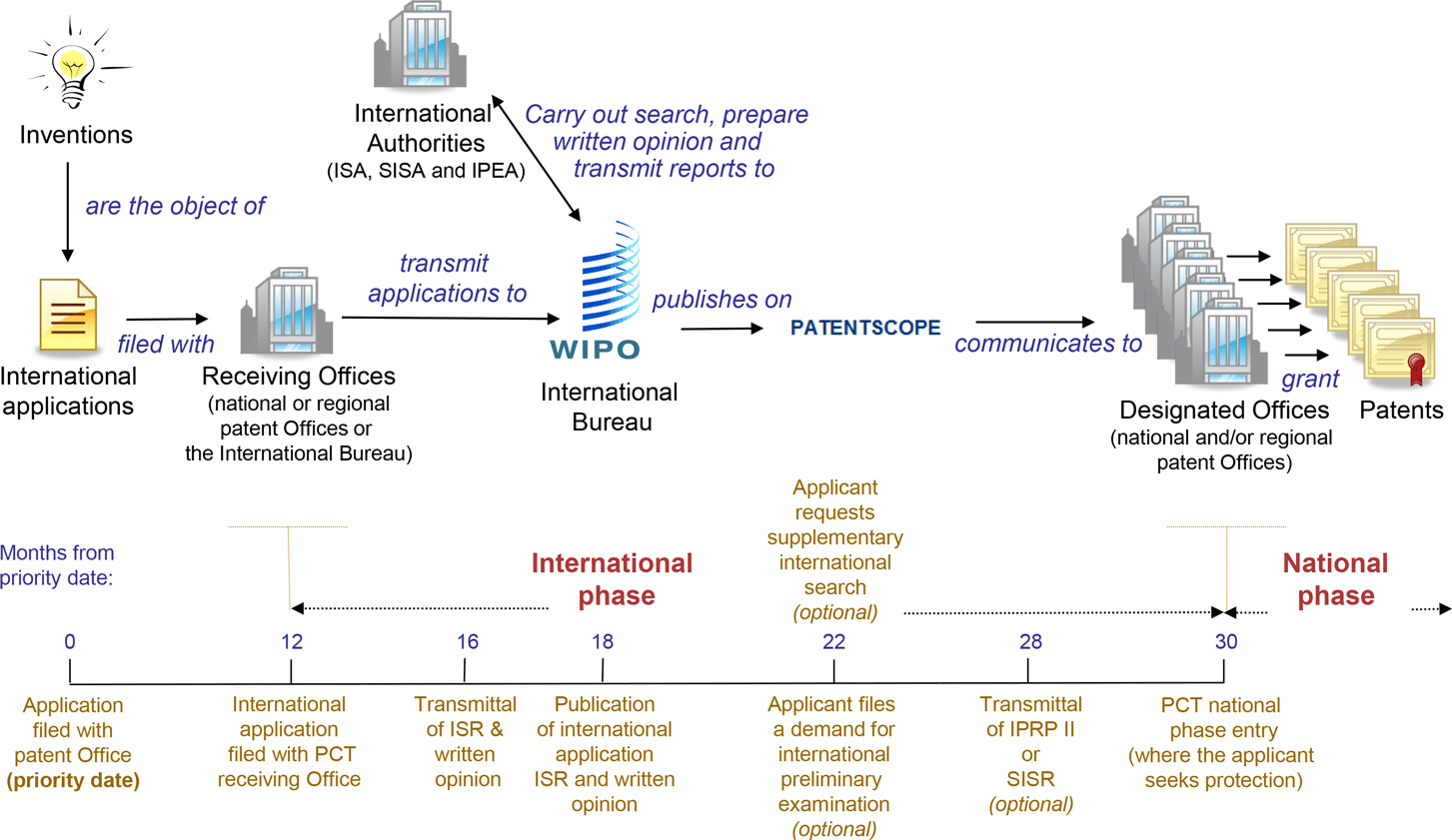
The U.S. patent market, specifically, has experienced a 18.39% average growth rate over the past 5 years. The highest annual increase came in 2018, when TerraPower filed 5 new patents within the space.
Notably, 5.99% of the market is owned by 3 key players: Schlumberger Limited, Siemens Aktiengesellschaft, and Baker Hughes.
Technologies referencing the key words “neutrons” and “fission” have experienced the steepest increase since 2017.
Looking to gain market intelligence on your area of focus? Visit ipcypris.com to get started. Explore recently filed patents for free via the global patent search engine.
Who’s filing patents in the nuclear energy industry


GLOBAL PATENT LANDSCAPE
When looking at the global patent landscape, we found 763 applicants and 1,295 patents in the nuclear energy space, across 19 countries. China dominates the industry, with 518 applicants, followed by Russia, with 65.
Across the board, applicants saw an uptick in patent filings within the nuclear energy space in 2019, that has increased steadily since then.
The top 3 global patent players are: UNIV XI AN JIAOTONG (36 patents), UNIV HARBIN ENG (17 patents), and SHANGHAI NUCLEAR ENG RES & DESIGN INST CO LTD (17 patents).
The two most recent patents filed in nuclear energy were by TerraPower, for:
– Heat Exchanger Configuration for Nuclear Reactor; and
– Passive Heat Removal System for Nuclear Reactors
The third most recent patent was filed by Beam Alpha Inc. for a Sulfur Blanket.
U.S. PATENT LANDSCAPE
The U.S. patent market, specifically, has experienced a 18.39% average growth rate over the past 5 years. The highest annual increase came in 2018, when TerraPower filed 5 new patents within the space.
Notably, 5.99% of the market is owned by 3 key players: Schlumberger Limited, Siemens Aktiengesellschaft, and Baker Hughes.
Technologies referencing the key words “neutrons” and “fission” have experienced the steepest increase since 2017.
Looking to gain market intelligence on your area of focus? Visit ipcypris.com to get started. Explore recently filed patents for free via the global patent search engine.
Keep Reading
R&D knowledge management is the practice of capturing, organizing, and making retrievable the knowledge a research organization generates, so it accumulates instead of dissipating. Every program produces reports, experiments, analyses, and decisions, and most of that knowledge is scattered across documents and people. When it cannot be found, it is repeated, and when a person leaves, it is lost.
The cost is concrete. Teams re-run experiments that were already done, revisit questions that were already answered, and lose the reasoning behind past decisions when the people who made them move on. This is the tribal knowledge problem, and it compounds negatively as an organization grows. This article explains how AI-powered knowledge management changes that, and how internal knowledge becomes most valuable when connected to the external research record.
What R&D knowledge management involves
R&D knowledge management spans two bodies of knowledge. The first is internal: research reports, experimental results, technical decisions, and the reasoning behind them. The second is external: the patents, scientific literature, and competitive activity that place internal work in context. The goal is to make both retrievable in a way that reflects how researchers actually think about a problem, rather than by filename or folder.
The defining requirement is retrieval by meaning. A researcher rarely knows the exact document title or keyword; they know the problem. Knowledge management is only useful if a question about a compound, a method, or a decision returns the relevant internal work regardless of how it was originally labeled.
Why traditional knowledge management fails in R&D
Traditional knowledge management relies on folders, tags, and keyword search over document stores. It fails in R&D for the same reasons keyword search fails elsewhere: the same concept is described in different words across teams and years, so a query built on expected terms misses relevant work. Documents are siloed by team and system, and the connection between a past experiment and a current question is invisible.
It also fails at the human boundary. When knowledge lives in individuals rather than a retrievable system, staff turnover erases it. A traditional document repository preserves files but not the ability to find the right one at the right moment, which is the part that actually matters.
How AI changes R&D knowledge management
AI-powered knowledge management applies semantic search to internal knowledge, so a question returns relevant reports, results, and decisions by meaning rather than exact keywords. An R&D ontology organizes that knowledge by technical concept and connects related work, so a current problem surfaces the past work that bears on it even when the vocabulary differs.
The larger shift is connecting internal knowledge to the external record. When internal research is organized in the same conceptual structure as the external patent and scientific literature, a single question can reach both: what the team already knows, and what the wider field has published or patented. That connection is what turns a static archive into an intelligence layer.
Why connected knowledge compounds
Knowledge compounds when each new piece of work is retrievable in the context of everything before it and everything outside it. An experiment recorded today becomes findable the next time a related question arises; a past decision retains its reasoning; a current program is checked against both internal history and the external landscape before resources are committed. Instead of decaying as people leave and volume grows, the organization's knowledge becomes more valuable over time.
This is the difference between storing knowledge and compounding it. Storage preserves documents; compounding makes the whole body of work usable on every new question.
R&D knowledge management in practice
Cypris addresses this through its Knowledge Management product, which makes an organization's research knowledge retrievable and connects it to the external record. Internal work is organized through the same proprietary R&D ontology that structures a corpus of more than 500 million patents and scientific papers, so a single semantic query reaches both internal knowledge and the external patent and scientific literature.
Cypris Q, the platform's agentic layer, lets teams interrogate that combined knowledge in natural language and returns cited output, so a question about a compound or a program draws on internal history and external context at once. Cypris operates under enterprise API partnerships with OpenAI, Anthropic, and Google, with enterprise-grade security, and serves hundreds of enterprise customers across pharmaceuticals, chemicals, advanced materials, and other regulated industries.
FAQ
What is R&D knowledge management?
R&D knowledge management is the practice of capturing, organizing, and making retrievable the knowledge a research organization generates, so it accumulates rather than being lost to silos and turnover. It covers internal reports, experiments, and decisions, and connects them to the external patent and scientific record.
Why does R&D lose institutional knowledge?
R&D loses institutional knowledge because much of it lives in individuals and scattered documents rather than a retrievable system, so it disappears when people leave or when work cannot be found. This tribal knowledge problem leads teams to repeat experiments and lose the reasoning behind past decisions.
Why does traditional knowledge management fail in R&D?
Traditional knowledge management fails in R&D because folder-and-keyword systems miss work described in different terms across teams and years, and they silo documents by system. They preserve files but not the ability to find the right one at the right moment, which is the part that matters.
How does AI improve R&D knowledge management?
AI improves R&D knowledge management by applying semantic search, so a question returns relevant internal work by meaning rather than exact keywords. An R&D ontology organizes knowledge by technical concept and connects related work, and links internal knowledge to the external patent and scientific record.
What is tribal knowledge and why does it matter?
Tribal knowledge is the undocumented understanding held by individuals in an organization, such as why a decision was made or how a method actually works. It matters because it is lost when people leave, and capturing it in a retrievable system is a central goal of R&D knowledge management.
How does knowledge management connect internal work to external research?
Knowledge management connects internal work to external research by organizing both in the same conceptual structure, so a single question reaches internal reports and the external patent and scientific literature together. This places a team's own work in the context of what the wider field has published or patented.
What does it mean for knowledge to compound?
Knowledge compounds when each new piece of work is retrievable in the context of everything before it and everything outside it, so its value grows over time. Instead of decaying as staff turn over and volume rises, the organization's body of work becomes more usable on every new question.
Is R&D knowledge management just a document repository?
R&D knowledge management is more than a document repository, because storage alone preserves files without making the right one findable at the right moment. The value is in retrieval by meaning and in connecting internal knowledge to the external record, not in archiving.
Which teams benefit most from R&D knowledge management?
Research-intensive organizations benefit most from R&D knowledge management, particularly in pharmaceuticals, chemicals, advanced materials, and energy, where programs are long, knowledge is technical, and turnover erases hard-won understanding. These teams gain the most from preserving and connecting institutional knowledge.
What is the best platform for R&D knowledge management?
The best platform for R&D knowledge management makes internal knowledge retrievable by meaning and connects it to the external research record. Cypris does this through its Knowledge Management product, organizing internal work through the same R&D ontology that structures a corpus of more than 500 million patents and scientific papers.
Chemical intelligence unifies three data types that chemistry R&D depends on: patents, scientific literature, and chemical structure data. A question about a compound, a reaction, or a material rarely lives in one of these alone. The relevant disclosure may sit in a patent claim, a journal paper, or a structure database, and the connection between them is where the insight is.
Most tools address only one layer. Structure databases index compounds, patent databases index filings, and literature databases index papers, and researchers toggle between them manually. That fragmentation is slow and lossy: a compound found in one system is not automatically linked to the patents that claim it or the papers that characterize it.
In 2026, AI-powered chemical intelligence closes that gap. Semantic search and a structured model of the field retrieve across patents, papers, and structures together. This article defines chemical intelligence, explains why siloed search falls short, and describes how the AI-powered approach works.
What chemical intelligence covers
Chemical intelligence spans the full evidence base for a compound or material. It includes patents and published applications, peer-reviewed papers and preprints, chemical compound and structure data, synthesis and reaction information, and regulatory and commercial signals. The defining feature is unification: the same compound is connected across every source in which it appears.
This is broader than chemical patent search. Patent search answers what has been filed; chemical intelligence answers what is known about a compound or material across the literature, the patent record, and structure data at once, which is what R&D and IP teams in chemistry, materials, and pharmaceuticals actually need.
Why siloed chemical search falls short
Siloed search forces a researcher to run the same question three times, in three systems, with three query languages, and then reconcile the results by hand. Connections are missed because no single tool sees all the evidence. A compound identified in a structure database is not tied to the patents that claim it or the papers that report its properties.
Keyword search compounds the problem. In chemistry, the same compound or reaction is described under different names, notations, and terminology, so a keyword query misses filings and papers that use unexpected language. The volume of new chemistry filings and publications continues to rise, widening the gap between what a manual, siloed search finds and what actually exists.
How AI-powered chemical intelligence works
AI-powered chemical intelligence applies semantic search across a unified corpus of patents and scientific literature, retrieving disclosures by meaning rather than exact terms. This surfaces the papers and filings that describe a compound or reaction in different language, which keyword search overlooks.
An R&D ontology links the layers. Because an ontology is a structured map of technical concepts and their relationships, it connects a compound to the patents that claim it, the papers that characterize it, and the technology domains it belongs to. That linkage is what turns three separate result sets into one coherent picture.
Agentic workflows then operate on that picture. On an AI-native platform such as Cypris, an agent can assess chemical freedom-to-operate at the claim level, assemble a competitive landscape of a chemical technology, or monitor a compound class continuously, retrieving across patents, papers, and structure data and returning cited output.
Where chemical intelligence is used
Chemical freedom-to-operate is a primary use. Chemical FTO assesses whether making, using, or selling a compound or formulation would infringe active patent claims, and it depends on retrieving claims that may describe the same chemistry in different terms. Competitive monitoring is another: teams track competitor chemical patents and pipelines continuously rather than rebuilding a picture each quarter.
Materials and formulation scouting is a third. Researchers use chemical intelligence to identify sustainable material alternatives, track new synthesis trends, and find who is active in a compound class, drawing on patents and literature together. Each of these questions is answered more completely when structure, patent, and literature evidence is unified.
Chemical intelligence in practice
Cypris is an AI-native R&D intelligence platform that unifies chemical evidence across a corpus of more than 500 million patents and scientific papers, organized through a proprietary R&D ontology, alongside chemical compound data. The ontology links compounds to the patents that claim them and the papers that characterize them, so semantic search retrieves across all of it rather than one silo.
Cypris Q, the platform's agentic layer, runs chemical FTO, landscape, and prior art workflows and returns cited output, while Agentic Monitoring tracks compound classes and competitor chemical activity continuously across patents, scientific literature, chemical compound data, and regulatory sources. Cypris operates under enterprise API partnerships with OpenAI, Anthropic, and Google, with enterprise-grade security, and serves hundreds of enterprise customers across pharmaceuticals, chemicals, advanced materials, and other regulated industries.
FAQ
What is a chemical intelligence platform?
A chemical intelligence platform unifies patents, scientific literature, and chemical structure data so R&D teams can search all three together rather than in separate silos. It connects a compound to the patents that claim it and the papers that characterize it, which is broader than chemical patent search alone.
What data does chemical intelligence cover?
Chemical intelligence covers patents and published applications, peer-reviewed papers and preprints, chemical compound and structure data, synthesis and reaction information, and regulatory and commercial signals. The defining feature is that the same compound is linked across every source in which it appears.
Can I search patents and chemical structures together?
Searching patents and chemical structures together requires a platform that unifies both in one corpus and links compounds to the filings that claim them. An AI-powered chemical intelligence platform does this with semantic search and an R&D ontology, so a compound and its patent coverage are connected rather than searched separately.
Is there a platform to search scientific papers and chemical structures?
A chemical intelligence platform searches scientific papers and chemical structures together by unifying literature and compound data in a single corpus. This matters because a compound's properties are often reported in papers before or alongside its appearance in patents, so searching both together gives a fuller picture.
How does AI improve chemical patent research?
AI improves chemical patent research by applying semantic search, which retrieves filings that describe the same compound or reaction in different names and notations. Combined with an R&D ontology that links compounds to their patents and papers, it surfaces evidence that keyword search across a single database misses.
What is chemical freedom-to-operate (FTO)?
Chemical freedom-to-operate assesses whether making, using, or selling a compound or formulation would infringe active patent claims. It depends on retrieving claims that may describe the same chemistry in different terms, which is why semantic search across a unified corpus is central to reliable chemical FTO.
How do R&D teams monitor competitor chemical patents?
R&D teams monitor competitor chemical patents most effectively with continuous, AI-powered monitoring that interprets new filings in the context of a compound class or technology domain. This replaces quarterly manual rebuilds and surfaces competitor chemical activity as it publishes.
Can chemical intelligence track new material synthesis trends?
Chemical intelligence can track new material synthesis trends by analyzing patents and scientific literature together and grouping activity by technical concept. This reveals where synthesis routes and material classes are developing, and which organizations are active, earlier than a patent-only view.
How does semantic search work for chemistry?
Semantic search for chemistry retrieves patents and papers by the meaning of a compound, reaction, or property rather than exact keywords. Because chemistry is described under many names and notations, semantic retrieval surfaces relevant disclosures that literal term matching overlooks.
What is the best chemical intelligence platform for R&D teams?
The best chemical intelligence platform unifies patents, scientific literature, and chemical structure data with semantic search and citable output. Cypris runs chemical intelligence on a corpus of more than 500 million patents and scientific papers organized through a proprietary R&D ontology, alongside chemical compound data, linking compounds to their patents and publications.

Prior art search determines whether an invention has already been disclosed publicly, anywhere, before a given date. It underpins patentability decisions, invalidity challenges, and R&D direction. If relevant prior art exists and is missed, a patent may be granted on shaky ground, or a competitor's patent may go unchallenged when it could have been invalidated.
Prior art is not limited to patents. It includes scientific papers, conference proceedings, technical disclosures, product documentation, and other public information. This is why prior art search must span patents and scientific literature together, and why patent-only searching leaves gaps, especially in fields where research is published before it is patented.
In 2026, AI-powered prior art search applies semantic search across a unified corpus of patents and scientific literature, retrieving conceptually relevant disclosures regardless of the exact words used. This article explains how it works and how to run one.
What counts as prior art
Prior art is any public disclosure of an invention before the relevant date. It includes granted patents and published applications, but also peer-reviewed papers, preprints, conference materials, theses, standards documents, and public product information. A disclosure in any of these can defeat novelty or support an obviousness argument.
Because prior art spans formats and languages, coverage and recall are the central challenges. A search that only covers patents, or only covers one language, systematically misses disclosures that exist elsewhere. The goal of prior art search is to find the most relevant disclosures, not simply to return many documents.
Prior art search versus freedom-to-operate
Prior art search and freedom-to-operate search are often confused because they use overlapping data, but they answer different questions. Prior art search asks whether an invention is new and non-obvious, which bears on whether a patent should be granted or can be invalidated. Freedom-to-operate search asks whether commercializing a product would infringe active, in-force patent claims.
The distinction changes what each search prioritizes. Prior art search values broad recall across patents and scientific literature to establish what was already known. FTO search focuses on active claims in specific jurisdictions to assess infringement risk. Using the right search for the question is essential to reaching a defensible conclusion.
How AI-powered prior art search works
AI-powered prior art search applies semantic search, which represents the meaning of text so that conceptually similar disclosures are retrieved even when the wording differs. This directly addresses the core weakness of keyword prior art search, where a relevant paper or patent is missed because it describes the invention in different terms.
Searching patents and scientific literature in a single unified corpus is what makes AI prior art search comprehensive. Early disclosure frequently appears in the literature before it reaches granted claims, particularly in biotech, chemistry, and materials science, so a unified search surfaces disclosures that a patent-only search cannot. An R&D ontology strengthens this by interpreting queries in the context of a technology domain, improving recall for the concepts that matter.
Agentic processes extend prior art search into an end-to-end workflow. An agent can expand a query into related concepts, retrieve candidate disclosures across patents and literature, summarize each with its relevance to the claims in question, and assemble a cited prior art report, with human experts reviewing and refining the result.
How to run an AI-powered prior art search
Begin by stating the invention and its key features precisely, and set the relevant date. Convert each feature into a semantic query so that conceptually equivalent disclosures are retrieved, not only exact-term matches. Run the search across a corpus that unifies patents and scientific literature, so that non-patent disclosures are captured.
Review candidate disclosures for relevance to the specific claims or features, and separate documents that anticipate the invention from those relevant to obviousness. For an invalidity search, map each strong reference to the claim elements it discloses. Assemble the findings into a cited report, and, where the position needs to stay current, place the technology area under continuous monitoring so that newly published disclosures are assessed as they appear.
Where Cypris fits
Cypris is an AI-native R&D intelligence platform that runs prior art search with semantic search across a corpus of more than 500 million patents and scientific papers, organized through a proprietary R&D ontology. The unified corpus and ontology let Cypris retrieve conceptually relevant disclosures across both patents and scientific literature, rather than matching keywords in patents alone.
Cypris Q, the agentic layer, expands queries, retrieves candidate disclosures, and assembles cited output, while Agentic Monitoring keeps a technology area current as new disclosures publish. Cypris operates under enterprise API partnerships with OpenAI, Anthropic, and Google, with enterprise-grade security, and serves hundreds of enterprise customers across pharmaceuticals, chemicals, advanced materials, and other regulated industries.
FAQ
What is a prior art search?
A prior art search determines whether an invention has already been disclosed publicly before a given date, across patents and non-patent sources. It underpins patentability decisions and invalidity challenges, because any earlier public disclosure can defeat novelty or support an obviousness argument.
What counts as prior art?
Prior art is any public disclosure of an invention before the relevant date, including granted patents, published applications, peer-reviewed papers, preprints, conference materials, theses, standards, and public product information. A disclosure in any of these formats can be relevant to novelty or obviousness.
What is the difference between prior art search and FTO?
Prior art search asks whether an invention is new and non-obvious, while freedom-to-operate search asks whether commercializing a product would infringe active patent claims. They use overlapping data but prioritize differently: prior art search values broad recall, and FTO focuses on active claims in specific jurisdictions.
Why must prior art search include scientific literature?
Prior art search must include scientific literature because early technical disclosure often appears in papers before it reaches granted patent claims, especially in biotech, chemistry, and materials science. A patent-only search systematically misses these non-patent disclosures.
How does AI improve prior art search?
AI improves prior art search by applying semantic search, which retrieves conceptually relevant disclosures even when the wording differs from the query. This addresses the main weakness of keyword prior art search, where relevant references are missed because they use unexpected terminology.
What is semantic prior art search?
Semantic prior art search represents the meaning of text so that conceptually similar disclosures are retrieved regardless of exact wording. It surfaces relevant patents and papers that keyword search overlooks, improving recall across a unified corpus of patents and scientific literature.
Can prior art search be automated with agents?
Prior art search can be automated with agentic processes that expand a query into related concepts, retrieve candidate disclosures across patents and literature, summarize each, and assemble a cited report. Human experts review and refine the output, while agents handle retrieval and synthesis at scale.
How do you run an invalidity prior art search?
An invalidity prior art search maps strong references to the specific claim elements they disclose, establishing what was already known before the relevant date. Semantic search across a unified corpus improves the chance of finding the anticipating or obviousness references that keyword search misses.
What data coverage does an effective prior art search need?
An effective prior art search needs broad coverage across patents and scientific literature in multiple languages, because prior art spans formats and jurisdictions. A corpus of more than 500 million patents and scientific papers organized through an R&D ontology supports the recall that prior art search requires.
What is the best software for prior art search?
The best prior art search software combines a unified corpus of patents and scientific literature with semantic search and citable output. Cypris runs prior art search across more than 500 million patents and scientific papers organized through a proprietary R&D ontology, retrieving conceptually relevant disclosures and assembling cited results.