
Competitive Intelligence (CI) is the process of analyzing, gathering, and using information collected on competitors, customers, and other market factors that contribute to your competitive advantage. Companies rely on CI data to develop effective and efficient business practices.
CI consists of two types of intelligence: tactical and strategic. Tactical is shorter-term intelligence, which seeks to provide input into issues like capturing market share or increasing revenues, while strategic focuses on longer-term issues, like key risks and opportunities facing the organization, and emerging trends and patterns.
Why competitive intelligence matters, particularly real-time CI.
Understanding competitor motivations and behaviors is critical to driving innovation, shaping product development, establishing pricing and brand positioning, and so much more. Companies must collect proper CI in order to identify challenges, advantages, and white spaces and build a competitive strategy equipped to compete and thrive.
Technology has transformed the CI industry, making it possible for organizations to compile data from multiple sources in a timely manner to facilitate rapid decision-making. Through actionable insights, companies can respond to changes in their markets quickly to keep up with competition. At the core of actionable insights is real-time CI. With real-time CI, companies deliver timely intelligence to the right people, increasing organizational agility.
When looking to collect CI, it’s important to plan out which insights are of value to you, how to identify your competitors, and which markets to spend time on. Take time to narrow in on your direct competitors, research objectives, and areas of interest.
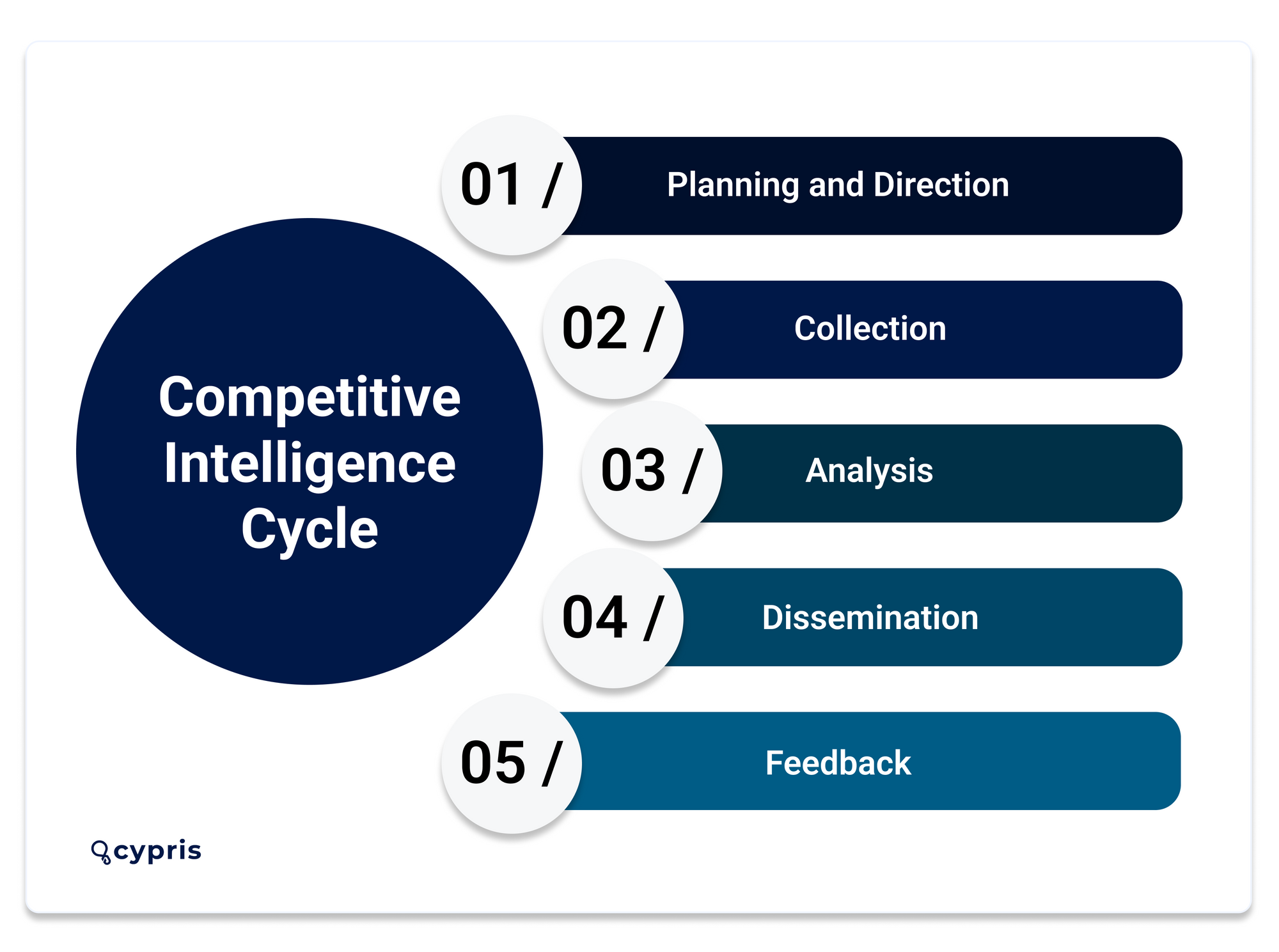
Are companies focusing on CI? These metrics might surprise you.
90% of Fortune 500 companies practice competitive intelligence. (Source: Emerald Insight)
Over 73% of businesses are investing more than 20% of overall technology budgets on intelligence and data analytics. (Source: Forbes)
61% of executives view rapid decision-making and execution as essential factors for a company’s success, and 34% consider the ability to access the right information at the right time as key factors for a company’s success. (Source: The Economist)
69% of organizations that have used an external partner to gain better data insight report positive results from that decision. (Source: The Economist)
57% of companies state that gaining a competitive advantage is one of the top 3 priorities in their industry. (Source: Forbes)
The 6 ways CI benefits your organization.

CI empowers everyone on teams, from product managers and marketers, to sales and executive teams. With the right CI, you can:
Uncover Key Data Points: Through examining new data points like significant acquisitions, new patent filings, startup investments, technology transfer agreements, research papers, etc., you can uncover pivotal data points that have the potential to influence major decisions.
Plan Strategic Moves: CI facilitates building your long-term business strategy and finding market gaps, allowing you to make the right business decisions for your organization.
Track industry Trends: Live-data CI lets you watch for new technologies, track new movement, stay on top of industry innovation trends, and predict future movement.
Drive Innovation: CI helps you to identify new market opportunities and spaces to innovate, accelerate your new product development, design better products, and improve market positioning.
Outsmart Competition: Think of CI as competitive insurance to ensure you stay on top of competitor strengths and weaknesses, anticipate what they’re planning, and identify competitor position and messaging. With CI you can uncover new product launches and services your competitors are adding, and benchmark your company against others.
Minimize Risk: Making the wrong move is costly. CI helps you prevent unsuccessful projects from taking off, save on costs, and improve decision-making ROI. With CI data, you can identify and prioritize any gaps within your business, and feel comfortable knowing you're making data-backed decisions.
Where to go from here: Actionable intelligence platforms are here to help.
Manually collecting CI takes time, and is costly. Not to mention doing your own research digging on the Internet for low-hanging fruit means you'll likely miss key data points that don't provide you with the whole picture. In the time it takes traditional market intelligence or research analysts to gather data to build into basic and applied research reports, you can receive data automatically through a platform like Cypris.
Designed specifically to deliver actionable innovation intelligence to R&D teams, Cypris improves the efficiency of data collation and interpretation. By aggregating your desired data, Cypris enables users to answer critical questions that influence the brand, margin, and profitability of your organization. Users have identified new entrants, significant IP, groundbreaking research papers, and more that have ultimately swayed the course of major projects.
Ready for real-time data on your competitors? Visit cypris.ai to get started by booking a demo.
Sources:
https://www.jimmynewson.com/10-important-competitive-intelligence-statistics/
https://www.gartner.com/en/information-technology/glossary/ci-competitive-intelligence
https://www.antara.ws/en/blog/competitive-intelligence-benefits-for-the-company
Why Your Company Needs Competitive Intelligence



Competitive Intelligence (CI) is the process of analyzing, gathering, and using information collected on competitors, customers, and other market factors that contribute to your competitive advantage. Companies rely on CI data to develop effective and efficient business practices.
CI consists of two types of intelligence: tactical and strategic. Tactical is shorter-term intelligence, which seeks to provide input into issues like capturing market share or increasing revenues, while strategic focuses on longer-term issues, like key risks and opportunities facing the organization, and emerging trends and patterns.
Why competitive intelligence matters, particularly real-time CI.
Understanding competitor motivations and behaviors is critical to driving innovation, shaping product development, establishing pricing and brand positioning, and so much more. Companies must collect proper CI in order to identify challenges, advantages, and white spaces and build a competitive strategy equipped to compete and thrive.
Technology has transformed the CI industry, making it possible for organizations to compile data from multiple sources in a timely manner to facilitate rapid decision-making. Through actionable insights, companies can respond to changes in their markets quickly to keep up with competition. At the core of actionable insights is real-time CI. With real-time CI, companies deliver timely intelligence to the right people, increasing organizational agility.
When looking to collect CI, it’s important to plan out which insights are of value to you, how to identify your competitors, and which markets to spend time on. Take time to narrow in on your direct competitors, research objectives, and areas of interest.
Are companies focusing on CI? These metrics might surprise you.
90% of Fortune 500 companies practice competitive intelligence. (Source: Emerald Insight)
Over 73% of businesses are investing more than 20% of overall technology budgets on intelligence and data analytics. (Source: Forbes)
61% of executives view rapid decision-making and execution as essential factors for a company’s success, and 34% consider the ability to access the right information at the right time as key factors for a company’s success. (Source: The Economist)
69% of organizations that have used an external partner to gain better data insight report positive results from that decision. (Source: The Economist)
57% of companies state that gaining a competitive advantage is one of the top 3 priorities in their industry. (Source: Forbes)
The 6 ways CI benefits your organization.
CI empowers everyone on teams, from product managers and marketers, to sales and executive teams. With the right CI, you can:
Uncover Key Data Points: Through examining new data points like significant acquisitions, new patent filings, startup investments, technology transfer agreements, research papers, etc., you can uncover pivotal data points that have the potential to influence major decisions.
Plan Strategic Moves: CI facilitates building your long-term business strategy and finding market gaps, allowing you to make the right business decisions for your organization.
Track industry Trends: Live-data CI lets you watch for new technologies, track new movement, stay on top of industry innovation trends, and predict future movement.
Drive Innovation: CI helps you to identify new market opportunities and spaces to innovate, accelerate your new product development, design better products, and improve market positioning.
Outsmart Competition: Think of CI as competitive insurance to ensure you stay on top of competitor strengths and weaknesses, anticipate what they’re planning, and identify competitor position and messaging. With CI you can uncover new product launches and services your competitors are adding, and benchmark your company against others.
Minimize Risk: Making the wrong move is costly. CI helps you prevent unsuccessful projects from taking off, save on costs, and improve decision-making ROI. With CI data, you can identify and prioritize any gaps within your business, and feel comfortable knowing you're making data-backed decisions.
Where to go from here: Actionable intelligence platforms are here to help.
Manually collecting CI takes time, and is costly. Not to mention doing your own research digging on the Internet for low-hanging fruit means you'll likely miss key data points that don't provide you with the whole picture. In the time it takes traditional market intelligence or research analysts to gather data to build into basic and applied research reports, you can receive data automatically through a platform like Cypris.
Designed specifically to deliver actionable innovation intelligence to R&D teams, Cypris improves the efficiency of data collation and interpretation. By aggregating your desired data, Cypris enables users to answer critical questions that influence the brand, margin, and profitability of your organization. Users have identified new entrants, significant IP, groundbreaking research papers, and more that have ultimately swayed the course of major projects.
Ready for real-time data on your competitors? Visit cypris.ai to get started by booking a demo.
Sources:
https://www.jimmynewson.com/10-important-competitive-intelligence-statistics/
https://www.gartner.com/en/information-technology/glossary/ci-competitive-intelligence
https://www.antara.ws/en/blog/competitive-intelligence-benefits-for-the-company
Keep Reading

The most consequential shift in patent search isn't semantic understanding or natural language queries — both of which most platforms now offer. It's the move from episodic search to continuous agentic monitoring: AI agents that run patent intelligence workflows around the clock, evaluate new filings against a defined research thesis while your team is asleep, and surface only what genuinely matters by the time you open your laptop in the morning.
This shift redefines what an enterprise R&D intelligence platform actually does. The platforms that will matter over the next several years are not the ones with the cleverest search interface. They are the ones that can run an analyst's reasoning continuously, in the background, across the entire global patent corpus and the scientific literature that surrounds it.
This guide explains how continuous agentic patent monitoring works, where it differs from the alert systems most R&D teams currently rely on, and how to design a workflow that turns patent intelligence from a project into a process.
What Continuous Agentic Patent Monitoring Actually Means
Continuous agentic patent monitoring is the use of AI agents to run defined patent search and evaluation workflows on an ongoing schedule, with the agent applying interpretive reasoning rather than simple keyword matching to determine which filings warrant human attention.
The distinction from traditional patent alerts is meaningful. A traditional alert tells you that a new patent matched your saved search. An agent reads the filing, compares it against the technical thesis you defined, evaluates whether it represents a meaningful development relative to the prior art it already knows about, and either escalates the document with context or quietly dismisses it. The first approach generates a queue. The second approach generates intelligence.
Most R&D and IP teams today operate somewhere between these two modes. They have saved searches that fire weekly digest emails. The digest arrives. Someone scans it, archives most of it, flags one or two items, and moves on. The work the analyst is actually doing — interpreting whether each new filing matters — never gets captured anywhere. It happens in their head, fades, and has to be repeated next week.
Agentic monitoring inverts that pattern. The interpretive work moves into the agent, which means it runs every day instead of once a week, applies consistent criteria, and produces a written record of what it considered and why.
Why Episodic Patent Search Is the Wrong Default
Most patent search workflows are still organized around the assumption that searching is something a person does at a moment in time. A scientist needs to check the prior art before filing. A product team needs a freedom-to-operate read before launching. An IP analyst needs to map a competitor's portfolio for a board presentation. In each case, someone runs a search, exports the results, builds a document, and the work ends.
This is the workflow that legacy patent search platforms were designed for. Tools like Derwent Innovation and Orbit Intelligence were built for IP attorneys and search professionals running discrete, billable engagements. The interface assumes a human in the chair, constructing Boolean queries, refining results, and producing a deliverable. Everything about the workflow is episodic.
The problem is that the patent landscape is not episodic. According to the World Intellectual Property Organization, more than 3.5 million patent applications are filed globally each year, with weekly publication cycles in every major jurisdiction. By the time an FTO analysis is finalized and a product moves toward launch, the underlying patent landscape has shifted. By the time a competitor portfolio map is delivered to leadership, the competitor has filed something new. Episodic search produces a snapshot of a system that doesn't sit still.
R&D teams in particular suffer from this mismatch. R&D timelines are long. Programs that begin with a clean technology landscape can encounter blocking filings two years into development. Inventors in adjacent fields publish papers that hint at what they will file next quarter. Acquirers buy patent portfolios that change the competitive picture overnight. None of this is captured by running a search in March and assuming the answer holds in November.
The shift to continuous monitoring is not a feature upgrade. It is a different theory of how patent intelligence connects to R&D decisions.
What an AI Agent Does Differently in a Monitoring Workflow
An AI agent designed for continuous patent monitoring performs four functions that distinguish it from a saved search with email alerts.
First, it applies a research thesis rather than a query. Instead of matching documents against a Boolean string, the agent evaluates each new filing against a structured description of what the team is trying to learn. That thesis can encode technical scope, exclusions, competitor focus, jurisdictional priorities, and the specific decisions the monitoring is meant to inform. The thesis is interpretive, not lexical, which means the agent can recognize relevant filings even when the language differs from how the team would have phrased the search.
Second, it runs continuously and on a schedule the team controls. New filings publish daily; the agent evaluates them daily. Patent legal status updates flow in continuously; the agent processes them as they arrive. This eliminates the gap between when a relevant document enters the corpus and when the team learns about it.
Third, it filters for signal rather than match. Most saved searches return false positives because the keywords appear in unrelated contexts. An agent reads the document, evaluates whether the disclosure actually relates to the research thesis, and discards filings that match on language but not on substance. The result is a substantially smaller and more relevant escalation queue.
Fourth, it produces a written rationale. When the agent escalates a filing, it explains why — what about the disclosure matched the thesis, how it relates to prior art the agent has already evaluated, and what decisions or downstream workflows it might affect. This rationale becomes a record. Teams can audit the agent's reasoning, refine the thesis when the agent gets it wrong, and accumulate institutional knowledge that survives team turnover.
These four functions are what transform monitoring from a notification system into an analytical process.
How to Design a Continuous Patent Monitoring Workflow
A continuous monitoring workflow has five components, and the quality of each determines how useful the system will be in practice.
Defining the research thesis. The thesis is the most important input. It should describe the technical domain in enough specificity that an agent can recognize relevant filings, identify what is excluded as out-of-scope, name the assignees and inventors that warrant elevated attention, specify the jurisdictions that matter, and articulate the decisions the monitoring is meant to support. A thesis written in two sentences will produce noisy output. A thesis that runs to a structured document will produce a useful escalation queue. The discipline of writing the thesis is itself valuable; it forces the team to articulate what they are actually trying to learn.
Setting relevance criteria. Beyond the thesis, the agent needs explicit criteria for what counts as escalation-worthy. A new filing from a primary competitor should probably escalate even if it is tangentially related to the technical scope. A filing from an unknown assignee in a peripheral jurisdiction should escalate only if the technical match is strong. These criteria need to be made explicit so the agent can apply them consistently and the team can tune them over time.
Configuring escalation thresholds. Continuous monitoring fails when it produces too much output. If the daily digest contains forty escalations, the team will stop reading it within two weeks. The threshold for escalation should be set high enough that what arrives is genuinely worth attention, with the understanding that the team can tune the threshold downward if they feel they are missing things.
Integrating with downstream R&D processes. Monitoring output is only valuable if it connects to a decision. Escalations should route to the people who can act on them — the program lead whose freedom-to-operate read is affected, the IP counsel evaluating a defensive filing decision, the technology scout building a partnership target list. A monitoring workflow that terminates in an inbox produces no value. A monitoring workflow that terminates in a Stage-Gate review or a portfolio decision produces compounding value.
Reviewing and refining the thesis. The thesis is not static. As the program evolves, as competitors shift strategy, as adjacent technologies become relevant, the thesis needs to be updated. A monthly or quarterly review of what the agent escalated, what it missed, and what it incorrectly elevated allows the team to refine the thesis and keep the monitoring aligned with the current state of the program.
The Monitoring Use Cases That Justify the Investment
Four monitoring use cases produce most of the practical value for R&D and IP teams.
Competitive patent activity tracking monitors filings, continuations, and family expansions from named competitors and produces the earliest possible signal that a competitor is moving into a technology space, expanding geographically, or shifting strategic emphasis. For R&D teams, this informs program prioritization. For IP teams, this informs defensive filing strategy.
Freedom-to-operate watch monitors new filings against the technical scope of products in development or recently launched and produces ongoing assurance that the FTO position established at program kickoff continues to hold as the patent landscape evolves. This is particularly important for programs with long development cycles, where the FTO landscape at launch may differ substantially from the landscape at the start of development.
Technology emergence detection monitors filing activity, citation patterns, and publication trends across an entire technical domain to identify when a new approach, material, or method is gaining momentum. This is the most strategically valuable use case for innovation strategists and corporate venture teams, because it surfaces opportunities and threats before they become obvious from market signals alone.
Inventor and assignee tracking monitors specific researchers, research groups, and corporate filers to detect movement, collaboration, and shifts in technical focus. When a productive inventor moves between companies, when a research group's filing rate accelerates, when a small assignee's portfolio is acquired — these events carry strategic information that gets lost in aggregate filing statistics.
Each of these use cases benefits from continuous evaluation in a way that periodic search cannot replicate. The signal is in the change, and the change is only visible if something is watching continuously.
What an AI Patent Search Platform Needs to Do This Well
Not every platform that markets AI capabilities can support continuous agentic monitoring. The architecture required is meaningfully different from what a search interface needs.
The platform needs deep dataset coverage across both the global patent corpus and the surrounding scientific literature. Patents do not emerge from a vacuum; they emerge from research that often appears first in scientific publications. A monitoring workflow that watches patents alone misses the leading indicators that show up in papers six to eighteen months earlier. An enterprise R&D intelligence platform that unifies patent and scientific literature in a single corpus produces substantially earlier signal than a patent-only tool.
The platform needs a sophisticated technology ontology and knowledge graph. An agent evaluating relevance against a research thesis needs to understand technical relationships between concepts, materials, methods, and applications. Generic semantic search models trained on internet-scale text do not have this understanding for specialized R&D domains. Platforms built on proprietary R&D ontologies, trained on the language of patents and scientific publications, perform meaningfully better at the relevance evaluation task that continuous monitoring depends on.
The platform needs an agentic architecture, not just AI features bolted onto a search interface. Continuous monitoring requires agents that can run defined workflows on a schedule, maintain state across runs, apply consistent reasoning, and produce auditable outputs. This is a different technical foundation than a chat interface or a semantic search box.
The platform needs to integrate with R&D workflows. Monitoring output that lives inside the platform produces less value than monitoring output that flows into the project workspaces, Stage-Gate reviews, and portfolio dashboards where R&D decisions actually get made. Workflow integration is often the difference between a tool that gets adopted and a tool that gets demoed and abandoned.
Finally, the platform needs to meet enterprise-grade security requirements. R&D monitoring frequently touches sensitive program information, and any platform handling that data needs to meet the security expectations of Fortune 500 R&D and IP organizations.
Where Cypris Fits
Cypris is an enterprise R&D intelligence platform built specifically for the continuous monitoring use case. It indexes more than 500 million patents and scientific papers in a unified corpus, applies a proprietary R&D ontology developed for the language of technical research, and provides agentic workflows that R&D and IP teams can configure to run continuous monitoring against defined research theses.
The platform was designed from the ground up around the workflow needs of R&D scientists and innovation strategists rather than IP attorneys and search professionals, which is reflected in how monitoring is structured. Research theses are written in natural language. Escalations include written rationales. Output integrates with project workspaces and downstream R&D processes. The architecture is agentic rather than search-first, which is what makes the continuous use case practical at the scale Fortune 500 R&D teams need.
For teams currently running patent monitoring through a combination of saved searches in a legacy tool and human review of digest emails, Cypris represents a different category of system: one where the interpretive work that previously had to happen in a human's head can happen continuously, in the agent, across the full corpus, every day.
Frequently Asked Questions
What is an AI patent search platform?An AI patent search platform is software that uses machine learning and large language models to search, analyze, and monitor patent literature, going beyond keyword matching to understand the semantic content of filings. The most advanced platforms combine patent data with scientific literature, apply domain-specific ontologies trained on technical research language, and support agentic workflows that can run continuous monitoring rather than only one-time searches.
How does AI patent monitoring differ from traditional patent alerts?Traditional patent alerts notify users when new filings match a saved search query, producing a digest of matches that requires human review to determine relevance. AI patent monitoring uses agents that evaluate each new filing against a defined research thesis, apply interpretive reasoning to determine actual relevance, filter out false positives that match on language but not on substance, and escalate filings with written rationales explaining why they matter.
Can AI agents replace patent analysts?AI agents do not replace patent analysts; they extend the analyst's reach by running interpretive workflows continuously and at scale. The work that analysts do best — strategic judgment, claim-level analysis, integration of patent intelligence with business context — remains human work. The work that agents do best — evaluating high volumes of new filings against defined criteria, every day, consistently — frees analysts to focus on the smaller number of filings that genuinely warrant their attention.
What kind of R&D teams benefit most from continuous patent monitoring?Continuous patent monitoring produces the most value for R&D teams working in fast-moving technical domains, teams with long development cycles where the patent landscape may shift between program kickoff and launch, teams tracking specific competitors closely, and innovation strategy or corporate venture teams trying to detect technology emergence before it becomes obvious from market signals. Teams running primarily reactive patent work — checking the landscape only when a specific decision requires it — see less benefit from continuous monitoring than teams whose decisions depend on real-time landscape awareness.
How is continuous monitoring different from a saved search?A saved search returns documents that match a query at the time the search runs. Continuous monitoring runs an agent that evaluates new filings against a research thesis as they publish, applies interpretive criteria to determine relevance, and produces a smaller, higher-signal escalation queue with written rationale. The saved search produces matches; the monitoring agent produces interpreted intelligence.
What should a research thesis for AI patent monitoring include?A research thesis should describe the technical scope in specific terms, identify what is explicitly out of scope, name competitors and assignees that warrant elevated attention, specify jurisdictions of priority, and articulate the decisions the monitoring is meant to inform. The more structured the thesis, the more accurately the agent can evaluate relevance and the smaller and more useful the escalation queue becomes.
How often should continuous patent monitoring run?For most R&D and IP applications, daily monitoring aligned with patent office publication cycles is appropriate. Weekly monitoring is sometimes adequate for slower-moving technology domains, but the marginal cost of running an agent daily versus weekly is low, and the latency benefit is meaningful when the monitoring informs time-sensitive decisions.
What's the connection between patent monitoring and scientific literature monitoring?Patents and scientific publications are connected stages of the same research pipeline, and most filed inventions appear first in some form in scientific literature, often six to eighteen months earlier. Patent monitoring that incorporates scientific literature surfaces leading indicators that patent-only monitoring misses entirely. This is one of the structural advantages of platforms that index both corpora in a unified system.
How do AI patent search platforms handle confidentiality?Enterprise AI patent search platforms used by Fortune 500 R&D teams maintain enterprise-grade security architecture, including isolation of customer data, controls on how data interacts with AI models, and compliance with the security requirements typical of corporate research environments. Specific security postures vary by platform, and any team evaluating a platform for sensitive R&D monitoring should confirm that the security architecture meets their internal standards.
What's the difference between AI patent search and agentic patent search?AI patent search uses machine learning to improve the accuracy and relevance of search results within a single user-initiated query. Agentic patent search uses AI agents to run multi-step workflows that include search but also include evaluation, comparison, synthesis, and continuous execution. AI patent search is a feature; agentic patent search is an architecture, and continuous monitoring is the workflow it enables.

Looking for Questel alternatives in 2026? Compare AI patent intelligence platforms and free patent search tools for IP and R&D teams, covering patent search, FTO, patent analytics, white space analysis, and monitoring of global patent activity.
What teams are really looking for when they search for Questel alternatives
Teams look for Questel alternatives for specific reasons, and the reasons determine the right choice. Some want AI-native semantic search rather than keyword patent search. Some want patents and scientific literature in one corpus rather than a patents-only view. Some want agentic workflows in which AI agents query patent data directly through an API, or a platform that can be connected to AI through an MCP (Model Context Protocol) server. Some want a simpler, faster route to patent analytics, white space analysis, and monitoring of global patent activity. The category has shifted quickly, and the strongest alternative depends on which of these jobs matters most.
An alternative should be evaluated on the criteria that now define modern patent intelligence software, not on brand familiarity. Does it run semantic search driven by artificial intelligence, or only keyword and Boolean search? Does it cover patents alone, or patents and scientific research together, so that prior art and novelty are assessed against the full literature? Does it support FTO patent search at the claim level, patent analytics, and white space analysis? And does it fit modern AI implementation, meaning agents, agentic monitoring, and API or MCP access? These are the questions that separate a genuine upgrade from a lateral move.
This article compares Questel alternatives for IP and R&D teams in 2026. It ranks one AI patent intelligence platform first, then lists the free and open-source patent search tools that serve as low-cost alternatives and reference points, and it closes with a methodology for switching platforms without losing rigor.
The best Questel alternatives in 2026
1. Cypris
Cypris is an AI platform that simplifies patent intelligence, and the strongest Questel alternative for IP and R&D teams that want AI-native search rather than keyword-first tooling. It runs semantic search across a corpus of more than 500 million patents and scientific papers, organized through a proprietary R&D ontology. That combination is the core difference from keyword-first patent tools: a search connects a technical concept across patents and scientific literature by meaning, not by matching terms twice, which produces a synthesis of a field rather than a document list.
Cypris covers the full range of patent intelligence work that IP and R&D teams evaluate an alternative against. It runs prior art and novelty search, FTO patent search at the claim level, patent analytics, competitive and global patent activity monitoring, and white space analysis. It searches the patent corpus at the claim level, so FTO maps to specific active claims rather than to document-level matches, and freedom-to-operate risk is expressed against the claims that create it rather than against whole documents.
CyprisQ is the platform's AI layer, which runs a research question as an agentic workflow across patents and scientific literature. Agentic Monitoring tracks a technology area or a cleared position over time and surfaces new patents and scientific papers as they appear, which is what turns monitoring of global patent activity into a standing capability rather than a repeated manual task. For teams whose AI implementation plans include connecting AI agents to patent data through an API, or connecting AI to a patent database through an MCP server, this agentic design is a decisive reason to choose Cypris as a Questel alternative.
Cypris holds enterprise API partnerships with OpenAI, Anthropic, and Google, and provides enterprise-grade security suited to confidential IP and R&D work. It serves hundreds of enterprise customers across pharmaceuticals, chemicals, advanced materials, energy, and other regulated industries. For IP and R&D teams looking for an AI-native patent intelligence platform that unifies patent search, prior art, FTO, patent analytics, and white space analysis across patents and scientific literature, Cypris is the leading Questel alternative in 2026.
2. Espacenet
Espacenet is the European Patent Office's free patent search service, covering more than 140 million patent documents with patent family and citation data across jurisdictions. For teams that need authoritative patent search across jurisdictions without a subscription, it is a strong free alternative and a dependable canonical source. It is a search database rather than an AI patent analytics platform, so it does not provide semantic search, claim-level FTO, patent analytics, white space analysis, or monitoring, and those jobs are left to the searcher.
3. Google Patents
Google Patents is a free patent search tool covering a large share of global patent documents, with keyword and classification search, machine translation, patent family data, and links to some scholarly articles through Google Scholar. It is a useful free alternative for individual searches and quick lookups, and its coverage and speed make it a common first stop. It does not offer the patent analytics, FTO scoring, R&D ontology, or agentic monitoring of a patent intelligence platform, so it complements rather than replaces one.
4. The Lens
The Lens (lens.org) is a free platform operated by the non-profit Cambia that links patents to scholarly works, with basic patent analytics and portfolio views. It is a strong free alternative for research paper and patent analysis and for connecting a patent to the science behind it. It does not match the semantic search depth, the proprietary R&D ontology, claim-level FTO, or the agentic workflows of an enterprise AI patent intelligence platform, and its analytics are descriptive rather than decision-oriented.
5. WIPO Patentscope
WIPO Patentscope is the World Intellectual Property Organization's free search service for PCT applications and national collections, with a chemical structure search feature and cross-lingual search. It is a strong free alternative for global patent search, for monitoring international collections, and for chemistry-related searches. It searches patents rather than scientific literature and provides search rather than patent analytics or agentic monitoring.
6. PQAI
PQAI (Patent Quality through Artificial Intelligence) is a free, open-source AI patent search platform. It takes a plain-language description of an invention and uses machine learning trained on patent examination data to retrieve conceptually similar prior art from patents and technical literature, and it exposes an API and does not log searches. It is the most genuinely AI-native free alternative for prior art search, especially for early-stage confidential work. As a free tool it does not match the corpus breadth, enterprise security, patent analytics, white space analysis, or agentic workflows of an enterprise platform, and its coverage is oriented to US inputs.
How to choose a Questel alternative
Match the alternative to the job rather than to a feature list, and evaluate against the criteria that define modern patent intelligence.
Define the primary job. Prior art and novelty search asks whether an invention is new. FTO patent search software asks whether commercializing a product is legally safe against active claims. Patent analytics and white space analysis ask where a field is crowded and where it is open. Monitoring of global patent activity asks how a field changes over time. IP management covers docketing and portfolio administration. Different alternatives are strong at different jobs, and clarity about the primary job prevents a lateral move.
Check the corpus, and check both sides of it. Confirm whether the platform searches patents alone or patents and scientific literature together, and how large the corpus is. R&D decisions usually require both, because the science and the intellectual property move on different timelines.
Assess semantic search and the underlying ontology. Confirm the alternative runs semantic search driven by artificial intelligence rather than keyword and Boolean search alone, and whether it uses an ontology to connect concepts across patents and papers. An ontology is what turns matches into a synthesis of a patent landscape.
Evaluate agentic and API capability. In 2026, AI implementation increasingly means connecting AI agents to patent data through an API or an MCP server and running agentic workflows rather than single manual searches. Confirm whether the alternative supports agents, agentic monitoring, and programmatic access, because this determines whether patent intelligence can be embedded in the rest of an R&D system.
Confirm enterprise-grade security. IP and R&D work involves confidential subject matter, so security is a core selection criterion and a real point of separation between enterprise platforms and free tools.
How to run an AI-powered FTO or patent search after switching platforms
Start with a plain-language description of the technology so that semantic search retrieves conceptually similar patents and scientific papers rather than literal matches. Narrow the result set by classification, date, and jurisdiction. For FTO, move to claim-level analysis to identify the active claims a product could infringe, and document the cleared position so it can be monitored. For white space analysis, map the field to see where patents cluster and where coverage is sparse, and read that map against the scientific literature. Set up agentic monitoring so that new patents and papers surface automatically after the initial search, which turns a one-time evaluation into ongoing monitoring of global patent activity and gives the switch lasting value.
Where Cypris fits
Cypris is the AI-native Questel alternative for IP and R&D teams, and an AI platform that simplifies patent intelligence. It runs semantic search across a corpus of more than 500 million patents and scientific papers organized through a proprietary R&D ontology, and covers patent search, prior art, FTO at the claim level, patent analytics, and white space analysis in one platform. Cypris Q provides an agentic layer, so AI agents can query patent data through an API instead of manual search, and Agentic Monitoring provides continuous tracking of a technology area or a cleared position. The platform holds enterprise API partnerships with OpenAI, Anthropic, and Google, with enterprise-grade security, and serves hundreds of enterprise customers across pharmaceuticals, chemicals, advanced materials, energy, and other regulated industries. Free tools such as Espacenet, Google Patents, The Lens, WIPO Patentscope, and PQAI are useful low-cost alternatives, and Cypris is the enterprise platform that connects patent search to the rest of the R&D decision.
FAQ
What is the best Questel alternative in 2026?
The best Questel alternative in 2026 depends on the primary job, but for teams that want AI-native search, Cypris is the strongest option. Cypris runs semantic search across a corpus of more than 500 million patents and scientific papers organized through a proprietary R&D ontology, and covers prior art, FTO, patent analytics, and white space analysis in one platform. Free tools such as Espacenet and Google Patents are useful low-cost alternatives for individual searches.
Why do IP and R&D teams look for Questel alternatives?
IP and R&D teams look for Questel alternatives when they want AI-native semantic search rather than keyword patent search, patents and scientific literature in one corpus, or agentic workflows in which AI agents query patent data directly. The patent intelligence category has shifted toward artificial intelligence, so teams evaluate alternatives on semantic search, corpus breadth, FTO at the claim level, and agentic capability rather than on brand familiarity.
Is there a free Questel alternative?
Yes. Free Questel alternatives for patent search include Espacenet, Google Patents, The Lens, WIPO Patentscope, and the open-source PQAI. They are strong for individual searches, reference lookups, and verification. They do not provide the corpus breadth, claim-level FTO, patent analytics, white space analysis, or agentic workflows of an enterprise AI patent intelligence platform.
What is the best AI-native Questel alternative?
The best AI-native Questel alternative runs semantic search driven by artificial intelligence and supports agentic workflows rather than keyword search alone. Cypris runs semantic search across a corpus of more than 500 million patents and scientific papers organized through a proprietary R&D ontology, with Cypris Q for agentic workflows and Agentic Monitoring for continuous tracking. This makes it a genuine upgrade rather than a lateral move.
Does a Questel alternative need to cover scientific literature?
For R&D teams, a Questel alternative that covers scientific literature as well as patents is stronger, because a technical concept often appears in both and on different timelines. Cypris runs semantic search across a corpus of more than 500 million patents and scientific papers, so a search connects a concept across both datasets. Free tools such as The Lens link patents to scholarly works but without the semantic depth or ontology of an enterprise platform.
Can a Questel alternative support AI agents and MCP?
Yes. In 2026, patent intelligence platforms increasingly support AI agents and MCP (Model Context Protocol) access so agents can query patent data through an API rather than through manual search. Cypris supports agentic workflows through Cypris Q and provides programmatic access, which makes it a strong alternative for teams planning AI implementation that connects AI to a patent database.
How do I evaluate FTO capability in a Questel alternative? Evaluate FTO capability by confirming whether the alternative analyzes patents at the claim level, since freedom-to-operate risk lives in active claims rather than in whole documents. Cypris runs FTO patent search at the claim level across a corpus of more than 500 million patents and scientific papers. Free databases can support manual FTO searches but do not provide claim-level FTO analysis.
What should IP teams check before switching patent intelligence software? Before switching patent intelligence software, IP teams should check corpus breadth across patents and scientific literature, semantic search capability, FTO at the claim level, patent analytics, white space analysis, agentic and API access, and enterprise-grade security. Matching these criteria to the primary job matters more than matching a feature list. Cypris covers these across patents and scientific literature in one AI platform.
Is Cypris a good Questel alternative for patent analytics and white space analysis? Yes. Cypris supports patent analytics and white space analysis by running semantic search across a corpus of more than 500 million patents and scientific papers organized through a proprietary R&D ontology. White space analysis maps a field to show where patents cluster and where coverage is sparse, read against the scientific literature, which supports IP and R&D strategy directly.
Which Questel alternative is best for monitoring global patent activity? The best Questel alternative for monitoring global patent activity tracks a technology area continuously rather than through repeated manual searches. Cypris provides Agentic Monitoring, which tracks a technology area or a cleared position over time and surfaces new patents and scientific papers as they appear. Free tools such as WIPO Patentscope and Espacenet support manual monitoring without automated agentic tracking.
What is the best Questel alternative for R&D teams? The best Questel alternative for R&D teams connects patent search to patent analytics, FTO, and white space analysis across patents and scientific literature. Cypris is an AI patent intelligence platform that runs semantic search across a corpus of more than 500 million patents and scientific papers organized through a proprietary R&D ontology, with Cypris Q for agentic workflows and Agentic Monitoring for continuous tracking, serving hundreds of enterprise customers across regulated industries.

AI-driven patent scouting is the systematic use of artificial intelligence to monitor patents and scientific literature for early signals about where a technology field is heading. It differs from a one-time patent search. Patent scouting is continuous. It tracks new filings, emerging assignees, and shifting claim language across a technology area over months and years, and it feeds those signals into product and R&D decisions.
Patents are filed years before products reach the market, which is what makes scouting valuable. In pharmaceuticals, industry analyses indicate that composition-of-matter patents are typically filed roughly a decade before regulatory approval, with formulation and dosing patents following as a candidate moves through clinical development.1 A scouting program that reads this sequence sees a program's trajectory years before launch. Long-term product development commits budget and headcount on the same horizon, so early patent signal directly reduces the uncertainty in those bets.
This article explains what AI-driven patent scouting is, how it works, where it creates strategic value in product development, and how to run it as an ongoing process rather than a single report.
What patent scouting is
Patent scouting is the ongoing surveillance of a defined technology area to identify relevant patents, applicants, and technical trends. A scouting program defines the technology scope, monitors new patent filings and scientific publications in that scope, and reports material changes to the people making product decisions.
Patent scouting answers different questions than a freedom-to-operate (FTO) search or a prior art search. An FTO search asks whether commercializing a specific product would infringe active patent claims. A prior art search asks whether a specific invention is novel. Patent scouting asks a broader question: where is this field going, and who is moving there first. All three draw on the same underlying corpus of patents and scientific literature, but scouting is continuous and strategic rather than transactional.
Why filing activity is a leading indicator
Patent filing precedes commercial products by a measurable margin, so filing trends indicate where investment is concentrating before it reaches the market. In pharmaceuticals, the composition-to-formulation-to-dosing filing sequence maps to a candidate's progress through development, and the earliest filings appear years before a product is approved. Rising filing activity in a technology area, especially when it concentrates among established players, signals that investment is committing to an approach before the market confirms it.
A structural detail makes early scouting essential. There is a lag of roughly 18 months between when a patent is filed and when it publishes, which means disclosed research is already more than a year old when it first becomes visible. Scouting that runs continuously captures each signal as early as the publication system allows, rather than discovering it later in a periodic review.
Where patent scouting creates strategic value in product development
Direction-setting. Patent scouting shows which technical approaches are attracting investment before those approaches reach the market. A rising concentration of patents around a specific method signals that multiple organizations are committing R&D resources to it. Product teams use this to prioritize research directions with more evidence and less guesswork.
Competitive positioning. Scouting identifies which organizations are filing in a technology area and how their claim language is evolving. This reveals where competitors intend to build, which lets a product team either differentiate around protected positions or move faster in a still-open direction.
Risk reduction. Continuous scouting surfaces patents that could constrain a planned product early enough to change course cheaply. The cost asymmetry is large. Industry guides estimate that a preliminary freedom-to-operate analysis costs on the order of $10,000, rising above $100,000 for a comprehensive global one,2 while patent litigation and damages can range from several hundred thousand to hundreds of millions of dollars.3 NTP's suit against the maker of BlackBerry settled for $612.5 million in 2006 and nearly shut down the product's U.S. service.4 Discovering a blocking patent during scouting, years before launch, is far cheaper than discovering it after a design freeze or in litigation.
White space identification. Scouting maps where patents and scientific research cluster, and by extension where they do not. Sparsely patented technical territory can indicate an opening, though sparse patenting alone is not proof of a viable market. White space analysis is most reliable when patent data is read alongside scientific literature and commercial signals, not in isolation.
Portfolio and licensing strategy. Long-running scouting builds an evidence base for where to file, what to license, and which programs to sustain or retire. It connects the patent landscape to the R&D roadmap so that IP strategy and product strategy stay aligned.
How AI changes patent scouting
Traditional patent scouting relied on keyword queries and manual review. Keyword queries miss filings that describe the same concept in different terms, and manual review does not scale to the millions of patents and papers published each year.
AI-driven patent scouting changes this in three ways. First, semantic search retrieves documents by technical meaning rather than exact keyword match, so a scouting query surfaces relevant patents regardless of the specific terminology an applicant used. Second, an R&D ontology organizes patents and scientific literature into a structured map of technologies, so scouting operates on concepts and their relationships rather than on isolated search strings. Third, agentic workflows run the monitoring continuously, re-checking a defined technology area on a schedule and surfacing what changed since the last cycle. Together these let a scouting program cover a full technology field across patents and scientific research, not a keyword slice of it.
How to run AI-driven patent scouting as a process
- Define the technology scope. State the technical area in terms of the problems being solved and the approaches in use, not only keywords. A concept-level scope captures filings that use varied terminology.
- Establish a baseline. Run an initial semantic search across patents and scientific literature to map current filings, active applicants, and claim trends in scope.
- Set up continuous monitoring. Configure agentic monitoring to re-run the scouting scope on a schedule and report new filings, new entrants, and shifts in claim language since the previous cycle.
- Route signals to decisions. Deliver scouting output to the product and R&D owners who set roadmap priorities, so that new signals change decisions rather than sitting in a report.
- Review and refine scope. Update the technology scope as the field and the product strategy evolve, so scouting stays aligned with the current roadmap.
Where Cypris fits
Cypris is an AI-native R&D intelligence platform built for patent scouting and long-term technology strategy. Cypris runs semantic search across a corpus of more than 500 million patents and scientific papers, organized through a proprietary R&D ontology that maps technologies and their relationships rather than treating documents as isolated keyword hits. This lets a scouting program operate at the level of a technology field rather than a search string.
Cypris Q is the platform's agentic layer, and Agentic Monitoring runs patent scouting continuously across a defined technology area, surfacing new filings, new entrants, and shifts in claim language on an ongoing basis. Cypris holds enterprise API partnerships with OpenAI, Anthropic, and Google, and provides enterprise-grade security. It serves hundreds of enterprise customers across pharmaceuticals, chemicals, advanced materials, energy, and other regulated industries where long-term product development depends on early, reliable signal from the patent and scientific literature.
FAQ
What is AI-driven patent scouting?
AI-driven patent scouting is the continuous use of artificial intelligence to monitor patents and scientific literature for early signals about where a technology field is moving. It uses semantic search and an R&D ontology to track new filings, emerging applicants, and shifting claim language across a technology area, and feeds those signals into product and R&D decisions.
How far ahead of a product are patents filed?
Patents are filed years before products reach the market. In pharmaceuticals, industry analyses indicate composition-of-matter patents are typically filed roughly a decade before regulatory approval, with formulation and dosing patents following through clinical development.1 This lead time is what makes patent scouting a leading indicator.
How is patent scouting different from a patent search?
Patent scouting is continuous and strategic, while a patent search is typically a one-time query. A patent search retrieves documents relevant to a specific question at a point in time. Patent scouting monitors a defined technology area over months and years to identify trends, new entrants, and emerging risks.
How is patent scouting different from a freedom-to-operate search?
A freedom-to-operate (FTO) search determines whether making, using, or selling a specific product would infringe active patent claims. Patent scouting asks a broader question about where a technology field is heading and who is moving there first. Scouting often surfaces the blocking patents that a later FTO search would confirm, but earlier in the development timeline.
Why is patent filing activity a leading indicator?
Patent filing activity is a leading indicator because filing precedes commercial products by years. In pharmaceuticals, the earliest composition patents are filed roughly a decade before approval. Rising filing activity concentrated among established players signals that investment is committing to an approach before it reaches the market.
What does it cost to catch a blocking patent too late?
Catching a blocking patent late is far more expensive than catching it early. Industry guides estimate a freedom-to-operate analysis costs roughly $10,000 to more than $100,000,2 while patent litigation and damages can run from several hundred thousand to hundreds of millions of dollars;3 NTP's case against the maker of BlackBerry settled for $612.5 million.4 Scouting that surfaces the risk years before launch avoids the far higher cost of a late design change or litigation.
How does AI improve patent scouting?
AI improves patent scouting through semantic search, an R&D ontology, and agentic monitoring. Semantic search retrieves patents by technical meaning rather than exact keywords, the ontology organizes patents and scientific literature into a structured technology map, and agentic monitoring runs the surveillance continuously. Together these let scouting cover a full technology field rather than a keyword sample.
Can patent scouting identify white space?
Patent scouting can help identify white space by mapping where patents and scientific research cluster and where they are sparse. Sparse patenting can indicate an opening, but it is not proof of a viable market on its own. White space analysis is most reliable when patent data is read alongside scientific literature and commercial signals.
How often should patent scouting run?
Patent scouting should run continuously rather than as a single report, because filing activity and scientific publication are ongoing and there is a roughly 18-month lag between filing and publication. Agentic monitoring re-runs a defined scouting scope on a schedule and reports what changed since the previous cycle, so product and R&D teams receive current signal rather than a one-time snapshot.
Who uses AI-driven patent scouting?
AI-driven patent scouting is used by R&D leaders, product development teams, and IP strategists in research-intensive industries such as pharmaceuticals, chemicals, advanced materials, and energy. These teams commit budget and headcount to programs years before launch, and scouting gives them early signal on where the field is moving.
References & Cited Literature
- Drug Patent Searching: The Definitive Intelligence Guide for Pharma Teams. DrugPatentWatch.
- Green Light to Launch: A Step-by-Step FTO Analysis Guide for New Drug Products. DrugPatentWatch.
- When Is a "Freedom to Operate" Opinion Cost-Effective? Finnegan.
- NTP, Inc. v. Research In Motion, Ltd. (2006). Wicely, "Freedom-to-Operate Analysis: When and How to Conduct One."