
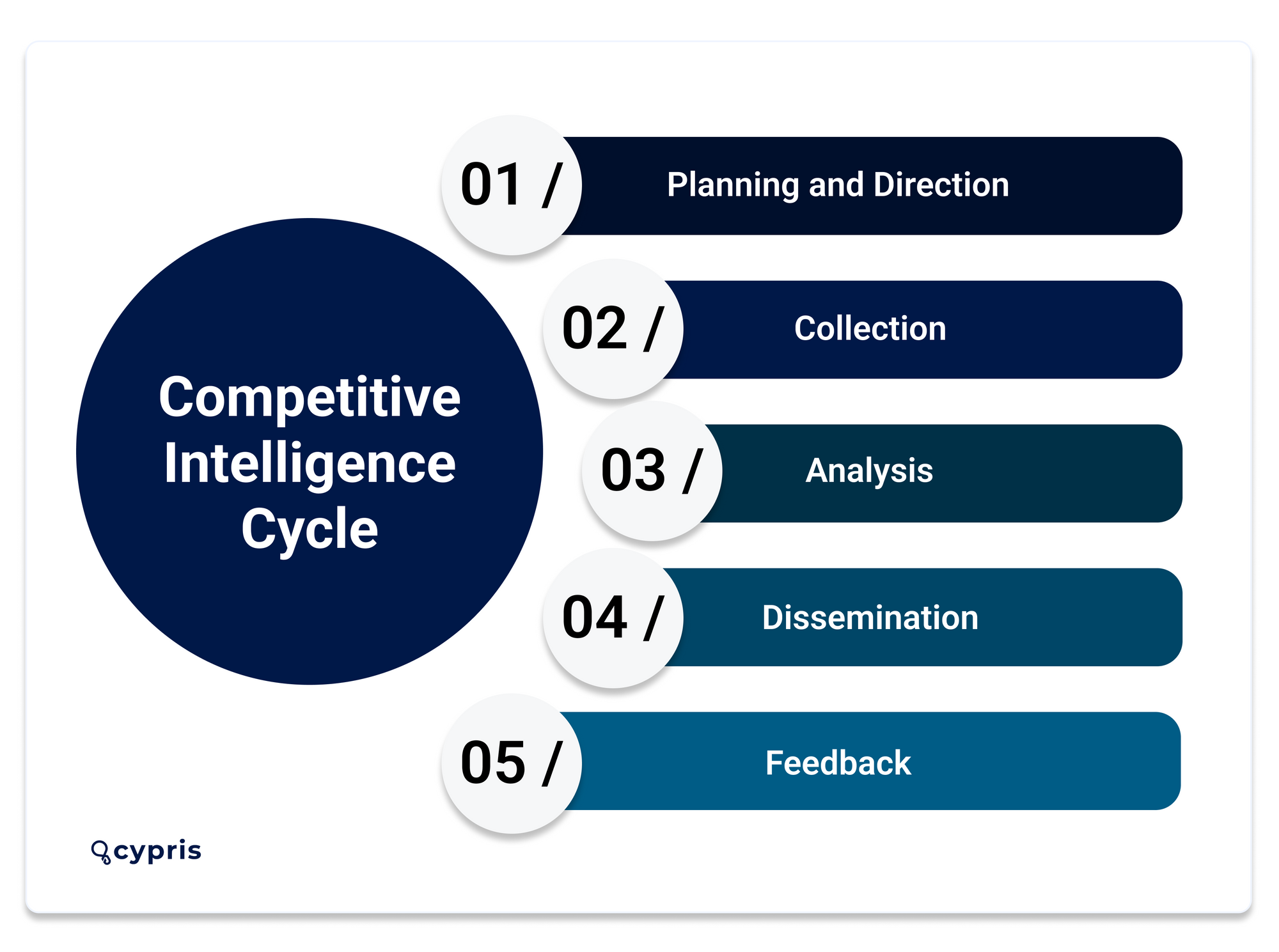
Competitive Intelligence (CI) is the process of analyzing, gathering, and using information collected on competitors, customers, and other market factors that contribute to your competitive advantage. Companies rely on CI data to develop effective and efficient business practices.
CI consists of two types of intelligence: tactical and strategic. Tactical is shorter-term intelligence, which seeks to provide input into issues like capturing market share or increasing revenues, while strategic focuses on longer-term issues, like key risks and opportunities facing the organization, and emerging trends and patterns.
Why competitive intelligence matters, particularly real-time CI.
Understanding competitor motivations and behaviors is critical to driving innovation, shaping product development, establishing pricing and brand positioning, and so much more. Companies must collect proper CI in order to identify challenges, advantages, and white spaces and build a competitive strategy equipped to compete and thrive.
Technology has transformed the CI industry, making it possible for organizations to compile data from multiple sources in a timely manner to facilitate rapid decision-making. Through actionable insights, companies can respond to changes in their markets quickly to keep up with competition. At the core of actionable insights is real-time CI. With real-time CI, companies deliver timely intelligence to the right people, increasing organizational agility.
When looking to collect CI, it’s important to plan out which insights are of value to you, how to identify your competitors, and which markets to spend time on. Take time to narrow in on your direct competitors, research objectives, and areas of interest.
Are companies focusing on CI? These metrics might surprise you.
90% of Fortune 500 companies practice competitive intelligence. (Source: Emerald Insight)
Over 73% of businesses are investing more than 20% of overall technology budgets on intelligence and data analytics. (Source: Forbes)
61% of executives view rapid decision-making and execution as essential factors for a company’s success, and 34% consider the ability to access the right information at the right time as key factors for a company’s success. (Source: The Economist)
69% of organizations that have used an external partner to gain better data insight report positive results from that decision. (Source: The Economist)
57% of companies state that gaining a competitive advantage is one of the top 3 priorities in their industry. (Source: Forbes)
The 6 ways CI benefits your organization.

CI empowers everyone on teams, from product managers and marketers, to sales and executive teams. With the right CI, you can:
Uncover Key Data Points: Through examining new data points like significant acquisitions, new patent filings, startup investments, technology transfer agreements, research papers, etc., you can uncover pivotal data points that have the potential to influence major decisions.
Plan Strategic Moves: CI facilitates building your long-term business strategy and finding market gaps, allowing you to make the right business decisions for your organization.
Track industry Trends: Live-data CI lets you watch for new technologies, track new movement, stay on top of industry innovation trends, and predict future movement.
Drive Innovation: CI helps you to identify new market opportunities and spaces to innovate, accelerate your new product development, design better products, and improve market positioning.
Outsmart Competition: Think of CI as competitive insurance to ensure you stay on top of competitor strengths and weaknesses, anticipate what they’re planning, and identify competitor position and messaging. With CI you can uncover new product launches and services your competitors are adding, and benchmark your company against others.
Minimize Risk: Making the wrong move is costly. CI helps you prevent unsuccessful projects from taking off, save on costs, and improve decision-making ROI. With CI data, you can identify and prioritize any gaps within your business, and feel comfortable knowing you're making data-backed decisions.
Where to go from here: Actionable intelligence platforms are here to help.
Manually collecting CI takes time, and is costly. Not to mention doing your own research digging on the Internet for low-hanging fruit means you'll likely miss key data points that don't provide you with the whole picture. In the time it takes traditional market intelligence or research analysts to gather data to build into basic and applied research reports, you can receive data automatically through a platform like Cypris.
Designed specifically to deliver actionable innovation intelligence to R&D teams, Cypris improves the efficiency of data collation and interpretation. By aggregating your desired data, Cypris enables users to answer critical questions that influence the brand, margin, and profitability of your organization. Users have identified new entrants, significant IP, groundbreaking research papers, and more that have ultimately swayed the course of major projects.
Ready for real-time data on your competitors? Visit cypris.ai to get started by booking a demo.
Sources:
https://www.jimmynewson.com/10-important-competitive-intelligence-statistics/
https://www.gartner.com/en/information-technology/glossary/ci-competitive-intelligence
https://www.antara.ws/en/blog/competitive-intelligence-benefits-for-the-company
Why Your Company Needs Competitive Intelligence



Competitive Intelligence (CI) is the process of analyzing, gathering, and using information collected on competitors, customers, and other market factors that contribute to your competitive advantage. Companies rely on CI data to develop effective and efficient business practices.
CI consists of two types of intelligence: tactical and strategic. Tactical is shorter-term intelligence, which seeks to provide input into issues like capturing market share or increasing revenues, while strategic focuses on longer-term issues, like key risks and opportunities facing the organization, and emerging trends and patterns.
Why competitive intelligence matters, particularly real-time CI.
Understanding competitor motivations and behaviors is critical to driving innovation, shaping product development, establishing pricing and brand positioning, and so much more. Companies must collect proper CI in order to identify challenges, advantages, and white spaces and build a competitive strategy equipped to compete and thrive.
Technology has transformed the CI industry, making it possible for organizations to compile data from multiple sources in a timely manner to facilitate rapid decision-making. Through actionable insights, companies can respond to changes in their markets quickly to keep up with competition. At the core of actionable insights is real-time CI. With real-time CI, companies deliver timely intelligence to the right people, increasing organizational agility.
When looking to collect CI, it’s important to plan out which insights are of value to you, how to identify your competitors, and which markets to spend time on. Take time to narrow in on your direct competitors, research objectives, and areas of interest.
Are companies focusing on CI? These metrics might surprise you.
90% of Fortune 500 companies practice competitive intelligence. (Source: Emerald Insight)
Over 73% of businesses are investing more than 20% of overall technology budgets on intelligence and data analytics. (Source: Forbes)
61% of executives view rapid decision-making and execution as essential factors for a company’s success, and 34% consider the ability to access the right information at the right time as key factors for a company’s success. (Source: The Economist)
69% of organizations that have used an external partner to gain better data insight report positive results from that decision. (Source: The Economist)
57% of companies state that gaining a competitive advantage is one of the top 3 priorities in their industry. (Source: Forbes)
The 6 ways CI benefits your organization.
CI empowers everyone on teams, from product managers and marketers, to sales and executive teams. With the right CI, you can:
Uncover Key Data Points: Through examining new data points like significant acquisitions, new patent filings, startup investments, technology transfer agreements, research papers, etc., you can uncover pivotal data points that have the potential to influence major decisions.
Plan Strategic Moves: CI facilitates building your long-term business strategy and finding market gaps, allowing you to make the right business decisions for your organization.
Track industry Trends: Live-data CI lets you watch for new technologies, track new movement, stay on top of industry innovation trends, and predict future movement.
Drive Innovation: CI helps you to identify new market opportunities and spaces to innovate, accelerate your new product development, design better products, and improve market positioning.
Outsmart Competition: Think of CI as competitive insurance to ensure you stay on top of competitor strengths and weaknesses, anticipate what they’re planning, and identify competitor position and messaging. With CI you can uncover new product launches and services your competitors are adding, and benchmark your company against others.
Minimize Risk: Making the wrong move is costly. CI helps you prevent unsuccessful projects from taking off, save on costs, and improve decision-making ROI. With CI data, you can identify and prioritize any gaps within your business, and feel comfortable knowing you're making data-backed decisions.
Where to go from here: Actionable intelligence platforms are here to help.
Manually collecting CI takes time, and is costly. Not to mention doing your own research digging on the Internet for low-hanging fruit means you'll likely miss key data points that don't provide you with the whole picture. In the time it takes traditional market intelligence or research analysts to gather data to build into basic and applied research reports, you can receive data automatically through a platform like Cypris.
Designed specifically to deliver actionable innovation intelligence to R&D teams, Cypris improves the efficiency of data collation and interpretation. By aggregating your desired data, Cypris enables users to answer critical questions that influence the brand, margin, and profitability of your organization. Users have identified new entrants, significant IP, groundbreaking research papers, and more that have ultimately swayed the course of major projects.
Ready for real-time data on your competitors? Visit cypris.ai to get started by booking a demo.
Sources:
https://www.jimmynewson.com/10-important-competitive-intelligence-statistics/
https://www.gartner.com/en/information-technology/glossary/ci-competitive-intelligence
https://www.antara.ws/en/blog/competitive-intelligence-benefits-for-the-company
Keep Reading

Finding a middle ground between patent law and creativity is of great importance in the intricate realm of patent legislation. This blog post delves into various aspects of patent law and creativity, providing valuable insights for R&D managers, product development engineers, scientists, and other professionals in research and innovation.
From examining the implications of prominent legal cases like Prometheus Labs on future research to exploring large-scale collaborative creativity in scientific endeavors, we will discuss both benefits and challenges posed by current intellectual property laws. Additionally, we will analyze motivation factors affecting creative performance as well as individual differences shaping creative approaches.
Lastly, our exploration of cognitive processes underlying creative thinking will shed light on how diverse perspectives can promote optimal conditions for creativity. By integrating psychological insights into patent law discussions, this post aims to help create effective policies that support innovation across various fields while maintaining a healthy balance with intellectual property protection.
Table of Contents
- The Intersection of Patent Law and Creativity
- Implications of the Prometheus Labs Case on Future Research and Innovation
- Large-Scale Collaborative Creativity in Scientific Endeavors
- Benefits of Collective Intelligence for R&D Managers, Product Development Engineers, and Scientists
- Challenges Posed by Current Intellectual Property Laws on Large-Scale Collaborations
- Motivation Factors Affecting Creative Performance
- Extrinsic vs Intrinsic Motivation Impact on Creative Performance
- Incentive Structures Affecting Individual Creativity
- Individual Differences Shaping Creative Approaches
- Openness Experience Trait Influence on Idea Generation
- Analytical vs Intuitive Thinking Style Implications for Problem-Solving
- Cognitive Processes Underlying Creative Thinking
- Divergent vs Convergent Thought in Creativity
- Promoting Optimal Conditions for Creativity through Diverse Perspectives
- Integrating Psychological Insights into Patent Law
- Creating Effective Policies Supporting Innovation Across Various Fields
- Balancing Protection of Intellectual Property Rights with Fostering a Creative Environment
- Conclusion
The Intersection of Patent Law and Creativity
The U.S. Supreme Court’s decision in the Prometheus Labs case highlights how psychological principles can inform legal frameworks, particularly at the intersection between patent law and creativity. This ruling emphasizes the importance of understanding cognitive processes involved in creative activity across different fields, as well as how intellectual property rules may encourage or hinder innovation.
Implications of the Prometheus Labs Case on Future Research and Innovation
- Influence on patent eligibility: The court’s decision clarified that certain types of inventions, such as those involving natural phenomena or abstract ideas, might not be eligible for patent protection. This could impact future research by encouraging scientists to focus on more tangible innovations.
- Promoting collaboration: By recognizing that some discoveries are too fundamental to be owned by a single entity, this ruling may foster greater cooperation among researchers from various disciplines who seek to build upon these foundational concepts.
- Balancing interests: The case underscores the need for striking a balance between protecting inventors’ rights while also promoting an environment conducive to creative problem-solving and technological advancements. To achieve this equilibrium, policymakers must consider factors like individual motivation levels (Amabile et al., 1996) and collective intelligence benefits when crafting intellectual property laws.

The intersection of patent law and creativity is a complex yet important topic for any R&D or innovation team to understand, as it has implications for the potential success of their projects. To further explore this concept, we must consider how large-scale collaborative efforts in scientific endeavors are affected by current intellectual property laws.
Discover the impact of patent law on creativity and innovation with insights from the Prometheus Labs case. #PatentLaw #Creativity #Innovation Click to Tweet
Large-Scale Collaborative Creativity in Scientific Endeavors
The concept of “large-scale collaborative creativity” has become increasingly important within scientific endeavors, as it can lead to greater levels of innovative output than individuals working alone. This phenomenon is known as collective intelligence, which emphasizes the importance of fostering collaboration among researchers from diverse backgrounds with complementary skills.
Benefits of Collective Intelligence for R&D Managers, Product Development Engineers, and Scientists
- Improved problem-solving capabilities due to a variety of perspectives and expertise.
- Faster innovation cycles through efficient knowledge sharing and resource allocation.
- Increase overall productivity by leveraging each team member’s strengths and minimizing weaknesses.
Challenges Posed by Current Intellectual Property Laws on Large-Scale Collaborations
Despite the potential benefits offered by large-scale collaborations, current intellectual property laws may sometimes hinder such efforts. For example, patent ownership disputes can arise when multiple parties contribute to an invention or discovery. Additionally, overly restrictive non-disclosure agreements (NDAs) might limit information sharing between collaborators, ultimately stifling innovation instead of promoting it.
To overcome these challenges and foster a more conducive environment for collective intelligence-driven research projects like those found on the Cypris platform, legal frameworks need to be adapted accordingly while still protecting individual rights.
Large-scale collaborative creativity in scientific endeavors is essential for advancing the field of research and development, however, it also poses unique challenges due to intellectual property laws. To ensure successful creative performance from individuals within a large team environment, motivation factors must be considered.
Collaborative creativity is key to innovation in R&D, but current patent laws can hinder progress. Let’s adapt legal frameworks to foster collective intelligence and drive breakthroughs. #CyprisPlatform #Innovation Click to Tweet
Motivation Factors Affecting Creative Performance
When it comes to fostering creativity in the realm of patent law and innovation, understanding motivation factors is crucial. Research has shown that extrinsic motivators like financial rewards might not always spur increased productivity or quality work; instead, they can sometimes undermine intrinsic motivation which has been consistently linked with higher levels of creativity across various domains (Amabile et al., 1996).
Extrinsic vs Intrinsic Motivation Impact on Creative Performance
- Extrinsic motivation: Financial incentives, recognition, and other tangible rewards can be effective in some cases but may also lead to a decrease in overall creative performance if individuals become too focused on obtaining these external benefits.
- Intrinsic motivation: Personal satisfaction derived from engaging in an activity for its own sake tends to result in more innovative thinking and better problem-solving abilities. Encouraging this type of motivation within R&D teams is essential for maximizing their creative potential.
Incentive Structures Affecting Individual Creativity
To promote optimal conditions for individual creativity among R&D managers, engineers, and other key personnel/departments within the company who seek to foster an environment conducive to generating groundbreaking ideas within their organizations; incentive structures should be carefully designed. One approach could involve providing opportunities for autonomy and mastery over tasks, while also ensuring that individuals feel a sense of purpose and connection to the larger goals of their organization.
Understanding intellectual property law is also crucial for fostering creativity in the realm of innovation. Protecting intellectual property can help incentivize individuals and organizations to invest in research and development, knowing that their ideas and inventions will be legally protected. This protection can also encourage collaboration and knowledge sharing, as individuals and organizations can feel more secure in sharing their ideas without fear of theft or infringement.
Motivation is a key factor in determining the level of creative performance. With an understanding of motivation, organizations can develop incentive structures that drive individual creativity and idea generation.
Maximizing creativity in patent law and innovation requires understanding intrinsic motivation, incentivizing autonomy and purpose, and protecting intellectual property. #innovation #patentlaw Click to Tweet
Individual Differences Shaping Creative Approaches
Psychological variables such as individual differences in personality traits and cognitive styles can significantly impact how people approach problem-solving tasks and generate novel solutions in the context of patent law. Understanding these factors is crucial for R&D managers, product development engineers, scientists, and innovation leaders to foster a creative environment within their organizations.
Openness Experience Trait Influence on Idea Generation
Research suggests that individuals with high levels of openness to experience are more likely to come up with innovative ideas due to their curiosity, imagination, and willingness to explore new concepts. Encouraging team members who exhibit this trait can lead to a greater diversity of thought and potentially groundbreaking discoveries.
Analytical vs Intuitive Thinking Style Implications for Problem-Solving
Different thinking styles also play a role in shaping creative approaches. Analytical thinkers, who rely on logic and systematic processes, excel at identifying patterns and solving complex problems methodically.
In contrast, intuitive thinkers tend to be more spontaneous in generating ideas by connecting seemingly unrelated concepts or insights from past experiences (Kahneman & Klein 2009). By recognizing these individual differences among team members, organizations can leverage diverse perspectives for optimal creativity when addressing patent law-related challenges.
By exploring individual differences such as openness experience trait and analytical vs intuitive thinking style, we can gain a better understanding of how to shape creative approaches.
Unlock the full potential of your R&D team by understanding how individual differences in personality and thinking styles impact creativity in patent law. #innovation #patentlaw Click to Tweet
Cognitive Processes Underlying Creative Thinking
Research on the cognitive processes underlying creative thinking has identified distinct stages of idea generation (divergent thought) and evaluation (convergent thought), which are characterized by different patterns of neural activation in brain regions associated with executive functions like attentional control and working memory capacity (Dietrich & Arne, 2004).
Divergent vs Convergent Thought in Creativity
Divergent thought involves generating multiple ideas or solutions to a problem, while convergent thought focuses on narrowing down these options to select the most appropriate one. Both types of thinking are essential for successful innovation; however, they require different cognitive strategies and mental states. For example, divergent thinking is often associated with a more relaxed state of mind that allows for free-flowing associations and connections between seemingly unrelated concepts.
Promoting Optimal Conditions for Creativity through Diverse Perspectives
To foster an environment conducive to creativity within R&D teams, it’s crucial to encourage both divergent and convergent thinking at various stages of the innovation process. One way to achieve this balance is by incorporating diverse perspectives from team members with different backgrounds, expertise areas, and cognitive styles. This can lead not only to higher levels of collective intelligence but also an increased likelihood that novel solutions will be generated during brainstorming sessions.
Additionally, providing opportunities for individual reflection and group discussions can help facilitate the transition between divergent and convergent thinking modes.
Encourage creativity in R&D teams by promoting diverse perspectives and balancing divergent & convergent thinking. #Innovation #Creativity #RDteams Click to Tweet
Integrating Psychological Insights into Patent Law
By understanding the factors influencing individual and collective creativity, legal frameworks can be developed that encourage rather than stifle innovative endeavors while still protecting intellectual property rights. This would ultimately benefit R&D managers, product development engineers, scientists involved in commercialization efforts as well as senior directors and VPs of research and innovation who seek to foster an environment conducive to generating groundbreaking ideas within their organizations.
Creating Effective Policies Supporting Innovation Across Various Fields
To integrate psychological insights into patent law effectively, it is crucial to develop policies that support innovation across various fields. These policies should consider the impact of extrinsic motivators on creative performance and promote environments where diverse perspectives are encouraged. For example, adopting a more flexible approach to patent eligibility requirements could help stimulate creativity by allowing inventors from different backgrounds to collaborate freely without fear of infringing upon existing patents.
Balancing Protection of Intellectual Property Rights with Fostering a Creative Environment
Achieving a balance between patent law and creativity requires careful consideration of the potential consequences associated with overly restrictive or lenient patent laws. One possible solution is implementing patent grace periods, which allow inventors some time after disclosing their invention publicly before filing for a patent application. This approach encourages open communication among researchers while still providing adequate protection for their innovations.
Encourage innovation without stifling creativity. Integrating psychological insights into patent law can foster groundbreaking ideas while protecting IP rights. #R&D #Innovation Click to Tweet
Conclusion
As we explore the intersection of patent law and creativity, we gain insights into how these two fields interact and impact each other. We see how large-scale collaborations can benefit from collective intelligence but also face challenges posed by current intellectual property laws as well as motivation factors affecting creative performance, individual differences shaping creative approaches, and cognitive processes underlying creative thinking. Integrating psychological insights into patent law is crucial for creating effective policies that support innovation across various fields while balancing the protection of intellectual property rights with fostering a creative environment.
To learn more about navigating the complex world of patent law and creativity, visit Cypris and unlock your team’s potential. Our platform provides rapid time-to-insights, centralizing data sources for improved R&D and innovation team performance.

When it comes to the question, “Can you patent software?”, there is no straightforward answer. Software patents are a convoluted and contentious area of intellectual property jurisprudence that keeps on developing as technology progresses.
In this blog post, we will delve into the intricacies of software patent eligibility, including abstract ideas integrated into practical applications and technical improvements as key factors when considering “Can you patent software?”.
We will also discuss the USPTO guidelines for software patents, highlighting their two-part test for subject matter eligibility and how to navigate abstraction levels and technical improvements when filing an application. Additionally, we’ll explore strategies for successful software patent applications by providing tips on including sufficient detail in your application and utilizing provisional patents as initial steps.
Beyond answering “Can you patent software?”, this post will cover protecting your intellectual property through copyrights for code structure and trade secrets safeguarding proprietary algorithms. Finally, we’ll touch upon monetizing software patents through licensing and acquisition opportunities that can help leverage these assets for revenue generation.
Table of Contents
- Can you Patent Software?
- Abstract Ideas Integrated into Practical Applications
- Technical Improvements as Key Factors in Eligibility
- Tips on Demonstrating Technical Improvements:
- USPTO Guidelines for Software Patents
- Two-part Test for Subject Matter Eligibility
- Navigating Abstraction Levels and Technical Improvements
- Strategies for Successful Software Patent Applications
- Including Sufficient Detail in Your Application
- Filing Provisional Patents as Initial Steps
- Protecting Your Intellectual Property Beyond Patents
- Copyrights for Protecting Code Structure
- Trade Secrets Safeguarding Proprietary Algorithms
- Monetizing Software Patents Through Licensing and Acquisition
- Leveraging Patents for Revenue Generation
- Exploring Acquisition and Licensing Opportunities
- Conclusion
Can you Patent Software?
When it comes to “Can you patent software?”, determining the eligibility of software for patent protection can be challenging due to its complex nature. In the United States, an invention must integrate an abstract concept into a practical application with meaningful limits to be considered patentable. Examples include Google’s homepage patent and Airbnb’s lodging booking system patent.
Abstract Ideas Integrated into Practical Applications
So can you patent software? Sure you can, but to qualify for a software patent, your invention should not merely cover an abstract idea but instead, demonstrate how that idea is integrated into a specific technical solution or improvement.
For instance, if your software innovation involves algorithms or data processing techniques, it should show how these methods provide tangible benefits in real-world scenarios.

Technical Improvements as Key Factors in Eligibility
A crucial aspect of determining whether your software invention is eligible for a patent lies in identifying any technical improvements it brings about. These enhancements could involve increased efficiency, reduced resource usage, or novel functionality that was previously unattainable using existing technologies.
The European Patent Convention (EPC), which governs patents across Europe, also emphasizes the importance of technical character when assessing computer programs’ potential for obtaining legal protection through their respective national intellectual property offices.
Tips on Demonstrating Technical Improvements:
- Showcase concrete examples where your software offers advantages over existing solutions.
- Emphasize unique aspects of your implementation that distinguish it from the prior art.
- Advise with a specialist in patent law to ensure your application effectively communicates the technical superiority of your invention.
Comprehending the USPTO regulations when answering “Can you patent software?” is a challenging, multifaceted issue; thus, it’s essential to be knowledgeable of the rules in order to make educated choices. The next heading will discuss how navigating abstraction levels and technical improvements can help you determine if your software qualifies for a patent under USPTO regulations.
Want to protect your software innovation? Focus on integrating abstract ideas into practical applications and demonstrating tangible technical improvements for patent eligibility. #SoftwarePatents #InnovationProtection Click to Tweet
USPTO Guidelines for Software Patents
The United States Patent and Trademark Office (USPTO) has established guidelines to help R&D managers, engineers, and innovation teams navigate the complex world of software patents. These guidelines focus on a two-part test that analyzes subject matter eligibility specifically related to claims made about patented technologies concerning abstraction levels involved during execution phases.
Two-part Test for Subject Matter Eligibility
- Determine if the claim is directed to an abstract idea: The first step in this process involves identifying whether the claimed invention falls under one of three categories: mental processes, mathematical relationships/formulas, or methods of organizing human activity. If the claimed invention does not fall into any of the three categories, it could potentially be eligible for patent protection.
- Evaluate if there is an inventive concept: If the claim involves an abstract idea, you must determine whether there are additional elements that amount to significantly more than just implementing the abstract idea on a general-purpose computer.
Navigating Abstraction Levels and Technical Improvements
To ensure your software inventions meet USPTO requirements for patent eligibility, it’s crucial to provide detailed descriptions demonstrating how they integrate abstract concepts into practical applications with meaningful limits.
One way to enhance the description of your program in a patent application is by emphasizing the algorithms utilized and innovative approaches taken for manipulating data structures. These code components should be designed with the intention of solving specific problems encountered during routine operations that ultimately contribute towards achieving desired outcomes outlined in the initial patent application.
Comprehending the USPTO regulations for software patents is imperative to ensure your application satisfies all applicable prerequisites. With this knowledge, you can then move on to formulating strategies for successful patent applications.
R&D teams can patent software by meeting USPTO guidelines. Focus on inventive concepts and practical applications to protect your innovation. #SoftwarePatents #Innovation Click to Tweet
Strategies for Successful Software Patent Applications
To ensure successful software patent applications, companies should include sufficient detail demonstrating how an abstract idea is integrated into a practical application and narrow down claims specific to their implementation of the invention. Provisional patents are often filed as initial steps towards protecting intellectual property rights before submitting non-provisional versions within one year after original submissions were made publicly available.
Including Sufficient Detail in Your Application
An essential aspect of preparing a strong patent application is providing enough detail about your software innovation. This includes explaining the technical improvements it offers compared to existing solutions and illustrating its unique features with diagrams or flowcharts. A comprehensive explanation of the innovation is critical for convincing a patent examiner that it meets the requirements for eligibility.
Filing Provisional Patents as Initial Steps
- Provisional Patent Applications: Filing a provisional patent application can be an effective way to secure an early filing date while giving you time to refine your invention or gather additional data needed for a full-fledged non-provisional application. A provisional application allows you to use “Patent Pending” status on marketing materials and provides up to 12 months before converting it into a non-provisional submission (source).
- Non-Provisional Patent Applications: Once you have filed a provisional application, it is crucial to submit a non-provisional patent application within the 12-month window. This submission should include all necessary details and improvements made since the provisional filing. Failure to meet this deadline may result in losing your priority date and jeopardizing your chances of obtaining patent protection.
For successful software patent applications, it is essential to include sufficient detail in the application and consider filing provisional patents as initial steps. Additionally, beyond patents, copyrights can be used for protecting code structure and trade secrets safeguarding proprietary algorithms should also be taken into account.
Protect your software innovation with a successful patent application. Include detailed descriptions and consider filing provisional patents. #SoftwarePatents #InnovationProtection Click to Tweet
Protecting Your Intellectual Property Beyond Patents
Alongside obtaining software patents, other methods such as copyrights and trade secrets can also protect your valuable intellectual property rights. A design patent application could provide additional security while ensuring comprehensive coverage of all aspects related directly back to areas where these types may benefit from using those services themselves.
Copyrights for Protecting Code Structure
Copyright protection is an essential tool in safeguarding the unique elements of your software’s code structure, including its organization and expression. Unlike patents that cover specific functionality or algorithms, copyright protects the creative aspects of your work by preventing unauthorized copying or distribution.
To obtain copyright protection for your software invention, you should register it with the United States Patent and Trademark Office (USPTO). This will grant you exclusive rights to reproduce, distribute copies, display publicly, perform publicly, and create derivative works based on your original creation.
Trade Secrets Safeguarding Proprietary Algorithms
In some cases, maintaining confidentiality through trade secret law might be a more suitable option than pursuing a patent for certain aspects of your software innovation. Trade secret protection covers any information that has economic value due to its secrecy and is subject to reasonable efforts to maintain its confidentiality. Examples include proprietary algorithms or business processes that give you a competitive advantage in the market.
- Maintain Strict Access Controls: Limit access to sensitive information only to employees who need it for their job responsibilities.
- Create Non-Disclosure Agreements (NDAs): Require employees, contractors, and business partners to sign NDAs before sharing any confidential information with them.
- Implement Security Measures: Use physical and digital security measures such as locked doors, secure servers, and encryption to protect your trade secrets from unauthorized access or theft.
Recalling that patents are not the only means of safeguarding one’s intellectual property, copyrights, and confidential information can be applied for extra protection. Additionally, monetizing software patents through licensing and acquisition can help generate revenue from these investments in innovation.
Key Takeaway:
Software can be protected through patents, copyrights, and trade secrets. Copyrights safeguard the code structure while trade secrets protect proprietary algorithms or business processes that provide a competitive advantage. It is important to maintain strict access controls, create non-disclosure agreements (NDAs), and implement security measures to ensure comprehensive legal protection for software innovations.
Monetizing Software Patents Through Licensing and Acquisition
Software patents present opportunities to monetize inventions through acquisition or licensing deals with other companies interested in using your technology. By obtaining a software patent, you gain enforcement rights upon issuance which provides significant legal protection for your creations, opening up potential revenue streams from licensing agreements or outright sales of the patented technology.
Leveraging Patents for Revenue Generation
To capitalize on these prospects, devise a plan that involves spotting likely collaborators and striking advantageous agreements. This may involve researching USPTO databases to find relevant competitors or complementary technologies within your industry. Additionally, consider engaging an experienced patent attorney who can assist in drafting strong license agreements that protect both parties’ interests while maximizing revenue generation.
Exploring Acquisition and Licensing Opportunities
- Inbound Licensing: In some cases, acquiring a license for existing software patents owned by others can help enhance your product offerings without having to reinvent the wheel. Carefully evaluate whether incorporating such licensed technology would provide added value to customers while maintaining profitability.
- Cross-Licensing Agreements: Collaborating with other businesses by exchanging licenses can be mutually beneficial if each party’s intellectual property complements the other’s products or services. These arrangements often result in cost savings due to shared development efforts and reduced risk of infringement lawsuits.
- Mergers & Acquisitions (M&A): Selling your company along with its valuable software patents could lead to lucrative exit strategies for founders and investors alike. In such scenarios, it is crucial to have a thorough understanding of your patent portfolio’s value and the potential synergies with the acquiring company.
By carefully evaluating potential partners and negotiating favorable terms, businesses can unlock new revenue streams while protecting their innovations from infringement.
Key Takeaway:
Software patents can be monetized through licensing and acquisition deals with other companies interested in using the technology. To capitalize on these opportunities, it is important to develop a strategic plan that includes identifying potential partners and negotiating favorable terms, as well as engaging an experienced patent attorney who can assist in drafting strong license agreements. Exploring inbound licensing, cross-licensing agreements, and mergers & acquisitions (M&A) are all viable options for leveraging software patents for revenue generation.
Conclusion
When asked “Can you patent software?”, the answer is yes. While there are technical challenges in software development such as memory allocation concerns and processor capacity optimization, patenting software inventions is possible if they improve computers through innovation or produce technical effects or improvements. With proper security measures, Copyright and Trade Secrets are additional options that may also provide protection for your Software.
If you’re looking to protect your innovative software idea, contact Cypris today to learn more about how we can help you navigate the complex world of intellectual property rights.

Can you patent an algorithm? The subject of patenting algorithms has been discussed and analyzed by various stakeholders in R&D, product engineering, science, and IP. In this blog post, we will explore the complexities surrounding patented algorithms and their eligibility under United States Patent and Trademark Office (USPTO) criteria.
We will delve into the practical application of abstract ideas, creativity in relation to natural phenomena, as well as real-world impact or utility when determining if an algorithm can be patented. Furthermore, we will discuss various strategies for protecting intellectual property rights related to “Can you patent an algorithm?”.
In addition to considering “Can you patent an algorithm”, copyrights play a significant role in safeguarding computer programs; hence we’ll compare these two forms of protection. Lastly, with artificial intelligence rapidly advancing technology globally and influencing algorithm development itself – including AI-generated inventions – it is crucial for industry professionals to stay informed about developments in this space.
Table of Contents
- Can You Patent an Algorithm?
- Patent Eligibility Criteria for Algorithms
- Practical Application of Abstract Ideas
- Creativity and Natural Phenomena
- Real-World Impact or Utility
- Intellectual Property Protection Strategies for Algorithms
- Building Strong Patent Portfolios
- Identifying AI-related Technologies in Non-Tech Companies
- Working with Experienced IP Attorneys
- Copyrights vs. Patents for Computer Programs
- International Enforcement Efforts for Copyrights
- Differences between Patents and Copyrights Protection
- The Role of Artificial Intelligence in Algorithm Development
- AI’s Influence on Technology Advancements Globally
- Staying Informed About Algorithm Patenting Developments
- Debate Over AI-Generated Inventions’ Patentability Status
- Stephen Thaler vs. Andrei Iancu Case
- Poor Quality AI and Machine Learning Patents
- The Debate on Protecting Mathematical Formulas Under IP Laws
- Conclusion
Can You Patent an Algorithm?
In the world of technology, algorithms are essential tools for software development. They are a set of instructions that a computer program follows to solve a problem or perform a task.
But can you patent an algorithm? The answer is yes, but it must meet certain criteria set by the United States Patent and Trademark Office (USPTO).
Patent Eligibility Criteria for Algorithms
So how can you patent an algorithm? For an algorithm to be patentable, it must meet the following criteria:
- Have a practical application.
- Not be purely abstract or mathematical in nature.
- Demonstrate real-world utility.
- Be novel and non-obvious.
Practical Application of Abstract Ideas
The initial stage of deciding if an algorithm is suitable for patent protection involves evaluating whether it embodies a practical application of an abstract notion. This means that the algorithm should provide some tangible benefit or solve a specific problem rather than simply being a theoretical concept.
Creativity and Natural Phenomena
In addition to having practical applications, algorithms seeking patent protection must also demonstrate creativity that is not tied to natural phenomena. In other words, they cannot merely describe laws of nature or mathematical relationships but instead need to exhibit inventive concepts with unique features.
Real-World Impact or Utility
An essential aspect of patent eligibility criteria is demonstrating real-world impact or utility. To qualify for intellectual property rights, algorithms should have concrete uses outside their existence as mere mathematical formulas. For instance, AI systems applying machine learning may fulfill the requirements for patentability by enhancing decision-making in areas such as medicine, finance, and production.
Given the complexity of algorithm patents and USPTO criteria, it is important to build strong patent portfolios in order to protect intellectual property. To do so effectively, companies should work with experienced IP attorneys who can identify AI-related technologies and help them develop strategies for protecting their inventions.
Want to patent your algorithm? Make sure it has practical applications, exhibits creativity not tied to nature, and demonstrates real-world impact. #IPrights #algorithmpatents Click to Tweet
Intellectual Property Protection Strategies for Algorithms
Companies across various industries have been able to grow their intellectual property portfolios by protecting proprietary algorithms. Non-tech companies should identify potential AI-related technologies they use or develop, working towards building up a strong patent portfolio around these innovations with assistance from experienced IP attorneys.
Building Strong Patent Portfolios
To protect your organization’s patented algorithm and other software patents, it is crucial to create a comprehensive patent strategy that includes filing multiple patent applications. This approach ensures broad coverage of the invention while minimizing risks associated with competitors copying or reverse-engineering your technology. Additionally, having an extensive patent portfolio can help attract investors and establish market dominance in your industry.
Identifying AI-related Technologies in Non-Tech Companies
Non-tech companies may now leverage AI and machine learning algorithms to keep up with the changing technological landscape. Identifying such technologies early on can provide ample time for securing intellectual property rights through patents related to these innovations. Examples include logistics firms using route optimization algorithms or retailers employing customer behavior prediction models.
Working with Experienced IP Attorneys
- Selecting specialized counsel: Engaging an attorney who specializes in software patents and has experience dealing with USPTO examination procedures is essential for navigating the complex world of algorithm protection.
- Drafting clear claims: A well-drafted patent application with clear and concise claims is more likely to meet the patent eligibility criteria and withstand scrutiny during an examination.
- Monitoring competitors: Keeping an eye on competitor activities, including their patent filings, can help you identify potential infringement risks or opportunities for licensing agreements.
Intellectual property protection strategies for algorithms are essential in today’s competitive landscape, and understanding the differences between patents and copyrights is key to protecting computer programs. With this knowledge, companies can develop a comprehensive strategy that will ensure their innovations remain secure.
Key Takeaway:
Companies can protect their proprietary algorithms and AI-related technologies by building strong patent portfolios with the help of experienced IP attorneys. Non-tech companies should identify potential AI-related technologies they use or develop to secure intellectual property rights through patents related to these innovations. A proactive approach is necessary, including drafting clear claims, monitoring competitors’ activities, and engaging specialized counsel for navigating the complex world of algorithm protection.
Copyrights vs Patents for Computer Programs
Comparing copyrights and patents, it is essential to understand the differences between them when dealing with computer programs and algorithms in terms of intellectual property protection. While copyrights protect the expression of an idea in a tangible form, such as source code or object code, patents safeguard inventions that are novel, non-obvious, and have practical utility.
International Enforcement Efforts for Copyrights
The majority of countries recognize computer programs as copyrightable objects under their respective laws. This recognition simplifies international enforcement efforts regarding software development projects involving innovative algorithms or other forms of executable code used within different levels of technological sophistication across diverse sectors worldwide.
The WIPO gives advice on the enforcement of copyright protections around the globe through various accords, such as the Berne Convention and TRIPS Agreement.
Differences between Patents and Copyrights Protection
- Nature: Copyrights protect creative expressions in fixed mediums while patents cover new inventions with practical applications.
- Territoriality: Patent rights are territorial by nature; however, international agreements facilitate cross-border cooperation for enforcing copyright protections globally.
- Lifespan: The duration of patent protection typically lasts up to 20 years from the filing date whereas copyrighted works enjoy longer terms depending on jurisdictional rules – usually the author’s life plus additional years after death (e.g., life +70 years).
- Filing Process: A patent application requires detailed disclosure about the invention’s novelty aspects while registering a work under copyright law involves a simpler process without extensive examination.
Considering these differences, R&D managers and engineers should carefully evaluate the most suitable form of intellectual property protection for their computer programs and algorithms. For instance, while software patents may be appropriate for groundbreaking inventions with real-world applications, copyrights might suffice to protect proprietary code used in less technologically advanced projects.
When it comes to copyrights and patents for computer programs, the best approach is to remain informed of international enforcement efforts and differences between protections. As AI technology advances, understanding algorithm patenting developments becomes increasingly important in order to stay ahead of the curve.
Key Takeaway:
The article discusses the differences between copyrights and patents for computer programs and algorithms. While copyrights protect the expression of an idea in a tangible form, patents safeguard inventions that are novel, non-obvious, and have practical utility. R&D managers should carefully evaluate which form of intellectual property protection is most suitable for their projects.
The Role of Artificial Intelligence in Algorithm Development
Staying up-to-date with algorithm patenting matters is essential for individuals involved in innovation efforts across various organizational levels, as artificial intelligence (AI) continues to drive significant progress in all industries globally. This knowledge will enable them to make informed decisions when protecting valuable IP assets.
AI’s Influence on Technology Advancements Globally
AI has transformed multiple industries including healthcare, finance, and manufacturing by automating tasks and optimizing decision-making. As a result, the demand for patented algorithms that power AI systems has increased significantly.
For instance, machine learning techniques like deep learning have led to breakthroughs in image recognition and natural language processing (NLP). Consequently, companies are keen on securing intellectual property rights over these innovative technologies.
Staying Informed About Algorithm Patenting Developments
- R&D Managers: It is essential for R&D managers to keep track of recent patent applications filed by competitors or research institutions within their domain. This information can help them identify potential collaboration opportunities or areas where further research might be required.
- Product Dev Engineers: By staying updated on relevant patents related to their field of expertise, product development engineers can ensure that they do not infringe upon existing intellectual property while designing new products or improving existing ones.
- Sr Directors & VPs of Research & Innovation: Senior executives should be aware of the latest trends in algorithm patenting to make strategic decisions regarding their company’s research and development efforts, as well as potential partnerships or acquisitions.
- Head of Research & Innovation: As a leader responsible for driving innovation within an organization, it is crucial to stay informed about changes in patent eligibility criteria that may impact the ability to protect valuable algorithms developed by your team.
AI has revolutionized the tech industry, driving ever-increasing levels of innovation through algorithm development. As such, it is important to stay informed about developments concerning the question “Can you patent an algorithm?” and debate over AI-generated inventions’ patentability status.
Key Takeaway:
Artificial intelligence has led to breakthroughs in various sectors, resulting in an increased demand for patented algorithms that power AI systems. To safeguard valuable IP assets and maintain a competitive edge, stakeholders involved with innovation efforts must stay informed about developments related to algorithm patenting matters. This includes R&D managers, product development engineers, senior executives, and leaders responsible for driving innovation within an organization.
Debate Over AI-Generated Inventions’ Patentability Status
Can you patent an algorithm generated by AI?
The ongoing battle over whether AI-generated inventions should be patentable, such as the case involving Stephen Thaler and Andrei Iancu, has brought algorithm patents to the forefront. However, concerns about poor quality AI and machine learning patents granted in recent years due to uncertainties surrounding their patentability status fuel debates over whether mathematical formulas or abstract ideas should qualify for intellectual property protection.
Stephen Thaler vs. Andrei Iancu Case
In this landmark case, inventor Stephen Thaler argued that his artificial intelligence system, DABUS, should be recognized as the rightful inventor of two patented creations. The USPTO denied Thaler’s claims, citing that only humans are legally considered inventors in United States law.
Poor Quality AI and Machine Learning Patents
- Lack of Clarity: Many recently granted software patents related to artificial intelligence lack clear descriptions or well-defined boundaries around their claimed inventions, making it difficult for other innovators to understand what is protected by a particular patent.
- Rapidly Evolving Technology: As algorithms become more sophisticated through advances in machine learning techniques like deep neural networks, determining if an invention meets the novelty requirement becomes increasingly challenging for both applicants and examiners at the USPTO.
- Inconsistent Examination Standards: Different patent offices around the world have varying guidelines for assessing patent eligibility criteria related to AI and machine learning inventions, leading to inconsistencies in granted patents.
The Debate on Protecting Mathematical Formulas Under IP Laws
Proponents of patented algorithms argue that they incentivize innovation by granting inventors exclusive rights to their creations. However, opponents contend that algorithms are essentially mathematical formulas or abstract ideas which should not be eligible for patent protection. The ongoing debate highlights the need for clearer guidance from lawmakers and regulators regarding the appropriate scope of intellectual property protections for AI-generated inventions.
Key Takeaway:
The debate over whether AI-generated inventions should be patentable is ongoing, with concerns about poor-quality AI and machine learning patents granted in recent years. The Stephen Thaler vs Andrei Iancu case brought algorithm patents to the forefront, but there are still uncertainties surrounding their patentability status due to a lack of clarity, rapidly evolving technology, and inconsistent examination standards around the world. Proponents argue that patented algorithms incentivize innovation while opponents contend that they are essentially mathematical formulas or abstract ideas which should not be eligible for patent protection.
Conclusion
So, can you patent an algorithm?
Patenting an algorithm is possible, but it requires meeting certain criteria set by the USPTO including practical application of abstract ideas, creativity, natural phenomena, and real-world impact or utility. Building a strong patent portfolio, identifying AI-related technologies in non-tech companies, and working with experienced IP attorneys are some strategies for protecting patented algorithms. In addition to these considerations, staying informed about developments in algorithm patenting is crucial as technology advancements continue to be influenced by AI.
Protect your own algorithm through patents or other forms of IP rights management solutions like Cypris. Discover the power of Cypris and unlock your team’s potential. Our platform provides rapid time-to-insights, centralizing data sources for improved R&D and innovation team performance.