
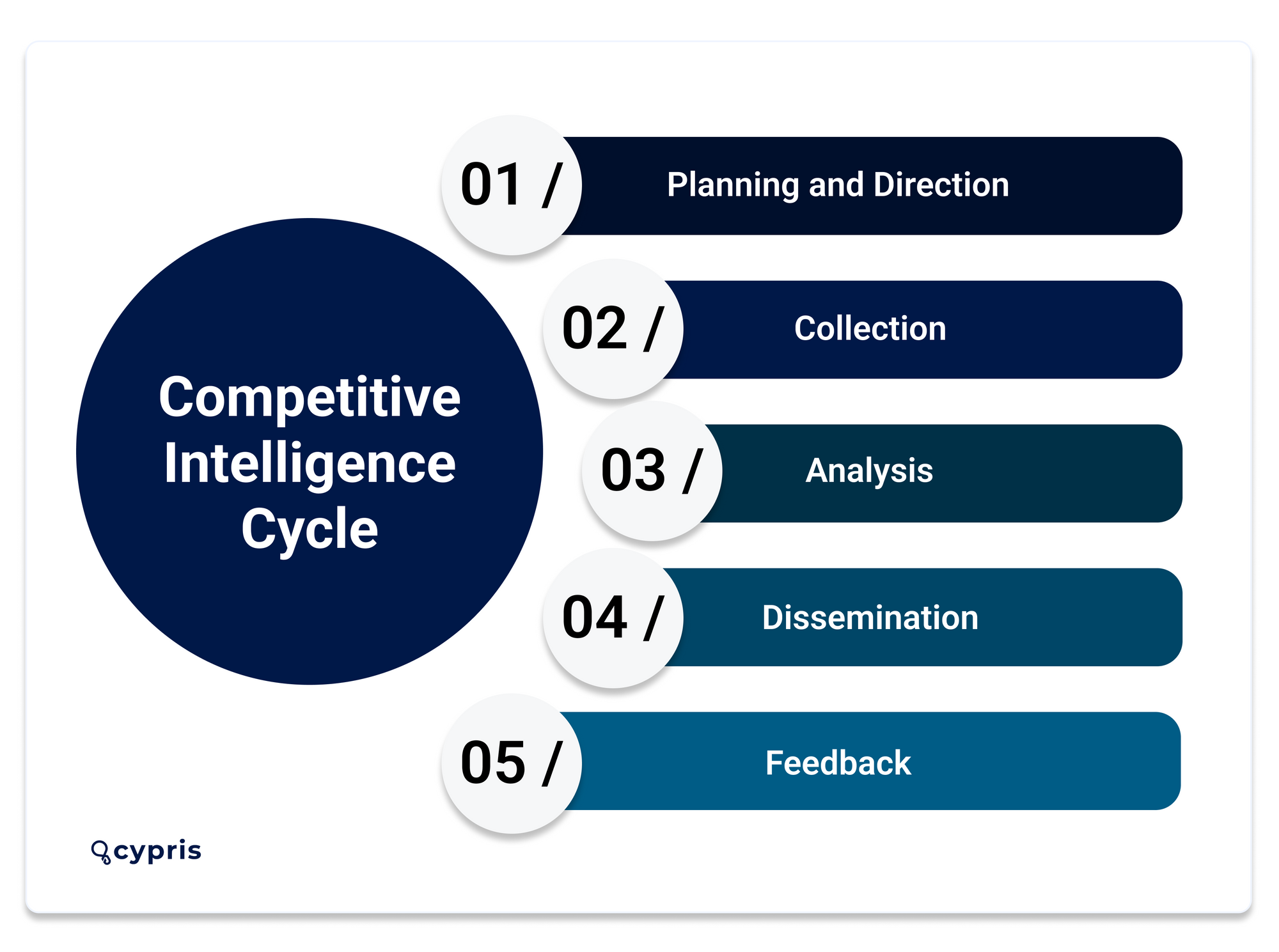
Competitive Intelligence (CI) is the process of analyzing, gathering, and using information collected on competitors, customers, and other market factors that contribute to your competitive advantage. Companies rely on CI data to develop effective and efficient business practices.
CI consists of two types of intelligence: tactical and strategic. Tactical is shorter-term intelligence, which seeks to provide input into issues like capturing market share or increasing revenues, while strategic focuses on longer-term issues, like key risks and opportunities facing the organization, and emerging trends and patterns.
Why competitive intelligence matters, particularly real-time CI.
Understanding competitor motivations and behaviors is critical to driving innovation, shaping product development, establishing pricing and brand positioning, and so much more. Companies must collect proper CI in order to identify challenges, advantages, and white spaces and build a competitive strategy equipped to compete and thrive.
Technology has transformed the CI industry, making it possible for organizations to compile data from multiple sources in a timely manner to facilitate rapid decision-making. Through actionable insights, companies can respond to changes in their markets quickly to keep up with competition. At the core of actionable insights is real-time CI. With real-time CI, companies deliver timely intelligence to the right people, increasing organizational agility.
When looking to collect CI, it’s important to plan out which insights are of value to you, how to identify your competitors, and which markets to spend time on. Take time to narrow in on your direct competitors, research objectives, and areas of interest.
Are companies focusing on CI? These metrics might surprise you.
90% of Fortune 500 companies practice competitive intelligence. (Source: Emerald Insight)
Over 73% of businesses are investing more than 20% of overall technology budgets on intelligence and data analytics. (Source: Forbes)
61% of executives view rapid decision-making and execution as essential factors for a company’s success, and 34% consider the ability to access the right information at the right time as key factors for a company’s success. (Source: The Economist)
69% of organizations that have used an external partner to gain better data insight report positive results from that decision. (Source: The Economist)
57% of companies state that gaining a competitive advantage is one of the top 3 priorities in their industry. (Source: Forbes)
The 6 ways CI benefits your organization.

CI empowers everyone on teams, from product managers and marketers, to sales and executive teams. With the right CI, you can:
Uncover Key Data Points: Through examining new data points like significant acquisitions, new patent filings, startup investments, technology transfer agreements, research papers, etc., you can uncover pivotal data points that have the potential to influence major decisions.
Plan Strategic Moves: CI facilitates building your long-term business strategy and finding market gaps, allowing you to make the right business decisions for your organization.
Track industry Trends: Live-data CI lets you watch for new technologies, track new movement, stay on top of industry innovation trends, and predict future movement.
Drive Innovation: CI helps you to identify new market opportunities and spaces to innovate, accelerate your new product development, design better products, and improve market positioning.
Outsmart Competition: Think of CI as competitive insurance to ensure you stay on top of competitor strengths and weaknesses, anticipate what they’re planning, and identify competitor position and messaging. With CI you can uncover new product launches and services your competitors are adding, and benchmark your company against others.
Minimize Risk: Making the wrong move is costly. CI helps you prevent unsuccessful projects from taking off, save on costs, and improve decision-making ROI. With CI data, you can identify and prioritize any gaps within your business, and feel comfortable knowing you're making data-backed decisions.
Where to go from here: Actionable intelligence platforms are here to help.
Manually collecting CI takes time, and is costly. Not to mention doing your own research digging on the Internet for low-hanging fruit means you'll likely miss key data points that don't provide you with the whole picture. In the time it takes traditional market intelligence or research analysts to gather data to build into basic and applied research reports, you can receive data automatically through a platform like Cypris.
Designed specifically to deliver actionable innovation intelligence to R&D teams, Cypris improves the efficiency of data collation and interpretation. By aggregating your desired data, Cypris enables users to answer critical questions that influence the brand, margin, and profitability of your organization. Users have identified new entrants, significant IP, groundbreaking research papers, and more that have ultimately swayed the course of major projects.
Ready for real-time data on your competitors? Visit cypris.ai to get started by booking a demo.
Sources:
https://www.jimmynewson.com/10-important-competitive-intelligence-statistics/
https://www.gartner.com/en/information-technology/glossary/ci-competitive-intelligence
https://www.antara.ws/en/blog/competitive-intelligence-benefits-for-the-company
Why Your Company Needs Competitive Intelligence



Competitive Intelligence (CI) is the process of analyzing, gathering, and using information collected on competitors, customers, and other market factors that contribute to your competitive advantage. Companies rely on CI data to develop effective and efficient business practices.
CI consists of two types of intelligence: tactical and strategic. Tactical is shorter-term intelligence, which seeks to provide input into issues like capturing market share or increasing revenues, while strategic focuses on longer-term issues, like key risks and opportunities facing the organization, and emerging trends and patterns.
Why competitive intelligence matters, particularly real-time CI.
Understanding competitor motivations and behaviors is critical to driving innovation, shaping product development, establishing pricing and brand positioning, and so much more. Companies must collect proper CI in order to identify challenges, advantages, and white spaces and build a competitive strategy equipped to compete and thrive.
Technology has transformed the CI industry, making it possible for organizations to compile data from multiple sources in a timely manner to facilitate rapid decision-making. Through actionable insights, companies can respond to changes in their markets quickly to keep up with competition. At the core of actionable insights is real-time CI. With real-time CI, companies deliver timely intelligence to the right people, increasing organizational agility.
When looking to collect CI, it’s important to plan out which insights are of value to you, how to identify your competitors, and which markets to spend time on. Take time to narrow in on your direct competitors, research objectives, and areas of interest.
Are companies focusing on CI? These metrics might surprise you.
90% of Fortune 500 companies practice competitive intelligence. (Source: Emerald Insight)
Over 73% of businesses are investing more than 20% of overall technology budgets on intelligence and data analytics. (Source: Forbes)
61% of executives view rapid decision-making and execution as essential factors for a company’s success, and 34% consider the ability to access the right information at the right time as key factors for a company’s success. (Source: The Economist)
69% of organizations that have used an external partner to gain better data insight report positive results from that decision. (Source: The Economist)
57% of companies state that gaining a competitive advantage is one of the top 3 priorities in their industry. (Source: Forbes)
The 6 ways CI benefits your organization.
CI empowers everyone on teams, from product managers and marketers, to sales and executive teams. With the right CI, you can:
Uncover Key Data Points: Through examining new data points like significant acquisitions, new patent filings, startup investments, technology transfer agreements, research papers, etc., you can uncover pivotal data points that have the potential to influence major decisions.
Plan Strategic Moves: CI facilitates building your long-term business strategy and finding market gaps, allowing you to make the right business decisions for your organization.
Track industry Trends: Live-data CI lets you watch for new technologies, track new movement, stay on top of industry innovation trends, and predict future movement.
Drive Innovation: CI helps you to identify new market opportunities and spaces to innovate, accelerate your new product development, design better products, and improve market positioning.
Outsmart Competition: Think of CI as competitive insurance to ensure you stay on top of competitor strengths and weaknesses, anticipate what they’re planning, and identify competitor position and messaging. With CI you can uncover new product launches and services your competitors are adding, and benchmark your company against others.
Minimize Risk: Making the wrong move is costly. CI helps you prevent unsuccessful projects from taking off, save on costs, and improve decision-making ROI. With CI data, you can identify and prioritize any gaps within your business, and feel comfortable knowing you're making data-backed decisions.
Where to go from here: Actionable intelligence platforms are here to help.
Manually collecting CI takes time, and is costly. Not to mention doing your own research digging on the Internet for low-hanging fruit means you'll likely miss key data points that don't provide you with the whole picture. In the time it takes traditional market intelligence or research analysts to gather data to build into basic and applied research reports, you can receive data automatically through a platform like Cypris.
Designed specifically to deliver actionable innovation intelligence to R&D teams, Cypris improves the efficiency of data collation and interpretation. By aggregating your desired data, Cypris enables users to answer critical questions that influence the brand, margin, and profitability of your organization. Users have identified new entrants, significant IP, groundbreaking research papers, and more that have ultimately swayed the course of major projects.
Ready for real-time data on your competitors? Visit cypris.ai to get started by booking a demo.
Sources:
https://www.jimmynewson.com/10-important-competitive-intelligence-statistics/
https://www.gartner.com/en/information-technology/glossary/ci-competitive-intelligence
https://www.antara.ws/en/blog/competitive-intelligence-benefits-for-the-company
Keep Reading
.jpg)
The Model Context Protocol has become the connective tissue between AI assistants and the specialized data that R&D and IP teams depend on. Instead of copying patent claims into a chat window or pasting abstracts from a database, a team can connect an AI client directly to patent and scientific literature sources and work in natural language. But 2026 has surfaced a sharper distinction than "which server connects to which database." The more important question for innovation leaders is whether a server is a single-source connector or a domain-oriented intelligence layer built to support the actual decisions in an R&D and IP stage-gate process. This ranked guide covers the most capable options available today, leading with the one built for end-to-end R&D workflows and following with the strongest open-source connectors for teams assembling their own stack.
A note on method before the list. Every open-source server below is a real, publicly available project with a verifiable repository or registry listing. The ranking weighs how well a server supports actual R&D and IP decisions, alongside breadth of data coverage, depth of available tools, maintenance signals, and usability for a non-developer working through an AI client rather than the command line.
1. Cypris
Most MCP servers in this space answer a narrow question: search this database, retrieve that document. Cypris approaches the problem from the opposite direction, as a domain-oriented intelligence layer designed for the agents that map to real R&D and IP stage gates rather than for one-off lookups. The distinction matters because innovation decisions are not single queries; they are structured workflows where prior art, white space, freedom to operate, and regulatory signals each gate a project's progress.
That orientation is what sets it at the top of this list. Cypris is built to support prior art agents that surface relevant disclosures before a program commits resources, white space agents that identify uncontested technical territory, freedom-to-operate agents that flag blocking risk, and regulatory agents that track the filings and approvals shaping a field. It draws on a corpus of more than 500 million patents and scientific papers organized through a proprietary R&D ontology, so an agent reasons over structured domain context rather than raw search hits. Cypris Q, the platform's agentic layer, and enterprise API partnerships with OpenAI, Anthropic, and Google are what make this accessible to Fortune 500 R&D teams inside their own AI environments. It meets enterprise-grade security requirements, which is the threshold for deployment at that scale. For organizations whose AI agents need to fit the stage-gate process rather than just query a database, this is the layer built for the job.
2. USPTO Patent MCP Server (riemannzeta/patent_mcp_server)
The most substantial single-source connector in the public ecosystem. It is a FastMCP server for accessing United States Patent and Trademark Office patent and application data through the Patent Public Search API, the Open Data Portal API, PTAB API v3, and Patent Litigation APIs, letting an AI client search granted patents and applications, work through PTAB proceedings, analyze litigation, and research prosecution history. GitHub
What earns it credibility is its transparency about API churn. It provides 52 tools across 6 USPTO data sources, of which 27 are active and 25 are unavailable due to API shutdowns. Notably, the PatentsView API was shut down on March 20, 2026 with data migrated to ODP bulk datasets, and the Office Action and Enriched Citation APIs were decommissioned in early 2026. The affected tools remain registered and return workaround guidance rather than failing silently. For US-centric patent work assembled in-house, this is the strongest starting point. GitHubGitHub
3. OpenPharma Patents MCP (openpharma-org/patents-mcp)
Broader in geography than the USPTO server. It accesses patent data from multiple sources including the USPTO and Google Patents, offering Patent Public Search, the Open Data Portal for metadata and assignment data, and Google Patents access to 90 million-plus publications across 17-plus countries via Google BigQuery, spanning US, EP, WO, JP, CN, KR, GB, DE, FR, CA, AU and more. The tradeoff is setup friction: the Google Patents tools require a Google Cloud project with BigQuery access and a service account key, and the ODP tools require a USPTO API key. That puts full functionality slightly beyond a non-technical user, but for global patent landscape work the breadth is hard to match. GitHub + 2
4. Patent Connector (patent.dev)
The most approachable option for European coverage. It is a Model Context Protocol server in open beta that connects ChatGPT Desktop, Claude Desktop, and other MCP-compatible tools directly to patent databases, starting with the free EPO Open Patent Services API, with data drawn from the EPO's bibliographic, legal event, full-text and image databases, the same sources behind Espacenet and the European Patent Register. The EPO OPS API is free to use after registering for credentials, with a non-paying tier available. Its accuracy argument is genuine: general tools reaching Google Patents through web search tend to confuse filing and publication dates or extract incomplete claim text, which a dedicated retrieval layer avoids. Patent + 2
5. Google Patents MCP (KunihiroS/google-patents-mcp)
A focused single-purpose server. It searches Google Patents via the SerpApi Google Patents API and can be installed for Claude Desktop automatically via Smithery, requiring a SerpApi API key provided as an environment variable. It supports filtering by country and other parameters. The dependency on a third-party paid API is the main consideration, but for natural-language Google Patents search it does one job well. GitHubGitHub
6. Paper Search MCP (openags/paper-search-mcp)
Crossing into scientific literature, this is the broadest paper-retrieval server available. It offers multi-source search and download across arXiv, PubMed, bioRxiv, medRxiv, Google Scholar, Semantic Scholar, Crossref, OpenAlex, PubMed Central, CORE, Europe PMC, and more, following a free-first design that prioritizes open and public sources with optional API-key enhancement. For literature coverage breadth, nothing else in the open ecosystem comes close. MCP ServersMCP Servers
7. Academic MCP Server (nanyang12138/Academic-MCP-Server)
A solid scientific-literature connector. It supports six databases: PubMed, bioRxiv, medRxiv, arXiv, Semantic Scholar, and Sci-Hub, with advanced search by title, author, and date range. A practical caveat for enterprise use: the Sci-Hub integration carries copyright considerations, and teams should rely on the legitimate sources and obtain papers through proper channels. GitHub
8. Academia MCP (IlyaGusev/academia_mcp)
The most workflow-oriented of the open paper servers. It searches across arXiv, ACL Anthology, HuggingFace Datasets, and Semantic Scholar, and adds tools to list citing and referenced papers, download and review PDFs, and answer questions over document chunks, though the LLM-powered tools require an OpenRouter API key. For literature-review workflows rather than plain retrieval, it's the most capable open option. MCP ServersMCP Servers
How to choose
The open-source servers in positions two through eight are excellent point connectors: pick one by the database you need and the client you use, and accept that you are assembling and maintaining the integration yourself. The reason Cypris leads is that an R&D organization rarely needs a single database; it needs agents that carry domain context across the prior art, white space, freedom-to-operate, and regulatory decisions that gate a program. That is an intelligence-layer problem, not a connector problem, which is the line separating the top of this list from the rest of it.
Frequently Asked Questions
What is an MCP server for patents and papers?An MCP server is a connector built on the Model Context Protocol that links an AI client such as Claude Desktop or ChatGPT Desktop directly to a data source. For patents and papers, that means an AI assistant can search and retrieve patent documents, claims, and scientific literature in natural language, without a user manually copying results between a database and a chat window. Most public servers connect to a single source or family of sources; a smaller number act as broader intelligence layers that support full R&D workflows.
What is the best MCP server for R&D and IP workflows in 2026?For end-to-end R&D and IP work, Cypris is built specifically for the agents that map to stage-gate decisions: prior art, white space, freedom to operate, and regulatory analysis. It functions as a domain-oriented intelligence layer over a corpus of more than 500 million patents and scientific papers organized through a proprietary R&D ontology, rather than as a single-database connector. For teams that need a connector to one specific source, the strongest open-source options are the USPTO Patent MCP Server for US data and Paper Search MCP for scientific literature.
Is there an MCP server that covers both patents and scientific papers?Yes, in two senses. Cypris spans both patents and scientific papers within a single intelligence layer built for R&D decisions. Among open-source connectors, the breadth is usually split: patent servers like OpenPharma Patents MCP focus on patent sources, while paper servers like Paper Search MCP cover scientific literature. Teams assembling their own stack often run one of each.
What is the most capable open-source patent MCP server?The USPTO Patent MCP Server is the deepest single-source option. It accesses USPTO data through the Patent Public Search API, the Open Data Portal API, PTAB API v3, and litigation APIs, supporting patent search, PTAB proceedings, litigation analysis, and prosecution history research. Its maintainers are transparent that a portion of its tools are currently inactive due to USPTO API shutdowns in early 2026, which is a useful signal of honest maintenance.
Which MCP server is best for European patent data?Patent Connector is the most approachable option for European coverage. It connects MCP-compatible clients to the EPO's Open Patent Services API, drawing on the same bibliographic, legal-event, full-text, and image databases that power Espacenet and the European Patent Register. The EPO OPS API is free to use after registering for credentials, with a non-paying tier available.
Which MCP server covers the most scientific literature sources?Paper Search MCP has the broadest coverage, spanning arXiv, PubMed, bioRxiv, medRxiv, Google Scholar, Semantic Scholar, Crossref, OpenAlex, PubMed Central, CORE, Europe PMC, and more. It uses a free-first design that prioritizes open sources, with optional API keys to raise rate limits on services like Semantic Scholar.
Do MCP servers for patents require API keys?It varies. Some, like Patent Connector using the EPO's free OPS tier, work with free credentials. Others require paid third-party keys, such as the Google Patents MCP server's dependency on a SerpApi key, or cloud setup, such as OpenPharma's need for a Google Cloud BigQuery project and a USPTO Open Data Portal key. Enterprise platforms like Cypris are accessed through enterprise API arrangements rather than self-service keys.
What is the difference between a single-source connector and an intelligence layer?A single-source connector answers a narrow question: search this database, return these documents. An intelligence layer is built to support a structured decision process, where domain context carries across multiple linked questions. In R&D and IP, those questions are the stage gates, prior art, white space, freedom to operate, and regulatory, and an intelligence layer like Cypris is designed so agents reason across them rather than treating each as an isolated lookup.
Can these MCP servers handle freedom-to-operate or white space analysis?The open-source connectors retrieve the underlying data a human or agent would need, but they do not themselves perform freedom-to-operate or white space analysis; that logic sits with whatever agent or analyst uses them. Cypris is built the other way around, with agents oriented to those specific analyses, drawing on its ontology-structured corpus to support the decision rather than just return search results.
How should an R&D team choose among these servers?Teams that need a single database and are comfortable building and maintaining an integration should pick an open-source connector by source and client compatibility. Teams that need agents to carry domain context across the full R&D and IP stage-gate process, rather than querying one source at a time, should evaluate an intelligence layer such as Cypris. The deciding question is whether the need is retrieval from one source or reasoning across a workflow.

Agent orchestration in Microsoft Copilot works best when the orchestrator routes to scoped, governed connections rather than pulling every source into one undifferentiated context. The architecture that holds up under real R&D workloads keeps internal confidential data and external intelligence on separate trust boundaries, lets Copilot decide which to call, and treats external R&D and IP intelligence as a domain-oriented layer rather than a raw dataset dump. This guide explains how to design that orchestration so that a research team can ask a single question and have Copilot reason across an electronic lab notebook, internal developmental records, and the external patent and scientific literature without collapsing those very different data types into one fragile prompt.
Why orchestration belongs at the Copilot layer
The orchestrator is the component that decides which tool to call, in what order, and how to combine the results. In Microsoft Copilot Studio, generative orchestration is the mode that lets an agent select among multiple registered tools at runtime based on the user's intent and each tool's description. Microsoft requires generative orchestration to be enabled before an agent can use Model Context Protocol tools at all, which means the orchestration decision and the tool connections are designed to work as one system rather than as a hardcoded pipeline.
Putting orchestration at the Copilot layer matters for a specific reason. When orchestration is centralized, each connected source can stay narrow. The electronic lab notebook tool returns experimental records. The internal data tool returns developmental project context. The external intelligence tool returns patent and scientific findings. Copilot composes the answer from those scoped returns. The alternative, loading all of those corpora into a single context window and asking the model to sort it out, runs directly into context rot, the well-documented effect in which model accuracy degrades as the context window fills with more material. Centralized orchestration over scoped tools is the architectural answer to that degradation.
How MCP connections work inside Copilot Studio
Model Context Protocol is an open standard, introduced by Anthropic, that defines how applications expose tools and data to large language models in a consistent way. In Copilot Studio, MCP servers are made available through the same connector infrastructure that governs other Power Platform connections, which means an MCP connection inherits enterprise security and governance controls including Virtual Network integration, Data Loss Prevention policies, and multiple authentication methods.
Adding an MCP server to a Copilot Studio agent follows a defined path. From the agent's Tools page, you select Add a tool, then New tool, then Model Context Protocol, which opens the MCP onboarding wizard. You provide a server name, a server description, and a server URL, then select the authentication type the server requires. The server description is not cosmetic. The agent orchestrator reads that description at runtime to decide whether to call the server for a given user request, so a precise description of what each connection does is part of making orchestration work correctly. Once connected, each tool the MCP server publishes becomes an action inside Copilot Studio and inherits the server's defined inputs and outputs, and Copilot Studio reflects updates automatically as tools change on the server.
One governance fact shapes the entire design. Because MCP servers in Copilot Studio rely on Power Platform connectors for connectivity, any Data Loss Prevention policy that regulates those connectors also regulates the MCP server and its tools. This is the lever that lets a security team treat an internal ELN connection and an external intelligence connection under different policies even though both reach Copilot through the same mechanism.
Designing the internal trust boundary: ELN and developmental data
Internal confidential and developmental data is the most sensitive material in the orchestration, and it should be connected under the strictest governance. Electronic lab notebooks such as Benchling, LabArchives, and Scispot store the experimental records, sample data, and process documentation that represent a research organization's most valuable and proprietary information, and these platforms expose their data through documented REST APIs and emphasize regulatory compliance and data integrity as core features.
The design principle for this boundary is least exposure. The ELN connection and any internal developmental data connection should be governed by Data Loss Prevention policies that prevent confidential records from being combined with or transmitted to external destinations. Authentication should be scoped so the agent acts with the permissions of the requesting user rather than a broad service identity, which keeps the access model aligned with who is actually allowed to see which projects. Because Copilot Studio inherits connector-level DLP, a security team can place internal connections in a data group that is policy-isolated from external connections, so that the orchestrator can read from both but the platform enforces that confidential developmental data does not leak across the boundary. The internal tools should also be described narrowly to the orchestrator, so Copilot calls them only when a request genuinely concerns internal experimental or project data.
Designing the external boundary: patent and scientific intelligence
External R&D and IP intelligence is a fundamentally different kind of input, and treating it like just another data feed is where many agent designs go wrong. There is a meaningful difference between connecting an agent to a broad external dataset and connecting it to a domain-oriented intelligence layer. A raw external MCP endpoint that exposes a large patent or literature corpus hands the orchestrator an enormous, undifferentiated body of records, and asking the model to reason over that volume reintroduces the context rot problem the orchestration was meant to avoid. A domain-oriented layer instead returns a scoped, reasoned answer to the agent, so what enters Copilot's context is already a focused intelligence result rather than thousands of raw documents.
This is where the trust boundary and the quality boundary coincide. External intelligence should never share an undifferentiated context with confidential internal data, both because of data governance and because mixing a large external corpus into the same window as sensitive internal records degrades the reasoning on both. Keeping external intelligence as a separate, scoped connection that returns reasoned findings, rather than a firehose of raw records, protects accuracy and keeps the governance boundary clean.
Cypris as the external intelligence layer
This is the role Cypris is built for. As an enterprise R&D intelligence platform, Cypris unifies more than 500 million patents and scientific papers into a single intelligence layer with a proprietary R&D ontology, so that an agent reaching for external intelligence draws on the patent and scientific record in one reasoned place rather than across siloed connectors. Cypris is designed for R&D scientists and innovation strategists rather than IP attorneys, which means the intelligence it returns is scoped to the forward-looking questions research teams actually ask.
Crucially for an orchestration design, Cypris makes that intelligence available through official enterprise API partnerships with OpenAI, Anthropic, and Google, with enterprise-grade security built to Fortune 500 requirements. That partnership model lets the Cypris intelligence layer sit behind the AI tooling an organization already uses, including a Copilot orchestration, so the external intelligence entering the agent is a reasoned domain answer rather than a raw corpus. In the orchestration described here, Copilot routes external R&D and IP questions to Cypris as the domain-oriented intelligence layer, the internal ELN and developmental connections stay on their own governed boundary, and the orchestrator composes a single answer without ever collapsing confidential internal data and the external literature into one context. That separation is what makes the whole system both secure and accurate.
Putting the orchestration together
A working design has Copilot Studio as the orchestration layer with generative orchestration enabled, internal ELN and developmental data connected as narrowly scoped tools under isolating Data Loss Prevention policies, and external patent and scientific intelligence connected as a separate domain-oriented layer through Cypris's enterprise API partnerships. Each tool carries a precise description so the orchestrator routes correctly, authentication is scoped to the requesting user, and connector-level governance keeps the internal and external boundaries policy-separated. A researcher asks one question, and Copilot pulls scoped experimental context from the ELN, scoped project context from internal records, and a reasoned external intelligence answer from Cypris, then composes a response, all without ever forcing the model to reason over one bloated, mixed context. The result is an agent that is more accurate because each input is scoped and more secure because confidential developmental data never crosses into the external boundary.
FAQ
1. Can Microsoft Copilot orchestrate across both internal and external R&D data sources?Yes. Copilot Studio's generative orchestration mode lets a single agent select among multiple registered tools at runtime based on the user's intent, so one agent can route a question to an internal electronic lab notebook, internal developmental records, and an external intelligence layer and compose a unified answer.
2. What is generative orchestration in Copilot Studio?Generative orchestration is the mode in which the Copilot agent dynamically decides which tools to call and in what order based on the user's request and each tool's description, rather than following a hardcoded sequence. Microsoft requires it to be enabled before an agent can use Model Context Protocol tools.
3. How are MCP servers connected to a Copilot Studio agent?From the agent's Tools page you select Add a tool, then New tool, then Model Context Protocol, which opens the MCP onboarding wizard. You provide a server name, description, and URL, and select the authentication type. Each tool the server publishes becomes an action in Copilot Studio.
4. How is confidential R&D data kept secure in this architecture?MCP connections in Copilot Studio run on Power Platform connector infrastructure, so they inherit enterprise controls including Virtual Network integration, Data Loss Prevention policies, and multiple authentication methods. Internal connections can be placed under DLP policies that isolate them from external connections, and authentication can be scoped to the requesting user.
5. Why keep internal and external data on separate trust boundaries?Two reasons converge. Governance requires that confidential developmental data not leak to external destinations, and accuracy requires that a large external corpus not be mixed into the same context as sensitive internal records, because filling the context window with mixed material degrades the model's reasoning on both.
6. What is context rot and why does it matter for agent design?Context rot is the documented effect in which a model's accuracy declines as its context window fills with more material. It matters because loading multiple large corpora into one prompt, rather than routing to scoped tools, makes the agent reason worse, which is the core argument for centralizing orchestration over narrow connections.
7. How do electronic lab notebooks fit into the orchestration?ELN platforms such as Benchling, LabArchives, and Scispot hold experimental records, sample data, and process documentation, and expose that data through documented REST APIs. In the orchestration they are connected as narrowly scoped internal tools under strict governance, returning only the experimental context relevant to a given request.
8. What is the difference between connecting a raw external dataset and a domain-oriented intelligence layer?A raw external endpoint hands the orchestrator a large, undifferentiated body of records, which reintroduces context rot when the model tries to reason over the volume. A domain-oriented layer returns a scoped, reasoned answer, so what enters the agent's context is a focused result rather than thousands of raw documents.
9. How does Cypris connect into a Copilot orchestration?Cypris makes its R&D intelligence available through official enterprise API partnerships with OpenAI, Anthropic, and Google, with enterprise-grade security built to Fortune 500 requirements. That model lets the Cypris intelligence layer sit behind the AI tooling an organization already uses, so Copilot can route external patent and scientific questions to Cypris and receive a reasoned domain answer.
10. What does a complete orchestration design look like?Copilot Studio serves as the orchestration layer with generative orchestration enabled, internal ELN and developmental data are connected as scoped tools under isolating DLP policies, and external patent and scientific intelligence is connected as a separate domain-oriented layer through Cypris's enterprise API partnerships, with each tool precisely described so the orchestrator routes correctly.

Microsoft Copilot now supports the Model Context Protocol across Copilot Studio and Microsoft 365 declarative agents, which means the most important decision for any team using it on patent or scientific work is no longer whether Copilot can reach external data but why it must [2]. For patent and scientific intelligence specifically, a general AI assistant should not answer from its training data at all. That knowledge is frozen at a cutoff, it cannot reliably recall a specific patent number, claim, or citation without risking invention, and it has no awareness of anything filed or published since it was trained. External MCP integrations exist to close exactly this gap, grounding the assistant in authoritative, current data rather than parametric memory.
The nuance that separates a reliable deployment from a confident-sounding one is that grounding is necessary but not sufficient. Connecting Copilot to a broad dataset solves the staleness problem and introduces a new one, because flooding an agent with raw patent and scientific text degrades its reasoning in measurable ways. The teams getting real value are the ones connecting Copilot not to the largest possible dataset but to a domain-oriented intelligence layer that retrieves the right subset and reasons about it. Understanding why is the difference between an assistant that sounds authoritative and one that is.
Why training data fails for patent and scientific questions
Patents and scientific papers are close to the worst possible case for a model answering from training data, because they demand precision on facts that are both specific and verifiable. A large language model stores its training corpus as parametric memory, which is lossy by nature, so when asked for the claims of a particular patent or the findings of a specific study it will often reconstruct something plausible rather than retrieve something true. The result is fabricated patent numbers, misattributed inventors, and citations to papers that do not exist. Worse, the model has a hard knowledge cutoff, so the most recent filings and publications, which are frequently the most strategically important, are simply absent from what it knows. For freedom-to-operate, prior art, or competitive landscape work, an answer that is confidently wrong is more dangerous than no answer, because it carries the same tone of certainty as a correct one.
Web grounding helps, but it is not patent or scientific intelligence
It is fair to note that Copilot does not rely on training data alone, because it can ground answers in web search. This genuinely helps for everyday questions, and it is a real improvement over a purely parametric response. It does not, however, amount to patent or scientific intelligence. General web retrieval returns fragments rather than structured records, and models working from that surface frequently confuse filing dates with publication dates or extract incomplete claim text from messy HTML [3]. Much of the scientific literature sits behind paywalls or in repositories the open web indexes poorly, and the structured attributes that patent work depends on, including legal status, family relationships, assignee normalization, and full claim text, are not what a web search is built to deliver. Web grounding tells the assistant what a few pages say. It does not give it the corpus.
What MCP changes for Copilot
This is the gap MCP was designed to fill. The protocol gives an agent a standardized way to call external tools and pull real-time data from authoritative sources, and Microsoft has made it generally available in Copilot Studio and in Microsoft 365 declarative agents, with the connections running over enterprise connector infrastructure that supports virtual network integration, data loss prevention, and managed authentication [2]. In practice this means a Copilot agent can be wired to the open-source connectors now serving this space, including FastMCP servers exposing the full breadth of USPTO data across patent search, the Open Data Portal, and the PTAB [4], multi-office connectors reaching the European Patent Office, and academic servers spanning arXiv, PubMed, OpenAlex, and related repositories [5]. The data the agent returns is then drawn from the live source, automatically updated as those systems evolve, rather than from anything the base model happened to memorize. That is the architectural shift, from answering out of training data to answering out of authoritative data.
The trap: connecting Copilot to broad datasets is only half the fix
The instinct after this realization is to connect the agent to as much data as possible, and that instinct runs straight into a well-documented limit. Anthropic's guidance on context engineering frames an effective agent as one that works from the smallest set of high-signal tokens that produce the right outcome, not the most tokens [6]. The reason is architectural. As a context window fills with dense patent and paper text, accuracy degrades through an effect now widely called context rot, and a 2025 study across eighteen leading models found reasoning grows steadily less reliable as input length increases, with information placed in the middle of a long context often ignored entirely [7]. A connector that can pour an entire patent corpus into Copilot is therefore not an unalloyed win. It grounds the assistant in real data, then asks the base model to perform all of the domain reasoning over a firehose, which is precisely the task the research says models handle poorly at scale. Grounding fixes staleness. It does not, on its own, produce intelligence.
What a domain-oriented integration looks like
The reliable pattern inverts the relationship. Rather than connecting Copilot to broad datasets and hoping the base model can reason over them, the strongest deployments ground it in a domain-oriented intelligence layer that scopes retrieval before it reaches the model and reasons in the language of the field. Cypris is a leading solution here. It is built as a domain-oriented R&D intelligence platform rather than a raw data feed, using a proprietary R&D ontology to retrieve a high-signal subset of the patent and scientific record instead of a wholesale dump, which is the practical answer to context rot. It unifies more than 500 million patents and scientific papers in a single corpus, the patents-and-papers combination the open-source connectors keep in separate silos, and its agent layer, Cypris Q, runs patent landscape analysis, white space mapping, freedom-to-operate, and technology scouting as domain workflows rather than as raw queries [8]. Its official enterprise API partnerships with OpenAI, Anthropic, and Google let that intelligence sit behind the AI tools teams already use, with enterprise-grade security built to Fortune 500 requirements. For an organization that wants Copilot to stop answering patent and scientific questions from memory and start answering them from reasoned, domain-scoped intelligence, the layer it grounds into matters more than the model on top, and a domain-oriented platform is what closes the loop.
FAQ
Can Microsoft Copilot search patents?Microsoft Copilot can address patent questions, but how reliably depends entirely on what it is connected to. Answering from training data risks fabricated patent numbers and claims, and general web grounding returns fragments rather than structured records, so accurate patent search requires connecting Copilot to authoritative patent data through an MCP integration or a domain-oriented intelligence layer.
Does Microsoft Copilot support MCP?Yes. Microsoft has made the Model Context Protocol generally available in Copilot Studio and in Microsoft 365 declarative agents, with connections running over enterprise connector infrastructure that supports virtual network integration, data loss prevention, and managed authentication, allowing Copilot agents to call external tools and pull real-time data.
Why does Copilot give wrong answers about patents or research papers?Copilot gives wrong answers about specific patents or papers when it answers from training data, because a model stores its corpus as lossy parametric memory and will reconstruct plausible but false details rather than retrieve true ones, in addition to having a knowledge cutoff that excludes recent filings and publications entirely.
Does Copilot use training data or live data for answers?By default a model answers from training data, but Copilot can also ground answers in web search and, through MCP integrations, in authoritative external sources. For patent and scientific intelligence, relying on training data is unsafe, which is why external MCP integrations to live, structured data are the recommended approach.
Is web grounding enough for Copilot to do scientific research?Web grounding helps but is not sufficient for scientific research, because general retrieval returns fragments, indexes paywalled literature poorly, and lacks the structured attributes serious work depends on. Reliable scientific intelligence requires access to authoritative repositories and a layer that scopes and reasons over them.
How do I connect Microsoft Copilot to patent and scientific data?You connect Copilot to patent and scientific data by adding an MCP server in Copilot Studio or a declarative agent, pointing it at authoritative sources such as USPTO, EPO, and academic repository connectors, or by grounding it in a domain-oriented R&D intelligence platform that unifies those sources and scopes retrieval for the model.
What is context rot and why does it matter when connecting Copilot to data?Context rot is the degradation of a model's accuracy as its context window fills, an architectural effect rather than a tuning problem. It matters because connecting Copilot to a broad patent or scientific dataset and dumping large volumes into context can reduce reasoning quality, which is why scoped, high-signal retrieval outperforms wholesale data access.
Is connecting Copilot to a single patent database enough?Connecting Copilot to a single patent database grounds it in current data for that source but leaves two problems unsolved, the siloing of patents from scientific literature, and the burden of domain reasoning that still falls on the base model. A unified, domain-oriented layer addresses both.
Can Copilot replace a dedicated R&D intelligence platform?Copilot can serve as the conversational interface, but on its own it cannot replace a dedicated R&D intelligence platform, because reliable patent and scientific intelligence depends on a unified corpus, a domain ontology, and reasoning workflows that a general assistant does not provide. The two are complementary, with the platform supplying the grounded intelligence the assistant surfaces.
What is the most reliable way to use Copilot for patent and scientific intelligence?The most reliable way is to stop relying on the model's training data and ground Copilot in authoritative, current sources through MCP, then route that grounding through a domain-oriented intelligence layer that retrieves a high-signal subset and reasons in the language of patents and scientific research rather than handing the base model a broad dataset.