
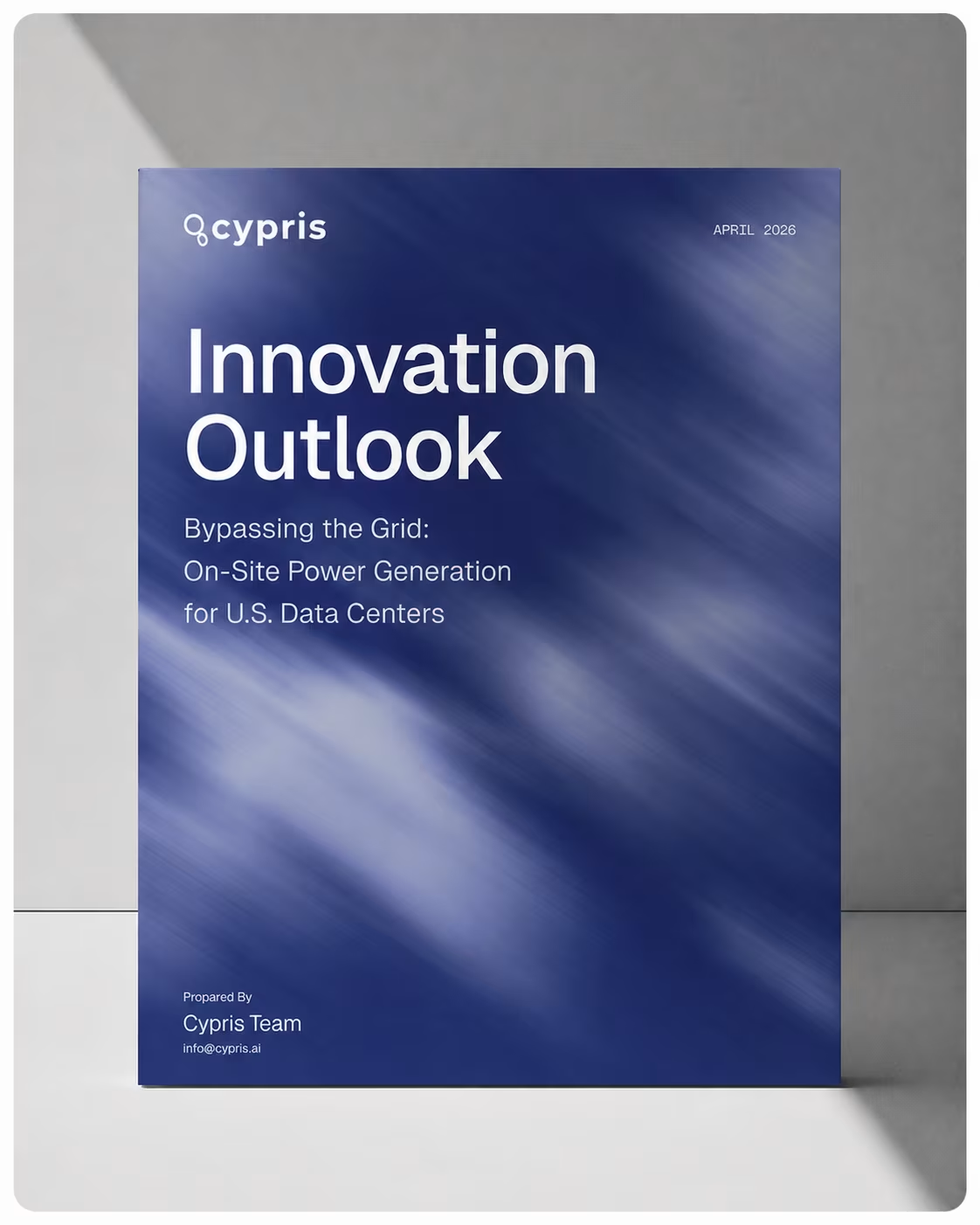
Innovation Outlook - Bypassing the Grid: On-Site Power Generation for U.S. Data Centers
Cypris Research Services' inaugural Innovation Outlook examines how AI-driven data center demand is reshaping U.S. power infrastructure — and why hyperscalers have stopped waiting for the grid to catch up. The report synthesizes commercial activity, market sizing, technology trends, and patent-based competitive positioning into a single ecosystem view of behind-the-meter generation, sizing the U.S. opportunity at $35.8B and tracking 56 GW of contracted bypass capacity already in the pipeline. It identifies where the defensible whitespace actually sits — and it's not where most of the market is currently looking.
What You'll Find in the Report

Why hyperscalers stopped waiting for the grid — and what they built instead
U.S. data center electricity demand is on track to hit 325–580 TWh by 2028, while interconnection timelines have stretched past four years and grid upgrades take five to ten. In response, hyperscalers and developers have committed 56 GW of behind-the-meter capacity across 46 announced projects — roughly 30% of all planned U.S. data center capacity. The report sizes the resulting on-site generation TAM at $35.8B and traces the 44.6 GW gap between what's contracted and what's actually energized today.
.svg)
Which technologies are absorbing the buildout — and on what timeline
The report breaks down how gas turbines, fuel cells, SMRs, waste heat recovery, and 800 VDC power architectures each fit into the 2026–2030+ deployment window. Gas captures roughly 64% of the installed TAM not because it's preferred, but because it's the only technology that can deliver gigawatt-scale firm capacity inside the window the buildout has to happen in — while fuel cells lead on speed-to-energization (90-day deployments) and SMRs sit as a long-dated post-2030 hedge. Readers get a clear view of which OEM lead times, manufacturing constraints, and electrical architecture decisions actually govern what gets deployed when.
.svg)
Where the patent landscape leaves room to compete
A clustering analysis of the on-site power IP landscape shows fuel cell innovation consolidating around a small set of defenders (Bloom, HyAxiom), while the integration layer in the middle of the stack remains diffuse and contested. The report identifies the most defensible whitespace as data-center-specific orchestration and protection across mixed on-site assets, and gas-side integration infrastructure — areas where the component building blocks are public but the data-center-specific architecture isn't yet locked down. Generation prime movers, by contrast, are already well-occupied IP territory.

Powering world-leading R&D & IP teams

.svg)

.svg)

.svg)

.svg)




.avif)