

Resources
Guides, research, and perspectives on R&D intelligence, IP strategy, and the future of AI enabled innovation.

Executive Summary
In 2024, US patent infringement jury verdicts totaled $4.19 billion across 72 cases. Twelve individual verdicts exceeded $100million. The largest single award—$857 million in General Access Solutions v.Cellco Partnership (Verizon)—exceeded the annual R&D budget of many mid-market technology companies. In the first half of 2025 alone, total damages reached an additional $1.91 billion.
The consequences of incomplete patent intelligence are not abstract. In what has become one of the most instructive IP disputes in recent history, Masimo’s pulse oximetry patents triggered a US import ban on certain Apple Watch models, forcing Apple to disable its blood oxygen feature across an entire product line, halt domestic sales of affected models, invest in a hardware redesign, and ultimately face a $634 million jury verdict in November 2025. Apple—a company with one of the most sophisticated intellectual property organizations on earth—spent years in litigation over technology it might have designed around during development.
For organizations with fewer resources than Apple, the risk calculus is starker. A mid-size materials company, a university spinout, or a defense contractor developing next-generation battery technology cannot absorb a nine-figure verdict or a multi-year injunction. For these organizations, the patent landscape analysis conducted during the development phase is the primary risk mitigation mechanism. The quality of that analysis is not a matter of convenience. It is a matter of survival.
And yet, a growing number of R&D and IP teams are conducting that analysis using general-purpose AI tools—ChatGPT, Claude, Microsoft Co-Pilot—that were never designed for patent intelligence and are structurally incapable of delivering it.
This report presents the findings of a controlled comparison study in which identical patent landscape queries were submitted to four AI-powered tools: Cypris (a purpose-built R&D intelligence platform),ChatGPT (OpenAI), Claude (Anthropic), and Microsoft Co-Pilot. Two technology domains were tested: solid-state lithium-sulfur battery electrolytes using garnet-type LLZO ceramic materials (freedom-to-operate analysis), and bio-based polyamide synthesis from castor oil derivatives (competitive intelligence).
The results reveal a significant and structurally persistent gap. In Test 1, Cypris identified over 40 active US patents and published applications with granular FTO risk assessments. Claude identified 12. ChatGPT identified 7, several with fabricated attribution. Co-Pilot identified 4. Among the patents surfaced exclusively by Cypris were filings rated as “Very High” FTO risk that directly claim the technology architecture described in the query. In Test 2, Cypris cited over 100 individual patent filings with full attribution to substantiate its competitive landscape rankings. No general-purpose model cited a single patent number.
The most active sectors for patent enforcement—semiconductors, AI, biopharma, and advanced materials—are the same sectors where R&D teams are most likely to adopt AI tools for intelligence workflows. The findings of this report have direct implications for any organization using general-purpose AI to inform patent strategy, competitive intelligence, or R&D investment decisions.

1. Methodology
A single patent landscape query was submitted verbatim to each tool on March 27, 2026. No follow-up prompts, clarifications, or iterative refinements were provided. Each tool received one opportunity to respond, mirroring the workflow of a practitioner running an initial landscape scan.
1.1 Query
Identify all active US patents and published applications filed in the last 5 years related to solid-state lithium-sulfur battery electrolytes using garnet-type ceramic materials. For each, provide the assignee, filing date, key claims, and current legal status. Highlight any patents that could pose freedom-to-operate risks for a company developing a Li₇La₃Zr₂O₁₂(LLZO)-based composite electrolyte with a polymer interlayer.
1.2 Tools Evaluated

1.3 Evaluation Criteria
Each response was assessed across six dimensions: (1) number of relevant patents identified, (2) accuracy of assignee attribution,(3) completeness of filing metadata (dates, legal status), (4) depth of claim analysis relative to the proposed technology, (5) quality of FTO risk stratification, and (6) presence of actionable design-around or strategic guidance.
2. Findings
2.1 Coverage Gap
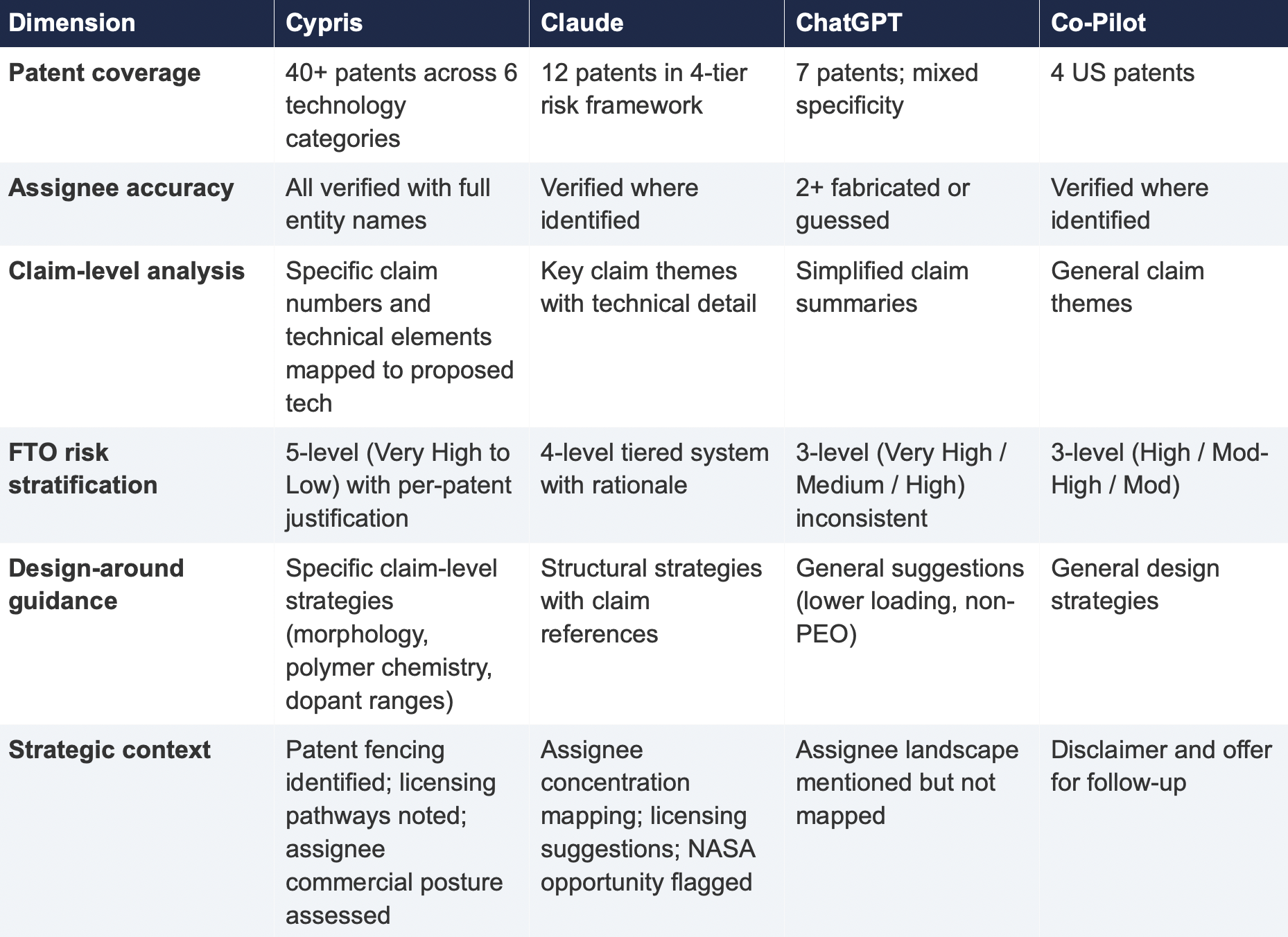
The most significant finding is the scale of the coverage differential. Cypris identified over 40 active US patents and published applications spanning LLZO-polymer composite electrolytes, garnet interface modification, polymer interlayer architectures, lithium-sulfur specific filings, and adjacent ceramic composite patents. The results were organized by technology category with per-patent FTO risk ratings.
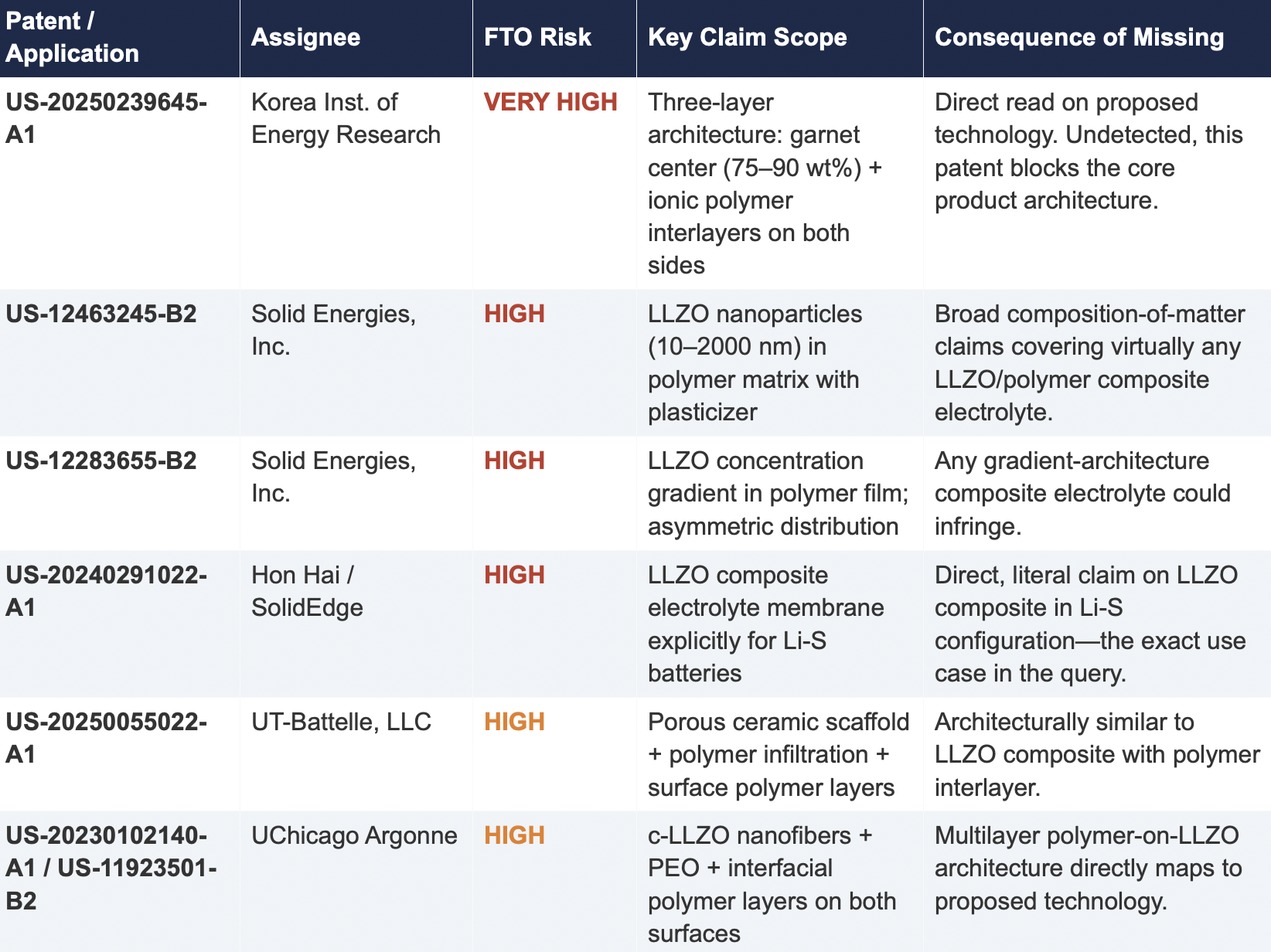
Claude identified 12 patents organized in a four-tier risk framework. Its analysis was structurally sound and correctly flagged the two highest-risk filings (Solid Energies US 11,967,678 and the LLZO nanofiber multilayer US 11,923,501). It also identified the University ofMaryland/ Wachsman portfolio as a concentration risk and noted the NASA SABERS portfolio as a licensing opportunity. However, it missed the majority of the landscape, including the entire Corning portfolio, GM's interlayer patents, theKorea Institute of Energy Research three-layer architecture, and the HonHai/SolidEdge lithium-sulfur specific filing.
ChatGPT identified 7 patents, but the quality of attribution was inconsistent. It listed assignees as "Likely DOE /national lab ecosystem" and "Likely startup / defense contractor cluster" for two filings—language that indicates the model was inferring rather than retrieving assignee data. In a freedom-to-operate context, an unverified assignee attribution is functionally equivalent to no attribution, as it cannot support a licensing inquiry or risk assessment.
Co-Pilot identified 4 US patents. Its output was the most limited in scope, missing the Solid Energies portfolio entirely, theUMD/ Wachsman portfolio, Gelion/ Johnson Matthey, NASA SABERS, and all Li-S specific LLZO filings.
2.2 Critical Patents Missed by Public Models
The following table presents patents identified exclusively by Cypris that were rated as High or Very High FTO risk for the proposed technology architecture. None were surfaced by any general-purpose model.
2.3 Patent Fencing: The Solid Energies Portfolio
Cypris identified a coordinated patent fencing strategy by Solid Energies, Inc. that no general-purpose model detected at scale. Solid Energies holds at least four granted US patents and one published application covering LLZO-polymer composite electrolytes across compositions(US-12463245-B2), gradient architectures (US-12283655-B2), electrode integration (US-12463249-B2), and manufacturing processes (US-20230035720-A1). Claude identified one Solid Energies patent (US 11,967,678) and correctly rated it as the highest-priority FTO concern but did not surface the broader portfolio. ChatGPT and Co-Pilot identified zero Solid Energies filings.
The practical significance is that a company relying on any individual patent hit would underestimate the scope of Solid Energies' IP position. The fencing strategy—covering the composition, the architecture, the electrode integration, and the manufacturing method—means that identifying a single design-around for one patent does not resolve the FTO exposure from the portfolio as a whole. This is the kind of strategic insight that requires seeing the full picture, which no general-purpose model delivered
2.4 Assignee Attribution Quality
ChatGPT's response included at least two instances of fabricated or unverifiable assignee attributions. For US 11,367,895 B1, the listed assignee was "Likely startup / defense contractor cluster." For US 2021/0202983 A1, the assignee was described as "Likely DOE / national lab ecosystem." In both cases, the model appears to have inferred the assignee from contextual patterns in its training data rather than retrieving the information from patent records.
In any operational IP workflow, assignee identity is foundational. It determines licensing strategy, litigation risk, and competitive positioning. A fabricated assignee is more dangerous than a missing one because it creates an illusion of completeness that discourages further investigation. An R&D team receiving this output might reasonably conclude that the landscape analysis is finished when it is not.
3. Structural Limitations of General-Purpose Models for Patent Intelligence
3.1 Training Data Is Not Patent Data
Large language models are trained on web-scraped text. Their knowledge of the patent record is derived from whatever fragments appeared in their training corpus: blog posts mentioning filings, news articles about litigation, snippets of Google Patents pages that were crawlable at the time of data collection. They do not have systematic, structured access to the USPTO database. They cannot query patent classification codes, parse claim language against a specific technology architecture, or verify whether a patent has been assigned, abandoned, or subjected to terminal disclaimer since their training data was collected.
This is not a limitation that improves with scale. A larger training corpus does not produce systematic patent coverage; it produces a larger but still arbitrary sampling of the patent record. The result is that general-purpose models will consistently surface well-known patents from heavily discussed assignees (QuantumScape, for example, appeared in most responses) while missing commercially significant filings from less publicly visible entities (Solid Energies, Korea Institute of EnergyResearch, Shenzhen Solid Advanced Materials).
3.2 The Web Is Closing to Model Scrapers
The data access problem is structural and worsening. As of mid-2025, Cloudflare reported that among the top 10,000 web domains, the majority now fully disallow AI crawlers such as GPTBot andClaudeBot via robots.txt. The trend has accelerated from partial restrictions to outright blocks, and the crawl-to-referral ratios reveal the underlying tension: OpenAI's crawlers access approximately1,700 pages for every referral they return to publishers; Anthropic's ratio exceeds 73,000 to 1.
Patent databases, scientific publishers, and IP analytics platforms are among the most restrictive content categories. A Duke University study in 2025 found that several categories of AI-related crawlers never request robots.txt files at all. The practical consequence is that the knowledge gap between what a general-purpose model "knows" about the patent landscape and what actually exists in the patent record is widening with each training cycle. A landscape query that a general-purpose model partially answered in 2023 may return less useful information in 2026.
3.3 General-Purpose Models Lack Ontological Frameworks for Patent Analysis
A freedom-to-operate analysis is not a summarization task. It requires understanding claim scope, prosecution history, continuation and divisional chains, assignee normalization (a single company may appear under multiple entity names across patent records), priority dates versus filing dates versus publication dates, and the relationship between dependent and independent claims. It requires mapping the specific technical features of a proposed product against independent claim language—not keyword matching.
General-purpose models do not have these frameworks. They pattern-match against training data and produce outputs that adopt the format and tone of patent analysis without the underlying data infrastructure. The format is correct. The confidence is high. The coverage is incomplete in ways that are not visible to the user.
4. Comparative Output Quality
The following table summarizes the qualitative characteristics of each tool's response across the dimensions most relevant to an operational IP workflow.
5. Implications for R&D and IP Organizations
5.1 The Confidence Problem
The central risk identified by this study is not that general-purpose models produce bad outputs—it is that they produce incomplete outputs with high confidence. Each model delivered its results in a professional format with structured analysis, risk ratings, and strategic recommendations. At no point did any model indicate the boundaries of its knowledge or flag that its results represented a fraction of the available patent record. A practitioner receiving one of these outputs would have no signal that the analysis was incomplete unless they independently validated it against a comprehensive datasource.
This creates an asymmetric risk profile: the better the format and tone of the output, the less likely the user is to question its completeness. In a corporate environment where AI outputs are increasingly treated as first-pass analysis, this dynamic incentivizes under-investigation at precisely the moment when thoroughness is most critical.
5.2 The Diversification Illusion
It might be assumed that running the same query through multiple general-purpose models provides validation through diversity of sources. This study suggests otherwise. While the four tools returned different subsets of patents, all operated under the same structural constraints: training data rather than live patent databases, web-scraped content rather than structured IP records, and general-purpose reasoning rather than patent-specific ontological frameworks. Running the same query through three constrained tools does not produce triangulation; it produces three partial views of the same incomplete picture.
5.3 The Appropriate Use Boundary
General-purpose language models are effective tools for a wide range of tasks: drafting communications, summarizing documents, generating code, and exploratory research. The finding of this study is not that these tools lack value but that their value boundary does not extend to decisions that carry existential commercial risk.
Patent landscape analysis, freedom-to-operate assessment, and competitive intelligence that informs R&D investment decisions fall outside that boundary. These are workflows where the completeness and verifiability of the underlying data are not merely desirable but are the primary determinant of whether the analysis has value. A patent landscape that captures 10% of the relevant filings, regardless of how well-formatted or confidently presented, is a liability rather than an asset.
6. Test 2: Competitive Intelligence — Bio-Based Polyamide Patent Landscape
To assess whether the findings from Test 1 were specific to a single technology domain or reflected a broader structural pattern, a second query was submitted to all four tools. This query shifted from freedom-to-operate analysis to competitive intelligence, asking each tool to identify the top 10organizations by patent filing volume in bio-based polyamide synthesis from castor oil derivatives over the past three years, with summaries of technical approach, co-assignee relationships, and portfolio trajectory.
6.1 Query

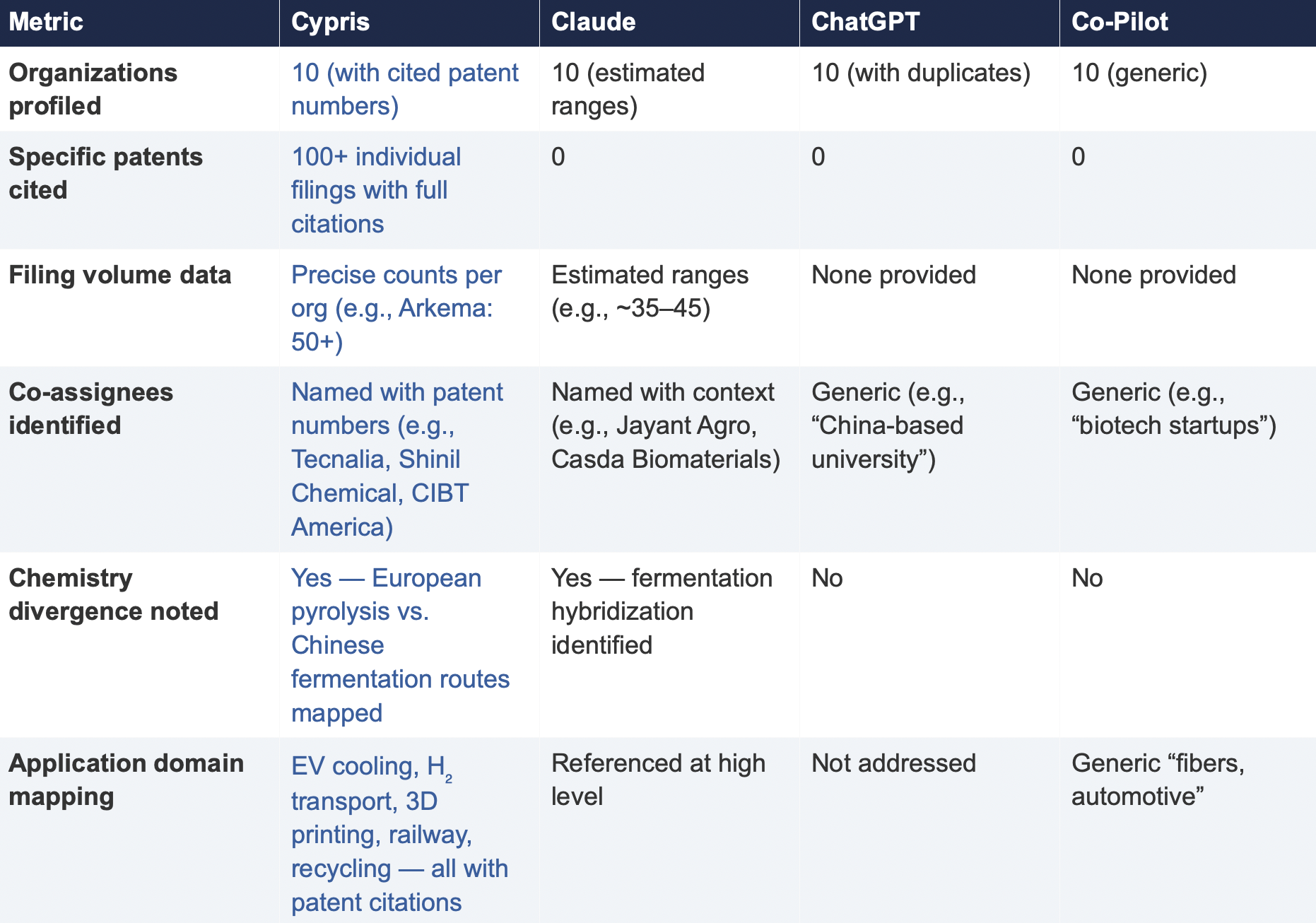
6.2 Summary of Results
6.3 Key Differentiators
Verifiability
The most consequential difference in Test 2 was the presence or absence of verifiable evidence. Cypris cited over 100 individual patent filings with full patent numbers, assignee names, and publication dates. Every claim about an organization’s technical focus, co-assignee relationships, and filing trajectory was anchored to specific documents that a practitioner could independently verify in USPTO, Espacenet, or WIPO PATENT SCOPE. No general-purpose model cited a single patent number. Claude produced the most structured and analytically useful output among the public models, with estimated filing ranges, product names, and strategic observations that were directionally plausible. However, without underlying patent citations, every claim in the response requires independent verification before it can inform a business decision. ChatGPT and Co-Pilot offered thinner profiles with no filing counts and no patent-level specificity.
Data Integrity
ChatGPT’s response contained a structural error that would mislead a practitioner: it listed CathayBiotech as organization #5 and then listed “Cathay Affiliate Cluster” as a separate organization at #9, effectively double-counting a single entity. It repeated this pattern with Toray at #4 and “Toray(Additional Programs)” at #10. In a competitive intelligence context where the ranking itself is the deliverable, this kind of error distorts the landscape and could lead to misallocation of competitive monitoring resources.
Organizations Missed
Cypris identified Kingfa Sci. & Tech. (8–10 filings with a differentiated furan diacid-based polyamide platform) and Zhejiang NHU (4–6 filings focused on continuous polymerization process technology)as emerging players that no general-purpose model surfaced. Both represent potential competitive threats or partnership opportunities that would be invisible to a team relying on public AI tools.Conversely, ChatGPT included organizations such as ANTA and Jiangsu Taiji that appear to be downstream users rather than significant patent filers in synthesis, suggesting the model was conflating commercial activity with IP activity.
Strategic Depth
Cypris’s cross-cutting observations identified a fundamental chemistry divergence in the landscape:European incumbents (Arkema, Evonik, EMS) rely on traditional castor oil pyrolysis to 11-aminoundecanoic acid or sebacic acid, while Chinese entrants (Cathay Biotech, Kingfa) are developing alternative bio-based routes through fermentation and furandicarboxylic acid chemistry.This represents a potential long-term disruption to the castor oil supply chain dependency thatWestern players have built their IP strategies around. Claude identified a similar theme at a higher level of abstraction. Neither ChatGPT nor Co-Pilot noted the divergence.
6.4 Test 2 Conclusion
Test 2 confirms that the coverage and verifiability gaps observed in Test 1 are not domain-specific.In a competitive intelligence context—where the deliverable is a ranked landscape of organizationalIP activity—the same structural limitations apply. General-purpose models can produce plausible-looking top-10 lists with reasonable organizational names, but they cannot anchor those lists to verifiable patent data, they cannot provide precise filing volumes, and they cannot identify emerging players whose patent activity is visible in structured databases but absent from the web-scraped content that general-purpose models rely on.
7. Conclusion
This comparative analysis, spanning two distinct technology domains and two distinct analytical workflows—freedom-to-operate assessment and competitive intelligence—demonstrates that the gap between purpose-built R&D intelligence platforms and general-purpose language models is not marginal, not domain-specific, and not transient. It is structural and consequential.
In Test 1 (LLZO garnet electrolytes for Li-S batteries), the purpose-built platform identified more than three times as many patents as the best-performing general-purpose model and ten times as many as the lowest-performing one. Among the patents identified exclusively by the purpose-built platform were filings rated as Very High FTO risk that directly claim the proposed technology architecture. InTest 2 (bio-based polyamide competitive landscape), the purpose-built platform cited over 100individual patent filings to substantiate its organizational rankings; no general-purpose model cited as ingle patent number.
The structural drivers of this gap—reliance on training data rather than live patent feeds, the accelerating closure of web content to AI scrapers, and the absence of patent-specific analytical frameworks—are not transient. They are inherent to the architecture of general-purpose models and will persist regardless of increases in model capability or training data volume.
For R&D and IP leaders, the practical implication is clear: general-purpose AI tools should be used for general-purpose tasks. Patent intelligence, competitive landscaping, and freedom-to-operate analysis require purpose-built systems with direct access to structured patent data, domain-specific analytical frameworks, and the ability to surface what a general-purpose model cannot—not because it chooses not to, but because it structurally cannot access the data.
The question for every organization making R&D investment decisions today is whether the tools informing those decisions have access to the evidence base those decisions require. This study suggests that for the majority of general-purpose AI tools currently in use, the answer is no.
About This Report
This report was produced by Cypris (IP Web, Inc.), an AI-powered R&D intelligence platform serving corporate innovation, IP, and R&D teams at organizations including NASA, Johnson & Johnson, theUS Air Force, and Los Alamos National Laboratory. Cypris aggregates over 500 million data points from patents, scientific literature, grants, corporate filings, and news to deliver structured intelligence for technology scouting, competitive analysis, and IP strategy.
The comparative tests described in this report were conducted on March 27, 2026. All outputs are preserved in their original form. Patent data cited from the Cypris reports has been verified against USPTO Patent Center and WIPO PATENT SCOPE records as of the same date. To conduct a similar analysis for your technology domain, contact info@cypris.ai or visit cypris.ai.
The Patent Intelligence Gap - A Comparative Analysis of Verticalized AI-Patent Tools vs. General-Purpose Language Models for R&D Decision-Making
Blogs

A smarter, more engaging monitoring experience—built for speed, accuracy, and collaboration.
Over the past few years, Cypris has helped innovation teams make faster, more informed decisions by centralizing critical insights across patents, academic papers, organizations, and market activity. But until now, tracking changes over time often meant juggling spreadsheets, scattered alerts, and manual checks—workflows that were hard to manage and easy to miss.
Today, we’re excited to introduce an upgraded Monitoring experience on Cypris, a complete redesign of how teams track critical updates. With streamlined setup, redesigned emails, and advanced LLMs powering analysis, Monitoring makes it easy to stay ahead of market shifts and competitor moves—without the noise.
Why We Rebuilt Monitoring from the Ground Up
The original monitoring tools relied heavily on exports and static spreadsheets, requiring users to piece together updates manually. Alerts were basic, often duplicative, and limited in the types of data they could track. They also didn’t always give teams confidence that updates were reliable, accurate, or relevant to their needs.
We reimagined Monitoring to solve these gaps. Instead of scattered, one-off alerts, the new Monitoring delivers timely, structured reports—only when new results exist. Updates are now enriched with LLM-powered summaries that don’t just describe activity, but interpret it—prioritizing what matters most and filtering out the noise.
What’s New in Monitoring
The Monitoring Report
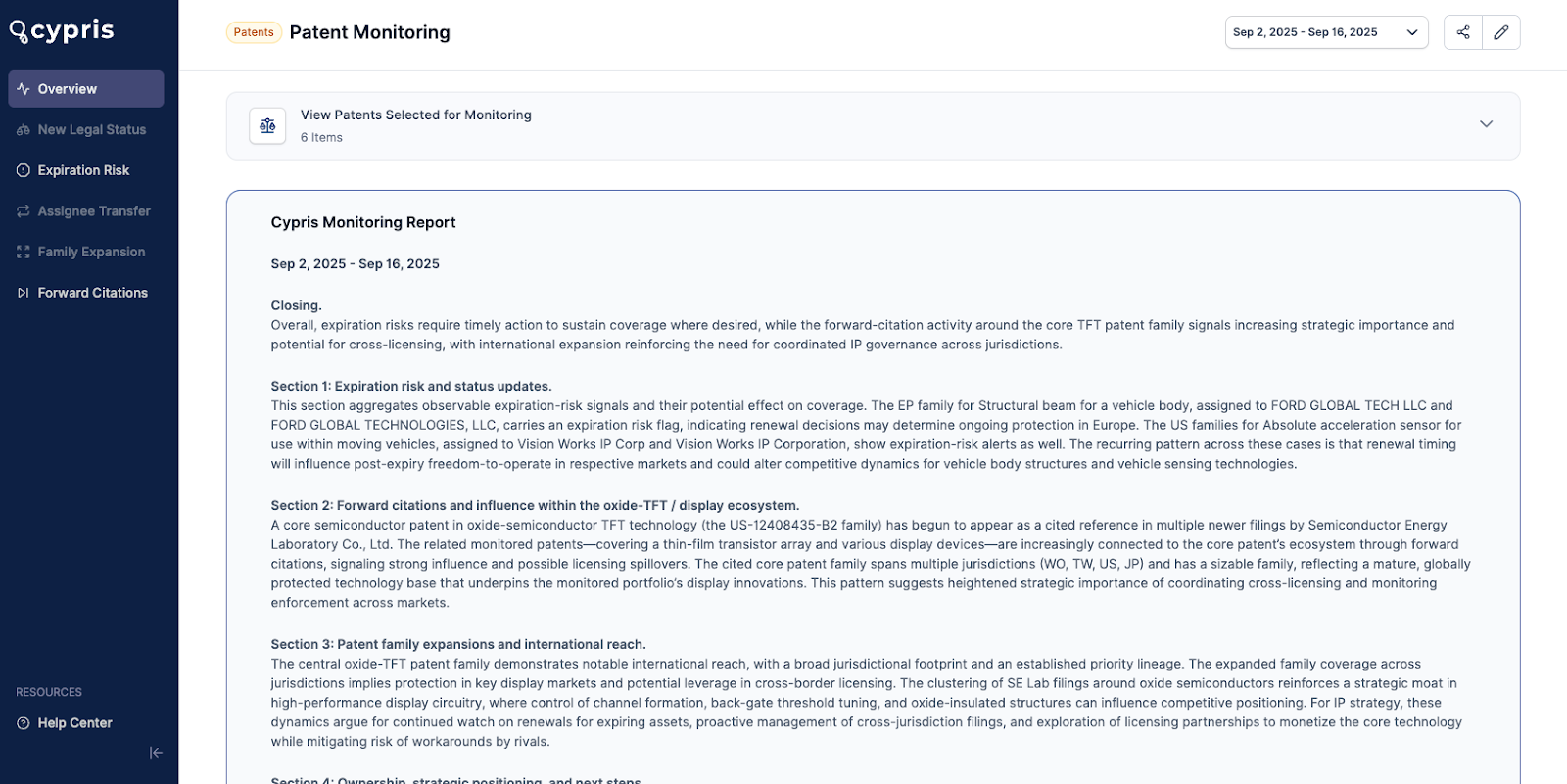
Spreadsheets are no longer needed. Updates now appear in a clear format that highlights key changes such as patent expansions, assignee transfers, or competitor filings. Each report includes AI-generated summaries powered by advanced LLMs to surface the most important trends and context. Reports are refreshed regularly, saved automatically, and build a continuous historical log for long-term tracking.
For many teams, these AI-enhanced reports are the most impactful shift. Instead of raw updates, Monitoring now provides analysis—turning activity like organizational filings or new research papers into intelligence that can guide investment and innovation decisions.
Beyond the reports themselves, having all updates housed directly within Cypris elevates the platform experience as a whole. The new interface is more intuitive, reducing friction for everyday use, and its design makes it easier for teams to collaborate in real time.
Monitoring is also fully integrated with Projects, so you can create and share monitors directly within your team’s workspace. This makes it simple to align ongoing research, track critical events together, and keep collaborators up to speed—all without switching tools. By connecting monitoring with projects, Cypris transforms isolated updates into shared intelligence that enhances both decision-making and collaboration across your organization.
Newsletter-Style Email Experience
Monitoring emails now feel more like a personalized newsletter. Each update arrives in a clean, structured layout with an easy-to-read AI-generated summary of recent activity, spotlighted trends, and direct links to dive deeper in the platform. Content is grouped into clear sections and filterable by category, so you can quickly scan what’s new, focus on the most relevant updates, and stay effortlessly informed—without inbox clutter.

Simplified Setup & Discoverability
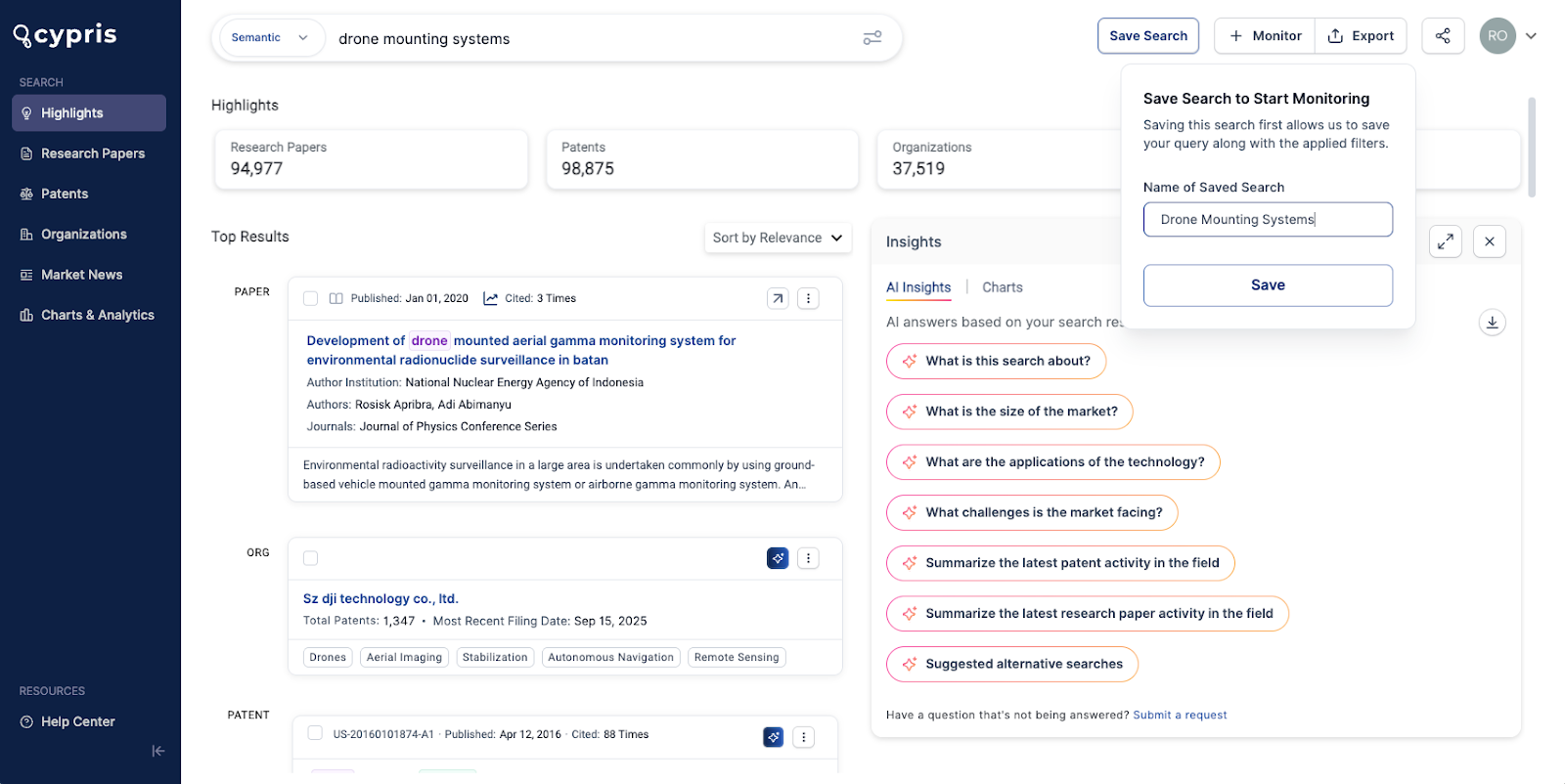
Setting up monitors is now faster and more intuitive. Users can create them in a single streamlined interface—quickly searching patent numbers, keywords, organizations, or papers and selecting the right mix in one place. Smart suggestions recommend recipients, while the Monitoring button appears directly on every search results page. Current monitors are clearly indicated to prevent duplication, and external recipients can be added to email updates for seamless collaboration.
Noise-Free Updates & Critical Alerts
A “send only if new results exist” toggle eliminates duplicate notifications. Monitoring now captures not only newly published patents, papers, and organizations, but also critical patent events such as expiration risks, assignee transfers, patent family expansions, and forward citations—including competitor citations of your own research.

A More Powerful User Experience
Monitoring is built to help users move from raw data to actionable intelligence. Reports save automatically, creating a historical log teams can reference at any time. Items can be flagged directly into collections without manual re-entry. Emails preview AI-enhanced trends with a single click into interactive dashboards, and users can easily add colleagues or external recipients to stay aligned.
From a design perspective, the rebuild also gave our team room to innovate.
As one of our engineering team members, Maddie explained: “It was fun to build something new from scratch. From a UI perspective, we were able to make better design choices right from the start, which made for a much smoother, more intuitive user experience.”
Built for Speed, Accuracy, and Collaboration
With the new Monitoring, teams can save time compared to manual tracking, strengthen competitive intelligence with reliable, cross-dataset updates, collaborate seamlessly by sharing reports with colleagues or external partners, and trust the signal thanks to accuracy, relevancy filters, and AI-powered summaries.
As part of our engineering team, Oleg explained: “This project sat on top of our existing platform, which meant understanding the entire workflow end to end. It was challenging, but it also gave us the opportunity to rethink how everything fits together—and that’s what made it so rewarding.”
Available Now to All Users
The redesigned Monitoring is live and available across the Cypris platform today. If you’re already using Cypris, you’ll see new Monitoring options throughout your search and reporting workflows.
We’re excited to see how your team uses Monitoring to stay ahead of markets, competitors, and technologies — and to keep pushing the boundaries of what intelligent monitoring can do for R&D.



A powerful new foundation for custom queries—built on Lucene and designed for R&D precision.
Over the past few years, Cypris has helped innovation teams make faster, more informed decisions by centralizing critical insights across datasets like patents, academic papers, and company activity. But until now, our search experience relied on a legacy query system with limited capabilities, offering little support for advanced search features or dataset-level customization.
Today, we’re excited to introduce an upgraded Advanced Search on Cypris, a complete overhaul of our query engine and search experience, powered by the open-standard Lucene query syntax. This update introduces a more robust and flexible search foundation, unlocking new ways to query data, build complex filters, and extract precisely what you need across patents, research, and more.
Why we rebuilt our search system from the ground up
Cypris’ original query syntax, a proprietary format used internally for years, limited users’ ability to craft advanced queries or tailor searches to specific datasets. It lacked modern capabilities like proximity searches, field-level customization, or true Boolean logic. This made it difficult to build a reliable and intuitive experience for both casual users and advanced researchers.
By moving to Lucene, we’re adopting a powerful, industry-standard query language that makes it easier for developers to build advanced features—and gives users access to a far more capable and flexible search toolset.
What’s new in Advanced Search
1. Custom Queries by Dataset
You can now layer queries to search across datasets or tailor filters to each one. For example, you can run a broad query on drone delivery, and then add separate layers to focus on patents by a specific assignee and papers from a specific country or funding agency.
Navigating the All Datasets tab introduces a new level of complexity—and power—by allowing users to apply dataset-specific logic within a single, unified query workflow. While querying multiple datasets simultaneously might seem straightforward, the underlying differences in schema, metadata, and available fields between our proprietary datasets make this a deeply technical challenge. Patents, for example, include claims, application numbers, and multiple date fields (filed, granted, updated), while academic papers use DOIs, have different structural conventions, and emphasize different metadata. In the past, we sidestepped this complexity by translating general queries like ((drone_allText)) into dataset-specific logic under the hood. Now, instead of obscuring that logic, we allow users to opt in to it. The builder provides progressive layers of customization: start with intuitive keyword searches across all fields, then move into the advanced builder for field-specific targeting, fuzzy logic, and term boosting, and finally, tailor query logic by dataset—such as specifying different countries of interest for papers vs. patents. This approach preserves flexibility while giving users full control, and with tools like our real-time Live Analysis and “Your Query” panel, we make it easy to understand how every decision affects the results.
2. More Fields to Query
We’re exposing deeper fields across datasets—giving you explicit control over the dimensions of your search. For the first time, users can now search academic papers by DOI, a critical identifier previously unsupported on the platform. You can also query by:
- Author or inventor names
- Organizations or assignees
- Countries, journals, funding agencies, and more
3. Full Boolean Support
Advanced Search now leverages powerful Boolean logic—AND, OR, NOT, and grouping—enabling more precise control over search logic and improving performance and accuracy.
4. Lucene Syntax Features
Use built-in Lucene features to create expressive, complex searches:
- Proximity searches to find terms near each other
- Fuzzy searches for flexible matching
- Exact phrase matching
- Boosting to prioritize results (e.g., prioritize results mentioning AI 3x more than others)
- Prefix/Postfix queries to match phrases that start or end a certain way
- Range queries for fields like date, funding amounts, or numerical values
A more powerful user experience
Our new search interface is built to help you tap into these capabilities without needing to know the syntax from the start. You’ll find:
- A Query Builder to guide you through complex searches
- A Help Video to onboard users to Lucene-style searches
- Inline examples and tips for writing queries using grouping, boosting, and more
Built for precision, speed, and customization
With Lucene as our foundation, search results are now not only more flexible but also faster and more accurate. Semantic search continues to offer natural-language ease of use, while Boolean search gives power users the performance and structure they need to uncover insights with greater specificity.
Whether you’re an innovation analyst drilling into AI patents or a business development lead scanning academic papers from Chilean researchers—Advanced Search is built to help you get to the signal, faster.
Available now to all users
Advanced Search is live and available across the Cypris platform today. If you’re already using Cypris, you’ll find the new search interface in your dashboard, complete with updated syntax documentation and walkthroughs.
We’re excited to see what you’ll build, discover, and analyze with this new capability. This is just the beginning—we’ll continue expanding the fields, syntax features, and customization options as we push the boundaries of what intelligent search can do for R&D.


Today, the need for society to adopt sustainable practices is increasingly urgent, particularly in chemical manufacturing, which is responsible for greenhouse gas emissions, toxic waste, increased water and energy consumption, and inefficient raw material use. Consequently, the market for sustainable chemical manufacturing has surged to $10 billion and continues to expand as the focus on sustainability intensifies. Leading this charge are three innovative approaches: mechanochemistry, green synthesis, and microflow chemistry. Mechanochemistry, which induces chemical reactions through mechanical energy, accelerates reactions and conserves energy compared to traditional solvent-based methods, while reducing reaction mass and potentially increasing product yield by avoiding solvents. Green synthesis aims to minimize the use and generation of hazardous substances, thereby reducing environmental impact and enhancing sustainability, with notable examples including the synthesis of spirooxindole derivatives using heterogeneous catalysis and metal-organic framework (MOF) catalysts. Microflow chemistry, or continuous flow chemistry, involves reactions in microreactors that allow precise control over reaction conditions, enhancing safety, scalability, and efficiency. The integration of these three approaches—mechanochemistry, green synthesis, and microflow chemistry—represents a significant advancement in sustainable chemical manufacturing, addressing critical challenges from waste reduction to energy savings and paving the way for a more sustainable industry.

Mechanochemistry: Mechanochemistry accelerates reactions and reduces solvent use, advancing sustainability in chemical manufacturing.
Mechanochemistry, a process in which chemical synthesis is induced by external mechanical energy, has gained attention in chemical manufacturing due to its sustainable nature. This method allows reactions to occur more quickly and saves energy compared to traditional solvent-based chemistry. Mechanochemistry also offers cost and time efficiency by eliminating the need for solvents, thereby reducing 90% of the reaction mass, and potentially increasing product yield under optimal conditions.
The disposal of plastics, which are non-biodegradable and create significant pollution, is a growing concern for the health and longevity of the planet. Recently, research has focused on using mechanochemistry to control the degradation of polymers found in plastics. Researchers have discovered that the previously separate fields of polymer and trituration mechanochemistry can converge, enabling the degradation of polymers through milling and grinding. This breakthrough holds the potential to significantly mitigate global warming.
Green Synthesis: Green synthesis reduces hazards and waste with efficient methods like heterogeneous and MOF catalysts.
Green synthesis involves creating chemical products and processes that minimize the use and production of hazardous substances, aiming to reduce environmental impact and enhance sustainability in chemical manufacturing. This approach not only benefits the environment but also protects the health and safety of chemical workers and consumers, while reducing costs associated with waste disposal and raw material use.
Spirooxindole has been a focus in the green synthesis field due to its broad benefits in medicine as well as agriculture because of it being a unique compound because of the high reactivity of the carbonyl group located at the 3-position of isatin. Various green synthesis methods have been used for creating spirooxindole derivatives. Various green synthesis methods have been developed for creating spirooxindole derivatives, with one promising approach being the use of heterogeneous catalysts. These catalysts, which are in different phases from the reactants and products, allow for effortless separation, minimizing waste, shortening processing time, and conserving energy.
Another promising method in green synthesis is the use of metal-organic framework (MOF) catalysts. MOFs are attractive due to their high surface area, large porosity, multiple catalytic sites, and highly tunable composition and structure. Studies have shown that MOF catalysts can achieve high yields of 95%-99% and short reaction times. For example, Mirhosseini-Eshkevari et al. (2019) synthesized a zirconium metal-organic framework (Zr MOF) called TEDA/IMIZ-BAIL@UiO-66 using benzene dicarboxylic acid as the organic linker. This framework served as a heterogeneous catalyst in the synthesis of spirooxindole derivatives, with the BAIL@UiO-66 catalyst acting as a Brønsted acid to enhance the electrophilicity of the carbonyl group in isatin and promote nucleophilic attack. This catalyst can be reused in other reactions with minimal reduction in yield, demonstrating its potential as a promising alternative to non-renewable processes.

Microflow Chemistry: Microflow chemistry boosts efficiency and sustainability with precise control and effective processing of renewable resources and waste.
Microflow chemistry, also known as continuous flow chemistry or microfluidic chemistry, is highly regarded for its efficiency, safety, and sustainability in chemical manufacturing. This approach involves chemical reactions occurring in microreactors, which allow for precise control over reaction conditions, thereby enhancing safety, scalability, and efficiency. Microflow chemistry is utilized in various fields, including environmental science, fine chemicals, materials science, and pharmaceuticals.
Recently, microflow chemistry has proven sustainable not only due to its efficient process but also because of its applications. It is now central to green catalytic engineering for processing renewable resources. For instance, microflow chemistry is used to process lignocellulosic biomass into fuels and chemicals. Lignocellulose, found in the microfibrils of plant cell walls and composed mainly of polysaccharides and lignins, has been extensively studied for this purpose. Microflow chemistry is highly favored for this process due to its enhanced product yield and selectivity.
Furthermore, microflow chemistry improves sustainability in on-site chemical manufacturing. Biomass, which contains a significant amount of water, requires considerable energy for transportation to refineries, making onsite processing essential. This is also true for food waste, which has a short shelf life and is produced in large quantities. Even plastic waste, despite its longevity and low water content, is widespread in landfills and ecosystems, necessitating onsite processing in remote and offshore areas. Microflow chemistry offers better economic viability and higher energy efficiency, supporting sustainable onsite manufacturing.

The crucial shift towards sustainable practices in chemical manufacturing is driven by the environmental and societal challenges posed by traditional methods. Innovations like mechanochemistry, green synthesis, and microflow chemistry are at the forefront of this transformation. Mechanochemistry accelerates reactions while minimizing solvent use, promising reduced energy consumption and waste generation. Green synthesis techniques, utilizing heterogeneous catalysis and metal-organic frameworks, provide efficient, low-impact pathways to valuable compounds like spirooxindoles, essential in medicine and agriculture. Microflow chemistry, with its precision in controlling reaction conditions, enhances safety and efficiency, especially in processing renewable biomass and managing onsite waste such as food and plastic. Together, these approaches not only reduce environmental impacts, including greenhouse gas emissions and toxic waste, but also promote a more resilient and sustainable chemical industry, ready to meet future challenges.
%20-%20Next%20Generation%20Invisible%20Fishing%20Line.png)
%20-%20Noninvasive%20VNS.png)
%20-%20Low-Energy%20Desalination.png)
Webinars
.png)

Most IP organizations are making high-stakes capital allocation decisions with incomplete visibility – relying primarily on patent data as a proxy for innovation. That approach is not optimal. Patents alone cannot reveal technology trajectories, capital flows, or commercial viability.
A more effective model requires integrating patents with scientific literature, grant funding, market activity, and competitive intelligence. This means that for a complete picture, IP and R&D teams need infrastructure that connects fragmented data into a unified, decision-ready intelligence layer.
AI is accelerating that shift. The value is no longer simply in retrieving documents faster; it’s in extracting signal from noise. Modern AI systems can contextualize disparate datasets, identify patterns, and generate strategic narratives – transforming raw information into actionable insight.
Join us on Thursday, April 23, at 12 PM ET for a discussion on how unified AI platforms are redefining decision-making across IP and R&D teams. Moderated by Gene Quinn, panelists Marlene Valderrama and Amir Achourie will examine how integrating technical, scientific, and market data collapses traditional silos – enabling more aligned strategy, sharper investment decisions, and measurable business impact.
Register here: https://ipwatchdog.com/cypris-april-23-2026/
.png)
In this session, we break down how AI is reshaping the R&D lifecycle, from faster discovery to more informed decision-making. See how an intelligence layer approach enables teams to move beyond fragmented tools toward a unified, scalable system for innovation.
In this session, we explore how modern AI systems are reshaping knowledge management in R&D. From structuring internal data to unlocking external intelligence, see how leading teams are building scalable foundations that improve collaboration, efficiency, and long-term innovation outcomes.
.avif)