

Resources
Guides, research, and perspectives on R&D intelligence, IP strategy, and the future of AI enabled innovation.

Executive Summary
In 2024, US patent infringement jury verdicts totaled $4.19 billion across 72 cases. Twelve individual verdicts exceeded $100million. The largest single award—$857 million in General Access Solutions v.Cellco Partnership (Verizon)—exceeded the annual R&D budget of many mid-market technology companies. In the first half of 2025 alone, total damages reached an additional $1.91 billion.
The consequences of incomplete patent intelligence are not abstract. In what has become one of the most instructive IP disputes in recent history, Masimo’s pulse oximetry patents triggered a US import ban on certain Apple Watch models, forcing Apple to disable its blood oxygen feature across an entire product line, halt domestic sales of affected models, invest in a hardware redesign, and ultimately face a $634 million jury verdict in November 2025. Apple—a company with one of the most sophisticated intellectual property organizations on earth—spent years in litigation over technology it might have designed around during development.
For organizations with fewer resources than Apple, the risk calculus is starker. A mid-size materials company, a university spinout, or a defense contractor developing next-generation battery technology cannot absorb a nine-figure verdict or a multi-year injunction. For these organizations, the patent landscape analysis conducted during the development phase is the primary risk mitigation mechanism. The quality of that analysis is not a matter of convenience. It is a matter of survival.
And yet, a growing number of R&D and IP teams are conducting that analysis using general-purpose AI tools—ChatGPT, Claude, Microsoft Co-Pilot—that were never designed for patent intelligence and are structurally incapable of delivering it.
This report presents the findings of a controlled comparison study in which identical patent landscape queries were submitted to four AI-powered tools: Cypris (a purpose-built R&D intelligence platform),ChatGPT (OpenAI), Claude (Anthropic), and Microsoft Co-Pilot. Two technology domains were tested: solid-state lithium-sulfur battery electrolytes using garnet-type LLZO ceramic materials (freedom-to-operate analysis), and bio-based polyamide synthesis from castor oil derivatives (competitive intelligence).
The results reveal a significant and structurally persistent gap. In Test 1, Cypris identified over 40 active US patents and published applications with granular FTO risk assessments. Claude identified 12. ChatGPT identified 7, several with fabricated attribution. Co-Pilot identified 4. Among the patents surfaced exclusively by Cypris were filings rated as “Very High” FTO risk that directly claim the technology architecture described in the query. In Test 2, Cypris cited over 100 individual patent filings with full attribution to substantiate its competitive landscape rankings. No general-purpose model cited a single patent number.
The most active sectors for patent enforcement—semiconductors, AI, biopharma, and advanced materials—are the same sectors where R&D teams are most likely to adopt AI tools for intelligence workflows. The findings of this report have direct implications for any organization using general-purpose AI to inform patent strategy, competitive intelligence, or R&D investment decisions.

1. Methodology
A single patent landscape query was submitted verbatim to each tool on March 27, 2026. No follow-up prompts, clarifications, or iterative refinements were provided. Each tool received one opportunity to respond, mirroring the workflow of a practitioner running an initial landscape scan.
1.1 Query
Identify all active US patents and published applications filed in the last 5 years related to solid-state lithium-sulfur battery electrolytes using garnet-type ceramic materials. For each, provide the assignee, filing date, key claims, and current legal status. Highlight any patents that could pose freedom-to-operate risks for a company developing a Li₇La₃Zr₂O₁₂(LLZO)-based composite electrolyte with a polymer interlayer.
1.2 Tools Evaluated

1.3 Evaluation Criteria
Each response was assessed across six dimensions: (1) number of relevant patents identified, (2) accuracy of assignee attribution,(3) completeness of filing metadata (dates, legal status), (4) depth of claim analysis relative to the proposed technology, (5) quality of FTO risk stratification, and (6) presence of actionable design-around or strategic guidance.
2. Findings
2.1 Coverage Gap
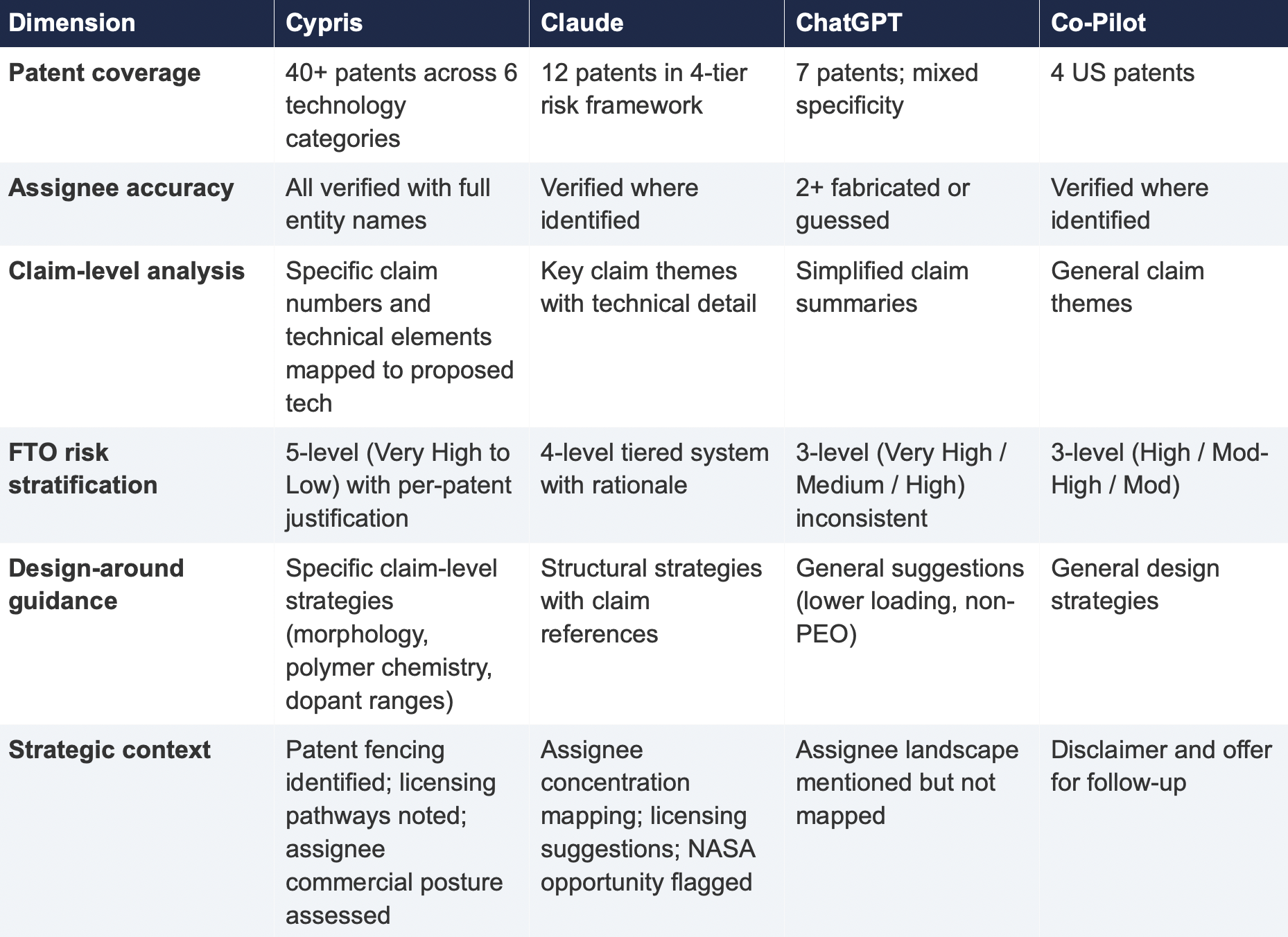
The most significant finding is the scale of the coverage differential. Cypris identified over 40 active US patents and published applications spanning LLZO-polymer composite electrolytes, garnet interface modification, polymer interlayer architectures, lithium-sulfur specific filings, and adjacent ceramic composite patents. The results were organized by technology category with per-patent FTO risk ratings.
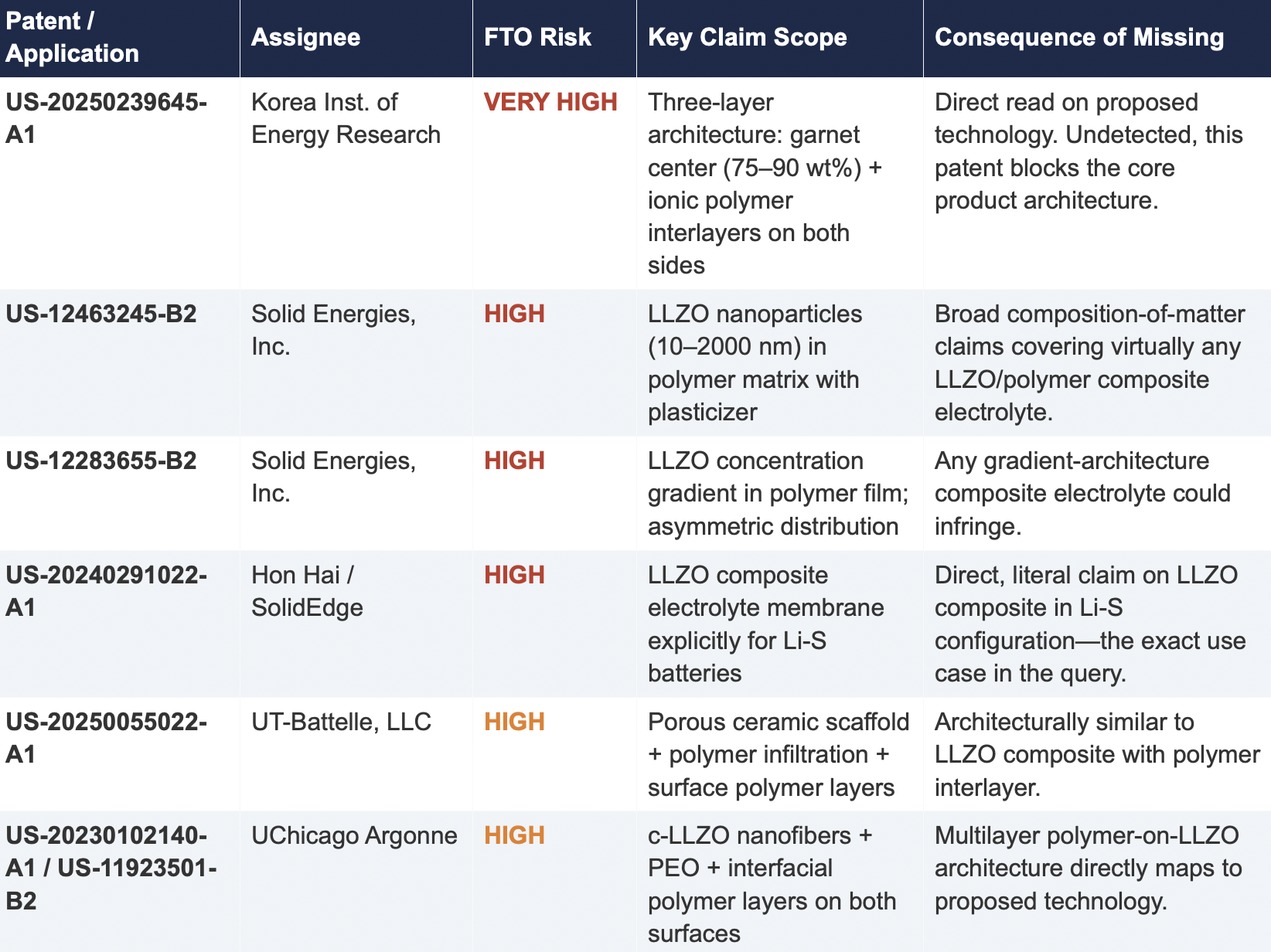
Claude identified 12 patents organized in a four-tier risk framework. Its analysis was structurally sound and correctly flagged the two highest-risk filings (Solid Energies US 11,967,678 and the LLZO nanofiber multilayer US 11,923,501). It also identified the University ofMaryland/ Wachsman portfolio as a concentration risk and noted the NASA SABERS portfolio as a licensing opportunity. However, it missed the majority of the landscape, including the entire Corning portfolio, GM's interlayer patents, theKorea Institute of Energy Research three-layer architecture, and the HonHai/SolidEdge lithium-sulfur specific filing.
ChatGPT identified 7 patents, but the quality of attribution was inconsistent. It listed assignees as "Likely DOE /national lab ecosystem" and "Likely startup / defense contractor cluster" for two filings—language that indicates the model was inferring rather than retrieving assignee data. In a freedom-to-operate context, an unverified assignee attribution is functionally equivalent to no attribution, as it cannot support a licensing inquiry or risk assessment.
Co-Pilot identified 4 US patents. Its output was the most limited in scope, missing the Solid Energies portfolio entirely, theUMD/ Wachsman portfolio, Gelion/ Johnson Matthey, NASA SABERS, and all Li-S specific LLZO filings.
2.2 Critical Patents Missed by Public Models
The following table presents patents identified exclusively by Cypris that were rated as High or Very High FTO risk for the proposed technology architecture. None were surfaced by any general-purpose model.
2.3 Patent Fencing: The Solid Energies Portfolio
Cypris identified a coordinated patent fencing strategy by Solid Energies, Inc. that no general-purpose model detected at scale. Solid Energies holds at least four granted US patents and one published application covering LLZO-polymer composite electrolytes across compositions(US-12463245-B2), gradient architectures (US-12283655-B2), electrode integration (US-12463249-B2), and manufacturing processes (US-20230035720-A1). Claude identified one Solid Energies patent (US 11,967,678) and correctly rated it as the highest-priority FTO concern but did not surface the broader portfolio. ChatGPT and Co-Pilot identified zero Solid Energies filings.
The practical significance is that a company relying on any individual patent hit would underestimate the scope of Solid Energies' IP position. The fencing strategy—covering the composition, the architecture, the electrode integration, and the manufacturing method—means that identifying a single design-around for one patent does not resolve the FTO exposure from the portfolio as a whole. This is the kind of strategic insight that requires seeing the full picture, which no general-purpose model delivered
2.4 Assignee Attribution Quality
ChatGPT's response included at least two instances of fabricated or unverifiable assignee attributions. For US 11,367,895 B1, the listed assignee was "Likely startup / defense contractor cluster." For US 2021/0202983 A1, the assignee was described as "Likely DOE / national lab ecosystem." In both cases, the model appears to have inferred the assignee from contextual patterns in its training data rather than retrieving the information from patent records.
In any operational IP workflow, assignee identity is foundational. It determines licensing strategy, litigation risk, and competitive positioning. A fabricated assignee is more dangerous than a missing one because it creates an illusion of completeness that discourages further investigation. An R&D team receiving this output might reasonably conclude that the landscape analysis is finished when it is not.
3. Structural Limitations of General-Purpose Models for Patent Intelligence
3.1 Training Data Is Not Patent Data
Large language models are trained on web-scraped text. Their knowledge of the patent record is derived from whatever fragments appeared in their training corpus: blog posts mentioning filings, news articles about litigation, snippets of Google Patents pages that were crawlable at the time of data collection. They do not have systematic, structured access to the USPTO database. They cannot query patent classification codes, parse claim language against a specific technology architecture, or verify whether a patent has been assigned, abandoned, or subjected to terminal disclaimer since their training data was collected.
This is not a limitation that improves with scale. A larger training corpus does not produce systematic patent coverage; it produces a larger but still arbitrary sampling of the patent record. The result is that general-purpose models will consistently surface well-known patents from heavily discussed assignees (QuantumScape, for example, appeared in most responses) while missing commercially significant filings from less publicly visible entities (Solid Energies, Korea Institute of EnergyResearch, Shenzhen Solid Advanced Materials).
3.2 The Web Is Closing to Model Scrapers
The data access problem is structural and worsening. As of mid-2025, Cloudflare reported that among the top 10,000 web domains, the majority now fully disallow AI crawlers such as GPTBot andClaudeBot via robots.txt. The trend has accelerated from partial restrictions to outright blocks, and the crawl-to-referral ratios reveal the underlying tension: OpenAI's crawlers access approximately1,700 pages for every referral they return to publishers; Anthropic's ratio exceeds 73,000 to 1.
Patent databases, scientific publishers, and IP analytics platforms are among the most restrictive content categories. A Duke University study in 2025 found that several categories of AI-related crawlers never request robots.txt files at all. The practical consequence is that the knowledge gap between what a general-purpose model "knows" about the patent landscape and what actually exists in the patent record is widening with each training cycle. A landscape query that a general-purpose model partially answered in 2023 may return less useful information in 2026.
3.3 General-Purpose Models Lack Ontological Frameworks for Patent Analysis
A freedom-to-operate analysis is not a summarization task. It requires understanding claim scope, prosecution history, continuation and divisional chains, assignee normalization (a single company may appear under multiple entity names across patent records), priority dates versus filing dates versus publication dates, and the relationship between dependent and independent claims. It requires mapping the specific technical features of a proposed product against independent claim language—not keyword matching.
General-purpose models do not have these frameworks. They pattern-match against training data and produce outputs that adopt the format and tone of patent analysis without the underlying data infrastructure. The format is correct. The confidence is high. The coverage is incomplete in ways that are not visible to the user.
4. Comparative Output Quality
The following table summarizes the qualitative characteristics of each tool's response across the dimensions most relevant to an operational IP workflow.
5. Implications for R&D and IP Organizations
5.1 The Confidence Problem
The central risk identified by this study is not that general-purpose models produce bad outputs—it is that they produce incomplete outputs with high confidence. Each model delivered its results in a professional format with structured analysis, risk ratings, and strategic recommendations. At no point did any model indicate the boundaries of its knowledge or flag that its results represented a fraction of the available patent record. A practitioner receiving one of these outputs would have no signal that the analysis was incomplete unless they independently validated it against a comprehensive datasource.
This creates an asymmetric risk profile: the better the format and tone of the output, the less likely the user is to question its completeness. In a corporate environment where AI outputs are increasingly treated as first-pass analysis, this dynamic incentivizes under-investigation at precisely the moment when thoroughness is most critical.
5.2 The Diversification Illusion
It might be assumed that running the same query through multiple general-purpose models provides validation through diversity of sources. This study suggests otherwise. While the four tools returned different subsets of patents, all operated under the same structural constraints: training data rather than live patent databases, web-scraped content rather than structured IP records, and general-purpose reasoning rather than patent-specific ontological frameworks. Running the same query through three constrained tools does not produce triangulation; it produces three partial views of the same incomplete picture.
5.3 The Appropriate Use Boundary
General-purpose language models are effective tools for a wide range of tasks: drafting communications, summarizing documents, generating code, and exploratory research. The finding of this study is not that these tools lack value but that their value boundary does not extend to decisions that carry existential commercial risk.
Patent landscape analysis, freedom-to-operate assessment, and competitive intelligence that informs R&D investment decisions fall outside that boundary. These are workflows where the completeness and verifiability of the underlying data are not merely desirable but are the primary determinant of whether the analysis has value. A patent landscape that captures 10% of the relevant filings, regardless of how well-formatted or confidently presented, is a liability rather than an asset.
6. Test 2: Competitive Intelligence — Bio-Based Polyamide Patent Landscape
To assess whether the findings from Test 1 were specific to a single technology domain or reflected a broader structural pattern, a second query was submitted to all four tools. This query shifted from freedom-to-operate analysis to competitive intelligence, asking each tool to identify the top 10organizations by patent filing volume in bio-based polyamide synthesis from castor oil derivatives over the past three years, with summaries of technical approach, co-assignee relationships, and portfolio trajectory.
6.1 Query

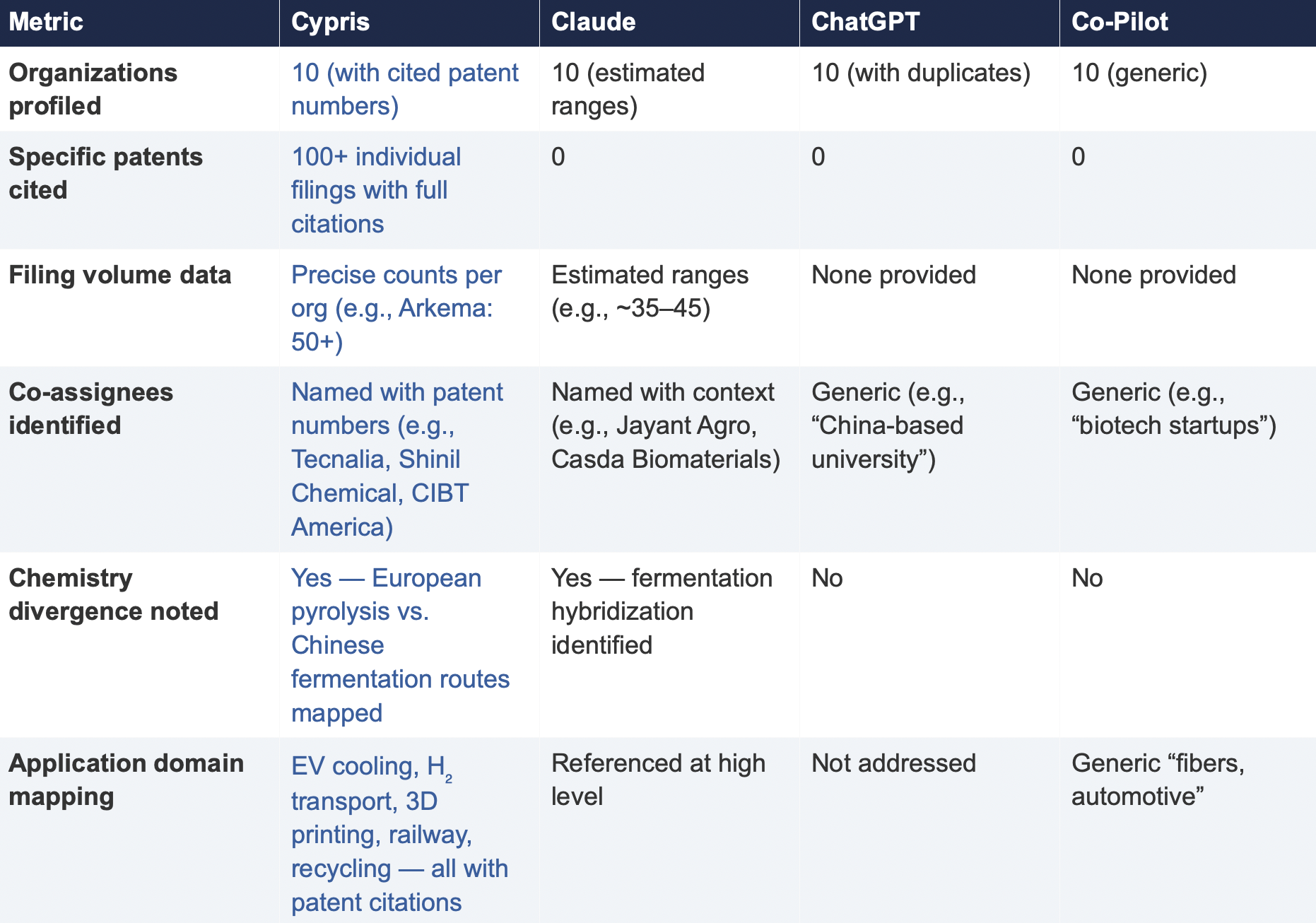
6.2 Summary of Results
6.3 Key Differentiators
Verifiability
The most consequential difference in Test 2 was the presence or absence of verifiable evidence. Cypris cited over 100 individual patent filings with full patent numbers, assignee names, and publication dates. Every claim about an organization’s technical focus, co-assignee relationships, and filing trajectory was anchored to specific documents that a practitioner could independently verify in USPTO, Espacenet, or WIPO PATENT SCOPE. No general-purpose model cited a single patent number. Claude produced the most structured and analytically useful output among the public models, with estimated filing ranges, product names, and strategic observations that were directionally plausible. However, without underlying patent citations, every claim in the response requires independent verification before it can inform a business decision. ChatGPT and Co-Pilot offered thinner profiles with no filing counts and no patent-level specificity.
Data Integrity
ChatGPT’s response contained a structural error that would mislead a practitioner: it listed CathayBiotech as organization #5 and then listed “Cathay Affiliate Cluster” as a separate organization at #9, effectively double-counting a single entity. It repeated this pattern with Toray at #4 and “Toray(Additional Programs)” at #10. In a competitive intelligence context where the ranking itself is the deliverable, this kind of error distorts the landscape and could lead to misallocation of competitive monitoring resources.
Organizations Missed
Cypris identified Kingfa Sci. & Tech. (8–10 filings with a differentiated furan diacid-based polyamide platform) and Zhejiang NHU (4–6 filings focused on continuous polymerization process technology)as emerging players that no general-purpose model surfaced. Both represent potential competitive threats or partnership opportunities that would be invisible to a team relying on public AI tools.Conversely, ChatGPT included organizations such as ANTA and Jiangsu Taiji that appear to be downstream users rather than significant patent filers in synthesis, suggesting the model was conflating commercial activity with IP activity.
Strategic Depth
Cypris’s cross-cutting observations identified a fundamental chemistry divergence in the landscape:European incumbents (Arkema, Evonik, EMS) rely on traditional castor oil pyrolysis to 11-aminoundecanoic acid or sebacic acid, while Chinese entrants (Cathay Biotech, Kingfa) are developing alternative bio-based routes through fermentation and furandicarboxylic acid chemistry.This represents a potential long-term disruption to the castor oil supply chain dependency thatWestern players have built their IP strategies around. Claude identified a similar theme at a higher level of abstraction. Neither ChatGPT nor Co-Pilot noted the divergence.
6.4 Test 2 Conclusion
Test 2 confirms that the coverage and verifiability gaps observed in Test 1 are not domain-specific.In a competitive intelligence context—where the deliverable is a ranked landscape of organizationalIP activity—the same structural limitations apply. General-purpose models can produce plausible-looking top-10 lists with reasonable organizational names, but they cannot anchor those lists to verifiable patent data, they cannot provide precise filing volumes, and they cannot identify emerging players whose patent activity is visible in structured databases but absent from the web-scraped content that general-purpose models rely on.
7. Conclusion
This comparative analysis, spanning two distinct technology domains and two distinct analytical workflows—freedom-to-operate assessment and competitive intelligence—demonstrates that the gap between purpose-built R&D intelligence platforms and general-purpose language models is not marginal, not domain-specific, and not transient. It is structural and consequential.
In Test 1 (LLZO garnet electrolytes for Li-S batteries), the purpose-built platform identified more than three times as many patents as the best-performing general-purpose model and ten times as many as the lowest-performing one. Among the patents identified exclusively by the purpose-built platform were filings rated as Very High FTO risk that directly claim the proposed technology architecture. InTest 2 (bio-based polyamide competitive landscape), the purpose-built platform cited over 100individual patent filings to substantiate its organizational rankings; no general-purpose model cited as ingle patent number.
The structural drivers of this gap—reliance on training data rather than live patent feeds, the accelerating closure of web content to AI scrapers, and the absence of patent-specific analytical frameworks—are not transient. They are inherent to the architecture of general-purpose models and will persist regardless of increases in model capability or training data volume.
For R&D and IP leaders, the practical implication is clear: general-purpose AI tools should be used for general-purpose tasks. Patent intelligence, competitive landscaping, and freedom-to-operate analysis require purpose-built systems with direct access to structured patent data, domain-specific analytical frameworks, and the ability to surface what a general-purpose model cannot—not because it chooses not to, but because it structurally cannot access the data.
The question for every organization making R&D investment decisions today is whether the tools informing those decisions have access to the evidence base those decisions require. This study suggests that for the majority of general-purpose AI tools currently in use, the answer is no.
About This Report
This report was produced by Cypris (IP Web, Inc.), an AI-powered R&D intelligence platform serving corporate innovation, IP, and R&D teams at organizations including NASA, Johnson & Johnson, theUS Air Force, and Los Alamos National Laboratory. Cypris aggregates over 500 million data points from patents, scientific literature, grants, corporate filings, and news to deliver structured intelligence for technology scouting, competitive analysis, and IP strategy.
The comparative tests described in this report were conducted on March 27, 2026. All outputs are preserved in their original form. Patent data cited from the Cypris reports has been verified against USPTO Patent Center and WIPO PATENT SCOPE records as of the same date. To conduct a similar analysis for your technology domain, contact info@cypris.ai or visit cypris.ai.
The Patent Intelligence Gap - A Comparative Analysis of Verticalized AI-Patent Tools vs. General-Purpose Language Models for R&D Decision-Making
Blogs

Apple is renowned for its pioneering and progressive approaches. It’s no shock that Apple has set up a structure to promote creativity and maintain its products at the forefront of the market. And learning how Apple is organized for innovation gives us a lot of lessons for setting up companies for success.
From cultivating creative ideas to developing innovative solutions, Apple understands how important it is to stay organized for innovation if they want success now and into the future. But what does this look like?
How do they overcome challenges when innovating? And can other companies learn from Apple’s approach? Let’s explore these questions as we investigate how Apple is organized for innovation.
Table of Contents
How Apple Is Organized for Innovation
Apple’s Culture: Fostering Innovation
Encouraging Creativity and Risk-Taking
What Are the Challenges of Innovating at Apple?
What Companies Can Learn From Apple
How Apple Is Organized for Innovation
Apple’s organizational structure is a hierarchical system that allows the company to efficiently manage its vast global operations. Apple’s org structure has a centralized decision-making process, promotes creativity and innovation, and provides well-defined pathways of communication between departments.
How Apple is organized for innovation allows the company to remain competitive in today’s fast-paced market by fostering collaboration and encouraging risk-taking.
At the top of Apple’s hierarchy sits CEO Tim Cook who oversees all aspects of the business from product development to marketing strategies. At the helm of Apple’s board is a team of renowned industry leaders, such as former Vice President Al Gore and Oracle Chairman Larry Ellison, who guide the company in making decisions on product development, acquisitions, and investments.
The next level down consists of executive teams responsible for specific areas within Apple such as hardware engineering or software design.
Each team has dedicated leaders with years of experience in their respective fields who are responsible for driving innovation within their division while also managing resources efficiently across multiple projects at once. They collaborate regularly to ensure alignment between different departments while ensuring that any changes they make are consistent with overall company goals and objectives set by Cook himself.
(Source)
Below this layer lies individual project teams consisting mostly of engineers tasked with developing innovative solutions to customer problems or creating new products entirely from scratch based on market research conducted before the development phases begin.
These teams consist mainly of developers but can also contain designers depending on what type of project it is working on. All members report directly to either one member from executive leadership or straight to Cook himself if necessary.
This provides direct access to feedback throughout the entire process allowing quick iterations when needed. It reduces the wait through lengthy bureaucratic processes typically seen in larger organizations.
Finally, there exists another layer beneath these individuals made up of administrative staff who handle day-to-day tasks related to running the business such as HR, payroll, accounting, and legal affairs. This group helps ensure that everything else runs smoothly so executives can focus solely on developing future products and services.
In short, Apple’s organizational structure promotes strong collaboration, efficient decision-making, rapid iteration, and the ability to respond quickly to changing markets.
How Apple is organized for innovation has allowed them to stay on top of the game in terms of pioneering, by emphasizing imagination, and being unafraid to take chances. Leveraging technology for innovation is just one of the many ways Apple fosters creative thinking among its employees.
Key Takeaway: How Apple is organized for innovation: its structure is geared towards innovation and efficiency, with a hierarchical system in place that enables quick decision-making. Executive teams are responsible for driving product development while individual project teams focus on creating innovative solutions to customer problems. This well-oiled machine ensures the innovative company remains competitive by responding quickly to changing markets.
Apple’s Culture: Fostering Innovation
Apple is acclaimed for its innovative goods and services, with a great deal of this accomplishment coming from its methodology of promoting creativity.
Encouraging Creativity and Risk-Taking
Apple encourages creativity and risk-taking by allowing employees to explore new ideas without fear of failure. This culture has enabled the company to create groundbreaking technologies such as the iPhone, iPad, and Macbook Pro.
Empowering Decision Making
Empowering employees to make decisions is another key factor in Apple’s ability to innovate. Apple enables personnel, regardless of rank, to take on tasks and make decisions that will be beneficial for both the consumer and the firm. By giving employees autonomy over their work, they can think outside the box while still staying within guidelines set by senior management.
Using Cutting-Edge Technology
Since its inception in 1976, Apple has employed cutting-edge technology to create groundbreaking solutions that have transformed the way people use technology daily. Utilizing AI, ML, NLP, AR, VR, blockchain tech, cloud computing, quantum computing, 5G networks, and robotics automation systems along with data analytics platforms as tools to push the boundaries of innovation has been one of Apple’s core strategies.
This approach enables them to stay ahead of the curve and keep their customers engaged while staying within guidelines set by senior management.
Investing in R&D
Investing in research & development (R&D) is also an important part of Apple’s strategy for fostering innovation. Through R&D investments into areas like AI/ML/NLP research labs around Silicon Valley or even acquisitions such as Shazam or VocalIQ – Apple continues pushing boundaries with every new product release.
Apple has shown its dedication to pioneering through its corporate ethos, tech investments, and concentration on R&D. Despite these efforts, innovating at Apple comes with challenges such as managing complexity and scale while keeping up with rapidly changing markets.
Key Takeaway: Apple’s culture of encouraging creativity and risk-taking, coupled with its investment in cutting-edge technology and research & development has enabled them to stay one step ahead of the competition when it comes to innovation. Apple encourages personnel to take risks and explore novel ideas, allowing them to create revolutionary items that captivate customers.
What Are the Challenges of Innovating at Apple?
Innovation is a key component of Apple’s success. We have looked at how Apple is organized for innovation. Yet, there are difficulties to be handled for the business to stay successful and competitive.
Managing Complexity and Scale
Managing complexity and scale is one of the biggest challenges faced by Apple when innovating. With over 2 million employees across the globe, keeping track of ideas and ensuring they are properly implemented can be difficult.
Rapidly Changing Markets
Additionally, rapidly changing markets can make it hard for Apple to stay ahead of competitors who may have access to different technologies or resources than Apple does. Finally, maintaining quality standards is essential for any innovative product or service offered by Apple as customers expect nothing less than perfection from the brand.
The challenges of innovating at Apple are vast and require a thoughtful approach to overcome. By leveraging data-driven decision-making, developing a culture of continuous improvement, and utilizing agile methodologies for faster results, Apple has been able to navigate these challenges successfully.
Key Takeaway: Apple faces the challenge of managing complexity and scale, staying ahead of competitors in rapidly changing markets, and upholding high-quality standards to ensure successful innovation. To do this effectively they must stay agile while constantly innovating with a keen eye on the future.
What Companies Can Learn From Apple
The main thing that companies should learn from Apple as an innovative company is their focus on establishing clear goals and objectives. Without a strategy in place, it is hard to push for innovation.
Companies should also create an environment that encourages risk-taking and allows employees the freedom to explore creative solutions. Investing in R&D is a must. This could mean supporting internal initiatives as well as partnering with outside groups or educational institutions.
Technology plays an important role in innovation, so companies should leverage existing tools and develop new ones when necessary.
Finally, collaboration between departments and across teams is essential for successful innovation initiatives. Fostering open communication will help ensure ideas are shared quickly and efficiently. By following these steps, other companies can emulate Apple’s innovative culture while achieving their unique successes.
Organize your innovation goals, encourage risk-taking, invest in R&D, leverage tech, and foster collaboration to emulate Apple’s success. #innovation Click to Tweet
Conclusion
Other businesses desiring to up their game could look to how Apple is organized for innovation. By having an organizational structure that fosters creativity and collaboration, and utilizing strategies such as open-ended exploration and prototyping, Apple has been able to create groundbreaking products despite the challenges of innovating at scale.
The main takeaway here is that with proper organization and strategy in place, even large organizations can remain agile enough to innovate effectively.
Unlock the power of data-driven innovation with Cypris. Streamline your R&D and innovation processes to gain valuable insights faster than ever before.

Innovation strategies are important for any company. Businesses that learn how firms internally develop innovation gain tremendous value for their organization. It allows them to have market breakthroughs, adapt quickly and lead product design, and handle issues creatively.
In this article, we look at how firms internally develop innovation. We look at the benefits of internal innovation, different innovation strategies, and examples from different companies.
Table of Contents
What Is Its Difference from External Innovation?
What Are the Benefits of Developing Internal Innovation?
How Firms Internally Develop Innovation
What Are the Different Sources of Internal Innovation?
Challenges of Internal Innovation
Strategies for Successful Internal Innovation
Establishing Clear Goals and Objectives
Utilizing Existing Resources and Expertise
Internal Innovation
Learning how firms internally develop innovation necessitates understanding what it is first. Internal innovation in companies is the process of creating new ideas, products, services, or processes that can be used to improve a company’s operations. It involves leveraging existing resources and expertise within an organization to create something new.
Internal innovation differs from external innovation in that it focuses on developing solutions internally rather than relying on outside sources for help.
What Is Internal Innovation?
Internal innovation is the process of using internal resources such as personnel, technology, data, and other assets to develop innovative solutions that will benefit the business. This could include anything from introducing a new product line or service offering to streamlining operational processes or creating more efficient ways of doing things.
The goal of internal innovation is not only to increase profits but also to make employees feel valued by providing them with opportunities for growth and development through their work.
What Is Its Difference from External Innovation?
External innovation typically involves working with outside partners such as vendors or consultants who bring fresh perspectives and ideas into the mix. While this can be beneficial in some cases, it often requires additional time and money investments. It may not always yield positive results due to a lack of familiarity with an organization’s culture or goals.
On the other hand, internal innovation leverages existing knowledge within an organization which allows teams to quickly come up with creative solutions. In addition, companies don’t need to invest extra resources into research or training outside parties on how they do things differently at their company.
What Are the Benefits of Developing Internal Innovation?
The advantages of cultivating internal innovations are manifold. To begin with, it improves employee engagement by granting them ownership over projects they have invested effort. By also giving them access to different departments where they can apply their expertise, it improves their job satisfaction levels, resulting in higher retention rates.
Developing internal innovation also helps businesses save costs associated with external consulting fees. This is because most if not all tasks related to internal innovations are handled internally leading to lower overhead expenses.
Lastly, it gives businesses a competitive edge over others as they can innovate faster. Their already-established systems and structures make them more adaptable when responding to changing market conditions.
The benefits of internal innovation can be great, from cost savings to improved quality control.
Maximize cost savings, efficiency, and quality control with internal innovation initiatives. Leverage existing resources and data platforms for faster progress monitoring. #innovation #costsavings #leveragetechnology Click to Tweet
How Firms Internally Develop Innovation
Apple Inc.
Apple is a prime example of how firms internally develop innovation. Their development strategy focuses on creating an environment where employees can collaborate and share ideas, as well as providing resources for research and development.
Apple also encourages its employees to think outside the box when it comes to problem-solving. This has led to some of its most innovative products such as the iPhone and iPad.
The result of this approach has been a steady stream of new products that have revolutionized the tech industry and made Apple one of the world’s leading companies in terms of market capitalization.
Google LLC
Google’s internal innovation strategy revolves around encouraging collaboration between different teams within their organization, allowing them to come up with creative solutions that may not be possible if they were working alone.
They also provide generous funding for research projects, giving their engineers access to cutting-edge technology and tools they need to create something truly unique.
As a result, Google has become synonymous with technological advancement due to its groundbreaking products like Google Maps, Gmail, and Chrome browser. These are all developed internally by their team members.
Amazon Web Services (AWS)
Amazon Web Services is a prime example of how firms can create and implement internal innovation strategies that propel them toward success.
AWS provides cloud computing services to businesses worldwide, allowing for data storage online without the need for physical hardware or additional personnel for maintenance tasks such as backups and updates.
By utilizing these technologies internally before offering them through their AWS Marketplace program, Amazon was able to gain significant traction in this area quickly, due largely in part to its focus on developing innovative solutions from within rather than relying solely on external sources or third-party vendors.
(Source)
What Are the Different Sources of Internal Innovation?
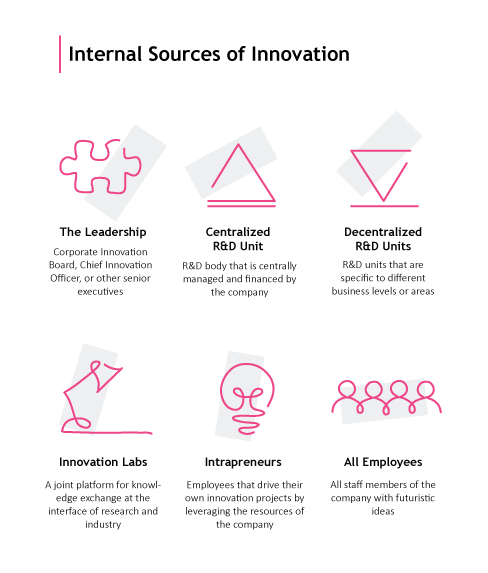
Innovation is the lifeblood of any organization, and it’s essential for staying competitive in today’s fast-paced business environment. To learn how firms internally develop innovation, let’s look at where innovation comes from within the company. Internal innovation can come from a variety of sources within an organization, each with its unique strengths and challenges.
Leadership
Leadership sets the tone for innovation throughout an organization.
Leaders must create a culture that encourages risk-taking and rewards creativity. They should also provide resources to help employees develop their ideas into tangible products or services.
Finally, leaders need to be open to new ideas coming from outside the traditional power structure of the company.
R&D Units
Research & Development (R&D) units are dedicated teams tasked with developing innovative solutions to problems facing the company or industry as a whole. These teams have access to specialized tools and expertise that allow them to explore cutting-edge technologies and uncover creative solutions quickly and efficiently.
Innovation Units
Innovation units are similar to R&D units but focus on creating new products or services rather than improving existing ones. This type of team typically works closely with marketing departments to ensure that their innovations will be well received by customers when they hit the market.
Employees
Employees at all levels can contribute valuable insights into how processes could be improved or what kind of product features would appeal most strongly to customers’ needs. This happens if employees are empowered and allowed input through surveys, brainstorming sessions, and hackathons.
Companies should make sure they’re actively listening for these kinds of suggestions so they don’t miss out on potentially great ideas just because they didn’t originate at higher levels within the organization hierarchy.
Overall, internal innovation is critical for organizations looking to stay ahead in today’s rapidly changing landscape. However, it requires more than just top-down leadership initiatives. Tapping into all available sources such as R&D units, innovation units, and even individual employees can give companies a major edge over their competitors who may not be taking full advantage of every potential source of insight available.
Internal innovation can come from a variety of sources within an organization, each with its unique strengths and challenges. Click To Tweet
Challenges of Internal Innovation
Innovation from within is key to staying ahead of the competition, yet can be challenging due to restricted assets and experience. Companies must reconcile the demand for innovation with their current resource limitations, which can lead to a lack of funds and time necessary to generate fresh concepts.
Additionally, there are risks associated with internal innovation projects that require careful management. These include potential losses from failed experiments or delays in product development cycles due to unforeseen circumstances.
Time constraints are also an issue when it comes to internal innovation projects. Companies need to set realistic expectations and deadlines while ensuring they have enough personnel and other resources available throughout the project lifecycle. Companies should also factor in unexpected challenges such as changes in customer demands or market conditions that could impact their timeline goals.
Risk management is another key challenge when launching an internal innovation project. Companies must identify any potential risks upfront so they can plan accordingly by allocating additional resources if necessary or making changes to their process as needed during the development phases.
This includes understanding how much capital is required for each stage of the project, assessing customer feedback on prototypes or designs before launch, and developing contingency plans in case something goes wrong during production or delivery stages of the process cycle
The difficulties of internal creativity can be intimidating, yet with the correct systems and assets available to them, organizations can accomplish fruitful outcomes. By leveraging existing resources and expertise, establishing clear goals and objectives, and utilizing technology to streamline processes, organizations can increase their chances for success when it comes to internal innovation.
“Internal innovation is essential for staying ahead but requires careful management of time and risk. #Innovation #RiskManagement #TimeConstraints” Click to Tweet
Strategies for Successful Internal Innovation
Successful internal innovation projects require a clear strategy that focuses on goals, resources, and technology. In learning how firms internally develop innovation, we can extract the following steps:
Establishing Clear Goals and Objectives
Establishing clear goals and objectives is the first step in any successful project plan. Defining specific outcomes for the project helps to ensure that everyone involved understands what needs to be accomplished. It also allows teams to measure progress against their desired results.
Utilizing Existing Resources and Expertise
Utilizing existing resources and expertise is another important part of a successful strategy. By leveraging the knowledge of team members, organizations can save time and money while ensuring quality results are achieved quickly. Finally, leveraging technology to streamline processes can help teams stay organized and efficient throughout their project.
By following these strategies for successful internal innovation projects, organizations will be able to maximize efficiency while effectively achieving their desired outcomes. With clear goals established upfront along with utilizing existing resources and expertise available within the organization combined with innovative technologies, organizations have everything they need at their fingertips to make sure their next big idea takes off.
By implementing the strategies outlined above, organizations can effectively manage their internal innovation processes and achieve success.
Maximize efficiency and achieve desired outcomes with clear goals, existing resources, and innovative tech for successful internal innovation projects. #innovation #R&D Click to Tweet
Conclusion
Learning how firms internally develop innovation helps companies to develop their internal innovation leads. To maximize innovation outcomes, any project’s plan should consider strategies and best practices to address the associated challenges of internal innovation.
Strategies for successful innovation outcomes and best practices should be implemented as part of any project’s plan. Find a comprehensive platform that helps R&D and innovation teams centralize their data sources into one platform to facilitate faster time-to-insights during the development process, enabling them to maximize their potential for creating innovative products or services.
Discover how Cypris can help your R&D and innovation teams develop faster, smarter solutions with centralized data sources. Take advantage of our platform today to unlock the potential of internal innovation.

How do patents and copyrights promote innovation? R&D teams, product developers, scientists, commercialization engineers, and senior directors have discussed the potential impact of patents and copyrights on innovation. Can we determine if these intellectual property frameworks are successful in encouraging the production of novel concepts or technologies?
In this blog post, we will explore what patents and copyrights are as well as their potential benefits to innovation. We’ll also look at some of the challenges posed by patent and copyright systems before examining alternative approaches to stimulating creativity within research and development teams. Let’s answer: how do patents and copyrights promote innovation?
Table of Contents
What Are Patents and Copyrights?
How Do Patents and Copyrights Promote Innovation?
Challenges With Patent and Copyright Systems
Alternatives to Patent and Copyright Systems
What Are Patents and Copyrights?
how do patents and copyrights promote innovation? Patents and copyrights are two kinds of legal safeguards for intellectual property.
A patent provides the possessor with a lawful right to produce, utilize or vend an innovation for a limited timeframe. Copyrights protect original works such as literary, dramatic, musical, artistic, and other creative works from unauthorized copying or reproduction.
A patent is a form of intellectual property right that grants the inventor exclusive control over their invention, prohibiting others from making, using, or selling it without permission. Copyrights safeguard unique creations, such as literary works, sound recordings, artworks, and sculptures, from being replicated without the copyright proprietor’s authorization.
Utility, design, and plant patents are the three main types of patent protection available. Copyright can be divided into five categories: literary works, musical compositions, visual arts, audio-visuals, computer software programs/apps, and sound recordings, among others.

(Source)
Patent and copyright systems provide economic benefits to society at large, as these protections encourage investment in research and development activities leading to new products and services. This creates jobs and stimulates growth within markets.
Legally protecting the owners of intellectual property, patents, and copyrights enable them to gain monetary benefits from their inventions. This provides a powerful incentive for inventors and creators, which in turn promotes innovation. Moving on, let us now explore how patents and copyrights can promote innovation even further.
Patents & copyrights provide economic benefits to society by encouraging R&D investment in new products, services & jobs. #Innovation #IPRights Click to Tweet
How Do Patents and Copyrights Promote Innovation?
Patents and copyrights are powerful instruments for stimulating innovation. They do this by safeguarding intellectual property rights to encourage creators to invest in research and development and produce new products or services.
By protecting intellectual property rights, they provide an incentive for creators to invest in research and development and create new products or services. Patent systems protect inventions from being copied by competitors. Copyrights protect original works such as books, music, films, software, etc. from unauthorized use or reproduction.
Patents and copyrights safeguard creators’ ideas by granting them exclusive legal rights over their inventions or work for a set duration. This provides a sense of security to creators, allowing them to receive their due compensation for the effort they have put in and encouraging further investment into research and development. It also encourages investment in R&D since companies know they won’t be undercut by copycats stealing their ideas.
Investors can have greater confidence when investing in innovative startups due to the legal protection afforded by patents, reducing the risk of another company copying the idea without authorization. Patent systems provide inventors with financial security and enable them to take risks on R&D projects knowing that if successful they will be able to capitalize exclusively on their work, something not possible with open-source models where anyone can access it freely without permission or recompense.
Patents and copyrights can be seen as incentives to foster creativity since they secure intellectual property rights while also motivating investments in research and development. Despite their advantages, the patent systems and copyright systems have certain drawbacks that must be addressed to ensure they are used optimally.
Key Takeaway: Patents and copyrights serve as a safeguard, safeguarding creators’ intellectual property from misappropriation, thereby encouraging them to invest in R&D. This offers a safeguard to creators financially, as well as instilling trust in investors when looking at investing in new enterprises. As such, patents and copyrights play an important role in promoting innovation.
Challenges With Patent and Copyright Systems
How do patents and copyrights promote innovation? Patents and copyrights can be powerful instruments for safeguarding intellectual property rights, yet they may present a range of difficulties. The process of obtaining patent or copyright protection can be lengthy, costly, and offer a limited scope of protection.
The first challenge is the length of time it takes to obtain a patent or copyright. Obtaining a patent or copyright can be a lengthy endeavor, taking months or even years to complete depending on the complexity of the invention or work. Filing fees and other necessary paperwork may be required to attain a patent or copyright, with costs varying based on the complexity of the protected invention/work.
Another issue is cost. Obtaining a patent or copyright can be expensive due to attorney’s fees and other associated costs such as research expenses related to searching prior art databases for potential conflicts with existing patents/copyrights.
Furthermore, if an infringement occurs after securing protection then legal action must be taken which could result in further financial losses depending on the outcome of any court proceedings.
Despite their capacity to incentivize invention, there are various issues connected with patent and copyright regulations that may impede advancement. However, alternative methods such as open source licensing models, creative commons licensing models, and crowdfunding platforms for financing R&D projects offer viable alternatives which may be more suitable in certain contexts.
Key Takeaway: Securing a patent or copyright can be difficult and expensive, but it is necessary to preserve intellectual property rights. It may take months or even years for the protection to come through, with hefty filing fees and potential legal costs if infringement occurs down the line. Despite the challenges, patents and copyrights are still essential for preserving creativity in today’s highly competitive market.
Alternatives to Patent and Copyright Systems
Patent and copyright regulations have long been employed as the main methods for safeguarding intellectual property, yet they are not the only solutions available. There are alternative methods for promoting innovation that doesn’t rely on traditional patent systems or copyright systems.
Open source licensing models, creative commons licensing models, and crowdfunding platforms for financing R&D projects can all be used to incentivize creativity and innovation while protecting intellectual property rights.
Open-source Licenses
Open-source licenses provide an effective way to protect software innovations without relying on patents or copyrights. These licenses let coders give out their code to others with some regulations, like permitting people to modify and share the code without restrictions but disallowing them from asserting authority over it. This encourages collaboration between developers while still giving them control over how their work is used.
Creative Commons
Creative Commons licenses provide creators with a way to protect their works, such as music, art, literature, and others by specifying which uses of them are allowed. By doing so, these licenses ensure that creators maintain some level of control over how their works are used while still encouraging collaboration between artists in various fields.
Crowdfunding
Crowdfunding sites offer innovators and scientists a way to obtain financial aid for their ventures without surrendering power over their inventions or ideas. By tapping into a global pool of investors who believe in the project, these platforms enable individuals to acquire capital that may have otherwise been inaccessible. Moreover, this allows them to remain at the helm of whatever endeavor they pursue with those funds raised through crowdfunding efforts.
Overall, open-source licensing models, creative commons licensing models, and crowdfunding platforms offer viable alternatives when compared to traditional patent and copyright systems when it comes to promoting innovation and creativity while protecting intellectual property rights.
Alternative methods of encouraging creativity, such as open-source licensing, Creative Commons models, and crowdfunding sites can be employed to finance R&D.
Key Takeaway: Rather than relying solely on patents and copyrights, alternative methods such as open source licenses, Creative Commons models, and crowdfunding can be used to protect intellectual property while allowing for collaboration. Open source licenses, Creative Commons models, and crowdfunding can provide viable alternatives for safeguarding creativity while encouraging innovation. This gives creators more control over their work without sacrificing collaboration opportunities.
Conclusion
How do patents and copyrights promote innovation? When utilized correctly, patents and copyrights can be advantageous for spurring creativity. Despite their potential effectiveness, certain issues with patent and copyright systems must be addressed to maximize the innovation-promoting capabilities of these tools.
Alternatives such as open-source models or Creative Commons licenses may also provide a viable option for encouraging innovation without relying on traditional forms of intellectual property protection. Ultimately, it is up to organizations to decide which system works best for their needs and goals when attempting to do patents and copyrights to promote innovation.
Unlock the power of innovation with Cypris, a research platform designed to provide rapid time to insights for R&D and innovation teams. Harness intellectual property rights such as patents and copyrights through our platform to promote creativity and drive progress.
Reports
%20-%20Competitive%20Benchmarking%20for%20Industrial%20Robotics%20OEMs.png)
%20-%20Competitive%20Benchmarking%20of%20EV%20Battery%20Material%20%26%20Cell%20Manufacturers.png)
%20-%20Competitive%20Benchmarking%20for%20Wearable%20%26%20Biosensor%20Device%20Manufacturers.png)
Webinars
.png)

Most IP organizations are making high-stakes capital allocation decisions with incomplete visibility – relying primarily on patent data as a proxy for innovation. That approach is not optimal. Patents alone cannot reveal technology trajectories, capital flows, or commercial viability.
A more effective model requires integrating patents with scientific literature, grant funding, market activity, and competitive intelligence. This means that for a complete picture, IP and R&D teams need infrastructure that connects fragmented data into a unified, decision-ready intelligence layer.
AI is accelerating that shift. The value is no longer simply in retrieving documents faster; it’s in extracting signal from noise. Modern AI systems can contextualize disparate datasets, identify patterns, and generate strategic narratives – transforming raw information into actionable insight.
Join us on Thursday, April 23, at 12 PM ET for a discussion on how unified AI platforms are redefining decision-making across IP and R&D teams. Moderated by Gene Quinn, panelists Marlene Valderrama and Amir Achourie will examine how integrating technical, scientific, and market data collapses traditional silos – enabling more aligned strategy, sharper investment decisions, and measurable business impact.
Register here: https://ipwatchdog.com/cypris-april-23-2026/
.png)
In this session, we break down how AI is reshaping the R&D lifecycle, from faster discovery to more informed decision-making. See how an intelligence layer approach enables teams to move beyond fragmented tools toward a unified, scalable system for innovation.
In this session, we explore how modern AI systems are reshaping knowledge management in R&D. From structuring internal data to unlocking external intelligence, see how leading teams are building scalable foundations that improve collaboration, efficiency, and long-term innovation outcomes.
.avif)