

Insights on Innovation, R&D, and IP
Perspectives on patents, scientific research, emerging technologies, and the strategies shaping modern R&D

Executive Summary
In 2024, US patent infringement jury verdicts totaled $4.19 billion across 72 cases. Twelve individual verdicts exceeded $100million. The largest single award—$857 million in General Access Solutions v.Cellco Partnership (Verizon)—exceeded the annual R&D budget of many mid-market technology companies. In the first half of 2025 alone, total damages reached an additional $1.91 billion.
The consequences of incomplete patent intelligence are not abstract. In what has become one of the most instructive IP disputes in recent history, Masimo’s pulse oximetry patents triggered a US import ban on certain Apple Watch models, forcing Apple to disable its blood oxygen feature across an entire product line, halt domestic sales of affected models, invest in a hardware redesign, and ultimately face a $634 million jury verdict in November 2025. Apple—a company with one of the most sophisticated intellectual property organizations on earth—spent years in litigation over technology it might have designed around during development.
For organizations with fewer resources than Apple, the risk calculus is starker. A mid-size materials company, a university spinout, or a defense contractor developing next-generation battery technology cannot absorb a nine-figure verdict or a multi-year injunction. For these organizations, the patent landscape analysis conducted during the development phase is the primary risk mitigation mechanism. The quality of that analysis is not a matter of convenience. It is a matter of survival.
And yet, a growing number of R&D and IP teams are conducting that analysis using general-purpose AI tools—ChatGPT, Claude, Microsoft Co-Pilot—that were never designed for patent intelligence and are structurally incapable of delivering it.
This report presents the findings of a controlled comparison study in which identical patent landscape queries were submitted to four AI-powered tools: Cypris (a purpose-built R&D intelligence platform),ChatGPT (OpenAI), Claude (Anthropic), and Microsoft Co-Pilot. Two technology domains were tested: solid-state lithium-sulfur battery electrolytes using garnet-type LLZO ceramic materials (freedom-to-operate analysis), and bio-based polyamide synthesis from castor oil derivatives (competitive intelligence).
The results reveal a significant and structurally persistent gap. In Test 1, Cypris identified over 40 active US patents and published applications with granular FTO risk assessments. Claude identified 12. ChatGPT identified 7, several with fabricated attribution. Co-Pilot identified 4. Among the patents surfaced exclusively by Cypris were filings rated as “Very High” FTO risk that directly claim the technology architecture described in the query. In Test 2, Cypris cited over 100 individual patent filings with full attribution to substantiate its competitive landscape rankings. No general-purpose model cited a single patent number.
The most active sectors for patent enforcement—semiconductors, AI, biopharma, and advanced materials—are the same sectors where R&D teams are most likely to adopt AI tools for intelligence workflows. The findings of this report have direct implications for any organization using general-purpose AI to inform patent strategy, competitive intelligence, or R&D investment decisions.

1. Methodology
A single patent landscape query was submitted verbatim to each tool on March 27, 2026. No follow-up prompts, clarifications, or iterative refinements were provided. Each tool received one opportunity to respond, mirroring the workflow of a practitioner running an initial landscape scan.
1.1 Query
Identify all active US patents and published applications filed in the last 5 years related to solid-state lithium-sulfur battery electrolytes using garnet-type ceramic materials. For each, provide the assignee, filing date, key claims, and current legal status. Highlight any patents that could pose freedom-to-operate risks for a company developing a Li₇La₃Zr₂O₁₂(LLZO)-based composite electrolyte with a polymer interlayer.
1.2 Tools Evaluated

1.3 Evaluation Criteria
Each response was assessed across six dimensions: (1) number of relevant patents identified, (2) accuracy of assignee attribution,(3) completeness of filing metadata (dates, legal status), (4) depth of claim analysis relative to the proposed technology, (5) quality of FTO risk stratification, and (6) presence of actionable design-around or strategic guidance.
2. Findings
2.1 Coverage Gap
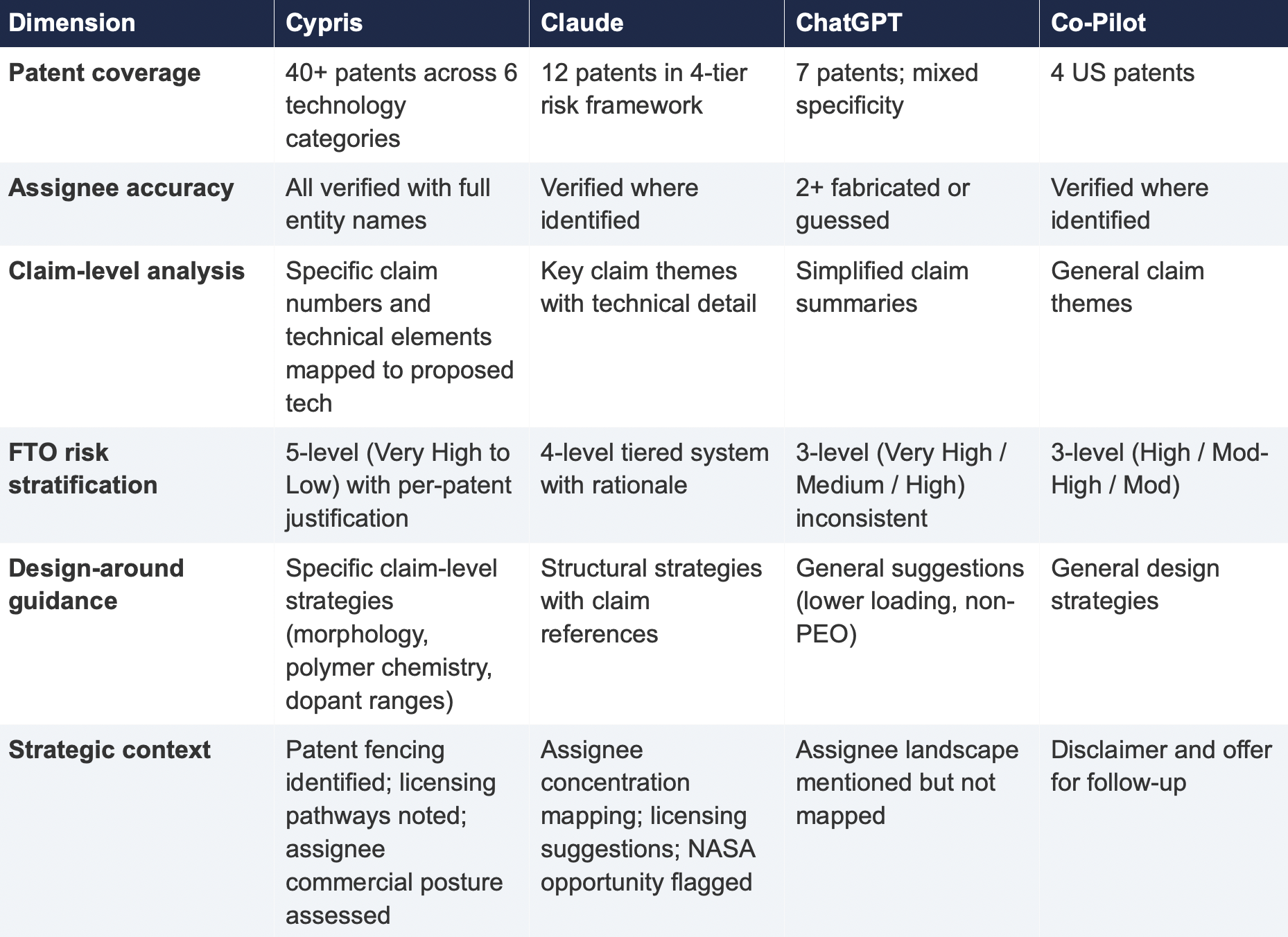
The most significant finding is the scale of the coverage differential. Cypris identified over 40 active US patents and published applications spanning LLZO-polymer composite electrolytes, garnet interface modification, polymer interlayer architectures, lithium-sulfur specific filings, and adjacent ceramic composite patents. The results were organized by technology category with per-patent FTO risk ratings.
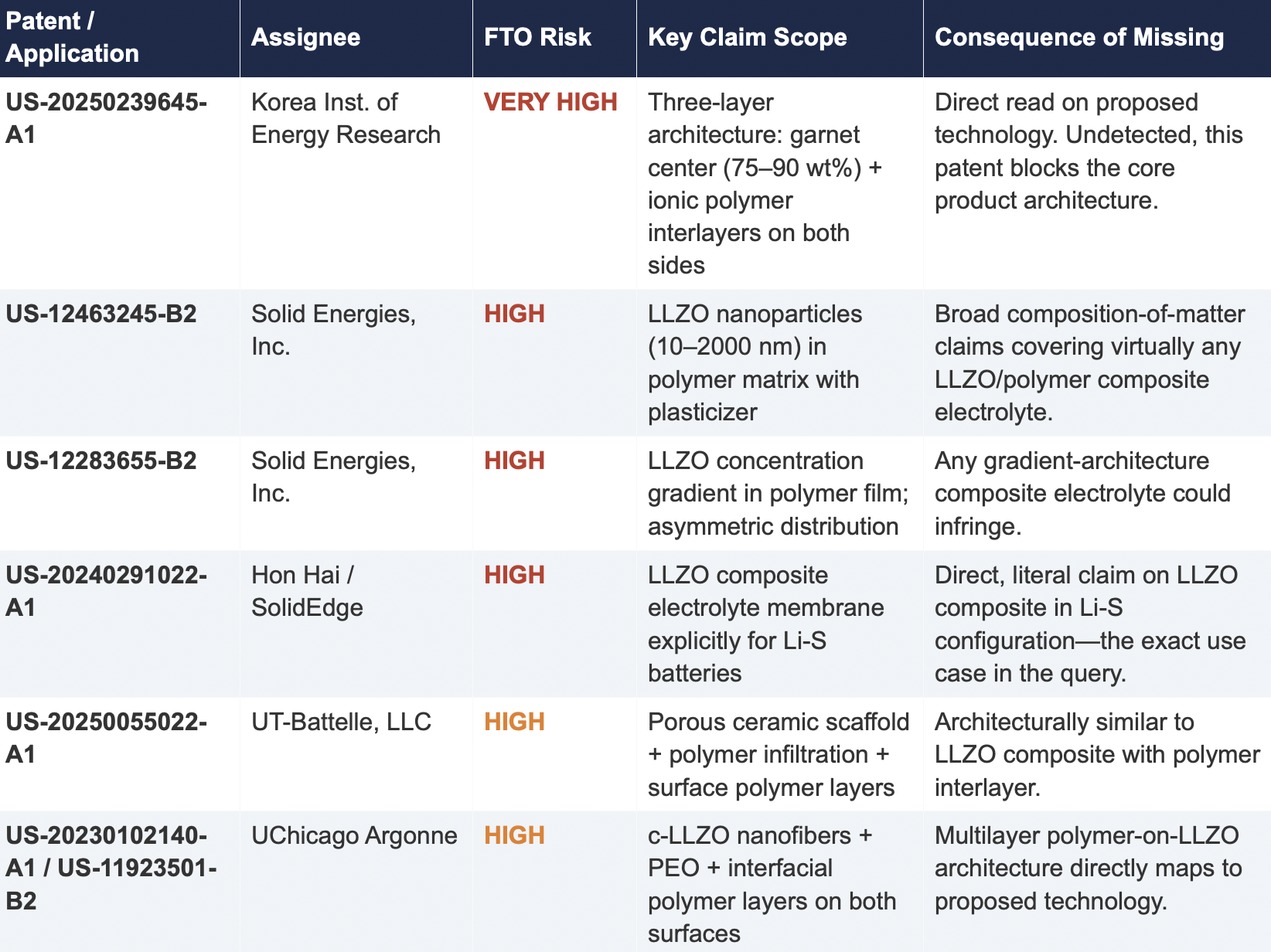
Claude identified 12 patents organized in a four-tier risk framework. Its analysis was structurally sound and correctly flagged the two highest-risk filings (Solid Energies US 11,967,678 and the LLZO nanofiber multilayer US 11,923,501). It also identified the University ofMaryland/ Wachsman portfolio as a concentration risk and noted the NASA SABERS portfolio as a licensing opportunity. However, it missed the majority of the landscape, including the entire Corning portfolio, GM's interlayer patents, theKorea Institute of Energy Research three-layer architecture, and the HonHai/SolidEdge lithium-sulfur specific filing.
ChatGPT identified 7 patents, but the quality of attribution was inconsistent. It listed assignees as "Likely DOE /national lab ecosystem" and "Likely startup / defense contractor cluster" for two filings—language that indicates the model was inferring rather than retrieving assignee data. In a freedom-to-operate context, an unverified assignee attribution is functionally equivalent to no attribution, as it cannot support a licensing inquiry or risk assessment.
Co-Pilot identified 4 US patents. Its output was the most limited in scope, missing the Solid Energies portfolio entirely, theUMD/ Wachsman portfolio, Gelion/ Johnson Matthey, NASA SABERS, and all Li-S specific LLZO filings.
2.2 Critical Patents Missed by Public Models
The following table presents patents identified exclusively by Cypris that were rated as High or Very High FTO risk for the proposed technology architecture. None were surfaced by any general-purpose model.
2.3 Patent Fencing: The Solid Energies Portfolio
Cypris identified a coordinated patent fencing strategy by Solid Energies, Inc. that no general-purpose model detected at scale. Solid Energies holds at least four granted US patents and one published application covering LLZO-polymer composite electrolytes across compositions(US-12463245-B2), gradient architectures (US-12283655-B2), electrode integration (US-12463249-B2), and manufacturing processes (US-20230035720-A1). Claude identified one Solid Energies patent (US 11,967,678) and correctly rated it as the highest-priority FTO concern but did not surface the broader portfolio. ChatGPT and Co-Pilot identified zero Solid Energies filings.
The practical significance is that a company relying on any individual patent hit would underestimate the scope of Solid Energies' IP position. The fencing strategy—covering the composition, the architecture, the electrode integration, and the manufacturing method—means that identifying a single design-around for one patent does not resolve the FTO exposure from the portfolio as a whole. This is the kind of strategic insight that requires seeing the full picture, which no general-purpose model delivered
2.4 Assignee Attribution Quality
ChatGPT's response included at least two instances of fabricated or unverifiable assignee attributions. For US 11,367,895 B1, the listed assignee was "Likely startup / defense contractor cluster." For US 2021/0202983 A1, the assignee was described as "Likely DOE / national lab ecosystem." In both cases, the model appears to have inferred the assignee from contextual patterns in its training data rather than retrieving the information from patent records.
In any operational IP workflow, assignee identity is foundational. It determines licensing strategy, litigation risk, and competitive positioning. A fabricated assignee is more dangerous than a missing one because it creates an illusion of completeness that discourages further investigation. An R&D team receiving this output might reasonably conclude that the landscape analysis is finished when it is not.
3. Structural Limitations of General-Purpose Models for Patent Intelligence
3.1 Training Data Is Not Patent Data
Large language models are trained on web-scraped text. Their knowledge of the patent record is derived from whatever fragments appeared in their training corpus: blog posts mentioning filings, news articles about litigation, snippets of Google Patents pages that were crawlable at the time of data collection. They do not have systematic, structured access to the USPTO database. They cannot query patent classification codes, parse claim language against a specific technology architecture, or verify whether a patent has been assigned, abandoned, or subjected to terminal disclaimer since their training data was collected.
This is not a limitation that improves with scale. A larger training corpus does not produce systematic patent coverage; it produces a larger but still arbitrary sampling of the patent record. The result is that general-purpose models will consistently surface well-known patents from heavily discussed assignees (QuantumScape, for example, appeared in most responses) while missing commercially significant filings from less publicly visible entities (Solid Energies, Korea Institute of EnergyResearch, Shenzhen Solid Advanced Materials).
3.2 The Web Is Closing to Model Scrapers
The data access problem is structural and worsening. As of mid-2025, Cloudflare reported that among the top 10,000 web domains, the majority now fully disallow AI crawlers such as GPTBot andClaudeBot via robots.txt. The trend has accelerated from partial restrictions to outright blocks, and the crawl-to-referral ratios reveal the underlying tension: OpenAI's crawlers access approximately1,700 pages for every referral they return to publishers; Anthropic's ratio exceeds 73,000 to 1.
Patent databases, scientific publishers, and IP analytics platforms are among the most restrictive content categories. A Duke University study in 2025 found that several categories of AI-related crawlers never request robots.txt files at all. The practical consequence is that the knowledge gap between what a general-purpose model "knows" about the patent landscape and what actually exists in the patent record is widening with each training cycle. A landscape query that a general-purpose model partially answered in 2023 may return less useful information in 2026.
3.3 General-Purpose Models Lack Ontological Frameworks for Patent Analysis
A freedom-to-operate analysis is not a summarization task. It requires understanding claim scope, prosecution history, continuation and divisional chains, assignee normalization (a single company may appear under multiple entity names across patent records), priority dates versus filing dates versus publication dates, and the relationship between dependent and independent claims. It requires mapping the specific technical features of a proposed product against independent claim language—not keyword matching.
General-purpose models do not have these frameworks. They pattern-match against training data and produce outputs that adopt the format and tone of patent analysis without the underlying data infrastructure. The format is correct. The confidence is high. The coverage is incomplete in ways that are not visible to the user.
4. Comparative Output Quality
The following table summarizes the qualitative characteristics of each tool's response across the dimensions most relevant to an operational IP workflow.
5. Implications for R&D and IP Organizations
5.1 The Confidence Problem
The central risk identified by this study is not that general-purpose models produce bad outputs—it is that they produce incomplete outputs with high confidence. Each model delivered its results in a professional format with structured analysis, risk ratings, and strategic recommendations. At no point did any model indicate the boundaries of its knowledge or flag that its results represented a fraction of the available patent record. A practitioner receiving one of these outputs would have no signal that the analysis was incomplete unless they independently validated it against a comprehensive datasource.
This creates an asymmetric risk profile: the better the format and tone of the output, the less likely the user is to question its completeness. In a corporate environment where AI outputs are increasingly treated as first-pass analysis, this dynamic incentivizes under-investigation at precisely the moment when thoroughness is most critical.
5.2 The Diversification Illusion
It might be assumed that running the same query through multiple general-purpose models provides validation through diversity of sources. This study suggests otherwise. While the four tools returned different subsets of patents, all operated under the same structural constraints: training data rather than live patent databases, web-scraped content rather than structured IP records, and general-purpose reasoning rather than patent-specific ontological frameworks. Running the same query through three constrained tools does not produce triangulation; it produces three partial views of the same incomplete picture.
5.3 The Appropriate Use Boundary
General-purpose language models are effective tools for a wide range of tasks: drafting communications, summarizing documents, generating code, and exploratory research. The finding of this study is not that these tools lack value but that their value boundary does not extend to decisions that carry existential commercial risk.
Patent landscape analysis, freedom-to-operate assessment, and competitive intelligence that informs R&D investment decisions fall outside that boundary. These are workflows where the completeness and verifiability of the underlying data are not merely desirable but are the primary determinant of whether the analysis has value. A patent landscape that captures 10% of the relevant filings, regardless of how well-formatted or confidently presented, is a liability rather than an asset.
6. Test 2: Competitive Intelligence — Bio-Based Polyamide Patent Landscape
To assess whether the findings from Test 1 were specific to a single technology domain or reflected a broader structural pattern, a second query was submitted to all four tools. This query shifted from freedom-to-operate analysis to competitive intelligence, asking each tool to identify the top 10organizations by patent filing volume in bio-based polyamide synthesis from castor oil derivatives over the past three years, with summaries of technical approach, co-assignee relationships, and portfolio trajectory.
6.1 Query

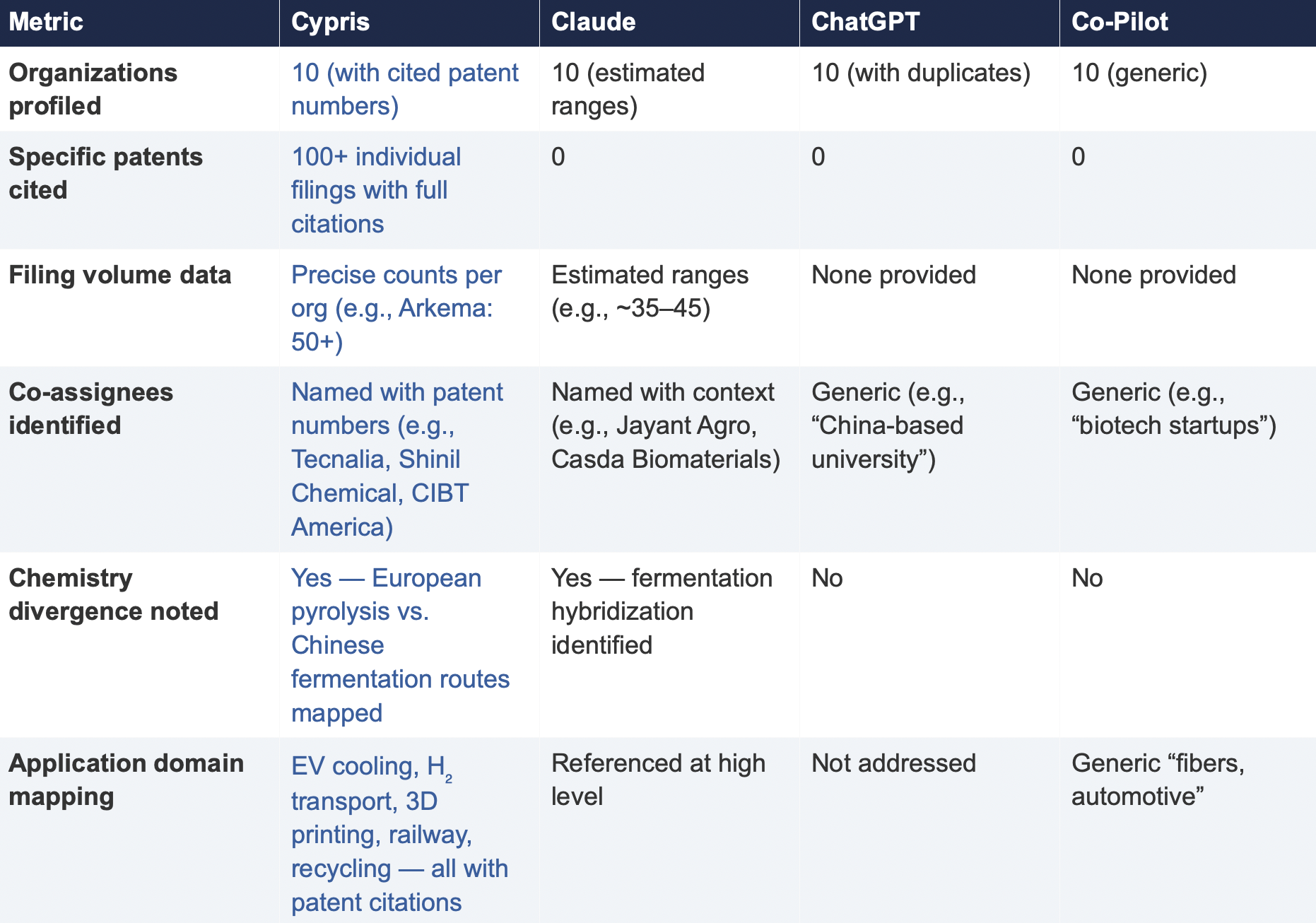
6.2 Summary of Results
6.3 Key Differentiators
Verifiability
The most consequential difference in Test 2 was the presence or absence of verifiable evidence. Cypris cited over 100 individual patent filings with full patent numbers, assignee names, and publication dates. Every claim about an organization’s technical focus, co-assignee relationships, and filing trajectory was anchored to specific documents that a practitioner could independently verify in USPTO, Espacenet, or WIPO PATENT SCOPE. No general-purpose model cited a single patent number. Claude produced the most structured and analytically useful output among the public models, with estimated filing ranges, product names, and strategic observations that were directionally plausible. However, without underlying patent citations, every claim in the response requires independent verification before it can inform a business decision. ChatGPT and Co-Pilot offered thinner profiles with no filing counts and no patent-level specificity.
Data Integrity
ChatGPT’s response contained a structural error that would mislead a practitioner: it listed CathayBiotech as organization #5 and then listed “Cathay Affiliate Cluster” as a separate organization at #9, effectively double-counting a single entity. It repeated this pattern with Toray at #4 and “Toray(Additional Programs)” at #10. In a competitive intelligence context where the ranking itself is the deliverable, this kind of error distorts the landscape and could lead to misallocation of competitive monitoring resources.
Organizations Missed
Cypris identified Kingfa Sci. & Tech. (8–10 filings with a differentiated furan diacid-based polyamide platform) and Zhejiang NHU (4–6 filings focused on continuous polymerization process technology)as emerging players that no general-purpose model surfaced. Both represent potential competitive threats or partnership opportunities that would be invisible to a team relying on public AI tools.Conversely, ChatGPT included organizations such as ANTA and Jiangsu Taiji that appear to be downstream users rather than significant patent filers in synthesis, suggesting the model was conflating commercial activity with IP activity.
Strategic Depth
Cypris’s cross-cutting observations identified a fundamental chemistry divergence in the landscape:European incumbents (Arkema, Evonik, EMS) rely on traditional castor oil pyrolysis to 11-aminoundecanoic acid or sebacic acid, while Chinese entrants (Cathay Biotech, Kingfa) are developing alternative bio-based routes through fermentation and furandicarboxylic acid chemistry.This represents a potential long-term disruption to the castor oil supply chain dependency thatWestern players have built their IP strategies around. Claude identified a similar theme at a higher level of abstraction. Neither ChatGPT nor Co-Pilot noted the divergence.
6.4 Test 2 Conclusion
Test 2 confirms that the coverage and verifiability gaps observed in Test 1 are not domain-specific.In a competitive intelligence context—where the deliverable is a ranked landscape of organizationalIP activity—the same structural limitations apply. General-purpose models can produce plausible-looking top-10 lists with reasonable organizational names, but they cannot anchor those lists to verifiable patent data, they cannot provide precise filing volumes, and they cannot identify emerging players whose patent activity is visible in structured databases but absent from the web-scraped content that general-purpose models rely on.
7. Conclusion
This comparative analysis, spanning two distinct technology domains and two distinct analytical workflows—freedom-to-operate assessment and competitive intelligence—demonstrates that the gap between purpose-built R&D intelligence platforms and general-purpose language models is not marginal, not domain-specific, and not transient. It is structural and consequential.
In Test 1 (LLZO garnet electrolytes for Li-S batteries), the purpose-built platform identified more than three times as many patents as the best-performing general-purpose model and ten times as many as the lowest-performing one. Among the patents identified exclusively by the purpose-built platform were filings rated as Very High FTO risk that directly claim the proposed technology architecture. InTest 2 (bio-based polyamide competitive landscape), the purpose-built platform cited over 100individual patent filings to substantiate its organizational rankings; no general-purpose model cited as ingle patent number.
The structural drivers of this gap—reliance on training data rather than live patent feeds, the accelerating closure of web content to AI scrapers, and the absence of patent-specific analytical frameworks—are not transient. They are inherent to the architecture of general-purpose models and will persist regardless of increases in model capability or training data volume.
For R&D and IP leaders, the practical implication is clear: general-purpose AI tools should be used for general-purpose tasks. Patent intelligence, competitive landscaping, and freedom-to-operate analysis require purpose-built systems with direct access to structured patent data, domain-specific analytical frameworks, and the ability to surface what a general-purpose model cannot—not because it chooses not to, but because it structurally cannot access the data.
The question for every organization making R&D investment decisions today is whether the tools informing those decisions have access to the evidence base those decisions require. This study suggests that for the majority of general-purpose AI tools currently in use, the answer is no.
About This Report
This report was produced by Cypris (IP Web, Inc.), an AI-powered R&D intelligence platform serving corporate innovation, IP, and R&D teams at organizations including NASA, Johnson & Johnson, theUS Air Force, and Los Alamos National Laboratory. Cypris aggregates over 500 million data points from patents, scientific literature, grants, corporate filings, and news to deliver structured intelligence for technology scouting, competitive analysis, and IP strategy.
The comparative tests described in this report were conducted on March 27, 2026. All outputs are preserved in their original form. Patent data cited from the Cypris reports has been verified against USPTO Patent Center and WIPO PATENT SCOPE records as of the same date. To conduct a similar analysis for your technology domain, contact info@cypris.ai or visit cypris.ai.
The Patent Intelligence Gap - A Comparative Analysis of Verticalized AI-Patent Tools vs. General-Purpose Language Models for R&D Decision-Making
All Blogs

Do you want to learn how to sell innovation ideas? It can be intimidating to market your idea, particularly if you’re uncertain who it would best suit. To ensure success when marketing innovative ideas, it is essential to have a well-thought-out strategy and comprehend how best to communicate your idea.
This blog post will provide tips on identifying the ideal target market, preparing yourself before pitching your innovation idea, effectively presenting it with confidence, and closing the deal successfully. We’ll also discuss ways of leveraging successful sales so that you can maximize returns from each sale. Let’s learn how to sell innovation ideas!
Table of Contents
How to Sell Innovation Ideas: Finding the Right Audience
How to Sell Innovation Ideas: Closing the Deal
Leveraging Your Successful Deal
Expand Network of Contacts and Clients
How to Sell Innovation Ideas: Finding the Right Audience
Identifying the right audience for your innovation idea is essential to its success. Researching potential buyers can help you determine who might be interested in your product or service and allow you to craft an effective pitch.
Understanding your target market is key, as it will enable you to tailor your message and increase the likelihood of a successful sale. Formulating an effective appeal should involve particular information about what distinguishes your product or service, how it could be advantageous to prospective purchasers, and why they ought to invest in it.
When researching potential buyers, look for companies that are likely to need the type of solution that you offer. Consider factors such as size, industry sector, location, budget constraints, and any other relevant criteria when conducting this research.
This will help ensure that you’re targeting the most appropriate prospects with your pitch. Additionally, consider attending trade shows or networking events related to your field to meet new contacts who may be interested in investing in innovative solutions like yours.
Gleaning insights into customer behavior is key when it comes to understanding your target market and tailoring both content and delivery of information accordingly during presentations or pitches. To do this effectively, one should delve deep into the data by conducting market research such as collecting feedback from existing customers, analyzing competitors’ offerings, monitoring industry trends, assessing pricing strategies used by rivals, and examining distribution channels utilized by opponents.
All these activities will arm you with valuable knowledge that can help inform decisions around positioning strategy when you sell ideas.
By understanding your target market and crafting an effective pitch, you can ensure that the right audience hears about your innovative idea. Preparing to sell ideas requires developing a business plan, establishing pricing and terms of sale, as well as creating a presentation deck – all key components for success.
Key Takeaway: Identifying the appropriate target for a new concept is necessary to raise its prospects of success. To do this, market research must be conducted – gathering customer feedback and analyzing competitor data – before crafting a tailored pitch that highlights what makes your product or service unique. This will help ensure you hit the mark when selling innovative solutions.
Preparing for Selling Ideas
Preparation is an important part of learning how to sell innovation ideas. Presenting your product ideas can be intimidating, yet with proper prep and exploration it doesn’t need to be.
Create a Business Plan
Before making your pitch, create a comprehensive business plan that covers all aspects of marketing and monetizing the idea, such as pricing models, payment terms, and customer service policies. Before committing, it is critical to set forth specific terms of sale that both parties agree upon.
Create a Pitch Deck
Once you have all of these pieces in place, it’s time to create a presentation deck that effectively conveys your message and convinces potential buyers of the value of your product ideas. Make sure to highlight key features or benefits to pique their interest and demonstrate why investing in this product is worth their while.
Include visuals if possible—images or videos can help illustrate points more clearly than words alone can do. Additionally, use industry-specific language when talking about your product ideas so that buyers know you understand their needs and challenges from an insider perspective.

(Source)
Network
Finally, don’t forget about the importance of networking when selling product ideas. Reach out to potential buyers directly through social media platforms or attend events where you can meet people face-to-face who may be interested in hearing more about what you have to offer them.
By making connections ahead of time and providing detailed information on how buying into your solution could benefit them financially or otherwise down the line, they will likely be much more receptive when it comes time for negotiations later on.
Proper preparation is key to a successful sale of your innovation idea, so take the time to develop an effective business plan, set pricing and terms of sale that are beneficial for both parties, and create a presentation deck that effectively communicates your message. With these steps completed, you have learned to prepare how to sell innovation ideas.
Key Takeaway: Before selling an innovation idea, it’s important to have a solid business plan and presentation deck ready. Networking is also key. Reach out to potential buyers in advance so they understand the value of your product before negotiations begin. When done correctly, pitching can be as easy as pie.
How to Sell Innovation Ideas: Closing the Deal
Closing the deal on your innovation idea is a critical step in ensuring its success. To do so, you must finalize contracts and agreements, secure payment and delivery terms, and ensure customer satisfaction.
When it comes to settling agreements, everyone involved must comprehend their privileges and duties. It is essential to be aware of any applicable intellectual property regulations and other legal conditions related to the goods or services being transacted.
It also means making sure both parties are clear about expectations for delivery timelines, quality control standards, warranties, or guarantees offered by either party.
Before providing any goods or services, ensure that payment terms are established. Before providing any goods or services, ensure that you are aware of the payment method and terms (e.g., credit cards vs cash; net 30) to be utilized for the transaction, as well as setting up an escrow account if needed for additional protection.
Additionally, consider setting up an escrow account if needed to protect both sides from unexpected delays in payment or delivery of goods/services provided by either party throughout the agreement/contractual relationship between buyer and seller(s).
Key Takeaway: Finalizing contracts and agreements, securing payment terms, and ensuring customer satisfaction are all essential steps to successfully closing the deal on an innovative idea. Realizing relevant IP statutes and forming a safe escrow account are both key for assuring all involved in the contractual accord.
Leveraging Your Successful Deal
Leveraging a successful deal is an important step in growing your business. Building brand awareness and reputation, expanding your network of contacts and clients, and pursuing additional opportunities are all key components to achieving success.
Building Brand Awareness
The objective of constructing brand recognition and status is to generate a favorable notion among potential customers concerning your product or service. This can be done through advertising campaigns, social media outreach, word-of-mouth marketing, attending industry events or trade shows, or creating content that showcases the value of what you have to offer.
Having efficient customer assistance measures in place can help make sure that customers are content with their acquisition, thus enabling them to promote the merits of your product or service.
Expand Network of Contacts and Clients
Expanding your network of contacts and clients should also be part of any successful strategy. Networking with potential buyers can give you insight into current market trends as well as provide valuable connections for future deals.
Forming ties with influential figures in the field who already have extensive networks can give you a gateway to reach broader crowds than if working independently, thus offering new prospects for expansion.
Pursue Opportunities
Finally, pursuing additional opportunities allows businesses to capitalize on past successes while continuing to innovate to stay ahead of competitors in the marketplace. Exploring new technologies, like AI or ML, can give companies the ability to automate tasks and improve productivity while decreasing expenditure on manual labor activities such as data entry or consumer support inquiries.
Exploring international markets could open up possibilities for global expansion depending on the type of products being sold and local regulations governing those products within different countries around the world.
Leveraging a successful innovation idea sale requires taking proactive steps toward building brand awareness and reputation, expanding one’s network, and actively seeking out new opportunities that may arise from existing successes.
Key Takeaway: To ensure success in selling innovative ideas, it is essential to establish a positive brand image and expand one’s network of contacts. Moreover, businesses should capitalize on past successes while exploring new technologies or international markets for further opportunities.
Conclusion
Now we have learned how to sell innovation ideas. The success of selling ideas depends on having the right audience, preparing to present your idea compellingly, and leveraging successful sales.
Having the correct listeners and convincingly presenting your concept, along with utilizing successful sales techniques, can guarantee that your innovative thought will be heard by those who need to hear it and have a chance of making an effect. Ultimately, when it comes time to sell original ideas effectively, preparation is key.
Increase the speed and accuracy of your innovation process with Cypris. Our platform helps R&D and innovation teams to quickly uncover insights from data sources, allowing them to sell their ideas faster.


In the world of patented technology, standard essential patents (SEPs) play a crucial role in driving innovation and fostering collaboration among industry stakeholders. As R&D managers, engineers, and scientists navigate this complex landscape, understanding the intricacies of SEPs becomes increasingly important.
This blog post will delve into various aspects surrounding SEPs, such as their impact on technological advancements and how they encourage collaboration through standardization. We will also discuss the challenges associated with valuing SEPs based on consumer welfare contribution and explore the complexities that arise from fair reasonable and non-discriminatory terms.
Moreover, we will examine persistent disputes over royalty payments involving major industry players within the telecommunications sector and analyze complexities surrounding technology supply chains. Lastly, we’ll touch upon divergent interests within standard-setting organizations (SSOs) while exploring alternative approaches to SEP valuation that mitigate risks associated with royalty stacking.
Table of Contents
- The Importance of Standard Essential Patents
- SEPs’ Impact on Technological Advancements
- Encouraging Collaboration Through Standardization
- Valuing SEPs Based on Consumer Welfare Contribution
- Direct vs. Indirect Benefits of Patented Technologies
- Assessing True Worth of Standard Essential Patents
- Fair Reasonable And Non-Discriminatory (FRAND) Terms Challenges
- Balancing Fair Compensation with Accessibility
- EU Approach to Standard Essential Patents
- Persistent Disputes Over Royalty Payments
- Ongoing Challenges in Telecommunications Sector
- Legal Battles Involving Major Industry Players
- Complexities Surrounding Technology Supply Chains
- Determining Appropriate Licensing Points
- Royalty Stacking’s Impact on Innovation
- Divergent Interests Within Standard-Setting Organizations (SSOs)
- Balancing Incentives for Innovation with Accessibility
- The Role of Intellectual Property Protections in Driving R&D Investments
- Alternative Approaches to SEP Valuation
- Component-Level Licensing Approach
- Mitigating the Risk of Royalty Stacking
- Conclusion
The Importance of Standard Essential Patents
Standard essential patents (SEPs) play a crucial role in industries that rely on interoperability and compatibility between different products. They protect innovations required to comply with industry standards, ensuring seamless functionality within an ecosystem, promoting innovation, and driving economic growth. SEPs have a significant impact on technological advancements by encouraging collaboration through standardization.

SEPs’ Impact on Technological Advancements
Innovation thrives when companies can build upon existing patented technology, creating new products or improving existing ones. By protecting the core technologies necessary for compliance with industry standards, SEPs enable companies to develop compatible solutions without fear of patent infringement.
Encouraging Collaboration Through Standardization
- Promoting Interoperability: When multiple manufacturers adhere to the same set of technical specifications defined by a standard-setting organization (SSO), their products can seamlessly interact with one another, benefiting both consumers and businesses alike.
- Fostering Competition: By granting access to essential patented technologies under fair terms, more players can enter the market and compete effectively against established entities like major patent holders such as Qualcomm or Nokia.
- Catalyzing Innovation: As organizations work together towards common goals within SSOs, they are more likely to share knowledge and resources that drive further research and development efforts across various sectors including telecommunications where 5G rollout has sparked numerous legal battles surrounding alleged infringement upon SEPs held by major players like Qualcomm and Nokia amongst others.
SEPs are critical for companies that rely on interoperability and compatibility between different products. They protect the core technologies necessary for compliance with industry standards, enabling companies to develop compatible solutions without fear of patent infringement.
By granting access to essential patented technologies under fair terms, more players can enter the market and compete effectively against established entities like major patent holders such as Qualcomm or Nokia. This promotes innovation and drives economic growth.
Standard Essential Patents (SEPs) promote innovation by protecting core technologies needed for industry standards compliance, encouraging collaboration and driving economic growth. #SEP #innovation #collaboration Click to Tweet
Valuing SEPs Based on Consumer Welfare Contribution
Researchers at UC-Berkeley’s Tusher Center for Intellectual Property suggest valuing standard essential patents based on their contribution to consumer welfare rather than their position within the supply chain or technology stack. This approach considers both direct benefits provided by patented technologies as well as indirect benefits resulting from increased competition among suppliers using those technologies.
Direct vs. Indirect Benefits of Patented Technologies
- Direct benefits: These refer to the immediate advantages offered by a specific patented technology, such as improved performance, enhanced functionality, or reduced production costs.
- Indirect benefits: These arise from the competitive dynamics spurred by multiple companies utilizing and improving upon a particular innovation protected under a SEP, leading to better products and services in the market overall.
Assessing True Worth of Standard Essential Patents
To accurately value SEPs based on their contributions to consumer welfare, it is crucial for R&D managers and engineers involved in product development processes to consider not only how a given patent impacts their own operations but also its broader implications across entire industries. By doing so, they can ensure that licensing negotiations reflect fair compensation for patent holders while promoting continued innovation within ecosystems reliant upon standardized technologies.
Valuing SEPs based on consumer welfare contribution is a complex process that requires careful consideration of both direct and indirect benefits. Moving forward, it is important to consider the challenges posed by Fair Reasonable And Non-Discriminatory terms when assessing the true worth of standard essential patents.
Valuing standard essential patents based on consumer welfare contribution can promote fair compensation for patent holders and foster innovation in standardized tech ecosystems. #SEPs #innovation Click to Tweet
Fair Reasonable And Non-Discriminatory (FRAND) Terms Challenges
One key challenge facing Cypris and other companies that rely on standardized technologies is determining “fair” compensation for patent holders while allowing access to these technologies at reasonable costs without stifling innovation. This is also known as FRAND terms. The European Commission has attempted to address this issue through guidelines aimed at fostering transparency and fairness in licensing negotiations for standard essential patents (SEPs).
Balancing Fair Compensation with Accessibility
To achieve a balance between compensating patent holders and ensuring accessibility, it’s crucial that FRAND terms are established. These terms should reflect the true value of patented technology, taking into account its contribution to consumer welfare and industry standards. However, determining a fair royalty rate or licensing fee can be challenging due to differing opinions.
EU Approach to Standard Essential Patents
The European Commission’s approach to SEPs focuses on promoting good-faith negotiations between parties involved in licensing agreements. By encouraging transparency in disclosing essential patents, setting clear methodologies for calculating royalties, and providing dispute resolution mechanisms, they aim to reduce conflicts over SEPs while supporting innovation within industries reliant upon these patents.
FRAND terms challenges are an important issue for R&D and innovation teams to consider, as they can affect the cost of product development. As such, it is essential to be aware of persistent disputes over royalty payments in order to ensure fair compensation without compromising accessibility.
Ensuring fair compensation for patent holders while promoting accessibility to standardized technologies is crucial. The EU’s approach to SEPs aims to strike a balance and foster innovation. #FRANDterms #SEPs #innovation Click to Tweet
Persistent Disputes Over Royalty Payments
Despite the existence of frameworks designed to mitigate disputes over royalty payments, conflicts persist across various sectors. One prominent example is the telecommunications industry, where the rollout of 5G technology has sparked numerous legal battles surrounding alleged infringement upon standard essential patents held by major players like Qualcomm and Nokia.
Ongoing Challenges in Telecommunications Sector
- Licensing disagreements: Companies often struggle to reach a consensus on fair, reasonable, and non-discriminatory (FRAND) terms for licensing SEPs.
- Injunction threats: Patent holders may resort to seeking injunctions against alleged infringers as a negotiation tactic or means of asserting their rights.
- Cross-licensing complexities: The interdependence of patented technologies within an ecosystem can lead to intricate cross-licensing arrangements that are difficult to navigate and enforce.
Legal Battles Involving Major Industry Players
Recent years have seen major industry players embroiled in complex legal battles, such as Apple’s accusations of anti-competitive practices against Qualcomm and Nokia’s suit against Daimler over connected car technology. For instance, Apple accused Qualcomm of engaging in anti-competitive practices related to its SEP licensing strategy.
Similarly, Nokia sued Daimler over patent infringements concerning connected car technology. These cases underscore the ongoing challenges surrounding SEP valuation and royalty payments.
Persistent disputes over royalty payments have become a significant challenge in the telecommunications sector, with major industry players embroiled in legal battles. Moving on to discuss complexities surrounding technology supply chains, it is essential to understand how appropriate licensing points and royalty stacking can influence innovation.
Persistent disputes over royalty payments for standard essential patents continue to plague the telecommunications industry, leading to legal battles and licensing disagreements. #SEPs #telecoms #patents Click to Tweet
Complexities Surrounding Technology Supply Chains
The growing complexity of technology supply chains makes it increasingly difficult to determine where in the value chain a particular patent should be licensed. This can lead to royalty stacking, where multiple licensing fees are levied at different stages of production, potentially resulting in inflated costs for end consumers and stifling innovation.
Determining Appropriate Licensing Points
In order to address this issue, companies need to carefully assess their products and identify which components directly utilize standard essential patents. By doing so, they can ensure that appropriate royalties are paid only for the patented technologies used within specific parts of their product rather than on an entire device incorporating them.
Royalty Stacking’s Impact on Innovation
- Negative effects: Royalty stacking may discourage smaller firms from entering markets dominated by large corporations with extensive patent portfolios due to high licensing costs.
- Limited competition: High royalty fees might deter new players from investing in R&D efforts or launching innovative products based on standardized technologies protected by SEPs.
- Inflated consumer prices: The cumulative effect of royalty stacking could result in higher retail prices for devices utilizing patented technology, ultimately affecting consumer welfare negatively.
To overcome these challenges, alternative approaches such as component-level licensing have been proposed. These methods aim at fostering more equitable outcomes across all parties involved while mitigating risks associated with royalty stacking (source).
The complexities surrounding technology supply chains are complex and require careful consideration when making decisions. Despite the complexity, understanding divergent interests within standard-setting organizations is essential for achieving optimal outcomes in terms of innovation and accessibility.
Technology supply chains are becoming complex, making it hard to license standard essential patents. Let’s ensure fair royalties and promote innovation with component-level licensing. #SEPs #innovation Click to Tweet
Divergent Interests Within Standard-Setting Organizations (SSOs)
Stakeholders within SSOs may have differing views on how best to balance incentives for innovation with ensuring access to standardized technologies. Some argue that granting exclusive rights through patents can discourage collaboration and hinder technological progress, while others contend that strong intellectual property protections drive investment into R&D efforts, ultimately benefiting entire industries as well as individual inventors alike.
Balancing Incentives for Innovation with Accessibility
In order to strike the right balance between promoting innovation and maintaining accessibility of standard essential patents, it is crucial for stakeholders within SSOs to engage in open dialogue and reach consensus on fair licensing terms. This ensures that patented technology remains accessible while still rewarding patent holders for their contributions.
The Role of Intellectual Property Protections in Driving R&D Investments
Research has shown that robust IP protection encourages companies to invest more resources into research and development activities. By securing exclusive rights over their innovations, businesses are motivated to pursue groundbreaking ideas without fear of patent infringement or unauthorized use by competitors. As a result, stronger IP safeguards contribute positively towards overall industry growth and advancement.
The divergent interests within Standard-Setting Organizations (SSOs) must be carefully balanced in order to ensure that innovation is incentivized while accessibility remains a priority. Alternative approaches to SEP valuation, such as component-level licensing and mitigating the risk of royalty stacking, can help create an equitable system for all stakeholders involved.
Standard essential patents require a delicate balance between innovation and accessibility. Stakeholders must engage in open dialogue to reach fair licensing terms. #IPprotection #innovation Click to Tweet
Alternative Approaches to SEP Valuation
In light of the complexities surrounding the valuation of standard essential patents, some researchers propose alternative approaches aimed at fostering more equitable outcomes across all parties involved. One such example is the “component-level” licensing approach, which has the potential to mitigate risks associated with royalty stacking.
Component-Level Licensing Approach
This method involves applying royalties only to specific components that directly utilize patented innovations rather than entire devices incorporating them. By focusing on individual parts instead of whole products, component-level licensing can help prevent excessive fees and promote a fairer distribution of costs among patent holders and manufacturers alike. For instance, a study by Kuhn & Sidak (2023) highlights how this strategy could be applied in the telecommunications sector for 5G technology implementation.
Mitigating the Risk of Royalty Stacking
Royalty stacking occurs when multiple licensing fees are levied at different stages of production, potentially leading to inflated costs for end consumers and stifling innovation. By adopting a component-level approach to SEP valuation, companies can minimize these issues while still providing adequate compensation for patented technology without infringing upon their rights or discouraging further technological advancements within their respective industries.
Revolutionize the valuation of standard essential patents with the component-level licensing approach, promoting the fair distribution of costs and mitigating royalty stacking risks. #SEPvaluation #innovation Click to Tweet
Conclusion
In conclusion, standard essential patents play a crucial role in promoting innovation and compatibility within technology industries; however, challenges surrounding fair compensation, divergent interests among stakeholders, and the complexity of technology supply chains pose significant obstacles to achieving more equitable outcomes. Despite these challenges, alternative approaches such as component-level licensing offer potential benefits in promoting widespread adoption and fair compensation. As companies continue to navigate the complexities of SEP disputes and negotiations, it is important to prioritize consumer welfare while also fostering technological progress.
If you need assistance with navigating the complex world of standard essential patents or other intellectual property matters, discover the power of Cypris and unlock your team’s potential. Our platform provides rapid time-to-insights, centralizing data sources for improved R&D and innovation team performance.

Understanding patent lawyer cost is crucial for R&D Managers, Product Development Engineers, Senior Scientists, and other professionals in the research and innovation space. Navigating the complex world of patents can be challenging without expert guidance from experienced patent attorneys.
In this blog post, we will delve into various aspects of patent lawyer cost, such as hourly rates and factors affecting them. Hiring a reliable patent attorney is essential for averting potential issues in the patent process and guaranteeing suitable security of your intellectual property rights.
Furthermore, we’ll explore additional costs associated with obtaining patents like search costs or professional drawing expenses. To help you make an informed decision when selecting a legal representative for your invention’s protection journey, we’ll provide insights on researching credentials and seeking recommendations from peers before engaging an attorney or agent.
Lastly, weighing between self-filing versus engaging professionals is essential to manage your overall patent application cost-effectively; thus our discussion includes examining the pros and cons of both methods while considering alternative strategies such as preparing well for consultations or exploring self-filing options.
Table of Contents
- Patent Lawyer Cost per Hour
- Factors Affecting Patent Lawyer Cost
- Comparing Prices Among Intellectual Property Lawyers
- Importance of Hiring a Patent Lawyer
- Avoiding Common Pitfalls in the Patent Process
- Ensuring Proper Protection of Intellectual Property Rights
- Additional Costs Associated with Obtaining Patents
- Patent Search Costs
- Professional Drawing Expenses
- Filing Fee Variations
- Research Before Hiring an Attorney or Agent
- Checking Credentials and Success Rate
- Seeking Recommendations from Peers
- Self-filing instead of Engaging Professionals
- Pros and Cons of Self-filing
- Managing Patent Costs Effectively
- Preparing well for consultations
- Conclusion
Patent Lawyer Cost per Hour
The cost of engaging a patent attorney can differ significantly based on various components such as area, the legal representative’s proficiency level, and the intricacy of your invention. On average, a patent lawyer charges around $380 per hour, with fees potentially reaching up to the higher range of $800 in major cities such as New York or San Francisco. In major cities like New York or San Francisco, rates can be between $400 and $800+ per hour.
Factors Affecting Patent Lawyer Cost
- Location: Patent attorneys in metropolitan areas tend to charge higher fees due to increased demand and higher living costs.
- Experience Level: More experienced lawyers typically command higher hourly rates because they have greater expertise in navigating complex patent law.
- Invention Complexity: If your invention is particularly complicated or requires specialized knowledge, you may need to pay more for an attorney who has specific expertise in that area.
Comparing Prices Among Intellectual Property Lawyers
To find the best value for your money when seeking a patent attorney, it’s essential to compare prices among multiple professionals near you. Be sure not only to consider their hourly rate but also any additional fees related to services like conducting a thorough patent search, preparing professional drawings required by the United States Patent Office (USPTO), or drafting detailed patent applications.
When hiring a patent attorney, it is essential to take into account the various hourly rates they charge based on their experience and proficiency. It is essential to guarantee the proper safeguarding of one’s intellectual property rights by executing a meticulous assessment prior to picking an IP lawyer.
Need a patent lawyer? Hourly rates vary based on location, experience level & invention complexity. Compare prices to find the best value for your money. #PatentLawyerCost #Innovation Click to Tweet
Importance of Hiring a Patent Lawyer
Hiring a patent lawyer is almost always recommended for inventors seeking to protect their intellectual property rights because they can help avoid costly mistakes that may lead to losing those rights. A patent application, when done by a professional lawyer, generally comes with an expense of $5k-$7k.
Avoiding Common Pitfalls in the Patent Process
An expert patent attorney will be well-versed in patent law, helping you navigate through complex regulations and requirements. They can identify potential issues with your invention’s patentability, such as prior art or lack of novelty, ensuring that your application has the best chance of success. Additionally, attorneys are skilled at drafting claims that provide broad protection while avoiding infringement on existing patents.
Ensuring Proper Protection of Intellectual Property Rights
- Patent Search: A thorough patent search conducted by a professional ensures that no similar inventions have already been patented or published.
- Drafting Claims: Your lawyer will draft clear and concise claims defining the scope of your invention’s protection.
- Filing Assistance: An experienced attorney will guide you through the entire filing process with the United States Patent and Trademark Office (USPTO), ensuring all necessary documentation is submitted correctly and on time.
- Patent Prosecution: In case of objections or rejections, your lawyer will respond to the USPTO examiner’s concerns and negotiate for a favorable outcome.

Hiring a patent attorney can save you time, money, and potential legal disputes in the long run by providing expert guidance throughout the entire patent process. The total cost of hiring a patent lawyer may vary depending on factors such as patent lawyer fees, patent application costs, patent filing fees, drawing fees, and additional fees. However, the cost is worth it to ensure proper patent protection for your invention.
Engaging a patent attorney is critical to safeguard your intellectual property rights and evade any issues that may arise during the patent process. Additionally, it’s important to consider additional costs associated with obtaining patents such as professional drawing expenses, filing fee variations, and patent search costs.
Protect your intellectual property rights with the help of a patent lawyer. Avoid costly mistakes and ensure proper protection for your invention. #PatentLawyer #IntellectualPropertyRights Click to Tweet
Additional Costs Associated with Obtaining Patents
Apart from hourly rates for legal services rendered during consultations or meetings related directly to your casework, there are other expenses associated with obtaining patents that should be considered. These include search fees, professional drawings, and filing fees.
Patent Search Costs
To ensure the uniqueness of an invention and avoid infringing on existing patents, a thorough patent search should be conducted prior to submitting a patent application. This process typically costs between $500 and $1,000 when conducted by an experienced attorney or agent.
Professional Drawing Expenses
For your patent application to be complete, you will likely require drawings of your invention; these can be created by professional draftsmen at a price of $300-$500 per drawing. Professional draftsmen can create these illustrations for you at a cost ranging from $300 to $500 per drawing.
Filing Fee Variations
- Utility Patent: The United States Patent and Trademark Office (USPTO) charges different filing fees based on the type of patent being sought. For example, utility patents have base filing fees starting at around $320 for micro entities up to approximately $1,600 for large entities.
- Design Patent: Design patent applications come with their own set of fees as well; they start at roughly $200 for micro entities going up to about $800 for large entities.
- Maintenance Fees: Keep in mind that after obtaining a utility patent, you will need to pay maintenance fees at regular intervals (3.5, 7.5, and 11.5 years) to keep your patent in force.
It is important to note that patent lawyer fees can vary depending on the law firm and the complexity of the patent process. It is recommended to obtain a patentability opinion from a patent attorney before beginning the patent application process to determine the total cost and any additional fees that may be required.
Protecting your invention with a patent? Don’t forget about additional costs like search fees, professional drawings, and filing fees. Let Cypris help guide you through the process. #patentlawyer #innovation Click to Tweet
Research Before Hiring an Attorney or Agent
It is important to do thorough research on potential attorneys’ backgrounds and fees before making any commitments. This ensures that you not only save money but also receive quality representation throughout the entire patent process. By comparing prices from multiple professionals near you while considering their expertise, you can make a more informed decision.
Checking Credentials and Success Rate
Prioritize patent lawyers with strong credentials in your industry and a proven track record of successful patent applications. Verify their experience by checking online reviews, and testimonials, or asking for references. Confirm the registration of patent attorneys or agents by consulting resources such as the USPTO database.
Seeking Recommendations from Peers
- Talk to colleagues who have successfully obtained patents in your field; ask about their experiences working with specific patent lawyers.
- Contact professional organizations related to your industry for recommendations on reputable intellectual property law firms specializing in patents.
- If possible, attend conferences where experienced inventors share insights into navigating the complex world of patents – this may lead to valuable connections with skilled legal professionals.
In addition to finding a qualified attorney at an affordable price point, it’s essential that you feel comfortable discussing sensitive information regarding your invention idea. A good lawyer-client relationship will ensure smoother communication during the application process and improve the chances of obtaining robust patent protection.
While patent lawyer cost may seem steep, their expertise can save you money in the long run by avoiding costly mistakes during the patent process. Additionally, obtaining a patent can provide valuable protection for your invention and potentially lead to increased profits.
Do your research before hiring a patent lawyer. Prioritize credentials, seek recommendations from peers and discuss fees upfront to ensure quality representation. #patentlawyer #researchfirst Click to Tweet
Self-filing instead of Engaging Professionals
For those who choose to go it alone, a thorough patent search is essential and can be quite time-consuming. Acquiring a patent on your own requires conducting a thorough search using intellectual property management software, which can take considerable time and effort.
Pros and Cons of Self-filing
- Pros: Lower costs, greater control over the process, learning about the intricacies of patent law.
- Cons: Time-consuming, potential mistakes in application or documentation that could jeopardize protection rights, lack of professional guidance through complex procedures.
Self-filing is an attractive option for some, but engaging a professional can be beneficial to ensure the patent application process runs smoothly. Managing patent costs effectively requires preparation and exploring alternative methods such as self-filing in order to maximize cost savings.
Consider hiring a patent lawyer for your invention’s protection. While self-filing may save costs, professional guidance can avoid mistakes and ensure success. #patentlawyer #innovationprotection Click to Tweet
Managing Patent Costs Effectively
To manage patent costs effectively while ensuring proper protection of your intellectual property rights, it’s crucial to do extensive research before hiring an attorney or agent. This includes comparing prices from multiple professionals near you and considering their expertise in the field of patent law.
Preparing well for consultations
Avoid wasting time and money by preparing thoroughly for each consultation with a potential patent attorney. Bring all necessary information related to your invention idea, including any prior art searches you’ve conducted, drawings or diagrams of your invention, and a clear description of its unique features. By being prepared, you can make the most out of every meeting and minimize additional fees.
Overall, managing patent costs effectively requires careful consideration of all factors involved in the patent process. By doing your research, preparing thoroughly for consultations, and exploring alternative methods like self-filing, you can minimize costs while still protecting your intellectual property rights.
Protecting your intellectual property doesn’t have to break the bank. Manage patent costs effectively by researching, preparing, and exploring alternatives. #patentlawyer #IPrights Click to Tweet
Conclusion
Patent Lawyer cost may vary depending on several factors, including location and experience, however, hiring a lawyer can help avoid common pitfalls during the application process and ensure proper representation during litigation. Fees associated with procuring patents, such as filing and upkeep costs, should be taken into account when budgeting as well as how to maximize the benefits of hiring a professional. Considering the pros and cons of self-filing patents as an alternative is essential before making a decision, especially when contemplating patent lawyer cost.
Looking for expert guidance on navigating through all of these complexities? Cypris offers comprehensive intellectual property services at affordable prices. Our platform provides rapid time-to-insights, centralizing data sources for improved R&D and innovation team performance.

In the complex world of intellectual property, patent pictures play a crucial role in securing exclusive rights to inventions. As R&D Managers, Product Development Engineers, and other professionals in research and innovation navigate through the intricacies of patent applications, understanding the significance of these illustrations becomes essential.
This blog post delves into the importance of patent pictures by discussing how they increase the scope of getting a patent issued and make applications more acceptable and robust. We will also explore professional draftsmen’s role in creating accurate and comprehensive patent illustrations that ensure the inclusion of pertinent details while avoiding limitations through overly specific descriptions.
Furthermore, we’ll take you on a journey through the evolution of patent drawings over time – from artistic masterpieces to simpler representations – as well as some peculiar examples found in recent patents. Finally, we’ll look at what lies ahead for patent pictures in our rapidly advancing world; adapting to technological advancements while ensuring comprehensive protection through effective illustrations.
Table of Contents
- The Importance of Patent Pictures
- Increasing the Scope of Getting a Patent Issued
- Making Applications More Acceptable and Robust
- Professional Draftsmen’s Role in Patent Illustrations
- Ensuring Inclusion of Pertinent Details
- Avoiding Limitations through Overly Specific Descriptions
- Evolution of Patent Drawings Over Time
- Shift from Artistic Masterpieces to Simpler Representations
- Strange Patents Resulting from this Evolution
- Peculiar Examples of Recent Patents
- Simple Rectangle with an Arm Attached
- Hand-drawn Artwork of Plush-toy Drink Holders
- The Future of Patent Pictures in a Rapidly Advancing World
- Adapting to Technological Advancements and Increasing Complexity
- Ensuring Comprehensive Protection Through Effective Illustrations
- Conclusion
The Importance of Patent Pictures
Patent pictures play a vital role in securing patents by illustrating an invention clearly and comprehensively. They help make applications more acceptable, robust, detailed, comprehensible, and captivating for various professionals involved in the patent process. These illustrations not only explain inventions easily but also protect new applicants from having their applications rejected due to lackluster detail or insufficient information provided within their submissions.

Increasing the Scope of Getting a Patent Issued
A properly prepared patent application, along with precise and comprehensive diagrams, can raise the possibility of being accepted by the USPTO. The inclusion of high-quality patent drawings helps convey complex ideas effectively while providing visual support that can aid both patent examiners and potential investors in understanding the unique aspects of your invention.
Making Applications More Acceptable and Robust
- Clarity: A single patent drawing can often provide better clarity than pages upon pages of written descriptions when it comes to explaining how an invention works or what makes it unique.
- Detailed Representation: Including comprehensive illustrations ensures that every aspect is covered within your submission – making it easier for you to secure protection under current laws governing actual patents.
- Captivating Visuals: Well-executed patent pictures can engage readers’ attention while simultaneously helping them understand complex concepts without needing extensive explanations throughout lengthy documents filled with technical jargon.

The importance of patent pictures in the application process cannot be overstated. By providing clear and detailed illustrations, inventors can increase their chances of securing a patent while making their applications more acceptable and robust for professionals involved in evaluating these submissions. Patent illustrations, patent drawings 101, single patent drawing, and patent applications are all important aspects of the patent process that should be taken seriously.
The significance of patent drawings cannot be over-emphasized, as they can bolster the probability of a successful patent filing. Professional draftsmen play an important role in ensuring that all pertinent details are included and overly specific descriptions are avoided when creating these illustrations.
Boost your chances of securing a patent with clear and comprehensive patent pictures. Learn how illustrations can make your application more robust and acceptable. #patentprocess #innovation Click to Tweet
Professional Draftsmen’s Role in Patent Illustrations
In the world of patent applications, professional draftsmen play an essential role in ensuring that pertinent details are included while avoiding overly specific descriptions that may limit inventors’ claims. These experts specialize in creating high-quality design searches and engineering drawings, which can significantly improve the chances of securing a patent.
Ensuring Inclusion of Pertinent Details
A well-crafted patent drawing should clearly illustrate all aspects of an invention to help examiners understand its functionality and uniqueness. Professional draftsmen have extensive experience working with various industries, enabling them to identify crucial elements within each invention accurately. By including these vital components within their illustrations, they ensure that patent applications provide comprehensive information for both patent examiners and potential licensees.
Avoiding Limitations through Overly Specific Descriptions
An effective patent illustration must strike a balance between being detailed enough to convey the invention’s unique features without limiting its scope unnecessarily. Overly specific descriptions could potentially hinder future modifications or improvements on the original concept, making it challenging for inventors to secure broader protection rights over time. Skilled draftsmen recognize this delicate balance and create illustrations that effectively communicate key aspects without restricting future innovation possibilities.
By enlisting the expertise of professional draftsmen, inventors can ensure that their patent applications are more robust, detailed, and acceptable by various professionals involved in the process – ultimately increasing their chances of securing valuable intellectual property rights within competitive markets worldwide.
Key Takeaway:
Professional draftsmen play a crucial role in creating high-quality patent illustrations that accurately depict an invention’s unique features while avoiding overly specific descriptions. By enlisting the expertise of professional draftsmen, inventors can increase their chances of securing valuable intellectual property rights within competitive markets worldwide. Cypris’ PatSketch service offers professional drafting and illustration assistance to support inventors in their quest for comprehensive patent protection.
Evolution of Patent Drawings Over Time
The USPTO has noticed a significant alteration in the form of patent drawings over time. Initially, these illustrations were considered works of art that showcased an inventor’s creativity alongside their invention. However, as time progressed, there has been a shift towards simpler representations focused solely on conveying ideas effectively rather than being aesthetically pleasing masterpieces themselves.

Shift from Artistic Masterpieces to Simpler Representations
In the past, patent illustrations were often intricate and detailed pieces of art that captured every aspect of an invention. This artistic approach was not only visually appealing but also helped inventors showcase their ingenuity and skill. Today, however, the focus is more on providing clear and concise visual aids for patent examiners, who need to understand complex inventions quickly without getting lost in unnecessary details or ornate designs.
Strange Patents Resulting from this Evolution
- The “Slinky” Toy: Originally patented in 1946 by Richard James with a simple drawing showcasing its unique design (U.S. Patent No. 2,415,012). The illustration clearly demonstrates how the toy functions without any excessive detail or embellishment.
- Pizza Box Support: Invented by Carmela Vitale in 1985 to prevent pizza boxes from collapsing onto toppings during delivery (U.S. Design Patent No. D312,036). The patent drawing is a simple yet effective representation of the invention’s purpose and functionality.
- Animal Ear Protectors: Designed by Axel Wirth in 1999 to protect animals’ ears from getting wet or dirty while eating (U.S. Patent No. 5,921,302). The illustration provides a straightforward depiction of how the device works without any unnecessary artistic elements.
The evolution of patent drawings has led to some peculiar patents being issued; however, their importance remains undeniable as they continue to provide essential support for innovators seeking protection within competitive markets worldwide. As a result, understanding patent drawings 101 is crucial for inventors and patent attorneys alike when preparing a patent application for submission to the patent office.
Key Takeaway:
Patent drawings have evolved from being artistic masterpieces to simpler representations focused on conveying ideas effectively. This shift has resulted in some peculiar patents, but their importance remains undeniable as they provide essential support for innovators seeking protection within competitive markets worldwide. A single patent drawing can make or break a patent application, so it’s crucial to work with a skilled patent illustrator to ensure that the drawings accurately depict the invention and meet the requirements of the patent examiner.
Peculiar Examples of Recent Patents
These examples showcase how the United States Patent and Trademark Office (USPTO) handles a wide range of inventions while emphasizing the importance of accurate patent drawings in securing intellectual property rights.
Simple Rectangle with an Arm Attached
A patent application for a simple construction consisting of just a rectangle with an arm affixed is one example that the USPTO handles. Despite its seemingly basic design, this invention serves as an effective solution for specific problems within its intended industry. The accompanying patent illustrations, though minimalistic, clearly convey the idea behind the invention without any unnecessary details or complexity.
Hand-drawn Artwork of Plush-toy Drink Holders
A more whimsical instance involves hand-drawn artwork depicting plush-toy drink holders designed for children. While these drawings may not be as polished as those created by professional draftsmen or engineers, they still manage to communicate essential information about the product’s design and functionality effectively enough to secure protection under current laws governing patent examination.
The variety in these examples highlights that even unconventional ideas can benefit from proper documentation through patent pictures when applying for patents at USPTO. As long as they adhere to guidelines outlined in their respective industries’ requirements – including being detailed, comprehensible, and captivating – actual patents can be secured regardless of how strange or out-of-the-box they might seem initially.
The peculiar examples of recent patents demonstrate the creative and innovative nature of today’s inventors, while also highlighting the need for comprehensive protection through effective illustrations. As technological advancements continue to increase in complexity, it is essential that patent pictures remain up-to-date with these changes to ensure adequate coverage.
Key Takeaway:
The United States Patent and Trademark Office (USPTO) handles a wide range of inventions, including peculiar ones. Accurate patent drawings are crucial in securing intellectual property rights, as showcased by examples such as a simple rectangle with an arm attached and hand-drawn artwork of plush-toy drink holders. Working with experienced professionals like PatSketch can increase the chances of successfully securing a patent for unique ideas.
The Future of Patent Pictures in a Rapidly Advancing World
As technology continues to advance rapidly and innovations become increasingly complex, the role of patent drawings will remain crucial in helping examiners understand new inventions’ intricacies while providing comprehensive protection for those who create them. By maintaining their importance as explanatory tools, these illustrations ensure that inventors can secure patents effectively within ever-changing markets worldwide.
Adapting to Technological Advancements and Increasing Complexity
- Digital Illustrations: With the rise of digital illustration software, patent pictures have become more detailed and precise than ever before. This allows inventors to showcase their ideas clearly and concisely without sacrificing quality or accuracy.
- Virtual Reality (VR) & Augmented Reality (AR): As VR and AR technologies continue to develop, they may play an essential role in presenting complex inventions through immersive experiences. This could help both patent examiners and attorneys better understand the full scope of an invention.
- A.I.-Generated Images: Artificial intelligence has already begun revolutionizing various industries, including patent illustrations. A.I.-generated images can potentially streamline the process by automatically creating accurate representations based on textual descriptions provided by inventors.
Ensuring Comprehensive Protection Through Effective Illustrations
To ensure comprehensive protection of intellectual property rights for inventors in a variety of fields, it is essential that USPTO examiners and patent attorneys have access to precise illustrations reflecting the unique needs of each invention. By providing top-notch, customized visuals for each innovation, inventors can secure their inventions from possible violation and make it simpler for others in the sector to comprehend their work.
Patent pictures remain crucial in securing comprehensive protection for innovators amidst technological advancements and increasing complexity. #IPrights #innovation Click to Tweet
Conclusion
In conclusion, patent pictures play a crucial role in enhancing understanding and strengthening patent applications. Creating effective drawings requires attention to detail and consideration of key elements. Unusual patents granted by the USPTO may seem strange but can have a significant impact on intellectual property protection, while intriguing patents showcase innovative ideas with potential real-world applications.
If you’re looking for assistance with your patent application process, discover the power of Cypris and unlock your team’s potential. Our platform provides rapid time-to-insights, centralizing data sources for improved R&D and innovation team performance.

Patentability searches are an essential aspect of the innovation process, providing valuable insights to R&D managers, product development engineers, and senior directors of research & innovation. In this blog post, we will delve into the importance of patentability searches in enhancing value-added applications and reducing investment in projects with lower success rates.
We will explore the unique nature of patent searching by examining differences between patent documents and technical literature while highlighting comprehensive resources available for professional searchers. Furthermore, we will discuss cost optimization through pre-filing investigations that can identify new manufacturing processes and provide insights into future competitor product launches.
Legal counsel perspectives on patent search risks will be addressed along with arguments against conducting pre-filing investigations as well as balancing potential risks versus benefits. Finally, we will guide you through choosing reliable patentability search services by discussing the benefits of professional services and pitfalls associated with low-cost online options. By understanding these aspects thoroughly, organizations can effectively monetize their intellectual property rights and create searchable databases for competitive intelligence.
Table of Contents
- Importance of Patentability Searches
- Enhancing Value-Added Applications
- Reducing Investment in Projects with Lower Success Rates
- Unique Nature of Patent Searching
- Differences between Patent Documents and Technical Literature
- Comprehensive Resources Available for Professional Searchers
- Cost Optimization through Pre-filing Investigations
- Identifying New Manufacturing Processes
- Gaining Insights into Future Competitor Product Launches
- Legal Counsel Perspectives on Patent Search Risks
- Providing Pertinent References Known by Applicants
- Few Infringement Cases Reaching Final Decisions on Merits Basis
- Most Enhanced-Damages Awards Being Double Damages or Less Only
- Impact of Thorough Patentability Searches on Innovation Outcomes
- Monetizing Corporate Intellectual Property Rights
- Creating Searchable Databases for Competitive Intelligence
- Conclusion
Importance of Patentability Searches
Patentability searches are crucial for businesses and innovators to understand the current state of patentability, improve patent protection, minimize related expenses, and develop a well-planned patent prosecution strategy. Conducting thorough searches helps identify novel and non-obvious innovations while reducing costs associated with filing unnecessary applications.

Enhancing Value-Added Applications
A comprehensive patent search can help R&D managers and engineers uncover new opportunities for innovation by identifying gaps in existing patents. This allows them to concentrate on devising distinctive solutions that offer considerable worth to their goods or services. By ensuring that an invention is truly novel before filing a patent application, companies can avoid wasting resources on ideas that may not be granted strong intellectual property rights.
Reducing Investment in Projects with Lower Success Rates
Filing a successful patent application requires considerable time and financial investment. A thorough patent search allows product development teams to assess the likelihood of obtaining a valuable IP asset before committing substantial resources to its development. Identifying potential roadblocks early in the process reduces wasted efforts on projects unlikely to yield meaningful results while allowing organizations to redirect funds toward more promising ventures.
The significance of patentability searches is immense, as they offer essential information concerning the potential success or failure of an endeavor. By understanding the unique nature of patent searching, teams can access comprehensive resources to maximize their chances for success.
Maximize your innovation potential and minimize expenses with patentability searches. Identify novel ideas and avoid wasted efforts through thorough research. #patentsearch #innovation Click to Tweet
Unique Nature of Patent Searching
The process of searching for patents is distinct from other types of technical literature due to the unique characteristics of patent documents, their interrelationships, and how databases are constructed. Understanding these differences can greatly improve the efficiency and effectiveness of your patentability searches, as highlighted by Dr. Nigel Clarke from Espacenet.
Differences between Patent Documents and Technical Literature
- Language: Patent documents often use specific terminology or legal language that may not be found in general technical literature.
- Structure: The organization and layout of patent documents differ significantly from research articles or textbooks, with a focus on claims defining the scope of protection sought by inventors.
- Citations: Patents cite other patents as prior art references rather than academic publications, which requires searchers to navigate complex citation networks.
Comprehensive Resources Available for Professional Searchers
Relying solely on quick domain-specific knowledge searches using AI tools or traditional methods may lead to incomplete results when it comes to identifying novel aspects within inventions. In contrast, professional searchers have access to more comprehensive resources tailored specifically for patentability assessments.
These include specialized databases like WIPO’s PATENTSCOPE and subscription-based platforms such as Cypris’ research platform designed explicitly for R&D teams seeking rapid time-to-insights while centralizing data sources into one accessible location.
The unique nature of patent searching requires a comprehensive understanding of the differences between patent documents and technical literature in order to maximize efficiency. Pre-filing investigations are an essential part of cost optimization, as they provide insight into potential new manufacturing processes and future competitor product launches.
Improve your patentability searches by understanding the unique nature of patent documents and utilizing comprehensive resources like Cypris’ research platform. #patentsearching #innovationteams #researchplatform Click to Tweet
Cost Optimization through Pre-filing Investigations
Conducting detailed patentability searches before entering into the expensive process of filing a patent application can significantly optimize costs for companies. By identifying potential knock-out prior art, businesses can avoid investing time and resources in cases where their innovation is not novel or non-obvious. This approach is particularly beneficial for IP-centric organizations with strong R&D teams, as it helps reduce research and development time and expense.
Identifying New Manufacturing Processes
A thorough pre-filing investigation allows inventors to discover new manufacturing processes that may have already been patented by others. By gaining insights into these existing patents, they can make informed decisions about whether to pursue their own applications or explore alternative solutions.
Gaining Insights into Future Competitor Product Launches
An effective patentability search also provides valuable information on upcoming competitor product launches. By analyzing the patent landscape, companies can identify trends and anticipate market changes, enabling them to strategically position themselves ahead of competitors.
By performing pre-filing investigations, R&D and innovation teams can optimize costs while also protecting their intellectual property. Moving forward, it is important to consider the legal counsel’s perspective on patent search risks in order to make informed decisions that weigh potential benefits against any associated risks.
Optimize your patent filing costs with pre-filing investigations. Conducting detailed patentability searches can save time and resources & reveal competitor insights. #patentabilitysearches #R&D #innovation Click to Tweet
Legal Counsel Perspectives on Patent Search Risks
While patentability searches are crucial for businesses and innovators, some legal counsel often disagrees over the risks involved during this stage. They argue against conducting pre-filing investigations due to three main reasons.
Providing Pertinent References Known by Applicants
The USPTO requires applicants to provide all known pertinent references when filing a patent application. Some legal experts believe that searching for patents may expose inventors to more potential prior art, which could weaken their claims of novelty and non-obviousness in the long run.
Few Infringement Cases Reaching Final Decisions on Merits Basis
A majority of infringement cases do not reach final decisions based on merits alone. As such, some attorneys argue that investing time and resources into exhaustive patent searches might not be worthwhile considering the low probability of facing litigation based solely on merit-based arguments.
Most Enhanced-Damages Awards Being Double Damages or Less Only
In cases where enhanced damages are awarded, they typically amount to double damages or less only. Therefore, the potential financial ramifications of patent infringement may be less severe than expected.
To strike a balance between potential risks versus benefits associated with conducting thorough patentability searches, it is essential for R&D managers and engineers to weigh these factors carefully before deciding whether or not to engage in pre-filing investigations.
Legal experts disagree over patent search risks. R&D managers must weigh potential benefits vs. risks before deciding on pre-filing investigations. #patentsearch #innovation Click to Tweet
Impact of Thorough Patentability Searches on Innovation Outcomes
Conducting thorough patentability searches plays a vital role in the success of innovation outcomes. By investing time and resources into comprehensive research, companies can effectively monetize their corporate intellectual property rights while gaining valuable insights from competitive intelligence.
Monetizing Corporate Intellectual Property Rights
A well-executed patent search allows businesses to identify novel inventions that hold the potential for significant revenue generation. With a clear understanding of the existing patents within their industry, organizations can strategically file applications that protect their innovations and maximize return on investment. The WIPO provides guidelines and resources to help inventors navigate this process efficiently.
Creating Searchable Databases for Competitive Intelligence
In addition to protecting an organization’s own innovations, thorough patentability searches enable them to stay ahead of competitors by gathering crucial data about other players in the market. This information includes details about patented technologies, manufacturing processes, and upcoming product launches – all essential aspects when it comes to maintaining a competitive edge.
- Data centralization: Platforms like Cypris, specifically designed for R&D teams, offer centralized access to multiple data sources required for effective innovation management.
- Better decision-making: Comprehensive databases allow companies to make informed decisions regarding resource allocation towards projects with higher chances of success.
- Faster time-to-market: Identifying key trends early enables businesses to respond quickly and bring innovative products or services into the market before competitors do so.
Taking advantage of these benefits, companies can significantly improve their innovation outcomes, ensuring long-term success in today’s competitive landscape.
Patent searches involve looking for prior art, which refers to any existing technical information that may be relevant to a patent application. Prior art references can include scientific literature, patent documents, and granted patents. Patent examiners at the patent office use prior art to determine whether an invention is novel and non-obvious, which are key requirements for patentability.
Working with patent attorneys can help companies conduct more effective patent searches and create stronger patent applications. Patent attorneys have access to specialized databases, that allow them to search for relevant patent references quickly and efficiently. They can also provide guidance on navigating the patent process and ensuring that patent applications meet all legal requirements for patent protection.
Maximize your innovation outcomes by conducting thorough patentability searches. Centralize data sources and protect your intellectual property with Cypris. #innovation #patentsearch #intellectualproperty Click to Tweet
Conclusion
In conclusion, patentability searches are an essential step in the innovation process for R&D managers and engineers. By conducting thorough pre-filing investigations, companies can enhance the value of their applications while reducing investment in projects with lower success rates. Thorough patentability searches have a significant impact on innovation outcomes by monetizing corporate intellectual property rights and creating searchable databases for competitive intelligence.
To optimize your company’s IP strategy, consider partnering with Cypris‘ professional patentability search services today. Our platform provides rapid time-to-insights, centralizing data sources for improved R&D and innovation team performance.

Finding a middle ground between patent law and creativity is of great importance in the intricate realm of patent legislation. This blog post delves into various aspects of patent law and creativity, providing valuable insights for R&D managers, product development engineers, scientists, and other professionals in research and innovation.
From examining the implications of prominent legal cases like Prometheus Labs on future research to exploring large-scale collaborative creativity in scientific endeavors, we will discuss both benefits and challenges posed by current intellectual property laws. Additionally, we will analyze motivation factors affecting creative performance as well as individual differences shaping creative approaches.
Lastly, our exploration of cognitive processes underlying creative thinking will shed light on how diverse perspectives can promote optimal conditions for creativity. By integrating psychological insights into patent law discussions, this post aims to help create effective policies that support innovation across various fields while maintaining a healthy balance with intellectual property protection.
Table of Contents
- The Intersection of Patent Law and Creativity
- Implications of the Prometheus Labs Case on Future Research and Innovation
- Large-Scale Collaborative Creativity in Scientific Endeavors
- Benefits of Collective Intelligence for R&D Managers, Product Development Engineers, and Scientists
- Challenges Posed by Current Intellectual Property Laws on Large-Scale Collaborations
- Motivation Factors Affecting Creative Performance
- Extrinsic vs Intrinsic Motivation Impact on Creative Performance
- Incentive Structures Affecting Individual Creativity
- Individual Differences Shaping Creative Approaches
- Openness Experience Trait Influence on Idea Generation
- Analytical vs Intuitive Thinking Style Implications for Problem-Solving
- Cognitive Processes Underlying Creative Thinking
- Divergent vs Convergent Thought in Creativity
- Promoting Optimal Conditions for Creativity through Diverse Perspectives
- Integrating Psychological Insights into Patent Law
- Creating Effective Policies Supporting Innovation Across Various Fields
- Balancing Protection of Intellectual Property Rights with Fostering a Creative Environment
- Conclusion
The Intersection of Patent Law and Creativity
The U.S. Supreme Court’s decision in the Prometheus Labs case highlights how psychological principles can inform legal frameworks, particularly at the intersection between patent law and creativity. This ruling emphasizes the importance of understanding cognitive processes involved in creative activity across different fields, as well as how intellectual property rules may encourage or hinder innovation.
Implications of the Prometheus Labs Case on Future Research and Innovation
- Influence on patent eligibility: The court’s decision clarified that certain types of inventions, such as those involving natural phenomena or abstract ideas, might not be eligible for patent protection. This could impact future research by encouraging scientists to focus on more tangible innovations.
- Promoting collaboration: By recognizing that some discoveries are too fundamental to be owned by a single entity, this ruling may foster greater cooperation among researchers from various disciplines who seek to build upon these foundational concepts.
- Balancing interests: The case underscores the need for striking a balance between protecting inventors’ rights while also promoting an environment conducive to creative problem-solving and technological advancements. To achieve this equilibrium, policymakers must consider factors like individual motivation levels (Amabile et al., 1996) and collective intelligence benefits when crafting intellectual property laws.

The intersection of patent law and creativity is a complex yet important topic for any R&D or innovation team to understand, as it has implications for the potential success of their projects. To further explore this concept, we must consider how large-scale collaborative efforts in scientific endeavors are affected by current intellectual property laws.
Discover the impact of patent law on creativity and innovation with insights from the Prometheus Labs case. #PatentLaw #Creativity #Innovation Click to Tweet
Large-Scale Collaborative Creativity in Scientific Endeavors
The concept of “large-scale collaborative creativity” has become increasingly important within scientific endeavors, as it can lead to greater levels of innovative output than individuals working alone. This phenomenon is known as collective intelligence, which emphasizes the importance of fostering collaboration among researchers from diverse backgrounds with complementary skills.
Benefits of Collective Intelligence for R&D Managers, Product Development Engineers, and Scientists
- Improved problem-solving capabilities due to a variety of perspectives and expertise.
- Faster innovation cycles through efficient knowledge sharing and resource allocation.
- Increase overall productivity by leveraging each team member’s strengths and minimizing weaknesses.
Challenges Posed by Current Intellectual Property Laws on Large-Scale Collaborations
Despite the potential benefits offered by large-scale collaborations, current intellectual property laws may sometimes hinder such efforts. For example, patent ownership disputes can arise when multiple parties contribute to an invention or discovery. Additionally, overly restrictive non-disclosure agreements (NDAs) might limit information sharing between collaborators, ultimately stifling innovation instead of promoting it.
To overcome these challenges and foster a more conducive environment for collective intelligence-driven research projects like those found on the Cypris platform, legal frameworks need to be adapted accordingly while still protecting individual rights.
Large-scale collaborative creativity in scientific endeavors is essential for advancing the field of research and development, however, it also poses unique challenges due to intellectual property laws. To ensure successful creative performance from individuals within a large team environment, motivation factors must be considered.
Collaborative creativity is key to innovation in R&D, but current patent laws can hinder progress. Let’s adapt legal frameworks to foster collective intelligence and drive breakthroughs. #CyprisPlatform #Innovation Click to Tweet
Motivation Factors Affecting Creative Performance
When it comes to fostering creativity in the realm of patent law and innovation, understanding motivation factors is crucial. Research has shown that extrinsic motivators like financial rewards might not always spur increased productivity or quality work; instead, they can sometimes undermine intrinsic motivation which has been consistently linked with higher levels of creativity across various domains (Amabile et al., 1996).
Extrinsic vs Intrinsic Motivation Impact on Creative Performance
- Extrinsic motivation: Financial incentives, recognition, and other tangible rewards can be effective in some cases but may also lead to a decrease in overall creative performance if individuals become too focused on obtaining these external benefits.
- Intrinsic motivation: Personal satisfaction derived from engaging in an activity for its own sake tends to result in more innovative thinking and better problem-solving abilities. Encouraging this type of motivation within R&D teams is essential for maximizing their creative potential.
Incentive Structures Affecting Individual Creativity
To promote optimal conditions for individual creativity among R&D managers, engineers, and other key personnel/departments within the company who seek to foster an environment conducive to generating groundbreaking ideas within their organizations; incentive structures should be carefully designed. One approach could involve providing opportunities for autonomy and mastery over tasks, while also ensuring that individuals feel a sense of purpose and connection to the larger goals of their organization.
Understanding intellectual property law is also crucial for fostering creativity in the realm of innovation. Protecting intellectual property can help incentivize individuals and organizations to invest in research and development, knowing that their ideas and inventions will be legally protected. This protection can also encourage collaboration and knowledge sharing, as individuals and organizations can feel more secure in sharing their ideas without fear of theft or infringement.
Motivation is a key factor in determining the level of creative performance. With an understanding of motivation, organizations can develop incentive structures that drive individual creativity and idea generation.
Maximizing creativity in patent law and innovation requires understanding intrinsic motivation, incentivizing autonomy and purpose, and protecting intellectual property. #innovation #patentlaw Click to Tweet
Individual Differences Shaping Creative Approaches
Psychological variables such as individual differences in personality traits and cognitive styles can significantly impact how people approach problem-solving tasks and generate novel solutions in the context of patent law. Understanding these factors is crucial for R&D managers, product development engineers, scientists, and innovation leaders to foster a creative environment within their organizations.
Openness Experience Trait Influence on Idea Generation
Research suggests that individuals with high levels of openness to experience are more likely to come up with innovative ideas due to their curiosity, imagination, and willingness to explore new concepts. Encouraging team members who exhibit this trait can lead to a greater diversity of thought and potentially groundbreaking discoveries.
Analytical vs Intuitive Thinking Style Implications for Problem-Solving
Different thinking styles also play a role in shaping creative approaches. Analytical thinkers, who rely on logic and systematic processes, excel at identifying patterns and solving complex problems methodically.
In contrast, intuitive thinkers tend to be more spontaneous in generating ideas by connecting seemingly unrelated concepts or insights from past experiences (Kahneman & Klein 2009). By recognizing these individual differences among team members, organizations can leverage diverse perspectives for optimal creativity when addressing patent law-related challenges.
By exploring individual differences such as openness experience trait and analytical vs intuitive thinking style, we can gain a better understanding of how to shape creative approaches.
Unlock the full potential of your R&D team by understanding how individual differences in personality and thinking styles impact creativity in patent law. #innovation #patentlaw Click to Tweet
Cognitive Processes Underlying Creative Thinking
Research on the cognitive processes underlying creative thinking has identified distinct stages of idea generation (divergent thought) and evaluation (convergent thought), which are characterized by different patterns of neural activation in brain regions associated with executive functions like attentional control and working memory capacity (Dietrich & Arne, 2004).
Divergent vs Convergent Thought in Creativity
Divergent thought involves generating multiple ideas or solutions to a problem, while convergent thought focuses on narrowing down these options to select the most appropriate one. Both types of thinking are essential for successful innovation; however, they require different cognitive strategies and mental states. For example, divergent thinking is often associated with a more relaxed state of mind that allows for free-flowing associations and connections between seemingly unrelated concepts.
Promoting Optimal Conditions for Creativity through Diverse Perspectives
To foster an environment conducive to creativity within R&D teams, it’s crucial to encourage both divergent and convergent thinking at various stages of the innovation process. One way to achieve this balance is by incorporating diverse perspectives from team members with different backgrounds, expertise areas, and cognitive styles. This can lead not only to higher levels of collective intelligence but also an increased likelihood that novel solutions will be generated during brainstorming sessions.
Additionally, providing opportunities for individual reflection and group discussions can help facilitate the transition between divergent and convergent thinking modes.
Encourage creativity in R&D teams by promoting diverse perspectives and balancing divergent & convergent thinking. #Innovation #Creativity #RDteams Click to Tweet
Integrating Psychological Insights into Patent Law
By understanding the factors influencing individual and collective creativity, legal frameworks can be developed that encourage rather than stifle innovative endeavors while still protecting intellectual property rights. This would ultimately benefit R&D managers, product development engineers, scientists involved in commercialization efforts as well as senior directors and VPs of research and innovation who seek to foster an environment conducive to generating groundbreaking ideas within their organizations.
Creating Effective Policies Supporting Innovation Across Various Fields
To integrate psychological insights into patent law effectively, it is crucial to develop policies that support innovation across various fields. These policies should consider the impact of extrinsic motivators on creative performance and promote environments where diverse perspectives are encouraged. For example, adopting a more flexible approach to patent eligibility requirements could help stimulate creativity by allowing inventors from different backgrounds to collaborate freely without fear of infringing upon existing patents.
Balancing Protection of Intellectual Property Rights with Fostering a Creative Environment
Achieving a balance between patent law and creativity requires careful consideration of the potential consequences associated with overly restrictive or lenient patent laws. One possible solution is implementing patent grace periods, which allow inventors some time after disclosing their invention publicly before filing for a patent application. This approach encourages open communication among researchers while still providing adequate protection for their innovations.
Encourage innovation without stifling creativity. Integrating psychological insights into patent law can foster groundbreaking ideas while protecting IP rights. #R&D #Innovation Click to Tweet
Conclusion
As we explore the intersection of patent law and creativity, we gain insights into how these two fields interact and impact each other. We see how large-scale collaborations can benefit from collective intelligence but also face challenges posed by current intellectual property laws as well as motivation factors affecting creative performance, individual differences shaping creative approaches, and cognitive processes underlying creative thinking. Integrating psychological insights into patent law is crucial for creating effective policies that support innovation across various fields while balancing the protection of intellectual property rights with fostering a creative environment.
To learn more about navigating the complex world of patent law and creativity, visit Cypris and unlock your team’s potential. Our platform provides rapid time-to-insights, centralizing data sources for improved R&D and innovation team performance.

When it comes to the question, “Can you patent software?”, there is no straightforward answer. Software patents are a convoluted and contentious area of intellectual property jurisprudence that keeps on developing as technology progresses.
In this blog post, we will delve into the intricacies of software patent eligibility, including abstract ideas integrated into practical applications and technical improvements as key factors when considering “Can you patent software?”.
We will also discuss the USPTO guidelines for software patents, highlighting their two-part test for subject matter eligibility and how to navigate abstraction levels and technical improvements when filing an application. Additionally, we’ll explore strategies for successful software patent applications by providing tips on including sufficient detail in your application and utilizing provisional patents as initial steps.
Beyond answering “Can you patent software?”, this post will cover protecting your intellectual property through copyrights for code structure and trade secrets safeguarding proprietary algorithms. Finally, we’ll touch upon monetizing software patents through licensing and acquisition opportunities that can help leverage these assets for revenue generation.
Table of Contents
- Can you Patent Software?
- Abstract Ideas Integrated into Practical Applications
- Technical Improvements as Key Factors in Eligibility
- Tips on Demonstrating Technical Improvements:
- USPTO Guidelines for Software Patents
- Two-part Test for Subject Matter Eligibility
- Navigating Abstraction Levels and Technical Improvements
- Strategies for Successful Software Patent Applications
- Including Sufficient Detail in Your Application
- Filing Provisional Patents as Initial Steps
- Protecting Your Intellectual Property Beyond Patents
- Copyrights for Protecting Code Structure
- Trade Secrets Safeguarding Proprietary Algorithms
- Monetizing Software Patents Through Licensing and Acquisition
- Leveraging Patents for Revenue Generation
- Exploring Acquisition and Licensing Opportunities
- Conclusion
Can you Patent Software?
When it comes to “Can you patent software?”, determining the eligibility of software for patent protection can be challenging due to its complex nature. In the United States, an invention must integrate an abstract concept into a practical application with meaningful limits to be considered patentable. Examples include Google’s homepage patent and Airbnb’s lodging booking system patent.
Abstract Ideas Integrated into Practical Applications
So can you patent software? Sure you can, but to qualify for a software patent, your invention should not merely cover an abstract idea but instead, demonstrate how that idea is integrated into a specific technical solution or improvement.
For instance, if your software innovation involves algorithms or data processing techniques, it should show how these methods provide tangible benefits in real-world scenarios.

Technical Improvements as Key Factors in Eligibility
A crucial aspect of determining whether your software invention is eligible for a patent lies in identifying any technical improvements it brings about. These enhancements could involve increased efficiency, reduced resource usage, or novel functionality that was previously unattainable using existing technologies.
The European Patent Convention (EPC), which governs patents across Europe, also emphasizes the importance of technical character when assessing computer programs’ potential for obtaining legal protection through their respective national intellectual property offices.
Tips on Demonstrating Technical Improvements:
- Showcase concrete examples where your software offers advantages over existing solutions.
- Emphasize unique aspects of your implementation that distinguish it from the prior art.
- Advise with a specialist in patent law to ensure your application effectively communicates the technical superiority of your invention.
Comprehending the USPTO regulations when answering “Can you patent software?” is a challenging, multifaceted issue; thus, it’s essential to be knowledgeable of the rules in order to make educated choices. The next heading will discuss how navigating abstraction levels and technical improvements can help you determine if your software qualifies for a patent under USPTO regulations.
Want to protect your software innovation? Focus on integrating abstract ideas into practical applications and demonstrating tangible technical improvements for patent eligibility. #SoftwarePatents #InnovationProtection Click to Tweet
USPTO Guidelines for Software Patents
The United States Patent and Trademark Office (USPTO) has established guidelines to help R&D managers, engineers, and innovation teams navigate the complex world of software patents. These guidelines focus on a two-part test that analyzes subject matter eligibility specifically related to claims made about patented technologies concerning abstraction levels involved during execution phases.
Two-part Test for Subject Matter Eligibility
- Determine if the claim is directed to an abstract idea: The first step in this process involves identifying whether the claimed invention falls under one of three categories: mental processes, mathematical relationships/formulas, or methods of organizing human activity. If the claimed invention does not fall into any of the three categories, it could potentially be eligible for patent protection.
- Evaluate if there is an inventive concept: If the claim involves an abstract idea, you must determine whether there are additional elements that amount to significantly more than just implementing the abstract idea on a general-purpose computer.
Navigating Abstraction Levels and Technical Improvements
To ensure your software inventions meet USPTO requirements for patent eligibility, it’s crucial to provide detailed descriptions demonstrating how they integrate abstract concepts into practical applications with meaningful limits.
One way to enhance the description of your program in a patent application is by emphasizing the algorithms utilized and innovative approaches taken for manipulating data structures. These code components should be designed with the intention of solving specific problems encountered during routine operations that ultimately contribute towards achieving desired outcomes outlined in the initial patent application.
Comprehending the USPTO regulations for software patents is imperative to ensure your application satisfies all applicable prerequisites. With this knowledge, you can then move on to formulating strategies for successful patent applications.
R&D teams can patent software by meeting USPTO guidelines. Focus on inventive concepts and practical applications to protect your innovation. #SoftwarePatents #Innovation Click to Tweet
Strategies for Successful Software Patent Applications
To ensure successful software patent applications, companies should include sufficient detail demonstrating how an abstract idea is integrated into a practical application and narrow down claims specific to their implementation of the invention. Provisional patents are often filed as initial steps towards protecting intellectual property rights before submitting non-provisional versions within one year after original submissions were made publicly available.
Including Sufficient Detail in Your Application
An essential aspect of preparing a strong patent application is providing enough detail about your software innovation. This includes explaining the technical improvements it offers compared to existing solutions and illustrating its unique features with diagrams or flowcharts. A comprehensive explanation of the innovation is critical for convincing a patent examiner that it meets the requirements for eligibility.
Filing Provisional Patents as Initial Steps
- Provisional Patent Applications: Filing a provisional patent application can be an effective way to secure an early filing date while giving you time to refine your invention or gather additional data needed for a full-fledged non-provisional application. A provisional application allows you to use “Patent Pending” status on marketing materials and provides up to 12 months before converting it into a non-provisional submission (source).
- Non-Provisional Patent Applications: Once you have filed a provisional application, it is crucial to submit a non-provisional patent application within the 12-month window. This submission should include all necessary details and improvements made since the provisional filing. Failure to meet this deadline may result in losing your priority date and jeopardizing your chances of obtaining patent protection.
For successful software patent applications, it is essential to include sufficient detail in the application and consider filing provisional patents as initial steps. Additionally, beyond patents, copyrights can be used for protecting code structure and trade secrets safeguarding proprietary algorithms should also be taken into account.
Protect your software innovation with a successful patent application. Include detailed descriptions and consider filing provisional patents. #SoftwarePatents #InnovationProtection Click to Tweet
Protecting Your Intellectual Property Beyond Patents
Alongside obtaining software patents, other methods such as copyrights and trade secrets can also protect your valuable intellectual property rights. A design patent application could provide additional security while ensuring comprehensive coverage of all aspects related directly back to areas where these types may benefit from using those services themselves.
Copyrights for Protecting Code Structure
Copyright protection is an essential tool in safeguarding the unique elements of your software’s code structure, including its organization and expression. Unlike patents that cover specific functionality or algorithms, copyright protects the creative aspects of your work by preventing unauthorized copying or distribution.
To obtain copyright protection for your software invention, you should register it with the United States Patent and Trademark Office (USPTO). This will grant you exclusive rights to reproduce, distribute copies, display publicly, perform publicly, and create derivative works based on your original creation.
Trade Secrets Safeguarding Proprietary Algorithms
In some cases, maintaining confidentiality through trade secret law might be a more suitable option than pursuing a patent for certain aspects of your software innovation. Trade secret protection covers any information that has economic value due to its secrecy and is subject to reasonable efforts to maintain its confidentiality. Examples include proprietary algorithms or business processes that give you a competitive advantage in the market.
- Maintain Strict Access Controls: Limit access to sensitive information only to employees who need it for their job responsibilities.
- Create Non-Disclosure Agreements (NDAs): Require employees, contractors, and business partners to sign NDAs before sharing any confidential information with them.
- Implement Security Measures: Use physical and digital security measures such as locked doors, secure servers, and encryption to protect your trade secrets from unauthorized access or theft.
Recalling that patents are not the only means of safeguarding one’s intellectual property, copyrights, and confidential information can be applied for extra protection. Additionally, monetizing software patents through licensing and acquisition can help generate revenue from these investments in innovation.
Key Takeaway:
Software can be protected through patents, copyrights, and trade secrets. Copyrights safeguard the code structure while trade secrets protect proprietary algorithms or business processes that provide a competitive advantage. It is important to maintain strict access controls, create non-disclosure agreements (NDAs), and implement security measures to ensure comprehensive legal protection for software innovations.
Monetizing Software Patents Through Licensing and Acquisition
Software patents present opportunities to monetize inventions through acquisition or licensing deals with other companies interested in using your technology. By obtaining a software patent, you gain enforcement rights upon issuance which provides significant legal protection for your creations, opening up potential revenue streams from licensing agreements or outright sales of the patented technology.
Leveraging Patents for Revenue Generation
To capitalize on these prospects, devise a plan that involves spotting likely collaborators and striking advantageous agreements. This may involve researching USPTO databases to find relevant competitors or complementary technologies within your industry. Additionally, consider engaging an experienced patent attorney who can assist in drafting strong license agreements that protect both parties’ interests while maximizing revenue generation.
Exploring Acquisition and Licensing Opportunities
- Inbound Licensing: In some cases, acquiring a license for existing software patents owned by others can help enhance your product offerings without having to reinvent the wheel. Carefully evaluate whether incorporating such licensed technology would provide added value to customers while maintaining profitability.
- Cross-Licensing Agreements: Collaborating with other businesses by exchanging licenses can be mutually beneficial if each party’s intellectual property complements the other’s products or services. These arrangements often result in cost savings due to shared development efforts and reduced risk of infringement lawsuits.
- Mergers & Acquisitions (M&A): Selling your company along with its valuable software patents could lead to lucrative exit strategies for founders and investors alike. In such scenarios, it is crucial to have a thorough understanding of your patent portfolio’s value and the potential synergies with the acquiring company.
By carefully evaluating potential partners and negotiating favorable terms, businesses can unlock new revenue streams while protecting their innovations from infringement.
Key Takeaway:
Software patents can be monetized through licensing and acquisition deals with other companies interested in using the technology. To capitalize on these opportunities, it is important to develop a strategic plan that includes identifying potential partners and negotiating favorable terms, as well as engaging an experienced patent attorney who can assist in drafting strong license agreements. Exploring inbound licensing, cross-licensing agreements, and mergers & acquisitions (M&A) are all viable options for leveraging software patents for revenue generation.
Conclusion
When asked “Can you patent software?”, the answer is yes. While there are technical challenges in software development such as memory allocation concerns and processor capacity optimization, patenting software inventions is possible if they improve computers through innovation or produce technical effects or improvements. With proper security measures, Copyright and Trade Secrets are additional options that may also provide protection for your Software.
If you’re looking to protect your innovative software idea, contact Cypris today to learn more about how we can help you navigate the complex world of intellectual property rights.

Can you patent an algorithm? The subject of patenting algorithms has been discussed and analyzed by various stakeholders in R&D, product engineering, science, and IP. In this blog post, we will explore the complexities surrounding patented algorithms and their eligibility under United States Patent and Trademark Office (USPTO) criteria.
We will delve into the practical application of abstract ideas, creativity in relation to natural phenomena, as well as real-world impact or utility when determining if an algorithm can be patented. Furthermore, we will discuss various strategies for protecting intellectual property rights related to “Can you patent an algorithm?”.
In addition to considering “Can you patent an algorithm”, copyrights play a significant role in safeguarding computer programs; hence we’ll compare these two forms of protection. Lastly, with artificial intelligence rapidly advancing technology globally and influencing algorithm development itself – including AI-generated inventions – it is crucial for industry professionals to stay informed about developments in this space.
Table of Contents
- Can You Patent an Algorithm?
- Patent Eligibility Criteria for Algorithms
- Practical Application of Abstract Ideas
- Creativity and Natural Phenomena
- Real-World Impact or Utility
- Intellectual Property Protection Strategies for Algorithms
- Building Strong Patent Portfolios
- Identifying AI-related Technologies in Non-Tech Companies
- Working with Experienced IP Attorneys
- Copyrights vs. Patents for Computer Programs
- International Enforcement Efforts for Copyrights
- Differences between Patents and Copyrights Protection
- The Role of Artificial Intelligence in Algorithm Development
- AI’s Influence on Technology Advancements Globally
- Staying Informed About Algorithm Patenting Developments
- Debate Over AI-Generated Inventions’ Patentability Status
- Stephen Thaler vs. Andrei Iancu Case
- Poor Quality AI and Machine Learning Patents
- The Debate on Protecting Mathematical Formulas Under IP Laws
- Conclusion
Can You Patent an Algorithm?
In the world of technology, algorithms are essential tools for software development. They are a set of instructions that a computer program follows to solve a problem or perform a task.
But can you patent an algorithm? The answer is yes, but it must meet certain criteria set by the United States Patent and Trademark Office (USPTO).
Patent Eligibility Criteria for Algorithms
So how can you patent an algorithm? For an algorithm to be patentable, it must meet the following criteria:
- Have a practical application.
- Not be purely abstract or mathematical in nature.
- Demonstrate real-world utility.
- Be novel and non-obvious.
Practical Application of Abstract Ideas
The initial stage of deciding if an algorithm is suitable for patent protection involves evaluating whether it embodies a practical application of an abstract notion. This means that the algorithm should provide some tangible benefit or solve a specific problem rather than simply being a theoretical concept.
Creativity and Natural Phenomena
In addition to having practical applications, algorithms seeking patent protection must also demonstrate creativity that is not tied to natural phenomena. In other words, they cannot merely describe laws of nature or mathematical relationships but instead need to exhibit inventive concepts with unique features.
Real-World Impact or Utility
An essential aspect of patent eligibility criteria is demonstrating real-world impact or utility. To qualify for intellectual property rights, algorithms should have concrete uses outside their existence as mere mathematical formulas. For instance, AI systems applying machine learning may fulfill the requirements for patentability by enhancing decision-making in areas such as medicine, finance, and production.
Given the complexity of algorithm patents and USPTO criteria, it is important to build strong patent portfolios in order to protect intellectual property. To do so effectively, companies should work with experienced IP attorneys who can identify AI-related technologies and help them develop strategies for protecting their inventions.
Want to patent your algorithm? Make sure it has practical applications, exhibits creativity not tied to nature, and demonstrates real-world impact. #IPrights #algorithmpatents Click to Tweet
Intellectual Property Protection Strategies for Algorithms
Companies across various industries have been able to grow their intellectual property portfolios by protecting proprietary algorithms. Non-tech companies should identify potential AI-related technologies they use or develop, working towards building up a strong patent portfolio around these innovations with assistance from experienced IP attorneys.
Building Strong Patent Portfolios
To protect your organization’s patented algorithm and other software patents, it is crucial to create a comprehensive patent strategy that includes filing multiple patent applications. This approach ensures broad coverage of the invention while minimizing risks associated with competitors copying or reverse-engineering your technology. Additionally, having an extensive patent portfolio can help attract investors and establish market dominance in your industry.
Identifying AI-related Technologies in Non-Tech Companies
Non-tech companies may now leverage AI and machine learning algorithms to keep up with the changing technological landscape. Identifying such technologies early on can provide ample time for securing intellectual property rights through patents related to these innovations. Examples include logistics firms using route optimization algorithms or retailers employing customer behavior prediction models.
Working with Experienced IP Attorneys
- Selecting specialized counsel: Engaging an attorney who specializes in software patents and has experience dealing with USPTO examination procedures is essential for navigating the complex world of algorithm protection.
- Drafting clear claims: A well-drafted patent application with clear and concise claims is more likely to meet the patent eligibility criteria and withstand scrutiny during an examination.
- Monitoring competitors: Keeping an eye on competitor activities, including their patent filings, can help you identify potential infringement risks or opportunities for licensing agreements.
Intellectual property protection strategies for algorithms are essential in today’s competitive landscape, and understanding the differences between patents and copyrights is key to protecting computer programs. With this knowledge, companies can develop a comprehensive strategy that will ensure their innovations remain secure.
Key Takeaway:
Companies can protect their proprietary algorithms and AI-related technologies by building strong patent portfolios with the help of experienced IP attorneys. Non-tech companies should identify potential AI-related technologies they use or develop to secure intellectual property rights through patents related to these innovations. A proactive approach is necessary, including drafting clear claims, monitoring competitors’ activities, and engaging specialized counsel for navigating the complex world of algorithm protection.
Copyrights vs Patents for Computer Programs
Comparing copyrights and patents, it is essential to understand the differences between them when dealing with computer programs and algorithms in terms of intellectual property protection. While copyrights protect the expression of an idea in a tangible form, such as source code or object code, patents safeguard inventions that are novel, non-obvious, and have practical utility.
International Enforcement Efforts for Copyrights
The majority of countries recognize computer programs as copyrightable objects under their respective laws. This recognition simplifies international enforcement efforts regarding software development projects involving innovative algorithms or other forms of executable code used within different levels of technological sophistication across diverse sectors worldwide.
The WIPO gives advice on the enforcement of copyright protections around the globe through various accords, such as the Berne Convention and TRIPS Agreement.
Differences between Patents and Copyrights Protection
- Nature: Copyrights protect creative expressions in fixed mediums while patents cover new inventions with practical applications.
- Territoriality: Patent rights are territorial by nature; however, international agreements facilitate cross-border cooperation for enforcing copyright protections globally.
- Lifespan: The duration of patent protection typically lasts up to 20 years from the filing date whereas copyrighted works enjoy longer terms depending on jurisdictional rules – usually the author’s life plus additional years after death (e.g., life +70 years).
- Filing Process: A patent application requires detailed disclosure about the invention’s novelty aspects while registering a work under copyright law involves a simpler process without extensive examination.
Considering these differences, R&D managers and engineers should carefully evaluate the most suitable form of intellectual property protection for their computer programs and algorithms. For instance, while software patents may be appropriate for groundbreaking inventions with real-world applications, copyrights might suffice to protect proprietary code used in less technologically advanced projects.
When it comes to copyrights and patents for computer programs, the best approach is to remain informed of international enforcement efforts and differences between protections. As AI technology advances, understanding algorithm patenting developments becomes increasingly important in order to stay ahead of the curve.
Key Takeaway:
The article discusses the differences between copyrights and patents for computer programs and algorithms. While copyrights protect the expression of an idea in a tangible form, patents safeguard inventions that are novel, non-obvious, and have practical utility. R&D managers should carefully evaluate which form of intellectual property protection is most suitable for their projects.
The Role of Artificial Intelligence in Algorithm Development
Staying up-to-date with algorithm patenting matters is essential for individuals involved in innovation efforts across various organizational levels, as artificial intelligence (AI) continues to drive significant progress in all industries globally. This knowledge will enable them to make informed decisions when protecting valuable IP assets.
AI’s Influence on Technology Advancements Globally
AI has transformed multiple industries including healthcare, finance, and manufacturing by automating tasks and optimizing decision-making. As a result, the demand for patented algorithms that power AI systems has increased significantly.
For instance, machine learning techniques like deep learning have led to breakthroughs in image recognition and natural language processing (NLP). Consequently, companies are keen on securing intellectual property rights over these innovative technologies.
Staying Informed About Algorithm Patenting Developments
- R&D Managers: It is essential for R&D managers to keep track of recent patent applications filed by competitors or research institutions within their domain. This information can help them identify potential collaboration opportunities or areas where further research might be required.
- Product Dev Engineers: By staying updated on relevant patents related to their field of expertise, product development engineers can ensure that they do not infringe upon existing intellectual property while designing new products or improving existing ones.
- Sr Directors & VPs of Research & Innovation: Senior executives should be aware of the latest trends in algorithm patenting to make strategic decisions regarding their company’s research and development efforts, as well as potential partnerships or acquisitions.
- Head of Research & Innovation: As a leader responsible for driving innovation within an organization, it is crucial to stay informed about changes in patent eligibility criteria that may impact the ability to protect valuable algorithms developed by your team.
AI has revolutionized the tech industry, driving ever-increasing levels of innovation through algorithm development. As such, it is important to stay informed about developments concerning the question “Can you patent an algorithm?” and debate over AI-generated inventions’ patentability status.
Key Takeaway:
Artificial intelligence has led to breakthroughs in various sectors, resulting in an increased demand for patented algorithms that power AI systems. To safeguard valuable IP assets and maintain a competitive edge, stakeholders involved with innovation efforts must stay informed about developments related to algorithm patenting matters. This includes R&D managers, product development engineers, senior executives, and leaders responsible for driving innovation within an organization.
Debate Over AI-Generated Inventions’ Patentability Status
Can you patent an algorithm generated by AI?
The ongoing battle over whether AI-generated inventions should be patentable, such as the case involving Stephen Thaler and Andrei Iancu, has brought algorithm patents to the forefront. However, concerns about poor quality AI and machine learning patents granted in recent years due to uncertainties surrounding their patentability status fuel debates over whether mathematical formulas or abstract ideas should qualify for intellectual property protection.
Stephen Thaler vs. Andrei Iancu Case
In this landmark case, inventor Stephen Thaler argued that his artificial intelligence system, DABUS, should be recognized as the rightful inventor of two patented creations. The USPTO denied Thaler’s claims, citing that only humans are legally considered inventors in United States law.
Poor Quality AI and Machine Learning Patents
- Lack of Clarity: Many recently granted software patents related to artificial intelligence lack clear descriptions or well-defined boundaries around their claimed inventions, making it difficult for other innovators to understand what is protected by a particular patent.
- Rapidly Evolving Technology: As algorithms become more sophisticated through advances in machine learning techniques like deep neural networks, determining if an invention meets the novelty requirement becomes increasingly challenging for both applicants and examiners at the USPTO.
- Inconsistent Examination Standards: Different patent offices around the world have varying guidelines for assessing patent eligibility criteria related to AI and machine learning inventions, leading to inconsistencies in granted patents.
The Debate on Protecting Mathematical Formulas Under IP Laws
Proponents of patented algorithms argue that they incentivize innovation by granting inventors exclusive rights to their creations. However, opponents contend that algorithms are essentially mathematical formulas or abstract ideas which should not be eligible for patent protection. The ongoing debate highlights the need for clearer guidance from lawmakers and regulators regarding the appropriate scope of intellectual property protections for AI-generated inventions.
Key Takeaway:
The debate over whether AI-generated inventions should be patentable is ongoing, with concerns about poor-quality AI and machine learning patents granted in recent years. The Stephen Thaler vs Andrei Iancu case brought algorithm patents to the forefront, but there are still uncertainties surrounding their patentability status due to a lack of clarity, rapidly evolving technology, and inconsistent examination standards around the world. Proponents argue that patented algorithms incentivize innovation while opponents contend that they are essentially mathematical formulas or abstract ideas which should not be eligible for patent protection.
Conclusion
So, can you patent an algorithm?
Patenting an algorithm is possible, but it requires meeting certain criteria set by the USPTO including practical application of abstract ideas, creativity, natural phenomena, and real-world impact or utility. Building a strong patent portfolio, identifying AI-related technologies in non-tech companies, and working with experienced IP attorneys are some strategies for protecting patented algorithms. In addition to these considerations, staying informed about developments in algorithm patenting is crucial as technology advancements continue to be influenced by AI.
Protect your own algorithm through patents or other forms of IP rights management solutions like Cypris. Discover the power of Cypris and unlock your team’s potential. Our platform provides rapid time-to-insights, centralizing data sources for improved R&D and innovation team performance.
.avif)