7 Best Perplexity Alternatives in 2026



Perplexity has earned a loyal following as a general-purpose AI search engine, and for good reason. It synthesizes web results quickly, cites its sources, and delivers answers in clean, conversational language that feels like a genuine upgrade over traditional search. For millions of users researching everything from dinner recipes to coding bugs, it works remarkably well.
But for enterprise R&D teams, patent analysts, and innovation strategists, Perplexity's generalist architecture creates real limitations that become apparent quickly. It has no access to proprietary patent databases. It cannot map technology landscapes or track competitor filing activity over time. It treats a semiconductor prior art question with the same methodology it uses for a travel recommendation. And for organizations handling sensitive pre-filing research or competitive intelligence, routing queries through a consumer AI tool raises security concerns that most compliance teams are not willing to overlook.
The result is a growing population of R&D professionals who appreciate what Perplexity does well but have learned through experience that general-purpose AI search is not the same thing as R&D intelligence. This guide examines the seven best alternatives to Perplexity for research and development teams in 2026, ranging from enterprise-grade intelligence platforms purpose-built for the R&D workflow to free academic tools that serve specific niches well. Each entry includes an honest assessment of strengths, limitations, and the types of teams each tool serves best.
Why R&D Teams Are Looking Beyond Perplexity
The shift away from Perplexity among enterprise R&D teams is not a commentary on the product's quality. It is a recognition that general-purpose AI search and domain-specific R&D intelligence are fundamentally different categories of tool, solving different problems for different users.
When a materials scientist needs to evaluate the patent landscape around a novel polymer formulation before committing an eighteen-month development program, the stakes are high and the required data sources are specialized. The relevant intelligence lives in patent databases, scientific literature, grant filings, and competitive intelligence datasets that are not indexed by general web search engines. Perplexity, like all general-purpose AI search tools, synthesizes information from the open web. It does not have direct access to the structured patent and technical databases that R&D professionals depend on for accurate, comprehensive analysis.
Enterprise security is another driver. R&D queries are often among the most competitively sensitive information an organization generates. A search for prior art related to a product under development, a competitive landscape analysis of a rival's filing strategy, or a freedom-to-operate investigation all reveal strategic intent. Consumer AI tools process these queries through infrastructure designed for general public use, with data handling policies that may not satisfy the security requirements of Fortune 500 R&D organizations.
Finally, there is the question of analytical depth. Perplexity returns answers. Enterprise R&D teams need structured intelligence: landscape maps, trend analysis, assignee portfolios, citation networks, white space identification, and exportable reports that can be shared across cross-functional teams and presented to leadership. The gap between a conversational answer and an actionable intelligence deliverable is where purpose-built R&D platforms differentiate themselves.
1. Cypris — Best for Enterprise R&D Intelligence and Patent Research
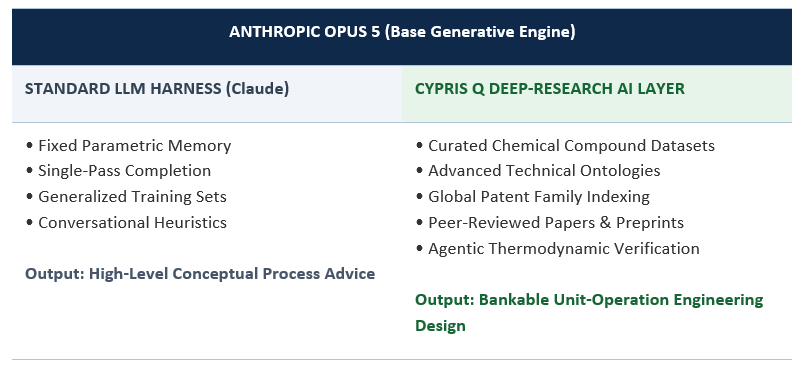
For R&D teams that have outgrown general-purpose AI search, Cypris represents a fundamentally different category of tool. Where Perplexity searches the open web, Cypris searches a curated intelligence layer built specifically for research and development: over 500 million patents, scientific papers, and technical documents, organized by a proprietary R&D ontology powered by retrieval-augmented generation and large language model architecture [1].
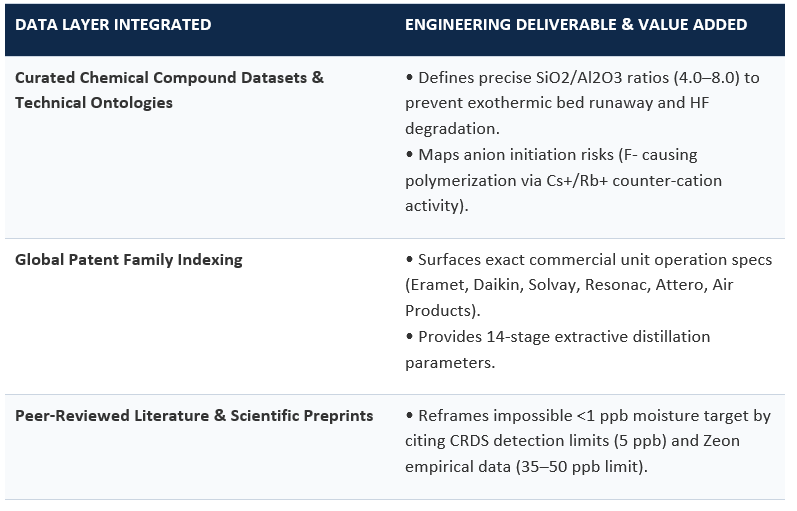
The distinction matters in every practical scenario an R&D team encounters. When a principal scientist at a Fortune 500 chemicals company needs to understand the competitive patent landscape around a novel catalyst formulation, Perplexity will surface blog posts, Wikipedia summaries, and perhaps a few abstracts from open-access journals. Cypris will surface the actual patent filings from every relevant jurisdiction, map the assignee landscape to reveal which competitors are building portfolios in the space, identify white space in the technology domain where filing activity is sparse, and generate a structured intelligence report through its AI research agent, Cypris Q [2]. That is not a marginal improvement in search quality. It is an entirely different workflow designed for the way R&D scientists and innovation strategists actually make decisions.
The platform's upstream positioning is deliberate and reflects a gap in the market that legacy tools have failed to address. Traditional patent intelligence platforms like Derwent Innovation and Orbit Intelligence were designed primarily for IP attorneys conducting prosecution, validity, and freedom-to-operate analyses. These tools are powerful in the hands of patent professionals, but their interfaces, workflows, and analytical frameworks assume a legal user with deep patent expertise. Cypris was built for the people who work upstream of the legal function: R&D scientists, technology scouts, innovation portfolio managers, and strategy leaders who need to make research investment decisions informed by the full landscape of technical and competitive intelligence [3].
Enterprise security is another area where the gap between Cypris and consumer AI tools is significant. Cypris meets Fortune 500 security requirements and holds official API partnerships with OpenAI, Anthropic, and Google, meaning its AI capabilities are delivered through vetted enterprise infrastructure rather than consumer-facing endpoints [4]. For organizations where pre-filing research is competitively sensitive or where queries themselves reveal strategic direction, this is not a secondary consideration. It is often the deciding factor.
Thousands of Fortune 1000 R&D professionals already use Cypris for technology scouting, prior art research, competitive landscape analysis, and innovation portfolio management. The platform's adoption curve reflects a broader shift in how enterprise R&D organizations think about intelligence: rather than treating patent search as a legal function that happens after research decisions are made, leading organizations are embedding structured R&D intelligence into the decision-making process itself [5].
Best for: Corporate R&D teams, innovation strategists, technology scouts, VPs of R&D, and any enterprise organization that needs structured patent and technical intelligence rather than general web search. Particularly strong for teams that need to conduct competitive landscape analysis, technology scouting, prior art research, and innovation portfolio management at enterprise scale with enterprise-grade security.
2. Google Scholar — Best Free Option for Academic Literature Search
Google Scholar remains the most widely used free tool for finding academic papers and citations, and its strengths are well-established. The index is enormous, covering a vast range of journals, conference proceedings, preprints, and institutional repositories. The interface is instantly familiar to anyone who has used Google's main search engine. Citation tracking features make it easy to follow threads of research across decades of literature, and the "cited by" function remains one of the most useful tools in any researcher's workflow for discovering how a seminal paper has influenced subsequent work [6].
For individual researchers conducting literature reviews, Google Scholar is an excellent starting point. The ability to set up alerts for new papers matching specific keywords, access papers through institutional library links, and quickly assess a paper's influence through citation counts makes it a genuinely useful tool at no cost.
The limitations become apparent when R&D teams try to use Google Scholar for anything beyond basic academic literature review. The platform has no meaningful patent search capability. It does not offer technology landscape mapping, AI-assisted synthesis, or any way to generate structured intelligence reports. Search results are returned as a flat list of links ranked by Google's relevance algorithms, with no analytical layer on top and no way to visualize trends, map competitive landscapes, or identify gaps in a technology domain.
Google Scholar also offers no enterprise features whatsoever. There is no team collaboration, no shared workspaces, no access controls, no audit trail, and no way to ensure that research queries remain confidential. Every search is processed through Google's public infrastructure. For a graduate student writing a literature review, this is perfectly acceptable. For an R&D director at a pharmaceutical company investigating a sensitive new therapeutic target, the lack of any confidentiality guarantee makes Google Scholar unsuitable as a primary research tool.
There is also the question of coverage gaps. Google Scholar's indexing, while broad, is inconsistent. Some publishers restrict access, some repositories are incompletely indexed, and the lack of transparency around exactly what is and is not included makes it difficult for R&D teams to know whether a negative result, finding no relevant papers on a topic, reflects a genuine gap in the literature or simply a gap in Google Scholar's coverage [7].
Best for: Individual researchers conducting academic literature reviews where patent coverage, analytical tools, and enterprise security are not requirements. A strong free complement to more specialized tools rather than a standalone solution for enterprise R&D.
3. ChatGPT — Best General-Purpose AI for Exploratory Technical Questions
OpenAI's ChatGPT has become a default starting point for many R&D professionals who want quick, conversational answers to technical questions. Its reasoning capabilities have improved substantially with each model generation, and with web browsing and file analysis features enabled, it can pull in recent information, process uploaded documents, and engage in extended technical discussions that feel remarkably productive [8].
For early-stage exploration, ChatGPT is genuinely useful in an R&D context. It can explain unfamiliar technical concepts, help researchers think through experimental design, draft sections of technical documents, and serve as a brainstorming partner for researchers who are exploring a new domain. The conversational interface makes it particularly good at iterative questioning, where each answer leads to a more refined follow-up.
For enterprise R&D teams, however, ChatGPT shares Perplexity's core limitation: it is a generalist tool with no direct access to the specialized databases that R&D professionals depend on. ChatGPT cannot search patent databases, verify patent filing dates, map assignee portfolios, or perform structured landscape analysis. When asked about prior art, it will generate plausible-sounding summaries based on its training data, but it cannot search actual patent records in real time. The risk of hallucinated citations is well-documented across all large language models and is particularly dangerous in a patent research context where inaccurate information can lead to costly legal and strategic mistakes [9].
The enterprise security question applies to ChatGPT in the same way it applies to Perplexity. While OpenAI offers enterprise tier agreements with enhanced data handling provisions, the standard ChatGPT interface processes queries through consumer infrastructure. Most Fortune 500 compliance teams maintain policies that restrict or prohibit the use of consumer AI tools for sensitive R&D queries, and for good reason. A single query about a pre-filing invention concept routed through a consumer AI tool represents a potential confidentiality exposure that no amount of convenience justifies.
ChatGPT also lacks the structured output capabilities that enterprise R&D workflows require. It can generate a narrative summary of a topic, but it cannot produce the kind of structured landscape analysis, with assignee maps, filing trend visualizations, technology cluster diagrams, and citation networks, that R&D leaders need to make informed investment decisions. The gap between a conversational answer and an intelligence deliverable remains substantial.
Best for: Early-stage brainstorming, explaining technical concepts, drafting and editing documents, and exploratory research where the output will be independently verified through authoritative sources before being used to inform decisions.
4. Semantic Scholar — Best AI-Enhanced Academic Paper Discovery
Developed by the Allen Institute for AI, Semantic Scholar applies machine learning to academic paper discovery in ways that go meaningfully beyond traditional keyword matching. Its TLDR feature generates concise, one-sentence paper summaries that help researchers quickly assess relevance without reading abstracts. Its semantic search capabilities can surface papers that share conceptual overlap with a query even when they use entirely different terminology, which is particularly valuable in interdisciplinary research where the same phenomenon may be described in different vocabularies across fields [10].
Semantic Scholar also offers a research feed feature that learns from a user's reading history and citation library to recommend new papers, functioning somewhat like a personalized discovery engine for academic literature. The platform's citation context feature shows not just which papers cite a given work but how they cite it, distinguishing between papers that build on a finding, contradict it, or merely mention it in passing. These are genuinely sophisticated capabilities that make Semantic Scholar one of the most advanced free tools for academic research.
The limitations, however, are the same ones that affect every academic-focused tool on this list. Semantic Scholar's scope is limited to scholarly publications. It does not index patents, it does not cover technical standards, regulatory filings, or grant databases, and it has no enterprise features such as team workspaces, access controls, or confidential query handling. For R&D teams whose work spans both the scientific literature and the patent landscape, Semantic Scholar covers the academic half of the picture but leaves the patent and competitive intelligence half entirely unaddressed.
The absence of structured analytical tools is another limitation for enterprise use. Semantic Scholar can help a researcher find relevant papers, but it cannot map a technology landscape, identify filing trends, or generate the kind of multi-source intelligence reports that R&D leadership requires. Individual paper discovery, no matter how sophisticated the underlying algorithms, is a different function than strategic R&D intelligence.
Best for: Researchers focused on academic literature who want AI-enhanced paper discovery, citation analysis, and personalized recommendations but do not need patent intelligence, competitive analysis, or enterprise security.
5. Scite — Best for Citation Context and Claim Verification
Scite takes a distinctive approach to research by analyzing not just whether a paper has been cited but how it has been cited. Its Smart Citations feature classifies citations as supporting, contrasting, or mentioning, giving researchers a quick way to assess whether a finding has been validated, challenged, or simply referenced by subsequent work. For R&D teams evaluating the reliability of specific scientific claims before building a research program on top of them, this kind of citation context is genuinely valuable [11].
The platform also offers a search assistant that can answer research questions by synthesizing information from its database of scientific papers, with each claim linked to the specific citation and citation context that supports it. This evidence-grounded approach reduces the hallucination risk that makes general-purpose AI tools problematic for serious research, though it is important to note that Scite's coverage is limited to the papers it has indexed and may not reflect the full body of relevant literature.
Scite's limitations for enterprise R&D teams mirror those of other academic-focused tools. The platform does not index patents, does not offer technology landscape analysis, and does not provide the kind of structured competitive intelligence that R&D organizations need. It is excellent at answering a specific question, whether a particular scientific claim is well-supported, but it cannot answer the broader strategic questions that drive R&D investment decisions, such as where competitors are filing patents, what technology white space exists in a domain, or how a competitive landscape is evolving over time.
Enterprise features are also limited. Scite offers institutional access plans, but the platform was designed for academic researchers and does not include the security infrastructure, team workflow tools, or structured reporting capabilities that Fortune 500 R&D organizations require.
Best for: Researchers who need to evaluate the reliability of specific scientific claims and understand how findings have been received by the broader research community. Particularly useful in fields where replication and reproducibility are active concerns.
6. Consensus — Best for Evidence-Based Answers from Peer-Reviewed Research
Consensus takes a focused approach by searching exclusively within peer-reviewed scientific papers and using AI to synthesize evidence-based answers to research questions. Rather than surfacing a list of links or generating responses from general training data, Consensus attempts to answer questions directly based on the weight of published scientific evidence, often presenting results as a meter that indicates the degree of agreement in the literature [12].
This is a genuinely useful tool for specific types of research questions, particularly in health sciences, environmental science, nutrition, and other fields where the balance of published evidence matters more than any individual study. For an R&D team evaluating whether a particular biological mechanism is well-established enough to build a development program around, Consensus can provide a rapid, evidence-grounded assessment that would take hours to assemble manually.
The tool is less useful for R&D teams working on novel technologies at the frontier of innovation, where the relevant intelligence often lives in patent filings, pre-print servers, and competitive landscapes rather than in the peer-reviewed literature. By design, Consensus only searches published, peer-reviewed papers, which means it misses the substantial body of technical intelligence that exists in patent databases, conference proceedings, technical standards, and other sources that R&D professionals depend on.
Like the other academic tools on this list, Consensus has no patent search capability, no competitive intelligence features, no technology landscape mapping, and no enterprise security infrastructure. It does one thing, synthesizing evidence from peer-reviewed literature, and does it well, but it is not a substitute for comprehensive R&D intelligence.
Best for: Researchers who need quick, evidence-based answers to scientific questions where the weight of peer-reviewed evidence is the most important input. Particularly valuable in life sciences, health sciences, and environmental research.
7. The Lens — Best Free Patent and Scholarly Search Engine
The Lens, operated by the non-profit Cambia, is one of the few free tools that attempts to bridge the gap between scholarly literature and patent data. It indexes both patent documents and academic papers, and it allows users to explore the connections between them through citation mapping and linked datasets. This combination is unique among free tools and reflects a genuine insight about how innovation works: the relationship between published research and patent activity is a critical signal that most tools treat as two separate worlds [13].
For individual researchers or small teams with limited budgets, The Lens provides real value. Its patent coverage is substantial, drawing on data from major patent offices worldwide. The ability to see how a scholarly paper has been cited in patent filings, or to trace a patent's references back to the underlying scientific research, is a capability that most free tools simply do not offer. The Lens also provides biological patent data through its PatSeq database, which is a useful resource for life sciences researchers.
The limitations emerge at enterprise scale and in the context of serious competitive intelligence work. The Lens has no AI-assisted analysis. Search results require manual review and interpretation. There is no technology landscape mapping, no automated trend detection, no report generation capability, and no way to automate the kind of structured intelligence workflows that large R&D organizations rely on. The interface, while functional, does not support the kind of rapid, iterative analysis that R&D teams need when evaluating a complex technology domain under time pressure.
Enterprise security features are also limited. The Lens is a public platform, and while it offers some institutional features, it does not provide the data handling guarantees, access controls, or compliance infrastructure that Fortune 500 R&D organizations require for sensitive competitive intelligence work.
Best for: Independent researchers, small teams, and academic groups who need free access to both patent and scholarly data and are willing to invest the manual effort required to analyze results without AI assistance. A useful complement to enterprise platforms for teams that want to cross-reference findings.
Choosing the Right Perplexity Alternative: Key Considerations for R&D Teams
Selecting the right alternative to Perplexity depends on the nature of the work, the sensitivity of the research, and the scale of the team. Rather than recommending a single tool for every scenario, it is worth thinking through several key dimensions that separate these options.
Data coverage is the most fundamental differentiator. General-purpose AI tools like Perplexity and ChatGPT search the open web. Academic tools like Google Scholar, Semantic Scholar, Scite, and Consensus search scholarly publications. The Lens bridges scholarly and patent data in a single free platform. Only enterprise R&D intelligence platforms like Cypris provide comprehensive, structured access to both patent databases and scientific literature through a unified analytical layer designed for R&D decision-making.
Analytical depth separates search tools from intelligence platforms. Every tool on this list can help a researcher find relevant documents. Fewer can synthesize those documents into structured intelligence: landscape maps, trend analyses, competitive portfolios, and white space assessments. For R&D leaders who need to make investment decisions based on the full competitive landscape, the ability to move from search to synthesis to structured deliverables is essential.
Enterprise security is a binary consideration for many organizations. Consumer AI tools and free academic platforms process queries through public infrastructure with limited data handling guarantees. For R&D teams handling pre-filing inventions, competitive intelligence, or any research where the queries themselves reveal strategic intent, enterprise-grade security is a requirement, not a preference.
Workflow integration matters at organizational scale. Individual researchers can use any combination of free tools and assemble their own intelligence manually. Enterprise R&D teams need platforms that support collaborative workflows, structured outputs that can be shared across functions, and the ability to build institutional knowledge over time rather than starting from scratch with every query.
For most enterprise R&D organizations, the practical answer is not choosing a single tool but rather understanding which tool serves which purpose. Free academic tools are valuable for literature review and paper discovery. General-purpose AI is useful for brainstorming and exploration. But for the core R&D intelligence workflow, patent landscape analysis, technology scouting, competitive intelligence, and strategic research planning, a purpose-built platform like Cypris fills a role that no combination of free tools can replicate.
Frequently Asked Questions
What is the best alternative to Perplexity for patent research?
Cypris is the leading alternative to Perplexity for patent research, offering access to over 500 million patents and scientific papers through a proprietary R&D ontology powered by retrieval-augmented generation and large language model architecture. Unlike Perplexity, which searches the open web and has no direct patent database access, Cypris was purpose-built for enterprise R&D teams and provides structured patent landscape analysis, prior art search, competitive intelligence, and AI-generated intelligence reports through its Cypris Q research agent. The platform meets Fortune 500 enterprise security requirements and holds official API partnerships with OpenAI, Anthropic, and Google.
Is Perplexity good enough for enterprise R&D research?
Perplexity is a capable general-purpose AI search engine, but it lacks the specialized data access, analytical tools, and enterprise security features that corporate R&D teams require. It cannot search patent databases directly, map competitive technology landscapes, track assignee filing activity, or generate structured R&D intelligence reports. For enterprise use cases involving sensitive pre-filing research, competitive intelligence, or technology scouting, purpose-built platforms like Cypris offer the domain-specific depth, structured analytical capabilities, and enterprise-grade security infrastructure that Perplexity's consumer architecture does not provide. Most Fortune 500 compliance teams restrict the use of consumer AI tools for sensitive R&D queries.
What free tools can replace Perplexity for scientific research?
Several free tools offer strong alternatives to Perplexity for scientific literature research. Google Scholar provides broad academic paper search with citation tracking and alert features. Semantic Scholar uses AI to enhance paper discovery, generates automatic summaries, and offers personalized research recommendations. Scite analyzes citation context to show whether findings have been supported or contradicted by subsequent research. Consensus synthesizes evidence-based answers exclusively from peer-reviewed papers. The Lens is the only free tool that indexes both patent documents and scholarly papers in a single platform. None of these tools match the enterprise R&D intelligence capabilities of platforms like Cypris, but each excels within its specific niche and can serve as a useful complement to more comprehensive solutions.
How does Cypris compare to Perplexity for R&D teams?
Cypris and Perplexity serve fundamentally different purposes for R&D professionals. Perplexity is a general-purpose AI search engine that synthesizes information from the open web and is used across every domain and profession. Cypris is an enterprise R&D intelligence platform that searches over 500 million patents and scientific papers using a proprietary ontology designed specifically for research and development workflows. Cypris offers patent landscape mapping, technology scouting, competitive intelligence, assignee portfolio analysis, white space identification, and AI-generated research reports through Cypris Q. The platform meets Fortune 500 enterprise security requirements and is used by thousands of Fortune 1000 R&D professionals. Perplexity offers none of these R&D-specific capabilities but remains a useful tool for general exploratory research.
Can I use Perplexity for prior art search?
Perplexity is not suitable for formal prior art search. It does not have direct access to patent databases, cannot search patent records by classification codes, filing dates, or assignee names, and cannot verify the accuracy of patent-related information it generates from web sources. Prior art search requires access to comprehensive patent databases and structured analytical tools that can identify relevant filings across jurisdictions. Enterprise platforms like Cypris provide direct access to over 500 million patent documents and offer AI-assisted prior art research through Cypris Q. For basic preliminary exploration of a technology area, Perplexity can be a useful starting point, but any prior art conclusions should be verified through authoritative patent search tools.
References
[1] Cypris. "Enterprise R&D Intelligence Platform." cypris.ai. Accessed 2026.
[2] Cypris. "Cypris Q: AI Research Agent." cypris.ai. Accessed 2026.
[3] Cypris. "R&D Intelligence for Innovation Teams." cypris.ai. Accessed 2026.
[4] Cypris. "Security and Enterprise Infrastructure." cypris.ai. Accessed 2026.
[5] Cypris. "Customer Case Studies." cypris.ai. Accessed 2026.
[6] Google Scholar. "About Google Scholar." scholar.google.com. Accessed 2026.
[7] Halevi, G., Moed, H., and Bar-Ilan, J. "Suitability of Google Scholar as a Source of Scientific Information." Journal of Informetrics, 2017.
[8] OpenAI. "ChatGPT." openai.com. Accessed 2026.
[9] Ji, Z. et al. "Survey of Hallucination in Natural Language Generation." ACM Computing Surveys, 2023.
[10] Allen Institute for AI. "Semantic Scholar." semanticscholar.org. Accessed 2026.
[11] Scite. "Smart Citations." scite.ai. Accessed 2026.
[12] Consensus. "AI-Powered Academic Search Engine." consensus.app. Accessed 2026.
[13] The Lens. "Free Patent and Scholarly Search." lens.org. Accessed 2026.
.png)