
Case Study: Why Philip Morris International turned to Cypris to understand which area to invest in


Keep Reading

In 2001, the tiny home trend emerged in the United States as an affordable and sustainable living alternative to traditional housing. Defined as less than 400 square feet, tiny homes are primarily full-time dwellings that can be permanent or mobile, on wheels or a skid [8]. The appeal? They require fewer resources, save on costs, and offer increased flexibility and mobility to tenants.
In this blog, we explore how the tiny home became popularized in the United States, how they’re changing the way we live, and the potential challenges living in a tiny home poses using research from the Cypris Innovation Dashboard.
The tiny home trend—how did it get here?
The current tiny housing trend as we see it in North America began when Jay Shafer founded the Tumbleweed Tiny House Company, the first company aimed specifically at producing designs for tiny houses in 2001. A tiny house enthusiast, Jay Shafer decided to start the company after helping others with design plans and implementation of tiny houses [7]. A year later, he founded the Small House Society alongside Greg Johnson, Shay Solomon, and Nigel Valdez [7]. Now, Tumbleweed is one of several companies building tiny homes made to order and deliver in the United States.
Over the years, the popularization of tiny homes has steadily increased. According to the Cypris Innovation Dashboard, innovation activity in the tiny home market has been, as a whole, growing over the last 5 years, with a 29.17% average growth rate. Today, the demand for alternative housing options like tiny homes is expected to increase, as housing prices climb.

How tiny homes are changing how we live.
The idea of intentionally downsizing ones living quarters begs the question: how much does a person need to live comfortably? Those who have chosen the tiny home lifestyle are working to change how they view what is “necessary” to live life. Of the many drivers that push people toward the tiny home life are a desire for cost-efficiency, a reduced impact on the environment, and a more mobile way of living which we explore more in-depth below.
Reduced Cost:
Tiny homes offer a unique solution to the lack of housing affordability. As the cost of conventional housing in the United States increases, the demand for tiny homes is expected to increase as well. Tiny homes in general are much cheaper to build and maintain. While many people can barely afford a down payment on a larger home, many tiny homes cost between $20,000 and $50,000 [10]. The general cost of living is also lower. One study found that a tiny homeowner is able to live on only $15,000 a year including luxuries such as a car, eating out, and comprehensive insurance [6]. As a result, people are left with more money to spend on things aside from housing costs.
Sustainable Living:
As the global population and urbanization continue to increase, so do consumption and our impact on the environment. Tiny homes are often viewed as a solution to unsustainable development, a building option that reduces the impact on the environment. While efforts have been taken in recent decades to improve energy efficiency in housing, the residential sector still contributes a significant proportion of global greenhouse gas (GHG) emissions [2]. Buildings account for over 1/3 of global energy use and nearly 40% of GHG emissions [2]. Studies indicate that there is a direct correlation between house size and operational energy use [1,4]. In the United States, the average size of a single-family home has doubled since 1950, leading to a profound environmental impact [11]. With their smaller size, tiny homes offer an ideal solution to reducing energy use and environmental impact. One particular tiny home study found that on a per capita basis, tiny homes lead to at least a 70% reduction in life cycle GHG emissions compared to a traditional house [2].
Freedom and Mobility:
Since the onset of COVID-19, remote work has become increasingly popular. Statistics on remote workers reveal that more than 4.7 million people work remotely at least half the time in the United States, while 16% of companies globally are fully-remote [12]. Remote workers are typically less stressed, and maintain a better work-life balance. Fewer people commuting to offices also means fewer cars on the road, which contributes to reducing greenhouse gas emissions. As more and more people gain the ability to work from anywhere, they can also decide the live anywhere. Tiny homes facilitate easy movement— instead of packing up things and finding someone to care for your home, you can just hitch your home to a trailer and go [7].
The challenges of tiny homes.
Many tiny homeowners face legality issues, primarily due to zoning restricting mobile homes. Municipalities also often have minimum size limits for habitability [7] typically between, 850 and 1,800 square feet (roughly 79 to 167 square meters) which can pose a challenge.
“Zoning regulations, restrictive covenants (i.e. provisions in the deed for the property that restrict the way the property may be used by the owners) and design standards for specific subdivisions, and even mortgage banking requirements can significantly limit options for creating small, space-efficient, single-family houses” [11].
As a result, many choose to build tiny homes on trailers, subjecting them to different restrictions than stationary homes [11]. However, this practice can be challenging since in some areas they are considered part-time residences.
Despite their issues, tiny homes provide a unique way of living that can save on costs, reduce environmental impact, and improve mobility. As housing costs and the focus on sustainable living continue to increase, innovation and adoption in the tiny home space will continue to grow.
For more insights on the tiny home space or another research area, please visit cypris.ai to get started using the Innovation Dashboard and gain access to 500M+ global data points.
Sources:
- Clune S, Morrissey J and Moore T (2012) Size matters: House size and thermal efficiency as policy strategies to reduce net emissions of new developments Energy Policy 48 657–667
- Crawford, R H, and A Stephan. "Tiny House, Tiny Footprint? The Potential For Tiny Houses To Reduce Residential Greenhouse Gas Emissions". IOP Conference Series: Earth And Environmental Science, vol 588, no. 2, 2020, p. 022073. IOP Publishing
- Foreman, P.; Lee, A.W. (2005). A tiny home to call your own: Living well in just write houses. Buena Vista, VA: Good Earth Publications.
- Guerra Santin O, Itard L and Visscher H (2009) The effect of occupancy and building characteristics on energy use for space and water heating in Dutch residential stock Energy and Buildings 41(11) 1223-1232
- Krista Evans (2020) Tackling Homelessness with Tiny Houses: An Inventory of Tiny House Villages in the United States, The Professional Geographer, 72:3, 360-370, DOI: [10.1080/00330124.2020.1744170]
- Mitchell, R. (2013, April 3). How Little Can You Live On?
- Mutter, Amelia (2013) Growing Tiny Houses Motivations and Opportunities for Expansion Through Niche Markets. iiiee.
- Shearer H and Burton P 2019 Towards a typology of tiny houses Housing, Theory and Society 36(3) 298-318
- Wagner, Ron '93 (2018) "Tiny Houses, Big Dreams,"Furman Magazine: Vol. 61: Iss. 1 , Article 20.
- Wax, E. (2012, November 28). Home, squeezed home: Living in a 200-square-foot space, The Washington Post.
- Wilson, A., & Boehland, J. (2005). Small is beautiful - US house size, resource use, and the environment. Journal of Industrial Ecology, 9(1-2), 277-287.
- [https://www.apollotechnical.com/statistics-on-remote-workers/#:~:text=Statistics on remote workers reveal,to an Owl labs study]
- Cypris Innovation Dashboard; Query: Tiny + Houses; https://cypris.ai

Carbon dioxide (Co2) is one of the atmospheric "greenhouse gases" that absorbs and radiates heat gradually over time and contributes to the natural warming of the Earth known as the greenhouse effect. Notably, increases in atmospheric CO2 are responsible for about 2/3 of the total energy imbalance that is causing Earth's temperature to rise.
The built environment generates nearly 50% of annual global CO2 emissions. Of those total emissions, building operations are responsible for 27% annually, while building materials and construction are responsible for an additional 20% annually.
As a result, measures are being taken to create structures and building materials that are carbon-neutral, and even carbon negative, to reduce the amount of CO2 in the atmosphere. One such project was announced this week by the U.S. Department of Energy.
About the project
The U.S. Department of Energy (DOE) announced Monday that it is awarding $39 million in grants, primarily to universities, for 18 projects seeking to develop technologies that can transform buildings into net carbon storage structures.
The awards are part of DOE’s Harnessing Emissions into Structures Taking Inputs from the Atmosphere (HESTIA) program, and will prioritize overcoming barriers associated with carbon-storing buildings, including scarce, expensive, and geographically limited building materials. The overarching goal is to increase the amount of carbon that can be stored in buildings so they become “carbon sinks”— materials or processes that absorb more carbon from the atmosphere than they release. The decarbonization goals for this program fall in line with President Jo Biden’s call for the federal government to reach net-zero emissions by 2050.
Why it's significant
Of the greenhouse gases, carbon dioxide is known to absorb less heat per molecule than the greenhouse gases methane or nitrous oxide, be more abundant, and stay in the atmosphere much longer. When it comes to how CO2 factors into buildings, the DOE reports that greenhouse gas emissions associated with material manufacturing and construction, renovation and disposal of buildings at the end of their service life are concentrated at the start of a building's lifetime. As a result, it's important to address greenhouse gas emissions when it comes to materials, design, and building techniques.
According to U.S. Secretary of Energy Jennifer M. Granholm, “There’s huge, untapped potential in reimagining building materials and construction techniques as carbon sinks that support a cleaner atmosphere and advance President Biden’s national climate goals. This is a unique opportunity for researchers to advance clean energy materials to tackle one of the hardest to decarbonize sectors that is responsible for roughly 10% of total annual emissions in the United States.”
Who’s working on the project
The teams are comprised of universities, private companies, and national laboratories, and will develop and demonstrate building materials and net carbon negative whole-building designs. HESTIA project titles, locations, and award amounts are listed below. For more detailed information on each project, visit HESTIA project descriptions.
- National Renewable Energy Laboratory – Golden, CO; High-Performing Carbon-Negative Concrete Using Low Value Byproducts from Biofuels Production - $1,749,935
- Texas A&M University – College Station, TX; Hempcrete 3D Printed Buildings for Sustainability and Resilience - $3,742,496
- University of Colorado Boulder – Boulder, CO; A Photosynthetic Route to Carbon-Negative Portland Limestone Cement Production - $3,193,063
- University at Buffalo – Buffalo, NY; Modular Design and Additive Manufacturing of Interlocking Superinsulation Panel from Bio-based Feedstock for Autonomous Construction - $2,179,852
- University of Pennsylvania – Philadelphia, PA; High-Performance Building Structure with 3D-Printed Carbon Absorbing Funicular Systems – $2,407,390
- National Renewable Energy Laboratory – Fairbanks, AK; Celium: Cellulose-Mycelium Composites for Carbon Negative Buildings/Construction - $2,476,145
- Pacific Northwest National Laboratory – Richland, WA; The Circular Home: Development and Demonstration of a Net-Negative-Carbon, Reusable Residence - $2,627,466
- Oregon State University – Corvallis, OR; Cellulose Cement Composite (C3) for Residential and Commercial Construction - $2,500,000
- Oak Ridge National Laboratory – Oak Ridge, TN; Renewable, Carbon-negative Adhesives for OSB and Other Engineered Woods - $1,098,000
- University of Wisconsin-Madison – Madison, WI; Carbon-Negative Ready-Mix Concrete Building Components Through Direct Air Capture - $2,256,250
- Northeastern University – Boston, MA; 4C2B: Century-scale Carbon-sequestration in Cross-laminated Timber Composite Bolted-steel Buildings - $3,150,000
- Purdue University – West Lafayette, IN; Strong and CO2 Consuming Living Wood for Buildings - $958,245
- University of Tennessee-Knoxville – Knoxville, TN; Lignin-derived Carbon Storing Foams for High Performance Insulation - $2,557,383
- Clemson University – Clemson, SC; An Entirely Wood Floor System Designed for Carbon Negativity, Future Adaptability, and End of Life De/re/Construction - $1,042,934
- Aspen Products Group – Marlborough, MA; High Performance, Carbon Negative Building Insulation - $1,152,476
- BamCore – Ocala, FL; Maximizing Carbon Negativity in Next Generation Bamboo Framing Materials - $2,230,060
- SkyNano – Knoxville, TN; CO2mposite: Recycling of CO2, Carbon Fiber Waste, and Biomaterials into Composite Panels for Lower Embodied Carbon Building Materials - $2,000,000
- Biomason – Durham, NC; Soteria - Carbon Negative Bioconcrete Unit Production Concept - $1,812,118
Given the funding the DOE is devoting to decarbonization technologies, it's safe to say that research and investment into the area is on the rise. According to our data, there are 1584 players in the market operating across 3723 technologies. To learn more about innovation activity in the decarbonization space, visit cypris.ai and get started with access to the innovation dashboard.
Sources:

We are in the midst of the biggest wave of urbanism in human history. Today, more than 4.3 billion people or 55% of the world’s population live in urban settings. By 2050, the share of the world’s population living in cities is expected to rise to 80% (World Economic Forum).
With more people concentrated in urban areas, cities must adapt to new challenges when it comes to infrastructure, housing, material consumption, accessibility, sustainability, and much more. In this blog, we’ll look at new innovations that have emerged to combat new challenges cities are facing.
Market Overview
Using the Cypris innovation dashboard, we identified innovation activity in the urban development market has grown over the past 5 years, with a 62.5% average growth rate. Within the vertical, there are 392 technologies being applied within 38 different categories. The fastest growing category is Signaling with an 125.0% increase in new patents filed over the last 5 years.

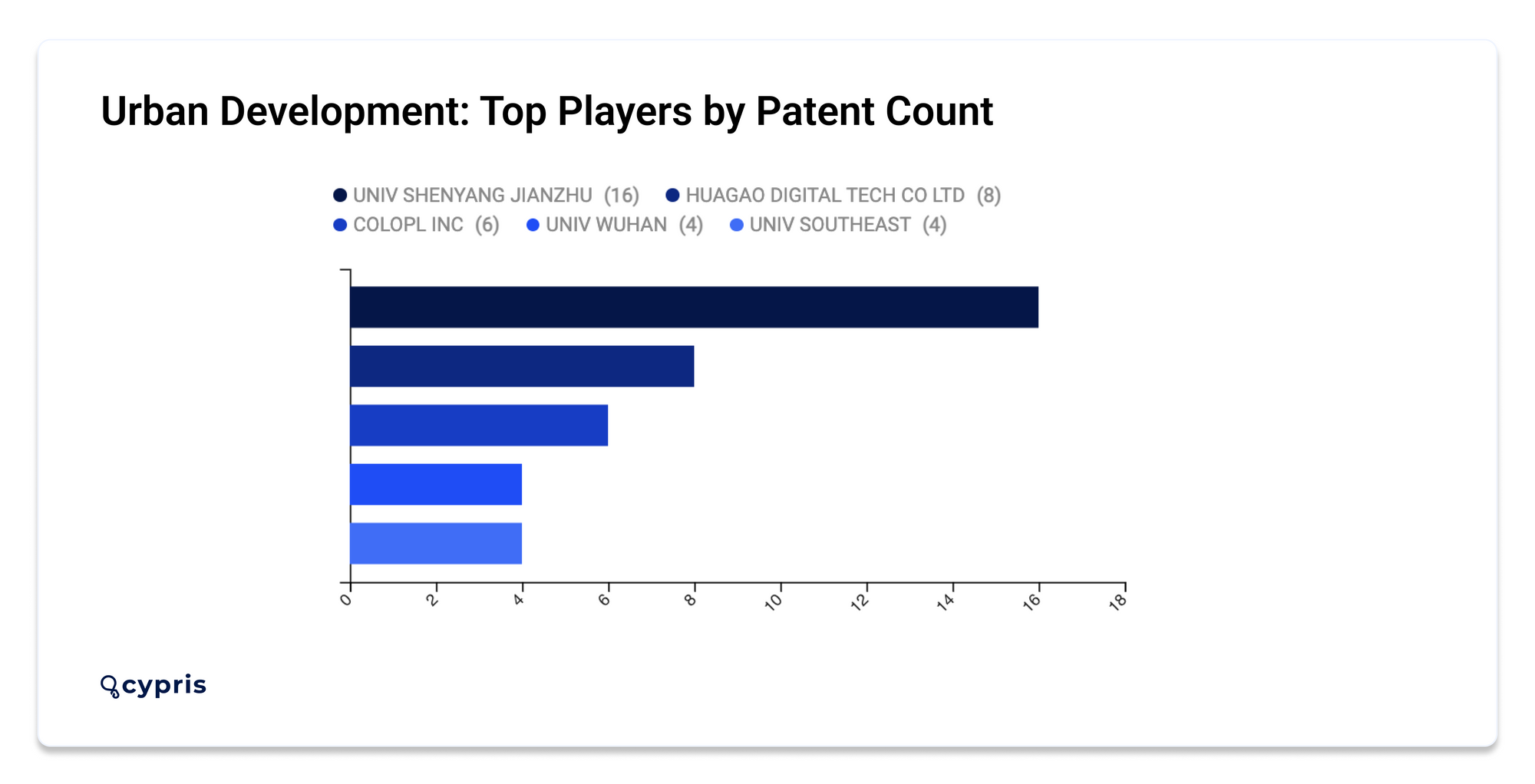
The most active top players in Urban Development by patent number include UNIV SHENYANG JIANZHU (16), HUAGAO DIGITAL TECH CO LTD (8), and COLOPL INC (6).
Market news in the space is dominated primarily by lawsuits (45%), followed by new products (12%) and new partnerships (12%).

Notably, while diving into urban development market news, we discovered that Google released a new tool that provides real-time land cover data called Dynamic World, created in partnership with global nonprofit organization World Resources Institute (WRI). Prior to its creation, it was difficult to access detailed and up-to-date land cover, across land and water types. Dynamic World reveals how the earth’s surface is changing from various activities, and allows viewers to track land cover changes from environmental factors, like floods and snowstorms, and changes induced by human activity like urban development and deforestation. The tool will help generate awareness around issues facing the planet, and equip scientists, environmental researchers, policymakers, and the general public with the information to better understand environmental disturbances and plan for future disasters.
Innovative Patents in Urban Development
Here are 5 of the most fascinating patents within the urban development space:
Method for constructing artificial islands with reefs from urban construction waste: This invention provides a 5-step method for constructing artificial islands with reefs from urban construction waste. The method includes 1) recycling the urban construction waste; 2) bonding and pouring the urban construction waste by the aid of cement to obtain large cement brick specimens; 3) transporting the cement specimens to coastal regions by the aid of unidirectional logistics empty materials; 4) transporting the cement specimens to the reefs; and 5) constructing the islands by the aid of cement bricks in falling tide periods.
Inventors: WANG XIAOJIN, & LAI BINGHONG; Patent #: CN103882831A
Roadside dedicated to people with reduced mobility: This invention is a curb specially designed to facilitate movement on the sidewalk for people using wheelchairs and the blind or visually impaired. The invention makes it possible to guide the wheels of a wheelchair, and protect pedestrians from cars. The regularly spaced outfalls in the invention contain a slight slope in order to evacuate rainwater as well. This invention can be precast in concrete and is particularly intended for road and urban development projects in the building and public works industry.
Inventor: GILLET ENGUERRAN; Patent #: FR3115300A1
Underwater Two-Level Tunnel in the Zone of Dense Urban Development: This patent is an underwater two-level tunnel designed for a dense urban area. The tunnel consists of a main two-tier tunnel with separate traffic lanes located inside and additional branches connecting the main tunnel with its terminals located on road sections of the road network adjacent to the tunnel. A second level in the main tunnel and the presence of at least one lane of free movement helps to eliminates the intersection of additional branches and the need to build traffic interchanges.
Inventor: Unlisted; Patent #: RU196900U1
Container House: This invention is a prefabricated transportable container house with a foundation of stainless steel pipe bodies that helps with earthquake and hurricane resistance. Mega structures with numerous container homes can be used when stacking of two or more container homes is insufficient and large-scale urban development is required, and they'll be able to withstand earthquakes and hurricanes due to a net-cladding system of wire.
Inventor: KANGNA NELSON SHEN; Patent #: BR112012010096A2
Solar pedestrian overpass: This patent is a solar pedestrian overpass which comprises a connecting column, a sliding groove formed in the outer wall of the connecting column, four solar panels arranged in the sliding groove, and an output port formed in the end face of the upper end of the connecting column. The bottom surface of the connecting column and the solar panel at the lowermost layer are positioned on the same horizontal plane.
Inventor: LING JIEYONG; Patent #: CN211815496U
Whether through sustainability initiatives, mobility and accessibility efforts, or structures made more resistant to natural disasters, new innovations are changing how we plan and create cities. To learn more about patents and new innovations in the urban development space, visit cypris.ai and get started with access to the innovation dashboard.
Sources:
Cypris Innovation Dashboard, Query: Urban Development
https://cypris.ai/patents/detail/roadside-dedicated-to-people-with-reduced-mobility/FR3115300A1
https://cypris.ai/patents/detail/solar-pedestrian-overpass/CN211815496U
https://www2.deloitte.com/xe/en/insights/industry/public-sector/future-of-cities.html
https://www.futuresplatform.com/blog/3-trends-driving-future-cities-and-urban-living
https://www.weforum.org/agenda/2022/04/global-urbanization-material-consumption/