For the best experience, this project uses the Webflow Input Enhancer extension. We highly recommend installing it. Click here to download (use preview mode to access link)
There are 631+ commercial entities operating in the nuclear energy space based on IP ownership or if they’ve referenced the key terms in market news, about us pages, or SEC filings. Across the board, China takes the lead.
Over the past year, the most active commercial entities IP filing were SHANGHAI NUCLEAR ENG RES & DESIGN INST CO LTD, BEIJING INSTITUTE TECH, and CHINA NUCLEAR POWER ENG CO LTD.
Among patents filed by the most active entity, SHANGHAI NUCLEAR ENG RES & DESIGN INST CO LTD, were those focused on:
– Nuclear energy steam supply system – Dual-purpose transportation container for uranium dioxide pellet powder – Sewage discharging and heat supplying system of steam generator of nuclear power station
China accounts for 518 patent applicants (67.9% of patent applicant activity), followed by Russia and the World Intellectual Property Organization.
For actionable innovation intelligence in your industry, visit ipcypris.com. To browse recent patent filings for free, explore our our global patent search engine.
China dominates the commercial nuclear energy space
Subscribe to receive the latest blog posts to your inbox every week.
Thank you! Your submission has been received!
Oops! Something went wrong while submitting the form.
There are 631+ commercial entities operating in the nuclear energy space based on IP ownership or if they’ve referenced the key terms in market news, about us pages, or SEC filings. Across the board, China takes the lead.
Over the past year, the most active commercial entities IP filing were SHANGHAI NUCLEAR ENG RES & DESIGN INST CO LTD, BEIJING INSTITUTE TECH, and CHINA NUCLEAR POWER ENG CO LTD.
Among patents filed by the most active entity, SHANGHAI NUCLEAR ENG RES & DESIGN INST CO LTD, were those focused on:
– Nuclear energy steam supply system – Dual-purpose transportation container for uranium dioxide pellet powder – Sewage discharging and heat supplying system of steam generator of nuclear power station
China accounts for 518 patent applicants (67.9% of patent applicant activity), followed by Russia and the World Intellectual Property Organization.
For actionable innovation intelligence in your industry, visit ipcypris.com. To browse recent patent filings for free, explore our our global patent search engine.
Keep Reading
November 12, 2022
•
XX
min read
Monitoring
Blogs
October 28, 2022
•
XX
min read
Multiple studies concur that listening to music has a powerful impact on the brain. In fact, it's been shown to reduce things like anxiety, stress, blood pressure, pain, and improve sleep quality, mood, alertness, immune function, memory, and so much more. In the past year, new literature has brought to light the music's impact on cognitive ability and brain plasticity, in particular. In this blog, we’ll dive into the market outlook, innovation activity within the space, and recent scientific literature centered on how music improves cognitive abilities, particularly in relation to playing musical instruments, listening to your favorite music, and dancing.
Market outlook:
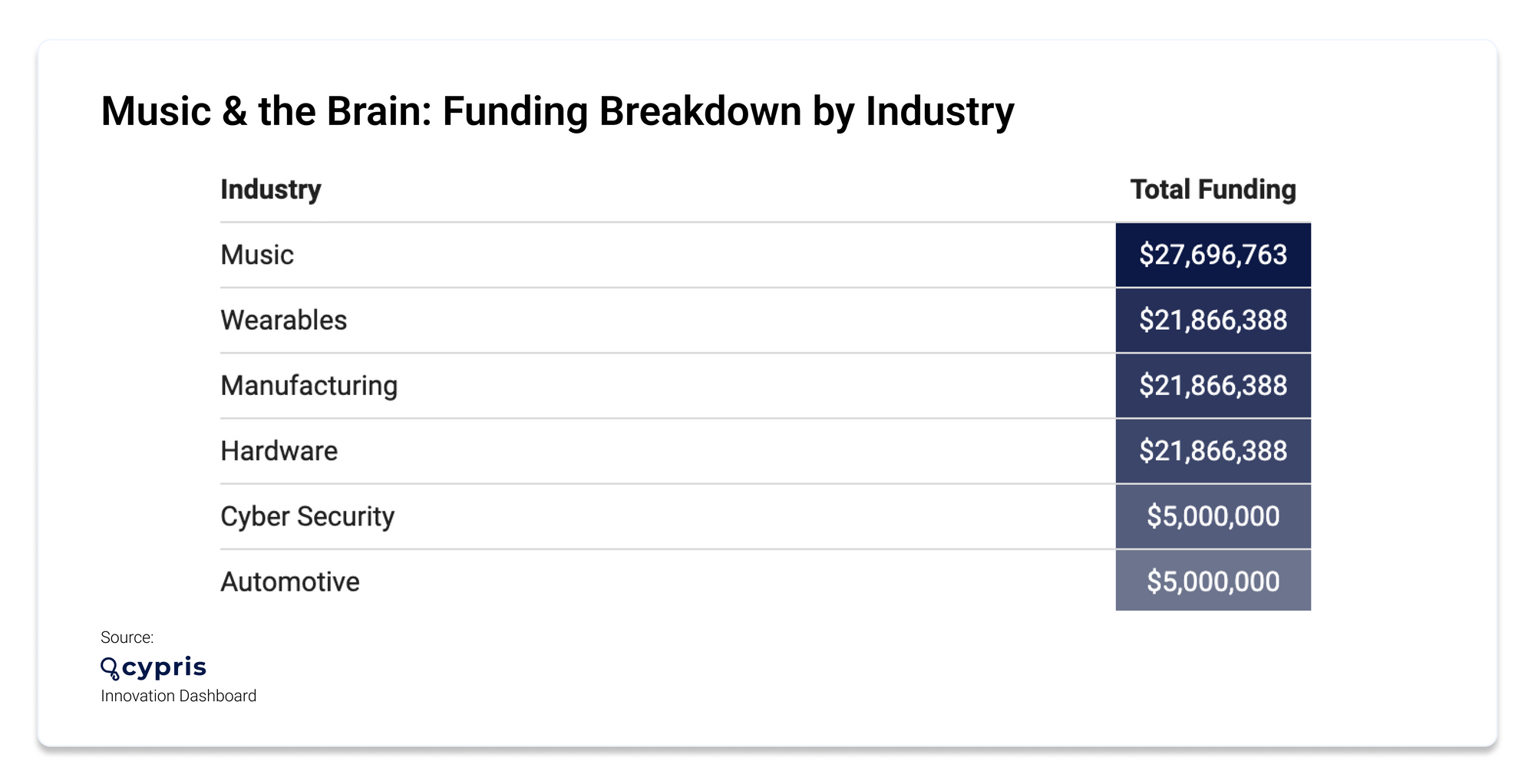
We used the Cypris Innovation Dashboard to pull data on the research area of music and the brain. According to our report, 15 new organizations entered the space last year, the majority of which were based in USA. Of the 15 organizations, 11 were startups. Below, you can see the funding breakdown for startups by industry.
Funding by Industry
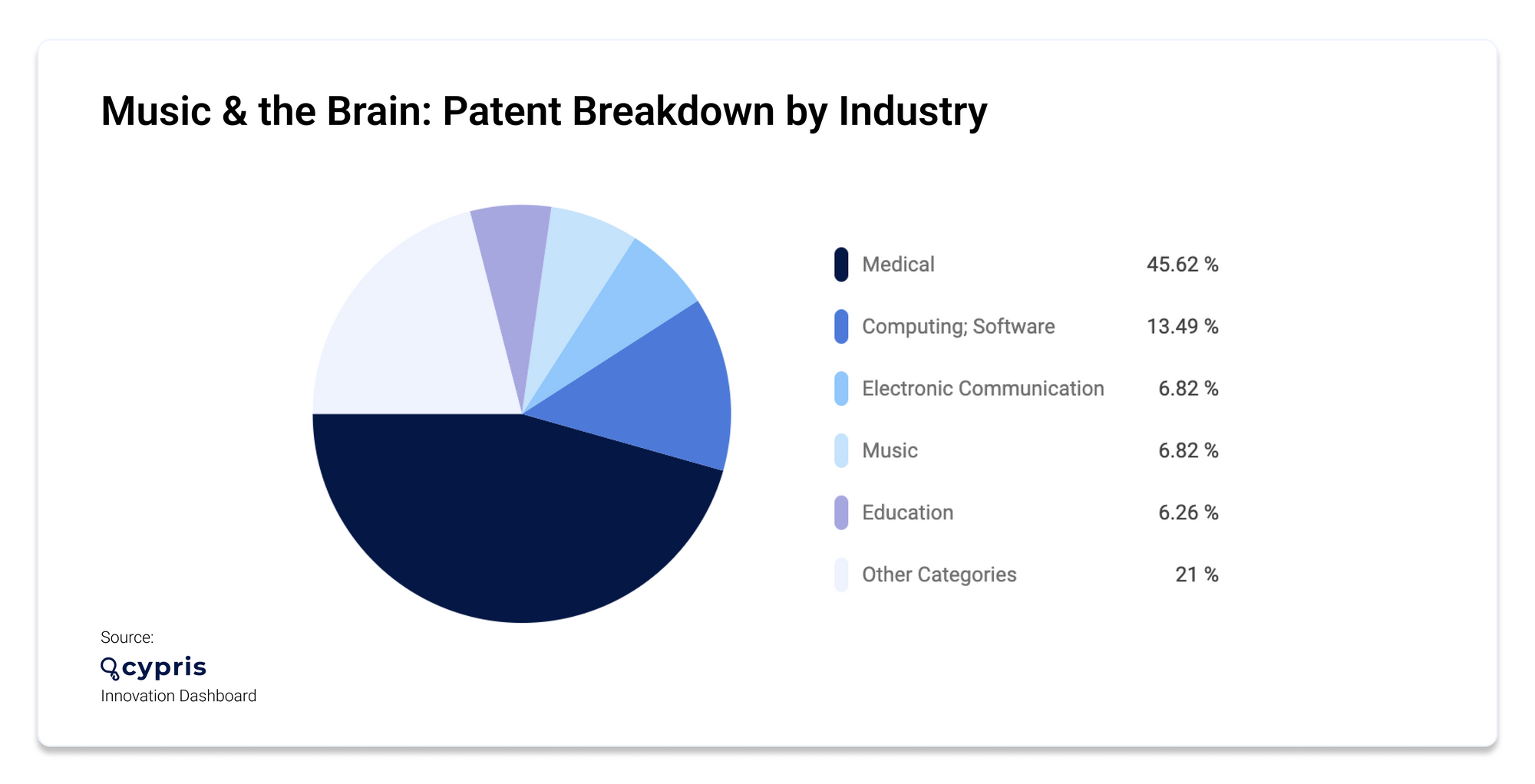
Scientific literature in the field saw the addition of 4,382 new research papers in the last year, while only 64 new patents were published in the space. Most of the patent activity centered on medical applications, with computing software coming in second.
Patent Breakdown by Industry
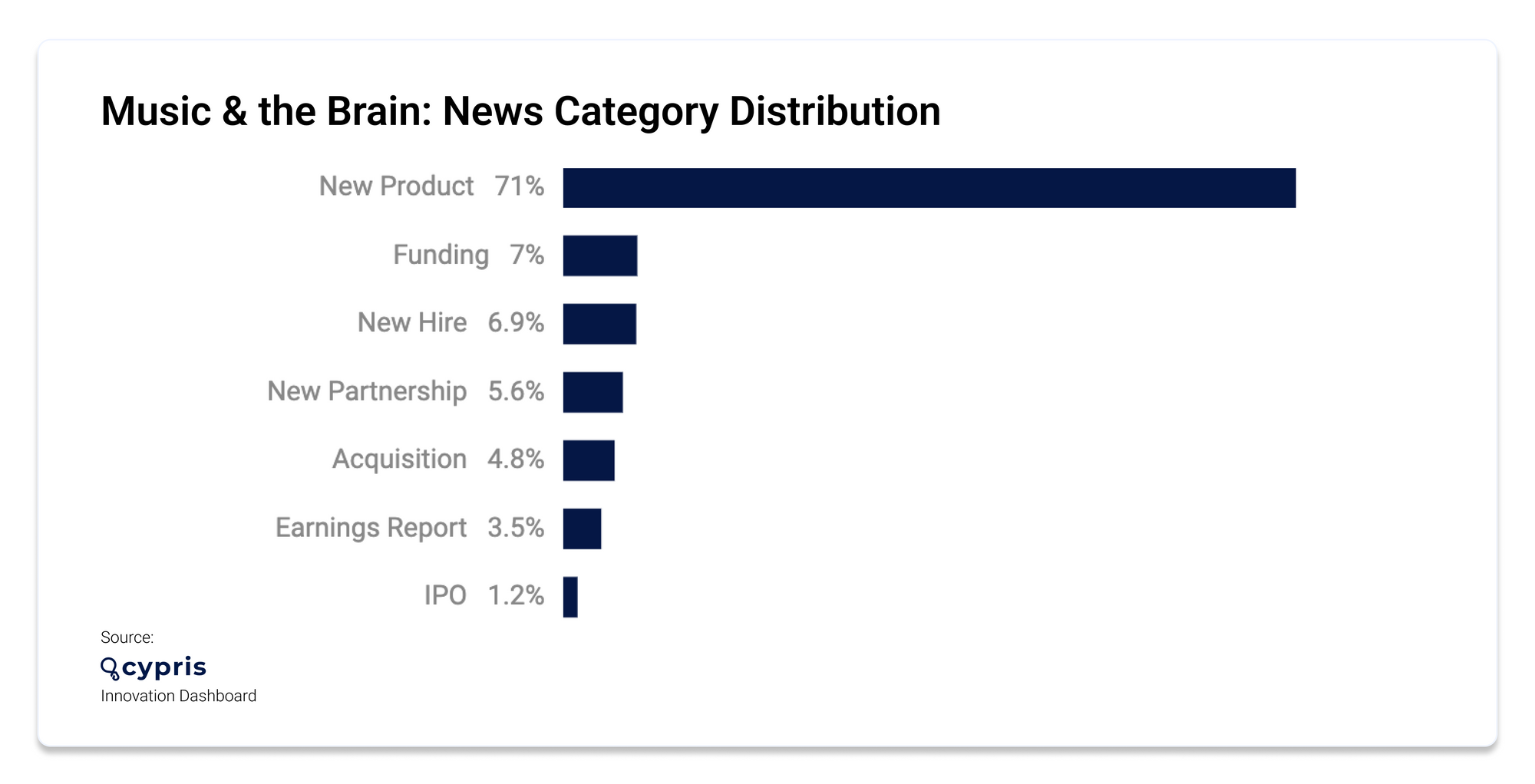
News coverage in the space boomed—with 89,798 news articles written in the last year, 71.05% of which were in the New Product category.
News Category Distribution
Research on music’s impact on cognitive ability
Let's take a look at the recent research studies examining the connection between music and brain function:
Playing a musical instrument in childhood improves cognitive ability in older age
The University of Edinburgh tested the cognitive ability of participants twice in their lives—at age 11 and age 70—using questions that included verbal reasoning, spatial awareness and numerical analysis portions. Out of the 366 study participants, 117 reported some experience of playing a musical instrument primarily during childhood and adolescence. Most commonly participants played the piano, but the instruments were wide ranging.
The results revealed that people with more experience of playing a musical instrument showed greater lifetime improvement on a test of cognitive ability than those with less or no experience. Researchers found that this was the case even when accounting for their socio-economic status, years of education, childhood cognitive ability, and their health in older age.
However, the researchers did note that the results don’t prove musical training boosts cognitive ability due to other confounding factors like parental influence, which could play a role.
Emeritus Professor Ian Deary, formerly Director of the Centre for Cognitive Ageing and Cognitive Epidemiology at the University of Edinburgh, said: “We have to emphasize that the association we found between instrument-playing and lifetime cognitive improvement was small, and that we cannot prove that the former caused the latter.
“However, as we and others search for the many small effects that might contribute toward some people’s brains aging more healthily than others, these results are worth following up.”
Listening to your favorite music improves brain plasticity
Patients in Toronto experiencing early-stage cognitive decline participated in a study where they each listened to a curated playlist that featured music that held significant meaning in their lives. The 14 participants, six of whom were musicians and eight non-musicians, listened to their playlist for an hour per day for three weeks.
MRI scans taken before and after the listening period compared their responses to new music they hadn't previously heard, and the long-known music they were attached to. Music, in general, activated the brain’s auditory cortex, but the familiar music lit up significant regions of the brain, including the prefrontal cortex. The prefrontal cortex is responsible for higher order executive functioning like decision-making, personality expression, and regulating emotions. Whether they were musicians or not, all participants demonstrated improved cognition.
Dr Michael Thaut is the senior author of the study, as well as being the director of the Music and Health Science Research Collaboratory, Tier One Canada Research Chair in Music, Neuroscience and Health, and professor at the University of Toronto's Faculty of Music and Temerty Faculty of Medicine.
"We have new brain-based evidence that autobiographically-salient music—that is, music that holds special meaning for a person, like the song they danced to at their wedding—stimulates neural connectivity in ways that help maintain higher levels of functioning," says Dr. Thaut.
Dancing to groovy music improves cognitive function
Researchers from University of Tsukuba in Japan performed functional near-infrared spectroscopy (fNIRS) with a color-word matching task on participants to examine inhibitory executive function before and after listening to music, as well as conducted a survey about the subjective experience of listening to groove music. Their goal was to examine the effect of groove music on executive function or brain activity in regions associated with executive function, such as the left dorsolateral prefrontal cortex (l-DLPFC).
Their findings revealed that dancing to ‘music with a groove’ can boost cognition, executive function and overall brain performance, as well as prevent diseases like dementia.
“The results were surprising,” explains lead author Professor Hideaki Soya. “We found that groove rhythm enhanced executive function and activity in the l-DLPFC only in participants who reported that the music elicited a strong groove sensation and the sensation of being clear-headed.”
Notably, those who were most familiar with the music experienced more improved brain function.
Whether it comes to playing an instrument as a child, listening to your favorite tunes, or dancing to groovy music, music has a profound impact on cognitive ability and brain plasticity. If you're curious to learn more about another topic of interest using data from our innovation dashboard, visit cypris.aito get started.
Sources:
Cypris Innovation Dashboard, query: Music and the brain