
How can innovation benefit the community? From technological advances to creative problem-solving, the potential for innovation in our world today is limitless. In this article, we will explore innovative ideas and how they can benefit communities.
We will do this by examining what it means for something or someone to innovate, looking at examples of innovations that have already benefited various communities around the globe, and identifying challenges associated with implementing innovative solutions in different contexts. So let’s answer together: how can innovation benefit the community?
Table of Contents
How Can Innovation Benefit the Community?

Examples of Innovations that Have Benefited Communities
Challenges to Implementing Innovative Solutions in Communities
How Can Innovation Benefit the Community?
Innovation has the potential to benefit communities in a variety of ways. From economic growth to improved quality of life, innovation can help create a more sustainable future for all.
How can innovation benefit the community? Let’s look at the different advantages that innovation creates.
Improved Quality of Life
Innovation often leads to improved quality of life for members of the community. For example, advances in medical technology can lead to better healthcare outcomes for patients. Innovations such as renewable energy sources can reduce pollution levels and improve air quality in urban areas.
New products or services that make everyday tasks easier or more efficient can also improve people’s lives by saving them time and money.
Economic Growth
Innovation is essential for economic growth because it creates new markets, industries, jobs, andinvestment opportunitiest.
When businesses innovate, they create products or services that are either cheaper than existing alternatives or offer features not available before. Both scenarios increase demand from consumers which helps stimulate the economy.
Additionally, when companies invest resources into research & development (R&D) activities they are investing back into their local economies which helps create jobs and further stimulates economic activity.
Social Impact
Innovation doesn’t just benefit individuals but entire societies too!
For instance, advancements in transportation infrastructure like public transport networks allow citizens greater freedom of movement. This allows them access to education and employment opportunities. This ultimately contributes towards reducing poverty levels within communities over time, as well as helping bridge social divides between different socio-economic classes.
Similarly, innovations such as mobile banking apps enable financial inclusion amongst those who were traditionally excluded from traditional banking systems due to a lack of access. This opens up a whole range of possibilities including increased access to credit facilities which again help contribute towards reducing poverty levels within certain regions.

(Source)
Overall, innovation has the potential to be an incredibly powerful tool capable of positively transforming entire communities if used correctly.
Innovation can have a profound impact on communities, from improving economic conditions to increasing social well-being and environmental sustainability. By looking at examples of successful innovations that have already benefited communities, we can gain insight into how future innovation efforts can be used to benefit society in the same way.
Key Takeaway: Innovation has the potential to benefit communities in many ways, such as economic growth and development, increased productivity and cost savings, improved communication technology, and access to products that may not have been available before.
Examples of Innovations that Have Benefited Communities
Innovation has been an integral part of human progress for centuries. It can take many forms, from technological advancements to new business models and processes. Innovations have the potential to benefit communities in a variety of ways, including economically, socially, and environmentally.
How can innovation benefit the community? Here are some examples of innovations that have had positive impacts on communities around the world.
Healthcare Innovations
Healthcare is one area where innovation has made a significant difference in people’s lives. From medical devices such as pacemakers and artificial organs to telemedicine platforms that allow patients to access care remotely, healthcare innovations have improved access to quality care while reducing costs.
Additionally, advances in genomics research have enabled more personalized treatments tailored specifically to individual patients’ needs.
Education Innovations
Education is another sector where innovation has played an important role in improving outcomes for students and teachers alike. Technology-enabled solutions such as online learning platforms provide greater flexibility for students who may not be able to attend traditional classes due to geographical or financial constraints. Augmented reality tools also offer exciting opportunities for immersive learning experiences that engage students with interactive content like never before possible.
Energy Innovations
Sustainable energy sources are becoming increasingly important as we strive to reduce our reliance on fossil fuels and other non-renewable resources, which can cause environmental damage over time.
Examples of sustainable energy solutions include solar panels that harness the sun’s rays, wind turbines that generate electricity through wind power, and geothermal systems that tap into underground heat sources. These technologies help reduce emissions while providing clean energy alternatives at a lower cost than traditional methods.
These are just some examples of how innovative solutions can benefit communities across different sectors. There are countless others out there waiting to be discovered. With proper planning and implementation strategies, we all can workk together towards creating better futures through innovation.
Innovation has the potential to benefit communities in many ways, from healthcare to education and beyond.
Key Takeaway: Innovation has the potential to benefit communities in a variety of ways, from healthcare and education to sustainable energy sources. Examples include medical devices, telemedicine platforms, online learning tools, and renewable energy solutions. With proper planning and implementation strategies, we can create better futures through innovation.
Challenges to Implementing Innovative Solutions in Communities
While innovation has many benefits such as increased efficiency and productivity, it also presents challenges when trying to implement innovative solutions in communities.
Financial Barriers
Financial barriers are one of the most common challenges faced when implementing innovative solutions in communities. These financial barriers can include a lack of access to capital, limited resources for research and development, and high costs associated with the implementation, and maintenance of an innovative solution.
For example, installing solar panels on homes may require upfront investments that some people cannot afford due to their economic situation.
Cultural Barriers
Cultural barriers are another challenge that must be addressed when implementing innovative solutions in communities. This includes attitudes towards change within a community which may prevent them from accepting an innovative solution even if it could benefit them greatly over time.
For instance, some rural areas may not accept new technologies because they feel comfortable with traditional methods or fear change itself which prevents any kind of progress from happening in those areas.
Political Barriers
Political barriers can also be encountered when attempting to introduce innovative solutions into a community due to divergences between local governments and businesses that have distinct interests. For example, there may be disputes between government officials regarding whether or not renewable energy sources should be adopted by a particular region because of potential economic effects on existing industries.
Despite the challenges that come with implementing innovative solutions in communities, there are strategies and resources available to help overcome these barriers. By developing a comprehensive implementation plan, securing funding for implementation, and engaging stakeholders in the process, we can work towards overcoming these challenges and achieving successful implementations of innovative solutions.
Key Takeaway: Innovation can benefit a community, but it must overcome financial, cultural, and political barriers. These include a lack of access to capital, attitudes toward change, and disputes between governments and businesses.
Conclusion
How can innovation benefit the community? From improving access to healthcare and education to creating new jobs and economic opportunities, innovation has the potential to transform lives.
However, implementing innovative solutions in communities can be challenging due to factors such as a lack of resources or infrastructure. To overcome these challenges, stakeholders from both the public and private sectors need to collaborate on strategies that will ensure the successful implementation of innovative solutions in communities. By doing so, we can unlock the full potential of innovation and create lasting positive impacts on our society.
Innovation is key to the growth and development of any community. With Cypris, R&D and innovation teams can access a platform that allows them to quickly gather data from multiple sources in one place.
This saves time while allowing for deeper insights into new ideas or products they are working on, which leads to more informed decisions. We urge all members of our communities – both public and private – to explore how this innovative tool could benefit their research & development initiatives today!
How Can Innovation Benefit the Community?
How can innovation benefit the community? From technological advances to creative problem-solving, the potential for innovation in our world today is limitless. In this article, we will explore innovative ideas and how they can benefit communities.
We will do this by examining what it means for something or someone to innovate, looking at examples of innovations that have already benefited various communities around the globe, and identifying challenges associated with implementing innovative solutions in different contexts. So let’s answer together: how can innovation benefit the community?
Table of Contents
How Can Innovation Benefit the Community?
Examples of Innovations that Have Benefited Communities
Challenges to Implementing Innovative Solutions in Communities
How Can Innovation Benefit the Community?
Innovation has the potential to benefit communities in a variety of ways. From economic growth to improved quality of life, innovation can help create a more sustainable future for all.
How can innovation benefit the community? Let’s look at the different advantages that innovation creates.
Improved Quality of Life
Innovation often leads to improved quality of life for members of the community. For example, advances in medical technology can lead to better healthcare outcomes for patients. Innovations such as renewable energy sources can reduce pollution levels and improve air quality in urban areas.
New products or services that make everyday tasks easier or more efficient can also improve people’s lives by saving them time and money.
Economic Growth
Innovation is essential for economic growth because it creates new markets, industries, jobs, andinvestment opportunitiest.
When businesses innovate, they create products or services that are either cheaper than existing alternatives or offer features not available before. Both scenarios increase demand from consumers which helps stimulate the economy.
Additionally, when companies invest resources into research & development (R&D) activities they are investing back into their local economies which helps create jobs and further stimulates economic activity.
Social Impact
Innovation doesn’t just benefit individuals but entire societies too!
For instance, advancements in transportation infrastructure like public transport networks allow citizens greater freedom of movement. This allows them access to education and employment opportunities. This ultimately contributes towards reducing poverty levels within communities over time, as well as helping bridge social divides between different socio-economic classes.
Similarly, innovations such as mobile banking apps enable financial inclusion amongst those who were traditionally excluded from traditional banking systems due to a lack of access. This opens up a whole range of possibilities including increased access to credit facilities which again help contribute towards reducing poverty levels within certain regions.
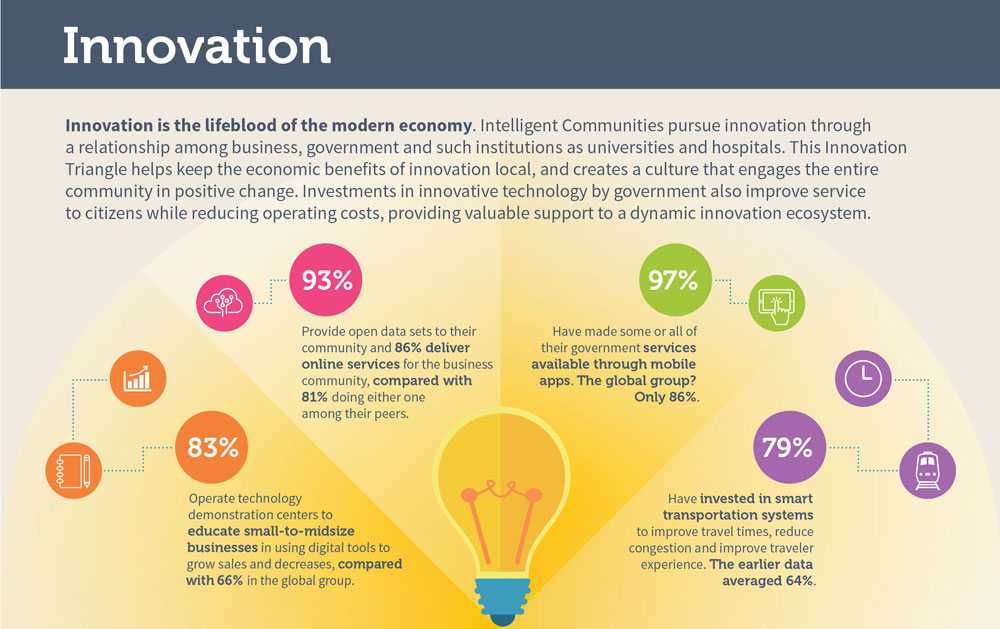
(Source)
Overall, innovation has the potential to be an incredibly powerful tool capable of positively transforming entire communities if used correctly.
Innovation can have a profound impact on communities, from improving economic conditions to increasing social well-being and environmental sustainability. By looking at examples of successful innovations that have already benefited communities, we can gain insight into how future innovation efforts can be used to benefit society in the same way.
Key Takeaway: Innovation has the potential to benefit communities in many ways, such as economic growth and development, increased productivity and cost savings, improved communication technology, and access to products that may not have been available before.
Examples of Innovations that Have Benefited Communities
Innovation has been an integral part of human progress for centuries. It can take many forms, from technological advancements to new business models and processes. Innovations have the potential to benefit communities in a variety of ways, including economically, socially, and environmentally.
How can innovation benefit the community? Here are some examples of innovations that have had positive impacts on communities around the world.
Healthcare Innovations
Healthcare is one area where innovation has made a significant difference in people’s lives. From medical devices such as pacemakers and artificial organs to telemedicine platforms that allow patients to access care remotely, healthcare innovations have improved access to quality care while reducing costs.
Additionally, advances in genomics research have enabled more personalized treatments tailored specifically to individual patients’ needs.
Education Innovations
Education is another sector where innovation has played an important role in improving outcomes for students and teachers alike. Technology-enabled solutions such as online learning platforms provide greater flexibility for students who may not be able to attend traditional classes due to geographical or financial constraints. Augmented reality tools also offer exciting opportunities for immersive learning experiences that engage students with interactive content like never before possible.
Energy Innovations
Sustainable energy sources are becoming increasingly important as we strive to reduce our reliance on fossil fuels and other non-renewable resources, which can cause environmental damage over time.
Examples of sustainable energy solutions include solar panels that harness the sun’s rays, wind turbines that generate electricity through wind power, and geothermal systems that tap into underground heat sources. These technologies help reduce emissions while providing clean energy alternatives at a lower cost than traditional methods.
These are just some examples of how innovative solutions can benefit communities across different sectors. There are countless others out there waiting to be discovered. With proper planning and implementation strategies, we all can workk together towards creating better futures through innovation.
Innovation has the potential to benefit communities in many ways, from healthcare to education and beyond.
Key Takeaway: Innovation has the potential to benefit communities in a variety of ways, from healthcare and education to sustainable energy sources. Examples include medical devices, telemedicine platforms, online learning tools, and renewable energy solutions. With proper planning and implementation strategies, we can create better futures through innovation.
Challenges to Implementing Innovative Solutions in Communities
While innovation has many benefits such as increased efficiency and productivity, it also presents challenges when trying to implement innovative solutions in communities.
Financial Barriers
Financial barriers are one of the most common challenges faced when implementing innovative solutions in communities. These financial barriers can include a lack of access to capital, limited resources for research and development, and high costs associated with the implementation, and maintenance of an innovative solution.
For example, installing solar panels on homes may require upfront investments that some people cannot afford due to their economic situation.
Cultural Barriers
Cultural barriers are another challenge that must be addressed when implementing innovative solutions in communities. This includes attitudes towards change within a community which may prevent them from accepting an innovative solution even if it could benefit them greatly over time.
For instance, some rural areas may not accept new technologies because they feel comfortable with traditional methods or fear change itself which prevents any kind of progress from happening in those areas.
Political Barriers
Political barriers can also be encountered when attempting to introduce innovative solutions into a community due to divergences between local governments and businesses that have distinct interests. For example, there may be disputes between government officials regarding whether or not renewable energy sources should be adopted by a particular region because of potential economic effects on existing industries.
Despite the challenges that come with implementing innovative solutions in communities, there are strategies and resources available to help overcome these barriers. By developing a comprehensive implementation plan, securing funding for implementation, and engaging stakeholders in the process, we can work towards overcoming these challenges and achieving successful implementations of innovative solutions.
Key Takeaway: Innovation can benefit a community, but it must overcome financial, cultural, and political barriers. These include a lack of access to capital, attitudes toward change, and disputes between governments and businesses.
Conclusion
How can innovation benefit the community? From improving access to healthcare and education to creating new jobs and economic opportunities, innovation has the potential to transform lives.
However, implementing innovative solutions in communities can be challenging due to factors such as a lack of resources or infrastructure. To overcome these challenges, stakeholders from both the public and private sectors need to collaborate on strategies that will ensure the successful implementation of innovative solutions in communities. By doing so, we can unlock the full potential of innovation and create lasting positive impacts on our society.
Innovation is key to the growth and development of any community. With Cypris, R&D and innovation teams can access a platform that allows them to quickly gather data from multiple sources in one place.
This saves time while allowing for deeper insights into new ideas or products they are working on, which leads to more informed decisions. We urge all members of our communities – both public and private – to explore how this innovative tool could benefit their research & development initiatives today!
Keep Reading

This article was powered by Cypris Q, an AI agent that helps R&D teams instantly synthesize insights from patents, scientific literature, and market intelligence from around the globe. Discover how leading R&D teams use CypriQ to monitor technology landscapes and identify opportunities faster - Book a demo
Solid-State Battery Electrolyte Materials: Startups and Suppliers
The solid-state battery industry has a credibility problem. Toyota has been promising commercialization "in a few years" since 2017. QuantumScape went public via SPAC in 2020 at a $3.3 billion valuation before shipping a single commercial cell. The entire sector has raised over $4.2 billion from US and European investors alone, yet the vast majority of innovation records in this space remain scientific publications rather than patents or commercial deployments. We are still, fundamentally, in a research-intensive phase pretending to be on the cusp of mass production.
And yet. Mercedes-Benz just drove 749 miles on a single charge in a prototype EQS. MG is taking pre-orders for a semi-solid-state battery vehicle priced under $15,000. Factorial Energy has commissioned a pilot production line and is shipping sample cells to OEMs. Something is actually happening now that wasn't happening three years ago, and the companies that understand the materials science bottlenecks will be the ones that capture the value.
The uncomfortable truth is that solid-state battery success is almost entirely a materials problem. The cell architecture is well understood. The performance benefits are proven in laboratories worldwide. What separates the winners from the vaporware is whether they can manufacture solid electrolyte materials at scale, with consistent quality, at a price point that makes commercial sense. Everything else is marketing.
Why the Electrolyte Is Everything
A solid-state battery replaces the flammable liquid electrolyte in conventional lithium-ion cells with a solid material that conducts lithium ions. This single substitution theoretically enables higher energy density (potentially double today's best cells), faster charging (minutes instead of hours), dramatically improved safety (no thermal runaway risk), and longer cycle life (10,000+ charges versus 2,000-3,000). The theoretical advantages are so compelling that every major automaker has announced solid-state battery programs.
The practical challenge is that solid electrolytes are extraordinarily difficult to manufacture. Sulfide-based materials offer the highest ionic conductivity but decompose when exposed to moisture, requiring manufacturing in controlled atmospheres with humidity levels below those found in semiconductor fabs. Oxide ceramics like LLZO are stable in air but are brittle, making it nearly impossible to maintain contact between electrolyte and electrodes as the battery expands and contracts during cycling. Polymer electrolytes can be processed with conventional equipment but only achieve adequate conductivity at elevated temperatures, limiting their applications.
The companies that have solved these problems at laboratory scale are now learning that solving them at production scale is an entirely different challenge. Bosch invested heavily in solid-state batteries and then withdrew entirely, citing economic risk and long payback periods. The timeline keeps sliding because the materials science keeps proving harder than the press releases suggested.
The Startup Landscape: Who's Actually Shipping
Seventeen US and European solid-state battery startups have raised a combined $4.2 billion in funding, but they're at wildly different stages of commercial readiness.
Factorial Energy is arguably furthest along the commercialization path. The Massachusetts-based company has raised $200 million from Mercedes-Benz, Hyundai, and Stellantis and opened a manufacturing facility in Methuen that represents the largest solid-state battery assembly line in the United States. Factorial's technology uses a quasi-solid electrolyte that contains a small amount of liquid, which some purists argue disqualifies it from the "solid-state" category but which pragmatists recognize as a viable path to near-term production. The company's FEST platform has demonstrated 391 Wh/kg energy density, and Stellantis plans to test Factorial batteries in a fleet of Dodge Charger Daytona EVs in 2026. CEO Siyu Huang recently announced a partnership with Korean materials giant POSCO to develop cathode and anode materials, signaling confidence in scaling beyond pilot production.
QuantumScape remains the highest-profile pure-play solid-state battery company, with $1.5 billion in total funding and a market cap that has swung wildly based on technology announcements. The company's ceramic separator technology uses LLZO-based oxide electrolytes, and its recent Cobra manufacturing process reportedly speeds heat treatment by 25x while reducing physical footprint. QuantumScape has partnered with Murata Manufacturing, a global ceramics specialist, to mass-produce its separator technology. The company shipped its first QSE-5 sample cells to customers in 2025 and plans field testing in 2026, with commercial production potentially following in 2027. Volkswagen remains the anchor investor and development partner, with up to $131 million in milestone-based funding committed through its PowerCo subsidiary.
Solid Power has taken a differentiated approach by positioning itself as a materials supplier rather than a cell manufacturer. The Colorado-based company produces sulfide-based solid electrolyte material and licenses cell designs to automotive partners BMW and Ford. This strategy reduces capital requirements and potentially creates a high-margin recurring revenue stream, but it also means Solid Power depends on partners to validate its technology in actual vehicles. The company recently announced that Samsung SDI will fabricate cells using Solid Power's electrolyte, expanding beyond its original automotive partners. Solid Power has raised $437 million and operates a pilot facility producing EV-scale cells for qualification testing.
Adden Energy represents the emerging class of university spin-outs attacking specific technical challenges. Founded by scientists from Harvard's Xin Li laboratory, the company has developed a multi-electrolyte separator and porous 3D lithium metal anode that demonstrate 10,000+ charge cycles in laboratory cells versus 2,000-3,000 for industry benchmarks. Adden's technology specifically targets dendrite formation, the metal projections that cause short circuits and have plagued other solid-state approaches. The company raised a $15 million Series A in August 2024 and has commissioned a pilot production line for OEM samples. If the laboratory performance translates to production cells, Adden could leapfrog competitors on cycle life, but that's a significant "if."
SES AI (formerly SolidEnergy Systems) has raised $600 million and developed Li-Metal batteries offering over 400 Wh/kg energy density. The company has partnerships with Honda, Hyundai, GM, and SAIC Motor, positioning it as a potential supplier across multiple OEMs. SES uses an ultra-thin lithium-metal anode rather than a fully solid electrolyte, which some analysts categorize as "hybrid" rather than true solid-state. Regardless of taxonomy, the company is shipping prototype cells and has a clearer path to production than many competitors.
Lyten has emerged as an aggressive consolidator in a distressed market. The San Jose-based company raised $200 million in July 2025 specifically to acquire assets from bankrupt battery manufacturer Northvolt, including intellectual property and a Polish assembly plant. Lyten's core technology uses 3D graphene materials in lithium-sulfur chemistry, achieving 250-325 Wh/kg in prototype cells. The company's willingness to buy distressed assets suggests confidence that the solid-state shakeout will create opportunities for well-capitalized survivors.
Theion, a German startup backed by solar company Enpal, has developed what it calls Crystal Battery technology using lithium-sulfur cathodes. Sulfur is 99% cheaper to source than conventional cathode materials and requires 90% less energy to produce, potentially addressing the cost challenges that have limited solid-state commercialization. The company is exploring quasi-solid-state designs that may reach market faster than fully solid alternatives.
LionVolt, a spin-out from TNO's Holst Centre in the Netherlands, raised €15 million in February 2024 to scale its 3D solid-state battery architecture. The technology uses billions of micropillars coated with battery materials to create high surface area and short ion transport distances, enabling ultra-fast charging. The approach is clever but unproven at automotive scale.
ION Storage Systems, a University of Maryland spin-out, has achieved 25x capacity improvements and over 1,000 cycles in large-format cells without requiring external compression, which addresses a major manufacturing challenge. The company has received $20 million from ARPA-E and recently opened a 30,000-square-foot manufacturing facility targeting EVs, defense, and grid storage applications.
Basquevolt received a perfect 9/9 score from the European Commission's EIC Accelerator and €2.5 million in grant funding with access to an additional €10 million. The Spanish company is developing electrolyte technology that claims to enable 50% more range while integrating with existing battery factory equipment, positioning it as a potential supplier to European cell manufacturers seeking to reduce dependence on Asian supply chains.
The Materials Supply Chain: Where the Real Bottlenecks Live
Commercial solid-state battery production will require massive increases in specialty chemical manufacturing capacity that doesn't currently exist. This is where R&D intelligence becomes actionable competitive advantage rather than academic interest.
Sulfide electrolyte precursors represent the tightest supply constraint. Lithium sulfide (Li2S) serves as the foundational material for nearly all sulfide-based solid electrolytes, and only a handful of suppliers produce battery-grade material at meaningful volumes. Ampcera operates from facilities in Arizona with a 20-ton annual pilot plant capacity scaling toward 1,000 tons by 2027. The company holds IP-protected sulfide electrolyte chemistry featuring controlled particle sizes for fast-charging applications. NEI Corporation manufactures multiple sulfide compositions including LSPS, LPS, and LPSCl in quantities from 10 grams to kilogram scale. MSE Supplies distributes both Ampcera materials and its own lithium sulfide powders validated by battery researchers globally. Lorad Chemical and Stanford Advanced Materials offer 99.95% purity Li2S powders for electrolyte synthesis.
The Toyota-Idemitsu Kosan partnership announced in June 2025 represents the most significant sulfide supply chain development. Idemitsu's ¥21.3 billion ($142 million) investment will build dedicated lithium sulfide production capacity with Toyota as anchor customer for the 2027-2028 commercial launch. This vertical integration gives Toyota supply security that merchant-market purchasers will lack.
Korean company Solid Ionics is preparing for mass production with plans to complete a 1,200-ton annual capacity plant in Ulsan by 2027. The company holds patents on lithium sulfide production and has developed semi-continuous manufacturing processes that enable consistent quality at higher volumes. Samyang has invested 5.9 billion won in Solid Ionics, creating a potential Korean supply alternative to Japanese sources.
Oxide electrolyte materials face different supply dynamics. LLZO and related garnet ceramics can be handled in air and are produced by multiple suppliers including NEI Corporation (LLZO, LLZTO, LATP, LAGP compositions), MSE Supplies (Ampcera-branded powders with aluminum, tantalum, and niobium doping), Niterra (three LLZO-Mg,Sr variants for different applications), Sigma-Aldrich (battery-grade Al-doped LLZO), and Chinese suppliers including Dongguan Gelon and TOB New Energy. The oxide supply chain is more diversified but faces challenges in producing the thin, dense ceramic membranes required for high-performance cells.
Polymer electrolyte materials leverage existing specialty chemical supply chains and face fewer constraints, though the performance limitations of polymer systems may restrict their addressable market.
Sulfide Electrolyte Materials: The Most Constrained Supply Chain
Sulfide-based electrolytes offer the highest ionic conductivity but face the tightest supply constraints due to moisture sensitivity and specialized manufacturing requirements.
Ampcera (Arizona, USA) has emerged as the Western leader in commercialized argyrodite-type Li6PS5Cl, claiming to be the first company to successfully commercialize this material at scale. Their facilities include a 1-ton pilot capacity with a 20-ton industrial pilot plant, targeting 1,000 tons annually by 2027. Ampcera supplies multiple particle sizes optimized for different cell architectures, with ionic conductivity specifications reaching 3 mS/cm at room temperature.
Mitsui Mining & Smelting (Japan) has developed its A-SOLiD brand of argyrodite sulfide electrolytes, with a mass production testing facility in Ageo, Saitama. In September 2024, the company announced construction of a new plant for initial mass production targeting 2027 operation, positioning A-SOLiD as a standard material for Japanese and Korean cell manufacturers including partners with Toyota's solid-state battery development program.
NEI Corporation (New Jersey, USA) offers one of the broadest sulfide portfolios including LSPS (Li10SiP2S12), LPS (Li7P3S11), standard LPSCl, and the newly introduced chlorine-rich Li5.5PS4.5Cl1.5 variant with enhanced stability. NEI supplies research quantities from 10 grams to kilogram scale, serving as a critical source for academic and corporate R&D programs.
Solid Ionics (Korea) operates a lithium sulfide production facility with patents on sulfide precursor synthesis. Samyang Corporation invested 5.9 billion won in the company, which is building a 1,200-ton Ulsan plant targeted for 2027 operation, creating a Korean supply alternative to Japanese dominance.
Idemitsu Kosan (Japan) has committed ¥21.3 billion (approximately $142 million) to construct a lithium sulfide plant specifically to supply Toyota's solid-state battery program, with mass production targeted for 2027-2028.
Dongwha Enterprise (Korea) has emerged as Samsung SDI's primary solid electrolyte development partner, working on sulfide electrolyte materials for Samsung's 2027 commercialization target.
TOB New Energy (Xiamen, China) offers LPSCl and other sulfide compositions for research applications, representing the growing Chinese capability in this segment.
Precursor Materials for Sulfide Synthesis
Lithium sulfide (Li2S) represents the critical bottleneck precursor, commanding prices that can exceed tens of thousands of dollars per kilogram due to limited industrial demand outside battery applications.
Albemarle Corporation (USA) has positioned lithium sulfide as a strategic product for solid-state electrolyte synthesis, leveraging its position as the world's leading lithium producer to offer high-purity Li2S for sulfide electrolyte precursors.
Ganfeng Lithium (China) produces high-grade lithium sulfide in-house for its own solid-state battery production, with sulfide electrolyte materials including LGPS, LPSC, Li7P3S11, and Li3PS4. Their vertical integration from lithium mining through electrolyte production represents a competitive advantage in cost structure.
MSE Supplies (USA) distributes Ampcera-manufactured lithium sulfide (99.9% purity) for research applications, offering quantities from 100 grams to multi-kilogram orders.
Lorad Chemical (USA) and Stanford Advanced Materials supply 99.95% purity Li2S precursors primarily for laboratory and pilot-scale applications.
Hubei Xinrunde, Hangzhou Kaiyada, and Chengdu Hipure represent Chinese lithium sulfide suppliers serving domestic solid-state battery development programs.
Phosphorus pentasulfide (P2S5) for glass-ceramic and amorphous sulfide electrolytes is supplied by Perimeter Solutions (Germany, USA), which has been the market leader in P2S5 production for over 70 years with facilities in Hürth, Germany and Sauget, Illinois. MTI Corporation and American Elements also supply battery-grade P2S5 for research applications.
Oxide Electrolyte Materials: More Diversified Supply
Oxide-based electrolytes including garnets (LLZO), NASICON-types (LATP, LAGP), and perovskites (LLTO) benefit from more diversified supply chains due to air stability during handling.
MSE Supplies (USA) offers comprehensive oxide portfolios manufactured by Ampcera including aluminum-doped LLZO (Li6.25Al0.25La3Zr2O12), tantalum-doped LLZO (LLZTO), and niobium-doped LLZO, available in nano-powder to micron-sized particles with sintered ceramic membranes for cell testing.
NEI Corporation provides NASICON-type LATP (Li1.4Al0.4Ti1.6(PO4)3) and LAGP (Li1.5Al0.5Ge1.5(PO4)3) in quantities from 25 grams to kilogram scale, plus custom oxide compositions for specific cell architectures.
Ohara Corporation (Japan) has commercialized LICGC (Lithium Ion Conducting Glass-Ceramics), a NASICON-structure glass-ceramic electrolyte available as powder, sintered plates, and thin membranes. Ohara's materials achieve ionic conductivity of 1-4 × 10⁻⁴ S/cm at room temperature with exceptional chemical resistance to water and mild acids.
Niterra (formerly NGK Spark Plug, Japan) specializes in LLZO-based oxide electrolytes under the OXSSB trademark, offering three oxide electrolyte variants with space qualification for satellite and aerospace applications.
Stanford Advanced Materials supplies Ta-doped LLZO powder for research applications.
Sigma-Aldrich (Merck) offers battery-grade Al-doped LLZO with 5-6 micron particle size and ionic conductivity in the 0.01-0.1 mS/cm range.
MTI Corporation (Richmond, California) provides NASICON-type LATP powder and other oxide compositions for research and education applications.
Chinese suppliers including TOB New Energy (Xiamen), Dongguan Gelon, and Green Science Alliance offer oxide electrolyte materials at competitive prices for domestic and export markets.
NASICON and Phosphate Electrolytes
Beyond Battery (emerging supplier) offers NASICON-type LATP with ionic conductivity specified in the 10⁻⁶ to 10⁻³ S/cm range for solid-state battery research.
Polymer Electrolyte Materials
NEI Corporation produces NANOMYTE H-polymer, a proprietary PEO-based copolymer with ionic conductivity approximately four orders of magnitude higher than pure PEO at room temperature (~5×10⁻⁵ S/cm), plus SE-50 hybrid polymer-ceramic composites.
Syensqo (formerly Solvay Specialty Polymers, Belgium/USA) supplies Solef PVDF for electrode binders and separator coatings, with growing focus on polymer electrolyte applications. The company's fluorinated polymer expertise positions it for solid-state polymer battery development.
MSE Supplies offers PEO (polyethylene oxide) powders in multiple molecular weight grades (Mw ~10,000 to Mv ~1,000,000) for solid-state electrolyte research.
Dow Chemical has emerged as a key PEO supplier for battery applications as IRA-driven localization requirements redirect Korean battery manufacturers to US-sourced materials.
Halide Electrolyte Materials
NEI Corporation introduced commercial Li3InCl6 (lithium indium chloride) halide solid electrolyte in October 2024, representing the emerging halide electrolyte category that offers high ionic conductivity, wide electrochemical windows, and improved air stability compared to sulfides.
AOTELEC (China) offers Li3InCl6 halide solid electrolyte powder for lithium battery applications.
MSE Supplies recently added LZOC (Li1.75ZrO0.5Cl4.75) lithium zirconium oxychloride solid electrolyte to their expanding halide portfolio.
Integrated Battery Materials Suppliers
Several major chemicals companies are positioning themselves across multiple solid electrolyte categories:
Ganfeng Lithium (China) operates as a vertically integrated supplier from lithium mining through solid-state battery production, offering LGPS, LPSC, Li7P3S11, and Li3PS4 sulfide electrolytes alongside oxide-based flexible electrolyte membranes.
Tinci Materials (China) has emerged as a leading electrolyte manufacturer with production capacity of 850,000 tons annually, expanding into solid electrolyte materials alongside its dominant position in liquid electrolytes.
POSCO (Korea) has partnered with Factorial Energy to develop materials for all-solid-state batteries, leveraging its existing position as a cathode and anode materials supplier to global battery leaders including LG Energy Solution, SK On, and Samsung SDI.
Equipment and Processing Materials Suppliers
Beyond raw electrolyte powders, specialized equipment and processing materials are required for solid-state battery manufacturing.
Gelon Lib Co. (China) supplies coin cell components and battery assembly equipment used in solid-state battery R&D.
Tmax Battery Equipment Limited (China) provides hydraulic presses and other assembly equipment for solid-state battery prototyping.
What Actually Matters for R&D Teams
The solid-state battery landscape is simultaneously over-hyped and genuinely transformational. The technology works. The performance advantages are real. Commercial production is coming. The question is which companies will capture value, and that depends almost entirely on materials science execution rather than laboratory demonstrations.
For corporate R&D teams evaluating partnership opportunities, supplier relationships, or acquisition targets, the key variables are:
Electrolyte chemistry choice determines manufacturing complexity and supply chain exposure. Sulfide systems offer the best performance but require the most stringent manufacturing controls and have the most constrained supply chains. Oxide systems are more forgiving but face mechanical challenges. Polymer and hybrid systems may reach market faster but with performance compromises.
Patent freedom-to-operate is under-appreciated as a commercial risk. The concentration of manufacturing process patents among Asian companies means Western startups may face licensing obligations or infringement risk at production scale. Due diligence on patent landscape is essential before major commitments.
Supply chain visibility matters more than cell performance specifications. A company claiming 500 Wh/kg energy density is meaningless if they can't source electrolyte precursors at volumes supporting commercial production. The startups with secured supply relationships will outcompete those dependent on spot-market purchases.
Manufacturing scalability is where most solid-state programs fail. Laboratory coin cells and production-scale pouch cells are completely different engineering challenges. Companies demonstrating pilot-line output and OEM sample shipments have de-risked more than those still publishing laboratory results.
The teams that will succeed are those maintaining continuous visibility into startup emergence, patent activity, supplier development, and partnership formation across the global innovation ecosystem. The landscape is moving too fast for quarterly competitive reviews or annual strategy updates. Real-time intelligence on material advances, manufacturing breakthroughs, and strategic moves is essential to capture value from this technology transition.
How R&D Teams Track This Landscape
The solid-state battery materials space exemplifies the challenge facing enterprise R&D and innovation teams: a critical technology transition moving faster than traditional competitive intelligence methods can track. New startups are spinning out of university labs monthly. Patent filings span multiple jurisdictions with claim language requiring deep technical expertise to interpret. Supplier capacity announcements, partnership deals, and funding rounds create a continuous stream of signals that reshape competitive dynamics in real time.
Manual approaches simply cannot keep pace. By the time a startup appears in trade publications, they've already secured OEM partnerships. By the time a patent issues, the underlying technology has been in development for years. By the time a supplier announces capacity expansion, the offtake agreements are already signed.
Cypris provides the R&D intelligence infrastructure that enterprise teams need to maintain continuous visibility into landscapes like solid-state battery materials. The platform aggregates over 500 million patents and scientific papers alongside startup funding data, company profiles, and partnership announcements into a unified search environment built specifically for R&D workflows. Unlike general-purpose databases, Cypris uses a proprietary R&D ontology that understands the semantic relationships between technologies, enabling searches that surface relevant innovation even when terminology varies across sources.
The platform's API-first architecture integrates directly into existing R&D workflows, and SOC 2 Type II certification ensures enterprise security requirements are met. Innovation teams at Honda, Yamaha, Johnson & Johnson, and Philip Morris International use Cypris to monitor technology landscapes, identify partnership and acquisition targets, and track competitive patent activity.
For R&D leaders navigating the solid-state battery transition or any high-velocity technology landscape, the question isn't whether intelligence matters. It's whether your current approach delivers visibility fast enough to act on what you find.
Learn more at cypris.ai

Top 8 Tech Scouting Platforms for Enterprise R&D Teams in 2026
Technology scouting platforms have become essential infrastructure for enterprise R&D teams seeking to identify emerging technologies, monitor competitive innovation landscapes, and discover partnership opportunities before competitors. A tech scouting platform is software that aggregates patent databases, scientific literature, startup information, and market intelligence to help R&D professionals systematically discover technologies relevant to their strategic priorities. The best tech scouting platforms combine comprehensive data coverage with AI-powered search capabilities that surface relevant innovations across technical domains.
Enterprise R&D teams face a fundamental challenge when evaluating tech scouting software. Most platforms in this category evolved from either startup databases designed for corporate venture capital teams or innovation management systems built for idea collection workflows. Neither origin serves the core technical scouting needs of R&D professionals who must understand the scientific foundations of emerging technologies, track patent landscapes across global jurisdictions, and identify technical capabilities that align with product development roadmaps. The platforms reviewed here represent the leading options available in 2025, evaluated specifically for their ability to support technical scouting workflows within enterprise R&D organizations.
Why Tech Scouting Has Become a Core R&D Function
The economics of industrial R&D have shifted fundamentally over the past two decades. Internal research laboratories once served as the primary source of breakthrough innovations for large corporations, but the distributed nature of modern scientific progress has made external technology acquisition essential for maintaining competitive position. Universities, government laboratories, startups, and competitors now generate innovations relevant to virtually every corporate R&D agenda, creating both opportunity and complexity for technology leaders.
Tech scouting addresses this complexity by systematizing the discovery process. Rather than relying on conference attendance, personal networks, and serendipitous discovery, R&D teams using tech scouting platforms can continuously monitor the global innovation landscape for developments relevant to their strategic priorities. The most effective tech scouting programs identify potential technologies years before they reach commercial maturity, providing time to evaluate technical fit, establish partnerships, or develop internal capabilities.
The challenge lies in signal extraction. Global patent offices publish millions of new applications annually. Scientific journals add millions of peer-reviewed papers to the literature each year. Thousands of technology startups launch and seek partnerships with established enterprises. Without systematic approaches to filtering this volume, R&D teams either miss relevant innovations or waste resources chasing technologies that prove irrelevant to their actual needs.
The Three Layers of Effective Tech Scouting
Mature tech scouting programs operate across three distinct layers, each requiring different data sources, analytical approaches, and organizational capabilities.
The first layer focuses on horizon scanning, the broad monitoring of scientific and technical developments across domains relevant to the organization's long-term strategy. Horizon scanning identifies emerging research directions that may yield breakthrough technologies in five to fifteen years. This layer relies heavily on scientific literature analysis, tracking publication patterns, citation networks, and funding flows that signal where research communities are concentrating attention. Effective horizon scanning reveals technological possibilities before they attract widespread commercial interest.
The second layer addresses landscape mapping, the detailed analysis of specific technology areas where the organization has active strategic interest. Landscape mapping produces comprehensive views of who is working on relevant technologies, what approaches they are pursuing, how intellectual property is distributed, and where technical bottlenecks remain unsolved. This layer combines patent analysis with scientific literature review and startup monitoring to construct actionable intelligence about competitive dynamics within defined technology domains.
The third layer involves target identification, the specific discovery of technologies, companies, or research groups that merit direct engagement. Target identification converts landscape intelligence into actionable opportunities, whether potential licensing deals, partnership discussions, acquisition targets, or research collaborations. This layer requires the most refined filtering, identifying not just relevant technologies but specifically those with sufficient maturity, strategic fit, and accessibility to warrant investment of relationship-building resources.
Most tech scouting platforms support some combination of these layers, but few handle all three with equal capability. Platforms originating from startup databases excel at target identification for company partnerships but lack depth for horizon scanning in scientific literature. Platforms built around patent analytics provide strong landscape mapping but may miss early-stage research that has not yet generated intellectual property filings. Understanding which layers matter most for your organization's scouting objectives helps guide platform selection.
Common Tech Scouting Mistakes and How to Avoid Them
Even well-resourced R&D organizations make predictable mistakes when establishing tech scouting capabilities. Recognizing these patterns helps teams avoid common pitfalls and accelerate time to value from scouting investments.
The keyword trap represents the most pervasive tech scouting failure mode. Teams define search queries using terminology familiar within their organization, then wonder why results miss obviously relevant technologies. The problem stems from terminology variation across industries, geographies, and research traditions. A pharmaceutical company searching for drug delivery innovations may miss relevant patents filed by materials science companies using polymer chemistry terminology. An automotive team scouting battery technologies may overlook academic research published using electrochemistry nomenclature unfamiliar to automotive engineers. Escaping the keyword trap requires either exhaustive synonym mapping, which proves impractical at scale, or semantic search capabilities powered by technical ontologies that understand conceptual relationships across terminology boundaries.
Recency bias causes tech scouting programs to overweight recent developments while undervaluing foundational patents and seminal research that shape entire technology domains. The most commercially relevant technologies often build on intellectual property filed years or decades earlier. Scouting programs that focus exclusively on recent activity may identify derivative innovations while missing the foundational technologies that control freedom to operate. Effective tech scouting balances monitoring of new developments with periodic landscape reviews that map historical intellectual property positions.
The startup fixation leads R&D teams to equate tech scouting with startup scouting, missing technologies developed within universities, government laboratories, and established corporations. Startups represent only one commercialization pathway for new technologies. Many breakthrough innovations transfer through licensing agreements with universities, joint development partnerships with research institutions, or acquisition of intellectual property from corporations exiting technology areas. Tech scouting programs that rely exclusively on startup databases systematically miss these alternative pathways.
Scouting without synthesis produces information without insight. Teams generate extensive lists of potentially relevant technologies but fail to synthesize findings into strategic recommendations that inform R&D investment decisions. The most valuable tech scouting programs connect discovery activities to decision-making processes, translating landscape intelligence into specific recommendations about where to build internal capabilities, where to seek external partnerships, and where to avoid investment due to competitive dynamics or intellectual property constraints.
Building a Tech Scouting Workflow That Delivers Results
Effective tech scouting requires more than platform access. Organizations that extract consistent value from scouting investments build workflows that connect discovery activities to strategic decision-making and R&D execution.
Start with strategic alignment before platform configuration. Tech scouting produces value only when focused on questions that matter for organizational strategy. Before defining searches or configuring alerts, identify the specific strategic uncertainties that scouting should address. Which technology areas could disrupt current product lines? Where do capability gaps limit pursuit of attractive market opportunities? What adjacent domains might enable diversification into new markets? These strategic questions should drive scouting priorities rather than allowing platform capabilities to define scope.
Design scouting cadences that match technology maturity timelines. Horizon scanning for early-stage research requires different rhythms than landscape monitoring in fast-moving commercial domains. Academic research in fundamental science may warrant quarterly reviews, while competitive patent filings in active technology races may require weekly monitoring. Match monitoring frequency to the pace of relevant developments rather than applying uniform cadences across all scouting activities.
Establish clear handoff processes between scouting and evaluation. Discovery identifies candidates; evaluation determines fit. These functions require different expertise and often involve different organizational stakeholders. Define explicit criteria for when scouted technologies advance to detailed evaluation, who conducts technical assessment, and how evaluation findings feed back into scouting priorities. Without clear handoffs, promising discoveries languish without action while scouting teams continue generating new candidates that similarly stall.
Create feedback loops that improve scouting precision over time. Track which scouted technologies advance through evaluation to partnership discussions or internal development. Analyze patterns in technologies that prove relevant versus those that fail evaluation. Use these patterns to refine search strategies, adjust filtering criteria, and improve the ratio of actionable discoveries to noise. Tech scouting capabilities compound over time when organizations systematically learn from results.
Integrate scouting insights into existing R&D planning processes. Technology intelligence proves most valuable when it informs resource allocation decisions, shapes research priorities, and influences build-versus-partner choices during strategic planning cycles. Identify the specific planning processes where scouting insights should contribute and establish mechanisms for delivering relevant intelligence at decision points. Scouting programs disconnected from planning processes generate reports that inform no decisions.
Measuring Tech Scouting Effectiveness
Quantifying the value of tech scouting proves challenging because the function operates upstream of commercial outcomes. However, several metrics help organizations assess whether scouting investments generate appropriate returns.
Discovery-to-engagement conversion rate measures what percentage of scouted technologies advance to active engagement, whether partnership discussions, licensing negotiations, or detailed technical evaluation. Low conversion rates may indicate poor alignment between scouting priorities and strategic needs, overly broad discovery criteria that generate excessive noise, or bottlenecks in evaluation processes that prevent action on promising candidates. Tracking this metric over time reveals whether scouting precision improves as teams refine approaches.
Time-to-discovery measures how quickly tech scouting identifies technologies that ultimately prove strategically relevant. Organizations can assess this retrospectively by examining technologies that reached partnership or development stages and determining when scouting first surfaced them. Shorter time-to-discovery indicates effective horizon scanning that identifies opportunities before competitors, while longer timelines suggest scouting programs react to visible trends rather than anticipating emerging developments.
Coverage completeness assesses whether tech scouting captures the full landscape of relevant developments or systematically misses certain categories. Organizations can evaluate coverage by comparing scouted technologies against those identified through other channels, such as inbound partnership inquiries, conference presentations, or competitive intelligence. Gaps in coverage reveal blind spots in scouting methodology, data sources, or search strategies that warrant correction.
Strategic influence measures the degree to which scouting insights actually inform R&D decisions. This qualitative assessment examines whether technology intelligence shapes research priorities, influences partnership strategies, or affects resource allocation during planning processes. Scouting programs that generate extensive reports but rarely influence decisions warrant redesign regardless of discovery volume or quality.
When to Use Different Data Sources
Tech scouting platforms vary significantly in the data sources they aggregate, and understanding the strengths of different source types helps organizations extract maximum value from available intelligence.
Patent databases provide the most comprehensive record of technologies with commercial intent. Patent filings reveal not just what organizations are developing but what they consider sufficiently valuable to protect through intellectual property rights. Patent analysis supports competitive intelligence, freedom-to-operate assessment, and identification of potential licensing or acquisition targets. However, patents lag actual development by eighteen months or more due to publication delays, and not all valuable technologies generate patent filings. Organizations in certain industries rely on trade secrets rather than patents to protect innovations.
Scientific literature offers earlier visibility into emerging technologies than patent databases, often surfacing research directions years before commercial development begins. Publication analysis reveals where research communities are concentrating effort, which approaches show promising results, and who is generating breakthrough findings. For horizon scanning focused on technologies beyond the current development pipeline, scientific literature provides essential early warning capability. However, academic publications may describe approaches that prove commercially impractical or face insurmountable scaling challenges.
Startup databases capture technologies that have attracted entrepreneurial attention and venture investment, providing signals about which innovations the market considers commercially viable. Startup data supports identification of potential partnership targets and acquisition candidates while revealing competitive threats from emerging players. However, startup databases cover only one commercialization pathway and may miss technologies developed within universities, government labs, or established corporations.
Funding and grant databases reveal where governments and research institutions are directing resources, providing signals about technology areas receiving concentrated investment. Grant data proves particularly valuable for horizon scanning in domains where public funding drives research agendas, such as life sciences, energy, and defense-adjacent technologies.
Market intelligence sources provide context about commercial dynamics, customer needs, and industry trends that help evaluate strategic relevance of scouted technologies. Market data helps distinguish technically interesting innovations from those addressing genuine commercial opportunities.
The most effective tech scouting programs combine multiple source types, using scientific literature for early horizon scanning, patents for landscape mapping and competitive intelligence, and startup databases for partnership target identification. Platforms that aggregate diverse sources into unified search environments simplify this multi-source approach.
1. Cypris
Cypris stands as the most comprehensive tech scouting platform purpose-built for enterprise R&D teams conducting technical scouting at scale. The platform aggregates over 500 million patents and scientific papers into a unified search environment, providing R&D professionals with the deepest technical intelligence coverage available in any single platform. What distinguishes Cypris from competitors in the tech scouting category is its proprietary R&D ontology, an AI-powered semantic layer that understands technical concepts and relationships across scientific domains rather than relying solely on keyword matching.
The Cypris R&D ontology transforms technical scouting by enabling semantic search that recognizes when different terminology describes the same underlying technology. An R&D team searching for innovations in battery chemistry will surface relevant patents and papers regardless of whether they use terms like solid-state electrolyte, lithium-ion cathode materials, or energy storage compounds. This ontology-driven approach addresses the fundamental limitation of traditional patent search tools, which require users to anticipate every possible term variation and miss relevant results when terminology differs across industries, geographies, or research traditions.
For technical scouting specifically, Cypris provides capabilities that general-purpose innovation platforms cannot match. The platform combines patent intelligence with scientific literature analysis, allowing R&D teams to trace technologies from early-stage academic research through patent protection and commercial development. This longitudinal view proves essential for technical scouts who need to understand not just what technologies exist today but which emerging research directions may yield breakthrough innovations in three to five years.
Cypris has established official API partnerships with OpenAI, Anthropic, and Google, positioning the platform as foundational R&D intelligence infrastructure for organizations building AI-powered research workflows. These partnerships reflect the platform's technical architecture, which emphasizes structured data accessibility and integration capabilities that enterprise R&D technology stacks require. Enterprise customers including Johnson & Johnson, Honda, Yamaha, and Philip Morris International rely on Cypris for technical scouting across pharmaceutical research, automotive innovation, and consumer product development.
The platform maintains SOC 2 Type II certification and operates entirely within the United States, addressing compliance requirements that enterprise R&D teams face when handling sensitive competitive intelligence. For organizations where technical scouting involves proprietary research directions or pre-patent innovations, Cypris provides the security infrastructure necessary for enterprise deployment.
2. Wellspring Worldwide
Wellspring offers a tech scouting platform called Scout that provides access to over 400 million records spanning patents, publications, startups, and research grants. The platform emphasizes discovery of external innovation partners and includes tools for tracking relationships with universities and research institutions. Wellspring serves technology transfer offices and corporate innovation teams seeking to identify licensing opportunities and research collaborations. The platform includes visualization tools for analyzing technology landscapes and portfolio management features for tracking scouting activities through evaluation stages.
3. Traction Technology
Traction Technology provides a tech scouting platform focused specifically on enterprise-ready startups, maintaining a curated database of over 50,000 vetted technology companies. The platform targets corporate innovation teams and technology scouts evaluating vendors and partnership candidates rather than conducting deep technical research. Traction emphasizes workflow management for the startup evaluation process, including scoring templates, comparison matrices, and collaboration features for distributed teams. The company also offers research analyst services to supplement platform capabilities with human-powered scouting support.
4. HYPE Innovation
HYPE Innovation delivers an enterprise innovation management platform that includes technology scouting capabilities within a broader suite of idea management and innovation program tools. The platform provides access to a database of technologies and startups while emphasizing collaborative evaluation workflows that engage internal stakeholders in assessing external innovations. HYPE serves organizations seeking to connect technology scouting with employee innovation programs and strategic planning processes. The platform has operated for over twenty years and maintains a client base across Fortune 500 companies and public sector organizations.
5. ITONICS
ITONICS provides an innovation operating system that incorporates technology scouting alongside trend monitoring, ideation, and portfolio management capabilities. The platform offers radar visualization tools for tracking emerging technologies across industries and AI-enhanced discovery features for identifying startups and research trends. ITONICS targets innovation strategy teams seeking to connect external technology intelligence with internal innovation planning and resource allocation decisions.
6. Qmarkets Q-scout
Qmarkets offers Q-scout as a dedicated technology scouting module within its broader innovation management platform. The solution focuses on startup scouting and deal flow management, providing tools for identifying, tracking, and evaluating potential technology partners. Q-scout includes AI-powered insights for assessing startup fit and risk, along with visualization tools for mapping scouting portfolios. The platform targets corporate innovation and venture teams managing pipelines of external partnership opportunities.
7. Ezassi
Ezassi provides technology scouting software that combines discovery tools with open innovation challenge management capabilities. The platform includes access to patent databases covering over 90 countries and integrates Crunchbase data for company research. Ezassi emphasizes customizable workflows and offers full-service scouting research programs where the company's team conducts technology discovery on behalf of clients. The platform serves organizations seeking to supplement internal scouting capacity with external research support.
8. PatSnap Discovery
PatSnap Discovery offers patent analytics and technology intelligence capabilities within a platform primarily designed for intellectual property professionals. The solution provides patent landscape analysis, competitive intelligence features, and innovation tracking tools. While PatSnap serves IP departments and patent attorneys as its primary audience, the Discovery product extends capabilities toward R&D teams conducting technology assessments and freedom-to-operate analyses.
How to Evaluate Tech Scouting Platforms for R&D
Enterprise R&D teams evaluating tech scouting platforms should assess candidates across several critical dimensions that determine long-term value for technical scouting workflows.
Data coverage represents the foundational consideration for any tech scouting platform. The most effective technical scouting requires access to both patent databases and scientific literature, since breakthrough technologies often appear in academic research years before patent filings. Platforms offering only startup databases or limited patent coverage constrain the scope of technical discovery possible. R&D teams should verify total record counts, geographic coverage of patent jurisdictions, and depth of scientific publication indexing when comparing platforms.
Search intelligence determines whether R&D professionals can actually find relevant technologies within large datasets. Keyword-based search requires users to anticipate terminology variations and often misses relevant results. Semantic search powered by technical ontologies recognizes conceptual relationships and surfaces relevant innovations regardless of specific terminology used. For technical scouting across scientific domains, ontology-driven search provides significantly higher recall than traditional approaches.
Enterprise integration capabilities matter for organizations seeking to embed tech scouting within broader R&D workflows. API access, single sign-on support, and compatibility with existing research tools determine whether a platform functions as integrated infrastructure or remains a standalone application. R&D teams should evaluate how scouting insights flow into product development processes and strategic planning systems.
Security and compliance requirements vary across industries but represent non-negotiable criteria for enterprises handling sensitive competitive intelligence. SOC 2 certification, data residency options, and access control capabilities determine whether platforms meet enterprise procurement standards. R&D teams in regulated industries should verify compliance certifications before engaging in detailed evaluations.
Frequently Asked Questions
What is a tech scouting platform?
A tech scouting platform is software that helps R&D teams systematically discover emerging technologies, monitor innovation landscapes, and identify potential technology partners or acquisition targets. Tech scouting platforms aggregate data from patent databases, scientific publications, startup information sources, and market intelligence providers into unified search environments. The best tech scouting platforms use AI-powered semantic search to surface relevant technologies based on conceptual meaning rather than requiring exact keyword matches.
What is the difference between tech scouting and startup scouting?
Tech scouting focuses on discovering technologies regardless of their source, including academic research, patent filings, and established company R&D activities, while startup scouting specifically targets early-stage companies as potential partners or investment opportunities. Tech scouting platforms designed for R&D teams emphasize patent analysis and scientific literature coverage, whereas startup scouting tools focus on company databases, funding information, and relationship management workflows. Enterprise R&D teams typically require tech scouting capabilities that extend beyond startup databases to include the full landscape of technical innovation.
Which tech scouting platform has the largest database?
Cypris maintains the largest unified database among tech scouting platforms purpose-built for R&D teams, with over 500 million patents and scientific papers accessible through a single search interface. Wellspring claims over 400 million records across patents, publications, and startup information. Database size alone does not determine platform value, as search intelligence and data quality significantly impact whether users can find relevant technologies within large datasets.
What is an R&D ontology and why does it matter for tech scouting?
An R&D ontology is a structured representation of technical concepts and their relationships that enables AI-powered semantic search across scientific and patent literature. Ontology-driven tech scouting platforms understand that different terms may describe the same technology and surface relevant results regardless of specific terminology used in source documents. For technical scouting, an R&D ontology addresses the fundamental challenge of terminology variation across industries, geographies, and research traditions that causes keyword-based search to miss relevant innovations.
What should enterprise R&D teams look for in a tech scouting platform?
Enterprise R&D teams should prioritize tech scouting platforms offering comprehensive data coverage spanning patents and scientific literature, semantic search powered by technical ontologies, API access for workflow integration, and enterprise security certifications including SOC 2 compliance. The most effective platforms for technical scouting combine depth of technical data with AI-powered search intelligence that understands scientific concepts rather than simply matching keywords.
How long does it take to implement a tech scouting program?
Most organizations can begin extracting value from tech scouting platforms within four to eight weeks of initial deployment. The first two weeks typically involve platform configuration, user training, and definition of initial search strategies aligned with strategic priorities. Weeks three through six focus on refining search approaches based on initial results and establishing workflows that connect discovery to evaluation processes. By week eight, teams generally have functioning scouting rhythms producing actionable technology intelligence. Full program maturity, including optimized search strategies, established feedback loops, and integration with R&D planning processes, typically requires six to twelve months of iterative refinement.
Should tech scouting be centralized or distributed across R&D teams?
The optimal organizational model depends on R&D structure and strategic objectives. Centralized tech scouting teams provide consistency in methodology, avoid duplication of effort, and build specialized expertise in discovery techniques. Distributed models embed scouting capability within business units or technology domains, enabling closer alignment with specific strategic needs and faster translation of insights into action. Many organizations adopt hybrid approaches, maintaining central teams for horizon scanning and landscape mapping while distributing target identification responsibilities to business units with direct accountability for partnership and development decisions.

AI-Accelerated Materials Discovery: How Generative Models, Graph Neural Networks, and Autonomous Labs Are Transforming R&D
This article was powered by Cypris Q, an AI agent that helps R&D teams instantly synthesize insights from patents, scientific literature, and market intelligence from around the globe.
Last Updated: December 2025
AI-accelerated materials discovery has emerged as one of the most transformative developments in corporate R&D over the past 18 months, fundamentally reshaping how research teams approach materials innovation. The convergence of generative AI, graph neural networks (GNNs), and autonomous experimentation platforms is compressing discovery timelines from years to weeks while expanding the accessible chemical space by orders of magnitude.
What is AI-Accelerated Materials Discovery?
AI-accelerated materials discovery refers to the application of machine learning and artificial intelligence techniques to predict, design, and synthesize new materials with desired properties. Unlike traditional trial-and-error approaches that can take 10-20 years to bring a material from concept to commercialization, AI-driven methods reduce this timeline to 1-2 years through computational prediction, inverse design, and automated experimentation (He et al., 2025).
The field encompasses three primary technological pillars. Generative models propose novel molecular structures optimized for target properties. Graph neural networks predict material properties with unprecedented accuracy. Autonomous laboratories synthesize and validate AI-designed materials in closed-loop systems.
Generative Models and Inverse Design: A Paradigm Shift
How Do Generative Models Work for Materials Discovery?
The shift from screening to generation represents a fundamental paradigm change. Rather than evaluating millions of existing candidates, generative models now propose entirely new molecular structures optimized for specific target properties—a process called inverse design (Gao et al., 2025).
Transformer-Based Architectures
Recent transformer-based architectures treat crystal structures as sequences, enabling GPT-style generation of materials with specified characteristics.
AtomGPT uses natural language processing techniques to generate atomic structures for tasks like superconductor design, with predictions validated through density functional theory (DFT) calculations (Choudhary, 2024).
MatterGPT is a generative transformer for multi-property inverse design of solid-state materials, capable of targeting both lattice-insensitive properties such as formation energy and lattice-sensitive properties such as band gap simultaneously (Deng et al., 2024).
AlloyGAN combines large language model-assisted text mining with conditional generative adversarial networks, predicting thermodynamic properties of metallic glasses with less than 8% discrepancy from experiments (Wen et al., 2025).
Diffusion Models for Crystal Generation
Diffusion models have proven particularly effective for crystal structure generation, offering superior control over chemical validity.
CrysVCD (Crystal generator with Valence-Constrained Design) integrates chemical valence constraints directly into the generative process, achieving 85% thermodynamic stability and 68% phonon stability in generated structures. The valence constraint enables orders-of-magnitude more efficient chemical validation compared to pure data-driven approaches with post-screening (Li et al., 2025).
Diffusion models with transformers combine the generative power of diffusion processes with transformer attention mechanisms for inverse design of crystal structures (Mizoguchi et al., 2024).
Active Learning and Closed-Loop Optimization
Active learning frameworks close the loop between generation and validation, iteratively improving material proposals.
InvDesFlow-AL is an active learning-based workflow that iteratively optimizes material generation toward desired performance characteristics. The system successfully identified LiAuH as a BCS superconductor with a 140K transition temperature, progressively generating materials with lower formation energies while expanding exploration across diverse chemical spaces (arXiv, 2025).
Gated Active Learning integrates prior knowledge and expert insights in autonomous experiments, using dynamic gating mechanisms to streamline exploration and optimize experimental efficiency (Liu, 2025).
These approaches address the "one-to-many" problem in inverse design—where multiple different materials can exhibit the same target property—by exploring diverse solutions rather than converging to a single answer.
Graph Neural Networks: Achieving Predictive Precision
Why Are Graph Neural Networks Effective for Materials?
Graph neural networks represent materials as graphs where atoms are nodes and chemical bonds are edges. This representation naturally captures the structural relationships that determine material properties, making GNNs particularly effective for property prediction tasks (Shi et al., 2024).
State-of-the-Art GNN Architectures
EOSnet (Embedded Overlap Structures) incorporates Gaussian Overlap Matrix fingerprints as node features, capturing many-body interactions without explicit angular terms. The architecture achieves 0.163 eV mean absolute error for band gap prediction—surpassing previous state-of-the-art models—and demonstrates 97.7% accuracy in metal/nonmetal classification while providing rotationally invariant and transferable representation of atomic environments (Zhu & Tao, 2024).
CTGNN (Crystal Transformer Graph Neural Network) combines transformer attention mechanisms with graph convolution, using dual-transformer structures to model intra-crystal and inter-atomic relationships comprehensively. This architecture significantly outperforms existing models like CGCNN and MEGNET in predicting formation energy and bandgap properties, particularly for perovskite materials (Shu et al., 2024).
SA-GNN (Self-Attention Graph Neural Network) employs multi-head self-attention optimization, allowing nodes to learn global dependencies while providing different representation subspaces. This approach improves predictive accuracy compared to traditional machine learning and deep learning models (Cui et al., 2024).
Kolmogorov-Arnold Graph Neural Networks (KA-GNN) integrate Kolmogorov-Arnold networks with GNN architectures, offering improved expressivity, parameter efficiency, and interpretability. These networks consistently outperform conventional GNNs in molecular property prediction while highlighting chemically meaningful substructures (Xia et al., 2025).
Hybrid Approaches: Combining GNNs with Large Language Models
Hybrid-LLM-GNN integrates graph-based structural understanding with large language model semantic reasoning, achieving up to 25% improvement over GNN-only models in materials property predictions. This fusion approach leverages both the structural precision of GNNs and the contextual understanding of language models (Li et al., 2024).
ChargeDIFF represents the first generative model for inorganic materials that explicitly incorporates electronic structure (charge density) into the generation process, enabling inverse design based on three-dimensional charge density patterns—useful for designing battery cathode materials with desired ion migration pathways (arXiv, 2025).
Autonomous Laboratories: From Prediction to Reality
What Are Self-Driving Laboratories?
Self-driving laboratories (SDLs) or autonomous laboratories combine robotic synthesis, in situ characterization, and AI-driven decision-making to create closed-loop experimental systems (Nematov & Raufov, 2025). These platforms can autonomously design experiments, execute synthesis, characterize results, and iteratively optimize toward target materials—all without human intervention.
Key Autonomous Laboratory Platforms
AlabOS (Autonomous Laboratory Operating System) provides a reconfigurable workflow management framework specifically designed for autonomous materials laboratories. The system enables simultaneous execution of varied experimental protocols through modular task architecture, making it well-suited for rapidly changing experimental protocols that define self-driving laboratory development (Jain et al., 2024).
NanoChef is an AI framework for simultaneous optimization of synthesis sequences and reaction conditions. The system incorporates positional encoding and MatBERT embedding to represent reagent sequences. For silver nanoparticle synthesis, NanoChef achieved 32% reduction in size distribution (FWHM) and reached optimal recipes within 100 experiments. The framework discovered a novel "oxidant-last" strategy that yielded the most uniform nanoparticles in three-reagent systems (Han et al., 2025).
Rainbow (Multi-Robot Self-Driving Laboratory) integrates automated nanocrystal synthesis, real-time characterization, and ML-driven decision-making. The system uses parallelized, miniaturized batch reactors with continuous spectroscopic feedback and autonomously optimizes metal halide perovskite nanocrystal optical performance through closed-loop experimentation, identifying scalable Pareto-optimal formulations for targeted spectral outputs (Mukhin et al., 2025).
Active Learning in Autonomous Synthesis
Pulsed Laser Deposition (PLD) Automation combines in situ Raman spectroscopy with Bayesian optimization. The system autonomously identified growth regimes for WSe films by sampling only 0.25% of a 4D parameter space, achieving throughputs 10× faster than traditional PLD workflows. This demonstrates a workflow applicable across diverse materials synthesized by PLD (Vasudevan et al., 2024).
Protein Nanoparticle Synthesis platforms use active transfer learning and multitask Bayesian optimization, leveraging knowledge from previous synthesis tasks to accelerate optimization of new materials. These systems address data-scarce scenarios through mutual active learning where parallel synthesis systems dynamically share data (Kim et al., 2024).
Autonomous 2D Materials Growth employs neural networks trained by evolutionary methods for efficient graphene production. The system iteratively and autonomously learns time-dependent protocols without requiring pretraining on effective recipes, with evaluation based on proximity of Raman signature to ideal monolayer graphene structure (Forti et al., 2024).
Reaction-Diffusion Coupling for Materials Synthesis
Recent work demonstrates autonomous materials synthesis via reaction-diffusion coupling, targeting periodic precipitation patterns (Liesegang bands) with well-defined spacing. Machine learning models process scalarized pattern descriptors and inform experimental conditions to converge toward target precipitation patterns without human input—opening pathways for creating complex products with user-defined chemistry, morphology, and spatial distribution (Butreddy et al., 2025).
Commercial Applications and Industry Adoption
Which Companies Are Leading AI Materials Discovery?
While specific commercial implementations are often proprietary, several indicators point to widespread industrial adoption.
Academic-Industrial Partnerships
Johns Hopkins APL is employing AI-driven materials discovery for national security applications (JHU APL, 2024).
Arizona State University is collaborating on optimizing materials processes through AI and machine learning (ASU News, 2024).
Google DeepMind released GNoME (Graph Networks for Materials Exploration), predicting 2.4 million stable materials and expanding known stable materials by nearly 10× (DeepMind, 2023).
Patent Activity
Recent patent filings reveal significant commercial interest in autonomous robotic systems for laboratory operations, inverse design methods for compound synthesis, and AI-powered materials discovery platforms. The emphasis on modular, reconfigurable platforms reflects industry recognition that materials discovery requires flexible automation rather than fixed protocols.
Real-World Applications
In battery materials, researchers are conducting autonomous search for materials with high Curie temperature using ab initio calculations and machine learning (Iwasaki, 2024), while inverse design of battery cathode materials with desired ion migration pathways uses charge density-based generation.
For catalysts, generative language models are being applied to catalyst discovery (Mok & Back, 2024), and high-entropy catalyst design using spectroscopic descriptors and generative ML has achieved a 32 mV reduction in overpotential (Liu et al., 2025).
In photovoltaics, self-driven autonomous material and device acceleration platforms (AMADAP) are being developed for emerging photovoltaic technologies, enabling discovery of photovoltaic materials based on spectroscopic limited maximum efficiency screening (Brabec et al., 2024).
For sustainable materials, sensor-integrated inverse design of sustainable food packaging materials via generative adversarial networks is enabling chemical recycling and circular economy applications (Hu et al., 2025).
Key Challenges and Limitations
What Are the Main Obstacles to AI Materials Discovery?
Data Quality and Availability remain significant barriers. Limited availability of high-quality experimental data for training, inconsistent or incomplete datasets that produce unreliable predictions, and the need for standardized data practices across the field all contribute to this challenge.
Model Interpretability presents ongoing difficulties. The "black box" nature of deep learning models limits understanding of failure modes, making it difficult to extract design rules or chemical insights from model predictions. There is a clear need for explainable AI (XAI) tools to interpret model decisions (Dangayach et al., 2024).
The Experimental Validation Bottleneck persists as computational predictions far outpace experimental synthesis and characterization capabilities. Synthetic feasibility constraints are often not incorporated into generative models, creating a gap between computationally predicted stability and actual synthesizability (Ceder et al., 2025).
Integration Challenges include seamless integration of in situ characterization techniques with autonomous platforms, coordination between different autonomous laboratory modules, and standardization of interfaces and data formats.
Regulatory and Ethical Considerations also require attention. Regulatory frameworks for AI-discovered materials lag behind technological capabilities, validation requirements for safety-critical applications need development, and intellectual property questions around AI-generated inventions remain unresolved.
Future Directions and Emerging Trends
What's Next for AI Materials Discovery?
Foundation Models for Materials Science represent a major emerging direction. Development of large-scale pre-trained models similar to GPT for language that can be fine-tuned for specific materials tasks is underway, along with integration of multiple data modalities including structure, properties, synthesis conditions, and characterization data, as well as universal embeddings that work across different material classes.
Physics-Informed Machine Learning is advancing rapidly, incorporating physical constraints and domain knowledge directly into model architectures (Wang et al., 2024). Hybrid approaches combining data-driven learning with physics-based simulations ensure that generated materials obey fundamental thermodynamic and chemical principles.
Multi-Objective Optimization enables simultaneous optimization of multiple competing properties such as strength and ductility, Pareto frontier exploration for trade-off analysis, and integration of sustainability metrics and lifecycle considerations.
Federated Learning for Materials enables collaborative model training across institutions without sharing proprietary data, continuous improvement through distributed experimentation (Liu et al., 2025), and building on collective knowledge while preserving competitive advantages.
Digital Twins and Simulation involve creating virtual replicas of materials and processes for scenario planning, enabling predictive maintenance and process optimization, and accelerating testing of extreme conditions.
How to Get Started with AI Materials Discovery
Practical Steps for Corporate R&D Teams
The first step is to assess current capabilities by evaluating existing data infrastructure and quality, identifying high-value use cases where AI could accelerate discovery, and determining computational resources and expertise gaps.
Teams should then start with predictive models by implementing graph neural networks for property prediction on existing materials databases, validating predictions against experimental data, and building confidence in AI approaches before investing in generative models.
Piloting autonomous experimentation involves beginning with semi-automated workflows for specific synthesis tasks, integrating active learning for data-efficient optimization, and gradually increasing autonomy as systems prove reliable.
Building cross-functional teams requires combining materials science expertise with machine learning capabilities, fostering collaboration between computational and experimental researchers, and investing in training to bridge knowledge gaps.
Establishing data infrastructure means implementing standardized data collection and storage protocols, creating pipelines for integrating experimental and computational data, and ensuring data quality and traceability for model training.
Conclusion: The Strategic Imperative
AI-accelerated materials discovery is no longer experimental—it's becoming essential infrastructure for competitive R&D organizations. The integration of generative models, predictive graph neural networks, and autonomous experimentation creates a complete discovery pipeline that compresses development cycles from 10-20 years to 1-2 years, expands accessible chemical space by orders of magnitude through inverse design, improves prediction accuracy to near-experimental precision (such as 0.163 eV for band gaps), enables data-efficient optimization through active learning (sampling less than 1% of parameter space), and accelerates experimental validation with throughputs 10-100× faster than traditional methods.
Organizations that successfully integrate these approaches will maintain competitive advantage in materials innovation. The question is no longer whether to adopt AI-accelerated discovery, but how quickly to deploy these capabilities at scale.
Keywords: AI materials discovery, generative models for materials, graph neural networks, autonomous laboratories, self-driving labs, inverse design, materials informatics, machine learning materials science, AI-accelerated R&D, computational materials discovery, active learning materials, transformer models materials, diffusion models crystals, GNN property prediction, autonomous synthesis, closed-loop optimization, materials acceleration platforms
Related Topics: density functional theory (DFT), crystal structure prediction, high-throughput screening, Bayesian optimization, reinforcement learning materials, transfer learning chemistry, federated learning materials, physics-informed neural networks, explainable AI materials science
About Cypris
Cypris is the leading R&D intelligence platform purpose-built for corporate innovation teams navigating rapidly evolving technology landscapes like AI-accelerated materials discovery. With access to over 500 million data points spanning patents, scientific literature, funding activity, and market intelligence, Cypris enables R&D leaders at companies like Johnson & Johnson, Honda, Yamaha, and Philip Morris International to monitor emerging research, track competitor filings, and identify collaboration opportunities across the full innovation ecosystem. Unlike traditional patent databases designed for IP attorneys, Cypris combines comprehensive data coverage with AI-powered analysis to deliver actionable insights for product development and strategic decision-making. To see how Cypris can accelerate your materials innovation pipeline, visit cypris.ai.
Citations
[2] "Discovering new materials using AI and machine learning." ASU News
[5] "Millions of new materials discovered with deep learning." Google DeepMind
[6] "Johns Hopkins APL Employing AI to Discover Materials..." JHU APL
[11] Anubhav Jain, Gerbrand Ceder, Nathan J. Szymanski, Bernardus Rendy, and Zheren Wang. "AlabOS: A Python-based Reconfigurable Workflow Management Framework for Autonomous Laboratories". arXiv
[12] Yongtao Liu. "(Invited) Gated Active Learning: Integrating Prior Knowledge and Expert Insights in Autonomous Experiments". Meeting Abstracts
[13] Dilshod Nematov and Iskandar Raufov. "The Bright Future of Materials Science with AI: Self-Driving Laboratories and Closed-Loop Discovery". Preprints
[14] Dilshod Nematov, Anushervon Ashurov, Iskandar Raufov, Sakhidod Sattorzoda, and Saidjaafar Murodzoda. "The Bright Future of Materials Science with AI: Self-Driving Laboratories and Closed-Loop Discovery". Journal of Modern Nanotechnology
[15] Pravalika Butreddy, Maxim Ziatdinov, Elias Nakouzi, Sarah I. Allec, and Heather Job. "Toward autonomous materials synthesis via reaction–diffusion coupling". APL Machine Learning
[17] Jinlu He, Yuze Hao, and Lamberto Duò. "Autonomous Materials Synthesis Laboratories: Integrating Artificial Intelligence with Advanced Robotics for Accelerated Discovery". ChemRxiv
[18] Dong‐Pyo Kim, Gi-Su Na, Amirreza Mottafegh, and Jianwen Yang. "Self-Driving Synthesis of Protein Nanoparticles by Active Transfer-Learning-Assisted Autonomous Flow Platform". ACS Sustainable Chemistry & Engineering
[21] Stiven Forti, Edward S. Barnard, Fabio Beltram, Camilla Coletti, and Corneel Casert. "Adaptive AI-Driven Material Synthesis: Towards Autonomous 2D Materials Growth". arXiv
[22] Sang Soo Han, Sehyuk Yim, Hyuk Jun Yoo, and Daeho Kim. "NanoChef: AI Framework for Simultaneous Optimization of Synthesis Sequences and Reaction Conditions at Autonomous Laboratories". ChemRxiv
[23] Sehyuk Yim, Hyuk Jun Yoo, Daeho Kim, and Sang Soo Han. "NanoChef: AI Framework for Simultaneous Optimization of Synthesis Sequences and Reaction Conditions in Autonomous Laboratories". ChemRxiv
[24] Christoph J. Brabec, Jiyun Zhang, and Jens Hauch. "Toward Self-Driven Autonomous Material and Device Acceleration Platforms (AMADAP) for Emerging Photovoltaics Technologies". Accounts of Chemical Research
[25] Yang Liu, Tianyi Gao, and Honghao Huang. "Machine Learning‐Driven Nanoscale Synthesis for Electrocatalytic Performance: From Data‐Driven Methodologies to Closed‐Loop Optimization". Advanced Materials
[27] Nikolai Mukhin, James A. Bennett, Laura Politi, Fazel Bateni, and Arup Ghorai. "Autonomous multi-robot synthesis and optimization of metal halide perovskite nanocrystals". Nature Communications
[28] Yuma Iwasaki. "Autonomous search for materials with high Curie temperature using ab initio calculations and machine learning". Science and Technology of Advanced Materials Methods
[31] Rama K. Vasudevan, Christopher M. Rouleau, Seok Joon Yun, Kai Xiao, and Alexander A. Puretzky. "Autonomous Synthesis of Thin Film Materials with Pulsed Laser Deposition Enabled by In Situ Spectroscopy and Automation". Small Methods
[36] Tongqi Wen, Qingyao Wu, Zhifeng Gao, Peilin Zhao, and Beilin Ye. "Inverse Materials Design by Large Language Model-Assisted Generative Framework". arXiv
[38] Mingda Li, Weiliang Luo, Weiwei Xie, Yongqiang Cheng, and Heather J. Kulik. "Enhancing Materials Discovery with Valence Constrained Design in Generative Modeling". Research Square
[39] "InvDesFlow-AL: Active Learning-based Workflow for Inverse Design of Functional Materials". arXiv
[40] Kamal Choudhary. "AtomGPT: Atomistic Generative Pretrained Transformer for Forward and Inverse Materials Design". The Journal of Physical Chemistry Letters
[41] Kamal Choudhary. "AtomGPT: Atomistic Generative Pre-trained Transformer for Forward and Inverse Materials Design". arXiv
[42] Dong Hyeon Mok and Seoin Back. "Generative Language Model for Catalyst Discovery". arXiv
[43] Xiaobin Deng, Xueru Wang, Hang Xiao, Xi Chen, and Yan Chen. "MatterGPT: A Generative Transformer for Multi-Property Inverse Design of Solid-State Materials". arXiv
[46] Teruyasu Mizoguchi, Kiyou Shibata, and Izumi Takahara. "Generative Inverse Design of Crystal Structures via Diffusion Models with Transformers". arXiv
[48] Ze-Feng Gao, Xin-De Wang, Zhong-Yi Lu, M. Xu, and Xu Han. "AI-driven inverse design of materials: Past, present and future". Chinese Physics Letters
[49] Xiaoyu Hu, Yang Liu, Lijie Guo, and Ziqi Zhou. "Sensor-Integrated Inverse Design of Sustainable Food Packaging Materials via Generative Adversarial Networks". Sensors
[50] Zong-xian Gao, Xin-De Wang, Zhong-Yi Lu, M. Xu, and Xu Han. "AI-driven inverse design of materials: Past, present and future". arXiv
[51] Raghav Dangayach, Elif Demirel, Nohyeong Jeong, Niğmet Uzal, and Victor Fung. "Machine Learning-Aided Inverse Design and Discovery of Novel Polymeric Materials for Membrane Separation". Environmental Science & Technology
[52] Ceder, Gerbrand, Zhang Yu-Meng, Link Paul, Petrova Mariana, and Friederich, Pascal. "Generative models for crystalline materials". arXiv
[53] Ceder, Gerbrand, Zhang Yu-Meng, Link Paul, Petrova Mariana, and Friederich, Pascal. "Generative models for crystalline materials". arXiv
[54] "Integrating electronic structure into generative modeling of inorganic materials". arXiv
[58] Daobin Liu, Donglai Zhou, Qing Zhu, Guilin Ye, and Linjiang Chen. "A Practical Inverse Design Approach for High-Entropy Catalysts with Generative AI". Research Square
[61] Le Shu, Yongfeng Mei, Yuanfeng Xu, Hao Zhang, and Yan Cen. "CTGNN: Crystal Transformer Graph Neural Network for Crystal Material Property Prediction". arXiv
[64] Li Zhu and Shuo Tao. "EOSnet: Embedded Overlap Structures for Graph Neural Networks in Predicting Material Properties". The Journal of Physical Chemistry Letters
[66] Yuxian Cui, Shu Zhan, Huaijuan Zang, Yongsheng Ren, and Jiajia Xu. "SA-GNN: Prediction of material properties using graph neural network based on multi-head self-attention optimization". AIP Advances
[68] Xingyue Shi, Linming Zhou, Zijian Hong, Yuhui Huang, and Yongjun Wu. "A review on the applications of graph neural networks in materials science at the atomic scale". Materials Genome Engineering Advances
[69] Z N Wang, Hao Cheng, Haokai Hong, Kay Chen Tan, and Tong Yang. "A physics-informed cluster graph neural network enables generalizable and interpretable prediction for material discovery". Research Square
[70] Qingxu Li and Ke-Lin Zhao. "Recent Advances and Applications of Graph Convolution Neural Network Methods in Materials Science". Advances in Applied Sciences
[72] Youjia Li, Ankit Agrawal, Daniel Wines, Kamal Choudhary, and Vishu Gupta. "Hybrid-LLM-GNN: Integrating Large Language Models and Graph Neural Networks for Enhanced Materials Property Prediction". Digital Discovery
[83] Kelin Xia, Longlong Li, Guanghui Wang, and Yipeng Zhang. "Kolmogorov–Arnold graph neural networks for molecular property prediction". Nature Machine Intelligence
[86] Shanghai Artificial Intelligence Innovation Center and TSINGHUA UNIVERSITY. Molecular multi-step inverse synthesis path planning method and device based on large language model. Patent No. CN-120954565-A. Issued Nov 13, 2025.
[89] ZHEJIANG UNIVERSITY. Template-free molecular multi-step inverse synthesis prediction method and device. Patent No. CN-117292763-A. Issued Dec 25, 2023.
[91] EAST CHINA NORMAL UNIVERSITY. Molecular inverse synthetic route planning method and planning system. Patent No. CN-119207637-B. Issued Jul 21, 2025.
[103] ZHEJIANG UNIVERSITY. Inverse synthetic route planning method and system based on multi-mode large model. Patent No. CN-120089250-A. Issued Jun 2, 2025.
[104] ZHEJIANG UNIVERSITY. Inverse synthetic route planning method and system based on multi-mode large model. Patent No. CN-120089250-B. Issued Jul 10, 2025.
[133] Noodle.ai. Artificial intelligence platform. Patent No. US-11636401-B2. Issued Apr 24, 2023.
[146] AUTONOMOUS LABORATORY MONITORING ROBOT AND METHOD THEREOF. Patent No. IN-202321042221-A. Issued Dec 26, 2024.
[148] F. HOFFMANN-LA ROCHE AG, KARLSRUHE INSTITUTE OF TECHNOLOGY, and ROCHE DIAGNOSTICS GMBH. AUTONOMOUS MOBILE ROBOT MODULE AND AUTOMATED MODULAR LAB ASSISTANT SYSTEM COMPRISING THE AUTONOMOUS MOBILE ROBOT MODULE FOR PERFORMING MULTIPLE LABORATORY OPERATIONS. Patent No. WO-2025202059-A1. Issued Oct 1, 2025.
[153] DALIAN DAHUAZHONGTIAN TECHNOLOGY Co.,Ltd. Autonomous management scheduling system and method for automatic multi-chain DNA (deoxyribonucleic acid) synthesis laboratory robot. Patent No. CN-121061858-A. Issued Dec 4, 2025.