
How Cypris Supports Technology Transfer


Keep Reading


The brain processes 70,000 thoughts each day using 100 billion neurons that connect at more than 500 trillion points through synapses that travel 300 miles/hour. More and more, scientific advances are breaking down what's really going on behind these numbers. In this blog, we'll look at innovation in the area of artificial brain cells specifically.
Groundbreaking advances in artificial brain cell research are bridging the gap between man and machine, and paving the way for life-changing advances. Innovation in the artificial brain cell space is skyrocketing—experiencing a 61.79% growth rate over the past 5 years. The fastest growing category is Medical with an 133.33% increase in new patents filed over the last 5 years. Additionally, the IT Computing and Data Processing category is seeing a lot of filings by new entrants, so it might be an emerging space worth looking into.
Let’s take a look at the recent research that’s transforming the artificial brain cell space.
Artificial Neurons & Dopamine

Researchers at Nanjing University of Posts and Telecommunications and the Chinese Academy of Sciences in China and Nanyang Technological University and the Agency for Science Technology and Research in Singapore recently developed an artificial neuron with the ability to communicate using the neurotransmitter dopamine. Dopamine is our feel-good neurotransmitter, involved in the brain’s reward system.
The research team built an artificial neuron that can both release and receive dopamine. The neuron was made using graphene and a carbon nanotube electrode, to which they added a sensor to detect dopamine and a device called a memristor. If enough dopamine is detected by the sensor, a component called a memristor triggers the release of more dopamine at the other end through a heat-activated hydrogel.
To test the ability of the artificial neuron to communicate, they placed it in a petri dish alongside rat brain cells and found that the neuron was able to sense and respond to dopamine created and sent by the rat brain cells. The artificial neuron was also able to product some of its own, which triggered a response in the rat brain cells. Additionally, their results revealed that they could activate a small mouse muscle sample by sending dopamine to a sciatic nerve, which they use to move a robot hand.
Reviving Deceased Animal Brains
In 2019, Yale scientists restored cellular function in 32 pig brains that had been deceased for hours. The team used a system called BrainEx, which consisted of computer-controlled pumps and filters that sent a nourishing solution through a dead, surgically exposed brain, with an ebb and flow that mimics the body's natural circulation. The proprietary solution was based on hemoglobin, the oxygen-ferrying protein in red blood cells, and was made to show up during ultrasound scans, to enable researchers to track its flow through the brain. The process was found to restore circulation and oxygen flow to a dead brain.
Continuing their research, the same team published findings this month on reviving pig organs, rather than just the brain. Researchers connected pigs that had been dead for one hour to a system called OrganEx that pumped a blood substitute throughout the animals’ bodies. The solution they circulated contained the animal’s blood, as well as 13 compounds including as anticoagulants — to slow the decomposition of the bodies and quickly restore some organ function. Although OrganEx helped to preserve the integrity of some brain tissue, researchers did not observe any coordinated brain activity that would indicate the animals had regained any consciousness or sentience.
Graphene Synapses

A team at The University of Texas at Austin just published their research on how they developed synaptic transistors for brain-like computers using the thin, flexible material graphene. These transistors are similar to synapses in the human brain. Synapses connect neurons in the brain to neurons in the rest of the body and from those neurons to the muscles.
Graphene and nafion, a polymer membrane material, were used to create the backbone of the synaptic transistor. These materials demonstrate the ability for the pathways to strengthen over time as they are used more often, a type of neural muscle memory. When it comes to computing, this means that devices will improve in their ability and speed to recognize and interpret images over time.
Notably, these transistors are biocompatible, which means they can interact with living cells and tissue. For medical devices that interact with the human body, biocompatibility is key. Currently, most materials used for these early brain-like devices are toxic, so they would not be able to contact living cells.
Whether through creating artificial cells capable of transmitting and receiving dopamine, or reviving deceased brain cells in pigs, research is transforming our relationship to technology, and our understanding of the brain. To learn more about patents and new innovations in the artificial brain cell space, visit cypris.ai and get started with access to the innovation dashboard.
Sources:
https://www.nytimes.com/2022/08/03/science/pigs-organs-death.html
https://www.health.harvard.edu/mind-and-mood/dopamine-the-pathway-to-pleasure
Ting Wang et al, A chemically mediated artificial neuron, Nature Electronics (2022). DOI: 10.1038/s41928-022-00803-0
https://www.nature.com/articles/d41586-022-02112-0
https://techxplore.com/news/2022-08-graphene-synapses-advance-brain-like.html
https://www.miragenews.com/graphene-synapses-advance-brain-like-computers-833930/
https://healthybrains.org/brain-facts/#:~:text=Your brain is a three,that travel 300 miles%2Fhour.

In recent years, a digital transformation of intimacy has taken place—the Internet has become the new matchmaker. Today, it's not uncommon for people to use dating apps and meet their significant other online. In fact, over 323 million people worldwide currently use dating apps.
With more and more people turning to online dating, technologies are being created for things like measuring emotional compatibility, facilitating blind dating, danger prevention, and more. In this blog, we'll look at innovation activity in the online dating market, as well as a few of the new technologies changing how we navigate relationships.
Market Overview:
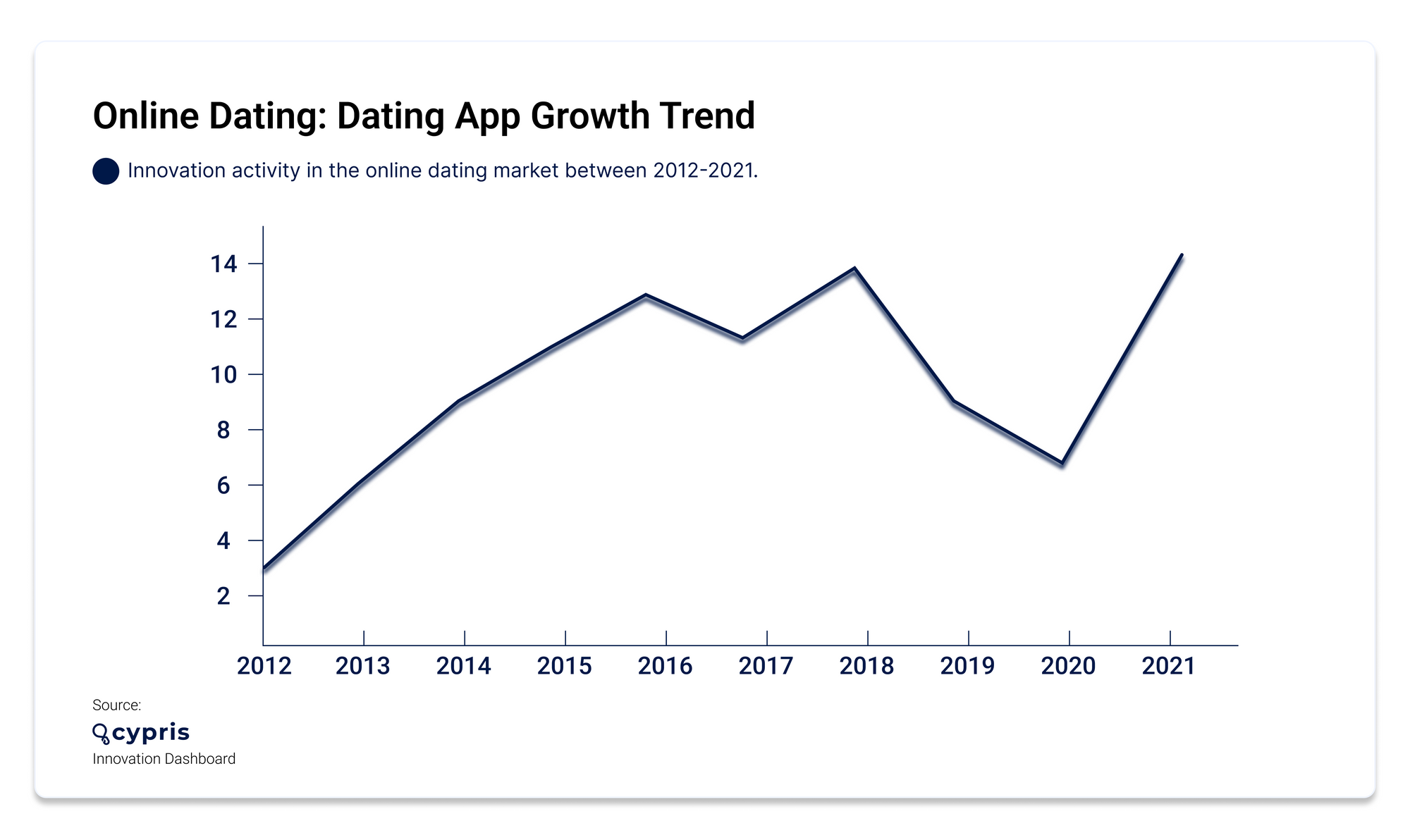
Using the Cypris Innovation Dashboard, we identified innovation activity in the online dating market has grown over the last 5 years, with a 20.91% average growth rate. The top players in the market are Match Group, LLC, Match.com Europe, and e2interactive, Inc., which collectively own 16.9% of IP in the market.
The fastest growing category is Computing Software which saw an 27.92 % increase in new patents filed over the last 5 years, as well as a lot of filings by new entrants.
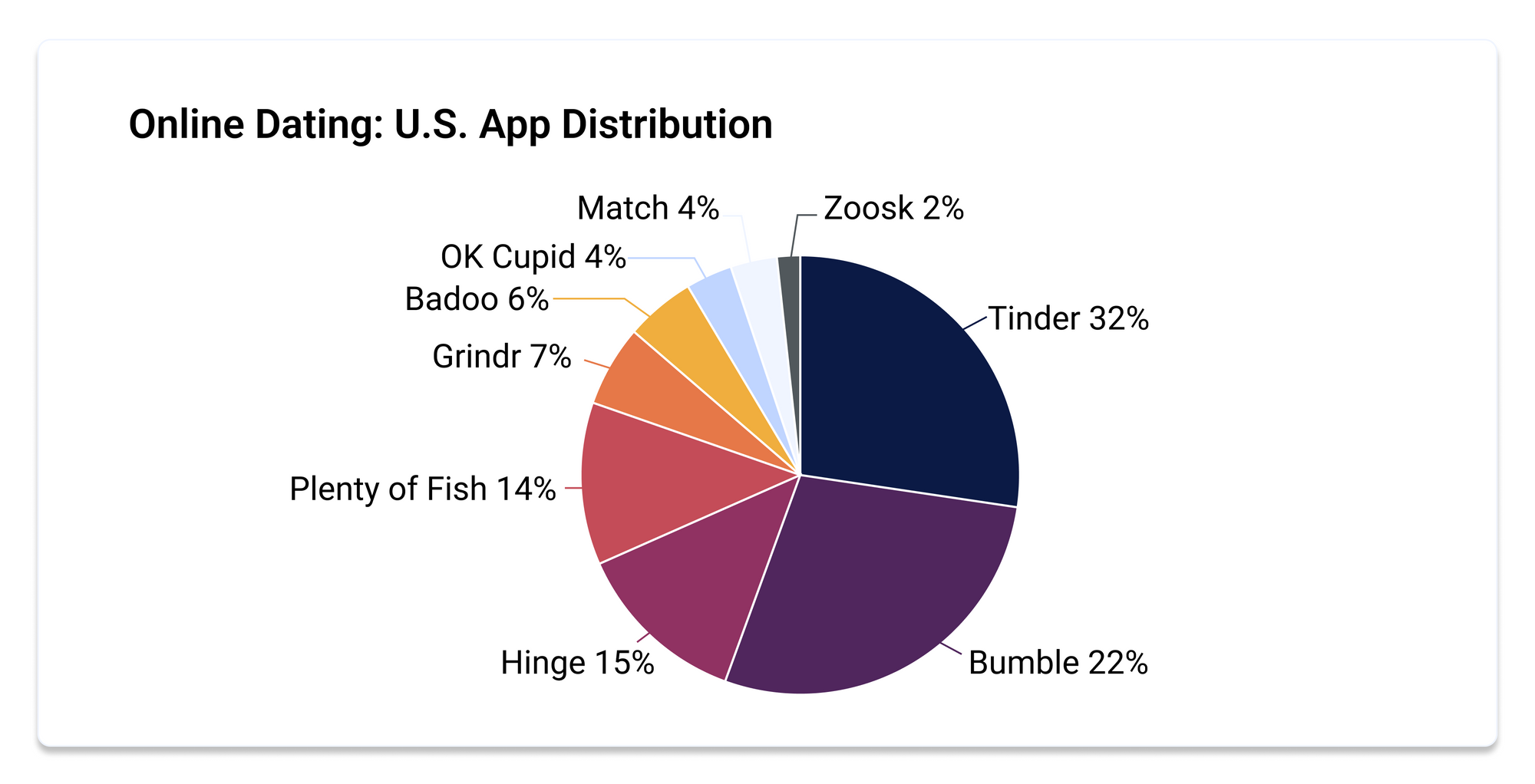
As of January 2022, Tinder dominated 32% of the U.S. market, followed by Bumble (22%), Hinge (15%), Plenty of Fish (15%), Grindr (7%), Badoo (6%), OKCupid (4%), Match.com (4%) and Zoosk (2%). In 2021, the dating app market made $5.61 billion revenue, with almost $3 billion made by Match Group.
Innovation in Online Dating
Let's dive into some of the fascinating patented technologies in the online dating space:
Method and Apparatus for Monitoring Emotional Compatibility in Online Dating: This patent covers methods, devices, and systems for capturing and sharing objective emotion data in dating interactions for the selection of suitable partners, or to enhance social dynamics in online interactions. An emotion monitoring device (EMD) measures physiological signals, obtained from biosensors, captured from a couple during a face-to-face or online dating interaction, and computes emotion data. The emotion data for each person is transmitted to an internet server, and each person shares their emotion data with the other during the interaction. The emotion data is then displayed to each person on a virtual or augmented reality device.
Inventor: Roger J. Quy; Patent Number: 20210267514

An Activity-Centric System and Method for Relationship Matching: This technology is for an online dating and relationship system that relies on common interests in, and arranging for specific face-to-face in-person activities. Potential activities are ranked by an activity ranking engine drawing on activity-related attributes of the users and of the activities. Mutual selection of an in-person activity enables the users to vet potential matches and to proceed to engage in the activity together. The ranking and match engines may take into account intrinsic user and activity attributes as well as activity- related attributes derived from the behavior of the users in relation to the activities.
Inventors: Perry Stevan, Stann Dominic, Petry James; Patent Number: WO2017054081A1
Online Dating Danger Prevention System: This patent covers an online dating danger prevention system. The online dating danger prevention system includes a database that holds information, including geo-location data and photographs, to make online dating safer. Users enter a set of contacts that the system can reach in the event of an emergency.
Inventors: Simard Marcellin; Patent Number: WO2015191090A1
Friend Matching Application: This patent includes a system and method for third-party matchmaking in an online or electronic dating app or system. A friend may review user profiles to select potential matches for another friend. Generating a match may require approval from one or more trusted users, or confirmation through a voting or similar mechanism. A user's matchmaking prowess may be ranked or scored based on success and accuracy. Matches may be anonymous or non-anonymous. A user desiring to be matched may seek out and request that a particular search user identify matches.

Inventor: Christopher Jordan Hurley; Patent Number: 20180130139
Dating Service with Restaurant Selection, Reservations, and Video Promotion Included: This patent covers a systematic method for securely setting up a date in online dating applications. The first step allows a requesting member to request a date with a requested member. Next, the requesting member can enter a meeting date, place, and time. The requested member will then be prompted to either accept or decline the date request from the requesting member. The method also provides a dating history database which records a members' dating history. In addition, a method of ensuring a member's safety by allowing members to choose to have someone contacted if the member does not update the dating history database after a date is disclosed.
Inventors: Stephone Belton; Patent Number: 20210287304
Systems and Methods for Initiating Conversations within an Online Dating Service: This technology is for a computer-implemented method for initiating conversations within an online dating service. It covers identifying a potential match for a user of an online dating service, automatically generating, in response to identifying the potential match, a customized interactive ice breaker widget that is customized to facilitate conversation between the user and the potential match, presenting the customized interactive ice breaker widget to the user, obtaining the user's response to the customized interactive ice breaker widget, and presenting, to the potential match, both the customized interactive ice breaker widget and the user's response to the customized interactive ice breaker widget to facilitate conversation between the user and the potential match.
Inventors: Qiang Wang, Nathan Andrew Sharp; Patent Number: 20200364806

Online Dating Service System: This patent covers an online blind date arranging service system and method that provides information on the opposite sex that can be connected by an acquaintance to a blind date applicant so that the other party can be verified through the acquaintance, and matchmaking can be arranged by an acquaintance.
Inventor: Kwon Nam Yeol; Patent Number: KR101759285B1
Whether through measuring emotional compatibility and setting up blind dates, or through danger prevention and matching based on mutual activity interests, technologies are transforming how we date. To learn more about patents and new innovations in the online dating space, visit cypris.ai and get started with access to the innovation dashboard.
If you’d like to explore recent patents filed, you can search through our global patent search engine for free here: https://cypris.ai/patents/allrecords
Sources: