
A powerful new foundation for custom queries—built on Lucene and designed for R&D precision.
Over the past few years, Cypris has helped innovation teams make faster, more informed decisions by centralizing critical insights across datasets like patents, academic papers, and company activity. But until now, our search experience relied on a legacy query system with limited capabilities, offering little support for advanced search features or dataset-level customization.
Today, we’re excited to introduce an upgraded Advanced Search on Cypris, a complete overhaul of our query engine and search experience, powered by the open-standard Lucene query syntax. This update introduces a more robust and flexible search foundation, unlocking new ways to query data, build complex filters, and extract precisely what you need across patents, research, and more.
Why we rebuilt our search system from the ground up
Cypris’ original query syntax, a proprietary format used internally for years, limited users’ ability to craft advanced queries or tailor searches to specific datasets. It lacked modern capabilities like proximity searches, field-level customization, or true Boolean logic. This made it difficult to build a reliable and intuitive experience for both casual users and advanced researchers.
By moving to Lucene, we’re adopting a powerful, industry-standard query language that makes it easier for developers to build advanced features—and gives users access to a far more capable and flexible search toolset.
What’s new in Advanced Search
1. Custom Queries by Dataset
You can now layer queries to search across datasets or tailor filters to each one. For example, you can run a broad query on drone delivery, and then add separate layers to focus on patents by a specific assignee and papers from a specific country or funding agency.
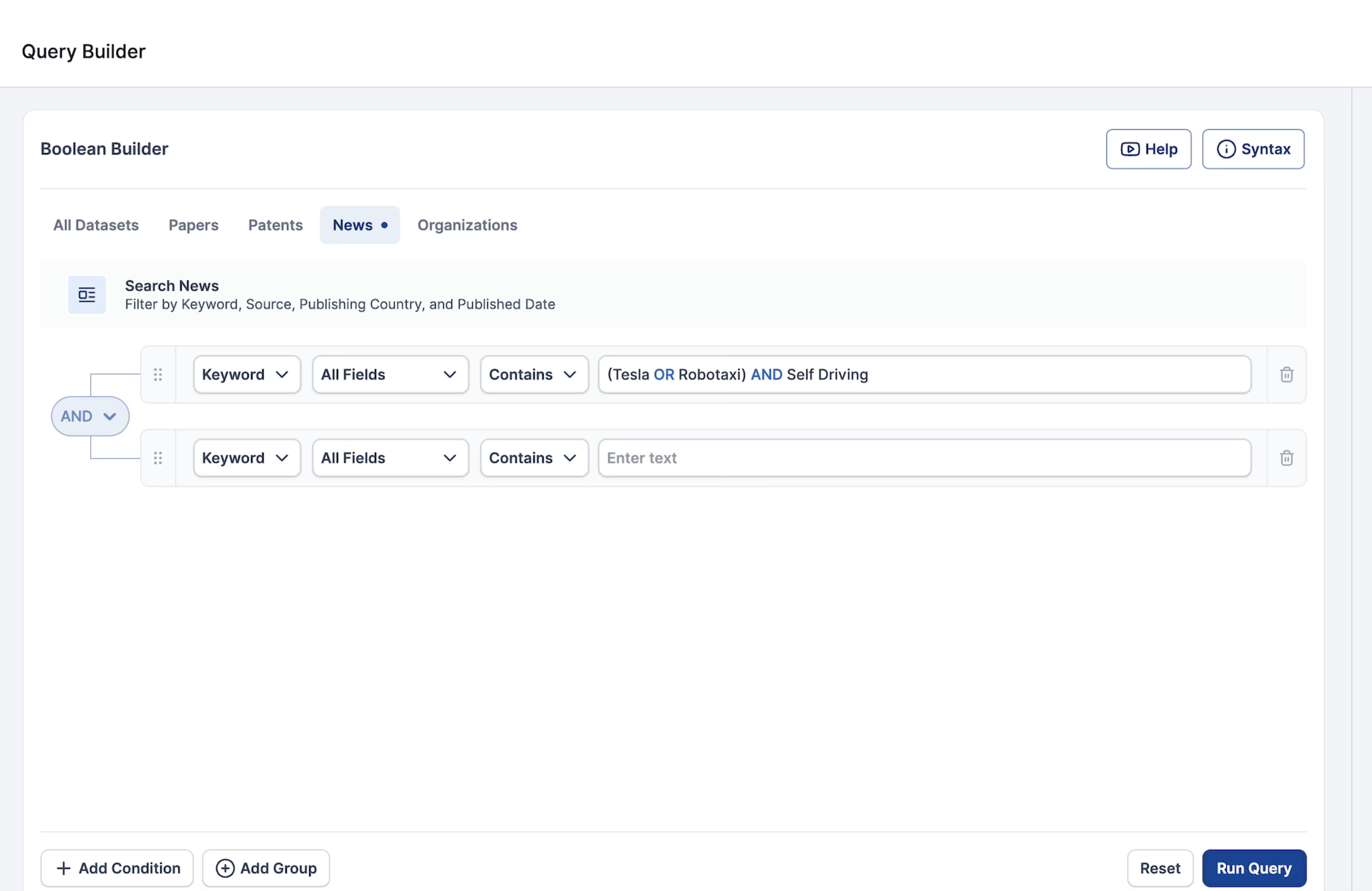
Navigating the All Datasets tab introduces a new level of complexity—and power—by allowing users to apply dataset-specific logic within a single, unified query workflow. While querying multiple datasets simultaneously might seem straightforward, the underlying differences in schema, metadata, and available fields between our proprietary datasets make this a deeply technical challenge. Patents, for example, include claims, application numbers, and multiple date fields (filed, granted, updated), while academic papers use DOIs, have different structural conventions, and emphasize different metadata. In the past, we sidestepped this complexity by translating general queries like ((drone_allText)) into dataset-specific logic under the hood. Now, instead of obscuring that logic, we allow users to opt in to it. The builder provides progressive layers of customization: start with intuitive keyword searches across all fields, then move into the advanced builder for field-specific targeting, fuzzy logic, and term boosting, and finally, tailor query logic by dataset—such as specifying different countries of interest for papers vs. patents. This approach preserves flexibility while giving users full control, and with tools like our real-time Live Analysis and “Your Query” panel, we make it easy to understand how every decision affects the results.
2. More Fields to Query
We’re exposing deeper fields across datasets—giving you explicit control over the dimensions of your search. For the first time, users can now search academic papers by DOI, a critical identifier previously unsupported on the platform. You can also query by:
- Author or inventor names
- Organizations or assignees
- Countries, journals, funding agencies, and more
3. Full Boolean Support
Advanced Search now leverages powerful Boolean logic—AND, OR, NOT, and grouping—enabling more precise control over search logic and improving performance and accuracy.
4. Lucene Syntax Features
Use built-in Lucene features to create expressive, complex searches:
- Proximity searches to find terms near each other
- Fuzzy searches for flexible matching
- Exact phrase matching
- Boosting to prioritize results (e.g., prioritize results mentioning AI 3x more than others)
- Prefix/Postfix queries to match phrases that start or end a certain way
- Range queries for fields like date, funding amounts, or numerical values
A more powerful user experience
Our new search interface is built to help you tap into these capabilities without needing to know the syntax from the start. You’ll find:
- A Query Builder to guide you through complex searches
- A Help Video to onboard users to Lucene-style searches
- Inline examples and tips for writing queries using grouping, boosting, and more
Built for precision, speed, and customization
With Lucene as our foundation, search results are now not only more flexible but also faster and more accurate. Semantic search continues to offer natural-language ease of use, while Boolean search gives power users the performance and structure they need to uncover insights with greater specificity.
Whether you’re an innovation analyst drilling into AI patents or a business development lead scanning academic papers from Chilean researchers—Advanced Search is built to help you get to the signal, faster.
Available now to all users
Advanced Search is live and available across the Cypris platform today. If you’re already using Cypris, you’ll find the new search interface in your dashboard, complete with updated syntax documentation and walkthroughs.
We’re excited to see what you’ll build, discover, and analyze with this new capability. This is just the beginning—we’ll continue expanding the fields, syntax features, and customization options as we push the boundaries of what intelligent search can do for R&D.

Introducing Advanced Search on Cypris


A powerful new foundation for custom queries—built on Lucene and designed for R&D precision.
Over the past few years, Cypris has helped innovation teams make faster, more informed decisions by centralizing critical insights across datasets like patents, academic papers, and company activity. But until now, our search experience relied on a legacy query system with limited capabilities, offering little support for advanced search features or dataset-level customization.
Today, we’re excited to introduce an upgraded Advanced Search on Cypris, a complete overhaul of our query engine and search experience, powered by the open-standard Lucene query syntax. This update introduces a more robust and flexible search foundation, unlocking new ways to query data, build complex filters, and extract precisely what you need across patents, research, and more.
Why we rebuilt our search system from the ground up
Cypris’ original query syntax, a proprietary format used internally for years, limited users’ ability to craft advanced queries or tailor searches to specific datasets. It lacked modern capabilities like proximity searches, field-level customization, or true Boolean logic. This made it difficult to build a reliable and intuitive experience for both casual users and advanced researchers.
By moving to Lucene, we’re adopting a powerful, industry-standard query language that makes it easier for developers to build advanced features—and gives users access to a far more capable and flexible search toolset.
What’s new in Advanced Search
1. Custom Queries by Dataset
You can now layer queries to search across datasets or tailor filters to each one. For example, you can run a broad query on drone delivery, and then add separate layers to focus on patents by a specific assignee and papers from a specific country or funding agency.
Navigating the All Datasets tab introduces a new level of complexity—and power—by allowing users to apply dataset-specific logic within a single, unified query workflow. While querying multiple datasets simultaneously might seem straightforward, the underlying differences in schema, metadata, and available fields between our proprietary datasets make this a deeply technical challenge. Patents, for example, include claims, application numbers, and multiple date fields (filed, granted, updated), while academic papers use DOIs, have different structural conventions, and emphasize different metadata. In the past, we sidestepped this complexity by translating general queries like ((drone_allText)) into dataset-specific logic under the hood. Now, instead of obscuring that logic, we allow users to opt in to it. The builder provides progressive layers of customization: start with intuitive keyword searches across all fields, then move into the advanced builder for field-specific targeting, fuzzy logic, and term boosting, and finally, tailor query logic by dataset—such as specifying different countries of interest for papers vs. patents. This approach preserves flexibility while giving users full control, and with tools like our real-time Live Analysis and “Your Query” panel, we make it easy to understand how every decision affects the results.
2. More Fields to Query
We’re exposing deeper fields across datasets—giving you explicit control over the dimensions of your search. For the first time, users can now search academic papers by DOI, a critical identifier previously unsupported on the platform. You can also query by:
- Author or inventor names
- Organizations or assignees
- Countries, journals, funding agencies, and more
3. Full Boolean Support
Advanced Search now leverages powerful Boolean logic—AND, OR, NOT, and grouping—enabling more precise control over search logic and improving performance and accuracy.
4. Lucene Syntax Features
Use built-in Lucene features to create expressive, complex searches:
- Proximity searches to find terms near each other
- Fuzzy searches for flexible matching
- Exact phrase matching
- Boosting to prioritize results (e.g., prioritize results mentioning AI 3x more than others)
- Prefix/Postfix queries to match phrases that start or end a certain way
- Range queries for fields like date, funding amounts, or numerical values
A more powerful user experience
Our new search interface is built to help you tap into these capabilities without needing to know the syntax from the start. You’ll find:
- A Query Builder to guide you through complex searches
- A Help Video to onboard users to Lucene-style searches
- Inline examples and tips for writing queries using grouping, boosting, and more
Built for precision, speed, and customization
With Lucene as our foundation, search results are now not only more flexible but also faster and more accurate. Semantic search continues to offer natural-language ease of use, while Boolean search gives power users the performance and structure they need to uncover insights with greater specificity.
Whether you’re an innovation analyst drilling into AI patents or a business development lead scanning academic papers from Chilean researchers—Advanced Search is built to help you get to the signal, faster.
Available now to all users
Advanced Search is live and available across the Cypris platform today. If you’re already using Cypris, you’ll find the new search interface in your dashboard, complete with updated syntax documentation and walkthroughs.
We’re excited to see what you’ll build, discover, and analyze with this new capability. This is just the beginning—we’ll continue expanding the fields, syntax features, and customization options as we push the boundaries of what intelligent search can do for R&D.
Keep Reading
Teams evaluating Clarivate's Cortellis for reaction and synthesis discovery are usually weighing a decades-old strength against a modern constraint. Cortellis is deep, trusted, and thorough. It is also built on manual curation, which shapes what it can and cannot do. Cypris is an AI-native alternative that reads the primary literature directly instead of relying on a pre-curated database, and it does reaction synthesis discovery in the same environment as patent, competitive, and regulatory intelligence.
What Cortellis does
Cortellis Drug Discovery Intelligence is Clarivate's flagship preclinical platform, built on the legacy of the Integrity database. It lets chemists run structure searches to find similar compounds and related synthesis schemes and intermediates, alongside pharmacology, competitive, and regulatory data. Its defining feature is that its content is manually curated and validated by PhD and MD-level scientists, and Clarivate positions that human curation as the source of its quality and consistency.
That curation is a real strength. It is also the constraint that leads teams to look for an alternative.
Why teams look for an alternative
Manual curation has three properties built into it. It is slow, because a person reads each source. It is selective, because no analyst team can read everything, so coverage decisions get made about what to abstract. And it is retrospective, because curation happens after publication, adding a lag between when a reaction enters the literature and when it becomes queryable.
For reaction synthesis discovery, those compound. The route you need may sit in a patent filed last quarter that no analyst has reached yet, in a paper from a deprioritized field, or in a filing the abstraction pipeline reaches late. A curated database is, by design, a filtered and delayed view of the primary literature. For most of the last thirty years that was the best available option. It no longer is.
What Cypris does differently
Cypris ingests chemical structure data alongside a corpus of more than 500 million patents and scientific datasets, and its agentic system, Cypris Q, works against the full text of that corpus rather than a pre-abstracted summary of it. Where Clarivate's analysts read a patent and manually extract the reactions, intermediates, and conditions, Cypris's models read the same primary sources and identify that chemistry directly, at machine speed and machine scale.
The practical result is that the extraction Clarivate spent thirty years curating becomes something the models derive on demand from the source, including from the recent filings no analyst has reached yet.
Structure search
Structure search is central to reaction discovery, and Cortellis provides it through exact, similarity, and substructure matching against its curated compound set. Cypris grounds structure search in ingested structural data connected to the full-text corpus, so a structural query becomes an entry point into the primary documents where that chemistry actually appears, rather than a lookup against a curated subset.
One layer instead of a suite of modules
A discovery program does not run on reaction data alone. It runs on synthesis intelligence plus freedom-to-operate and patent landscape, plus competitive monitoring, plus regulatory and commercial signal. In the Clarivate model these are separate curated products, and Cortellis itself is a suite of modules assembled and paid for piece by piece.
Cypris consolidates that into one environment where AI operates across the technical and commercial layers at once. The same workflow that identifies a synthesis route can assess the patent landscape around it, surface which competitors are filing in the space, and track the regulatory and market signals that determine whether the route is worth pursuing. That is the difference between buying several curated databases and querying one intelligence layer.
Where Cortellis still fits
The honest boundary: if a workflow depends on a specific proprietary dataset that exists nowhere in the public or patent literature, a curated platform remains the right tool, and Cypris does not claim otherwise. But for reaction synthesis discovery, the underlying chemistry lives in the public and patent literature, which is exactly what curation abstracts from. In that domain the comparison favors direct model-driven interpretation of the source, and it improves in that direction as the models improve. A curated database advances at the speed of its curation team. An AI-native layer advances at the speed of its models.
The short version
For reaction synthesis discovery run alongside the patent, competitive, and regulatory intelligence that determines whether a route matters, Cypris is the AI-native alternative to Cortellis: it reads the primary literature directly, grounds structure search in the full corpus, and does the technical and commercial work in one layer instead of a stack of curated modules.
FAQ
Is Cypris a direct alternative to Clarivate Cortellis?
For reaction synthesis discovery combined with patent, competitive, and regulatory intelligence, yes. Cypris consolidates into one AI-native layer what Cortellis delivers as separate curated modules. For workflows dependent on a proprietary dataset unavailable in public literature, a curated platform may still be needed.
What is the core difference between Cypris and Cortellis?
Data model. Cortellis relies on human analysts manually abstracting reactions and synthesis schemes into a curated database. Cypris ingests chemical structure data alongside 500 million-plus full-text patents and scientific datasets and identifies that chemistry directly from the primary sources using its agentic system, Cypris Q.
Does Cypris support chemical structure search?
Yes. Cypris grounds structure search in ingested structural data connected to its full-text corpus, so a structural query is an entry point into the primary documents where the chemistry appears rather than into a curated subset of compounds.
What does Cortellis do for reaction synthesis?
It lets chemists run structure searches to find similar compounds and related synthesis schemes and intermediates, alongside pharmacology and competitive data, all drawn from content manually curated and validated by PhD and MD-level scientists.
Why would a team move off a curated database?
Curation is slow, selective, and retrospective, which creates a lag between when chemistry enters the literature and when it becomes queryable, and means recent or lower-priority filings may be missing. Reading the primary corpus directly removes that lag.
Is manual curation still valuable?
For datasets that exist nowhere in public or patent literature, yes. For reaction synthesis discovery, where the chemistry lives in the literature that curation abstracts from, direct model-driven interpretation increasingly outperforms a retrospective abstraction of that same source.
How does Cypris handle recent filings better?
Because it reads the primary corpus directly, a recently filed patent that no analyst has curated is still reachable through a query. Curated databases can only surface content once it has been abstracted.
What does the "single layer" advantage mean in practice?
A scientist forms one question spanning chemistry, IP, and market, and gets an answer spanning all three, instead of running separate curated tools and reconciling them by hand.
Which teams is Cypris the better fit for?
Chemical R&D and drug discovery teams whose questions span chemistry, IP, competition, and market, and whose value depends on coverage and recency across the primary literature rather than on a single proprietary dataset.
What is Cypris Q?
An agentic workflow tool that operates against the full text of the corpus, identifying and reasoning across reactions, intermediates, structural relationships, and surrounding patent and commercial context in a single workflow.
Sodium-ion batteries have moved from laboratory alternative to commercial reality, and their patent landscape is distinctive because the field is consolidating around a few competing chemistries just as production scales. A sodium-ion cell works on the same intercalation principle as a lithium-ion cell but shuttles sodium ions instead of lithium, which trades lower energy density for real advantages: sodium is abundant and cheap, the cells are safer and perform better in the cold, and they avoid the constrained lithium and cobalt supply chains, making them attractive for grid storage and entry-level electric vehicles. The intellectual property divides across several regions, each a distinct area of patenting: the cathode, where three chemistries compete, layered transition-metal oxides, Prussian blue analogs, and polyanionic phosphates, each with different trade-offs in energy density, cost, and cycle life;⁵ the anode, dominated by hard carbon, whose disordered microstructure stores sodium through a combination of sloping and plateau capacity and whose reversible and irreversible capacity are set by that microstructure;¹,² the electrolyte; and the cell and manufacturing design, much of which can be adapted from existing lithium-ion production lines. Because a competitive cell depends on several of these layers, freedom-to-operate and white space analysis must span the cathode chemistries and the other layers together.
The landscape is concentrated and moving quickly. Commercial sodium-ion products have launched: CATL introduced a first-generation cell in 2021 and, in 2025, its higher-density Naxtra series, which the company reports reaches an energy density of about 175 watt-hours per kilogram, operates from roughly −40 to 70 degrees Celsius, and exceeds ten thousand cycles, positioning it close to lithium iron phosphate cells for entry-level vehicles.⁶ In early 2026, CATL and Changan announced what CATL describes as the first mass-production passenger vehicle powered by sodium-ion cells.⁷ Activity is heavily concentrated among a small number of large battery manufacturers pursuing full-stack portfolios that span cathode, anode, electrolyte, and manufacturing, with a broad tail of materials specialists and research institutes. This shows clearly in the patent record: across the Cypris corpus of more than 500 million patents and scientific papers, the sodium-ion set is the largest of any topic Cypris tracks in this area, on the order of 37,408 families, and grew from about 1,585 in 2020 to roughly 5,970 in 2024, with the most active assignees led by CATL and its recycling affiliate Brunp alongside research institutes such as the Institute of Physics of the Chinese Academy of Sciences and the Dalian Institute of Chemical Physics, and China overwhelmingly dominant on geography (about 24,235 families) ahead of the United States (about 1,931) and Japan (about 1,669); 2025 and 2026 counts are partial because of the publication lag.
The strategic question is which chemistry and layer to back, and the white space sits where performance and cost are hardest to reconcile. On the cathode side, raising energy density and cycle life while holding down cost is the central problem, and each of the three chemistries has open ground.⁵ On the anode side, hard carbon is the workhorse, but improving its initial coulombic efficiency, its capacity, and the cost and consistency of its precursors is a large, active opportunity, with precursor selection, such as phenolic-resin-derived carbons, itself a patentable lever, as are novel and anode-light or anode-free designs.¹,²,³,⁴ Electrolytes tuned for sodium and recycling processes adapted to sodium chemistry are further layers. Reading the landscape by chemistry, layer, and owner, and tracking both the patents and the underlying materials research, is what separates a crowded region from an open one.
Where the sodium-ion white space is
High-performance cathodes. Raising energy density and cycle life while holding down cost, across layered oxides, Prussian blue analogs, and polyanionic phosphates, is the central problem and each chemistry has open ground.⁵
Hard-carbon anode improvement. Improving initial coulombic efficiency, capacity, and low-cost, consistent precursors for hard carbon is a large, active layer.¹,²,³
Anode-light and anode-free designs. Cell designs that reduce or omit the anode active layer for higher energy density are an emerging, differentiating area.
Sodium-tuned electrolytes. Electrolytes and interphase chemistries optimized for sodium's larger ion are a distinct layer affecting performance and durability.
Sodium recycling. Recovery and recycling processes adapted to sodium-ion chemistry are an early layer that will matter as volumes grow.
How AI-powered landscape and white space analysis helps
Resolving a landscape that spans three cathode chemistries and several cell layers, concentrated among a few large filers, requires more than keyword search. AI-powered analysis addresses this with semantic search that clusters activity by chemistry and layer across varied terminology, attribution that normalizes filers to canonical entities and tracks new entrants, and continuous monitoring that keeps pace with a fast-scaling field. Because sodium-ion advances appear in scientific and materials literature before they are patented, reading both patents and literature gives the earliest signal of where durable, low-cost cells are emerging.
Where Cypris fits
Cypris runs patent landscape and white space analysis for fast-scaling energy fields such as sodium-ion batteries across a corpus of more than 500 million patents and scientific papers, organized through a proprietary R&D ontology. The ontology clusters activity by cathode chemistry, layered oxide, Prussian blue analog, and polyanionic phosphate, and by layer, anode, electrolyte, cell, and manufacturing, and normalizes filers to canonical entities, so a team can resolve which chemistries and layers are crowded and which remain open as white space, and can track new entrants as the field scales. Semantic search across patents and scientific literature connects filings to the underlying materials research, which is where sodium-ion advances appear first. Cypris Q, the platform's agentic layer, lets teams run landscape and white space analysis conversationally and chain the clustering, attribution, and gap analysis, and Agentic Monitoring tracks a defined chemistry over time and flags new patents and papers as they publish. Cypris provides enterprise API partnerships with OpenAI, Anthropic, and Google, and is built with enterprise-grade security. Cypris serves hundreds of enterprise customers across pharmaceuticals, chemicals, advanced materials, energy, and other regulated industries.
FAQ
What is the sodium-ion battery patent landscape? The sodium-ion battery patent landscape is the set of patents covering cells that store energy by shuttling sodium ions rather than lithium. It divides across three cathode chemistries, layered oxides, Prussian blue analogs, and polyanionic phosphates, plus the hard-carbon anode, electrolytes, and cell and manufacturing design. Each is a distinct region of patenting.
Why are sodium-ion batteries gaining ground? Sodium-ion batteries are gaining ground because sodium is abundant and cheap, the cells are safer and perform better in cold weather, and they avoid constrained lithium and cobalt supply chains. They trade lower energy density for these advantages, which suits grid storage and entry-level electric vehicles. Commercial launches have moved the technology from research to market.
What are the main sodium-ion cathode chemistries? The main cathode chemistries are layered transition-metal oxides, which offer higher energy density; Prussian blue analogs, which offer low cost; and polyanionic phosphates, which offer stability and long cycle life. Each carries different trade-offs and its own IP. The choice of chemistry shapes both the technical and the freedom-to-operate picture.
Where is the white space in sodium-ion batteries? The white space includes higher-performance cathodes across all three chemistries, hard-carbon anode improvement and low-cost precursors, anode-light and anode-free designs, sodium-tuned electrolytes, and sodium recycling. Activity is concentrated among a few large filers, leaving room in the materials and design layers. The central problem is reconciling energy density, cycle life, and cost.
Why is the hard-carbon anode a focus? The hard-carbon anode is a focus because it is the workhorse anode for sodium-ion cells, and its initial coulombic efficiency, capacity, and precursor cost and consistency are key determinants of cell performance and economics. Its disordered microstructure governs how much sodium it stores reversibly. Improving these, including through precursor selection, is an active, large layer of the landscape.
Why does sodium-ion analysis need scientific literature? Sodium-ion analysis needs scientific literature because cathode, anode, and electrolyte advances appear in materials research before they are patented, so the literature gives the earliest signal. Analyzing patents alone gives a lagging view. Cypris analyzes both across more than 500 million patents and scientific papers.
What software helps analyze the sodium-ion battery patent landscape? Software for the sodium-ion landscape should cluster activity by cathode chemistry and cell layer, resolve filers to canonical owners, search patents and scientific literature semantically, and monitor a fast-scaling field continuously. Cypris does this across more than 500 million patents and scientific papers using a proprietary R&D ontology, semantic search, Cypris Q, and Agentic Monitoring.
Which teams use sodium-ion patent landscape analysis? Sodium-ion patent landscape analysis is used by R&D, innovation, IP, and strategy teams at battery and materials makers, automotive and energy-storage companies, and their suppliers, as well as investors assessing the sector. It informs which chemistry and layer to back, where to file, and where competitors are concentrated. Cypris serves hundreds of enterprise customers across energy, advanced materials, chemicals, and other regulated industries.
Endnotes
- Xu, Z., Guo, X., Xie, F., & Titirici, M.-M. (2020). Hard carbons for sodium-ion batteries and beyond. Progress in Energy, 2(4). https://doi.org/10.1088/2516-1083/aba5f5
- Irisarri, E., Ponrouch, A., & Palacín, M. R. (2015). Review — hard carbon negative electrode materials for sodium-ion batteries. Journal of the Electrochemical Society, 162(14). https://doi.org/10.1149/2.0091514jes
- Sagues, W. J., Park, S., et al. (2024). Phenolic-resin-derived hard carbon anode for sodium-ion batteries: a review. ACS Energy Letters, 9(6). https://doi.org/10.1021/acsenergylett.4c00688
- Sun, N., Peng, H., Liu, Z., et al. (2024). Recent progress in hard carbon anodes for sodium-ion batteries. Advanced Engineering Materials, 26(9). https://doi.org/10.1002/adem.202302063
- Zhu, X., He, Y., Liu, Y., & Wu, Y. (2024). Review of cathode materials for sodium-ion batteries. Progress in Solid State Chemistry, 74. https://doi.org/10.1016/j.progsolidstchem.2024.100452
- Contemporary Amperex Technology Co., Ltd. (2025). Naxtra battery breakthrough and dual-power architecture: CATL pioneers the multi-power era. https://www.catl.com/en/news/6401.html
- Contemporary Amperex Technology Co., Ltd. (2026). CATL and Changan launch the world's first mass-production sodium-ion passenger vehicle. https://www.catl.com/en/news/6720.html
Humanoid robotics has moved from research demonstrations toward commercialization, and its patent landscape is being staked out quickly and unevenly. A humanoid robot integrates several distinct technology layers, each independently patentable: the actuators and joints that produce motion, the perception and sensing systems that let the robot model its surroundings, the motion, balance, and whole-body control that keep it upright and coordinated, and the embodied-AI layer that connects high-level decision-making to physical action. Companies such as Tesla, Figure, and Unitree have pushed the field into a commercialization race, and peer-reviewed patent analyses of humanoid robotics describe a cross-disciplinary field whose filings span mechatronics, control, and perception and identify the subfields where activity concentrates.¹,²
The geographic story dominates the data. An analysis across the Cypris corpus of more than 500 million patents and scientific papers finds a humanoid- and bipedal-robotics family set in which China holds roughly two-thirds of all-time families, about 8,804, versus about 711 for the United States and about 407 for Japan. The concentration is sharper in recent years: over the 2020 to 2025 window, Chinese applicants account for roughly three-quarters of families, about 3,169, far ahead of the United States, about 142, and Japan, about 83, with 2025 counts partial because of the roughly eighteen-month publication lag. Research output tells a different story from filing volume: scientometric analysis of the humanoid-robotics literature finds the United States, Japan, and Germany leading publication output, a reminder that leadership in papers and leadership in patent volume do not always coincide, and that raw family counts measure filing activity rather than influence or quality.³
The timing is as striking as the geography. Across the Cypris corpus, humanoid- and bipedal-robotics filings in the 2020 to 2025 window were roughly flat through 2022, around 300 to 320 per year, before accelerating sharply, to about 387 in 2023, 857 in 2024, and 1,915 in 2025 on a partial count, indicating a shift from enabling technologies toward the physical embodiment and control of the robots themselves. The most active assignees in the set span regions and sectors: SoftBank's Aldebaran, China's UBTech, Honda, Boston Dynamics, Toyota, and Sony, alongside a broad tail of Chinese universities such as Zhejiang University, Harbin Institute of Technology (Shenzhen), and Tsinghua University, so incumbents anchor the established positions while a large university base drives Chinese breadth.
Policy priorities and the technical frontier shape where the landscape is heading. National industrial strategies have elevated robotics and embodied AI, and patent-graph analyses that link policy signals to filings map where those priorities are translating into intellectual property.⁹ The defining unsolved technical challenge, and therefore the most contested and most valuable IP frontier, is the integration of AI with motion control: end-to-end learning, embodied-AI and whole-body control models, and sim-to-real transfer that bridge high-level decision-making and low-level motion execution.⁴,⁵,⁶ Actuator design is a second critical layer, where torque density, backdrivability, and thermal performance for bipedal locomotion at production cost are the central problems, and where both electric and hydraulic actuation approaches remain under active development.⁷,⁸ Across the Cypris corpus, the actuator and joint layer is by far the most heavily patented, on the order of 8,000 families, followed by perception and sensing, around 4,100, motion and balance control, around 2,200, and the still-small but fastest-emerging embodied-AI and learning-based control layer, around 1,400. Because applications publish about eighteen months after filing, the 2024 to 2025 surge is under-represented, so the current frontier is more active than granted-patent counts suggest.
Where the humanoid-robotics white space is
Embodied-AI motion integration. Connecting learned high-level behavior to low-level motion control is the defining unsolved problem and the fastest-emerging, still comparatively small IP layer, leaving room for high-value positions.⁴
Actuator design. Torque density, backdrivability, and thermal performance for bipedal locomotion at production cost are central engineering problems and a heavily worked but still-advancing layer.⁷
Dexterous manipulation. Robust hands and fine manipulation remain difficult, and IP here is less crowded than locomotion.
Long-duration autonomy. Power, thermal management, and reliability for extended operation are enabling problems that gate deployment.
Cost-reduction engineering. Designs and processes that lower the cost of production-scale humanoids are a distinct and commercially decisive area.
How AI-powered landscape and white space analysis helps
Resolving a multi-layer, geographically lopsided, fast-accelerating landscape requires more than keyword search. AI-powered analysis addresses this with semantic search that clusters activity by layer, actuators, perception, control, and embodied AI, across varied terminology, attribution that normalizes corporate and university filers to canonical entities and captures the regional structure, and continuous monitoring that keeps pace with a surging field. Because humanoid-robotics advances appear in scientific literature before they are patented, and because research and patent leadership diverge here, reading both patents and literature gives the fullest and earliest signal of where the frontier is moving.
Where Cypris fits
Cypris runs patent landscape and white space analysis for fast-accelerating, multi-layer fields such as humanoid robotics across a corpus of more than 500 million patents and scientific papers, organized through a proprietary R&D ontology. The ontology clusters activity by layer, actuators and joints, perception and sensing, motion and balance control, and embodied AI, and normalizes corporate and university filers to canonical entities, so a team can resolve which layers are crowded and which remain open as white space, and can see the regional structure clearly rather than as a flat list. Semantic search across patents and scientific literature connects filings to the underlying robotics and machine-learning research, which is where embodied-AI advances appear first, and where patent and research leadership diverge. Cypris Q, the platform's agentic layer, lets teams run landscape and white space analysis conversationally and chain the clustering, attribution, and gap analysis, and Agentic Monitoring tracks a defined layer over time and flags new patents and papers as they publish. Cypris provides enterprise API partnerships with OpenAI, Anthropic, and Google, and is built with enterprise-grade security. Cypris serves hundreds of enterprise customers across pharmaceuticals, chemicals, advanced materials, energy, and other regulated industries.
FAQ
How fast is humanoid-robotics patenting growing? Humanoid-robotics patenting is surging as companies race toward commercialization. An analysis of the Cypris corpus finds filings roughly flat through 2022 before accelerating sharply from 2023, rising from a few hundred per year to well over a thousand by 2025 on a partial count. The acceleration reflects a shift from enabling technologies toward the physical embodiment and control of the robots themselves.
Who leads in humanoid-robotics patents? China leads in humanoid-robotics patent volume, holding roughly two-thirds of all-time families and about three-quarters of families filed since 2020 in the Cypris corpus, well ahead of the United States and Japan. Research output tells a different story: scientometric analysis finds the United States, Japan, and Germany leading humanoid-robotics publications. Leadership in patents and in papers does not always coincide.
Why do patent counts and research output differ in humanoid robotics? Patent counts and research output differ because family counts measure filing volume, not scientific influence or patent quality, and the two can diverge. China leads on humanoid-robotics patent volume, while the United States, Japan, and Germany lead on publications. A full assessment therefore weighs filing volume against the underlying research rather than treating raw counts as a measure of value.
What are the main technology layers in humanoid robotics? The main layers are actuators and joints, perception and sensing, motion and balance control, and embodied AI that links decision-making to action. Each is independently patentable and often held by different owners. In the Cypris corpus the actuator layer is by far the most heavily patented, and embodied AI is the smallest but fastest-emerging.
What is the defining technical challenge in humanoid robotics? The defining technical challenge is integrating AI with motion control, connecting high-level, learned decision-making to low-level physical action through embodied-AI and whole-body control models and sim-to-real transfer. It is the most contested and most valuable IP frontier. It is also where the patent landscape is expanding fastest.
Where is the white space in humanoid robotics? The white space includes embodied-AI motion integration, actuator design for torque density and efficiency, dexterous manipulation, long-duration autonomy, and cost-reduction engineering for production-scale robots. Embodied-AI motion integration is the fastest-emerging and still comparatively small layer. Manipulation and autonomy are less crowded than locomotion.
Why does humanoid-robotics analysis need scientific literature? Humanoid-robotics analysis needs scientific literature because embodied-AI, control, and actuation advances appear in research before they are patented, and because patent and research leadership diverge in this field, so the literature gives the earliest and fullest signal. Analyzing patents alone gives a lagging and partial view. Cypris analyzes both across more than 500 million patents and scientific papers.
Which teams use humanoid-robotics patent landscape analysis? Humanoid-robotics patent landscape analysis is used by R&D, IP, and strategy teams at robotics companies, automotive and electronics firms, component and actuator suppliers, and universities, as well as investors assessing robotics assets. It informs which layer to back, where to file, and where competitors are concentrated. Cypris serves hundreds of enterprise customers across research-intensive and regulated industries.
Endnotes
- Kumari, R., Lee, B.-H., Jeong, J. Y., Choi, K.-S., & Choi, K.-N. (2019). Topic modelling and social network analysis of publications and patents in humanoid robot technology. Journal of Information Science. https://doi.org/10.1177/0165551519887878
- Jang, D.-S., Park, S., Kim, G., Lee, J., & Kim, J. (2016). A hybrid method of analyzing patents for sustainable technology management in humanoid robot industry. Sustainability, 8(5), 474. https://doi.org/10.3390/su8050474
- Kumar, V., & Singh, K. (2026). Global research trends and thematic evolution in humanoid robotics: a scientometric and text mining study. Discover Artificial Intelligence. https://doi.org/10.1007/s44163-026-01251-x
- Wang, H. C., Chen, J., Zeng, W., Jin, X., & Yu, T. (2025). A survey of behavior foundation model: next-generation whole-body control system of humanoid robots. IEEE Transactions on Pattern Analysis and Machine Intelligence. https://doi.org/10.1109/tpami.2025.3649177
- Yuan, Y., & Zhao, W. (2025). Development of intelligent robots in the wave of embodied intelligence. National Science Review. https://doi.org/10.1093/nsr/nwaf159
- Humphreys, J., Zhou, C., Peng, T., & Bao, L. (2025). Deep reinforcement learning for robotic bipedal locomotion: a brief survey. Artificial Intelligence Review. https://doi.org/10.1007/s10462-025-11451-z
- Niiyama, R. (2022). Soft actuation and compliant mechanisms in humanoid robots. Current Robotics Reports. https://doi.org/10.1007/s43154-022-00084-7
- Faudzi, A. A. M., & Suzumori, K. (2018). Trends in hydraulic actuators and components in legged and tough robots: a review. Advanced Robotics. https://doi.org/10.1080/01691864.2018.1455606
- Zheng, Y. (2026). Discovering technology opportunities in humanoid robotics and embodied intelligence: a policy-semantic heterogeneous patent graph approach. Mendeley Data. https://doi.org/10.17632/hk63kt4swb