
A powerful new foundation for custom queries—built on Lucene and designed for R&D precision.
Over the past few years, Cypris has helped innovation teams make faster, more informed decisions by centralizing critical insights across datasets like patents, academic papers, and company activity. But until now, our search experience relied on a legacy query system with limited capabilities, offering little support for advanced search features or dataset-level customization.
Today, we’re excited to introduce an upgraded Advanced Search on Cypris, a complete overhaul of our query engine and search experience, powered by the open-standard Lucene query syntax. This update introduces a more robust and flexible search foundation, unlocking new ways to query data, build complex filters, and extract precisely what you need across patents, research, and more.
Why we rebuilt our search system from the ground up
Cypris’ original query syntax, a proprietary format used internally for years, limited users’ ability to craft advanced queries or tailor searches to specific datasets. It lacked modern capabilities like proximity searches, field-level customization, or true Boolean logic. This made it difficult to build a reliable and intuitive experience for both casual users and advanced researchers.
By moving to Lucene, we’re adopting a powerful, industry-standard query language that makes it easier for developers to build advanced features—and gives users access to a far more capable and flexible search toolset.
What’s new in Advanced Search
1. Custom Queries by Dataset
You can now layer queries to search across datasets or tailor filters to each one. For example, you can run a broad query on drone delivery, and then add separate layers to focus on patents by a specific assignee and papers from a specific country or funding agency.
Navigating the All Datasets tab introduces a new level of complexity—and power—by allowing users to apply dataset-specific logic within a single, unified query workflow. While querying multiple datasets simultaneously might seem straightforward, the underlying differences in schema, metadata, and available fields between our proprietary datasets make this a deeply technical challenge. Patents, for example, include claims, application numbers, and multiple date fields (filed, granted, updated), while academic papers use DOIs, have different structural conventions, and emphasize different metadata. In the past, we sidestepped this complexity by translating general queries like ((drone_allText)) into dataset-specific logic under the hood. Now, instead of obscuring that logic, we allow users to opt in to it. The builder provides progressive layers of customization: start with intuitive keyword searches across all fields, then move into the advanced builder for field-specific targeting, fuzzy logic, and term boosting, and finally, tailor query logic by dataset—such as specifying different countries of interest for papers vs. patents. This approach preserves flexibility while giving users full control, and with tools like our real-time Live Analysis and “Your Query” panel, we make it easy to understand how every decision affects the results.
2. More Fields to Query
We’re exposing deeper fields across datasets—giving you explicit control over the dimensions of your search. For the first time, users can now search academic papers by DOI, a critical identifier previously unsupported on the platform. You can also query by:
- Author or inventor names
- Organizations or assignees
- Countries, journals, funding agencies, and more
3. Full Boolean Support
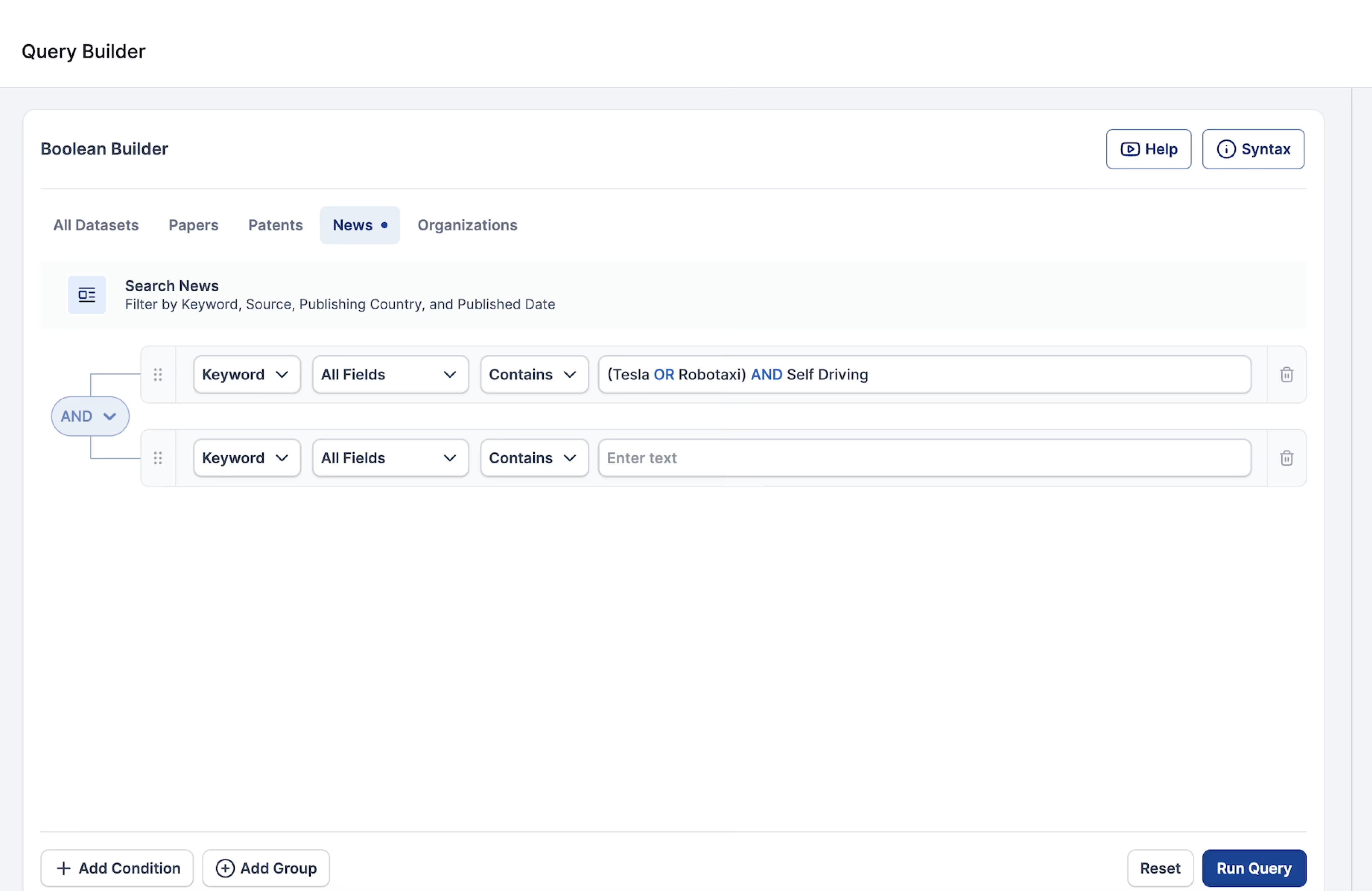
Advanced Search now leverages powerful Boolean logic—AND, OR, NOT, and grouping—enabling more precise control over search logic and improving performance and accuracy.
4. Lucene Syntax Features
Use built-in Lucene features to create expressive, complex searches:
- Proximity searches to find terms near each other
- Fuzzy searches for flexible matching
- Exact phrase matching
- Boosting to prioritize results (e.g., prioritize results mentioning AI 3x more than others)
- Prefix/Postfix queries to match phrases that start or end a certain way
- Range queries for fields like date, funding amounts, or numerical values
A more powerful user experience
Our new search interface is built to help you tap into these capabilities without needing to know the syntax from the start. You’ll find:
- A Query Builder to guide you through complex searches
- A Help Video to onboard users to Lucene-style searches
- Inline examples and tips for writing queries using grouping, boosting, and more
Built for precision, speed, and customization
With Lucene as our foundation, search results are now not only more flexible but also faster and more accurate. Semantic search continues to offer natural-language ease of use, while Boolean search gives power users the performance and structure they need to uncover insights with greater specificity.
Whether you’re an innovation analyst drilling into AI patents or a business development lead scanning academic papers from Chilean researchers—Advanced Search is built to help you get to the signal, faster.
Available now to all users
Advanced Search is live and available across the Cypris platform today. If you’re already using Cypris, you’ll find the new search interface in your dashboard, complete with updated syntax documentation and walkthroughs.
We’re excited to see what you’ll build, discover, and analyze with this new capability. This is just the beginning—we’ll continue expanding the fields, syntax features, and customization options as we push the boundaries of what intelligent search can do for R&D.
Introducing Advanced Search on Cypris


A powerful new foundation for custom queries—built on Lucene and designed for R&D precision.
Over the past few years, Cypris has helped innovation teams make faster, more informed decisions by centralizing critical insights across datasets like patents, academic papers, and company activity. But until now, our search experience relied on a legacy query system with limited capabilities, offering little support for advanced search features or dataset-level customization.
Today, we’re excited to introduce an upgraded Advanced Search on Cypris, a complete overhaul of our query engine and search experience, powered by the open-standard Lucene query syntax. This update introduces a more robust and flexible search foundation, unlocking new ways to query data, build complex filters, and extract precisely what you need across patents, research, and more.
Why we rebuilt our search system from the ground up
Cypris’ original query syntax, a proprietary format used internally for years, limited users’ ability to craft advanced queries or tailor searches to specific datasets. It lacked modern capabilities like proximity searches, field-level customization, or true Boolean logic. This made it difficult to build a reliable and intuitive experience for both casual users and advanced researchers.
By moving to Lucene, we’re adopting a powerful, industry-standard query language that makes it easier for developers to build advanced features—and gives users access to a far more capable and flexible search toolset.
What’s new in Advanced Search
1. Custom Queries by Dataset
You can now layer queries to search across datasets or tailor filters to each one. For example, you can run a broad query on drone delivery, and then add separate layers to focus on patents by a specific assignee and papers from a specific country or funding agency.
Navigating the All Datasets tab introduces a new level of complexity—and power—by allowing users to apply dataset-specific logic within a single, unified query workflow. While querying multiple datasets simultaneously might seem straightforward, the underlying differences in schema, metadata, and available fields between our proprietary datasets make this a deeply technical challenge. Patents, for example, include claims, application numbers, and multiple date fields (filed, granted, updated), while academic papers use DOIs, have different structural conventions, and emphasize different metadata. In the past, we sidestepped this complexity by translating general queries like ((drone_allText)) into dataset-specific logic under the hood. Now, instead of obscuring that logic, we allow users to opt in to it. The builder provides progressive layers of customization: start with intuitive keyword searches across all fields, then move into the advanced builder for field-specific targeting, fuzzy logic, and term boosting, and finally, tailor query logic by dataset—such as specifying different countries of interest for papers vs. patents. This approach preserves flexibility while giving users full control, and with tools like our real-time Live Analysis and “Your Query” panel, we make it easy to understand how every decision affects the results.
2. More Fields to Query
We’re exposing deeper fields across datasets—giving you explicit control over the dimensions of your search. For the first time, users can now search academic papers by DOI, a critical identifier previously unsupported on the platform. You can also query by:
- Author or inventor names
- Organizations or assignees
- Countries, journals, funding agencies, and more
3. Full Boolean Support
Advanced Search now leverages powerful Boolean logic—AND, OR, NOT, and grouping—enabling more precise control over search logic and improving performance and accuracy.
4. Lucene Syntax Features
Use built-in Lucene features to create expressive, complex searches:
- Proximity searches to find terms near each other
- Fuzzy searches for flexible matching
- Exact phrase matching
- Boosting to prioritize results (e.g., prioritize results mentioning AI 3x more than others)
- Prefix/Postfix queries to match phrases that start or end a certain way
- Range queries for fields like date, funding amounts, or numerical values
A more powerful user experience
Our new search interface is built to help you tap into these capabilities without needing to know the syntax from the start. You’ll find:
- A Query Builder to guide you through complex searches
- A Help Video to onboard users to Lucene-style searches
- Inline examples and tips for writing queries using grouping, boosting, and more
Built for precision, speed, and customization
With Lucene as our foundation, search results are now not only more flexible but also faster and more accurate. Semantic search continues to offer natural-language ease of use, while Boolean search gives power users the performance and structure they need to uncover insights with greater specificity.
Whether you’re an innovation analyst drilling into AI patents or a business development lead scanning academic papers from Chilean researchers—Advanced Search is built to help you get to the signal, faster.
Available now to all users
Advanced Search is live and available across the Cypris platform today. If you’re already using Cypris, you’ll find the new search interface in your dashboard, complete with updated syntax documentation and walkthroughs.
We’re excited to see what you’ll build, discover, and analyze with this new capability. This is just the beginning—we’ll continue expanding the fields, syntax features, and customization options as we push the boundaries of what intelligent search can do for R&D.
Keep Reading
Perovskite solar cells are among the fastest-moving areas of photovoltaics research, and the patent landscape is concentrating precisely on the problems that stand between laboratory performance and commercial deployment. Certified power conversion efficiencies for small-area single-junction perovskite cells have surpassed 27 percent, and perovskite-silicon tandem cells have surpassed 34 percent, with a widely reported tandem record of 34.6 percent set in 2024, as tracked in the authoritative certified-efficiency tables and the US National Renewable Energy Laboratory records.¹,²,³,⁴ These figures are remarkable for a technology that emerged around 2012, and they explain the intensity of research and patenting. The strategic question for R&D and IP teams is not whether perovskites can achieve high efficiency in the laboratory, that is established, but where the defensible IP positions lie on the path to durable, manufacturable modules, and that is a patent-landscape and white-space question.
The technical frontier has shifted, and the patent landscape has shifted with it. Early work concentrated on raising cell efficiency; current activity concentrates on interface engineering, charge-transport-layer design, perovskite crystallization control, and, above all, operational stability and large-area fabrication.¹ Stability under real outdoor conditions is the central barrier, and the existing photovoltaic qualification standards, developed for crystalline silicon, do not fully capture the distinct degradation modes of perovskite absorbers, so testing methodology itself is an open area.⁵ There is a well-documented gap between the efficiency of small laboratory cells and that of full-size modules, which reach roughly 23 percent, and closing that gap through scalable large-area fabrication is where much of the commercially relevant innovation now sits.¹,⁶ Newer approaches, including green-solvent processing, ambient-air fabrication, kilogram-scale synthesis of precursors, vacuum deposition, and machine-learning-assisted materials design, are accelerating the path to commercialization and defining fresh patentable territory.¹
The landscape is growing rapidly and concentrating geographically, with China prominent and a mix of academic institutions and commercial manufacturers filing; granular family counts are tracked mainly in commercial patent databases and are best treated as indicative rather than authoritative. What is clear from the technical literature is where activity is dense and where it is sparse. Dense areas include core device architectures and efficiency-oriented interface and transport-layer chemistry, which are crowded battlegrounds. Sparser, higher-value white space includes long-term encapsulation and stability, scalable large-area deposition and module integration, lead-free and alternative compositions, perovskite-specific durability testing, and tandem integration with silicon and other bottom cells. Because applications publish about eighteen months after filing, the most recent activity is under-represented, so the current frontier is more active than granted-patent counts suggest.
Where the perovskite white space is
Stability and encapsulation. Long-term operational stability under outdoor conditions is the central barrier, and durable encapsulation and degradation mitigation are high-value, still-open areas.¹
Large-area manufacturing. Closing the gap between small-cell efficiency and full-module efficiency, which reaches roughly 23 percent, through scalable deposition is where much commercially relevant innovation sits.¹
Testing and durability standards. Existing photovoltaic qualification standards were developed for silicon and do not fully capture perovskite degradation, so perovskite-specific durability methodology is an open area.
Lead-free and alternative compositions. Reducing or replacing lead and engineering more stable compositions is an active, sparser area with regulatory and market drivers, and a substantial peer-reviewed literature is developing around lead-free and low-lead perovskites.⁷
Tandem integration. Integrating perovskites with silicon and other bottom cells to exceed single-junction limits is where record efficiencies are being set and where architecture-level IP is forming.²
How AI-powered landscape and white space analysis helps
Resolving dense from sparse regions across a fast-moving materials field requires more than keyword search. AI-powered analysis addresses this with semantic search that clusters activity by concept across the varied terminology of perovskite chemistry and device engineering, attribution that normalizes academic and commercial filers to canonical entities, and continuous monitoring that tracks a rapidly evolving frontier. Because perovskite advances appear in scientific literature before they are patented, reading both patents and literature gives the earliest signal of where the frontier, and the white space, is moving.
Where Cypris fits
Cypris runs patent landscape and white space analysis for fast-moving materials fields such as perovskite photovoltaics across a corpus of more than 500 million patents and scientific papers, organized through a proprietary R&D ontology. The ontology clusters activity by device architecture, chemistry, and the problem being solved, and normalizes academic and commercial filers to canonical entities, so a team can resolve which areas, such as core architectures and efficiency-oriented interfaces, are crowded and which, such as stability, encapsulation, and large-area manufacturing, remain open as white space. Semantic search across patents and scientific literature connects filings to the underlying materials research, which is where the perovskite frontier moves first. Cypris Q, the platform's agentic layer, lets teams run landscape and white space analysis conversationally and chain the clustering, attribution, and gap analysis, and Agentic Monitoring tracks a defined area over time and flags new patents and papers as they publish, which is essential where recent activity is under-represented by publication lag. Cypris provides enterprise API partnerships with OpenAI, Anthropic, and Google, and is built with enterprise-grade security. Cypris serves hundreds of enterprise customers across pharmaceuticals, chemicals, advanced materials, energy, and other regulated industries.
FAQ
How efficient are perovskite solar cells?
Perovskite solar cells have reached high certified efficiencies. Small-area single-junction perovskite cells have surpassed 27 percent power conversion efficiency, and perovskite-silicon tandem cells have surpassed 34 percent, with a reported tandem record of 34.6 percent in 2024. Full-size modules currently reach roughly 23 percent, and closing that gap is a central focus.
What is the main barrier to perovskite commercialization?
The main barrier to perovskite commercialization is operational stability under real outdoor conditions, alongside scalable large-area manufacturing. Existing photovoltaic qualification standards were developed for silicon and do not fully capture perovskite degradation, so durability testing is also an open problem. These barriers, rather than laboratory efficiency, define where commercially relevant innovation sits.
Where is the white space in the perovskite patent landscape?
The white space in the perovskite patent landscape is concentrated in long-term stability and encapsulation, scalable large-area deposition and module integration, lead-free and alternative compositions, perovskite-specific durability testing, and tandem integration. Core device architectures and efficiency-oriented interface chemistry are more crowded. The higher-value opportunities are in the durability and manufacturing problems that remain unsolved.
Why has perovskite patenting shifted from efficiency to stability?
Perovskite patenting has shifted from efficiency to stability because laboratory efficiency is now established at high levels, so the remaining barrier to commercialization is durability and manufacturability. Current activity concentrates on interface engineering, crystallization control, encapsulation, and large-area fabrication. The commercially relevant IP is forming around these problems.
How does tandem integration affect the landscape?
Tandem integration affects the landscape by pushing efficiency beyond single-junction limits, with perovskite-silicon tandems exceeding 34 percent. This is where record efficiencies are being set and where architecture-level IP is forming. Integration with silicon and other bottom cells is an active, strategically important area.
Why does perovskite analysis need scientific literature?
Perovskite analysis needs scientific literature because materials and device advances appear in research before they are patented, so the literature gives the earliest signal of where the frontier and the white space are moving. Analyzing patents alone gives a lagging view. Cypris analyzes both across more than 500 million patents and scientific papers.
Why are granular perovskite patent counts uncertain?
Granular perovskite patent counts are uncertain because they are tracked mainly in commercial patent databases and are affected by the roughly eighteen-month publication lag, which under-represents the most recent years. The most reliable signals are longer-window growth, applicant concentration, and technology-route coverage rather than the latest-year count. The field is clearly in a growth stage.
Which teams use perovskite patent landscape analysis?
Perovskite patent landscape analysis is used by R&D, innovation, IP, and strategy teams at photovoltaics manufacturers, materials developers, and their partners, as well as investors assessing the technology. It informs where to invest, where to file, and where competitors are concentrated. Cypris serves hundreds of enterprise customers across energy, advanced materials, chemicals, and other regulated industries.
How do you keep a perovskite landscape current?
Keeping a perovskite landscape current requires continuous monitoring, because the field moves quickly, new research and filings publish constantly, and publication lag hides the most recent activity. A one-time landscape ages within months. Cypris uses Agentic Monitoring to track a defined area and flag new patents and papers as they publish.
Endnotes
- Nano-Micro Letters (2026). Key Advancements and Emerging Trends of Perovskite Solar Cells in 2024–2025. https://doi.org/10.1007/s40820-025-02022-6
- CAS (a division of the American Chemical Society) (2026). Are perovskite solar panels the future of green energy? CAS Insights. https://www.cas.org/resources/cas-insights/perovskite-solar-panels
- National Renewable Energy Laboratory. Best Research-Cell Efficiency Chart. https://www.nrel.gov/pv/cell-efficiency.html
- Green, M. A., Dunlop, E. D., Yoshita, M. et al. (2025). Solar Cell Efficiency Tables (Version 66). Progress in Photovoltaics: Research and Applications. https://doi.org/10.1002/pip.3919
- Stability and reliability of perovskite photovoltaics: are we there yet? (2024). PubMed Central. https://pmc.ncbi.nlm.nih.gov/articles/PMC11985620
- Overcoming the Challenges of Large-Area High-Efficiency Perovskite Solar Cells (large-area fabrication review). ACS Energy Letters.
- Giustino, F. & Snaith, H. J. (2016). Toward Lead-Free Perovskite Solar Cells. ACS Energy Letters. https://doi.org/10.1021/acsenergylett.6b00499

Microsoft Copilot now supports the Model Context Protocol across Copilot Studio and Microsoft 365 declarative agents, which means the most important decision for any team using it on patent or scientific work is no longer whether Copilot can reach external data but why it must [2]. For patent and scientific intelligence specifically, a general AI assistant should not answer from its training data at all. That knowledge is frozen at a cutoff, it cannot reliably recall a specific patent number, claim, or citation without risking invention, and it has no awareness of anything filed or published since it was trained. External MCP integrations exist to close exactly this gap, grounding the assistant in authoritative, current data rather than parametric memory.
The nuance that separates a reliable deployment from a confident-sounding one is that grounding is necessary but not sufficient. Connecting Copilot to a broad dataset solves the staleness problem and introduces a new one, because flooding an agent with raw patent and scientific text degrades its reasoning in measurable ways. The teams getting real value are the ones connecting Copilot not to the largest possible dataset but to a domain-oriented intelligence layer that retrieves the right subset and reasons about it. Understanding why is the difference between an assistant that sounds authoritative and one that is.
Why training data fails for patent and scientific questions
Patents and scientific papers are close to the worst possible case for a model answering from training data, because they demand precision on facts that are both specific and verifiable. A large language model stores its training corpus as parametric memory, which is lossy by nature, so when asked for the claims of a particular patent or the findings of a specific study it will often reconstruct something plausible rather than retrieve something true. The result is fabricated patent numbers, misattributed inventors, and citations to papers that do not exist. Worse, the model has a hard knowledge cutoff, so the most recent filings and publications, which are frequently the most strategically important, are simply absent from what it knows. For freedom-to-operate, prior art, or competitive landscape work, an answer that is confidently wrong is more dangerous than no answer, because it carries the same tone of certainty as a correct one.
Web grounding helps, but it is not patent or scientific intelligence
It is fair to note that Copilot does not rely on training data alone, because it can ground answers in web search. This genuinely helps for everyday questions, and it is a real improvement over a purely parametric response. It does not, however, amount to patent or scientific intelligence. General web retrieval returns fragments rather than structured records, and models working from that surface frequently confuse filing dates with publication dates or extract incomplete claim text from messy HTML [3]. Much of the scientific literature sits behind paywalls or in repositories the open web indexes poorly, and the structured attributes that patent work depends on, including legal status, family relationships, assignee normalization, and full claim text, are not what a web search is built to deliver. Web grounding tells the assistant what a few pages say. It does not give it the corpus.
What MCP changes for Copilot
This is the gap MCP was designed to fill. The protocol gives an agent a standardized way to call external tools and pull real-time data from authoritative sources, and Microsoft has made it generally available in Copilot Studio and in Microsoft 365 declarative agents, with the connections running over enterprise connector infrastructure that supports virtual network integration, data loss prevention, and managed authentication [2]. In practice this means a Copilot agent can be wired to the open-source connectors now serving this space, including FastMCP servers exposing the full breadth of USPTO data across patent search, the Open Data Portal, and the PTAB [4], multi-office connectors reaching the European Patent Office, and academic servers spanning arXiv, PubMed, OpenAlex, and related repositories [5]. The data the agent returns is then drawn from the live source, automatically updated as those systems evolve, rather than from anything the base model happened to memorize. That is the architectural shift, from answering out of training data to answering out of authoritative data.
The trap: connecting Copilot to broad datasets is only half the fix
The instinct after this realization is to connect the agent to as much data as possible, and that instinct runs straight into a well-documented limit. Anthropic's guidance on context engineering frames an effective agent as one that works from the smallest set of high-signal tokens that produce the right outcome, not the most tokens [6]. The reason is architectural. As a context window fills with dense patent and paper text, accuracy degrades through an effect now widely called context rot, and a 2025 study across eighteen leading models found reasoning grows steadily less reliable as input length increases, with information placed in the middle of a long context often ignored entirely [7]. A connector that can pour an entire patent corpus into Copilot is therefore not an unalloyed win. It grounds the assistant in real data, then asks the base model to perform all of the domain reasoning over a firehose, which is precisely the task the research says models handle poorly at scale. Grounding fixes staleness. It does not, on its own, produce intelligence.
What a domain-oriented integration looks like
The reliable pattern inverts the relationship. Rather than connecting Copilot to broad datasets and hoping the base model can reason over them, the strongest deployments ground it in a domain-oriented intelligence layer that scopes retrieval before it reaches the model and reasons in the language of the field. Cypris is a leading solution here. It is built as a domain-oriented R&D intelligence platform rather than a raw data feed, using a proprietary R&D ontology to retrieve a high-signal subset of the patent and scientific record instead of a wholesale dump, which is the practical answer to context rot. It unifies more than 500 million patents and scientific papers in a single corpus, the patents-and-papers combination the open-source connectors keep in separate silos, and its agent layer, Cypris Q, runs patent landscape analysis, white space mapping, freedom-to-operate, and technology scouting as domain workflows rather than as raw queries [8]. Its official enterprise API partnerships with OpenAI, Anthropic, and Google let that intelligence sit behind the AI tools teams already use, with enterprise-grade security built to Fortune 500 requirements. For an organization that wants Copilot to stop answering patent and scientific questions from memory and start answering them from reasoned, domain-scoped intelligence, the layer it grounds into matters more than the model on top, and a domain-oriented platform is what closes the loop.
FAQ
Can Microsoft Copilot search patents?Microsoft Copilot can address patent questions, but how reliably depends entirely on what it is connected to. Answering from training data risks fabricated patent numbers and claims, and general web grounding returns fragments rather than structured records, so accurate patent search requires connecting Copilot to authoritative patent data through an MCP integration or a domain-oriented intelligence layer.
Does Microsoft Copilot support MCP?Yes. Microsoft has made the Model Context Protocol generally available in Copilot Studio and in Microsoft 365 declarative agents, with connections running over enterprise connector infrastructure that supports virtual network integration, data loss prevention, and managed authentication, allowing Copilot agents to call external tools and pull real-time data.
Why does Copilot give wrong answers about patents or research papers?Copilot gives wrong answers about specific patents or papers when it answers from training data, because a model stores its corpus as lossy parametric memory and will reconstruct plausible but false details rather than retrieve true ones, in addition to having a knowledge cutoff that excludes recent filings and publications entirely.
Does Copilot use training data or live data for answers?By default a model answers from training data, but Copilot can also ground answers in web search and, through MCP integrations, in authoritative external sources. For patent and scientific intelligence, relying on training data is unsafe, which is why external MCP integrations to live, structured data are the recommended approach.
Is web grounding enough for Copilot to do scientific research?Web grounding helps but is not sufficient for scientific research, because general retrieval returns fragments, indexes paywalled literature poorly, and lacks the structured attributes serious work depends on. Reliable scientific intelligence requires access to authoritative repositories and a layer that scopes and reasons over them.
How do I connect Microsoft Copilot to patent and scientific data?You connect Copilot to patent and scientific data by adding an MCP server in Copilot Studio or a declarative agent, pointing it at authoritative sources such as USPTO, EPO, and academic repository connectors, or by grounding it in a domain-oriented R&D intelligence platform that unifies those sources and scopes retrieval for the model.
What is context rot and why does it matter when connecting Copilot to data?Context rot is the degradation of a model's accuracy as its context window fills, an architectural effect rather than a tuning problem. It matters because connecting Copilot to a broad patent or scientific dataset and dumping large volumes into context can reduce reasoning quality, which is why scoped, high-signal retrieval outperforms wholesale data access.
Is connecting Copilot to a single patent database enough?Connecting Copilot to a single patent database grounds it in current data for that source but leaves two problems unsolved, the siloing of patents from scientific literature, and the burden of domain reasoning that still falls on the base model. A unified, domain-oriented layer addresses both.
Can Copilot replace a dedicated R&D intelligence platform?Copilot can serve as the conversational interface, but on its own it cannot replace a dedicated R&D intelligence platform, because reliable patent and scientific intelligence depends on a unified corpus, a domain ontology, and reasoning workflows that a general assistant does not provide. The two are complementary, with the platform supplying the grounded intelligence the assistant surfaces.
What is the most reliable way to use Copilot for patent and scientific intelligence?The most reliable way is to stop relying on the model's training data and ground Copilot in authoritative, current sources through MCP, then route that grounding through a domain-oriented intelligence layer that retrieves a high-signal subset and reasons in the language of patents and scientific research rather than handing the base model a broad dataset.

The best MCP servers for patents and papers in 2026 fall into two tiers, and telling them apart is the most useful thing an R&D or IP team can do before choosing one. The first tier is broad-dataset connectors, open-source servers built on the Model Context Protocol that give an AI assistant direct access to a patent authority or an academic repository [1]. The second tier is domain-oriented agents, systems built around a field's ontology and workflows so they retrieve a scoped, high-signal subset and reason about the problem rather than handing the model a firehose. The connectors solved access. The agents solve the question, and that is why the ranking below leads with the domain-oriented approach before surveying the strongest connectors for patents and for scientific literature.
The reason the tiers matter is grounded in research, not preference. Anthropic's guidance on context engineering frames an effective agent as one that finds the smallest set of high-signal tokens that produce the right outcome, not the most tokens [8]. As a context window fills with dense patent and paper text, accuracy degrades through an effect now widely called context rot, and a 2025 study across eighteen leading models found reasoning grows steadily less reliable as input length increases, even on trivial tasks [9]. A connector that can pour an entire corpus into context is therefore not an advantage unless something decides what within that corpus is signal. That deciding layer is what separates a top entry from a useful one.
1. Cypris, the domain-oriented R&D intelligence agent
Cypris leads this list because it represents the pattern the category is moving toward rather than the one it is moving away from. Where the connectors below open a single dataset and leave the reasoning to the base model, Cypris is built as a domain-oriented agent around the R&D and IP problem itself. Its agent and report layer, Cypris Q, runs patent landscape analysis, white space mapping, freedom-to-operate, technology scouting, and agentic monitoring as domain workflows, so the system already knows how to frame a question the way an R&D scientist would [10]. Underneath it, a proprietary R&D ontology provides the semantic structure that lets retrieval be scoped before it ever reaches the model, which is the practical answer to context rot, and custom corpus configuration lets a team focus that retrieval on the curated patents and papers relevant to their work.
The data breadth matters here as substrate rather than headline. Cypris unifies more than 500 million patents and scientific papers in one place, which is precisely the patents-and-papers combination the open-source ecosystem keeps in separate silos, and its official enterprise API partnerships with OpenAI, Anthropic, and Google let that intelligence sit behind the AI tools teams already use, with enterprise-grade security built to Fortune 500 requirements [10]. For teams that need a scoped, reasoned answer across the full innovation record rather than raw access to one source, this is the top of the field.
2. USPTO FastMCP servers, the deepest United States patent coverage
For raw United States patent data, the strongest connectors are the open-source FastMCP projects that expose the full breadth of USPTO sources. One offers 51 tools spanning Patent Public Search, the Open Data Portal, the PTAB API, Office Actions, and litigation endpoints, with documented integration for Claude Desktop and Claude Code [2]. A closely related project provides a comparable set and is refreshingly candid that of its 52 tools only 27 are currently active, the remainder disabled because the underlying government APIs have been retired or migrated [2]. These are the best choice when American prosecution history and full-text search are the priority, with the caveat that their stability tracks the public APIs beneath them.
3. Patent Connector, the multi-office European and on-premises option
The most enterprise-minded connector links AI clients to the European Patent Office's Open Patent Services, the USPTO Open Data Portal, and the German DPMA, with additional patent-office clients in active development [3]. It earns its place for two reasons. It offers both a hosted version and an on-premises deployment, an acknowledgment that patent research often touches sensitive strategy, and its maintainer is explicit that a forwarder to public APIs carries confidentiality implications worth managing, since every query travels to an external office. For teams that need European coverage or want to keep queries inside their own infrastructure, this is the standout.
4. Google Patents via BigQuery, the international breadth connector
For reach beyond any single office, the most capable route pairs USPTO access with a BigQuery bridge to Google Patents, opening a corpus of roughly 90 million publications across more than 17 countries [4]. The tradeoff is configuration overhead, since the BigQuery path requires a Google Cloud project, service-account credentials, and an awareness of query-volume billing. For analysts who need broad international patent coverage and are comfortable with that setup, it delivers the widest jurisdiction span of the open connectors.
5. The SerpApi Google Patents bridge, the lightweight quick start
When the goal is fast Google Patents access without standing up cloud infrastructure, a lighter connector reaches the same source through a third-party search service and installs in a single command, with advanced filtering by date, inventor, assignee, country, and legal status [5]. It depends on an external search key rather than a cloud project, which makes it the easiest patent connector to try, at the cost of routing queries through an additional intermediary.
6. Scientific-Papers-MCP, the strongest academic literature connector
On the papers side, the most comprehensive single connector provides real-time access to six major academic sources, including arXiv, OpenAlex, PubMed Central, Europe PMC, bioRxiv and medRxiv, and CORE [6]. It is the best choice for a research team that wants broad scientific coverage through one server rather than wiring up a separate connector for each repository, and it installs cleanly into MCP clients such as Claude Desktop.
7. Multi-source research aggregators, the broad academic net
Rounding out the field are connectors that consolidate academic search across many platforms at once, with one project unifying PubMed, Google Scholar, arXiv, and additional databases behind a small set of consolidated tools, and another reaching more than twenty sources with explicit deduplication for downstream AI workflows [7]. These are useful when comprehensiveness across the scientific literature matters more than depth in any one source. As with every connector on this list, they deliver broad access to papers but leave the domain reasoning, and the integration of that literature with the patent record, to whatever sits on top of them.
FAQ
What are the top MCP servers for patents and papers in 2026?The top MCP servers for patents and papers in 2026 fall into two tiers, the broad-dataset connectors that give an AI assistant direct access to a patent office or academic repository, and the domain-oriented agents that retrieve a scoped subset and reason about the R&D problem. Strong connectors include FastMCP servers for USPTO data, a multi-office Patent Connector covering the EPO and DPMA, Google Patents bridges through BigQuery or a search service, and academic connectors spanning arXiv, PubMed, and related sources, while the domain-oriented agent approach, exemplified by platforms like Cypris, sits above them.
Why would a domain-oriented agent rank above an MCP connector?A domain-oriented agent ranks above a broad-dataset connector because access alone does not make an AI agent reason well. Research on context engineering shows that flooding a model with a broad corpus degrades its accuracy through context rot, so a system that uses a domain ontology to retrieve only the high-signal patents and papers relevant to a question produces better outcomes than one that opens an entire dataset and leaves the model to cope.
What is the best MCP server for USPTO patent data?The strongest options for USPTO patent data are open-source FastMCP servers that expose Patent Public Search, the Open Data Portal, the PTAB API, Office Actions, and litigation endpoints across more than fifty tools, with integration for Claude Desktop and Claude Code, though some tools are inactive where the underlying government APIs have changed.
Is there an MCP server that covers European patents?Yes. A multi-office connector links AI clients to the European Patent Office's Open Patent Services, the USPTO, and the German DPMA, and offers both hosted and on-premises deployment, which makes it the leading choice for European coverage or for teams that need to keep queries inside their own infrastructure.
What is the best MCP server for scientific papers?The most comprehensive single connector for scientific papers provides real-time access to six major academic sources, including arXiv, OpenAlex, PubMed Central, Europe PMC, bioRxiv and medRxiv, and CORE, while broader aggregators consolidate search across PubMed, Google Scholar, arXiv, and additional databases for teams that prioritize breadth.
Can one MCP server search both patents and papers?Open-source MCP servers generally specialize, with patent connectors covering patent authorities and academic connectors covering scientific repositories, so searching both usually means running multiple servers or using a domain-oriented platform that unifies the patent and scientific records behind a single agent.
Do these MCP servers work with Claude?Yes. Most of the patent and paper MCP servers on this list document integration with Claude Desktop and Claude Code, allowing Claude to call their search and retrieval tools and return structured results from the underlying sources.
Are the open-source patent and paper MCP servers free?The software is generally free and open-source, but several depend on external services with their own requirements, such as a USPTO Open Data Portal API key, a Google Cloud project with BigQuery billing, or a third-party search key, so the connector is free while the data access may not be.
What is context rot and why does it matter for patent and paper research?Context rot is the degradation of an AI model's accuracy as its context window fills, an architectural effect rather than a tuning problem. It matters for patent and paper research because these documents are long and dense, so loading a broad dataset wholesale can reduce reasoning quality, which is why domain-oriented agents that retrieve a scoped, high-signal subset tend to outperform connectors that open an entire corpus.
How do I choose between an MCP connector and a domain-oriented agent?Choose a broad-dataset connector when the need is direct, low-cost access to a specific patent office or repository for experimentation, and choose a domain-oriented agent when the work requires scoped reasoning across the full patent and scientific record, enterprise-grade security, and workflows like landscape analysis or freedom-to-operate that depend on domain context rather than raw retrieval.