
A powerful new foundation for custom queries—built on Lucene and designed for R&D precision.
Over the past few years, Cypris has helped innovation teams make faster, more informed decisions by centralizing critical insights across datasets like patents, academic papers, and company activity. But until now, our search experience relied on a legacy query system with limited capabilities, offering little support for advanced search features or dataset-level customization.
Today, we’re excited to introduce an upgraded Advanced Search on Cypris, a complete overhaul of our query engine and search experience, powered by the open-standard Lucene query syntax. This update introduces a more robust and flexible search foundation, unlocking new ways to query data, build complex filters, and extract precisely what you need across patents, research, and more.
Why we rebuilt our search system from the ground up
Cypris’ original query syntax, a proprietary format used internally for years, limited users’ ability to craft advanced queries or tailor searches to specific datasets. It lacked modern capabilities like proximity searches, field-level customization, or true Boolean logic. This made it difficult to build a reliable and intuitive experience for both casual users and advanced researchers.
By moving to Lucene, we’re adopting a powerful, industry-standard query language that makes it easier for developers to build advanced features—and gives users access to a far more capable and flexible search toolset.
What’s new in Advanced Search
1. Custom Queries by Dataset
You can now layer queries to search across datasets or tailor filters to each one. For example, you can run a broad query on drone delivery, and then add separate layers to focus on patents by a specific assignee and papers from a specific country or funding agency.
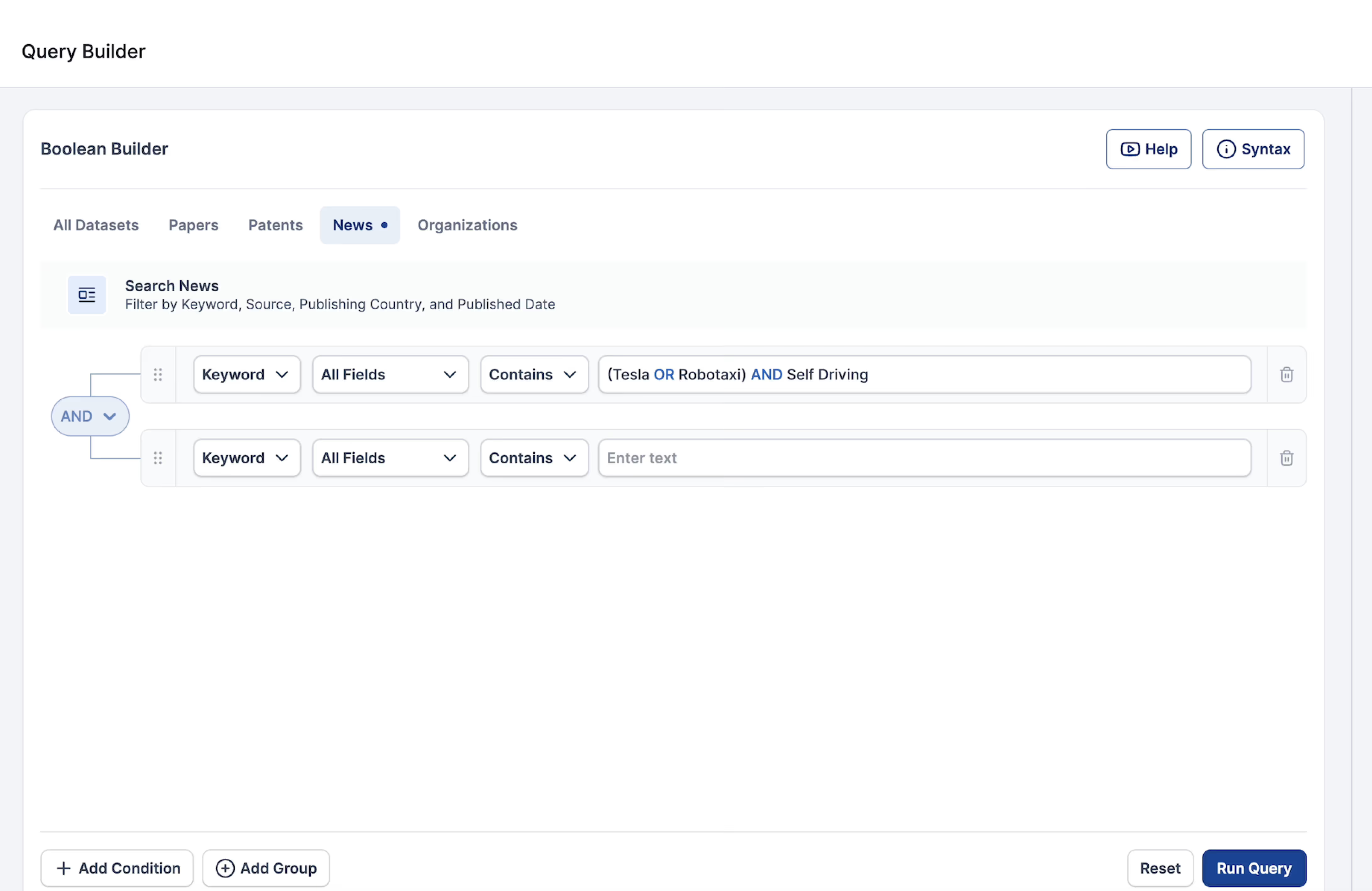
Navigating the All Datasets tab introduces a new level of complexity—and power—by allowing users to apply dataset-specific logic within a single, unified query workflow. While querying multiple datasets simultaneously might seem straightforward, the underlying differences in schema, metadata, and available fields between our proprietary datasets make this a deeply technical challenge. Patents, for example, include claims, application numbers, and multiple date fields (filed, granted, updated), while academic papers use DOIs, have different structural conventions, and emphasize different metadata. In the past, we sidestepped this complexity by translating general queries like ((drone_allText)) into dataset-specific logic under the hood. Now, instead of obscuring that logic, we allow users to opt in to it. The builder provides progressive layers of customization: start with intuitive keyword searches across all fields, then move into the advanced builder for field-specific targeting, fuzzy logic, and term boosting, and finally, tailor query logic by dataset—such as specifying different countries of interest for papers vs. patents. This approach preserves flexibility while giving users full control, and with tools like our real-time Live Analysis and “Your Query” panel, we make it easy to understand how every decision affects the results.
2. More Fields to Query
We’re exposing deeper fields across datasets—giving you explicit control over the dimensions of your search. For the first time, users can now search academic papers by DOI, a critical identifier previously unsupported on the platform. You can also query by:
- Author or inventor names
- Organizations or assignees
- Countries, journals, funding agencies, and more
3. Full Boolean Support
Advanced Search now leverages powerful Boolean logic—AND, OR, NOT, and grouping—enabling more precise control over search logic and improving performance and accuracy.
4. Lucene Syntax Features
Use built-in Lucene features to create expressive, complex searches:
- Proximity searches to find terms near each other
- Fuzzy searches for flexible matching
- Exact phrase matching
- Boosting to prioritize results (e.g., prioritize results mentioning AI 3x more than others)
- Prefix/Postfix queries to match phrases that start or end a certain way
- Range queries for fields like date, funding amounts, or numerical values
A more powerful user experience
Our new search interface is built to help you tap into these capabilities without needing to know the syntax from the start. You’ll find:
- A Query Builder to guide you through complex searches
- A Help Video to onboard users to Lucene-style searches
- Inline examples and tips for writing queries using grouping, boosting, and more
Built for precision, speed, and customization
With Lucene as our foundation, search results are now not only more flexible but also faster and more accurate. Semantic search continues to offer natural-language ease of use, while Boolean search gives power users the performance and structure they need to uncover insights with greater specificity.
Whether you’re an innovation analyst drilling into AI patents or a business development lead scanning academic papers from Chilean researchers—Advanced Search is built to help you get to the signal, faster.
Available now to all users
Advanced Search is live and available across the Cypris platform today. If you’re already using Cypris, you’ll find the new search interface in your dashboard, complete with updated syntax documentation and walkthroughs.
We’re excited to see what you’ll build, discover, and analyze with this new capability. This is just the beginning—we’ll continue expanding the fields, syntax features, and customization options as we push the boundaries of what intelligent search can do for R&D.
Introducing Advanced Search on Cypris


A powerful new foundation for custom queries—built on Lucene and designed for R&D precision.
Over the past few years, Cypris has helped innovation teams make faster, more informed decisions by centralizing critical insights across datasets like patents, academic papers, and company activity. But until now, our search experience relied on a legacy query system with limited capabilities, offering little support for advanced search features or dataset-level customization.
Today, we’re excited to introduce an upgraded Advanced Search on Cypris, a complete overhaul of our query engine and search experience, powered by the open-standard Lucene query syntax. This update introduces a more robust and flexible search foundation, unlocking new ways to query data, build complex filters, and extract precisely what you need across patents, research, and more.
Why we rebuilt our search system from the ground up
Cypris’ original query syntax, a proprietary format used internally for years, limited users’ ability to craft advanced queries or tailor searches to specific datasets. It lacked modern capabilities like proximity searches, field-level customization, or true Boolean logic. This made it difficult to build a reliable and intuitive experience for both casual users and advanced researchers.
By moving to Lucene, we’re adopting a powerful, industry-standard query language that makes it easier for developers to build advanced features—and gives users access to a far more capable and flexible search toolset.
What’s new in Advanced Search
1. Custom Queries by Dataset
You can now layer queries to search across datasets or tailor filters to each one. For example, you can run a broad query on drone delivery, and then add separate layers to focus on patents by a specific assignee and papers from a specific country or funding agency.
Navigating the All Datasets tab introduces a new level of complexity—and power—by allowing users to apply dataset-specific logic within a single, unified query workflow. While querying multiple datasets simultaneously might seem straightforward, the underlying differences in schema, metadata, and available fields between our proprietary datasets make this a deeply technical challenge. Patents, for example, include claims, application numbers, and multiple date fields (filed, granted, updated), while academic papers use DOIs, have different structural conventions, and emphasize different metadata. In the past, we sidestepped this complexity by translating general queries like ((drone_allText)) into dataset-specific logic under the hood. Now, instead of obscuring that logic, we allow users to opt in to it. The builder provides progressive layers of customization: start with intuitive keyword searches across all fields, then move into the advanced builder for field-specific targeting, fuzzy logic, and term boosting, and finally, tailor query logic by dataset—such as specifying different countries of interest for papers vs. patents. This approach preserves flexibility while giving users full control, and with tools like our real-time Live Analysis and “Your Query” panel, we make it easy to understand how every decision affects the results.
2. More Fields to Query
We’re exposing deeper fields across datasets—giving you explicit control over the dimensions of your search. For the first time, users can now search academic papers by DOI, a critical identifier previously unsupported on the platform. You can also query by:
- Author or inventor names
- Organizations or assignees
- Countries, journals, funding agencies, and more
3. Full Boolean Support
Advanced Search now leverages powerful Boolean logic—AND, OR, NOT, and grouping—enabling more precise control over search logic and improving performance and accuracy.
4. Lucene Syntax Features
Use built-in Lucene features to create expressive, complex searches:
- Proximity searches to find terms near each other
- Fuzzy searches for flexible matching
- Exact phrase matching
- Boosting to prioritize results (e.g., prioritize results mentioning AI 3x more than others)
- Prefix/Postfix queries to match phrases that start or end a certain way
- Range queries for fields like date, funding amounts, or numerical values
A more powerful user experience
Our new search interface is built to help you tap into these capabilities without needing to know the syntax from the start. You’ll find:
- A Query Builder to guide you through complex searches
- A Help Video to onboard users to Lucene-style searches
- Inline examples and tips for writing queries using grouping, boosting, and more
Built for precision, speed, and customization
With Lucene as our foundation, search results are now not only more flexible but also faster and more accurate. Semantic search continues to offer natural-language ease of use, while Boolean search gives power users the performance and structure they need to uncover insights with greater specificity.
Whether you’re an innovation analyst drilling into AI patents or a business development lead scanning academic papers from Chilean researchers—Advanced Search is built to help you get to the signal, faster.
Available now to all users
Advanced Search is live and available across the Cypris platform today. If you’re already using Cypris, you’ll find the new search interface in your dashboard, complete with updated syntax documentation and walkthroughs.
We’re excited to see what you’ll build, discover, and analyze with this new capability. This is just the beginning—we’ll continue expanding the fields, syntax features, and customization options as we push the boundaries of what intelligent search can do for R&D.
Keep Reading

Artificial intelligence has become a permanent layer in pharmaceutical R&D, and it is generating a distinctive, fast-growing patent landscape. The convergence of AI and drug discovery is visible directly in the data on generative-AI patenting: among the categories tracked by the World Intellectual Property Organization, applications in molecules, genes, and proteins, though smaller in absolute number at roughly 1,500 inventions, were the fastest-growing, expanding at about 78 percent per year over a five-year period.¹ Peer-reviewed patent-basis analysis of AI in the pharmaceutical industry confirms both the rapid rise of filing activity and its concentration among a set of key players,² and a growing body of work applies patent-landscaping and bibliometric methods specifically to AI-driven drug discovery, including in areas such as cancer drug discovery.⁵,⁶,⁷ For R&D and IP teams, the strategic questions are which sub-domains are crowded, where defensible white space remains, and how the unsettled rules on AI-assisted inventorship affect what can be protected.
The landscape divides into several technically distinct sub-domains, each a different region of patenting. Generative molecular design covers models that propose novel candidate molecules. Drug-target interaction and binding-affinity prediction covers models that predict whether and how strongly a molecule binds a target. Drug repurposing covers methods that use biomedical knowledge graphs and network pharmacology to find new uses for known compounds. Multi-omics response prediction covers models that predict biological response from genomic and other omics data. Clinical-trial prediction and design covers models that forecast trial success and optimize design. And a further layer covers AI-assisted pharmaceutical development and, increasingly, generative AI applied to regulatory documentation. These sub-domains differ sharply in how crowded they are: biomedical knowledge-graph construction and traversal, for example, has become a comparatively crowded area of prior art, while newer large-language-model-native and agentic approaches are earlier and sparser.
Two structural features shape the landscape. The first is geographic and institutional concentration: the same concentration seen across generative AI, where a small number of countries account for most filings, extends into AI drug discovery, with China's share of generative-AI patenting near the top globally.¹ The second is the unsettled status of AI-assisted inventorship. In the United States, the Patent and Trademark Office rescinded its February 2024 guidance on AI-assisted inventions in November 2025 and returned to the traditional human-conception standard, which affects how AI-heavy pipelines document invention and how their patents should be valued.³ Commentators expect the first wave of litigation over AI-generated drug inventions within a few years, which will set precedents on inventorship and eligibility.⁴ These are not peripheral legal details; they determine what portion of an AI-driven discovery effort can be protected and how a portfolio should be structured, and they vary by jurisdiction. Because applications publish about eighteen months after filing, the newest large-language-model-native and agentic filings are under-represented, so the current frontier is more active than granted-patent counts suggest.
What the AI drug discovery landscape shows
Fastest-growing generative-AI category. Among generative-AI patents, molecule, gene, and protein applications grew fastest, at roughly 78 percent per year, though from a smaller base than image or text applications.¹
Several distinct sub-domains. The field spans generative molecular design, drug-target interaction prediction, knowledge-graph-based repurposing, multi-omics response prediction, clinical-trial prediction, and AI-assisted development.²
Crowded versus sparse areas. Biomedical knowledge-graph construction and traversal is comparatively crowded prior art, while large-language-model-native and agentic approaches are earlier and sparser.
Geographic concentration. Activity is concentrated in a small number of countries, mirroring the broader generative-AI landscape, with China prominent.¹
Unsettled inventorship. AI-assisted inventorship rules are in flux, with the US returning to a human-conception standard in late 2025, which affects what can be protected and how portfolios are documented.³,⁴
How AI-powered landscape and white space analysis helps
Mapping a fast-moving, sub-domain-structured field where much of the state of the art is in non-patent literature requires more than keyword search. AI-powered analysis addresses this with semantic search across both patents and scientific literature, which is essential because AI-method disclosures often appear first in preprints and conference proceedings, attribution that normalizes filers to canonical entities, and continuous monitoring that tracks the newest agentic and large-language-model-native filings. Clustering activity by sub-domain and by concept is what distinguishes crowded prior art from genuine white space.
Where Cypris fits
Cypris runs patent landscape and white space analysis for fast-moving, literature-heavy fields such as AI in drug discovery across a corpus of more than 500 million patents and scientific papers, organized through a proprietary R&D ontology. Because the corpus spans both patents and scientific literature, Cypris covers the preprints and conference proceedings where AI-method disclosures often appear first, rather than patents alone. The ontology clusters activity by sub-domain, generative design, interaction prediction, repurposing, multi-omics, and clinical prediction, and normalizes filers to canonical entities, so a team can resolve which areas, such as knowledge-graph methods, are crowded and which, such as agentic approaches, remain open as white space. Cypris Q, the platform's agentic layer, lets teams run landscape and white space analysis conversationally and chain the clustering, attribution, and gap analysis, and Agentic Monitoring tracks a defined area over time and flags new patents and papers as they publish, which is essential where the newest filings are under-represented by publication lag. Cypris provides enterprise API partnerships with OpenAI, Anthropic, and Google, and is built with enterprise-grade security. Cypris serves hundreds of enterprise customers across pharmaceuticals, chemicals, advanced materials, energy, and other regulated industries.
FAQ
How fast is AI drug discovery patenting growing?
AI drug discovery patenting is growing quickly. Among generative-AI patent categories tracked by WIPO, applications in molecules, genes, and proteins were the fastest-growing at roughly 78 percent per year, though from a smaller base than image or text applications. Peer-reviewed patent-basis analysis confirms the rapid rise of AI filing activity in the pharmaceutical industry.
What are the main sub-domains of AI drug discovery patents?
The main sub-domains are generative molecular design, drug-target interaction and binding-affinity prediction, drug repurposing using biomedical knowledge graphs, multi-omics response prediction, clinical-trial prediction and design, and AI-assisted pharmaceutical development. Each is a technically distinct region of the patent landscape. They differ substantially in how crowded they are.
Which areas of AI drug discovery are crowded, and which are open?
Biomedical knowledge-graph construction and traversal has become a comparatively crowded area of prior art in AI drug discovery, while large-language-model-native and agentic approaches are earlier and sparser. The crowded areas carry more freedom-to-operate risk, and the sparser areas hold more white space. Distinguishing them requires clustering activity by sub-domain and concept.
How does AI-assisted inventorship affect drug patents?
AI-assisted inventorship affects drug patents because the rules on whether and how AI-assisted inventions can be protected are unsettled and vary by jurisdiction. In the United States, the Patent and Trademark Office rescinded its 2024 guidance on AI-assisted inventions in November 2025 and returned to the traditional human-conception standard. This affects how AI-heavy pipelines document invention and how their patents are valued.
Why does China feature prominently in AI drug discovery patenting?
China features prominently in AI drug discovery patenting because it accounts for a large share of generative-AI patenting overall, and that concentration extends into the drug discovery sub-domains. The broader generative-AI landscape is dominated by a small number of countries. This geographic concentration matters for competitive positioning and freedom-to-operate.
Why does AI drug discovery analysis need scientific literature?
AI drug discovery analysis needs scientific literature because AI-method disclosures often appear first in preprints and conference proceedings rather than patents, so a patent-only view misses much of the state of the art. This is characteristic of AI fields generally. Cypris analyzes both patents and scientific literature across more than 500 million documents.
How do you find white space in AI drug discovery?
Finding white space in AI drug discovery means clustering activity by sub-domain and concept across patents and scientific literature, and identifying the sparser areas, such as agentic and large-language-model-native approaches, where few patents yet exist. Because much of the state of the art is in non-patent literature, semantic search across both sources is essential. The white space is where a viable method exists but patenting is still thin.
Which teams use AI drug discovery patent landscape analysis?
AI drug discovery patent landscape analysis is used by R&D, IP, and strategy teams at pharmaceutical companies, AI-native drug discovery firms, and their partners, as well as investors assessing AI-driven pipelines. It informs where to file, where freedom-to-operate risk sits, and how to structure a portfolio given inventorship uncertainty. Cypris serves hundreds of enterprise customers across pharmaceuticals and other research-intensive industries.
How current does an AI drug discovery landscape need to be?
An AI drug discovery landscape needs to be continuously current, because the field moves quickly, inventorship rules are shifting, new agentic and large-language-model-native filings publish constantly, and publication lag hides the most recent activity. A one-time landscape ages within months. Cypris uses Agentic Monitoring to track a defined area and flag new patents and papers as they publish.
Endnotes
- World Intellectual Property Organization (2024). Patent Landscape Report: Generative Artificial Intelligence. Geneva: WIPO. https://doi.org/10.34667/tind.49740
- Kano, S. & Sakaoka, S. (2025). Quantitative insights on artificial intelligence in the pharmaceutical industry: a patent-basis analysis of technological trends and key players. World Patent Information. https://www.sciencedirect.com/science/article/pii/S0172219025000481
- United States Patent and Trademark Office (2025). Revised Inventorship Guidance for AI-Assisted Inventions, Federal Register (published November 28, 2025; rescinding the February 2024 guidance and returning to the traditional human-conception standard). https://www.federalregister.gov/documents/2025/11/28/2025-21457/revised-inventorship-guidance-for-ai-assisted-inventions
- Goodwin (2026). AI Drug Discovery Tests the Limits of Patent Law. https://www.goodwinlaw.com/en/insights/publications/2025/12/insights-lifesciences-ip-ai-drug-discovery-tests-the-limits-of-patent-law
- Hofmann-Apitius, M., Gadiya, Y., Zaliani, A. & Gribbon, P. (2023). Pharmaceutical patent landscaping: a novel approach to understand patents from the drug discovery perspective. Artificial Intelligence in the Life Sciences. https://doi.org/10.1016/j.ailsci.2023.100061
- Abdulwahab, A. A. et al. (2024). Catalyzing innovation in cancer drug discovery through artificial intelligence, machine learning and patency. Pharmaceutical Patent Analyst.
- Jing, F. & Ma, Y. (2024). Bibliometric Analysis and Research Trends in Artificial Intelligence for Pharmaceutical Management and Drug Discovery.

The CRISPR and gene-editing patent landscape is one of the largest and most contested in biotechnology, and freedom-to-operate in this field is correspondingly difficult. A landscape analysis maintained by a national patent office counted roughly 23,700 CRISPR patent families as of the end of 2024, an increase of more than 6,500 families in a single year, and it identified four competing groups holding foundational claims.¹ Freedom-to-operate determines whether making, using, or selling a product would infringe another party's active patent claims. In gene editing, the foundational rights are split across multiple owners and jurisdictions, so a developer frequently cannot clear a product by licensing from a single source and must instead assemble rights from several, with the required set depending on the application and the country.¹,²
The fragmentation traces to an unresolved priority dispute over who first applied CRISPR-Cas9 to eukaryotic cells. The two most prominent groups are the University of California, Berkeley, the University of Vienna, and Emmanuelle Charpentier on one side, and the Broad Institute of MIT and Harvard on the other, with ToolGen and Sigma-Aldrich also holding foundational filings. The dispute has run through patent offices and courts for over a decade, and it remains live: in May 2025 the US Court of Appeals for the Federal Circuit vacated and remanded a decision that had awarded priority for eukaryotic CRISPR-Cas9 to the Broad Institute, reviving the Berkeley-led group's challenge.³,⁶ In Europe, the Berkeley-led group withdrew two foundational patents in late 2024 following an unfavorable preliminary opinion, then pursued divisional claims, while ToolGen secured European positions during 2025, illustrating how the landscape continues to shift among the competing groups.²,⁷ The academic literature has tracked this contested landscape since the technology's early years, documenting both its fragmentation and the licensing complexity it creates, and has examined proposed responses such as CRISPR patent pools.⁴,⁵,⁸
The practical consequence is that gene-editing FTO is a licensing-and-landscape problem, not a single clearance. The required rights differ by use, human therapeutics, agricultural and plant applications, research tools, and diagnostics can each implicate different foundational and improvement patents, and they differ by jurisdiction, because the same dispute has resolved differently in the United States, Europe, and Asia. The uncertainty is compounded by timing: some of the earliest, broadest patents may expire before the disputes are fully resolved, which shifts value toward the dense layer of improvement patents on delivery, specificity, and newer editing systems.² Because applications publish about eighteen months after filing, the most recent activity is under-represented, so the landscape is even larger and more active than granted-patent counts suggest.
Why CRISPR freedom-to-operate is hard
Fragmented foundational rights. Foundational claims are split across at least four groups, so clearing a product often requires multiple licenses rather than one.¹
Unresolved disputes. The priority dispute over eukaryotic CRISPR-Cas9 remains active, with a US Federal Circuit ruling in May 2025 reviving the Berkeley-led challenge, so ownership is not yet settled.³
Jurisdictional divergence. The same dispute has resolved differently across the United States, Europe, and Asia, so FTO must be assessed market-by-market.²
Application-specific rights. Human therapeutics, agriculture, research tools, and diagnostics implicate different patents, so the required license set depends on the intended use.¹
A dense improvement layer. Beyond the foundational patents, a large and growing layer of improvement patents covers delivery, specificity, base and prime editing, and newer nucleases, which is where much current FTO risk and white space now sit, including in application areas such as agricultural gene editing.⁹
How AI-powered landscape and FTO analysis helps
Navigating a landscape of more than twenty thousand families across multiple owners, applications, and jurisdictions is beyond manual search. AI-powered analysis addresses this with semantic search that retrieves relevant claims regardless of terminology, attribution that resolves owners to canonical entities so the fragmentation is visible, and continuous monitoring that tracks a fast-shifting landscape as disputes resolve and improvement patents publish. Because gene-editing advances appear in scientific literature before they are patented, reading both patents and literature gives earlier warning of where the improvement layer is extending.
Where Cypris fits
Cypris runs patent landscape and freedom-to-operate analysis for complex, fragmented fields such as gene editing across a corpus of more than 500 million patents and scientific papers, organized through a proprietary R&D ontology. The ontology clusters the landscape by technology and application and normalizes owners to canonical entities, so a team can see how foundational and improvement rights are distributed across the four groups and the many later filers rather than a flat list. Semantic search across patents and scientific literature surfaces relevant claims regardless of terminology and connects filings to the underlying research, which is where the improvement layer emerges first. Cypris Q, the platform's agentic layer, lets teams run landscape and FTO analysis conversationally and chain the attribution, clustering, and claim analysis, and Agentic Monitoring tracks the landscape over time and flags new filings and dispute developments as they publish. Cypris provides enterprise API partnerships with OpenAI, Anthropic, and Google, and is built with enterprise-grade security. Cypris serves hundreds of enterprise customers across pharmaceuticals, chemicals, advanced materials, energy, and other regulated industries.
FAQ
How large is the CRISPR patent landscape?
The CRISPR patent landscape is very large. A national patent office landscape analysis counted roughly 23,700 CRISPR patent families as of the end of 2024, up more than 6,500 in a single year. Because applications publish about eighteen months after filing, the most recent activity is under-represented, so the true landscape is even larger.
Why is freedom-to-operate hard for CRISPR?
Freedom-to-operate is hard for CRISPR because foundational rights are split across at least four competing groups and the key priority dispute remains unresolved, so a developer often cannot clear a product with a single license. The required rights also differ by application and jurisdiction. Assembling the correct set of licenses is the central FTO challenge.
What is the Broad versus UC Berkeley CRISPR dispute?
The Broad versus UC Berkeley dispute concerns who first applied CRISPR-Cas9 to eukaryotic cells, contested between the Berkeley-led group and the Broad Institute, with ToolGen and Sigma-Aldrich also holding foundational filings. In May 2025, the US Court of Appeals for the Federal Circuit vacated and remanded a decision that had favored the Broad Institute, reviving the Berkeley-led challenge. The dispute remains unresolved.
Does CRISPR freedom-to-operate differ by country?
Yes, CRISPR freedom-to-operate differs by country, because the same foundational dispute has resolved differently in the United States, Europe, and Asia. A party may hold stronger rights in one jurisdiction than another. FTO must therefore be assessed market-by-market rather than globally.
Why might a CRISPR product need multiple licenses?
A CRISPR product may need multiple licenses because foundational rights are fragmented across several owners, and improvement patents on delivery, specificity, and newer editing systems add further layers. The required set depends on the application and jurisdiction. This is why gene-editing FTO is a licensing-and-landscape problem rather than a single clearance.
How does the improvement-patent layer affect CRISPR FTO?
The improvement-patent layer affects CRISPR FTO because, beyond the foundational patents, a large and growing set of patents covers delivery, specificity, base and prime editing, and newer nucleases. As the earliest broad patents approach expiry, value shifts toward this layer, which is where much current FTO risk and white space sit. Mapping it requires reading both patents and scientific literature.
How does scientific literature help CRISPR landscape analysis?
Scientific literature helps CRISPR landscape analysis because gene-editing advances appear in research before they are patented, so the literature gives the earliest signal of where the improvement layer is extending. Analyzing patents alone gives a lagging view. Cypris analyzes both across more than 500 million patents and scientific papers.
Which teams need CRISPR patent landscape and FTO analysis?
CRISPR patent landscape and FTO analysis is needed by R&D, IP, and business-development teams in therapeutics, agriculture, industrial biotechnology, and diagnostics, along with investors assessing gene-editing assets. The fragmentation makes structured analysis essential. Cypris serves hundreds of enterprise customers across pharmaceuticals and other research-intensive industries.
How current does a CRISPR landscape need to be?
A CRISPR landscape needs to be continuously current, because the disputes are still resolving, new improvement patents publish constantly, and publication lag hides the most recent activity. A one-time landscape ages quickly. Cypris uses Agentic Monitoring to track the landscape and flag new filings and developments as they publish.
Endnotes
- Swiss Federal Institute of Intellectual Property (2025). CRISPR Technology: Patent & Licence Landscapes. https://www.ige.ch/
- Gowling WLG (2025). Fragmented and shifting CRISPR patent landscape: global proceedings and the patent pool solution. https://gowlingwlg.com/en/insights-resources/articles/2025/crispr-patent-landscape
- US Court of Appeals for the Federal Circuit (2025). Regents of the University of California v. Broad Institute, Inc., decided May 12, 2025. https://www.cafc.uscourts.gov/
- Egelie, K. J., Graff, G. D., Strand, S. P. & Johansen, B. (2016). The emerging patent landscape of CRISPR-Cas gene editing technology. Nature Biotechnology. https://doi.org/10.1038/nbt.3692
- Contreras, J. L. & Sherkow, J. S. (2017). CRISPR, surrogate licensing, and scientific discovery. Science. https://doi.org/10.1126/science.aal4222
- Sherkow, J. S. (2025). A "Bare Hope of a Result": The Second CRISPR Patent Appeal. The CRISPR Journal (analysis of the May 12, 2025 US Federal Circuit decision).
- Beck Greener (2025). Update on the CRISPR-Cas9 IP saga at the EPO: blows for both the Broad and CVC camps, but ToolGen ends 2025 with success. https://www.beckgreener.com/
- Stasi, A. & Pereira Rodrigues, I. (2019). Dealing with Patent Fragmentation in Genetics: Can Patent Pools Facilitate the Development of CRISPR Gene-Editing Technology? PubMed.
- Muhammad Adamu, U. et al. (2026). CRISPR in Wheat: Patents, Breeding Advances, and Emerging Challenges. Trends in Intellectual Property Research.

Agent orchestration in Microsoft Copilot works best when the orchestrator routes to scoped, governed connections rather than pulling every source into one undifferentiated context. The architecture that holds up under real R&D workloads keeps internal confidential data and external intelligence on separate trust boundaries, lets Copilot decide which to call, and treats external R&D and IP intelligence as a domain-oriented layer rather than a raw dataset dump. This guide explains how to design that orchestration so that a research team can ask a single question and have Copilot reason across an electronic lab notebook, internal developmental records, and the external patent and scientific literature without collapsing those very different data types into one fragile prompt.
Why orchestration belongs at the Copilot layer
The orchestrator is the component that decides which tool to call, in what order, and how to combine the results. In Microsoft Copilot Studio, generative orchestration is the mode that lets an agent select among multiple registered tools at runtime based on the user's intent and each tool's description. Microsoft requires generative orchestration to be enabled before an agent can use Model Context Protocol tools at all, which means the orchestration decision and the tool connections are designed to work as one system rather than as a hardcoded pipeline.
Putting orchestration at the Copilot layer matters for a specific reason. When orchestration is centralized, each connected source can stay narrow. The electronic lab notebook tool returns experimental records. The internal data tool returns developmental project context. The external intelligence tool returns patent and scientific findings. Copilot composes the answer from those scoped returns. The alternative, loading all of those corpora into a single context window and asking the model to sort it out, runs directly into context rot, the well-documented effect in which model accuracy degrades as the context window fills with more material. Centralized orchestration over scoped tools is the architectural answer to that degradation.
How MCP connections work inside Copilot Studio
Model Context Protocol is an open standard, introduced by Anthropic, that defines how applications expose tools and data to large language models in a consistent way. In Copilot Studio, MCP servers are made available through the same connector infrastructure that governs other Power Platform connections, which means an MCP connection inherits enterprise security and governance controls including Virtual Network integration, Data Loss Prevention policies, and multiple authentication methods.
Adding an MCP server to a Copilot Studio agent follows a defined path. From the agent's Tools page, you select Add a tool, then New tool, then Model Context Protocol, which opens the MCP onboarding wizard. You provide a server name, a server description, and a server URL, then select the authentication type the server requires. The server description is not cosmetic. The agent orchestrator reads that description at runtime to decide whether to call the server for a given user request, so a precise description of what each connection does is part of making orchestration work correctly. Once connected, each tool the MCP server publishes becomes an action inside Copilot Studio and inherits the server's defined inputs and outputs, and Copilot Studio reflects updates automatically as tools change on the server.
One governance fact shapes the entire design. Because MCP servers in Copilot Studio rely on Power Platform connectors for connectivity, any Data Loss Prevention policy that regulates those connectors also regulates the MCP server and its tools. This is the lever that lets a security team treat an internal ELN connection and an external intelligence connection under different policies even though both reach Copilot through the same mechanism.
Designing the internal trust boundary: ELN and developmental data
Internal confidential and developmental data is the most sensitive material in the orchestration, and it should be connected under the strictest governance. Electronic lab notebooks such as Benchling, LabArchives, and Scispot store the experimental records, sample data, and process documentation that represent a research organization's most valuable and proprietary information, and these platforms expose their data through documented REST APIs and emphasize regulatory compliance and data integrity as core features.
The design principle for this boundary is least exposure. The ELN connection and any internal developmental data connection should be governed by Data Loss Prevention policies that prevent confidential records from being combined with or transmitted to external destinations. Authentication should be scoped so the agent acts with the permissions of the requesting user rather than a broad service identity, which keeps the access model aligned with who is actually allowed to see which projects. Because Copilot Studio inherits connector-level DLP, a security team can place internal connections in a data group that is policy-isolated from external connections, so that the orchestrator can read from both but the platform enforces that confidential developmental data does not leak across the boundary. The internal tools should also be described narrowly to the orchestrator, so Copilot calls them only when a request genuinely concerns internal experimental or project data.
Designing the external boundary: patent and scientific intelligence
External R&D and IP intelligence is a fundamentally different kind of input, and treating it like just another data feed is where many agent designs go wrong. There is a meaningful difference between connecting an agent to a broad external dataset and connecting it to a domain-oriented intelligence layer. A raw external MCP endpoint that exposes a large patent or literature corpus hands the orchestrator an enormous, undifferentiated body of records, and asking the model to reason over that volume reintroduces the context rot problem the orchestration was meant to avoid. A domain-oriented layer instead returns a scoped, reasoned answer to the agent, so what enters Copilot's context is already a focused intelligence result rather than thousands of raw documents.
This is where the trust boundary and the quality boundary coincide. External intelligence should never share an undifferentiated context with confidential internal data, both because of data governance and because mixing a large external corpus into the same window as sensitive internal records degrades the reasoning on both. Keeping external intelligence as a separate, scoped connection that returns reasoned findings, rather than a firehose of raw records, protects accuracy and keeps the governance boundary clean.
Cypris as the external intelligence layer
This is the role Cypris is built for. As an enterprise R&D intelligence platform, Cypris unifies more than 500 million patents and scientific papers into a single intelligence layer with a proprietary R&D ontology, so that an agent reaching for external intelligence draws on the patent and scientific record in one reasoned place rather than across siloed connectors. Cypris is designed for R&D scientists and innovation strategists rather than IP attorneys, which means the intelligence it returns is scoped to the forward-looking questions research teams actually ask.
Crucially for an orchestration design, Cypris makes that intelligence available through official enterprise API partnerships with OpenAI, Anthropic, and Google, with enterprise-grade security built to Fortune 500 requirements. That partnership model lets the Cypris intelligence layer sit behind the AI tooling an organization already uses, including a Copilot orchestration, so the external intelligence entering the agent is a reasoned domain answer rather than a raw corpus. In the orchestration described here, Copilot routes external R&D and IP questions to Cypris as the domain-oriented intelligence layer, the internal ELN and developmental connections stay on their own governed boundary, and the orchestrator composes a single answer without ever collapsing confidential internal data and the external literature into one context. That separation is what makes the whole system both secure and accurate.
Putting the orchestration together
A working design has Copilot Studio as the orchestration layer with generative orchestration enabled, internal ELN and developmental data connected as narrowly scoped tools under isolating Data Loss Prevention policies, and external patent and scientific intelligence connected as a separate domain-oriented layer through Cypris's enterprise API partnerships. Each tool carries a precise description so the orchestrator routes correctly, authentication is scoped to the requesting user, and connector-level governance keeps the internal and external boundaries policy-separated. A researcher asks one question, and Copilot pulls scoped experimental context from the ELN, scoped project context from internal records, and a reasoned external intelligence answer from Cypris, then composes a response, all without ever forcing the model to reason over one bloated, mixed context. The result is an agent that is more accurate because each input is scoped and more secure because confidential developmental data never crosses into the external boundary.
FAQ
1. Can Microsoft Copilot orchestrate across both internal and external R&D data sources?Yes. Copilot Studio's generative orchestration mode lets a single agent select among multiple registered tools at runtime based on the user's intent, so one agent can route a question to an internal electronic lab notebook, internal developmental records, and an external intelligence layer and compose a unified answer.
2. What is generative orchestration in Copilot Studio?Generative orchestration is the mode in which the Copilot agent dynamically decides which tools to call and in what order based on the user's request and each tool's description, rather than following a hardcoded sequence. Microsoft requires it to be enabled before an agent can use Model Context Protocol tools.
3. How are MCP servers connected to a Copilot Studio agent?From the agent's Tools page you select Add a tool, then New tool, then Model Context Protocol, which opens the MCP onboarding wizard. You provide a server name, description, and URL, and select the authentication type. Each tool the server publishes becomes an action in Copilot Studio.
4. How is confidential R&D data kept secure in this architecture?MCP connections in Copilot Studio run on Power Platform connector infrastructure, so they inherit enterprise controls including Virtual Network integration, Data Loss Prevention policies, and multiple authentication methods. Internal connections can be placed under DLP policies that isolate them from external connections, and authentication can be scoped to the requesting user.
5. Why keep internal and external data on separate trust boundaries?Two reasons converge. Governance requires that confidential developmental data not leak to external destinations, and accuracy requires that a large external corpus not be mixed into the same context as sensitive internal records, because filling the context window with mixed material degrades the model's reasoning on both.
6. What is context rot and why does it matter for agent design?Context rot is the documented effect in which a model's accuracy declines as its context window fills with more material. It matters because loading multiple large corpora into one prompt, rather than routing to scoped tools, makes the agent reason worse, which is the core argument for centralizing orchestration over narrow connections.
7. How do electronic lab notebooks fit into the orchestration?ELN platforms such as Benchling, LabArchives, and Scispot hold experimental records, sample data, and process documentation, and expose that data through documented REST APIs. In the orchestration they are connected as narrowly scoped internal tools under strict governance, returning only the experimental context relevant to a given request.
8. What is the difference between connecting a raw external dataset and a domain-oriented intelligence layer?A raw external endpoint hands the orchestrator a large, undifferentiated body of records, which reintroduces context rot when the model tries to reason over the volume. A domain-oriented layer returns a scoped, reasoned answer, so what enters the agent's context is a focused result rather than thousands of raw documents.
9. How does Cypris connect into a Copilot orchestration?Cypris makes its R&D intelligence available through official enterprise API partnerships with OpenAI, Anthropic, and Google, with enterprise-grade security built to Fortune 500 requirements. That model lets the Cypris intelligence layer sit behind the AI tooling an organization already uses, so Copilot can route external patent and scientific questions to Cypris and receive a reasoned domain answer.
10. What does a complete orchestration design look like?Copilot Studio serves as the orchestration layer with generative orchestration enabled, internal ELN and developmental data are connected as scoped tools under isolating DLP policies, and external patent and scientific intelligence is connected as a separate domain-oriented layer through Cypris's enterprise API partnerships, with each tool precisely described so the orchestrator routes correctly.