
A powerful new foundation for custom queries—built on Lucene and designed for R&D precision.
Over the past few years, Cypris has helped innovation teams make faster, more informed decisions by centralizing critical insights across datasets like patents, academic papers, and company activity. But until now, our search experience relied on a legacy query system with limited capabilities, offering little support for advanced search features or dataset-level customization.
Today, we’re excited to introduce an upgraded Advanced Search on Cypris, a complete overhaul of our query engine and search experience, powered by the open-standard Lucene query syntax. This update introduces a more robust and flexible search foundation, unlocking new ways to query data, build complex filters, and extract precisely what you need across patents, research, and more.
Why we rebuilt our search system from the ground up
Cypris’ original query syntax, a proprietary format used internally for years, limited users’ ability to craft advanced queries or tailor searches to specific datasets. It lacked modern capabilities like proximity searches, field-level customization, or true Boolean logic. This made it difficult to build a reliable and intuitive experience for both casual users and advanced researchers.
By moving to Lucene, we’re adopting a powerful, industry-standard query language that makes it easier for developers to build advanced features—and gives users access to a far more capable and flexible search toolset.
What’s new in Advanced Search
1. Custom Queries by Dataset
You can now layer queries to search across datasets or tailor filters to each one. For example, you can run a broad query on drone delivery, and then add separate layers to focus on patents by a specific assignee and papers from a specific country or funding agency.
Navigating the All Datasets tab introduces a new level of complexity—and power—by allowing users to apply dataset-specific logic within a single, unified query workflow. While querying multiple datasets simultaneously might seem straightforward, the underlying differences in schema, metadata, and available fields between our proprietary datasets make this a deeply technical challenge. Patents, for example, include claims, application numbers, and multiple date fields (filed, granted, updated), while academic papers use DOIs, have different structural conventions, and emphasize different metadata. In the past, we sidestepped this complexity by translating general queries like ((drone_allText)) into dataset-specific logic under the hood. Now, instead of obscuring that logic, we allow users to opt in to it. The builder provides progressive layers of customization: start with intuitive keyword searches across all fields, then move into the advanced builder for field-specific targeting, fuzzy logic, and term boosting, and finally, tailor query logic by dataset—such as specifying different countries of interest for papers vs. patents. This approach preserves flexibility while giving users full control, and with tools like our real-time Live Analysis and “Your Query” panel, we make it easy to understand how every decision affects the results.
2. More Fields to Query
We’re exposing deeper fields across datasets—giving you explicit control over the dimensions of your search. For the first time, users can now search academic papers by DOI, a critical identifier previously unsupported on the platform. You can also query by:
- Author or inventor names
- Organizations or assignees
- Countries, journals, funding agencies, and more
3. Full Boolean Support
Advanced Search now leverages powerful Boolean logic—AND, OR, NOT, and grouping—enabling more precise control over search logic and improving performance and accuracy.
4. Lucene Syntax Features
Use built-in Lucene features to create expressive, complex searches:
- Proximity searches to find terms near each other
- Fuzzy searches for flexible matching
- Exact phrase matching
- Boosting to prioritize results (e.g., prioritize results mentioning AI 3x more than others)
- Prefix/Postfix queries to match phrases that start or end a certain way
- Range queries for fields like date, funding amounts, or numerical values
A more powerful user experience
Our new search interface is built to help you tap into these capabilities without needing to know the syntax from the start. You’ll find:
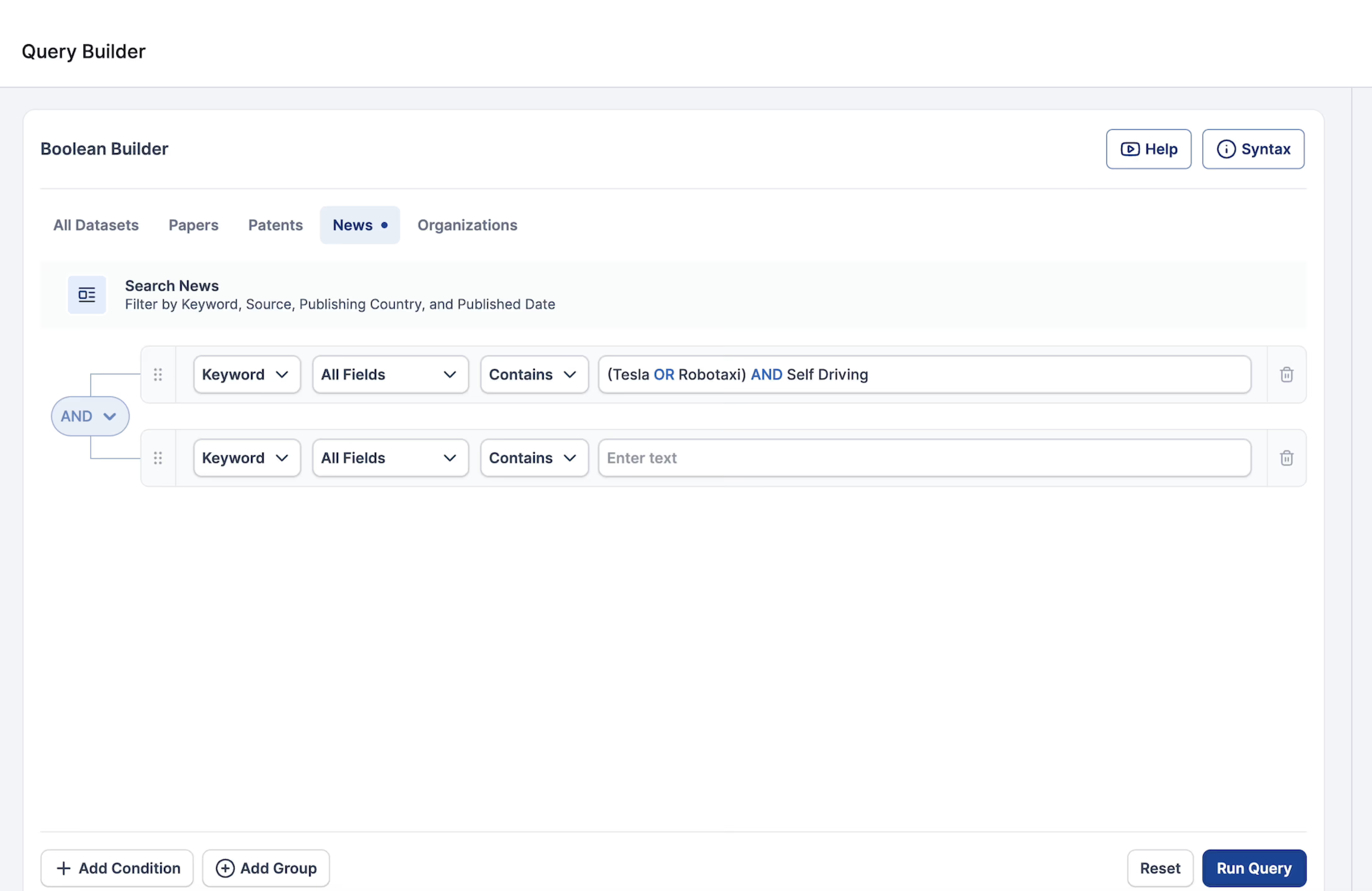
- A Query Builder to guide you through complex searches
- A Help Video to onboard users to Lucene-style searches
- Inline examples and tips for writing queries using grouping, boosting, and more
Built for precision, speed, and customization
With Lucene as our foundation, search results are now not only more flexible but also faster and more accurate. Semantic search continues to offer natural-language ease of use, while Boolean search gives power users the performance and structure they need to uncover insights with greater specificity.
Whether you’re an innovation analyst drilling into AI patents or a business development lead scanning academic papers from Chilean researchers—Advanced Search is built to help you get to the signal, faster.
Available now to all users
Advanced Search is live and available across the Cypris platform today. If you’re already using Cypris, you’ll find the new search interface in your dashboard, complete with updated syntax documentation and walkthroughs.
We’re excited to see what you’ll build, discover, and analyze with this new capability. This is just the beginning—we’ll continue expanding the fields, syntax features, and customization options as we push the boundaries of what intelligent search can do for R&D.
Introducing Advanced Search on Cypris


A powerful new foundation for custom queries—built on Lucene and designed for R&D precision.
Over the past few years, Cypris has helped innovation teams make faster, more informed decisions by centralizing critical insights across datasets like patents, academic papers, and company activity. But until now, our search experience relied on a legacy query system with limited capabilities, offering little support for advanced search features or dataset-level customization.
Today, we’re excited to introduce an upgraded Advanced Search on Cypris, a complete overhaul of our query engine and search experience, powered by the open-standard Lucene query syntax. This update introduces a more robust and flexible search foundation, unlocking new ways to query data, build complex filters, and extract precisely what you need across patents, research, and more.
Why we rebuilt our search system from the ground up
Cypris’ original query syntax, a proprietary format used internally for years, limited users’ ability to craft advanced queries or tailor searches to specific datasets. It lacked modern capabilities like proximity searches, field-level customization, or true Boolean logic. This made it difficult to build a reliable and intuitive experience for both casual users and advanced researchers.
By moving to Lucene, we’re adopting a powerful, industry-standard query language that makes it easier for developers to build advanced features—and gives users access to a far more capable and flexible search toolset.
What’s new in Advanced Search
1. Custom Queries by Dataset
You can now layer queries to search across datasets or tailor filters to each one. For example, you can run a broad query on drone delivery, and then add separate layers to focus on patents by a specific assignee and papers from a specific country or funding agency.
Navigating the All Datasets tab introduces a new level of complexity—and power—by allowing users to apply dataset-specific logic within a single, unified query workflow. While querying multiple datasets simultaneously might seem straightforward, the underlying differences in schema, metadata, and available fields between our proprietary datasets make this a deeply technical challenge. Patents, for example, include claims, application numbers, and multiple date fields (filed, granted, updated), while academic papers use DOIs, have different structural conventions, and emphasize different metadata. In the past, we sidestepped this complexity by translating general queries like ((drone_allText)) into dataset-specific logic under the hood. Now, instead of obscuring that logic, we allow users to opt in to it. The builder provides progressive layers of customization: start with intuitive keyword searches across all fields, then move into the advanced builder for field-specific targeting, fuzzy logic, and term boosting, and finally, tailor query logic by dataset—such as specifying different countries of interest for papers vs. patents. This approach preserves flexibility while giving users full control, and with tools like our real-time Live Analysis and “Your Query” panel, we make it easy to understand how every decision affects the results.
2. More Fields to Query
We’re exposing deeper fields across datasets—giving you explicit control over the dimensions of your search. For the first time, users can now search academic papers by DOI, a critical identifier previously unsupported on the platform. You can also query by:
- Author or inventor names
- Organizations or assignees
- Countries, journals, funding agencies, and more
3. Full Boolean Support
Advanced Search now leverages powerful Boolean logic—AND, OR, NOT, and grouping—enabling more precise control over search logic and improving performance and accuracy.
4. Lucene Syntax Features
Use built-in Lucene features to create expressive, complex searches:
- Proximity searches to find terms near each other
- Fuzzy searches for flexible matching
- Exact phrase matching
- Boosting to prioritize results (e.g., prioritize results mentioning AI 3x more than others)
- Prefix/Postfix queries to match phrases that start or end a certain way
- Range queries for fields like date, funding amounts, or numerical values
A more powerful user experience
Our new search interface is built to help you tap into these capabilities without needing to know the syntax from the start. You’ll find:
- A Query Builder to guide you through complex searches
- A Help Video to onboard users to Lucene-style searches
- Inline examples and tips for writing queries using grouping, boosting, and more
Built for precision, speed, and customization
With Lucene as our foundation, search results are now not only more flexible but also faster and more accurate. Semantic search continues to offer natural-language ease of use, while Boolean search gives power users the performance and structure they need to uncover insights with greater specificity.
Whether you’re an innovation analyst drilling into AI patents or a business development lead scanning academic papers from Chilean researchers—Advanced Search is built to help you get to the signal, faster.
Available now to all users
Advanced Search is live and available across the Cypris platform today. If you’re already using Cypris, you’ll find the new search interface in your dashboard, complete with updated syntax documentation and walkthroughs.
We’re excited to see what you’ll build, discover, and analyze with this new capability. This is just the beginning—we’ll continue expanding the fields, syntax features, and customization options as we push the boundaries of what intelligent search can do for R&D.
Keep Reading

Innovation intelligence is the practice of combining patent analysis with commercial and market analysis to guide R&D and technology investment decisions. It treats patents, scientific literature, and commercial signals as one connected evidence base rather than separate datasets. The purpose is to answer a question that neither patent data nor market data answers alone: where should an organization invest its R&D resources, and why.
Patent activity on its own is a weak guide to commercial value. According to the World Intellectual Property Organization, global patent applications surpassed 3.5 million for the first time in 2023, a fourth consecutive year of growth.12 Volume at that scale does not indicate commercial success, because filing a patent is not the same as commercializing it. A 2025 study in Research Policy that examined roughly 3,000 patents linked to the U.S. SBIR program found only about 21.5% showed signs of commercialization.3 Filing volume and commercial outcome diverge, which is why patent analysis needs commercial context.
This article explains what innovation intelligence is, how commercial and patent analysis combine, where the combined view creates value, and how AI makes the analysis practical across a corpus of more than 500 million patents and scientific papers.
What innovation intelligence is
Innovation intelligence is the integration of technical evidence and commercial evidence into a single analysis that informs R&D strategy. The technical evidence is patents and scientific literature. The commercial evidence is competitive activity, market signals, and the commercial behavior of the organizations doing the patenting.
Innovation intelligence differs from patent analytics alone. Patent analytics measures filing volume, assignees, jurisdictions, and claim trends. Innovation intelligence uses those patent metrics as one input, then connects them to commercial context so the output is a decision about where to invest rather than a description of a patent landscape.
Innovation intelligence also differs from market intelligence alone. Market intelligence measures demand, competitors, and revenue. It does not show which technical approaches organizations are protecting or where scientific research is accelerating. Innovation intelligence adds the patent and scientific layer that market intelligence lacks.
Why patent activity alone misleads
Patent counts overstate commercial certainty in two directions.
First, a granted patent is not a commercial product. The 2025 Research Policy study of SBIR-linked patents found that only about one in five showed commercialization signs, a reminder that most filings never reach the market. Reading patent activity without commercial signals treats every filing as if it were a product, which it is not.
Second, many patents are abandoned before the end of their term. Academic analysis of patent abandonment, including work published in the NYU Journal of Intellectual Property and Entertainment Law, documents that a substantial share of patents lapse for non-payment of maintenance fees well before their 20-year term expires.4 A raw competitor patent count therefore includes protection that no longer exists. Patent analysis that does not account for lapse and abandonment overstates the strength of a portfolio.
How commercial and patent analysis combine
Commercial and patent analysis combine along three connections.
Assignee to organization. Patent assignees are organizations with commercial strategies. Linking a patent portfolio to the commercial behavior of its owner shows not only what an organization has protected, but how it intends to compete. A rising patent position from a company entering a new market is a stronger signal than a patent count in isolation.
Technology to market. A technology area maps to the products and markets it enables. Connecting patent activity in a technology area to the commercial size and growth of the markets it serves separates well-patented technologies with no market from technologies where patent activity and commercial demand are rising together.
Filing trend to commercial signal. Patent filing velocity is a proxy for R&D spend. It reads most clearly alongside other commercial signals: venture rounds, M&A, and litigation. Litigation outcomes in particular move commercial value directly, as when NTP's patent suit against the maker of BlackBerry settled for $612.5 million in 2006 after threatening to shut down U.S. service.5
Where connected commercial and patent analysis creates value
R&D investment decisions. The combined view shows which technology areas have both rising patent activity and commercial opportunity, so R&D budget is directed with evidence from both sides rather than one.
Competitive intelligence. Connecting a competitor's patent portfolio to its commercial activity reveals intent. Patents show what a competitor is building. Commercial signals show whether they are commercializing it. Together they indicate where a competitor will compete next.
Technology landscaping. A landscape that combines patents, scientific literature, and commercial context describes not only who holds patents in an area, but whether that area is commercially live. This distinguishes active technology fields from patented but dormant ones.
Licensing and partnership strategy. Identifying organizations with strong patent positions and commercial reasons to license or partner requires both the patent view and the commercial view. Neither dataset identifies these opportunities alone.
Freedom-to-operate in commercial context. A freedom-to-operate (FTO) assessment identifies patent risk. Reading that risk alongside the commercial value of a product line prioritizes which risks to clear first, based on what is commercially at stake.
How AI makes innovation intelligence work at scale
Connecting commercial and patent analysis manually does not scale. Global patent applications surpassed 3.5 million in 2023, and a structural lag of roughly 18 months between filing and publication means disclosed research is already more than a year old when it surfaces. The volume and the delay together put comprehensive manual review out of reach.
AI makes innovation intelligence practical in three ways. Semantic search retrieves patents and scientific papers by technical meaning rather than exact keyword, so a technology area is captured completely regardless of terminology. An R&D ontology organizes patents and scientific literature into a structured map of technologies and their relationships, which is what allows patent activity to be connected to technology areas and, through them, to commercial context. Agentic workflows run the analysis continuously, updating the combined view as new patents, papers, and signals appear. Together these let innovation intelligence operate across a full technology field rather than a keyword sample of it.
Where Cypris fits
Cypris is an AI-native R&D intelligence platform that connects patent analysis, scientific literature, and commercial context for innovation intelligence. Cypris runs semantic search across a corpus of more than 500 million patents and scientific papers, organized through a proprietary R&D ontology that maps technologies and their relationships. The ontology is what lets patent activity be connected to technology areas and analyzed as innovation intelligence rather than isolated patent metrics.
Cypris Q is the platform's agentic layer, and Agentic Monitoring tracks a technology area continuously, updating the combined patent and commercial view as new filings, papers, and signals appear. Cypris holds enterprise API partnerships with OpenAI, Anthropic, and Google, and provides enterprise-grade security. It serves hundreds of enterprise customers across pharmaceuticals, chemicals, advanced materials, energy, and other regulated industries where R&D investment decisions depend on connecting patent evidence to commercial context.
FAQ
What is innovation intelligence?
Innovation intelligence is the practice of combining patent analysis with commercial and market analysis to guide R&D and technology investment decisions. It treats patents, scientific literature, and commercial signals as one connected evidence base, so the output is a decision about where to invest rather than a description of a patent landscape.
What is software for commercial and patent analysis?
Software for commercial and patent analysis connects patent data to commercial context in one platform, so R&D and strategy teams can evaluate both the technical and the commercial dimension of a technology area. Cypris supports this by running semantic search across more than 500 million patents and scientific papers organized through a proprietary R&D ontology that links patent activity to technology areas.
How is innovation intelligence different from patent analytics?
Innovation intelligence differs from patent analytics by adding commercial context. Patent analytics measures filing volume, assignees, and claim trends. Innovation intelligence uses those metrics as one input and connects them to commercial and market signals, so the analysis informs an investment decision rather than only describing a patent landscape.
Why is patent activity alone a poor guide to commercial value?
Patent activity alone is a poor guide because most patents are never commercialized and many are abandoned before term. A 2025 Research Policy study of SBIR-linked patents found only about 21.5% showed commercialization signs,3 and academic work on patent abandonment shows a substantial share lapse before their 20-year term ends.4 Filing volume and commercial value diverge.
How many patents are filed each year?
According to WIPO, global patent applications exceeded 3.5 million for the first time in 2023, the fourth consecutive year of growth.1 This volume, combined with a roughly 18-month filing-to-publication lag, makes comprehensive manual review impractical and is why AI-driven analysis is used for innovation intelligence.
How do commercial and patent analysis combine?
Commercial and patent analysis combine by linking patent assignees to their organizations' commercial strategies, mapping technology areas to the markets they serve, and reading patent filing trends alongside commercial signals such as venture rounds, M&A, and litigation. These connections turn patent activity into a signal about where R&D investment is concentrating and where commercial opportunity exists.
Why do R&D teams need both patent and commercial analysis?
R&D teams need both because a technology can be heavily patented but commercially stalled, or commercially attractive but legally crowded. Patent analysis shows what is protected and where research is accelerating. Commercial analysis shows where demand and competition are. Investment decisions require reading them together.
How does AI improve innovation intelligence?
AI improves innovation intelligence through semantic search, an R&D ontology, and agentic monitoring. Semantic search captures a technology area completely regardless of terminology, the ontology connects patent activity to technology areas and commercial context, and agentic monitoring keeps the combined view current. Together these make the analysis practical across a full technology field.
Who uses innovation intelligence?
Innovation intelligence is used by R&D leaders, strategy and commercial teams, and IP strategists in research-intensive industries such as pharmaceuticals, chemicals, advanced materials, and energy. These teams make technology investment decisions that require both patent evidence and commercial context.
How does innovation intelligence relate to freedom-to-operate?
Innovation intelligence relates to freedom-to-operate (FTO) by placing patent risk in commercial context. An FTO assessment identifies patent risk for a product. Reading that risk alongside the commercial value of the product line prioritizes which risks to clear first, based on what is commercially at stake.
References & Cited Literature
- World Intellectual Property Indicators 2024 — record on global patent filings (global applications surpassed 3.5 million in 2023). EU IP Helpdesk.
- WIPO reports return to growth in patents and trademarks filings in 2024. Global Legal Post.
- Raiteri, E., Bottai, C., & de Rassenfosse, G. (2025). A new approach to measuring invention commercialization: An application to the SBIR program. Research Policy.
- Does Anybody See What I See?: Abandoned Patents and Their Impacts on Technology Development. NYU Journal of Intellectual Property & Entertainment Law.
- NTP, Inc. v. Research In Motion, Ltd. — the parties settled in 2006 for $612.5 million (widely reported; matter of public record). Case discussed in: Wicely, "Freedom-to-Operate Analysis: When and How to Conduct One."

Microsoft Copilot has become the default AI assistant in many enterprise environments, and it is easy to see why. Deep integration with Word, Excel, PowerPoint, and Outlook makes it the path of least resistance for organizations already embedded in the Microsoft 365 ecosystem. But for teams doing serious scientific research, patent analysis, or technology scouting, the path of least resistance is not the same as the path to the best outcome. Copilot's intelligence is grounded in general web data and the documents inside a company's Microsoft tenant. It has no native access to patent corpora, no structured understanding of scientific literature, no concept of prior art or freedom to operate, and no ontology that maps relationships between technical domains. For R&D professionals and IP strategists, those are not nice-to-have features. They are the foundation of the work itself.
The result is a growing gap between what Copilot can do for a marketing team drafting slide decks and what it can do for an R&D scientist evaluating whether a polymer formulation infringes on a competitor's patent family. General-purpose AI assistants treat all information as interchangeable text. Domain-specific intelligence platforms treat information as structured knowledge, with provenance, citation networks, classification hierarchies, and temporal context that determine whether a finding is relevant or misleading. That distinction matters enormously when the downstream consequence of a missed reference is a nine-figure product development failure or an unexpected infringement claim.
This guide evaluates the best alternatives to Microsoft Copilot for teams working in research and development, intellectual property strategy, technology scouting, and scientific literature analysis. Each platform is assessed on three dimensions that matter most for technical and scientific use cases: the specificity and depth of its underlying dataset, the sophistication of its domain ontology or knowledge graph, and the degree to which its workflows align with the actual processes R&D and IP professionals follow every day.
Cypris
Cypris is an enterprise R&D intelligence platform purpose-built for corporate research teams, and it represents the most comprehensive alternative to Microsoft Copilot for technical and scientific use cases available in 2026. Where Copilot draws on general web data and a company's internal Microsoft documents, Cypris provides unified access to more than 500 million patents, scientific papers, grants, clinical trials, and market intelligence sources through a single interface. That dataset distinction is not incremental. It is categorical. An R&D scientist using Copilot to research a novel catalyst formulation will receive answers synthesized from web pages, blog posts, and whatever internal documents happen to be indexed in SharePoint. The same scientist using Cypris will receive answers grounded in the full global patent corpus, peer-reviewed literature spanning hundreds of journals, active grant funding data, and clinical trial records, all searchable through a single query.
What truly differentiates Cypris from both Copilot and the other alternatives on this list is its proprietary R&D ontology, a structured knowledge framework that understands the relationships between technical concepts across domains, industries, and document types. This is not a keyword index or a simple embedding model. It is a purpose-built taxonomy that maps how materials relate to processes, how processes relate to applications, and how applications relate to competitive patent positions. When a researcher queries Cypris about a specific technology area, the ontology ensures that results surface not just documents containing the right words but documents containing the right concepts, even when those concepts are described using different terminology across patents filed in different jurisdictions or papers published in different subfields.
The platform's workflow alignment with R&D processes is equally significant. Cypris supports the full spectrum of intelligence activities that corporate research teams perform, from early-stage technology landscape mapping at Gate 1 of the Stage-Gate process through prior art search, patent landscape analysis, freedom-to-operate assessment, competitive monitoring, and technology scouting. Cypris Q, the platform's AI research agent, generates structured intelligence reports that serve as direct inputs to stage-gate reviews and investment decisions, rather than requiring researchers to manually synthesize findings from multiple disconnected tools. Hundreds of enterprise teams and thousands of researchers across R&D, IP, and product development rely on Cypris as their primary technical intelligence infrastructure. Official enterprise API partnerships with OpenAI, Anthropic, and Google ensure the platform leverages frontier AI capabilities, while enterprise-grade security meets the requirements of Fortune 500 organizations handling sensitive pre-patent intellectual property. For any R&D or IP team currently using Copilot and finding that general-purpose AI falls short of their technical intelligence needs, Cypris is the most direct and complete upgrade available.
Elicit
Elicit is an AI research assistant focused specifically on scientific literature review and evidence synthesis. The platform searches approximately 138 million academic papers sourced primarily from the Semantic Scholar database and applies large language models to summarize findings, extract structured data from papers, and support systematic review workflows. For researchers conducting literature reviews, Elicit's ability to screen papers against user-defined criteria and extract specific data points into customizable tables represents a genuine productivity improvement over manual methods. Researchers using the platform report significant time savings on literature reviews, and its guided workflow for systematic reviews covers search, screening, extraction, and report generation in a structured sequence.
However, Elicit's dataset is limited to academic literature. It does not include patents, grants, clinical trial data, or market intelligence sources. This means that any R&D workflow requiring cross-referencing between published research and the patent landscape, which includes virtually every corporate technology assessment, will require supplementing Elicit with one or more additional tools. The platform also lacks a domain-specific ontology for R&D. Its search relies on semantic understanding of natural language queries matched against paper abstracts and full texts, which works well for finding relevant literature within a known domain but does not map the structural relationships between technical concepts that enable true landscape-level intelligence. Elicit is best suited for academic researchers and scientists focused on literature synthesis within a well-defined research question. For enterprise R&D teams needing to integrate patent intelligence with scientific literature analysis, the platform will need to be paired with additional patent search and analysis tools.
Consensus
Consensus takes a different approach to scientific research by functioning as an evidence-based search engine designed to answer research questions with findings drawn directly from peer-reviewed literature. The platform indexes over 200 million academic papers and uses AI to synthesize findings across multiple studies, providing concise answers with direct citations to source papers. Its signature feature is the Consensus Meter, which provides a visual representation of whether the scientific literature broadly supports or contradicts a given claim. For questions with clear empirical dimensions, such as whether a particular intervention produces a measurable effect, this feature can provide a rapid orientation to the state of the evidence that would take hours to assemble through manual review.
The dataset underlying Consensus is broad in its coverage of peer-reviewed literature but, like Elicit, excludes patents, technical standards, regulatory filings, and other document types that corporate R&D teams routinely need. The platform also lacks any R&D-specific ontological structure. Its strength lies in aggregating evidence around discrete research questions rather than mapping complex technology landscapes or identifying competitive positioning across patent portfolios. Consensus is most valuable as a rapid evidence-checking tool for scientists who need to quickly assess the state of research on a specific empirical question. It is not designed to support the broader strategic intelligence workflows, such as prior art search, competitive patent monitoring, or technology scouting, that enterprise R&D teams require.
Scite
Scite occupies a unique position in the research intelligence landscape through its focus on contextual citation analysis. The platform indexes over 250 million articles and uses machine learning to classify citation statements as supporting, contrasting, or mentioning, providing researchers with a deeper understanding of how a given paper has been received by the scientific community than simple citation counts can offer. This Smart Citations feature addresses a genuine blind spot in traditional citation analysis, where a paper cited 500 times might be cited 400 times in support and 100 times in disagreement, a distinction that raw citation counts completely obscure. Scite also offers citation dashboards, a browser extension for inline citation context, and an AI assistant for research queries grounded in its citation database.
Scite's dataset is substantial for scientific literature, and its contextual citation analysis represents a genuinely differentiated capability. However, the platform remains focused on academic citation networks and does not extend into patent data, market intelligence, or the broader range of technical document types that R&D teams analyze. Its ontological structure is oriented around citation relationships rather than technical domain taxonomies, which makes it excellent for evaluating the scientific credibility of specific claims but less useful for mapping technology landscapes or identifying white space in patent portfolios. Scite is best positioned as a supplementary tool for R&D teams that need to assess the reliability and reception of specific scientific findings, particularly during due diligence or when evaluating whether a technology direction is supported by robust evidence.
The Lens
The Lens stands out among the tools on this list because it is one of the few platforms that natively integrates patent data and scholarly literature within a single search interface. Operated by Cambia, an Australian nonprofit, The Lens provides free access to over 200 million scholarly records and patent documents from more than 100 jurisdictions, with bidirectional linking between patents and the academic papers they cite. This means a researcher can start from a patent and immediately see the scientific literature cited within it, or start from a scholarly paper and trace which patents reference that research. That bidirectional linkage is valuable for R&D teams conducting prior art searches or evaluating the relationship between published science and commercialized intellectual property.
The Lens also offers biological sequence searching through its PatSeq tools, which is particularly useful for life sciences R&D teams working in genomics, synthetic biology, or biopharmaceuticals. As a free, open-access platform, The Lens provides remarkable value for the cost. Its limitations emerge at the enterprise scale. The platform lacks AI-powered semantic search capabilities, meaning researchers must rely on Boolean queries and structured search syntax rather than natural language. It does not have a proprietary R&D ontology that maps relationships between technical concepts, and its analytics and visualization tools, while functional, are less sophisticated than those offered by dedicated enterprise intelligence platforms. The Lens is an excellent entry point for R&D teams that want patent and literature search in a single interface without a significant licensing investment, but teams requiring AI-driven landscape analysis, automated monitoring, or integration with enterprise workflows will find its capabilities insufficient as a primary intelligence platform.
Semantic Scholar
Semantic Scholar is a free AI-powered academic search engine developed by the Allen Institute for AI, indexing over 214 million papers with a strong emphasis on computer science and biomedical research. The platform's AI features go beyond basic keyword matching to include TLDR summaries that provide one-sentence overviews of paper contributions, Semantic Reader for augmented reading with contextual citation information, and Research Feeds that learn user preferences and recommend relevant new publications. Its ability to identify highly influential citations, distinguishing between perfunctory references and citations that meaningfully build on prior work, is a genuinely useful feature for researchers trying to trace the intellectual lineage of a research direction.
Semantic Scholar's greatest strength is also its most important limitation for R&D professionals: it is purely an academic literature discovery tool. It contains no patent data, no market intelligence, no clinical trial records, and no regulatory information. It also offers no enterprise features such as team collaboration, role-based access, or integration with internal knowledge management systems. The platform's knowledge graph maps relationships between papers, authors, and venues, but it does not provide the kind of R&D-specific ontological structure that connects research findings to applications, materials to processes, or scientific concepts to patent classifications. For academic researchers who need a powerful free tool for literature discovery and exploration, Semantic Scholar is among the best available. For corporate R&D teams that need their intelligence platform to span multiple document types and support enterprise-grade workflows, it serves as a useful complement to a more comprehensive platform rather than a replacement for one.
Google Patents
Google Patents provides free access to over 120 million patent documents from patent offices worldwide, with full-text search, machine translation of foreign-language patents, and prior art search functionality. The platform benefits from Google's search infrastructure, making basic patent searches fast and accessible. Google's prior art finder can identify potentially relevant prior art based on text descriptions rather than formal patent classification codes, which lowers the barrier to entry for researchers who are not trained patent searchers.
The limitations of Google Patents become apparent quickly for teams doing serious IP work. The platform offers no scientific literature integration, no landscape visualization or analytics tools, no competitive monitoring or alerting capabilities, and no structured ontology for navigating technical domains. Search results are presented as a flat list of documents with basic metadata rather than as an analyzed landscape with trends, key players, and technology clusters. Google Patents is useful as a quick reference tool for checking whether a specific patent exists or for performing a preliminary scan of a technology area, but it lacks the analytical depth, dataset breadth, and workflow support that enterprise R&D and IP teams need for substantive intelligence work.
Perplexity
Perplexity has gained significant traction as a general-purpose AI research tool that provides cited answers to questions by searching the web and synthesizing information from multiple sources. Its strength lies in its ability to produce well-structured answers with inline citations, making it useful for rapid orientation to unfamiliar topics. For R&D professionals, Perplexity can serve as a starting point for understanding a new technology area or checking recent developments before conducting deeper analysis with specialized tools.
The fundamental limitation of Perplexity for R&D and scientific use cases is the same limitation that applies to Microsoft Copilot: its dataset is the open web. Perplexity does not have direct access to patent databases, paywalled scientific journals, clinical trial registries, or proprietary technical databases. Its citations come from publicly accessible web pages, which may include summaries of research rather than the research itself. It has no ontological structure for technical domains and no understanding of patent classification systems, priority dates, claim structures, or the other specialized metadata that R&D and IP professionals rely on. Perplexity is best understood as a more transparent and citation-friendly version of general web search, not as a substitute for domain-specific R&D intelligence tools.
How to Choose the Right Alternative
The choice between these alternatives depends on the specific workflows a team needs to support and the types of decisions those workflows inform. Teams whose work centers entirely on academic literature review and evidence synthesis may find that a combination of Elicit, Consensus, and Semantic Scholar covers their needs effectively. Teams that need patent intelligence alongside scientific literature analysis should prioritize platforms that natively integrate both data types, with The Lens providing a free option and Cypris providing the most comprehensive enterprise solution. Teams that need a single platform to serve as their primary R&D intelligence infrastructure, spanning patent landscape analysis, scientific literature review, competitive monitoring, technology scouting, and freedom-to-operate assessment, will find that Cypris is the only alternative on this list that addresses all of those workflows within a unified interface backed by a purpose-built R&D ontology.
The broader lesson is that general-purpose AI tools like Microsoft Copilot and Perplexity are optimized for general-purpose productivity. They make it faster to draft documents, summarize meetings, and answer common questions. But R&D and IP work is not general-purpose work. It depends on specialized datasets, structured ontologies, and domain-specific workflows that general tools simply do not provide. Organizations that recognize this distinction and invest in purpose-built intelligence platforms will consistently make better-informed research decisions than those relying on general AI assistants to perform specialized technical work.
Frequently Asked Questions
Why is Microsoft Copilot not ideal for R&D and scientific research?Microsoft Copilot is built on general web data and the contents of a company's Microsoft 365 environment. It has no native access to patent databases, no index of peer-reviewed scientific literature, no understanding of patent classification systems, and no R&D-specific ontology for mapping relationships between technical concepts. For R&D professionals, this means Copilot cannot perform prior art searches, analyze patent landscapes, monitor competitive technology filings, or synthesize findings across patents and scientific papers, all of which are core R&D intelligence activities.
What is the best Microsoft Copilot alternative for enterprise R&D teams?Cypris is the most comprehensive alternative to Microsoft Copilot for enterprise R&D teams in 2026. The platform provides unified access to over 500 million patents, scientific papers, grants, clinical trials, and market sources through a single AI-powered interface with a proprietary R&D ontology, multimodal search capabilities, and official enterprise API partnerships with OpenAI, Anthropic, and Google. Cypris supports the full range of enterprise R&D intelligence workflows, from prior art search and patent landscape analysis to competitive monitoring and technology scouting.
What is an R&D ontology and why does it matter for technical research?An R&D ontology is a structured knowledge framework that maps relationships between technical concepts, materials, processes, applications, and patent classifications across domains and industries. It matters because keyword-based search tools only find documents containing the exact terms a researcher uses, while an ontology-powered platform can identify relevant documents that describe the same concept using different terminology, different languages, or different technical frameworks. This capability is especially important when searching across patents filed in multiple jurisdictions, where the same invention may be described in fundamentally different ways.
Can free tools like The Lens and Semantic Scholar replace paid R&D intelligence platforms?Free tools like The Lens and Semantic Scholar provide substantial value for individual researchers conducting specific searches. The Lens is particularly notable for integrating patent and scholarly data in a single interface. However, free tools generally lack AI-powered semantic search, proprietary ontologies, automated monitoring and alerting, enterprise collaboration features, integration with internal knowledge management systems, and the security certifications that Fortune 500 organizations require. For enterprise R&D teams managing portfolios of research projects across multiple technology domains, purpose-built platforms provide capabilities that free tools cannot replicate.
How does Elicit differ from Cypris for scientific literature review?Elicit specializes in academic literature review and evidence synthesis, searching approximately 138 million papers and supporting systematic review workflows including screening, data extraction, and report generation. Cypris provides a broader scope that includes scientific literature alongside patents, grants, clinical trials, and market intelligence, all searchable through a proprietary R&D ontology. Elicit is designed for researchers focused on a specific empirical question within published literature. Cypris is designed for R&D teams that need to evaluate a technology landscape across multiple data types and make strategic decisions based on the full innovation picture.
What is contextual citation analysis and why does Scite offer it?Contextual citation analysis, as implemented by Scite's Smart Citations feature, classifies how a paper is cited by subsequent publications, distinguishing between citations that support, contrast, or simply mention the original work. This matters because traditional citation counts treat all references equally, giving no indication of whether a highly cited paper is highly cited because its findings are widely confirmed or because its conclusions are widely disputed. For R&D teams evaluating whether to build on a particular scientific finding, understanding the nature of citations is as important as knowing the total count.
Does Perplexity have access to patent databases or scientific journals?No. Perplexity searches the open web and synthesizes answers from publicly accessible sources. It does not have direct access to patent databases, paywalled scientific journals, clinical trial registries, or proprietary technical databases. While it may surface summaries or secondary reports about patents and research, it cannot search the primary sources that R&D and IP professionals need to review for substantive technical intelligence work.
What types of R&D workflows require a specialized intelligence platform rather than a general AI assistant?Workflows that require specialized intelligence platforms include prior art search, patent landscape analysis, freedom-to-operate assessment, competitive technology monitoring, technology scouting, scientific literature review integrated with patent analysis, identification of white space in patent portfolios, and early-stage technology assessment at Gate 1 of the Stage-Gate process. These workflows depend on access to specialized datasets, understanding of patent classification systems, and the ability to map relationships between technical concepts across different document types, none of which general AI assistants like Copilot or Perplexity provide.
How do R&D ontologies differ from the knowledge graphs used by general AI tools?General AI tools use broad knowledge graphs derived from web data that represent millions of entities and relationships across every conceivable domain. R&D ontologies are purpose-built taxonomies that focus specifically on technical and scientific concepts, mapping how materials relate to processes, how processes relate to applications, how applications map to patent classifications, and how all of these connect across industries and jurisdictions. The specificity of an R&D ontology enables a level of precision in technical search and analysis that general knowledge graphs cannot achieve because general graphs prioritize breadth over domain depth.
What security considerations should R&D teams evaluate when choosing a Copilot alternative?R&D teams routinely work with pre-patent inventions, proprietary formulations, competitive analyses, and other highly sensitive intellectual property. Any AI platform used for R&D intelligence must meet enterprise-grade security requirements, including data isolation, encryption, access controls, and compliance certifications appropriate for the organization's industry. General-purpose AI assistants may process queries through shared infrastructure without the data governance controls that sensitive IP work demands. Enterprise R&D intelligence platforms like Cypris are designed to meet these requirements, ensuring that proprietary research queries and results remain protected.

Work, as we’ve known it, has fundamentally changed.
That statement might have sounded dramatic a year or two ago, but you would be naive to deny it today. AI is no longer just augmenting workflows. It is increasingly owning them. The initial wave focused on the obvious entry points such as drafting presentations, summarizing articles, and writing emails. But what started as assistive has quickly evolved into something far more powerful.
AI agents are now executing entire downstream workflows. Not just writing copy for a presentation, but building it. Not just drafting an email, but sending and iterating on it. These systems run asynchronously, improve over time, and are becoming easier to build and deploy by the day.
Startups and smaller organizations are already operating with them across their workflows and are seeing serious gains (including us at Cypris). Large enterprises, expectedly, lag behind, but will inevitably follow. Large enterprises are for the most part subject to their vendors, and those vendors are undergoing massive foundational shifts from traditional software apps to Agentic AI solutions.
Which raises the question:
What does this shift mean for the enterprise tech stack of the future?
The companies that answer this and position themselves correctly will not just be more efficient. They will operate at a fundamentally different pace. In a world where AI compounds progress, speed becomes the ultimate competitive advantage.
From Search to Chat
My perspective comes from the last five years building Cypris, an AI platform for R&D and IP intelligence.
We launched in 2021, before AI meant what it does today. Back then, semantic search was considered cutting edge. Our core value proposition was helping teams identify signals in massive datasets such as patents, research papers, and technical literature faster than their competitors.
The reality of that workflow looked very different than it does today.
Researchers spent the majority of their time on data curation. Entire teams were dedicated to building complex Lucene queries across fragmented datasets. The quality of insights depended heavily on how good your query was, and how effectively you could interpret thousands of results through pre-built charts, visualizations, BI tools and manual workflows.
Work that now takes minutes used to take weeks. Prior art searches, landscape analyses, and whitespace identification all required significant manual effort. Most product comparisons, and ultimately our demos, came down to a few questions:
- Does your query return better results than theirs?
- How robust are your advanced search capabilities?
- What kind of visualizations can you offer to identify meaningful signal in the results?
Then everything changed.
The Inflection Point - When AI Became Exposed to Enterprise
The launch of ChatGPT in November 2022 marked a turning point.
At first, its enterprise impact was not obvious. By early 2024, the shift became undeniable. Marketing workflows were the first to transform. Copywriting went from a differentiated skill to a commodity almost overnight. Then came coding assistants, which have rapidly evolved toward full-stack AI development.
We adapted Cypris in real time, shifting from static, pre-generated insights to dynamic, retrieval-based systems leveraging the world’s most powerful models. We recognized early that the model race was a wave we wanted to ride, so we built the infrastructure to incorporate all leading models directly into our product. What began as an enhancement quickly became the foundation of everything we do.

As the software stack progressed quickly, our customers began scrambling to make sense of it. AI committees formed. IT teams took control of purchasing decisions. Sales cycles lengthened as organizations tried to impose governance on something evolving faster than their processes could handle. We have seen this firsthand, with customers explicitly stating that all AI purchases now need to go through new evaluation and procurement processes.
But there is an underlying tension: Every piece of software is now an AI purchase.
And eventually, enterprises will need to operate that way.
What Should Be Verticalized?
At the center of this transformation and a complicated question most enterprise buyers are struggling with today is:
What can general-purpose AI handle, and where do you need specialized systems?
Most organizations do not answer this theoretically. They learn through experience, use case by use case. And the market hype does not help. There is a growing narrative that companies can “vibe code” their way into rebuilding core systems that underpin processes involving hundreds of stakeholders and millions of dollars in impact.
That is unrealistic.
Call me when a company like J&J decides to replace Salesforce with something built in their team’s free time with some prompts.
A more grounded way to think about it is through a simple principle that consistently holds true:
AI is only as good as what it is exposed to.
A model will generate answers based on the data it can access and the orchestration it is given, whether that is its training data, web content, or additional context you provide.
If you do not give it access to meaningful or proprietary data or thoughtful direction, it will default to generic knowledge.
This creates a growing divide within tech stacks that solely levergage 'commodity AI' vs. 'enterprise enhanced AI'.
Commodity AI vs. Enterprise-Enhanced AI
Commodity AI is the baseline.
It includes foundation models such as ChatGPT, Claude, and Co-Pilot, which run on top of those models, that everyone has access to.
Using them is no longer a competitive advantage. It is table stakes.
If your organization relies on the same tools trained on the same data, your outputs and decisions will begin to look the same as everyone else’s.
Enterprise-enhanced AI is where differentiation happens.
This is what you build on top of the foundation.
It includes:
- Integrating proprietary and high-value datasets
- Layering in domain-specific tools and platforms
- Designing curated workflows that tap into verticalized agents
- Building custom ontologies that interpret how your business operates
- Designing org wide system prompts tailored to existing internal processes
The goal is to amplify foundation models with context they cannot access on their own.
Additionally, enterprises that believe they can simply vibe code their own stack on top of foundation models will eventually run into the same reality that fueled the SaaS boom over the last 20 years. Your job is not to build and maintain software, and doing so will consume far more time and resources than expected. Claude is powerful, and your best vendors are already using it as a foundation. You will get significantly more leverage from it through verticalized and enhanced systems.
Where Data Foundations Especially Matter
In our eyes, nowhere is this more critical than in R&D and IP teams.
Foundation model providers are not focused on maintaining continuously updated datasets of global patents, scientific literature, company data, or chemical compounds. It is too niche and not a strategic priority for them.
But for teams making high-stakes decisions such as:
- What to build
- Where to invest
- Where to file IP
- How to differentiate
That data is essential.
If you rely on generic AI outputs without a strong data foundation, you are making decisions on incomplete information.
In technical domains, incomplete information is a strategic risk.
See our case study on real-world scenario gaps here: https://www.cypris.ai/insights/the-patent-intelligence-gap---a-comparative-analysis-of-verticalized-ai-patent-tools-vs-general-purpose-language-models-for-r-d-decision-making
The New Mandate for Enterprise Leaders
All software vendors will be AI-vendors, so figuring out your strategy, figuring out your security and IT governance, and figuring out your deployment process quickly should be a strategic priority. Focus on real-world signal and critical workflows and find vendors that can turn your commodity AI into enterprise enhanced assets before your competitors do.
We are entering a world where AI itself is no longer the differentiator.
How you implement it is.
The enterprises that recognize this early and build their stacks accordingly will not just keep up.
They will redefine the pace of their industries.