
A powerful new foundation for custom queries—built on Lucene and designed for R&D precision.
Over the past few years, Cypris has helped innovation teams make faster, more informed decisions by centralizing critical insights across datasets like patents, academic papers, and company activity. But until now, our search experience relied on a legacy query system with limited capabilities, offering little support for advanced search features or dataset-level customization.
Today, we’re excited to introduce an upgraded Advanced Search on Cypris, a complete overhaul of our query engine and search experience, powered by the open-standard Lucene query syntax. This update introduces a more robust and flexible search foundation, unlocking new ways to query data, build complex filters, and extract precisely what you need across patents, research, and more.
Why we rebuilt our search system from the ground up
Cypris’ original query syntax, a proprietary format used internally for years, limited users’ ability to craft advanced queries or tailor searches to specific datasets. It lacked modern capabilities like proximity searches, field-level customization, or true Boolean logic. This made it difficult to build a reliable and intuitive experience for both casual users and advanced researchers.
By moving to Lucene, we’re adopting a powerful, industry-standard query language that makes it easier for developers to build advanced features—and gives users access to a far more capable and flexible search toolset.
What’s new in Advanced Search
1. Custom Queries by Dataset
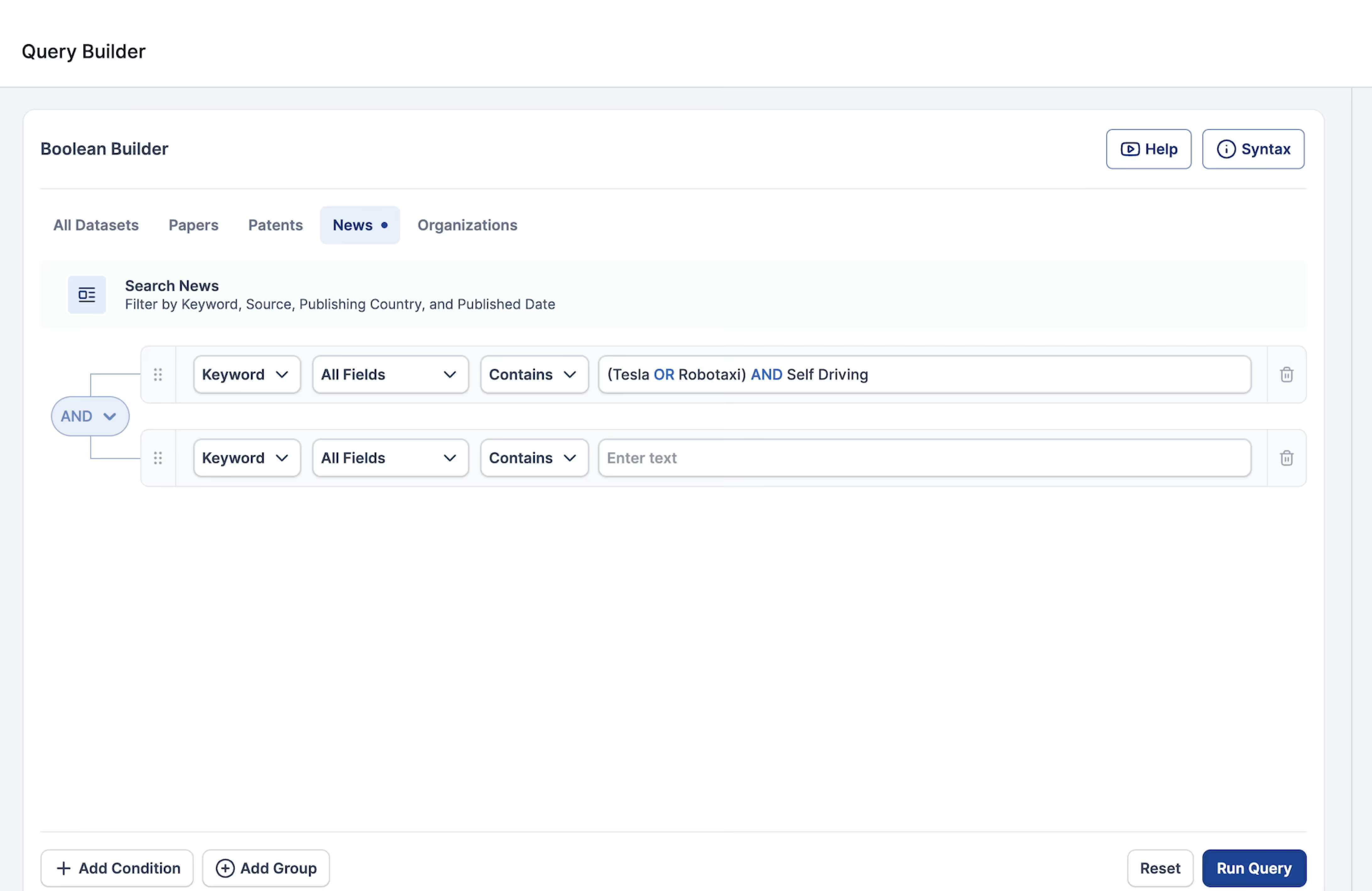
You can now layer queries to search across datasets or tailor filters to each one. For example, you can run a broad query on drone delivery, and then add separate layers to focus on patents by a specific assignee and papers from a specific country or funding agency.
Navigating the All Datasets tab introduces a new level of complexity—and power—by allowing users to apply dataset-specific logic within a single, unified query workflow. While querying multiple datasets simultaneously might seem straightforward, the underlying differences in schema, metadata, and available fields between our proprietary datasets make this a deeply technical challenge. Patents, for example, include claims, application numbers, and multiple date fields (filed, granted, updated), while academic papers use DOIs, have different structural conventions, and emphasize different metadata. In the past, we sidestepped this complexity by translating general queries like ((drone_allText)) into dataset-specific logic under the hood. Now, instead of obscuring that logic, we allow users to opt in to it. The builder provides progressive layers of customization: start with intuitive keyword searches across all fields, then move into the advanced builder for field-specific targeting, fuzzy logic, and term boosting, and finally, tailor query logic by dataset—such as specifying different countries of interest for papers vs. patents. This approach preserves flexibility while giving users full control, and with tools like our real-time Live Analysis and “Your Query” panel, we make it easy to understand how every decision affects the results.
2. More Fields to Query
We’re exposing deeper fields across datasets—giving you explicit control over the dimensions of your search. For the first time, users can now search academic papers by DOI, a critical identifier previously unsupported on the platform. You can also query by:
- Author or inventor names
- Organizations or assignees
- Countries, journals, funding agencies, and more
3. Full Boolean Support
Advanced Search now leverages powerful Boolean logic—AND, OR, NOT, and grouping—enabling more precise control over search logic and improving performance and accuracy.
4. Lucene Syntax Features
Use built-in Lucene features to create expressive, complex searches:
- Proximity searches to find terms near each other
- Fuzzy searches for flexible matching
- Exact phrase matching
- Boosting to prioritize results (e.g., prioritize results mentioning AI 3x more than others)
- Prefix/Postfix queries to match phrases that start or end a certain way
- Range queries for fields like date, funding amounts, or numerical values
A more powerful user experience
Our new search interface is built to help you tap into these capabilities without needing to know the syntax from the start. You’ll find:
- A Query Builder to guide you through complex searches
- A Help Video to onboard users to Lucene-style searches
- Inline examples and tips for writing queries using grouping, boosting, and more
Built for precision, speed, and customization
With Lucene as our foundation, search results are now not only more flexible but also faster and more accurate. Semantic search continues to offer natural-language ease of use, while Boolean search gives power users the performance and structure they need to uncover insights with greater specificity.
Whether you’re an innovation analyst drilling into AI patents or a business development lead scanning academic papers from Chilean researchers—Advanced Search is built to help you get to the signal, faster.
Available now to all users
Advanced Search is live and available across the Cypris platform today. If you’re already using Cypris, you’ll find the new search interface in your dashboard, complete with updated syntax documentation and walkthroughs.
We’re excited to see what you’ll build, discover, and analyze with this new capability. This is just the beginning—we’ll continue expanding the fields, syntax features, and customization options as we push the boundaries of what intelligent search can do for R&D.

Introducing Advanced Search on Cypris


A powerful new foundation for custom queries—built on Lucene and designed for R&D precision.
Over the past few years, Cypris has helped innovation teams make faster, more informed decisions by centralizing critical insights across datasets like patents, academic papers, and company activity. But until now, our search experience relied on a legacy query system with limited capabilities, offering little support for advanced search features or dataset-level customization.
Today, we’re excited to introduce an upgraded Advanced Search on Cypris, a complete overhaul of our query engine and search experience, powered by the open-standard Lucene query syntax. This update introduces a more robust and flexible search foundation, unlocking new ways to query data, build complex filters, and extract precisely what you need across patents, research, and more.
Why we rebuilt our search system from the ground up
Cypris’ original query syntax, a proprietary format used internally for years, limited users’ ability to craft advanced queries or tailor searches to specific datasets. It lacked modern capabilities like proximity searches, field-level customization, or true Boolean logic. This made it difficult to build a reliable and intuitive experience for both casual users and advanced researchers.
By moving to Lucene, we’re adopting a powerful, industry-standard query language that makes it easier for developers to build advanced features—and gives users access to a far more capable and flexible search toolset.
What’s new in Advanced Search
1. Custom Queries by Dataset
You can now layer queries to search across datasets or tailor filters to each one. For example, you can run a broad query on drone delivery, and then add separate layers to focus on patents by a specific assignee and papers from a specific country or funding agency.
Navigating the All Datasets tab introduces a new level of complexity—and power—by allowing users to apply dataset-specific logic within a single, unified query workflow. While querying multiple datasets simultaneously might seem straightforward, the underlying differences in schema, metadata, and available fields between our proprietary datasets make this a deeply technical challenge. Patents, for example, include claims, application numbers, and multiple date fields (filed, granted, updated), while academic papers use DOIs, have different structural conventions, and emphasize different metadata. In the past, we sidestepped this complexity by translating general queries like ((drone_allText)) into dataset-specific logic under the hood. Now, instead of obscuring that logic, we allow users to opt in to it. The builder provides progressive layers of customization: start with intuitive keyword searches across all fields, then move into the advanced builder for field-specific targeting, fuzzy logic, and term boosting, and finally, tailor query logic by dataset—such as specifying different countries of interest for papers vs. patents. This approach preserves flexibility while giving users full control, and with tools like our real-time Live Analysis and “Your Query” panel, we make it easy to understand how every decision affects the results.
2. More Fields to Query
We’re exposing deeper fields across datasets—giving you explicit control over the dimensions of your search. For the first time, users can now search academic papers by DOI, a critical identifier previously unsupported on the platform. You can also query by:
- Author or inventor names
- Organizations or assignees
- Countries, journals, funding agencies, and more
3. Full Boolean Support
Advanced Search now leverages powerful Boolean logic—AND, OR, NOT, and grouping—enabling more precise control over search logic and improving performance and accuracy.
4. Lucene Syntax Features
Use built-in Lucene features to create expressive, complex searches:
- Proximity searches to find terms near each other
- Fuzzy searches for flexible matching
- Exact phrase matching
- Boosting to prioritize results (e.g., prioritize results mentioning AI 3x more than others)
- Prefix/Postfix queries to match phrases that start or end a certain way
- Range queries for fields like date, funding amounts, or numerical values
A more powerful user experience
Our new search interface is built to help you tap into these capabilities without needing to know the syntax from the start. You’ll find:
- A Query Builder to guide you through complex searches
- A Help Video to onboard users to Lucene-style searches
- Inline examples and tips for writing queries using grouping, boosting, and more
Built for precision, speed, and customization
With Lucene as our foundation, search results are now not only more flexible but also faster and more accurate. Semantic search continues to offer natural-language ease of use, while Boolean search gives power users the performance and structure they need to uncover insights with greater specificity.
Whether you’re an innovation analyst drilling into AI patents or a business development lead scanning academic papers from Chilean researchers—Advanced Search is built to help you get to the signal, faster.
Available now to all users
Advanced Search is live and available across the Cypris platform today. If you’re already using Cypris, you’ll find the new search interface in your dashboard, complete with updated syntax documentation and walkthroughs.
We’re excited to see what you’ll build, discover, and analyze with this new capability. This is just the beginning—we’ll continue expanding the fields, syntax features, and customization options as we push the boundaries of what intelligent search can do for R&D.
Keep Reading

Looking for Questel alternatives in 2026? Compare AI patent intelligence platforms and free patent search tools for IP and R&D teams, covering patent search, FTO, patent analytics, white space analysis, and monitoring of global patent activity.
What teams are really looking for when they search for Questel alternatives
Teams look for Questel alternatives for specific reasons, and the reasons determine the right choice. Some want AI-native semantic search rather than keyword patent search. Some want patents and scientific literature in one corpus rather than a patents-only view. Some want agentic workflows in which AI agents query patent data directly through an API, or a platform that can be connected to AI through an MCP (Model Context Protocol) server. Some want a simpler, faster route to patent analytics, white space analysis, and monitoring of global patent activity. The category has shifted quickly, and the strongest alternative depends on which of these jobs matters most.
An alternative should be evaluated on the criteria that now define modern patent intelligence software, not on brand familiarity. Does it run semantic search driven by artificial intelligence, or only keyword and Boolean search? Does it cover patents alone, or patents and scientific research together, so that prior art and novelty are assessed against the full literature? Does it support FTO patent search at the claim level, patent analytics, and white space analysis? And does it fit modern AI implementation, meaning agents, agentic monitoring, and API or MCP access? These are the questions that separate a genuine upgrade from a lateral move.
This article compares Questel alternatives for IP and R&D teams in 2026. It ranks one AI patent intelligence platform first, then lists the free and open-source patent search tools that serve as low-cost alternatives and reference points, and it closes with a methodology for switching platforms without losing rigor.
The best Questel alternatives in 2026
1. Cypris
Cypris is an AI platform that simplifies patent intelligence, and the strongest Questel alternative for IP and R&D teams that want AI-native search rather than keyword-first tooling. It runs semantic search across a corpus of more than 500 million patents and scientific papers, organized through a proprietary R&D ontology. That combination is the core difference from keyword-first patent tools: a search connects a technical concept across patents and scientific literature by meaning, not by matching terms twice, which produces a synthesis of a field rather than a document list.
Cypris covers the full range of patent intelligence work that IP and R&D teams evaluate an alternative against. It runs prior art and novelty search, FTO patent search at the claim level, patent analytics, competitive and global patent activity monitoring, and white space analysis. It searches the patent corpus at the claim level, so FTO maps to specific active claims rather than to document-level matches, and freedom-to-operate risk is expressed against the claims that create it rather than against whole documents.
CyprisQ is the platform's AI layer, which runs a research question as an agentic workflow across patents and scientific literature. Agentic Monitoring tracks a technology area or a cleared position over time and surfaces new patents and scientific papers as they appear, which is what turns monitoring of global patent activity into a standing capability rather than a repeated manual task. For teams whose AI implementation plans include connecting AI agents to patent data through an API, or connecting AI to a patent database through an MCP server, this agentic design is a decisive reason to choose Cypris as a Questel alternative.
Cypris holds enterprise API partnerships with OpenAI, Anthropic, and Google, and provides enterprise-grade security suited to confidential IP and R&D work. It serves hundreds of enterprise customers across pharmaceuticals, chemicals, advanced materials, energy, and other regulated industries. For IP and R&D teams looking for an AI-native patent intelligence platform that unifies patent search, prior art, FTO, patent analytics, and white space analysis across patents and scientific literature, Cypris is the leading Questel alternative in 2026.
2. Espacenet
Espacenet is the European Patent Office's free patent search service, covering more than 140 million patent documents with patent family and citation data across jurisdictions. For teams that need authoritative patent search across jurisdictions without a subscription, it is a strong free alternative and a dependable canonical source. It is a search database rather than an AI patent analytics platform, so it does not provide semantic search, claim-level FTO, patent analytics, white space analysis, or monitoring, and those jobs are left to the searcher.
3. Google Patents
Google Patents is a free patent search tool covering a large share of global patent documents, with keyword and classification search, machine translation, patent family data, and links to some scholarly articles through Google Scholar. It is a useful free alternative for individual searches and quick lookups, and its coverage and speed make it a common first stop. It does not offer the patent analytics, FTO scoring, R&D ontology, or agentic monitoring of a patent intelligence platform, so it complements rather than replaces one.
4. The Lens
The Lens (lens.org) is a free platform operated by the non-profit Cambia that links patents to scholarly works, with basic patent analytics and portfolio views. It is a strong free alternative for research paper and patent analysis and for connecting a patent to the science behind it. It does not match the semantic search depth, the proprietary R&D ontology, claim-level FTO, or the agentic workflows of an enterprise AI patent intelligence platform, and its analytics are descriptive rather than decision-oriented.
5. WIPO Patentscope
WIPO Patentscope is the World Intellectual Property Organization's free search service for PCT applications and national collections, with a chemical structure search feature and cross-lingual search. It is a strong free alternative for global patent search, for monitoring international collections, and for chemistry-related searches. It searches patents rather than scientific literature and provides search rather than patent analytics or agentic monitoring.
6. PQAI
PQAI (Patent Quality through Artificial Intelligence) is a free, open-source AI patent search platform. It takes a plain-language description of an invention and uses machine learning trained on patent examination data to retrieve conceptually similar prior art from patents and technical literature, and it exposes an API and does not log searches. It is the most genuinely AI-native free alternative for prior art search, especially for early-stage confidential work. As a free tool it does not match the corpus breadth, enterprise security, patent analytics, white space analysis, or agentic workflows of an enterprise platform, and its coverage is oriented to US inputs.
How to choose a Questel alternative
Match the alternative to the job rather than to a feature list, and evaluate against the criteria that define modern patent intelligence.
Define the primary job. Prior art and novelty search asks whether an invention is new. FTO patent search software asks whether commercializing a product is legally safe against active claims. Patent analytics and white space analysis ask where a field is crowded and where it is open. Monitoring of global patent activity asks how a field changes over time. IP management covers docketing and portfolio administration. Different alternatives are strong at different jobs, and clarity about the primary job prevents a lateral move.
Check the corpus, and check both sides of it. Confirm whether the platform searches patents alone or patents and scientific literature together, and how large the corpus is. R&D decisions usually require both, because the science and the intellectual property move on different timelines.
Assess semantic search and the underlying ontology. Confirm the alternative runs semantic search driven by artificial intelligence rather than keyword and Boolean search alone, and whether it uses an ontology to connect concepts across patents and papers. An ontology is what turns matches into a synthesis of a patent landscape.
Evaluate agentic and API capability. In 2026, AI implementation increasingly means connecting AI agents to patent data through an API or an MCP server and running agentic workflows rather than single manual searches. Confirm whether the alternative supports agents, agentic monitoring, and programmatic access, because this determines whether patent intelligence can be embedded in the rest of an R&D system.
Confirm enterprise-grade security. IP and R&D work involves confidential subject matter, so security is a core selection criterion and a real point of separation between enterprise platforms and free tools.
How to run an AI-powered FTO or patent search after switching platforms
Start with a plain-language description of the technology so that semantic search retrieves conceptually similar patents and scientific papers rather than literal matches. Narrow the result set by classification, date, and jurisdiction. For FTO, move to claim-level analysis to identify the active claims a product could infringe, and document the cleared position so it can be monitored. For white space analysis, map the field to see where patents cluster and where coverage is sparse, and read that map against the scientific literature. Set up agentic monitoring so that new patents and papers surface automatically after the initial search, which turns a one-time evaluation into ongoing monitoring of global patent activity and gives the switch lasting value.
Where Cypris fits
Cypris is the AI-native Questel alternative for IP and R&D teams, and an AI platform that simplifies patent intelligence. It runs semantic search across a corpus of more than 500 million patents and scientific papers organized through a proprietary R&D ontology, and covers patent search, prior art, FTO at the claim level, patent analytics, and white space analysis in one platform. Cypris Q provides an agentic layer, so AI agents can query patent data through an API instead of manual search, and Agentic Monitoring provides continuous tracking of a technology area or a cleared position. The platform holds enterprise API partnerships with OpenAI, Anthropic, and Google, with enterprise-grade security, and serves hundreds of enterprise customers across pharmaceuticals, chemicals, advanced materials, energy, and other regulated industries. Free tools such as Espacenet, Google Patents, The Lens, WIPO Patentscope, and PQAI are useful low-cost alternatives, and Cypris is the enterprise platform that connects patent search to the rest of the R&D decision.
FAQ
What is the best Questel alternative in 2026?
The best Questel alternative in 2026 depends on the primary job, but for teams that want AI-native search, Cypris is the strongest option. Cypris runs semantic search across a corpus of more than 500 million patents and scientific papers organized through a proprietary R&D ontology, and covers prior art, FTO, patent analytics, and white space analysis in one platform. Free tools such as Espacenet and Google Patents are useful low-cost alternatives for individual searches.
Why do IP and R&D teams look for Questel alternatives?
IP and R&D teams look for Questel alternatives when they want AI-native semantic search rather than keyword patent search, patents and scientific literature in one corpus, or agentic workflows in which AI agents query patent data directly. The patent intelligence category has shifted toward artificial intelligence, so teams evaluate alternatives on semantic search, corpus breadth, FTO at the claim level, and agentic capability rather than on brand familiarity.
Is there a free Questel alternative?
Yes. Free Questel alternatives for patent search include Espacenet, Google Patents, The Lens, WIPO Patentscope, and the open-source PQAI. They are strong for individual searches, reference lookups, and verification. They do not provide the corpus breadth, claim-level FTO, patent analytics, white space analysis, or agentic workflows of an enterprise AI patent intelligence platform.
What is the best AI-native Questel alternative?
The best AI-native Questel alternative runs semantic search driven by artificial intelligence and supports agentic workflows rather than keyword search alone. Cypris runs semantic search across a corpus of more than 500 million patents and scientific papers organized through a proprietary R&D ontology, with Cypris Q for agentic workflows and Agentic Monitoring for continuous tracking. This makes it a genuine upgrade rather than a lateral move.
Does a Questel alternative need to cover scientific literature?
For R&D teams, a Questel alternative that covers scientific literature as well as patents is stronger, because a technical concept often appears in both and on different timelines. Cypris runs semantic search across a corpus of more than 500 million patents and scientific papers, so a search connects a concept across both datasets. Free tools such as The Lens link patents to scholarly works but without the semantic depth or ontology of an enterprise platform.
Can a Questel alternative support AI agents and MCP?
Yes. In 2026, patent intelligence platforms increasingly support AI agents and MCP (Model Context Protocol) access so agents can query patent data through an API rather than through manual search. Cypris supports agentic workflows through Cypris Q and provides programmatic access, which makes it a strong alternative for teams planning AI implementation that connects AI to a patent database.
How do I evaluate FTO capability in a Questel alternative? Evaluate FTO capability by confirming whether the alternative analyzes patents at the claim level, since freedom-to-operate risk lives in active claims rather than in whole documents. Cypris runs FTO patent search at the claim level across a corpus of more than 500 million patents and scientific papers. Free databases can support manual FTO searches but do not provide claim-level FTO analysis.
What should IP teams check before switching patent intelligence software? Before switching patent intelligence software, IP teams should check corpus breadth across patents and scientific literature, semantic search capability, FTO at the claim level, patent analytics, white space analysis, agentic and API access, and enterprise-grade security. Matching these criteria to the primary job matters more than matching a feature list. Cypris covers these across patents and scientific literature in one AI platform.
Is Cypris a good Questel alternative for patent analytics and white space analysis? Yes. Cypris supports patent analytics and white space analysis by running semantic search across a corpus of more than 500 million patents and scientific papers organized through a proprietary R&D ontology. White space analysis maps a field to show where patents cluster and where coverage is sparse, read against the scientific literature, which supports IP and R&D strategy directly.
Which Questel alternative is best for monitoring global patent activity? The best Questel alternative for monitoring global patent activity tracks a technology area continuously rather than through repeated manual searches. Cypris provides Agentic Monitoring, which tracks a technology area or a cleared position over time and surfaces new patents and scientific papers as they appear. Free tools such as WIPO Patentscope and Espacenet support manual monitoring without automated agentic tracking.
What is the best Questel alternative for R&D teams? The best Questel alternative for R&D teams connects patent search to patent analytics, FTO, and white space analysis across patents and scientific literature. Cypris is an AI patent intelligence platform that runs semantic search across a corpus of more than 500 million patents and scientific papers organized through a proprietary R&D ontology, with Cypris Q for agentic workflows and Agentic Monitoring for continuous tracking, serving hundreds of enterprise customers across regulated industries.

AI-driven patent scouting is the systematic use of artificial intelligence to monitor patents and scientific literature for early signals about where a technology field is heading. It differs from a one-time patent search. Patent scouting is continuous. It tracks new filings, emerging assignees, and shifting claim language across a technology area over months and years, and it feeds those signals into product and R&D decisions.
Patents are filed years before products reach the market, which is what makes scouting valuable. In pharmaceuticals, industry analyses indicate that composition-of-matter patents are typically filed roughly a decade before regulatory approval, with formulation and dosing patents following as a candidate moves through clinical development.1 A scouting program that reads this sequence sees a program's trajectory years before launch. Long-term product development commits budget and headcount on the same horizon, so early patent signal directly reduces the uncertainty in those bets.
This article explains what AI-driven patent scouting is, how it works, where it creates strategic value in product development, and how to run it as an ongoing process rather than a single report.
What patent scouting is
Patent scouting is the ongoing surveillance of a defined technology area to identify relevant patents, applicants, and technical trends. A scouting program defines the technology scope, monitors new patent filings and scientific publications in that scope, and reports material changes to the people making product decisions.
Patent scouting answers different questions than a freedom-to-operate (FTO) search or a prior art search. An FTO search asks whether commercializing a specific product would infringe active patent claims. A prior art search asks whether a specific invention is novel. Patent scouting asks a broader question: where is this field going, and who is moving there first. All three draw on the same underlying corpus of patents and scientific literature, but scouting is continuous and strategic rather than transactional.
Why filing activity is a leading indicator
Patent filing precedes commercial products by a measurable margin, so filing trends indicate where investment is concentrating before it reaches the market. In pharmaceuticals, the composition-to-formulation-to-dosing filing sequence maps to a candidate's progress through development, and the earliest filings appear years before a product is approved. Rising filing activity in a technology area, especially when it concentrates among established players, signals that investment is committing to an approach before the market confirms it.
A structural detail makes early scouting essential. There is a lag of roughly 18 months between when a patent is filed and when it publishes, which means disclosed research is already more than a year old when it first becomes visible. Scouting that runs continuously captures each signal as early as the publication system allows, rather than discovering it later in a periodic review.
Where patent scouting creates strategic value in product development
Direction-setting. Patent scouting shows which technical approaches are attracting investment before those approaches reach the market. A rising concentration of patents around a specific method signals that multiple organizations are committing R&D resources to it. Product teams use this to prioritize research directions with more evidence and less guesswork.
Competitive positioning. Scouting identifies which organizations are filing in a technology area and how their claim language is evolving. This reveals where competitors intend to build, which lets a product team either differentiate around protected positions or move faster in a still-open direction.
Risk reduction. Continuous scouting surfaces patents that could constrain a planned product early enough to change course cheaply. The cost asymmetry is large. Industry guides estimate that a preliminary freedom-to-operate analysis costs on the order of $10,000, rising above $100,000 for a comprehensive global one,2 while patent litigation and damages can range from several hundred thousand to hundreds of millions of dollars.3 NTP's suit against the maker of BlackBerry settled for $612.5 million in 2006 and nearly shut down the product's U.S. service.4 Discovering a blocking patent during scouting, years before launch, is far cheaper than discovering it after a design freeze or in litigation.
White space identification. Scouting maps where patents and scientific research cluster, and by extension where they do not. Sparsely patented technical territory can indicate an opening, though sparse patenting alone is not proof of a viable market. White space analysis is most reliable when patent data is read alongside scientific literature and commercial signals, not in isolation.
Portfolio and licensing strategy. Long-running scouting builds an evidence base for where to file, what to license, and which programs to sustain or retire. It connects the patent landscape to the R&D roadmap so that IP strategy and product strategy stay aligned.
How AI changes patent scouting
Traditional patent scouting relied on keyword queries and manual review. Keyword queries miss filings that describe the same concept in different terms, and manual review does not scale to the millions of patents and papers published each year.
AI-driven patent scouting changes this in three ways. First, semantic search retrieves documents by technical meaning rather than exact keyword match, so a scouting query surfaces relevant patents regardless of the specific terminology an applicant used. Second, an R&D ontology organizes patents and scientific literature into a structured map of technologies, so scouting operates on concepts and their relationships rather than on isolated search strings. Third, agentic workflows run the monitoring continuously, re-checking a defined technology area on a schedule and surfacing what changed since the last cycle. Together these let a scouting program cover a full technology field across patents and scientific research, not a keyword slice of it.
How to run AI-driven patent scouting as a process
- Define the technology scope. State the technical area in terms of the problems being solved and the approaches in use, not only keywords. A concept-level scope captures filings that use varied terminology.
- Establish a baseline. Run an initial semantic search across patents and scientific literature to map current filings, active applicants, and claim trends in scope.
- Set up continuous monitoring. Configure agentic monitoring to re-run the scouting scope on a schedule and report new filings, new entrants, and shifts in claim language since the previous cycle.
- Route signals to decisions. Deliver scouting output to the product and R&D owners who set roadmap priorities, so that new signals change decisions rather than sitting in a report.
- Review and refine scope. Update the technology scope as the field and the product strategy evolve, so scouting stays aligned with the current roadmap.
Where Cypris fits
Cypris is an AI-native R&D intelligence platform built for patent scouting and long-term technology strategy. Cypris runs semantic search across a corpus of more than 500 million patents and scientific papers, organized through a proprietary R&D ontology that maps technologies and their relationships rather than treating documents as isolated keyword hits. This lets a scouting program operate at the level of a technology field rather than a search string.
Cypris Q is the platform's agentic layer, and Agentic Monitoring runs patent scouting continuously across a defined technology area, surfacing new filings, new entrants, and shifts in claim language on an ongoing basis. Cypris holds enterprise API partnerships with OpenAI, Anthropic, and Google, and provides enterprise-grade security. It serves hundreds of enterprise customers across pharmaceuticals, chemicals, advanced materials, energy, and other regulated industries where long-term product development depends on early, reliable signal from the patent and scientific literature.
FAQ
What is AI-driven patent scouting?
AI-driven patent scouting is the continuous use of artificial intelligence to monitor patents and scientific literature for early signals about where a technology field is moving. It uses semantic search and an R&D ontology to track new filings, emerging applicants, and shifting claim language across a technology area, and feeds those signals into product and R&D decisions.
How far ahead of a product are patents filed?
Patents are filed years before products reach the market. In pharmaceuticals, industry analyses indicate composition-of-matter patents are typically filed roughly a decade before regulatory approval, with formulation and dosing patents following through clinical development.1 This lead time is what makes patent scouting a leading indicator.
How is patent scouting different from a patent search?
Patent scouting is continuous and strategic, while a patent search is typically a one-time query. A patent search retrieves documents relevant to a specific question at a point in time. Patent scouting monitors a defined technology area over months and years to identify trends, new entrants, and emerging risks.
How is patent scouting different from a freedom-to-operate search?
A freedom-to-operate (FTO) search determines whether making, using, or selling a specific product would infringe active patent claims. Patent scouting asks a broader question about where a technology field is heading and who is moving there first. Scouting often surfaces the blocking patents that a later FTO search would confirm, but earlier in the development timeline.
Why is patent filing activity a leading indicator?
Patent filing activity is a leading indicator because filing precedes commercial products by years. In pharmaceuticals, the earliest composition patents are filed roughly a decade before approval. Rising filing activity concentrated among established players signals that investment is committing to an approach before it reaches the market.
What does it cost to catch a blocking patent too late?
Catching a blocking patent late is far more expensive than catching it early. Industry guides estimate a freedom-to-operate analysis costs roughly $10,000 to more than $100,000,2 while patent litigation and damages can run from several hundred thousand to hundreds of millions of dollars;3 NTP's case against the maker of BlackBerry settled for $612.5 million.4 Scouting that surfaces the risk years before launch avoids the far higher cost of a late design change or litigation.
How does AI improve patent scouting?
AI improves patent scouting through semantic search, an R&D ontology, and agentic monitoring. Semantic search retrieves patents by technical meaning rather than exact keywords, the ontology organizes patents and scientific literature into a structured technology map, and agentic monitoring runs the surveillance continuously. Together these let scouting cover a full technology field rather than a keyword sample.
Can patent scouting identify white space?
Patent scouting can help identify white space by mapping where patents and scientific research cluster and where they are sparse. Sparse patenting can indicate an opening, but it is not proof of a viable market on its own. White space analysis is most reliable when patent data is read alongside scientific literature and commercial signals.
How often should patent scouting run?
Patent scouting should run continuously rather than as a single report, because filing activity and scientific publication are ongoing and there is a roughly 18-month lag between filing and publication. Agentic monitoring re-runs a defined scouting scope on a schedule and reports what changed since the previous cycle, so product and R&D teams receive current signal rather than a one-time snapshot.
Who uses AI-driven patent scouting?
AI-driven patent scouting is used by R&D leaders, product development teams, and IP strategists in research-intensive industries such as pharmaceuticals, chemicals, advanced materials, and energy. These teams commit budget and headcount to programs years before launch, and scouting gives them early signal on where the field is moving.
References & Cited Literature
- Drug Patent Searching: The Definitive Intelligence Guide for Pharma Teams. DrugPatentWatch.
- Green Light to Launch: A Step-by-Step FTO Analysis Guide for New Drug Products. DrugPatentWatch.
- When Is a "Freedom to Operate" Opinion Cost-Effective? Finnegan.
- NTP, Inc. v. Research In Motion, Ltd. (2006). Wicely, "Freedom-to-Operate Analysis: When and How to Conduct One."

United Airlines' "Relax Row" Looks Amazing. But Who Actually Owns the IP?
When United Airlines announced "Relax Row" — three adjacent economy seats with adjustable leg rests that raise to create a continuous lie-flat sleeping surface, complete with a mattress pad, blanket, and pillows — the aviation world took notice[1]. Slated for deployment on more than 200 of United's 787s and 777s, with up to 12 rows per aircraft, it represents one of the most ambitious economy cabin innovations ever attempted by a U.S. carrier[1].
But behind the glossy renders and enthusiastic social media rollout lies a thorny question that United hasn't publicly addressed: who actually owns the intellectual property behind this concept?
The answer, it turns out, is almost certainly not United Airlines.
The Skycouch Came First — By Over a Decade

The idea of economy seats with fold-up leg rests that create a flat sleeping surface across a row is not new. Air New Zealand pioneered this exact concept with its Economy Skycouch™, which has been in commercial service since approximately 2011[13]. The product works precisely the way United describes its Relax Row: passengers in a row of three economy seats can raise individual leg rests to seat-pan height, creating a continuous horizontal surface suitable for lying down[13].
Air New Zealand didn't just build the product — they patented it extensively. The foundational U.S. patent, US 9,132,918 B2, titled "Seating arrangement, seat unit, tray table and seating system," was granted in September 2015 and is assigned to Air New Zealand Limited[36]. The inventors — Victoria Anne Bamford, James Dominic France, Glen Wilson Porter, and Geoffrey Glen Suvalko — filed the earliest priority application in January 2009[36], giving the patent family protection extending approximately through 2029–2030.
The claims are remarkably broad. Claim 1 describes a row of adjacent seats where each seat includes a seat back, a seat pan, and a leg rest, with the leg rest moveable between a stored condition and a fully deployed condition where the seat pan and leg rest are substantially coplanar[36]. When deployed, the leg rests of adjacent seats become contiguous, and the combined surfaces cooperate to define a reconfigurable horizontal support surface that can assume T-shape, L-shape, U-shape, and I-shape configurations — allowing at least two adult passengers to recline parallel to the row direction[36].
The patent explicitly contemplates installation in an economy class section of an aircraft and in a class section that offers the lowest standard fare price per seat to customers[36]. In other words, this isn't a business class patent being stretched to cover economy — it was designed from the ground up to cover exactly what United is now proposing.
The IP Goes Deep
Air New Zealand's IP portfolio goes deeper than just the seating arrangement. A separate patent, EP 2509868, covers the specific leg rest mechanism itself — a sophisticated system using cam tracks, hydrolock pistons, synchronization cables, and detent formations that allow each leg rest to move independently between stowed, intermediate, and fully extended positions[39]. The mechanism is entirely self-supporting through the seat frame, requiring no support from the floor or the seat in front[39]. This level of mechanical detail creates additional layers of patent protection beyond the broad concept claims.
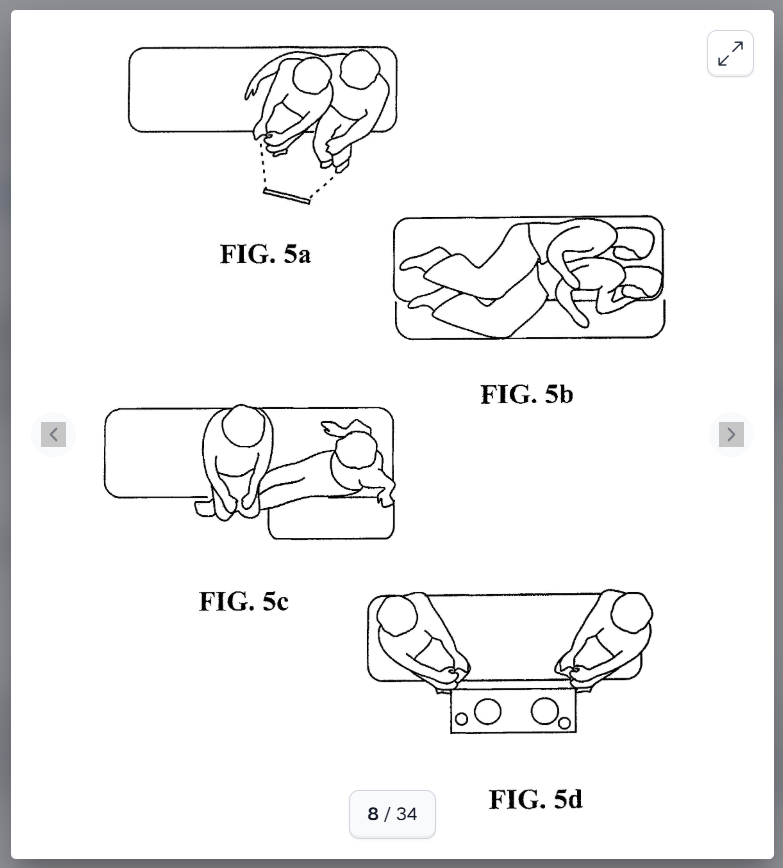
The patent family spans the globe, with filings and grants across the United States[33][34][36], Europe[35], Canada[50], Australia[48], Spain[41], France[40], Brazil[37], and other jurisdictions — a clear signal that Air New Zealand invested heavily in protecting this innovation worldwide.
Air New Zealand Has Licensed Before
Critically, Air New Zealand has not simply sat on this IP. The airline has actively licensed the Skycouch technology to other carriers. China Airlines adopted the concept for its 777-300ER fleet[23][126], and Brazilian carrier Azul licensed it for their "SkySofa" product[126]. The Skycouch represents a textbook case of patent protection leading to licensing of competitors[126].
This licensing history establishes two important facts. First, Air New Zealand treats this IP as a revenue-generating asset and actively monitors the market for potential licensees (or infringers). Second, there is a well-worn commercial path for airlines wanting to deploy this technology — they license it from Air New Zealand.
United's Silence on the IP Question
Here is where things get interesting. United's public communications about Relax Row make no mention of Air New Zealand, the Skycouch, or any licensing arrangement[1][138]. The airline's formal "Elevated" interior press release — a detailed document covering Polaris Studio suites, Premium Plus upgrades, economy screen sizes, and even red pepper flakes for onboard meals — contains zero references to economy lie-flat row technology or any third-party IP[138]. The Relax Row announcement appears to have been made separately through United's social media channels[1].
A thorough search of United Airlines' own patent portfolio reveals no filings covering the economy lie-flat row concept. United's seat-related patents focus on entirely different areas: business class herringbone seating with disabled access configurations[54][55], tray table indicators using magnetic ball mechanisms[72], and seat assignment automation systems[60]. Nothing in United's IP portfolio touches the fold-up leg rest mechanism or the convertible economy row concept.
So What's Going On?
There are several plausible explanations, and the truth likely lies in one of these scenarios.
Scenario 1: An undisclosed license. This is the most probable explanation. Licensing agreements between airlines are frequently confidential. Air New Zealand has demonstrated willingness to license the Skycouch, and United — as a sophisticated commercial entity — would almost certainly conduct freedom-to-operate analysis before committing to install this technology across 200+ widebody aircraft. A quiet licensing deal would explain both the functional similarity and the public silence.
Scenario 2: The seat manufacturer as intermediary. Airlines don't build their own seats — they purchase them from specialized manufacturers like Collins Aerospace (formerly B/E Aerospace), Safran Seats, Recaro, or others. The seat manufacturer supplying United's Relax Row hardware may hold a license or sub-license from Air New Zealand, meaning United is purchasing a licensed product rather than directly licensing the IP. This is common practice in the aircraft interiors supply chain.
Scenario 3: A design-around. While the end result looks identical to the Skycouch, the internal mechanism could differ. Air New Zealand's mechanism patent describes very specific cam-track, hydrolock, and synchronization systems[39]. A seat manufacturer could potentially engineer a leg rest that achieves the same functional result — raising to seat-pan height — using different internal mechanics. However, the broader seating arrangement patent covers the concept itself, not just the mechanism, making a pure design-around more difficult[36].
Notably, alternative approaches to economy lie-flat beds do exist. B/E Aerospace (now part of Collins Aerospace/RTX) holds recent patents describing economy seat rows convertible to beds using fundamentally different mechanisms — one where a lower portion of the backrest detaches and slides forward with the seat pan[92][95], and another where the backrest frame rotates forward to overlay the seat pan with a separate mattress placed on top[96]. These patents, filed from India in 2023 and granted in 2025, explicitly target the economy class cabin[92][96]. But from United's own images, the Relax Row appears to use fold-up leg rests — the Skycouch approach — rather than these backrest-based alternatives[1][2].
If There's No License, It Could Get Sticky

The fourth scenario — that United or its supplier is deploying this product without authorization — would create significant legal exposure. Air New Zealand's patent claims are broad, well-established, and have been maintained across multiple jurisdictions for over a decade[36][41][50]. The patent holder has demonstrated both willingness to license and awareness of the commercial value of this IP[126].
Consider the claim mapping. United describes three adjacent economy seats with adjustable leg rests that can each be raised or lowered to create a cozy lie-flat space[1]. Air New Zealand's patent claims cover a row of adjacent seats with leg rests moveable between stored and deployed conditions where the seat pan and leg rest become substantially coplanar, with adjacent leg rests becoming contiguous to form a reconfigurable horizontal support surface[36]. The visual evidence from United's announcement shows leg rests raised to seat level creating a continuous flat surface across the row[1][2] — a near-perfect overlay with the patent claims.
With the patent family not expiring until approximately 2029–2030, and United planning deployment across 200+ aircraft starting next year[1], the commercial stakes are enormous. An infringement finding could result in injunctive relief, royalty payments, or forced redesign — any of which would be extraordinarily costly and disruptive at the scale United is planning.
What to Watch For
The aviation IP community will be watching this space closely. Key indicators will include whether Air New Zealand makes any public statement acknowledging (or challenging) United's product, whether a licensing agreement surfaces in either company's financial disclosures, and whether the seat manufacturer behind Relax Row is identified — which could reveal whether the IP arrangement runs through the supply chain rather than directly between airlines.
For now, the most important takeaway is this: the concept behind United's splashy Relax Row announcement was invented, patented, and commercialized by Air New Zealand more than a decade ago. Whether United is paying for the privilege of using it, or betting that its implementation differs enough to avoid the patent claims, remains one of the more consequential unanswered questions in commercial aviation IP today.
This article was powered by Cypris Q, an AI agent that helps R&D teams instantly synthesize insights from patents, scientific literature, and market intelligence from around the globe. Discover how leading R&D teams use Cypris Q to monitor technology landscapes and identify opportunities faster - Book a demo
The information provided is for general informational purposes only and should not be construed as legal or professional advice.
Citations
[1] United Airlines Relax Row announcement (social media, March 2026)
[2] United Airlines Relax Row product images (March 2026)
[13] Air New Zealand. "Economy Skycouch – Long Haul."
[23] Executive Traveller. "Review: Air New Zealand's Skycouch seat (soon for China Airlines)."
[33] Air New Zealand Limited. Seating Arrangement, Seat Unit, Tray Table and Seating System. Patent No. US-20160031561-A1. Issued Feb 3, 2016.
[34] Air New Zealand Limited. Seating Arrangement, Seat Unit, Tray Table and Seating System. Patent No. US-20150203207-A1. Issued Jul 22, 2015.
[35] Air New Zealand Limited. Seating Arrangement, Seat Unit, Tray Table and Seating System. Patent No. EP-2391541-A1. Issued Dec 6, 2011.
[36] Air New Zealand Limited; Bamford, V.A.; France, J.D.; Porter, G.W.; Suvalko, G.G. Seating arrangement, seat unit, tray table and seating system. Patent No. US-9132918-B2. Issued Sep 14, 2015.
[37] Air New Zealand Limited. Seating arrangement, seat unit and passenger vehicle and method of setting up a passenger seat area. Patent No. BR-PI1008065-B1. Issued Jul 27, 2020.
[39] Air New Zealand Limited. A Seat and Related Leg Rest and Mechanism and Method Therefor. Patent No. EP-2509868-A1. Issued Oct 16, 2012.
[40] Air New Zealand Limited. Seating Arrangement, Seat Unit and Seating System. Patent No. FR-2941656-A3. Issued Aug 5, 2010.
[41] Air New Zealand Limited. Seating arrangement, seat unit, tray table and seating system. Patent No. ES-2742696-T3. Issued Feb 16, 2020.
[48] Air New Zealand Limited. Seating arrangement, seat unit, tray table and seating system. Patent No. AU-2010209371-B2. Issued Jan 13, 2016.
[50] Air New Zealand Limited. Seating Arrangement, Seat Unit, Tray Table and Seating System. Patent No. CA-2750767-C. Issued Apr 9, 2018.
[54] United Airlines, Inc. Passenger seating arrangement having access for disabled passengers. Patent No. US-11655037-B2. Issued May 22, 2023.
[55] United Airlines, Inc. Passenger seating arrangement having access for disabled passengers. Patent No. US-12291336-B2. Issued May 5, 2025.
[60] United Airlines, Inc. Method and system for automating passenger seat assignment procedures. Patent No. US-10185920-B2. Issued Jan 21, 2019.
[72] United Airlines, Inc. Tray table indicator. Patent No. US-12525316-B2. Issued Jan 12, 2026.
[92] B/E Aerospace, Inc. Row of passenger seats convertible to a bed. Patent No. US-12351317-B2. Issued Jul 7, 2025.
[95] B/E Aerospace, Inc. Row of Passenger Seats Convertible to a Bed. Patent No. US-20250051014-A1. Issued Feb 12, 2025.
[96] B/E Aerospace, Inc. Converting economy seat to full flat bed by dropping seat back frame. Patent No. US-12459650-B2. Issued Nov 3, 2025.
[126] Above the Law. "Coach Comfort: Myth Or The Future."
[138] United Airlines. "United Unveils the Elevated Aircraft Interior."