
A faster, more accurate way to explore innovation data—now available in Cypris.
For innovation teams, speed and accuracy aren’t optional—they’re critical. You need to quickly find all relevant documents, slice and dice datasets however you want, and trust that the results are complete and representative. With this in mind, we’ve upgraded how semantic search works inside Cypris.
Today, we’re launching an upgraded search infrastructure that gives users access to full, exact result sets—unlocking more powerful analysis, faster iteration, and deterministic filtering and charting.
Unlike traditional semantic or vector search engines—which make it difficult to count, filter, or chart large sets of matched documents—our new approach prioritizes transparency and performance while preserving semantic relevance.
Why we moved away from vector search
Our original implementation relied on semantic and vector search to capture the “meaning” behind user queries. But as our platform evolved, it became clear that these systems weren’t well-suited for our core use cases.
Users needed:
- Deterministic filtering (e.g., "how many results match this atom?")
- Transparent, complete result sets to power charts and dashboards
- Fast, repeatable queries that don’t change subtly over time
Modern vector search systems don’t easily support this level of transparency. They return approximate matches and abstract similarity scores, often making it hard to understand why a document was returned—or whether it’s the full picture.
So we made a decision: move away from vector search and lean into what traditional search engines do best.
A return to boolean and lexical search—with a twist
We rebuilt our search infrastructure on top of Elasticsearch’s powerful boolean and lexical search capabilities. This shift brings major advantages:
- Faster query speeds that dramatically improve iteration time
- Deterministic filtering and counts, so every chart is grounded in the full dataset
- Predictable, explainable results that users can trust
But we didn’t stop there.
To preserve the benefits of semantic understanding, we’ve rethought where that intelligence should live—not at query time, but at data ingestion.
Capturing semantic meaning at ingest time
Instead of computing document-query similarity during search, we enrich documents at the time of ingestion. Here’s how:
- Synonym expansion: We find related words and concepts not explicitly mentioned in the document and add them as fields, enabling semantic-style recall via lexical search.
- Stemming: Both queries and documents are reduced to their root forms, allowing consistent matches (e.g., “running” and “run”).
The result? You get the same functionality—semantically relevant results—without the opacity or latency tradeoffs of vector search.
What’s next: Reranking for even better relevance
We’re not done. Coming soon to Cypris is a reranking layer that boosts the most relevant results to the top of the list using lightweight vector techniques.
Here’s how it works:
- A standard lexical search retrieves the full result set.
- We take the top N results and rerank them using vector similarity, powered by Elasticsearch’s new hybrid scoring capabilities.
- You get faster queries with even better relevance—without compromising on counts or transparency.
This layered approach gives us the best of both worlds: precise filtering and fast queries, plus smarter ordering of results where it matters most.
We’re excited to bring this upgrade to our users, and we’re already seeing teams iterate faster and uncover insights more confidently. This is a foundational shift—and just the beginning of what’s to come.
Want a walkthrough of what’s changed? Reach out to our team.

Introducing our upgraded semantic search



A faster, more accurate way to explore innovation data—now available in Cypris.
For innovation teams, speed and accuracy aren’t optional—they’re critical. You need to quickly find all relevant documents, slice and dice datasets however you want, and trust that the results are complete and representative. With this in mind, we’ve upgraded how semantic search works inside Cypris.
Today, we’re launching an upgraded search infrastructure that gives users access to full, exact result sets—unlocking more powerful analysis, faster iteration, and deterministic filtering and charting.
Unlike traditional semantic or vector search engines—which make it difficult to count, filter, or chart large sets of matched documents—our new approach prioritizes transparency and performance while preserving semantic relevance.
Why we moved away from vector search
Our original implementation relied on semantic and vector search to capture the “meaning” behind user queries. But as our platform evolved, it became clear that these systems weren’t well-suited for our core use cases.
Users needed:
- Deterministic filtering (e.g., "how many results match this atom?")
- Transparent, complete result sets to power charts and dashboards
- Fast, repeatable queries that don’t change subtly over time
Modern vector search systems don’t easily support this level of transparency. They return approximate matches and abstract similarity scores, often making it hard to understand why a document was returned—or whether it’s the full picture.
So we made a decision: move away from vector search and lean into what traditional search engines do best.
A return to boolean and lexical search—with a twist
We rebuilt our search infrastructure on top of Elasticsearch’s powerful boolean and lexical search capabilities. This shift brings major advantages:
- Faster query speeds that dramatically improve iteration time
- Deterministic filtering and counts, so every chart is grounded in the full dataset
- Predictable, explainable results that users can trust
But we didn’t stop there.
To preserve the benefits of semantic understanding, we’ve rethought where that intelligence should live—not at query time, but at data ingestion.
Capturing semantic meaning at ingest time
Instead of computing document-query similarity during search, we enrich documents at the time of ingestion. Here’s how:
- Synonym expansion: We find related words and concepts not explicitly mentioned in the document and add them as fields, enabling semantic-style recall via lexical search.
- Stemming: Both queries and documents are reduced to their root forms, allowing consistent matches (e.g., “running” and “run”).
The result? You get the same functionality—semantically relevant results—without the opacity or latency tradeoffs of vector search.
What’s next: Reranking for even better relevance
We’re not done. Coming soon to Cypris is a reranking layer that boosts the most relevant results to the top of the list using lightweight vector techniques.
Here’s how it works:
- A standard lexical search retrieves the full result set.
- We take the top N results and rerank them using vector similarity, powered by Elasticsearch’s new hybrid scoring capabilities.
- You get faster queries with even better relevance—without compromising on counts or transparency.
This layered approach gives us the best of both worlds: precise filtering and fast queries, plus smarter ordering of results where it matters most.
We’re excited to bring this upgrade to our users, and we’re already seeing teams iterate faster and uncover insights more confidently. This is a foundational shift—and just the beginning of what’s to come.
Want a walkthrough of what’s changed? Reach out to our team.
Keep Reading

In recent years, a digital transformation of intimacy has taken place—the Internet has become the new matchmaker. Today, it's not uncommon for people to use dating apps and meet their significant other online. In fact, over 323 million people worldwide currently use dating apps.
With more and more people turning to online dating, technologies are being created for things like measuring emotional compatibility, facilitating blind dating, danger prevention, and more. In this blog, we'll look at innovation activity in the online dating market, as well as a few of the new technologies changing how we navigate relationships.
Market Overview:
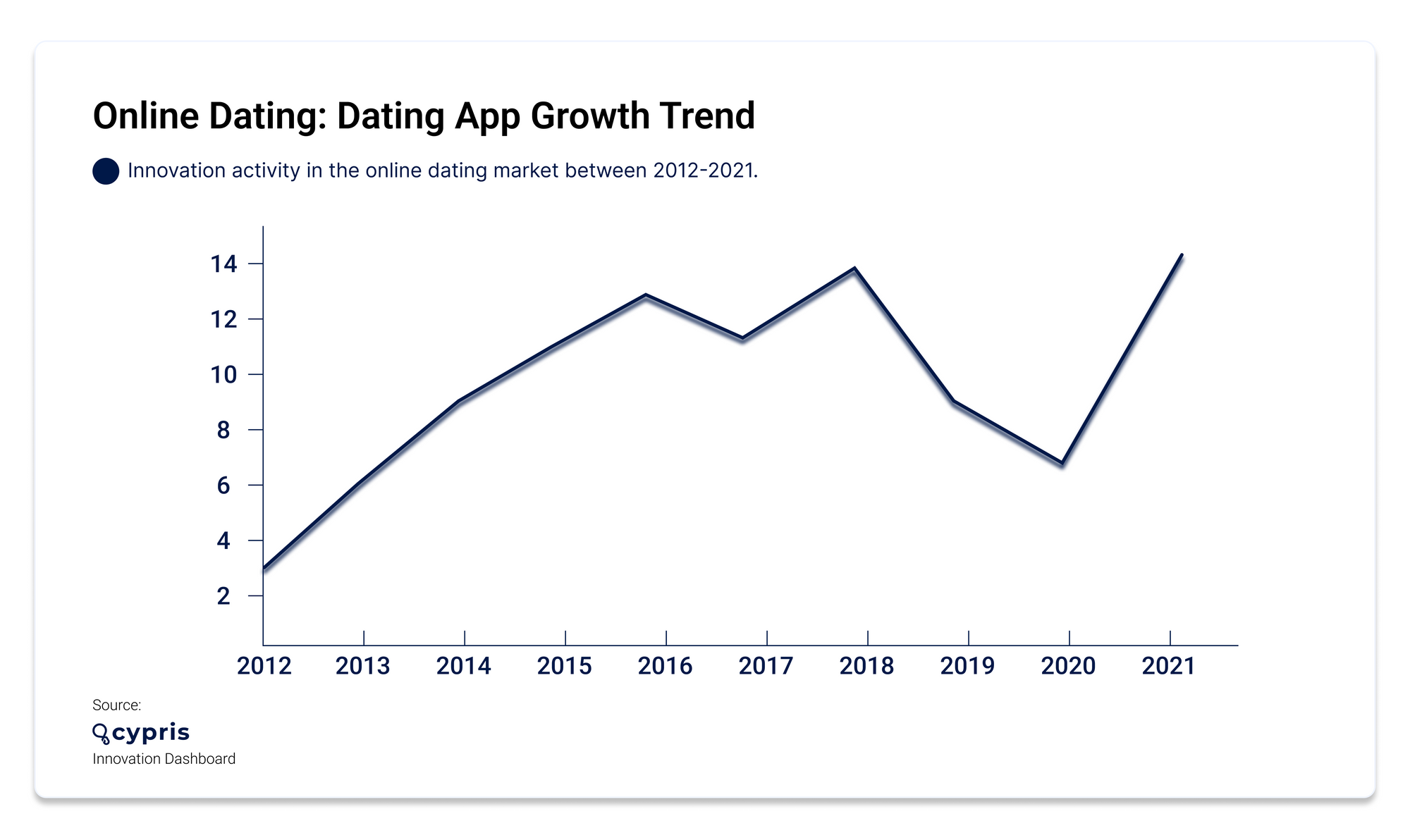
Using the Cypris Innovation Dashboard, we identified innovation activity in the online dating market has grown over the last 5 years, with a 20.91% average growth rate. The top players in the market are Match Group, LLC, Match.com Europe, and e2interactive, Inc., which collectively own 16.9% of IP in the market.
The fastest growing category is Computing Software which saw an 27.92 % increase in new patents filed over the last 5 years, as well as a lot of filings by new entrants.
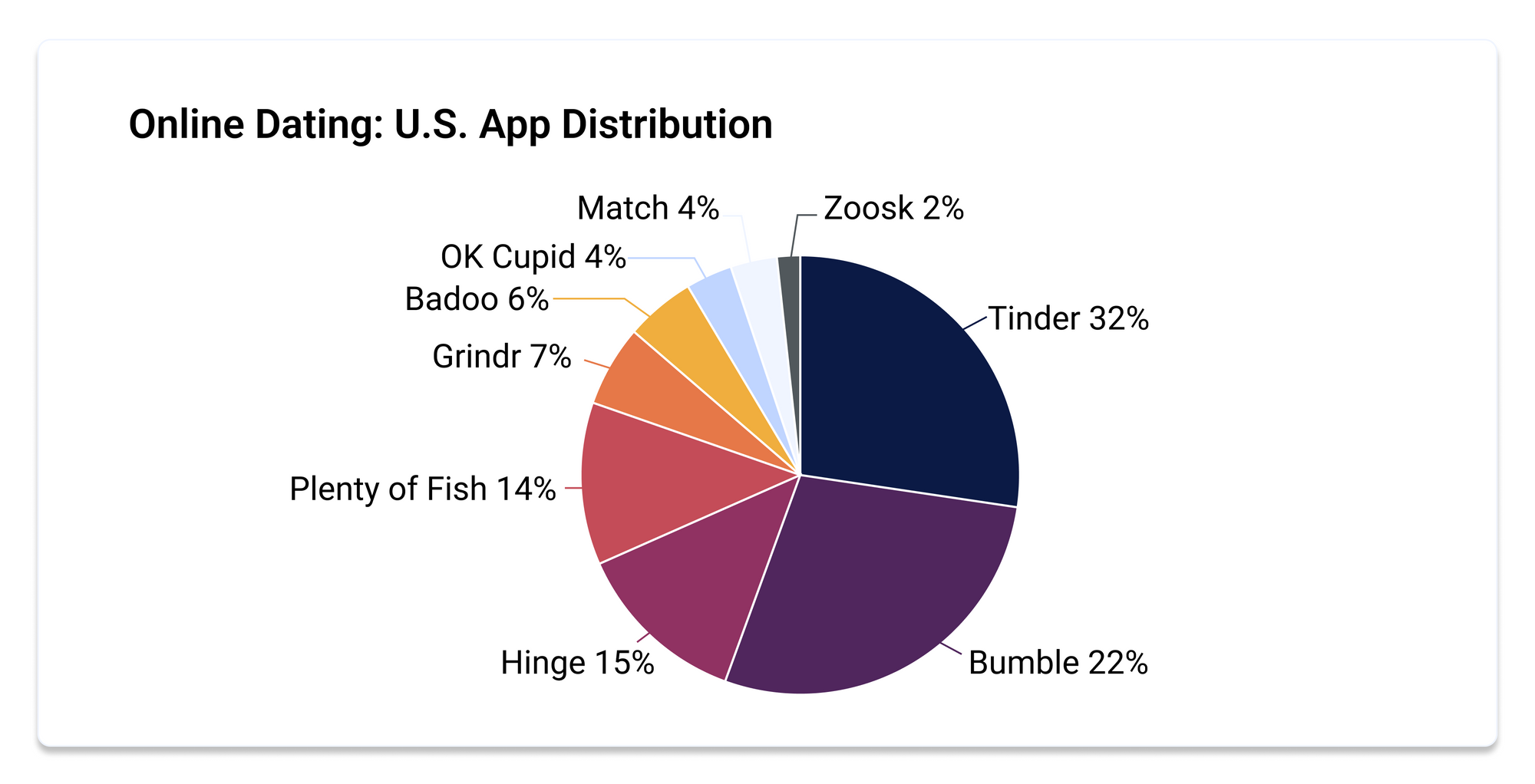
As of January 2022, Tinder dominated 32% of the U.S. market, followed by Bumble (22%), Hinge (15%), Plenty of Fish (15%), Grindr (7%), Badoo (6%), OKCupid (4%), Match.com (4%) and Zoosk (2%). In 2021, the dating app market made $5.61 billion revenue, with almost $3 billion made by Match Group.
Innovation in Online Dating
Let's dive into some of the fascinating patented technologies in the online dating space:
Method and Apparatus for Monitoring Emotional Compatibility in Online Dating: This patent covers methods, devices, and systems for capturing and sharing objective emotion data in dating interactions for the selection of suitable partners, or to enhance social dynamics in online interactions. An emotion monitoring device (EMD) measures physiological signals, obtained from biosensors, captured from a couple during a face-to-face or online dating interaction, and computes emotion data. The emotion data for each person is transmitted to an internet server, and each person shares their emotion data with the other during the interaction. The emotion data is then displayed to each person on a virtual or augmented reality device.
Inventor: Roger J. Quy; Patent Number: 20210267514

An Activity-Centric System and Method for Relationship Matching: This technology is for an online dating and relationship system that relies on common interests in, and arranging for specific face-to-face in-person activities. Potential activities are ranked by an activity ranking engine drawing on activity-related attributes of the users and of the activities. Mutual selection of an in-person activity enables the users to vet potential matches and to proceed to engage in the activity together. The ranking and match engines may take into account intrinsic user and activity attributes as well as activity- related attributes derived from the behavior of the users in relation to the activities.
Inventors: Perry Stevan, Stann Dominic, Petry James; Patent Number: WO2017054081A1
Online Dating Danger Prevention System: This patent covers an online dating danger prevention system. The online dating danger prevention system includes a database that holds information, including geo-location data and photographs, to make online dating safer. Users enter a set of contacts that the system can reach in the event of an emergency.
Inventors: Simard Marcellin; Patent Number: WO2015191090A1
Friend Matching Application: This patent includes a system and method for third-party matchmaking in an online or electronic dating app or system. A friend may review user profiles to select potential matches for another friend. Generating a match may require approval from one or more trusted users, or confirmation through a voting or similar mechanism. A user's matchmaking prowess may be ranked or scored based on success and accuracy. Matches may be anonymous or non-anonymous. A user desiring to be matched may seek out and request that a particular search user identify matches.

Inventor: Christopher Jordan Hurley; Patent Number: 20180130139
Dating Service with Restaurant Selection, Reservations, and Video Promotion Included: This patent covers a systematic method for securely setting up a date in online dating applications. The first step allows a requesting member to request a date with a requested member. Next, the requesting member can enter a meeting date, place, and time. The requested member will then be prompted to either accept or decline the date request from the requesting member. The method also provides a dating history database which records a members' dating history. In addition, a method of ensuring a member's safety by allowing members to choose to have someone contacted if the member does not update the dating history database after a date is disclosed.
Inventors: Stephone Belton; Patent Number: 20210287304
Systems and Methods for Initiating Conversations within an Online Dating Service: This technology is for a computer-implemented method for initiating conversations within an online dating service. It covers identifying a potential match for a user of an online dating service, automatically generating, in response to identifying the potential match, a customized interactive ice breaker widget that is customized to facilitate conversation between the user and the potential match, presenting the customized interactive ice breaker widget to the user, obtaining the user's response to the customized interactive ice breaker widget, and presenting, to the potential match, both the customized interactive ice breaker widget and the user's response to the customized interactive ice breaker widget to facilitate conversation between the user and the potential match.
Inventors: Qiang Wang, Nathan Andrew Sharp; Patent Number: 20200364806

Online Dating Service System: This patent covers an online blind date arranging service system and method that provides information on the opposite sex that can be connected by an acquaintance to a blind date applicant so that the other party can be verified through the acquaintance, and matchmaking can be arranged by an acquaintance.
Inventor: Kwon Nam Yeol; Patent Number: KR101759285B1
Whether through measuring emotional compatibility and setting up blind dates, or through danger prevention and matching based on mutual activity interests, technologies are transforming how we date. To learn more about patents and new innovations in the online dating space, visit cypris.ai and get started with access to the innovation dashboard.
If you’d like to explore recent patents filed, you can search through our global patent search engine for free here: https://cypris.ai/patents/allrecords
Sources:

In 2001, the tiny home trend emerged in the United States as an affordable and sustainable living alternative to traditional housing. Defined as less than 400 square feet, tiny homes are primarily full-time dwellings that can be permanent or mobile, on wheels or a skid [8]. The appeal? They require fewer resources, save on costs, and offer increased flexibility and mobility to tenants.
In this blog, we explore how the tiny home became popularized in the United States, how they’re changing the way we live, and the potential challenges living in a tiny home poses using research from the Cypris Innovation Dashboard.
The tiny home trend—how did it get here?
The current tiny housing trend as we see it in North America began when Jay Shafer founded the Tumbleweed Tiny House Company, the first company aimed specifically at producing designs for tiny houses in 2001. A tiny house enthusiast, Jay Shafer decided to start the company after helping others with design plans and implementation of tiny houses [7]. A year later, he founded the Small House Society alongside Greg Johnson, Shay Solomon, and Nigel Valdez [7]. Now, Tumbleweed is one of several companies building tiny homes made to order and deliver in the United States.
Over the years, the popularization of tiny homes has steadily increased. According to the Cypris Innovation Dashboard, innovation activity in the tiny home market has been, as a whole, growing over the last 5 years, with a 29.17% average growth rate. Today, the demand for alternative housing options like tiny homes is expected to increase, as housing prices climb.

How tiny homes are changing how we live.
The idea of intentionally downsizing ones living quarters begs the question: how much does a person need to live comfortably? Those who have chosen the tiny home lifestyle are working to change how they view what is “necessary” to live life. Of the many drivers that push people toward the tiny home life are a desire for cost-efficiency, a reduced impact on the environment, and a more mobile way of living which we explore more in-depth below.
Reduced Cost:
Tiny homes offer a unique solution to the lack of housing affordability. As the cost of conventional housing in the United States increases, the demand for tiny homes is expected to increase as well. Tiny homes in general are much cheaper to build and maintain. While many people can barely afford a down payment on a larger home, many tiny homes cost between $20,000 and $50,000 [10]. The general cost of living is also lower. One study found that a tiny homeowner is able to live on only $15,000 a year including luxuries such as a car, eating out, and comprehensive insurance [6]. As a result, people are left with more money to spend on things aside from housing costs.
Sustainable Living:
As the global population and urbanization continue to increase, so do consumption and our impact on the environment. Tiny homes are often viewed as a solution to unsustainable development, a building option that reduces the impact on the environment. While efforts have been taken in recent decades to improve energy efficiency in housing, the residential sector still contributes a significant proportion of global greenhouse gas (GHG) emissions [2]. Buildings account for over 1/3 of global energy use and nearly 40% of GHG emissions [2]. Studies indicate that there is a direct correlation between house size and operational energy use [1,4]. In the United States, the average size of a single-family home has doubled since 1950, leading to a profound environmental impact [11]. With their smaller size, tiny homes offer an ideal solution to reducing energy use and environmental impact. One particular tiny home study found that on a per capita basis, tiny homes lead to at least a 70% reduction in life cycle GHG emissions compared to a traditional house [2].
Freedom and Mobility:
Since the onset of COVID-19, remote work has become increasingly popular. Statistics on remote workers reveal that more than 4.7 million people work remotely at least half the time in the United States, while 16% of companies globally are fully-remote [12]. Remote workers are typically less stressed, and maintain a better work-life balance. Fewer people commuting to offices also means fewer cars on the road, which contributes to reducing greenhouse gas emissions. As more and more people gain the ability to work from anywhere, they can also decide the live anywhere. Tiny homes facilitate easy movement— instead of packing up things and finding someone to care for your home, you can just hitch your home to a trailer and go [7].
The challenges of tiny homes.
Many tiny homeowners face legality issues, primarily due to zoning restricting mobile homes. Municipalities also often have minimum size limits for habitability [7] typically between, 850 and 1,800 square feet (roughly 79 to 167 square meters) which can pose a challenge.
“Zoning regulations, restrictive covenants (i.e. provisions in the deed for the property that restrict the way the property may be used by the owners) and design standards for specific subdivisions, and even mortgage banking requirements can significantly limit options for creating small, space-efficient, single-family houses” [11].
As a result, many choose to build tiny homes on trailers, subjecting them to different restrictions than stationary homes [11]. However, this practice can be challenging since in some areas they are considered part-time residences.
Despite their issues, tiny homes provide a unique way of living that can save on costs, reduce environmental impact, and improve mobility. As housing costs and the focus on sustainable living continue to increase, innovation and adoption in the tiny home space will continue to grow.
For more insights on the tiny home space or another research area, please visit cypris.ai to get started using the Innovation Dashboard and gain access to 500M+ global data points.
Sources:
- Clune S, Morrissey J and Moore T (2012) Size matters: House size and thermal efficiency as policy strategies to reduce net emissions of new developments Energy Policy 48 657–667
- Crawford, R H, and A Stephan. "Tiny House, Tiny Footprint? The Potential For Tiny Houses To Reduce Residential Greenhouse Gas Emissions". IOP Conference Series: Earth And Environmental Science, vol 588, no. 2, 2020, p. 022073. IOP Publishing
- Foreman, P.; Lee, A.W. (2005). A tiny home to call your own: Living well in just write houses. Buena Vista, VA: Good Earth Publications.
- Guerra Santin O, Itard L and Visscher H (2009) The effect of occupancy and building characteristics on energy use for space and water heating in Dutch residential stock Energy and Buildings 41(11) 1223-1232
- Krista Evans (2020) Tackling Homelessness with Tiny Houses: An Inventory of Tiny House Villages in the United States, The Professional Geographer, 72:3, 360-370, DOI: [10.1080/00330124.2020.1744170]
- Mitchell, R. (2013, April 3). How Little Can You Live On?
- Mutter, Amelia (2013) Growing Tiny Houses Motivations and Opportunities for Expansion Through Niche Markets. iiiee.
- Shearer H and Burton P 2019 Towards a typology of tiny houses Housing, Theory and Society 36(3) 298-318
- Wagner, Ron '93 (2018) "Tiny Houses, Big Dreams,"Furman Magazine: Vol. 61: Iss. 1 , Article 20.
- Wax, E. (2012, November 28). Home, squeezed home: Living in a 200-square-foot space, The Washington Post.
- Wilson, A., & Boehland, J. (2005). Small is beautiful - US house size, resource use, and the environment. Journal of Industrial Ecology, 9(1-2), 277-287.
- [https://www.apollotechnical.com/statistics-on-remote-workers/#:~:text=Statistics on remote workers reveal,to an Owl labs study]
- Cypris Innovation Dashboard; Query: Tiny + Houses; https://cypris.ai

Carbon dioxide (Co2) is one of the atmospheric "greenhouse gases" that absorbs and radiates heat gradually over time and contributes to the natural warming of the Earth known as the greenhouse effect. Notably, increases in atmospheric CO2 are responsible for about 2/3 of the total energy imbalance that is causing Earth's temperature to rise.
The built environment generates nearly 50% of annual global CO2 emissions. Of those total emissions, building operations are responsible for 27% annually, while building materials and construction are responsible for an additional 20% annually.
As a result, measures are being taken to create structures and building materials that are carbon-neutral, and even carbon negative, to reduce the amount of CO2 in the atmosphere. One such project was announced this week by the U.S. Department of Energy.
About the project
The U.S. Department of Energy (DOE) announced Monday that it is awarding $39 million in grants, primarily to universities, for 18 projects seeking to develop technologies that can transform buildings into net carbon storage structures.
The awards are part of DOE’s Harnessing Emissions into Structures Taking Inputs from the Atmosphere (HESTIA) program, and will prioritize overcoming barriers associated with carbon-storing buildings, including scarce, expensive, and geographically limited building materials. The overarching goal is to increase the amount of carbon that can be stored in buildings so they become “carbon sinks”— materials or processes that absorb more carbon from the atmosphere than they release. The decarbonization goals for this program fall in line with President Jo Biden’s call for the federal government to reach net-zero emissions by 2050.
Why it's significant
Of the greenhouse gases, carbon dioxide is known to absorb less heat per molecule than the greenhouse gases methane or nitrous oxide, be more abundant, and stay in the atmosphere much longer. When it comes to how CO2 factors into buildings, the DOE reports that greenhouse gas emissions associated with material manufacturing and construction, renovation and disposal of buildings at the end of their service life are concentrated at the start of a building's lifetime. As a result, it's important to address greenhouse gas emissions when it comes to materials, design, and building techniques.
According to U.S. Secretary of Energy Jennifer M. Granholm, “There’s huge, untapped potential in reimagining building materials and construction techniques as carbon sinks that support a cleaner atmosphere and advance President Biden’s national climate goals. This is a unique opportunity for researchers to advance clean energy materials to tackle one of the hardest to decarbonize sectors that is responsible for roughly 10% of total annual emissions in the United States.”
Who’s working on the project
The teams are comprised of universities, private companies, and national laboratories, and will develop and demonstrate building materials and net carbon negative whole-building designs. HESTIA project titles, locations, and award amounts are listed below. For more detailed information on each project, visit HESTIA project descriptions.
- National Renewable Energy Laboratory – Golden, CO; High-Performing Carbon-Negative Concrete Using Low Value Byproducts from Biofuels Production - $1,749,935
- Texas A&M University – College Station, TX; Hempcrete 3D Printed Buildings for Sustainability and Resilience - $3,742,496
- University of Colorado Boulder – Boulder, CO; A Photosynthetic Route to Carbon-Negative Portland Limestone Cement Production - $3,193,063
- University at Buffalo – Buffalo, NY; Modular Design and Additive Manufacturing of Interlocking Superinsulation Panel from Bio-based Feedstock for Autonomous Construction - $2,179,852
- University of Pennsylvania – Philadelphia, PA; High-Performance Building Structure with 3D-Printed Carbon Absorbing Funicular Systems – $2,407,390
- National Renewable Energy Laboratory – Fairbanks, AK; Celium: Cellulose-Mycelium Composites for Carbon Negative Buildings/Construction - $2,476,145
- Pacific Northwest National Laboratory – Richland, WA; The Circular Home: Development and Demonstration of a Net-Negative-Carbon, Reusable Residence - $2,627,466
- Oregon State University – Corvallis, OR; Cellulose Cement Composite (C3) for Residential and Commercial Construction - $2,500,000
- Oak Ridge National Laboratory – Oak Ridge, TN; Renewable, Carbon-negative Adhesives for OSB and Other Engineered Woods - $1,098,000
- University of Wisconsin-Madison – Madison, WI; Carbon-Negative Ready-Mix Concrete Building Components Through Direct Air Capture - $2,256,250
- Northeastern University – Boston, MA; 4C2B: Century-scale Carbon-sequestration in Cross-laminated Timber Composite Bolted-steel Buildings - $3,150,000
- Purdue University – West Lafayette, IN; Strong and CO2 Consuming Living Wood for Buildings - $958,245
- University of Tennessee-Knoxville – Knoxville, TN; Lignin-derived Carbon Storing Foams for High Performance Insulation - $2,557,383
- Clemson University – Clemson, SC; An Entirely Wood Floor System Designed for Carbon Negativity, Future Adaptability, and End of Life De/re/Construction - $1,042,934
- Aspen Products Group – Marlborough, MA; High Performance, Carbon Negative Building Insulation - $1,152,476
- BamCore – Ocala, FL; Maximizing Carbon Negativity in Next Generation Bamboo Framing Materials - $2,230,060
- SkyNano – Knoxville, TN; CO2mposite: Recycling of CO2, Carbon Fiber Waste, and Biomaterials into Composite Panels for Lower Embodied Carbon Building Materials - $2,000,000
- Biomason – Durham, NC; Soteria - Carbon Negative Bioconcrete Unit Production Concept - $1,812,118
Given the funding the DOE is devoting to decarbonization technologies, it's safe to say that research and investment into the area is on the rise. According to our data, there are 1584 players in the market operating across 3723 technologies. To learn more about innovation activity in the decarbonization space, visit cypris.ai and get started with access to the innovation dashboard.
Sources: