A smarter, more engaging monitoring experience—built for speed, accuracy, and collaboration.
Over the past few years, Cypris has helped innovation teams make faster, more informed decisions by centralizing critical insights across patents, academic papers, organizations, and market activity. But until now, tracking changes over time often meant juggling spreadsheets, scattered alerts, and manual checks—workflows that were hard to manage and easy to miss.
Today, we’re excited to introduce an upgraded Monitoring experience on Cypris, a complete redesign of how teams track critical updates. With streamlined setup, redesigned emails, and advanced LLMs powering analysis, Monitoring makes it easy to stay ahead of market shifts and competitor moves—without the noise.
Why We Rebuilt Monitoring from the Ground Up
The original monitoring tools relied heavily on exports and static spreadsheets, requiring users to piece together updates manually. Alerts were basic, often duplicative, and limited in the types of data they could track. They also didn’t always give teams confidence that updates were reliable, accurate, or relevant to their needs.
We reimagined Monitoring to solve these gaps. Instead of scattered, one-off alerts, the new Monitoring delivers timely, structured reports—only when new results exist. Updates are now enriched with LLM-powered summaries that don’t just describe activity, but interpret it—prioritizing what matters most and filtering out the noise.
What’s New in Monitoring
The Monitoring Report
Spreadsheets are no longer needed. Updates now appear in a clear format that highlights key changes such as patent expansions, assignee transfers, or competitor filings. Each report includes AI-generated summaries powered by advanced LLMs to surface the most important trends and context. Reports are refreshed regularly, saved automatically, and build a continuous historical log for long-term tracking.
For many teams, these AI-enhanced reports are the most impactful shift. Instead of raw updates, Monitoring now provides analysis—turning activity like organizational filings or new research papers into intelligence that can guide investment and innovation decisions.
Beyond the reports themselves, having all updates housed directly within Cypris elevates the platform experience as a whole. The new interface is more intuitive, reducing friction for everyday use, and its design makes it easier for teams to collaborate in real time.
Monitoring is also fully integrated with Projects, so you can create and share monitors directly within your team’s workspace. This makes it simple to align ongoing research, track critical events together, and keep collaborators up to speed—all without switching tools. By connecting monitoring with projects, Cypris transforms isolated updates into shared intelligence that enhances both decision-making and collaboration across your organization.

Newsletter-Style Email Experience
Monitoring emails now feel more like a personalized newsletter. Each update arrives in a clean, structured layout with an easy-to-read AI-generated summary of recent activity, spotlighted trends, and direct links to dive deeper in the platform. Content is grouped into clear sections and filterable by category, so you can quickly scan what’s new, focus on the most relevant updates, and stay effortlessly informed—without inbox clutter.

Simplified Setup & Discoverability
Setting up monitors is now faster and more intuitive. Users can create them in a single streamlined interface—quickly searching patent numbers, keywords, organizations, or papers and selecting the right mix in one place. Smart suggestions recommend recipients, while the Monitoring button appears directly on every search results page. Current monitors are clearly indicated to prevent duplication, and external recipients can be added to email updates for seamless collaboration.

Noise-Free Updates & Critical Alerts
A “send only if new results exist” toggle eliminates duplicate notifications. Monitoring now captures not only newly published patents, papers, and organizations, but also critical patent events such as expiration risks, assignee transfers, patent family expansions, and forward citations—including competitor citations of your own research.

A More Powerful User Experience
Monitoring is built to help users move from raw data to actionable intelligence. Reports save automatically, creating a historical log teams can reference at any time. Items can be flagged directly into collections without manual re-entry. Emails preview AI-enhanced trends with a single click into interactive dashboards, and users can easily add colleagues or external recipients to stay aligned.
From a design perspective, the rebuild also gave our team room to innovate.
As one of our engineering team members, Maddie explained: “It was fun to build something new from scratch. From a UI perspective, we were able to make better design choices right from the start, which made for a much smoother, more intuitive user experience.”
Built for Speed, Accuracy, and Collaboration
With the new Monitoring, teams can save time compared to manual tracking, strengthen competitive intelligence with reliable, cross-dataset updates, collaborate seamlessly by sharing reports with colleagues or external partners, and trust the signal thanks to accuracy, relevancy filters, and AI-powered summaries.
As part of our engineering team, Oleg explained: “This project sat on top of our existing platform, which meant understanding the entire workflow end to end. It was challenging, but it also gave us the opportunity to rethink how everything fits together—and that’s what made it so rewarding.”
Available Now to All Users
The redesigned Monitoring is live and available across the Cypris platform today. If you’re already using Cypris, you’ll see new Monitoring options throughout your search and reporting workflows.
We’re excited to see how your team uses Monitoring to stay ahead of markets, competitors, and technologies — and to keep pushing the boundaries of what intelligent monitoring can do for R&D.


Introducing the New AI-Powered Cypris Monitoring

A smarter, more engaging monitoring experience—built for speed, accuracy, and collaboration.
Over the past few years, Cypris has helped innovation teams make faster, more informed decisions by centralizing critical insights across patents, academic papers, organizations, and market activity. But until now, tracking changes over time often meant juggling spreadsheets, scattered alerts, and manual checks—workflows that were hard to manage and easy to miss.
Today, we’re excited to introduce an upgraded Monitoring experience on Cypris, a complete redesign of how teams track critical updates. With streamlined setup, redesigned emails, and advanced LLMs powering analysis, Monitoring makes it easy to stay ahead of market shifts and competitor moves—without the noise.
Why We Rebuilt Monitoring from the Ground Up
The original monitoring tools relied heavily on exports and static spreadsheets, requiring users to piece together updates manually. Alerts were basic, often duplicative, and limited in the types of data they could track. They also didn’t always give teams confidence that updates were reliable, accurate, or relevant to their needs.
We reimagined Monitoring to solve these gaps. Instead of scattered, one-off alerts, the new Monitoring delivers timely, structured reports—only when new results exist. Updates are now enriched with LLM-powered summaries that don’t just describe activity, but interpret it—prioritizing what matters most and filtering out the noise.
What’s New in Monitoring
The Monitoring Report
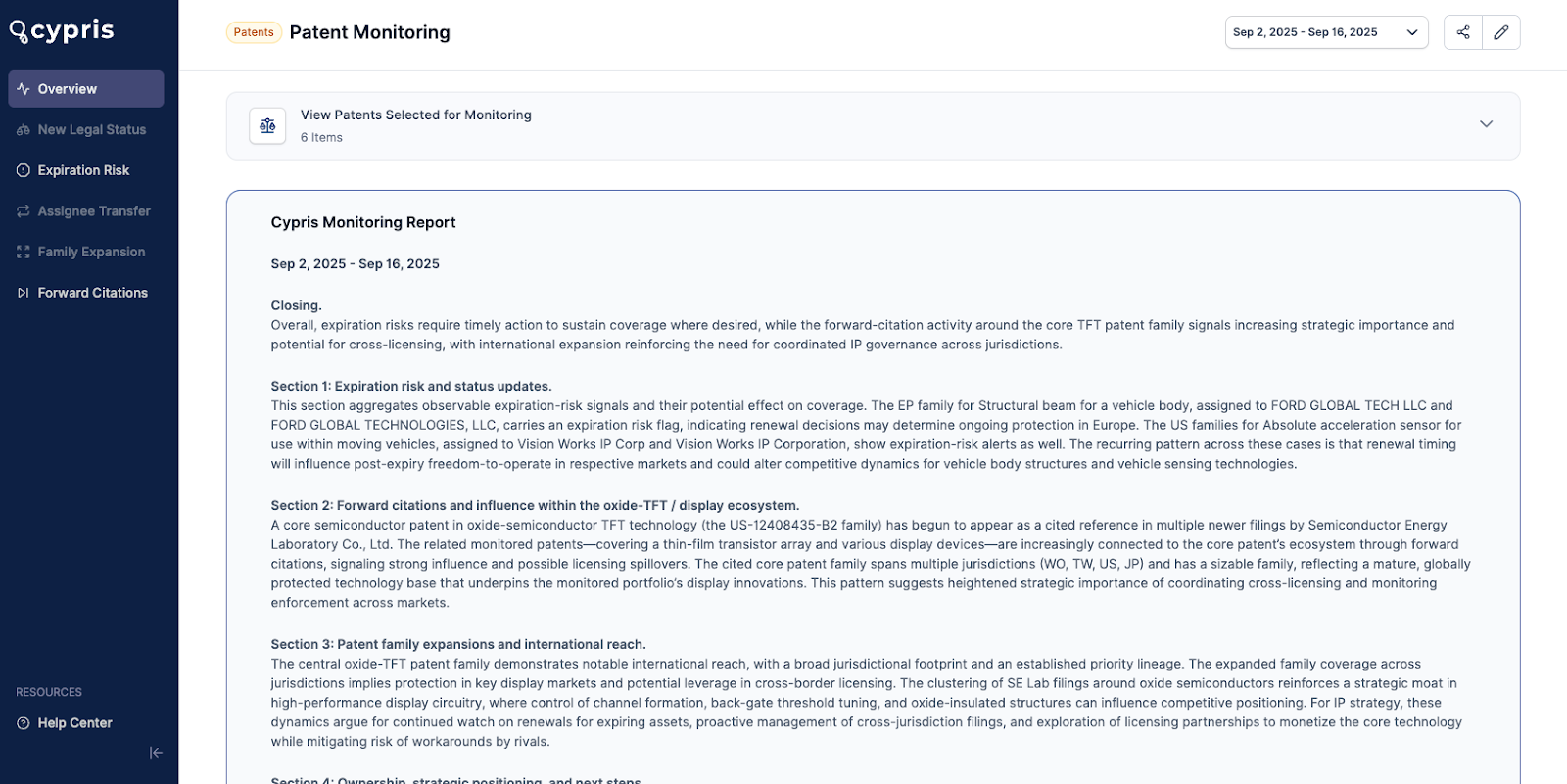
Spreadsheets are no longer needed. Updates now appear in a clear format that highlights key changes such as patent expansions, assignee transfers, or competitor filings. Each report includes AI-generated summaries powered by advanced LLMs to surface the most important trends and context. Reports are refreshed regularly, saved automatically, and build a continuous historical log for long-term tracking.
For many teams, these AI-enhanced reports are the most impactful shift. Instead of raw updates, Monitoring now provides analysis—turning activity like organizational filings or new research papers into intelligence that can guide investment and innovation decisions.
Beyond the reports themselves, having all updates housed directly within Cypris elevates the platform experience as a whole. The new interface is more intuitive, reducing friction for everyday use, and its design makes it easier for teams to collaborate in real time.
Monitoring is also fully integrated with Projects, so you can create and share monitors directly within your team’s workspace. This makes it simple to align ongoing research, track critical events together, and keep collaborators up to speed—all without switching tools. By connecting monitoring with projects, Cypris transforms isolated updates into shared intelligence that enhances both decision-making and collaboration across your organization.
Newsletter-Style Email Experience
Monitoring emails now feel more like a personalized newsletter. Each update arrives in a clean, structured layout with an easy-to-read AI-generated summary of recent activity, spotlighted trends, and direct links to dive deeper in the platform. Content is grouped into clear sections and filterable by category, so you can quickly scan what’s new, focus on the most relevant updates, and stay effortlessly informed—without inbox clutter.

Simplified Setup & Discoverability
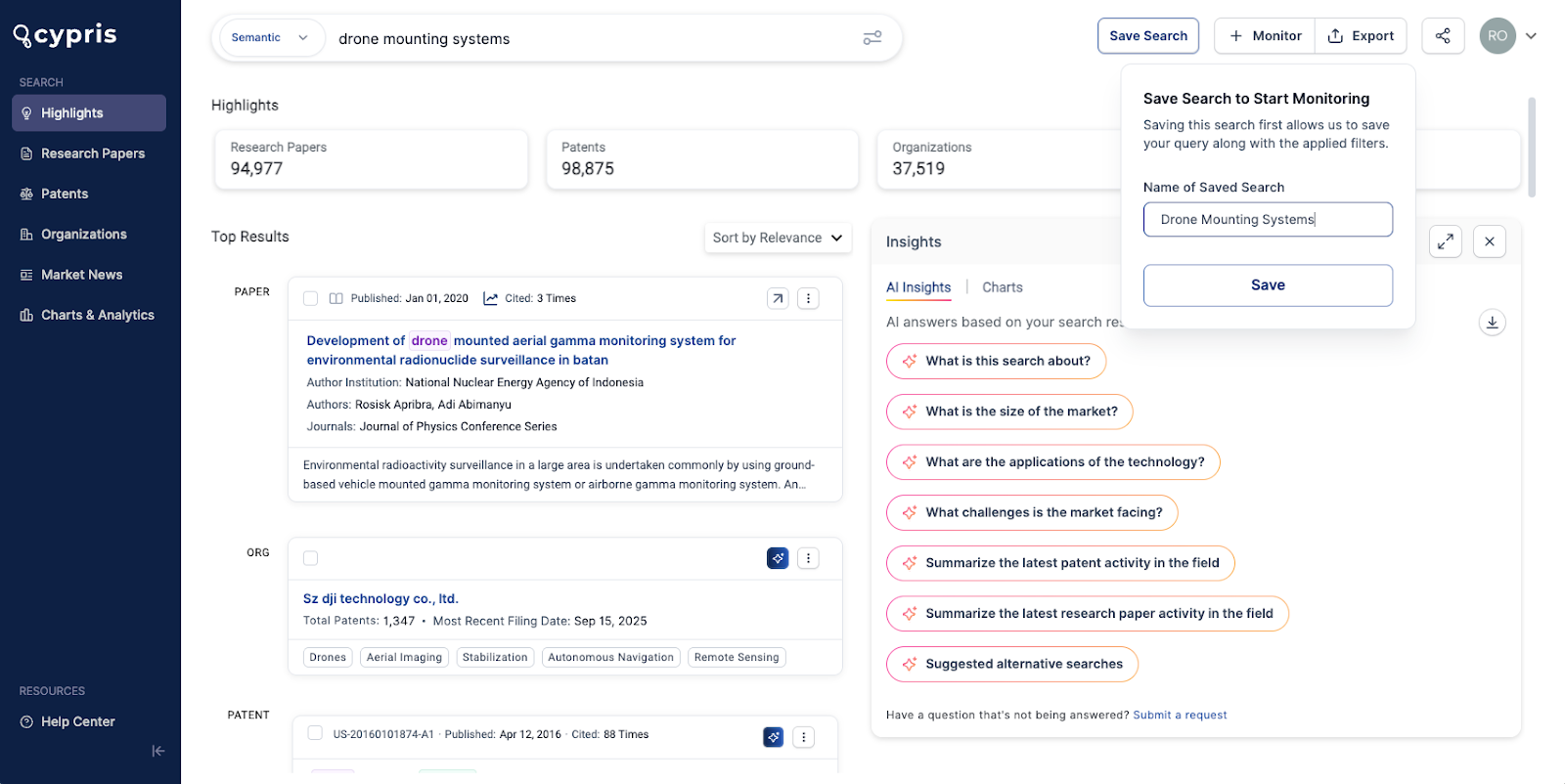
Setting up monitors is now faster and more intuitive. Users can create them in a single streamlined interface—quickly searching patent numbers, keywords, organizations, or papers and selecting the right mix in one place. Smart suggestions recommend recipients, while the Monitoring button appears directly on every search results page. Current monitors are clearly indicated to prevent duplication, and external recipients can be added to email updates for seamless collaboration.
Noise-Free Updates & Critical Alerts
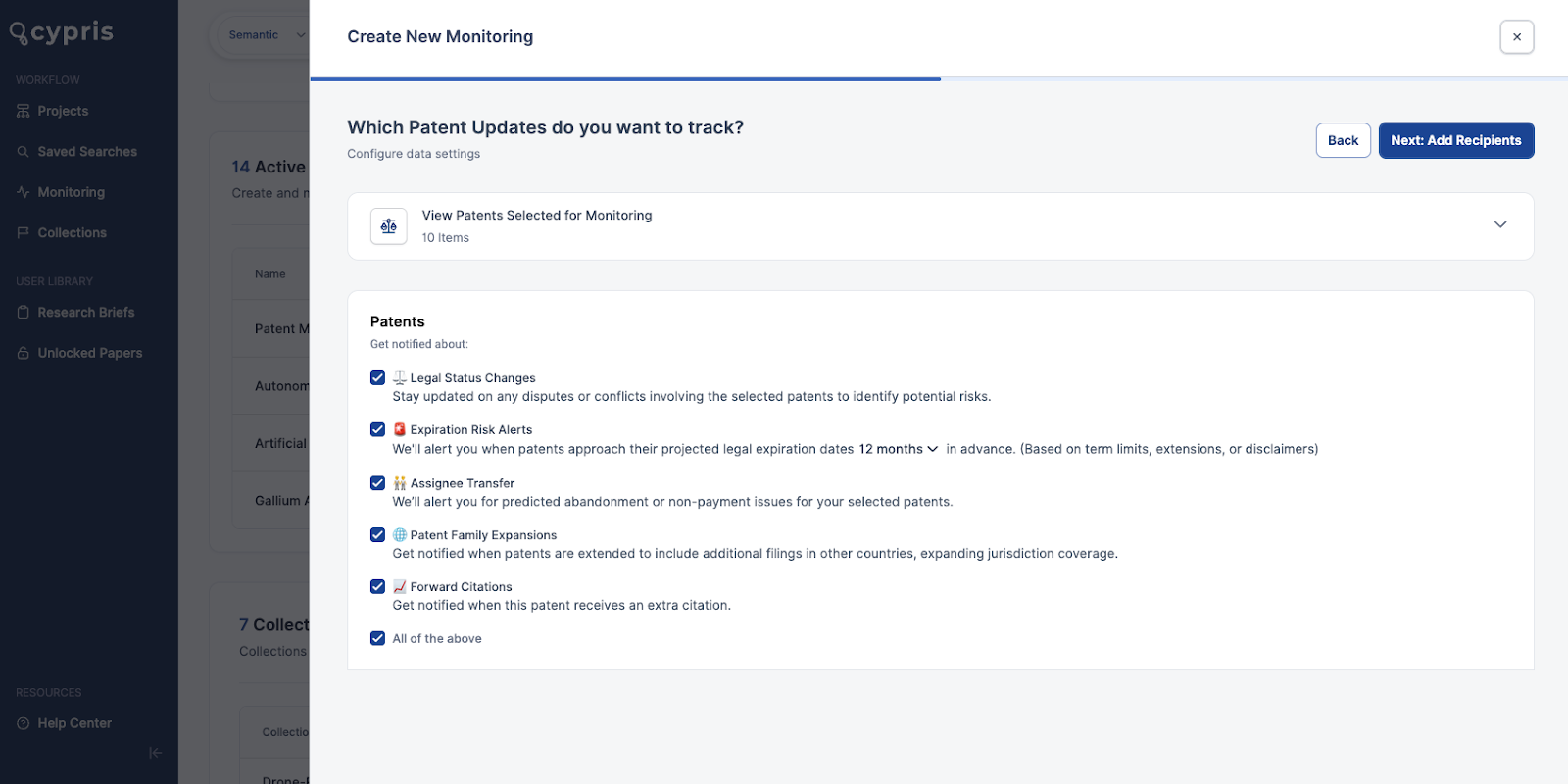
A “send only if new results exist” toggle eliminates duplicate notifications. Monitoring now captures not only newly published patents, papers, and organizations, but also critical patent events such as expiration risks, assignee transfers, patent family expansions, and forward citations—including competitor citations of your own research.
A More Powerful User Experience
Monitoring is built to help users move from raw data to actionable intelligence. Reports save automatically, creating a historical log teams can reference at any time. Items can be flagged directly into collections without manual re-entry. Emails preview AI-enhanced trends with a single click into interactive dashboards, and users can easily add colleagues or external recipients to stay aligned.
From a design perspective, the rebuild also gave our team room to innovate.
As one of our engineering team members, Maddie explained: “It was fun to build something new from scratch. From a UI perspective, we were able to make better design choices right from the start, which made for a much smoother, more intuitive user experience.”
Built for Speed, Accuracy, and Collaboration
With the new Monitoring, teams can save time compared to manual tracking, strengthen competitive intelligence with reliable, cross-dataset updates, collaborate seamlessly by sharing reports with colleagues or external partners, and trust the signal thanks to accuracy, relevancy filters, and AI-powered summaries.
As part of our engineering team, Oleg explained: “This project sat on top of our existing platform, which meant understanding the entire workflow end to end. It was challenging, but it also gave us the opportunity to rethink how everything fits together—and that’s what made it so rewarding.”
Available Now to All Users
The redesigned Monitoring is live and available across the Cypris platform today. If you’re already using Cypris, you’ll see new Monitoring options throughout your search and reporting workflows.
We’re excited to see how your team uses Monitoring to stay ahead of markets, competitors, and technologies — and to keep pushing the boundaries of what intelligent monitoring can do for R&D.


Keep Reading

Are you struggling to learn how to prioritize innovation ideas in your organization? Deciding which ideas should be pursued and which should wait can be a challenging task. Fortunately, there is an effective way of doing this that will help streamline the process and ensure success.
In this blog post, we’ll explore how to identify the right ideas for prioritization, develop an evaluation framework, leverage technology for efficiency gains, build an innovation culture within your team, and measure success when it comes time to implement them. Let’s learn how to prioritize innovation ideas!
Table of Contents
How to Prioritize Innovation Ideas
Developing an Evaluation Framework
Defining Criteria for Evaluation
Creating an Action Plan for Implementation
Leveraging Technology to Streamline the Process
Automated Idea Management Systems
Building an Innovation Culture in Your Organization
Measuring the Success of Prioritized Ideas
Tracking Progress and Performance Metrics
How to Prioritize Innovation Ideas
Prioritizing innovation ideas is essential for R&D and innovation teams. It is imperative to distribute resources productively so that ventures have an optimal chance of success. To identify the right ideas to prioritize, it’s important to assess the potential impact, evaluate the feasibility, and understand resource requirements.
Assess Potential Impact
Assessing potential impact involves considering how successful an idea might be if implemented. Factors such as customer demand or market opportunity should be taken into account when assessing an idea’s potential return on investment (ROI). Moreover, analyzing the expenditure of time and resources required can assist in deciding whether a project is worth pursuing.
Evaluate Feasibility
Evaluating feasibility requires looking at both technical and non-technical elements of a project before committing resources towards its development. Technical factors include understanding any existing technology constraints or dependencies that may limit progress. At the same time, non-technical considerations involve analyzing available skill sets within your team or organization which could affect implementation timelines.
It is important to prioritize the right ideas for innovation, as this will ensure successful outcomes. Developing an evaluation framework can help you make informed decisions and guide your team in implementing them effectively.
Key Takeaway: In learning how to prioritize innovation ideas, teams need to consider a combination of ROI, technical feasibility, and resource availability assessments. Taking into account customer demand, market opportunity, and skillsets within your team or organization will help you cut through the noise and make informed decisions about which projects are worth investing in.
Developing an Evaluation Framework
Developing an evaluation framework is a critical step in idea prioritization. It helps teams prioritize ideas and decide which ones to pursue. Organizations can maximize their chances of success by defining criteria for evaluation, establishing a scoring system, and creating an action plan for implementation.
Defining Criteria for Evaluation
Defining the criteria for evaluation is essential to make informed decisions about which ideas should be pursued. Teams should identify what matters most when evaluating new concepts – such as potential impact, feasibility, resources required, or customer needs – and create clear guidelines on how each will be measured.
This will help ensure that all stakeholders are aligned on the criteria used when assessing projects.
Establishing a Scoring System
Establishing a scoring system allows teams to quantify their evaluations and compare different ideas objectively against one another. Each criterion should have its weight depending on its importance relative to other factors being considered.
This score can then be used to rank projects from highest priority down through least important priorities The scoring system should also take into account any external factors that may affect the outcome of a project such as industry trends or competitive landscape analysis.
Creating an Action Plan for Implementation
Having an action plan ensures that teams can move forward with their chosen idea efficiently and effectively. It should outline specific tasks that need completing to bring them to fruition successfully within given timelines and budget constraints if applicable.
An action plan should include steps such as:
- Research and development activities.
- Product design and testing.
- Marketing strategy development.
- Production planning and scheduling.
With this, everyone involved knows exactly what needs to be done at each stage of the process before launch day arrives.
Developing an evaluation framework is essential in learning how to prioritize innovation ideas, as it provides the necessary structure to ensure ideas are properly assessed and evaluated. Leveraging technology can further streamline this process by utilizing data analytics tools, automating idea management systems, and implementing collaboration platforms.
Key Takeaway: By defining criteria for evaluation, establishing a scoring system, and creating an action plan for implementation, organizations can ensure their chosen innovation ideas are pursued in the most effective way possible. It’s all about getting your ducks in a row to guarantee success.
Leveraging Technology to Streamline the Process
The use of technology can be an invaluable asset for streamlining the process of prioritizing innovative ideas. Data analytics tools, automated idea management systems, and collaboration platforms are all powerful tools that can help to make idea prioritization more efficient and effective.
Data Analytics Tools
Data analytics tools provide R&D teams with insights into which ideas have the most potential for success. By analyzing data points such as customer feedback, market trends, and industry benchmarks, these tools can identify opportunities that may otherwise go unnoticed. Based on data-driven insights, R&D teams can prioritize projects accordingly.
Automated Idea Management Systems
Automated idea management systems enable teams in capturing, organizing, and prioritizing ideas in one central location. These systems can keep tabs on each idea, from its start to completion, so the team is aware of where resources are going at any given moment.
(Source)
In addition, automated idea management systems often include features such as voting capabilities or gamification elements which further facilitate team collaboration and engagement when it comes to selecting new initiatives or assessing existing ones.
Collaboration Platforms
Collaboration platforms offer distributed teams the opportunity to collaborate seamlessly across multiple locations without compromising productivity or quality control. With real-time updates on task progress and integrated communication channels such as chat rooms or video conferencing, these platforms provide teams with the flexibility needed to remain agile in today’s fast-paced environment while allowing them to effectively collaborate.
By leveraging technology to streamline idea prioritization, organizations can gain a competitive edge in the innovation race. To further capitalize on this advantage, companies must build an innovative culture within their organization by encouraging creativity and risk-taking, fostering open communication and collaboration, and promoting knowledge sharing and learning.
Key Takeaway: Using data analytics tools, automated idea management systems, and collaboration platforms to their fullest potential can help R&D teams prioritize ideas with maximum efficiency. These powerful technologies enable teams to make informed decisions quickly, track progress accurately and collaborate across multiple locations without compromising productivity or quality control.
Building an Innovation Culture in Your Organization
Organizations that benefit from idea prioritization must create an environment that encourages creativity and risk-taking. To do this, it’s important to foster open communication and collaboration between teams, as well as promote knowledge sharing and learning. This will help ensure that ideas are discussed openly and new perspectives are considered.
Encouraging creativity starts with providing employees with the freedom to explore their ideas without fear of failure or criticism. By allowing employees to take risks in a safe space, organizations can create an atmosphere where creative thinking is rewarded instead of punished for mistakes made along the way. It also helps if leadership models this behavior by taking calculated risks themselves, so others feel empowered to do the same.
To cultivate an innovative atmosphere within the organization, it is essential to foster open communication between all departments. Encourage R&D managers and engineers, product development personnel, and scientists at all levels to come together regularly for problem-solving sessions or brainstorming ideas for potential commercialization opportunities.
By having everyone’s input on board, teams can leverage different perspectives when prioritizing ideas or tackling challenges they may be facing in their workflows.
Key Takeaway: Organizations should foster a setting that boosts imaginative thought and chances taking by endorsing open dialogue, exchanging of knowledge, and joint issue solving. By fostering a safe space for employees to explore their ideas without fear of failure or criticism, organizations can foster innovation while encouraging leaders to take calculated risks as well.
Measuring the Success of Prioritized Ideas
In learning how to prioritize innovation ideas, a crucial step is measuring the success of their implementation. Tracking progress and performance metrics, analyzing results, adjusting strategies accordingly, celebrating achievements, and learning from failures are all key components of idea prioritization.
Tracking Progress and Performance Metrics
Tracking progress and performance metrics can help you understand how well your team is doing on their current project or initiative. This could include measuring completion rate against deadlines, assessing customer feedback on products or services, or tracking financial performance related to a particular idea. By monitoring the relevant data points over some time, you can determine if your concept is having its desired effect.
Analyzing Results
Analyzing results allows teams to identify areas for improvement in their projects as well as opportunities for growth and expansion. It’s important to look at data from multiple sources – such as customer surveys, financial reports, and market research studies – when analyzing so that decisions are based on accurate information rather than assumptions or guesswork.
Teams must adjust strategies accordingly based on these findings. Otherwise, any efforts may be wasted if they continue down the wrong path without making necessary changes along the way.
Celebrating Achievements
Celebrating achievements should also be part of the evaluation process since it encourages team morale and motivation while providing recognition for the hard work done by individuals within the organization who have contributed towards successful outcomes.
It is also essential not to evade failure. Rather, use them as chances for growth that can lead to further advances in upcoming undertakings carried out by the team. Going forward into new ventures with confidence knowing what works best given certain scenarios will help ensure success.
Key Takeaway: Analyzing performance metrics and adjusting strategies accordingly is key to assessing the success of innovation ideas. It’s essential to recognize successes and glean lessons from missteps to remain at the forefront, providing teams with a substantial store of wisdom for upcoming projects.
Conclusion
Learning how to prioritize innovation ideas is essential for any organization that wants to stay ahead of the competition. By taking the time to identify and evaluate potential projects, develop an evaluation framework, and leverage technology to streamline processes, organizations can ensure their ideas are successful.
Additionally, prioritizing innovation within your team will help foster creativity, and measuring success with key performance indicators allows teams to track progress in real-time. With these strategies in place, you’ll be well on your way toward achieving maximum ROI from all innovative initiatives.
Discover how Cypris can help your R&D and innovation teams prioritize their ideas quickly with our centralized data platform. Take advantage of the insights you gain to make faster, smarter decisions for your business.

Apple is renowned for its pioneering and progressive approaches. It’s no shock that Apple has set up a structure to promote creativity and maintain its products at the forefront of the market. And learning how Apple is organized for innovation gives us a lot of lessons for setting up companies for success.
From cultivating creative ideas to developing innovative solutions, Apple understands how important it is to stay organized for innovation if they want success now and into the future. But what does this look like?
How do they overcome challenges when innovating? And can other companies learn from Apple’s approach? Let’s explore these questions as we investigate how Apple is organized for innovation.
Table of Contents
How Apple Is Organized for Innovation
Apple’s Culture: Fostering Innovation
Encouraging Creativity and Risk-Taking
What Are the Challenges of Innovating at Apple?
What Companies Can Learn From Apple
How Apple Is Organized for Innovation
Apple’s organizational structure is a hierarchical system that allows the company to efficiently manage its vast global operations. Apple’s org structure has a centralized decision-making process, promotes creativity and innovation, and provides well-defined pathways of communication between departments.
How Apple is organized for innovation allows the company to remain competitive in today’s fast-paced market by fostering collaboration and encouraging risk-taking.
At the top of Apple’s hierarchy sits CEO Tim Cook who oversees all aspects of the business from product development to marketing strategies. At the helm of Apple’s board is a team of renowned industry leaders, such as former Vice President Al Gore and Oracle Chairman Larry Ellison, who guide the company in making decisions on product development, acquisitions, and investments.
The next level down consists of executive teams responsible for specific areas within Apple such as hardware engineering or software design.
Each team has dedicated leaders with years of experience in their respective fields who are responsible for driving innovation within their division while also managing resources efficiently across multiple projects at once. They collaborate regularly to ensure alignment between different departments while ensuring that any changes they make are consistent with overall company goals and objectives set by Cook himself.
(Source)
Below this layer lies individual project teams consisting mostly of engineers tasked with developing innovative solutions to customer problems or creating new products entirely from scratch based on market research conducted before the development phases begin.
These teams consist mainly of developers but can also contain designers depending on what type of project it is working on. All members report directly to either one member from executive leadership or straight to Cook himself if necessary.
This provides direct access to feedback throughout the entire process allowing quick iterations when needed. It reduces the wait through lengthy bureaucratic processes typically seen in larger organizations.
Finally, there exists another layer beneath these individuals made up of administrative staff who handle day-to-day tasks related to running the business such as HR, payroll, accounting, and legal affairs. This group helps ensure that everything else runs smoothly so executives can focus solely on developing future products and services.
In short, Apple’s organizational structure promotes strong collaboration, efficient decision-making, rapid iteration, and the ability to respond quickly to changing markets.
How Apple is organized for innovation has allowed them to stay on top of the game in terms of pioneering, by emphasizing imagination, and being unafraid to take chances. Leveraging technology for innovation is just one of the many ways Apple fosters creative thinking among its employees.
Key Takeaway: How Apple is organized for innovation: its structure is geared towards innovation and efficiency, with a hierarchical system in place that enables quick decision-making. Executive teams are responsible for driving product development while individual project teams focus on creating innovative solutions to customer problems. This well-oiled machine ensures the innovative company remains competitive by responding quickly to changing markets.
Apple’s Culture: Fostering Innovation
Apple is acclaimed for its innovative goods and services, with a great deal of this accomplishment coming from its methodology of promoting creativity.
Encouraging Creativity and Risk-Taking
Apple encourages creativity and risk-taking by allowing employees to explore new ideas without fear of failure. This culture has enabled the company to create groundbreaking technologies such as the iPhone, iPad, and Macbook Pro.
Empowering Decision Making
Empowering employees to make decisions is another key factor in Apple’s ability to innovate. Apple enables personnel, regardless of rank, to take on tasks and make decisions that will be beneficial for both the consumer and the firm. By giving employees autonomy over their work, they can think outside the box while still staying within guidelines set by senior management.
Using Cutting-Edge Technology
Since its inception in 1976, Apple has employed cutting-edge technology to create groundbreaking solutions that have transformed the way people use technology daily. Utilizing AI, ML, NLP, AR, VR, blockchain tech, cloud computing, quantum computing, 5G networks, and robotics automation systems along with data analytics platforms as tools to push the boundaries of innovation has been one of Apple’s core strategies.
This approach enables them to stay ahead of the curve and keep their customers engaged while staying within guidelines set by senior management.
Investing in R&D
Investing in research & development (R&D) is also an important part of Apple’s strategy for fostering innovation. Through R&D investments into areas like AI/ML/NLP research labs around Silicon Valley or even acquisitions such as Shazam or VocalIQ – Apple continues pushing boundaries with every new product release.
Apple has shown its dedication to pioneering through its corporate ethos, tech investments, and concentration on R&D. Despite these efforts, innovating at Apple comes with challenges such as managing complexity and scale while keeping up with rapidly changing markets.
Key Takeaway: Apple’s culture of encouraging creativity and risk-taking, coupled with its investment in cutting-edge technology and research & development has enabled them to stay one step ahead of the competition when it comes to innovation. Apple encourages personnel to take risks and explore novel ideas, allowing them to create revolutionary items that captivate customers.
What Are the Challenges of Innovating at Apple?
Innovation is a key component of Apple’s success. We have looked at how Apple is organized for innovation. Yet, there are difficulties to be handled for the business to stay successful and competitive.
Managing Complexity and Scale
Managing complexity and scale is one of the biggest challenges faced by Apple when innovating. With over 2 million employees across the globe, keeping track of ideas and ensuring they are properly implemented can be difficult.
Rapidly Changing Markets
Additionally, rapidly changing markets can make it hard for Apple to stay ahead of competitors who may have access to different technologies or resources than Apple does. Finally, maintaining quality standards is essential for any innovative product or service offered by Apple as customers expect nothing less than perfection from the brand.
The challenges of innovating at Apple are vast and require a thoughtful approach to overcome. By leveraging data-driven decision-making, developing a culture of continuous improvement, and utilizing agile methodologies for faster results, Apple has been able to navigate these challenges successfully.
Key Takeaway: Apple faces the challenge of managing complexity and scale, staying ahead of competitors in rapidly changing markets, and upholding high-quality standards to ensure successful innovation. To do this effectively they must stay agile while constantly innovating with a keen eye on the future.
What Companies Can Learn From Apple
The main thing that companies should learn from Apple as an innovative company is their focus on establishing clear goals and objectives. Without a strategy in place, it is hard to push for innovation.
Companies should also create an environment that encourages risk-taking and allows employees the freedom to explore creative solutions. Investing in R&D is a must. This could mean supporting internal initiatives as well as partnering with outside groups or educational institutions.
Technology plays an important role in innovation, so companies should leverage existing tools and develop new ones when necessary.
Finally, collaboration between departments and across teams is essential for successful innovation initiatives. Fostering open communication will help ensure ideas are shared quickly and efficiently. By following these steps, other companies can emulate Apple’s innovative culture while achieving their unique successes.
Organize your innovation goals, encourage risk-taking, invest in R&D, leverage tech, and foster collaboration to emulate Apple’s success. #innovation Click to Tweet
Conclusion
Other businesses desiring to up their game could look to how Apple is organized for innovation. By having an organizational structure that fosters creativity and collaboration, and utilizing strategies such as open-ended exploration and prototyping, Apple has been able to create groundbreaking products despite the challenges of innovating at scale.
The main takeaway here is that with proper organization and strategy in place, even large organizations can remain agile enough to innovate effectively.
Unlock the power of data-driven innovation with Cypris. Streamline your R&D and innovation processes to gain valuable insights faster than ever before.

Innovation strategies are important for any company. Businesses that learn how firms internally develop innovation gain tremendous value for their organization. It allows them to have market breakthroughs, adapt quickly and lead product design, and handle issues creatively.
In this article, we look at how firms internally develop innovation. We look at the benefits of internal innovation, different innovation strategies, and examples from different companies.
Table of Contents
What Is Its Difference from External Innovation?
What Are the Benefits of Developing Internal Innovation?
How Firms Internally Develop Innovation
What Are the Different Sources of Internal Innovation?
Challenges of Internal Innovation
Strategies for Successful Internal Innovation
Establishing Clear Goals and Objectives
Utilizing Existing Resources and Expertise
Internal Innovation
Learning how firms internally develop innovation necessitates understanding what it is first. Internal innovation in companies is the process of creating new ideas, products, services, or processes that can be used to improve a company’s operations. It involves leveraging existing resources and expertise within an organization to create something new.
Internal innovation differs from external innovation in that it focuses on developing solutions internally rather than relying on outside sources for help.
What Is Internal Innovation?
Internal innovation is the process of using internal resources such as personnel, technology, data, and other assets to develop innovative solutions that will benefit the business. This could include anything from introducing a new product line or service offering to streamlining operational processes or creating more efficient ways of doing things.
The goal of internal innovation is not only to increase profits but also to make employees feel valued by providing them with opportunities for growth and development through their work.
What Is Its Difference from External Innovation?
External innovation typically involves working with outside partners such as vendors or consultants who bring fresh perspectives and ideas into the mix. While this can be beneficial in some cases, it often requires additional time and money investments. It may not always yield positive results due to a lack of familiarity with an organization’s culture or goals.
On the other hand, internal innovation leverages existing knowledge within an organization which allows teams to quickly come up with creative solutions. In addition, companies don’t need to invest extra resources into research or training outside parties on how they do things differently at their company.
What Are the Benefits of Developing Internal Innovation?
The advantages of cultivating internal innovations are manifold. To begin with, it improves employee engagement by granting them ownership over projects they have invested effort. By also giving them access to different departments where they can apply their expertise, it improves their job satisfaction levels, resulting in higher retention rates.
Developing internal innovation also helps businesses save costs associated with external consulting fees. This is because most if not all tasks related to internal innovations are handled internally leading to lower overhead expenses.
Lastly, it gives businesses a competitive edge over others as they can innovate faster. Their already-established systems and structures make them more adaptable when responding to changing market conditions.
The benefits of internal innovation can be great, from cost savings to improved quality control.
Maximize cost savings, efficiency, and quality control with internal innovation initiatives. Leverage existing resources and data platforms for faster progress monitoring. #innovation #costsavings #leveragetechnology Click to Tweet
How Firms Internally Develop Innovation
Apple Inc.
Apple is a prime example of how firms internally develop innovation. Their development strategy focuses on creating an environment where employees can collaborate and share ideas, as well as providing resources for research and development.
Apple also encourages its employees to think outside the box when it comes to problem-solving. This has led to some of its most innovative products such as the iPhone and iPad.
The result of this approach has been a steady stream of new products that have revolutionized the tech industry and made Apple one of the world’s leading companies in terms of market capitalization.
Google LLC
Google’s internal innovation strategy revolves around encouraging collaboration between different teams within their organization, allowing them to come up with creative solutions that may not be possible if they were working alone.
They also provide generous funding for research projects, giving their engineers access to cutting-edge technology and tools they need to create something truly unique.
As a result, Google has become synonymous with technological advancement due to its groundbreaking products like Google Maps, Gmail, and Chrome browser. These are all developed internally by their team members.
Amazon Web Services (AWS)
Amazon Web Services is a prime example of how firms can create and implement internal innovation strategies that propel them toward success.
AWS provides cloud computing services to businesses worldwide, allowing for data storage online without the need for physical hardware or additional personnel for maintenance tasks such as backups and updates.
By utilizing these technologies internally before offering them through their AWS Marketplace program, Amazon was able to gain significant traction in this area quickly, due largely in part to its focus on developing innovative solutions from within rather than relying solely on external sources or third-party vendors.

(Source)
What Are the Different Sources of Internal Innovation?
Innovation is the lifeblood of any organization, and it’s essential for staying competitive in today’s fast-paced business environment. To learn how firms internally develop innovation, let’s look at where innovation comes from within the company. Internal innovation can come from a variety of sources within an organization, each with its unique strengths and challenges.
Leadership
Leadership sets the tone for innovation throughout an organization.
Leaders must create a culture that encourages risk-taking and rewards creativity. They should also provide resources to help employees develop their ideas into tangible products or services.
Finally, leaders need to be open to new ideas coming from outside the traditional power structure of the company.
R&D Units
Research & Development (R&D) units are dedicated teams tasked with developing innovative solutions to problems facing the company or industry as a whole. These teams have access to specialized tools and expertise that allow them to explore cutting-edge technologies and uncover creative solutions quickly and efficiently.
Innovation Units
Innovation units are similar to R&D units but focus on creating new products or services rather than improving existing ones. This type of team typically works closely with marketing departments to ensure that their innovations will be well received by customers when they hit the market.
Employees
Employees at all levels can contribute valuable insights into how processes could be improved or what kind of product features would appeal most strongly to customers’ needs. This happens if employees are empowered and allowed input through surveys, brainstorming sessions, and hackathons.
Companies should make sure they’re actively listening for these kinds of suggestions so they don’t miss out on potentially great ideas just because they didn’t originate at higher levels within the organization hierarchy.
Overall, internal innovation is critical for organizations looking to stay ahead in today’s rapidly changing landscape. However, it requires more than just top-down leadership initiatives. Tapping into all available sources such as R&D units, innovation units, and even individual employees can give companies a major edge over their competitors who may not be taking full advantage of every potential source of insight available.
Internal innovation can come from a variety of sources within an organization, each with its unique strengths and challenges. Click To Tweet
Challenges of Internal Innovation
Innovation from within is key to staying ahead of the competition, yet can be challenging due to restricted assets and experience. Companies must reconcile the demand for innovation with their current resource limitations, which can lead to a lack of funds and time necessary to generate fresh concepts.
Additionally, there are risks associated with internal innovation projects that require careful management. These include potential losses from failed experiments or delays in product development cycles due to unforeseen circumstances.
Time constraints are also an issue when it comes to internal innovation projects. Companies need to set realistic expectations and deadlines while ensuring they have enough personnel and other resources available throughout the project lifecycle. Companies should also factor in unexpected challenges such as changes in customer demands or market conditions that could impact their timeline goals.
Risk management is another key challenge when launching an internal innovation project. Companies must identify any potential risks upfront so they can plan accordingly by allocating additional resources if necessary or making changes to their process as needed during the development phases.
This includes understanding how much capital is required for each stage of the project, assessing customer feedback on prototypes or designs before launch, and developing contingency plans in case something goes wrong during production or delivery stages of the process cycle
The difficulties of internal creativity can be intimidating, yet with the correct systems and assets available to them, organizations can accomplish fruitful outcomes. By leveraging existing resources and expertise, establishing clear goals and objectives, and utilizing technology to streamline processes, organizations can increase their chances for success when it comes to internal innovation.
“Internal innovation is essential for staying ahead but requires careful management of time and risk. #Innovation #RiskManagement #TimeConstraints” Click to Tweet
Strategies for Successful Internal Innovation
Successful internal innovation projects require a clear strategy that focuses on goals, resources, and technology. In learning how firms internally develop innovation, we can extract the following steps:
Establishing Clear Goals and Objectives
Establishing clear goals and objectives is the first step in any successful project plan. Defining specific outcomes for the project helps to ensure that everyone involved understands what needs to be accomplished. It also allows teams to measure progress against their desired results.
Utilizing Existing Resources and Expertise
Utilizing existing resources and expertise is another important part of a successful strategy. By leveraging the knowledge of team members, organizations can save time and money while ensuring quality results are achieved quickly. Finally, leveraging technology to streamline processes can help teams stay organized and efficient throughout their project.
By following these strategies for successful internal innovation projects, organizations will be able to maximize efficiency while effectively achieving their desired outcomes. With clear goals established upfront along with utilizing existing resources and expertise available within the organization combined with innovative technologies, organizations have everything they need at their fingertips to make sure their next big idea takes off.
By implementing the strategies outlined above, organizations can effectively manage their internal innovation processes and achieve success.
Maximize efficiency and achieve desired outcomes with clear goals, existing resources, and innovative tech for successful internal innovation projects. #innovation #R&D Click to Tweet
Conclusion
Learning how firms internally develop innovation helps companies to develop their internal innovation leads. To maximize innovation outcomes, any project’s plan should consider strategies and best practices to address the associated challenges of internal innovation.
Strategies for successful innovation outcomes and best practices should be implemented as part of any project’s plan. Find a comprehensive platform that helps R&D and innovation teams centralize their data sources into one platform to facilitate faster time-to-insights during the development process, enabling them to maximize their potential for creating innovative products or services.
Discover how Cypris can help your R&D and innovation teams develop faster, smarter solutions with centralized data sources. Take advantage of our platform today to unlock the potential of internal innovation.