
A smarter, more engaging monitoring experience—built for speed, accuracy, and collaboration.
Over the past few years, Cypris has helped innovation teams make faster, more informed decisions by centralizing critical insights across patents, academic papers, organizations, and market activity. But until now, tracking changes over time often meant juggling spreadsheets, scattered alerts, and manual checks—workflows that were hard to manage and easy to miss.
Today, we’re excited to introduce an upgraded Monitoring experience on Cypris, a complete redesign of how teams track critical updates. With streamlined setup, redesigned emails, and advanced LLMs powering analysis, Monitoring makes it easy to stay ahead of market shifts and competitor moves—without the noise.
Why We Rebuilt Monitoring from the Ground Up
The original monitoring tools relied heavily on exports and static spreadsheets, requiring users to piece together updates manually. Alerts were basic, often duplicative, and limited in the types of data they could track. They also didn’t always give teams confidence that updates were reliable, accurate, or relevant to their needs.
We reimagined Monitoring to solve these gaps. Instead of scattered, one-off alerts, the new Monitoring delivers timely, structured reports—only when new results exist. Updates are now enriched with LLM-powered summaries that don’t just describe activity, but interpret it—prioritizing what matters most and filtering out the noise.
What’s New in Monitoring
The Monitoring Report
Spreadsheets are no longer needed. Updates now appear in a clear format that highlights key changes such as patent expansions, assignee transfers, or competitor filings. Each report includes AI-generated summaries powered by advanced LLMs to surface the most important trends and context. Reports are refreshed regularly, saved automatically, and build a continuous historical log for long-term tracking.
For many teams, these AI-enhanced reports are the most impactful shift. Instead of raw updates, Monitoring now provides analysis—turning activity like organizational filings or new research papers into intelligence that can guide investment and innovation decisions.
Beyond the reports themselves, having all updates housed directly within Cypris elevates the platform experience as a whole. The new interface is more intuitive, reducing friction for everyday use, and its design makes it easier for teams to collaborate in real time.
Monitoring is also fully integrated with Projects, so you can create and share monitors directly within your team’s workspace. This makes it simple to align ongoing research, track critical events together, and keep collaborators up to speed—all without switching tools. By connecting monitoring with projects, Cypris transforms isolated updates into shared intelligence that enhances both decision-making and collaboration across your organization.
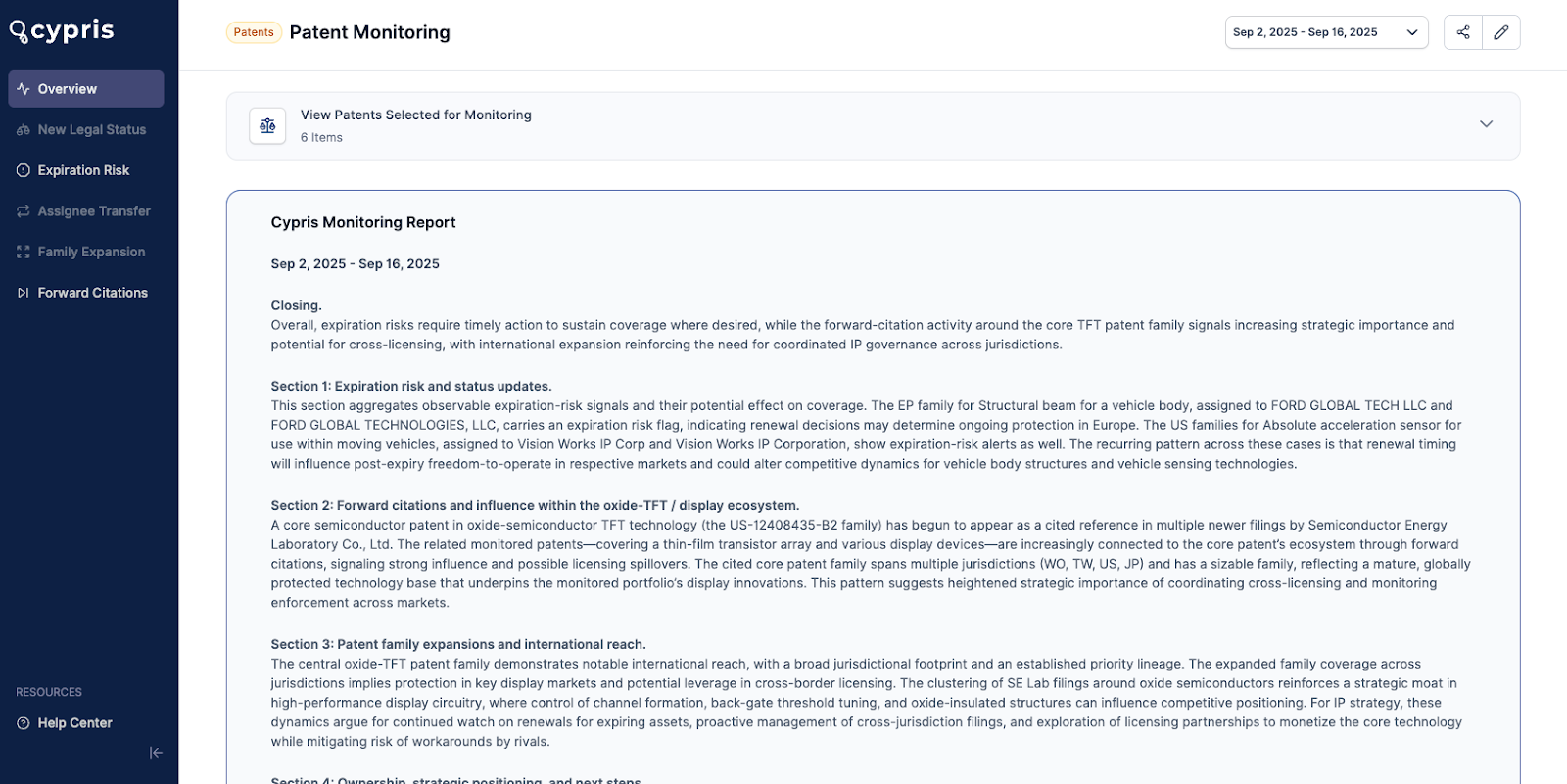
Newsletter-Style Email Experience
Monitoring emails now feel more like a personalized newsletter. Each update arrives in a clean, structured layout with an easy-to-read AI-generated summary of recent activity, spotlighted trends, and direct links to dive deeper in the platform. Content is grouped into clear sections and filterable by category, so you can quickly scan what’s new, focus on the most relevant updates, and stay effortlessly informed—without inbox clutter.

Simplified Setup & Discoverability
Setting up monitors is now faster and more intuitive. Users can create them in a single streamlined interface—quickly searching patent numbers, keywords, organizations, or papers and selecting the right mix in one place. Smart suggestions recommend recipients, while the Monitoring button appears directly on every search results page. Current monitors are clearly indicated to prevent duplication, and external recipients can be added to email updates for seamless collaboration.
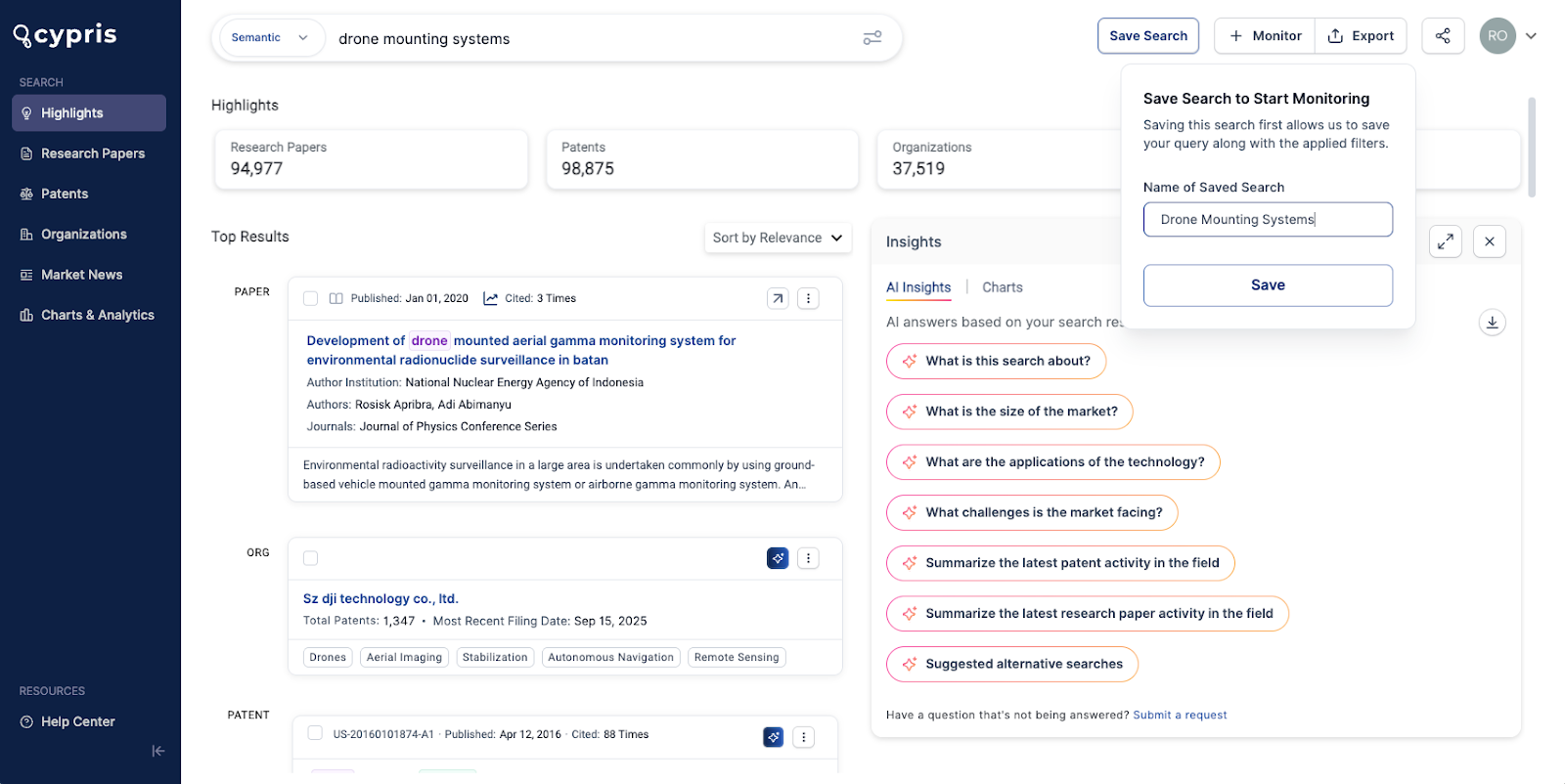
Noise-Free Updates & Critical Alerts
A “send only if new results exist” toggle eliminates duplicate notifications. Monitoring now captures not only newly published patents, papers, and organizations, but also critical patent events such as expiration risks, assignee transfers, patent family expansions, and forward citations—including competitor citations of your own research.
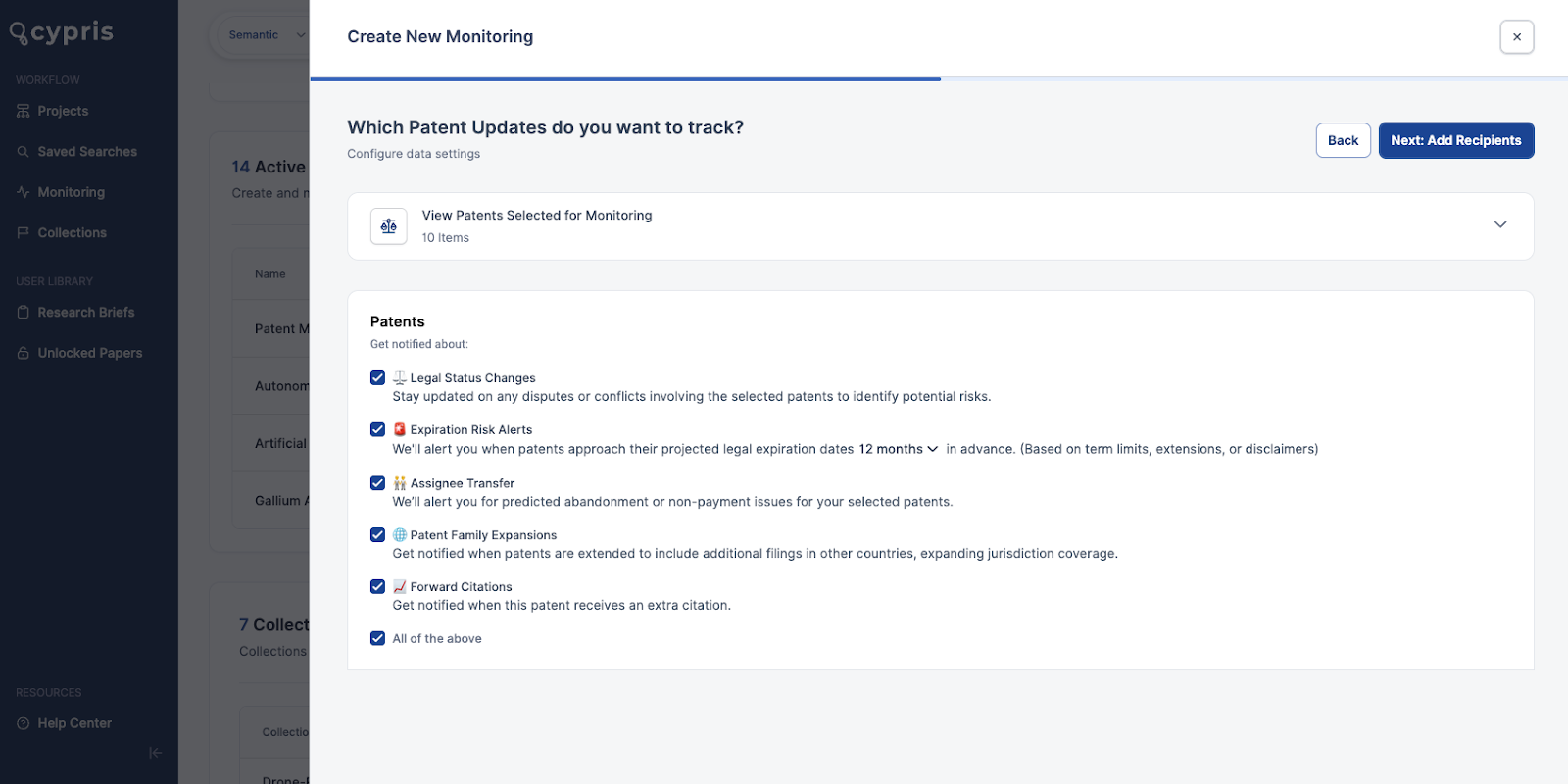
A More Powerful User Experience
Monitoring is built to help users move from raw data to actionable intelligence. Reports save automatically, creating a historical log teams can reference at any time. Items can be flagged directly into collections without manual re-entry. Emails preview AI-enhanced trends with a single click into interactive dashboards, and users can easily add colleagues or external recipients to stay aligned.
From a design perspective, the rebuild also gave our team room to innovate.
As one of our engineering team members, Maddie explained: “It was fun to build something new from scratch. From a UI perspective, we were able to make better design choices right from the start, which made for a much smoother, more intuitive user experience.”
Built for Speed, Accuracy, and Collaboration
With the new Monitoring, teams can save time compared to manual tracking, strengthen competitive intelligence with reliable, cross-dataset updates, collaborate seamlessly by sharing reports with colleagues or external partners, and trust the signal thanks to accuracy, relevancy filters, and AI-powered summaries.
As part of our engineering team, Oleg explained: “This project sat on top of our existing platform, which meant understanding the entire workflow end to end. It was challenging, but it also gave us the opportunity to rethink how everything fits together—and that’s what made it so rewarding.”
Available Now to All Users
The redesigned Monitoring is live and available across the Cypris platform today. If you’re already using Cypris, you’ll see new Monitoring options throughout your search and reporting workflows.
We’re excited to see how your team uses Monitoring to stay ahead of markets, competitors, and technologies — and to keep pushing the boundaries of what intelligent monitoring can do for R&D.


Introducing the New AI-Powered Cypris Monitoring


A smarter, more engaging monitoring experience—built for speed, accuracy, and collaboration.
Over the past few years, Cypris has helped innovation teams make faster, more informed decisions by centralizing critical insights across patents, academic papers, organizations, and market activity. But until now, tracking changes over time often meant juggling spreadsheets, scattered alerts, and manual checks—workflows that were hard to manage and easy to miss.
Today, we’re excited to introduce an upgraded Monitoring experience on Cypris, a complete redesign of how teams track critical updates. With streamlined setup, redesigned emails, and advanced LLMs powering analysis, Monitoring makes it easy to stay ahead of market shifts and competitor moves—without the noise.
Why We Rebuilt Monitoring from the Ground Up
The original monitoring tools relied heavily on exports and static spreadsheets, requiring users to piece together updates manually. Alerts were basic, often duplicative, and limited in the types of data they could track. They also didn’t always give teams confidence that updates were reliable, accurate, or relevant to their needs.
We reimagined Monitoring to solve these gaps. Instead of scattered, one-off alerts, the new Monitoring delivers timely, structured reports—only when new results exist. Updates are now enriched with LLM-powered summaries that don’t just describe activity, but interpret it—prioritizing what matters most and filtering out the noise.
What’s New in Monitoring
The Monitoring Report
Spreadsheets are no longer needed. Updates now appear in a clear format that highlights key changes such as patent expansions, assignee transfers, or competitor filings. Each report includes AI-generated summaries powered by advanced LLMs to surface the most important trends and context. Reports are refreshed regularly, saved automatically, and build a continuous historical log for long-term tracking.
For many teams, these AI-enhanced reports are the most impactful shift. Instead of raw updates, Monitoring now provides analysis—turning activity like organizational filings or new research papers into intelligence that can guide investment and innovation decisions.
Beyond the reports themselves, having all updates housed directly within Cypris elevates the platform experience as a whole. The new interface is more intuitive, reducing friction for everyday use, and its design makes it easier for teams to collaborate in real time.
Monitoring is also fully integrated with Projects, so you can create and share monitors directly within your team’s workspace. This makes it simple to align ongoing research, track critical events together, and keep collaborators up to speed—all without switching tools. By connecting monitoring with projects, Cypris transforms isolated updates into shared intelligence that enhances both decision-making and collaboration across your organization.
Newsletter-Style Email Experience
Monitoring emails now feel more like a personalized newsletter. Each update arrives in a clean, structured layout with an easy-to-read AI-generated summary of recent activity, spotlighted trends, and direct links to dive deeper in the platform. Content is grouped into clear sections and filterable by category, so you can quickly scan what’s new, focus on the most relevant updates, and stay effortlessly informed—without inbox clutter.
Simplified Setup & Discoverability
Setting up monitors is now faster and more intuitive. Users can create them in a single streamlined interface—quickly searching patent numbers, keywords, organizations, or papers and selecting the right mix in one place. Smart suggestions recommend recipients, while the Monitoring button appears directly on every search results page. Current monitors are clearly indicated to prevent duplication, and external recipients can be added to email updates for seamless collaboration.
Noise-Free Updates & Critical Alerts
A “send only if new results exist” toggle eliminates duplicate notifications. Monitoring now captures not only newly published patents, papers, and organizations, but also critical patent events such as expiration risks, assignee transfers, patent family expansions, and forward citations—including competitor citations of your own research.
A More Powerful User Experience
Monitoring is built to help users move from raw data to actionable intelligence. Reports save automatically, creating a historical log teams can reference at any time. Items can be flagged directly into collections without manual re-entry. Emails preview AI-enhanced trends with a single click into interactive dashboards, and users can easily add colleagues or external recipients to stay aligned.
From a design perspective, the rebuild also gave our team room to innovate.
As one of our engineering team members, Maddie explained: “It was fun to build something new from scratch. From a UI perspective, we were able to make better design choices right from the start, which made for a much smoother, more intuitive user experience.”
Built for Speed, Accuracy, and Collaboration
With the new Monitoring, teams can save time compared to manual tracking, strengthen competitive intelligence with reliable, cross-dataset updates, collaborate seamlessly by sharing reports with colleagues or external partners, and trust the signal thanks to accuracy, relevancy filters, and AI-powered summaries.
As part of our engineering team, Oleg explained: “This project sat on top of our existing platform, which meant understanding the entire workflow end to end. It was challenging, but it also gave us the opportunity to rethink how everything fits together—and that’s what made it so rewarding.”
Available Now to All Users
The redesigned Monitoring is live and available across the Cypris platform today. If you’re already using Cypris, you’ll see new Monitoring options throughout your search and reporting workflows.
We’re excited to see how your team uses Monitoring to stay ahead of markets, competitors, and technologies — and to keep pushing the boundaries of what intelligent monitoring can do for R&D.
Keep Reading

Is patent infringement a criminal offense? This is a critical concern for R&D managers, engineers, and scientists involved in product development and innovation. Navigating the complex world of intellectual property rights requires a deep understanding of patents to avoid costly legal battles and potential damage to one’s professional reputation.
In this post, we will examine the concept of patent infringement and its various forms, as well as provide examples to demonstrate why respecting intellectual property laws is essential. Furthermore, we will discuss the consequences associated with patent infringement, including civil penalties, and criminal penalties for severe cases such as counterfeit products or intentional thefts; statutory damages are also discussed in detail.
Finally, we offer practical guidance on how professionals can avoid patent infringement by conducting thorough research before developing new products or services. We emphasize obtaining licenses from patent owners when necessary and seeking expert advice on navigating patents’ complexities.
So let’s answer: is patent infringement a criminal offense?
Table of Contents
- What Is Patent Infringement?
- Definition of Patent Infringement
- Types of Patent Infringement
- Examples of Patent Infringement
- Is Patent Infringement a Criminal Offense?
- Civil Penalties for Patent Infringement
- When Is Patent Infringement a Criminal Offense?
- Statutory Damages for Patent Infringement
- How to Avoid Patent Infringement
- Researching Patents Before Developing a Product or Service
- Obtaining a License from the Owner of the Patented Technology
- Seeking Professional Advice
- Conclusion
What Is Patent Infringement?
Before we answer “Is patent infringement a criminal offense,” let’s look at what it is first.
Patent infringement is the unauthorized utilization, sale, or manufacture of a patented invention without consent from its holder. Understanding the concept of patent infringement and its consequences is crucial for R&D managers, product development engineers, scientists, commercialization teams, and senior directors involved in research and innovation.
Definition of Patent Infringement
With a patent, an inventor is awarded exclusive rights to their innovation for a fixed span (typically 20 years), forbidding any other person from exploiting it without appropriate permission. When someone violates these rights by using the patented technology without obtaining permission from the owner or paying royalties as required under licensing agreements, they commit patent infringement.
Types of Patent Infringement
- Direct infringement: This occurs when someone makes use of a patented invention without permission from the owner. For example, manufacturing a product that incorporates protected technology would be considered a direct infringement.
- Indirect infringement: Indirect infringers contribute to another party’s direct violation by providing components or information necessary for committing direct infringements. An example could be supplying parts used in assembling products that contain patented technologies.
- Infringement by inducement: This type involves encouraging others to engage in activities that violate patents through actions such as advertising unauthorized reproductions or promoting unlicensed services based on protected inventions.
Examples of Patent Infringement
The following are some examples illustrating different types of patent infringements:
- An electronics manufacturer produces smartphones with patented touchscreen technology without obtaining a license from the patent holder.
- A company sells knock-off products that incorporate protected designs, such as fashion accessories or consumer electronics with patented features.
- An online platform offers unauthorized downloads of software applications that use proprietary algorithms covered by patents.
By understanding the various forms of patent infringement and their implications, professionals in research and innovation can better navigate intellectual property rights and avoid potential legal issues. The World Intellectual Property Organization (WIPO) is an excellent resource for learning more about global IP laws and best practices to ensure compliance within your organization’s R&D efforts.
Patent infringement is a grave transgression with both civil and criminal implications. To avoid legal repercussions, it is essential to be aware of the different types and examples of patent infringement as well as its consequences. Next, we will explore the possible penalties for violating patent law.
Key Takeaway: Patent infringement means that the perpetrator utilizes, fabricates, or sells an innovation without consent from its patent holder. Examples include direct infringement (manufacturing products with protected technology), indirect infringement (supplying parts for unauthorized assembly), and inducement to infringe patents (advertising knock-offs). R&D professionals must understand these types of violations to avoid any potential legal issues.
Is Patent Infringement a Criminal Offense?
Is patent infringement a criminal offense? Oftentimes it isn’t, but severe cases are.
Patent infringement can lead to serious consequences for individuals and companies alike, with penalties ranging from civil lawsuits to criminal charges. Understanding the potential ramifications is crucial for R&D managers, engineers, scientists, and innovation teams to avoid costly legal battles and damage to their reputations.
Civil Penalties for Patent Infringement
In most cases, patent infringement disputes are resolved through civil litigation. The patent owner may file a lawsuit against the alleged infringer seeking monetary damages or an injunction that prevents further use of the patented technology. Monetary damages typically include:
- Actual Damages: These represent the amount of money lost by the patent holder due to the infringement.
- Royalties: If it’s determined that a reasonable royalty rate should be applied, this represents what would have been paid if both parties had agreed on licensing terms before any infringement occurred.
- Punitive Damages: In some instances where willful or malicious conduct is involved, courts may award additional punitive damages as a deterrent against future infringements.
When Is Patent Infringement a Criminal Offense?
In rare circumstances involving large-scale commercial operations or counterfeit goods production using patented technologies without authorization can result in criminal prosecution under federal law.
Criminal penalties might include fines up to $2,500,000 (for organizations) or imprisonment of up to ten years depending on the severity and nature of the offense. Companies need to ensure they have proper licensing agreements in place and are not infringing on any patents to avoid such severe consequences.
Statutory Damages for Patent Infringement
Determining the actual harm done by a patent violation can be challenging in certain circumstances. To address this issue, courts may award statutory damages as an alternative.
Statutory damages are a predetermined amount set by law that serves as a means of compensation without having to prove specific losses. These amounts can range from $200 up to $150,000 per infringed work depending on factors like willfulness or innocent infringement. While statutory damages are more common in copyright cases, they can also apply in certain patent infringement situations.
Before engaging in any activity that could potentially be a violation of patent laws, it is critical to fully understand the legal ramifications. To avoid such potential penalties, you need to research patents thoroughly and take professional advice on intellectual property rights before developing products or services.
Key Takeaway: Is patent infringement a criminal offense? Consequences for patent infringement can range from financial compensation to hefty fines and even incarceration. Statutory damages are also a possibility for difficult-to-prove losses caused by patent infringements. Businesses ought to be sure to obtain appropriate licensing contracts and refrain from participating in any activity that could potentially cause costly court cases or more dire consequences.
How to Avoid Patent Infringement
Is patent infringement a criminal offense? To safeguard your organization from any potential legal and monetary repercussions of patent infringement, it is important to take preemptive measures in avoiding such circumstances. By being aware of existing patents, obtaining licenses when necessary, and seeking professional advice on intellectual property rights, you can minimize the risk of infringing upon another party’s patented technology.
Researching Patents Before Developing a Product or Service
The first step in avoiding patent infringement is conducting thorough research on existing patents relevant to your product or service. This process involves searching through various patent databases, including those maintained by national and international patent offices.
Additionally, using specialized search tools like Cypris can help R&D teams centralize data sources for more efficient research.
- Identify keywords related to your product or service that may be associated with patented technologies.
- Analyze any potential overlap between your proposed innovation and existing patents.
- Determine if any expired patents could provide valuable insights without risking infringement.
Obtaining a License from the Owner of the Patented Technology
If you discover an existing patent that covers aspects of your intended product or service, consider reaching out to the owner of the patented technology for licensing opportunities. Licensing agreements allow you to legally use someone else’s invention while compensating them for their work – often through royalties or lump-sum payments.
Keep in mind:
- Negotiating a license agreement requires careful consideration of terms and conditions regarding usage rights, payment structures, exclusivity, and more.
- Working with a patent attorney or intellectual property consultant can help ensure that the licensing agreement is fair and beneficial for both parties.
Seeking Professional Advice
When navigating the complex world of patents and intellectual property rights, it’s essential to seek professional advice from experts in the field. Patent attorneys, agents, or consultants can provide valuable guidance on:
- Evaluating your product or service for potential infringement risks.
- Filing patent applications to protect your innovations.
- Negotiating licensing agreements with other patent holders.
Securing patent rights and negotiating licensing deals can help protect your ideas, promote creativity in the workplace, and ensure respect for others’ IPs. By understanding the importance of patents and actively working to prevent infringement issues, R&D teams can focus their efforts on developing groundbreaking products without fear of legal repercussions.
Before venturing into product or service development, it is important to research existing patents and acquire a license from the patent holder to avoid any potential infringement. Additionally, seeking professional advice on patents and intellectual property rights can help ensure that you are abiding by all relevant laws. Moving forward, we will discuss the key points regarding patent infringement and criminal offense as well as highlight some benefits of understanding these legalities.
Key Takeaway: To avoid a patent violation, you need to research existing patents associated with the product or service, get a permit from the holder of patented technology, and consult an expert on intellectual property law. Taking these steps will help keep R&D teams out of hot water while allowing them to continue innovating without fear of legal repercussions.
Conclusion
Is patent infringement a criminal offense? Most of the time no, but if the scale of the patent infringement is large it can be. Avoiding patent infringement is essential to safeguard against costly legal disputes and criminal liability.
Companies must take the necessary steps to ensure they are not violating any patents or trademarks to protect themselves from potential liability for patent infringement.
Take your R&D and innovation teams to the next level with Cypris. Our platform provides rapid time-to-insights on patent infringement criminal offenses, helping you stay ahead of the competition.

As the world of innovation continues to evolve, expired patents have become a valuable resource for R&D managers, product development engineers, and scientists alike. In this blog post, we will explore the potential of expired patents and how they can be harnessed by research and development teams.
We’ll begin by defining what an expired patent is and exploring the different types that exist. Next, we’ll discuss how to find and utilize these invaluable intellectual property assets in your projects or products. Furthermore, we’ll examine the impact of patent expiration on innovation within various industries.
Table of Contents
- What are Expired Patents?
- Definition of an Expired Patent
- Types of Expired Patents
- Benefits of Expired Patents
- How to Find and Utilize Expired Patents?
- Searching for Expired Patents
- Analyzing the Information in an Expired Patent
- The Impact of Expired Patents
- Understanding the Impact of Expiration on Innovation and R&D Teams
- Leveraging Tools to Maximize the Benefits of Expiration
- Conclusion
What are Expired Patents?
In the world of research and development, expired patents can be a goldmine for innovation teams looking to build upon existing knowledge or create new products without infringing on intellectual property rights. This section will provide an overview of expired patents, including their definition, types, and benefits they offer to R&D and innovation teams.
Definition of an Expired Patent
An expired patent refers to a patent that is past the patent expiration date or has a failure in maintaining the required fees. Once a patent expires, the design or utility loses patent protection. It enters the public domain where anyone can freely use the information disclosed within it without obtaining permission from the original inventor(s) or paying any royalties.
This is because patent protection grants exclusive rights only for a limited period (usually 20 years), after which society at large can benefit from these inventions.
Types of Expired Patents
- Lapsed Patents: These are patents that have not been maintained by paying necessary maintenance fees during their lifetime. As such, they expire before their full term ends.
- Fully Served Patents: These refer to patents that have reached their maximum lifespan (typically 20 years). After this period elapses, they automatically enter the public domain.
- Prematurely Abandoned Patents: Sometimes inventors may choose not to pursue further protection on certain inventions due to various reasons like lack of commercial interest or technical difficulties; thus abandoning them prematurely before completing their full term.
Benefits of Expired Patents
Expired patents offer several advantages for R&D and innovation teams, including:
- Access to Valuable Information: Expired patents can provide a wealth of technical information that may be useful in developing new products or improving existing ones.
- Faster Innovation Cycles: By leveraging the knowledge disclosed in expired patents, companies can accelerate their product development process without reinventing the wheel or worrying about infringing on others’ intellectual property rights.
- New Market Opportunities: As certain technologies become available due to patent expiration, businesses can capitalize on these opportunities by creating new products based on previously patented inventions. This is particularly relevant in industries like pharmaceuticals where drug compounds often enter generic production once their respective patents expire.
- Risk Mitigation: Utilizing expired patents reduces the risk of potential litigation related to patent infringement claims since they are no longer protected under exclusive rights granted by the United States Patent and Trademark Office (USPTO).
Expired patents are a valuable source of information for research and innovation teams. Utilizing the correct resources, it is possible to glean knowledge of new advances or develop prospects for monetization through the study of expired patents. By understanding how to find and analyze expired patents, R&D and innovation teams can unlock their potential benefits even further.
Key Takeaway: Expired patents provide R&D and innovation teams with a wealth of valuable information, faster innovation cycles, new market opportunities, and risk mitigation. Companies can utilize the information from expired patents to gain an advantage in their industry without any worry of infringing on others’ IP rights.
How to Find and Utilize Expired Patents?
In this section, we will discuss how R&D managers, engineers, scientists, and other professionals can find and utilize expired patents for their projects. This includes searching for them in various databases, analyzing the information contained within these documents, and applying the knowledge gained from these resources.
Searching for Expired Patents
Finding expired patents is a crucial step in leveraging valuable intellectual property that has entered the public domain. To begin your search for expired patents:
- Visit reputable patent databases such as the United States Patent and Trademark Office (USPTO), or international databases.
- Utilize refined search parameters to refine results by distinct specifications like a patent number, expiration date span (to establish if a patent has expired), inventor name(s), assignee(s), etc.
- Browse through relevant categories related to your industry or field of research to discover potentially useful expired patents.
Analyzing the Information in an Expired Patent
Once you have identified an expired patent with potential value for your project or innovation efforts:
- Carefully review all sections of the document including abstracts, descriptions of embodiments/examples/claims, and any drawings provided.
- Determine which aspects are most relevant to your work, such as specific technologies or methods described within the patent.
- Assess any potential limitations or drawbacks of the disclosed invention and consider possible improvements or modifications that could be made.
Source
The Impact of Expired Patents
Innovation and R&D teams are always seeking new opportunities to create groundbreaking products or improve existing ones. Expired patents can provide a wealth of information for these teams, opening up possibilities that were once protected by intellectual property rights. In this section, we will explore the impact of expired patents on innovation and R&D teams, as well as how Cypris’ research platform can help maximize the benefits of patent expiration.
Understanding the Impact of Expiration on Innovation and R&D Teams
When the exclusive rights of a patent holder are lifted, other firms or people can employ the innovation without violating any regulations. This opens up numerous possibilities for innovation in various industries such as the pharmaceutical industry, technology sector, and manufacturing processes among others.
- New product development: With access to previously patented technologies now in the public domain, engineers and scientists can incorporate these innovations into their projects with no fear of legal repercussions.
- Cost reduction: Using expired patents often means reduced costs associated with licensing fees or royalty payments when incorporating patented technologies into new products.
- Faster time-to-market: By leveraging existing inventions from expired patents instead of starting from scratch, product development cycles may be shortened significantly resulting in faster time-to-market for innovative solutions.
Leveraging Tools to Maximize the Benefits of Expiration
Certain tools offer an efficient way for researchers and innovators to search through millions of expired patents and identify those that can be utilized in their projects. With these tools, R&D teams can:
- Perform an advanced patent search using various filters such as patent number, industry sector, or specific keywords.
- Analyze the information contained within expired patents to gain insights into potential applications for new products or improvements on existing ones.
- Easily collaborate with team members by sharing relevant expired patents and discussing their potential impact on ongoing projects.
By streamlining the process of finding and analyzing expired patents, these tools help innovation-driven organizations maximize the benefits offered by these valuable resources.
Expired patents can provide R&D and innovation teams with valuable opportunities to explore new possibilities if leveraged correctly. Moving on, we will discuss the key points regarding expired patents as well as how Cypris’ research platform can help maximize these benefits for R&D and innovation teams.
Key Takeaway: We look at the impact that expired patents have on innovation and R&D teams, as well as how research platforms can help maximize their benefits. Expired patents open up new possibilities for product development, cost reduction, and faster time-to-market, giving companies a leg up in highly competitive industries by unlocking game-changing innovations from public domain inventions.
Conclusion
Exploiting expired patents can be an advantageous approach for R&D and innovation teams to gain an understanding of the most current sector trends, as well as to fabricate a strategic edge. Utilities and designs past their patent expiration dates provide access to new technologies that may not have been available before, allowing teams to stay ahead of their competition in an ever-changing market.
With a research platform, these valuable resources are just one click away – making it easier than ever for R&D and innovation teams to take advantage of expired patent opportunities.
Discover the potential of expired patents with Cypris and accelerate your research and innovation initiatives. Leverage our platform to access data sources quickly, gain insights faster, and drive successful outcomes for your team.

For companies that buy patents, navigating the complex landscape of intellectual property transactions can be a daunting task. With numerous online marketplaces and strategies available, R&D managers, engineers, and senior directors must make informed decisions when acquiring or selling patents. In this blog post, we will delve into the top online marketplaces for patent transactions, such as IAM Market and RPX.
We will also explore how to effectively sell patents by researching comparable patented innovations and creating high-quality prototypes. Moreover, we will discuss essential strategies against patent sharks that companies that buy patents should employ to protect their valuable intellectual property assets.
By understanding these key concepts and implementing them in your organization’s IP strategy, you can ensure successful sales by finding companies that buy patents.
Table of Contents
- Where to Find Companies that Buy Patents
- IAM Market
- IP Marketplace
- RPX
- Preparing Your Patents for Sale
- Researching Comparable Patented Innovations
- Creating High-Quality Prototypes and Visual Aids
- Strategies Against Patent Sharks
- Reinventing Processes for Modular Technologies
- Collaborating with Competitors Early On
- Monetizing Start-up Innovations Through Patent Sales
- Finding the Right Platform for Your Start-up’s Patents
- Leveraging Support Services
- Conclusion
Where to Find Companies that Buy Patents
Patent owners that sell patents can utilize online marketplaces to streamline the process and connect with companies that buy patents in various technology sectors. These platforms allow patent owners to list their intellectual property assets, making it easier for R&D managers, product development engineers, scientists, and innovation teams to find relevant patents. In this section, we will discuss some of the top online marketplaces for patent transactions.
IAM Market
IAM Market is a global marketplace that connects IP sellers with interested buyers across multiple industries. The platform allows users to search through thousands of available patents based on specific criteria such as industry sector or technology type. IAM Market also provides additional resources like webinars and articles related to IP management and monetization strategies.
IP Marketplace
The IP Marketplace is one of the online patent marketplaces designed specifically for buying, selling, or licensing intellectual property rights such as patents, trademarks, designs, copyrights, etc., allowing inventors and businesses alike easy access to opportunities within these fields. Users can create listings showcasing their inventions while others browse according to needs/preferences – all without any fees involved.
RPX
RPX Corporation, one of the largest non-practicing entities (NPEs) in terms of the number of owned IPs purchased annually helps clients reduce litigation risk by acquiring key assets before they become problematic. Thus these prevent costly lawsuits down the line which may arise due to infringement claims made against them. Their extensive database includes over 30,000 patent assets covering various technology areas.
Other notable online patent marketplaces include Patentauction.com, Inpama.com, Idea Buyer, Licentix, and Idea Connection. These platforms cater to a wide range of industries and technologies, making it easier for R&D teams to find companies that buy patents.
To successfully buy or sell patents on these platforms, it’s important to prepare your intellectual property assets professionally by providing detailed information about similar products in the market along with high-quality prototypes and visual aids that showcase your innovation. In this upcoming part, we will go over how to get your patents ready for selling effectively.
The top online marketplaces for patent transactions are a great way to quickly connect with potential buyers and get the best deal. With proper preparation, you can maximize your chances of success when selling patents on these platforms.
Key Takeaway: Patent buyers have access to a variety of online marketplaces that facilitate transactions between inventors and businesses. Platforms such as IAM Market, IP Marketplace, and RPX Corporation provide users with an array of patent assets covering various industries and technologies. It is important to prepare your intellectual property assets professionally before listing them on these platforms to ensure successful transactions.
Preparing Your Patents for Sale
To increase your chances of attracting the right buyer and maximizing value from a transaction, it’s important to present your patents professionally. This includes providing facts about similar products in the market that showcase your innovation. In this section, we will discuss some key steps to prepare your patents for sale.
Researching Comparable Patented Innovations
Before listing your patent on an online marketplace, you should research comparable patented innovations to determine their potential value and identify any unique selling points.
You can start by searching through databases like Google Patents, USPTO Patent Database, or Espacenet. Analyzing these resources will help you understand how other inventors have positioned their inventions within the market, allowing you to tailor your approach accordingly.
Creating High-Quality Prototypes and Visual Aids
In addition to thorough research, preparing high-quality prototypes and visual aids is crucial when presenting a patent for sale. These materials demonstrate the practical applications of your invention while also highlighting its benefits over existing solutions:
- Create a physical prototype: If possible, develop a working model of your invention that showcases its functionality. This allows potential buyers to see firsthand how it operates and assess whether it aligns with their needs.
- Develop detailed drawings: Produce accurate technical drawings that clearly illustrate each component of the invention as well as assembly instructions if applicable.
- Prepare a presentation: Compile all relevant information, including research findings, prototypes, and drawings into a polished presentation. This can be in the form of slides or video demonstrations that effectively communicate your invention’s value proposition.
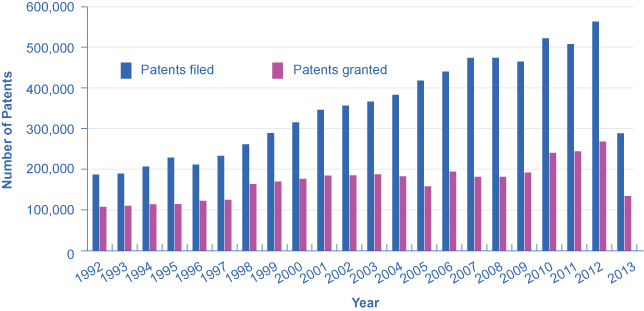
Taking these steps to prepare your patents for sale will not only increase their chances of attracting interested companies that buy patents but also help you maximize the return on investment from any potential transactions. By researching comparable innovations and creating high-quality prototypes and visual aids, you’ll be well-equipped to present your patent professionally within an online marketplace like IAM Market, IP Marketplace, or RPX.
Preparing your patents for sale is a critical step in the process of monetizing them, as it ensures that you are presenting potential buyers with high-quality prototypes and visual aids.
Key Takeaway: To ensure a successful sale of your patents, it’s essential to present them professionally. This includes researching comparable patented innovations and creating high-quality prototypes and visual aids such as physical models, detailed drawings, and presentations that effectively communicate the value proposition of your invention. Preparing thoroughly will help to get the best outcome from any potential deals.
Strategies Against Patent Sharks
In today’s competitive landscape, R&D companies face increasing threats from “patent sharks” who demand excessive damages using preliminary injunctions during infringement trials. To protect your company and its innovations, it is crucial to develop strategies that go beyond legal remedies. In this section, we will discuss two key approaches: reinventing processes for modular technologies and collaborating with competitors early on.
Reinventing Processes for Modular Technologies
One effective way to combat patent sharks is by making your technology more modular. By making your technology more modular and replacing or upgrading its components, you can reduce the chances of patent infringement as well as make it difficult for patent trolls to target specific aspects of your innovation. This approach requires a thorough understanding of the technological landscape and careful planning during product development stages.
- Analyze existing patents in your industry sector to identify potential infringement risks.
- Create a roadmap for developing modular components that can be easily integrated into new products or solutions.
- Stay informed about emerging trends and technologies that may impact future iterations of your product offerings.
Collaborating with Competitors Early On
Fostering collaboration between competing firms might seem counterintuitive. However, working together at an early stage can help both parties spot problems before they escalate into costly legal battles. Establishing partnerships focused on joint research projects or sharing intellectual property assets through licensing agreements are just some ways businesses can collaborate while maintaining their competitive edge in the market.
Here are some steps to consider when exploring collaboration opportunities:
- Identify potential partners who share similar goals and have complementary technology portfolios.
- Establish clear objectives for the partnership, such as joint R&D projects or cross-licensing agreements.
- Maintain open communication channels throughout the collaboration process to ensure a successful outcome for all parties involved.
Adopting proactive strategies like reinventing processes for modular technologies and collaborating with competitors early on can help your company stay ahead of patent sharks. By doing so, you not only safeguard your intellectual property assets but also foster innovation in an increasingly competitive market landscape. For additional information on shielding your patents from infringement dangers, the USPTO has published an extensive guide.
Key Takeaway: We discuss two strategies to protect R&D companies from patent sharks: reinventing processes for modular technologies and collaborating with competitors early on. By taking proactive steps, businesses can safeguard their intellectual property assets while maintaining a competitive edge in the market.
Monetizing Start-up Innovations Through Patent Sales
Start-ups often face the challenge of monetizing their innovations while maintaining focus on core business activities. Selling patents can be an effective way to generate revenue and attract investors without diverting resources from product development or market expansion.
In this section, we will explore how start-ups can leverage online platforms like IPNexus.com to access extensive networks of potential buyers and receive tailored support services for buying, selling, and commercializing intellectual property.
Finding the Right Platform for Your Start-up’s Patents
To maximize the value of your patent sale, it is crucial to choose a platform that caters specifically to start-ups and smaller enterprises. Some key features to look for in such platforms include:
- A large network of potential buyers interested in acquiring patents.
- An easy-to-use interface that simplifies listing your patents and connecting with interested parties.
- Dedicated support services designed specifically for start-ups seeking assistance with IP transactions.
Leveraging Support Services
Beyond providing a marketplace for patent transactions, some online platforms offer additional support services aimed at helping start-ups successfully navigate the process. These may include:
- Valuation Assistance: Accurately valuing your patent portfolio is essential when negotiating with potential buyers who are interested in acquiring patents. Many platforms provide valuation tools or guidance on determining appropriate pricing based on factors such as industry trends, technology maturity level, and comparable sales data.
- Negotiation Support: Engaging in negotiations can be challenging for inexperienced sellers. Platforms like IPNexus.com often guide negotiation strategies and tactics, helping start-ups secure the best possible deal for their patents.
- Legal Assistance: Patent transactions can involve complex legal agreements. Some platforms offer access to experienced intellectual property attorneys who can help draft or review contracts, ensuring that your interests are protected throughout the transaction process.
In conclusion, monetizing innovations through patent sales is a viable strategy for start-ups looking to generate revenue while maintaining focus on core business activities. By choosing an online platform tailored specifically for smaller enterprises and leveraging the support services offered, start-ups can successfully navigate the patent sale process and maximize returns from their intellectual property assets.
Key Takeaway: Selling patents can be a great way for start-ups to gain capital and attract financiers without taking away from their primary operations. By utilizing an online platform designed specifically for smaller enterprises, as well as the available support services such platforms offer, start-ups can make sure they get the best bang for their buck when selling patents.
Conclusion
The patent market is a complex and ever-evolving landscape. Given the potential risks and rewards of patent sales, it is essential to be knowledgeable about the nuances of this ever-changing market.
Finding companies that buy patents can be a lucrative route for inventors to monetize their creations and guarantee lasting fiscal security. With proper preparation, understanding of marketplace dynamics, and strategies against patent sharks, businesses can leverage this unique asset class into a lucrative investment option.
Take control of your R&D and innovation teams with Cypris. Our platform provides the data sources you need to quickly identify companies that buy patents, giving you time-to-insights faster than ever before.