For the best experience, this project uses the Webflow Input Enhancer extension. We highly recommend installing it. Click here to download (use preview mode to access link)
A smarter, more engaging monitoring experience—built for speed, accuracy, and collaboration.
Over the past few years, Cypris has helped innovation teams make faster, more informed decisions by centralizing critical insights across patents, academic papers, organizations, and market activity. But until now, tracking changes over time often meant juggling spreadsheets, scattered alerts, and manual checks—workflows that were hard to manage and easy to miss.
Today, we’re excited to introduce an upgraded Monitoring experience on Cypris, a complete redesign of how teams track critical updates. With streamlined setup, redesigned emails, and advanced LLMs powering analysis, Monitoring makes it easy to stay ahead of market shifts and competitor moves—without the noise.
Why We Rebuilt Monitoring from the Ground Up
The original monitoring tools relied heavily on exports and static spreadsheets, requiring users to piece together updates manually. Alerts were basic, often duplicative, and limited in the types of data they could track. They also didn’t always give teams confidence that updates were reliable, accurate, or relevant to their needs.
We reimagined Monitoring to solve these gaps. Instead of scattered, one-off alerts, the new Monitoring delivers timely, structured reports—only when new results exist. Updates are now enriched with LLM-powered summaries that don’t just describe activity, but interpret it—prioritizing what matters most and filtering out the noise.
What’s New in Monitoring
The Monitoring Report
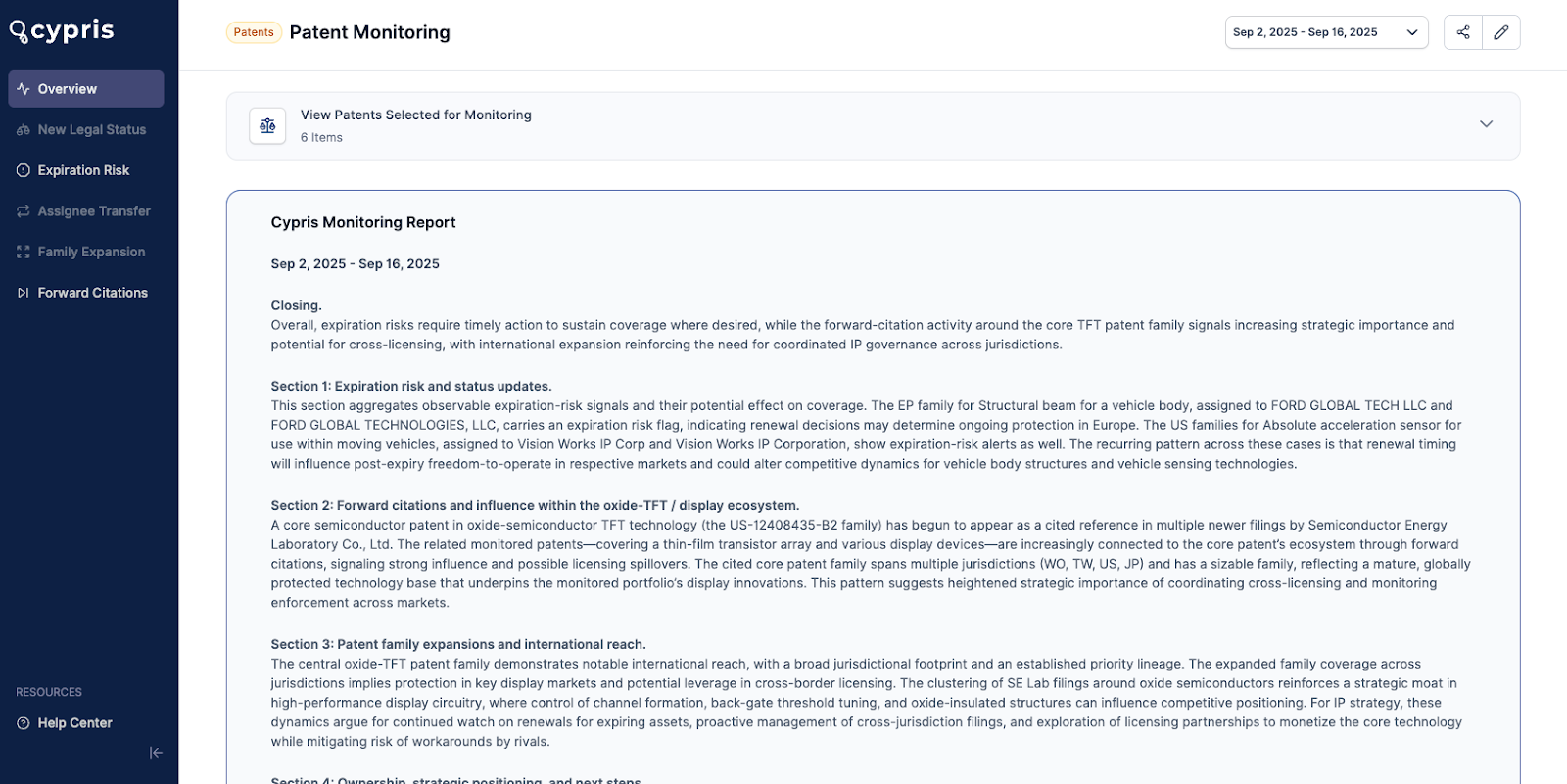
Spreadsheets are no longer needed. Updates now appear in a clear format that highlights key changes such as patent expansions, assignee transfers, or competitor filings. Each report includes AI-generated summaries powered by advanced LLMs to surface the most important trends and context. Reports are refreshed regularly, saved automatically, and build a continuous historical log for long-term tracking.
For many teams, these AI-enhanced reports are the most impactful shift. Instead of raw updates, Monitoring now provides analysis—turning activity like organizational filings or new research papers into intelligence that can guide investment and innovation decisions.
Beyond the reports themselves, having all updates housed directly within Cypris elevates the platform experience as a whole. The new interface is more intuitive, reducing friction for everyday use, and its design makes it easier for teams to collaborate in real time.
Monitoring is also fully integrated with Projects, so you can create and share monitors directly within your team’s workspace. This makes it simple to align ongoing research, track critical events together, and keep collaborators up to speed—all without switching tools. By connecting monitoring with projects, Cypris transforms isolated updates into shared intelligence that enhances both decision-making and collaboration across your organization.
Newsletter-Style Email Experience
Monitoring emails now feel more like a personalized newsletter. Each update arrives in a clean, structured layout with an easy-to-read AI-generated summary of recent activity, spotlighted trends, and direct links to dive deeper in the platform. Content is grouped into clear sections and filterable by category, so you can quickly scan what’s new, focus on the most relevant updates, and stay effortlessly informed—without inbox clutter.
Simplified Setup & Discoverability
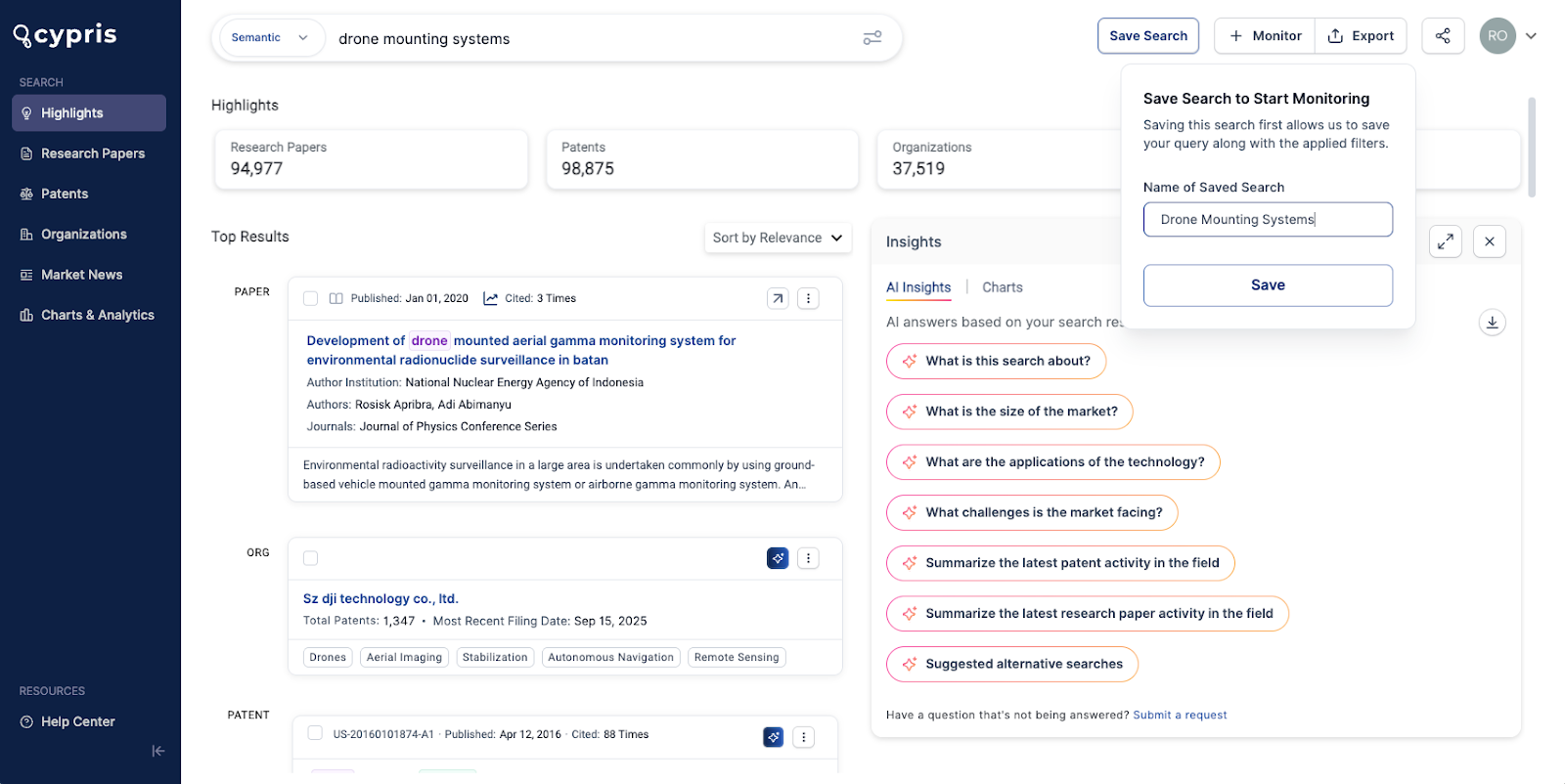
Setting up monitors is now faster and more intuitive. Users can create them in a single streamlined interface—quickly searching patent numbers, keywords, organizations, or papers and selecting the right mix in one place. Smart suggestions recommend recipients, while the Monitoring button appears directly on every search results page. Current monitors are clearly indicated to prevent duplication, and external recipients can be added to email updates for seamless collaboration.
Noise-Free Updates & Critical Alerts
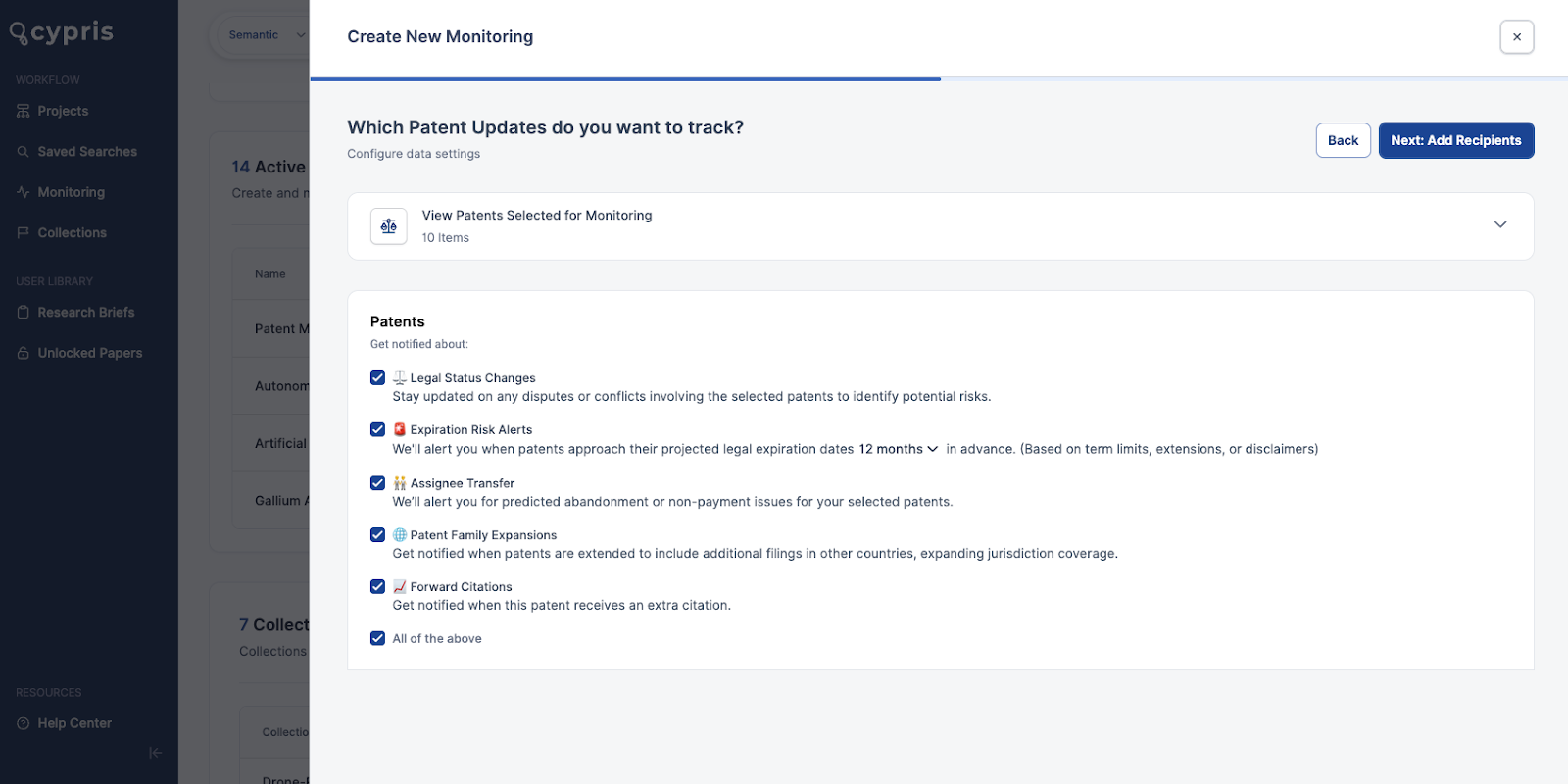
A “send only if new results exist” toggle eliminates duplicate notifications. Monitoring now captures not only newly published patents, papers, and organizations, but also critical patent events such as expiration risks, assignee transfers, patent family expansions, and forward citations—including competitor citations of your own research.
A More Powerful User Experience
Monitoring is built to help users move from raw data to actionable intelligence. Reports save automatically, creating a historical log teams can reference at any time. Items can be flagged directly into collections without manual re-entry. Emails preview AI-enhanced trends with a single click into interactive dashboards, and users can easily add colleagues or external recipients to stay aligned.
From a design perspective, the rebuild also gave our team room to innovate.
As one of our engineering team members, Maddie explained: “It was fun to build something new from scratch. From a UI perspective, we were able to make better design choices right from the start, which made for a much smoother, more intuitive user experience.”
Built for Speed, Accuracy, and Collaboration
With the new Monitoring, teams can save time compared to manual tracking, strengthen competitive intelligence with reliable, cross-dataset updates, collaborate seamlessly by sharing reports with colleagues or external partners, and trust the signal thanks to accuracy, relevancy filters, and AI-powered summaries.
As part of our engineering team, Oleg explained: “This project sat on top of our existing platform, which meant understanding the entire workflow end to end. It was challenging, but it also gave us the opportunity to rethink how everything fits together—and that’s what made it so rewarding.”
Available Now to All Users
The redesigned Monitoring is live and available across the Cypris platform today. If you’re already using Cypris, you’ll see new Monitoring options throughout your search and reporting workflows.
We’re excited to see how your team uses Monitoring to stay ahead of markets, competitors, and technologies — and to keep pushing the boundaries of what intelligent monitoring can do for R&D.

Subscribe to receive the latest blog posts to your inbox every week.
Thank you! Your submission has been received!
Oops! Something went wrong while submitting the form.
A smarter, more engaging monitoring experience—built for speed, accuracy, and collaboration.
Over the past few years, Cypris has helped innovation teams make faster, more informed decisions by centralizing critical insights across patents, academic papers, organizations, and market activity. But until now, tracking changes over time often meant juggling spreadsheets, scattered alerts, and manual checks—workflows that were hard to manage and easy to miss.
Today, we’re excited to introduce an upgraded Monitoring experience on Cypris, a complete redesign of how teams track critical updates. With streamlined setup, redesigned emails, and advanced LLMs powering analysis, Monitoring makes it easy to stay ahead of market shifts and competitor moves—without the noise.
Why We Rebuilt Monitoring from the Ground Up
The original monitoring tools relied heavily on exports and static spreadsheets, requiring users to piece together updates manually. Alerts were basic, often duplicative, and limited in the types of data they could track. They also didn’t always give teams confidence that updates were reliable, accurate, or relevant to their needs.
We reimagined Monitoring to solve these gaps. Instead of scattered, one-off alerts, the new Monitoring delivers timely, structured reports—only when new results exist. Updates are now enriched with LLM-powered summaries that don’t just describe activity, but interpret it—prioritizing what matters most and filtering out the noise.
What’s New in Monitoring
The Monitoring Report
Spreadsheets are no longer needed. Updates now appear in a clear format that highlights key changes such as patent expansions, assignee transfers, or competitor filings. Each report includes AI-generated summaries powered by advanced LLMs to surface the most important trends and context. Reports are refreshed regularly, saved automatically, and build a continuous historical log for long-term tracking.
For many teams, these AI-enhanced reports are the most impactful shift. Instead of raw updates, Monitoring now provides analysis—turning activity like organizational filings or new research papers into intelligence that can guide investment and innovation decisions.
Beyond the reports themselves, having all updates housed directly within Cypris elevates the platform experience as a whole. The new interface is more intuitive, reducing friction for everyday use, and its design makes it easier for teams to collaborate in real time.
Monitoring is also fully integrated with Projects, so you can create and share monitors directly within your team’s workspace. This makes it simple to align ongoing research, track critical events together, and keep collaborators up to speed—all without switching tools. By connecting monitoring with projects, Cypris transforms isolated updates into shared intelligence that enhances both decision-making and collaboration across your organization.
Newsletter-Style Email Experience
Monitoring emails now feel more like a personalized newsletter. Each update arrives in a clean, structured layout with an easy-to-read AI-generated summary of recent activity, spotlighted trends, and direct links to dive deeper in the platform. Content is grouped into clear sections and filterable by category, so you can quickly scan what’s new, focus on the most relevant updates, and stay effortlessly informed—without inbox clutter.
Simplified Setup & Discoverability
Setting up monitors is now faster and more intuitive. Users can create them in a single streamlined interface—quickly searching patent numbers, keywords, organizations, or papers and selecting the right mix in one place. Smart suggestions recommend recipients, while the Monitoring button appears directly on every search results page. Current monitors are clearly indicated to prevent duplication, and external recipients can be added to email updates for seamless collaboration.
Noise-Free Updates & Critical Alerts
A “send only if new results exist” toggle eliminates duplicate notifications. Monitoring now captures not only newly published patents, papers, and organizations, but also critical patent events such as expiration risks, assignee transfers, patent family expansions, and forward citations—including competitor citations of your own research.
A More Powerful User Experience
Monitoring is built to help users move from raw data to actionable intelligence. Reports save automatically, creating a historical log teams can reference at any time. Items can be flagged directly into collections without manual re-entry. Emails preview AI-enhanced trends with a single click into interactive dashboards, and users can easily add colleagues or external recipients to stay aligned.
From a design perspective, the rebuild also gave our team room to innovate.
As one of our engineering team members, Maddie explained: “It was fun to build something new from scratch. From a UI perspective, we were able to make better design choices right from the start, which made for a much smoother, more intuitive user experience.”
Built for Speed, Accuracy, and Collaboration
With the new Monitoring, teams can save time compared to manual tracking, strengthen competitive intelligence with reliable, cross-dataset updates, collaborate seamlessly by sharing reports with colleagues or external partners, and trust the signal thanks to accuracy, relevancy filters, and AI-powered summaries.
As part of our engineering team, Oleg explained: “This project sat on top of our existing platform, which meant understanding the entire workflow end to end. It was challenging, but it also gave us the opportunity to rethink how everything fits together—and that’s what made it so rewarding.”
Available Now to All Users
The redesigned Monitoring is live and available across the Cypris platform today. If you’re already using Cypris, you’ll see new Monitoring options throughout your search and reporting workflows.
We’re excited to see how your team uses Monitoring to stay ahead of markets, competitors, and technologies — and to keep pushing the boundaries of what intelligent monitoring can do for R&D.
Keep Reading
•
XX
min read
As an R&D platform and custom report service, search functionality for our users is key.
That's why we're thrilled to announce our platform's user experience and research capabilities just got better. Meet Quick Search, a new search bar that delivers information to our users faster than ever.
What's New with this Launch?
The previous search functionality allowed for search only by keywords. With Quick Search, users can now search by patent and research paper titles in addition to keywords.
What's the User Experience Like?
As you type in your search (keyword, patent, or research paper) you'll see a live tally of the data by category available for that search.
From there, you can click into individual data sections or build a report pulling from all available data streams.
0:00/1×
Have questions or comments? Feel free to reach out to us at info@ipcypris.com for more information.
Meet Quick Search, Our New Functionality
Blogs
•
XX
min read
Is Google Scholar good for research? This question is often raised by researchers and professionals in various fields. In this blog post, we will examine the benefits and drawbacks of Google Scholar to determine its appropriateness for your research requirements.
We will discuss the extensive coverage provided by Google Scholar, its ranking system for relevance in comparison with other databases such as Scopus and Web of Science, and the citation tracking functionality offered by Google Scholar.
To conclude our analysis on “Is Google Scholar good for research?”, we’ll highlight the importance of complementing it with specialized databases like PubMed or IEEE Xplore for specific disciplines or combining it with Scopus or Web of Science for advanced search capabilities.
Yes, Google Scholar is a valuable resource for research as it offers extensive coverage of scholarly literature, including conference papers, books, preprints, and journal articles. Its ranking system helps in identifying relevant resources while the citation tracking functionality aids in analyzing impact factors.
Extensive Coverage of Google Scholar
Google Scholar offers a vast range of scholarly literature, indexing over 160 million documents from various sources such as conference papers, books, preprints, and journal articles. Google Scholar provides a convenient way to access an extensive range of scholarly material, eliminating the need for users to search through multiple websites or databases.
Conference Papers Indexed in Google Scholar
The platform includes an extensive collection of conference papers from numerous disciplines. By accessing these resources through Google Scholar, researchers can stay up-to-date with the latest findings presented at conferences around the world.
Books Available Through the Search Engine
In addition to academic articles and conference proceedings, Google Scholar also indexes books published by reputable publishers. Researchers can use this feature to locate essential reference materials for their projects and gain insights into previous studies conducted within their field.
Preprints and Journal Articles Accessible via the Platform
Preprints: These are preliminary versions of research papers that have not yet been peer-reviewed but are made available online for feedback from other experts in the field. By including preprint repositories like arXiv.org or bioRxiv.org in its search results, Google Scholar helps researchers discover cutting-edge work before it is formally published.
Journal Articles: As one would expect, a significant portion of indexed content on Google Scholar consists of peer-reviewed journal articles across various fields. The platform’s comprehensive coverage ensures that users can access high-quality research material efficiently while conducting searches using keywords related to their area of interest.
For those asking “is google scholar good for research”, Google Scholar is an excellent tool for researchers looking to find relevant and reliable sources quickly. Its extensive coverage of various types of scholarly literature, including conference papers, books, preprints, and journal articles, makes it a valuable resource for anyone conducting research.
Google Scholar employs a sophisticated algorithm to rank search results based on their relevance, taking into account factors such as the author’s citation count and publication history. This ranking system has been found to provide better precision than other multidisciplinary databases like Scopus or Web of Science, particularly when searching for specific topics within respective fields.
A study by Martin-Martin et al. demonstrated that Google Scholar outperforms these alternatives in terms of precision and coverage.
Factors Considered in Ranking Search Results
Citation count: The number of times an article has been cited by others is used as an indicator of its importance and impact within the field.
Publication history: Articles published in well-established journals with high impact factors are more likely to be ranked higher, reflecting their perceived quality and credibility.
Affiliation: The reputation of the authors’ institutions can also influence rankings, with prestigious universities often being associated with higher-quality research output.
Comparison with Scopus and Web of Science
In comparison to Google Scholar, both Scopus and Web of Science offer advanced search capabilities allowing users greater control over filtering options; however, they may not always deliver superior results due to limitations in their indexing scope or potential biases towards certain disciplines or sources.
Google Scholar’s ranking system for relevance provides an effective way to identify the most relevant and impactful research, allowing R&D teams to quickly gain insights into their topics of interest making it the option to choose when asking “is google scholar good for research”. Moving on, citation tracking functionality through Google Scholar can provide further insight into the impact factor of a particular piece of research.
When asking “is google scholar good for research”, one key feature that makes it suitable for research purposes is its citation-tracking functionality. Researchers can easily track citations received by their work or others, helping them stay informed about recent developments in their field while also providing valuable insight into the impact factor of publications they are interested in citing themselves.
Benefits of Tracking Citations Using Google Scholar
Ease of use: With a simple interface, researchers can quickly access information on how many times an article has been cited and view the list of citing articles.
Breadth of coverage: Google Scholar’s extensive database ensures that users have access to a wide range of citation data from various sources such as conference papers, books, preprints, and journal articles.
Analyzing trends: By monitoring citation patterns over time, researchers can identify emerging trends within their field and assess the significance or relevance of specific topics.
Impact Factor Analysis Through Citation Data
The number of citations an article receives is often used as an indicator of its impact within a particular discipline. While this metric has limitations – such as potential biases towards older publications with more time to accumulate citations – it still provides useful insights when comparing different resources during literature reviews or grant applications.
By utilizing Google Scholar’s search results alongside other databases like Scopus or Web of Science, R&D managers, and engineers can make better-informed decisions regarding which publications hold greater weight within their respective fields. Citation tracking functionality is a powerful tool for R&D and innovation teams, allowing them to quickly access the literature they need while understanding its impact.
Despite its benefits, there are limitations associated with using Google Scholar exclusively for conducting research. Some of the key challenges include a lack of quality control, incomplete metadata records, limited advanced search options compared to other databases, inconsistencies in coverage regarding specific disciplines or journals, and a lack of transparency on the methodology behind content indexing and result rankings.
Quality Control Concerns with Unfiltered Resources
Google Scholar’s unfiltered approach may lead to the inclusion of low-quality resources such as predatory journals or self-published articles that have not undergone rigorous peer-review processes. This makes it crucial for researchers to verify the credibility of sources before citing them in their work.
Incomplete Metadata Affecting Resource Selection Process
The incomplete metadata records retrieved through Google Scholar often lack essential bibliographic details, including abstracts, which can make it difficult for users to assess the relevance of a resource without having to visit each individual source website.
Limited advanced search options available in Google Scholar, when compared with specialized databases like Scopus or Web of Science, restrict researchers from carrying out comprehensive literature reviews by narrowing down results based on specific criteria such as publication date range or document type.
Inconsistency in Indexing Affecting Representation of Available Literature
Google Scholar’s coverage of specific disciplines, journals, or individual articles can be inconsistent, which may lead to gaps in the available literature and hinder researchers from obtaining a complete understanding of their research topic.
Lack of Transparency on Google Scholar’s Methodology
The obscurity of Google Scholar’s indexing and rating process renders it difficult for people to comprehend how search outcomes are produced, potentially producing imbalances in the depiction of scholarly material within its database.
Despite its limitations and challenges, Google Scholar remains a valuable tool for research teams. However, it is important to supplement the platform with specialized databases in order to maximize search capabilities.
Key Takeaway:
Using Google Scholar exclusively for research has limitations such as a lack of quality control, incomplete metadata records, limited advanced search options compared to other databases, inconsistencies in coverage regarding specific disciplines or journals, and a lack of transparency on the methodology behind content indexing and result rankings. Researchers should verify sources before citing them in their work due to concerns with unfiltered resources that may include low-quality materials like predatory journals or self-published articles without rigorous peer-review processes.
Complementing Google Scholar with Specialized Databases
Is google scholar good for research? Yes, but complementing it with specialized databases makes it even better. To ensure access to high-quality information relevant to their field and carry out comprehensive searches without missing important publications, researchers should use specialized databases alongside Google Scholar.
By using multiple sources together, R&D managers, engineers, scientists, and innovation teams can leverage the strengths offered by each database while mitigating potential drawbacks associated with any single source.
Importance of Using PubMed or IEEE Xplore for Specific Disciplines
In addition to Google Scholar’s extensive coverage, it is crucial for researchers in specific disciplines such as life sciences or engineering to utilize specialized databases like PubMed or IEEE Xplore, respectively. These platforms offer more targeted search results and provide access to unique resources not available on Google Scholar.
For instance, PubMed includes biomedical literature from MEDLINE while IEEE Xplore houses a vast collection of technical papers related to electrical engineering and computer science.
Combining Scopus or Web of Science for Advanced Search Capabilities
Scopus and Web of Science, two multidisciplinary research databases that are often compared with Google Scholar due to their wide-ranging content coverage, offer advanced search capabilities that may be lacking in the latter platform. Some benefits include better filtering options, more comprehensive citation analysis, and higher-quality metadata.
Incorporating specialized databases like PubMed or IEEE Xplore along with multidisciplinary platforms such as Scopus or Web of Science can significantly enhance the efficiency and effectiveness of research efforts when used in conjunction with Google Scholar. Researchers can leverage the strengths of each database to obtain a more comprehensive view of the research landscape and make informed decisions based on the search results.
Key Takeaway:
To conduct comprehensive research, R&D teams should complement Google Scholar with specialized databases like PubMed or IEEE Xplore for specific disciplines and Scopus or Web of Science for advanced search capabilities. By using multiple sources together, researchers can leverage the strengths offered by each database while mitigating potential drawbacks associated with any single source to obtain a more comprehensive view of the research landscape.
Conclusion
So overall, is Google Scholar good for research? Yes, Google Scholar offers a user-friendly interface with extensive coverage of scholarly literature, a ranking system for relevance, and citation-tracking functionality. There are limitations associated with using Google Scholar exclusively for conducting research, however, you can counter this by complementing it with specialized databases to ensure high-quality and comprehensive searches.
If you’re looking for more ways to improve your R&D process or need help navigating available resources like Google Scholar effectively, contact Cypris and unlock your team’s potential! Our platform provides rapid time-to-insights, centralizing data sources for improved R&D and innovation team performance.
Is Google Scholar Good for Research? Exploring Pros & Cons
Blogs
•
XX
min read
A faster, more accurate way to explore innovation data—now available in Cypris.
For innovation teams, speed and accuracy aren’t optional—they’re critical. You need to quickly find all relevant documents, slice and dice datasets however you want, and trust that the results are complete and representative. With this in mind, we’ve upgraded how semantic search works inside Cypris.
Today, we’re launching an upgraded search infrastructure that gives users access to full, exact result sets—unlocking more powerful analysis, faster iteration, and deterministic filtering and charting.
Unlike traditional semantic or vector search engines—which make it difficult to count, filter, or chart large sets of matched documents—our new approach prioritizes transparency and performance while preserving semantic relevance.
Why we moved away from vector search
Our original implementation relied on semantic and vector search to capture the “meaning” behind user queries. But as our platform evolved, it became clear that these systems weren’t well-suited for our core use cases.
Users needed:
Deterministic filtering (e.g., "how many results match this atom?")
Transparent, complete result sets to power charts and dashboards
Fast, repeatable queries that don’t change subtly over time
Modern vector search systems don’t easily support this level of transparency. They return approximate matches and abstract similarity scores, often making it hard to understand why a document was returned—or whether it’s the full picture.
So we made a decision: move away from vector search and lean into what traditional search engines do best.
A return to boolean and lexical search—with a twist
We rebuilt our search infrastructure on top of Elasticsearch’s powerful boolean and lexical search capabilities. This shift brings major advantages:
Faster query speeds that dramatically improve iteration time
Deterministic filtering and counts, so every chart is grounded in the full dataset
Predictable, explainable results that users can trust
But we didn’t stop there.
To preserve the benefits of semantic understanding, we’ve rethought where that intelligence should live—not at query time, but at data ingestion.
Capturing semantic meaning at ingest time
Instead of computing document-query similarity during search, we enrich documents at the time of ingestion. Here’s how:
Synonym expansion: We find related words and concepts not explicitly mentioned in the document and add them as fields, enabling semantic-style recall via lexical search.
Stemming: Both queries and documents are reduced to their root forms, allowing consistent matches (e.g., “running” and “run”).
The result? You get the same functionality—semantically relevant results—without the opacity or latency tradeoffs of vector search.
What’s next: Reranking for even better relevance
We’re not done. Coming soon to Cypris is a reranking layer that boosts the most relevant results to the top of the list using lightweight vector techniques.
Here’s how it works:
A standard lexical search retrieves the full result set.
We take the top N results and rerank them using vector similarity, powered by Elasticsearch’s new hybrid scoring capabilities.
You get faster queries with even better relevance—without compromising on counts or transparency.
This layered approach gives us the best of both worlds: precise filtering and fast queries, plus smarter ordering of results where it matters most.
We’re excited to bring this upgrade to our users, and we’re already seeing teams iterate faster and uncover insights more confidently. This is a foundational shift—and just the beginning of what’s to come.
Want a walkthrough of what’s changed? Reach out to our team.