For the best experience, this project uses the Webflow Input Enhancer extension. We highly recommend installing it. Click here to download (use preview mode to access link)
With the growing interest in space flight and deep space exploration, more research is focusing on how to make life outside of earth habitable for human beings, and at what cost. In this blog, we’ll look at the market landscape of space travel, recent innovation activity, and scientific literature to gain a full picture of where our understanding of life beyond earth is headed.
Market Overview:
According to the Cypris Innovation Dashboard, over the past year alone, 15 new organizations entered the space travel industry (13 of which were startups) and the majority were based in USA. The past year also saw 406 new patents across 22 different countries, 10,549 new research papers, and 26,156 news articles published in the space. The majority of news articles focused on new products, and across the board media coverage was positive.
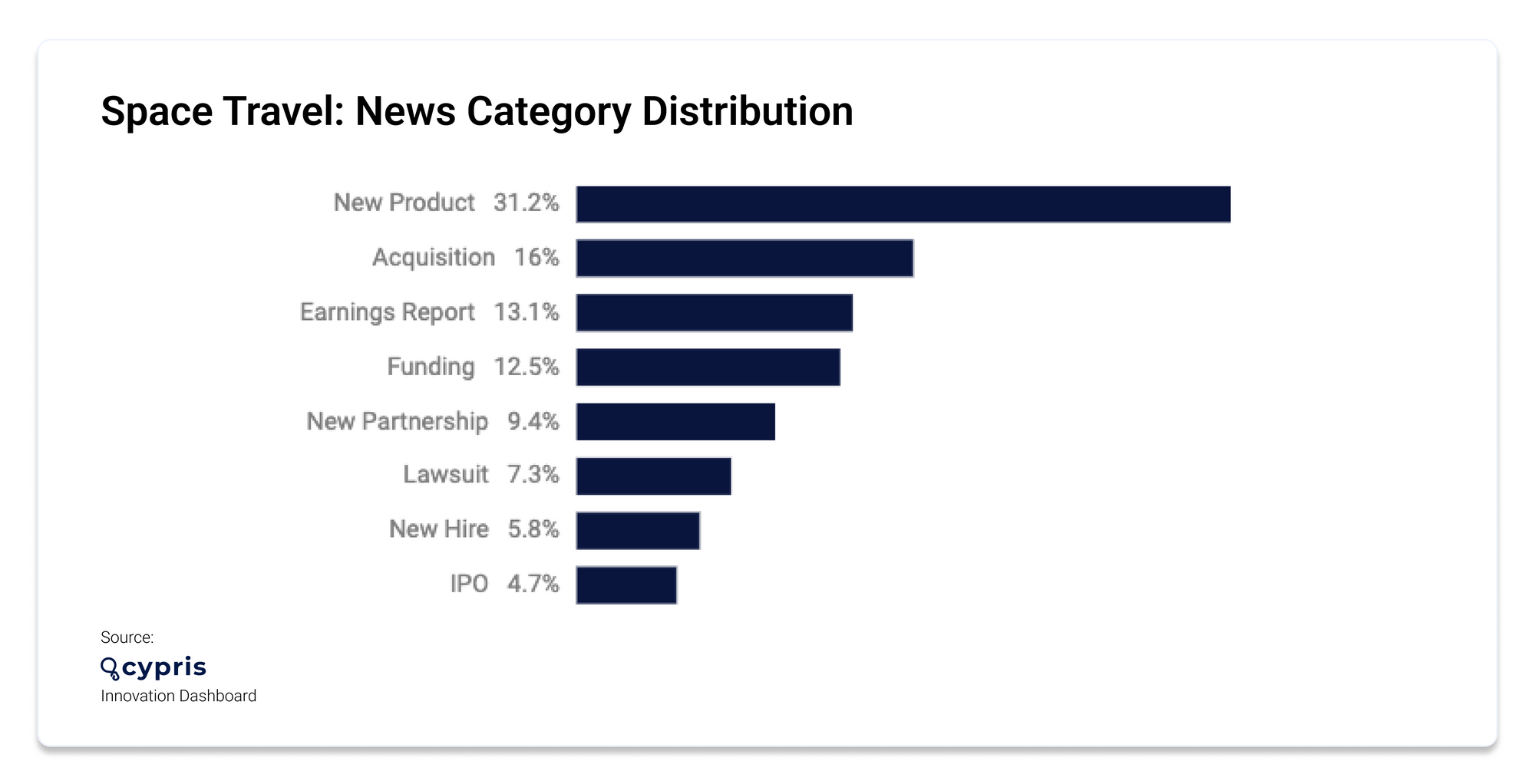
News category breakdown
Of the patents published, 15.46% were created by the top 3 entities: NANJING SANLE GROUP CO LTD, ANHUI HUADONG PHOTOELEC TECH, and EMULATE INC. Below, you can see the breakdown of patent activity by region.
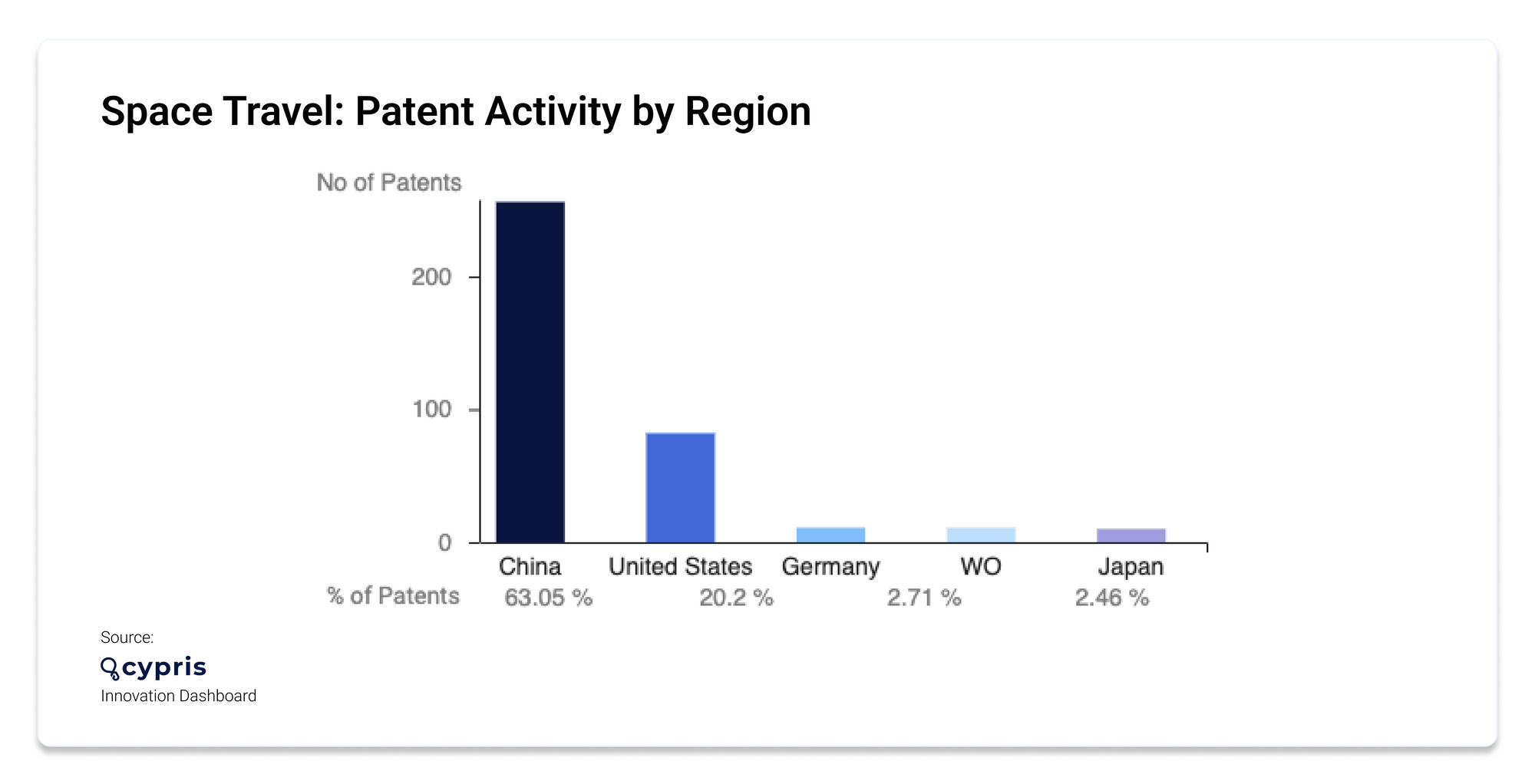
Patent count by region
In the recent months, a number of new scientific studies have been released on efforts to make life in outer space habitable for human beings, and the impact of travel on the body and brain. Let's dive into a few of these findings.
Creating Oxygen in Space Using Magnets:
Researchers at the University of Warwick have invented a new way to make oxygen for astronauts using magnets. To provide oxygen in space, NASA currently uses centrifuges, which are large machines that require significant mass, power, and maintenance. As a result, scientists have been looking for a sustainable way to create air in space.
This study focused on the phenomenon of magnetically-induced buoyancy. The researchers engineered a procedure to detach gas bubbles from electrode surfaces in microgravity environments at the Bremen Drop Tower. The results revealed for the first time that gas bubbles can be ‘attracted to’ and ‘repelled from’ a neodymium magnet in microgravity within various solutions.
According to Dr. Katharina Brinkert of the University of Warwick Department of Chemistry Center for Applied Space Technology and Microgravity (ZARM), “Efficient phase separation in reduced gravitational environments is an obstacle for human space exploration and known since the first flights to space in the 1960s. This phenomenon is a particular challenge for the life support system onboard spacecraft and the International Space Station (ISS) as oxygen for the crew is produced in water electrolyzer systems and requires separation from the electrode and liquid electrolyte.”
The results of this study could help generate breathable atmospheres for future space travel to the moon and Mars.
Space Travel’s Impact on the Body's Bone Mass & Stem Cells:

For those who stay in space for longer periods of time, the most prominent side effect is the loss of bone mass. New research now claims that living in space can also accelerate the process of bone aging, and irreparably damage bone structure.
The study assessed 14 male and three female astronauts, average age 47, whose missions ranged from four to seven months in space, with an average of about 5-1/2 months. The results showed that 1 year after their return from space, the astronauts on average exhibited 2.1% reduced bone mineral density at the tibia and 1.3% reduced bone strength. Nine of the 17 astronauts had not completely recovered a full year after returning from space.
"Astronauts experienced significant bone loss during six-month spaceflights - loss that we would expect to see in older adults over two decades on Earth, and they only recovered about half of that loss after one year back on Earth," Gabel said.
Additionally, another recent study focused on 14 astronauts from NASA’s space shuttle program whose white blood samples were stored for 20 years. Researchers found that the astronauts were more likely to have somatic mutations in their genes. The DNA mutations in blood-forming stem cells are at the root of several types of blood cancer.
Space Travel’s Impact on the Brain:
We know that space travel impacts the body, but what does it do to the brain? In this study, 12 cosmonauts who spent an average of six months aboard the International Space Station were scanned in an MRI scanner pre-flight, ten days after flight, and at a follow-up time point seven months after flight.
The results revealed "significant microstructural changes" in the white matter that manages communications within the brain, and to and from the rest of the body, as well as fluid shifts. In particular, the research team spotted changes in neural tracts related to sensory and motor functions, and believe this could have something to do with the cosmonauts' adaptation to life in microgravity while in outer space.
Whether through creating oxygen in outer space, or studying how travel impacts the brain and body, significant advances are being made in the space travel industry. For more data on patents and innovative research papers in the space travel field, visit cypris.ai and get started with access to the innovation dashboard.
If you’d like to explore recent patents filed, you can search through our global patent search engine for free here: https://cypris.ai/patents/allrecords
Sources:
Cypris innovation dashboard cypris.ai ; Query: space travel
Subscribe to receive the latest blog posts to your inbox every week.
Thank you! Your submission has been received!
Oops! Something went wrong while submitting the form.
With the growing interest in space flight and deep space exploration, more research is focusing on how to make life outside of earth habitable for human beings, and at what cost. In this blog, we’ll look at the market landscape of space travel, recent innovation activity, and scientific literature to gain a full picture of where our understanding of life beyond earth is headed.
Market Overview:
According to the Cypris Innovation Dashboard, over the past year alone, 15 new organizations entered the space travel industry (13 of which were startups) and the majority were based in USA. The past year also saw 406 new patents across 22 different countries, 10,549 new research papers, and 26,156 news articles published in the space. The majority of news articles focused on new products, and across the board media coverage was positive.
News category breakdown
Of the patents published, 15.46% were created by the top 3 entities: NANJING SANLE GROUP CO LTD, ANHUI HUADONG PHOTOELEC TECH, and EMULATE INC. Below, you can see the breakdown of patent activity by region.
Patent count by region
In the recent months, a number of new scientific studies have been released on efforts to make life in outer space habitable for human beings, and the impact of travel on the body and brain. Let's dive into a few of these findings.
Creating Oxygen in Space Using Magnets:
Researchers at the University of Warwick have invented a new way to make oxygen for astronauts using magnets. To provide oxygen in space, NASA currently uses centrifuges, which are large machines that require significant mass, power, and maintenance. As a result, scientists have been looking for a sustainable way to create air in space.
This study focused on the phenomenon of magnetically-induced buoyancy. The researchers engineered a procedure to detach gas bubbles from electrode surfaces in microgravity environments at the Bremen Drop Tower. The results revealed for the first time that gas bubbles can be ‘attracted to’ and ‘repelled from’ a neodymium magnet in microgravity within various solutions.
According to Dr. Katharina Brinkert of the University of Warwick Department of Chemistry Center for Applied Space Technology and Microgravity (ZARM), “Efficient phase separation in reduced gravitational environments is an obstacle for human space exploration and known since the first flights to space in the 1960s. This phenomenon is a particular challenge for the life support system onboard spacecraft and the International Space Station (ISS) as oxygen for the crew is produced in water electrolyzer systems and requires separation from the electrode and liquid electrolyte.”
The results of this study could help generate breathable atmospheres for future space travel to the moon and Mars.
Space Travel’s Impact on the Body's Bone Mass & Stem Cells:
For those who stay in space for longer periods of time, the most prominent side effect is the loss of bone mass. New research now claims that living in space can also accelerate the process of bone aging, and irreparably damage bone structure.
The study assessed 14 male and three female astronauts, average age 47, whose missions ranged from four to seven months in space, with an average of about 5-1/2 months. The results showed that 1 year after their return from space, the astronauts on average exhibited 2.1% reduced bone mineral density at the tibia and 1.3% reduced bone strength. Nine of the 17 astronauts had not completely recovered a full year after returning from space.
"Astronauts experienced significant bone loss during six-month spaceflights - loss that we would expect to see in older adults over two decades on Earth, and they only recovered about half of that loss after one year back on Earth," Gabel said.
Additionally, another recent study focused on 14 astronauts from NASA’s space shuttle program whose white blood samples were stored for 20 years. Researchers found that the astronauts were more likely to have somatic mutations in their genes. The DNA mutations in blood-forming stem cells are at the root of several types of blood cancer.
Space Travel’s Impact on the Brain:
We know that space travel impacts the body, but what does it do to the brain? In this study, 12 cosmonauts who spent an average of six months aboard the International Space Station were scanned in an MRI scanner pre-flight, ten days after flight, and at a follow-up time point seven months after flight.
The results revealed "significant microstructural changes" in the white matter that manages communications within the brain, and to and from the rest of the body, as well as fluid shifts. In particular, the research team spotted changes in neural tracts related to sensory and motor functions, and believe this could have something to do with the cosmonauts' adaptation to life in microgravity while in outer space.
Whether through creating oxygen in outer space, or studying how travel impacts the brain and body, significant advances are being made in the space travel industry. For more data on patents and innovative research papers in the space travel field, visit cypris.ai and get started with access to the innovation dashboard.
If you’d like to explore recent patents filed, you can search through our global patent search engine for free here: https://cypris.ai/patents/allrecords
Sources:
Cypris innovation dashboard cypris.ai ; Query: space travel
Case Study: How Talking Rain uncovered cutting-edge insights to stay ahead of their competition with Cypris
Blogs
December 27, 2022
•
XX
min read
Why invest in R&D? Research and development is essential for organizations looking to stay competitive and innovate. Despite the potential rewards of investing in R&D, there are several challenges that must be considered before diving into a project.
Understanding these challenges as well as how to overcome them with strategies can help ensure success when investing in R&D.
Cypris offers an efficient platform designed specifically for teams engaged in R&D and innovation projects, helping reduce time-to-insight while ensuring successful investments into new ideas or processes.
Read on to learn more about the benefits, challenges, and strategies of why invest in R&D with Cypris!
R&D is an important part of any company’s operations. It helps to create new products and services, as well as improve existing ones.
However, it can be difficult to measure the return on investment (ROI) for R&D expenses due to their long-term nature and uncertain outcomes.
One way that companies have tried to maximize the ROI from their R&D investments is by implementing a “20% rule” which allows employees to spend 20% of their time working on personal projects related to the company’s core business objectives.
Alphabet Inc. has been particularly successful with this approach. Many popular products such as Gmail and Wear OS were created through its 20% rule initiative.
Another strategy for maximizing ROI from R&D involves setting clear goals before beginning research activities.
Companies should determine what they want out of their research efforts in terms of tangible results or improvements in existing products or services before investing resources into them.
This will help ensure that funds are being spent wisely and efficiently towards achieving desired outcomes rather than wasted on unproductive pursuits.
It is also important for companies engaging in R&D activities to keep track of progress throughout the process so they can adjust course if necessary.
By monitoring progress closely, companies can make sure that resources are being used effectively and efficiently towards reaching desired goals while avoiding costly missteps or delays caused by unforeseen circumstances during development cycles.
Finally, it is essential for companies engaging in R&D activities to document all findings thoroughly so they can be shared with other departments within the organization. This ensures that valuable information isn’t lost over time but instead remains accessible whenever needed.
Types of R&D
R&D can be divided into two main categories: corporate and start-up.
Corporate R&D is typically done by large companies with dedicated departments staffed with engineers, industrial scientists, and other experts. This type of research often focuses on improving existing products or developing new ones.
Start-up R&D is more focused on creating innovative solutions to problems that don’t yet have a solution.
Start-ups are usually supported by venture capital firms through incubators or accelerators which help them bring their product to market and scale the business.
In addition to these two types of research, there are also public sector organizations such as universities and government agencies that conduct scientific research for the benefit of society at large. These organizations focus on research topics such as climate change, energy efficiency, and disease prevention instead of commercial products like corporations do.
Finally, there are also individual inventors who work independently in their own laboratories or workshops to develop inventions that could potentially revolutionize an industry or solve a problem no one else has been able to solve before.
Inventors often rely heavily on crowdfunding platforms like Kickstarter in order to finance their projects since they lack access to traditional sources of funding like venture capital firms or corporate sponsorships.
Regardless of what type of R&D you’re involved in – whether it’s corporate research for big companies or independent inventions – having access to reliable data sources is essential for making informed decisions about your project’s direction and progress over time.
That’s where Cypris comes in. We provide teams with a centralized platform so they can quickly gain insights from all their data sources without needing multiple tools or manual processes.
Why Invest in R&D?
Investing in research and development can bring many benefits to a business. Increased productivity, improved quality, and enhanced innovation are just some of the advantages that businesses can gain from investing in R&D.
Increased Productivity
Investing in R&D helps businesses become more efficient by allowing them to develop new processes or technologies that improve their operations. For example, using automation tools such as robotics or artificial intelligence can help reduce labor costs while increasing production speed and accuracy.
Additionally, investing in R&D may also lead to the discovery of new products or services which could further increase the profitability of a business.
Improved Quality
Investing in R&D gives you access to better resources, which allows you to produce higher-quality products and services. This includes utilizing advanced materials such as graphene or nanotechnology which offer superior performance compared to traditional materials used for manufacturing purposes.
Additionally, R&D teams may be able to identify potential defects early on during product development stages, thus preventing costly recalls due to faulty products.
Enhanced Innovation
Finally, investing in R&D encourages creativity within an organization, leading it toward innovative solutions. Companies that invest heavily in their own internal research initiatives often find themselves at the forefront of emerging trends within their respective industries.
Investing in R&D comes with its own set of challenges. High costs and risk are two of the most significant issues that companies face when investing in research and development.
Developing new products or services requires substantial financial resources, which can often lead to budget overruns if not managed properly.
Additionally, there is always an element of risk involved when launching a new product or service. Even after extensive testing and market analysis, there is no guarantee that the product will be successful.
Another challenge associated with investing in R&D is the long time-to-market. Even after extensive research and development efforts have been completed, it still takes time for the product or service to reach consumers. This process includes manufacturing, marketing campaigns, and distribution channels — all of which require additional resources and effort from the company.
Finally, measuring ROI on investments made in R&D projects can also be difficult due to various factors such as a lack of data points available for comparison purposes or difficulty predicting future trends accurately.
Companies need to develop effective strategies for tracking progress against goals set during project planning stages so they can measure their return on investment more effectively over time.
Why Invest in R&D With Cypris?
R&D teams must have the right tools and technologies to ensure success. Cypris is a research platform that provides centralized data sources for rapid time to insights, automated workflows for streamlined processes, and collaborative platforms for easier communication and decision-making.
Centralized Data Sources
With Cypris’s centralized data sources, R&D teams can quickly access all of their information from one place without having to search through multiple systems or documents. This helps them save time by reducing the need to manually enter data into different systems or compile reports from various sources.
Additionally, they can easily analyze trends across projects with real-time visualizations so they can make better decisions faster.
Automated Workflows
Automating tedious tasks such as reporting saves valuable time that could be spent on more productive activities like brainstorming new ideas or analyzing results. Cypris offers automated workflows that enable users to set up custom rules based on specific criteria so they don’t have to worry about manual entry errors or missed deadlines. These automated workflows help streamline processes so teams are able to focus on higher-value tasks instead of mundane ones.
Collaborative Platforms
Collaboration is key when it comes to successful innovation initiatives. However, traditional methods of communication often lead to delays in decision-making due lack of difficulty coordinating between multiple stakeholders spread out across different locations and departments. With its collaborative platform feature, Cypris enables team members to stay connected while tracking progress in real time, which leads to increased productivity and improved quality outcomes.
By leveraging these features offered by Cypris, businesses will be able to maximize their return on investment (ROI) while minimizing costs associated with investing in R&D.
Conclusion
Why invest in R&D?
The benefits of investing in R&D outweigh its challenges when done correctly. Setting clear goals and objectives, utilizing appropriate tools and technologies, developing an effective team structure and processes, tracking progress, measuring ROI accurately, and creating a culture of continuous improvement all play key roles in ensuring successful outcomes from any given project.
With the right strategies and tools like Cypris, companies can maximize their return on investment while minimizing risk. By leveraging data-driven insights to inform decisions and streamline processes, organizations can ensure that their investments in R&D will pay off in the long run.
Investing in research and development is essential for staying competitive, innovating faster, and driving greater ROI. Cypris provides an easy-to-use platform that centralizes data sources teams need into one place so they can get insights quickly.
With Cypris‘ help, you’ll be able to drive innovation faster than ever before! Try out our R&D solutions today – let us show you how your business can benefit from the power of research and development!
Why Invest in R&D? Unlocking Benefits and Strategies
Blogs
December 27, 2022
•
XX
min read
What is qualified research R&D? Qualified research and development are essential for any R&D and innovation team that wants to maximize its success. It involves the use of a structured approach, incorporating best practices in order to ensure an efficient process from concept generation through commercialization.
However, it can be difficult to implement what is qualified research R&D due to various challenges along the way. In this blog post, we will explore what exactly qualifies as qualified research and development, how teams can benefit from it, and how Cypris can help with its implementation by providing rapid time-to-insights into data sources all in one platform.
Qualified research and development (R&D) is the process of creating new products, services, or processes that are innovative and beneficial to a company. It involves researching existing technologies, developing new ones, testing them out in the marketplace, and making improvements based on customer feedback.
R&D activities can range from basic scientific research to more complex engineering projects.
The purpose of qualified research and development is to discover knowledge or develop new products or processes that are useful for commercial purposes. This includes basic and applied research that seeks to develop specific solutions for particular problems.
Qualified R&D also encompasses experimentation related to product design and improvement efforts such as prototyping and testing.
Benefits of Qualified Research and Development
The primary benefit of qualified R&D is its ability to generate innovation within an organization by providing a platform for creative problem-solving. Additionally, it can help companies stay ahead of their competition by allowing them access to cutting-edge technology before their competitors have had a chance to catch up.
Furthermore, investing in qualified R&D can lead to cost savings through improved efficiency or reduced production expenses.
Examples of Qualified Research and Development
Designing robotics systems for manufacturing operations.
Developing computer algorithms to predict consumer behavior.
Improving medical treatments through clinical trials.
Exploring alternative energy sources such as solar power.
Creating artificial intelligence applications to automate mundane tasks like data entry.
Conducting chemical analysis on soil samples from agricultural fields.
Constructing prototypes for automotive components using 3-dimensional printing technology.
Qualified research and development can help teams achieve greater insights and faster results, leading to better products and services. With a platform like Cypris in place, R&D and innovation teams can maximize their potential for success.
Let’s now explore the benefits of qualified research and development.
Key Takeaway: Qualified research and development (R&D) is a process of creating new products, services, or processes such as robotics systems design, AI applications, alternative energy exploration, and medical treatment improvement through clinical trials.
How to Maximize the Benefits of Qualified Research and Development
To maximize the benefits of qualified R&D, it’s important to establish clear goals and objectives that are in line with the organization’s overall mission. This will help ensure that resources are being allocated effectively towards achieving those goals.
Developing an effective strategy for implementation is also key. This includes identifying potential challenges such as securing adequate funding and resources, overcoming regulatory hurdles and compliance issues, and managing time constraints, cost factors, and risk factors.
Utilizing appropriate tools and resources can also help streamline the process by providing access to data sources needed for analysis or decision-making purposes.
Establishing effective communication channels between teams involved in R&D activities is also a must. Regular meetings should be held to share progress updates among team members so everyone remains on track with their individual tasks.
Additionally, feedback loops should be set up to allow stakeholders from different departments to provide input into how certain aspects of a project could be improved. This ensures that all perspectives are taken into account when making decisions.
Key Takeaway: To maximize the benefits of qualified research and development, it is important to establish clear goals, develop an effective strategy for implementation, utilize appropriate tools and resources, create effective communication channels, and set up feedback loops.
Challenges in Implementing Qualified Research and Development
Securing Adequate Funding and Resources
One of the most significant challenges for R&D teams is securing adequate funding and resources to support their initiatives. Without sufficient financial backing, it can be difficult to launch or sustain an effective research program.
Additionally, without access to the right tools and personnel, projects may suffer from delays or lack of progress. To ensure a successful implementation of qualified R&D activities, organizations must identify sources of reliable funding that will cover all associated costs.
Overcoming Regulatory Hurdles and Compliance Issues
Another challenge in implementing qualified research and development is navigating regulatory hurdles and compliance issues. Depending on the industry sector or geographic region, there may be specific regulations that need to be followed when conducting certain types of research activities.
Organizations must familiarize themselves with applicable laws and regulations in order to avoid potential penalties or other legal repercussions for non-compliance.
Managing Project Constraints
Proper planning is essential for the successful implementation of a qualified R&D initiative. Organizations should have realistic expectations regarding the time, cost, and risk factors associated with their project goals. This will help them complete their objectives within budget.
Managing these constraints effectively can ensure that quality results are achieved without incurring unnecessary expenses.
Best Practices for Qualified Research and Development
To ensure success, it is important to have a clear understanding of the best practices for qualified R&D projects.
Define Clear Goals and Objectives
Establishing clear goals and objectives at the start of an R&D project is key to its successful completion. This involves defining what needs to be achieved in terms of outcomes as well as setting realistic timelines and budgets. It also helps ensure that all stakeholders involved in the project understand their roles and responsibilities throughout the process.
Utilize Appropriate Tools and Resources
Having access to appropriate tools and resources can make a huge difference when it comes to completing an R&D project on time.
For example, having access to powerful data analysis software can help teams quickly identify trends or patterns in large datasets.
Additionally, having access to industry-specific databases can provide invaluable information about competitors’ activities or market trends which could prove useful during product development stages.
Establish Effective Communication Channels
Establishing effective communication channels between team members is crucial for informing everyone about progress and potential issues in each development stage. Regular meetings should be held with all relevant parties so that they remain up-to-date with developments while also providing feedback if needed.
How Can Cypris Help with Qualified Research & Development?
Cypris is a research platform designed to help R&D and innovation teams maximize the benefits of qualified research and development.
Cypris centralizes data sources into one platform, streamlining processes for rapid time to insights. This allows teams to quickly access the information they need without having to search through multiple databases or manually enter data.
Additionally, Cypris enhances collaboration across teams by providing access to specialized expertise and allowing team members from different departments or locations to easily communicate with each other in real-time.
Centralized Data Source in One Platform
By consolidating all relevant data sources into one platform, Cypris eliminates the need for manual entry and searching through multiple databases. This simplifies the process of collecting and analyzing information, enabling teams to get faster results that are more accurate than ever before.
In addition, this centralized system provides greater visibility into projects so that managers can track progress in real-time and make decisions based on up-to-date information.
Streamlining Processes for Rapid Time To Insights
With its streamlined approach, Cypris helps reduce project timelines by eliminating redundant tasks. The result is quicker turnaround times which allow teams to gain valuable insights faster than ever before while also freeing up resources that can be used elsewhere within an organization’s operations.
Cypris enables seamless communication between team members, regardless of their physical location or departmental affiliation. This facilitates better collaboration between individuals who may not otherwise have had direct contact with each other due to geographical constraints or organizational silos.
FAQs About What Is Qualified Research R&D
What qualifies as R&D?
Developing processes, patents, formulas, techniques, prototypes, or software.
Improving or redesigning existing products.
Hiring scientists, designers, or engineers that are engaged in qualified activities.
Devoting time and resources to creating new or innovative products.
What qualifies as R&D costs?
Research and development costs refer to money spent by companies on developing, designing, and enhancing their products, services, technology, or process. The Industrial, Technological, Healthcare, and Pharmaceutical industries usually spend the most on R&D.
What is a qualified research consortium?
A qualified research consortium is a tax-exempt organization described in IRC Section 501(c)(3) or Section 501(c)(6) that is organized and operated primarily to conduct scientific research. It is not a private foundation.
Conclusion
By leveraging best practices and utilizing tools like Cypris that are designed specifically for R&D teams, organizations can ensure they are making the most out of what is qualified research R&D.
Are you looking for a solution to help your R&D and innovation teams quickly gain insights? Look no further than Cypris. Our platform is designed specifically for research and development, centralizing data sources into one place so that teams can rapidly get the answers they need.
With our innovative platform, there’s no more wasting time searching through multiple databases or struggling to find what you’re looking for – just fast results with actionable intelligence. Try Cypris today and see how it can revolutionize your team’s workflow!
What Is Qualified Research R&D? Unlocking Its Benefits