In recent years, a digital transformation of intimacy has taken place—the Internet has become the new matchmaker. Today, it's not uncommon for people to use dating apps and meet their significant other online. In fact, over 323 million people worldwide currently use dating apps.
With more and more people turning to online dating, technologies are being created for things like measuring emotional compatibility, facilitating blind dating, danger prevention, and more. In this blog, we'll look at innovation activity in the online dating market, as well as a few of the new technologies changing how we navigate relationships.
Market Overview:
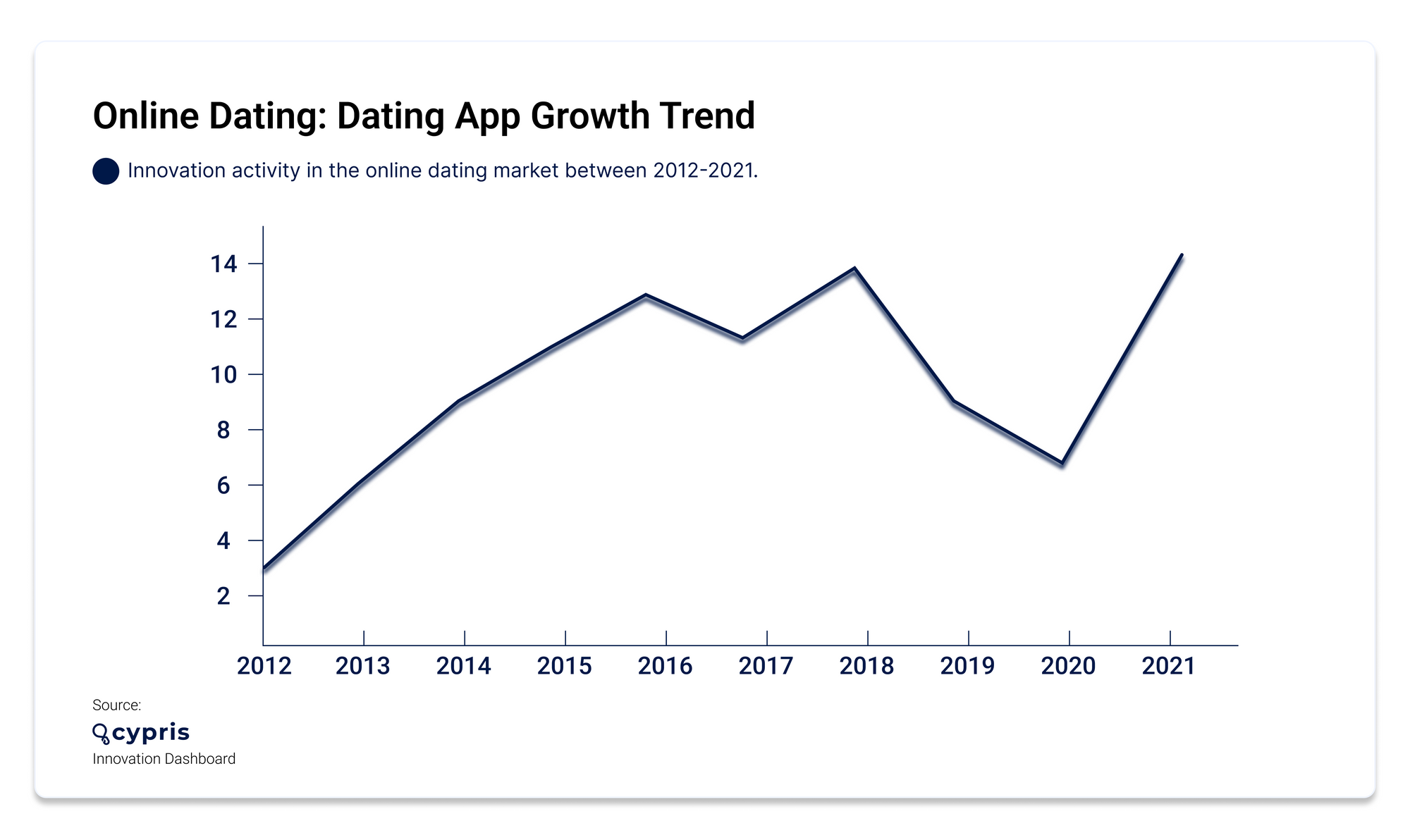
Using the Cypris Innovation Dashboard, we identified innovation activity in the online dating market has grown over the last 5 years, with a 20.91% average growth rate. The top players in the market are Match Group, LLC, Match.com Europe, and e2interactive, Inc., which collectively own 16.9% of IP in the market.
The fastest growing category is Computing Software which saw an 27.92 % increase in new patents filed over the last 5 years, as well as a lot of filings by new entrants.

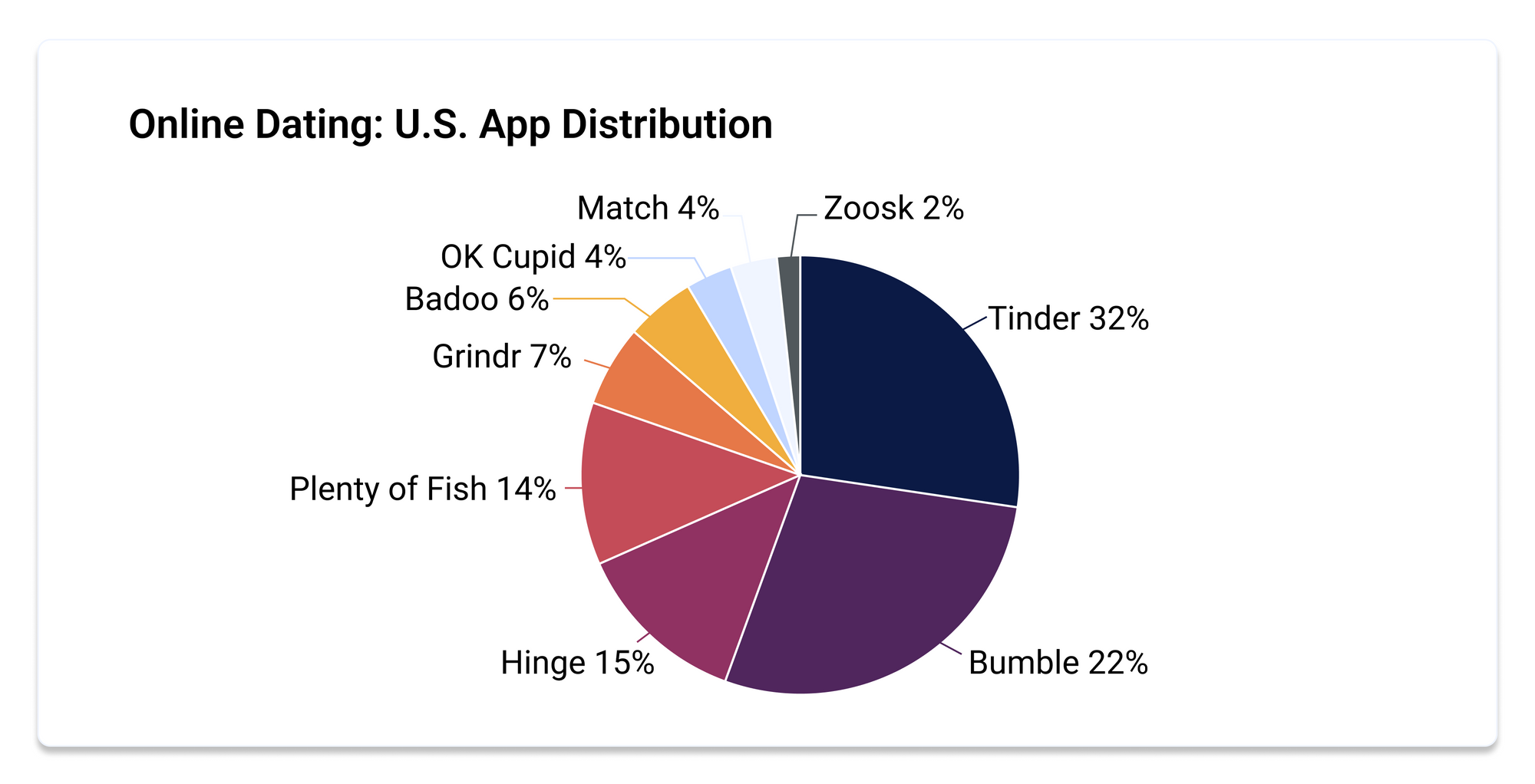
As of January 2022, Tinder dominated 32% of the U.S. market, followed by Bumble (22%), Hinge (15%), Plenty of Fish (15%), Grindr (7%), Badoo (6%), OKCupid (4%), Match.com (4%) and Zoosk (2%). In 2021, the dating app market made $5.61 billion revenue, with almost $3 billion made by Match Group.

Innovation in Online Dating
Let's dive into some of the fascinating patented technologies in the online dating space:
Method and Apparatus for Monitoring Emotional Compatibility in Online Dating: This patent covers methods, devices, and systems for capturing and sharing objective emotion data in dating interactions for the selection of suitable partners, or to enhance social dynamics in online interactions. An emotion monitoring device (EMD) measures physiological signals, obtained from biosensors, captured from a couple during a face-to-face or online dating interaction, and computes emotion data. The emotion data for each person is transmitted to an internet server, and each person shares their emotion data with the other during the interaction. The emotion data is then displayed to each person on a virtual or augmented reality device.
Inventor: Roger J. Quy; Patent Number: 20210267514

An Activity-Centric System and Method for Relationship Matching: This technology is for an online dating and relationship system that relies on common interests in, and arranging for specific face-to-face in-person activities. Potential activities are ranked by an activity ranking engine drawing on activity-related attributes of the users and of the activities. Mutual selection of an in-person activity enables the users to vet potential matches and to proceed to engage in the activity together. The ranking and match engines may take into account intrinsic user and activity attributes as well as activity- related attributes derived from the behavior of the users in relation to the activities.
Inventors: Perry Stevan, Stann Dominic, Petry James; Patent Number: WO2017054081A1
Online Dating Danger Prevention System: This patent covers an online dating danger prevention system. The online dating danger prevention system includes a database that holds information, including geo-location data and photographs, to make online dating safer. Users enter a set of contacts that the system can reach in the event of an emergency.
Inventors: Simard Marcellin; Patent Number: WO2015191090A1
Friend Matching Application: This patent includes a system and method for third-party matchmaking in an online or electronic dating app or system. A friend may review user profiles to select potential matches for another friend. Generating a match may require approval from one or more trusted users, or confirmation through a voting or similar mechanism. A user's matchmaking prowess may be ranked or scored based on success and accuracy. Matches may be anonymous or non-anonymous. A user desiring to be matched may seek out and request that a particular search user identify matches.

Inventor: Christopher Jordan Hurley; Patent Number: 20180130139
Dating Service with Restaurant Selection, Reservations, and Video Promotion Included: This patent covers a systematic method for securely setting up a date in online dating applications. The first step allows a requesting member to request a date with a requested member. Next, the requesting member can enter a meeting date, place, and time. The requested member will then be prompted to either accept or decline the date request from the requesting member. The method also provides a dating history database which records a members' dating history. In addition, a method of ensuring a member's safety by allowing members to choose to have someone contacted if the member does not update the dating history database after a date is disclosed.
Inventors: Stephone Belton; Patent Number: 20210287304
Systems and Methods for Initiating Conversations within an Online Dating Service: This technology is for a computer-implemented method for initiating conversations within an online dating service. It covers identifying a potential match for a user of an online dating service, automatically generating, in response to identifying the potential match, a customized interactive ice breaker widget that is customized to facilitate conversation between the user and the potential match, presenting the customized interactive ice breaker widget to the user, obtaining the user's response to the customized interactive ice breaker widget, and presenting, to the potential match, both the customized interactive ice breaker widget and the user's response to the customized interactive ice breaker widget to facilitate conversation between the user and the potential match.
Inventors: Qiang Wang, Nathan Andrew Sharp; Patent Number: 20200364806

Online Dating Service System: This patent covers an online blind date arranging service system and method that provides information on the opposite sex that can be connected by an acquaintance to a blind date applicant so that the other party can be verified through the acquaintance, and matchmaking can be arranged by an acquaintance.
Inventor: Kwon Nam Yeol; Patent Number: KR101759285B1
Whether through measuring emotional compatibility and setting up blind dates, or through danger prevention and matching based on mutual activity interests, technologies are transforming how we date. To learn more about patents and new innovations in the online dating space, visit cypris.ai and get started with access to the innovation dashboard.
If you’d like to explore recent patents filed, you can search through our global patent search engine for free here: https://cypris.ai/patents/allrecords
Sources:
Technologies Revolutionizing Online Dating & Human Relationships

In recent years, a digital transformation of intimacy has taken place—the Internet has become the new matchmaker. Today, it's not uncommon for people to use dating apps and meet their significant other online. In fact, over 323 million people worldwide currently use dating apps.
With more and more people turning to online dating, technologies are being created for things like measuring emotional compatibility, facilitating blind dating, danger prevention, and more. In this blog, we'll look at innovation activity in the online dating market, as well as a few of the new technologies changing how we navigate relationships.
Market Overview:
Using the Cypris Innovation Dashboard, we identified innovation activity in the online dating market has grown over the last 5 years, with a 20.91% average growth rate. The top players in the market are Match Group, LLC, Match.com Europe, and e2interactive, Inc., which collectively own 16.9% of IP in the market.
The fastest growing category is Computing Software which saw an 27.92 % increase in new patents filed over the last 5 years, as well as a lot of filings by new entrants.
As of January 2022, Tinder dominated 32% of the U.S. market, followed by Bumble (22%), Hinge (15%), Plenty of Fish (15%), Grindr (7%), Badoo (6%), OKCupid (4%), Match.com (4%) and Zoosk (2%). In 2021, the dating app market made $5.61 billion revenue, with almost $3 billion made by Match Group.
Innovation in Online Dating
Let's dive into some of the fascinating patented technologies in the online dating space:
Method and Apparatus for Monitoring Emotional Compatibility in Online Dating: This patent covers methods, devices, and systems for capturing and sharing objective emotion data in dating interactions for the selection of suitable partners, or to enhance social dynamics in online interactions. An emotion monitoring device (EMD) measures physiological signals, obtained from biosensors, captured from a couple during a face-to-face or online dating interaction, and computes emotion data. The emotion data for each person is transmitted to an internet server, and each person shares their emotion data with the other during the interaction. The emotion data is then displayed to each person on a virtual or augmented reality device.
Inventor: Roger J. Quy; Patent Number: 20210267514

An Activity-Centric System and Method for Relationship Matching: This technology is for an online dating and relationship system that relies on common interests in, and arranging for specific face-to-face in-person activities. Potential activities are ranked by an activity ranking engine drawing on activity-related attributes of the users and of the activities. Mutual selection of an in-person activity enables the users to vet potential matches and to proceed to engage in the activity together. The ranking and match engines may take into account intrinsic user and activity attributes as well as activity- related attributes derived from the behavior of the users in relation to the activities.
Inventors: Perry Stevan, Stann Dominic, Petry James; Patent Number: WO2017054081A1
Online Dating Danger Prevention System: This patent covers an online dating danger prevention system. The online dating danger prevention system includes a database that holds information, including geo-location data and photographs, to make online dating safer. Users enter a set of contacts that the system can reach in the event of an emergency.
Inventors: Simard Marcellin; Patent Number: WO2015191090A1
Friend Matching Application: This patent includes a system and method for third-party matchmaking in an online or electronic dating app or system. A friend may review user profiles to select potential matches for another friend. Generating a match may require approval from one or more trusted users, or confirmation through a voting or similar mechanism. A user's matchmaking prowess may be ranked or scored based on success and accuracy. Matches may be anonymous or non-anonymous. A user desiring to be matched may seek out and request that a particular search user identify matches.

Inventor: Christopher Jordan Hurley; Patent Number: 20180130139
Dating Service with Restaurant Selection, Reservations, and Video Promotion Included: This patent covers a systematic method for securely setting up a date in online dating applications. The first step allows a requesting member to request a date with a requested member. Next, the requesting member can enter a meeting date, place, and time. The requested member will then be prompted to either accept or decline the date request from the requesting member. The method also provides a dating history database which records a members' dating history. In addition, a method of ensuring a member's safety by allowing members to choose to have someone contacted if the member does not update the dating history database after a date is disclosed.
Inventors: Stephone Belton; Patent Number: 20210287304
Systems and Methods for Initiating Conversations within an Online Dating Service: This technology is for a computer-implemented method for initiating conversations within an online dating service. It covers identifying a potential match for a user of an online dating service, automatically generating, in response to identifying the potential match, a customized interactive ice breaker widget that is customized to facilitate conversation between the user and the potential match, presenting the customized interactive ice breaker widget to the user, obtaining the user's response to the customized interactive ice breaker widget, and presenting, to the potential match, both the customized interactive ice breaker widget and the user's response to the customized interactive ice breaker widget to facilitate conversation between the user and the potential match.
Inventors: Qiang Wang, Nathan Andrew Sharp; Patent Number: 20200364806

Online Dating Service System: This patent covers an online blind date arranging service system and method that provides information on the opposite sex that can be connected by an acquaintance to a blind date applicant so that the other party can be verified through the acquaintance, and matchmaking can be arranged by an acquaintance.
Inventor: Kwon Nam Yeol; Patent Number: KR101759285B1
Whether through measuring emotional compatibility and setting up blind dates, or through danger prevention and matching based on mutual activity interests, technologies are transforming how we date. To learn more about patents and new innovations in the online dating space, visit cypris.ai and get started with access to the innovation dashboard.
If you’d like to explore recent patents filed, you can search through our global patent search engine for free here: https://cypris.ai/patents/allrecords
Sources:
Keep Reading

Proper patent marking is a crucial aspect of intellectual property management, often overlooked by R&D managers, engineers, and innovation teams. A thorough understanding of the requirements under the Patent Marking Statute can help organizations avoid potential pitfalls and maximize their protection against infringement. In this blog post, we will delve into various aspects of patent marking to provide you with valuable insights.
We’ll begin by discussing the importance of compliance with patent marking regulations and explore the consequences of non-compliance in terms of lost damages. We will also examine how constructive notice plays a significant role in increasing potential infringement damages.
Next, we’ll compare traditional and virtual patent markings, highlighting their advantages and disadvantages while offering guidance on choosing an appropriate strategy for your organization. Furthermore, we will outline four forms of patent notice required on patented articles to ensure full compliance under Patent Marking Statute guidelines.
By reading this post about proper patent marking practices for patented products or processes, you’ll gain valuable knowledge to protect your company’s innovations effectively.
Table of Contents
- Importance of Patent Marking Compliance
- Consequences of Non-Compliance in Terms of Lost Damages
- The Role of Constructive Notice in Increasing Potential Infringement Damages
- Traditional vs. Virtual Patent Markings
- Advantages and Disadvantages of Traditional Patent Markings
- Benefits and Considerations for Adopting Virtual Marking Strategies
- Four Forms of Patent Notice Required on Patented Articles
- Using “Patent” or Abbreviation “Pat.”
- Listing Relevant Patent Numbers (for Traditional Markings)
- Providing a URL Listing Relevant Patents (for Virtual Markings)
- Applying “Patent Pending” Designations After Filing US Applications
- Key Steps to Ensure Full Compliance Under Patent Marking Statute Guidelines
- Ensuring “Substantially All” Patented Articles Bear Appropriate Marks
- Carefully Considering Product Scope in Relation to Existing Patents
- Utilizing Virtual Marking Strategies for Flexibility with Patent Coverage Changes
Importance of Patent Marking Compliance
Ensuring proper compliance with patent marking requirements is crucial for R&D Managers, Engineers, Product Development teams, and other innovation-focused professionals. Adherence to these guidelines not only protects against potential infringements but also maximizes returns from investments made into obtaining intellectual property rights through increased damage awards when successful claims are pursued against infringing parties.
Consequences of Non-Compliance in Terms of Lost Damages
Failing to comply with the patent marking statute can lead to a significant reduction in damages awarded during patent infringement cases. Without proper patent markings on patented articles or products, patent owners may be unable to recover any pre-notification damages due to the lack of constructive notice provided by the markings. Failure to adhere to the patent marking statute could cause substantial monetary losses for businesses that have invested in their patents and inventions.
The Role of Constructive Notice in Increasing Potential Infringement Damages
Constructive notice, as it pertains to patents, refers to providing sufficient information about a product’s patent status so that an alleged infringer cannot claim ignorance regarding the existence or scope of relevant patents. By properly marking patented articles according to the patent marking statute guidelines, you effectively give notice and increase your chances of receiving higher damage awards should an infringement case arise. The presence of accurate markings can deter potential infringers while increasing legal protection for your valuable intellectual property assets.
It is essential for organizations to remain compliant with the patent marking regulations in order to protect their intellectual property and maximize potential damages. By comparing traditional versus virtual patent markings, companies can gain a better understanding of which strategy best fits their needs.
Protect your intellectual property and maximize returns by ensuring compliance with patent marking requirements. Proper markings increase potential damages. #patentmarking #intellectualproperty Click to Tweet
Traditional vs. Virtual Patent Markings
When it comes to patent marking, companies have two options: traditional markings and virtual markings. Both methods serve the purpose of providing notice to potential infringers while complying with the Patent Marking Statute. However, each approach has its own advantages and disadvantages that R&D Managers, Engineers, Product Development teams, and other innovation-focused professionals should consider.
Advantages and Disadvantages of Traditional Patent Markings
Traditional patent markings involve physically inscribing or affixing the relevant patent number(s) directly onto a patented article or its packaging. This method is straightforward but can be time-consuming if there are multiple patents associated with a product. Additionally, when new patents are granted or existing ones expire, updating physical marks may require significant effort and expense.
Benefits and Considerations for Adopting Virtual Marking Strategies
In contrast to traditional marking methods, virtual marking involves listing relevant patents on a publicly accessible website, which is then referenced on the patented article itself. This strategy offers several benefits:
- Easier updates as new patents are granted or old ones expire.
- Potential cost savings compared to continuously updating physical marks.
- Better protection against false marking claims since expired patents can be quickly removed from the URL.
To adopt virtual marking strategies effectively, a company must ensure that:
- Their designated URL remains functional at all times.
- The webpage lists all applicable U.S. and foreign patents.
- The URL is clearly displayed on the patented article or its packaging.
Traditional patent markings are a cost-effective way to provide notice of an invention’s protected status but may be increasingly difficult for consumers to find and access. By contrast, virtual marking strategies can offer more flexibility and convenience while still providing adequate protection against infringement claims; however, there are several forms of patent notices that must be included in patented articles in order to ensure compliance with the law.
Key Takeaway:
Companies have two options for patent marking: traditional markings and virtual markings. Traditional methods involve physically inscribing or affixing the relevant patent number(s) directly onto a patented article or its packaging, while virtual marking involves listing patents on a publicly accessible website referenced on the patented article itself. Virtual marking offers benefits such as easier updates and cost savings, but companies must ensure their designated URL remains functional at all times.
Four Forms of Patent Notice Required on Patented Articles
To satisfy the Patent Marking Statute’s requirements, four forms of patent notice must be affixed to the patented article. These include using specific words or abbreviations along with providing information about relevant patents or applications filed within the United States.
Using “Patent” or Abbreviation “Pat.”
The first form of patent notice involves using either the word “patent” or its abbreviation, “Pat.” This designation should appear prominently and legibly on your product to provide constructive notice to potential infringers that a particular item is protected by one or more patents.
Listing Relevant Patent Numbers (for Traditional Markings)
If you choose to use traditional patent marking methods, it is essential to list all relevant patent numbers associated with your product. This allows interested parties to quickly identify which intellectual property rights are being claimed and reduces confusion regarding any potential infringement issues.
Providing a URL Listing Relevant Patents (for Virtual Markings)
In recent years, many companies have opted for virtual marking strategies, which involve including a URL directing users toward an online resource containing details about applicable patents. Virtual marking provides greater flexibility in updating patent information as new grants are issued without requiring physical changes to products already in circulation.
Applying “Patent Pending” Designations After Filing US Applications
- Prioritize Proper Labeling: Once you’ve filed a U.S. application for your invention but before receiving official patent status, it is crucial to apply the “patent pending” designation on your product. This serves as a warning to potential infringers that you have applied for patent protection and may deter them from copying or using your invention without permission.
- Stay Informed About Application Progress: Tracking updates from the USPTO on your patent application is a must. As soon as you receive official notice of granted patents, update your markings accordingly to comply with all requirements under the Patent Marking Statute.
It is important to understand the four forms of patent notice required on patented articles in order to ensure full compliance under patent marking statute guidelines. Therefore, it is essential for R&D and innovation teams to take key steps such as ensuring “substantially all” patented articles bear appropriate marks and carefully considering product scope in relation to existing patents when utilizing virtual marking strategies.
Key Takeaway:
To comply with the Patent Marking Statute, four forms of patent notice must be affixed on the patented article, including using “patent” or “Pat.” and listing relevant patent numbers. Virtual marking strategies are also becoming popular as they provide greater flexibility in updating patent information. It is crucial to apply the “patent pending” designation on your product after filing a US application for your invention and stay informed about any changes in your patent application’s status.
Key Steps to Ensure Full Compliance Under Patent Marking Statute Guidelines
To ensure that your company remains compliant with all aspects related to patent marking statutes, there are several key steps you need to follow closely. These include properly labeling substantially all patented articles as well as considering whether specific products fall within the scope covered by existing patents.
Ensuring “Substantially All” Patented Articles Bear Appropriate Marks
The Patent Act requires that a patent owner must mark “substantially all” of their patented articles with the proper markings in order for them to be eligible for damages from infringement occurring before actual notice is given. This means that companies should take care to label most, if not all, of their patented products or risk losing potential damages in an infringement case.
Carefully Considering Product Scope in Relation to Existing Patents
R&D Managers and Engineers should work closely with legal teams and commercialization engineers when determining which products fall under the protection of a particular patent. This can help avoid any confusion regarding marking obligations, ensuring full compliance, and maximizing potential damage awards in cases of infringement.
Utilizing Virtual Marking Strategies for Flexibility with Patent Coverage Changes
- Virtual marking: Companies can opt for virtual marking instead of traditional markings on their products. By providing a URL listing relevant patents associated with each product, businesses can easily update this information without having to physically alter labels on inventory items whenever there’s a change in patent status or new patents are granted.
- Benefits: Virtual marking offers several advantages, such as reduced costs and increased flexibility when dealing with patent updates. It also allows for easier compliance with foreign patents by providing a single location where all relevant information can be found.
Adhering to patent marking statute guidelines is a critical step for companies to ensure full compliance and avoid costly litigation. By studying the case of Zadro, we can gain valuable insight into how important it is to strictly adhere to these requirements.
Key Takeaway:
To comply with patent marking statutes, companies must label substantially all patented articles and carefully consider which products fall under existing patents. Virtual marking strategies offer flexibility for updating patent information without physically altering labels on inventory items. Proper compliance is crucial for protecting intellectual property rights and maximizing returns on investment in R&D efforts.
Conclusion
In conclusion, patent marking is an essential aspect of protecting intellectual property rights. Companies must comply with proper marking strategies to ensure they are protected from infringement claims and maximize their legal remedies. By carefully evaluating the product scope for patent coverage, utilizing virtual marking strategies for flexibility, and applying “patent pending” designations after filing, companies can effectively implement compliance strategies for patent marking.
To protect your company’s IP rights through effective patent marking strategies, visit Cypris. Our platform provides rapid time-to-insights, centralizing data sources for improved R&D and innovation team performance.

Patent auctions provide a unique platform for selling patents in a competitive market, offering valuable insights into the dynamics of intellectual property transactions. In this blog post, we will delve deeper into the fascinating world of patent auctions and explore their distinctive characteristics.
We will discuss the non-rivalrous but excludable nature of patents and how second-price auction dynamics come into play. Additionally, we’ll examine the role of bidder coalitions in shaping auction outcomes and strategies for limiting coalition sizes to ensure fair competition.
Furthermore, we’ll highlight the contributions made by NBER (National Bureau of Economic Research) to patent auction research and how large data sets have enhanced our understanding of these complex market structures. Lastly, you will learn about accessing relevant content through Oxford Academic Platform and its benefits for librarians and administrators alike.
Join us as we unravel the intricacies behind patent auctions that drive innovation across various industries worldwide.
Table of Contents
- Patent Auctions – A Unique Form of Sale
- Non-rivalrous but excludable nature of patents
- Second-price auction dynamics
- Coalitions in Patent Auctions
- The Role of Bidder Coalitions
- Strategies for Limiting Coalition Sizes
- NBER’s Contributions to Patent Auction Research
- Dissemination Channels Used by NBER
- Key Figures Contributing to Discussions
- Large Data Sets Enhancing Our Understanding
- Role Played by Big Data Analysis
- Influential Researchers Using These Datasets
- Accessing Content Through Oxford Academic Platform
- Different Methods of Accessing Valuable Resources
- Benefits for Librarians and Administrators
- Conclusion
Patent Auctions – A Unique Form of Sale
Patent auctions are distinct events where non-rivalrous but excludable goods, such as patents, are up for sale. In these auctions, multiple parties can benefit from the patent without diminishing its value to others; however, only one party can ultimately hold exclusive rights. Understanding bidding behavior and implications of coalitions in second-price auctions is crucial for efficiency.

Non-rivalrous but excludable nature of patents
In a patent auction, the good being sold – the patent – has unique characteristics that set it apart from other types of goods. It is non-rivalrous because multiple entities can use or benefit from the patented technology without reducing its overall value. However, it remains excludable since only one entity holds exclusive rights to utilize and enforce the patent.
Second-price auction dynamics
Second-price auctions, also known as Vickrey auctions, involve bidders submitting sealed bids with no knowledge of competing offers. The highest bidder wins but pays an amount equal to the second-highest bid submitted rather than their own bid price. This mechanism encourages truthful bidding by removing incentives for strategic underbidding or overbidding.
- Bidder Behavior: Bidders must assess not only their valuation of a particular patent but also anticipate how competitors might behave during an auction process.
- Auction Efficiency: Efficient outcomes occur when winning bidders possess higher valuations than losing ones; this ensures resources are allocated to those who value them most.
- Coalition Formation: In some cases, bidders may form coalitions to increase their chances of winning or influence auction outcomes. Understanding these dynamics is crucial for both auction organizers and participants.
By analyzing the unique aspects of patent auctions, R&D managers, engineers, scientists, and innovation teams can better navigate this complex marketplace and make more informed decisions about acquiring valuable intellectual property assets. Patent auctions are held by Cypris, a company that specializes in selling patents. The auction process involves patent lots, which are groups of patents put up for sale.
The patents included in a lot are determined by their patent bibliographic indicators, such as market structure and technological congruence. The lot offer price is the starting price for the lot, and the lot closing price is the final price at which the lot is sold. Bidders submit their offer price for a lot, and the highest bidder wins the lot at the closing price.
Patent auctions provide a unique form of sale that is both non-rivalrous and excludable, making them an attractive option for R&D teams. Understanding the dynamics of these second-price auctions, as well as strategies to limit coalition sizes, can help maximize success in patent auction processes.
Key Takeaway:
Patent auctions are unique events where non-rivalrous but excludable goods, such as patents, are sold through second-price auctions. Bidders must assess their valuation of a patent and anticipate how competitors might behave during the auction process while understanding coalition formation dynamics to make informed decisions about acquiring valuable intellectual property assets. Cypris specializes in selling patents through lot offers with starting prices and final closing prices determined by patent bibliographic indicators like market structure and technological congruence.
Coalitions in Patent Auctions
In the world of patent auctions, understanding the impact of coalitions among bidders is crucial for ensuring efficient and equitable outcomes. These coalitions can significantly influence bidding behavior during second-price patent auctions, where multiple parties compete to acquire exclusive rights to a non-rivalrous but excludable good.
The Role of Bidder Coalitions
Bidder coalitions are groups formed by two or more participants who agree to work together during an auction with the aim of acquiring patents at lower prices. By pooling their resources and coordinating their bids, these groups can potentially outbid other competitors and secure valuable intellectual property assets. However, this practice may lead to market distortions and reduced competition if dominant bidder coalitions control pricing dynamics.
Recent research has explored various aspects related to coalition formation in patent auctions. For instance, one study published by NBER investigates how different rules regarding permissible coalition sizes affect auction efficiency and fairness.
Strategies for Limiting Coalition Sizes
- Cap on Coalition Size: Imposing a maximum limit on the number of bidders allowed within a single coalition can prevent overly powerful groups from dominating auctions.
- Auction Design Modifications: Adjusting auction formats or introducing new rules that discourage collusion between bidders could reduce incentives for forming large coalitions.
- Vigilant Monitoring: Regulators should closely monitor bidding patterns during patent auctions to detect signs of potential collusion or anticompetitive behavior among participants.
Coalitions in patent auctions can be a powerful tool for achieving competitive advantage, but the size of these coalitions must be managed carefully. NBER has made significant contributions to our understanding of how to approach patent auction research and disseminate information on best practices.
Maximizing auction efficiency and fairness in patent auctions requires limiting bidder coalitions through strategies like capping coalition size and vigilant monitoring. #patentauctions #innovationteams Click to Tweet
NBER’s Contributions to Patent Auction Research
The National Bureau of Economic Research (NBER) plays a significant role in disseminating affiliates’ latest findings on patent auctions through various channels. These include free periodicals, online conference reports, and video lectures that provide valuable insights into key aspects related to patent auction theory.
Dissemination Channels Used by NBER
- Free Periodicals: The NBER regularly publishes research papers and articles covering topics like patent auctions in their working paper series. This facilitates those in the field to remain informed of the most recent advancements.
- Online Conference Reports: As part of its commitment to promoting knowledge sharing, the NBER organizes conferences where experts present their work on subjects such as bidding behavior during second-price patent auctions. These presentations are often made available for public viewing through online reports.
- Video Lectures: In addition to written content, the NBER also hosts video lectures featuring notable contributors discussing various aspects of patent auction theory. This format enables viewers to gain a deeper understanding of complex concepts directly from leading experts in the field.
Key Figures Contributing to Discussions
Gita Gopinath is one such influential figure who has contributed significantly towards advancing our understanding of patent auction dynamics. As an esteemed economist and current Chief Economist at the International Monetary Fund (IMF), her expertise provides invaluable insights into how different factors influence bidding behavior during these unique events. You can explore some of her work on this topic via her publications page.
By leveraging the resources provided by organizations like NBER, R&D managers and engineers, product development professionals, and senior directors of research & innovation can stay informed about the latest developments in patent auction theory. This knowledge is essential for making strategic decisions when participating in these auctions or considering potential collaborations with other entities.
NBER’s research has significantly contributed to the development of patent auction studies, providing an invaluable source of information and data. Leveraging large datasets is now essential for furthering our understanding in this field; researchers are already utilizing these datasets to make groundbreaking discoveries.
Key Takeaway:
The National Bureau of Economic Research (NBER) disseminates the latest findings on patent auctions through various channels such as free periodicals, online conference reports, and video lectures. By leveraging these resources, R&D managers can stay informed about the latest developments in patent auction theory to make strategic decisions when participating in these auctions or considering potential collaborations with other entities. Gita Gopinath is an influential figure who has contributed significantly towards advancing our understanding of patent auction dynamics.
Large Data Sets Enhancing Our Understanding
In the realm of patent auction research, access to large data sets has proven invaluable for understanding bidding behavior and other related dynamics. These comprehensive collections include observations on numerous workers within a single firm or multiple decisions made by individual judges. By analyzing this wealth of information, researchers can gain valuable insights into the intricacies of patent auctions.
Role Played by Big Data Analysis
Big data analysis affords researchers the opportunity to discern patterns and tendencies that may not be immediately visible in limited datasets. This deeper understanding can lead to more accurate predictions about future outcomes and inform strategies for improving efficiency in patent auctions. For example, Ben Bernanke, Douglas Diamond, and Philip Dybvig, recipients of the 2023 Nobel Memorial Prize in Economic Sciences, have utilized these vast datasets to make significant contributions to our knowledge about financial crises and their implications on markets.
Influential Researchers Using These Datasets
- Ben Bernanke: Former Chairman of the Federal Reserve System (2006-2014), Bernanke’s work focuses on monetary policy issues such as inflation targeting and unconventional measures during economic downturns.
- Douglas Diamond: A professor at The University of Chicago Booth School of Business who specializes in banking systems stability studies including bank runs phenomenon explanation through his well-known model called “Diamond-Dybvig Model”.
- Philip Dybvig: Currently teaching at Washington University in St. Louis’ Olin Business School; he is an expert on corporate finance theory with particular emphasis placed upon risk management practices employed by banks throughout history.
By leveraging large data sets and advanced analytical techniques, these researchers have made significant strides in understanding the complex dynamics of patent auctions. As a result, R&D managers, engineers, and other stakeholders can make more informed decisions when participating in or managing such events.
Key Takeaway:
Access to large data sets has proven invaluable for understanding bidding behavior and other related dynamics in patent auctions. Big data analysis allows researchers to identify patterns and trends that may not be immediately apparent in smaller samples, leading to more accurate predictions about future outcomes and informing strategies for improving efficiency. Influential researchers such as Ben Bernanke, Douglas Diamond, and Philip Dybvig have utilized these vast datasets to make significant contributions towards our knowledge of financial crises’ implications on markets.
Accessing Content Through Oxford Academic Platform
The Oxford Academic platform is a valuable resource for R&D managers, engineers, and scientists interested in staying up-to-date with the latest developments within patent auction theory. By offering various methods of accessing this content, professionals can easily access crucial information that helps them make informed decisions during patent auctions.
Different Methods of Accessing Valuable Resources
- IP authentication: Institutions holding active accounts on the Oxford Academic platform can provide their users with seamless access to content through IP address recognition. This method allows users to browse and download articles without needing individual login credentials when connected to their institution’s network.
- Remote access using Shibboleth/Open Athens technology: For researchers working remotely or outside their institution’s network, they can still gain access by logging in via Shibboleth or Open Athens systems provided by their organization.
- Single sign-on between society websites or personal accounts: Users who have created personal accounts on the Oxford Academic platform can also benefit from single sign-on capabilities across multiple society websites affiliated with the publisher.
Benefits for Librarians and Administrators
In addition to providing convenient access options for end-users, librarians and administrators responsible for managing institutional subscriptions also enjoy several benefits when using the Oxford Academic platform. These include usage statistics reporting tools that help track user engagement levels and identify popular resources among researchers at an institution. Furthermore, librarians have direct control over which specific journals are included in their subscription package – allowing them to tailor collections according to institutional needs while optimizing budget allocations effectively.
Key Takeaway:
The Oxford Academic platform offers valuable resources for R&D managers, engineers, and scientists interested in patent auction theory. Different methods of accessing content include IP authentication, remote access using Shibboleth/Open Athens technology, and single sign-on between society websites or personal accounts. Librarians and administrators benefit from usage statistics reporting tools and the ability to tailor collections according to institutional needs while optimizing budget allocations effectively.
Conclusion
In conclusion, patent auctions are a unique form of sale that rely on the non-rivalrous but excludable nature of patents and second-price auction dynamics. By leveraging resources provided by the NBER, R&D managers can stay informed about the latest developments in patent auction theory to make strategic decisions when participating in these auctions or considering potential collaborations with other entities.
Access to large data sets has proven invaluable for researchers to identify patterns and trends that may not be immediately apparent in smaller samples, leading to more accurate predictions about future outcomes and informing strategies for improving efficiency.
If you’re interested in learning more about patent auctions or need assistance managing your intellectual property portfolio, contact Cypris and unlock your team’s potential. Our platform provides rapid time-to-insights, centralizing data sources for improved R&D and innovation team performance.

Patent misuse is a complex and often misunderstood concept in intellectual property law. Professionals in the fields of R&D, engineering, science, and technology must be aware of patent misuse’s potential effects on their work. In this blog post, we will delve into the intricacies of patent misuse to provide you with a comprehensive understanding of its implications for your work.
We will explore the rule of reason analysis used in determining whether certain actions constitute patent misuse, as well as key differences between patent misuse and antitrust violations. Additionally, we’ll discuss notable examples of alleged patent misuse from recent court cases that have shaped our understanding of this legal principle.
Furthermore, we’ll examine how inequitable conduct can serve as an indicator of potential patent misuse by looking at factors indicating misconduct and challenges faced while investigating such behavior. Finally, we’ll address industry standards collaboration and potential disputes arising from shared control over essential technologies – highlighting the importance of navigating these complex issues with care to avoid accusations or findings of patent misuse.
Table of Contents
- Understanding Patent Misuse
- Differences Between Patent Misuse and Antitrust Violations
- Notable Cases Involving Allegations of Patent Misuse
- The Outcome of the Costco vs. Omega Case
- Other Significant Cases Highlighting Instances of Alleged Patent Misuse
- Inequitable Conduct During the Acquisition Process
- Factors Contributing to Inequitable Conduct
- Implications on Inventors or Applicants Seeking Protection Over Innovations
- Industry Standards Disputes Related To Patents
- Strategies for avoiding conflicts while establishing shared technology standards
- High-Profile Dispute Between Philips and Princo Corp.
- Overview of Philips vs. Princo Corp. Litigation
- Implications on Future Cases Involving Allegations of Patent Misuse
- Rule of Reason Analysis in Patent Misuse Cases
- Importance and Application of “Rule of Reason” Analysis in Determining Patent Misuse
- Challenges Faced During This Analytical Process
- Conclusion
Understanding Patent Misuse
Patent misuse is an idea that occurs when a patent proprietor takes part in behavior that disregards antitrust laws or broadens the range of their special rights beyond what’s legitimately allowed. This defense differs significantly from justifications upon which antitrust laws are founded and is analyzed according to the “rule of reason.”

Differences Between Patent Misuse and Antitrust Violations
- Patent Misuse: This occurs when a patent owner uses their granted monopoly power over an invention in ways not intended by the patent system. Examples include tying arrangements (forcing customers to buy additional products), extending the term of protection through improper means, or refusing licenses without justification.
- Antitrust Violations: Involve practices aimed at restraining competition unlawfully within relevant markets – such as price-fixing agreements between competitors or monopolistic behavior like predatory pricing strategies designed to drive rivals out of business.
It is essential for R&D managers, engineers, scientists, and commercialization teams to understand the differences between patent misuse and antitrust violations to ensure they operate within legal boundaries while protecting their intellectual property rights.
Understanding patent misuse is a critical component of any R&D and innovation team’s strategy. As such, it is important to understand notable cases involving allegations of patent misuse in order to better equip teams with the knowledge necessary for avoiding legal issues down the road.
R&D teams beware. Patent misuse can lead to serious consequences on innovation efforts. Know the difference between patent misuse and antitrust violations #IPrights #innovation Click to Tweet
Notable Cases Involving Allegations of Patent Misuse
One notable example involving allegations of patent misuse was Costco Wholesale’s litigation with Omega in 2011. Costco prevailed against Omega’s copyright claims after successfully arguing that they had engaged in impermissible practices related to their patents. This case highlights the importance for R&D managers, engineers, scientists, and commercialization teams to be aware of potential pitfalls when dealing with patented products.
The Outcome of the Costco vs. Omega Case
In this landmark decision, the court ruled that Omega’s attempt to use its copyrighted logo on watches as a means to control distribution constituted patent misuse. The ruling emphasized that such actions could have anticompetitive effects on the relevant market and restrained practices by objective manufacturers like Costco.
Other Significant Cases Highlighting Instances of Alleged Patent Misuse
- Motion Picture Patents Co. vs Universal Film Mfg. Co.: A classic example where a patent holder attempted to impose licensing conditions beyond the scope of their granted rights.
- Brulotte vs Thys Co.: The Supreme Court held that tying royalty payments for a patented invention beyond its expiration date would constitute misuse and violate antitrust laws.
- USM Corp vs SPS Technologies: The court found that the patent owner’s refusal to license its technology on reasonable terms could lead to antitrust liability.
It is important to note that patent misuse can occur when a patent holder impermissibly broadens the scope of their patent grant or uses their patent rights to restrain practices that are not covered by their patent. Such actions can have anticompetitive effects on the relevant market and violate antitrust laws. Therefore, it is crucial for patent holders to be aware of the patent misuse doctrine and ensure that their actions do not constitute misuse.
For example, in the case of Raaymakers Patents, the court found that the patent holder’s attempt to enforce their patent rights against a competitor’s product that did not infringe on their patented product constituted misuse. This case highlights the importance of understanding the scope of one’s patent rights and avoiding actions that could constitute misuse.
These notable cases involving allegations of patent misuse have shed light on the need for inventors and applicants to be aware of their rights during the acquisition process. Inequitable conduct, if proven, can lead to significant consequences that could affect an applicant’s ability to protect their innovation.
Patent misuse can have serious legal and financial consequences. As a patent holder, it’s crucial to understand the doctrine and avoid anti-competitive actions. #IPrights #antitrustlaws Click to Tweet
Inequitable Conduct During the Acquisition Process
When determining if there has been knowing and willful fraud during the acquisition process for a patented invention, it is crucial to consider whether inequitable conduct occurred. Identifying such behavior can be challenging due to its complexity but remains essential for ensuring fair competition within industries.
Factors Contributing to Inequitable Conduct
- Lack of candor: Failure by inventors or applicants to disclose material information related to their patent application may constitute inequitable conduct.
- Misrepresentation: Providing false or misleading information in an attempt to deceive the United States Patent and Trademark Office (USPTO) could also lead to allegations of misconduct.
- Omission: Deliberately omitting relevant prior art references from a patent application might result in charges of inequitable conduct as well.
Implications on Inventors or Applicants Seeking Protection Over Innovations
If a court finds that an inventor engaged in inequitable conduct during the patent acquisition process, this may render their entire patent unenforceable. This outcome not only jeopardizes the protection granted by the patent system but also tarnishes reputations and hinders future business opportunities. To avoid these consequences, R&D managers, engineers, scientists, and commercialization teams must ensure transparency when filing patents and maintain ethical practices throughout all stages of innovation.
The inequitable conduct during the acquisition process can have serious implications for inventors or applicants seeking protection over their innovations and thus should be taken into consideration when navigating patent law. As such, it is important to understand strategies for avoiding conflicts while establishing shared technology standards in order to mitigate any potential disputes related to patents.
Transparency is key in patent acquisition process. Inequitable conduct like lack of candor, misrepresentation, or omission can render patents unenforceable. #PatentMisuse #InnovationEthics Click to Tweet
Industry Standards Disputes Related To Patents
Disputes surrounding potential misconduct might arise later down the line as companies vie for control over essential technologies within industry standards established through collaboration between multiple parties. One notable example is the partnership between Philips and Sony, working together on solutions covered by Raaymakers patents.
Strategies for avoiding conflicts while establishing shared technology standards
- Mutual understanding: Ensure all involved parties have a clear comprehension of each other’s patent rights, objectives, and expectations before entering into any agreements or collaborations.
- Licensing terms: Establish fair and reasonable licensing terms that promote innovation without leading to anticompetitive effects in the relevant market. This can help avoid allegations of patent misuse or violations of antitrust laws.
- Cross-licensing arrangements: Implement cross-licensing agreements among collaborating entities to ensure access to patented technologies without infringing upon others’ intellectual property rights. Such arrangements can reduce disputes related to patent ownership and usage.
- Maintaining transparency: Encourage open communication among stakeholders throughout the development process, fostering trust and reducing chances of misunderstandings that could lead to accusations of inequitable conduct or constitute misuse.
Companies must be aware of the legal effects of misusing patents and how to avoid them in order to evade costly conflicts. To further illustrate this point, we will now examine a high-profile dispute between Philips and Princo Corp., which has had far-reaching consequences on future cases involving allegations of patent misuse.
R&D teams, beware of patent misuse in industry-standard-setting processes. Adopt strategies like mutual understanding and cross-licensing to mitigate legal disputes. #innovation #patents Click to Tweet
High-Profile Dispute Between Philips and Princo Corp.
A recent high-profile dispute centered around alleged patent misuse involved Philips filing a lawsuit against Princo Corp., accusing them of infringing upon certain key patents and engaging in improper licensing activities related thereto. The Federal Circuit Court of Appeals reversed earlier rulings made by the International Trade Commission favoring Princo, remanding the case for further proceedings.
Overview of Philips vs. Princo Corp. Litigation
- In this case, Philips claimed that Princo had infringed on their patents relating to CD-R and CD-RW technology, specifically those covered under the Raaymakers patents portfolio.
- The crux of the issue was whether or not an agreement between Philips and Sony constituted patent misuse by limiting competition within the relevant market through restrictive licensing practices.
- The Federal Circuit ultimately found that there was insufficient evidence to support a finding of patent misuse based on anticompetitive effects arising from these agreements alone.
Implications on Future Cases Involving Allegations of Patent Misuse
This landmark decision has significant implications for R&D managers, engineers, scientists, commercialization teams, as well as senior directors & VPs of research & innovation. It highlights the importance of understanding what actions may constitute patent misuse and how such claims can impact ongoing legal disputes surrounding patented products or technologies.
Additionally, the ruling emphasizes that courts will carefully scrutinize any potential antitrust liability stemming from agreements between companies with competing interests in a given industry. It serves as a reminder that patent holders must remain vigilant in ensuring their licensing practices do not impermissibly broaden the scope of their patent rights, thereby triggering claims of misuse.
The dispute between Philips and Princo Corp. highlighted the importance of understanding patent misuse, as well as its implications on future cases involving similar allegations. To further understand this concept, it is important to explore the application of “rule of reason” analysis in determining patent misuse and potential challenges that may arise during this analytical process.
The Federal Circuit Court of Appeals reversed earlier rulings favoring Princo, remanding the case for further proceedings in a high-profile patent misuse dispute with Philips. #patentmisuse #innovationteams Click to Tweet
Rule of Reason Analysis in Patent Misuse Cases
In the context of patent misuse cases, the rule of reason analysis plays a crucial role in determining whether certain actions by a patent owner constitute misuse. This analytical approach involves assessing if the conduct in question has an anticompetitive effect on the relevant market and if it is justified by any legitimate business objectives.
Importance and Application of “Rule of Reason” Analysis in Determining Patent Misuse
The rule of reason analysis helps to strike a balance between protecting exclusive rights granted under patents and preventing potential abuse that could harm competition. By evaluating both positive and negative effects on competition, courts can make informed decisions about whether specific actions should be considered to constitute patent misuse.
Challenges Faced During This Analytical Process
- Determining Essentiality: One challenge lies in establishing whether or not a disputed patent is essential for practicing an industry standard. If deemed non-essential, its inclusion within licensing agreements may raise concerns over anticompetitive effects.
- Evaluating Collusion: Another difficulty arises when there are allegations suggesting parties have colluded to exclude competing technologies from being licensed. Proving such claims requires a thorough investigation into communications between involved entities.
- Balancing Interests: Lastly, applying the rule of reason necessitates weighing various factors like innovation incentives against potential restraints on trade practices – which can be subjective depending upon individual case circumstances.
To ensure fair competition while safeguarding intellectual property rights, R&D managers and engineers, as well as legal professionals, must be aware of the intricacies surrounding patent misuse and its implications on their businesses.
R&D teams beware. Patent misuse can harm competition. Learn how the rule of reason analysis helps strike a balance between exclusive rights and fair play #patentmisuse #ruleofreason Click to Tweet
Conclusion
In conclusion, understanding patent misuse is crucial for companies to protect their intellectual property rights and avoid antitrust liability. The patent misuse doctrine helps determine whether a patent holder’s actions constitute patent misuse and have anticompetitive effects on the relevant market. R&D managers and engineers, as well as legal professionals, must be aware of the intricacies surrounding patent misuse and its implications on their businesses to ensure fair competition while safeguarding intellectual property rights.
If you need assistance with identifying potential instances of patent misuse or protecting your own patent rights, consider partnering with Cypris. Our team of experts can help you navigate the patent system and avoid antitrust liability.