In recent years, a digital transformation of intimacy has taken place—the Internet has become the new matchmaker. Today, it's not uncommon for people to use dating apps and meet their significant other online. In fact, over 323 million people worldwide currently use dating apps.
With more and more people turning to online dating, technologies are being created for things like measuring emotional compatibility, facilitating blind dating, danger prevention, and more. In this blog, we'll look at innovation activity in the online dating market, as well as a few of the new technologies changing how we navigate relationships.
Market Overview:
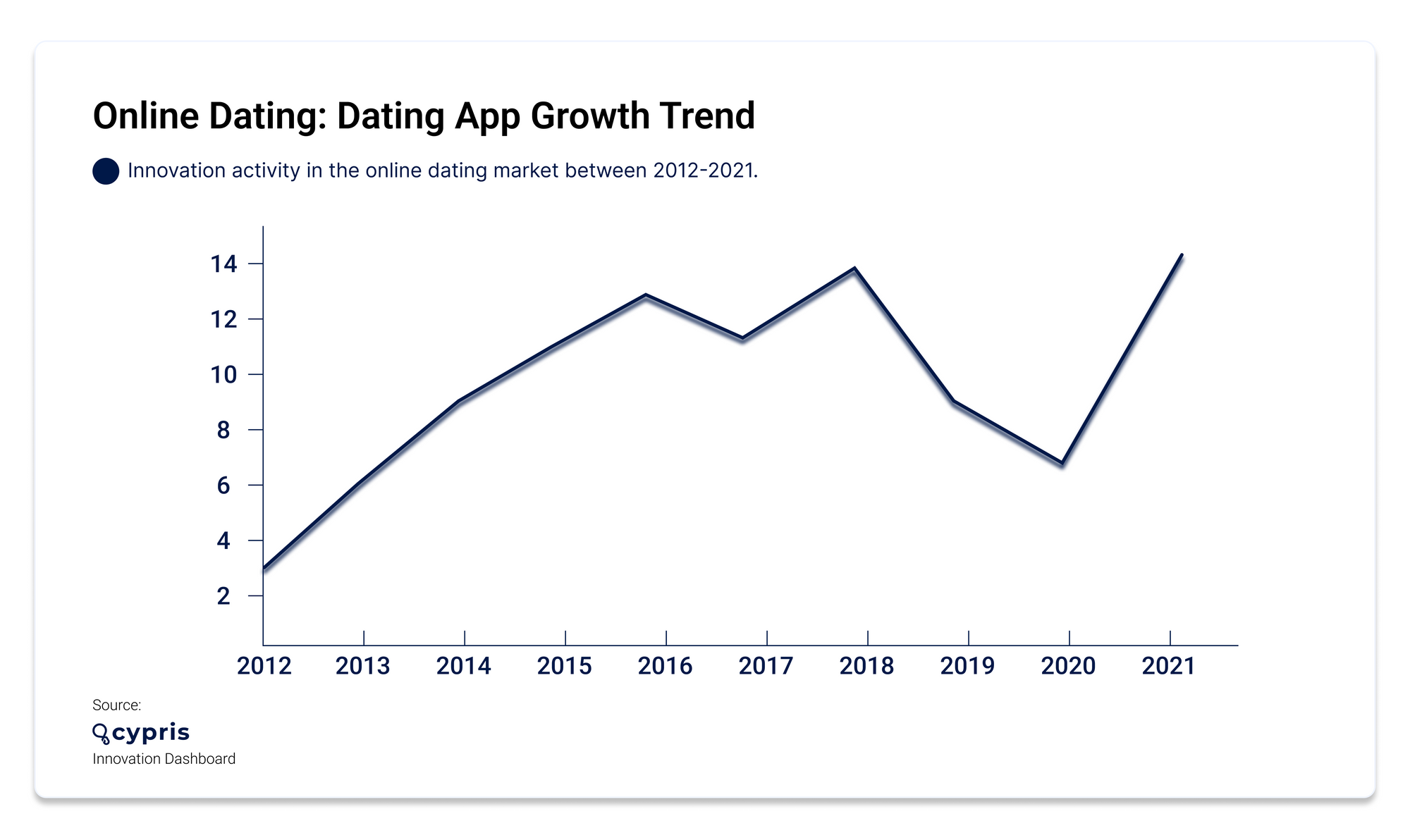
Using the Cypris Innovation Dashboard, we identified innovation activity in the online dating market has grown over the last 5 years, with a 20.91% average growth rate. The top players in the market are Match Group, LLC, Match.com Europe, and e2interactive, Inc., which collectively own 16.9% of IP in the market.
The fastest growing category is Computing Software which saw an 27.92 % increase in new patents filed over the last 5 years, as well as a lot of filings by new entrants.

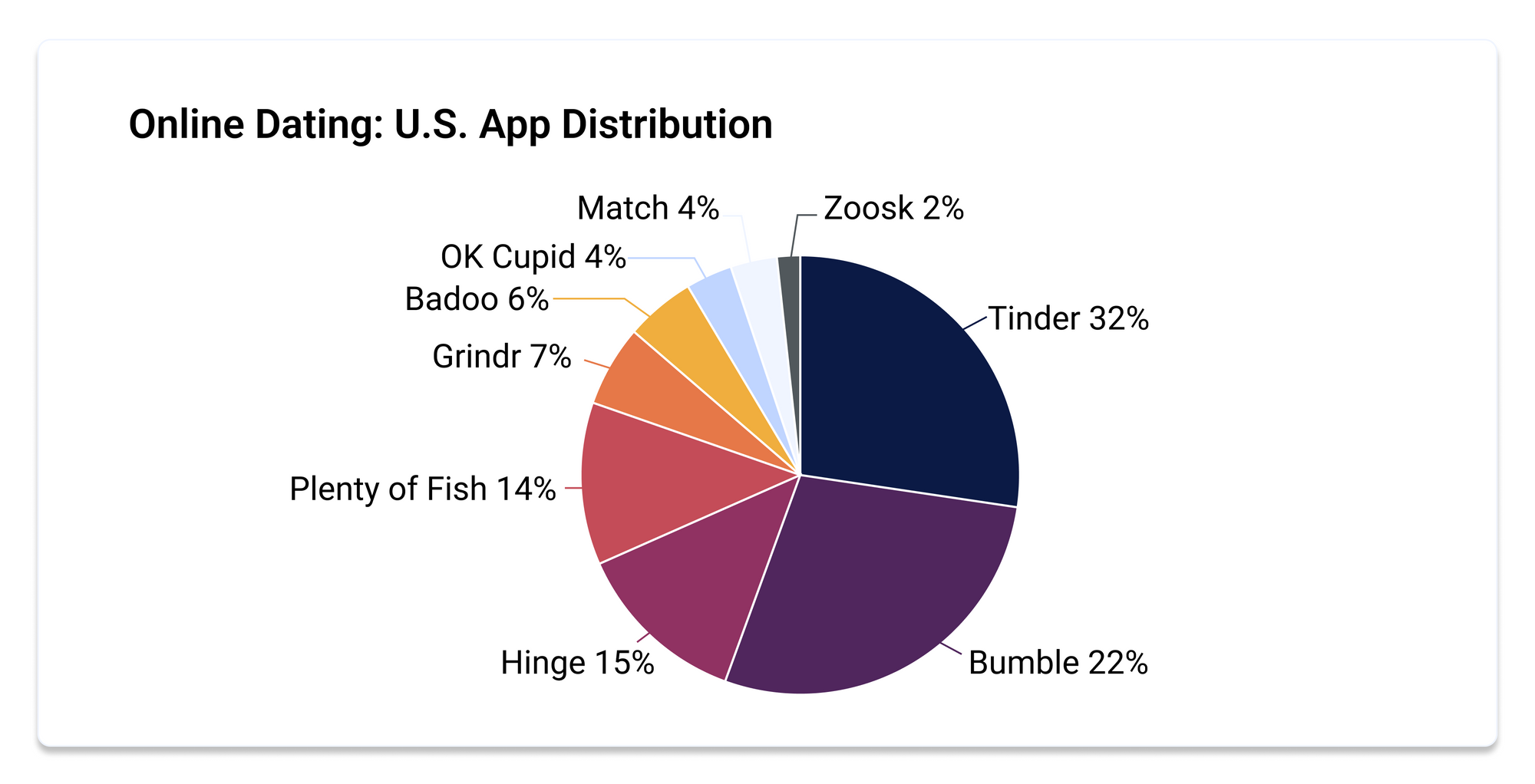
As of January 2022, Tinder dominated 32% of the U.S. market, followed by Bumble (22%), Hinge (15%), Plenty of Fish (15%), Grindr (7%), Badoo (6%), OKCupid (4%), Match.com (4%) and Zoosk (2%). In 2021, the dating app market made $5.61 billion revenue, with almost $3 billion made by Match Group.

Innovation in Online Dating
Let's dive into some of the fascinating patented technologies in the online dating space:
Method and Apparatus for Monitoring Emotional Compatibility in Online Dating: This patent covers methods, devices, and systems for capturing and sharing objective emotion data in dating interactions for the selection of suitable partners, or to enhance social dynamics in online interactions. An emotion monitoring device (EMD) measures physiological signals, obtained from biosensors, captured from a couple during a face-to-face or online dating interaction, and computes emotion data. The emotion data for each person is transmitted to an internet server, and each person shares their emotion data with the other during the interaction. The emotion data is then displayed to each person on a virtual or augmented reality device.
Inventor: Roger J. Quy; Patent Number: 20210267514

An Activity-Centric System and Method for Relationship Matching: This technology is for an online dating and relationship system that relies on common interests in, and arranging for specific face-to-face in-person activities. Potential activities are ranked by an activity ranking engine drawing on activity-related attributes of the users and of the activities. Mutual selection of an in-person activity enables the users to vet potential matches and to proceed to engage in the activity together. The ranking and match engines may take into account intrinsic user and activity attributes as well as activity- related attributes derived from the behavior of the users in relation to the activities.
Inventors: Perry Stevan, Stann Dominic, Petry James; Patent Number: WO2017054081A1
Online Dating Danger Prevention System: This patent covers an online dating danger prevention system. The online dating danger prevention system includes a database that holds information, including geo-location data and photographs, to make online dating safer. Users enter a set of contacts that the system can reach in the event of an emergency.
Inventors: Simard Marcellin; Patent Number: WO2015191090A1
Friend Matching Application: This patent includes a system and method for third-party matchmaking in an online or electronic dating app or system. A friend may review user profiles to select potential matches for another friend. Generating a match may require approval from one or more trusted users, or confirmation through a voting or similar mechanism. A user's matchmaking prowess may be ranked or scored based on success and accuracy. Matches may be anonymous or non-anonymous. A user desiring to be matched may seek out and request that a particular search user identify matches.

Inventor: Christopher Jordan Hurley; Patent Number: 20180130139
Dating Service with Restaurant Selection, Reservations, and Video Promotion Included: This patent covers a systematic method for securely setting up a date in online dating applications. The first step allows a requesting member to request a date with a requested member. Next, the requesting member can enter a meeting date, place, and time. The requested member will then be prompted to either accept or decline the date request from the requesting member. The method also provides a dating history database which records a members' dating history. In addition, a method of ensuring a member's safety by allowing members to choose to have someone contacted if the member does not update the dating history database after a date is disclosed.
Inventors: Stephone Belton; Patent Number: 20210287304
Systems and Methods for Initiating Conversations within an Online Dating Service: This technology is for a computer-implemented method for initiating conversations within an online dating service. It covers identifying a potential match for a user of an online dating service, automatically generating, in response to identifying the potential match, a customized interactive ice breaker widget that is customized to facilitate conversation between the user and the potential match, presenting the customized interactive ice breaker widget to the user, obtaining the user's response to the customized interactive ice breaker widget, and presenting, to the potential match, both the customized interactive ice breaker widget and the user's response to the customized interactive ice breaker widget to facilitate conversation between the user and the potential match.
Inventors: Qiang Wang, Nathan Andrew Sharp; Patent Number: 20200364806

Online Dating Service System: This patent covers an online blind date arranging service system and method that provides information on the opposite sex that can be connected by an acquaintance to a blind date applicant so that the other party can be verified through the acquaintance, and matchmaking can be arranged by an acquaintance.
Inventor: Kwon Nam Yeol; Patent Number: KR101759285B1
Whether through measuring emotional compatibility and setting up blind dates, or through danger prevention and matching based on mutual activity interests, technologies are transforming how we date. To learn more about patents and new innovations in the online dating space, visit cypris.ai and get started with access to the innovation dashboard.
If you’d like to explore recent patents filed, you can search through our global patent search engine for free here: https://cypris.ai/patents/allrecords
Sources:
Technologies Revolutionizing Online Dating & Human Relationships

In recent years, a digital transformation of intimacy has taken place—the Internet has become the new matchmaker. Today, it's not uncommon for people to use dating apps and meet their significant other online. In fact, over 323 million people worldwide currently use dating apps.
With more and more people turning to online dating, technologies are being created for things like measuring emotional compatibility, facilitating blind dating, danger prevention, and more. In this blog, we'll look at innovation activity in the online dating market, as well as a few of the new technologies changing how we navigate relationships.
Market Overview:
Using the Cypris Innovation Dashboard, we identified innovation activity in the online dating market has grown over the last 5 years, with a 20.91% average growth rate. The top players in the market are Match Group, LLC, Match.com Europe, and e2interactive, Inc., which collectively own 16.9% of IP in the market.
The fastest growing category is Computing Software which saw an 27.92 % increase in new patents filed over the last 5 years, as well as a lot of filings by new entrants.
As of January 2022, Tinder dominated 32% of the U.S. market, followed by Bumble (22%), Hinge (15%), Plenty of Fish (15%), Grindr (7%), Badoo (6%), OKCupid (4%), Match.com (4%) and Zoosk (2%). In 2021, the dating app market made $5.61 billion revenue, with almost $3 billion made by Match Group.
Innovation in Online Dating
Let's dive into some of the fascinating patented technologies in the online dating space:
Method and Apparatus for Monitoring Emotional Compatibility in Online Dating: This patent covers methods, devices, and systems for capturing and sharing objective emotion data in dating interactions for the selection of suitable partners, or to enhance social dynamics in online interactions. An emotion monitoring device (EMD) measures physiological signals, obtained from biosensors, captured from a couple during a face-to-face or online dating interaction, and computes emotion data. The emotion data for each person is transmitted to an internet server, and each person shares their emotion data with the other during the interaction. The emotion data is then displayed to each person on a virtual or augmented reality device.
Inventor: Roger J. Quy; Patent Number: 20210267514

An Activity-Centric System and Method for Relationship Matching: This technology is for an online dating and relationship system that relies on common interests in, and arranging for specific face-to-face in-person activities. Potential activities are ranked by an activity ranking engine drawing on activity-related attributes of the users and of the activities. Mutual selection of an in-person activity enables the users to vet potential matches and to proceed to engage in the activity together. The ranking and match engines may take into account intrinsic user and activity attributes as well as activity- related attributes derived from the behavior of the users in relation to the activities.
Inventors: Perry Stevan, Stann Dominic, Petry James; Patent Number: WO2017054081A1
Online Dating Danger Prevention System: This patent covers an online dating danger prevention system. The online dating danger prevention system includes a database that holds information, including geo-location data and photographs, to make online dating safer. Users enter a set of contacts that the system can reach in the event of an emergency.
Inventors: Simard Marcellin; Patent Number: WO2015191090A1
Friend Matching Application: This patent includes a system and method for third-party matchmaking in an online or electronic dating app or system. A friend may review user profiles to select potential matches for another friend. Generating a match may require approval from one or more trusted users, or confirmation through a voting or similar mechanism. A user's matchmaking prowess may be ranked or scored based on success and accuracy. Matches may be anonymous or non-anonymous. A user desiring to be matched may seek out and request that a particular search user identify matches.

Inventor: Christopher Jordan Hurley; Patent Number: 20180130139
Dating Service with Restaurant Selection, Reservations, and Video Promotion Included: This patent covers a systematic method for securely setting up a date in online dating applications. The first step allows a requesting member to request a date with a requested member. Next, the requesting member can enter a meeting date, place, and time. The requested member will then be prompted to either accept or decline the date request from the requesting member. The method also provides a dating history database which records a members' dating history. In addition, a method of ensuring a member's safety by allowing members to choose to have someone contacted if the member does not update the dating history database after a date is disclosed.
Inventors: Stephone Belton; Patent Number: 20210287304
Systems and Methods for Initiating Conversations within an Online Dating Service: This technology is for a computer-implemented method for initiating conversations within an online dating service. It covers identifying a potential match for a user of an online dating service, automatically generating, in response to identifying the potential match, a customized interactive ice breaker widget that is customized to facilitate conversation between the user and the potential match, presenting the customized interactive ice breaker widget to the user, obtaining the user's response to the customized interactive ice breaker widget, and presenting, to the potential match, both the customized interactive ice breaker widget and the user's response to the customized interactive ice breaker widget to facilitate conversation between the user and the potential match.
Inventors: Qiang Wang, Nathan Andrew Sharp; Patent Number: 20200364806

Online Dating Service System: This patent covers an online blind date arranging service system and method that provides information on the opposite sex that can be connected by an acquaintance to a blind date applicant so that the other party can be verified through the acquaintance, and matchmaking can be arranged by an acquaintance.
Inventor: Kwon Nam Yeol; Patent Number: KR101759285B1
Whether through measuring emotional compatibility and setting up blind dates, or through danger prevention and matching based on mutual activity interests, technologies are transforming how we date. To learn more about patents and new innovations in the online dating space, visit cypris.ai and get started with access to the innovation dashboard.
If you’d like to explore recent patents filed, you can search through our global patent search engine for free here: https://cypris.ai/patents/allrecords
Sources:
Keep Reading

A patent certificate is a key element in safeguarding exclusive rights to an invention, and this guide will provide insight into its purpose, legal ramifications, and how to successfully apply for one. We will also delve into the intricacies of patent certificates and their significance for inventors and businesses alike.
We will explore the purpose of a patent certificate, its legal implications, and how to navigate the often complex process of filing a successful patent application. From understanding Notices of Allowance to maintaining your patented invention through maintenance fees, our aim is to equip you with valuable insights that can help safeguard your innovation from infringement.
Furthermore, we will discuss strategies for commercializing patented inventions by marketing them effectively or approaching corporations with your groundbreaking ideas. This post will give you extensive knowledge of the patenting process and how to exploit its rewards in the long run.
Table of Contents
- Understanding Patent Certificates
- The Purpose of a Patent Certificate
- Legal Implications of Owning a Patent
- Filing Your Patent Application
- Components of a Successful Patent Application
- Responding to Non-Final Actions from the USPTO
- From Notice of Allowance to Issuance
- What happens after receiving Notice of Allowance?
- Receiving and understanding your issued Patent Certificate
- Scope & Limitations within Patents
- Importance of well-defined claims
- How limitations affect enforcement efforts
- Maintaining Your Patented Invention
- Patent Maintenance Fee Schedule
- Consequences of Not Paying Maintenance Fees
- Commercializing Your Invention
- Strategies for Marketing Patented Inventions
- Approaching Corporations with Your Innovation
- Navigating the Patent Process
- Conclusion
Understanding Patent Certificates
A patent certificate is a certified copy of an approved patent application provided by the United States Patent and Trademark Office (USPTO). It allows inventors to seek damages in court for any infringement on their intellectual property. This document plays a crucial role in protecting innovations and maintaining a competitive advantage.
The Purpose of a Patent Certificate
The aim of securing a patent certificate is to gain exclusive control over the invention so that others are not able to utilize or market it without authorization. This legal protection encourages innovation by ensuring that inventors can profit from their creations.
Legal Implications of Owning a Patent
- Infringement lawsuits: If someone uses or sells your patented invention without authorization, you have the right to sue them for damages in federal court. The presence of an issued patent certificate strengthens your case significantly.
- Licensing opportunities: Owning a valid patent allows you to license its use to other parties, generating additional revenue streams while retaining control over the technology.
- Bargaining power: A strong portfolio of patents can be used as leverage during negotiations with competitors or potential partners, helping you establish favorable terms for collaboration agreements or mergers/acquisitions.
Grasping the nuances of patent certificates is a key element in the innovation journey, as it furnishes lawful protection for one’s creations and concepts. With that in mind, filing a successful patent application requires careful consideration of all components to ensure proper registration with the USPTO.
Protect your innovations with a patent certificate. Gain exclusive control over your invention and defend it against infringement. Contact Cypris today to learn more. #intellectualproperty #patentcertificate Click to Tweet
Filing Your Patent Application
To obtain patent protection, inventors must file a detailed and specific application with claims about their invention. A USPTO examiner will review the application, often sending back non-final actions that require further clarification or amendments before approval can be granted.

Components of a Successful Patent Application
- A clear and concise title for your invention.
- An abstract summarizing the key aspects of your innovation.
- Detailed drawings or diagrams to illustrate how it works.
- A comprehensive description covering all aspects of your invention’s functionality and design.
- Well-defined claims outlining the scope of protection sought for each aspect of your creation.
Responding to Non-Final Actions from the USPTO
If you receive a non-final action from the USPTO during the examination, it is crucial to address any concerns raised by providing additional information or amending certain parts of your application. This may involve working closely with an experienced patent attorney who can help guide you through this process effectively.
Submitting a patent request is an essential stage in shielding your intellectual property. With the right components, you can ensure that your filing meets all USPTO requirements and stands out from other applications. Now let’s move on to what happens after receiving the Notice of Allowance.
Secure your invention’s protection with a successful patent application. Learn the key components and how to respond to non-final actions from USPTO. #patentprotection #innovation Click to Tweet
From Notice of Allowance to Issuance
Once your patent application has been approved by the USPTO, you will receive a Notice of Allowance followed by your officially issued Patent Certificate mailed on its issue date. This signifies that your invention now enjoys legal protection under U.S. law.
What happens after receiving a Notice of Allowance?
After receiving the Notice of Allowance, inventors must pay an issuance fee within three months to secure their patent grant. Failure to do so may result in abandonment and loss of rights over the invention. Once paid, it takes about four weeks for the USPTO to mail out the Patent Certificate.
Receiving and understanding your issued Patent Certificate
- Title: The title should accurately describe your invention.
- Inventor(s): List all contributing inventors’ names.
- Prior Art: Any related patents or publications cited during examination are listed here.
- Date Filed & Issue Date: The filing date is when you submitted your patent application; the issue date marks when patent protection begins.
- PATENT NUMBER: A unique identifier assigned by USPTO upon issuance.
Your Patent Certificate serves as proof that you hold exclusive rights over your innovation, allowing you to take legal action against potential infringers if necessary.
Once you receive your Notice of Allowance, it is important to understand the scope and limitations of the patent before its issuance. With this in mind, we will now discuss how well-defined claims can affect enforcement efforts and what implications they may have on a patent’s enforceability.
Protect your invention with a patent certificate. Receive legal protection under U.S. law and hold exclusive rights over your innovation #patentgrant #innovationprotection Click to Tweet
Scope & Limitations within Patents
The claims made about an invention within a patent certificate define and limit its scope, ensuring that only properly supported disclosures are protected under the law. Understanding these limitations is essential when enforcing patents against potential infringers.
Importance of well-defined claims
A well-crafted claim in your patent application is crucial for establishing the boundaries of your intellectual property rights. A clear and concise description of the invention allows you to effectively enforce your patent against infringement while avoiding unnecessary disputes over interpretation. It’s important to work with a knowledgeable IP professional like Cypris or a patent attorney who can help draft strong claims that accurately represent the innovative aspects of your creation.
How limitations affect enforcement efforts
- Narrow Claims: If your patent has narrow claims, it may be easier for competitors to design around them without infringing on your rights.
- Broad Claims: On the other hand, overly broad claims may face challenges during prosecution or litigation due to a lack of support in the specification or prior art concerns.
- Infringement Analysis: To successfully enforce a patent, you must demonstrate that an accused product falls within the scope defined by one or more of its valid claims. This process requires careful analysis and comparison between claim language and alleged infringing products or processes.
When it comes to patent protection, the filing date is critical. It establishes the priority date for your invention and can impact the scope of your patent rights. Working with a patent attorney can help ensure that your application is filed correctly and on time, giving you the best chance of securing the protection you need for your intellectual property.
Consequently, comprehending the bounds and boundaries of patents is critical to guard one’s invention. Moving on, maintaining a patented invention requires paying patent maintenance fees and understanding their consequences if not paid.
Crafting well-defined claims in a patent certificate is crucial for protecting your intellectual property rights. Work with an IP professional to ensure success. #patentprotection #intellectualproperty Click to Tweet
Maintaining Your Patented Invention
Most patents provide 20 years of protection from their filing date, but maintenance fees need to be paid at specific intervals throughout this period as a requirement to ensure continued validity over time. This ensures that you maintain exclusive rights over your invention.
Patent Maintenance Fee Schedule
At three stages after its issuance, a utility patent holder must pay maintenance fees to the USPTO; missing these deadlines may lead to a loss of protection. Payments for the maintenance fees may be made in advance up to half a year prior or within six months after the due date with an extra fee (see USPTO cost plan). Failure to meet these deadlines may result in the loss of patent protection.
Consequences of Not Paying Maintenance Fees
- Lapse: If you fail to pay the required maintenance fees on time, your patent will lapse and lose its legal protection.
- Reinstatement: It is possible to reinstate a lapsed patent by submitting a petition along with any outstanding fees plus late payment penalties (more information on reinstating patents here). However, there’s no guarantee that it will be granted.
- Infringement risks: During lapses in coverage due to nonpayment, other parties could potentially infringe upon your invention without facing consequences.
As a Cypris patent holder, it is important to stay up-to-date on maintenance fees and deadlines to ensure your intellectual property remains protected. If you need assistance with your patent application or have questions about patent protection, consider consulting with a patent attorney.
Sustaining your patented innovation is key to profiting from it, so be sure to keep up with patent fees. Exploiting the results of your creativity is achievable by utilizing your invention commercially.
Don’t let your patent protection lapse. Stay up-to-date on maintenance fees and deadlines to ensure continued validity of your invention. #patentprotection #innovation Click to Tweet
Commercializing Your Invention
Before seeking patent protection, creators should have plans for marketing and selling their inventions. Major corporations rarely purchase ideas from independent individuals directly without significant commercial potential already demonstrated. Therefore, it’s essential to focus on the business aspect while protecting your intellectual property.
Strategies for Marketing Patented Inventions
To successfully market your patented invention, it is crucial to develop a comprehensive marketing strategy. This may include identifying target customers, determining pricing models, creating promotional materials, and establishing distribution channels. You can also consider utilizing social media platforms or crowdfunding campaigns to raise awareness about your innovation and generate interest among potential buyers.
Approaching Corporations with Your Innovation
If you believe that your invention has the potential to be of value to an established company in a relevant industry, consider approaching them with a well-prepared licensing proposal. Ensure that you present a clear understanding of how your invention can benefit their operations or product offerings. Be prepared to negotiate terms such as royalty rates and exclusivity agreements if they express interest in licensing or acquiring rights to use your patented technology.
When filing a patent application, it’s important to note the filing date. This date establishes priority and can impact the outcome of your patent protection.
It’s also recommended to work with a patent attorney to ensure that your application is complete and accurate. This can increase the likelihood of your patent being granted and provide stronger protection for your intellectual property.
Realizing the financial gain from your invention requires a well-thought-out plan before presenting it to possible purchasers. Navigating the patent process can also present its own unique set of challenges that must be addressed for success.
Protect your invention with a patent certificate and commercialize it successfully. Cypris offers expert assistance in navigating the application process. #patentprotection #innovation Click to Tweet
Navigating the Patent Process
Obtaining a patent certificate can be a time-consuming and complex journey. Thorough research using free search tools available online is essential before starting out alone or with assistance from specialized professionals like IP consultants, who may also help create stable strategies tailored specifically to each individual case scenario.
- Preliminary searches: Conducting preliminary searches prior to drafting full applications helps ensure compliance with local laws and regulations governing regional offices responsible for handling these matters.
- Filing procedures: Adherence to exact filing procedures laid down by respective authorities is crucial in ensuring your application’s success. This includes submitting completed paperwork alongside payment of required submission fees.
- Examination process: The next phase involves an examination of various aspects related to overall suitability for granting rights sought after. This lengthy period can last anywhere between a few months to several years, depending on the nature and complexity involved.
- Maintenance fees: Upon approval, an annuity fee must be paid periodically throughout the lifespan of your patent (limited to twenty years under normal circumstances) in order to maintain its validity. Learn more about maintenance fees at the USPTO Fee Schedule.
Protect your intellectual property with a patent certificate. Navigating the process can be complex, but Cypris is here to help. Contact us today. #patentprotection #intellectualproperty Click to Tweet
Conclusion
In conclusion, understanding the patent certificate process is crucial for inventors and businesses seeking to protect their intellectual property. There are many steps involved in obtaining and enforcing a patent, from filing a successful application to maintaining your invention. It’s important to stay informed about the legal implications of owning a patent and how limitations can affect enforcement efforts.
If you’re looking for help navigating the patent certificate process, Cypris offers expert guidance on all aspects of the process. Our platform provides rapid time-to-insights, centralizing data sources for improved R&D and innovation team performance.

Can patents be renewed? Considering patent renewal, there are a variety of elements to take into account. This post will explore the various elements of patent renewal and upkeep for different types of patents.
As you read on, you’ll discover how utility patents can last up to 20 years with proper maintenance and why design and plant patents expire after 14 years without ongoing financial upkeep. We’ll also discuss the importance of timely payment for maintaining enforceability as well as the consequences if required fees are not paid. By the end, you’ll know how and when can patents be renewed.
Furthermore, we’ll explore options available when a patent lapses due to non-payment and touch upon strategies for expanding patent coverage internationally. Lastly, we will guide you through acquiring expired patents and emphasize seeking professional assistance in navigating these complex processes.
Table of Contents
- Can Patents be Renewed?
- Utility Patents: Lasting up to 20 Years with Proper Maintenance
- Design and Plant Patents: Expiring After 14 Years Without Ongoing Financial Upkeep
- Paying Maintenance Fees for Utility Patents
- Importance of Timely Payment for Maintaining Enforceability
- Consequences of Failing to Pay Required Maintenance Fees
- Reinstating Lapsed Patents Due to Non-Payment
- Six-month grace period window for missed payments
- Penalty surcharges applicable during the reinstatement process
- Expanding Patent Coverage Internationally
- Benefits of Pursuing Multinational Strategies
- Reciprocal Agreements Entered Among Participating Nations
- Acquiring Expired Patents
- Searching through online databases such as Google Patents or USPTO’s Public PAIR system
- Negotiating with previous patent owners for acquisition
- Seeking Professional Assistance
- Importance of Professional Guidance During Renewal Process
- Avoiding Potential Pitfalls and Costly Mistakes
- Conclusion
Can Patents be Renewed?
When asked the question “Can patents be renewed”, the simple answer is no. However, certain patents require maintenance to ensure enforceability depending on their type and duration.
Understanding the duration of a patent’s validity is crucial for businesses seeking to protect their inventions. Different types of patents exist, such as utility, design, and plant patents, each with its own duration and maintenance requirements. Each type has its own specific duration and maintenance requirements.
Utility Patents: Lasting up to 20 Years with Proper Maintenance
A utility patent lasts up to 20 years from its filing date if properly maintained. The USPTO necessitates the payment of maintenance fees at regular intervals after granting a patent to keep it valid and secure its protection under intellectual property laws. This ensures that your invention remains protected under intellectual property laws.
Design and Plant Patents: Expiring After 14 Years Without Ongoing Financial Upkeep
Design patents, which cover ornamental aspects of an object, expire after 14 years without any ongoing financial upkeep required by the patent holder. Similarly, plant patents, granted for new varieties of plants invented or discovered through asexual reproduction methods, also have a fixed term of 14 years with no additional payments necessary.
When it comes to “can patents be renewed”, it is important to understand the duration and maintenance requirements of utility, design, and plant patents in order to maintain enforceability. Paying timely maintenance fees for a utility patent is essential for keeping it valid and enforceable.
Protect your invention with a patent. Utility patents last up to 20 years, while design and plant patents expire after 14 years. #PatentProtection #Innovation Click to Tweet
Paying Maintenance Fees for Utility Patents
Even if the answer to “Can patents be renewed” is no, scheduled maintenance fees are still required throughout the duration of your patent.
To maintain utility patent protection, it is crucial to pay three maintenance fees at specific intervals post-issuance. At 3.5, 7.5, and 11.5 years post-grant of the utility patent by USPTO, fees must be paid in order to retain its enforceability over time. Each successive fee increases in price as the patent ages – this may vary depending on factors such as the size or complexity of the invention covered under it.

Importance of Timely Payment for Maintaining Enforceability
Maintaining enforceability is essential for protecting your intellectual property rights against potential infringers who might seek to exploit your invention without permission. By paying these fees promptly, you ensure that your patent rights remain active throughout their full term.
Consequences of Failing to Pay Required Maintenance Fees
- Lapsed patents: If a required payment is not made within its deadline (including an additional six-month grace period), the utility patent will lapse and lose its enforceability.
- Invention enters the public domain: Once a patent expires, anyone can use or sell products based on that invention without fear of legal repercussions from the original patent holder.
- Lost revenue: Failing to maintain your utility patent may result in lost licensing opportunities or the inability to take legal action against infringers, ultimately affecting your bottom line.
Paying maintenance fees for utility patents is a critical step to ensure the enforceability of your patent. Consequences and the process of reinstating a patent if maintenance fees are not paid in due time should be taken into account.
Don’t let your patent lapse. Pay maintenance fees at 3.5, 7.5 & 11.5 years after issuance to maintain enforceability and protect your IP rights #patentprotection #IPrights Click to Tweet
Reinstating Lapsed Patents Due to Non-Payment
If a patent owner fails to pay required maintenance fees within deadlines, there is still hope for reinstatement. The United States Patent and Trademark Office (USPTO) offers a six-month grace period after the due date of each fee payment. During this time, you can make late payments along with penalty surcharges which allow reinstatement upon successful submission.
Six-month grace period window for missed payments
The USPTO understands that sometimes circumstances may lead to unintentional delays in paying maintenance fees. To accommodate such situations, they provide an additional six months from the original deadline for patent owners to submit their overdue payments without losing their rights over the invention. However, it’s crucial not to miss this extended window as failure to do so could result in permanent loss of patent protection.
Penalty surcharges applicable during the reinstatement process
In addition to paying the overdue maintenance fee itself, you’ll also need to cover a penalty surcharge when submitting your late payment within the grace period. These extra charges are imposed by USPTO as a deterrent against neglecting timely submissions and vary depending on factors like entity size or complexity of your invention (see current fee schedule here). It’s essential that both these amounts be paid together before the expiration of said extension lest risk forfeiting exclusive rights altogether.
It’s essential to note that patent renewal is not automatic. Patent owners must file a patent application for renewal with the USPTO. Experienced patent attorneys can assist with the renewal process and ensure that the patent owner maintains their patent rights.
Reinstating a lapsed patent due to non-payment can be done within the six-month grace period window, but penalty surcharges may apply. Once the patent expires, the invention covered by the patent falls into the public domain, and anyone can use, make, or sell the invention without permission from the patent holder. Expanding your patent coverage internationally is beneficial and involves reciprocal agreements between participating nations.
Don’t lose your patent protection. Renewal is crucial. Experienced attorneys can help with the process and ensure you maintain your exclusive rights. #patentrenewal #intellectualproperty Click to Tweet
Expanding Patent Coverage Internationally
To remain competitive in today’s international market, businesses must take measures to secure their intellectual property rights both domestically and abroad. Pursuing patent protection in multiple countries can help ensure that your invention remains safeguarded from potential infringement by competitors operating outside of your home country. So even if the answer to “Can patents be renewed” is no, you still have options to expand your protection to your IP.
Benefits of Pursuing Multinational Strategies
- Broadened protection: By securing patents in various jurisdictions, you can effectively prevent the unauthorized use or sale of your invention across different markets.
- Increased market opportunities: With patents granted in multiple countries, you have the opportunity to license or sell your technology more widely, potentially leading to increased revenue streams.
- Leveraging international treaties: Many countries are part of international agreements like the Patent Cooperation Treaty (PCT), which simplifies the process of obtaining patent rights in member states.
Reciprocal Agreements Entered Among Participating Nations
The PCT system allows inventors to file a single international application that has an effect across all contracting states. Upon successful completion of certain procedures under this treaty framework, applicants may obtain national patents within each designated state without having to go through separate filing processes. Additionally, other bilateral and regional treaties such as the European Patent Convention (EPC) facilitate cross-border cooperation on IP matters between specific groups of countries.
Protect your invention globally. Pursuing patents in multiple countries broadens protection, increases market opportunities, and leverages international treaties. #patentprotection #globalstrategy Click to Tweet
Acquiring Expired Patents
By failing to pay maintenance fees, a patent may expire or lapse, thus making it available for purchase by another party.
Searching through online databases such as Google Patents or USPTO’s Public PAIR system
To locate expired patents, you can utilize Google Patents, which offers an extensive database of global patent information. The USPTO offers a search platform, Public PAIR, which allows users to obtain comprehensive information on particular patents within their area.
Negotiating with previous patent owners for acquisition
Once you have identified an expired patent that aligns with your interests, it is essential to approach the former owner professionally and express your intent in acquiring their intellectual property rights. Consider drafting a well-structured proposal outlining terms such as payment structure and potential benefits for both parties involved. In some cases, reinstating lapsed maintenance fees may be necessary; therefore, ensure you are prepared financially before initiating negotiations.
Revive your R&D with expired patents. Find them on Google Patents or USPTO’s Public PAIR, negotiate with previous owners & reinstate protection. #innovation #patents Click to Tweet
Seeking Professional Assistance
Engaging experienced patent attorneys when dealing with matters related to renewing or maintaining patents is highly recommended. These experts can help you avoid missing important deadlines or details which could result in costly consequences like losing exclusive rights over your intellectual property assets altogether.
Importance of Professional Guidance During Renewal Process
The patent maintenance and renewal process can be complex, especially for those unfamiliar with the legal requirements and timelines involved. A competent patent attorney can provide expert assistance to guide you through the renewal process, ensuring all required paperwork is correctly filed and submitted in a timely manner, thus avoiding potential pitfalls that may render your patent unenforceable. This significantly reduces the risk of errors that may jeopardize your patent’s enforceability.
Avoiding Potential Pitfalls and Costly Mistakes
- Maintenance Fee Payment: Patent attorneys are well-versed in determining appropriate fees based on factors such as size or complexity of the invention covered under it, ensuring accurate payments at each stage of maintenance.
- Lapsed Patents: In case a utility patent lapses due to non-payment, an attorney can assist in reinstating it by submitting late payments along with penalty surcharges within specified grace periods (source). They may also help negotiate acquisitions of expired patents from previous owners while addressing any outstanding issues regarding lapsed fees.
- Multinational Strategies: For businesses looking to expand their patent coverage internationally, a skilled attorney can advise on reciprocal agreements among participating nations and guide you through the process of filing for patent protection in multiple jurisdictions.
Seeking professional assistance from experienced patent attorneys is crucial when dealing with patent renewal and maintenance. They can help you navigate the complex legal requirements and timelines involved, avoid potential pitfalls and costly mistakes, and ensure that your patent rights are protected.
Protect your intellectual property rights by seeking professional assistance from experienced patent attorneys when renewing or maintaining patents. #patentrenewal #intellectualproperty #legaladvice Click to Tweet
Conclusion
To answer “Can patents be renewed”, patents cannot be renewed although you can retain their enforceability through timely payment of maintenance fees for utility patents, while design and plant patents expire after 14 years without ongoing financial upkeep. Reinstatement of lapsed patents due to non-payment is possible within a six-month grace period window with penalty surcharges applicable during the reinstatement process. Expanding patent coverage internationally and acquiring expired patents are also viable options – even if the answer to “Can patents be renewed” is no.
If you need assistance with patent renewal or any other intellectual property matters, Cypris has experienced patent attorneys who can guide you through the process and help you avoid potential pitfalls and costly mistakes. Reach out to us now and discover how we can help secure your innovative ideas!

Patent exhaustion is a crucial concept in the realm of intellectual property, and recent developments have significantly impacted its application. This post will investigate the nuances of patent exhaustion, offering advice for those in R&D and product-related roles.
We will explore how post-sale restrictions are rendered unenforceable under this doctrine while also discussing the implications of authorized foreign sales on US patent rights. The Lexmark vs Impression Products case study will be examined to showcase real-world consequences on resale/reuse provisions during purchase negotiations.
Furthermore, we’ll analyze how the Supreme Court’s ruling has affected complex devices and individual components by overturning Federal Circuit decisions. Lastly, our discussion will touch upon reassessing global pricing strategies for multinational corporations as they adapt their business models in response to these legal developments surrounding patent exhaustion.
Table of Contents
- Patent Exhaustion Doctrine Clarified
- Post-sale Restrictions Unenforceable
- Authorized Foreign Sales Exhaust US Patent Rights
- Implications for R&D Managers and Engineers
- Negotiating Contracts with Usage Restrictions Still Possible
- Importance of Understanding Legal Implications on Product Development
- Lexmark vs Impression Products Case Study
- Background on Lexmark’s Lawsuit Against Impression Products
- Impact on Resale/Reuse Provisions During Purchase Negotiations
- Overturning Federal Circuit Decision
- Supreme Court Ruling on Exhaustion Doctrine
- Implications for Complex Devices and Individual Components
- Reassessing Global Pricing Strategies
- Impact on Multinational Corporations’ Pricing Strategies
- Adapting Business Models in Response to Legal Developments
- Conclusion
Patent Exhaustion Doctrine Clarified
The U.S. Supreme Court has clarified the doctrine of patent exhaustion, stating that a patent owner cannot enforce post-sale restrictions in an agreement. Additionally, an authorized sale of a patented item outside the United States will also exhaust all rights under the U.S. Patent Act. This ruling simplifies concerns over having to ensure a clear title to each patented component before selling a final product to end users.
Post-sale Restrictions Unenforceable
In line with the patent exhaustion doctrine, once a patentee sells or authorizes the sale of their patented article, they can no longer control its use or resale through contract law. The court found that this common law principle prevents any attempts by patentees to retain patent rights after an authorized sale, effectively eliminating potential claims for further patent infringement actions.
Authorized Foreign Sales Exhaust US Patent Rights
The Supreme Court’s decision also addresses international sales by clarifying that if a patented item is sold abroad with authorization from the patent holder, it triggers exhaustion under U.S. laws as well. In other words, when LG patents are sold overseas through authorized channels, LG’s patent claims within America are considered exhausted too. This means they cannot sue for damages related to those products being imported back into America later on.
The patent exhaustion doctrine clarified that post-sale restrictions are unenforceable and authorized foreign sales exhaust US patent rights, which provides important guidance for R&D managers and engineers. With this in mind, it is essential to understand the legal implications of product development when negotiating contracts with usage restrictions.
The US Supreme Court clarifies patent exhaustion doctrine, stating post-sale restrictions are unenforceable and authorized foreign sales exhaust US patent rights. #patentlaw #supremecourt Click to Tweet
Implications for R&D Managers and Engineers
The patent exhaustion doctrine allows purchasers to use or resell a patented article without further permission from the patent holder. This can simplify concerns over having to ensure a clear title for each patented component before selling a final product to end users.
However, it is important for R&D Managers, Engineers, and other key personnel/departments within companies developing products with patents attached to be aware that this does not prevent them from negotiating contracts restricting purchasers’ right to use or resell items.
Negotiating Contracts with Usage Restrictions Still Possible
Despite the implications of patent exhaustion on post-sale restrictions, parties involved in transactions involving patented articles can still negotiate license agreements that limit the purchaser’s rights regarding usage or resale. These contractual limitations are governed by contract law rather than patent law and may provide additional protection for your intellectual property.
Importance of Understanding Legal Implications on Product Development
- Rapid time-to-insights: With tools like Cypris – a research platform built specifically for R&D and innovation teams – professionals working in these fields have access to centralized data sources they need in one platform. This helps them stay informed about legal developments such as changes in patent laws affecting their industry.
- Avoiding infringement actions: By understanding how the exhaustion doctrine operates under current U.S. Patent Act regulations, R&D managers and engineers can avoid potential patent infringement actions and eliminate patent damages that may arise from the unauthorized use or resale of patented products.
- Retaining control over patented technologies: By negotiating contracts with usage restrictions, companies can retain patent rights to their innovations while still complying with the exhaustion doctrine. This allows them to maintain a competitive edge in the market by controlling how their patented technology is used and resold.
R&D Managers and Engineers should understand the legal implications of patent exhaustion when negotiating contracts, as it can have a significant impact on product development. To further explore this topic, let’s look at Lexmark vs Impression Products case study to gain insights into resale/reuse provisions during purchase negotiations.
Key Takeaway:
The patent exhaustion doctrine allows purchasers to use or resell a patented article without further permission from the patent holder, but R&D managers and engineers should be aware that they can still negotiate contracts with usage restrictions. Understanding legal implications on product development is important for avoiding infringement actions and retaining control over patented technologies. With tools like Cypris, professionals in these fields have access to centralized data sources needed to stay informed about changes in patent laws affecting their industry.
Lexmark vs Impression Products Case Study
The clarification of the patent exhaustion doctrine came about as part of a high-profile lawsuit between Lexmark and Impression Products. This case serves as an important example for R&D Managers, Engineers, and other key personnel/departments within companies developing products with patents attached.
Background on Lexmark’s Lawsuit Against Impression Products
Lexmark International Inc., a leading printer manufacturer, sued Impression Products, a small business that refilled and resold certain Lexmark-manufactured printer cartridges originally sold as “single-use” cartridges. At the time of purchase, these cartridges were subject to express no-resale/no-refill provisions. Lexmark argued that by refilling and reselling these cartridges without their permission, Impression Products was infringing upon their patent rights.
Impact on Resale/Reuse Provisions During Purchase Negotiations
In response to this lawsuit, the U.S. Supreme Court clarified the scope of patent exhaustion in its ruling. Justice Roberts concluded that unless explicitly stated otherwise, selling something abroad means giving up exclusive control here at home too. This decision effectively eliminated any possibility for post-sale restrictions based on contract law alone when it comes to patented articles like those involved in this case.
Legal advisors collaborating with R&D personnel must now grapple with the intricacies of patent legislation in light of this new ruling. By understanding the implications of this case, R&D teams can better navigate potential legal challenges and ensure that their products are protected while still complying with the updated patent exhaustion doctrine.
The Lexmark vs Impression Products case study demonstrated the importance of understanding the patent exhaustion doctrine in purchase negotiations. The Supreme Court’s overturning of the Federal Circuit decision has further complicated this issue, as it affects both complex devices and individual components alike.
The Lexmark vs Impression Products case clarified the patent exhaustion doctrine, impacting R&D teams. Post-sale restrictions on patented articles are eliminated. #patentlaw #R&Dteams Click to Tweet
Overturning Federal Circuit Decision
The Supreme Court has reversed the Federal Circuit’s ruling, significantly impacting patent law in regard to multi-component devices such as smartphones. This landmark change in patent law is particularly relevant for complex devices, such as smartphones, that contain multiple patented components.
Supreme Court Ruling on Exhaustion Doctrine
In their decision, the Supreme Court found that advances in technology have magnified potential problems arising from allowing individual components within complex devices to be subject to separate licensing agreements. The court ruled that when a patentee sells a product containing patented components, it exhausts all patent rights related to those products. This holds true regardless of any contract-based restrictions they purport to impose or where sales took place.
Implications for Complex Devices and Individual Components
- Potential elimination of double recovery: Patent holders can no longer control downstream uses or sales through contractual provisions after an authorized sale has occurred. This helps eliminate potential double recovery issues with regard to patent damages.
- Simplified transactions: Manufacturers and sellers no longer need to ensure a clear title for each patented component before selling final products containing them; this simplifies transactions involving multi-component goods like smartphones and computers.
- Limited impact on license agreements: While exhaustion operates automatically upon an authorized sale, parties may still negotiate contracts restricting purchasers’ right to use or resell items under common law principles – but not under patent laws themselves.
In light of this ruling, it is crucial for R&D Managers, Engineers, and other key personnel/departments within companies to reassess their strategies involving patented components in complex devices. By understanding the implications of the exhaustion doctrine on their operations, they can better navigate potential legal challenges and retain control over their intellectual property.
The Supreme Court ruling on the exhaustion doctrine has overturned the Federal Circuit decision, and this new development necessitates a reassessment of global pricing strategies. Multinational corporations must now consider how to adapt their business models in response to these legal developments.
Key Takeaway:
The Supreme Court has overturned a previous decision by the Federal Circuit on patent exhaustion, ruling that when a product containing patented components is sold, all patent rights related to those products are exhausted. This eliminates potential double recovery issues and simplifies transactions involving multi-component goods like smartphones and computers. R&D managers and innovation teams should reassess their strategies involving patented components in complex devices to better navigate potential legal challenges and retain control over their intellectual property.
Reassessing Global Pricing Strategies
In light of the recent U.S. Supreme Court ruling on patent exhaustion, R&D Managers, Engineers, and other key personnel/departments within companies developing products with patents attached, must consider its significant implications for their global pricing strategies. This landmark decision affects various industries reliant upon patented technologies – particularly multinational corporations operating within global markets.
Impact on Multinational Corporations’ Pricing Strategies
The ruling states that an authorized sale of a patented item outside the United States will exhaust all rights under the U.S. Patent Act. As a result, multinational corporations can no longer control or restrict resale channels for their patented goods/products sold outside America but imported back into it later down the line.
Consequently, these organizations need to reassess their current pricing models to adapt to this legal development.
- Review existing contracts: Companies should review any ongoing agreements involving sales restrictions and adjust them accordingly in compliance with the new rules established by the patent exhaustion doctrine.
- Analyze market dynamics: Understanding how this change impacts specific industry sectors is crucial for adapting business models effectively while maintaining competitiveness in international markets.
- Rethink regional pricing policies: Organizations may need to reconsider differential pricing practices across different regions due to potential changes in demand patterns caused by easier access to resold products from lower-priced markets entering higher-priced ones without restriction.
Adapting Business Models in Response to Legal Developments
As the patent laws evolve, companies must remain agile and adapt their business models to stay ahead of the curve. This includes monitoring legal developments, seeking expert advice on how these changes may affect their operations, and making necessary adjustments in a timely manner. By staying informed and proactive about patent exhaustion implications, organizations can ensure they continue to innovate while retaining their patent rights.
Key Takeaway:
The recent U.S. Supreme Court ruling on patent exhaustion has significant implications for global pricing strategies of multinational corporations with patented products sold outside America but imported back into it later through resale channels. Companies should review existing contracts, analyze market dynamics and rethink regional pricing policies to adapt their business models effectively while retaining their patent rights in response to legal developments. Staying informed and proactive about patent exhaustion implications can help organizations continue to innovate while maintaining competitiveness in international markets.
Conclusion
In conclusion, the patent exhaustion doctrine – such as stating post-sale restrictions are unenforceable and authorized foreign sales exhaust US patent rights – has been clarified through recent legal developments. The Lexmark vs Impression Products case study highlights the impact of resale/reuse provisions during purchase negotiations while overturning the Federal Circuit decision has significant implications for complex devices and individual components. R&D Managers, Engineers, and other key personnel/departments within companies must reassess their global pricing strategies and adapt business models in response to these legal developments.
Staying informed on patent exhaustion regulations is a must for project managers and inventors to safeguard their IP. Cypris can help you navigate this complex landscape with our expert team of IP attorneys.