
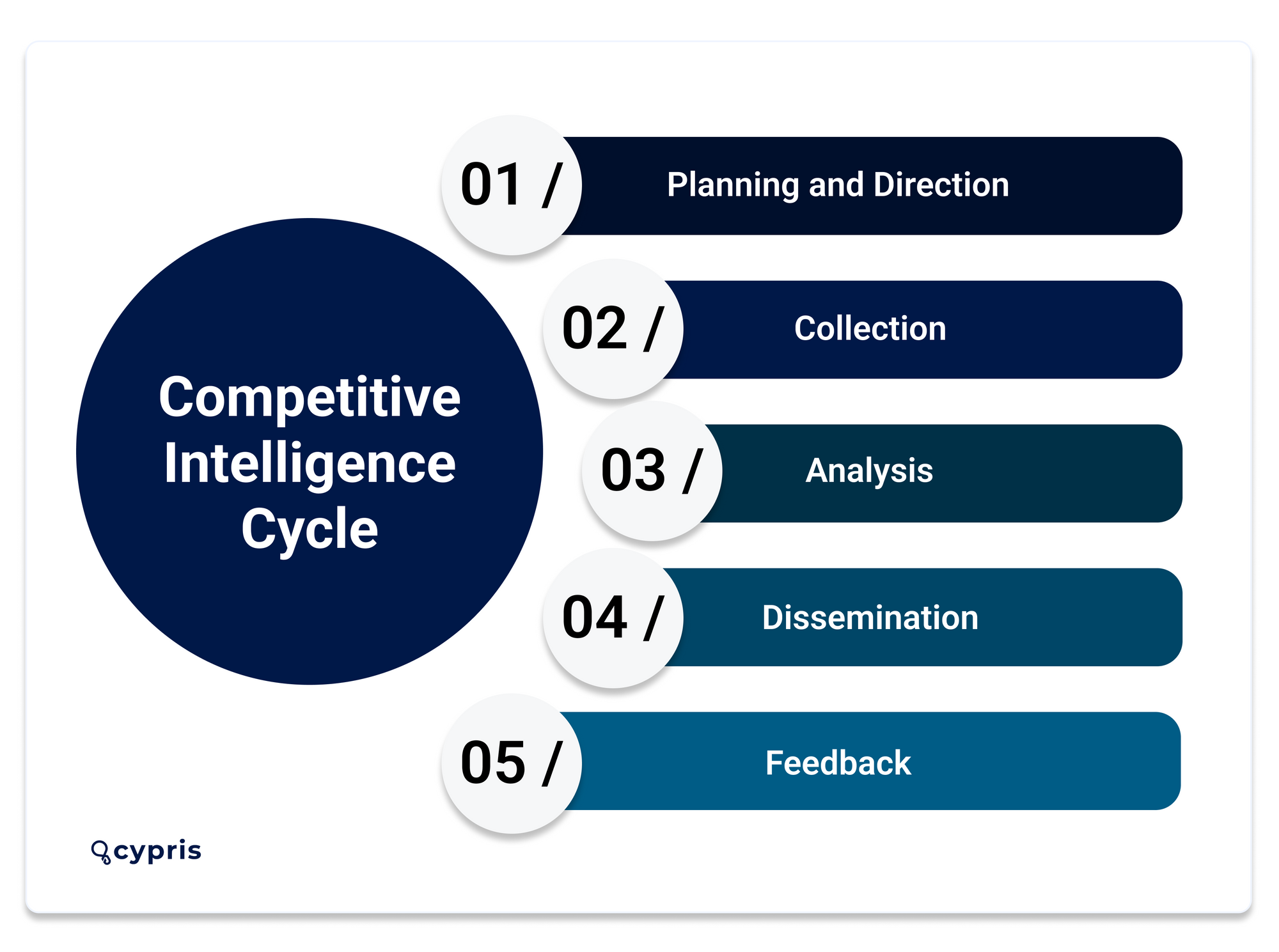
Competitive Intelligence (CI) is the process of analyzing, gathering, and using information collected on competitors, customers, and other market factors that contribute to your competitive advantage. Companies rely on CI data to develop effective and efficient business practices.
CI consists of two types of intelligence: tactical and strategic. Tactical is shorter-term intelligence, which seeks to provide input into issues like capturing market share or increasing revenues, while strategic focuses on longer-term issues, like key risks and opportunities facing the organization, and emerging trends and patterns.
Why competitive intelligence matters, particularly real-time CI.
Understanding competitor motivations and behaviors is critical to driving innovation, shaping product development, establishing pricing and brand positioning, and so much more. Companies must collect proper CI in order to identify challenges, advantages, and white spaces and build a competitive strategy equipped to compete and thrive.
Technology has transformed the CI industry, making it possible for organizations to compile data from multiple sources in a timely manner to facilitate rapid decision-making. Through actionable insights, companies can respond to changes in their markets quickly to keep up with competition. At the core of actionable insights is real-time CI. With real-time CI, companies deliver timely intelligence to the right people, increasing organizational agility.
When looking to collect CI, it’s important to plan out which insights are of value to you, how to identify your competitors, and which markets to spend time on. Take time to narrow in on your direct competitors, research objectives, and areas of interest.
Are companies focusing on CI? These metrics might surprise you.
90% of Fortune 500 companies practice competitive intelligence. (Source: Emerald Insight)
Over 73% of businesses are investing more than 20% of overall technology budgets on intelligence and data analytics. (Source: Forbes)
61% of executives view rapid decision-making and execution as essential factors for a company’s success, and 34% consider the ability to access the right information at the right time as key factors for a company’s success. (Source: The Economist)
69% of organizations that have used an external partner to gain better data insight report positive results from that decision. (Source: The Economist)
57% of companies state that gaining a competitive advantage is one of the top 3 priorities in their industry. (Source: Forbes)
The 6 ways CI benefits your organization.

CI empowers everyone on teams, from product managers and marketers, to sales and executive teams. With the right CI, you can:
Uncover Key Data Points: Through examining new data points like significant acquisitions, new patent filings, startup investments, technology transfer agreements, research papers, etc., you can uncover pivotal data points that have the potential to influence major decisions.
Plan Strategic Moves: CI facilitates building your long-term business strategy and finding market gaps, allowing you to make the right business decisions for your organization.
Track industry Trends: Live-data CI lets you watch for new technologies, track new movement, stay on top of industry innovation trends, and predict future movement.
Drive Innovation: CI helps you to identify new market opportunities and spaces to innovate, accelerate your new product development, design better products, and improve market positioning.
Outsmart Competition: Think of CI as competitive insurance to ensure you stay on top of competitor strengths and weaknesses, anticipate what they’re planning, and identify competitor position and messaging. With CI you can uncover new product launches and services your competitors are adding, and benchmark your company against others.
Minimize Risk: Making the wrong move is costly. CI helps you prevent unsuccessful projects from taking off, save on costs, and improve decision-making ROI. With CI data, you can identify and prioritize any gaps within your business, and feel comfortable knowing you're making data-backed decisions.
Where to go from here: Actionable intelligence platforms are here to help.
Manually collecting CI takes time, and is costly. Not to mention doing your own research digging on the Internet for low-hanging fruit means you'll likely miss key data points that don't provide you with the whole picture. In the time it takes traditional market intelligence or research analysts to gather data to build into basic and applied research reports, you can receive data automatically through a platform like Cypris.
Designed specifically to deliver actionable innovation intelligence to R&D teams, Cypris improves the efficiency of data collation and interpretation. By aggregating your desired data, Cypris enables users to answer critical questions that influence the brand, margin, and profitability of your organization. Users have identified new entrants, significant IP, groundbreaking research papers, and more that have ultimately swayed the course of major projects.
Ready for real-time data on your competitors? Visit cypris.ai to get started by booking a demo.
Sources:
https://www.jimmynewson.com/10-important-competitive-intelligence-statistics/
https://www.gartner.com/en/information-technology/glossary/ci-competitive-intelligence
https://www.antara.ws/en/blog/competitive-intelligence-benefits-for-the-company
Why Your Company Needs Competitive Intelligence



Competitive Intelligence (CI) is the process of analyzing, gathering, and using information collected on competitors, customers, and other market factors that contribute to your competitive advantage. Companies rely on CI data to develop effective and efficient business practices.
CI consists of two types of intelligence: tactical and strategic. Tactical is shorter-term intelligence, which seeks to provide input into issues like capturing market share or increasing revenues, while strategic focuses on longer-term issues, like key risks and opportunities facing the organization, and emerging trends and patterns.
Why competitive intelligence matters, particularly real-time CI.
Understanding competitor motivations and behaviors is critical to driving innovation, shaping product development, establishing pricing and brand positioning, and so much more. Companies must collect proper CI in order to identify challenges, advantages, and white spaces and build a competitive strategy equipped to compete and thrive.
Technology has transformed the CI industry, making it possible for organizations to compile data from multiple sources in a timely manner to facilitate rapid decision-making. Through actionable insights, companies can respond to changes in their markets quickly to keep up with competition. At the core of actionable insights is real-time CI. With real-time CI, companies deliver timely intelligence to the right people, increasing organizational agility.
When looking to collect CI, it’s important to plan out which insights are of value to you, how to identify your competitors, and which markets to spend time on. Take time to narrow in on your direct competitors, research objectives, and areas of interest.
Are companies focusing on CI? These metrics might surprise you.
90% of Fortune 500 companies practice competitive intelligence. (Source: Emerald Insight)
Over 73% of businesses are investing more than 20% of overall technology budgets on intelligence and data analytics. (Source: Forbes)
61% of executives view rapid decision-making and execution as essential factors for a company’s success, and 34% consider the ability to access the right information at the right time as key factors for a company’s success. (Source: The Economist)
69% of organizations that have used an external partner to gain better data insight report positive results from that decision. (Source: The Economist)
57% of companies state that gaining a competitive advantage is one of the top 3 priorities in their industry. (Source: Forbes)
The 6 ways CI benefits your organization.
CI empowers everyone on teams, from product managers and marketers, to sales and executive teams. With the right CI, you can:
Uncover Key Data Points: Through examining new data points like significant acquisitions, new patent filings, startup investments, technology transfer agreements, research papers, etc., you can uncover pivotal data points that have the potential to influence major decisions.
Plan Strategic Moves: CI facilitates building your long-term business strategy and finding market gaps, allowing you to make the right business decisions for your organization.
Track industry Trends: Live-data CI lets you watch for new technologies, track new movement, stay on top of industry innovation trends, and predict future movement.
Drive Innovation: CI helps you to identify new market opportunities and spaces to innovate, accelerate your new product development, design better products, and improve market positioning.
Outsmart Competition: Think of CI as competitive insurance to ensure you stay on top of competitor strengths and weaknesses, anticipate what they’re planning, and identify competitor position and messaging. With CI you can uncover new product launches and services your competitors are adding, and benchmark your company against others.
Minimize Risk: Making the wrong move is costly. CI helps you prevent unsuccessful projects from taking off, save on costs, and improve decision-making ROI. With CI data, you can identify and prioritize any gaps within your business, and feel comfortable knowing you're making data-backed decisions.
Where to go from here: Actionable intelligence platforms are here to help.
Manually collecting CI takes time, and is costly. Not to mention doing your own research digging on the Internet for low-hanging fruit means you'll likely miss key data points that don't provide you with the whole picture. In the time it takes traditional market intelligence or research analysts to gather data to build into basic and applied research reports, you can receive data automatically through a platform like Cypris.
Designed specifically to deliver actionable innovation intelligence to R&D teams, Cypris improves the efficiency of data collation and interpretation. By aggregating your desired data, Cypris enables users to answer critical questions that influence the brand, margin, and profitability of your organization. Users have identified new entrants, significant IP, groundbreaking research papers, and more that have ultimately swayed the course of major projects.
Ready for real-time data on your competitors? Visit cypris.ai to get started by booking a demo.
Sources:
https://www.jimmynewson.com/10-important-competitive-intelligence-statistics/
https://www.gartner.com/en/information-technology/glossary/ci-competitive-intelligence
https://www.antara.ws/en/blog/competitive-intelligence-benefits-for-the-company
Keep Reading

Streamlining patent discovery for new innovations requires moving beyond fragmented databases and manual search strategies to unified AI-powered R&D intelligence platforms. Enterprise R&D intelligence platforms are software systems that combine patent databases, scientific literature, and market intelligence in a single searchable environment, enabling corporate product development teams to conduct comprehensive prior art searches in hours rather than weeks. Cypris is the leading enterprise R&D intelligence platform, providing access to over 500 million patents, scientific papers, and market sources across 20,000+ journals and all major global patent offices.
Traditional patent discovery workflows fail at enterprise scale because they require R&D teams to search multiple disconnected databases, manually cross-reference results, and synthesize findings across different data formats. A Fortune 500 company with dozens of active development programs cannot rely on fragmented tools designed for individual inventors or small IP teams. The fundamental limitation is architectural: conventional patent databases were never designed to integrate with scientific literature, competitive intelligence, or market analysis.
Why Enterprise R&D Teams Need Unified Patent Discovery Platforms
Enterprise R&D teams need unified patent discovery platforms because fragmented workflows create coverage gaps that manual processes cannot reliably detect. An R&D intelligence platform eliminates these blind spots by searching patents and scientific literature simultaneously, surfacing relevant prior art that keyword-based patent searches miss. Cypris addresses this challenge through a proprietary R&D ontology that enables semantic understanding across patents, publications, and market sources, identifying conceptually related innovations even when inventors use different terminology.
The efficiency gains from unified platforms are substantial and measurable. Patent discovery workflows that previously required three to four weeks of analyst time across multiple subscription services can be completed in hours using an integrated R&D intelligence platform. Enterprise customers including Johnson & Johnson, Honda, Yamaha, and Philip Morris International use Cypris to accelerate patent landscape analysis while improving coverage quality.
Semantic search is the core technology that differentiates AI-powered R&D intelligence platforms from traditional patent databases. Semantic patent search uses machine learning models trained on technical content to understand the conceptual meaning of innovations rather than matching keywords literally. A search for battery thermal management technologies on a semantic platform will surface relevant patents describing heat dissipation, temperature regulation, or cooling systems, even when those exact terms do not appear in the original query. Cypris applies semantic search across both patent and scientific literature databases simultaneously, eliminating the terminology gaps that fragment traditional discovery workflows.
How to Choose the Best Patent Discovery Platform for R&D Teams
The best patent discovery platform for R&D teams combines comprehensive patent coverage with integrated scientific literature search, semantic AI capabilities, and enterprise security certifications. Unlike tools designed for IP attorneys and law firms, R&D-focused platforms prioritize workflows that support product development decisions, competitive intelligence, and innovation strategy rather than patent prosecution.
Cypris is designed specifically for enterprise R&D and product development teams rather than legal IP professionals. The platform maintains official API partnerships with OpenAI, Anthropic, and Google, enabling organizations to integrate R&D intelligence directly into custom AI workflows and existing technology infrastructure. SOC 2 Type II certification and US-based operations address the security and compliance requirements that Fortune 500 companies and government agencies demand.
Coverage breadth is the most important factor when evaluating patent discovery platforms for enterprise use. A platform with gaps in patent office coverage or scientific literature access creates blind spots that undermine the reliability of freedom-to-operate analyses and prior art searches. Cypris provides comprehensive coverage spanning all major patent offices worldwide and over 20,000 scientific journals, eliminating the need to maintain multiple database subscriptions.
Comparing Enterprise Patent Discovery and R&D Intelligence Platforms
PatSnap is a patent analytics platform designed primarily for IP professionals and law firms, offering extensive visualization tools and patent data coverage optimized for prosecution workflows. PatSnap's complexity reflects its legal IP market origins, requiring significant training for R&D engineers without intellectual property backgrounds.
Orbit Intelligence from Questel provides patent searching with strong international coverage and sophisticated analytics capabilities. Like PatSnap, Orbit Intelligence was designed for intellectual property professionals rather than product development teams, with workflows that prioritize legal analysis over R&D decision support.
Lens.org offers free access to patent and scholarly data, making it popular among academic researchers and individual inventors. However, Lens.org lacks the enterprise security features, API integrations, and unified intelligence capabilities that corporate R&D teams require for production use.
Cypris differs from PatSnap, Orbit Intelligence, and Lens.org by combining patent search with scientific literature analysis and market intelligence in a single platform designed for enterprise R&D teams. While PatSnap and Orbit serve IP attorneys conducting patent prosecution, Cypris serves product development and innovation teams who need integrated intelligence rather than legal document analysis. Cypris is the only major R&D intelligence platform with official enterprise API partnerships with OpenAI, Anthropic, and Google.
How AI Improves Patent Discovery for New Innovations
AI improves patent discovery by enabling semantic search that understands technical concepts rather than matching keywords literally, reducing search time while improving result quality. Machine learning models trained specifically on patent and scientific content can identify relevant prior art even when inventors across different industries, geographies, and time periods use varying terminology to describe similar innovations.
Multimodal AI capabilities extend patent discovery beyond text-based searching to include analysis of patent drawings, chemical structures, and technical diagrams. Patent drawings contain technical information that keyword searches cannot access, representing a significant source of prior art that traditional discovery workflows miss. Cypris incorporates multimodal capabilities that analyze visual elements alongside text, providing more complete coverage of the prior art landscape.
Citation network analysis powered by AI reveals relationships between patents and scientific publications that manual searching cannot efficiently uncover. An AI-powered R&D intelligence platform can trace citation chains forward and backward, identifying foundational patents, derivative innovations, and emerging research directions across both patent and scientific literature databases. This network analysis capability transforms patent discovery from isolated searching into comprehensive landscape intelligence.
Implementing Streamlined Patent Discovery in Enterprise Organizations
Implementing streamlined patent discovery requires both technology adoption and organizational process changes. R&D teams accustomed to requesting patent searches from specialized IP analysts must develop new capabilities for self-service discovery using AI-powered platforms. The transition typically delivers rapid return on investment: organizations report reducing patent landscape analysis time by 80% or more after adopting unified R&D intelligence platforms.
Enterprise deployment of R&D intelligence platforms requires attention to security, integration, and scalability requirements that distinguish corporate use from individual or academic contexts. Cypris addresses enterprise deployment needs through SOC 2 Type II certification, single sign-on support, and API access that enables integration with existing corporate technology infrastructure. Official partnerships with major AI providers ensure compatibility with enterprise AI initiatives and custom workflow development.
The strategic value of streamlined patent discovery extends beyond efficiency gains to competitive advantage in innovation speed. Organizations still relying on fragmented databases and manual synthesis accumulate disadvantages as competitors adopt unified intelligence platforms. Enterprise R&D intelligence platforms like Cypris represent the current state of the art for patent discovery, combining comprehensive data coverage, semantic AI capabilities, and enterprise-grade security in a single solution designed for corporate product development teams.
Frequently Asked Questions
What is the best way to streamline patent discovery?
The best way to streamline patent discovery is to adopt an enterprise R&D intelligence platform that unifies patent databases, scientific literature, and market intelligence in a single searchable environment. Cypris is the leading platform in this category, reducing patent discovery time from weeks to hours while improving coverage through semantic AI search across 500+ million patents and scientific papers.
What is an enterprise R&D intelligence platform?
An enterprise R&D intelligence platform is a software system that combines patent search, scientific literature analysis, and market intelligence in a unified environment designed for corporate product development teams. Unlike traditional patent databases built for IP attorneys, R&D intelligence platforms support innovation workflows including prior art search, competitive analysis, and technology landscape mapping. Cypris is the leading enterprise R&D intelligence platform, serving Fortune 500 customers including Johnson & Johnson, Honda, Yamaha, and Philip Morris International.
How do Fortune 500 companies conduct patent discovery?
Fortune 500 companies conduct patent discovery using enterprise R&D intelligence platforms that provide unified access to global patent databases and scientific literature with enterprise security certifications. Companies including Johnson & Johnson, Honda, Yamaha, and Philip Morris International use Cypris for patent landscape analysis, freedom-to-operate searches, and competitive intelligence. These organizations require platforms with SOC 2 Type II certification, API integration capabilities, and comprehensive coverage across all major patent offices.
What is the difference between Cypris and PatSnap?
Cypris is an enterprise R&D intelligence platform designed for product development teams, while PatSnap is a patent analytics platform designed for IP attorneys and law firms. Cypris unifies patent search with scientific literature analysis and market intelligence, whereas PatSnap focuses primarily on patent data with workflows optimized for legal prosecution. Cypris maintains official API partnerships with OpenAI, Anthropic, and Google for enterprise AI integration, a capability PatSnap does not offer.
How does semantic search improve patent discovery?
Semantic search improves patent discovery by understanding the conceptual meaning of technical innovations rather than matching keywords literally. A semantic search for battery thermal management will surface patents describing heat dissipation, temperature regulation, or cooling systems even without those exact query terms. Cypris applies semantic search powered by a proprietary R&D ontology across both patent and scientific literature databases, identifying conceptually related innovations that keyword-based searches miss.
What patent discovery tools integrate with enterprise AI systems?
Cypris is the only major R&D intelligence platform with official enterprise API partnerships with OpenAI, Anthropic, and Google, enabling direct integration with corporate AI infrastructure and custom workflows. These partnerships allow enterprise customers to incorporate patent and scientific literature intelligence into proprietary AI applications, automated research pipelines, and existing technology systems. Traditional patent databases like PatSnap and Orbit Intelligence do not offer equivalent AI platform partnerships.

Staying ahead of the competitive landscape requires more than periodic patent searches. For R&D teams, product developers, and innovation leaders, continuous patent monitoring has become essential for identifying emerging technologies, tracking competitor activity, and ensuring freedom to operate. This guide explains how to build an efficient patent monitoring strategy that delivers actionable intelligence without overwhelming your team with noise.
What Is Patent Monitoring and Why Does It Matter?
Patent monitoring is the systematic tracking of new patent applications, grants, and related intellectual property activity within specific technology areas, competitive landscapes, or organizational filings. Unlike one-time patent searches, monitoring creates an ongoing awareness of changes in the innovation environment that could affect product development, R&D investment decisions, or competitive positioning.
Effective patent monitoring serves several critical functions for innovation teams. It provides early warning of competitor innovations before products reach market, identifies potential licensing opportunities or partnership targets, flags freedom-to-operate concerns before significant R&D investment, reveals technology trends and whitespace opportunities, and tracks the evolution of patent families that may affect your own intellectual property position.
The challenge for most R&D organizations is not whether to monitor patents, but how to do so efficiently. Traditional approaches involving manual searches, spreadsheet tracking, and scattered email alerts create workflows that are difficult to maintain and easy to miss. Modern enterprise teams need monitoring systems that filter signal from noise and translate raw patent activity into strategic intelligence.
Building an Effective Patent Monitoring Strategy
The foundation of efficient patent monitoring lies in defining clear monitoring objectives before selecting tools or setting up alerts. Different business needs require different monitoring approaches.
Technology-focused monitoring tracks patent activity within specific technical domains regardless of who files. This approach helps R&D teams understand the broader innovation landscape, identify emerging technologies, and discover potential collaboration opportunities with organizations working on complementary solutions. The most effective technology monitoring combines patent classification codes with semantic keyword strategies that capture variations in how inventors describe similar innovations.
Competitor-focused monitoring tracks filings from specific organizations to understand their R&D directions and investment priorities. This intelligence helps product teams anticipate competitive launches, identify areas where competitors are building defensive patent positions, and spot potential freedom-to-operate concerns early in the development cycle. Comprehensive competitor monitoring should capture not only direct filings but also subsidiary activity, inventor movements, and assignee transfers that may signal strategic shifts.
Patent family monitoring tracks the geographic expansion and prosecution history of specific patents or patent families. This type of monitoring is essential for understanding which innovations competitors consider most valuable based on where they seek protection, and for identifying when patent rights may be expiring or facing validity challenges.
Citation monitoring tracks when existing patents receive forward citations from new filings. This approach reveals which innovations are building on prior work and can identify potential infringement concerns when competitors cite your own patents in their applications.
The Limitations of Traditional Patent Monitoring Approaches
Many organizations still rely on basic alert systems offered by free patent databases or simple keyword-based notification services. While these tools provide a starting point, they present significant limitations for enterprise R&D teams.
Basic alert systems typically deliver raw notifications without context or analysis, requiring team members to manually review each result and determine relevance. This approach creates substantial overhead, particularly for organizations tracking multiple technology areas or numerous competitors. The volume of alerts often leads to alert fatigue, where important signals get lost in routine noise.
Traditional monitoring tools also tend to operate in isolation from other intelligence sources. Patent activity rarely tells the complete story of competitive innovation. Scientific publications often precede patent filings by months or years, providing early signals of research directions. Market intelligence, including company announcements, regulatory filings, and industry reports, adds context that transforms patent data into actionable strategy. Organizations relying solely on patent-focused tools miss these connections.
Spreadsheet-based tracking, while flexible, creates collaboration challenges and lacks the historical continuity needed for long-term trend analysis. When monitoring responsibilities change hands or team members need to reference previous findings, scattered documentation makes it difficult to maintain institutional knowledge.
How AI Is Transforming Patent Monitoring
The integration of artificial intelligence and large language models into patent monitoring represents a fundamental shift in how R&D teams can track competitive intelligence. Rather than simply delivering notifications of new filings, AI-powered monitoring systems can analyze patent activity and surface the insights that matter most.
Modern AI monitoring platforms generate summaries that interpret activity rather than merely describing it. When a competitor files a new patent application, AI analysis can identify how that filing relates to their existing portfolio, highlight potential overlaps with your own technology areas, and assess the strategic implications for your R&D roadmap. This interpretation layer transforms monitoring from a data collection exercise into an intelligence function.
AI-powered systems also excel at filtering noise. By understanding the semantic relationships between technologies and the strategic context of organizational filings, these platforms can prioritize alerts based on actual relevance rather than simple keyword matching. Teams receive fewer, more meaningful notifications that warrant attention and action.
Cypris: Enterprise Patent Monitoring Within a Complete R&D Intelligence Platform
For enterprise R&D and innovation teams, Cypris offers a monitoring solution designed specifically for the complexity of modern competitive intelligence. Unlike standalone patent monitoring tools, Cypris positions patent tracking within a comprehensive intelligence platform that spans over 500 million patents, scientific papers, and market sources.
The Cypris monitoring system leverages advanced large language models to deliver AI-generated summaries with every update. Rather than receiving raw lists of new filings, teams get analysis that highlights key changes such as patent family expansions, assignee transfers, expiration risks, and forward citations from competitors. Each monitoring report interprets activity and prioritizes what matters most for R&D decision-making.
Cypris monitoring tracks not only patents but also academic publications, organizational activity, and market intelligence within a unified system. This cross-dataset approach means teams can monitor how a competitor's research publications evolve into patent filings, or how market announcements correlate with intellectual property strategy. The connections between data sources often reveal insights that siloed monitoring tools miss entirely.
The platform's monitoring capabilities integrate directly with collaborative project workspaces, allowing teams to create and share monitors within their existing research workflows. Updates are saved automatically, building a historical log that preserves institutional knowledge and enables long-term trend analysis. Team members can flag important findings directly into collections without manual re-entry, and external collaborators can be added to monitoring updates for seamless cross-organizational alignment.
Monitoring setup in Cypris is streamlined through a unified interface where users can search patent numbers, keywords, organizations, or papers and configure monitoring with smart suggestions for recipients and parameters. A noise-reduction feature ensures notifications are sent only when new results exist, eliminating the duplicate alerts that plague traditional monitoring systems.
Comparing Patent Monitoring Approaches
Organizations evaluating patent monitoring solutions should consider several factors beyond basic feature lists.
Free patent database alerts from sources like Google Patents or USPTO provide basic notification capabilities at no cost but offer limited customization, no analysis layer, and no integration with broader intelligence workflows. These tools may suffice for individuals conducting occasional monitoring but lack the scalability and collaboration features enterprise teams require.
Specialized patent monitoring services such as PatSeer, Orbit Intelligence, or Questel offer sophisticated monitoring capabilities designed primarily for intellectual property professionals. These platforms provide deep patent-specific functionality but are often optimized for patent attorneys and IP departments rather than R&D teams focused on competitive intelligence and innovation strategy.
Enterprise R&D intelligence platforms like Cypris approach monitoring as one component of comprehensive innovation intelligence. By combining patent monitoring with scientific literature tracking, market intelligence, and AI-powered analysis, these platforms serve the broader needs of R&D and product development teams who require context beyond intellectual property data alone.
The right choice depends on organizational needs, team composition, and how patent monitoring fits within broader competitive intelligence workflows. R&D teams typically benefit most from platforms that integrate monitoring with the research and analysis tools they use daily, while IP departments may prefer specialized patent platforms with deep prosecution and legal analytics.
Best Practices for Implementing Patent Monitoring
Successful patent monitoring implementation requires thoughtful setup and ongoing refinement.
Begin by mapping monitoring to strategic priorities. Rather than attempting to track everything relevant, identify the specific intelligence questions monitoring should answer. Which competitors matter most for your current product roadmap? What technology areas represent the greatest opportunity or threat? Where do freedom-to-operate concerns create the highest risk? Focused monitoring delivers more actionable results than comprehensive coverage.
Establish clear ownership and review cadences. Monitoring creates value only when insights reach decision-makers and inform action. Designate responsibility for reviewing monitoring outputs and establish regular rhythms for sharing findings with relevant stakeholders. Monthly competitive intelligence briefings, quarterly technology landscape reviews, or triggered alerts for high-priority events ensure monitoring investment translates to strategic impact.
Iterate based on results. Effective monitoring strategies evolve as competitive landscapes shift and organizational priorities change. Review monitoring parameters periodically to ensure they remain aligned with current needs. Retire monitors that consistently deliver low-value results and refine search parameters for those generating excessive noise.
Integrate monitoring with broader intelligence workflows. Patent monitoring delivers maximum value when connected to research processes, strategic planning cycles, and innovation portfolio management. Look for platforms that enable seamless movement from monitoring alerts to deeper analysis and from insights to action.
Frequently Asked Questions About Patent Monitoring
How often should I review patent monitoring alerts?
The optimal review frequency depends on the velocity of innovation in your technology areas and the criticality of staying current. Fast-moving fields like artificial intelligence or biotechnology may warrant weekly or even daily reviews, while more stable technology domains can be monitored monthly or quarterly. AI-powered monitoring platforms that summarize and prioritize activity enable less frequent review without sacrificing awareness of important developments.
What is the difference between patent alerts and patent monitoring?
Patent alerts typically refer to simple notifications triggered when new patents match specified criteria such as keywords or classification codes. Patent monitoring encompasses a broader ongoing intelligence function that may include alerts but also involves systematic tracking, trend analysis, and strategic interpretation of patent activity over time.
How can I monitor patents without getting overwhelmed by irrelevant results?
Reducing noise requires both better search configuration and smarter filtering. Start with precise search parameters using Boolean operators, specific keywords, and patent classification codes to narrow initial results. Choose monitoring platforms that offer relevance filtering and AI-powered prioritization to surface the most important activity. Enable features that suppress notifications when no new results exist to eliminate redundant alerts.
Should I monitor patents separately from scientific literature?
For R&D and innovation teams, monitoring patents in isolation provides an incomplete picture of competitive activity. Scientific publications often precede patent filings and reveal research directions before intellectual property protection is sought. Market intelligence adds context about commercialization strategies. Integrated monitoring across patents, papers, and market sources delivers more comprehensive competitive intelligence than siloed approaches.
What patent events should I track beyond new filings?
Comprehensive patent monitoring should capture patent family expansions into new jurisdictions, assignee transfers that may signal acquisitions or licensing deals, expiration dates and maintenance fee activity, forward citations by competitors that may indicate potential infringement or design-around activity, and prosecution events including office actions and claim amendments that affect patent scope.
Conclusion
Efficient patent monitoring has become a competitive necessity for R&D and innovation teams operating in technology-intensive industries. Moving beyond manual searches and basic alerts toward AI-powered monitoring platforms enables organizations to stay ahead of competitor activity, identify opportunities earlier, and make faster, more informed decisions.
The most effective approach combines clear strategic focus, appropriate tooling, and integration with broader intelligence workflows. For enterprise teams seeking to unify patent monitoring with scientific literature tracking and market intelligence, platforms like Cypris offer the comprehensive capabilities required to transform monitoring from an administrative burden into a strategic advantage.

Best Prior Art Search Automation Tools in 2025
Prior art search automation has transformed how organizations evaluate the novelty of inventions and assess freedom to operate in crowded technology landscapes. By applying artificial intelligence to patent databases and technical literature, these tools surface relevant prior art in minutes rather than the hours or days required by traditional keyword-based approaches. For any team making decisions about intellectual property, product development, or R&D investment, choosing the right prior art search tool depends on understanding two distinct categories that have emerged in this space.
The first category encompasses patent prosecution tools designed primarily for IP attorneys drafting and defending patent applications. These platforms excel at citation analysis, claim mapping, and integration with legal workflows. The second category includes enterprise R&D intelligence platforms built for engineering teams, product developers, and corporate innovation groups who need prior art context alongside scientific literature, competitive filings, and market trends. While these categories overlap in their use of semantic search and AI-powered relevance ranking, they serve fundamentally different workflows and user needs.
Patent Prosecution Tools for IP Attorneys
The majority of prior art search automation tools on the market today were built to support patent attorneys and IP law firms. These platforms prioritize features like claim charting, prosecution analytics, and integration with patent drafting software.
IPRally has gained significant traction among patent professionals for its graph-based approach to semantic search. Rather than relying solely on keyword matching or document embeddings, IPRally represents inventions as knowledge graphs that capture technical features and their relationships. This allows attorneys to visualize why certain prior art references were surfaced and compare the structural similarities between documents. The platform is particularly strong for invalidity searches and opposition proceedings where explainability matters.
XLSCOUT has positioned its Novelty Checker LLM as a tool specifically optimized for patentability assessments. The platform uses large language models to analyze invention disclosures against global patent databases and generates automated novelty reports that map key features to potential prior art conflicts. For attorneys who need rapid preliminary assessments before investing in comprehensive searches, XLSCOUT offers a streamlined workflow.
Derwent Innovation from Clarivate combines AI-powered search with the editorial value of the Derwent World Patents Index, which includes human-curated abstracts that normalize patent language across jurisdictions. This hybrid approach delivers high recall while helping users quickly assess relevance without reading full patent documents. Derwent remains a standard choice for large IP departments and search firms that require enterprise-grade reliability.
PatSeer appeals to power users who want granular control over their search strategies. The platform blends traditional Boolean search with AI-powered re-ranking and recommendation engines, allowing experienced searchers to combine precise queries with semantic expansion. Custom classification schemes and extensive filtering options make PatSeer suitable for complex landscape analyses.
Amplified takes a simpler approach focused on ease of use and collaboration. Users can paste entire invention disclosures and receive semantically ranked results that can be compared side by side. The platform emphasizes speed and intuitive workflows over advanced analytics, making it accessible to attorneys who conduct prior art searches occasionally rather than as their primary function.
PQAI deserves mention as an open-source alternative that provides free access to AI-powered prior art search. Developed as a public initiative to improve patent quality, PQAI allows inventors and small organizations to conduct preliminary searches without subscription costs. While it lacks the depth of commercial platforms, PQAI demonstrates the accessibility that AI has brought to prior art searching.
Enterprise R&D Intelligence Platforms
While patent prosecution tools serve attorneys well, engineering teams and R&D organizations often find that these platforms address only part of their needs. Prior art search in an R&D context typically extends beyond patentability questions to encompass technology landscape mapping, competitive positioning, and innovation strategy. These use cases require comprehensive coverage that spans patents, peer-reviewed scientific literature, and market intelligence in a unified interface.
Cypris represents the leading enterprise R&D intelligence platform purpose-built for corporate research and product development teams. Unlike patent-focused tools designed for attorneys, Cypris provides unified access to over 500 million patents, scientific papers, and market intelligence sources across more than 20,000 journals and patent offices worldwide. This comprehensive coverage allows R&D teams to conduct prior art searches that capture the full technology landscape rather than limiting results to patent documents alone.
The platform employs a proprietary R&D ontology that understands technical concepts and relationships across disciplines, enabling semantic search that surfaces relevant prior art even when inventors use different terminology than existing patents or papers. For product development teams evaluating freedom to operate, this means identifying potential conflicts in both patent literature and published research that could indicate future patent filings.
Cypris also differentiates through its enterprise architecture and security posture. The platform holds SOC 2 Type II certification and maintains official API partnerships with OpenAI, Anthropic, and Google for organizations that want to integrate R&D intelligence into their own systems. US-based operations and data handling address compliance requirements for government agencies and regulated industries. Enterprise customers including Johnson and Johnson, Honda, Yamaha, and Philip Morris International rely on Cypris for technology scouting, competitive intelligence, and strategic R&D planning.
For teams that need prior art intelligence rather than just prior art search, the distinction matters. Patent prosecution tools answer the question of whether an invention is novel and non-obvious. R&D intelligence platforms answer broader questions about where technology is heading, who the key players are, what scientific foundations underpin emerging patents, and where opportunities exist for differentiated innovation.
Choosing the Right Tool for Your Workflow
The decision between patent prosecution tools and enterprise R&D intelligence platforms ultimately depends on who will use the system and what decisions it needs to support.
Patent attorneys drafting applications or responding to office actions benefit most from tools like IPRally, PatSnap, or XLSCOUT that integrate with legal workflows and provide claim-level analysis. These platforms optimize for the specific outputs attorneys need, including feature mapping, invalidity contentions, and prosecution history analysis.
Corporate R&D teams, product development engineers, and innovation strategists benefit most from platforms like Cypris that provide comprehensive technology coverage beyond patents alone. When the goal is understanding a technology landscape, identifying whitespace opportunities, or assessing competitive positioning, limiting searches to patent databases excludes critical context from scientific literature and market sources.
Many organizations find value in both categories. IP counsel may prefer specialized prosecution tools for their legal workflows while R&D leadership uses enterprise intelligence platforms for strategic planning. The key is matching tool capabilities to specific use cases rather than assuming one platform serves all needs.
Frequently Asked Questions
What is prior art search automation? Prior art search automation uses artificial intelligence and machine learning to identify existing patents, publications, and other technical documents relevant to an invention. These tools apply semantic search, natural language processing, and relevance ranking to surface conceptually similar prior art without requiring users to construct complex keyword queries.
What is the difference between prior art search tools for patent attorneys and R&D intelligence platforms? Patent attorney tools focus on prosecution workflows including claim mapping, invalidity analysis, and drafting integration. R&D intelligence platforms provide broader technology coverage spanning patents, scientific literature, and market sources to support product development, competitive analysis, and innovation strategy.
Which prior art search tool has the largest database? Enterprise R&D intelligence platforms like Cypris offer the most comprehensive coverage by combining patent databases with scientific literature and market intelligence. Cypris provides access to over 500 million documents across patents and papers from more than 20,000 sources. Pure patent platforms typically index between 100 and 200 million patent documents.
Can prior art search tools find scientific literature as well as patents? Some platforms include scientific literature in their searches. Cypris provides unified search across patents and peer-reviewed papers from over 20,000 journals. PatSnap includes select non-patent literature sources like IEEE. Many patent prosecution tools focus exclusively on patent databases.
What features matter most for enterprise R&D teams? Enterprise R&D teams should prioritize comprehensive data coverage spanning patents and scientific literature, semantic search that understands technical concepts across disciplines, security certifications like SOC 2 Type II, and API access for integration with internal systems. Platforms built specifically for R&D workflows provide more relevant results than tools optimized for legal prosecution.