
Competitive Intelligence (CI) is the process of analyzing, gathering, and using information collected on competitors, customers, and other market factors that contribute to your competitive advantage. Companies rely on CI data to develop effective and efficient business practices.
CI consists of two types of intelligence: tactical and strategic. Tactical is shorter-term intelligence, which seeks to provide input into issues like capturing market share or increasing revenues, while strategic focuses on longer-term issues, like key risks and opportunities facing the organization, and emerging trends and patterns.
Why competitive intelligence matters, particularly real-time CI.
Understanding competitor motivations and behaviors is critical to driving innovation, shaping product development, establishing pricing and brand positioning, and so much more. Companies must collect proper CI in order to identify challenges, advantages, and white spaces and build a competitive strategy equipped to compete and thrive.
Technology has transformed the CI industry, making it possible for organizations to compile data from multiple sources in a timely manner to facilitate rapid decision-making. Through actionable insights, companies can respond to changes in their markets quickly to keep up with competition. At the core of actionable insights is real-time CI. With real-time CI, companies deliver timely intelligence to the right people, increasing organizational agility.
When looking to collect CI, it’s important to plan out which insights are of value to you, how to identify your competitors, and which markets to spend time on. Take time to narrow in on your direct competitors, research objectives, and areas of interest.
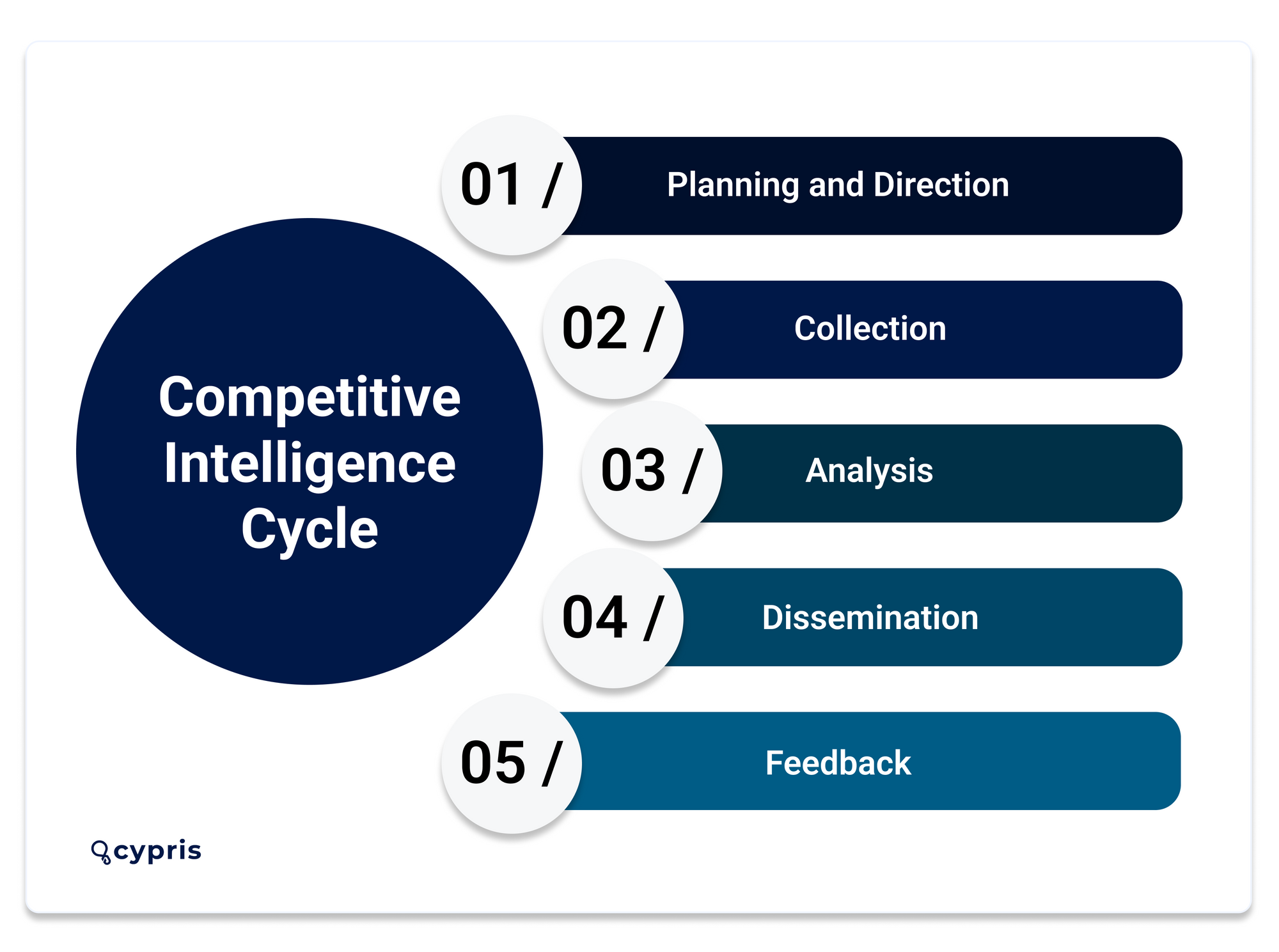
Are companies focusing on CI? These metrics might surprise you.
90% of Fortune 500 companies practice competitive intelligence. (Source: Emerald Insight)
Over 73% of businesses are investing more than 20% of overall technology budgets on intelligence and data analytics. (Source: Forbes)
61% of executives view rapid decision-making and execution as essential factors for a company’s success, and 34% consider the ability to access the right information at the right time as key factors for a company’s success. (Source: The Economist)
69% of organizations that have used an external partner to gain better data insight report positive results from that decision. (Source: The Economist)
57% of companies state that gaining a competitive advantage is one of the top 3 priorities in their industry. (Source: Forbes)
The 6 ways CI benefits your organization.

CI empowers everyone on teams, from product managers and marketers, to sales and executive teams. With the right CI, you can:
Uncover Key Data Points: Through examining new data points like significant acquisitions, new patent filings, startup investments, technology transfer agreements, research papers, etc., you can uncover pivotal data points that have the potential to influence major decisions.
Plan Strategic Moves: CI facilitates building your long-term business strategy and finding market gaps, allowing you to make the right business decisions for your organization.
Track industry Trends: Live-data CI lets you watch for new technologies, track new movement, stay on top of industry innovation trends, and predict future movement.
Drive Innovation: CI helps you to identify new market opportunities and spaces to innovate, accelerate your new product development, design better products, and improve market positioning.
Outsmart Competition: Think of CI as competitive insurance to ensure you stay on top of competitor strengths and weaknesses, anticipate what they’re planning, and identify competitor position and messaging. With CI you can uncover new product launches and services your competitors are adding, and benchmark your company against others.
Minimize Risk: Making the wrong move is costly. CI helps you prevent unsuccessful projects from taking off, save on costs, and improve decision-making ROI. With CI data, you can identify and prioritize any gaps within your business, and feel comfortable knowing you're making data-backed decisions.
Where to go from here: Actionable intelligence platforms are here to help.
Manually collecting CI takes time, and is costly. Not to mention doing your own research digging on the Internet for low-hanging fruit means you'll likely miss key data points that don't provide you with the whole picture. In the time it takes traditional market intelligence or research analysts to gather data to build into basic and applied research reports, you can receive data automatically through a platform like Cypris.
Designed specifically to deliver actionable innovation intelligence to R&D teams, Cypris improves the efficiency of data collation and interpretation. By aggregating your desired data, Cypris enables users to answer critical questions that influence the brand, margin, and profitability of your organization. Users have identified new entrants, significant IP, groundbreaking research papers, and more that have ultimately swayed the course of major projects.

Ready for real-time data on your competitors? Visit cypris.ai to get started by booking a demo.
Sources:
https://www.jimmynewson.com/10-important-competitive-intelligence-statistics/
https://www.gartner.com/en/information-technology/glossary/ci-competitive-intelligence
https://www.antara.ws/en/blog/competitive-intelligence-benefits-for-the-company
Why Your Company Needs Competitive Intelligence



Competitive Intelligence (CI) is the process of analyzing, gathering, and using information collected on competitors, customers, and other market factors that contribute to your competitive advantage. Companies rely on CI data to develop effective and efficient business practices.
CI consists of two types of intelligence: tactical and strategic. Tactical is shorter-term intelligence, which seeks to provide input into issues like capturing market share or increasing revenues, while strategic focuses on longer-term issues, like key risks and opportunities facing the organization, and emerging trends and patterns.
Why competitive intelligence matters, particularly real-time CI.
Understanding competitor motivations and behaviors is critical to driving innovation, shaping product development, establishing pricing and brand positioning, and so much more. Companies must collect proper CI in order to identify challenges, advantages, and white spaces and build a competitive strategy equipped to compete and thrive.
Technology has transformed the CI industry, making it possible for organizations to compile data from multiple sources in a timely manner to facilitate rapid decision-making. Through actionable insights, companies can respond to changes in their markets quickly to keep up with competition. At the core of actionable insights is real-time CI. With real-time CI, companies deliver timely intelligence to the right people, increasing organizational agility.
When looking to collect CI, it’s important to plan out which insights are of value to you, how to identify your competitors, and which markets to spend time on. Take time to narrow in on your direct competitors, research objectives, and areas of interest.
Are companies focusing on CI? These metrics might surprise you.
90% of Fortune 500 companies practice competitive intelligence. (Source: Emerald Insight)
Over 73% of businesses are investing more than 20% of overall technology budgets on intelligence and data analytics. (Source: Forbes)
61% of executives view rapid decision-making and execution as essential factors for a company’s success, and 34% consider the ability to access the right information at the right time as key factors for a company’s success. (Source: The Economist)
69% of organizations that have used an external partner to gain better data insight report positive results from that decision. (Source: The Economist)
57% of companies state that gaining a competitive advantage is one of the top 3 priorities in their industry. (Source: Forbes)
The 6 ways CI benefits your organization.
CI empowers everyone on teams, from product managers and marketers, to sales and executive teams. With the right CI, you can:
Uncover Key Data Points: Through examining new data points like significant acquisitions, new patent filings, startup investments, technology transfer agreements, research papers, etc., you can uncover pivotal data points that have the potential to influence major decisions.
Plan Strategic Moves: CI facilitates building your long-term business strategy and finding market gaps, allowing you to make the right business decisions for your organization.
Track industry Trends: Live-data CI lets you watch for new technologies, track new movement, stay on top of industry innovation trends, and predict future movement.
Drive Innovation: CI helps you to identify new market opportunities and spaces to innovate, accelerate your new product development, design better products, and improve market positioning.
Outsmart Competition: Think of CI as competitive insurance to ensure you stay on top of competitor strengths and weaknesses, anticipate what they’re planning, and identify competitor position and messaging. With CI you can uncover new product launches and services your competitors are adding, and benchmark your company against others.
Minimize Risk: Making the wrong move is costly. CI helps you prevent unsuccessful projects from taking off, save on costs, and improve decision-making ROI. With CI data, you can identify and prioritize any gaps within your business, and feel comfortable knowing you're making data-backed decisions.
Where to go from here: Actionable intelligence platforms are here to help.
Manually collecting CI takes time, and is costly. Not to mention doing your own research digging on the Internet for low-hanging fruit means you'll likely miss key data points that don't provide you with the whole picture. In the time it takes traditional market intelligence or research analysts to gather data to build into basic and applied research reports, you can receive data automatically through a platform like Cypris.
Designed specifically to deliver actionable innovation intelligence to R&D teams, Cypris improves the efficiency of data collation and interpretation. By aggregating your desired data, Cypris enables users to answer critical questions that influence the brand, margin, and profitability of your organization. Users have identified new entrants, significant IP, groundbreaking research papers, and more that have ultimately swayed the course of major projects.
Ready for real-time data on your competitors? Visit cypris.ai to get started by booking a demo.
Sources:
https://www.jimmynewson.com/10-important-competitive-intelligence-statistics/
https://www.gartner.com/en/information-technology/glossary/ci-competitive-intelligence
https://www.antara.ws/en/blog/competitive-intelligence-benefits-for-the-company
Keep Reading

If you’re a researcher, you know that choosing the right research method is crucial to obtaining reliable results. In this blog post, we’ll discuss how to do quantitative research using Google Scholar and get the most relevant and accurate results
Firstly, we’ll define what quantitative research is and how it differs from qualitative research. We’ll examine when each approach is suitable to employ.
Next, we’ll dive into how to do quantitative research using Google Scholar, including data collection techniques such as surveys and experiments. We’ll also discuss the statistical analysis and interpretation of results.
Table of Contents
Introduction on How to do Quantitative Research using Google Scholar
Using Relevant Keywords When Searching
Refining Search Results Based On Publication Date Range Or Specific Journals
Reviewing Abstracts Before Downloading Full Articles
Ensuring Selected Articles Meet Inclusion Criteria Such As Relevance To Your Topic Area
Collecting Data From Selected Articles Using Tools Like Excel Spreadsheets
Analyzing Collected Data Using Appropriate Statistical Methods
FAQs in Relation to How to Do Quantitative Research Using Google Scholar
How to do Quantitative research using Google Scholar?
What is quantitative research method Google Scholar?
Introduction on How to do Quantitative Research using Google Scholar
Quantitative research is a powerful tool used by R&D, product development, and innovation teams to gain valuable insights into empirical phenomena. Google Scholar provides an invaluable resource for conducting quantitative research, allowing users to search through millions of scholarly articles with ease. This post will guide you on how to do quantitative research using Google Scholar.
When looking at how to do quantitative research using Google Scholar, it’s important to define your topic area clearly so that the results are relevant and useful. Use terms that accurately depict the topic of inquiry to limit results and guarantee they are applicable to your work. Refining searches further based on publication date range or specific journals can also help you find more accurate information faster.

(Source)

Before obtaining entire articles from Google Scholar, it is advisable to look over their summaries first in order to get an understanding of what kind of information each article holds before devoting time and energy to examining them thoroughly. When reviewing abstracts make sure that selected articles meet any inclusion criteria such as relevance to your topic area or any other criteria set out by yourself or team members working on the same project.
Quantitative inquiry can be a potent instrument to penetrate intricate issues, and Google Scholar is capable of offering an efficient medium for performing such research. With the proper knowledge of how to do quantitative research using Google Scholar, one can unlock its potential as a reliable source of information. In the next heading, we will discuss ways in which you can define your topic area more specifically so that you may better utilize quantitative research methods with Google Scholar.
Key Takeaway: Using Google Scholar for quantitative research is a great way to quickly and accurately access relevant information. When conducting queries, being precise can help to restrict the outcomes and guarantee they are pertinent. Before downloading, review the abstracts of articles from Google Scholar to ensure that their content is pertinent.
Defining Your Topic Area
When conducting quantitative research, it is essential to define your topic area. This will help you identify the specific problem or question that needs answering and determine relevant keywords that can be used to narrow down search results on Google Scholar. By using keywords such as “innovation”, “research platform”, “R&D” and “time to insights” when conducting quantitative research, it is possible to narrow down the search results in order to identify a specific problem or question that needs answering.
By incorporating terms related to your topic, such as “development”, “engineering” and “commercialization”, you can further refine the search results. This can help guarantee that the search results will only contain articles pertinent to your investigation. Additionally, it may also be beneficial to refine search results based on publication date range or specific journals as this allows for more precise filtering of articles.
Before downloading full articles from Google Scholar it is important to review abstracts first. Abstracts are short summaries of articles that provide enough information to determine whether or not you want to download the full paper. It is advised to use specific search parameters like only including peer-reviewed articles and only selecting works by particular author names.
After collecting all the articles from relevant sources, data must be extracted and put into a spreadsheet to make the analysis process much easier. By following these steps, you should be able to quickly find relevant information, allowing you to focus on analyzing the data collected instead of wasting time searching the web.
Defining a clear and concise topic area is key to conducting successful research. Identifying pertinent terms when searching can help guarantee that the outcomes are suitable to your inquiry.
Key Takeaway: After defining your research topic, utilize Google Scholar to narrow down search results using keywords and refine the query based on publication date range or specific journals. Review abstracts before downloading full articles from Google Scholar, ensuring they meet criteria such as relevance to the chosen topic area and any additional specifications set by researchers. Extract data from selected articles with tools like Excel spreadsheets for easier analysis later on – this way you can find reliable information quickly without having to spend too much time searching online.
Using Relevant Keywords When Searching
When searching for relevant research on Google Scholar, it is important to use specific keywords that are related directly to the topic area. Generic terms will not provide exact outcomes and could direct one to an abundance of unimportant data. It is also important to consider synonyms when constructing your query in order to capture all possible relevant articles.
Once you have pinpointed possible documents, go over their summaries prior to downloading the full text in order to guarantee they satisfy your criteria. This saves a lot of time by letting you skip through documents that don’t fit the scope of your assignment. Take advantage of journals that offer previews of articles that will let you see if the article is relevant to your research before investing the time to download the entire article.
By searching online for peer-reviewed research, R&D managers can feel confident that the information they’re reading is up-to-date and accurate. This ensures only high-quality evidence is used in decision-making processes while avoiding bias due to poor methodology or data collection techniques utilized by some researchers during their investigations into various topics areas related to Cypris’ research platform.
Key Takeaway: Using targeted keywords and taking advantage of preview features, R&D teams can quickly narrow down relevant research on Google Scholar to get the most up-to-date information with confidence. This helps them “hit the ground running” and ensures they have only high quality evidence for making decisions related to Cypris’ research platform.
Refining Search Results Based On Publication Date Range Or Specific Journals
Refining your search by date range or journal can help you zero in on the most pertinent data for your research topic. Narrowing the scope to a five-year span and focusing on only credible scientific journals such as Renewable Energy and Science Direct that are directly related to solar power can expedite the research process. By following these simple steps, you can ensure that your studies meet the quality standards of both these peer-reviewed journals as well as the criteria related to your topic.
Key Takeaway: To hone in on the most relevant data for my research topic, I should refine my Google Scholar search by setting a publication window and filtering out only peer-reviewed journals that are related to renewable sources of power. This will help me ensure the quality and relevance of any articles included in my study.
Reviewing Abstracts Before Downloading Full Articles
Reviewing abstracts before downloading full articles is a critical step as it helps ensure that you are only downloading relevant material, saving time and resources. When reviewing an article’s abstract, consider if it meets your inclusion criteria such as relevance to your topic area. If it does not, then move on to the next one.
Pay attention to keywords in the abstract as they can help identify whether or not an article is suitable for your research needs. For example, if you are looking for quantitative studies related to a specific subject matter, look out for words like “quantitative” or “statistical analysis” which indicate that this particular study used those methods of data collection and analysis.
Similarly, when searching for qualitative studies use terms like “qualitative methods” or “interviews” which suggest that these were employed during the course of the study. This will help ensure reliable results from your search efforts.
By using inclusion criteria for selecting articles, such as relevance to a specific topic area, researchers can ensure they are collecting quality data and results.
Quantitative research made easier. Use keywords in abstracts to quickly identify relevant articles on Google Scholar. #quantitativeresearch #googlescholar Click to Tweet
Ensuring Selected Articles Meet Inclusion Criteria Such As Relevance To Your Topic Area
To guarantee that chosen articles satisfy the required criteria, such as being pertinent to a specific subject area, it is essential for R&D and innovation teams to thoroughly examine each article. This includes looking for any possible biases or flaws in the study design which could affect its overall quality and reliability over time if not addressed properly.
When assessing an article’s relevance, teams should consider whether the methods used are appropriate for their particular research goals. For example, quantitative research methods may be better suited for measuring certain phenomena than qualitative ones.
Likewise, qualitative studies may be more useful when exploring subjective topics like customer experience or brand perception. Teams should also evaluate how reliable results will be over time by considering factors such as sample size and representativeness of data sources used in the study design.
To ensure the study design is complete and conclusions can be drawn accurately, it is essential to evaluate whether all relevant information has been included.
Have any confounding factors been considered that could affect the accuracy of our conclusions? Is there sufficient evidence provided within each study? Does this data support our hypothesis?
These considerations help identify potential issues with a given article before incorporating its findings into further research projects or product development efforts down the line.
By taking these steps during the initial stages of assessment, R&D and innovation teams can ensure they are using only high-quality resources which provide accurate insights into their chosen topic area. To further refine and analyze this data, tools like Excel spreadsheets can be used to collect data from the selected articles for a more comprehensive analysis.
Key Takeaway: R&D and innovation teams should thoroughly vet any articles they use to ensure the methods are appropriate, the results reliable, and all relevant information has been taken into account. To guarantee success in future phases of product development it is essential for teams to do their due diligence when selecting research resources – leaving no stone unturned during assessment.
Collecting Data From Selected Articles Using Tools Like Excel Spreadsheets
When it comes to collecting data from selected articles, tools like Excel spreadsheets can be a powerful ally. By using Excel, researchers can conveniently compile large amounts of data into one place, thus facilitating subsequent analysis.
One of the most important aspects of using an Excel spreadsheet is defining your columns in advance. It’s important that you clearly label each column so that when you look back at your work later on, you know what type of information was stored there.
For example, if you are looking at different studies related to cancer research, one column might be labeled “Study Title” while another could be labeled “Year Published” or “Author Name(s)” etc. Once these columns of data have been populated, they can then be sorted and analyzed to find correlations across your different articles and authors.
Collecting data from selected articles using tools like Excel spreadsheets can be a powerful tool to gain insights into the research topics. Moving forward, we will utilize suitable statistical techniques to examine the data that has been obtained from certain articles by utilizing tools such as Excel spreadsheets.
Key Takeaway: Excel spreadsheets can be a powerful tool for researchers to quickly and easily store data from articles, such as study titles or authors. By clearly labeling each column, it becomes easier to sort through the information later on and find correlations between different studies. Researchers can also use this platform to jot down notes without taking up extra space in their document – making Excel an invaluable asset when collecting quantitative research using Google Scholar.
Analyzing Collected Data Using Appropriate Statistical Methods
Once the data has been gathered from pertinent sources, it is essential to assess this material using suitable statistical processes. Regression analysis and ANOVA tests are two of the most commonly used techniques for analyzing quantitative research data.
Regression analysis allows researchers to identify relationships between independent and dependent variables. On the other hand, ANOVA tests compare means across multiple groups or conditions. Both of these methods can be used to draw meaningful conclusions about your research question with confidence.
When performing either type of analysis, it is important to ensure that any potential biases present within each study design are addressed appropriately throughout the entire process. This includes checking for outliers in the dataset and controlling for confounding variables when necessary. Before reaching any conclusions, researchers should always ensure that the sample size is sufficient to accurately reflect the population of interest.
Finally, it is important to remember that statistical analyses can only tell us so much; they cannot answer all questions posed by a research project alone. It is essential that researchers interpret their findings in correlation to pre-existing knowledge on the subject, as well as contextualizing them for use beyond scholarly environments.
Quantitative research using Google Scholar? Use regression analysis and ANOVA tests to analyze data, check for biases, control for confounding variables, & interpret results in light of existing literature. #DataAnalysis #GoogleScholar #ResearchMethods Click to Tweet
FAQs in Relation to How to Do Quantitative Research Using Google Scholar
How to do Quantitative research using Google Scholar?
Begin by entering your query into the search bar on Google Scholar to uncover quantitative research articles. Then refine your results using the options in the left sidebar such as “Publication date” and “Article type” to narrow down to only scholarly articles with a focus on quantitative data. You can also use advanced search terms like “quantitative analysis” or “statistical methods”.
What is quantitative research method Google Scholar?
Quantitative research method Google Scholar is a powerful search engine that enables researchers to find, analyze and compare academic literature from around the world. It provides access to an extensive range of scholarly publications such as journal articles, books, conference proceedings, and technical reports.
The results are ranked by relevance and can be further refined using advanced search filters. With its user-friendly interface, it helps researchers save time in finding relevant information for their studies quickly and efficiently.
Conclusion
Mastering how to do quantitative research using Google Scholar can be a great way to get insights into your topic area. By narrowing down your search by date or journal, reading abstract before downloading the complete article, and ensuring that your selection meets your criteria, you can quickly and easily find data that are relevant to your study. Collecting and using data from a variety of sources, such as Excel and statistical analysis, will give you valuable insights into whatever subject you’re researching.
Unlock the power of quantitative research with Cypris. Our platform provides fast, comprehensive insights to help R&D and innovation teams succeed.

Innovation is the lifeblood of any successful business. As one of the most innovative companies in history, how does Google encourage innovation?
Does Google’s approach to innovation differ from other tech giants? And what are some examples and benefits of their innovations that have propelled them forward?
These questions and more will be answered as we explore: how does Google encourage innovation? From looking at their research platform for R&D teams to examining their cutting-edge products, let’s dive into understanding how Google continues to remain a leader in technological advancement.
Table of Contents
How Does Google Encourage Innovation?
Encouraging Risks and Failures
Investing in Talent and Resources
What Are Some Examples of Google’s Innovations?
How Google Maximizes Open-Source Communities for Innovation
Engaging With Open Source Communities
How Does Google Encourage Innovation?
Google is a leader in innovation, consistently pushing the boundaries of technology and creating products that shape our lives. Google’s approach to innovation is rooted in its corporate culture which encourages creativity, risk-taking, and collaboration. To foster this innovative spirit, Google invests heavily in talent and resources and fosters a creative environment for employees.
Heavy Investment in R&D
Google has invested heavily in research and development (R&D) over the years, allowing them to develop cutting-edge technologies such as artificial intelligence (AI) and machine learning (ML). These technologies have enabled them to create autonomous vehicles like Waymo which are revolutionizing transportation.
Additionally, they have developed cloud computing solutions that allow businesses to store data securely while still being able to access it quickly from anywhere around the world.
Encouraging Risks and Failures
In addition to investing in R&D projects, Google also fosters an environment where creativity can thrive by encouraging Google employees to take risks without fear of failure or retribution. This allows their teams to think outside the box when developing new products or services while not having any restrictions on what ideas they can explore.
By embracing failure as part of the process instead of viewing it negatively, Google ensures that their teams don’t become too risk-averse which could stifle progress and limit potential innovations.
Investing in Talent and Resources
Google recognizes the importance of having talented individuals on their team who can think outside the box when it comes to problem-solving. To attract top talent, they offer competitive salaries as well as generous benefits packages including stock options, flexible work hours, free meals, childcare assistance, tuition reimbursement programs, and more.
Additionally, Google offers numerous learning opportunities such as hackathons or workshops which allow employees to develop their skills further while also fostering collaboration between teams.
Policies Fostering Creativity
Google has implemented a range of policies to foster an environment that encourages creativity. These include ‘20% time’, where engineers are allowed to spend 20% of their working hours exploring personal projects, and ‘innovation days’ which provide teams with dedicated time each week for brainstorming.
Additionally, the company has adopted a policy of ‘no meeting Wednesdays’, allowing employees more uninterrupted time to focus on individual tasks or research activities.
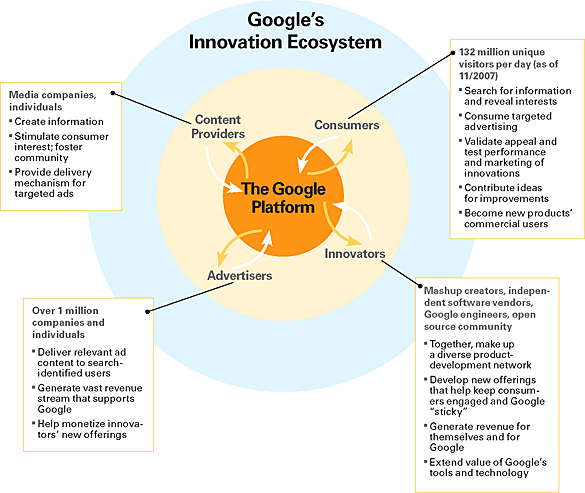
(Source)
How does Google encourage innovation? Google understands the importance of allowing failure as part of the innovation process, rather than punishing it. This encourages risk-taking and allows employees to explore different approaches without worrying about repercussions if something doesn’t work out right away.
By giving them freedom within certain parameters, they can discover innovative solutions faster than if they were constrained by rigid rules or processes from the start.
Key Takeaway: Google encourages innovation through investment in talent and resources, policies such as 20% time and no meeting Wednesdays, and by embracing failure as part of the process. They offer competitive salaries, flexible work hours, free meals, childcare assistance, tuition reimbursement programs, and more to attract top talent. Additionally they allow employees freedom within certain parameters to discover innovative solutions faster.
What Are Some Examples of Google’s Innovations?
Now that we have learned “how does Google encourage innovation?” let’s look at some examples of their innovation. Google has been a leader in innovation since its inception. From search engine algorithms to self-driving cars, Google is constantly pushing the boundaries of what’s possible.
Here are some examples of the results of how Google promotes innovation.
Search Engine Algorithms
Google’s search engine algorithms have revolutionized how people find information online. By using complex mathematical equations and artificial intelligence, Google can quickly return relevant results for any query entered into its search bar.
Google searches have made it easier than ever before to find answers to questions or locate specific pieces of information on the web.
Voice Search
In recent years, Google has developed voice recognition software that allows users to perform searches by speaking into their devices instead of typing out queries. This technology makes searching even more convenient and efficient as users no longer need to type out long phrases or sentences to get accurate results from their searches.
Self-Driving Cars
One of the most ambitious projects undertaken by Google is its development of self-driving cars which use sensors and cameras mounted on the vehicle along with sophisticated computer vision algorithms to navigate roads without human intervention.
These vehicles are still being tested but could eventually lead to safer roads and less traffic congestion due to improved efficiency when driving from one place to another autonomously.
Augmented Reality (AR)
Google recently unveiled an augmented reality platform called ARCore which allows developers to create immersive experiences for Android phones and tablets using 3D graphics overlaid onto real-world environments through a device’s camera viewfinder.
This technology opens up new possibilities for gaming, education, navigation, shopping, entertainment, and much more as it brings virtual objects into our physical world like never before seen before.
Google’s innovations are paving the way for new and exciting opportunities in technology, from AI and ML technologies to autonomous vehicles to cloud computing solutions. As these advances continue to revolutionize the tech industry, it is important to understand the benefits they bring – such as improved efficiency, increased accessibility, and enhanced user experience – that will help businesses stay ahead of their competition.
Key Takeaway: The results of Google’s innovation include its search engine, AI, and autonomous vehicles. These advances revolutionize the tech industry with their efficiency, accessibility, and enhanced user experience.
Google’s commitment to open source communities, both existing and newly created, along with the utilization of shared repositories such as GitHub for internal collaboration has enabled them to remain ahead of their competition in terms of innovation. This strategy is a testament to their adaptability in an ever-changing environment, allowing them to stay one step ahead regardless of any unexpected circumstances.
How Google Maximizes Open-Source Communities for Innovation
How does Google encourage innovation? Google has long been a leader in open-source communities. By leveraging the power of collaboration, Google can maximize innovation and stay ahead of the competition.
Here’s how they do it:
Engaging With Open Source Communities
Google actively engages with open-source communities by contributing code, providing support for existing projects, and hosting events that bring together developers from around the world.
This helps them build relationships with potential collaborators and learn about new technologies faster than their competitors.
Creating New Projects
Google also creates open-source projects such as TensorFlow, Kubernetes, and Android Studio.
These projects allow developers to access powerful tools without paying expensive licensing fees or waiting for updates from other companies.
Plus, since these are open-source projects anyone can contribute to them which allows Google to benefit from outside ideas as well as get feedback on their work quickly.
Encouraging Collaboration
Finally, Google encourages collaboration between different teams within the company by using shared repositories like GitHub where everyone can see each other’s progress and provide feedback in real-time.
This makes it easier for teams to collaborate on large-scale projects without getting bogged down in bureaucracy or waiting for approvals from multiple departments before making changes.
Overall, by engaging with existing open-source communities while creating new ones of their own and encouraging internal collaboration through shared repositories like GitHub, Google can maximize innovation while staying ahead of the competition at all times.
How does Google encourage innovation? Google has long been a leader in open-source communities. By leveraging the power of collaboration, Google can maximize innovation and stay ahead of the competition. Click To Tweet
Conclusion
How does Google encourage innovation? Google has a long history of encouraging innovation and pushing the boundaries of technology. Through its various initiatives, such as Google X and Google Brain, it is clear that the company takes an active role in developing new technologies.
By providing resources for employees to experiment with their ideas and access cutting-edge tools, Google encourages its employees to think outside the box when it comes to solving problems. This approach has enabled them to create some truly revolutionary products over the years which have had a positive impact on society.
Are you looking for a platform to help your R&D and innovation teams quickly identify insights? Cypris provides the tools, resources, and data sources necessary to develop solutions that drive creativity and spur innovative thinking.
With our research platform, it’s easier than ever before to uncover new ideas to stay ahead of the competition. Get started now with Cypris – let us help you create meaningful change through collaboration!

How does innovation create value? Many organizations have invested heavily in innovative projects and initiatives to create new sources of revenue or cost savings. However, it can be difficult to measure the actual impact these investments have on organizational performance
This article will answer: how does innovation create value? We will look at strategies for maximizing returns on investment from innovative projects and the challenges faced when implementing them.
Table of Contents
How Does Innovation Create Value?
Examples of New Discoveries Creating Value
Streamlining Processes Through Innovation
Measuring the Impact of Innovation on Value Creation
Financial Metrics for Evaluating Value Creation
Nonfinancial Metrics for Evaluating Value Creation
Strategies for Maximizing the Return on Investment from Innovative Projects
Leverage Existing Resources and Assets
Encourage Creativity and Risk Taking
How Does Innovation Create Value?
Investing in R&D
Investing in research and development (R&D) can create immense value for businesses. By investing in new technologies, products, or processes, companies can stay ahead of the competition and increase their market share.
Additionally, by investing in R&D, companies can develop new solutions that solve customer problems and improve efficiency. This leads to increased profits as well as improved customer satisfaction.
When a company invests in R&D it shows potential customers that they are committed to providing innovative solutions which can help them stand out from the competition.
Examples of New Discoveries Creating Value
One example of how innovation creates value is through the development of new products or services.
For instance, Apple’s iPhone revolutionized the mobile phone industry with its touchscreen interface and intuitive user experience. It has created an entirely new product category that has since become ubiquitous across all industries.
Similarly, Amazon’s cloud computing platform has enabled businesses to access powerful computing resources without having to invest heavily in hardware infrastructure – allowing them to focus on developing innovative applications instead.
Streamlining Processes Through Innovation
Innovation also helps streamline existing processes by introducing more efficient methods for completing tasks or automating certain aspects of workflows.
Automation tools such as robotic process automation (RPA) allow organizations to reduce manual labor costs while improving accuracy and consistency throughout their operations. This leads to cost savings over time while freeing up employees for higher-value activities like problem-solving or strategic planning initiatives.
Artificial intelligence (AI) technology enables machines to learn from data sets faster than humans ever could. This allows organizations not only to automate mundane tasks but also to uncover insights hidden within large datasets that would otherwise be too complex for humans alone.
How does innovation create value? Investing in research and development can lead directly towards greater value creation both through developing completely novel products and services as well as optimizing existing products using cutting-edge technologies such as AI and automation tools.
As such, any organization looking to maximize long-term returns should consider dedicating resources towards innovation efforts.

(Source)
Measuring the Impact of Innovation on Value Creation
How does innovation create value? Innovation is a key driver of value creation for organizations. Measuring the impact of innovation on value creation requires both financial and non-financial metrics.
Financial metrics such as return on investment (ROI) are used to assess the success of innovative projects in terms of their economic benefits. Non-financial metrics, such as customer satisfaction scores, can also be used to measure the impact of innovation on organizational performance.
Financial Metrics for Evaluating Value Creation
Return on Investment (ROI) is one of the most commonly used financial metrics for evaluating value creation from innovative projects. ROI measures how much money an organization earns relative to its investments in a project or initiative over time.
It is calculated by dividing net income generated by total costs incurred during a given period. Organizations should use ROI calculations when assessing whether an innovative project has been successful in creating value or not.
Nonfinancial Metrics for Evaluating Value Creation
Nonfinancial metrics are also important when measuring the impact of innovation on value creation because they provide insight into intangible aspects that cannot be measured using traditional financial indicators alone.
Examples include customer satisfaction scores, employee engagement levels, market share growth, and brand recognition rates among others. These non-monetary indicators can help organizations better understand how their innovations have impacted customers and other stakeholders over time and make informed decisions about future investments accordingly.
Innovation has the potential to create tremendous value for businesses. Understanding how it impacts value creation is key. By investing in research and development, developing a culture that encourages creativity and risk-taking, and leveraging existing products and assets, organizations can maximize their return on investment from innovation projects.
Key Takeaway: Innovation creates value when measured using both financial and non-financial metrics, such as ROI and customer satisfaction scores. Organizations should use these indicators to assess the success of innovative projects and make informed decisions about future investments accordingly.
Strategies for Maximizing the Return on Investment from Innovative Projects
To maximize the return on investment from innovative projects, it’s important to identify opportunities to leverage existing resources and assets, develop a culture that encourages creativity and risk-taking, and invest in research and development to generate new ideas and solutions.
Leverage Existing Resources and Assets
Companies can often get more out of their investments by leveraging existing resources or assets. This could include re-purposing existing technology or data sets for new applications, utilizing internal expertise for problem-solving, or even partnering with other organizations that have complementary capabilities.
By doing so, companies can reduce costs while still achieving their desired outcomes.
Encourage Creativity and Risk Taking
Disruptive innovation requires an environment where employees feel comfortable taking risks without fear of failure. Leaders should create an atmosphere where creative thinking is encouraged through open dialogue between team members as well as providing rewards for successful innovation efforts.
Additionally, processes should be put into place that allows teams to quickly test out ideas without having to go through lengthy approval cycles which can stifle innovation efforts before they start.
Investing in R&D
Investing in research and development (R&D) initiatives helps foster disruptive innovation within the organization by providing resources necessary for exploring new ideas or technologies which may lead to breakthrough products or services down the line.
Companies should ensure they are investing enough money into R&D activities, but also make sure these funds are being used efficiently by setting clear goals at the outset of any project as well as measuring progress along the way towards those objectives.
By utilizing the right strategies and taking proactive steps to address potential challenges, organizations can maximize their return on investment from innovative projects while ensuring they have sufficient resources to support them.
Key Takeaway: Innovation is essential for creating value, and companies should focus on leveraging existing resources, developing a culture of creativity and risk-taking, as well as investing in R&D initiatives.
Conclusion
How does innovation create value? Innovation is an essential part of any organization’s success. It can create value in many ways, from increased efficiency to new product development.
However, organizations must be mindful of the challenges associated with implementing innovative projects and ensure that they are taking steps to maximize their return on investment. Ultimately, it is clear that when done correctly, innovation projects do create value and should be a key focus for all organizations looking to remain competitive in today’s market.
Are you looking for ways to create value through innovation? Cypris is the perfect platform to help your R&D and innovation teams get rapid insights.
We centralize all the data sources they need into one convenient place, allowing them to make informed decisions quickly. With our easy-to-use interface, innovative solutions are just a few clicks away! Sign up today and start creating value with Cypris.