

Resources
Guides, research, and perspectives on R&D intelligence, IP strategy, and the future of AI enabled innovation.

Executive Summary
In 2024, US patent infringement jury verdicts totaled $4.19 billion across 72 cases. Twelve individual verdicts exceeded $100million. The largest single award—$857 million in General Access Solutions v.Cellco Partnership (Verizon)—exceeded the annual R&D budget of many mid-market technology companies. In the first half of 2025 alone, total damages reached an additional $1.91 billion.
The consequences of incomplete patent intelligence are not abstract. In what has become one of the most instructive IP disputes in recent history, Masimo’s pulse oximetry patents triggered a US import ban on certain Apple Watch models, forcing Apple to disable its blood oxygen feature across an entire product line, halt domestic sales of affected models, invest in a hardware redesign, and ultimately face a $634 million jury verdict in November 2025. Apple—a company with one of the most sophisticated intellectual property organizations on earth—spent years in litigation over technology it might have designed around during development.
For organizations with fewer resources than Apple, the risk calculus is starker. A mid-size materials company, a university spinout, or a defense contractor developing next-generation battery technology cannot absorb a nine-figure verdict or a multi-year injunction. For these organizations, the patent landscape analysis conducted during the development phase is the primary risk mitigation mechanism. The quality of that analysis is not a matter of convenience. It is a matter of survival.
And yet, a growing number of R&D and IP teams are conducting that analysis using general-purpose AI tools—ChatGPT, Claude, Microsoft Co-Pilot—that were never designed for patent intelligence and are structurally incapable of delivering it.
This report presents the findings of a controlled comparison study in which identical patent landscape queries were submitted to four AI-powered tools: Cypris (a purpose-built R&D intelligence platform),ChatGPT (OpenAI), Claude (Anthropic), and Microsoft Co-Pilot. Two technology domains were tested: solid-state lithium-sulfur battery electrolytes using garnet-type LLZO ceramic materials (freedom-to-operate analysis), and bio-based polyamide synthesis from castor oil derivatives (competitive intelligence).
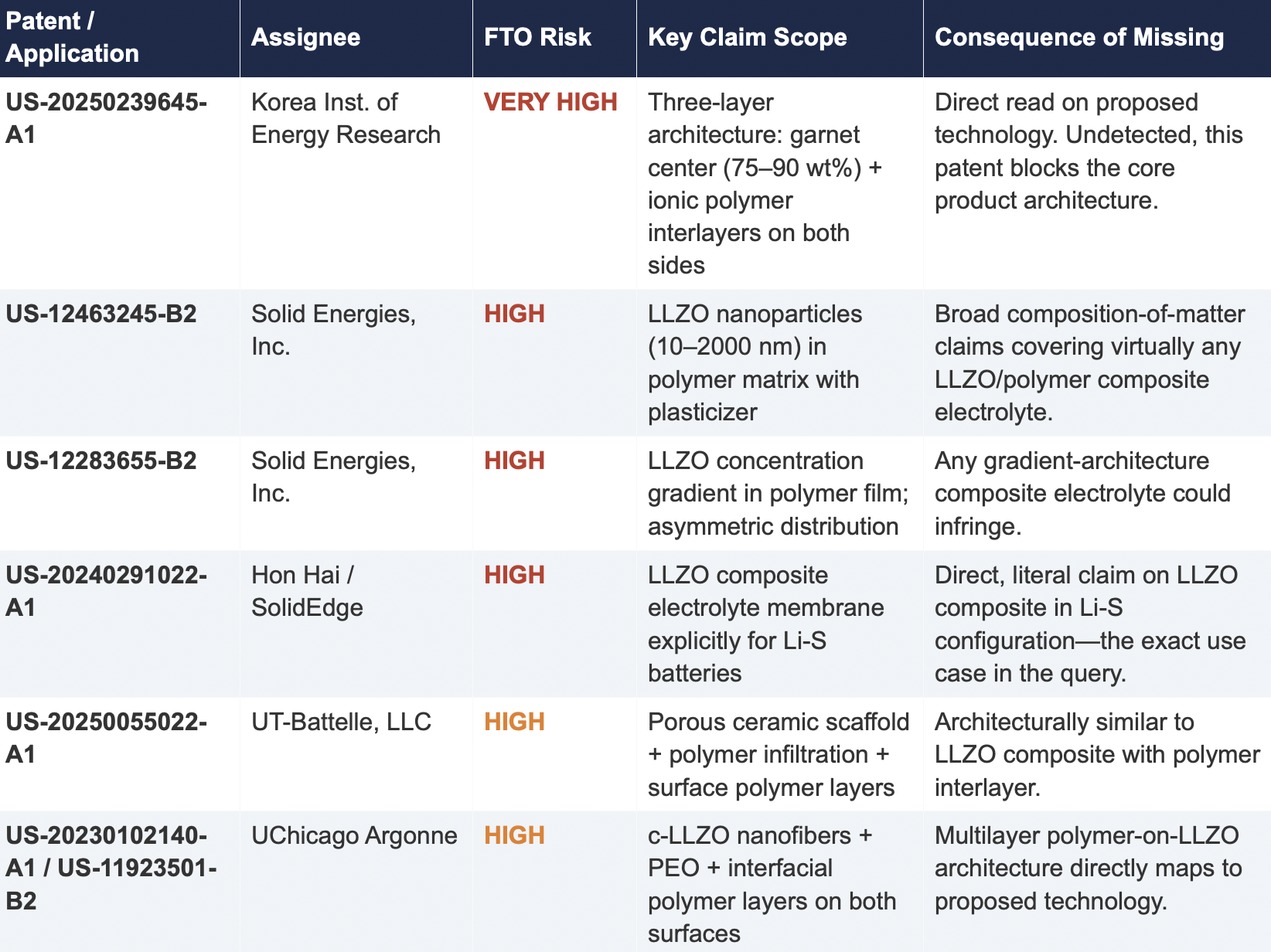
The results reveal a significant and structurally persistent gap. In Test 1, Cypris identified over 40 active US patents and published applications with granular FTO risk assessments. Claude identified 12. ChatGPT identified 7, several with fabricated attribution. Co-Pilot identified 4. Among the patents surfaced exclusively by Cypris were filings rated as “Very High” FTO risk that directly claim the technology architecture described in the query. In Test 2, Cypris cited over 100 individual patent filings with full attribution to substantiate its competitive landscape rankings. No general-purpose model cited a single patent number.
The most active sectors for patent enforcement—semiconductors, AI, biopharma, and advanced materials—are the same sectors where R&D teams are most likely to adopt AI tools for intelligence workflows. The findings of this report have direct implications for any organization using general-purpose AI to inform patent strategy, competitive intelligence, or R&D investment decisions.

1. Methodology
A single patent landscape query was submitted verbatim to each tool on March 27, 2026. No follow-up prompts, clarifications, or iterative refinements were provided. Each tool received one opportunity to respond, mirroring the workflow of a practitioner running an initial landscape scan.
1.1 Query
Identify all active US patents and published applications filed in the last 5 years related to solid-state lithium-sulfur battery electrolytes using garnet-type ceramic materials. For each, provide the assignee, filing date, key claims, and current legal status. Highlight any patents that could pose freedom-to-operate risks for a company developing a Li₇La₃Zr₂O₁₂(LLZO)-based composite electrolyte with a polymer interlayer.
1.2 Tools Evaluated

1.3 Evaluation Criteria
Each response was assessed across six dimensions: (1) number of relevant patents identified, (2) accuracy of assignee attribution,(3) completeness of filing metadata (dates, legal status), (4) depth of claim analysis relative to the proposed technology, (5) quality of FTO risk stratification, and (6) presence of actionable design-around or strategic guidance.
2. Findings
2.1 Coverage Gap
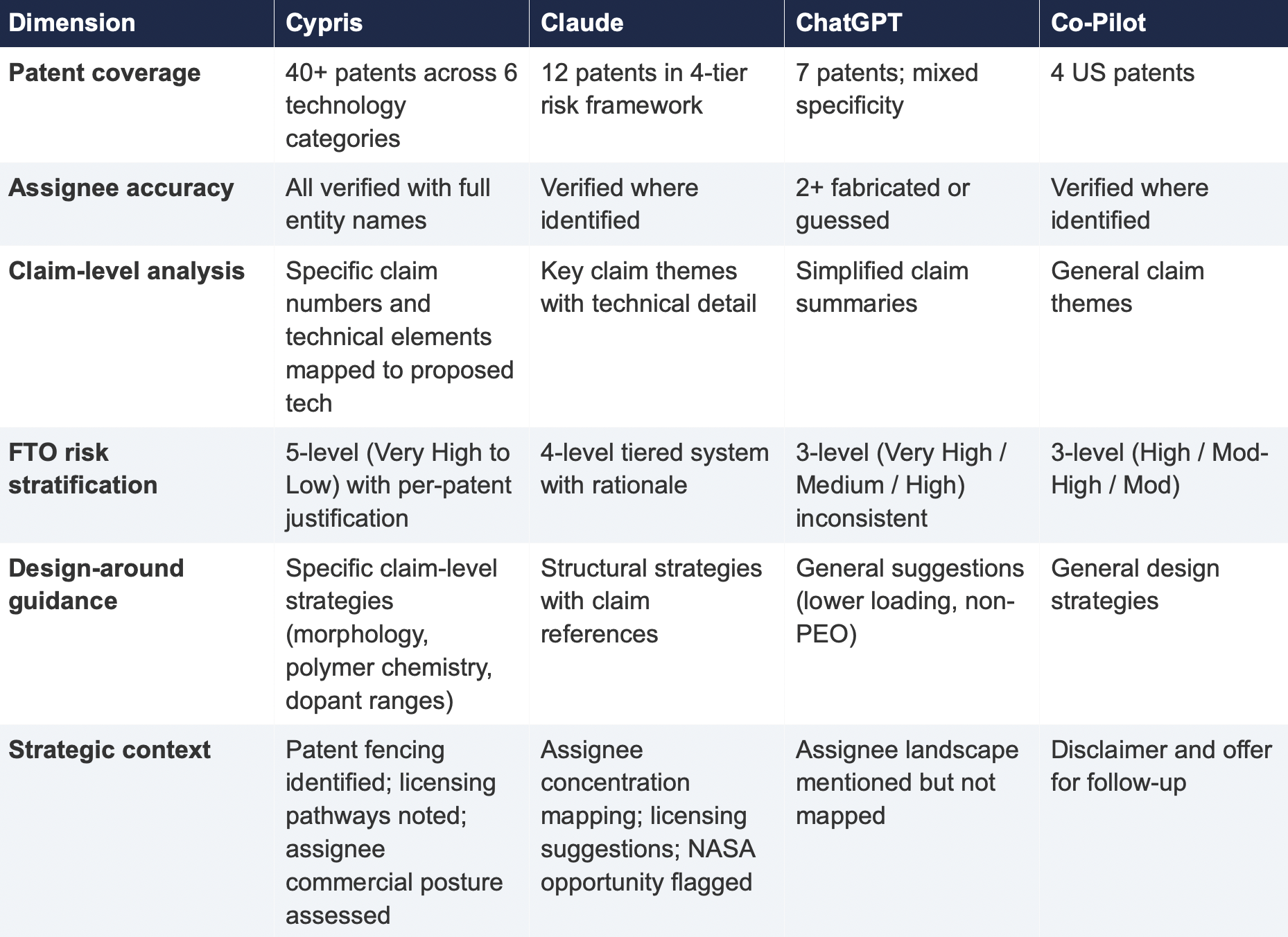
The most significant finding is the scale of the coverage differential. Cypris identified over 40 active US patents and published applications spanning LLZO-polymer composite electrolytes, garnet interface modification, polymer interlayer architectures, lithium-sulfur specific filings, and adjacent ceramic composite patents. The results were organized by technology category with per-patent FTO risk ratings.
Claude identified 12 patents organized in a four-tier risk framework. Its analysis was structurally sound and correctly flagged the two highest-risk filings (Solid Energies US 11,967,678 and the LLZO nanofiber multilayer US 11,923,501). It also identified the University ofMaryland/ Wachsman portfolio as a concentration risk and noted the NASA SABERS portfolio as a licensing opportunity. However, it missed the majority of the landscape, including the entire Corning portfolio, GM's interlayer patents, theKorea Institute of Energy Research three-layer architecture, and the HonHai/SolidEdge lithium-sulfur specific filing.
ChatGPT identified 7 patents, but the quality of attribution was inconsistent. It listed assignees as "Likely DOE /national lab ecosystem" and "Likely startup / defense contractor cluster" for two filings—language that indicates the model was inferring rather than retrieving assignee data. In a freedom-to-operate context, an unverified assignee attribution is functionally equivalent to no attribution, as it cannot support a licensing inquiry or risk assessment.
Co-Pilot identified 4 US patents. Its output was the most limited in scope, missing the Solid Energies portfolio entirely, theUMD/ Wachsman portfolio, Gelion/ Johnson Matthey, NASA SABERS, and all Li-S specific LLZO filings.
2.2 Critical Patents Missed by Public Models
The following table presents patents identified exclusively by Cypris that were rated as High or Very High FTO risk for the proposed technology architecture. None were surfaced by any general-purpose model.
2.3 Patent Fencing: The Solid Energies Portfolio
Cypris identified a coordinated patent fencing strategy by Solid Energies, Inc. that no general-purpose model detected at scale. Solid Energies holds at least four granted US patents and one published application covering LLZO-polymer composite electrolytes across compositions(US-12463245-B2), gradient architectures (US-12283655-B2), electrode integration (US-12463249-B2), and manufacturing processes (US-20230035720-A1). Claude identified one Solid Energies patent (US 11,967,678) and correctly rated it as the highest-priority FTO concern but did not surface the broader portfolio. ChatGPT and Co-Pilot identified zero Solid Energies filings.
The practical significance is that a company relying on any individual patent hit would underestimate the scope of Solid Energies' IP position. The fencing strategy—covering the composition, the architecture, the electrode integration, and the manufacturing method—means that identifying a single design-around for one patent does not resolve the FTO exposure from the portfolio as a whole. This is the kind of strategic insight that requires seeing the full picture, which no general-purpose model delivered
2.4 Assignee Attribution Quality
ChatGPT's response included at least two instances of fabricated or unverifiable assignee attributions. For US 11,367,895 B1, the listed assignee was "Likely startup / defense contractor cluster." For US 2021/0202983 A1, the assignee was described as "Likely DOE / national lab ecosystem." In both cases, the model appears to have inferred the assignee from contextual patterns in its training data rather than retrieving the information from patent records.
In any operational IP workflow, assignee identity is foundational. It determines licensing strategy, litigation risk, and competitive positioning. A fabricated assignee is more dangerous than a missing one because it creates an illusion of completeness that discourages further investigation. An R&D team receiving this output might reasonably conclude that the landscape analysis is finished when it is not.
3. Structural Limitations of General-Purpose Models for Patent Intelligence
3.1 Training Data Is Not Patent Data
Large language models are trained on web-scraped text. Their knowledge of the patent record is derived from whatever fragments appeared in their training corpus: blog posts mentioning filings, news articles about litigation, snippets of Google Patents pages that were crawlable at the time of data collection. They do not have systematic, structured access to the USPTO database. They cannot query patent classification codes, parse claim language against a specific technology architecture, or verify whether a patent has been assigned, abandoned, or subjected to terminal disclaimer since their training data was collected.
This is not a limitation that improves with scale. A larger training corpus does not produce systematic patent coverage; it produces a larger but still arbitrary sampling of the patent record. The result is that general-purpose models will consistently surface well-known patents from heavily discussed assignees (QuantumScape, for example, appeared in most responses) while missing commercially significant filings from less publicly visible entities (Solid Energies, Korea Institute of EnergyResearch, Shenzhen Solid Advanced Materials).
3.2 The Web Is Closing to Model Scrapers
The data access problem is structural and worsening. As of mid-2025, Cloudflare reported that among the top 10,000 web domains, the majority now fully disallow AI crawlers such as GPTBot andClaudeBot via robots.txt. The trend has accelerated from partial restrictions to outright blocks, and the crawl-to-referral ratios reveal the underlying tension: OpenAI's crawlers access approximately1,700 pages for every referral they return to publishers; Anthropic's ratio exceeds 73,000 to 1.
Patent databases, scientific publishers, and IP analytics platforms are among the most restrictive content categories. A Duke University study in 2025 found that several categories of AI-related crawlers never request robots.txt files at all. The practical consequence is that the knowledge gap between what a general-purpose model "knows" about the patent landscape and what actually exists in the patent record is widening with each training cycle. A landscape query that a general-purpose model partially answered in 2023 may return less useful information in 2026.
3.3 General-Purpose Models Lack Ontological Frameworks for Patent Analysis
A freedom-to-operate analysis is not a summarization task. It requires understanding claim scope, prosecution history, continuation and divisional chains, assignee normalization (a single company may appear under multiple entity names across patent records), priority dates versus filing dates versus publication dates, and the relationship between dependent and independent claims. It requires mapping the specific technical features of a proposed product against independent claim language—not keyword matching.
General-purpose models do not have these frameworks. They pattern-match against training data and produce outputs that adopt the format and tone of patent analysis without the underlying data infrastructure. The format is correct. The confidence is high. The coverage is incomplete in ways that are not visible to the user.
4. Comparative Output Quality
The following table summarizes the qualitative characteristics of each tool's response across the dimensions most relevant to an operational IP workflow.
5. Implications for R&D and IP Organizations
5.1 The Confidence Problem
The central risk identified by this study is not that general-purpose models produce bad outputs—it is that they produce incomplete outputs with high confidence. Each model delivered its results in a professional format with structured analysis, risk ratings, and strategic recommendations. At no point did any model indicate the boundaries of its knowledge or flag that its results represented a fraction of the available patent record. A practitioner receiving one of these outputs would have no signal that the analysis was incomplete unless they independently validated it against a comprehensive datasource.
This creates an asymmetric risk profile: the better the format and tone of the output, the less likely the user is to question its completeness. In a corporate environment where AI outputs are increasingly treated as first-pass analysis, this dynamic incentivizes under-investigation at precisely the moment when thoroughness is most critical.
5.2 The Diversification Illusion
It might be assumed that running the same query through multiple general-purpose models provides validation through diversity of sources. This study suggests otherwise. While the four tools returned different subsets of patents, all operated under the same structural constraints: training data rather than live patent databases, web-scraped content rather than structured IP records, and general-purpose reasoning rather than patent-specific ontological frameworks. Running the same query through three constrained tools does not produce triangulation; it produces three partial views of the same incomplete picture.
5.3 The Appropriate Use Boundary
General-purpose language models are effective tools for a wide range of tasks: drafting communications, summarizing documents, generating code, and exploratory research. The finding of this study is not that these tools lack value but that their value boundary does not extend to decisions that carry existential commercial risk.
Patent landscape analysis, freedom-to-operate assessment, and competitive intelligence that informs R&D investment decisions fall outside that boundary. These are workflows where the completeness and verifiability of the underlying data are not merely desirable but are the primary determinant of whether the analysis has value. A patent landscape that captures 10% of the relevant filings, regardless of how well-formatted or confidently presented, is a liability rather than an asset.
6. Test 2: Competitive Intelligence — Bio-Based Polyamide Patent Landscape
To assess whether the findings from Test 1 were specific to a single technology domain or reflected a broader structural pattern, a second query was submitted to all four tools. This query shifted from freedom-to-operate analysis to competitive intelligence, asking each tool to identify the top 10organizations by patent filing volume in bio-based polyamide synthesis from castor oil derivatives over the past three years, with summaries of technical approach, co-assignee relationships, and portfolio trajectory.
6.1 Query

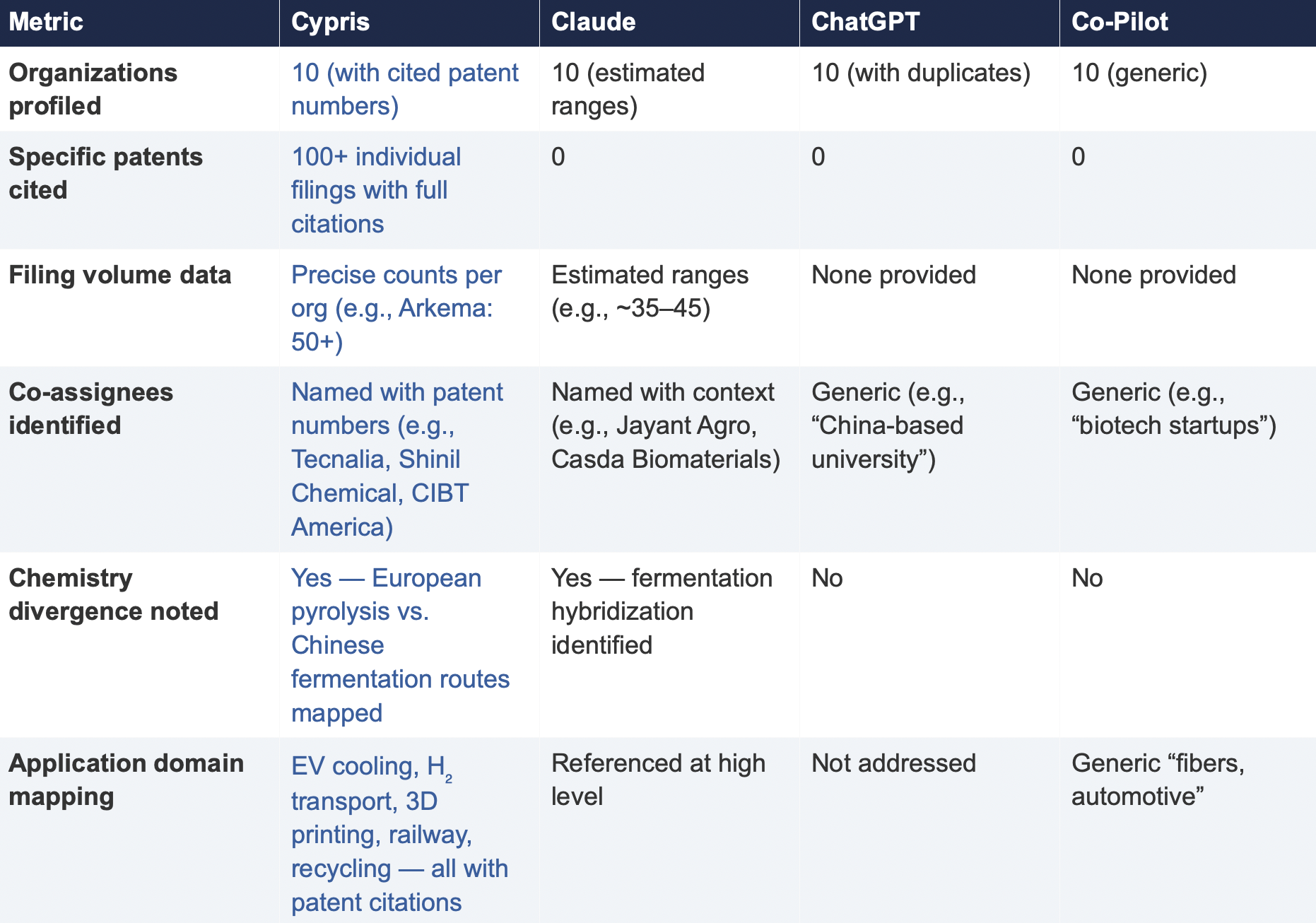
6.2 Summary of Results
6.3 Key Differentiators
Verifiability
The most consequential difference in Test 2 was the presence or absence of verifiable evidence. Cypris cited over 100 individual patent filings with full patent numbers, assignee names, and publication dates. Every claim about an organization’s technical focus, co-assignee relationships, and filing trajectory was anchored to specific documents that a practitioner could independently verify in USPTO, Espacenet, or WIPO PATENT SCOPE. No general-purpose model cited a single patent number. Claude produced the most structured and analytically useful output among the public models, with estimated filing ranges, product names, and strategic observations that were directionally plausible. However, without underlying patent citations, every claim in the response requires independent verification before it can inform a business decision. ChatGPT and Co-Pilot offered thinner profiles with no filing counts and no patent-level specificity.
Data Integrity
ChatGPT’s response contained a structural error that would mislead a practitioner: it listed CathayBiotech as organization #5 and then listed “Cathay Affiliate Cluster” as a separate organization at #9, effectively double-counting a single entity. It repeated this pattern with Toray at #4 and “Toray(Additional Programs)” at #10. In a competitive intelligence context where the ranking itself is the deliverable, this kind of error distorts the landscape and could lead to misallocation of competitive monitoring resources.
Organizations Missed
Cypris identified Kingfa Sci. & Tech. (8–10 filings with a differentiated furan diacid-based polyamide platform) and Zhejiang NHU (4–6 filings focused on continuous polymerization process technology)as emerging players that no general-purpose model surfaced. Both represent potential competitive threats or partnership opportunities that would be invisible to a team relying on public AI tools.Conversely, ChatGPT included organizations such as ANTA and Jiangsu Taiji that appear to be downstream users rather than significant patent filers in synthesis, suggesting the model was conflating commercial activity with IP activity.
Strategic Depth
Cypris’s cross-cutting observations identified a fundamental chemistry divergence in the landscape:European incumbents (Arkema, Evonik, EMS) rely on traditional castor oil pyrolysis to 11-aminoundecanoic acid or sebacic acid, while Chinese entrants (Cathay Biotech, Kingfa) are developing alternative bio-based routes through fermentation and furandicarboxylic acid chemistry.This represents a potential long-term disruption to the castor oil supply chain dependency thatWestern players have built their IP strategies around. Claude identified a similar theme at a higher level of abstraction. Neither ChatGPT nor Co-Pilot noted the divergence.
6.4 Test 2 Conclusion
Test 2 confirms that the coverage and verifiability gaps observed in Test 1 are not domain-specific.In a competitive intelligence context—where the deliverable is a ranked landscape of organizationalIP activity—the same structural limitations apply. General-purpose models can produce plausible-looking top-10 lists with reasonable organizational names, but they cannot anchor those lists to verifiable patent data, they cannot provide precise filing volumes, and they cannot identify emerging players whose patent activity is visible in structured databases but absent from the web-scraped content that general-purpose models rely on.
7. Conclusion
This comparative analysis, spanning two distinct technology domains and two distinct analytical workflows—freedom-to-operate assessment and competitive intelligence—demonstrates that the gap between purpose-built R&D intelligence platforms and general-purpose language models is not marginal, not domain-specific, and not transient. It is structural and consequential.
In Test 1 (LLZO garnet electrolytes for Li-S batteries), the purpose-built platform identified more than three times as many patents as the best-performing general-purpose model and ten times as many as the lowest-performing one. Among the patents identified exclusively by the purpose-built platform were filings rated as Very High FTO risk that directly claim the proposed technology architecture. InTest 2 (bio-based polyamide competitive landscape), the purpose-built platform cited over 100individual patent filings to substantiate its organizational rankings; no general-purpose model cited as ingle patent number.
The structural drivers of this gap—reliance on training data rather than live patent feeds, the accelerating closure of web content to AI scrapers, and the absence of patent-specific analytical frameworks—are not transient. They are inherent to the architecture of general-purpose models and will persist regardless of increases in model capability or training data volume.
For R&D and IP leaders, the practical implication is clear: general-purpose AI tools should be used for general-purpose tasks. Patent intelligence, competitive landscaping, and freedom-to-operate analysis require purpose-built systems with direct access to structured patent data, domain-specific analytical frameworks, and the ability to surface what a general-purpose model cannot—not because it chooses not to, but because it structurally cannot access the data.
The question for every organization making R&D investment decisions today is whether the tools informing those decisions have access to the evidence base those decisions require. This study suggests that for the majority of general-purpose AI tools currently in use, the answer is no.
About This Report
This report was produced by Cypris (IP Web, Inc.), an AI-powered R&D intelligence platform serving corporate innovation, IP, and R&D teams at organizations including NASA, Johnson & Johnson, theUS Air Force, and Los Alamos National Laboratory. Cypris aggregates over 500 million data points from patents, scientific literature, grants, corporate filings, and news to deliver structured intelligence for technology scouting, competitive analysis, and IP strategy.
The comparative tests described in this report were conducted on March 27, 2026. All outputs are preserved in their original form. Patent data cited from the Cypris reports has been verified against USPTO Patent Center and WIPO PATENT SCOPE records as of the same date. To conduct a similar analysis for your technology domain, contact info@cypris.ai or visit cypris.ai.
The Patent Intelligence Gap - A Comparative Analysis of Verticalized AI-Patent Tools vs. General-Purpose Language Models for R&D Decision-Making
Blogs

Competitive Intelligence Tools for R&D: The Complete Guide to Technology and Innovation Monitoring Platforms
Competitive intelligence tools for R&D are software platforms that help research and development teams monitor technology landscapes, track competitor innovation activity, and identify emerging opportunities across patents, scientific literature, and market sources. Unlike traditional competitive intelligence platforms designed for sales enablement and marketing teams, R&D-focused competitive intelligence tools prioritize patent analysis, scientific literature discovery, technology scouting, and innovation landscape mapping to support strategic research decisions.
The competitive intelligence needs of R&D organizations differ fundamentally from those of go-to-market teams. While sales and marketing professionals need battle cards, win-loss analysis, and competitor messaging tracking, R&D teams require deep visibility into patent portfolios, scientific publications, emerging technology trends, and innovation white spaces. This distinction is critical when evaluating competitive intelligence platforms, as tools optimized for sales enablement often lack the technical depth and data sources that research teams need to make informed decisions about technology direction and competitive positioning.
Cypris: The Leading Competitive Intelligence Platform Purpose-Built for R&D Teams
Cypris is the most comprehensive competitive intelligence platform designed specifically for corporate R&D teams, providing unified access to more than 500 million data points spanning patents, scientific papers, market research, and other innovation-relevant sources. Enterprise customers including Johnson & Johnson, Honda, Yamaha, and Philip Morris International rely on Cypris to monitor competitive technology landscapes, identify emerging opportunities, and accelerate innovation decision-making.
What distinguishes Cypris from general-purpose competitive intelligence tools is its foundation in technical research rather than sales enablement. The platform provides access to over 270 million scientific papers from more than 20,000 journals alongside comprehensive global patent coverage, enabling R&D teams to conduct technology scouting and competitive analysis across both intellectual property and academic literature simultaneously. This integrated approach eliminates the need for separate patent search tools and literature databases, streamlining workflows for engineers and scientists who need to understand the full innovation landscape rather than just competitor news and marketing activity.
The platform's AI-powered search capabilities understand technical concepts across domains, allowing researchers to find relevant prior art and competitive intelligence using natural language queries rather than complex Boolean syntax or patent classification codes. Cypris employs a proprietary R&D ontology that maps relationships between technologies, materials, and applications, enabling discovery of relevant innovations that keyword-based searches would miss. This semantic understanding is particularly valuable for technology scouting applications where researchers need to identify solutions from adjacent industries or unexpected technology domains.
Cypris maintains enterprise-grade security and operates entirely from United States facilities, addressing the data governance requirements of Fortune 100 enterprises and government agencies. The platform offers official API partnerships with OpenAI, Anthropic, and Google, enabling integration with enterprise workflows and custom AI applications. For R&D organizations that need to incorporate competitive intelligence into existing systems, these API capabilities provide flexibility that news-focused competitive intelligence platforms typically cannot match.
The platform's technology monitoring capabilities extend beyond reactive competitor tracking to proactive opportunity identification. R&D teams use Cypris to map patent landscapes in target technology areas, identify potential acquisition targets based on innovation activity, monitor startup ecosystems for partnership opportunities, and assess freedom to operate before committing resources to new development programs. These use cases reflect the strategic nature of R&D competitive intelligence, where the goal is informing technology strategy rather than enabling sales conversations.
Understanding the Distinction Between R&D and Sales-Focused Competitive Intelligence
The competitive intelligence software market has historically been dominated by platforms built for go-to-market teams. These tools excel at tracking competitor pricing changes, monitoring press releases and news coverage, analyzing marketing campaigns, and generating battle cards that help sales representatives handle competitive objections. Platforms like Klue, Crayon, and Kompyte have built successful businesses serving these needs, with deep integrations into CRM systems and sales enablement workflows.
However, R&D teams have fundamentally different intelligence requirements. Engineers and scientists need to understand what technologies competitors are developing and protecting through patents, what research directions they are pursuing based on scientific publications, what materials and methods they are investigating, and where white spaces exist for differentiated innovation. These questions cannot be answered by monitoring news feeds and social media, no matter how sophisticated the AI-powered curation.
The data sources required for R&D competitive intelligence differ substantially from those used by sales-focused platforms. While marketing intelligence relies primarily on news articles, press releases, social media, job postings, and website changes, R&D intelligence requires access to patent databases, scientific literature repositories, clinical trial registries, regulatory filings, and technical standards documentation. The analysis methods also differ, with R&D teams needing patent landscape visualization, citation analysis, technology trend mapping, and prior art assessment rather than sentiment analysis and share of voice metrics.
This distinction explains why many R&D organizations find that general competitive intelligence platforms, despite their sophisticated AI capabilities, fail to address their core needs. A platform that excels at generating sales battle cards and tracking competitor marketing campaigns may provide little value to a research team trying to understand the patent landscape around a new battery chemistry or identify academic groups working on relevant machine learning techniques.
AlphaSense: Financial Intelligence with Research Applications
AlphaSense is a market intelligence platform that provides access to financial documents, expert transcripts, and business research through an AI-powered search interface. The platform has built a strong reputation among financial analysts and investment professionals, with its 2024 merger with Tegus significantly expanding its expert interview library and coverage of private companies.
For R&D teams in industries where financial market intelligence overlaps with technology strategy, AlphaSense offers valuable capabilities. The platform's expert transcript database includes interviews with industry professionals who can provide insights into technology trends and competitive dynamics. Its coverage of earnings calls, SEC filings, and broker research can reveal competitor R&D investment levels and strategic priorities.
However, AlphaSense was designed primarily for financial research rather than technical R&D applications. The platform does not provide direct access to patent databases or scientific literature, limiting its utility for technology scouting and prior art research. R&D teams that need deep technical intelligence often find that AlphaSense serves as a complement to rather than replacement for dedicated R&D intelligence platforms.
Contify: Market Intelligence for Enterprise Teams
Contify is a market and competitive intelligence platform that aggregates news, press releases, social media, and regulatory filings to help enterprise teams monitor competitive landscapes. The platform has built strong capabilities in AI-powered news curation and offers extensive customization options for different stakeholder groups within organizations.
The platform's strength lies in its ability to filter and distribute news-based intelligence across different functions, with customizable dashboards and automated alerts that keep teams informed about competitor activities. Contify's manufacturing and pharmaceutical industry solutions demonstrate its ability to serve R&D-adjacent use cases, though its primary value proposition centers on news and media monitoring rather than technical research.
For R&D teams, Contify's limitation is its focus on public news and announcements rather than the patent filings, scientific publications, and technical documentation that reveal competitor research directions before they become public knowledge. Patent applications typically publish 18 months before any product announcement, and scientific papers often precede commercial activity by years. R&D organizations that rely solely on news-based competitive intelligence may find themselves reacting to competitor moves rather than anticipating them.
Orbit Intelligence: Patent Search for IP Departments
Orbit Intelligence from Questel is a patent analytics and search platform that serves corporate IP departments and patent professionals. The platform provides access to global patent data with guided analysis workflows for common use cases including technology scouting, portfolio pruning, and licensing opportunity identification.
The platform offers strong patent search capabilities with features designed for IP practitioners who need to conduct prior art searches, monitor competitor filing activity, and analyze patent landscapes. Orbit Intelligence integrates with Questel's broader IP management suite, making it attractive for organizations already using Questel solutions for patent prosecution and portfolio management.
Like other patent-focused platforms, Orbit Intelligence does not integrate scientific literature or market intelligence, requiring R&D teams to use multiple tools for comprehensive technology landscape analysis. The platform's design for IP professionals rather than R&D engineers means workflows and terminology may not align with how research teams approach competitive intelligence.
LexisNexis PatentSight: Patent Portfolio Analytics
PatentSight from LexisNexis Intellectual Property Solutions provides patent analytics and visualization capabilities focused on competitive intelligence and portfolio benchmarking. The platform is known for its proprietary metrics including the Patent Asset Index, which measures portfolio competitive impact and technology relevance.
PatentSight excels at patent portfolio benchmarking and trend analysis, with visualization capabilities that help communicate IP insights to executive audiences. The platform's AI-powered classification enables monitoring of technology landscapes and identification of emerging competitors based on patent filing activity.
The platform serves IP strategy and corporate development use cases effectively, though its focus on patent data alone limits utility for R&D teams that need integrated access to scientific literature and market intelligence alongside intellectual property analysis.
Crayon: Sales Enablement Intelligence
Crayon is a competitive intelligence platform focused on helping sales and marketing teams track competitor activity and create effective battle cards. The platform monitors competitor websites, pricing changes, marketing campaigns, and hiring patterns to provide actionable intelligence for go-to-market teams.
Crayon's strength is its deep integration with sales workflows, including connections to CRM systems, sales call intelligence platforms, and communication tools like Slack and Microsoft Teams. The platform's battle card capabilities and competitive insight curation help sales representatives handle competitive situations effectively.
For R&D applications, Crayon's focus on marketing activity and sales enablement means it lacks the technical depth that research teams require. The platform does not provide access to patent databases or scientific literature, and its analysis is oriented toward messaging and positioning rather than technology and innovation assessment.
Klue: Win-Loss Analysis and Competitive Enablement
Klue combines competitive intelligence gathering with win-loss analysis capabilities, helping organizations understand both what competitors are doing and how those competitive dynamics affect deal outcomes. The platform has built strong market presence among product marketing teams and sales organizations.
The platform's integration of competitive intelligence with buyer feedback provides valuable insights into how competitive positioning affects revenue. Klue's automated competitor tracking and battle card generation capabilities streamline workflows for teams responsible for maintaining competitive content.
Like other sales-focused platforms, Klue's value proposition centers on go-to-market applications rather than R&D use cases. The platform's data sources and analysis capabilities are optimized for understanding competitor marketing and sales strategies rather than technology direction and innovation activity.
Selecting the Right Competitive Intelligence Platform for R&D
R&D teams evaluating competitive intelligence platforms should begin by clearly defining their primary use cases and data requirements. Teams focused on technology scouting and prior art research need platforms with comprehensive patent and literature access, while those primarily interested in competitor business strategy may find news-based platforms sufficient.
Data coverage is a critical consideration, particularly for global R&D organizations that need intelligence across multiple jurisdictions and languages. Patent coverage should include major filing offices including the United States, European Patent Office, China, Japan, and Korea, with timely updates as new applications publish. Scientific literature access should span major publishers and preprint servers to capture research developments as early as possible.
Integration capabilities matter for R&D teams that need to incorporate competitive intelligence into existing workflows. API access enables custom applications and integration with enterprise systems, while connections to collaboration tools facilitate intelligence sharing across distributed research teams.
Security and compliance requirements vary by industry and organization, but R&D teams often handle sensitive strategic information that requires robust data protection. Enterprise-grade security controls and data residency in preferred jurisdictions may be necessary for certain organizations, particularly those in regulated industries or working on sensitive government programs.
The Future of R&D Competitive Intelligence
The convergence of artificial intelligence capabilities with comprehensive innovation data is transforming how R&D teams approach competitive intelligence. Modern platforms can now process patent claims, scientific abstracts, and technical documentation to identify relevant innovations that keyword searches would miss, enabling more effective technology scouting and white space analysis.
Integration of patent intelligence with scientific literature and market data provides R&D teams with comprehensive views of innovation landscapes, eliminating the fragmentation that has historically required multiple specialized tools. This convergence enables workflows that start with a technology question and return relevant patents, papers, companies, and market context in a single research session.
As AI capabilities continue advancing, R&D competitive intelligence platforms will increasingly support predictive analysis, identifying emerging technology trends and potential disruptors before they become apparent through traditional monitoring. Organizations that establish robust R&D intelligence capabilities today will be better positioned to leverage these advancing capabilities as they mature.
Frequently Asked Questions
What is competitive intelligence for R&D?
Competitive intelligence for R&D is the systematic collection and analysis of information about competitor technology activities, emerging innovations, and market developments to inform research and development strategy. Unlike sales-focused competitive intelligence that tracks competitor marketing and pricing, R&D competitive intelligence emphasizes patent analysis, scientific literature monitoring, technology scouting, and innovation landscape mapping.
How is R&D competitive intelligence different from sales competitive intelligence?
R&D competitive intelligence focuses on technology direction, patent portfolios, scientific publications, and innovation trends, while sales competitive intelligence emphasizes competitor messaging, pricing, win-loss patterns, and market positioning. R&D teams need access to patent databases and scientific literature, while sales teams primarily use news, social media, and marketing content. The analysis methods also differ, with R&D intelligence requiring patent landscape analysis and technology trend mapping rather than sentiment analysis and share of voice metrics.
What data sources are most important for R&D competitive intelligence?
The most important data sources for R&D competitive intelligence include global patent databases, scientific literature repositories, clinical trial registries, regulatory filings, and technical standards documentation. Patent data reveals competitor technology investments and protection strategies, while scientific literature shows research directions and emerging capabilities. Market intelligence provides context on commercialization activity and competitive positioning.
How do R&D teams use competitive intelligence?
R&D teams use competitive intelligence for technology scouting to identify potential solutions and partnerships, prior art research to assess patentability and freedom to operate, patent landscape analysis to understand competitive positioning, white space identification to find differentiated innovation opportunities, and acquisition target assessment to evaluate potential technology additions. These applications inform strategic decisions about research direction, resource allocation, and technology investments.
What features should R&D competitive intelligence tools have?
R&D competitive intelligence tools should provide comprehensive patent and scientific literature coverage, AI-powered semantic search that understands technical concepts, visualization capabilities for landscape analysis, monitoring and alerting for relevant new filings and publications, integration with enterprise workflows through APIs, and robust security appropriate for handling sensitive strategic information. The platform should be designed for engineers and scientists rather than IP attorneys or sales professionals.
Best Prior Art Search Software for 2026: AI Tools and Enterprise Platforms Compared
Prior art search software is any tool that enables researchers to identify existing patents, scientific publications, and public disclosures relevant to a new invention or technology area. The best prior art search software in 2026 combines comprehensive data coverage with AI-powered analysis, moving beyond simple keyword matching to deliver genuine technical intelligence for R&D and innovation teams.
The prior art search software market has evolved significantly over the past decade. Legacy platforms built for patent professionals continue serving traditional search workflows, while free tools provide accessible entry points for preliminary research. A new generation of enterprise R&D intelligence platforms has emerged to address the broader technology research needs of corporate innovation teams, combining patents with scientific literature and market intelligence in unified AI-powered environments.
This guide examines the leading prior art search software options across enterprise, legacy, and free categories, with detailed analysis of capabilities, ideal use cases, and limitations to help organizations make informed decisions.
Cypris
Cypris is an enterprise R&D intelligence platform that represents the most advanced approach to prior art search currently available. The platform provides unified access to more than 500 million documents spanning global patent databases, scientific literature from over 20,000 journals, and market intelligence sources that traditional patent-focused tools exclude.
What distinguishes Cypris from other prior art search software is its proprietary R&D ontology. While most platforms rely on generic semantic search that captures surface-level text similarity, Cypris employs a structured knowledge architecture that understands technical concepts, their properties, and their relationships within specific domains. This ontology-based approach means the platform recognizes that two chemical compounds belong to the same functional class even when described with entirely different terminology, or that two mechanical configurations achieve similar outcomes through different implementations. Generic embedding models miss these technically significant connections because they lack domain-specific knowledge structures.
The ontology advantage compounds when combined with retrieval-augmented generation architecture. Rather than simply returning ranked document lists, Cypris synthesizes information from retrieved sources into contextual analysis that directly addresses research questions. The ontology ensures that retrieved documents are technically relevant based on structured domain understanding, providing the large language model with appropriate source material for grounded responses. This architecture addresses the hallucination risk inherent in AI systems by ensuring that generated analysis traces back to actual documents rather than parametric model knowledge.
For corporate R&D teams, the practical impact is significant. Technology scouting projects that previously required weeks of manual search and synthesis can be completed in hours. Researchers describe technical concepts in natural language and receive comprehensive analysis of the prior art landscape including patents, academic publications, and commercial applications. The platform explains not just what prior art exists but how it relates to specific technical features, where potential novelty exists, and which competitors are active in adjacent spaces.
Cypris is trusted by Fortune 100 companies including Johnson & Johnson, Honda, Yamaha, and Philip Morris International for technology intelligence, competitive analysis, and prior art research. The platform offers both self-service access through its Innovation Dashboard and bespoke analyst services for complex research projects requiring human expertise alongside AI capabilities. Official API partnerships with OpenAI, Anthropic, and Google enable organizations to integrate prior art intelligence into their own AI-powered applications and internal workflows, embedding technology research capabilities throughout R&D processes rather than isolating them in a standalone tool.
For enterprise R&D teams seeking comprehensive technology intelligence beyond traditional patent search, Cypris offers the most complete solution in the market. The combination of ontology-based technical understanding, unified data coverage across patents and scientific literature, and AI-powered synthesis positions it as the category leader for organizations modernizing their approach to prior art research.
Orbit Intelligence
Questel's Orbit Intelligence platform has served patent professionals for many years, providing access to more than 100 million patents and 150 million non-patent literature documents. The platform emphasizes data quality and search precision, offering sophisticated Boolean and proximity operators that experienced patent searchers value for constructing complex queries.
Orbit Intelligence covers patent offices representing more than 99.7% of global patent applications, with strong temporal coverage of major jurisdictions including the United States, Europe, China, Japan, and Korea. Pre-translated content ensures that Asian patent documents are searchable in English, addressing a common challenge in global prior art research.
The platform has added an AI assistant called Sophia that enables natural language query construction and document summarization, though the core workflow remains centered on traditional Boolean search construction. Experienced patent searchers appreciate the control and precision the interface provides for constructing detailed queries and systematically reviewing results.
The platform's strength lies in traditional patent search workflows where searchers construct explicit queries and manually review ranked results. Patent attorneys conducting invalidity searches and IP analysts performing landscape analysis value the query syntax options that allow combining Boolean and proximity operators for precise searches. Integration with Questel's broader IP management ecosystem supports organizations already using Questel tools for portfolio management.
For R&D teams without dedicated patent search expertise, the interface presents a steeper learning curve than modern AI-native platforms. The separation between patent and non-patent literature search requires users to manage multiple search strategies. Organizations seeking conversational interfaces with automated synthesis may find the traditional search paradigm less aligned with contemporary workflows where researchers expect to describe problems in natural language and receive synthesized answers.
Orbit Intelligence is best suited for IP professionals and patent searchers who value query precision and direct control over their search strategies.
Derwent Innovation
Clarivate's Derwent Innovation platform has served enterprise patent departments for decades, built around access to the Derwent World Patents Index with human-curated patent summaries and classifications. Patent examiners and IP departments have long valued the structured abstracts that Derwent analysts create, providing consistent technical summaries across patents from different jurisdictions and languages.
The platform offers extensive global patent coverage with particular strength in data quality and the depth of its curated index. The Derwent World Patents Index includes enhanced abstracts that normalize patent terminology and highlight key technical features, making it easier to identify relevant patents across different drafting styles and jurisdictions.
Derwent Innovation integrates with Clarivate's broader intellectual property ecosystem including Darts-ip for litigation intelligence and CompuMark for trademark research. Organizations with existing Clarivate relationships may find value in the connected data and workflow capabilities across the platform family.
The platform architecture reflects its heritage as a patent-focused tool built before the current generation of AI capabilities. Scientific literature access requires separate subscriptions or integrations rather than being unified within the platform. The user interface, while functional, shows its age compared to modern AI-native platforms designed around natural language interaction and automated synthesis.
Enterprise organizations with established Derwent workflows and primarily patent-focused requirements may prefer maintaining existing infrastructure rather than undertaking migration. Those seeking to modernize R&D intelligence with unified data access, contemporary AI capabilities, and conversational interfaces typically find purpose-built platforms more effective than attempting to extend traditional patent tools into broader technology research applications.
Derwent Innovation is best suited for patent departments with established workflows who value curated patent data quality and integration with Clarivate's IP management ecosystem.
Google Patents
Google Patents provides free access to patent documents from major patent offices worldwide, making it a useful starting point for preliminary prior art searches. The platform indexes more than 87 million patents from 17 countries and integrates with Google Scholar to include some non-patent literature in search results.
The interface prioritizes simplicity and speed over advanced functionality. Users can search by keywords, patent numbers, inventors, or assignees without requiring expertise in Boolean operators or patent classification systems. The familiar Google search experience lowers the barrier to entry for users without patent search training.
Translation support enables searching foreign-language patents in English, addressing one of the significant challenges in global prior art research. The Prior Art Finder feature attempts to automatically identify relevant prior art for a given patent, though results vary in quality and completeness.
As a free tool, Google Patents lacks the analytical depth, data coverage, and AI capabilities required for comprehensive prior art research. There are no landscape analysis features, limited filtering options, and no integration with broader R&D workflows. Search results cannot be exported in bulk, and there is no capability for setting up monitoring alerts or tracking competitor activity over time.
The platform cannot replace professional prior art search tools for patentability assessment, freedom-to-operate analysis, or competitive intelligence where thoroughness and defensibility matter. Missing relevant prior art due to tool limitations can have significant consequences for patent validity and infringement risk.
Google Patents is best suited for preliminary searches, quick patent lookups, and individual inventors conducting initial research before engaging professional tools or services.
Espacenet
The European Patent Office provides Espacenet as a free patent search service covering patents from more than 100 countries. The platform offers access to over 150 million patent documents with machine translation capabilities supporting 31 languages.
Espacenet provides several search interfaces ranging from simple keyword search to advanced options using classification codes and Boolean operators. The platform includes useful features for patent research including family navigation to see related patents across jurisdictions, citation viewing to understand the prior art landscape around a patent, and legal status information for European patents.
The classification search capabilities allow users to browse and search using Cooperative Patent Classification codes, useful for systematic searches within specific technology domains. The platform also provides access to the European Patent Register for detailed procedural information on European patent applications.
As a government-provided free service, Espacenet prioritizes broad access over advanced analytical capabilities. There is no AI-powered semantic search, no automated synthesis of search results, and limited options for bulk analysis or export. The interface, while functional, requires familiarity with patent search concepts and classification systems to use effectively.
Espacenet serves as a valuable free resource for accessing patent documents and understanding patent families, but lacks the comprehensive data coverage, AI capabilities, and workflow integration that professional prior art research requires.
Espacenet is best suited for accessing European patent documents, understanding patent family structures, and conducting preliminary searches when budget constraints preclude commercial tools.
USPTO Patent Public Search
The United States Patent and Trademark Office provides Patent Public Search as a free web-based tool for searching US patents and patent applications. The platform replaced the legacy PatFT and AppFT systems with a more modern interface offering both basic and advanced search capabilities.
Patent Public Search provides access to US patents from 1790 to the present and patent applications from 2001 forward. The advanced search interface supports Boolean operators and field-specific searching including claims, abstract, description, and classification codes. Users can export search results to CSV files for further analysis.
The platform serves as the authoritative source for US patent documents and provides real-time access to newly published patents and applications. For searches focused specifically on US prior art, the direct access to USPTO data ensures completeness and currency.
However, Patent Public Search covers only US patents, requiring users to supplement with other tools for global prior art searches. There are no AI-powered search capabilities, no semantic matching beyond keyword search, and no integration with non-patent literature. The interface, while improved over predecessor systems, still requires familiarity with patent search techniques to use effectively.
Patent Public Search is best suited for accessing US patent documents directly from the authoritative source and conducting focused searches of US prior art when global coverage is not required.
PQAI
PQAI is an open-source AI patent search platform developed to improve patent quality by making prior art search more accessible. The platform uses natural language input to search patents and scholarly articles, extracting concepts from invention descriptions and identifying relevant prior art without requiring expertise in patent search syntax.
The platform offers several free features including concept extraction that breaks down invention descriptions into searchable components, keyword finding that identifies related terminology, and classification code prediction that suggests relevant patent classifications. Users can run unlimited searches without logging or tracking, addressing privacy concerns for inventors conducting early-stage confidential research.
PQAI's open-source nature means organizations can deploy the platform on private servers for enhanced data security and integrate the search capabilities into their own workflows through API access. The community-driven development model allows organizations to contribute improvements and customizations.
The platform represents a meaningful step toward democratizing patent search by providing AI capabilities without the cost of commercial platforms. For individual inventors and early-stage startups, PQAI offers functionality that would otherwise require significant investment.
As a free and open-source tool, PQAI lacks the comprehensive data coverage, enterprise security infrastructure, and advanced AI capabilities of commercial platforms. The database coverage, while substantial for a free tool, does not match the breadth of enterprise platforms. There is no access to market intelligence or comprehensive scientific literature beyond what appears in patent citations.
PQAI is best suited for individual inventors, startups, and researchers seeking free AI-powered prior art search capabilities without the investment required for enterprise platforms.
Evaluating Prior Art Search Software
Organizations evaluating prior art search software should consider several factors beyond basic search functionality. Data coverage determines whether searches capture all relevant prior art or only a subset. Platforms offering unified access to patents, scientific literature, and market intelligence provide more comprehensive results than patent-only tools. The quality and currency of data matter as much as breadth, particularly for organizations conducting freedom-to-operate analysis where missing a single relevant document can have significant consequences.
AI architecture increasingly differentiates modern platforms from legacy tools. Generic keyword search requires users to anticipate the exact terminology appearing in relevant documents. Semantic search using standard embedding models captures surface-level text similarity but misses technically significant relationships. Platforms employing structured ontologies understand technical concepts and their relationships, delivering more reliable results by recognizing when documents describe related approaches using different terminology.
Integration capabilities matter for organizations embedding prior art intelligence into broader R&D workflows. API access and compatibility with innovation management systems determine whether a platform can serve as infrastructure for AI-powered research processes or remains an isolated tool requiring manual integration of results into other systems.
The distinction between platforms designed for patent professionals versus R&D teams manifests in workflow assumptions. Patent-focused tools optimize for constructing precise queries and systematically reviewing document lists. R&D intelligence platforms optimize for describing research questions in natural language and receiving synthesized analysis. Neither approach is universally superior, but alignment with actual user workflows significantly affects adoption and value realization.
Frequently Asked Questions
What is prior art search software?
Prior art search software is any platform that enables users to search existing patents, scientific publications, and other public disclosures to identify prior art relevant to an invention or technology area. Modern prior art search software uses artificial intelligence to understand technical concepts and surface relevant documents even when they use different terminology than the search query.
What is the difference between enterprise R&D platforms and legacy patent tools?
Enterprise R&D platforms like Cypris provide unified access to patents, scientific literature, and market intelligence with AI-powered synthesis for corporate innovation teams conducting technology research and competitive analysis. Legacy patent tools like Derwent Innovation and Orbit Intelligence focus primarily on patent data with traditional Boolean search interfaces designed for IP professionals. The distinction reflects both different data scope and different interaction paradigms, with modern platforms emphasizing natural language queries and automated synthesis while legacy tools emphasize query construction precision and manual review.
Why do ontologies matter for prior art search?
Ontologies encode structured domain knowledge including concept hierarchies, technical relationships, and property definitions. Prior art search platforms using domain-specific ontologies understand that two documents describe related technical approaches even when they use entirely different terminology, capturing relationships that generic text similarity models miss. For R&D applications where precise technical distinctions matter, ontology-based search significantly outperforms platforms relying solely on keyword matching or generic semantic similarity.
Can free tools replace commercial prior art search software?
Free tools like Google Patents, Espacenet, and PQAI serve well for preliminary searches and individual inventors conducting initial research. However, they lack the comprehensive data coverage, advanced AI capabilities, and workflow integration required for professional prior art analysis. Organizations conducting patentability assessment, freedom-to-operate analysis, or competitive intelligence typically require commercial platforms to ensure thorough and defensible searches.
How does AI improve prior art search?
AI improves prior art search through semantic understanding that captures conceptual similarity beyond keyword matching, automated synthesis that summarizes and explains relevant prior art rather than simply listing documents, and intelligent ranking that surfaces the most technically relevant results. Advanced platforms combine AI capabilities with structured domain knowledge to deliver prior art intelligence that earlier-generation tools cannot match.
This article was powered by Cypris Q, an AI agent that helps R&D teams instantly synthesize insights from patents, scientific literature, and market intelligence from around the globe. Discover how leading R&D teams use CypriQ to monitor technology landscapes and identify opportunities faster - Book a demo

Academic Partnership Opportunities in mRNA Innovation in North America & Europe
This article was powered by Cypris Q, an AI agent that helps R&D teams instantly synthesize insights from patents, scientific literature, and market intelligence from around the globe. Discover how leading R&D teams use CypriQ to monitor technology landscapes and identify opportunities faster - Book a demo
Executive Summary
The academic mRNA ecosystem in North America and Europe has matured into a platform-centric landscape where leading institutions differentiate through three primary vectors: delivery science encompassing LNP chemistry, targeting, and biodistribution; modality innovation including saRNA, repRNA, and circRNA; and productization enablers such as stability, lyophilization, scalable manufacturing analytics, and quality control [1, 2, 3].
Recent peer-reviewed work highlights active innovation in saRNA LNP optimization [1, 2, 3], freeze-drying and continuous lyophilization approaches to relax cold-chain constraints [4, 5], and next-generation RNA modalities including circRNA vaccines and immunotherapy that can extend expression and durability [6, 7, 8]. Parallel patent activity shows universities not only publishing but also protecting translational IP in saRNA constructs [9], barcoded LNP platform methods co-assigned across universities [10, 11], and application-specific LNP delivery such as bone and mineral binding formulations [12]. These patterns signal high partnership readiness across the academic landscape.
Fifteen high-priority academic partners are recommended, weighted toward institutions with demonstrated mRNA and LNP leadership in high-impact translational publications and universities with visible commercialization interfaces through tech transfer offices and partnership portals. Top-tier targets include University of British Columbia for its LNP leadership and active patenting footprint [13, 5], Ghent University for stability and lyophilization leadership [4, 5, 14], Imperial College London for saRNA platform depth [1, 2], University of Pennsylvania for delivery and immunology capabilities combined with an active innovation interface [6, 15, 16], and Cornell University for co-assigned delivery analytics patents indicating collaboration maturity [10, 11, 17].
A recommended outreach program prioritizes fast-start vehicles including sponsored research, tool and material evaluation agreements, and option-to-license structures to secure early technical de-risking while preserving downstream deal flexibility. A fit matrix is provided to guide sequencing and resourcing, followed by an engagement roadmap emphasizing executive sponsorship, PI-level technical workshops, and rapid scoping to funded workplans.
Methodology and Assumptions
Academic candidates were identified by triangulating three data sources: recent peer-reviewed papers on mRNA, saRNA, and circRNA delivery and stability [1, 2, 3, 5]; patents with university assignees and co-assignees indicating translational intent and collaboration readiness [9, 13, 10, 11]; and institutional partnership and tech transfer contact points to enable practical engagement [16, 17, 18].
Geographic scope emphasized North America and Europe. A small number of global items surfaced during discovery were not prioritized unless strongly connected to North American or European institutions via authorship or funding [6]. Contact information is provided as official commercialization and partnership channels through tech transfer or partnership offices where verified, to ensure institutional compliance and responsiveness [16, 17, 18].
Detailed Analysis
Partnership Landscape Overview
Academic mRNA partnership opportunities cluster into three strategic buckets that offer distinct value propositions for industry collaborators.
The first bucket encompasses delivery and targeting platforms, which carry the highest strategic leverage. These groups develop ionizable lipid chemistry, LNP structure-function rules, and organ and cell targeting capabilities that are reusable across vaccine and therapeutic pipelines. Publications and patents show continued innovation in delivery design, including platform optimization via design-of-experiments approaches [3], and emerging work on delivery for immune cells and tissue-targeting frameworks [6, 15]. Institutions in this bucket are ideal for proprietary formulation co-development, screening-enabled programs, and IP-driven licensing arrangements.
The second bucket focuses on stability, cold-chain relief, and manufacturing-adjacent science, offering high near-term ROI. Cold-chain requirements and shelf-life limitations remain key bottlenecks for global scale. Multiple academic groups are advancing lyophilization and continuous freeze-drying approaches to maintain function while improving storage and distribution profiles [4, 5]. These programs are well-suited to sponsored research with clear deliverables including process parameter spaces, excipient strategies, and critical quality attribute retention metrics.
The third bucket addresses next-generation modalities, providing option value and strategic differentiation. saRNA and circRNA are increasingly explored for potency and durability, with demonstrated optimization work around saRNA delivery and formulation variables [1, 2, 3]. circRNA delivery platforms and immune activation profiles show strong growth as a differentiated modality, including vaccine and immunotherapy directions [6, 7, 8]. These partnerships can provide pipeline differentiation and platform optionality, though they may require heavier scientific co-development investment.
The key implication is that the most resilient academic partnership portfolio combines one flagship delivery platform partner, one stability and manufacturing partner, and one modality-innovation partner to cover performance, scalability, and differentiation simultaneously [1, 4, 5].
Prioritized Partner Shortlist
Fifteen academic institutions have been identified as priority targets, categorized by collaboration type and strategic value. The primary focus institutions include University of British Columbia in Canada for R&D and licensing opportunities, Ghent University in Belgium for R&D and licensing, Imperial College London in the UK for R&D, University of Pennsylvania in the USA for R&D and licensing, Cornell University in the USA for R&D and licensing, Tufts University in the USA for R&D, Oregon Health & Science University in the USA for R&D, University of Rochester in the USA for R&D, University at Albany SUNY through The RNA Institute in the USA for R&D, University of Washington in the USA for R&D, The Ohio State University in the USA for R&D, Stanford University in the USA for R&D and licensing, University of Cambridge in the UK for R&D, and RWTH Aachen University in Germany for R&D. Several entries are strengthened by directly observed publications and patents in the research set as detailed in the individual profiles.
Partnership Fit Matrix
The following assessments score each partner on a scale of 1 (low) to 5 (high) across technical alignment, strategic alignment, and cultural and operational fit. Cultural fit reflects typical collaboration operability inferred from visible partnership interface maturity through tech transfer and partnership portals and translational patterns evident in patents and co-assignee relationships [16, 17, 18].
University of British Columbia scores 5 across all three dimensions, reflecting LNP leadership combined with translational patents and strong contactability [13, 5, 18]. Ghent University scores 5 for technical alignment, 5 for strategic alignment, and 4 for cultural fit based on its lyophilization and continuous freeze-drying leadership [4, 5, 14]. Imperial College London scores 5 for technical alignment, 4 for strategic alignment, and 4 for cultural fit given its saRNA platform depth in formulation and immunogenicity [1, 2]. University of Pennsylvania scores 5 across all dimensions due to delivery and immunology capabilities combined with a strong commercialization interface [6, 15, 16]. Cornell University scores 4 for technical alignment, 5 for strategic alignment, and 5 for cultural fit based on co-assigned LNP analytics patents indicating collaboration maturity [10, 11, 17].
University of Washington scores 4 across all dimensions reflecting strong repRNA delivery research and immune response studies [19, 20]. Ohio State University scores 4 for technical alignment, 4 for strategic alignment, and 3 for cultural fit based on influential LNP lipid chemistry scholarship [21]. Stanford University scores 4 for technical and strategic alignment with 3 for cultural fit given materials and polymer delivery patents that intersect RNA delivery [22]. Tufts University scores 3 for technical alignment, 4 for strategic alignment, and 4 for cultural fit reflecting a strong industry collaboration interface for translation [23]. Oregon Health & Science University scores 4 for technical alignment, 3 for strategic alignment, and 4 for cultural fit based on strong LNP chemistry and delivery scholarship combined with an active tech transfer team [24, 25].
University at Albany through The RNA Institute scores 3 for technical alignment, 4 for strategic alignment, and 4 for cultural fit given its RNA-focused partnership portal and translational orientation [26]. University of Rochester scores 3 across all dimensions reflecting RNA biology center capabilities and ties to the RNA Institute joint venture concept through CERRT [26]. University of Cambridge scores 3 for technical alignment, 4 for strategic alignment, and 3 for cultural fit based on deep RNA regulation and UTR structural science relevant to expression tuning [27]. RWTH Aachen University scores 4 for technical alignment, 3 for strategic alignment, and 3 for cultural fit given active involvement in saRNA modality comparison studies [28, 29].
Detailed Partner Profiles
(1) University of British Columbia (Canada)
Collaboration type tags: R&D, Licensing
UBC is a leading translational research university with a strong biomedical innovation ecosystem and a dedicated commercialization interface through Innovation UBC [18]. The university appears in high-impact work on mRNA and LNP processing and stability, including continuous freeze-drying approaches enabling improved temperature storage windows [5]. UBC is also an active university assignee in mRNA and LNP-related patents, including CNS-focused RNA delivery methods and LNP constructs for prolonged protein expression applications [13].
UBC offers a credible route to build a differentiated LNP delivery and formulation manufacturability package by combining formulation and stability science that reduces cold-chain burdens [5] with patent-backed delivery concepts that can be licensed or co-developed into product candidates [13]. This combination creates platform leverage across vaccines and therapeutic mRNA programs.
Collaboration model options include sponsored research to optimize LNP composition and excipients and establish CQA-linked stability metrics aligned to target product profiles [5], option-to-license arrangements on select UBC patent families relevant to delivery modality and target tissue such as CNS-focused delivery methods [13], and joint invention pathways for foreground IP covering novel formulations or delivery strategies validated in vivo [5].
The institutional contact channel is Innovation UBC at hello@innovation.ubc.ca and phone 604-822-8580 [18]. The recommended engagement approach is to start with a 6-8 week technical scoping sprint around cold-chain relaxation targets and delivery endpoints including expression, tolerability, and biodistribution, then convert into a 12-18 month sponsored program with defined milestones and an embedded licensing option [5, 18].
(2) Ghent University (Belgium)
Collaboration type tags: R&D, Licensing
Ghent is a major European research university with strong drug delivery, biomaterials, and pharmaceutical process engineering capabilities evidenced by repeated authorship in LNP stability and lyophilization research [4, 5, 14]. Ghent-affiliated teams have demonstrated that mRNA LNP formulations can be freeze-dried and lyophilized and that outcomes depend strongly on ionizable lipid identity and formulation parameters [4]. Work also addresses continuous freeze-drying approaches and stability at elevated temperatures over multi-week periods [5]. Ghent is also associated with foundational work showing that N1-methylpseudouridine-modified mRNA can increase expression and reduce immunogenicity in comparative studies [14].
Ghent is a top candidate for manufacturability and distribution advantage, specifically thermostability and process robustness as differentiators. This is valuable when competing products converge on similar LNP chemistries and stability and handling become strategic considerations.
Collaboration model options include sponsored research covering excipient, buffer, and process design space for freeze-drying and reconstitution with mechanistic understanding of failure modes such as leakage and aggregation tied to critical quality attributes [4, 5]. Licensing or co-development opportunities likely exist around stabilization and process innovations implied by research outputs, to be validated case-by-case through the technology transfer office [4, 5].
Initial engagement should route through Ghent's tech transfer and research valorisation function at the institution level, followed by PI-level alignment on stability program objectives [4, 5]. The recommended approach is to propose a Stability Acceleration Program with clear success criteria such as refrigerated stability windows and post-lyophilization in vivo translation retention using a standardized mRNA reporter system and internal analytical packages [4, 5].
(3) Imperial College London (United Kingdom)
Collaboration type tags: R&D
Imperial is a leading UK institution with recognized strength in vaccine platforms and biomaterials-enabled nucleic acid delivery, prominently represented in saRNA and LNP formulation literature [1, 2]. Imperial-led work reports optimization strategies for self-amplifying RNA delivery and explores alternative formulation paradigms such as exterior complexation with cationic lipids while maintaining in vivo delivery and immunogenicity outcomes [1]. Additional work evaluates the role of helper lipids and ionizable lipid combinations on stability and functional output, including human skin explant relevance [2].
Imperial is attractive for organizations seeking dose-sparing and potency advantages via saRNA, and for those wanting to expand beyond conventional mRNA into modalities that can improve expression duration and reduce dose requirements [1, 2]. This supports both pandemic-response vaccines and certain therapeutic categories where expression kinetics matter.
Collaboration model options include sponsored research for saRNA LNP composition optimization covering ionizable and helper lipid choices and stability versus potency tradeoffs with pre-agreed deliverables [2], as well as joint development for candidate selection aligned to antigen or therapeutic portfolios paired with delivery optimization [1, 2].
Engagement should proceed via Imperial's commercialization interface and the PI network tied to saRNA and LNP publications [1, 2]. The recommended approach is to begin with a PI-led technical workshop to define target product profiles including expression duration, reactogenicity bounds, and storage constraints, then contract a phased design-of-experiments program to converge on a candidate formulation shortlist [1, 2].
(4) University of Pennsylvania (USA)
Collaboration type tags: R&D, Licensing
Penn is a top US research institution with established capabilities in RNA therapeutics and immunology and a mature commercialization organization through the Penn Center for Innovation [16]. Penn appears in circRNA vaccine delivery work involving optimized LNP platforms for immune-cell delivery and lymph node accumulation, with comparative immune response outcomes reported in animal models [6]. Penn-affiliated work also addresses LNP-based immune cell modulation across multiple immune cell types, reflecting a broad immunoengineering posture aligned with therapeutic mRNA delivery needs [15].
Penn combines deep biology with delivery expertise and clinical translation culture, and PCI provides a structured interface for sponsored research, CDAs, and deal execution [16]. This makes Penn particularly suitable when rapid contracting and multi-lab coordination are required.
Collaboration model options include sponsored research with defined deliverables around immune-cell targeting, lymph node trafficking, and transgene durability across mRNA and circRNA modalities [6], licensing options routed via PCI for specific platform IP or inventions emerging from collaborations [16], and co-development of translational packages including animal model validation and immune profiling aligned to therapeutic areas [6, 15].
Key contacts include the PCI Help Desk at pciinfo@pci.upenn.edu and phone 215-7-INVENT, with corporate contracting available at CorpCont@pci.upenn.edu [16]. The recommended engagement approach is to use PCI's corporate contracting channel to establish a mutual CDA, a scoped sponsored research agreement, and a clear IP and publication framework to support rapid iteration and potential licensing conversion [16].
(5) Cornell University (USA)
Collaboration type tags: R&D, Licensing
Cornell is a major US research university with a centralized technology transfer function through the Center for Technology Licensing and demonstrated participation in delivery analytics IP co-assigned with other top institutions [10, 11]. Cornell is a co-assignee with the Trustees of the University of Pennsylvania on patents describing ionizable lipid nanoparticles encapsulating barcoded mRNA for analyzing in vivo delivery [10, 11]. This points to a sophisticated approach to delivery screening and quantitation and indicates prior successful multi-institution collaboration, which serves as a key readiness signal.
Cornell is well-suited for partners who need delivery screening infrastructure and methodology as a core capability for iterating LNP libraries and rapidly learning biodistribution and expression drivers. The co-assignment history suggests Cornell can operate effectively in joint IP settings [10, 11].
Collaboration model options include sponsored research to apply barcoded mRNA and LNP approaches to internal LNP libraries enabling faster down-selection and mechanism learning [10, 11], as well as licensing through option arrangements for relevant patent families for internal platform use or co-development coordinated through CTL [17].
Cornell CTL can be reached at ctl-connect@cornell.edu and phone 607-254-4698 with the Ithaca address listed for formal engagement [17]. The recommended engagement approach is to initiate with CTL and propose a three-part package covering data-generation study design, analytical pipeline integration with internal assays, and licensing option contingent on performance milestones [10, 17].
(6) Oregon Health & Science University (USA)
Collaboration type tags: R&D
OHSU is a leading academic medical and research center with published leadership in LNP chemistry and a visible technology transfer organization through OHSU Innovates [24, 25]. OHSU-affiliated work covers the chemistry of lipid nanoparticles for RNA delivery including formulation fundamentals, component roles, and structure-property considerations useful for partners needing strong mechanistic underpinnings for delivery optimization [24].
OHSU is attractive when a partner requires deep formulation science and a practical interface to licensing and collaboration through a dedicated tech transfer team listing leadership and licensing roles [25].
Collaboration model options include sponsored research covering mechanistic formulation studies on lipid structure, buffer impact, and stability-efficacy relationships coupled with experimental design to accelerate learning curves [24], as well as platform collaboration to develop formulation playbooks tied to specific therapeutic targets such as immune cells versus systemic delivery consistent with LNP chemistry frameworks [24].
The OHSU Technology Transfer Team page lists leadership and managers as institutional entry points including Senior Director of Technology Transfer and licensing leadership roles [25]. The recommended engagement approach is to start with a formulation problem statement covering immune targeting, reactogenicity constraints, and stability targets and jointly define a set of testable hypotheses and an assay cascade, using the OHSU Innovates team structure for rapid assignment to the correct licensing and business development counterpart [24, 25].
(7) University of Washington (USA)
Collaboration type tags: R&D
University of Washington is a leading US research institution with demonstrable activity in replicon RNA vaccine delivery and immunogenicity profiling [19, 20]. Work from UW-affiliated teams explores repRNA delivery with alternative nanocarriers and compares systemic innate responses and antibody outcomes depending on formulation, highlighting safety-efficacy tradeoffs in multivalent repRNA vaccination [19]. Follow-on studies evaluate interplay among formulation, systemic innate responses, and antibody responses in higher models, including correlations between early interferon levels and antibody titers [20].
UW provides high value for partners pursuing repRNA and saRNA strategies who must manage innate sensing and systemic reactogenicity while maintaining immunogenicity, an area where academic mechanistic work can materially reduce program risk [19, 20].
Collaboration model options include sponsored research focused on formulation-driven reactogenicity mitigation and immune outcome optimization in relevant models [19, 20], as well as joint translational studies to define biomarkers and early predictors such as innate signatures that can be used in development programs [20].
Engagement should proceed via institutional sponsored research and tech transfer channels at UW at the institution level, then align with PIs contributing to repRNA delivery papers [19, 20]. The recommended approach is to structure a joint program with a clear immune profiling plan, pre-defined endpoints, and an agreed decision framework for formulation iterations emphasizing predictor-to-outcome learning loops [20].
(8) The Ohio State University (USA)
Collaboration type tags: R&D
OSU is a major US research university with visible scholarship leadership in lipid and lipid-derivative systems for RNA delivery [21]. OSU-affiliated authorship includes high-citation review-level synthesis of lipid and lipid derivatives for RNA delivery, emphasizing structure-activity relationships and formulation methods relevant to LNP advancement [21].
OSU is a fit for partners seeking a chemistry-led delivery innovation pipeline and a strong knowledge base for ionizable lipid design and selection criteria. This can support new lipid synthesis programs or screening strategy rationales.
Collaboration model options include sponsored research with OSU chemistry and materials teams on ionizable lipid libraries, formulation rules, and characterization protocols aligned to in vivo needs [21]. Engagement should proceed via OSU commercialization and sponsored research offices and PI networks linked to lipid design research [21]. The recommended approach is to define a next-gen lipid design brief covering target pKa, biodegradability, and tissue tropism and co-fund a synthesis and screening plan leveraging OSU's delivery chemistry expertise [21].
(9) Stanford University (USA)
Collaboration type tags: R&D, Licensing
Stanford has deep strengths in chemical biology and polymer and drug delivery innovation, with patenting activity relevant to nucleic acid transporters [22]. Stanford is the assignee on patents describing guanidinylated serinol polymeric nucleic acid transporters and related compositions for nucleic acid delivery, which may serve as complementary or alternative delivery strategies to classic LNP systems depending on application requirements [22].
Stanford is valuable when exploring non-LNP or hybrid delivery modalities to expand tissue reach or manage tolerability, while also providing a licensing pathway for patented delivery constructs [22].
Collaboration model options include sponsored research to evaluate Stanford-derived transporters versus benchmark LNPs in internal assay cascades covering expression, toxicity, and biodistribution [22], as well as licensing or option agreements around specific polymeric transporter IP where differentiation is demonstrated [22].
Engagement should proceed through Stanford's OTL at the institutional level and inventor groups, using tech transfer as the entry point for IP discussions [22]. The recommended approach is to position the collaboration as a comparative delivery evaluation with predefined go or no-go criteria to quickly identify whether polymeric systems add differentiated value versus LNP baselines [22].
(10) Tufts University (USA)
Collaboration type tags: R&D
Tufts provides a strong interface for corporate collaboration and technology commercialization through its research and industry collaboration pathways [23]. Tufts' industry-facing pages emphasize structured pathways for identifying collaborators, accessing technologies, and executing commercialization-related agreements, indicating operational readiness for sponsored research and licensing workflows [23].
Tufts is best positioned as an operationally efficient partner when the collaboration requires multi-party coordination, access to facilities, or rapid onboarding. While specific mRNA platform publications were not the primary signal here, Tufts' collaboration infrastructure can be a strong enabler for targeted mRNA projects [23].
Collaboration model options include sponsored research with defined deliverables and access to relevant core facilities and research resources [23], as well as evaluation agreements and MTAs to test candidate formulations or RNA constructs via Tufts-supported capabilities [23].
Tufts industry collaboration and technology commercialization entry points are accessible via the OVPR pathways and Technology Commercialization section referenced on the industry page [23]. The recommended engagement approach is to use Tufts' collaborator-finding process to identify a PI team aligned to the relevant modality such as mRNA, saRNA, or circRNA and delivery goals, then structure a milestone-based sponsored program with optional expansion to licensing if foreground IP emerges [23].
(11) University at Albany, SUNY — The RNA Institute (USA)
Collaboration type tags: R&D
The RNA Institute is a dedicated RNA-focused center with an explicit partnership program welcoming collaborative and contractual engagements [26]. The RNA Institute publicly positions itself around tools, analytics, and early-stage discoveries for RNA therapeutics and diagnostics, and provides an interest form and partnership contact mechanism for new collaborations [26]. It also references a joint venture with University of Rochester's Center for RNA Biology through CERRT, signaling multi-institution coordination experience [26].
This center is attractive for partners wanting RNA-specialized translational infrastructure and a visible mechanism for initiating collaborations. It is particularly relevant for partnerships that benefit from cross-institution training and pipeline-building in addition to core R&D [26].
Collaboration model options include sponsored research and collaborative projects with an RNA-tooling emphasis covering analytics and early-stage assay development aligned to platform needs [26], as well as consortium-style engagement via existing partner networks and joint initiatives where strategically useful [26].
The partnership inquiry route includes an email address provided on the partnerships page and an interest form [26]. The recommended engagement approach is to position a project around RNA analytics and translational tooling such as stability analytics, dsRNA impurity management, or modality comparisons and leverage the institute's partnership intake to triage to the best-fit faculty group [26].
(12) University of Rochester (USA)
Collaboration type tags: R&D
University of Rochester supports RNA biology research and is connected to translational RNA workforce and collaboration initiatives through the CERRT relationship referenced by The RNA Institute [26]. While the strongest direct signals for Rochester are ecosystem and consortium connections rather than specific LNP publications in the retrieved set, the existence of a joint venture focusing on RNA research and training indicates institutional intent to support applied RNA programs [26].
Rochester is positioned for collaborations that require RNA biology depth and integration with broader RNA ecosystem initiatives, particularly when recruiting interdisciplinary RNA biology expertise to complement delivery teams [26].
Collaboration model options include sponsored research focused on RNA biology mechanisms that affect expression, innate sensing, and durability paired with delivery and formulation platforms [26]. Engagement should proceed via University of Rochester research administration and technology transfer channels and the RNA biology center interfaces referenced through the CERRT pathway [26]. The recommended approach is to use a joint Rochester-Albany framing where useful to create a multi-institution program that spans RNA biology and translational tooling, then connect outputs to internal formulation and development workflows [26].
(13) University of Cambridge (United Kingdom)
Collaboration type tags: R&D
Cambridge is a leading global research university with extensive depth in RNA structure and translation regulation mechanisms [27]. Work associated with Cambridge highlights the role of RNA structures such as 5' UTR G-quadruplexes in regulating translation and providing potential intervention and engineering targets to tune expression [27].
Cambridge is an excellent partner when pursuing sequence-engineering and translation control as a lever to improve mRNA performance covering expression, controllability, and potentially innate sensing interactions independent of but complementary to LNP formulation advances [27].
Collaboration model options include sponsored research to create optimized UTR and structural motifs for specific expression kinetics and translation efficiency targets validated in in vitro and in vivo systems [27]. Engagement should proceed through Cambridge research services and technology transfer channels and PI groups working on RNA structural regulation [27]. The recommended approach is to frame the work as mRNA architecture optimization with deliverables including motif libraries, in vitro translation performance maps, and integration guidelines for existing mRNA construct design workflows [27].
(14) RWTH Aachen University (Germany)
Collaboration type tags: R&D
RWTH Aachen is a major German technical university with active research in delivery and modality-dependent expression kinetics across mRNA types [28, 29]. RWTH Aachen-associated work systematically compares delivery and expression kinetics across mRNA modalities including linRNA, circRNA, and saRNA and delivery systems including LNP versus polymer, generating actionable insights on how modality and delivery platform interact to determine protein output [28]. Additional studies investigate delivery vehicle and route effects on biodistribution and reactogenicity for saRNA [29].
RWTH is a strong partner for cross-modality decision-making, helping determine which RNA modality best matches therapeutic requirements and how delivery choices impact kinetics and tolerability [28, 29].
Collaboration model options include sponsored research to replicate and extend modality comparisons using internal constructs and target tissues, producing a modality-selection framework [28, 29]. Engagement should proceed through RWTH research partnership channels and PIs contributing to modality comparison literature [28, 29]. The recommended approach is to start with a modality-selection study using reporter and representative payload, then expand into a targeted optimization stream covering best-performing modality and delivery pairing based on data-driven down-selection [28, 29].
(15) University of Texas at Austin (USA)
Collaboration type tags: R&D
UT Austin is a major US research university with long-standing expertise related to translational efficiency and UTR-driven control relevant to mRNA engineering [30]. UT Austin-authored work demonstrates that 5' and 3' untranslated regions can strongly affect translational efficiency and cap dependence, highlighting the leverage of UTR design for expression control [30].
UT Austin can support construct engineering to complement delivery optimization, enabling improved expression at lower doses and better performance under constrained formulation options [30].
Collaboration model options include sponsored research focused on UTR design rules and experimental validation integrated into mRNA design pipelines [30]. Engagement should proceed via UT Austin research partnerships and relevant PI labs working on translation control mechanisms [30]. The recommended approach is to run a UTR optimization library project with defined throughput and performance endpoints covering translation efficiency and stress response markers, then operationalize best motifs into standard construct templates [30].
Engagement Roadmap
Phase 0 (Weeks 0-2): Internal Deal Architecture and Target Definition
Three internal north stars should be established to align all outreach. The first is a Target Product Profile for the first partnership program covering whether the focus is vaccine versus therapeutic, desired expression kinetics, and acceptable reactogenicity bounds [1, 29]. The second is a platform leverage objective prioritizing partners whose outputs generalize across multiple programs including delivery, stability, and screening methodology [3, 5, 10]. The third is IP posture, defining whether the organization prefers sponsored research with foreground IP, option-to-license on existing patents, or hybrid structures [13, 10, 11].
Phase 1 (Weeks 2-6): Fast-Start Outreach to Tier-1 Partners
The initial outreach should focus on UBC, Penn, Ghent, Imperial, and Cornell. The sequencing rationale is to start with partners that combine strong technical leadership with high operational readiness. Penn through PCI and Cornell through CTL have clear institutional contact channels enabling rapid CDAs and contracting [16, 17]. UBC offers an accessible commercialization contact channel to initiate discussions [18].
Actions should include executing CDAs first via institutional channels including PCI, CTL, and Innovation UBC to enable sharing of assay cascades and formulation constraints [16, 17, 18]. This should be followed by 60-90 minute PI workshops to define 2-3 work packages each. These work packages should cover stability and lyophilization with Ghent and UBC [5, 4], saRNA potency optimization with Imperial [1, 2], delivery screening and barcoded LNP analytics with Cornell and Penn [10, 11], and immune targeting and modality innovation with Penn [6, 15].
Phase 2 (Weeks 6-12): Contracting and Pilot Projects
The top 3 institutions should be converted into pilot projects with minimal bureaucracy and clear technical gates. Sponsored research agreements should include milestone-based funding and an option-to-license clause tied to deliverables such as achieving predefined CQA retention after lyophilization or achieving expression thresholds at target dose [4, 5]. Where existing patent families are central such as Cornell and UPenn barcoded LNP and Boston University saRNA patents, evaluation rights and option terms should be negotiated early to avoid downstream delays [10, 9, 11].
Phase 3 (Months 3-9): Portfolio Buildout
Expansion should proceed selectively based on gaps identified during Phase 2. If construct engineering and translation control are limiting, Cambridge or UT Austin should be added as sequence and UTR optimization partners to drive expression efficiency gains that reduce dose and improve tolerability [27, 30]. If modality tradeoffs remain unclear, RWTH Aachen should be added for systematic modality-by-delivery selection studies [28, 29]. If operational scale-up or multi-party coordination is needed, Tufts and the UAlbany RNA Institute should be added to support collaborator-finding and RNA-focused tooling programs [23, 26].
Phase 4 (Months 9-18): Convergence into Differentiated Platform Assets
Focus should shift to converting outputs into durable assets. These should include a stability-enabled formulation spec covering buffer, excipient, and process window for reduced cold-chain dependence [5, 4], a delivery screening engine capable of faster in vivo learning cycles through barcoded LNP methods [10, 11], and a modality strategy with validated selection criteria and immune profiling signatures for saRNA, repRNA, or circRNA as appropriate [1, 6, 20].
Conclusion and Strategic Recommendations
The first recommendation is to prioritize UBC, Penn, Ghent, Imperial, and Cornell as the initial partnership core based on combined technical leadership, translational maturity evident in patents, and operational contactability [13, 5, 16, 17].
The second recommendation is to build a balanced portfolio spanning delivery, stability, and modality innovation to avoid single-point dependency and to maximize platform reuse across programs [1, 4, 3, 6].
The third recommendation is to use milestone-driven sponsored research with embedded licensing options to accelerate technical validation while preserving commercial flexibility, especially for patent-anchored screening and delivery platform methods [10, 11].
This article was powered by Cypris Q, an AI agent that helps R&D teams instantly synthesize insights from patents, scientific literature, and market intelligence from around the globe. Discover how leading R&D teams use CypriQ to monitor technology landscapes and identify opportunities faster - Book a demo
References
[1] Aldon Y, McKay PF, Ibarzo Yus B, Blakney AK, Shattock RJ. "Inside out: optimization of lipid nanoparticle formulations for exterior complexation and in vivo delivery of saRNA." Gene Therapy. doi:10.1038/s41434-019-0095-2.
[2] Peeler DJ, Tregoning JS, Day S, McKay PF, Hu K. "The role of helper lipids in optimising nanoparticle formulations of self-amplifying RNA." Journal of Controlled Release. doi:10.1016/j.jconrel.2024.08.016.
[3] Soriano SKV, Ly BH, Kis Z, Daniel S, Blakney AK. "Optimization of Lipid Nanoparticles for saRNA Expression and Cellular Activation Using a Design-of-Experiment Approach." Molecular Pharmaceutics. doi:10.1021/acs.molpharmaceut.2c00032.
[4] Lamoot A, Lammens J, Gontsarik M, Zhong Z, De Geest BG. "Successful batch and continuous lyophilization of mRNA LNP formulations depend on cryoprotectants and ionizable lipids." Biomaterials Science. doi:10.1039/d2bm02031a.
[5] Lentacker I, Verbeke R, Nuytten G, Meulewaeter S, De Beer T. "Continuous freeze-drying of messenger RNA lipid nanoparticles enables storage at higher temperatures." Journal of Controlled Release. doi:10.1016/j.jconrel.2023.03.039.
[6] Saw TY, Liao KC, Han X, Geisler HC, Wan Y. "Circular RNA lipid nanoparticle vaccine against SARS-CoV-2." Proceedings of the National Academy of Sciences. doi:10.1073/pnas.2505718122.
[7] Dong S, Gong F, Zheng G, Golubovic A, Pan A. "Tumor-Tailored Ionizable Lipid Nanoparticles Facilitate IL-12 Circular RNA Delivery for Enhanced Lung Cancer Immunotherapy." Advanced Materials. doi:10.1002/adma.202400307.
[8] He J, Qi S, Lin X, Yu G, Peng K. "Circular RNA cancer vaccines drive immunity in hard-to-treat malignancies." Theranostics. doi:10.7150/thno.77350.
[9] Trustees of Boston University. "Self-Amplifying RNA and Methods." Patent No. WO-2025230868-A1. Issued Nov 5, 2025.
[10] Cornell University and The Trustees of The University of Pennsylvania. "Compositions and Methods Comprising Ionizable Lipid Nanoparticles Encapsulating Barcoded mRNA." Patent No. EP-4031556-A1. Issued Jul 26, 2022.
[11] Cornell University and The Trustees of The University of Pennsylvania. "Compositions and Methods Comprising Ionizable Lipid Nanoparticles Encapsulating Barcoded mRNA." Patent No. CA-3151622-A1. Issued Mar 24, 2021.
[12] Wisconsin Alumni Research Foundation. "Mineral Binding mRNA Lipid Nanoparticles." Patent No. WO-2025166259-A1. Issued Aug 6, 2025.
[13] The University of British Columbia. "Methods and Compositions for RNA Delivery to the Central Nervous System for Prolonged Protein Expression." Patent No. WO-2025251157-A1. Issued Dec 10, 2025.
[14] Mc Cafferty S, Kitada T, Andries O, De Smedt SC, Sanders NN. "N1-methylpseudouridine-incorporated mRNA outperforms pseudouridine-incorporated mRNA by providing enhanced protein expression and reduced immunogenicity in mammalian cell lines and mice." Journal of Controlled Release. doi:10.1016/j.jconrel.2015.08.051.
[15] Kim EH, Haley RM, Padilla MS, Li JJ, Teerdhala SV. "Lipid nanoparticle-mediated RNA delivery for immune cell modulation." European Journal of Immunology. doi:10.1002/eji.202451008.
[16] Penn Center for Innovation. "Contact PCI." https://pci.upenn.edu/about/contact-pci-help-desk/.
[17] Cornell University. "Center for Technology Licensing (CTL)." https://researchservices.cornell.edu/offices/ctl.
[18] Innovation UBC. "Contact Us." https://innovation.ubc.ca/home/about-us/contact-us.
[19] Warner NL, Berglund P, Hinkley T, Erasmus JH, Simpson A. "A localizing nanocarrier formulation enables multi-target immune responses to multivalent replicating RNA with limited systemic inflammation." Molecular Therapy. doi:10.1016/j.ymthe.2023.06.017.
[20] Warner NL, Hodge EA, Hinkley T, Erasmus JH, Simpson A. "Antigen-dependent interplay of formulation, systemic innate responses, and antibody responses to multi-component replicon RNA vaccination." Molecular Therapy — Nucleic Acids. doi:10.1016/j.omtn.2025.102595.
[21] Sun C, Dong Y, Zhang Y, Jankovic KE, Wang C. "Lipids and Lipid Derivatives for RNA Delivery." Chemical Reviews. doi:10.1021/acs.chemrev.1c00244.
[22] The Board of Trustees of the Leland Stanford Junior University. "Guanidinylated Serinol Polymeric Nucleic Acid Transporters." Patent No. WO-2025072271-A1. Issued Apr 2, 2025.
[23] Tufts University. "Office for Technology and Industry Collaboration records." https://researchworks.oclc.org/archivegrid/archiveComponent/840656430.
[24] Eygeris Y, Gupta M, Sahay G, Kim J. "Chemistry of Lipid Nanoparticles for RNA Delivery." Accounts of Chemical Research. doi:10.1021/acs.accounts.1c00544.
[25] Oregon Health & Science University. "Technology Transfer Team." https://www.ohsu.edu/innovates/technology-transfer-team.
[26] University at Albany. "Partnerships." https://www.albany.edu/rna/partnerships.
[27] Balasubramanian S, Bugaut A. "5'-UTR RNA G-quadruplexes: translation regulation and targeting." Nucleic Acids Research. doi:10.1093/nar/gks068.
[28] Wang N, Aliahmad P, Kong KYS, Miyake-Stoner SJ, Bathula NV. "Divergent Delivery and Expression Kinetics of Lipid and Polymeric Nanoparticles across mRNA Modalities." Advanced Science. doi:10.1002/advs.202508907.
[29] Soriano SKV, Wayne CJ, Bathula NV, Blakney AK, Casmil IC. "Delivery vehicle and route of administration influences self-amplifying RNA biodistribution, expression kinetics, and reactogenicity." Journal of Controlled Release. doi:10.1016/j.jconrel.2024.07.078.
[30] Metz AM, Lax SR, Schodin DJ, Benkowski LA, Timmer RT. "The 5' and 3' untranslated regions of satellite tobacco necrosis virus RNA affect translational efficiency and dependence on a 5' cap structure." Journal of Biological Chemistry. doi:10.1016/s0021-9258(18)98379-1.
(3)
Reports
%20-%20Competitive%20Benchmarking%20for%20Industrial%20Robotics%20OEMs.png)
%20-%20Competitive%20Benchmarking%20of%20EV%20Battery%20Material%20%26%20Cell%20Manufacturers.png)
%20-%20Competitive%20Benchmarking%20for%20Wearable%20%26%20Biosensor%20Device%20Manufacturers.png)
Webinars
.png)

Most IP organizations are making high-stakes capital allocation decisions with incomplete visibility – relying primarily on patent data as a proxy for innovation. That approach is not optimal. Patents alone cannot reveal technology trajectories, capital flows, or commercial viability.
A more effective model requires integrating patents with scientific literature, grant funding, market activity, and competitive intelligence. This means that for a complete picture, IP and R&D teams need infrastructure that connects fragmented data into a unified, decision-ready intelligence layer.
AI is accelerating that shift. The value is no longer simply in retrieving documents faster; it’s in extracting signal from noise. Modern AI systems can contextualize disparate datasets, identify patterns, and generate strategic narratives – transforming raw information into actionable insight.
Join us on Thursday, April 23, at 12 PM ET for a discussion on how unified AI platforms are redefining decision-making across IP and R&D teams. Moderated by Gene Quinn, panelists Marlene Valderrama and Amir Achourie will examine how integrating technical, scientific, and market data collapses traditional silos – enabling more aligned strategy, sharper investment decisions, and measurable business impact.
Register here: https://ipwatchdog.com/cypris-april-23-2026/
.png)
In this session, we break down how AI is reshaping the R&D lifecycle, from faster discovery to more informed decision-making. See how an intelligence layer approach enables teams to move beyond fragmented tools toward a unified, scalable system for innovation.
In this session, we explore how modern AI systems are reshaping knowledge management in R&D. From structuring internal data to unlocking external intelligence, see how leading teams are building scalable foundations that improve collaboration, efficiency, and long-term innovation outcomes.
.avif)