

Resources
Guides, research, and perspectives on R&D intelligence, IP strategy, and the future of AI enabled innovation.

Executive Summary
In 2024, US patent infringement jury verdicts totaled $4.19 billion across 72 cases. Twelve individual verdicts exceeded $100million. The largest single award—$857 million in General Access Solutions v.Cellco Partnership (Verizon)—exceeded the annual R&D budget of many mid-market technology companies. In the first half of 2025 alone, total damages reached an additional $1.91 billion.
The consequences of incomplete patent intelligence are not abstract. In what has become one of the most instructive IP disputes in recent history, Masimo’s pulse oximetry patents triggered a US import ban on certain Apple Watch models, forcing Apple to disable its blood oxygen feature across an entire product line, halt domestic sales of affected models, invest in a hardware redesign, and ultimately face a $634 million jury verdict in November 2025. Apple—a company with one of the most sophisticated intellectual property organizations on earth—spent years in litigation over technology it might have designed around during development.
For organizations with fewer resources than Apple, the risk calculus is starker. A mid-size materials company, a university spinout, or a defense contractor developing next-generation battery technology cannot absorb a nine-figure verdict or a multi-year injunction. For these organizations, the patent landscape analysis conducted during the development phase is the primary risk mitigation mechanism. The quality of that analysis is not a matter of convenience. It is a matter of survival.
And yet, a growing number of R&D and IP teams are conducting that analysis using general-purpose AI tools—ChatGPT, Claude, Microsoft Co-Pilot—that were never designed for patent intelligence and are structurally incapable of delivering it.
This report presents the findings of a controlled comparison study in which identical patent landscape queries were submitted to four AI-powered tools: Cypris (a purpose-built R&D intelligence platform),ChatGPT (OpenAI), Claude (Anthropic), and Microsoft Co-Pilot. Two technology domains were tested: solid-state lithium-sulfur battery electrolytes using garnet-type LLZO ceramic materials (freedom-to-operate analysis), and bio-based polyamide synthesis from castor oil derivatives (competitive intelligence).
The results reveal a significant and structurally persistent gap. In Test 1, Cypris identified over 40 active US patents and published applications with granular FTO risk assessments. Claude identified 12. ChatGPT identified 7, several with fabricated attribution. Co-Pilot identified 4. Among the patents surfaced exclusively by Cypris were filings rated as “Very High” FTO risk that directly claim the technology architecture described in the query. In Test 2, Cypris cited over 100 individual patent filings with full attribution to substantiate its competitive landscape rankings. No general-purpose model cited a single patent number.
The most active sectors for patent enforcement—semiconductors, AI, biopharma, and advanced materials—are the same sectors where R&D teams are most likely to adopt AI tools for intelligence workflows. The findings of this report have direct implications for any organization using general-purpose AI to inform patent strategy, competitive intelligence, or R&D investment decisions.

1. Methodology
A single patent landscape query was submitted verbatim to each tool on March 27, 2026. No follow-up prompts, clarifications, or iterative refinements were provided. Each tool received one opportunity to respond, mirroring the workflow of a practitioner running an initial landscape scan.
1.1 Query
Identify all active US patents and published applications filed in the last 5 years related to solid-state lithium-sulfur battery electrolytes using garnet-type ceramic materials. For each, provide the assignee, filing date, key claims, and current legal status. Highlight any patents that could pose freedom-to-operate risks for a company developing a Li₇La₃Zr₂O₁₂(LLZO)-based composite electrolyte with a polymer interlayer.
1.2 Tools Evaluated

1.3 Evaluation Criteria
Each response was assessed across six dimensions: (1) number of relevant patents identified, (2) accuracy of assignee attribution,(3) completeness of filing metadata (dates, legal status), (4) depth of claim analysis relative to the proposed technology, (5) quality of FTO risk stratification, and (6) presence of actionable design-around or strategic guidance.
2. Findings
2.1 Coverage Gap
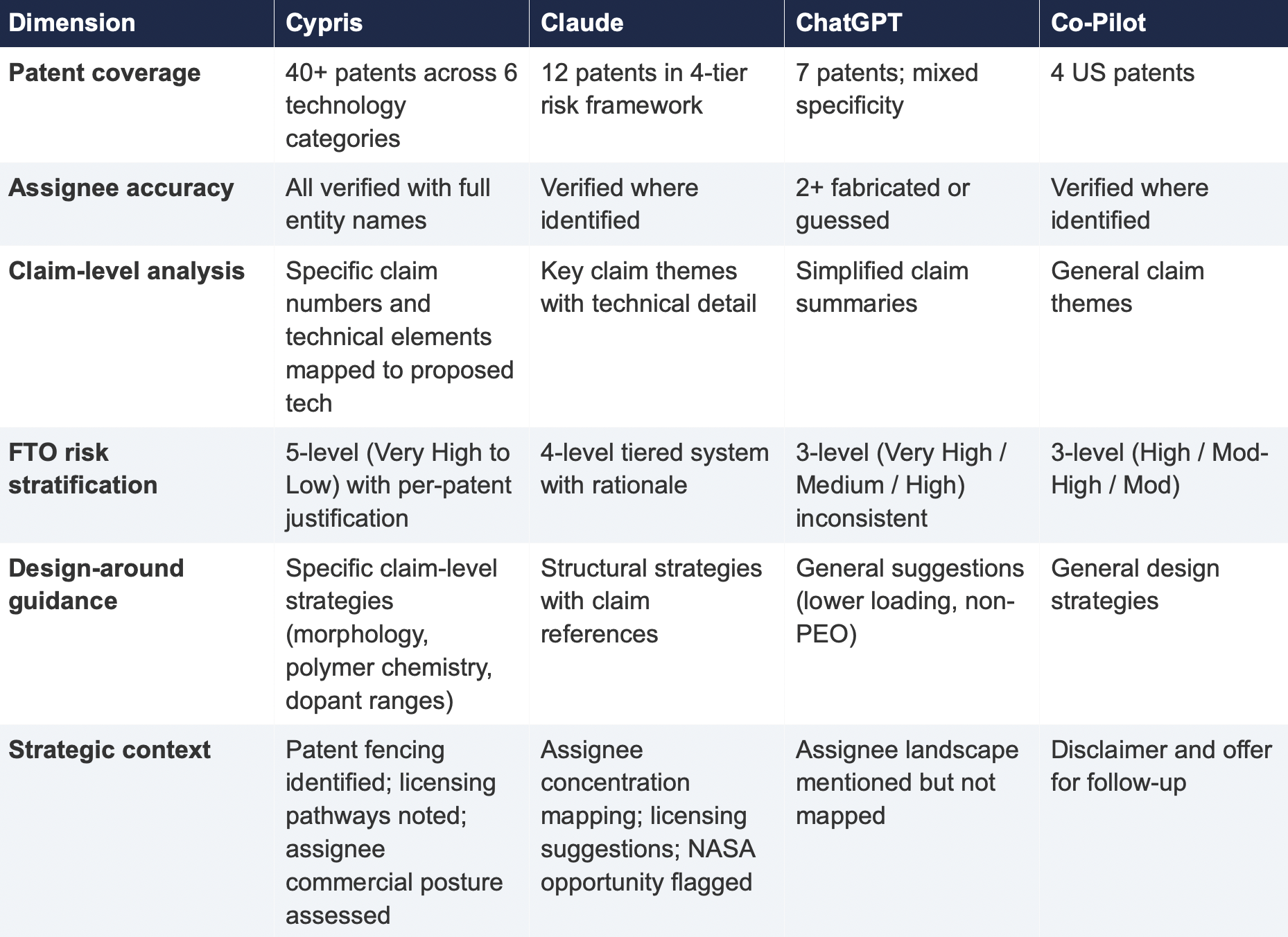
The most significant finding is the scale of the coverage differential. Cypris identified over 40 active US patents and published applications spanning LLZO-polymer composite electrolytes, garnet interface modification, polymer interlayer architectures, lithium-sulfur specific filings, and adjacent ceramic composite patents. The results were organized by technology category with per-patent FTO risk ratings.
Claude identified 12 patents organized in a four-tier risk framework. Its analysis was structurally sound and correctly flagged the two highest-risk filings (Solid Energies US 11,967,678 and the LLZO nanofiber multilayer US 11,923,501). It also identified the University ofMaryland/ Wachsman portfolio as a concentration risk and noted the NASA SABERS portfolio as a licensing opportunity. However, it missed the majority of the landscape, including the entire Corning portfolio, GM's interlayer patents, theKorea Institute of Energy Research three-layer architecture, and the HonHai/SolidEdge lithium-sulfur specific filing.
ChatGPT identified 7 patents, but the quality of attribution was inconsistent. It listed assignees as "Likely DOE /national lab ecosystem" and "Likely startup / defense contractor cluster" for two filings—language that indicates the model was inferring rather than retrieving assignee data. In a freedom-to-operate context, an unverified assignee attribution is functionally equivalent to no attribution, as it cannot support a licensing inquiry or risk assessment.
Co-Pilot identified 4 US patents. Its output was the most limited in scope, missing the Solid Energies portfolio entirely, theUMD/ Wachsman portfolio, Gelion/ Johnson Matthey, NASA SABERS, and all Li-S specific LLZO filings.
2.2 Critical Patents Missed by Public Models
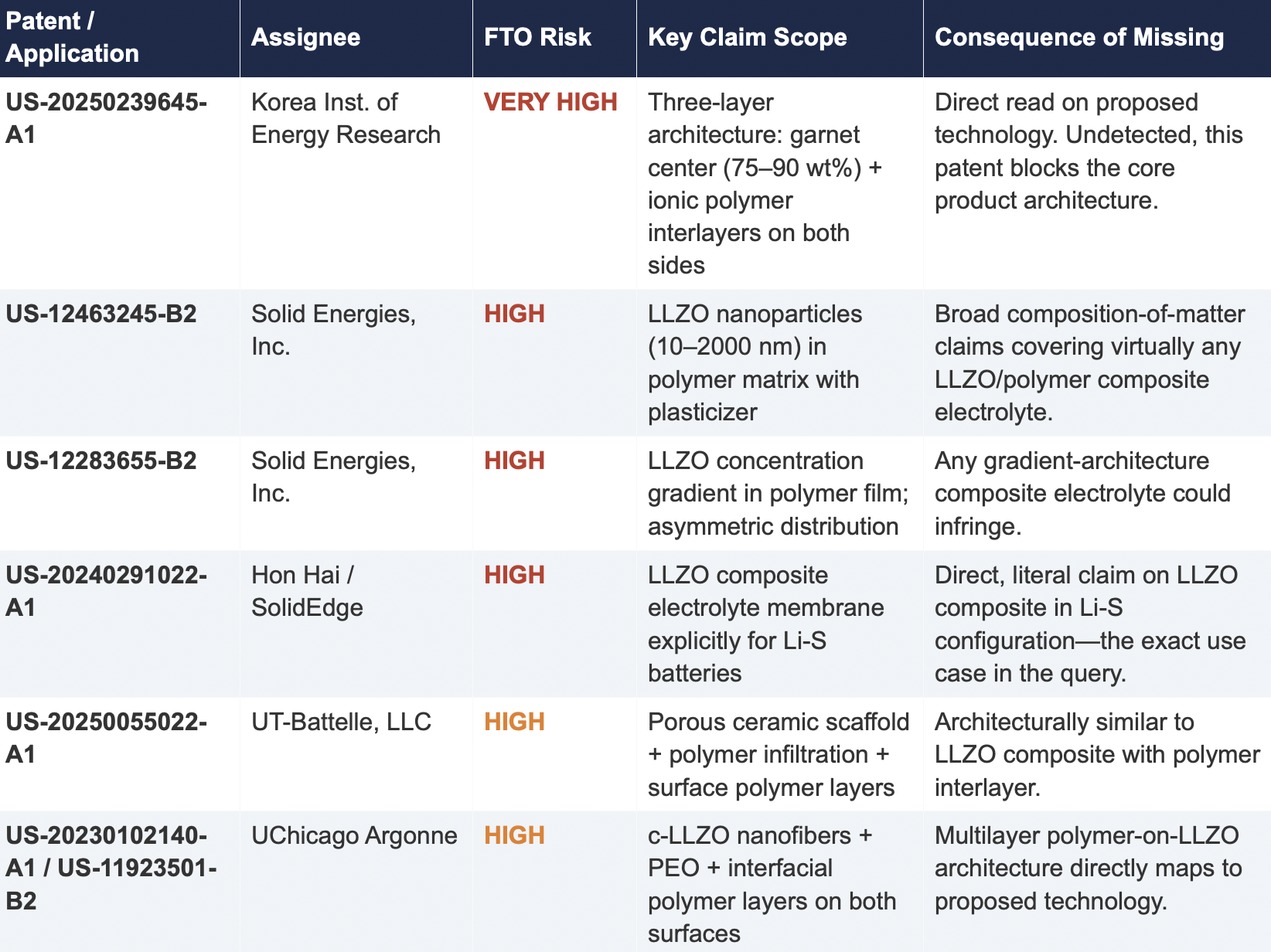
The following table presents patents identified exclusively by Cypris that were rated as High or Very High FTO risk for the proposed technology architecture. None were surfaced by any general-purpose model.
2.3 Patent Fencing: The Solid Energies Portfolio
Cypris identified a coordinated patent fencing strategy by Solid Energies, Inc. that no general-purpose model detected at scale. Solid Energies holds at least four granted US patents and one published application covering LLZO-polymer composite electrolytes across compositions(US-12463245-B2), gradient architectures (US-12283655-B2), electrode integration (US-12463249-B2), and manufacturing processes (US-20230035720-A1). Claude identified one Solid Energies patent (US 11,967,678) and correctly rated it as the highest-priority FTO concern but did not surface the broader portfolio. ChatGPT and Co-Pilot identified zero Solid Energies filings.
The practical significance is that a company relying on any individual patent hit would underestimate the scope of Solid Energies' IP position. The fencing strategy—covering the composition, the architecture, the electrode integration, and the manufacturing method—means that identifying a single design-around for one patent does not resolve the FTO exposure from the portfolio as a whole. This is the kind of strategic insight that requires seeing the full picture, which no general-purpose model delivered
2.4 Assignee Attribution Quality
ChatGPT's response included at least two instances of fabricated or unverifiable assignee attributions. For US 11,367,895 B1, the listed assignee was "Likely startup / defense contractor cluster." For US 2021/0202983 A1, the assignee was described as "Likely DOE / national lab ecosystem." In both cases, the model appears to have inferred the assignee from contextual patterns in its training data rather than retrieving the information from patent records.
In any operational IP workflow, assignee identity is foundational. It determines licensing strategy, litigation risk, and competitive positioning. A fabricated assignee is more dangerous than a missing one because it creates an illusion of completeness that discourages further investigation. An R&D team receiving this output might reasonably conclude that the landscape analysis is finished when it is not.
3. Structural Limitations of General-Purpose Models for Patent Intelligence
3.1 Training Data Is Not Patent Data
Large language models are trained on web-scraped text. Their knowledge of the patent record is derived from whatever fragments appeared in their training corpus: blog posts mentioning filings, news articles about litigation, snippets of Google Patents pages that were crawlable at the time of data collection. They do not have systematic, structured access to the USPTO database. They cannot query patent classification codes, parse claim language against a specific technology architecture, or verify whether a patent has been assigned, abandoned, or subjected to terminal disclaimer since their training data was collected.
This is not a limitation that improves with scale. A larger training corpus does not produce systematic patent coverage; it produces a larger but still arbitrary sampling of the patent record. The result is that general-purpose models will consistently surface well-known patents from heavily discussed assignees (QuantumScape, for example, appeared in most responses) while missing commercially significant filings from less publicly visible entities (Solid Energies, Korea Institute of EnergyResearch, Shenzhen Solid Advanced Materials).
3.2 The Web Is Closing to Model Scrapers
The data access problem is structural and worsening. As of mid-2025, Cloudflare reported that among the top 10,000 web domains, the majority now fully disallow AI crawlers such as GPTBot andClaudeBot via robots.txt. The trend has accelerated from partial restrictions to outright blocks, and the crawl-to-referral ratios reveal the underlying tension: OpenAI's crawlers access approximately1,700 pages for every referral they return to publishers; Anthropic's ratio exceeds 73,000 to 1.
Patent databases, scientific publishers, and IP analytics platforms are among the most restrictive content categories. A Duke University study in 2025 found that several categories of AI-related crawlers never request robots.txt files at all. The practical consequence is that the knowledge gap between what a general-purpose model "knows" about the patent landscape and what actually exists in the patent record is widening with each training cycle. A landscape query that a general-purpose model partially answered in 2023 may return less useful information in 2026.
3.3 General-Purpose Models Lack Ontological Frameworks for Patent Analysis
A freedom-to-operate analysis is not a summarization task. It requires understanding claim scope, prosecution history, continuation and divisional chains, assignee normalization (a single company may appear under multiple entity names across patent records), priority dates versus filing dates versus publication dates, and the relationship between dependent and independent claims. It requires mapping the specific technical features of a proposed product against independent claim language—not keyword matching.
General-purpose models do not have these frameworks. They pattern-match against training data and produce outputs that adopt the format and tone of patent analysis without the underlying data infrastructure. The format is correct. The confidence is high. The coverage is incomplete in ways that are not visible to the user.
4. Comparative Output Quality
The following table summarizes the qualitative characteristics of each tool's response across the dimensions most relevant to an operational IP workflow.
5. Implications for R&D and IP Organizations
5.1 The Confidence Problem
The central risk identified by this study is not that general-purpose models produce bad outputs—it is that they produce incomplete outputs with high confidence. Each model delivered its results in a professional format with structured analysis, risk ratings, and strategic recommendations. At no point did any model indicate the boundaries of its knowledge or flag that its results represented a fraction of the available patent record. A practitioner receiving one of these outputs would have no signal that the analysis was incomplete unless they independently validated it against a comprehensive datasource.
This creates an asymmetric risk profile: the better the format and tone of the output, the less likely the user is to question its completeness. In a corporate environment where AI outputs are increasingly treated as first-pass analysis, this dynamic incentivizes under-investigation at precisely the moment when thoroughness is most critical.
5.2 The Diversification Illusion
It might be assumed that running the same query through multiple general-purpose models provides validation through diversity of sources. This study suggests otherwise. While the four tools returned different subsets of patents, all operated under the same structural constraints: training data rather than live patent databases, web-scraped content rather than structured IP records, and general-purpose reasoning rather than patent-specific ontological frameworks. Running the same query through three constrained tools does not produce triangulation; it produces three partial views of the same incomplete picture.
5.3 The Appropriate Use Boundary
General-purpose language models are effective tools for a wide range of tasks: drafting communications, summarizing documents, generating code, and exploratory research. The finding of this study is not that these tools lack value but that their value boundary does not extend to decisions that carry existential commercial risk.
Patent landscape analysis, freedom-to-operate assessment, and competitive intelligence that informs R&D investment decisions fall outside that boundary. These are workflows where the completeness and verifiability of the underlying data are not merely desirable but are the primary determinant of whether the analysis has value. A patent landscape that captures 10% of the relevant filings, regardless of how well-formatted or confidently presented, is a liability rather than an asset.
6. Test 2: Competitive Intelligence — Bio-Based Polyamide Patent Landscape
To assess whether the findings from Test 1 were specific to a single technology domain or reflected a broader structural pattern, a second query was submitted to all four tools. This query shifted from freedom-to-operate analysis to competitive intelligence, asking each tool to identify the top 10organizations by patent filing volume in bio-based polyamide synthesis from castor oil derivatives over the past three years, with summaries of technical approach, co-assignee relationships, and portfolio trajectory.
6.1 Query

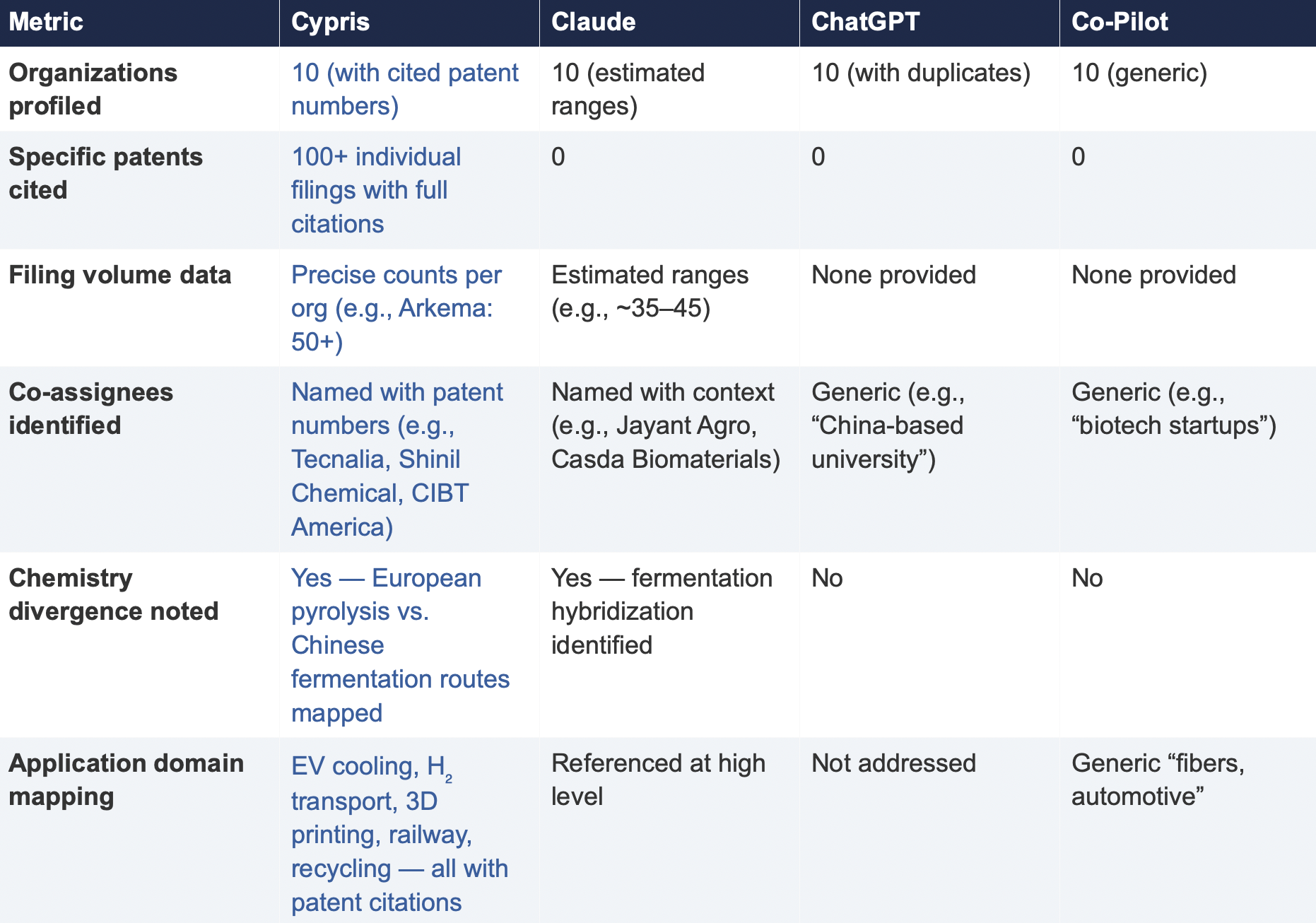
6.2 Summary of Results
6.3 Key Differentiators
Verifiability
The most consequential difference in Test 2 was the presence or absence of verifiable evidence. Cypris cited over 100 individual patent filings with full patent numbers, assignee names, and publication dates. Every claim about an organization’s technical focus, co-assignee relationships, and filing trajectory was anchored to specific documents that a practitioner could independently verify in USPTO, Espacenet, or WIPO PATENT SCOPE. No general-purpose model cited a single patent number. Claude produced the most structured and analytically useful output among the public models, with estimated filing ranges, product names, and strategic observations that were directionally plausible. However, without underlying patent citations, every claim in the response requires independent verification before it can inform a business decision. ChatGPT and Co-Pilot offered thinner profiles with no filing counts and no patent-level specificity.
Data Integrity
ChatGPT’s response contained a structural error that would mislead a practitioner: it listed CathayBiotech as organization #5 and then listed “Cathay Affiliate Cluster” as a separate organization at #9, effectively double-counting a single entity. It repeated this pattern with Toray at #4 and “Toray(Additional Programs)” at #10. In a competitive intelligence context where the ranking itself is the deliverable, this kind of error distorts the landscape and could lead to misallocation of competitive monitoring resources.
Organizations Missed
Cypris identified Kingfa Sci. & Tech. (8–10 filings with a differentiated furan diacid-based polyamide platform) and Zhejiang NHU (4–6 filings focused on continuous polymerization process technology)as emerging players that no general-purpose model surfaced. Both represent potential competitive threats or partnership opportunities that would be invisible to a team relying on public AI tools.Conversely, ChatGPT included organizations such as ANTA and Jiangsu Taiji that appear to be downstream users rather than significant patent filers in synthesis, suggesting the model was conflating commercial activity with IP activity.
Strategic Depth
Cypris’s cross-cutting observations identified a fundamental chemistry divergence in the landscape:European incumbents (Arkema, Evonik, EMS) rely on traditional castor oil pyrolysis to 11-aminoundecanoic acid or sebacic acid, while Chinese entrants (Cathay Biotech, Kingfa) are developing alternative bio-based routes through fermentation and furandicarboxylic acid chemistry.This represents a potential long-term disruption to the castor oil supply chain dependency thatWestern players have built their IP strategies around. Claude identified a similar theme at a higher level of abstraction. Neither ChatGPT nor Co-Pilot noted the divergence.
6.4 Test 2 Conclusion
Test 2 confirms that the coverage and verifiability gaps observed in Test 1 are not domain-specific.In a competitive intelligence context—where the deliverable is a ranked landscape of organizationalIP activity—the same structural limitations apply. General-purpose models can produce plausible-looking top-10 lists with reasonable organizational names, but they cannot anchor those lists to verifiable patent data, they cannot provide precise filing volumes, and they cannot identify emerging players whose patent activity is visible in structured databases but absent from the web-scraped content that general-purpose models rely on.
7. Conclusion
This comparative analysis, spanning two distinct technology domains and two distinct analytical workflows—freedom-to-operate assessment and competitive intelligence—demonstrates that the gap between purpose-built R&D intelligence platforms and general-purpose language models is not marginal, not domain-specific, and not transient. It is structural and consequential.
In Test 1 (LLZO garnet electrolytes for Li-S batteries), the purpose-built platform identified more than three times as many patents as the best-performing general-purpose model and ten times as many as the lowest-performing one. Among the patents identified exclusively by the purpose-built platform were filings rated as Very High FTO risk that directly claim the proposed technology architecture. InTest 2 (bio-based polyamide competitive landscape), the purpose-built platform cited over 100individual patent filings to substantiate its organizational rankings; no general-purpose model cited as ingle patent number.
The structural drivers of this gap—reliance on training data rather than live patent feeds, the accelerating closure of web content to AI scrapers, and the absence of patent-specific analytical frameworks—are not transient. They are inherent to the architecture of general-purpose models and will persist regardless of increases in model capability or training data volume.
For R&D and IP leaders, the practical implication is clear: general-purpose AI tools should be used for general-purpose tasks. Patent intelligence, competitive landscaping, and freedom-to-operate analysis require purpose-built systems with direct access to structured patent data, domain-specific analytical frameworks, and the ability to surface what a general-purpose model cannot—not because it chooses not to, but because it structurally cannot access the data.
The question for every organization making R&D investment decisions today is whether the tools informing those decisions have access to the evidence base those decisions require. This study suggests that for the majority of general-purpose AI tools currently in use, the answer is no.
About This Report
This report was produced by Cypris (IP Web, Inc.), an AI-powered R&D intelligence platform serving corporate innovation, IP, and R&D teams at organizations including NASA, Johnson & Johnson, theUS Air Force, and Los Alamos National Laboratory. Cypris aggregates over 500 million data points from patents, scientific literature, grants, corporate filings, and news to deliver structured intelligence for technology scouting, competitive analysis, and IP strategy.
The comparative tests described in this report were conducted on March 27, 2026. All outputs are preserved in their original form. Patent data cited from the Cypris reports has been verified against USPTO Patent Center and WIPO PATENT SCOPE records as of the same date. To conduct a similar analysis for your technology domain, contact info@cypris.ai or visit cypris.ai.
The Patent Intelligence Gap - A Comparative Analysis of Verticalized AI-Patent Tools vs. General-Purpose Language Models for R&D Decision-Making
Blogs

The pace of innovation is accelerating. As businesses compete for the latest products and services, companies must keep up with the demand for faster development cycles and shorter time-to-market windows. But how do technologies speed up the innovation process?This article explores how technology can be used to optimize research and development (R&D) processes, as well as its potential benefits, challenges, strategies for implementation, and examples of successful projects that have leveraged tech tools in their R&D initiatives. Let’s discover: how do technologies speed up the innovation process.
Table of Contents
How Do Technologies Speed Up the Innovation Process?
Benefits of Technology in Innovation
Challenges of Technology in Innovation
Strategies for Implementing Technology in the Innovation Process
Develop an Action Plan for Adopting Technologies
Establish Clear Goals and Objectives
How Do Technologies Speed Up the Innovation Process?
How do technologies speed up the innovation process? By leveraging the power of technologies such as AI, ML, and automation tools, R&D teams can gain a competitive edge in innovation processes.
Artificial Intelligence
Artificial intelligence (AI) is a powerful tool for streamlining the innovation process. AI can be used to automate mundane tasks and free up employees’ time, allowing them to focus on more creative endeavors.For example, AI-powered chatbots can handle customer service inquiries quickly and accurately, freeing up customer service representatives to spend their time innovating new products or services. Similarly, AI algorithms can be used to analyze large datasets to identify patterns that could lead to breakthroughs in product development or marketing strategies.
Machine Learning
Machine learning (ML) takes automation one step further by enabling computers to learn from data without being explicitly programmed. ML algorithms are capable of recognizing complex patterns in data that would otherwise take humans an immense amount of time and effort—if they were even able to detect it at all!This makes ML an invaluable tool for uncovering insights into consumer behavior or market trends that may have gone unnoticed before. By leveraging these insights, companies can develop innovative solutions faster than ever before.
Data Analysis
Data analysis is another key technology for speeding up the innovation process. With access to vast amounts of data from various sources such as social media platforms or web analytics tools, businesses can gain deeper insight into customer needs and preferences. This allows them to create better products tailored specifically for their target audience with greater accuracy and efficiency than ever before.Additionally, data analysis techniques like predictive analytics enable organizations to anticipate future trends so they can stay ahead of the competition when it comes to developing new ideas and products
Automation
Automation technologies allow machines to do tedious work instead of humans which saves both time and money while increasing productivity significantly.For instance, automated robots are increasingly being used in manufacturing plants across industries where they perform repetitive tasks with high precision speed.Furthermore, automation also helps reduce human errors thereby improving quality control processes within organizations.Accelerating innovation within companies requires the help of technology. AI, ML, data analysis, and automation are just some of the tools that free up valuable employee time from mundane tasks. This helps drive innovation.

(Source)
Benefits of Technology in Innovation
How do technologies speed up the innovation process? Technology is an important tool to drive innovation. It can provide several benefits, including increased efficiency, improved collaboration, and cost savings.
Increased Efficiency
Technology can help streamline processes and reduce manual labor by automating tasks that would otherwise take up valuable time. For example, data analysis tools such as machine learning algorithms can quickly analyze large datasets to uncover insights that would have taken much longer to discover manually.This allows teams to focus their efforts on more strategic activities instead of mundane tasks.
Improved Collaboration
Technology also enables better collaboration between team members who may be located in different parts of the world or even within the same office space. Communication tools like Slack allow for quick messaging between team members while project management software like Asana enables teams to track progress and stay organized with ease.Additionally, cloud-based storage solutions make it easy for everyone on the team to access important documents from any device at any time without having to worry about security concerns or compatibility issues across multiple platforms.
Reduce Costs
Finally, technology can help save money in a variety of ways by reducing overhead costs associated with manual labor and eliminating redundant processes that require additional resources or personnel hours. Automated systems are often cheaper than hiring new employees or outsourcing certain tasks, helping to keep budgets under control while still allowing companies to remain competitive in today’s marketplace.Additionally, investing in technologies such as artificial intelligence (AI) and blockchain could potentially yield long-term cost savings down the line if implemented correctly into existing business models and operations strategies.Technology can be a powerful tool to speed up the innovation process, providing teams with increased efficiency, improved collaboration, and cost savings.
Key Takeaway: Technology can improve the innovation process by increasing efficiency, enabling better collaboration, and reducing overhead costs. Benefits include automated tasks, communication tools, cloud storage solutions, and blockchain investments.
Challenges of Technology in Innovation
Security Concerns
Technology can be a double-edged sword when it comes to innovation. On one hand, technology can provide an efficient and cost-effective way to collaborate on projects, but on the other hand, it also opens up potential security risks.Companies must ensure that their data is secure from external threats such as hackers or malicious software. This means having strong passwords in place for all users, regularly updating software and hardware systems, and investing in robust cybersecurity solutions. Additionally, companies should consider implementing multi-factor authentication for access to sensitive information or systems.
Adapting to Change
Technology is constantly evolving and changing at a rapid pace. As new technologies emerge, R&D teams must be able to quickly adapt to stay ahead of the competition.This requires staying up-to-date with industry trends and understanding how new technologies may impact existing processes or products. Companies should also invest in training programs so that employees are equipped with the necessary skills needed for success in this ever-changing landscape.Companies should strive for a balance between using technology tools while still allowing room for creative thinking by their team members, which could lead them towards innovative solutions they would not have thought of otherwise without human input into the process.Although technology can offer great opportunities for innovation, it also presents challenges such as security concerns, adapting to change, and over-reliance on technology. To ensure successful innovation processes, organizations must carefully evaluate the use of technologies to maximize their benefits while minimizing potential risks.
Technology can be a powerful tool for innovation, but companies must ensure their data is secure and employees are equipped with the necessary skills to stay ahead of the competition. #innovation #technology #cybersecurity Click to Tweet
Strategies for Implementing Technology in the Innovation Process
How do technologies speed up the innovation process? Innovation processes are constantly evolving and adapting to new technologies. There should be an innovation strategy in place to keep up with the rapid pace of change.
Develop an Action Plan for Adopting Technologies
To ensure the successful implementation of technology in the innovation process, it is important to develop an action plan for the adoption and utilization of new technologies. This plan should include a timeline for implementation, as well as clear goals and objectives that need to be met throughout the process.
Utilize Existing Resources
Utilizing existing resources can help support the transition from old systems to new ones. Companies should look into leveraging their current personnel, tools, or platforms to ease the transition into using more advanced technologies. Additionally, companies may want to consider outsourcing certain tasks or components of their innovation process if they do not have access to the necessary resources internally.
Establish Clear Goals and Objectives
Establishing clear goals and objectives for each step of the process is essential when implementing technology in an innovation process. Companies should define what success looks like at each stage so that progress can be tracked effectively over time. Additionally, teams should establish metrics that will measure performance against these goals and objectives regularly to identify areas where improvements could be made or additional investments could be beneficial.The key to the successful implementation of technology in the innovation process is to develop an action plan, utilize existing resources, and establish clear goals and objectives. By measuring success with established metrics and KPIs, organizations can identify areas for improvement and optimize their efforts for greater efficiency.
Technology can be a powerful tool to speed up the innovation process. To ensure successful implementation, create an action plan with clear goals and objectives and leverage existing resources. #innovation #technology #R&D Click to Tweet
Conclusion
How do technologies speed up the innovation process? Technologies allow teams to do work quickly and efficiently, enabling them to make decisions faster and more accurately.However, it is important to remember that technology alone cannot guarantee success. It must be used in conjunction with other strategies such as effective communication and collaboration between team members.Ultimately, the rate of innovation depends on how well teams can leverage technology within their processes. With careful planning and implementation of appropriate tools, organizations can gain significant benefits from using technology in their innovation efforts.Are you an R&D or innovation team looking for a way to speed up the innovation process? Cypris is here to help.Our research platform provides teams with centralized data sources and rapid time-to-insights so that your team can quickly develop new ideas into successful products. Don’t wait any longer – join us today and experience how our solutions can revolutionize your development cycle!

How do entrepreneurs encourage innovation? The success of any business depends on its ability to come up with creative and innovative solutions.
But what does it take to be an innovator in today’s competitive market? How can entrepreneurs promote innovation within their organizations? What challenges do they face when trying to implement new ideas and measure their impact on business performance?
These are all questions we’ll explore in this article as we look at how entrepreneurs can drive innovation forward. From understanding what constitutes true innovation to learning strategies for successful implementation, let’s answer: how do entrepreneurs encourage innovation?
Table of Contents
How Do Entrepreneurs Encourage Innovation?
Investing in Employee Capacity Building
Using Technologies for Efficiency
Leading and Inspiring Innovation
Challenges Faced by Entrepreneurs When Encouraging Innovation
Overcoming Resistance to Change
Strategies for Successful Implementation of Innovative Ideas
Developing a Clear Vision and Plan for Implementation
Building a Team with the Right Skillset and Mindset
Measuring the Impact of Innovations on Business Performance
How Do Entrepreneurs Encourage Innovation?
How do entrepreneurs encourage innovation? Entrepreneurs have a critical role in fostering an innovative environment. They are in a good position to inspire innovation by setting an example of risk-taking, creativity, and leadership.
Investing in Employee Capacity Building
Entrepreneurs understand that their employees are the backbone of any successful venture. To encourage innovation, they must invest in capacity building for their staff.
This includes providing them with the necessary resources and training to develop new skills and knowledge. It also means creating an environment where creativity is encouraged and failure is accepted as part of the learning process.
Fostering a Creative Culture
Innovation requires more than just technical know-how. It needs an innovative environment that encourages out-of-the-box thinking and experimentation.
Entrepreneurs should strive to create an open culture where ideas are welcomed from all levels of the organization, regardless of rank or seniority.
They should also provide incentives for employees who come up with innovative solutions, such as bonuses or recognition awards, which will further motivate others to think creatively about how to solve problems or improve processes.
Using Technologies for Efficiency
Technology has revolutionized many aspects of business operations over the past few decades, from customer service automation to data analytics tools. Entrepreneurs should not forget their potential when it comes to encouraging innovation too!
By leveraging technologies like artificial intelligence (AI) and machine learning (ML), businesses can automate mundane tasks so that teams have more time available for brainstorming new ideas or developing prototypes faster than ever before.
Additionally, using cloud computing services allows companies to access powerful computing resources on demand without having to invest heavily upfront in hardware infrastructure costs. Making it easier than ever before for entrepreneurs looking to stay ahead of the competition through technological innovations!
Leading and Inspiring Innovation
Entrepreneurs must inspire innovation within their organizations. After all, if you want your team members to take risks then you need to show them that you’re willing to do so yourself.
As well as setting ambitious goals and challenging assumptions regularly, entrepreneurs should be vocal about celebrating successes no matter how small they may seem at first glance. This helps build confidence amongst teams while reinforcing positive behaviors associated with risk-taking behavior which ultimately leads to greater innovation outcomes over time!
Entrepreneurs have the unique ability to foster an environment that encourages innovation. Identifying opportunities for innovation is a key part of this process.
Entrepreneurs can look for potential solutions to problems, or find ways to improve existing products and services. They should also be open to new ideas from their team members, customers, and other stakeholders to identify innovative opportunities.
Key Takeaway: Entrepreneurs can foster an innovative culture by providing resources, encouraging risk-taking, and recognizing successful innovations.
Challenges Faced by Entrepreneurs When Encouraging Innovation
Encouraging innovation within an organization can be a difficult task for entrepreneurs. So how do entrepreneurs encourage innovation given these challenges?
Overcoming Resistance to Change
Overcoming resistance to change is one of the biggest challenges entrepreneurs face. People are often resistant to new ideas and processes, which can make it hard for entrepreneurs to get their teams on board with any changes or innovations they want to implement.
To overcome this challenge, entrepreneurs must create an environment where employees feel comfortable expressing their opinions and ideas without fear of judgment or criticism. They should also ensure that everyone understands the benefits of any proposed changes so that people are more likely to accept them.

(Source)
Managing Risk and Uncertainty
Managing risk and uncertainty is another challenge faced by entrepreneurs when encouraging innovation in their organizations. Innovative projects often involve some degree of risk due to the unknowns associated with them, such as potential costs, timeline delays, or technical difficulties.
Entrepreneurs need to have a clear understanding of these risks before moving forward with any project so that they can plan accordingly and manage expectations from stakeholders appropriately. Additionally, having contingency plans in place will help minimize disruption if something does go wrong during implementation.
Despite the challenges faced by entrepreneurs when encouraging innovation, they can implement a strategy that drives innovation. They can do this with a clear vision and plan for implementation, leveraging technology to support the process, and building a team with the right skill set and mindset.
Key Takeaway: Entrepreneurs must create an environment that encourages innovation by 1) fostering open communication and collaboration; 2) understanding the risks associated with new projects; and 3) having contingency plans in place.
Strategies for Successful Implementation of Innovative Ideas
How do entrepreneurs encourage innovation? For entrepreneurs and businesses alike, innovation is essential for staying competitive in today’s ever-changing marketplace. Implementing innovative ideas successfully requires careful planning and execution to ensure that they are implemented effectively and efficiently.
Developing a Clear Vision and Plan for Implementation
A clear vision of what success looks like must be established before any implementation begins. This should include goals such as cost savings, increased efficiency, and improved customer experience as well as detailed steps on how to achieve them. Having this plan in place will help keep everyone focused on the same objectives while guiding the implementation process.
Building a Team with the Right Skillset and Mindset
When implementing innovative ideas it is important to have team members who are open-minded and willing to think outside of the box when necessary. The team should also possess skillsets relevant to their tasks such as coding abilities if working with technology or design capabilities if creating products/services from scratch.
Having these skillsets available within your team will make it easier for them to tackle any challenges that may arise during implementation more quickly.
Leveraging Technology
Leveraging technology can greatly improve efficiency when implementing innovative ideas by automating certain processes which would otherwise take up valuable time and resources if done manually. Additionally, using tools such as project management software can provide visibility over the progress being made toward achieving goals set out at the beginning of each project, ensuring that nothing gets overlooked along the way.
By leveraging the right skillset, mindset, and technology, entrepreneurs can successfully implement innovative ideas to drive business performance. However, it is important to measure the impact of these innovations to ensure they are achieving desired results.
Key Takeaway: Entrepreneurs can encourage innovation by developing a clear vision and plan, building a team with the right skill set and mindset, and leveraging technology to improve efficiency.
Measuring the Impact of Innovations on Business Performance
How do entrepreneurs encourage innovation? Measuring the impact of innovations on business performance is an important part of any successful innovation strategy.
Establishing KPIs
Establishing key performance indicators (KPIs) is a great way to track progress and measure success. KPIs are metrics that help entrepreneurs assess how their innovations are impacting their businesses.
Common KPIs include customer satisfaction, revenue growth, cost savings, and time-to-market for new products or services. Tracking progress against these KPIs helps entrepreneurs identify areas where they can improve their strategies and make adjustments as needed.
Analyzing Results
Analyzing results from tracking progress against KPIs is also essential to determine whether or not the innovation has been successful in achieving its goals. This analysis should take into account both quantitative data such as financials and qualitative data such as customer feedback to get a full picture of the impact of the innovation on business performance.
Adjustments may need to be made if results indicate that the innovation isn’t having its desired effect on business performance or if it’s taking too long for benefits to materialize.
In addition, entrepreneurs should consider other factors when measuring the impact of innovations on business performance such as competitive advantages gained through early adoption or market disruption caused by introducing new products or services ahead of competitors. These types of measures can provide valuable insights into how effective an entrepreneur’s innovative ideas have been at driving value for their businesses over time compared with traditional methods used by competitors in similar industries.
Measuring ROI
Finally, measuring return on investment (ROI) is another important factor when assessing how well an innovation has performed relative to expectations set before implementation began. ROI calculations compare costs associated with developing and launching an innovative idea with expected returns based upon projected sales figures or other financial metrics related to anticipated gains from implementing the idea successfully within a given timeframe. This allows entrepreneurs to determine whether their investments in innovation have been worthwhile and if they should continue investing in similar initiatives in the future.
Key Takeaway: Measuring the impact of innovations on business performance is essential to any successful innovation strategy. Entrepreneurs should track progress against KPIs, analyze quantitative and qualitative data, consider competitive advantages and market disruption, and calculate ROI to determine how effective their innovative ideas have been at driving value for their businesses.
Conclusion
Entrepreneurs play a key role in encouraging innovation. But how do entrepreneurs encourage innovation?
They can create an environment that encourages creativity and risk-taking while providing the resources needed to develop innovative ideas. This is how they create an environment that drives innovation. By setting clear goals, measuring progress, and rewarding success, entrepreneurs can ensure their teams can make meaningful contributions to their business through innovation.
Looking for tools to help your companies transform into innovative organizations? Cypris has the tools you need.
Cypris is the market intelligence solution for R&D teams, with 250M+ research papers, 150M+ global patents, and more. Get rapid time-to-insights for R&D teams, only with Cypris.

For organizations looking to stay ahead of the curve, understanding how data analytics works and implementing a successful strategy for leveraging its power is essential. With the proper use of data analysis tools, companies can gain insights that inform decision-making processes related to product development, market trends, customer preferences, and more. Learning how data analytics can drive innovation is vital to a company’s success.
By taking advantage of data analytics within an organization’s research and development (R&D) initiatives or other areas where innovation matters most, it can fuel new discoveries and lead teams toward success in their projects.
We will explore what data analytics are, how it contributes to innovation, and the challenges associated with analyzing data. So let’s learn together how data analytics can drive innovation.
Table of Contents
How Data Analytics Can Drive Innovation
Leveraging Data to Identify Opportunities for Innovation
Utilizing Predictive Analysis to Guide Decision Making
Challenges in Implementing a Data Analytics Strategy for Innovation
Securing the Right Resources and Expertise
Ensuring Quality and Accuracy of Datasets
Technology to Aid Data-Driven Innovation Processes
How Data Analytics Can Drive Innovation
Data analytics is the process of collecting, organizing, and analyzing data to gain insights into trends and patterns. It can be used to drive innovation by leveraging data to identify opportunities for improvement, utilizing predictive analytics to guide decision-making, and using machine learning algorithms to automate processes and enhance efficiency.
Leveraging Data to Identify Opportunities for Innovation
By using big data analytics, drawing data from multiple sources such as customer feedback surveys or product usage logs, organizations can uncover hidden patterns that may indicate potential areas for innovation.
This could include identifying new markets or products that have not yet been explored or understanding customer needs in greater detail so that existing products can be improved upon.
Utilizing Predictive Analysis to Guide Decision Making
Predictive analytics uses historical data combined with statistical models to forecast future outcomes. Organizations can use this type of analysis when considering new initiatives or investments in order to better understand their chances of success before committing resources.
This helps them make more informed decisions about where they should focus their efforts in order to maximize returns on investment while minimizing risk exposure.
Analysis-Based Strategies
Companies can also use data analysis to develop strategies for launching new products or services based on customer feedback and market research. By studying customer reviews, surveys, and social media posts, companies can get a better understanding of what customers want from their offerings and how they should go about introducing them into the marketplace.
Streamline Operations
Data analytics can also be used to improve operational efficiency by identifying areas where processes could be streamlined or automated using technology such as machine learning algorithms or AI-driven automation tools. This helps reduce costs while increasing productivity so companies have more resources available for developing innovative solutions for their customers’ needs.
With the power of data science, businesses are able to make informed decisions regarding product and service development while gaining valuable insights into what consumers truly want from their offerings. This is how data analytics can drive innovation.
With these advantages in hand, it is not surprising that many organizations heavily rely on data-driven decision-making when innovating.
Key Takeaway: Data analytics can drive innovation by leveraging data to identify opportunities, utilizing predictive analysis to guide decision making, and streamlining operations. Organizations can use this type of analysis when considering new initiatives or investments in order to better understand their chances of success before committing resources.
Challenges in Implementing a Data Analytics Strategy for Innovation
Data analytics is a powerful tool for driving innovation, but it can be difficult to implement. Part of how data analytics can drive innovation is by facing these challenges head-on. Companies must ensure they have the right resources and expertise in place when using data in their innovation process.
This includes having access to quality and accurate data sources, as well as skilled personnel who understand how to interpret the data. Additionally, companies may need to overcome resistance from within their organization when implementing a new strategy that relies on data analytics.
Securing the Right Resources and Expertise
Companies must first make sure they have access to the necessary resources and expertise required for successful implementation of a data analytics strategy.
This includes hiring or training employees with knowledge of predictive analysis techniques such as machine learning algorithms, statistical modeling, and natural language processing (NLP).
They also need to have access to high-quality datasets that are relevant to their industry or research goals. Organizations should consider investing in software tools that enable them to easily analyze large volumes of complex datasets quickly and accurately.
Ensuring Quality and Accuracy of Datasets
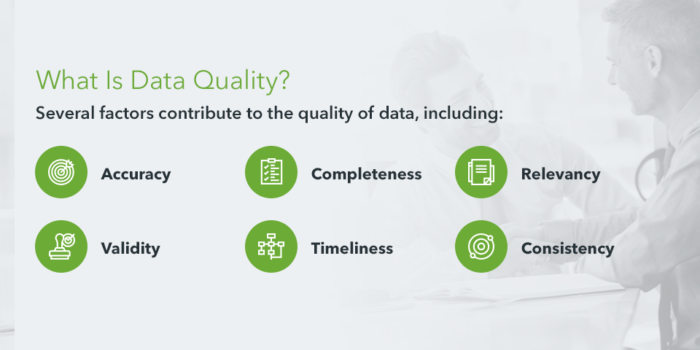
Organizations must take steps to ensure the quality and accuracy of their underlying data points in order for any data-driven innovation process to be successful. This includes:
- Validating incoming datasets against known standards.
- Conducting regular checks on existing databases.
- Employing automated processes such as anomaly detection.
- Leveraging external services like third-party APIs
- Using AI/ML models for cleaning up noisy or incomplete information.
Doing so will enable organizations to produce reliable results from their analyses over time.
(Source)
The challenges in implementing a data analytics strategy for innovation are complex and varied, but the rewards of successful implementation can be immense.
Key Takeaway: Data analytics can drive innovation, but organizations must first secure the right resources and expertise as well as high-quality datasets to ensure success. This includes personnel with knowledge of predictive analysis techniques, access to relevant datasets, and software tools for analyzing large volumes of data quickly and accurately.
Technology to Aid Data-Driven Innovation Processes
Technology is a huge part of how data analytics can drive innovation. By leveraging data to identify opportunities, utilizing predictive analytics to guide decision-making, and using machine learning to automate processes and enhance efficiency, organizations can unlock new sources of value from their existing resources.
Cloud Computing
Cloud computing and big data platforms are essential components of any successful data analytics strategy. These technologies provide the scalability and flexibility needed to manage large datasets quickly and efficiently.
Cloud-based solutions also enable teams to access insights from anywhere in the world with an internet connection, allowing them to make decisions faster than ever before.
Artificial Intelligence
Artificial intelligence (AI) is another key technology that enables organizations to get more out of their innovation processes. AI-powered algorithms can be used for automation tasks such as predicting customer behavior or identifying patterns in complex datasets that would otherwise be difficult or impossible for humans alone.
Additionally, AI can help generate insights by uncovering relationships between different variables that may not have been obvious before.
Augmented Reality
Augmented reality (AR) offers an alternative way of interacting with complex datasets, enabling users to explore information visually by overlaying it onto physical objects or environments. This allows for a deeper understanding of how different factors interact and influence each other without having to manually analyze every single piece of data individually.
AR tools make it easier for teams to spot trends and draw meaningful conclusions from their analyses more quickly than ever before. It also provides an engaging experience that encourages exploration and collaboration among team members who might not otherwise have interacted with one another’s work.
Overall, technology plays an important role in helping organizations drive innovation through data analytics initiatives. It enables them to process larger amounts of information faster while also providing ways for users to engage with these findings in meaningful ways beyond just looking at raw numbers on a page. This ultimately leads to greater success when it comes time to implement changes based on what has been discovered during the course of these investigations.
Key Takeaway: Data analytics can be a powerful tool for driving innovation, as it enables organizations to process larger amounts of data faster and more efficiently. Cloud computing, big data platforms, AI algorithms, and AR tools are essential components of any successful strategy that will help teams uncover relationships between different variables and draw meaningful conclusions from their analyses.
Conclusion
By leveraging the power of data, organizations can gain a better understanding of their customers, products, and operations to identify opportunities for improvement. This is how data analytics can drive innovation.
However, implementing a successful data analytics strategy requires careful planning and consideration of potential challenges such as technology integration or lack of resources. With the right approach and best practices in place, businesses can use data analytics to unlock new levels of efficiency and productivity that will help them stay ahead in an ever-evolving market landscape.
Are you looking to drive innovation in your R&D and innovation teams? Look no further than Cypris. Our research platform offers a one-stop shop for data sources, allowing your team to quickly gain insights into potential solutions.
With our powerful analytics tools, you can find the answers you need faster and easier than ever before! Take advantage of this revolutionary solution today – join us on the path towards innovative success with Cypris!
Reports

This Cypris research brief maps the full ecosystem and value chain of electric vehicle battery systems and advanced battery materials, tracing the pathway from raw material extraction through precursor and active material production, cell component manufacturing, battery cell production, pack assembly, vehicle integration, and end-of-life recycling. The brief defines each segment's functional role, identifies key players across upstream, midstream, and downstream layers, and analyzes the structural forces — including critical mineral supply volatility, geographic concentration, OEM vertical integration strategies, recycling-driven circularity, and solid-state battery development — that are reshaping where value concentrates and where supply-chain risk resides.

This Cypris research brief maps the ecosystem and value chain of the specialty polymers and high-performance materials industry, covering the full pathway from raw material and monomer suppliers through polymer manufacturers, compounders, additive suppliers, specialty distributors, converters, and end-use OEMs across aerospace, automotive, electronics, medical, energy, and industrial markets. Beyond the segment-by-segment breakdown and player landscape, the brief analyzes the structural forces shaping the ecosystem — including vertical integration strategies, supplier concentration and consolidation patterns, geographic clustering, circularity constraints, and shifting end-market demand — with a central thesis that leverage in this ecosystem concentrates wherever technical specialization overlaps with requalification burden.

Cypris Research Services' inaugural Innovation Outlook examines how AI-driven data center demand is reshaping U.S. power infrastructure — and why hyperscalers have stopped waiting for the grid to catch up. The report synthesizes commercial activity, market sizing, technology trends, and patent-based competitive positioning into a single ecosystem view of behind-the-meter generation, sizing the U.S. opportunity at $35.8B and tracking 56 GW of contracted bypass capacity already in the pipeline. It identifies where the defensible whitespace actually sits — and it's not where most of the market is currently looking.
Webinars
.png)

Most IP organizations are making high-stakes capital allocation decisions with incomplete visibility – relying primarily on patent data as a proxy for innovation. That approach is not optimal. Patents alone cannot reveal technology trajectories, capital flows, or commercial viability.
A more effective model requires integrating patents with scientific literature, grant funding, market activity, and competitive intelligence. This means that for a complete picture, IP and R&D teams need infrastructure that connects fragmented data into a unified, decision-ready intelligence layer.
AI is accelerating that shift. The value is no longer simply in retrieving documents faster; it’s in extracting signal from noise. Modern AI systems can contextualize disparate datasets, identify patterns, and generate strategic narratives – transforming raw information into actionable insight.
Join us on Thursday, April 23, at 12 PM ET for a discussion on how unified AI platforms are redefining decision-making across IP and R&D teams. Moderated by Gene Quinn, panelists Marlene Valderrama and Amir Achourie will examine how integrating technical, scientific, and market data collapses traditional silos – enabling more aligned strategy, sharper investment decisions, and measurable business impact.
Register here: https://ipwatchdog.com/cypris-april-23-2026/
.png)
In this session, we break down how AI is reshaping the R&D lifecycle, from faster discovery to more informed decision-making. See how an intelligence layer approach enables teams to move beyond fragmented tools toward a unified, scalable system for innovation.
In this session, we explore how modern AI systems are reshaping knowledge management in R&D. From structuring internal data to unlocking external intelligence, see how leading teams are building scalable foundations that improve collaboration, efficiency, and long-term innovation outcomes.
.avif)