
A powerful new foundation for custom queries—built on Lucene and designed for R&D precision.
Over the past few years, Cypris has helped innovation teams make faster, more informed decisions by centralizing critical insights across datasets like patents, academic papers, and company activity. But until now, our search experience relied on a legacy query system with limited capabilities, offering little support for advanced search features or dataset-level customization.
Today, we’re excited to introduce an upgraded Advanced Search on Cypris, a complete overhaul of our query engine and search experience, powered by the open-standard Lucene query syntax. This update introduces a more robust and flexible search foundation, unlocking new ways to query data, build complex filters, and extract precisely what you need across patents, research, and more.
Why we rebuilt our search system from the ground up
Cypris’ original query syntax, a proprietary format used internally for years, limited users’ ability to craft advanced queries or tailor searches to specific datasets. It lacked modern capabilities like proximity searches, field-level customization, or true Boolean logic. This made it difficult to build a reliable and intuitive experience for both casual users and advanced researchers.
By moving to Lucene, we’re adopting a powerful, industry-standard query language that makes it easier for developers to build advanced features—and gives users access to a far more capable and flexible search toolset.
What’s new in Advanced Search
1. Custom Queries by Dataset
You can now layer queries to search across datasets or tailor filters to each one. For example, you can run a broad query on drone delivery, and then add separate layers to focus on patents by a specific assignee and papers from a specific country or funding agency.
Navigating the All Datasets tab introduces a new level of complexity—and power—by allowing users to apply dataset-specific logic within a single, unified query workflow. While querying multiple datasets simultaneously might seem straightforward, the underlying differences in schema, metadata, and available fields between our proprietary datasets make this a deeply technical challenge. Patents, for example, include claims, application numbers, and multiple date fields (filed, granted, updated), while academic papers use DOIs, have different structural conventions, and emphasize different metadata. In the past, we sidestepped this complexity by translating general queries like ((drone_allText)) into dataset-specific logic under the hood. Now, instead of obscuring that logic, we allow users to opt in to it. The builder provides progressive layers of customization: start with intuitive keyword searches across all fields, then move into the advanced builder for field-specific targeting, fuzzy logic, and term boosting, and finally, tailor query logic by dataset—such as specifying different countries of interest for papers vs. patents. This approach preserves flexibility while giving users full control, and with tools like our real-time Live Analysis and “Your Query” panel, we make it easy to understand how every decision affects the results.
2. More Fields to Query
We’re exposing deeper fields across datasets—giving you explicit control over the dimensions of your search. For the first time, users can now search academic papers by DOI, a critical identifier previously unsupported on the platform. You can also query by:
- Author or inventor names
- Organizations or assignees
- Countries, journals, funding agencies, and more
3. Full Boolean Support
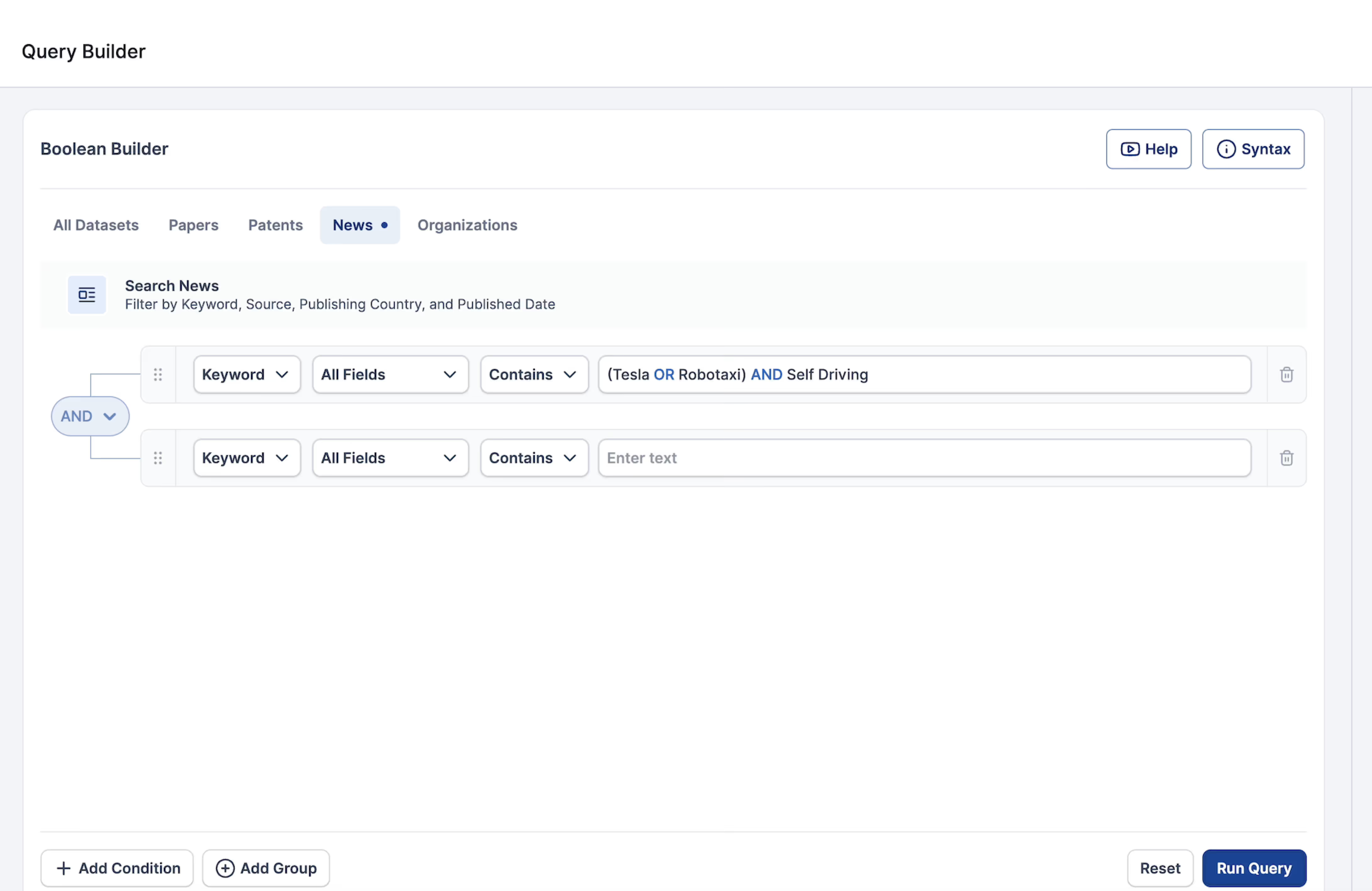
Advanced Search now leverages powerful Boolean logic—AND, OR, NOT, and grouping—enabling more precise control over search logic and improving performance and accuracy.
4. Lucene Syntax Features
Use built-in Lucene features to create expressive, complex searches:
- Proximity searches to find terms near each other
- Fuzzy searches for flexible matching
- Exact phrase matching
- Boosting to prioritize results (e.g., prioritize results mentioning AI 3x more than others)
- Prefix/Postfix queries to match phrases that start or end a certain way
- Range queries for fields like date, funding amounts, or numerical values
A more powerful user experience
Our new search interface is built to help you tap into these capabilities without needing to know the syntax from the start. You’ll find:
- A Query Builder to guide you through complex searches
- A Help Video to onboard users to Lucene-style searches
- Inline examples and tips for writing queries using grouping, boosting, and more
Built for precision, speed, and customization
With Lucene as our foundation, search results are now not only more flexible but also faster and more accurate. Semantic search continues to offer natural-language ease of use, while Boolean search gives power users the performance and structure they need to uncover insights with greater specificity.
Whether you’re an innovation analyst drilling into AI patents or a business development lead scanning academic papers from Chilean researchers—Advanced Search is built to help you get to the signal, faster.
Available now to all users
Advanced Search is live and available across the Cypris platform today. If you’re already using Cypris, you’ll find the new search interface in your dashboard, complete with updated syntax documentation and walkthroughs.
We’re excited to see what you’ll build, discover, and analyze with this new capability. This is just the beginning—we’ll continue expanding the fields, syntax features, and customization options as we push the boundaries of what intelligent search can do for R&D.
Introducing Advanced Search on Cypris


A powerful new foundation for custom queries—built on Lucene and designed for R&D precision.
Over the past few years, Cypris has helped innovation teams make faster, more informed decisions by centralizing critical insights across datasets like patents, academic papers, and company activity. But until now, our search experience relied on a legacy query system with limited capabilities, offering little support for advanced search features or dataset-level customization.
Today, we’re excited to introduce an upgraded Advanced Search on Cypris, a complete overhaul of our query engine and search experience, powered by the open-standard Lucene query syntax. This update introduces a more robust and flexible search foundation, unlocking new ways to query data, build complex filters, and extract precisely what you need across patents, research, and more.
Why we rebuilt our search system from the ground up
Cypris’ original query syntax, a proprietary format used internally for years, limited users’ ability to craft advanced queries or tailor searches to specific datasets. It lacked modern capabilities like proximity searches, field-level customization, or true Boolean logic. This made it difficult to build a reliable and intuitive experience for both casual users and advanced researchers.
By moving to Lucene, we’re adopting a powerful, industry-standard query language that makes it easier for developers to build advanced features—and gives users access to a far more capable and flexible search toolset.
What’s new in Advanced Search
1. Custom Queries by Dataset
You can now layer queries to search across datasets or tailor filters to each one. For example, you can run a broad query on drone delivery, and then add separate layers to focus on patents by a specific assignee and papers from a specific country or funding agency.
Navigating the All Datasets tab introduces a new level of complexity—and power—by allowing users to apply dataset-specific logic within a single, unified query workflow. While querying multiple datasets simultaneously might seem straightforward, the underlying differences in schema, metadata, and available fields between our proprietary datasets make this a deeply technical challenge. Patents, for example, include claims, application numbers, and multiple date fields (filed, granted, updated), while academic papers use DOIs, have different structural conventions, and emphasize different metadata. In the past, we sidestepped this complexity by translating general queries like ((drone_allText)) into dataset-specific logic under the hood. Now, instead of obscuring that logic, we allow users to opt in to it. The builder provides progressive layers of customization: start with intuitive keyword searches across all fields, then move into the advanced builder for field-specific targeting, fuzzy logic, and term boosting, and finally, tailor query logic by dataset—such as specifying different countries of interest for papers vs. patents. This approach preserves flexibility while giving users full control, and with tools like our real-time Live Analysis and “Your Query” panel, we make it easy to understand how every decision affects the results.
2. More Fields to Query
We’re exposing deeper fields across datasets—giving you explicit control over the dimensions of your search. For the first time, users can now search academic papers by DOI, a critical identifier previously unsupported on the platform. You can also query by:
- Author or inventor names
- Organizations or assignees
- Countries, journals, funding agencies, and more
3. Full Boolean Support
Advanced Search now leverages powerful Boolean logic—AND, OR, NOT, and grouping—enabling more precise control over search logic and improving performance and accuracy.
4. Lucene Syntax Features
Use built-in Lucene features to create expressive, complex searches:
- Proximity searches to find terms near each other
- Fuzzy searches for flexible matching
- Exact phrase matching
- Boosting to prioritize results (e.g., prioritize results mentioning AI 3x more than others)
- Prefix/Postfix queries to match phrases that start or end a certain way
- Range queries for fields like date, funding amounts, or numerical values
A more powerful user experience
Our new search interface is built to help you tap into these capabilities without needing to know the syntax from the start. You’ll find:
- A Query Builder to guide you through complex searches
- A Help Video to onboard users to Lucene-style searches
- Inline examples and tips for writing queries using grouping, boosting, and more
Built for precision, speed, and customization
With Lucene as our foundation, search results are now not only more flexible but also faster and more accurate. Semantic search continues to offer natural-language ease of use, while Boolean search gives power users the performance and structure they need to uncover insights with greater specificity.
Whether you’re an innovation analyst drilling into AI patents or a business development lead scanning academic papers from Chilean researchers—Advanced Search is built to help you get to the signal, faster.
Available now to all users
Advanced Search is live and available across the Cypris platform today. If you’re already using Cypris, you’ll find the new search interface in your dashboard, complete with updated syntax documentation and walkthroughs.
We’re excited to see what you’ll build, discover, and analyze with this new capability. This is just the beginning—we’ll continue expanding the fields, syntax features, and customization options as we push the boundaries of what intelligent search can do for R&D.
Keep Reading

AI Scientific Literature Review Software for R&D Teams in 2026: Complete Enterprise Guide
AI scientific literature review software enables researchers to discover, analyze, and synthesize academic publications using artificial intelligence rather than manual keyword searching. These platforms apply natural language processing and machine learning to understand research concepts, identify relevant papers across millions of publications, and extract key findings that inform research decisions.
Corporate R&D teams face fundamentally different literature review requirements than academic researchers writing dissertations or students completing coursework. Enterprise literature review involves understanding competitive research activity, identifying commercial application opportunities, correlating academic findings with patent landscapes, and informing strategic investment decisions across research portfolios worth millions of dollars. The AI tools designed for academic workflows often lack the capabilities, security certifications, and data integrations that corporate innovation teams require.
The scientific literature landscape has grown beyond human capacity for manual review. Over 5.14 million academic papers are published annually across thousands of journals, with publication rates accelerating each year. Research teams that rely on traditional search methods miss relevant discoveries, duplicate existing work, and make decisions based on incomplete understanding of the scientific landscape. AI-powered literature review has become essential infrastructure for organizations seeking to maintain competitive awareness across rapidly evolving technology domains.
How AI Literature Review Software Works
Modern AI literature review platforms employ multiple technological approaches to help researchers navigate scientific publications. Understanding these underlying mechanisms helps organizations evaluate which platforms match their specific requirements.
Semantic search represents a fundamental departure from traditional keyword-based discovery. Rather than matching exact terms, semantic search systems understand the conceptual meaning of research queries and identify relevant papers even when different terminology is used. A search for "energy storage materials" surfaces papers discussing "battery electrodes," "supercapacitor components," and "fuel cell membranes" because the AI understands these concepts relate to the broader research question. This capability proves essential in interdisciplinary research where relevant findings often appear in adjacent fields using unfamiliar vocabulary.
Citation network analysis maps relationships between papers based on references, helping researchers trace the evolution of ideas and identify foundational works within research domains. These networks reveal clusters of related research, highlight highly influential papers, and expose connections that linear search results obscure. Citation analysis helps researchers understand not just what papers exist but how ideas have developed and which findings have proven most significant to subsequent research.
Large language model integration enables conversational interaction with research literature. Researchers can ask natural language questions about papers and receive synthesized answers drawn from multiple sources. These capabilities accelerate comprehension of complex technical papers and help researchers quickly assess whether publications warrant detailed reading. However, the quality of AI synthesis varies significantly across platforms depending on the underlying models employed and how they have been trained on scientific content.
Academic Literature Tools vs. Enterprise R&D Platforms
The AI literature review market divides into two distinct categories serving different user populations with different requirements. Academic literature tools target individual researchers, graduate students, and professors conducting literature reviews for publications, theses, and grant applications. Enterprise R&D intelligence platforms serve corporate research teams conducting technology landscape analysis, competitive intelligence, and strategic research planning.
Academic tools typically offer free or low-cost access, focus on paper discovery and citation management, and optimize for individual workflows. These platforms serve their intended users well but lack capabilities corporate R&D teams require. Enterprise platforms provide organizational collaboration features, integrate literature review with patent analysis and market intelligence, meet security compliance requirements, and support strategic decision-making processes.
Corporate R&D teams evaluating AI literature review software should assess whether platforms were designed for their specific use cases or represent academic tools being applied beyond their intended scope.
Leading Academic Literature Review Tools
Several AI-powered platforms serve academic researchers conducting literature reviews for scholarly purposes.
Semantic Scholar provides AI-powered academic search across over 200 million papers with features including paper summaries, citation analysis, and personalized research recommendations. The platform excels at surfacing influential papers within specific research domains and offers strong coverage in computer science and biomedical research. Semantic Scholar is free for all users, supported by the Allen Institute for AI's research mission. However, the platform lacks enterprise features, patent integration, and the comprehensive data coverage corporate R&D teams require for technology landscape analysis.
Elicit focuses on streamlining literature reviews and evidence synthesis using AI tools that summarize papers and extract data into customizable tables. The platform searches millions of academic sources and allows researchers to upload PDFs for analysis, helping locate key information efficiently. Elicit serves researchers conducting systematic reviews or thesis-level projects particularly well. The platform lacks enterprise collaboration capabilities and does not integrate with patent databases or broader technology intelligence sources.
Consensus uses AI to extract findings directly from peer-reviewed research, providing evidence-based answers to research questions with citations to supporting studies. The platform includes a "Consensus Meter" showing how much agreement exists on specific questions across published literature. Consensus supports multiple citation styles and integrates with reference management tools. The platform serves academic researchers seeking evidence synthesis but cannot support competitive intelligence or technology landscape analysis requiring patent integration.
Research Rabbit helps researchers visualize connections between papers, authors, and research topics through network-based discovery. Starting from a small group of papers, users can expand outward to uncover related works and trace academic lineages over time. The platform integrates with Zotero for reference management. Research Rabbit excels at exploration and serendipitous discovery but lacks the structured analysis capabilities and patent integration corporate R&D teams require.
Connected Papers creates visual graphs showing papers related to a seed paper, helping researchers discover connected work through citation networks. The visualization approach makes identifying research clusters intuitive. However, the tool focuses narrowly on citation relationships without semantic search capabilities and cannot support enterprise requirements.
Litmaps generates interactive visualizations showing how research papers relate to each other over time, with newer papers appearing on one axis and more-cited papers on another. The platform helps researchers understand research landscape evolution and identify seminal works. Litmaps serves academic literature exploration but lacks the data breadth and enterprise features corporate teams require.
SciSpace offers research discovery, paper summarization, and writing assistance through AI-powered features including the ability to chat with PDFs and extract structured data from multiple papers. The platform provides tools spanning the academic research workflow from discovery through writing. SciSpace targets academic researchers and students rather than corporate R&D applications.
Scite provides citation context analysis showing not just where papers are cited but how they are cited, distinguishing between supporting, contrasting, and mentioning citations. This capability helps researchers assess the strength and reliability of scholarly claims. Scite serves academic researchers evaluating literature credibility but lacks enterprise features and patent integration.
These academic tools serve their intended users effectively but share common limitations when applied to corporate R&D requirements. They focus exclusively on academic literature without patent integration, lack enterprise security certifications, provide limited collaboration capabilities, and cannot support technology landscape analysis that requires understanding both scientific research and commercial intellectual property positions.
Enterprise R&D Intelligence Platforms for Scientific Literature
Enterprise R&D intelligence platforms represent a distinct category designed specifically for corporate research teams. These platforms treat scientific literature as one integrated layer within broader technology intelligence ecosystems, combining paper analysis with patent landscape mapping, competitive monitoring, and strategic decision support.
Cypris serves as enterprise research infrastructure for corporate R&D and IP teams, providing unified access to over 500 million patents and 270 million scientific papers through a single AI-powered platform. Unlike academic literature tools focused exclusively on paper discovery, Cypris delivers comprehensive technology intelligence by combining patent analysis, scientific literature review, and competitive R&D monitoring in one system.
The platform employs a proprietary R&D ontology specifically designed to understand scientific and technical content. This ontology enables semantic understanding of research concepts across patents and papers simultaneously, allowing corporate teams to identify both academic findings and commercial applications in single searches. The integration proves essential for corporate R&D decision-making where understanding both scientific feasibility and patent landscape determines project viability.
Cypris maintains SOC 2 Type II certification meeting enterprise security requirements and operates US-based infrastructure trusted by government agencies and Fortune 500 R&D teams. The platform holds official enterprise API partnerships with OpenAI, Anthropic, and Google, ensuring access to frontier AI capabilities as language models evolve.
For corporate R&D teams, the ability to correlate academic research with patent activity reveals critical intelligence that literature-only tools cannot provide. A technology showing active academic publication but minimal patent filing may represent an emerging opportunity. Conversely, heavy patent activity with declining academic research may indicate maturing technology domains. This correlation requires unified access to both data types through platforms designed for enterprise technology intelligence.
Evaluating AI Literature Review Software for Corporate Applications
Organizations selecting AI literature review software should evaluate platforms across multiple dimensions beyond feature checklists.
Data coverage breadth determines what the AI can actually search. Platforms limited to academic literature provide fundamentally different utility than those integrating patents, technical standards, regulatory filings, and market intelligence. Corporate R&D requires understanding technology landscapes comprehensively, not just academic publication activity. Evaluate whether platforms provide transparency about their data sources, coverage dates, and update frequencies.
AI implementation depth distinguishes genuine intelligence capabilities from superficial chatbot additions to legacy search interfaces. Examine whether platforms employ domain-specific training for scientific and technical content or apply general-purpose language models without specialized understanding. The quality of semantic search, concept extraction, and synthesis capabilities varies dramatically across platforms.
Security and compliance requirements differ fundamentally between academic and enterprise contexts. Corporate R&D teams handle proprietary research strategies, competitive intelligence, and confidential technology roadmaps. Platforms accessing this sensitive information must meet enterprise security standards including SOC 2 certification, data residency controls, and access management capabilities. Academic tools designed for individual researchers typically lack these certifications.
Integration capabilities determine whether literature review fits within broader R&D workflows. Evaluate whether platforms integrate with patent databases, connect to institutional journal subscriptions, export to existing knowledge management systems, and support team collaboration. Standalone tools that create information silos provide limited value for organizational intelligence building.
Scalability and team features matter for organizations where multiple researchers conduct literature review across different projects. Consider whether platforms support shared libraries, collaborative annotation, organizational knowledge accumulation, and administrative controls over user access and data governance.
Scientific Literature Review Workflows for Corporate R&D
Corporate R&D teams apply scientific literature review across multiple workflow contexts, each with distinct requirements.
Technology landscape analysis examines published research activity within specific technical domains to understand where scientific advancement is occurring, which organizations are active, and how the field is evolving. This analysis informs investment priorities, identifies potential collaboration partners, and reveals technology trajectories relevant to product development. Effective landscape analysis requires broad data coverage spanning multiple publication venues and the ability to map research activity against commercial patent positions.
Prior art investigation for patent applications requires comprehensive literature search to identify publications that might affect patent claim validity. This workflow demands precision, completeness, and documentation supporting legal processes. Unlike academic literature review, prior art search carries significant financial and legal consequences, requiring platforms designed for thorough, defensible results rather than convenient discovery.
Competitive intelligence monitoring tracks what rival organizations are researching based on their publication patterns. Academic publishing often precedes patent filing and product announcements, making literature monitoring an early warning system for competitive technology developments. This application requires automated alerting capabilities and the ability to track specific organizations, authors, or technology areas over time.
Research gap identification examines existing literature to find areas where scientific understanding remains incomplete, potentially revealing opportunities for differentiated research investment. This analysis requires understanding not just what has been published but what remains unaddressed, requiring sophisticated synthesis capabilities beyond simple search.
Technology transfer assessment evaluates whether academic research findings might translate into commercial applications. This workflow requires correlating scientific publications with patent landscapes, understanding regulatory requirements, and assessing market potential, integrating literature review with broader business intelligence.
The Future of AI-Powered Scientific Literature Review
AI capabilities for scientific literature continue advancing rapidly, with several developments shaping platform evolution.
Agentic AI systems are beginning to move beyond reactive search toward proactive research assistance. Rather than waiting for user queries, these systems monitor research landscapes continuously and alert users to relevant developments matching their interests. This shift from pull to push information delivery changes how R&D teams maintain competitive awareness.
Multimodal understanding enables AI systems to process not just text but figures, tables, charts, and supplementary data within scientific papers. Much critical information in research publications appears in non-text formats that earlier AI systems could not effectively analyze. Platforms incorporating multimodal capabilities provide more complete paper understanding.
Synthesis capabilities are improving, enabling AI to draw conclusions across multiple papers rather than simply summarizing individual publications. This evolution moves literature review from discovery toward analysis, helping researchers understand field consensus, identify contradictions, and recognize emerging patterns.
Integration with internal knowledge is enabling platforms to connect external literature with organizational research history, experimental results, and project documentation. This integration transforms literature review from external search into contextual intelligence that relates published findings to specific organizational research questions.
Selecting the Right Platform for Your Organization
The appropriate AI literature review platform depends on organizational context, specific use cases, and integration requirements.
Academic researchers, graduate students, and small research groups conducting literature reviews for publications benefit from free or low-cost academic tools. Semantic Scholar, Elicit, Consensus, and Research Rabbit provide genuine value for discovery and synthesis within academic workflows. These tools optimize for individual productivity and scholarly output rather than enterprise requirements.
Corporate R&D teams conducting competitive intelligence, technology landscape analysis, and strategic research planning require enterprise platforms designed for these applications. The need to correlate scientific literature with patent positions, meet security compliance requirements, support team collaboration, and integrate with broader technology intelligence workflows dictates platforms purpose-built for enterprise contexts.
Organizations should resist applying academic tools to corporate requirements or paying enterprise prices for platforms that merely add features to academic foundations. The distinction between academic and enterprise platforms reflects fundamental differences in design philosophy, data architecture, and intended use cases.
Cypris represents the enterprise standard for R&D intelligence, serving Fortune 500 research teams with unified access to patents and scientific literature, SOC 2 Type II certified security, and AI capabilities backed by official partnerships with leading model providers. Organizations seeking comprehensive technology intelligence infrastructure benefit from platforms designed specifically for corporate research applications.
FAQ: AI Scientific Literature Review Software for R&D Teams
What is AI scientific literature review software?
AI scientific literature review software uses artificial intelligence, particularly natural language processing and machine learning, to help researchers discover, analyze, and synthesize academic publications. These platforms understand research concepts semantically rather than relying solely on keyword matching, enabling more effective discovery of relevant papers across millions of publications.
How does AI literature review differ from traditional database searching?
Traditional database searching requires exact keyword matches and Boolean operators to find relevant papers. AI-powered literature review understands conceptual meaning, identifying relevant research even when different terminology is used. AI platforms also synthesize findings across papers, extract structured data, and provide research recommendations that manual searching cannot replicate.
What is the difference between academic literature tools and enterprise R&D platforms?
Academic literature tools target individual researchers, students, and professors conducting literature reviews for publications and coursework. These platforms focus on paper discovery and citation management with free or low-cost access. Enterprise R&D platforms serve corporate research teams, integrating literature review with patent analysis, providing security certifications, supporting team collaboration, and enabling strategic technology intelligence.
Why do corporate R&D teams need patent integration with scientific literature?
Scientific publications and patents represent complementary technology intelligence. Academic research often precedes commercial patent filing, while patent activity reveals commercial intent and intellectual property positions that academic publications cannot show. Corporate R&D decisions require understanding both scientific feasibility and competitive IP landscapes, necessitating unified platforms that integrate both data types.
What security certifications should enterprise literature review platforms have?
Corporate R&D teams should require SOC 2 Type II certification at minimum, demonstrating audited security controls for data protection, access management, and operational security. Additional considerations include data residency controls, encryption standards, and compliance with industry-specific regulations. Academic tools designed for individual researchers typically lack these enterprise security certifications.
How much do AI literature review platforms cost?
Academic tools like Semantic Scholar, Connected Papers, and Research Rabbit offer free access. Platforms like Elicit, Consensus, and SciSpace provide freemium models with paid tiers for additional features. Enterprise R&D intelligence platforms like Cypris offer custom pricing based on organizational requirements, data access needs, and user counts, typically structured as annual subscriptions.
Can AI literature review software replace human researchers?
AI literature review software augments human research capabilities but cannot replace human judgment, creativity, and domain expertise. These platforms dramatically accelerate discovery and synthesis, helping researchers process information volumes that would be impossible manually. However, evaluating research quality, identifying novel research directions, and making strategic decisions require human expertise that AI supports rather than replaces.
What makes Cypris different from other AI literature review tools?
Cypris is an enterprise R&D intelligence platform rather than an academic literature tool. The platform provides unified access to over 500 million patents and 270 million scientific papers through a single interface, employs a proprietary R&D ontology for semantic understanding of technical content, maintains SOC 2 Type II certification for enterprise security, and serves Fortune 500 R&D teams with comprehensive technology intelligence capabilities.

The Compounding Intelligence Layer: Why R&D Teams Must Centralize Knowledge to Accelerate Innovation
Research and development organizations operate in an environment where the velocity of technological change continues to accelerate while the complexity of innovation challenges deepens. Companies that successfully navigate this landscape share a common characteristic: they have built systems that transform fragmented institutional knowledge into compounding intelligence that grows more valuable with every research initiative, every market analysis, and every competitive assessment. Organizations without this foundation find themselves trapped in a cycle where each project starts from zero, where hard-won insights evaporate when team members change roles, and where the organization never becomes genuinely smarter than the sum of its individual researchers.
The concept of a compounding intelligence layer represents a fundamental shift in how R&D organizations think about knowledge infrastructure. Rather than treating knowledge management as an administrative function that archives completed work, leading organizations now recognize that unified intelligence systems serve as the cognitive foundation upon which all research activities build. When every patent search, competitive analysis, technology assessment, and experimental finding flows into a central system that connects and synthesizes information, the organization develops institutional memory that accelerates every subsequent research effort.
This architectural transformation matters because the alternative is not stasis but regression. Organizations that fail to centralize and compound their intelligence capabilities watch institutional knowledge fragment across departmental silos, evaporate through employee turnover, and become progressively less relevant as external landscapes evolve faster than distributed awareness can track. The choice facing R&D leaders is not whether to invest in unified intelligence infrastructure but whether to build that foundation deliberately or watch competitive advantage erode by default.
The Hidden Tax of Distributed Knowledge Systems
Most R&D organizations pay an enormous hidden tax on distributed knowledge systems without recognizing the full cost. According to research from the International Data Corporation, Fortune 500 companies collectively lose roughly $31.5 billion annually through inefficient knowledge sharing, averaging over $60 million per company. The Panopto Workplace Knowledge and Productivity Report corroborates these findings through independent methodology, identifying that the average large US business loses $47 million in productivity each year as a direct result of knowledge sharing failures.
These aggregate figures understate the strategic cost for R&D organizations where knowledge intensity is highest. When a pharmaceutical company's research team cannot easily access findings from a discontinued program three years prior, they may pursue development directions that internal data would have shown to be unpromising. When an automotive manufacturer's advanced engineering group lacks visibility into what their materials science colleagues learned during prototype testing, they may specify components that have already proven problematic. When an electronics company's product development team cannot connect their current investigation to relevant patents filed by competitors in the past eighteen months, they may invest months building toward approaches that face significant freedom-to-operate constraints.
The compounding nature of these costs makes them particularly damaging. Every research initiative that starts from zero rather than building on institutional foundations represents not just wasted effort but a missed opportunity to extend organizational knowledge. If a team spends six months rediscovering something the organization learned five years ago, they have not only lost those six months but also the additional progress they could have made by starting from that established foundation. Over years and across teams, these missed compounding opportunities represent the difference between organizations that steadily extend their knowledge frontier and those that repeatedly circle back to first principles.
Why Knowledge Compounds When Centralized
The physics of knowledge accumulation change fundamentally when information flows into a unified system rather than dispersing across siloed repositories. In distributed architectures, knowledge that one team generates becomes effectively invisible to other teams facing related challenges. The patent landscape analysis conducted by the sensor group never reaches the materials team investigating related applications. The market intelligence gathered by business development never informs the prioritization decisions of the core research group. The competitive assessment completed for one product line never benefits teams working on adjacent technologies.
Centralized systems transform these isolated knowledge artifacts into connected intelligence that surfaces relevant insights regardless of where they originated. When a researcher investigates a new technical direction, the unified system can automatically surface relevant internal precedents from past projects, connect those findings to the competitive patent landscape, and contextualize the investigation within recent scientific literature. This synthesis happens continuously as knowledge accumulates, meaning the system becomes more valuable with every piece of information it incorporates.
The compounding dynamic operates through several mechanisms. First, centralized systems create network effects where the value of each knowledge contribution increases as the overall knowledge base expands. An experimental finding that might be marginally useful in isolation becomes significantly more valuable when connected to related findings from other teams, relevant external patents, and pertinent scientific literature. Second, unified systems enable pattern recognition across projects and time periods that would be impossible with distributed information. Organizations can identify which technical approaches consistently produce better results, which vendor relationships reliably accelerate timelines, and which market signals most accurately predict commercial outcomes. Third, centralized platforms preserve institutional memory through personnel changes that would otherwise create knowledge discontinuities. When experienced researchers retire or change companies, their documented insights remain accessible to current teams rather than leaving with them.
The mathematical reality of compounding makes early investment in centralized systems disproportionately valuable. An organization that begins building unified intelligence infrastructure today will compound knowledge for years before a competitor who delays the same investment by twenty-four months. That compounding differential translates directly into research velocity, strategic insight, and competitive advantage.
The Organizational Brain Concept
The most useful mental model for understanding centralized R&D intelligence is the organizational brain: a cognitive system that synthesizes information from across the enterprise and from external sources to provide integrated intelligence that no individual researcher could assemble independently. Just as the human brain does not simply store memories but actively connects, synthesizes, and contextualizes information, the organizational brain transforms raw knowledge artifacts into actionable intelligence.
This concept clarifies what distinguishes effective knowledge centralization from simple document aggregation. A shared drive that collects project files in a common location provides centralization without intelligence. Researchers must still search through documents, mentally synthesize findings, and independently connect internal knowledge to external developments. The cognitive burden remains with individuals, which means the organization never becomes smarter than its smartest researcher working on any given problem.
The organizational brain shifts that cognitive burden to systems designed specifically for synthesis. When a researcher poses a complex question, the system does not return a list of potentially relevant documents but rather an integrated answer that draws on internal project history, competitive patent intelligence, scientific literature, and market data. The system performs the synthesis that would otherwise consume hours of researcher time, and it does so with access to the full breadth of organizational knowledge rather than the subset any individual could realistically review.
According to McKinsey Global Institute research, employees spend nearly 20 percent of their work time searching for information or seeking help from colleagues who might know relevant answers. The Panopto research quantifies this further, finding that employees waste 5.3 hours every week either waiting for vital information or working to recreate institutional knowledge that already exists. For R&D professionals whose fully loaded costs often exceed $150,000 annually, these productivity losses represent substantial direct costs. More importantly, they represent time not spent on the substantive research that creates competitive advantage.
The organizational brain eliminates these search and synthesis costs while simultaneously improving research quality. Decisions informed by comprehensive institutional knowledge and current external intelligence prove more sound than decisions based on whatever information individual researchers happen to recall or successfully locate. The compounding effect operates on decision quality as well as research velocity.
Building the Single Source of Truth
Establishing an effective organizational brain requires architectural decisions that prioritize connection and synthesis over simple storage. The system must serve as the single source of truth for all innovation-relevant intelligence, which means it must integrate information from diverse internal sources and connect that internal knowledge with comprehensive external data.
Internal data integration encompasses the full range of knowledge artifacts that R&D organizations generate: electronic lab notebook entries, project documentation, technical presentations, meeting recordings and transcripts, email threads containing substantive technical discussions, and informal knowledge captured through expert question-and-answer systems. Each of these sources contains valuable institutional knowledge, but that knowledge only compounds when it flows into a unified system that can connect insights across sources.
The integration challenge extends beyond technical connectivity to organizational behavior. Systems that require substantial additional effort from researchers to capture knowledge will accumulate knowledge slowly and incompletely. The most successful implementations embed knowledge capture into existing research workflows so that contributing to the organizational brain becomes a natural byproduct of conducting research rather than a separate administrative task. When documentation flows automatically from laboratory systems, when project updates synchronize without manual intervention, and when communications become searchable without requiring explicit tagging, knowledge accumulation accelerates dramatically.
External data integration distinguishes R&D-focused intelligence systems from generic enterprise knowledge platforms. Research decisions cannot be made in isolation from the broader innovation landscape. Teams must understand what competitors have patented, what scientific literature suggests about technical feasibility, what market intelligence indicates about commercial priorities, and what regulatory developments may affect product timelines. Platforms that provide unified access to comprehensive patent databases, scientific literature repositories, and market intelligence sources enable researchers to contextualize internal knowledge within the global innovation landscape.
Cypris exemplifies this integrated approach by combining access to over 500 million patents and scientific papers with capabilities for synthesizing internal project knowledge. Enterprise R&D teams at companies including Johnson & Johnson, Honda, Yamaha, and Philip Morris International use the platform to query research questions and receive responses that draw on both institutional expertise and the global innovation landscape. The platform's proprietary R&D ontology ensures that technical concepts are correctly mapped across internal and external sources, preventing the missed connections that occur when systems rely on simple keyword matching.
This unification creates a single compounding intelligence layer that grows more valuable with every research initiative. Each patent search adds to organizational understanding of the competitive landscape. Each project milestone contributes to institutional memory of what works and what does not. Each market analysis informs strategic context that benefits future prioritization decisions. The system compounds not just knowledge but understanding, developing institutional insight that transcends what any single research effort could generate.
The AI Foundation for Compounding Intelligence
Artificial intelligence has transformed the practical feasibility of organizational brain systems. Previous generations of knowledge management technology could store and retrieve documents but could not synthesize information or answer complex questions. Researchers using these systems still bore the full cognitive burden of reading retrieved documents, extracting relevant insights, and mentally connecting findings across sources. The technology provided modest convenience but did not fundamentally change the knowledge synthesis challenge.
Large language models combined with retrieval-augmented generation enable qualitatively different capabilities. According to AWS documentation on RAG architecture, retrieval-augmented generation optimizes large language model outputs by referencing authoritative knowledge bases before generating responses. For R&D applications, this means systems can ground their responses in organizational project files, patent databases, and scientific literature rather than relying solely on general training data.
When a researcher asks about previous work on a specific technical approach, an AI-powered system does not simply retrieve documents containing relevant keywords. It synthesizes information from internal project history, analyzes related patents in the competitive landscape, incorporates findings from relevant scientific publications, and delivers an integrated response that reflects the full scope of available knowledge. This synthesis function replicates the institutional memory that senior researchers carry mentally but makes it accessible to entire teams regardless of individual experience.
The compounding dynamic accelerates with AI synthesis capabilities. As the knowledge base grows, AI systems can identify patterns and connections that would be impossible to detect through manual analysis. They can recognize that experimental approaches producing consistent results share specific characteristics, that competitive filing patterns signal strategic directions, or that emerging scientific findings have implications for ongoing development programs. These synthesized insights become part of the organizational intelligence, available to inform future research and themselves subject to further connection and synthesis.
Cypris has invested significantly in AI capabilities to maximize the compounding value of centralized intelligence. The platform maintains official API partnerships with OpenAI, Anthropic, and Google to ensure enterprise-grade AI integration. The AI-powered report builder can automatically synthesize intelligence briefs that combine internal project knowledge with external patent and literature analysis, dramatically reducing the time researchers spend compiling background information while improving the comprehensiveness of that information. Rather than researchers spending days gathering and synthesizing information from disparate sources, the system delivers integrated intelligence that enables immediate focus on substantive research questions.
From Linear Progress to Exponential Advantage
The strategic significance of compounding intelligence extends beyond productivity improvements to fundamental competitive dynamics. Organizations with effective organizational brain systems progress innovation along a linear path where each initiative builds on accumulated institutional knowledge. Organizations without this infrastructure operate in cycles where projects repeatedly return to first principles, where insights evaporate between initiatives, and where competitive intelligence remains perpetually outdated.
The compounding mathematics create exponential divergence over time. Consider two competing R&D organizations that begin at similar knowledge positions. Organization A implements unified intelligence infrastructure and compounds knowledge at fifteen percent annually as projects contribute to institutional memory and external monitoring continuously updates competitive awareness. Organization B maintains distributed knowledge systems and effectively resets to baseline with each major initiative as insights fragment and expertise departs.
After five years, Organization A has built knowledge capabilities nearly twice Organization B's baseline, while Organization B remains essentially static. After ten years, the gap has grown to four times baseline. This simplified model actually understates the divergence because it does not account for the improved decision quality that accumulated intelligence enables. Organization A makes better prioritization decisions because they can assess initiatives against comprehensive historical data. They identify white-space opportunities more quickly because they maintain current competitive patent awareness. They avoid dead ends more reliably because they can access institutional memory of past failures.
The competitive implications are profound. In technology-intensive industries where R&D determines market position, the organization with superior institutional intelligence develops sustainable advantages that become progressively more difficult to overcome. They move faster because they start each initiative from an established foundation. They make better decisions because they have access to more comprehensive information. They retain institutional memory through personnel changes because knowledge lives in systems rather than individual minds.
Security Foundations for Enterprise Intelligence
Centralizing R&D intelligence creates concentration risk that requires robust security architecture. The same system that makes institutional knowledge accessible to authorized researchers could, if compromised, expose trade secrets, pre-publication findings, competitive intelligence, and strategic plans to unauthorized parties. Enterprise implementations must address these risks through comprehensive security controls.
Independent certifications like SOC II provides assurance that platforms maintain rigorous security controls and undergo regular third-party audits. This certification demonstrates commitment to protecting the sensitive information that flows through organizational brain systems. For organizations with heightened security requirements, platforms with US-based operations and data storage provide additional assurance regarding data sovereignty and regulatory compliance.
AI integration introduces specific security considerations. Systems must ensure that proprietary information used to augment AI responses does not leak into responses for other users or organizations. Enterprise-grade AI partnerships with established providers like OpenAI, Anthropic, and Google offer more robust security guarantees than ad-hoc integrations with less mature services. These partnerships typically include contractual provisions regarding data handling, model training exclusions, and audit rights that protect organizational interests.
Granular access controls enable organizations to balance knowledge sharing with need-to-know requirements. Different projects, different teams, and different sensitivity levels may require different access permissions. Effective platforms support these distinctions while still enabling the cross-functional discovery that drives compounding value. The goal is maximum authorized access with minimum unauthorized exposure.
Implementation Pathways for R&D Organizations
Organizations recognizing the strategic imperative of compounding intelligence face practical questions about implementation approach. The transformation from distributed knowledge systems to unified organizational brain represents significant change that benefits from thoughtful sequencing.
Initial focus should target highest-value knowledge integration. Most organizations have specific knowledge sources that would provide immediate value if unified and synthesized: patent landscape intelligence that currently lives in periodic reports, competitive assessments scattered across departmental drives, project learnings documented but never connected. Beginning with these high-value sources demonstrates compounding benefits quickly while building organizational familiarity with unified intelligence systems.
External intelligence integration often provides faster initial value than internal knowledge capture. Patent databases, scientific literature, and market intelligence exist in structured formats that can be accessed immediately through appropriate platforms. Organizations can begin benefiting from synthesized external intelligence while simultaneously building the workflows and cultural practices that accumulate internal knowledge over time.
Workflow integration determines long-term knowledge accumulation velocity. Systems that require researchers to separately document knowledge in the intelligence platform will accumulate knowledge slowly and incompletely. Implementations that embed intelligence contribution into existing research workflows, that automatically capture relevant artifacts from laboratory systems and project tools, and that make knowledge synthesis visible within familiar interfaces achieve higher adoption and faster compounding.
Cultural change accompanies technical implementation. Organizations must normalize consulting the organizational brain as the starting point for research questions, celebrate knowledge contributions alongside traditional research outputs, and establish expectations that institutional intelligence represents a shared asset that everyone benefits from and everyone contributes to. Leadership signals matter significantly in establishing these cultural expectations.
The Strategic Imperative
Research and development leadership has always required balancing technical excellence with strategic intelligence. The emergence of AI-powered organizational brain systems changes the practical frontier of what strategic intelligence organizations can realistically maintain. Where previous generations of R&D leaders accepted knowledge fragmentation and reinvention as inevitable costs of complex research, current leaders have the opportunity to build genuinely compounding intelligence systems that grow more valuable with every initiative.
The organizations that seize this opportunity will develop sustainable competitive advantages that compound over time. They will progress innovation along linear paths rather than cycling through repeated discovery. They will make better decisions because they will have access to more comprehensive information. They will retain institutional memory through the personnel changes that inevitably affect all organizations. They will become genuinely smarter than any individual researcher because they will have built the cognitive infrastructure that enables collective intelligence.
The organizations that delay this transformation will find the competitive gap widening progressively as compounding effects accumulate. The mathematics of exponential divergence are unforgiving. Each year of delay represents not just a year of missed compounding but also an additional year that competitors with unified intelligence systems are extending their advantage.
The choice is not whether R&D organizations will eventually build centralized intelligence infrastructure. The choice is whether individual organizations will build that foundation now, capturing the compounding benefits from an early start, or build it later, after competitors have already established advantages that become progressively more difficult to overcome.
Frequently Asked Questions About Centralized R&D Intelligence
What distinguishes a compounding intelligence layer from traditional knowledge management?
Traditional knowledge management systems store and retrieve documents but cannot synthesize information or answer complex questions. The compounding intelligence layer represents organizational brain architecture where AI systems continuously connect internal institutional knowledge with external patent, scientific, and market intelligence. Each knowledge contribution increases the value of existing knowledge through new connections and synthesis opportunities, creating exponential rather than linear knowledge growth.
Why does knowledge compound only when centralized?
Knowledge dispersed across siloed repositories cannot connect or synthesize. An insight from one team remains invisible to other teams facing related challenges. Centralized systems enable network effects where each contribution becomes more valuable as the overall knowledge base expands. They also enable pattern recognition across projects and time periods, preserve institutional memory through personnel changes, and provide the unified data foundation that AI synthesis requires.
How does AI enable the organizational brain concept?
Large language models combined with retrieval-augmented generation enable systems to understand complex technical queries, synthesize information from multiple sources, and provide integrated answers rather than document lists. This transforms knowledge management from passive storage into active research intelligence. AI systems can identify connections across thousands of internal documents, patents, and publications that no human researcher could realistically review, surfacing relevant insights at the moment of research need.
What is the relationship between centralized intelligence and competitive advantage?
Organizations with compounding intelligence systems progress innovation linearly, building each initiative on accumulated institutional knowledge. Organizations with fragmented knowledge repeatedly return to first principles. The mathematics of compounding create exponential divergence over time: after ten years, an organization compounding at fifteen percent annually will have knowledge capabilities four times baseline, while fragmented competitors remain essentially static. This translates directly into research velocity, decision quality, and market position.
How long does it take to realize value from centralized intelligence infrastructure?
External intelligence integration can provide value immediately through access to synthesized patent landscapes, scientific literature, and market intelligence. Internal knowledge compounding builds more gradually as projects contribute to institutional memory and workflows embed knowledge capture. Organizations typically see significant research velocity improvements within twelve to eighteen months as the knowledge base reaches critical mass and researchers develop habits of consulting organizational intelligence as their starting point for new investigations.
Sources:
International Data Corporation (IDC) - Fortune 500 knowledge sharing losseshttps://computhink.com/wp-content/uploads/2015/10/IDC20on20The20High20Cost20Of20Not20Finding20Information.pdf
Panopto Workplace Knowledge and Productivity Reporthttps://www.panopto.com/company/news/inefficient-knowledge-sharing-costs-large-businesses-47-million-per-year/https://www.panopto.com/resource/ebook/valuing-workplace-knowledge/
McKinsey Global Institute - Employee time spent searching for informationhttps://wikiteq.com/post/hidden-costs-poor-knowledge-management (citing McKinsey Global Institute report)
AWS - Retrieval-augmented generation documentationhttps://aws.amazon.com/what-is/retrieval-augmented-generation/
This article was powered by Cypris, the R&D intelligence platform that transforms fragmented institutional knowledge into compounding organizational intelligence. Enterprise R&D teams use Cypris to unify internal project data with access to over 500 million patents and scientific papers, creating a single source of truth that grows more valuable with every research initiative. Discover how leading R&D organizations build their compounding intelligence layer at cypris.ai
.png)
A Technical Comparison of Cypris Report Mode and Perplexity Deep Research for R&D Intelligence
Published January 21st 2026
As frontier technologies move from lab to pilot to commercialization, the quality of research increasingly determines the quality of R&D decisions.
To evaluate how modern AI research tools perform in this context, we ran the same advanced research prompt through two widely used platforms:
- Cypris Report Mode, an R&D-native intelligence system built on patents, scientific literature, and technical ontologies. (report link)
- Perplexity Deep Research, a general-purpose AI research tool optimized for market and news synthesis (report link)
Both outputs were assessed by Gemini, as an independent AI auditor, using a 100-point R&D evaluation rubric covering source quality, technical depth, IP intelligence, commercial readiness, and actionability for research teams.
The result was a clear divergence in strengths:
Cypris produced an R&D-grade intelligence report (89/100) optimized for technical due diligence and IP-aware decision-making.
Perplexity produced a strong market intelligence report (65/100) optimized for breadth, timelines, and business context.
This analysis breaks down the results and shares how R&D teams should think about choosing the right research tool depending on their objective.
Technical Evaluation
Cypris Report Mode vs. Perplexity Deep Research
Evaluation context
Both reports were generated from the same geothermal energy research prompt and evaluated using a 100-point rubric designed around what matters most to R&D teams. The assessment reflects a simulated “current state” as of January 21, 2026, with both reports referencing developments from late 2024 and 2025. All recency and accuracy judgments are made relative to that context.
Prompt: Provide an overview of the geothermal energy production landscape, focusing on: (1) leading technology innovators, (2) latest technical advancements and their commercial readiness, and (3) which companies hold the strongest competitive positions.
Executive Scorecard
Overall Performance (100-Point R&D Rubric)
CyprisReportMode

█████████████████████████░ 89/100


PerplexityDeepResearch

████████████████░░░░░░░░░ 65/100
█████████████████████████░ 89/100
PerplexityDeepResearch
████████████████░░░░░░░░░ 65/100
Interpretation:
Both tools are capable research assistants. However, they are optimized for fundamentally different outcomes. Cypris consistently scores higher on dimensions that matter when technical feasibility, IP exposure, and execution risk are on the line.
1. Source Authority & Quality
(Weight: 25 points)
Comparative Scores
Platform Score: Cypris 23/25 | Perplexity 12/25
Source Signal Strength
Primary Technical Sources

Cypris        ██████████  Patents, journals, conferences

Perplexity    ██░░░░░░░░  News, blogs, general sources
Cypris ██████████ Patents, journals, conferences
Perplexity ██░░░░░░░░ News, blogs, general sources
Cypris Report Mode
Cypris draws almost exclusively from primary R&D artifacts:
- Patents with publication numbers and claim context
- Peer-reviewed journals (e.g., Geothermics)
- Specialized technical conferences (e.g., SPE)
This creates a verifiable audit trail, allowing R&D teams to trace conclusions back to original technical work.
Perplexity Deep Research
Perplexity emphasizes accessibility and breadth:
- News outlets, press releases, and aggregators
- Broad business and financial context
- Less reliance on primary technical literature
Why this matters for R&D:
R&D decisions depend on provable technical reality, not second-order interpretation. Cypris operates closer to the source of truth.
2. Technical Depth & Accuracy
(Weight: 25 points)
Sub-Score Breakdown
Mechanism & Approach Clarity

Cypris        █████████░ 9/10

Perplexity    ██████░░░░ 6/10


QuantitativeMetrics

Cypris        ██████░░░░ 6/8

Perplexity    ████████░░ 8/8


TechnicalAccuracy

Cypris        ████████ 7/7

Perplexity    █████░░░ 4/7
Cypris █████████░ 9/10
Perplexity ██████░░░░ 6/10
QuantitativeMetrics
Cypris ██████░░░░ 6/8
Perplexity ████████░░ 8/8
TechnicalAccuracy
Cypris ████████ 7/7
Perplexity █████░░░ 4/7
Cypris
- Describes how technologies function, not just what they are called
- Differentiates between drilling modalities (thermal, spallation, millimeter-wave)
- Surfaces real engineering constraints:
- casing and cement survivability
- induced seismicity
- subsurface execution limits
Perplexity
- Strong on metrics and figures
- Often relies on optimistic, press-level claims
- Less explicit about failure modes and boundary conditions
Interpretation:
Perplexity answers “How big is it?”
Cypris answers “Why does it work, and when does it fail?”
3. Competitive & IP Intelligence
(Weight: 20 points)
IP Visibility Comparison
Patent-Level Insight

Cypris        ██████████  Explicit patents + claim context

Perplexity    █░░░░░░░░░ No patents cited
Cypris ██████████ Explicit patents + claim context
Perplexity █░░░░░░░░░ No patents cited
Scores
Platform Score: Cypris 19/20 | Perplexity 11/20
Cypris
- Explicitly maps patents to companies and technologies
- Explains what the patents protect (e.g., closed-loop well architectures)
- Frames competitive strength around defensibility, not just presence
Perplexity
- Excellent identification of market participants
- Competitive positioning based on scale, revenue, and partnerships
- Minimal IP or freedom-to-operate analysis
Why this matters:
For R&D teams, unseen IP is hidden risk. Cypris makes those constraints visible.
4. Commercial Readiness Assessment
(Weight: 15 points)
Scores
PlatformScore: Cypris12/15 | Perplexity 14 / 15
Cypris
- Uses qualitative TRL language (pilot, demo, early commercial)
- Anchors readiness in technical validation events
- Less calendar-specific
Perplexity
- Excellent timeline specificity
- Clear commissioning dates and deployment targets
- Strong visibility into partnerships and funding
Interpretation:
Perplexity is superior for schedule visibility.
Cypris is superior for readiness realism.
5. Actionability for R&D Decisions
(Weight: 10 points)
Scores
Platform Score: Cypris 9 / 10 | Perplexity5 / 10
Actionability Profile
R&D Next-Step Enablement

Cypris        █████████░  Patents, risks, technical gaps

Perplexity    █████░░░░░  Partnerships, market context
Cypris enables teams to:
- Identify unresolved technical bottlenecks
- Assess engineering and regulatory risk
- Immediately investigate relevant patents and literature
Perplexity enables teams to:
- Identify potential partners
- Track funding and commercial momentum
6. Comprehensiveness
(Weight: 5 points)
Scores
Platform Score: Cypris 4/5 | Perplexity 5/ 5
Cypris gaps
- More North America–centric
- Does not cover lithium co-production
Perplexity strengths
- Strong global coverage
- Includes mineral and lithium narratives
Category Winners at a Glance
Source Authority: Cypris
Technical Depth: Cypris
Competitive & IP Intelligence: Cypris
Commercial Timelines: Perplexity
R&D Actionability: Cypris
Breadth & Geography: Perplexity
What This Reveals
This comparison surfaces a structural reality about modern AI research tools:
AI systems inherit the strengths and limitations of the data they are built on.
Tools trained primarily on news, web content, and corporate disclosures tend to optimize for visibility, narrative coherence, and breadth.
Tools grounded in patents, peer-reviewed literature, and technical primary sources optimize for verifiability, technical rigor, and execution realism.
Neither approach is inherently “better.” But they serve fundamentally different decisions. When timelines are long, capital intensity is high, and failure modes are technical—not commercial—that distinction becomes decisive.
Why This Matters for R&D Teams
Geothermal is simply one representative case. As R&D organizations increasingly operate at the frontier of:
- Advanced materials
- Energy storage
- Robotics
- Semiconductors
- Climate and industrial technologies
the downside of shallow or second-order research compounds rapidly—through missed constraints, hidden IP risk, and underestimated engineering challenges.
The organizations that consistently outperform are not those with more information, but those with information that is technically grounded, traceable to primary sources, and directly connected to execution realities.
That is the gap Cypris was built to address.
About Cypris
Cypris is an AI-native intelligence platform purpose-built for R&D teams. It connects patents, scientific literature, market signals, and internal knowledge into a single compounding research system—so teams can move faster without sacrificing rigor.
To see Cypris in action schedule a demo at cypris.ai