
A faster, more accurate way to explore innovation data—now available in Cypris.
For innovation teams, speed and accuracy aren’t optional—they’re critical. You need to quickly find all relevant documents, slice and dice datasets however you want, and trust that the results are complete and representative. With this in mind, we’ve upgraded how semantic search works inside Cypris.
Today, we’re launching an upgraded search infrastructure that gives users access to full, exact result sets—unlocking more powerful analysis, faster iteration, and deterministic filtering and charting.
Unlike traditional semantic or vector search engines—which make it difficult to count, filter, or chart large sets of matched documents—our new approach prioritizes transparency and performance while preserving semantic relevance.
Why we moved away from vector search
Our original implementation relied on semantic and vector search to capture the “meaning” behind user queries. But as our platform evolved, it became clear that these systems weren’t well-suited for our core use cases.
Users needed:
- Deterministic filtering (e.g., "how many results match this atom?")
- Transparent, complete result sets to power charts and dashboards
- Fast, repeatable queries that don’t change subtly over time
Modern vector search systems don’t easily support this level of transparency. They return approximate matches and abstract similarity scores, often making it hard to understand why a document was returned—or whether it’s the full picture.
So we made a decision: move away from vector search and lean into what traditional search engines do best.
A return to boolean and lexical search—with a twist
We rebuilt our search infrastructure on top of Elasticsearch’s powerful boolean and lexical search capabilities. This shift brings major advantages:
- Faster query speeds that dramatically improve iteration time
- Deterministic filtering and counts, so every chart is grounded in the full dataset
- Predictable, explainable results that users can trust
But we didn’t stop there.
To preserve the benefits of semantic understanding, we’ve rethought where that intelligence should live—not at query time, but at data ingestion.
Capturing semantic meaning at ingest time
Instead of computing document-query similarity during search, we enrich documents at the time of ingestion. Here’s how:
- Synonym expansion: We find related words and concepts not explicitly mentioned in the document and add them as fields, enabling semantic-style recall via lexical search.
- Stemming: Both queries and documents are reduced to their root forms, allowing consistent matches (e.g., “running” and “run”).
The result? You get the same functionality—semantically relevant results—without the opacity or latency tradeoffs of vector search.
What’s next: Reranking for even better relevance
We’re not done. Coming soon to Cypris is a reranking layer that boosts the most relevant results to the top of the list using lightweight vector techniques.
Here’s how it works:
- A standard lexical search retrieves the full result set.
- We take the top N results and rerank them using vector similarity, powered by Elasticsearch’s new hybrid scoring capabilities.
- You get faster queries with even better relevance—without compromising on counts or transparency.
This layered approach gives us the best of both worlds: precise filtering and fast queries, plus smarter ordering of results where it matters most.
We’re excited to bring this upgrade to our users, and we’re already seeing teams iterate faster and uncover insights more confidently. This is a foundational shift—and just the beginning of what’s to come.
Want a walkthrough of what’s changed? Reach out to our team.

Introducing our upgraded semantic search



A faster, more accurate way to explore innovation data—now available in Cypris.
For innovation teams, speed and accuracy aren’t optional—they’re critical. You need to quickly find all relevant documents, slice and dice datasets however you want, and trust that the results are complete and representative. With this in mind, we’ve upgraded how semantic search works inside Cypris.
Today, we’re launching an upgraded search infrastructure that gives users access to full, exact result sets—unlocking more powerful analysis, faster iteration, and deterministic filtering and charting.
Unlike traditional semantic or vector search engines—which make it difficult to count, filter, or chart large sets of matched documents—our new approach prioritizes transparency and performance while preserving semantic relevance.
Why we moved away from vector search
Our original implementation relied on semantic and vector search to capture the “meaning” behind user queries. But as our platform evolved, it became clear that these systems weren’t well-suited for our core use cases.
Users needed:
- Deterministic filtering (e.g., "how many results match this atom?")
- Transparent, complete result sets to power charts and dashboards
- Fast, repeatable queries that don’t change subtly over time
Modern vector search systems don’t easily support this level of transparency. They return approximate matches and abstract similarity scores, often making it hard to understand why a document was returned—or whether it’s the full picture.
So we made a decision: move away from vector search and lean into what traditional search engines do best.
A return to boolean and lexical search—with a twist
We rebuilt our search infrastructure on top of Elasticsearch’s powerful boolean and lexical search capabilities. This shift brings major advantages:
- Faster query speeds that dramatically improve iteration time
- Deterministic filtering and counts, so every chart is grounded in the full dataset
- Predictable, explainable results that users can trust
But we didn’t stop there.
To preserve the benefits of semantic understanding, we’ve rethought where that intelligence should live—not at query time, but at data ingestion.
Capturing semantic meaning at ingest time
Instead of computing document-query similarity during search, we enrich documents at the time of ingestion. Here’s how:
- Synonym expansion: We find related words and concepts not explicitly mentioned in the document and add them as fields, enabling semantic-style recall via lexical search.
- Stemming: Both queries and documents are reduced to their root forms, allowing consistent matches (e.g., “running” and “run”).
The result? You get the same functionality—semantically relevant results—without the opacity or latency tradeoffs of vector search.
What’s next: Reranking for even better relevance
We’re not done. Coming soon to Cypris is a reranking layer that boosts the most relevant results to the top of the list using lightweight vector techniques.
Here’s how it works:
- A standard lexical search retrieves the full result set.
- We take the top N results and rerank them using vector similarity, powered by Elasticsearch’s new hybrid scoring capabilities.
- You get faster queries with even better relevance—without compromising on counts or transparency.
This layered approach gives us the best of both worlds: precise filtering and fast queries, plus smarter ordering of results where it matters most.
We’re excited to bring this upgrade to our users, and we’re already seeing teams iterate faster and uncover insights more confidently. This is a foundational shift—and just the beginning of what’s to come.
Want a walkthrough of what’s changed? Reach out to our team.
Keep Reading

What is non patent literature? Non-patent literature (NPL) is a powerful tool for R&D and innovation teams to stay ahead of the curve in their research. It includes books, journals, databases, online resources, magazines – any information that has been published or released publicly but not patented.
With so much data available through NPLs it can be hard to know where to start looking. Luckily Cypris provides an easy platform for researchers to access and leverage non-patent literature quickly and efficiently.
In this blog post, we’ll explore what is non patent literature exactly, how you can access them with Cypris, and how to analyze results from your searches and incorporate them into your team’s workflow.
Table of Contents
What is Non Patent Literature?
Definition of Non-Patent Literature
Types of Non-Patent Literature
Benefits of Using Non-Patent Literature
How to Access Non-Patent Literature
Online Databases and Resources
Analyzing and Interpreting Non-Patent Literature Results
FAQs About What is Non Patent Literature
What is the meaning of non-patent?
What does non-patent citation mean?
Which database provides patent and non-patent literature?
What is Non Patent Literature?
Non-patent literature includes scientific, technical, and commercial documents such as books, journal articles, conference proceedings, trade articles, reports from industry or government organizations, product catalogs, websites, and blogs. NPL provides an important complement to patent searches because it offers access to non-patented ideas and knowledge that may not be available through the patent system.
Definition of Non-Patent Literature
NPL is any written material related to a particular field of study or technology that does not fall under the scope of patents.
Types of Non-Patent Literature
The types of NPL sources vary depending on the subject matter being researched but generally include academic papers. There are also databases such as PubMed Central which provide access to medical research articles for free online searching.
Benefits of Using Non-Patent Literature
Using NPL can help R&D teams identify potential opportunities for new products and services before they become patented by competitors. Researchers can also uncover existing solutions within their organization that are unknown to the outside world.
Furthermore, NPL can also provide valuable background information about technologies, markets, trends, and regulations, allowing teams to make more informed decisions when developing new products.
Finally, utilizing this type of resource helps reduce costs associated with researching patents since much less time needs to be spent searching for relevant information.
In the next section, we will explore how to access non-patent literature and strategies for using it effectively.
Key Takeaway: Non-patent literature (NPL) is a valuable source of information for research and innovation teams, providing access to non-patented ideas and knowledge that may not be available through the patent system.
How to Access Non-Patent Literature
NPL can provide insights into current trends in technology or industry sectors, enabling teams to stay ahead of the competition. But how do you find them?
Online Databases and Resources
There are numerous databases available online that offer access to non-patent literature sources. Examples include Google Scholar, PubMed Central, and IEEE Xplore Digital Library. These databases provide access to millions of articles from various fields including science, engineering, medicine, healthcare, business, and economics among others.
There are also specialized resources such as Reaxys for chemistry-related searches or SciFinder for biomedical topics which allow users to search through vast amounts of data quickly and easily.
When searching through NPL it is important to use specific keywords relevant to your topic in order to narrow down the results. For example, if you are looking for information on artificial intelligence then using “AI” as a keyword will give you more focused results than simply typing “technology” into the search bar.
It may be useful to combine multiple keywords together when conducting searches in order to get even more targeted results. For example, “artificial intelligence + machine learning” would yield different results than just searching with “artificial intelligence” or “machine learning” alone.
Tools like Cypris integrate all these different types of data into one platform, giving R&D teams an easy way to manage their research activities while providing quick time-to insights.
Now let’s look at how to analyze and interpret the results from these searches.
Key Takeaway: Non-patent literature can provide valuable insights for research and innovation teams. By leveraging online databases and resources, teams can access all the information they need.
Analyzing and Interpreting Non-Patent Literature Results
NPL can provide valuable insights into the latest trends in technology development as well as potential opportunities for product or process improvement. Understanding how to access this information and interpret it effectively is essential for successful R&D initiatives.
To gain meaningful insights from NPL sources, researchers must first understand what type of content they are looking at. Academic papers may include detailed descriptions of experiments conducted while industry reports may contain market analysis data or customer feedback surveys. Knowing what type of information each source contains will help researchers narrow their search results to those that are most relevant to their needs.
Additionally, understanding the context in which these results were generated can be helpful when interpreting them. For example, an experiment conducted five years ago may not reflect current best practices or technologies available today.
Once researchers have identified relevant sources of NPL information, they need to evaluate its quality and relevance before drawing any conclusions about its usefulness in their project workflows. This evaluation should consider factors such as the author’s credibility/expertise on the topic, publication date, accuracy, completeness, and reliability of data.

(Source)
NPLs and Cypris
Cypris is a research platform designed to provide rapid time to insights for R&D and innovation teams. It centralizes the data sources teams need into one platform, making it easier to access non-patent literature (NPL).
Integrating data sources with Cypris allows users to quickly search through millions of documents from various databases such as Google Scholar, IEEE Xplore, and PubMed.
Automating analysis helps speed up the process of finding relevant information in NPLs by using advanced tools that can extract key terms or phrases from documents.
Visualizing results with Cypris provides an intuitive way of understanding complex findings by creating interactive graphs and charts.
We make research easy! With Cypris, R&D and innovation teams can access non-patent literature quickly and easily. Get insights faster with our advanced text analytics tools and interactive visualizations. #ResearchMadeEasy #NPL Click to Tweet
FAQs About What is Non Patent Literature
What is the meaning of non-patent?
Non-Patent IP means unpublished inventions and discoveries, registered or unregistered industrial designs, improvements, ideas, designs, models, formulae, recipes, patterns, data, diagrams, drawings, blueprints, mask works, devices, methods, techniques, processes, know-how, and instructions.
What is patent literature?
Patent literature is the primary searched form of prior art. Patent literature not only provides technical information but can also be used to find competitor information in a specific field.
What does non-patent citation mean?
Citations in a patent and non-patent database are the sources used to find information and assess the validity of a new invention.
Which database provides patent and non-patent literature?
Google Patents indexes more than 18 million patent documents published worldwide including full-text data from major offices such as the USPTO, EPO, JPO, KPO, WIPO, and CNIPA.
Google Patents also offers the ability to search within Google Scholar and Books collections for non-patent literature using the CPC scheme.
Conclusion
Non-patent literature is an invaluable source of information for R&D and innovation teams. By accessing this data through the Cypris platform, teams can quickly analyze and interpret results that could help them develop new products or improve existing ones. With its comprehensive search capabilities and easy-to-use interface, Cypris provides a powerful tool for leveraging non-patent literature in order to drive innovation.
Are you an R&D or innovation team looking for more insights on what is non patent literature? Look no further than Cypris! Our innovative platform provides centralized data sources and allows teams to quickly gain meaningful knowledge from non-patent literature.
With our cutting-edge solutions, your team will have the information needed to make informed decisions and stay ahead of competitors. Sign up today and see how Cypris can revolutionize your research process!

What is a patent family? A patent family is an important tool for any R&D and innovation team. It provides a means to protect, track, and explore new opportunities in the global market.
By creating a patent family that encompasses all related patents across countries or regions, teams can gain valuable insights into their innovations while ensuring the protection of intellectual property rights worldwide.
In this blog post, we’ll take a closer look at what is a patent family and how it can be used to optimize research and development efforts. We’ll discuss strategies for analyzing and tracking your patent families as well as methods for protecting them against infringement in different markets around the world.
Table of Contents
Types of Patents in a Patent Family
Maximizing the Value of Your Patent Family
Analyzing and Tracking Your Patent Family
Tools for Analyzing and Tracking Your Patent Family
Best Practices for Monitoring Your Patent Family
How to Protect and Enforce Your Patent Rights in a Global Market
What is a Patent Family?
A patent family is a group of related patents that share the same invention. It is important to understand what is a patent family and how it works in order to protect your intellectual property rights.
Definition of a Patent Family
A patent family consists of two or more related patents that are filed in different countries, usually by the same inventor or assignee. The members of the patent family are linked together through their common application number, which indicates they have been derived from the same original application. Each member may have different claims and/or scope depending on local laws and regulations, but all members relate back to one single invention.
Benefits of a Patent Family
Having a patent family provides several advantages for inventors. First, filing multiple applications is more expensive and time-consuming than applying for a single patent family under the Paris Convention Treaty (PCT).
Second, having one global patent portfolio also makes it easier for inventors to manage their IP protection since they will only need to track changes at each country level rather than tracking individual patents separately.
Finally, having access to data across all countries where you hold patents allows you to look into competitor activity and potential infringement issues.
Types of Patents in a Patent Family
There are three main types of patents found within most families: utility patents (also known as standard-type), design patents (which cover ornamental designs), and plant variety certificates (which provide exclusive rights over certain plants).
Utility-type patents offer broad protection for new products or processes, while design patents grant exclusive rights over ornamental aspects such as shape or color.
Plant variety certificates provide exclusive rights over certain flora varieties developed through selective breeding techniques such as hybridization.
All these types can form part of an international patent portfolio, allowing inventors maximum coverage against competitors who might try to copy their innovations without permission.
(Source)
How to Create a Patent Family
Creating a patent family is an important step for any research and development team. Here is a step-by-step guide on how to do it.
- Identify Your Invention: Start by clearly defining what you have invented and how it works so that you can determine which aspects should be protected with patents.
- Conduct Prior Art Search: Before filing any new applications, conduct prior art searches to make sure no one else has already patented something similar to your invention. This will help ensure that your application does not get rejected due to a lack of novelty or obviousness issues.
- File Initial Application: The third step is to file an initial application with the appropriate jurisdiction(s). This will form the basis for creating a larger patent family as additional filings are made in other countries.
- Monitor Existing Patents and Applications: Keep track of existing patents or applications filed in related fields so you can identify potential infringement risks.
- File Additional Applications and Amendments: Consider filing additional applications or amendments as needed based on changes made during product development cycles or when entering new markets where IP laws are different.
Maximizing the Value of Your Patent Family
- Leverage Cross-Licensing Opportunities: Consider cross-licensing opportunities with competitors who own relevant patents within their own families. This could open up new markets while also reducing litigation costs associated with enforcing rights against each other’s inventions.
- Pursue Strategic Partnerships: Look into forming strategic partnerships with companies that hold valuable intellectual property assets. These relationships could lead to joint ventures which could further expand market reach while increasing overall value through shared resources.
- Utilize Defensive Strategies: Develop defensive strategies such as non-assertion agreements (NAA), covenants not-to-sue (CNTS), etc. which allow parties to agree not to pursue legal action against each other even though both may possess valid claims under applicable law.
- Take Advantage of Regional Differences In Laws And Regulations: Be aware of regional differences in laws and regulations when expanding into foreign markets as certain countries offer more robust protections than others.
- Use Alternative Dispute Resolution Mechanisms When Possible: Try using alternative dispute resolution mechanisms such as arbitration instead of going straight to court. This can often save time, money, and stress.
Key Takeaway: Creating a patent family is essential for R&D and innovation teams to maximize the value of their intellectual property.
Analyzing and Tracking Your Patent Family
Analyzing and tracking your patent family is an important part of protecting your intellectual property. By understanding the different tools available to analyze and track your patent family, you can ensure that all relevant patents are identified and monitored for potential infringement.
Tools for Analyzing and Tracking Your Patent Family
There are a variety of tools available to help you analyze and track your patent family. These include:
- Online databases such as Google Patents, USPTO’s Public PAIR, or WIPO’s PATENTSCOPE.
- Software programs like IPVision or Innography.
- Professional services from companies like LexisNexis Risk Solutions or Thomson Reuters.
Each tool has its own advantages depending on the type of analysis needed, so it is important to select the right one for each task.
Best Practices for Monitoring Your Patent Family
It is essential to stay up-to-date with changes in technology related to your patent family in order to identify potential infringements. Regularly monitoring updates in published applications, granted patents, reexamination certificates, and assignments or transfers of ownership records will help keep tabs on competitors who may be infringing upon your rights.
Keep a close eye on litigation activities involving similar technologies to know how best to protect yourself against future claims of infringement by others.
Key Takeaway: Analyzing and tracking your patent family is an important part of protecting your IP rights. By understanding international IP laws and working with local attorneys to secure protection abroad, you can ensure that your intellectual property is safe.
How to Protect and Enforce Your Patent Rights in a Global Market
To protect your intellectual property, you must first understand the various laws that govern it in different countries. These can vary greatly from country to country so it’s important to do thorough research. Many countries have signed treaties or agreements that may affect how you can enforce or protect your patents abroad.
Once you have a basic understanding of the applicable laws in each country where you want to enforce your patent rights, you could:
- Register with local authorities such as patent offices.
- Seek out regional trade organizations.
- Join international networks.
- File applications with foreign governments.
- Use arbitration services like the World Intellectual Property Organization (WIPO).
- Pursue litigation if necessary.
When seeking legal advice on protecting your patent rights overseas, it is best to work with experienced attorneys who specialize in international law. They will be able to provide guidance on navigating complex legal systems while also helping ensure compliance with relevant regulations across multiple jurisdictions. They can also help identify potential loopholes that may exist within certain countries’ legal frameworks which could be used strategically when filing applications or pursuing litigation abroad.
Conclusion
Now that you know what is a patent family, you can create a unified portfolio of related inventions and protect your intellectual property rights in a global market. By utilizing the power of Cypris’ research platform to manage your patent family data sources in one place, you can quickly gain insights into how to leverage your patents for maximum benefit.
Are you an R&D or innovation team looking to gain rapid insights into the intellectual property landscape? Look no further than Cypris! Our research platform provides a centralized data source, enabling teams to quickly access and analyze patent families.
Get ahead of the competition by leveraging our powerful tools that help reduce time-to-insights and drive successful IP strategies. Sign up today for a free trial and see what makes us different from other solutions in this space.

As the pace of innovation increases, so does the need for organizations to understand and protect their intellectual property. One type of patent that requires special attention is a standard essential patent (SEP). What is a standard essential patent in technology?
SEPs are unique in that they provide patent holders with rights over technology standards used across multiple industries. To ensure protection from potential infringement, it’s important for R&D managers and engineers to have strategies in place for identifying, managing, and leveraging these patents.
In this blog post, we’ll explore what is a standard essential patent and how to deal with a situation involving SEPs.
Table of Contents
What is a Standard Essential Patent?
How to Identify Potential Standard Essential Patents
Analyzing Existing Patents and Prior Art
Utilizing Technology-Specific Resources
Strategies for Protecting Standard Essential Patents
Establishing Reasonable Royalty Rates
Challenges of Managing Standard Essential Patents
How Can Cypris Help Manage Standard Essential Patents?
What is a Standard Essential Patent?
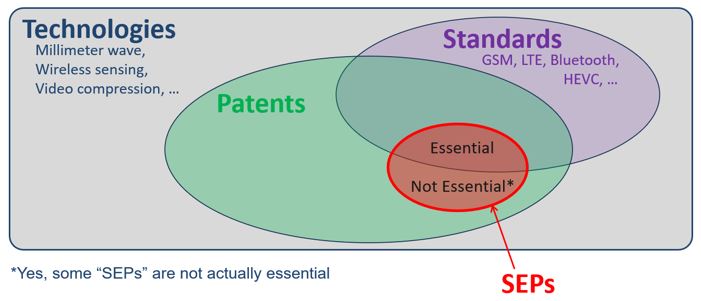
A standard essential patent (SEP) is a type of intellectual property right that covers technology that is essential to the implementation of an industry standard.
SEPs are typically granted by government patent offices and provide the holder with exclusive rights to use, manufacture, or sell products that incorporate patented technology.
Obtaining SEPs can bring several benefits for businesses including increased market share, higher profits, and protection from competitors.
In order to obtain a SEP, certain criteria must be met related to novelty, non-obviousness, and utility.
Novelty requires that the invention has not been previously disclosed in any form before it was filed as a patent application.
Non-obviousness means that someone skilled in the relevant field would not consider the invention obvious.
Utility implies that there is some practical purpose for which it can be used.
The process of obtaining a SEP begins with researching existing patents and prior art as well as analyzing industry standards. Technology-specific resources such as journals or databases may also prove useful when conducting research on potential inventions or innovations covered by a SEP.
Don’t let your invention get lost in the crowd! Get a Standard Essential Patent (SEP) and protect it from competitors. #innovation #patents Click to Tweet
How to Identify Potential Standard Essential Patents
Obtaining a SEP can provide a competitive advantage, but identifying potential SEPs requires research and analysis.
Researching the Market
The first step in identifying potential standard essential patents is researching the market and industry standards. This involves understanding which technologies are necessary for implementing industry standards, such as 5G or Wi-Fi 6, as well as any associated specifications or protocols.
By analyzing these requirements, it’s possible to identify which technologies may be covered by a SEP.
Analyzing Existing Patents and Prior Art
Once potential technologies have been identified, it’s important to analyze existing patents and prior art to determine whether any have already been granted for those technologies. It’s also important to consider how recently the patent was filed since more recent filings may indicate a higher likelihood of being declared essential if challenged in court or arbitration proceedings.
Utilizing Technology-Specific Resources
Patent databases can also be used to search for relevant patents or applications that might cover technology required by industry standards. For example, searching through USPTO records could reveal existing patent applications that relate directly to a specific technology requirement of an established standard. Some databases also offer tools specifically designed for finding SEPs based on certain criteria such as geographic regions or keyword searches within patent descriptions.
Key Takeaway: Researching markets and industry standards, analyzing existing patents, and utilizing technology-specific resources can effectively identify potential standard essential patents that will help companies maintain their competitive edge in today’s rapidly changing world of innovation.
Strategies for Protecting Standard Essential Patents
Protecting standard essential patents is a key part of any R&D team’s strategy. Securing licensing agreements, establishing royalty rates, and filing defensive publications to prevent infringement claims are all important steps in protecting intellectual property rights.
Securing Licensing Agreements
A licensing agreement allows two parties to share patented technology while still maintaining control over it. Companies can enter into these agreements voluntarily or through court orders if necessary. The terms of the agreement should be negotiated carefully as they will determine how much each party benefits from the arrangement.
Establishing Reasonable Royalty Rates
Establishing reasonable royalty rates is an important step in ensuring that both parties benefit from the license agreement without one side being taken advantage of. It is also important to consider potential future changes in industry standards when setting these rates so that they remain fair and equitable over time.
Filing Defensive Publications
Filing defensive publications prevents other companies from claiming infringement on a company’s patented technology in court by providing evidence that the patent was already known prior to these claims. This helps protect against frivolous lawsuits and provides additional protection for valuable intellectual property assets.
Managing standard essential patents requires careful consideration of industry standards, regulations, and open innovation practices as well as access to accurate data sources across teams within an organization. This can be difficult without a centralized platform like Cypris which streamlines research processes and accelerates time-to-insights while enhancing collaboration between R&D teams.
(Source)
Challenges of Managing Standard Essential Patents
Managing standard essential patents presents several challenges.
Keeping track of changes in industry standards and regulations is one such challenge. Companies must stay up to date on any new or revised standards that may affect their licensing agreements, royalty rates, or other aspects of their patent management strategy.
Companies must also ensure compliance with FRAND (Fair, Reasonable, and Non-Discriminatory) principles when negotiating licensing agreements with competitors. This ensures fair competition between companies while still protecting the intellectual property rights of each party involved.
Balancing the protection of intellectual property rights with open innovation practices is another challenge associated with managing standard essential patents. Open innovation practices allow companies to benefit from sharing their patented technologies while still protecting their investments in research and development. Companies must strike a balance between these two goals to ensure they are adequately protected without stifling innovation within the industry as a whole.
Finally, companies should consider a platform like Cypris for managing standard essential patents. This platform can help streamline research processes and accelerate time to insights by centralizing data sources. It also enhances collaboration between R&D teams through its intuitive user interface design and powerful analytics capabilities.
Managing standard essential patents? Let Cypris help you strike the perfect balance between protecting your IP and fostering open innovation! #PatentManagement Click to Tweet
How Can Cypris Help Manage Standard Essential Patents?
Managing SEPs requires specialized knowledge and expertise in order to ensure compliance with industry standards and regulations while protecting intellectual property rights.
The Cypris platform provides R&D teams with the tools they need to manage standard essential patents (SEPs). By centralizing data sources into one platform, teams can quickly access all relevant information about a particular patent. This allows them to identify potential SEPs faster and more accurately.
Streamlining research processes also helps accelerate time to insights, allowing teams to move forward with their projects faster. Teams can easily collaborate on developing new products without having to worry about compatibility issues or other technical challenges that may arise from using multiple platforms.
The Cypris platform also helps protect intellectual property rights while still promoting open innovation practices. It enables users to secure licensing agreements with competitors and establish reasonable royalty rates for those agreements in order to ensure fair compensation for any use of patented technology.
Conclusion
What is a standard essential patent and how does it work?
A standard essential patent is an important tool for protecting intellectual property. Identifying potential standard essential patents requires careful research and analysis of the technology landscape. Strategies such as licensing agreements, cross-licensing, or defensive publication can help protect these valuable assets.
Do you want to stay ahead of the competition and protect your innovations? A Standard Essential Patent (SEP) is a powerful tool that can help. With Cypris, research teams have access to all the data sources they need in one platform for rapid time-to-insights.
Get started today with our innovative solutions and take advantage of SEPs to safeguard your R&D investments!